Featuring Rahim Rashidi, Media Fellow, Gold Institute for International Strategy
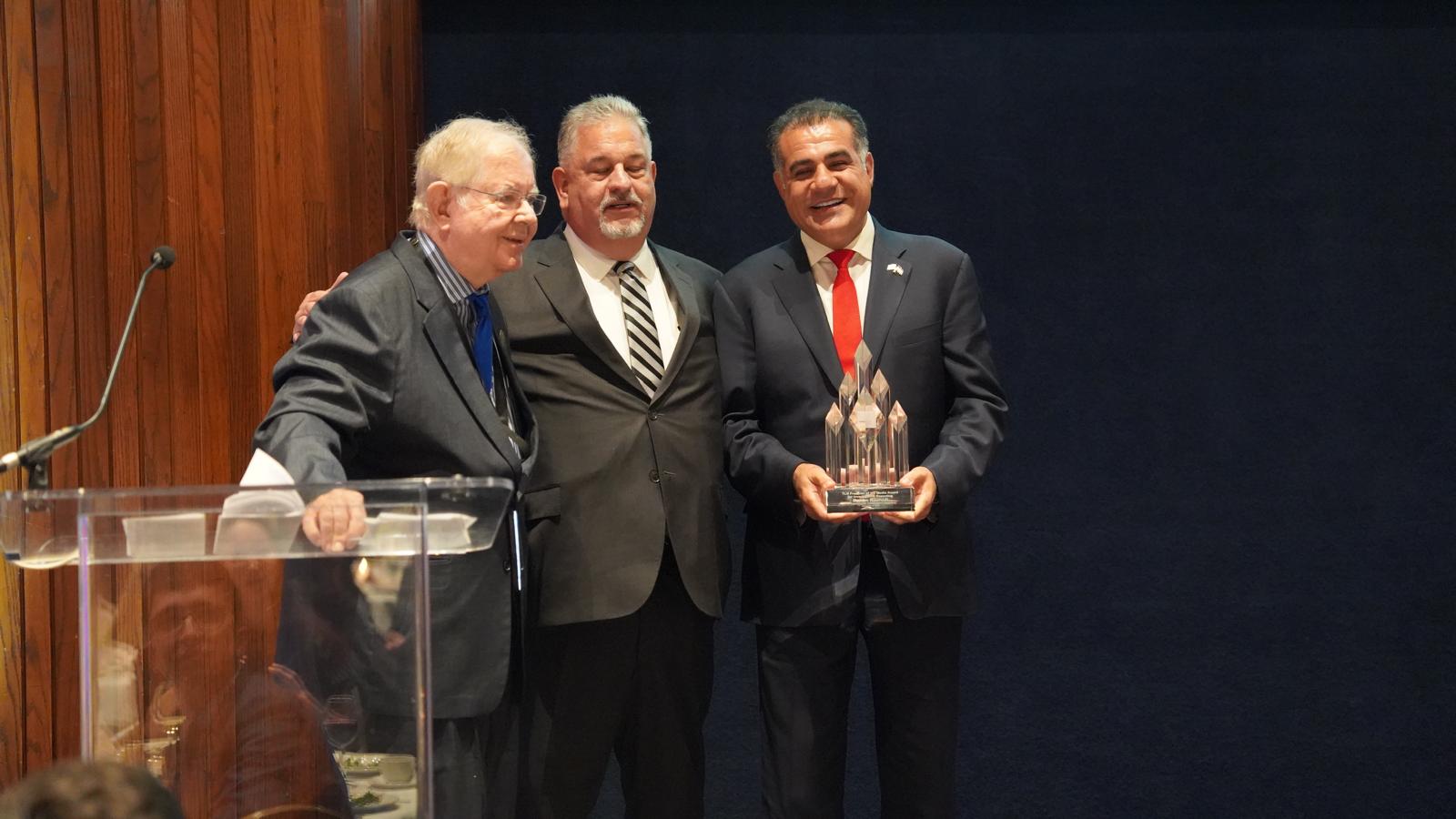
ERBIL (Kurdistan24) – Kurdistan24 and its Washington bureau chief, Rahim Rashidi, received an international reporting award on Monday at the sixth annual Transatlantic Leadership Network (TLN) Freedom of the Media Initiative conference and award ceremony at the National Press Club in Washington.
The event program lists the honor as the TLN Freedom of the Media award for Excellence in International Reporting, given to Kurdistan24 and Rashidi for the network’s coverage of the fight against ISIS.
Rahim Rashidi
Accepting the award on behalf of Kurdistan24, Rashidi said, “I dedicate this award to all journalists who stand for freedom, truth, justice, and democracy—especially those who risk their lives to ensure that others are heard.”
Peter Roff, Media Freedom Project Chairman at the Transatlantic Leadership Network (C), and John E. Craig Jr., chairman and founding member of Davidsonians for Freedom of Thought and Discourse (DFTD) (L), Kurdistan24’s Washington bureau chief, Rahim Rashidi (R). (Photo: Kurdistan24)
John E. Craig Jr., chairman and founding member of Davidsonians for Freedom of Thought and Discourse (DFTD), described the honor as the Award for Excellence in Broadcasting Current Events.
Craig said journalism “becomes a lifeline” in times of conflict, uncertainty, and rapid change, providing “facts amid rumors, context amid confusion, and understanding amid division.”
He said the award recognized Kurdistan24’s “outstanding contribution to journalism, its dedication to professional reporting, and its service to Kurdish-speaking communities throughout West Asia.”
Craig said Kurdistan24 launched its television service in Erbil on Oct. 31, 2015, and has since grown into a multilingual multimedia network.
He said it broadcasts through television, radio, digital platforms, and social media in Sorani and Kurmanji Kurdish, English, Arabic, Turkish, and Persian.
He added that the network was founded under the leadership of Noreldin Waisy and developed international bureaus within its first year.
Craig also said Kurdistan24’s reporting during the fight against ISIS earned citations and attention from major international news organizations, and that its coverage later expanded to culture, economics, education, public affairs, and sports.
He said that on its tenth anniversary, the organization reaffirmed its commitment to fact-based reporting and rigorous verification before publication.
Craig also paid tribute to the reporters, correspondents, producers, editors, researchers, translators, photographers, camera operators, technicians, and digital teams behind that work.
In his acceptance speech, Rashidi welcomed several guests. They included Beni Harmony, Assistant White House Press Secretary, and Dr. Malath Haba, whose work he recognized alongside that of Massad Boulos, Senior Adviser to President Donald Trump for Arab and Middle Eastern Affairs.
He also welcomed Treefa Aziz, the Kurdistan Regional Government (KRG) Representative to the United States.
Rahim Rashidi
Rashidi thanked President Trump for opportunities to ask questions at the White House. “As a journalist from Kurdistan, these opportunities mean a great deal to me,” he said, adding that they allow him to “bring attention to the rights, hopes, and aspirations of the people of Kurdistan.”
Rahim Rashidi
He also thanked President Masoud Barzani for respecting and supporting his work. “Mr. President, thank you for your leadership in our struggle for democracy, independence, justice, and freedom,” Rashidi said.
Ambassadors from several countries and many other diplomats attended the ceremony. Sarah B. Rogers, Under Secretary of State for Public Diplomacy, was also present and expressed her thanks to Kurdistan24.
The event program says TLN launched the Freedom of the Media Initiative out of concern that journalists around the world are being jailed, beaten, and murdered with increasing frequency.
In a foreword, Peter Roff, chairman of the initiative, and Dr. Sasha Toperich, executive vice president, wrote that TLN, through an international jury, honors US and international journalists and news organizations for sustaining the highest professional standards. The program lists three other 2026 awardees: Chris Ruddy, Katy Balls, and Doug Saunders.
Rahim Rashidi
Rashidi ended his remarks by describing the award as “both an honor and a reminder of our responsibility as journalists: to keep asking questions, to seek and report the truth, and to bring attention to people whose voices are too often ignored.”
Featuring Peter Huessy, Senior Fellow, Gold Institute for International Strategy
In brief
Peter Huessy delivers the Alexander Hamilton Institute’s annual General Josiah Bunting III Veterans Day lecture.
From the Alexander Hamilton Institute: Peter Huessy, President of Geostrategic Analysis, Senior Fellow at the National Institute for Deterrence Studies (NIDS), and Senior Fellow at the Gold Institute for International Strategy delivers the AHI’s annual General Josiah Bunting III Veterans Day lecture.
A Democratic victory in the U.S. elections was expected, but its scale is greater than predicted. The balance of power in Washington, D.C. will change as soon as the members of the 120th Senate and House of Representatives are sworn in on January 3, 2027, at 12:00 noon. Until then, President Trump can still try to salvage what he can through political appointments.
Voters chose against Trump rather than for the Democrats, who in some cases fielded very radical left-wing and Islamist candidates. Trump said: I AM on the ballot! He certainly paid the price for that. The blow was a hard one, although earlier presidents such as Clinton and Obama suffered equally heavy defeats in the midterm elections of 1994 and 2010. This regular shift in the balance of power hits harder now because the political landscape is deeply polarized. The America of the elder Bush, or even of Clinton, no longer exists.
A Radical Generation
Facing Trump, who fancies himself “King,” and his entourage stands a new guard of Democrats in which a radical generation is rising, with the “Democratic Socialists of America” (DSA) as its figurehead. Among them are some Islamists, such as the incoming senator Abdul El-Sayed of Michigan (42). It is a current among the Democrats that acts with a keen sense of power, like New York Mayor Zohran Mamdani, and it is gaining influence. The DSA is redefining the party’s ideological course.
For the next two years America and the world will have to make do with Trump, who has announced that he will “cooperate” with the new Congress. In practice this will turn into a “Tom and Jerry” game between Trump and the Democrats. No new legislation will be passed. Trump will work only with executive orders and vetoes. The Democrats will bombard members of the Trump administration with hearings and impeachment proceedings. The next election year, 2028, is drawing near: presidential candidates are weighing their chances.
Washington, D.C. is gazing at its own navel, but the outside world is not standing still: Israel, Iran, Ukraine and tense elections in Europe. In foreign policy Trump has a free hand as Commander-in-Chief. As for import tariffs, his favorite instrument, the Supreme Court hit the brakes in early 2026, ruling that they cannot be “unlimited.”
Trump wanted to use high import tariffs to force foreign companies to invest and produce in America. That takes time, however, while tariffs hit American consumers at once as a domestic tax. The Democrats were shrewd enough to make the “high cost of living” the main theme of their campaign. That feeling resonated with voters, even though the American economy is now growing at 3.4%. For the time being, Europe is rid of new American tariffs.
The Eternal Problem of Iran
Europe and Dutch politicians should not think that Trump (80) is preparing for his retirement: America is the leader of the NATO alliance. Trump will keep pressing European countries for higher defense spending, even though the economy is creaking under the planned economy of energy and climate policy. NATO member states can no longer balance their budgets under the euro criteria and are starting to file all kinds of spending under “defense infrastructure.” Mark Rutte, the Secretary General of NATO, gets to smooth things over; he has to keep “Daddy” calm for two more years.
It continues to rankle Trump that European countries did so little to help America in the fight against Iran. Trump is the seventh American president to have the “Islamic Republic of Iran” land on his plate and, like his predecessors, he ended up in the quagmire. The starting point: Iran must not get nuclear weapons. But how? Most countries supported sanctions. Obama gave Iran a “nuclear deal,” which Iran abused to make nuclear weapons anyway.
Trump followed with precision strikes on nuclear facilities, but Iran carried on undeterred, because it sees the atomic bomb as the “guarantee of the survival of the Islamic regime.” The U.S. Air Force launched “decapitation strikes” that the regime in Tehran barely survived.
The Central Mistake: The Memorandum of Understanding
Negotiations followed, and America and Iran concluded a “Memorandum of Understanding” (MoU) in which Iran promised to give up producing the atomic bomb. In Washington this led to a “near-break” between Trump, who wanted to press on, and Vice President J.D. Vance, who wanted to negotiate. Vance got his chance; Iran “negotiated” but simply carried on with its nuclear plans.
The ayatollahs pounded Israel, through Hezbollah in southern Lebanon, and the Arabian Peninsula as well. That fight came to dominate the midterms and brought about Trump’s poor result. Exactly what Iran intended. America should have carried the military action through. The MoU became an escape route for Iran, and Vance is rightly singled out in his party as the scapegoat.
“Islamo-Democrats”
For Trump, the unwillingness and even obstruction of European countries became a deep frustration. Why did the Western European countries do so little? Most of them have a growing Islamic electorate at home, mainly among the parties of the left, that is in fact against America and for Iran. The target of that hatred is Israel.
“Progressive Europe” has little compassion for the victims of the Palestinian attack of October 7, 2023 in Israel, during a music festival. After that, the Israeli army entered the Gaza Strip. In America, “Gaza” mobilized the “Islamo-Democrats” within the Democratic Party, who formed a core within the “Democratic Socialists of America” (DSA), with figures such as Ilhan Omar, prominent in the House of Representatives. In her state of Minnesota, Omar set up a whole corruption network with fake companies in health care.
The “Islamo-Democrat” phenomenon is radicalizing the Democrats, pushing through to the top of the party and paving the way for incoming senator El-Sayed, who wants to be a presidential candidate in 2028. He has already called Michigan “the capital of Arab America.”
In Western Europe, political Islamization is further advanced and is paralyzing democratic relations in many countries. With elections in France, Spain, Italy and Poland, a strong swing to the right is to be expected. The same holds for the federal states of Germany. Chancellor Merz is a powerless figure and seems “ausgemerzt.”
Poland, the Pressure Cooker
In Poland, a tug-of-war of many years is raging over the Constitutional Tribunal between Prime Minister Donald Tusk, former President of the European Council, and the right-wing President Karol Nawrocki. At stake: the appointment of judges to that Tribunal. The Polish parliament, the Sejm, elects the candidate judges; the president swears them in. Nawrocki, however, refused to swear in elected candidates.
The conflict went off the rails when Prime Minister Tusk (who has no role in the procedure) sought to have sitting judges removed, at the very moment President Nawrocki was away on a state visit to Senegal. He returned at once, broke through a police cordon at the Tribunal and demanded Tusk’s resignation. Commission President Ursula von der Leyen is taking Tusk’s side. Nowrocki is angling for Trump’s support. He has already received formal support from the presidents of the other Visegrad countries: the Czech Republic, Slovakia and Hungary.
The attack in Krakow is turning Poland into a pressure cooker. On Wednesday, November 11, Poland’s national holiday, the right-wing opposition has planned a mass rally in Warsaw.
Trump Is Not Gone Yet
Europe? The EU is choosing Tusk, who has lost his popularity in Poland. The heart of this struggle is that in the European doctrine of an “ever closer Union” the word “ever” is not an infinite concept: “nation states” want to cooperate, but evaporate in a federal European state. Proud Poland is Europe’s hardwood. Which side Trump is on is predictable.
The effect on the Netherlands is marginal. There is satisfaction that Trump lost, but he will go on governing until early 2029. At home, Congress is curbing his power. He is going to work on his legacy. And it now lies mostly abroad: Ukraine, Iran and his “beloved Europe,” with its tense elections. Trump is not gone (yet).
Written byDerk EppinkDistinguished Fellow (Honorary), Gold Institute for International Strategy
Featuring Hermann Tertsch, Distinguished Fellow (Honorary), Gold Institute for International Strategy
The future of the European Union has also made its way into the campaign for the general elections of November 29. The multiannual financial framework for 2028-2034, the management of migration and the European response to the war in Ukraine were the focus of the first election debate on Europe organized by DEMÓCRATA, held at the European Parliament in Brussels.
The meeting brought together Tono López-Istúriz, representing the Partido Popular; Sandra Gómez, of the PSOE; Hermann Tertsch, of Vox; and Estrella Galán, of Sumar. The four representatives set out their opposing positions on the main decisions the Union will have to face in the coming years, in a debate moderated by Álvaro Villarroel, Demócrata’s correspondent in Brussels.
Their remarks laid bare fundamental differences over the model of European integration, the distribution of EU resources, the control of borders and the degree of autonomy the EU should develop in security and defense. These three areas will also shape the position Spain takes in EU negotiations during the next legislature.
The European budget pits traditional priorities against new investments
The next multiannual financial framework (MFF) for 2028-2034 was one of the main points of friction. The European Commission’s proposal has opened a negotiation over how to divide resources between the Union’s traditional policies, especially the Common Agricultural Policy (CAP) and the cohesion funds, and the new EU priorities, such as competitiveness, defense and strategic autonomy.
López-Istúriz argued that agriculture and cohesion must keep a central role in the European budget. The Partido Popular representative stressed the importance of direct CAP payments and of structural funds which, in his view, should continue to be managed with the participation of the autonomous communities. At the same time, he acknowledged the need to strengthen other budget lines, among them those for defense, education, housing and opportunities for young people.
REYES ARANDA
The PP MEP placed competitiveness among the priorities the Union must address, although he warned of the difficulty of fitting in the new budgetary needs without compromising the European social model. The discussion, therefore, is not only about how much money the EU should spend, but also about how to distribute it among policies that compete for limited resources.
For the PSOE, Sandra Gómez questioned the Commission’s initial proposal because, in her view, it involves cuts to two of the main EU policies: the CAP and cohesion. The Socialist representative argued that the budget must keep its capacity to reduce territorial inequalities and respond to crises, and she pointed to the experience of the DANA storm to illustrate the importance of having mechanisms of solidarity and reconstruction.
Gómez also called for the Union to have greater financing capacity of its own. In this regard, she defended the creation of new own resources that would allow the EU budget to grow without shifting the whole burden onto national contributions. Among the formulas she put forward are levies linked to the large digital platforms, online betting and transactions in crypto-assets.
Estrella Galán agreed on the need to review European revenues, but she put the emphasis on the impact that a reduction in the funds for social and territorial policies would have. The Sumar representative warned of the risk of concentrating different budget lines in a single fund which, in her view, could weaken the capacity of states and regions to meet their specific needs.
🇪🇺 El primer debate del 29N en clave europea.@SanGomezLopez, sobre el marco financiero plurianual 2028-2034, el cual uno de los principales bloques del debate.
Galán rejected the idea that strengthening competitiveness should come at the expense of labor rights, environmental protection or social guarantees. She also defended a review of taxation so that large companies contribute in a more balanced way to the financing of public policies.
Hermann Tertsch
Hermann Tertsch’s position marked a deeper distance from the Union’s budgetary and regulatory model. The Vox representative maintained that Europe suffers from an excess of regulation that harms its ability to compete with other economic powers. Consequently, he called for a reduction of regulatory burdens and a review of spending priorities before any new taxes are proposed or citizens’ contributions are increased.
The debate over own resources again showed the differences between the blocs. While Gómez defended new sources of revenue linked to digital and financial economic activities, Tertsch rejected raising the tax burden and called for a review of where the funds go first. López-Istúriz, for his part, recalled the role of national governments in negotiating the budget within the Council, without specifying an alternative financing formula.
Migration: from the European pact to the externalization of borders
Migration policy was the second major axis of confrontation. The application of the Pact on Migration and Asylum, the control of external borders, returns and cooperation with third countries showed the differences between those who give priority to stronger control mechanisms and those who call for wider legal routes of entry and guarantees of protection.
Galán questioned the approach with which the Union is developing its migration policy and said that the European pact was born “mortally wounded.” The Sumar representative criticized the EU institutions for placing expulsions and border control at the center of their strategy while, in her view, legal and safe routes into European territory have not been developed enough.
Along those lines, she defended the expansion of visas, resettlement mechanisms and other forms of regular migration. She also questioned agreements with third countries when there are not sufficient guarantees to protect the rights of migrants, with particular attention to the outsourcing of European responsibilities to countries such as Morocco.
REYES ARANDA
Hermann Tertsch
Tertsch defended a firmer policy on border control. The Vox representative called for a review of how the asylum system works and linked the management of migration flows to the preservation of social cohesion. He also proposed the “remigration” of people who are in an irregular situation, a position he placed at the center of his remarks.
Sandra Gómez rejected the idea that migration should be addressed only from an economic or utilitarian perspective. The Socialist representative defended labor integration and regularization as instruments to respond to the needs of the labor market and guarantee the rights of migrants. She also questioned agreements with third countries when, in her view, they do not include sufficient safeguards.
The PSOE’s position sought to combine the management of migration flows with a defense of fundamental rights and of integration mechanisms. Gómez insisted that migration policy cannot be reduced to a discussion about expulsions, and she brought into the debate the situation of especially vulnerable groups, as well as the difficulties posed by cooperation with certain regimes.
López-Istúriz defended the need to distinguish between those who need international protection and those who do not meet the requirements to remain on European territory. The Partido Popular representative called for more effective border management and greater use of the capabilities of EU agencies such as Frontex and Europol.
On migratory pressure on Spain, he questioned the Government’s actions and maintained that the available European instruments have not been used enough. He also recalled that the intervention of these agencies depends on the requests and cooperation of the member states, a circumstance that conditions their operational deployment.
The four sets of remarks thus reflected a discussion that goes beyond the technical application of the migration pact. The underlying question lies in the balance between border control, external cooperation, international protection and legal routes of access, areas in which the parties hold clearly different proposals.
Ukraine and defense: support for Kyiv and differences over European autonomy
The war in Ukraine completed the three major blocks of the debate. The continuity of European support for Kyiv, the strengthening of military capabilities and the transatlantic relationship set against each other different visions of the role the Union should play in the new security landscape.
López-Istúriz argued that Europe must maintain its military and financial backing for Ukraine until a peace is reached that guarantees its security. The PP representative placed support for Kyiv within the defense of sovereignty and the international order, although he also warned of the risks associated with the circulation of weapons and their possible diversion to criminal networks. As for an eventual accession of Ukraine to the European Union, he argued that the process must follow the criteria set for any candidate country. Political support for Kyiv, therefore, must not translate into a change in the conditions for enlargement.
Gómez defended moving toward a European defense policy with greater instruments of common financing and economies of scale. The Socialist representative considered it necessary to strengthen EU capabilities, but she questioned whether the increase in military spending should become an automatic obligation in response to the demands of the United States. The PSOE’s remarks linked European security to the need to reduce strategic dependencies and maintain backing for Ukraine. Gómez argued that aid to Kyiv helps protect the civilian population, and she criticized Donald Trump’s positions on Russia and the energy relationship with Moscow.
🇪🇺 El primer debate del 29N en clave europea.
Antonio López- Isturiz @TonoEPP (PP), sobre la seguridad europea y la guerra de Ucrania. Un debate en el que España tendrá un papel relevante por su posición geográfica y los desafíos que afronta en sus fronteras exteriores.
Tertsch also defended maintaining support for Ukraine, although he placed the transatlantic relationship at the center of his approach. The Vox representative maintained that European security continues to depend in large measure on the alliance with the United States, and he questioned whether the Union can build a sufficient deterrent capability apart from Washington. In that context, he criticized Spanish energy policy and imports of Russian gas, which he used to question the Government’s coherence in its position toward Moscow. His remarks defended greater European military strength, but without detaching it from the American security umbrella.
Galán, for her part, questioned whether the strengthening of defense should be financed through reductions in other EU policies. The Sumar representative warned that security cannot become an argument for weakening social funds, cohesion or environmental policies. The MEP defended a diplomatic solution that would achieve a “just and lasting peace” and called for Russia to bear the costs of rebuilding Ukraine. Her position stressed the need to combine the response to Russian aggression with a political strategy that prevents the increase in military spending from displacing other European priorities.
The next Government faces a decisive European agenda
In the final stretch, the four participants summarized the priorities which, in their view, Spain should defend in the European Union during the next legislature. Their remarks again reflected the differences over the model of integration, the scope of EU powers and the relationship between national policies and shared decisions.
Galán called for a Europe centered on social rights, territorial cohesion and environmental protection. Tertsch defended a more limited Union, based on the principle of subsidiarity, the priority of the states and a reduction of EU regulation. Gómez upheld the social democratic model and the defense of freedoms and public services. López-Istúriz insisted on the need for Spain to assume its responsibilities in the European project and contribute to strengthening the continent’s security, while maintaining cooperation with the United States.
The debate showed that the elections of November 29 will determine not only the composition of the next Government, but also the direction Spain will defend in some of the Union’s most important negotiations. The budget for 2028-2034, the application of the Pact on Migration and Asylum and the response to the war in Ukraine will oblige the new Executive to set positions before its EU partners.
The differences set out in Brussels point, in short, to a discussion that will continue in the European institutions over the coming years. The financing of common priorities, the balance between control and protection in migration, and the Union’s degree of strategic autonomy will be some of the decisions that measure the capacity of the Spanish parties to carry their national proposals onto the EU agenda.
Hermann Tertsch is a Distinguished Fellow (Honorary) at the Gold Institute for International Strategy, a Washington, D.C. foreign policy and defense think tank.