

The complete record spanning from November 2024 through November 2026
Author’s Note: I did not publish an October update for voter registration analysis of what I consider the seven key states for this type of analysis. That is because there is too much noise and too many pieces flying for it to be of any analytical value. With the exception of New Hampshire, Democrats made significant gains in these states in October and through Election Day (if they have same-day voter registration available; these gains are mostly contained to urban areas and are potentially indicative of major financial efforts or voter registration drives, and not necessarily a coalition realignment.
The best way to view voter registration shifts is with a long-term view in mind. You can find my last update below; compare each state to the book closing totals presented in this article to get an idea of how much ground Democrats made up in the past two months.
FLORIDA
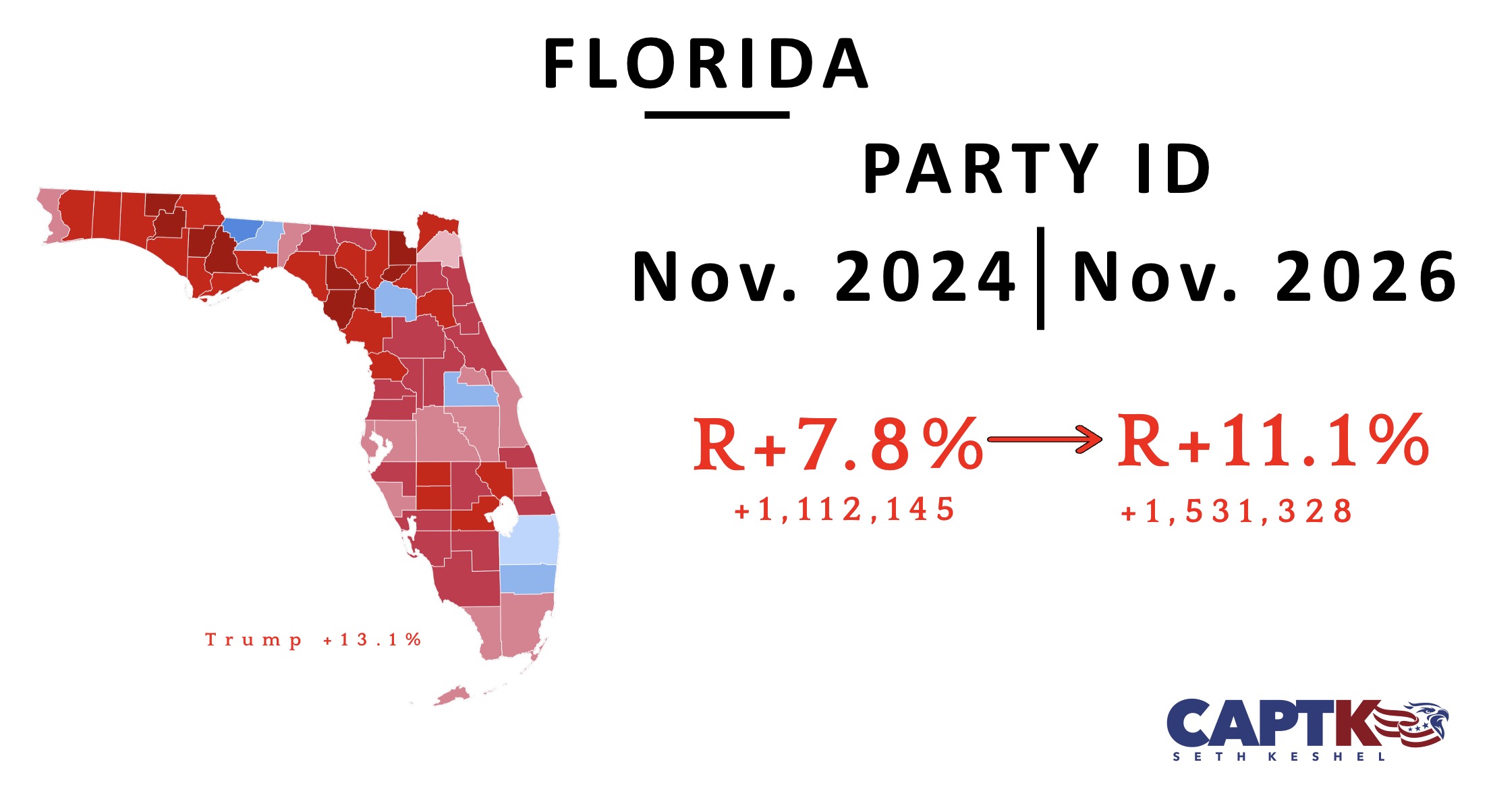
Since 2024 Presidential: R+3.3%, R+419,183
Commentary: Everything a GOP superstate should look like, and capable of withstanding a midterm drubbing for the ages. Even here, Democrats made up roughly 20,000 registrations in October. Given the results and the likelihood of another blowout presidential win in 2028 for the GOP, expect Democrats to divert resources to Georgia, North Carolina, and Texas.
IOWA
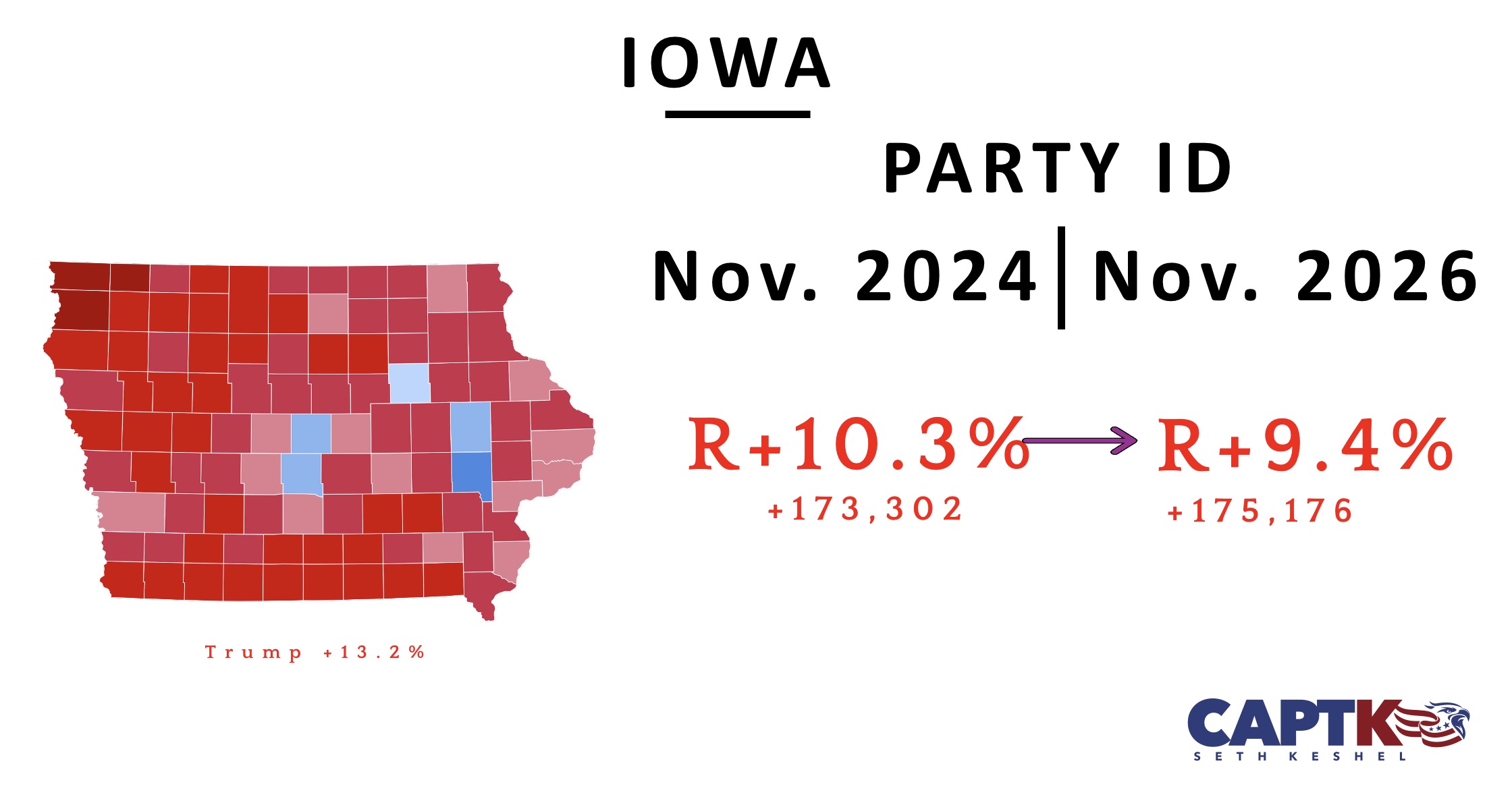
Since 2024 Presidential: D+0.9%, R+1,874
Commentary: Democrats have made up almost a point despite losing ground in raw registrations – this is owed to the addition of a large quantity of non-partisans inflating the denominator of total registrations. Iowa voter registration can shift a lot, and shift fast. As Iowa Caucuses approach in a year, many independents will declare a party and shift these numbers further. A perceived moderate, such as Jon Ossoff, will likely close this in favor of Democrats, whereas a fringe grassroots Democrat will likely send it back to the right.
Iowa appears to be a solid GOP hold in 2028; its trajectory is most worth following to understand the dynamics in Wisconsin and Minnesota, which don’t have party registration.
PENNSYLVANIA
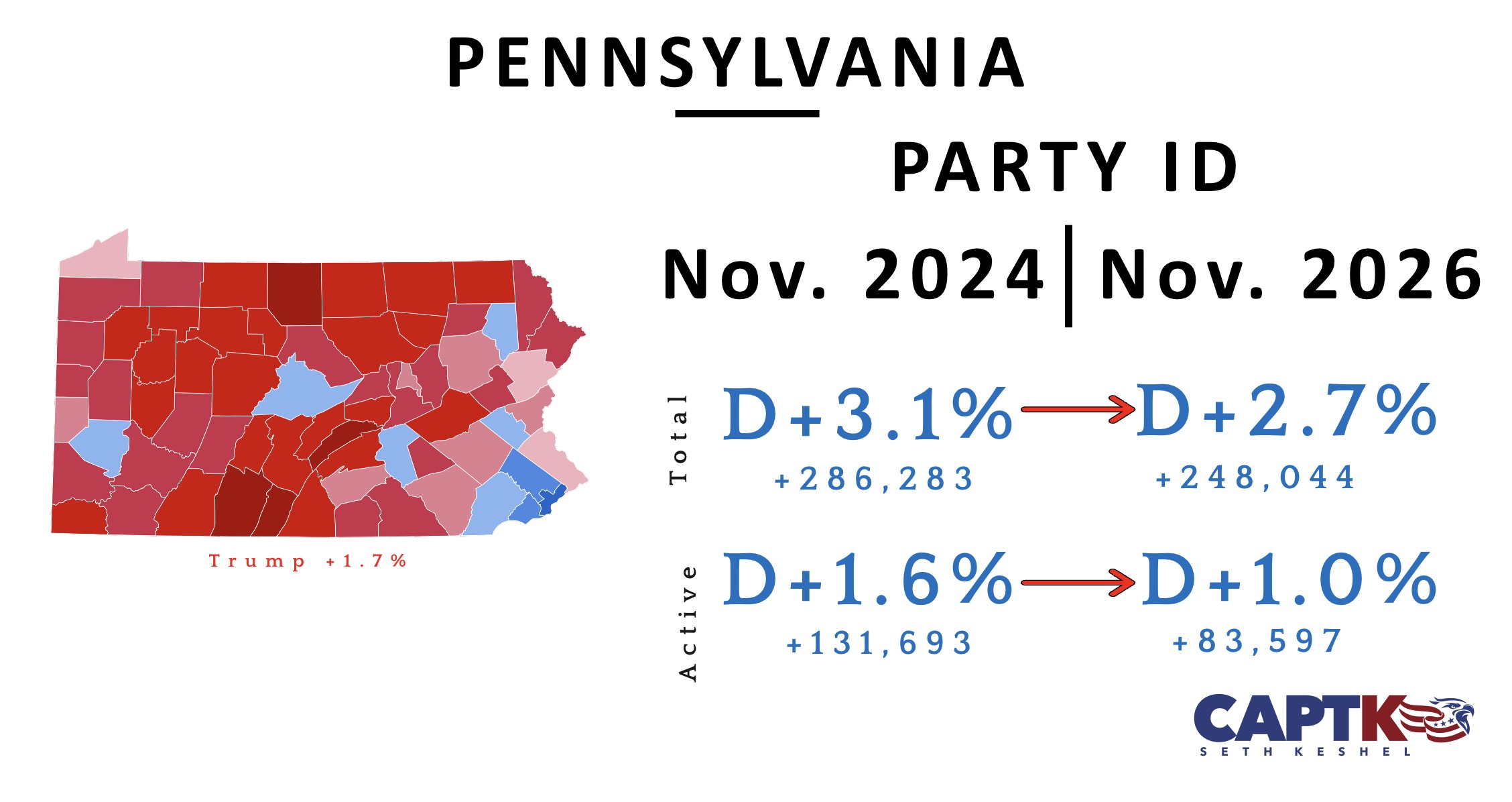
Since 2024 Presidential: R+0.4% Total/R+0.6% Active; R+38,239 Total/R+48,096 Active
Commentary: While every one of us would have been fine with where things stand right now compared to two years ago (Trump win/Senate win), Republicans have been absolutely thrashed this year. Democrats have clawed back a lot of the GOP’s gains that were present at this point in 2025. Active registrations alone have moved Democrat by more than 50,000 in the past two months, largely due to urban areas going nuts on registering voters.
Getting back to kitchen table issues should help Republicans shift this momentum in their favor in what has emerged as the king of battleground states – and one that stands as a must-win for Republicans in 2028.
NORTH CAROLINA
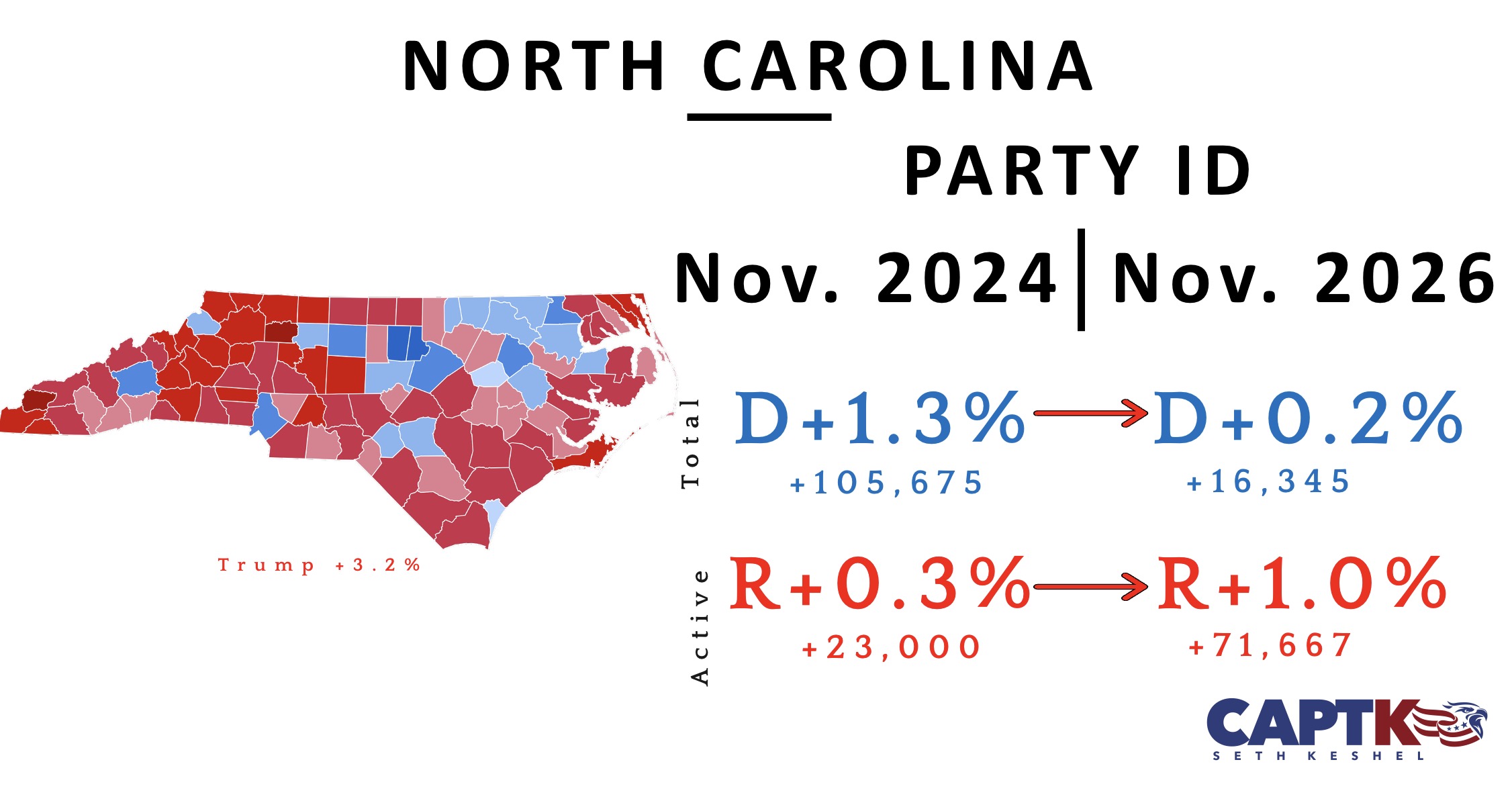
Since 2024 Presidential: R+1.1% Total, R+0.7% Active; R+89,340 Total, R+48,667 Active
Commentary: A carbon copy of Pennsylvania, with solid GOP gains on paper but an absolute bloodbath since mid-summer. Democrats have made up over 27,000 net registrations since the GOP’s high point, and erased the first-ever total GOP registration advantage in the history of the state.
A stagnation of these urban-heavy Democrat gains leaves the GOP nominee in good shape for 2028, but without a long-term strategy to compete in urban areas, North Carolina will go the way of Georgia by the mid-2030s.
NEW HAMPSHIRE
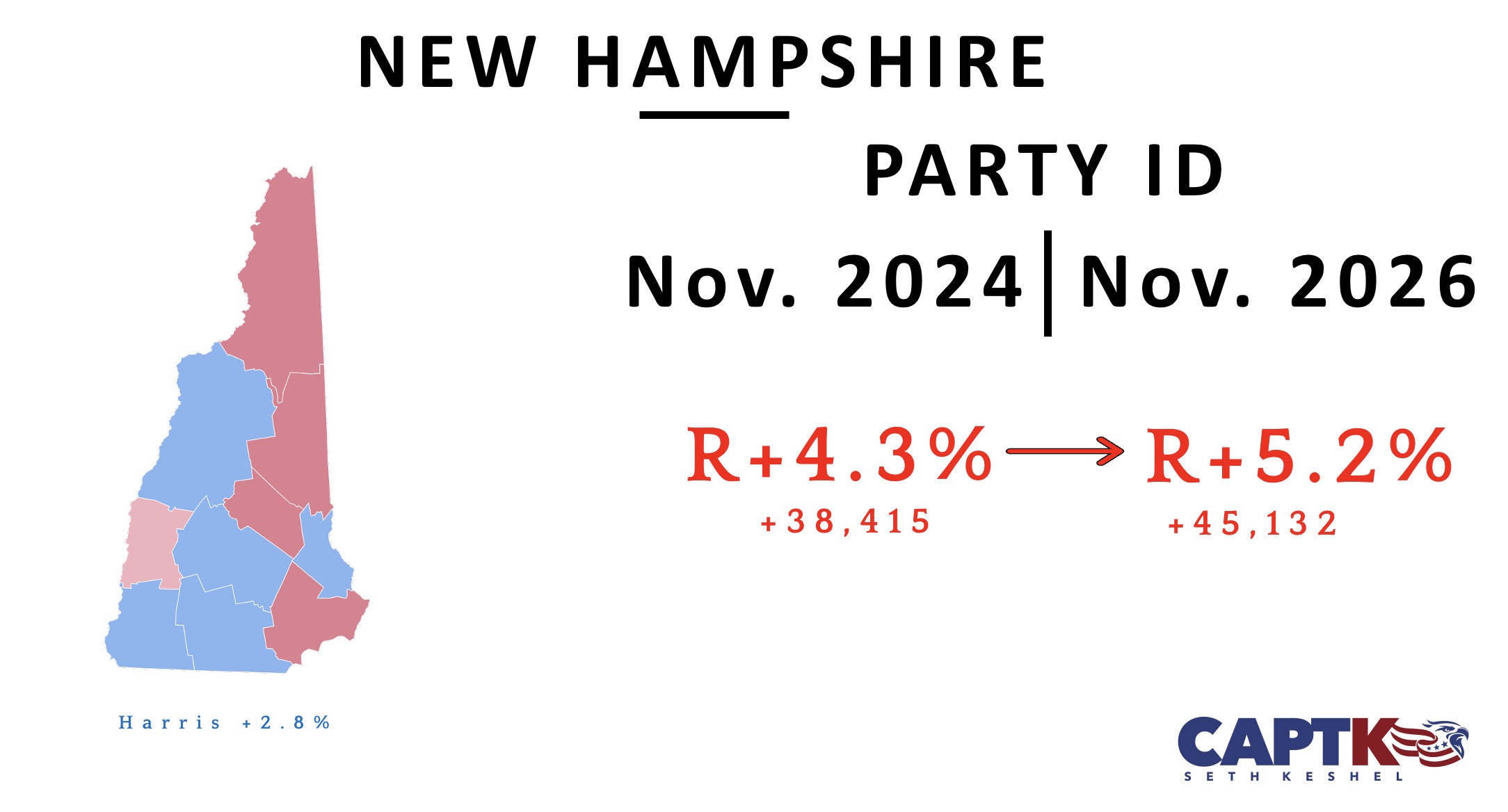
Since 2024 Presidential: R+0.9%, R+6,717
Commentary: The lone short-term bright spot here, with the GOP netting registrations since the state last updated after its primary. Still, New Hampshire’s presidential electorate leans far to the left of its registration index; the state hasn’t voted right of registration since George H.W. Bush won the state in 1988.
This state appears to be fool’s gold, although almost certainly a close state by percentage in the next presidential election. Like Iowa, there will be serious registration movement here come primary time that will give us a better idea as to how it is shaping up.
ARIZONA
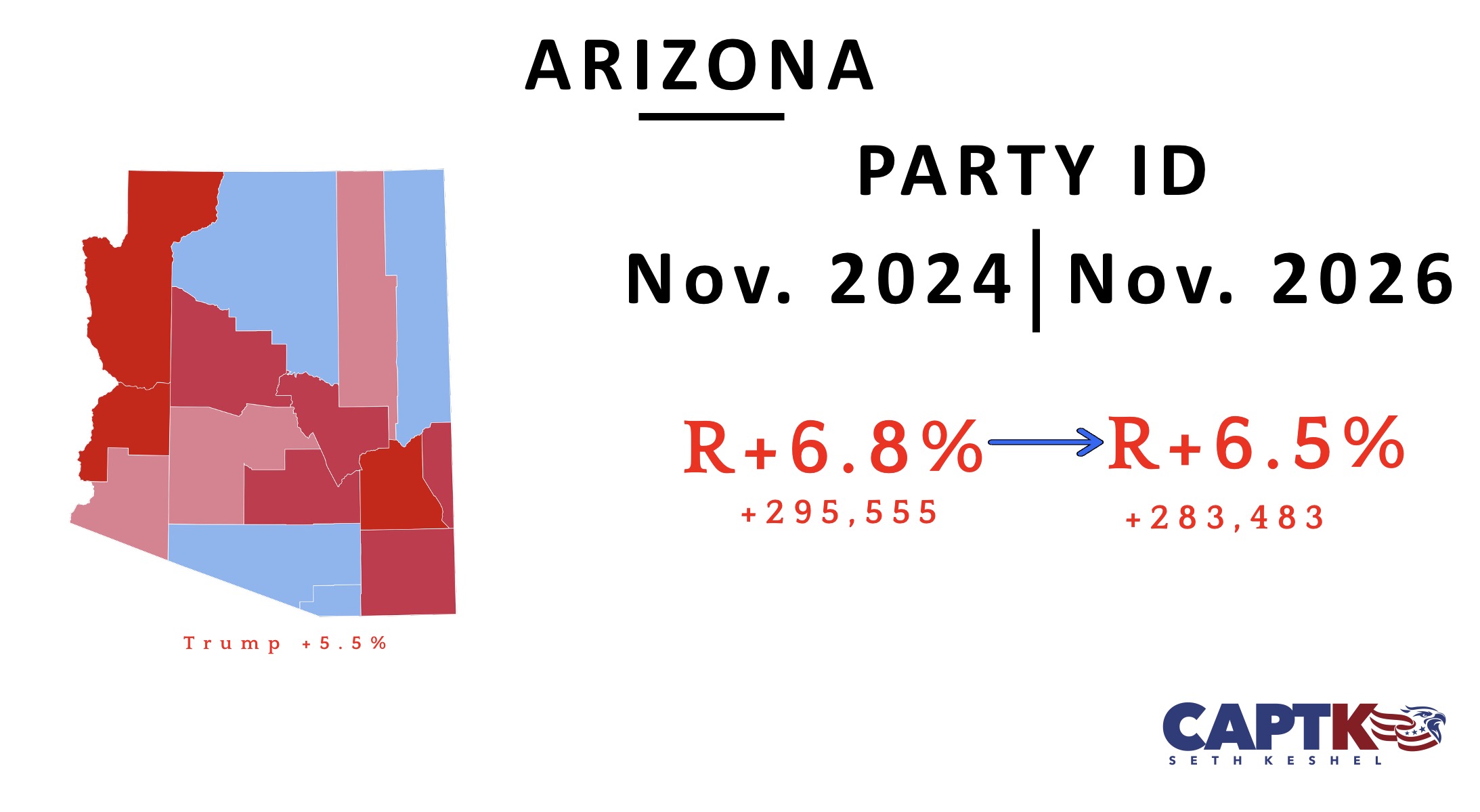
Since 2024 Presidential: D+0.3%, D+12,072
Commentary: Democrats have now shoved registrations left of where they were at the 2024 presidential election, but it took them all the way up to the final registration push to do so. This margin can be entirely attributed to Maricopa County, and mostly on account of lost GOP registrations.
Still, not much movement here overall, and the state is still well to the right of where it was in 2020 and 2022. The fatal flaw in Arizona, besides its miserable elections system, is a large cohort of Maricopa and Pima Republicans that despise the Republican grassroots more than they fear Democrats. They will finally get to understand the impact of this voting behavior with a New Democrat legislature set to take over in January.
As of right now, I would expect the GOP nominee to carry Arizona in 2028 – especially if Democrats nominate a radical.
NEVADA
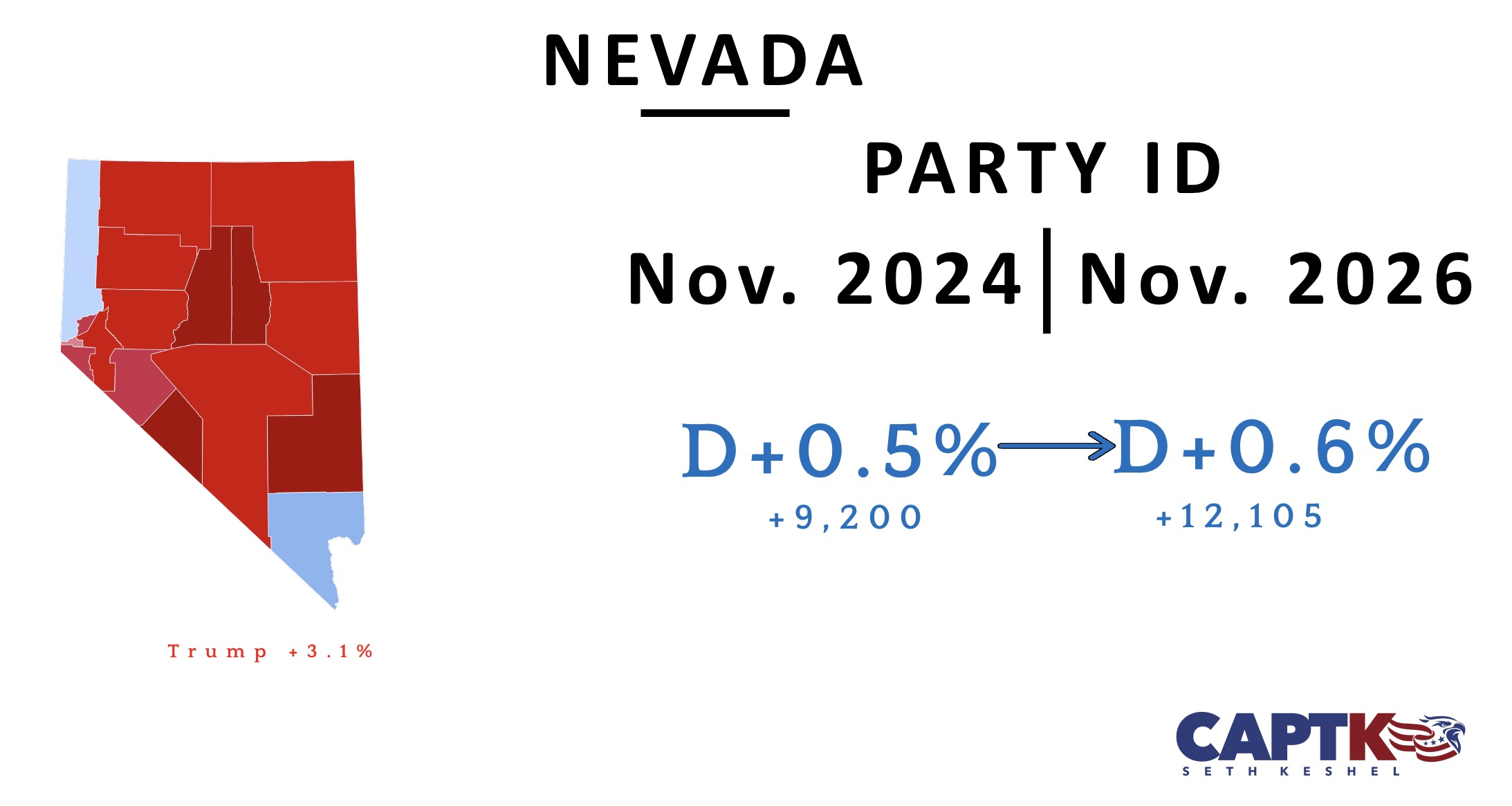
Since 2024 Presidential: D+0.1%, D+2,905
Commentary: A carbon copy of Arizona, just one that sits left of it. The two states shift together in presidential elections, and just like we see with Maricopa County in Arizona, Clark County is the dominant political force of Nevada. It alone is responsible for moving the registrations left of the November 2024 figures in the month of October alone.
The GOP nominee can hold Nevada if figures stay close to where they are today, but likely by under two points. Continued leftward drift in Clark County will likely push the state off the table for 2028.
WHY ARE REPUBLICANS LOSING GROUND?
These updates, up until the past six months, have been a bright spot for me. Voter registration is the biggest signal for the movement of battleground states in presidential elections, and the movement in all of these for most of the Trump 47 administration’s time in office has given reason for great optimism now blunted by deep midterm losses.
Shortly after Election Day, one of my subscribers sent me an email with a very telling graphic:
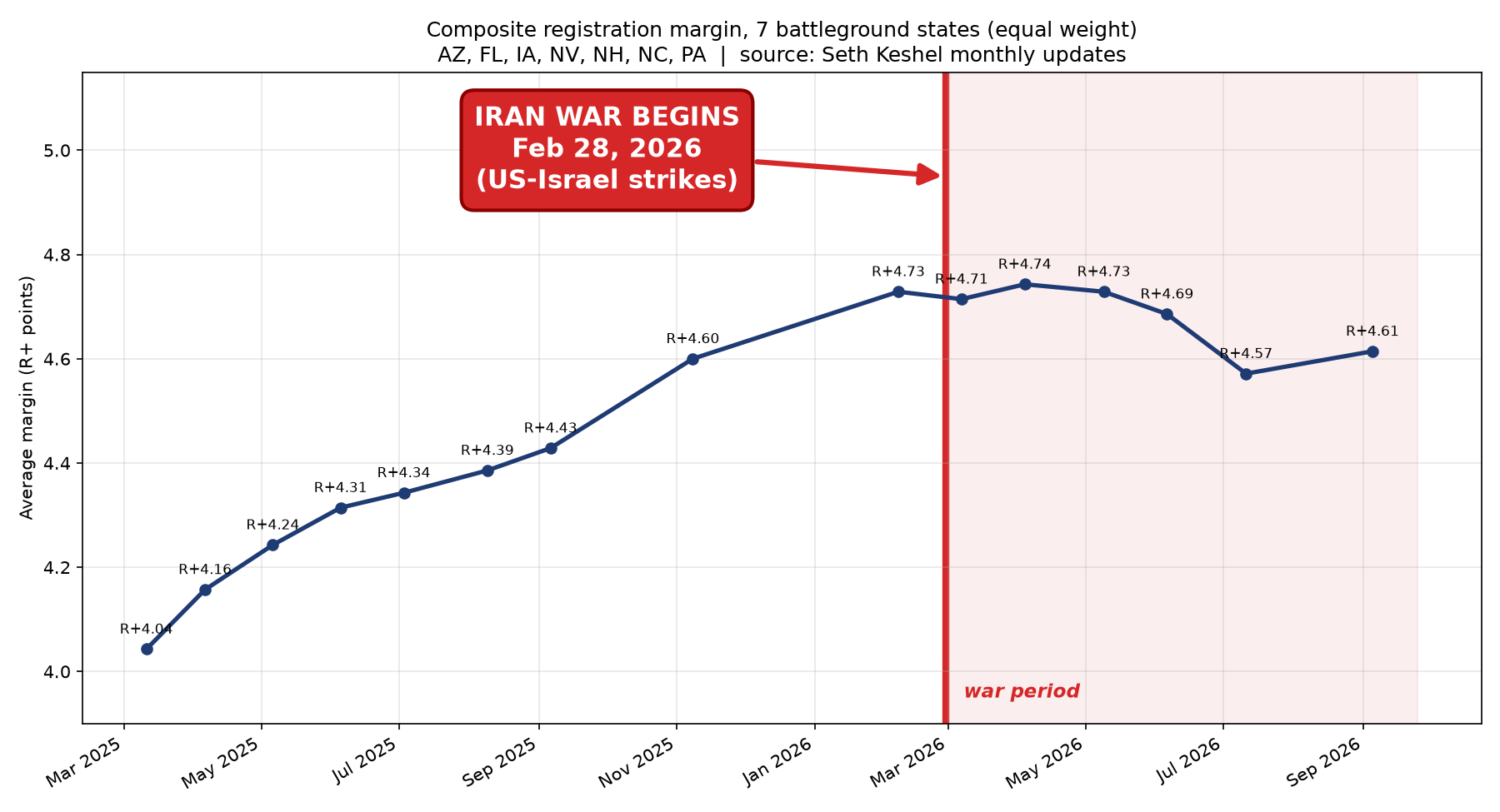
Here is what he had to say about his graphic:
Seth, I love your work and been following you for a few years now. Since Trump seems to think we lost because of immigration policy at some level everyone needs to know it was probably almost all the Iran war. See the chart below based on your data….
These are your monthly battleground registration updates and put the numbers into one composite: an equal-weight average of the Party ID registration margin across AZ, FL, IA, NV, NH, NC, and PA.
The average went from R+4.04 in March 2025 to a peak of R+4.74 in April 2026, and sits at R+4.61 as of your September 2026 update. I marked the start of the Iran war (US-Israel strikes on Feb 28, 2026) for context; the June 13 and 21, 2025 strikes happened earlier in the series. October 2025 is left out because Nevada’s figure wasn’t available that month, and I didn’t have your December 2025 or January 2026 updates when I built this.
The values were read from your chart images, so they carry the rounding shown there.
Thanks for the work you put into these.
The Trump coalition was not a traditional Republican coalition. Its appeal was based on remembering the forgotten man and woman, and prioritizing their domestic needs more than the perceived needs of the world. I have remained grounded in my analysis of the Iranian conflict and understand the bigger picture the president is seeking to address. Still, it is clear the public is weary of sustained military conflict and the signs are evident in this data that I am deeply familiar with.
I sense strongly that the success of Trump’s coalition in the short-term will have direct correlation to the speed at which the Iranian conflict is concluded. This conflict persisting beyond early 2027 will greatly enhance the Democrats’ likelihood of winning the presidency in 2028, and we will be able to see it moving that way in the voter registration updates.
Seth Keshel, MBA is a Senior Fellow at the Gold Institute for International Strategy and a retired Army Captain. He publishes Captain K’s Corner on Substack.

