Adam Lovinger, Vice President of Strategic Affairs at the Gold Institute for International Security, examines the parallel threats to democratic governance in the United States and Romania. Drawing on Romania’s cancelled December election and the broader challenge of entrenched bureaucratic subversion, Adam argues that transatlantic allies must invest equally in defending democratic institutions. Watch his full remarks below
Trump Forges His New Alliance With Ibero-America
(This article was written by Hermann Tertsch and appeared in El Debate. Trump forja su nueva alianza con Iberoamérica)
While Europe threatens to fall apart, in the Americas a new organization for the defense of freedom and common security is being created.
A buoyant President Donald Trump, confident he can soon end the war in Iran with the disappearance of the planet’s largest terrorist regime, yesterday gathered twelve presidents of Ibero-America in Miami to found a new organization, the Shield of the Americas, whose objective is the all-out fight against the drug cartels and the curbing of Chinese penetration throughout the American continent.
The meeting at the Doral Golf Club, owned by the president, is unprecedented because it stems from the convergence of interests, ideology and political will of Trump and his team — led by Marco Rubio — with the increasingly numerous conservative and anti-socialist leaders of Ibero-America. And its ambitious aim is to carry out the modernizing revolution of the continent that makes possible the advance of conservative forces toward the defeat of the alliance of left-wing forces with organized crime, and very especially with the large organizations of drug production and trafficking.
The new organization has a political, moral and intellectual link with Europe through the main channel of dialogue and political collaboration between the right-wing forces of all the Americas and the European right of patriots, conservatives and sovereigntists, which is constantly growing in the European nations. This organization for the political cooperation of the two pillars of the American West fits harmoniously into the project of the three pillars of the West that is the object of the policy of the Madrid Forum, which develops the Madrid Charter promoted by the Disenso foundation under the direction of the president of Vox, Santiago Abascal. Many of those attending are signatories of the Madrid Charter, collaborators of Patriots for Europe, allies and even personal friends of Abascal.
For the first time, a front is being forged in which the U.S. and numerous solid democratic allies of Ibero-America set out to put an end to the tragic and catastrophic prominence in Ibero-America of a violent, subversive and destructive left that made rivers of blood run throughout the subcontinent since the Cuban revolution. And Cuba — its mafia-like, communist and murderous regime, the infectious focus of violent communist subversion for nearly 70 years — will be the next to fall in the advance of this general redesign in which the dictatorships fed by crime are defeated and abolished.
America is beginning to unite in the reconquest of freedom, security and justice, with a recovery of the traditional values and virtues of the West and an unambiguous victory over the communist, socialist and drug-trafficking forces. The Shield of America aims to be an organization in defense of the market economy and the rule of law, and of self-defense against attempts at penetration by totalitarian and criminal powers.
Many countries have yet to join, and three of the largest — Mexico, Brazil and Colombia — remain in the hands of a left allied with the drug cartels. But the continent’s greatest focus of crime, the dictatorship of Nicolás Maduro, is being dismantled — not as quickly as many of us wish, but steadily.
Meanwhile, the European Union shows ever more signs of dissolution, with a power in Brussels — embodied by Ursula von der Leyen’s European Commission — that is failed and adrift, and member states that openly reconsider their own interests in order to appease the growing rebellion of their increasingly poor, frustrated and dissatisfied citizens.
While in Europe the rulers have more differences every day in how to confront times of crisis amid the formation of a new world order — and cannot even agree on the degree of hostility toward Donald Trump — in America there are many who see the immense opportunity of a reconstruction of the West.
While the narco-socialist left throughout the West, Islamism allied with socialism, and some pathetic intellectuals weep over what they call “Anglo-Zionist imperialism,” American rulers reach agreement to advance security, freedom and prosperity.
At the Miami summit, the U.S. and twelve presidents take part. Among the leaders present are Javier Milei (Argentina), Rodrigo Paz Pereira (Bolivia), José Antonio Kast (Chile, to be sworn in this Wednesday), Rodrigo Chaves (Costa Rica), Luis Abinader (Dominican Republic), Daniel Noboa (Ecuador), Santiago Peña (Paraguay), Nayib Bukele (El Salvador), Irfaan Ali (Guyana), Nasry “Tito” Asfura (Honduras), José Raúl Mulino (Panama) and Kamla Persad-Bissessar (Trinidad and Tobago).
Hermann Tertsch is a Distinguished Fellow at the Gold Institute for International Strategy, a Washington D.C.-based foreign policy and defense think tank.
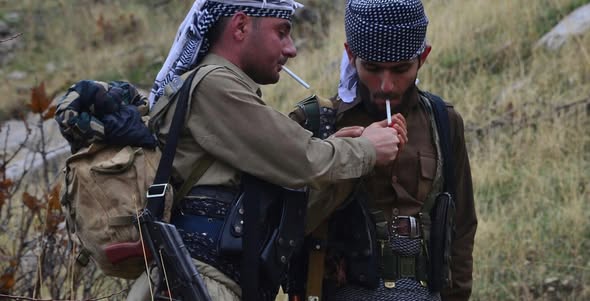
IRAN – BATTLE UPDATE – THE “KURDISH OFFENSIVE”
SITREP IRAN
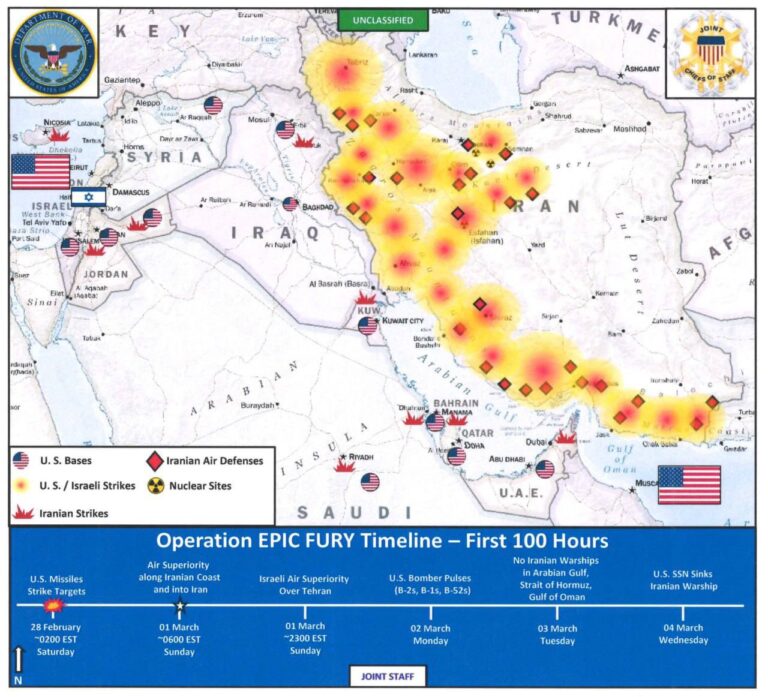
The ongoing military conflict in Iran, which began on February 28, 2026, involves a coalition led by the United States and Israel conducting airstrikes and operations aimed at degrading Iran’s military capabilities, including its ballistic missile program, nuclear sites, and leadership structures. The strikes have resulted in the death of Iran’s Supreme Leader Ayatollah Ali Khamenei and other high-ranking officials, escalating into a broader regional war.
Iran has retaliated with drone and missile attacks on U.S. bases, embassies, and allied infrastructure across the Middle East, including in Saudi Arabia, Qatar, the UAE, Oman, and Bahrain.
The conflict has drawn in proxies and allies, with no clear end in sight, though U.S. President Donald Trump has suggested it could last around four weeks.
Primary Opposing Sides
Side 1: Iran and Its Allies (Axis of Resistance)
- Iran (Islamic Republic): The central target, led by remaining IRGC (Islamic Revolutionary Guard Corps) elements and military leadership. Iran has launched widespread retaliatory strikes, closed the Strait of Hormuz to disrupt global oil flows, and deployed advanced drones, including first-person view (FPV) models for the first time.
Internal pro-regime forces are clashing with anti-regime protesters, adding a domestic dimension that could evolve into civil unrest.
- Hezbollah (Lebanon): Actively involved, with Israeli strikes targeting their positions in Beirut and southern Lebanon. Hezbollah has entered the conflict, firing on Israeli forces and contributing to the regional escalation.
- Iranian-Backed Militias: Groups like Shiite militias from Iraq have deployed fighters into Iran to suppress protests and support the regime.
These include broader proxy networks across the Middle East, such as those in Yemen (Houthis, though less prominently mentioned in recent reports) and Syria, united against U.S. and Israeli presence.
- Broader Support: Russia and China have reportedly sided with Iran diplomatically, opposing Western intervention and potentially providing indirect support.
Sunni militant groups, like those historically opposed to Israel, have shown some alignment with Shia proxies in this context.
This side focuses on asymmetric warfare, including missile barrages and proxy attacks, aiming to overwhelm defenses and disrupt energy supplies.
What the Arms Control Community Gets Wrong About Arms Control – RealClearDefense
(This article was written By Peter Huessy and Stephen Blank and appeared in the RealClearDefense. What the Arms Control Community Gets Wrong About Arms Control – RealClearDefense)
In an ideal world a binding arms control treaty governing numbers and types of deployed and stored nuclear weapons, proclaiming, and enforcing strictly agreed to mutual verification procedures would be a wonderful thing. But we do not live in that world nor is it likely to appear anytime soon. The New START Treaty expired on February 5 and there is not even a negotiation in sight let alone a viable treaty. Predictably the arms control community blames the Administration for this. Angela Kane, the former UN High Representative for Disarmament Affairs and Under-Secretary-General for Management in the United Nations, wrote that, civil society urged the Trump administration to accept Vladimir Putin’s proposal to continue observing the numerical limits of that treaty after expiration.
That may be true in Europe and among the arms control lobby here. But they assuredly do not speak for whatever she means by the term civil society here and in Europe. Indeed, treaty extension is a bad idea, and the Administration rightly refused Putin’s offer. Washington got it right. Putin’s offer was a typical Russian ruse. Notably it said nothing about verification, and it came from a government that has systematically broken every arms control treaty that it has ever signed. It is an axion of successful arms control that unless both sides can verify a treaty’s observance that treaty is worthless.
In the meantime Russia has used chemical weapons in Ukraine, provided them to the Assad government, conducted biological warfare against opponents at home and abroad – most recently – Alexei Navalny – and probably against U.S. diplomats abroad, the notorious Havana Syndrome being a case in point. Russia violated the Budapest accords on Ukrainian nuclear disarmament by seizing Crimea in 2014 and then invading again in 2022, actions that violated eight solemn international treaties.
As Dr. Blank wrote in 2023, Russia’s post-2014 aggression does not merely target Ukraine. Instead, it deliberately assaults the very idea of international order, particularly that of a European security order. Indeed, Putin, Secretary of the Security Council of Russia Nikolai Patrushev and Foreign Minister Sergey Lavrov proclaim the collective West is at war with Russia. Russian nationalist political scientist Sergei Karaganov openly says that “We are at war with the West. The European security order is illegitimate.”
As part of its assault on international order Russia violated the CTBT (Comprehensive Test Ban Treaty) by conducting nuclear weapons tests in 2019. At the same time, Russia’s Oreshnik missile, a prototype of which appeared approximately 15 years ago, was developed in violation of the Intermediate-Range Nuclear Forces Treaty. Furthermore, the Oreshnik prototype, the Rubezh missile, was developed in violation of the New START Treaty, since, given its range, it can be classified as an intercontinental ballistic missile.
Russia is also seeking to deploy a nuclear weapon in space in violation of previous treaties. Apart from all these treaty violations for which no penalty was exacted, Moscow regularly threatens Ukraine, Europe, and the U.S. with nuclear strikes for supporting Ukraine. The latest such threat against. Estonia occurred on February 22. Finally by moving nuclear weapons to Belarus, funding North Korean nuclear programs, and transferring missile, satellite, and nuclear submarine technology to Pyongyang Moscow has violated the Non-Proliferation treaty and a host of UN resolutions.
Neither is Russia alone, China’s breathtaking and utterly unconstrained nuclear buildup represents a growing threat to both the U.S. and Russia not to mention India, Japan, Australia, and virtually every other state in Asia. China now has a nuclear triad but because no treaty constrains it, it is also apparently developing a new generation of low-yield “mini-nukes” to give it the future option of limited nuclear warfare. It violated the CTBT in 2020 despite being a signatory to the treaty. Thus, it too cannot be counted on to uphold a treaty without strict verification and enforcement mechanisms.
It is hard to imagine either American or European governments let alone civil society, however it is defined, resuming an unverifiable treaty with Russia and/or China under such conditions of intolerable disadvantage, a phrase coined in 1999 by members of the Clinton Administration. As Thomas Schelling and Morton Halperin wrote in 1960-61, “the aims of arms control and the aims of a national military strategy should be substantially the same.” And a more recent commentary observes, “This principle established national security as the dominant goal of arms control, not the reduction of arms per se.”
Unfortunately, Ms. Kane and the arms control community have evidently forgotten this crucial distinction. Arms control is not and cannot be a moral crusade for unilateral disarmament or global zero. Experience shows that Moscow negotiates only when it fears a U.S. technology buildup or when one, as is now beginning, takes place. Neither will China be moved by moralism and what amounts to American self-deterrence. But it might be moved by a genuine American buildup to parry its threats. Otherwise, nuclear proliferation will inevitably become a more realistic option as China pushed in a secret 1982 Politburo meeting. Indeed, at the first sign of the fraying of our alliances in Asia and Europe those countries’ nuclearization instantly returns to their agendas as is now happening. Regardless of claims made on behalf of a nebulous civil society, Western populations expect their governments to defend them against threats and history shows us that only when we build do our enemies negotiate.
IRAN – BATTLE UPDATE – THE REGIME HAS LOST THE INITIATIVE
Leverage, Not Finality: Trump, Israel, and the Strategic Limits of American Commitment on Iran
A great deal of commentary on the U.S.-Israel-Iran confrontation suffers from a basic analytical defect: it treats formal alignment as if it were the same thing as strategic convergence. It is not. States can fight on the same side, strike the same targets, issue the same public language, and still be pursuing materially different wars in their own minds. That, in essence, is the core misunderstanding behind much of the discourse surrounding Donald Trump’s posture toward Iran during this phase of escalation. Too many observers saw operational cooperation and assumed deep unity of purpose. But the evidence, when viewed with greater strategic discipline, points to something more constrained, more conditional, and ultimately more revealing: Trump was never truly committed to the full strategic logic of the most maximalist Israeli view.
This does not mean he was passive. It does not mean he was indifferent. And it certainly does not mean he was unwilling to use force. On the contrary, Trump has always been comfortable with coercion, spectacle, intimidation, and the cultivation of unpredictability as political tools. But there is a decisive difference between being comfortable with coercion and being committed to an open-ended strategic project. There is also a difference between wanting to exert pressure and wanting to carry a war to its furthest logical conclusion. That distinction matters here, because Israel’s core logic toward Iran and Trump’s core logic toward Iran were never identical, even when tactically aligned.
Israel’s position was always anchored in a deeper and more existential framework. For Israel, Iran is not merely another adversarial file. It is not just a bargaining counterpart. It is not one dossier among many in a crowded global portfolio. It is a structural threat embedded in the region’s military, ideological, and proxy architecture. It is a regime whose missile program, nuclear trajectory, regional militia network, and eliminationist rhetoric are all understood in Jerusalem not as abstract challenges but as elements of a long-term strategic danger. That produces a very particular mentality: one that is less interested in cyclical bargaining than in degradation, rollback, deterrence restoration, and, where possible, systemic weakening of the adversary’s capacity to reconstitute power.
Trump’s posture, by contrast, appears to have been narrower from the outset. Even if he was persuaded whether by Israeli arguments, by advisers such as Kushner, or by his own reading of the failure of diplomacy that Iran was not going to yield a grand bargain on attractive terms, that still does not mean he internalized the Israeli end-state. What he seems to have accepted was not the full philosophical premise of a maximalist anti-Iran campaign, but rather a more limited proposition: that pressure had utility, that force could create leverage, and that leverage might produce a political opening that he could eventually convert into a sellable outcome. In other words, he appears to have approached the confrontation less as a civilizational or existential struggle and more as an escalatory bargaining instrument.
That distinction is not semantic. It goes to the heart of how he thinks. Trump’s strategic instinct has never been rooted in ideological patience or in the disciplined pursuit of a historic end-state at high cost. His instinct is transactional. He tends to view pressure as a means of manufacturing negotiating advantage, not as a sacred logic that must be followed regardless of downstream complications. He likes to sit at the top of an escalation ladder while preserving the freedom to climb higher, pause, descend, or suddenly declare victory. He is attracted to optionality far more than to doctrinal consistency. His ideal strategic environment is one in which he can credibly threaten destruction without becoming trapped inside the consequences of total commitment.
This is why the description of his posture as “half-hearted” is often misunderstood. Half-hearted does not mean weak. It does not mean fearful. It does not even necessarily mean restrained in the immediate tactical sense. It means conditional. It means instrumental. It means that his participation in coercive action is not evidence that he shares the full strategic appetite of the more committed partner. A man can authorize force and still be fundamentally uncommitted to where the pure logic of that force would lead if pursued without brakes. That, arguably, is precisely what we are seeing here.
Indeed, one of the clearest indicators of this difference lies in the persistent ambiguity surrounding the American end-state. If Washington had truly and fully embraced the most extreme version of the campaign, if it had fully internalized a logic of exhaustive dismantlement, uncompromising strategic closure, and the elimination of future political pathways with the existing Iranian system, its behavior would almost certainly look different. The rhetoric would be less elastic. The operational logic would be more totalizing. The tolerance for ambiguity would shrink. The preservation of backchannels, pauses, signaling ambiguity, and speculative off-ramps would make far less sense. The entire architecture would move toward finality rather than negotiable pressure.
But that is not what Trump instinctively prefers. Trump prefers pressure with reversibility. He prefers intimidation with personal discretion preserved. He prefers campaigns that can be narrated as strength and then repackaged as diplomacy the moment an opening appears. This is not incidental to his statecraft; it is the essence of it. He is far less interested in a morally purified or historically conclusive struggle than in a politically monetizable sequence of moves. He wants to be able to say: I hit them hard, I made them bend, and I got a deal. Whether that deal is structurally durable is, in many cases, secondary to whether it can be publicly sold as proof of dominance.
That pattern makes the possibility of exploratory ceasefire signals, backchannel feelers, or indirect diplomatic probing entirely plausible at the level of strategic psychology, even if any given report about them is false, exaggerated, or planted. One does not need to authenticate every rumor to recognize that the broader behavioral pattern fits. Trump’s political method has long involved using pressure not as an end in itself, but as a prelude to a transaction he can narrate as a triumph. He wants to remain feared enough to negotiate from strength, but unconstrained enough to stop when the political price of continuation rises or when a face-saving agreement becomes available. In that sense, escalation and negotiation are not opposites in his worldview. Escalation is often the staging ground for negotiation.
This is also why he may be more open than many ideologically driven hawks would be to the prospect of engaging new Iranian leadership if political dislocation inside the system creates such an opening. For Trump, the emergence of a new power configuration in Tehran would not necessarily be assessed primarily through the lenses of revolutionary continuity, institutional ideology, or regime resilience. His instinct is markedly more transactional than doctrinal. If a figure emerging from within the IRGC were to present as pragmatic, disciplined, technocratic in method, and capable of delivering a stable strategic understanding with Washington, Trump would be entirely capable of engaging that figure on functional terms. He is far less concerned with ideological essence than with operational utility. He is not looking for philosophical convergence, moral conversion, or some deep conceptual reorientation of the Islamic Republic. He is looking for a counterpart who can make decisions, enforce outcomes, and sustain a bargain. Trump’s threshold for engagement is not ideological moderation in any meaningful substantive sense. It is functional reliability.
From there, the logic follows naturally: a post-shock reconfiguration in Tehran would be read less as a question of ideological continuity than as a possible opening for a deal reset. New faces, new pressures, new leverage, new signatures. But that is also where the analytical weakness enters. Trump’s recurring analytical error is to assume that sufficiently pressured actors will eventually behave as transactional counterparts in a marketplace of fear. But the Islamic Republic, whatever internal fractures it may contain, is not merely a frightened negotiating unit waiting to be priced correctly. It is an ideological security state with embedded doctrines, internal legitimacy logics, and strategic self-conceptions that do not always bend in proportion to material pain. Pressure matters, certainly. Shock matters. Elite fragmentation matters. But not every regime translates pressure into pliability on the timeline or in the manner a transactional American president may expect.
This, in turn, creates a profound divergence between Israeli and Trumpian horizons. Israel’s strategic class is not naive about negotiation, but its approach to Iran is shaped by a much harder proposition: that even periods of tactical calm can merely mask reconstitution; that ideological hostility is not a temporary bargaining posture; that partial agreements may freeze symptoms while preserving the regime’s deeper strategic drive; and that the costs of underestimating Iran’s adaptive persistence are potentially catastrophic. Trump, by contrast, seems more inclined to believe that if the pressure is sharp enough, the adversary or some successor formation will eventually produce a negotiable outcome that can be claimed as success. That difference is not just about tactics. It is about anthropology. It is about what each side thinks the adversary fundamentally is.
Netanyahu, from this perspective, appears to have understood the asymmetry clearly. Israel could carry much of the campaign logic itself, and had long prepared to do so if necessary, but it still needed the United States for the outer layers of state power that only Washington can provide: strategic deterrent cover, force multiplication, political legitimacy, diplomatic shielding, escalation management, and the psychological weight that comes from America’s participation. Yet acquiring American participation was never the same thing as converting the United States into an Israeli mirror image. It meant obtaining the umbrella, not eliminating the difference in strategic temperament underneath it. Trump could provide protection, credibility, and military mass without truly embracing Israel’s full theory of victory.
That is why one should be careful not to overread American involvement as proof of American maximalism. The United States may have joined, enabled, or underwritten key parts of the campaign, but Trump’s deeper instinct still seems to have been to preserve maneuverability rather than surrender himself to an irreversible war logic. He wanted enough force to shape the board, not necessarily enough commitment to see every implication through to the bitter end. He wanted to retain authorship over the political narrative, including the ability to pivot from bombardment to bargaining without appearing to retreat. He wanted the benefits of confrontation without becoming fully possessed by its strategic absolutism.
Seen from that angle, the apparent lukewarmness is not an inconsistency. It is the core reality. Trump’s posture was never best understood as that of a man marching with ideological conviction toward total strategic closure. It was better understood as that of a man wielding violence as leverage while keeping one eye on the negotiating table, one eye on domestic political presentation, and one hand permanently on the exit door. Israel may have viewed the confrontation as a deep strategic necessity with long historical roots. Trump appears to have viewed it as an intense but still ultimately instrumental pressure campaign; something to dominate, shape, and perhaps later convert into an agreement he could market as proof of his mastery.
That makes his posture neither trivial nor incoherent. It makes it profoundly limited in a very specific way. He was not fighting with the same psychology as Israel, even when fighting beside Israel. He was not animated by the same internal stakes, not governed by the same strategic memory, and not necessarily aiming at the same horizon. His approach was harder than diplomacy, but softer than total war; more coercive than conciliatory, but less committed than ideological hawks would prefer; more interested in leverage than in historical finality.
And that, in the end, is probably the clearest way to understand the entire issue. Trump is not absent from the campaign. He is not detached from its utility. He is not indifferent to its symbolism or to the benefits of demonstrating force. But he was never fully inside Israel’s war in the deepest strategic sense. He is inside a pressure architecture, not a complete end-state architecture. He is inside an escalatory instrument, not a civilizational doctrine. He is inside the logic of conditional coercion, not the logic of uncompromising resolution.
Once that is understood, much else becomes clearer: the ambiguity, the preserved room for negotiation, the possibility of ceasefire exploration, the attraction to a post-shock deal, and the unmistakable sense that America’s role, though formidable, remained fundamentally more reversible than Israel’s own. Trump did not need to be weak to be half-hearted. He only needed to be what he has always been most consistently: a coercive tactician in search of leverage, not a strategist of total commitment.
The Days of Islamic Rule in Iran Are Numbered. But Iranians Must Seize Power Themselves, and That’s Harder Than It Seems
(This article was written by Derk Jan Eppink and appeared in Wynia’s Week. De dagen van het islamitische bewind in Iran zijn geteld. Maar de Iraniërs moeten zelf de macht grijpen en dat is lastiger dan het lijkt)
For decades, ayatollahs in Iran sat like substitute gods on their thrones, ruling with an iron hand and spreading military violence across the Middle East and across parts of the world through Islamic radicalization. This regime is heading, despite its death throes, toward the dustbin of history.
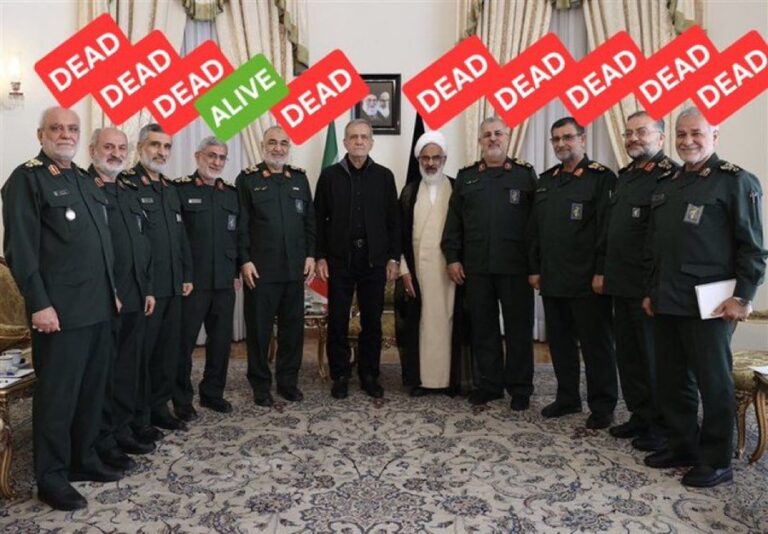
Spiritual leader Ayatollah Ali Khamenei ruled Iran for 36 years as the successor to Ruhollah Khomeini. He was brought down by an Israeli bombardment, along with the defense minister, leader of the Iranian army, and leader of the Revolutionary Guard. A collective funeral of Iranian leaders.
At such a historic turning point, members of the newly appointed Dutch cabinet struggled for words to say something. Premier Jetten called for ‘maximum restraint’, though it was unclear whether he meant the allied action by the US and Israel, or the leaders of the Iranian theocracy who have been anything but ‘restrained’ since 1979, Khomeini’s power takeover.
Jetten knows Iran. He took a tourist trip with his friend in the Iran of the mullahs. To be safe, female company also came along, because in Iran homosexuals are thrown off roofs. He called the trip an ‘eye-opener’ but that hasn’t broadened his insight. He points to the importance of ‘avoiding further escalation’. Iran has been escalating since the founding of the Islamic republic. According to him, ‘stability in the region is essential’. That’s correct, but Iran destabilized the Middle East, like a poisonous spider in the web, through proxies in Syria, Lebanon, the Gaza Strip, and Yemen. The end of that regime is precisely the way back to stability.
The reaction of the Dutch cabinet is emblematic of those in other Western European countries. France and Britain also called for ‘de-escalation and negotiations’.
Empty words. Both France and Britain refused to give Americans access to military airfields to carry out bombing raids in Iran. President Macron and Prime Minister Starmer played the role of peacemakers; the real reason runs deeper. They are afraid of unrest among Muslims in their own countries.
France votes on a new president in April 2027; the opponent of Marine Le Pen or another right-wing candidate will depend on the Muslim vote. For Labour, the party of Prime Minister Starmer, the Muslim vote is even the hard core of its electorate. In both countries, a growing Muslim community has become radicalized. As domestic politics becomes Islamicized, foreign policy Islamicizes itself. Including that of the Netherlands. See Jetten.
Other countries did give the US access to military airfields: Kuwait, Jordan, Qatar, United Arab Emirates, and Saudi Arabia. All Arab countries; America is their insurance policy.
The Americans and Israelis decided to attack Iran after failed negotiations with Iranian representatives in Geneva. Iran continues to enrich uranium with the goal of producing nuclear weapons. The Islamic republic sees nuclear weapons as its only guarantee of survival. For Israel, the opposite applies: an Iran with nuclear weapons is an existential threat. Irreconcilable positions.
President Trump decided, with Israel, to launch military action against Iran, with a large air and naval force. America is also bound. Since the Iraq War, military action abroad has been unpopular. Especially among Trump’s base. The line is drawn at ‘boots on the ground’.
Warfare has changed in 2026. Technology changes strategy; operations invisible from the air with millimeter precision and groundbreaking methods for gathering information. In this process, Israel is at the forefront. When liquidating Hamas leaders, Israel didn’t need to bomb buildings; the target’s bedroom sufficed. Regardless of where. Spiritual leader Khamenei thought himself safe with the military top, but America and Israel found him. The US can continue a bombing campaign for weeks, even until the Islamic republic has returned to the Stone Age.
Iran’s spiritual leadership has a big problem. Who wants to succeed Khamenei? His power structure was systematically dismantled. Who dares to apply for the position of ‘spiritual leader’? A triumvirate of top figures must find a candidate. During meetings, Israeli intelligence, Mossad, listens in. Whoever applies might be blown out of bed. Anyone who has seen the spy series Tehran will be amazed at the similarities to what is happening now. The regime has the Arab world against it and is also receiving no substantial support from Russia and China. It languishes in self-isolation.
Ultimately, Iranians must overthrow the Islamic regime themselves. Trump declared that military personnel and even members of the Revolutionary Guard (IRGC) can receive immunity if they lay down their weapons. Quite a major concession because the IRGC is Iran’s murder machine. During recent uprisings, some 32,000 people were murdered, often in gruesome ways, by members of that guard. They cling to the regime because, in addition to their police and military role, they also enjoy economic benefits, ownership and shares in companies, making them privileged. Offering immunity to those murderers will not be appreciated by the ordinary Iranian.
America is preparing the ground, but Iranians must seize power. That’s harder than it seems, because Iran is in a different situation than Venezuela, which has known democracy for some time and where democratic elections have taken place. By arresting President Maduro, Trump picked out the ‘bad guy’ and put the economy in a stranglehold so that Venezuela’s vice president must carry out America’s will. Iran has never even experienced fair elections.
After Khamenei’s death, Maryam Rajavi, leader of the national resistance group NCRI, declared a ‘Interim Government’ with a Ten-Point Plan, with a view to a ‘democratic, secular republic’. NCRI also has resistance strongholds in Iran. With the downfall of the Islamic regime, there should theoretically be room for a democratic uprising. Every uprising needs catalysts; the sparks that lead to the flame. NCRI has a long resistance tradition. It fought not only against the Islamic regime from the beginning but also against the rule of Shah Reza Pahlavi (1919-1980) and his self-glorifying peacock throne, which caused the Islamic revolution in 1979.
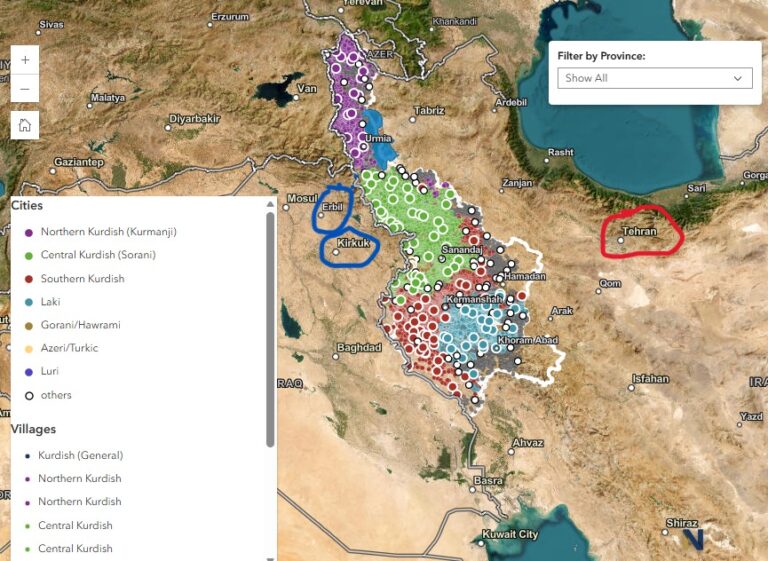
The Shah’s son, Reza Pahlavi II (65), left for the US at age 17 to train as an air force pilot but never returned to Iran because his family was expelled from the country during the Islamic revolution. He lives in Washington DC, has no long resistance tradition but positions himself as a ‘transition figure’ from the current dictatorship to a new form of government, possibly a monarchy. He calls the transition ‘temporary’, lasting up to 3 years or more. Pahlavi has also never disavowed his father’s rule from his peacock throne. Iran has various ethnic minorities such as the Kurds, who demand autonomy within Iran, but Pahlavi calls them ‘separatists’.
The Islamic regime continues to struggle, at the expense of Arab neighbors and freedom of the seas. But its days are numbered. As soon as the Islamic regime crumbles, a ‘moderate part’ of it will seek alignment with the opposition. That will happen sooner with the Pahlavi movement and its monarchical tradition than with the NCRI, which was hated by both the Shah and the Mullahs.
The best outcome is if the divided opposition reaches agreement in a round table negotiation about fair, general elections for a Constitutional Assembly, from which to continue negotiating about Iran’s future. Both Pahlavi and NCRI have effective lobbies in Washington DC, in Congress, and in American media. Trump can force them to the table and act as the growling ‘watchdog’.
Derk Jan Eppink is a Distinguished Fellow (Honorary) at the Gold Institute for International Strategy, a Washington D.C.-based foreign policy and defense think tank.