SITREP IRAN: Global Oil Prices Rising!

SITREP IRAN: Global Oil Prices Rising!

The IEA (International Energy Agency) is a Paris-based intergovernmental org founded in 1974 by 31 OECD countries (plus associates) to ensure energy security after the 1973 oil crisis.

The 1973 oil crisis was a total oil embargo against countries that had supported Israel at any point during the 1973 Yom Kippur War (another Middle East war—they never seem to end), which began after Egypt and Syria launched a large-scale surprise attack in an ultimately unsuccessful attempt to recover the territories that they had lost to Israel during the 1967 Six-Day War (a previous Middle East War).

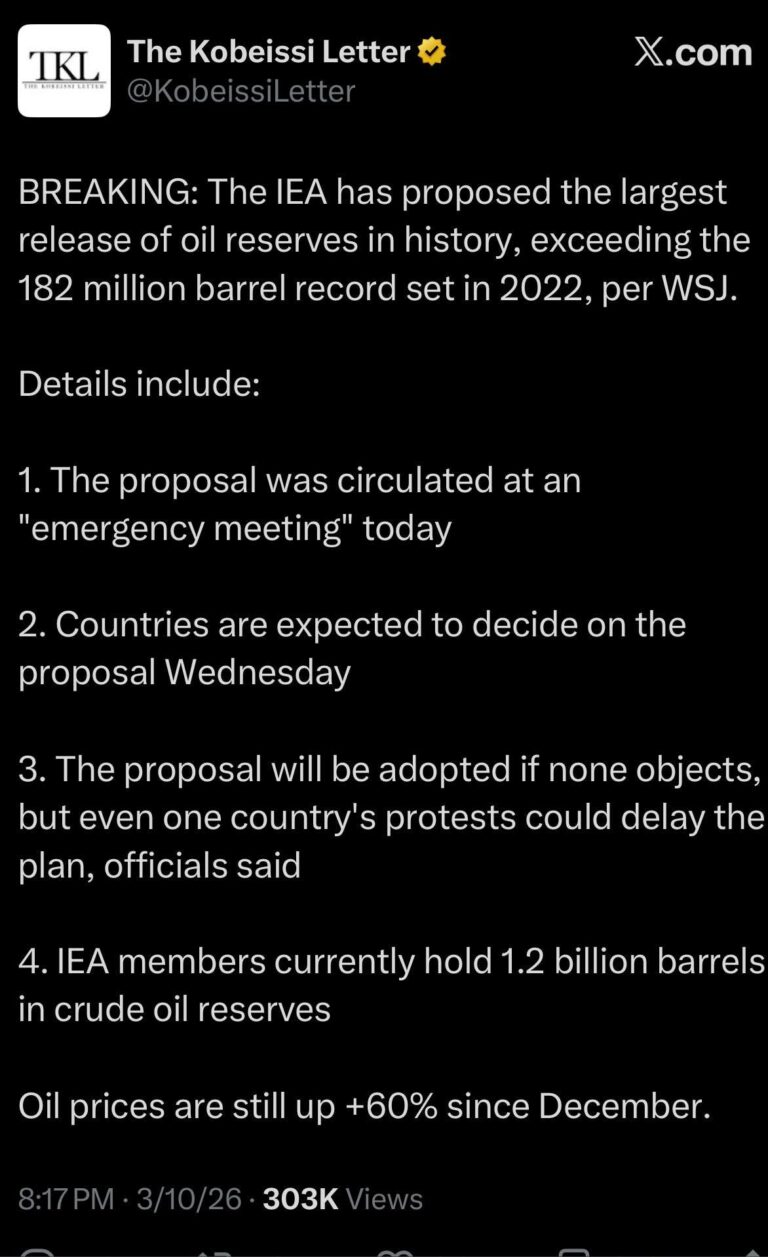
The IEA monitors, among many tasks, global energy markets and coordinates emergency oil reserve releases—like today’s proposed HISTORIC drawdown from the 1.2B barrel stockpile to stabilize prices and supply.

So what?

Fill your gas tanks up now before the prices go up even further.

You may not want war but war wants you and when it takes hold, the costs and consequences are usually severe.

Pray for our troops and our POTUS

SITREP

SITREP

Iran has crossed a significant threshold. Following confirmed strikes on banking infrastructure inside Iran, Iranian military sources are now threatening retaliatory action against US and Israeli financial centers across the region, with specific signals pointing toward tech sector targets. This represents a deliberate strategic shift from military-to-military engagement toward targeting civilian economic infrastructure, a move that places ordinary American workers, employees of major technology companies, directly in the crosshairs of a regime at war.

This escalation is not a sign of Iranian strength. It is the signature of a losing force making a desperate play.

Regimes that are winning wars fight on the battlefield. They do not threaten banks, financial centers, and technology campuses populated by civilian workers. The decision to escalate toward economic and civilian targets is a calculated gamble by Tehran, an attempt to generate enough global economic disruption and political pressure to force Washington and Jerusalem to stand down before the military situation deteriorates further.

It will not work, but it must be recognized for what it is.

Iran’s air defense architecture has been severely degraded since strikes began on February 28. Their missile and drone stockpiles are being systematically reduced. Proxy networks across Lebanon, Iraq, and Yemen are fractured or operating under significant constraint. The transition in the supreme leadership with Mojtaba Khamenei installed only days ago creates internal uncertainty at the command level. These are the conditions that produce exactly this kind of escalatory threat: loud, broad, and designed to intimidate rather than defeat.

Threatening US tech sector targets is significant for one specific reason.

It signals Iran is willing to accept international condemnation for targeting civilian economic infrastructure in exchange for the psychological and political impact of threatening American workers on American soil or in American-affiliated facilities abroad. That is a terrorism calculus, not a military one.

Iran is making a massive, desperate move because they are losing and they know it. The targeting of financial centers and technology infrastructure is designed to change the psychological terrain of this conflict when they can no longer change the physical terrain.

Desperation dressed as escalation is still desperation. Do not be deceived by it.

5th Generation Warfare at its most defined level

GEORGE SIMION: Romania, the U.S., and Sovereignty

George Simion, President of the Alliance for the Union of Romanians (AUR) and Vice-President of the European Conservatives and Reformists, addresses a delegation of opposition parliamentarians in Bucharest alongside representatives from the Gold Institute for International Strategy. He reflects on the state of U.S.-Romania relations and the importance of open dialogue between allied nations. Simion emphasizes the value of cooperation between GIIS and Romanian think tank RIS, and calls for stronger ties between Romania and the United States under the current administration.

CANDIN POP: Romania-U.S. Strategic Alliance

Candin Pop, President of the Romanian Institute for International Studies (RIIS), shares remarks on the importance of the Romania-U.S. strategic relationship at a Gold Institute for International Strategy event. highlighting RIIS’s mission to engage everyday citizens in international affairs and advocates for free markets and freedom of speech. He emphasizes the value of reconnecting Romania and the United States as natural allies with shared democratic values.

DAN DUNGACIU: Values, Alliance, and the RISS-GIIS Partnership

Dan Dungaciu, First Vice-President of AUR and Chairman of the Romanian Institute for Strategic Studies (RISS), addresses the opening of RISS in Bucharest, Romania. He reflects on the significance of shared values as the foundation of transatlantic conservative cooperation, drawing a parallel between how established political networks have long organized around common principles. Dungaciu frames the RISS-Gold Institute partnership as a step toward institutionalizing those values through NGOs, foundations, and media infrastructure. He describes the moment as historically significant, noting it marks the first time a U.S. think tank outside traditional institutions has established a presence in Bucharest to advance this model.

TIBERIO CONSTANTINESCU: Romania-U.S. Relations

TIBERIO CONSTANTINESCU: Romania-U.S. Relations

Tiberio Constantinescu, Secretary of RIIS, delivers brief remarks on the state of Romania-U.S. relations. He notes that a first step toward repairing bilateral ties has been taken, with RIIS and the Gold Institute serving as central partners in this effort. Constantinescu closes with an expression of hope and gratitude for the collaboration.

MG MAHMOUD HASSANIN: Egypt, the U.S., and Romania

MG MAHMOUD HASSANIN: Egypt, the U.S., and Romania

MG Mahmoud Hassanin, Distinguished Fellow at the Gold Institute for International Security, addresses Romanian government officials on Egypt’s strategic role as a key U.S. partner in the Middle East, the Arab world, and Africa. He highlights Egypt’s contributions to regional stability, including hosting the UN COP27 summit in Sharm el-Sheikh with U.S. support. Hassanin also underscores the interconnected interests of the United States and Europe, and the importance of strengthening Egyptian-Romanian diplomatic ties.

DERK EPPINK: Democracy & EU Election Interference in Romania

DERK EPPINK: Democracy & EU Election Interference in Romania

Hon. Derk Eppink MP, Distinguished Fellow at the Gold Institute for International Strategy, addresses a Romania-focused forum on democratic integrity and electoral sovereignty. Drawing on his experience in the European Commission and European Parliament, Eppink examines how EU institutions have sought to influence election outcomes across member states. He calls for greater awareness of institutional interference conducted under the guise of democratic protection, and expresses solidarity with Romania’s democratic aspirations.

ROB ROOS: Election Interference and Digital Freedoms

ROB ROOS: Election Interference and Digital Freedoms

Hon. Rob Roos, Distinguished Fellow at the Gold Institute for International Security, addresses the Romanian Parliament on patterns of election interference across the Western world and the misuse of EU digital legislation to suppress dissenting voices. Drawing on his experience negotiating the Digital Services Act on behalf of the ECR, Roos outlines how regulatory frameworks such as the DSA, Chat Control, and the Media Freedom Act are being used to curtail political opposition. He calls for cross-border cooperation among sovereignty-minded leaders to defend democratic freedoms.