

Dan Sullivan (R-inc.) vs. Mary Peltola (D)
I. The Race
Dan Sullivan (Republican) is running for his third term representing Alaska in the United States Senate. He last won reelection in 2020, running ahead of President Trump on the same ticket – albeit against an “independent” candidate rather than a card-carrying Democrat.
Mary Peltola (Democrat) replaced Republican U.S. House mainstay Don Young in Washington following a 2022 special election, and won a full term in November 2022. She is perhaps the Democrats’ only talented candidate in Alaska, and she opted to pursue the Senate instead of the AK-AL House seat she lost to Nick Begich in 2024 – essentially forfeiting that seat to the GOP this year.
Gerald Heikes, a no-name Republican, is also on the ticket and will factor in the First Choice calculation of the Ranked Choice system prior to redistribution of votes, and will probably be the first candidate voted off the island.
Daniel J. Sullivan, Jr., is the key factor in this race and was inserted by Alaska Democrats to spoil Senator Sullivan’s reelection chances. Significant judicial corruption allowed him to stay on the ballot against the wishes of the Division of Elections, which determined the imposter Sullivan’s motive for joining the Senate race was to deceive voters (obvious to most with a functioning brain).
II. State Profile
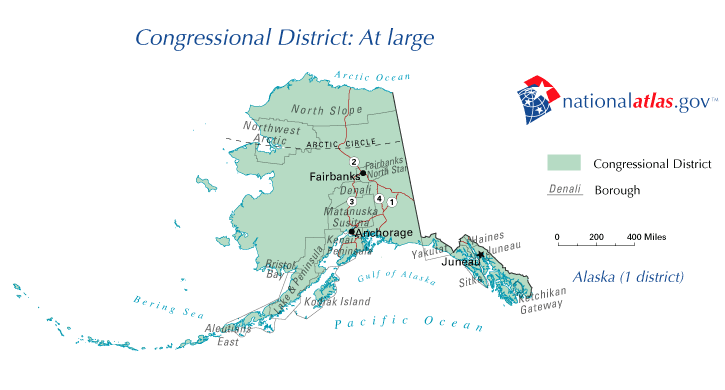
Alaska is a Republican stronghold despite not being tied to the standard set of evangelical preferences common throughout the Sun Belt and “Lower 48” conservative clubs and organizations. It prioritizes individual freedoms and property rights, and has a heavy reliance on the energy industry. These reasons, among others, are why the Last Frontier hasn’t backed a Democrat presidential nominee since 1964, during Lyndon B. Johnson’s national landslide.
Juneau aside, Alaska’s urban areas (primarily Anchorage and Fairbanks) are much more conservative than national counterparts, and under the MAGA realignment, the rural hinterlands have reddened substantially. Peltola is a Native Alaskan who spent time growing up in the rural areas of the state, which gives her a real advantage running in a statewide race. Senator Sullivan will need to maximize turnout in true Republican strongholds, such as the Matanuska-Susitna Borough (Sarah Palin’s home turf), and compete in Anchorage Municipality, to feel good about his chances of winning a third term.
Presidential Margins
2016 Trump +14.7%
2020 Trump +10.1%
2024 Trump +13.1%
Key Statistics
57.5% White, 14.8% Native Alaskan
65.7% Urban, 34.3% Rural
III. Market Assessment
Peltola, propped up by ludicrous polling, is vastly overpriced on Polymarket. The market, while not reflective of the true nature of the race, does correctly view this as a race that will come well inside of normal presidential margins.
IV. History
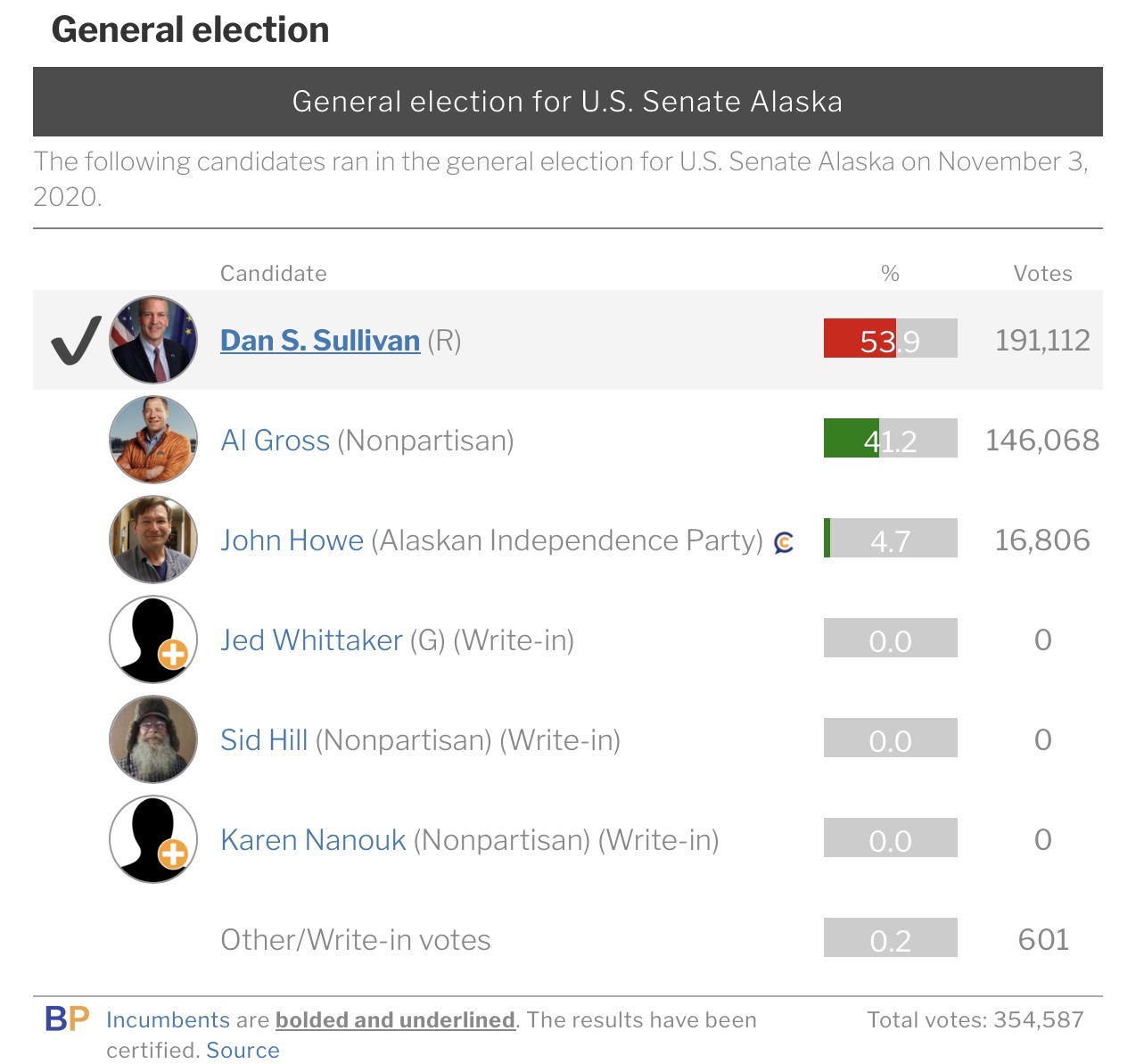
Sullivan was reelected without drama in 2020, with a presidential turnout and voter behavior, even though the election was a fiasco with far too much mail-in balloting authorized:
His first race for the seat, in 2014, came with a midterm red wave at his back and resulted in him unseating Mark Begich (Democrat):
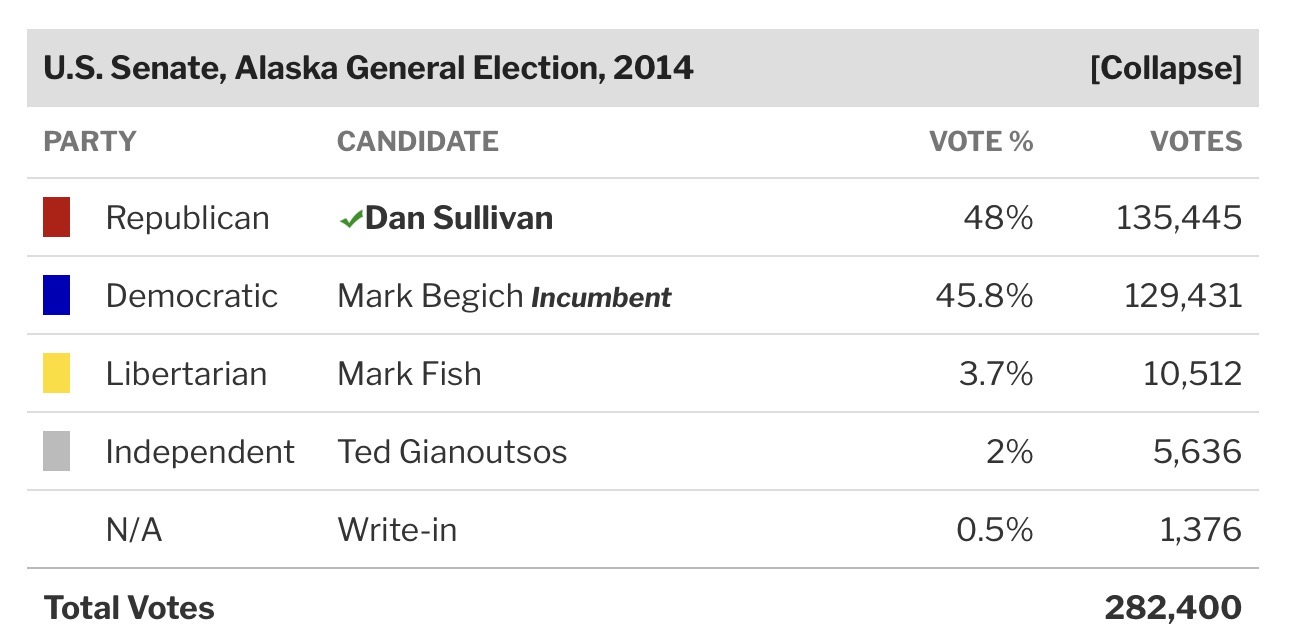
Sullivan was undoubtedly aided by the spoiler candidates taking more than six percent of the vote, allowing him to win with just 48%. Of note, Begich had shocked the political world in 2008 when he rode the Obama wave to knock off the legendary Ted Stevens, who at the time was the longest serving Senator in GOP history (since surpassed by Orrin Hatch and Chuck Grassley).
The other seat, held by swamp creature Lisa Murkowski (whose career Ranked Choice Voting was introduced to save), has been in Murkowski hands since 1981 – held by her father, Frank, starting then and transferring to Lisa by gubernatorial appointment after he (Frank) won his race for governor in 2002. Lisa immediately faced voters and won in a squeaker in 2004, despite a Bush landslide happening on the same ticket:
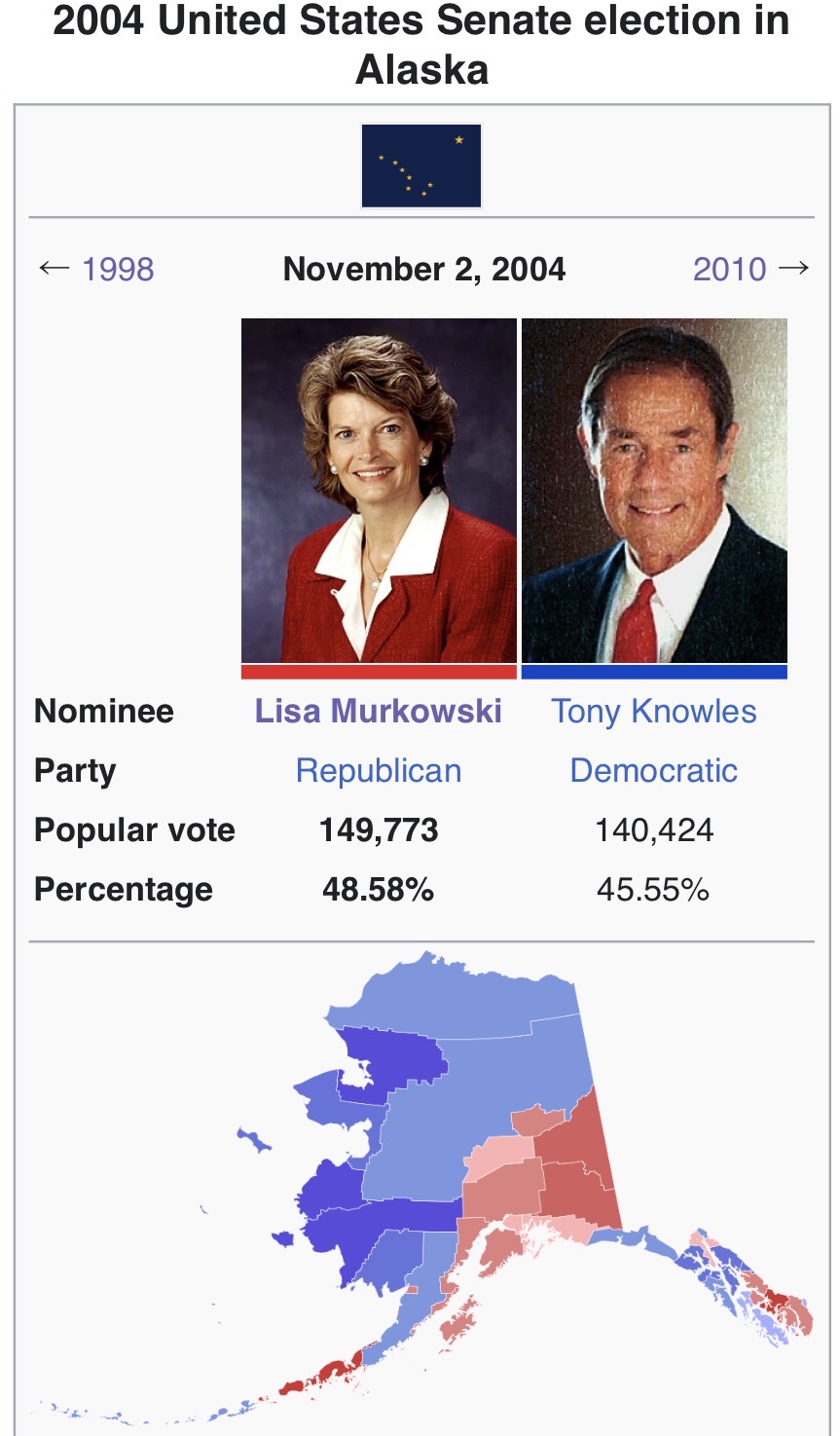
The vastly unpopular Lisa lost the 2010 GOP primary, only to fluke her way into a win in the General Election via a write-in campaign with less than 40% of the total vote. Not to pile onto Murkowski – but both seats have very recent evidence of serious departure from presidential baselines that we don’t see in other states; they must not be ignored in 2026.
V. Analysis of 2026 Primary Results
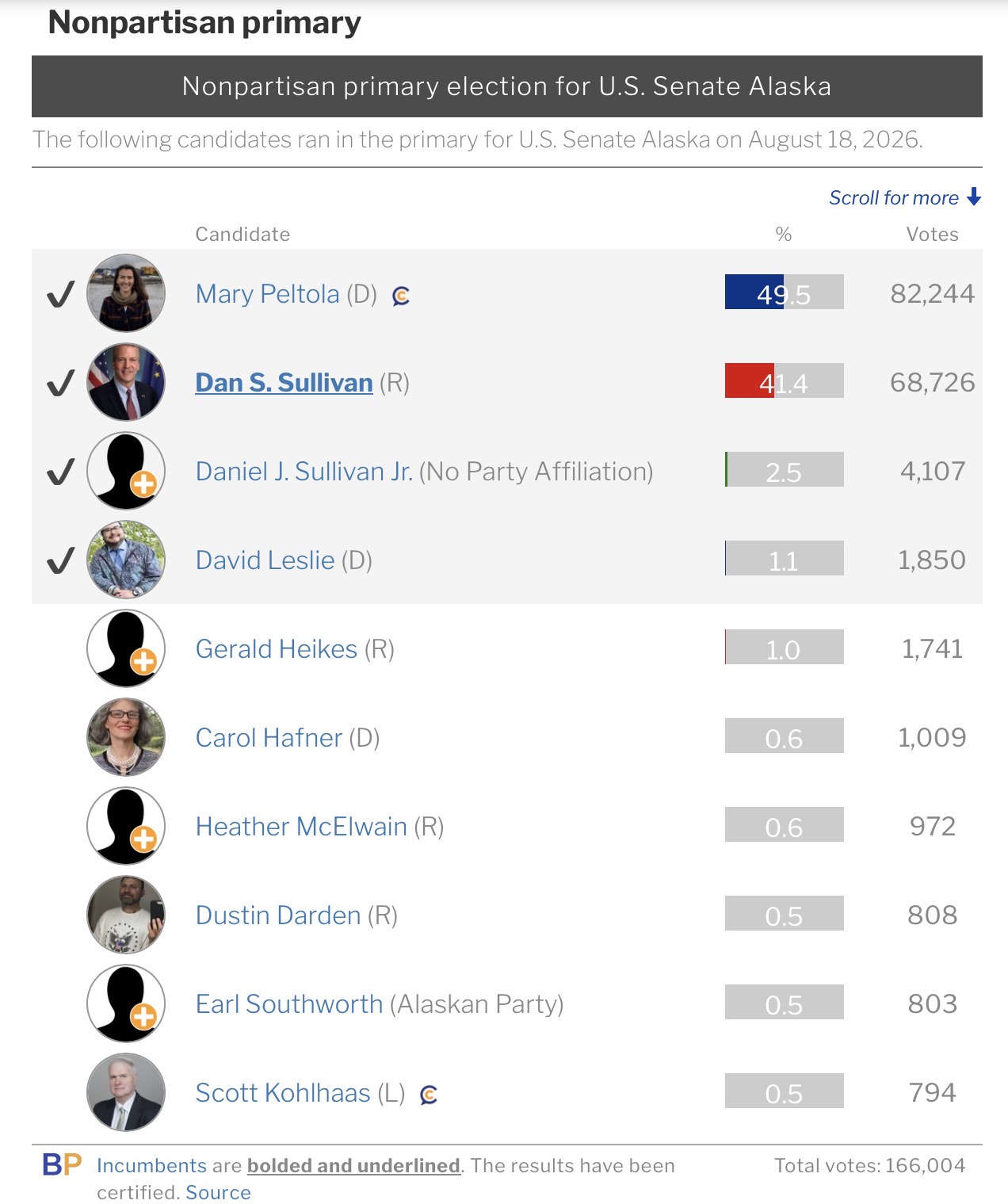
Sullivan’s reelection campaign of 2020 was the first U.S. Senate campaign held under the ridiculous jungle primary system Alaska runs today (in lieu of GOP/Democrat segregated primaries). Peltola came into this year’s primary with guns blazing, clearing Senator Sullivan by 8.1% (13,518 votes):
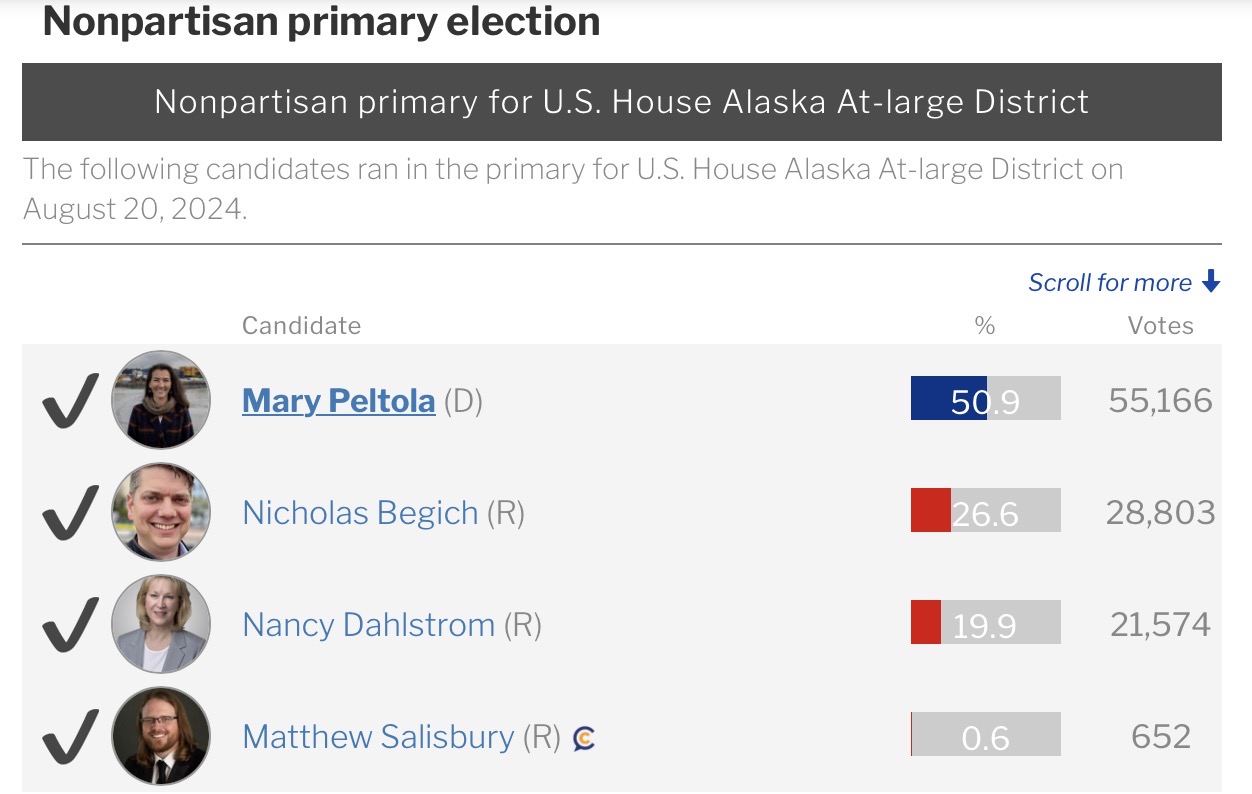
The doomsday prophets online hailed that as a major sign the seat is flipping in November, but ignore the fact that she did better in 2024, just before dropping her seat to Nick Begich:
The primary results are not predictive of what will happen in the General Election, although they accurately paint Peltola as a threat to take the seat. What is more important in the 2026 primary results is that the imposter Sullivan finished third and took 2.5% of the vote. It is not known how much of his support came from Peltola supporters who wanted to ensure he made the ballot to subtract votes from Senator Sullivan, or how many of imposter Sullivan’s votes were given out of sheer confusion over the multiple Sullivans on the ballot.
David Leslie, a loyal Democrat, did his duty to his party and dropped out shortly after the primary, which elevated Heikes to the November ballot. Now Senator Sullivan has to fend off a weak Republican (Heikes) and an imposter candidate (the other Sullivan) just to see how the reallocated votes from Ranked Choice Voting land against Peltola. Only Senator Sullivan or Mary Peltola has a chance to win this race; unfortunately, there is no way to predict how voters will rank their ballots in a system that is being constantly rejected when put before voters.
Peltola, for more than just her percentage, is the clear winner from the primary process this year.
VI. Polls
RCP Average: Peltola +1.2%
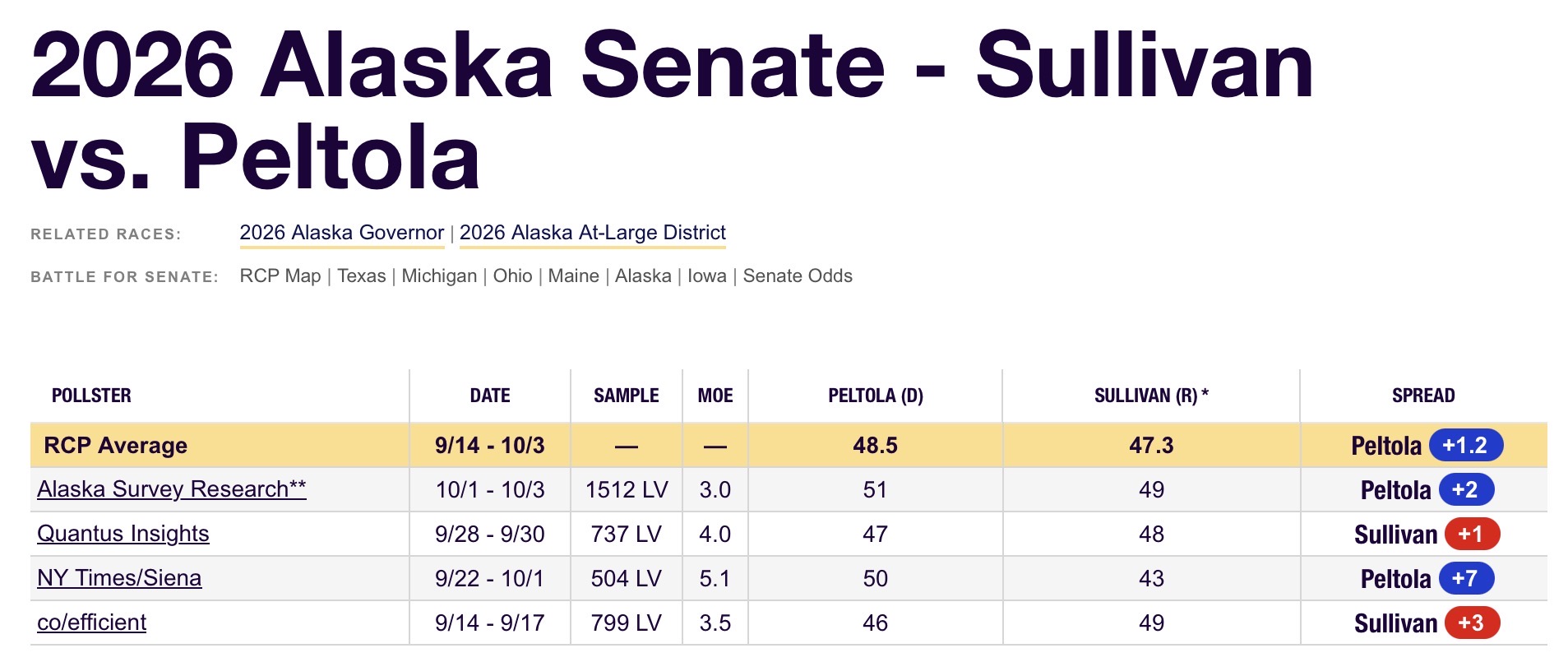
Because of the NYT/Siena outlier (Peltola +7), the average of polls gives Peltola a lead; tossing that outlier gives Sullivan a lead of less than one point. Besides it being obvious how media used rigged polling to influence outcomes, there is nothing conclusive about the Alaska Senate polling picture other than this is going to be a real race.
VII. Media Ratings
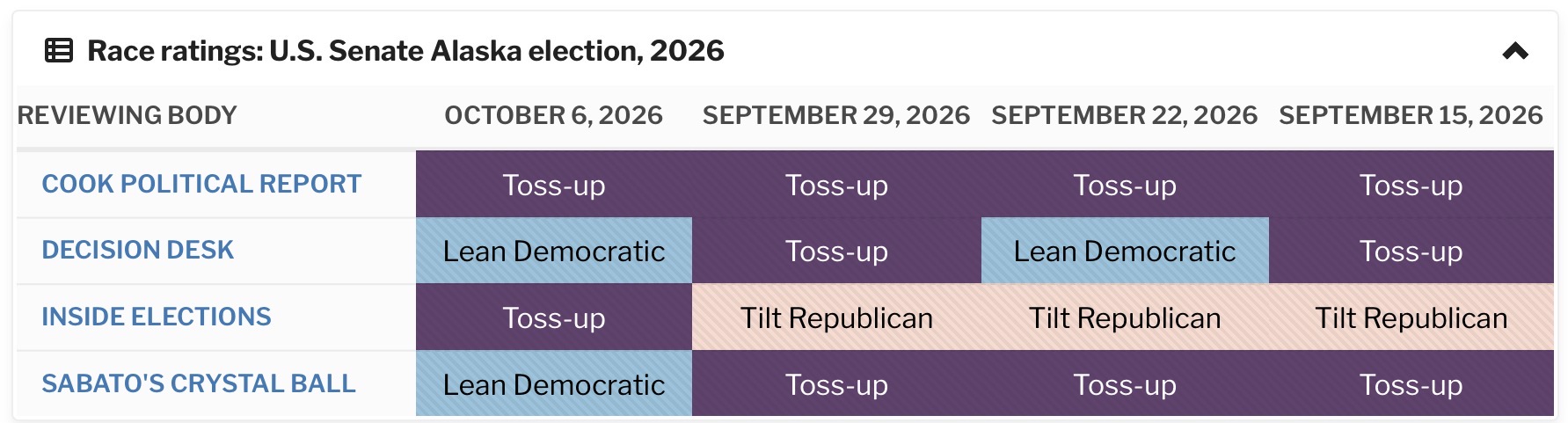
Decision Desk and Sabato’s Crystal Ball have leaned the race toward Peltola just in the past week. Cook and Inside Elections have it firmly in toss-up territory.
VIII. Voter Registration by Party
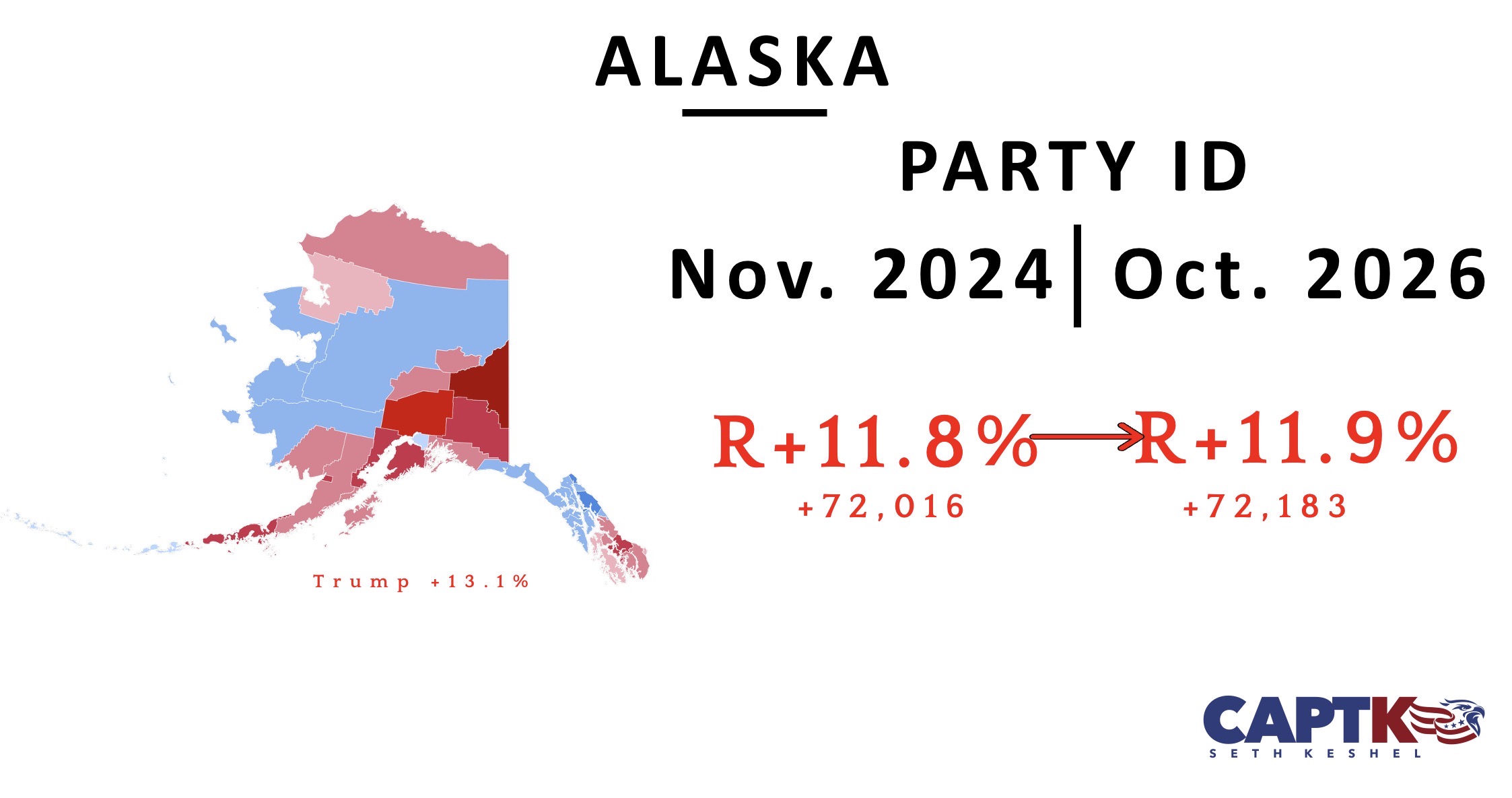
Democrats have inched backward since the 2024 election, although not by much. There is no notable drift to the left in Alaska, which would have been a major boost in a state that already has voting patterns that can be documented as nothing other than strange.
IX. Election Considerations
I have made it no secret that Alaska’s elections are horrifying. Even with the recently concluded jungle primary, it took two weeks to count all of the ballots as spectators pondered how the Peltola-Sullivan clash would shape up with the Ranked Choice Voting considerations (and who else made the ballot). Keep in mind, Alaska has 1/32nd the population of Florida, which counts almost all of its votes within hours of poll closure, but expects us to find it normal they’ll take two weeks to figure it all out (blaming RCV tabulation).
X. Summary and Election Estimate
Primary results are inconclusive and polls are flawed. With those facts accepted, here is another:
The Sullivan-Peltola race is a true scramble.
Alaska’s recent statewide electoral history demonstrates serious deviation from presidential baselines:
• Peltola winning in 2022 General Election despite GOP House takeover and national popular vote win
• Peltola nearly holding the same seat against Trump presidential popular vote win and blowout in Alaska
• Sullivan barely knocking off Mark Begich in 2014 despite large Romney win in 2012 and a midterm red wave
• Begich beating Ted Stevens despite McCain beating Obama comfortably in 2008
• Lisa Murkowski’s close victory in 2004 despite Bush winning Alaska handily on the same ticket
Three of the incidents described above came before the state had to deal with the catastrophe known as Ranked Choice Voting.
Now you should understand how precarious the situation is. Alaskans have yet another shot to eradicate RCV this year with a ballot referendum (after the effort was torpedoed by mail-in ballots in 2024 arriving well after Election Day), but it gets one more swan song and could determine who runs the Senate next year.
Peltola and Sullivan will both almost certainly have at least 47% each in the First Choice Round.
Heikes will probably receive 1% or less, and have his votes mostly redistributed to Senator Sullivan, although Peltola will receive some. The imposter Sullivan will be eliminated after Round Two, and his vote redistribution will decide between Peltola and Senator Sullivan.
The issue here is that no one truly wants the imposter Sullivan. We don’t know how many of Senator Sullivan’s real supporters will be duped and vote for the wrong guy, and we don’t know how many of imposter Sullivan’s supporters are Peltola supporters who voted for him just to make sure he wound up as a stumbling block on the November ballot. Therefore, Senator Sullivan needs to go all in on two things:
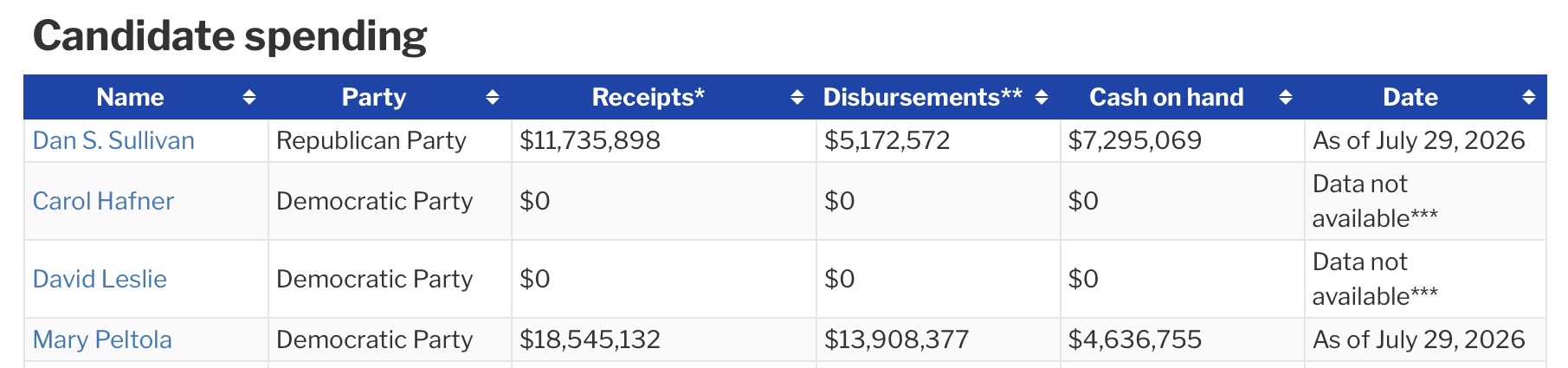
• Using his significant monetary advantage (cash on hand), an information operation campaign with as much reach as can be bought to alert voters of the fraudulent Sullivan allowed to stay on the ballot (he wanted to lie about even his middle initial).
• Doing everything he can to get a majority on the First Choice Round to completely sidestep the redistribution fiasco. Two major jurisdictions are going to give him the shot for that: Anchorage Municipality and Matanuska-Susitna Borough.
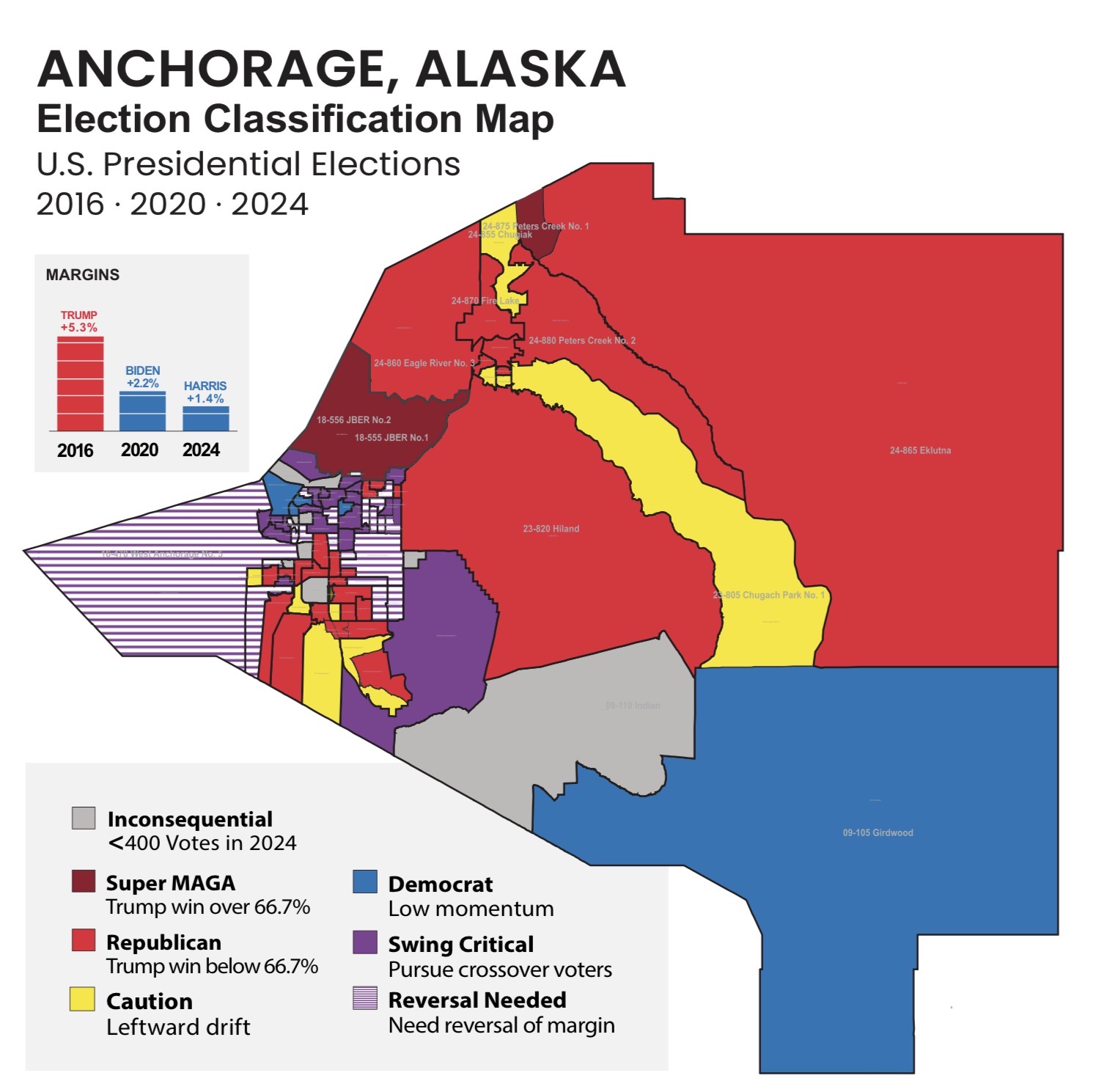
Anchorage Municipality was won by Trump in 2016, but with suburban slide and the perfection of mail-in ballot collection, had slipped to the left. Sullivan won it in 2020, but Peltola has been a strong candidate here – where roughly 39% of the statewide vote came from in 2024.
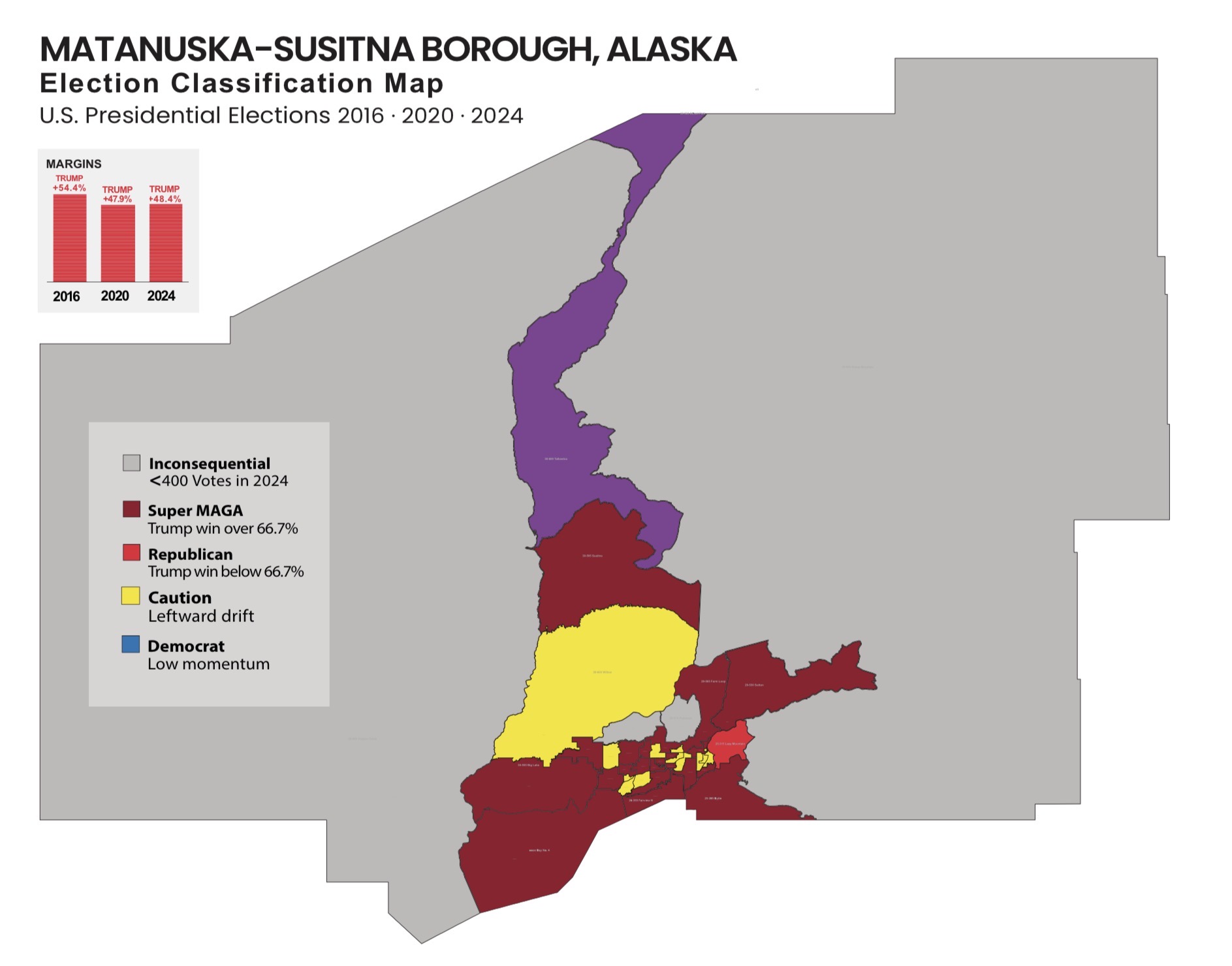
The big GOP numbers that Senator Sullivan needs to maximize come from Matanuska-Susitna (Mat-Su) Borough just north of Anchorage. Trump never carried it by less than +47.9% margin, and about one-sixth of the state’s votes come from it. There are only a handful of precincts within Mat-Su Borough Peltola can hope to make any headway in.
Peltola’s big strength is that as a Native Alaskan, she will fare better in Alaska’s vast hinterlands than a standard white Democrat would, especially with Trump having shifted it so much in his direction – winning entire Native Alaskan villages when he had lost them hands down in 2016. Sullivan will need to take as much of the outlying portions as possible, but his best bets are to max out Mat-Su, take the Fairbanks metro, and hold his own in Anchorage. The expansion of mail-in balloting in Alaska reduces Peltola’s risk of having poor turnout in the villages, so it is unclear if the Democrat turnout drag being observed with minorities in other states will manifest in the great north.
Here is how the key factors in this race stack up:
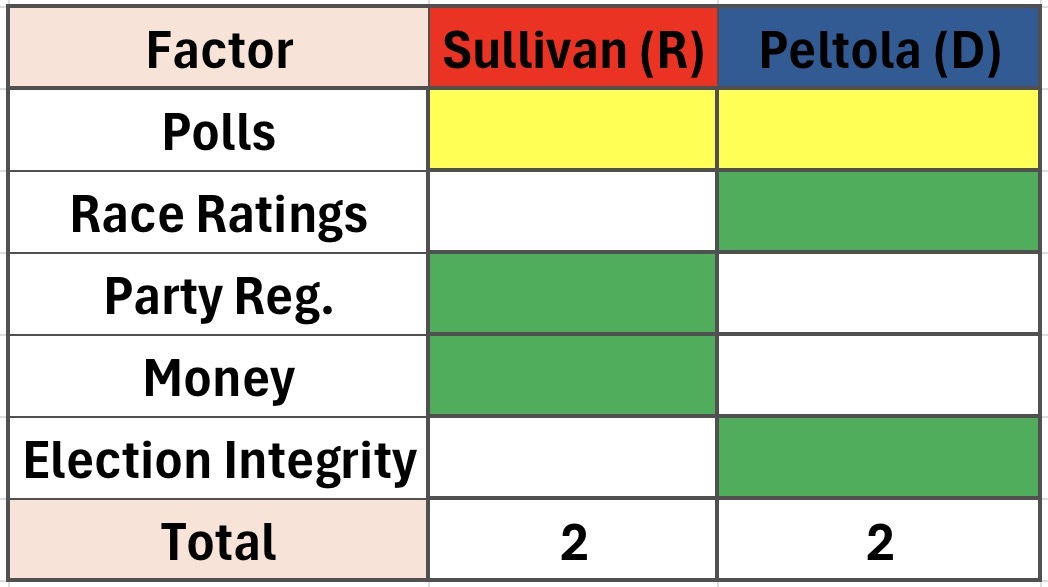
Forecast for AK Senate
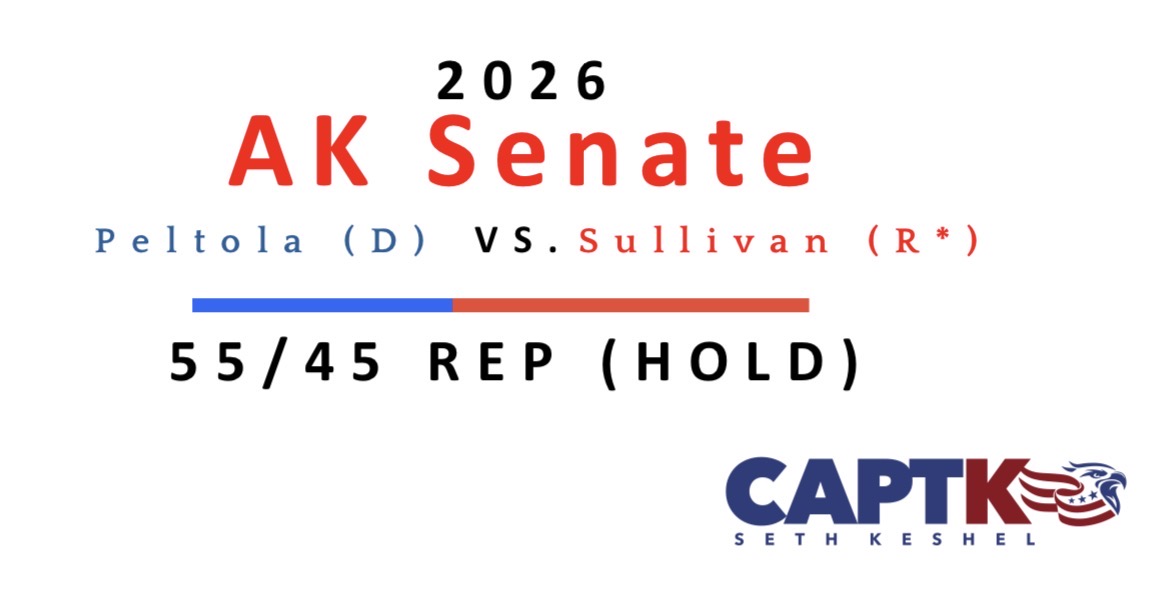
55/45 in either direction is as close as my forecasts for midterms get. I will not leave a race at 50/50, and will nudge it based on intuition or gut feeling. Still, a 55/45 rating is indeed a flip of the coin. Alaska’s volatile nature for non-presidential statewide races is the key factor here; the state is red enough for Trump that Sullivan would coast to victory against a standard Democrat, but he drew Peltola, and she is tough despite her recent image issues that may hurt her with soft Republican crossovers.
The factors keeping the Sullivan camp up at night go far beyond Peltola’s name on the ballot. Ranked Choice Voting is a true monster to overcome, and the irony is that its proponents say it takes the gaming of elections out of the way. Within six years of introducing it, Democrats have figured out exactly how to game it – and the imposter Dan Sullivan will determine the fate of Senator Dan Sullivan one way or another. This is a dead heat.
Seth Keshel, MBA is a Senior Fellow at the Gold Institute for International Strategy and a retired Army Captain. He publishes Captain K’s Corner on Substack.