Col. (ret.) Christopher P. Costa, Executive Director of the International Spy Museum in Washington, D.C., joined Brig. Gen. Ernie Audino on Frontlines of Freedom to discuss his career in intelligence and the work of the museum.
On Frontlines of Freedom, Chris Costa joined the program. Gen. Audino’s comments: Life really is like a James Bond movie. Chris Costa is the Executive Director of the International Spy Museum in Washington, D.C., a role he has held since 2018, and a retired U.S. Army intelligence officer whose career spanned counterintelligence, human intelligence and special operations.
Brig. Gen. Ernie Audino, US Army (Ret.), is a Senior Military Fellow at the Gold Institute for International Strategy, a Washington D.C. based foreign policy and defense think tank. He hosts Frontlines of Freedom, a nationally syndicated military news and talk radio program.
Maria Maalouf interviews Barak Zilberberg, entrepreneur and former Republican candidate for Nevada governor, on The Capitol Show about his election loss and his vision for Nevada.
From the video’s own description: “He lost the election, but Barak Zilberberg insists his ideas are winning.”
Interview byMaria MaaloufSenior Media Fellow, Gold Institute for International Strategy
Jennifer Balkcom (Republican) was selected by the Executive Committee of the NC-11 Republican Party to run as GOP nominee. This pick happened after the primary, and was required after incumbent Chuck Edwards decided he didn’t want to run again when it became clear he was going to be roasted over an ethics investigation into inappropriate workplace conduct with female staffers. Balkcom has served two terms in the North Carolina House of Representatives and is faced with a major burden of starting from scratch with less than 90 days to run the campaign.
Jamie Ager (Democrat) is one of the best Democrat candidates in the United States and is attempting to revive a brand of “mountain Democrat” that is practically extinct. He’s 47, a farmer, and the CEO of Hickory Nut Gap Farms in Fairview, North Carolina. His reported net worth is nearly $19 million.
II. District Geography
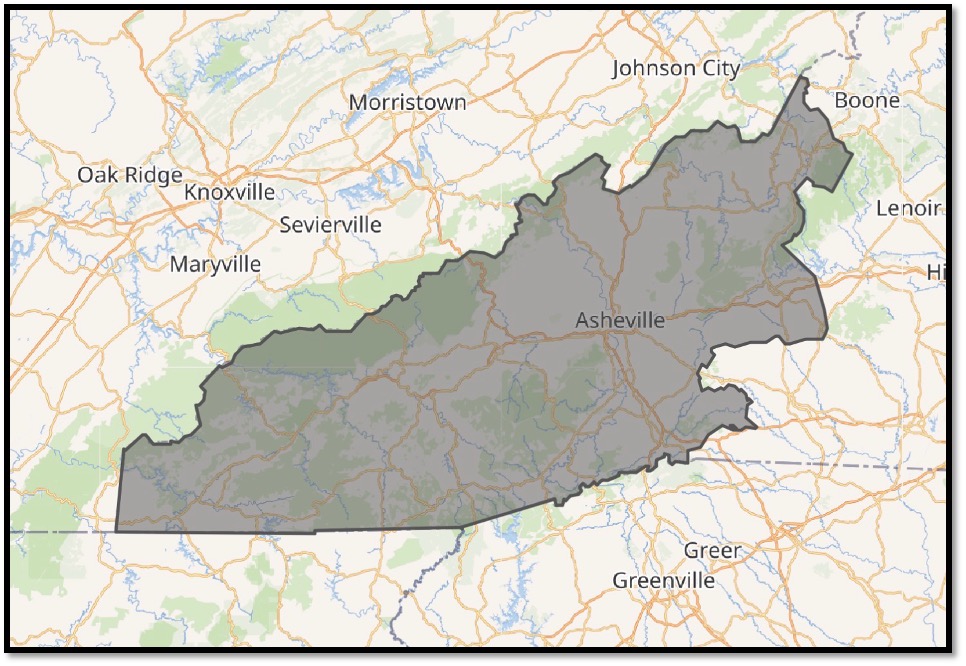
North Carolina’s 11th Congressional District (NC-11) is the westernmost district in the state. It hugs most of the state’s boundary with Tennessee and also borders South Carolina and Georgia. Asheville, a steadily growing leftist stronghold, is fully contained within the district, which is still dealing with the flood-related impacts of Hurricane Helene two years later.
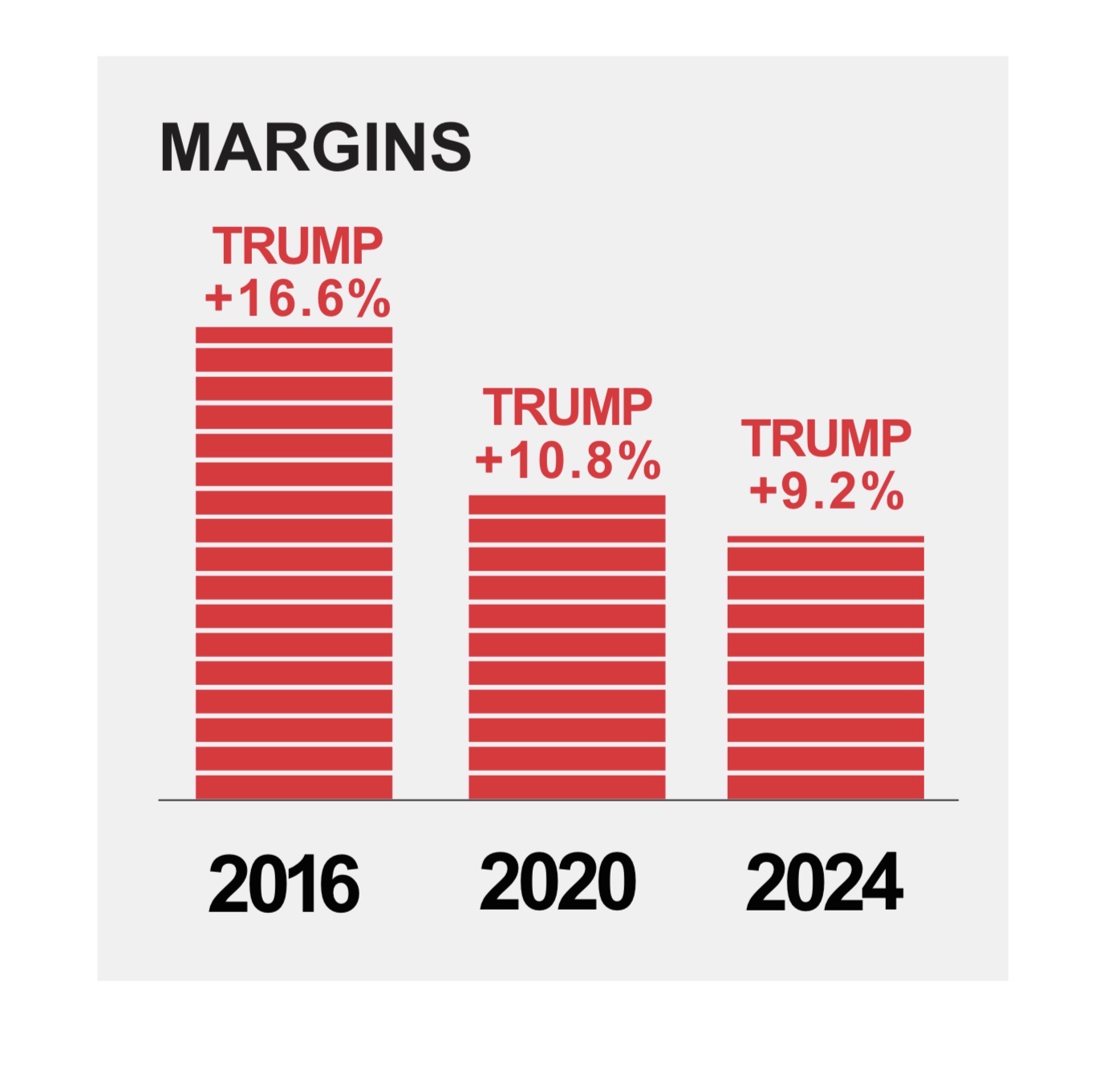
President Trump carried the district, as it is presently drawn, all three times he ran – but by declining margins each time.
Presidential Margins
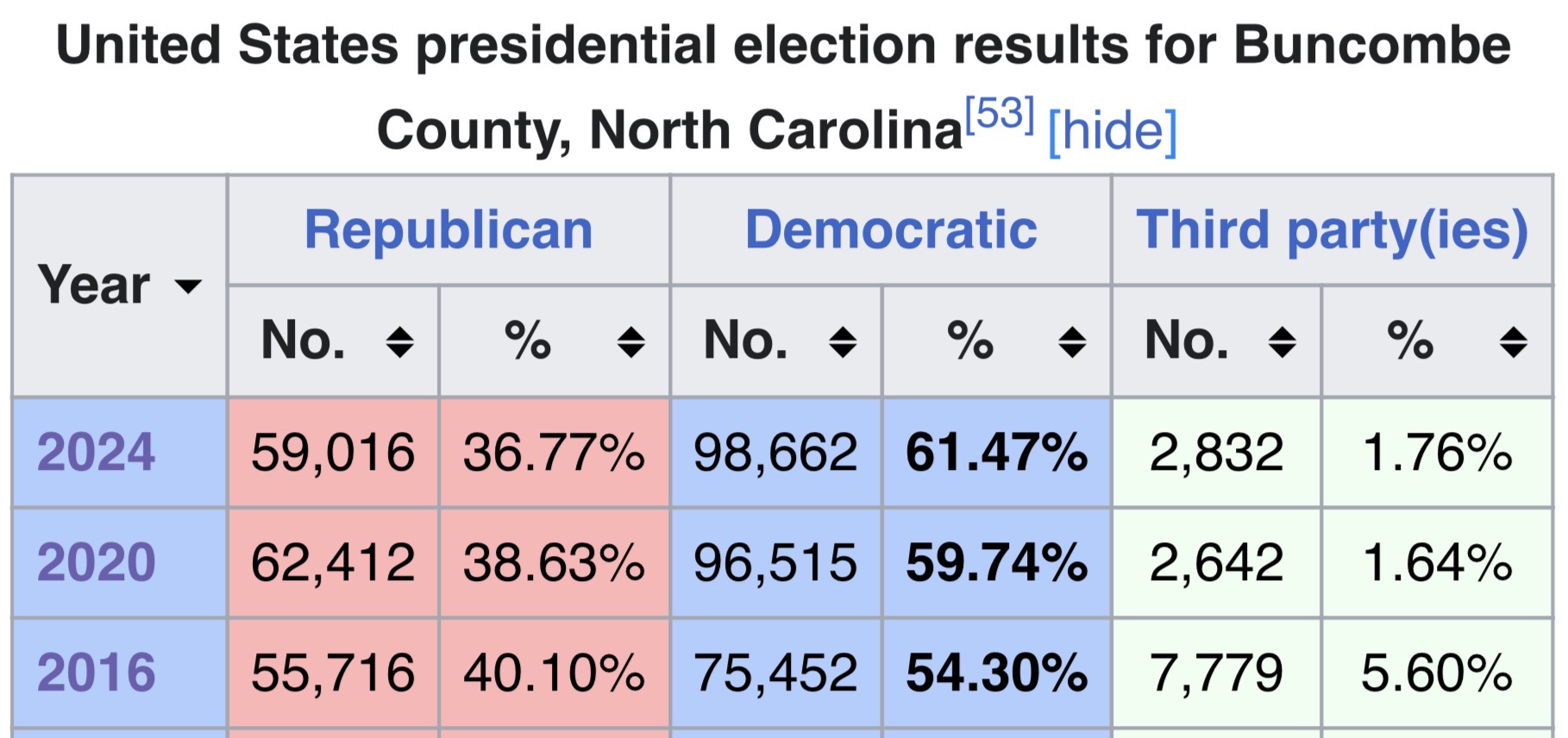
This decline in margin comes from much of the district being “maxed out,” meaning small counties with stagnant populations are no longer able to produce larger margins, and the expansion of Buncombe County (Asheville):
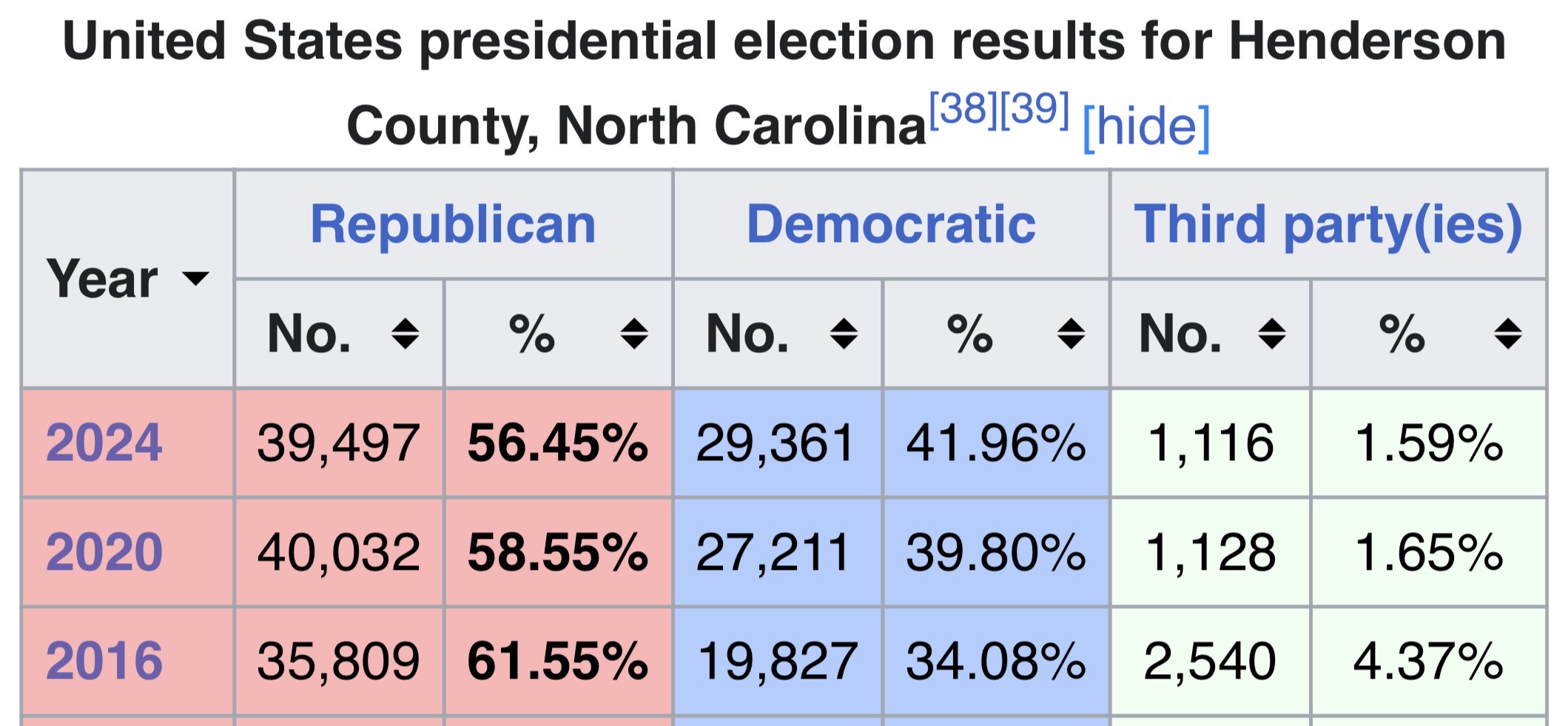
Whereas Trump lost Buncombe by 14.2%, a margin of 19,736 votes, in 2016, he lost it by 24.7% and 39,646 votes in 2024. There has also been a decline in GOP margin in mid-sized counties, such as Henderson, which Josh Stein carried against Mark Robinson in the 2024 gubernatorial race:
While it was worth +15,982 margin for Trump in 2016, it only gave him +10,136 in 2024. The North Carolina legislature would be wise to reassess these boundaries and split Asheville in two the next time they address the maps.
Key Statistics
82.3% White, 7.7% Hispanic
III. Market Assessment
Polymarket bettors understate Jennifer Balkcom’s position based on partisan strength alone, but accurately assess the risk of an Ager victory.
IV. History
NC-11 has a “blue dog” Democrat representing it in its recent history – former NFL quarterback Heath Shuler. Shuler fashioned himself as a conservative Democrat and was elected in the 2006 wave, then reelected twice. After his final reelection in 2010, the North Carolina House redrew the districts and cut away much of Asheville. Shuler read the room and retired from Congress.
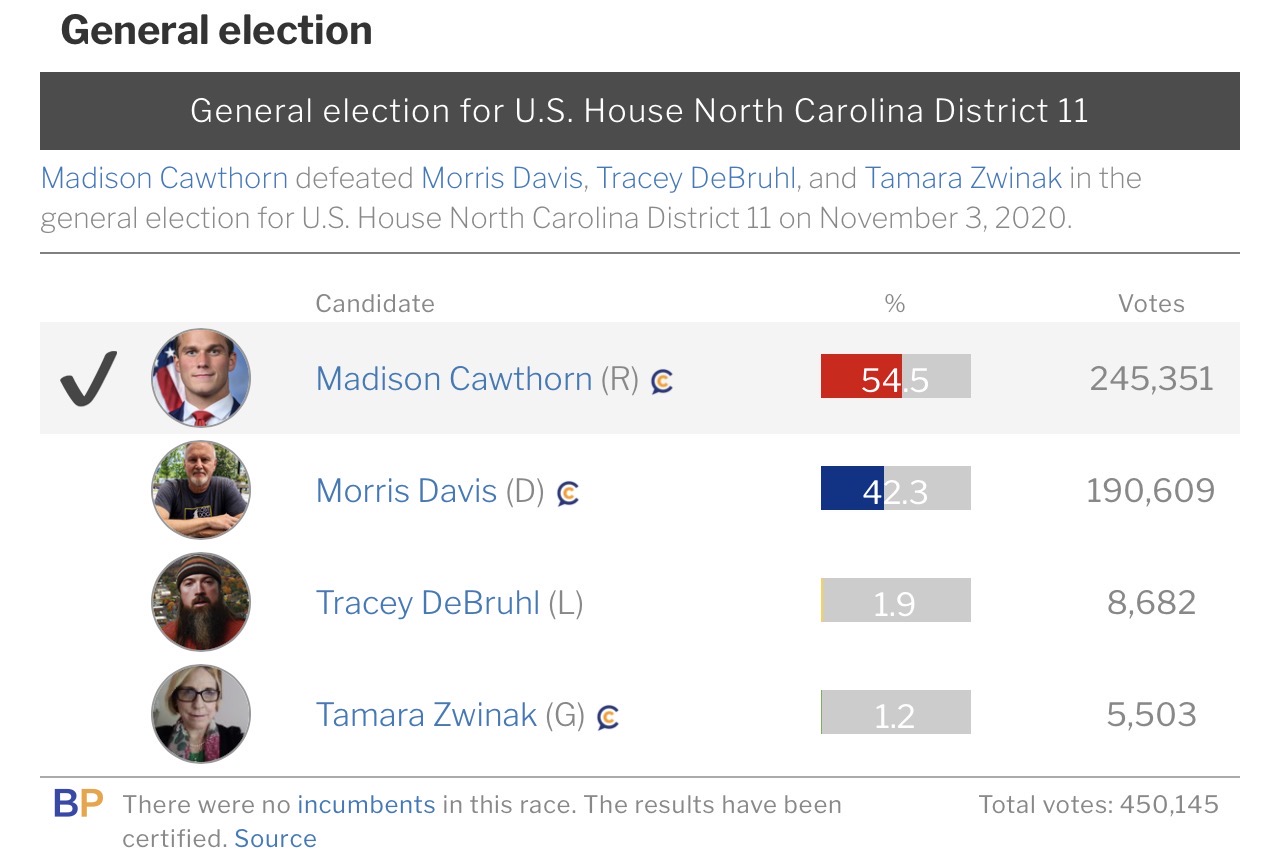
Then came Mark Meadows, who was elected in 2012 and re-elected three times before resigning the seat to become President Trump’s Chief of Staff in 2020, as the COVID-19 fracas was underway. With the seat open, Madison Cawthorn prevailed in the GOP primary and won the seat at the age of 25, with President Trump on the ticket:
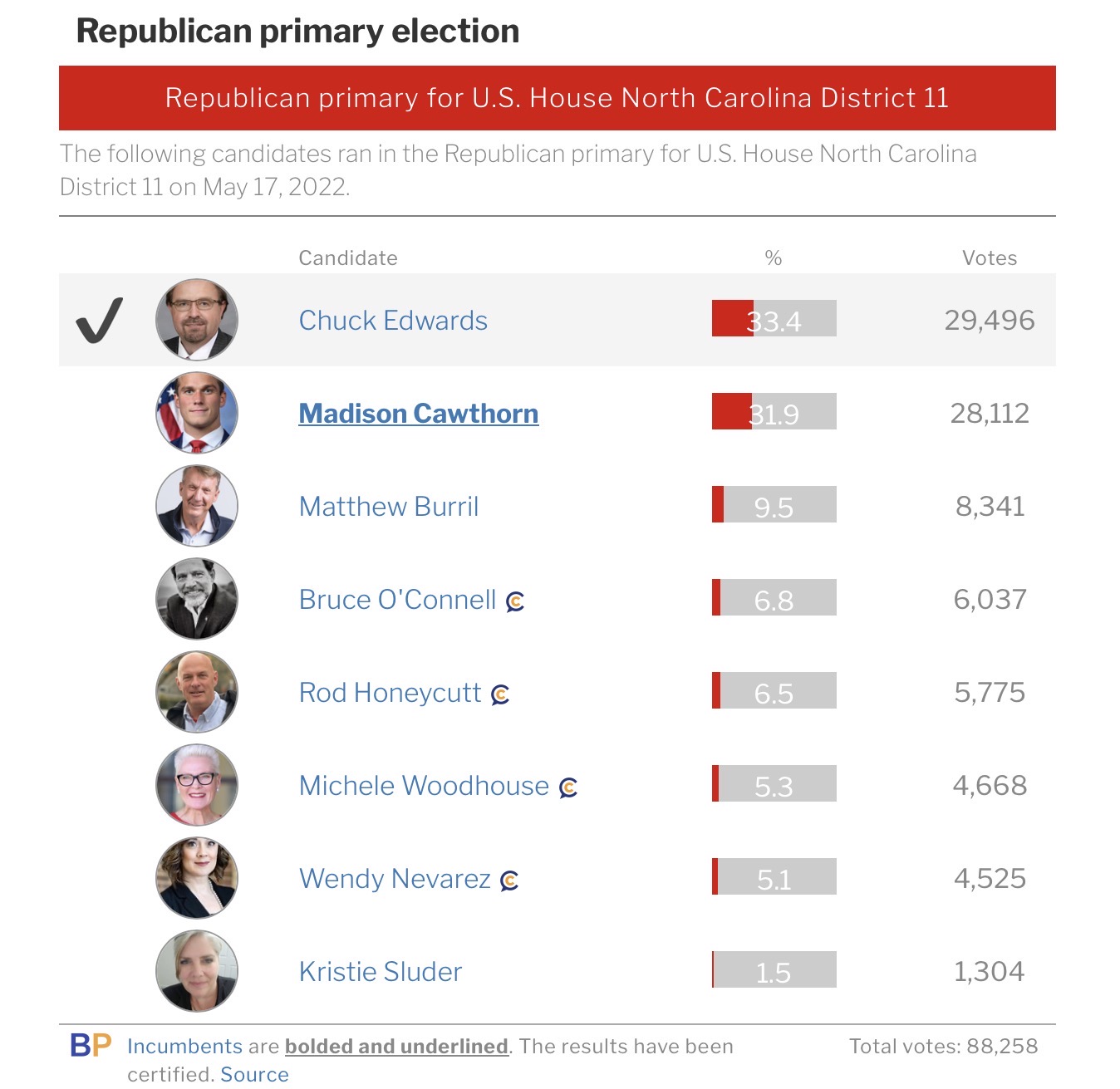
Cawthorn ran roughly even with Trump in the district (as it was drawn then), then proceeded to damage his reputation in Congress with careless behavior. Chuck Edwards exploited this and railed against Cawthorn’s morality, and ousted him in the 2022 GOP primary:
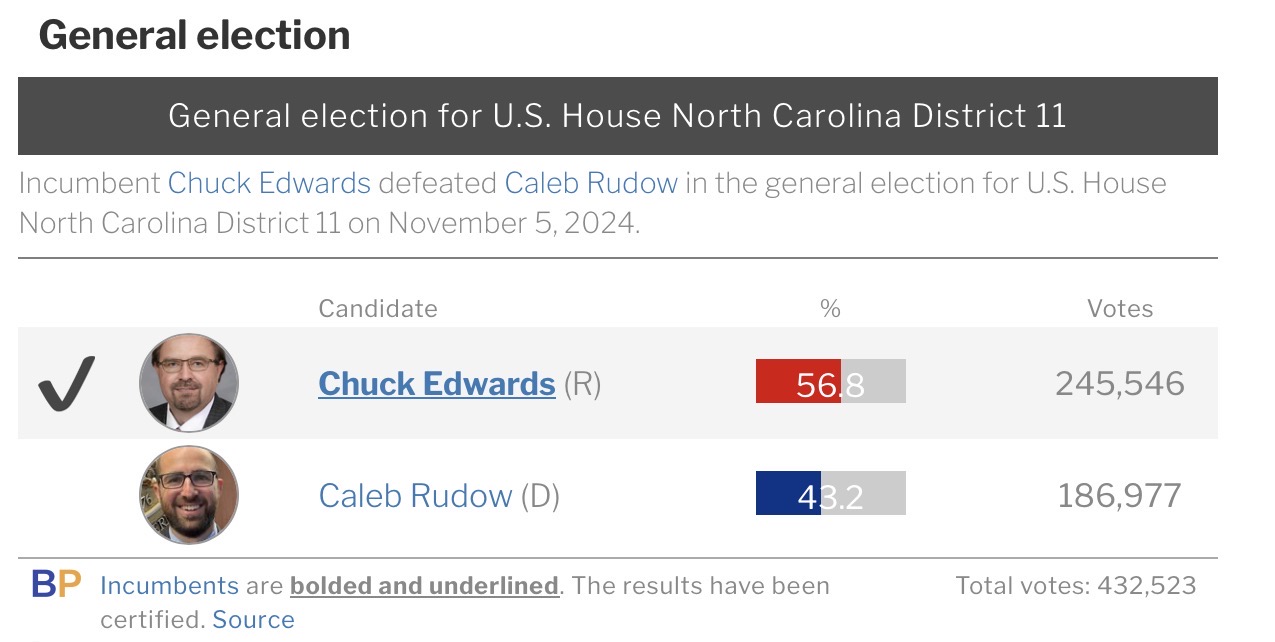
Edwards beat Democrat Jasmine Beach-Ferrara by 9.3% in the 2022 General Election, then cruised to reelection in 2024, outrunning Trump by 4.1% on the same ticket and in the same dirt:
All is well, right? A district with slight, but steady, leftward drift in a battleground state, but with a secure GOP incumbent that can win by more than 13 points?
Too bad Edwards couldn’t internalize all the admonishment he dished out to Cawthorn. Rather than buckling down on the work, he essentially wrote the “how to” guide for workplace harassment and generally making his staffers feel creeped out. The ethics investigation timeline didn’t drag out long enough to save Edwards’s campaign, so he dropped out of the race shortly after winning the primary.
And here we are, having to defend a relatively safe Republican seat in a midterm with little margin for error.
V. Analysis of 2026 Primary Results
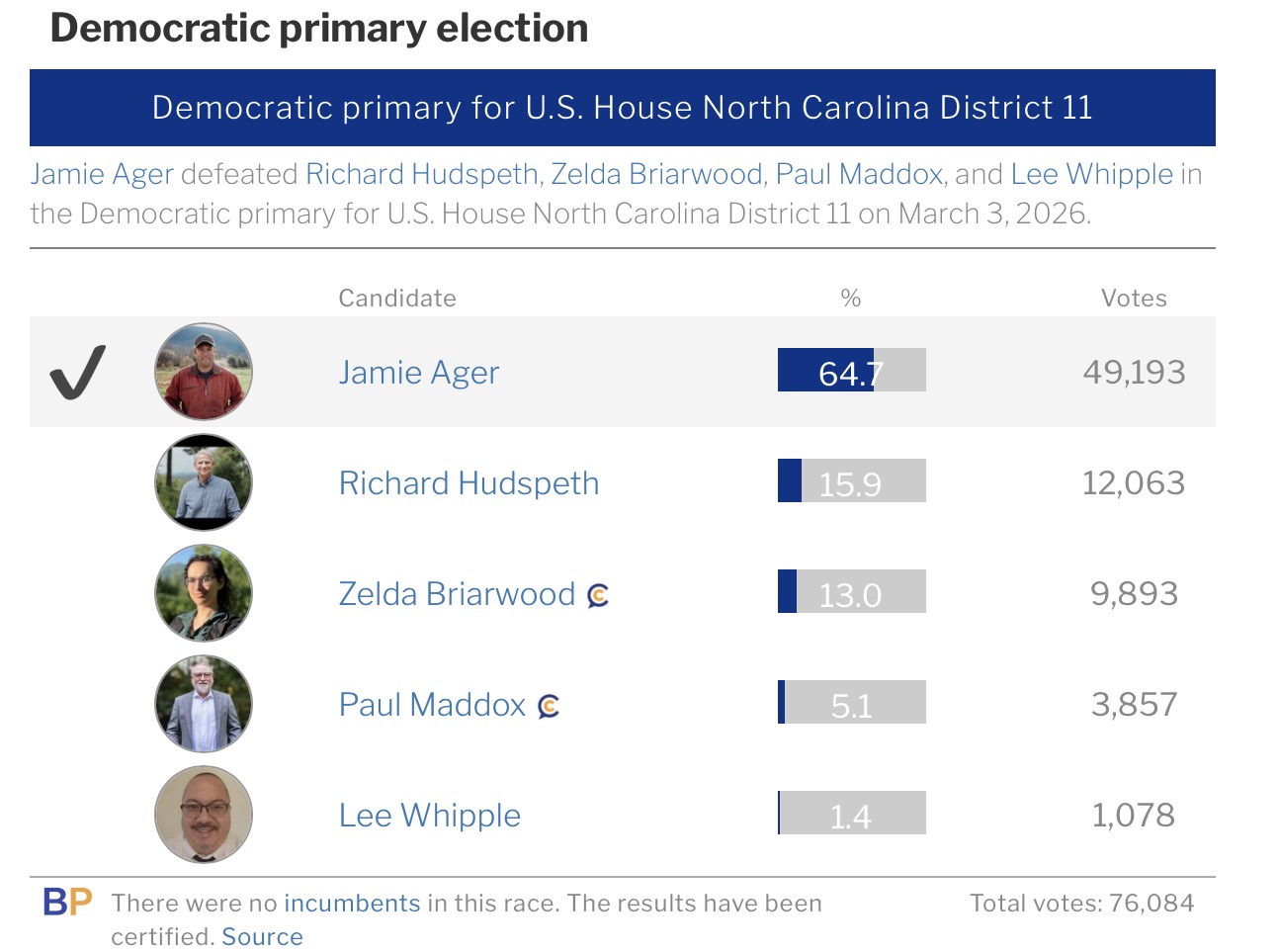
Edwards won his primary by more than 40 points, but that is now a moot point. Ager won his primary convincingly, also:
There are no signs of drama post-primary for Democrats, although Ager’s “blue dog” vibes will irritate radical leftists in Asheville; however, with an opportunity to win the seat, they’ll hold their noses and vote for him, especially with no Green candidate on the ballot.
Edwards’s departure and replacement by a candidate with a small online footprint and low name ID is the bigger story, and the late adjustment to this race is a major windfall for Democrats.
VI. Polls
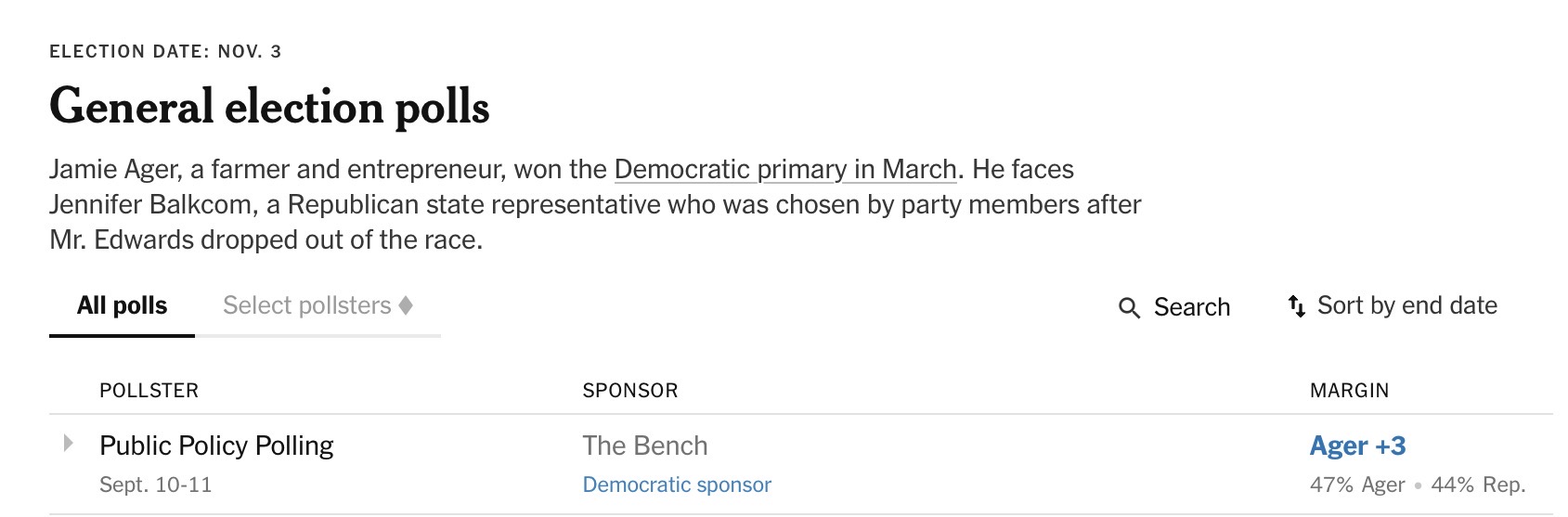
I pulled the only poll I could find from The New York Times:
A Democrat sponsor found the race at Ager +3, well short of a majority and generally inconclusive – as most polls are these days.
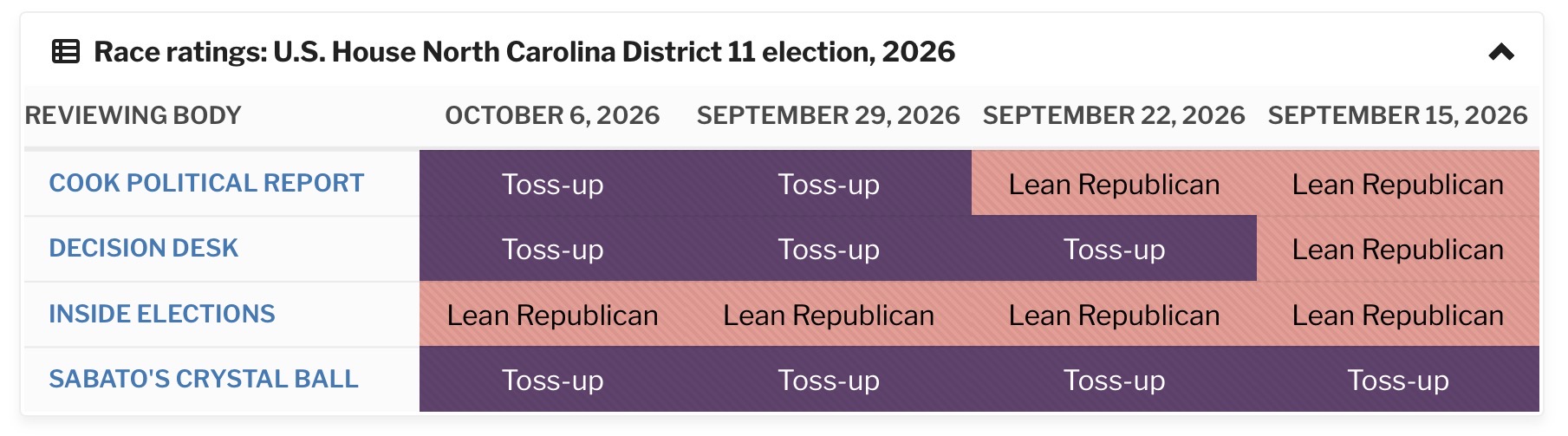
VII. Media Ratings
Only one of these analytical tanks still has the race favoring Balkcom, down from three a month ago. Still, no one is quite ready to lean it for Ager.
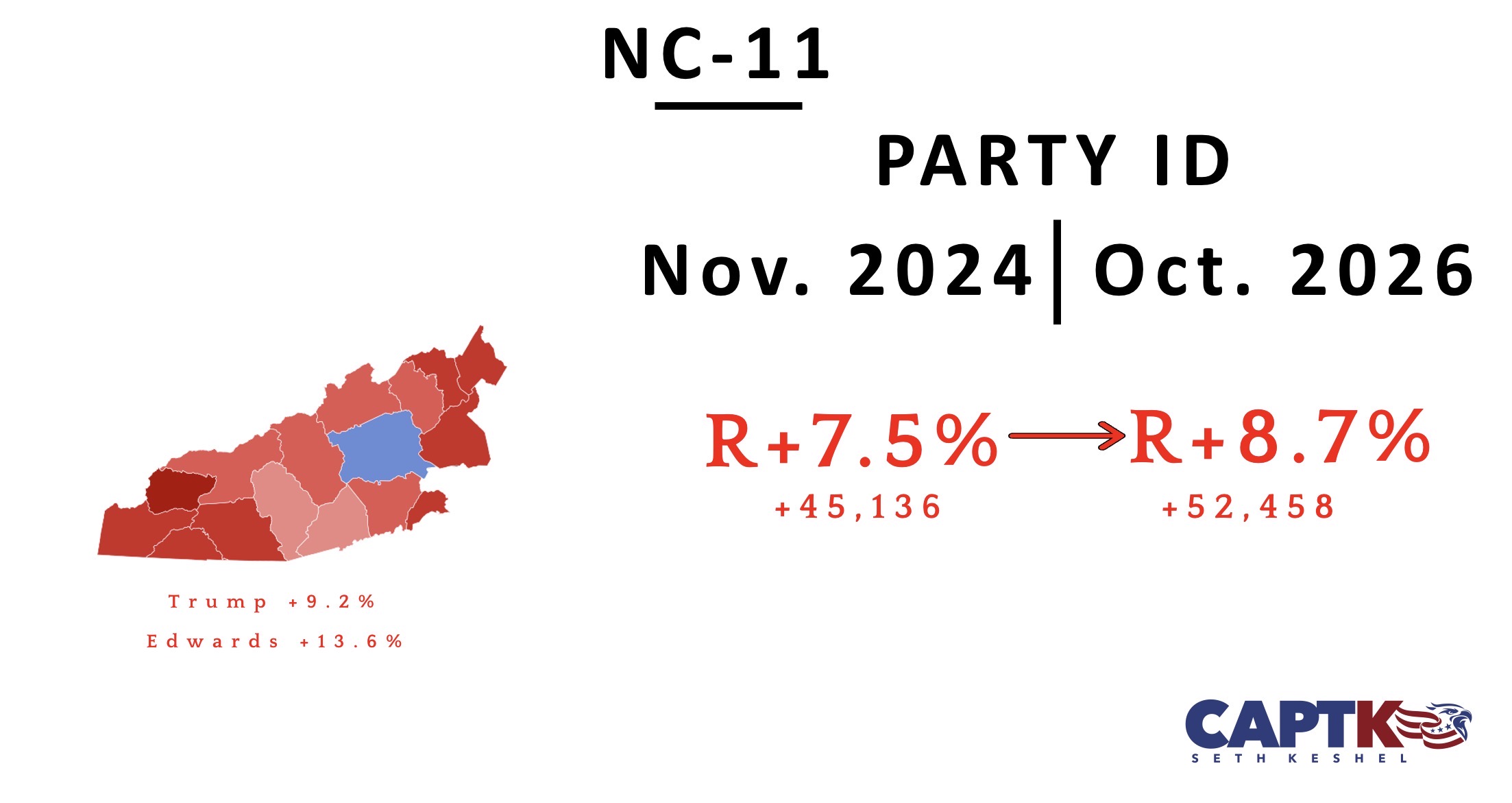
VIII. Party Registration
Despite a Democrat statewide surge in registrations since summer, NC-11 is notably more Republican than it was in November 2024. Democrats have lost over 2,500 registrants in Buncombe County since then, and the district itself sits over 7,000 registrations right from two years ago. This is not enough to seal the deal for Balkcom, but it makes the pathway to victory that much more difficult for Ager.
IX. Election Considerations
North Carolina only recently passed Voter ID, and has reasonably basic safeguards in place. It is not extremely easy to cheat in the state (exempting the mail-in heavy 2020 quasi election), but loopholes exist in the event of a close election, like that for the Supreme Court in 2024 – when the Democrat candidate “won” by 734 ballots after weeks of UOCAVA and provisional ballot drips.
In NC-11 specifically, based on disrupted registration to margin trends not seen in other portions of the state, I do believe absentee ballot cheating happened in small numbers in 2024 – but not enough to flip the state. Loopholes were available in Hurricane-impacted counties post-Helene, and my numbers suggest they were somewhat exploited. Those will not be open for exploitation in 2026, so the electoral environment isn’t of great concern to me this year.
You can read more about the above concerns in my review, North Carolina – 2024 Election Compendium (December 3, 2024).
X. Summary and Election Estimate
This seat becoming a decisive race for 2026 comes down to sheer Republican unforced error. It falls into the same category as OH-7, now a decisive race because Max Miller didn’t advise anyone of looming personal drama that was going to exacerbate the natural out-party margin advantage in a midterm year.
Edwards knew the ethics investigation was coming after him. He gambled and figured that anything that may drop on him would come after the November election, which he would have won against Ager somewhere in the mid to high single digits, riding incumbency. Had he prioritized the majority rather than his own status, he could have declined to run for reelection well in advance of the primary.
As things stand now, Balkcom has had to start from scratch. She won her own primary to run for reelection to the State House just two months ago, and now she’s taking on one of the most well-funded Democrats who actually fits his district in a year in which Democrats are blowing winnable races by nominating DSA-aligned radicals. She is being trounced in fundraising, and any leftward swinging that would have occurred against Edwards naturally (the swing in the former NC-11 was 7.8% left in 2018) will be amplified with the seat open.
Up until recently, I’ve had NC-11 in my “GOP leaner” category, even with Edwards out of the picture. Based on the data I track for these projections, I’m left with no choice but to now place this race on the decisive list. Mathematical pathways exist to a majority without this seat, but losing such a fundamentally strong seat makes it an extremely uphill climb to hold the House.
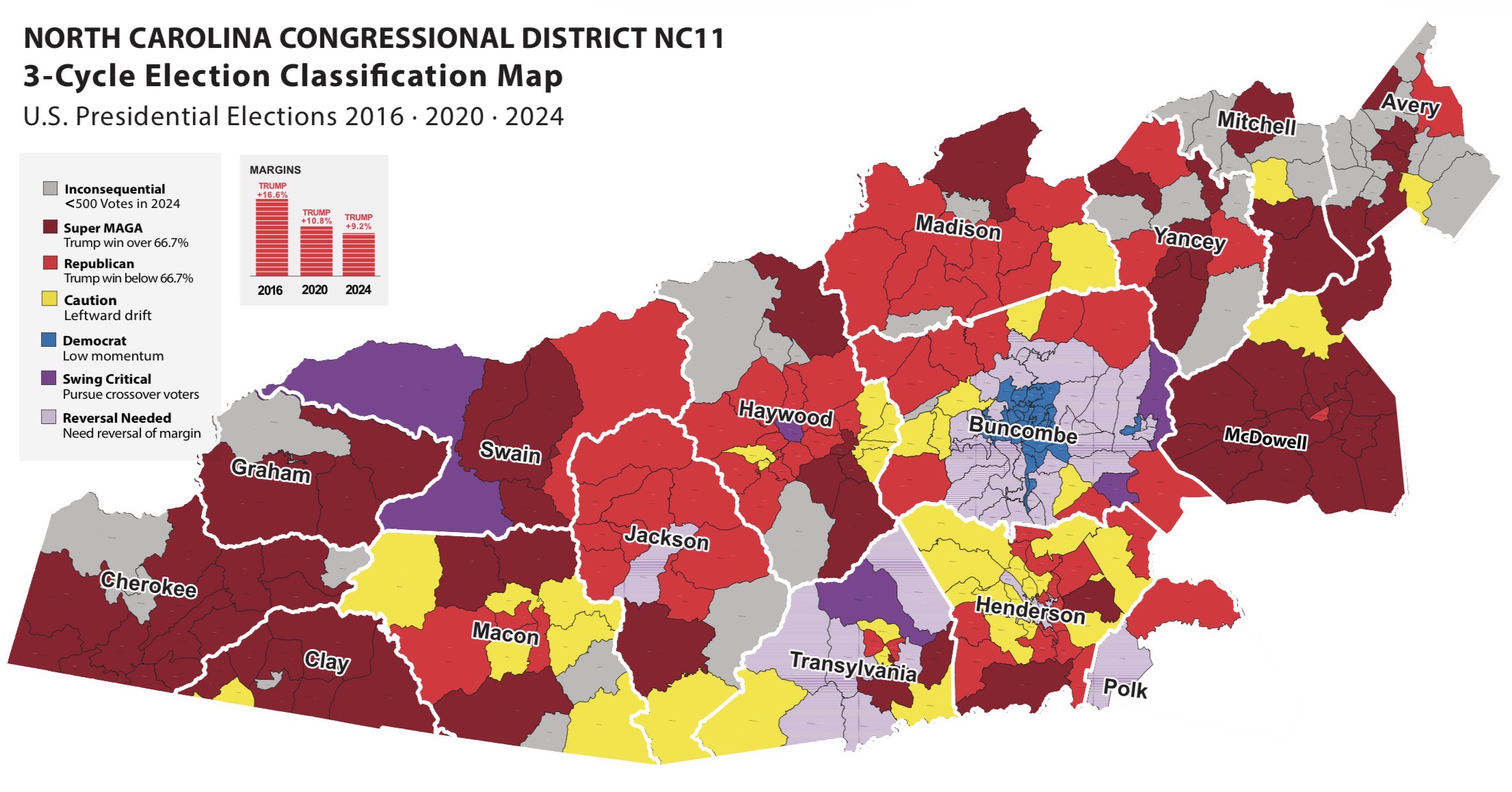
Captain K Proprietary Mapping of NC-11
The mapping above highlights the challenging electoral terrain in a race like this. Ager will get a big margin from Buncombe County (Asheville), which has a lot more high-propensity white liberals as a percentage voting in it than your standard urban area, such as Charlotte, which may see a drag with minority turnout once in-person early voting picks up. Those yellow precincts you see above (all over Henderson County), are precincts Trump won in 2024 that had notable leftward drift in margin from 2020, and in some cases, all the way back to 2016. These are the types of precincts Democrat Governor Josh Stein won in carrying this district by 7 points in his race against Mark Robinson (concurrent with the presidential race won by Trump by 9.2%).
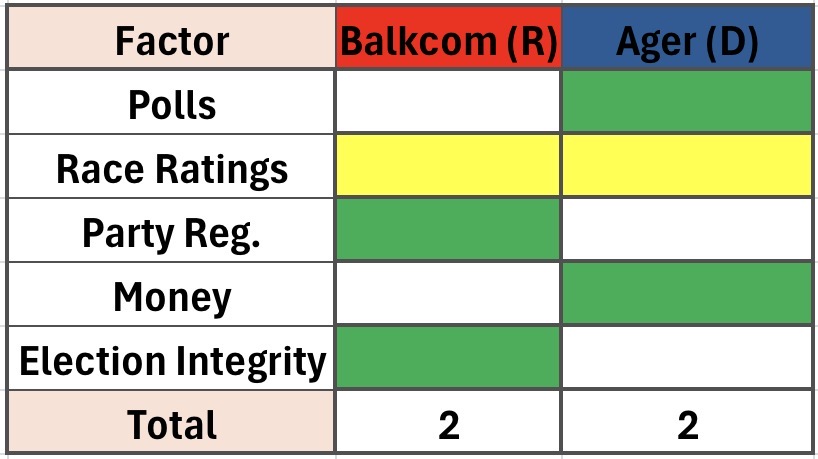
Here is where things stand today with regard to the key factors of the race:
Forecast for NC-11 House
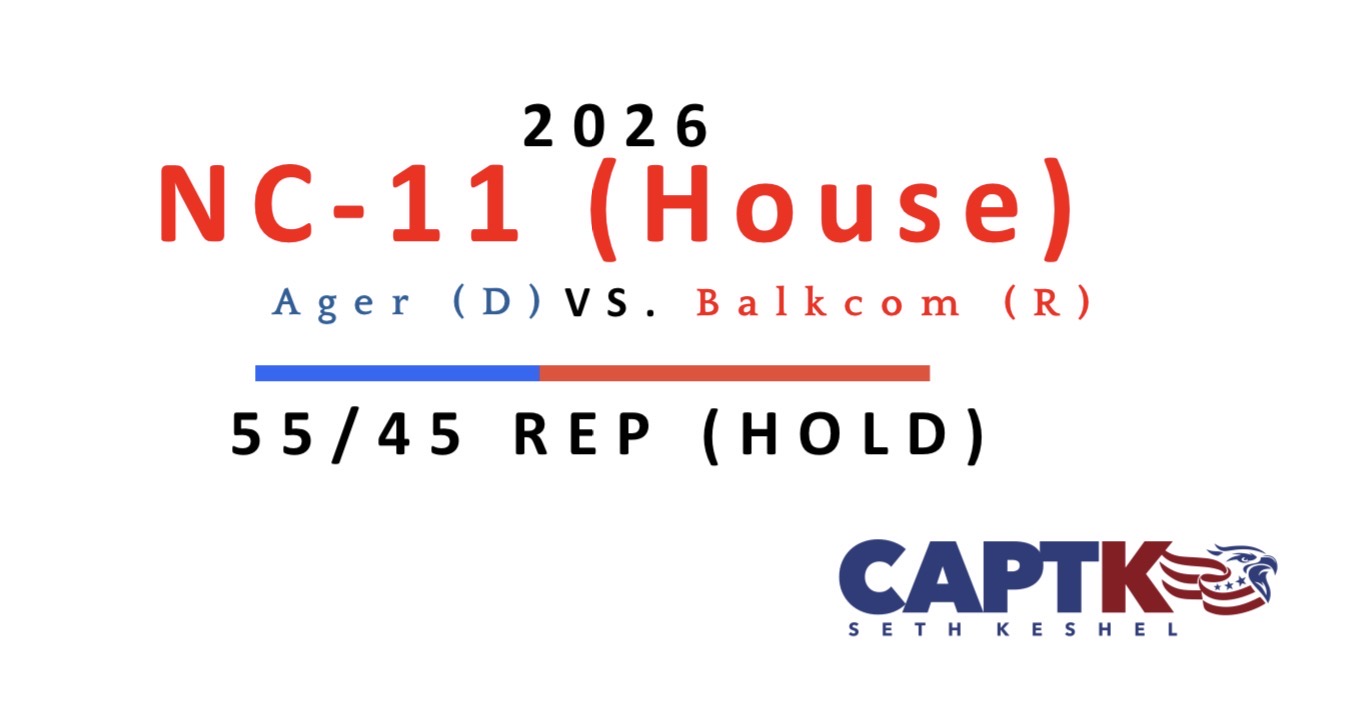
As noted earlier, Josh Stein won NC-11 by 7 points against Mark Robinson. North Carolina plays strange ball with Democrats in statewide elections, but has a very clear Republican preference for federal races. The big question for both Ager and Balkcom comes down to which preference will take root in this race. Edwards, free of scandal, would have carried this seat easily – albeit by a reduced margin from 2024. Balkcom, brand new to the race and facing a very tough midterm opponent with strong local ties and money, is a flip of the coin. A 55/45 rating in my system is a dead heat, and since I don’t believe in leaving things tied, she only holds an advantage based on the electoral terrain of the district and its modern precedent for electing Republicans. I don’t think either candidate has a ceiling of more than a few points in what may be one of the closest races this fall.
This seat has no business being in play, and you can thank Chuck Edwards if it is lost.
Seth Keshel, MBA is a Senior Fellow at the Gold Institute for International Strategy and a retired Army Captain. He publishes Captain K’s Corner on Substack.
From the Spanish government, the only thing His Majesty’s regime has received is doglike submission and collaboration in an invasion of Spanish territory.
King Mohammed VI has lashed out at Spain’s immigration laws, which he considers riddled with “obsolete legal provisions and unrealistic court rulings.” Allowing that the court rulings stem precisely from the laws, one has to admit that the monarch is very much right on this. Then, when he says he will not accept “pressure, threats or blackmail,” he gets rather grand. Because the truth is that the only thing His Majesty’s regime has received from the government of Spain is doglike submission and collaboration in an invasion of Spanish territory.
It has not even received a mild official reproach for unleashing a hundred thousand subjects on us and leaving us twenty thousand invaders to subvert order and sow panic in the Spanish city, tormenting the people of Ceuta with relentless vandalism, aggression and crime. True, given the evident collaboration of Pedro Sánchez and his government with the Moroccan authorities in allowing this invasion to happen, a reproach from Madrid might have drawn a response from Rabat that would have exposed his government’s betrayal of Spain even more plainly. It is the latest and most tragic chapter in Sánchez’s record of servitude to the government of Morocco.
Mohammed VI is right that in Spain we have ridiculous immigration laws, with authorities who always apply them in favor of illegal immigration and the pull effect. It is very true, for example, that the policy toward minors has all the hallmarks of a kidnapping. German or Norwegian or Italian children who turn up alone in Spain are back with their families and in their countries within 24 hours. African children are, in effect, forcibly adopted by the Spanish administration.
That has a great deal to do with an industry that has grown up in Spain around immigration, of which the current government is promoter and beneficiary, and which serves to divert massive amounts of public money into private hands via NGOs, associations and related services, all of them in the socialist orbit. And also some bodies and orders of the Church, so that the Spanish bishops never hesitate to applaud immigration, the more the better. The spending per immigrant and on all the services arising from their mass presence adds up to colossal sums that end up in all these organizations, which pay for the staff and for the organizational, propaganda and activist machinery of the left.
There is only one other way just as effective to plunder the public coffers without limit or shame, and that is international cooperation. It hands out billions to the most outlandish, exotic and remote projects, with, of course, no real monitoring or tracing of the funds that reach those supposed beneficiaries. The truth is that in many of those projects Spanish funding is incomprehensible when it is not grotesque. And those budget lines must necessarily answer to other interests, far more logical but unspeakable.
Mohammed VI is right that Spain needs much clearer and more logical laws for its very grave immigration problem, which is already an invasion. And not only in Ceuta. Laws that allow the immediate deportation of anyone, of any age and condition, without legal permission to be on its territory. Laws that remove every incentive to violate the borders, which means preventing illegal immigrants from benefiting from social, medical and housing services. And laws that require all countries of origin to accept their citizens. Spain and the European Union have the means to demand this respect from the countries of origin effectively.
Relations with Morocco will surely improve as soon as the government in Spain is not a lackey of Mohammed VI but a legal and legitimate government with no crimes to hide. Rabat, which has a government that defends its national interests, will get along better with a Spanish government devoted to defending the interests of Spaniards than with a traitorous, cowed government, constrained by a thousand secrets, complexes, fears and cover-ups. The many ambiguities in Spanish-Moroccan relations, many of them created on the Spanish side, must end. With a secure, militarized border in Ceuta and Melilla, an urgent clarification of the real legal status of all Moroccans naturalized as Spaniards without having renounced Moroccan nationality, a swift routine for deporting all illegal immigrants, minors included of course, and an end to hostile gestures, relations should reach a point of normalization.
For that, a policy that systematically favors Morocco to Spain’s detriment must end. This must also be made clear in Brussels, which, alongside the Sánchez government, is the greatest source of grievances, outrages and abuses against Spain for the benefit of Morocco. Let everyone remember that Morocco’s trade with Europe passes through Spain.
We know the effects of the deplorable fact that, while the Moroccan government works for its country, the current government of Spain also works for Morocco and against Spanish interests. The Spanish socialist group in the European Parliament is the Moroccan lobby there. Everything can and must improve in relations between the two countries.
But it is clear today that the demand for mutual respect, I insist, mutual, can only be met when Spain has a legal and legitimate government that defends Spanish interests and not a puppet of foreign or criminal interests.
Written byHermann TertschDistinguished Fellow (Honorary), Gold Institute for International Strategy