

Three more weeks.
This is my first post in nearly two weeks that isn’t a preview of a key race for the House or Senate. Today’s piece will be brief, but open for all of my subscribers in full. I may release a voter registration update spanning the 2024 election to the 2026 midterm election when I have closed books, but unless something absolutely wild breaks out, I’m going to be writing forecasts as I receive more and more data.
For today, I’m going to give you the clearest possible look at what I see developing in the midterms at a 30,000’ level. Like when you’re on the airplane and the captain tells you the cruising altitude and the weather at your destination, that’s what I’m going for today.
Here are four baseline items you can expect out of the 2026 midterms:
I. The GOP Can Retain the House Majority
Emphasis on can. They are not the favorites to do so, because 92 years of midterms inform us that the president’s party faces massive headwinds. Those have manifested as an average loss of 27 seats, and losses in 20 of 23 midterms since 1934; however, far fewer districts are competitive thanks to redistricting in blue and red states alike, and the GOP narrowly won the redistricting war thanks to the late impact of the Callais decision.
Even with Callais, the Democrats had a shot to sail to a relatively smooth flip of the House, even if their ceiling yielded only a small majority (less than 225). What they’ve done, however, is squander some of the most obvious flips by nominating radical, DSA-aligned candidates. In a normal year, even without an overwhelming generic ballot advantage, they would flip MI-7 and CO-8 with ease, winning both by roughly five points. I have the GOP favored to hold MI-7, and essentially dead even in CO-8.
We will soon find out just how much money impacts the balance of power when it is coming in hot from the Republican side. Normally, the Democrats are the ones with the huge financial advantage. Not so much this year. Republicans have a lot of seats to defend in which incumbents are doing the defending – this is an advantage worth a couple points, at minimum. While history suggests losses for the president’s party in 87% of midterms since 1934, I think the Republicans have perhaps a 1-in-3 shot of holding the House. Even if they don’t, the math doesn’t look promising for Democrats to command a large majority.
Like the Electoral College, the House math comes down to 435 individually drawn seats, not a generic ballot advantage.
II. The Democrats Have the Uphill Senate Climb
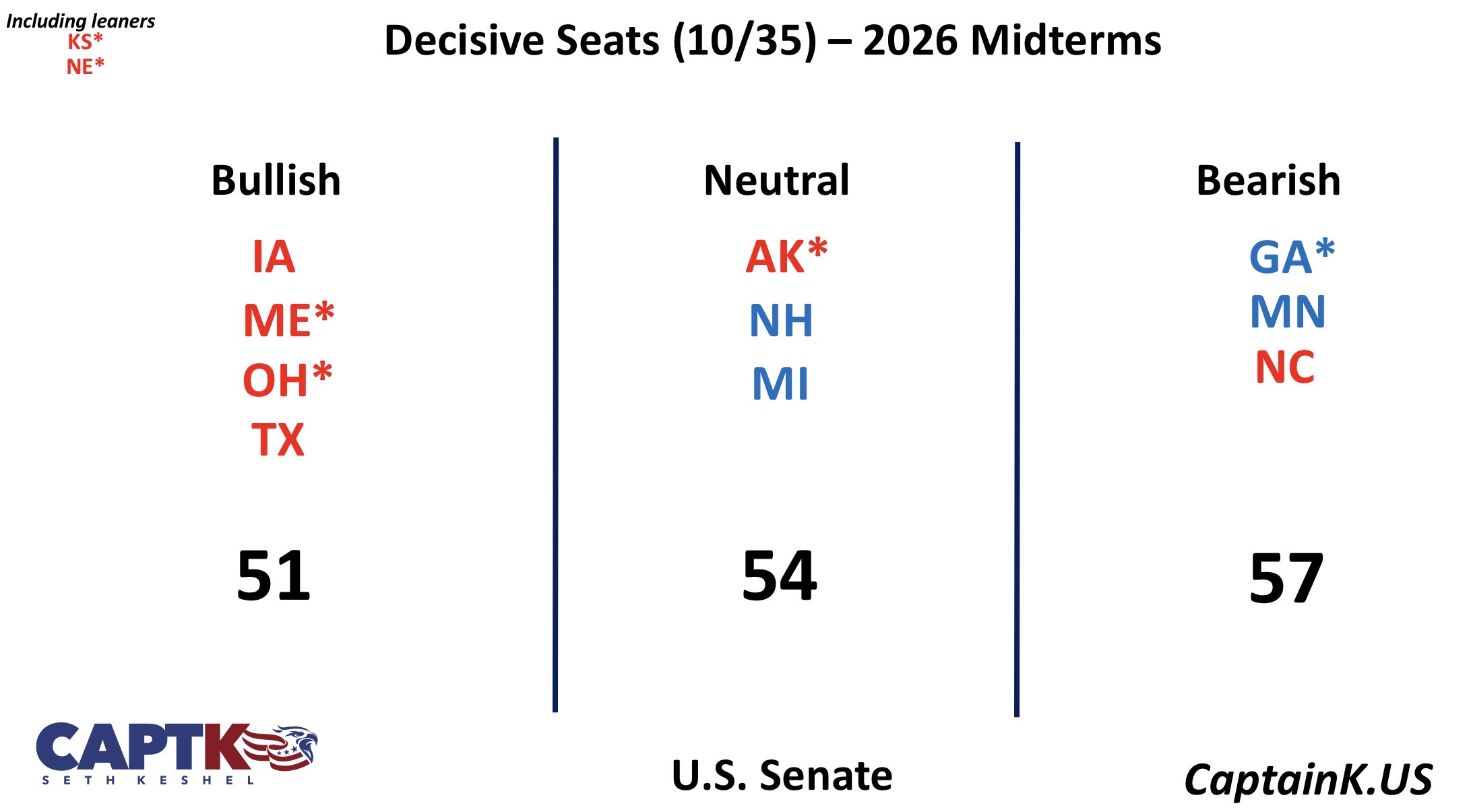
Just like the GOP can retain the House on paper, the Democrats can flip the Senate. It’s just not that easy, and the media are already hedging on the polls and their insane predictions that Democrats should be favored in four states Trump carried by over 11 points each.
Here’s how things go:
• Republicans have a 53-47 edge as things are today
• If Democrats flip North Carolina, that moves to 52-48
• Maine is a presidential blue state, but Collins is strong and likely to win, as I’ve profiled already – the Senate remains at 52-48 if this happens
• Democrats can hold Georgia, Minnesota, and New Hampshire (all likely), and even hold Michigan (toss-up), and still be down 52-48
• To get things to 50/50, they’d need to win two of Kansas, Nebraska, Iowa, Ohio, Alaska, or Texas
• Alaska may be a very dicey race for reasons I’ve profiled already, but the other states are formidable mountains and should help you understand why there is such a polling PSYOP underway
Senate races also behave more in line with presidential outcomes and feature far less volatility than House races. While the Democrats have a path, it’s most certainly not an easy one to navigate.
III. Tea Leaves
Many states have excellent reporting available in which analysts can observe mail-in balloting stats (like requests and returns) and in-person voting numbers. Georgia opens up in-person early voting today, and we will get a glimpse of enthusiasm that could tell us if Mike Collins has a shot in the Senate, or how the urban turnout in Atlanta that Keisha Lance Bottoms needs in order to become governor is shaping up. Data Republican has a great site with really cool trackers for Florida, Pennsylvania, and North Carolina.
Right now, early voting looks rough for Republicans in Virginia, but I am only monitoring VA-2, and possibly VA-1, as meaningful races. The media will cast this as a bad omen for the GOP, but what did we expect when the Trump 47 administration slashed the bureaucracy as promised? I warned of this in 2025 (and not a warning pleading not to do it).
Right now, Florida is not giving us a warning of a blue wave. There may be an indication of a blue undertow, which would be consistent with a standard midterm environment, but I’m less inclined to believe Republicans are heading for a reverse 1994 wipeout. Here’s data from Florida, from Data Republican’s page:
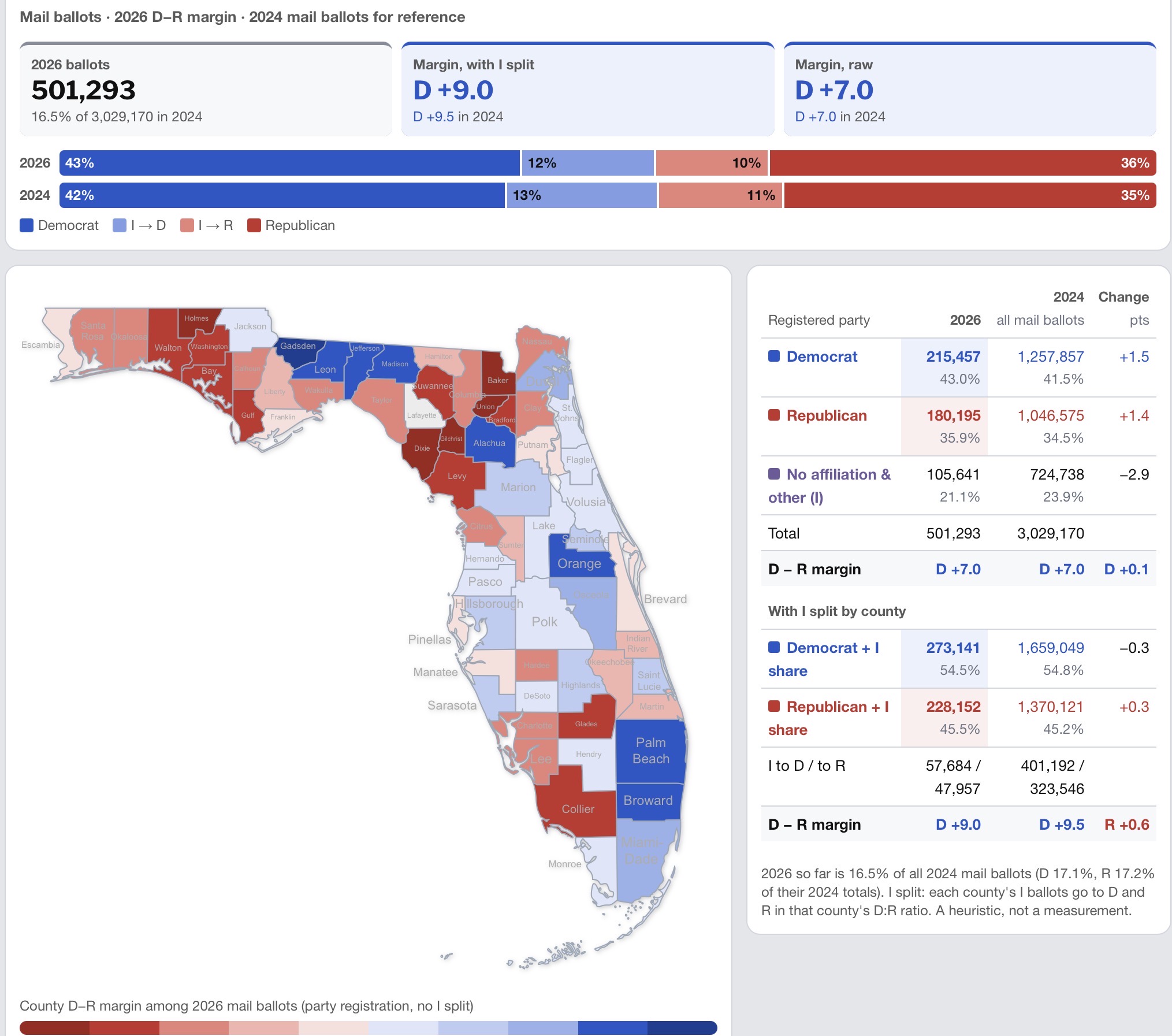
Yesterday, mail-in ballot returns favored Democrats by 7.1% (43.0% to 35.9%). You can see that in 2024, all mail-in ballots favored Democrats by 7.0%. This is also what things looked like in 2022; now, this may relatively favor Democrats because Florida is now R+11.4%, nearly four points to the right of the 2024 election – perhaps the GOP should run closer to even if all things were set equal.
That may be your Republican headwind, or perhaps during in-person early voting, Republicans will slaughter Democrats even worse than normal. Miami-Dade County and Broward County are much redder on returns compared with previous cycles, which is a bad omen for Democrats in the new decisive seat, FL-25.
In other states in which early voting data can be analyzed, Democrats appear to have mobilization issues in Ohio, Wisconsin, and more states in the Midwest. If this manifests in Georgia, North Carolina, and Texas, Democrats will struggle more than their forecasts and polls let on.
IV. Media and Polls Will Still Lie
If the pattern holds up, media fluff and polling nonsense will persist all the way until Election Day. Right now, there is a major operation to cover for James Talarico, who disappeared for almost two weeks before magically reemerging in Austin on October 9. If you’ve been following that drama on X, it has been suggested he was in a mental facility in Ohio, which the clinic denied and the New York Times denounced. Here’s an actual sequence of events:
Talarico disappeared in the middle of a campaign he’s supposedly winning, when actually winning it would require a full sprint through the finish line to win by the smallest of margins imaginable. When this came under scrutiny, we were told he had “the flu.” None of us would be off of work for that long with the flu, and no campaign would have been ground to a halt over it.
Whispers emerged about the Lindner Center of Hope in Mason, Ohio, which Lina Hidalgo (Harris County Judge) had been admitted to in 2023. Perhaps this was a source in Ohio, or one in Texas, or maybe just drawn from the internet as a rumor. Nick Sortor released audio of a receptionist at the clinic searching for “Talarico” in the database and confirming a discharge date. The date in the system didn’t line up with Talarico’s appearance in Austin, but that doesn’t erase the fact that she gave the information.
The facility, that evening, broke its own confirm/deny policies to state that they hadn’t ever treated Talarico. The statement looked to be written by a lawyer with plenty of room for interpretation.
The New York Times, yesterday, revealed that they had been shown proof of security footage confirming Talarico was indeed at home in Austin. They agreed not to show the evidence to the public. So, essentially, we were told “trust us” by the facility and by the media, as Talarico was lying about where he received medical care in Texas (Dallas or Austin?) and in which type of treatment center he was seen (primary or urgent care?).
There is a recorded call, and then there are two “trust us” statements – one from the facility and the other from the media. Talarico’s supporters say the call was made with AI; how are we to know any security footage, if it exists, isn’t made or timestamped by AI? If President Trump were being accused of a major scandal and ran to the NYT with evidence against it, would the public accept “trust us?” What would the media have done had Paxton disappeared for two weeks?
I fear we have reached the point in society at which anything can be written off as “AI” and without 100% evidence of something – it never happened. I don’t know if Talarico was in the mental facility or not, but I can damn near assure you they have something other than “the flu” going on. Many key Democrats are lamenting his absence from the trail publicly and don’t buy the story either.
You will continue to see the media rush to defend Democrat candidates and prop up suppression polling until the end of the cycle. The best thing that can happen for everyone is for the mainstream polling industry to go belly up, and be drastically wrong about the outcomes of this election. There are a few good pollsters left and some read this newsletter, and they will be the first to admit that many unethical pollsters should be forever exiled from the industry.
Conclusion
There you have the 30,000’ view in a nutshell. It will be an interesting three weeks, but these elections will face familiar headwinds and constant factors, as they do in every race. Key events can swing them, but early voting is underway in most states and the data we receive each day informs what is, and is not, possible for either side.
Thank you all for your readership, and make sure to get out and vote, and bring as many friends and family members of like mind with you to the polls.
Seth Keshel, MBA is a Senior Fellow at the Gold Institute for International Strategy and a retired Army Captain. He publishes Captain K’s Corner on Substack.
