Seth Keshel in The Washington Times on Why the Midterm Polls May Be Wrong

Voting booths set up beside an American flag on Election Day

This article was written by Seth McLaughlin and appeared in The Washington Times. Doubts abound about midterm polls. Could a ‘silver wave’ upend predictions of a Democratic takeover?.

Featuring Seth Keshel, MBA, Senior Fellow, Gold Institute for International Strategy

The polls say Democrats are headed for a wave in the midterm elections, but pollsters have been wrong before, and it would not take much of a miss to flip that script.

That is the worry hanging over races nationwide, including marquee Senate contests in red states such as Ohio and Texas. Democrats hold narrow leads in public surveys in those Republican strongholds and are counting on wins to take back the upper chamber.

It all comes down to a bigger question: Can the polls be trusted?

Pollsters have taken plenty of heat after several high-profile misses in recent cycles, and many analysts say the job is only getting harder. Fewer people pick up calls from unknown numbers, and response rates keep dropping. Meanwhile, campaigns are sifting through scattered streams of data to figure out who will actually show up on Election Day.

Harry Enten, CNN’s chief data analyst, said even a modest miss in Republicans’ favor could scramble expectations. It could flip Democratic-held Senate seats, such as in Michigan, and even help Republicans hold the House, which has historically been tough for a president’s party to keep in the midterms.

“If the polls underestimate Republicans by 2 to 4 points, well, remember all that blue that was on the map before? All that blue went bye bye, see you later, adios, amigos, sayonara,” Mr. Enten said.

Matt Towery, the Republican pollster who runs InsiderAdvantage, a polling and market research firm, said some polls are missing a key dynamic. He calls it the “silver wave” — a possible surge of older voters that could expose flaws in the polling and reshape the outcome on Nov. 3.

Early voting offers some hints. In Georgia, fewer than 70,000 early votes have come from 18- to 29-year-olds, compared with more than 549,000 from voters 65 and older. Ohio tells a similar story: 406,000 early votes from the white-haired crowd, against fewer than 50,000 from the 34-and-younger crowd.

“All of this nonsense you’ve heard about young people storming the polls and they’re going to change everything — it’s not taking place,” Mr. Towery said on Fox News.

Robert Cahaly, who runs polling and market research firm Trafalgar Group, said voters 50 and older are far more willing to vote than younger Americans, who often tell pollsters they will cast a ballot and then do not follow through.

He also said seniors who were less enthusiastic about President Trump in 2024 than about past Republican nominees are drifting back toward the Republican Party.

“A lot of the seniors are coming back, and they might not all love Trump,” Mr. Cahaly said.

He attributed the shift to older voters being more supportive of Mr. Trump’s approach to Iran — a stance he linked to their memories of the hostage crisis — and to their being less affected by high gas prices because they drive less, if at all, and are better positioned financially.

Older voters are also worried about the rise of socialism in the United States, he said.

The bigger problem, Mr. Cahaly said, is that the polling industry’s traditional tools just do not work like they used to.

Automated phone surveys have been hobbled by the disappearance of landlines, and voters are increasingly unwilling to answer calls from unknown numbers or sit through long online surveys.

He also knocked polls that ask 20 or 30 questions, saying they tend to attract highly engaged voters and people with time on their hands.

“How many people do you know that are under 50 that are going to answer the phone verbally from a number they don’t know?” he said.

Mr. Cahaly said many media and university polls overrepresent college-educated and higher-income voters, who have trended Democratic and have more time to kill, while missing the working-class and older voters who have moved toward Republicans.

He is not alone in questioning whether the polls capture the electorate.

Frank Luntz, a longtime pollster, said the industry’s biggest challenge is not measuring public opinion. It is figuring out who will actually cast a ballot.

Mr. Luntz said Republicans, especially Trump supporters, are less likely to take surveys and that many polls do not ask the questions needed to gauge engagement and turnout. Polls, he said, may be missing less-engaged voters who will not answer a survey but still show up on Election Day.

“I’m not convinced that they’re polling the people actually going to participate,” he said. “Turnout determines everything.”

Similar doubts have popped up elsewhere in the polling world.

In a recent interview with Politico, Republican pollster and strategist Patrick Ruffini said he thinks many surveys are right that the environment favors Democrats but may be overstating the size of the battleground.

Mr. Ruffini pointed to states such as Ohio, Iowa and Kansas, where he said history suggests Democrats face steeper odds than recent polling implies.

He also said pollsters are wrestling with response-rate problems that appear to favor Democrats.

“When you’re seeing high-propensity Democrats at twice the rate of high-propensity Republicans, when we know that the turnout on both sides would be roughly evenly paired, that’s a warning sign for polling in this cycle,” he told Politico.

Others have questioned specific surveys.

Take a recent University of Texas poll showing Democratic state Rep. James Talarico leading Republican Attorney General Ken Paxton by 3 percentage points in Texas’ U.S. Senate race, even though the Republican got just 55% of the White vote in the survey.

Seth Keshel, MBA

“Even Ted Cruz had 66% of the White vote in 2018,” said former Army Capt. Seth Keshel, an election analyst, citing exit polls and historical datasets. “So those kinds of things, you look at it, it’s like … either all these White rural voters that have voted Republican for everybody are going to run 20 points left, or this poll is going to be dead wrong.”

Look back at 2024: Mr. Trump carried Kansas by 16 percentage points, Texas by nearly 14 and Ohio by 11. He also won Iowa by 13 points after the final Des Moines Register poll showed Ms. Harris up by 3 points.

Others cite Sen. Susan M. Collins, Maine Republican, who was left for dead in 2020 after polls showed her losing by 6 percentage points. She won by 9 percentage points. She is trying to repeat that this year against Democrat Troy Jackson, who is up by almost 2 points in the latest RealClearPolitics polling average.

Mr. Keshel also questioned prediction markets and polls that suggest Democrats are competitive in deeply Republican states.

He said Mr. Talarico may become the first Democrat to win statewide in Texas since 1994, but it would take a near-perfect alignment of depressed Republican turnout, crossover voting and overwhelming Democratic margins in urban areas.

He applied the same skepticism to Kansas, where Democrats have struggled statewide for decades.

“My beef with the whole system is I don’t think that pollsters are considering any reality,” he said.

Read the full article at The Washington Times

Seth Keshel, MBA is a Senior Fellow at the Gold Institute for International Strategy and a retired Army Captain. He publishes Captain K’s Corner on Substack.

2026 Ten-Point Forecast: MT-1 (U.S. House – Leaner)

Montana landscape, cover image for the MT-1 House forecast

Aaron Flint (R) vs. Sam Forstag (D)

I. The Race

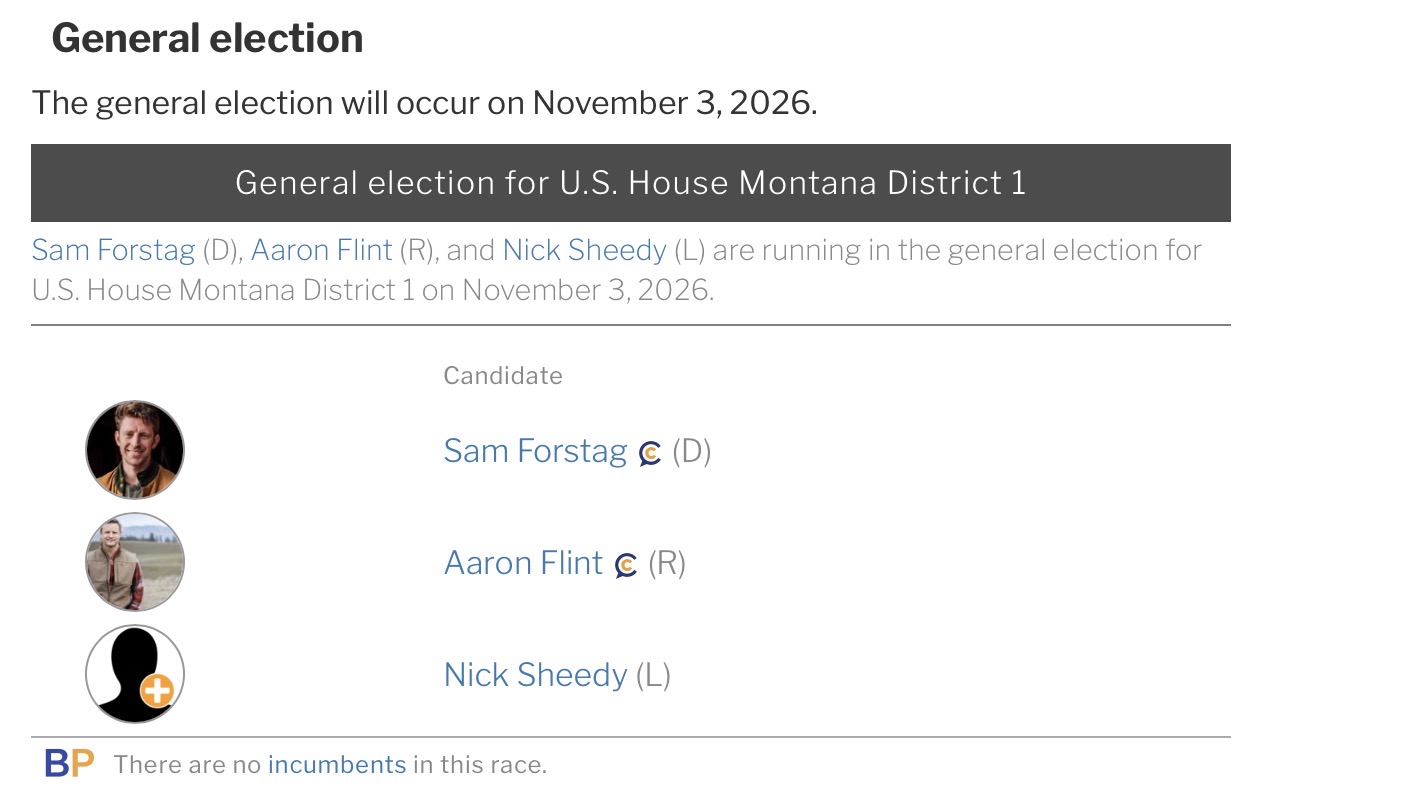
General election candidates for U.S. House Montana District 1: Sam Forstag (D), Aaron Flint (R) and Nick Sheedy (I)

Aaron Flint (Republican) is a well-known radio talk-show host and Army veteran. He’s new to elected politics and looking to replace Ryan Zinke, who served MT-1 for two terms.

Sam Forstag (Democrat) is a union man and smokejumper running a populist Democrat campaign with limited animosity toward the Trump administration. Most of it is boilerplate red state Democrat campaign fluff, but he’s adamant about bleeding the wealthy dry with taxes. I’m not sure how that’s going to fly with all of the people who watched Yellowstone and took their money north for a dream estate.

II. District Geography

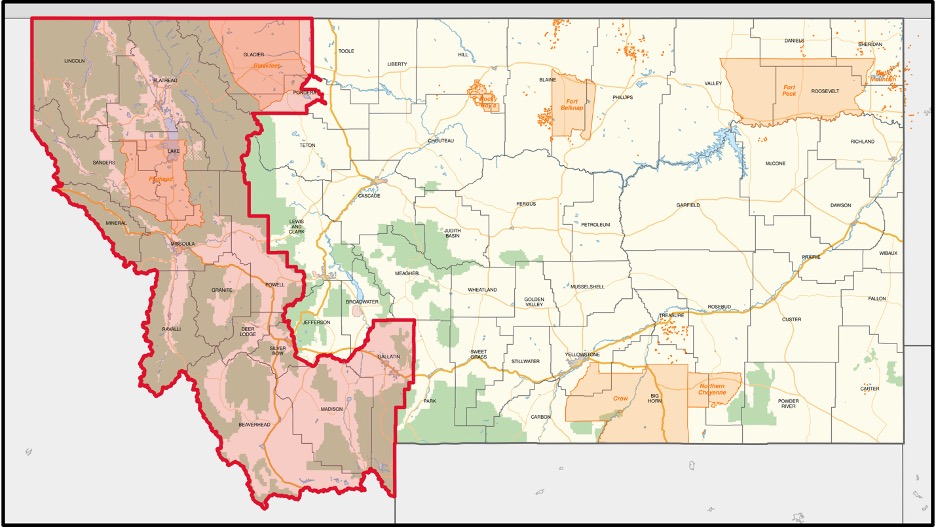
Map of Montana's 1st Congressional District

Montana’s 1st Congressional District (MT-1) is new. Montana’s population growth gave it a second seat in the U.S. House, and the at-large district it once had split in two. The people who drew the seat really failed Gerrymandering 101, because it is a tough district that could easily be lost in a Democrat wave year. It features all but a handful of Montana’s major cities – like Bozeman, Butte, Missoula, and Kalispell. All four of those except for Kalispell are trouble cities for the GOP that require high rural margins to override.

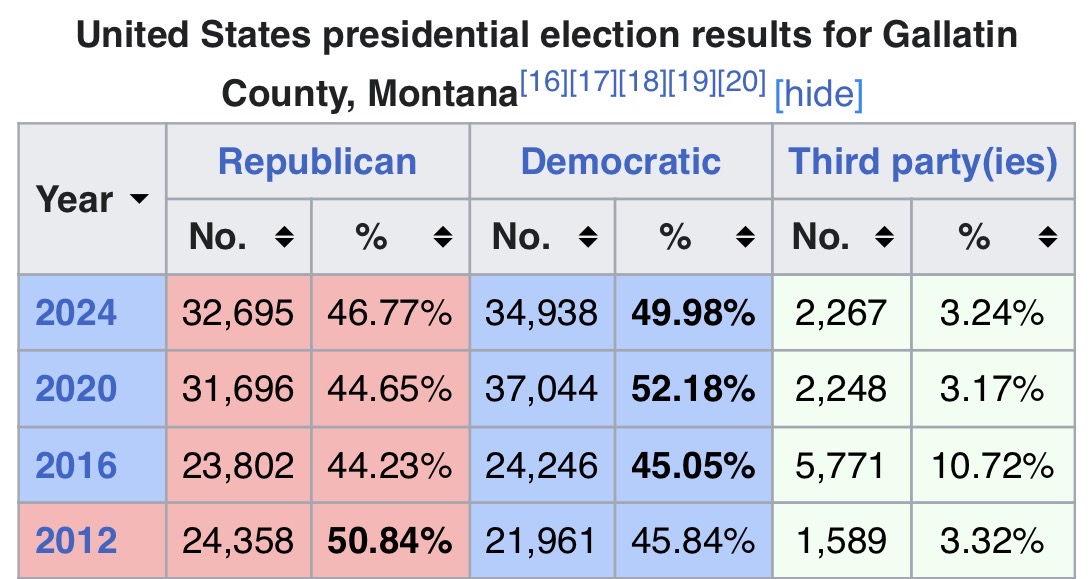
Bozeman is in Gallatin County. To provide an idea of how much the high tech development of this portion of Montana has hurt GOP margins, here’s a chart:

Chart of Gallatin County presidential margins since 2012

It has swung roughly 8 points left since 2012, and while not many raw votes have moved, the trajectory of Gallatin County (complete with an expanding tech industry and saddled with Montana State University) tracks like a standard Colorado urban area. Missoula County, home to the University of Montana, has provided Democrat presidential nominees with comfortable margins, although the GOP candidates normally park in the high 30s as a share of the vote. Outside of those areas, it’s cowboy country like the rest of Montana, with nice margins in places like Flathead County (Trump +33.8% in 2024) – home of some of the most amazing scenery anywhere in the world.

Presidential Margins

2016 Trump +12
2020 Trump +7
2024 Trump +11

Key Statistics

84.8% White, 4.4% Native American

III. Market Assessment

Despite the open seat and competitive nature of western Montana, Republican Flint remains a roughly two-to-one favorite on Polymarket.

IV. History

MT-1’s history, at least as an individual U.S. House seat, is new. Ryan Zinke, who is retiring from Congress, is the first person to represent the district. He served as Secretary of the Interior in Trump’s first administration and defeated Democrat Monica Tranel in 2022 by just 3.2% (less than 8,000 votes in margin). The two rematched in 2024, and Zinke expanded his margin to +7.7%; it is important to note that he rode the Trump train (which had a margin of +11%) to victory and ran 3.3% behind it.

For brevity’s sake, it is easy to understand why the president is rallying in Montana; it’s not for the U.S. Senate race.

V. Analysis of 2026 Primary Results

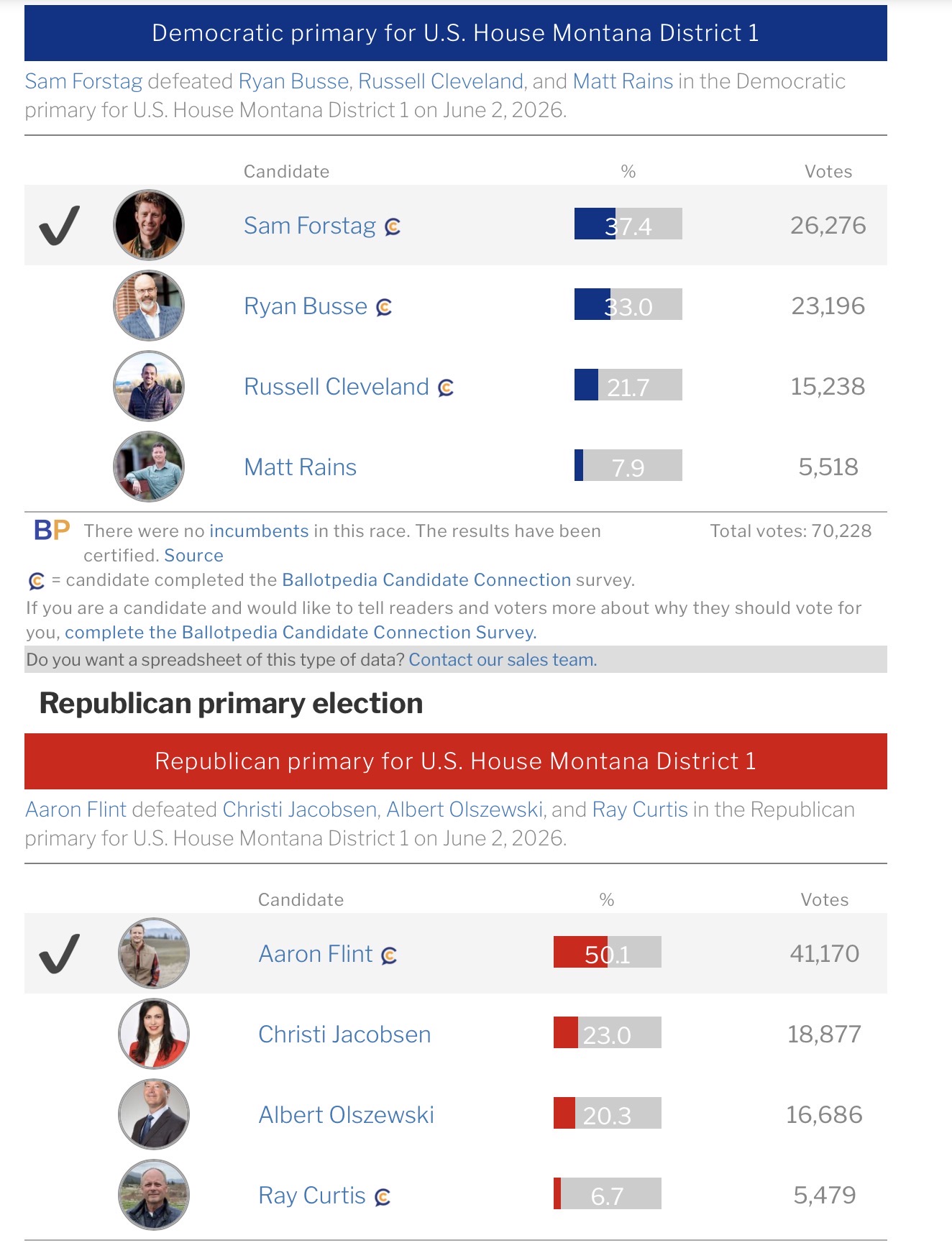
2026 primary results for Montana's 1st District

Both parties had crowded fields to nominate someone for the open seat. Flint won a bare majority for the GOP nomination, but Forstag squeaked past Ryan Busse by 3,080 votes to secure the Democrat nomination.

Despite the competition, everyone emerged unscathed and there is no bitter flap in this race on either side that should be expected to weigh on the General Election.

VI. Polls

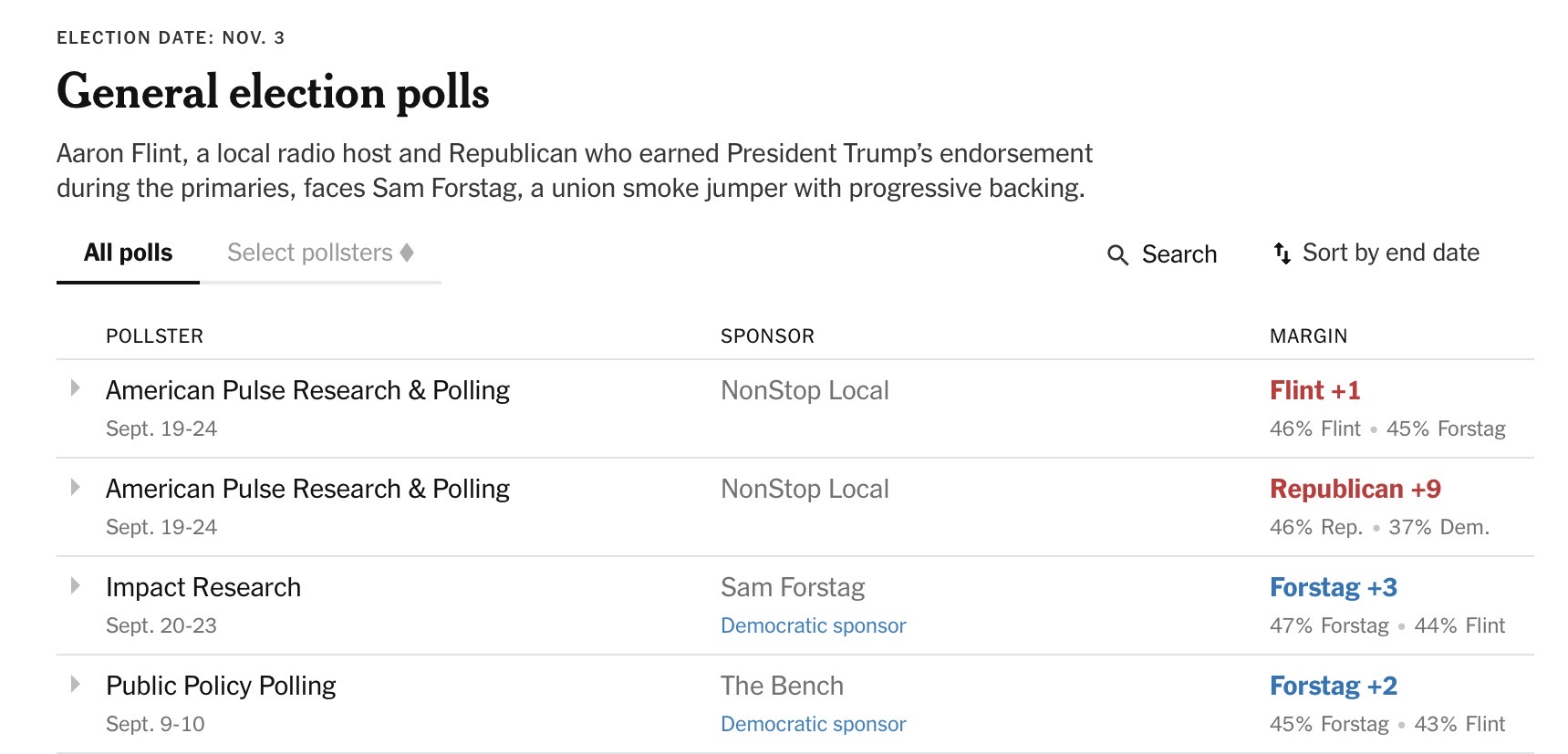
These polls were hosted by The New York Times:

Table of public polls in the MT-1 race

I don’t know what in the hell the Republican +9 poll is supposed to be, but that’s outside the realms of reality and logic. There are two narrow Forstag leads within the margin of error from September, and a Flint +1 that came out last month.

Polling reveals no clear advantage.

VII. Media Ratings

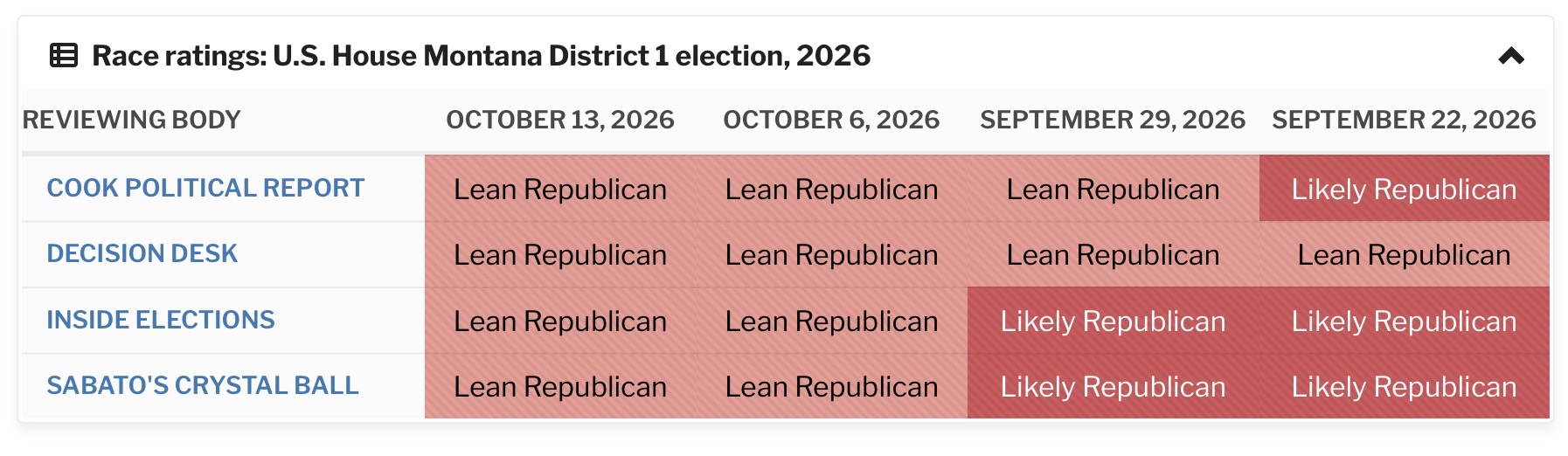
Media race ratings for MT-1

Every reviewing outlet considers the race “Lean Republican,” although three have recently downgraded from “Likely Republican” – a smart move.

VIII. Party Registration

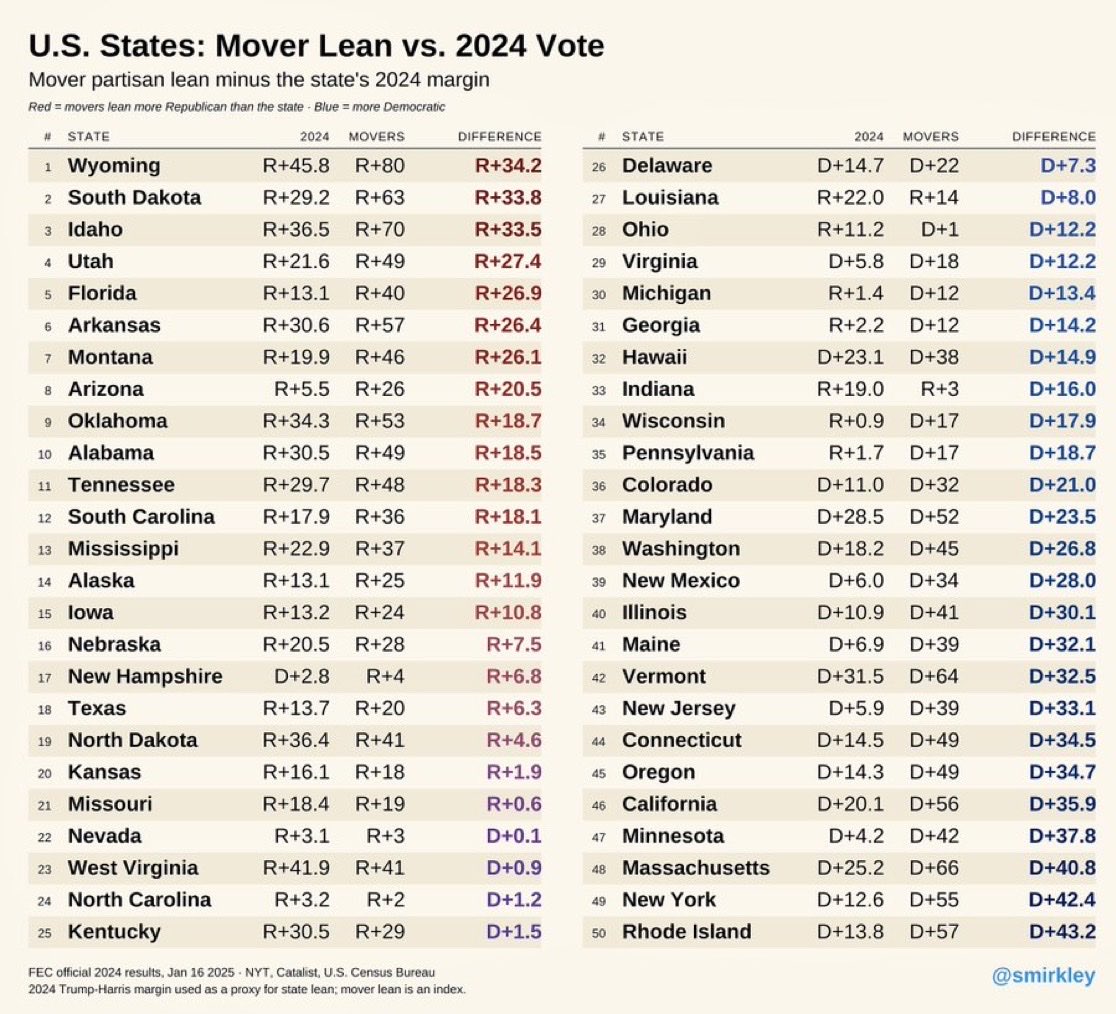
Montana does not register voters by party; however, data tracked for movers suggests new transplants to Montana are overwhelmingly Republican – perhaps as much as R+46.

Party lean of new movers to Montana

In a race that frequently comes down to tight margins, statistics like these really move the needle. I would consider this a likely stand-in advantage for party registration (if Montana tracked such data).

IX. Election Considerations

I profiled Montana’s 2024 election with regard to election integrity and found a low risk for that race.

In that article, however, I do note that the state has loose ballot harvesting laws, and independent researchers in Montana have found evidence of significant harvesting happening in Missoula and on reservations (like Blackfeet and Flathead, both inside MT-1’s boundaries). In a close race, this can be decisive.

X. Summary and Election Estimate

I don’t agree with all of President Trump’s rally locations because I think consultants and campaign strategists are buying into polling noise; however, the fundamentals of MT-1 absolutely justify increased attention, especially in a year that is ostensibly favorable to Democrats. MT-1 reminds me a little bit of AZ-2, a district with a GOP representative (Eli Crane) who didn’t get a huge margin in 2024. Crane’s base is white conservatives, especially from Yavapai and Gila Counties; they are inelastic (their margins are heavily Republican), as are the Democrat base voters (college kids, white liberals, and Native Americans).

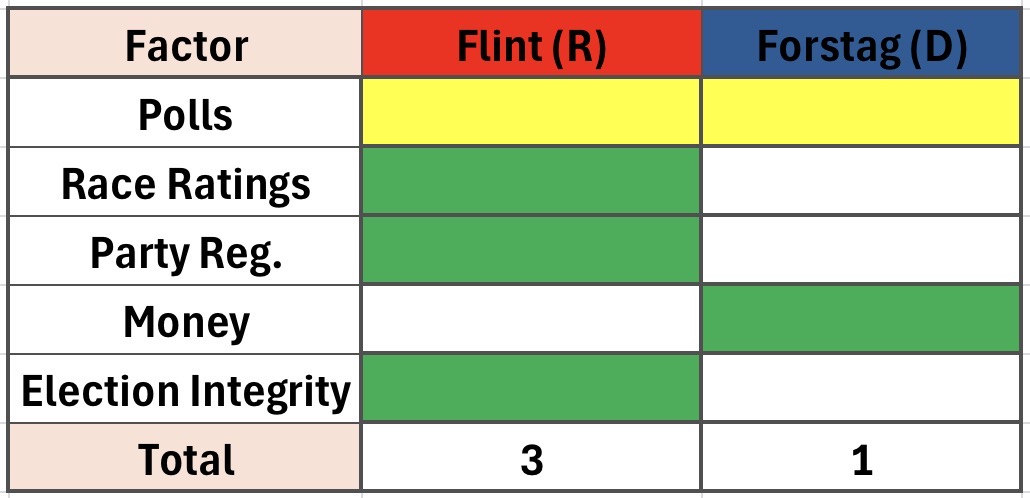
The same is true of this race, except for that it takes place with tighter baseline margins than the race in AZ-2 does. We will know if this seat is at risk of flipping based on how engaged Missoula and Gallatin Counties appear to be (home counties of two universities). This is what my decision matrix looks like:

Keshel's decision matrix for the MT-1 race

Forstag blew away Flint for receipts last quarter, although Flint has more on hand. Now is the time for him to use it, because MT-1 stands to be one of the top five upset opportunities available for Democrats in the 2026 cycle.

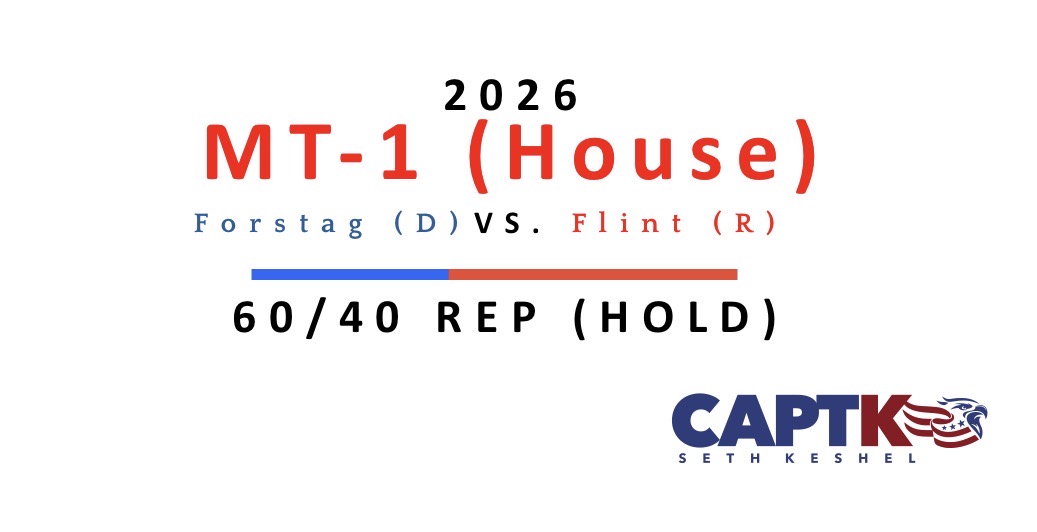
Forecast for MT-1 House

Keshel's forecast graphic for the MT-1 House race

The fundamentals of this race favor Flint, and not by much. The only thing keeping me from considering this race a tossup and leaning it to Flint 55/45 is the fact that transplants to Montana are overwhelmingly Republican. In a race decided by very few votes, those movers make a huge difference, and I don’t think they’re interested in being represented by someone tied to AOC and Bernie Sanders, or who wants to tax the hell out of them. The first order of business at the first possible opportunity for Montana Republicans should be to rearrange the district lines and pull MT-1 out of the line of fire. MT-2 has a Republican margin of more than 30 points, and Bozeman would fit quite nicely inside of it while sharing a district with Billings.

Seth Keshel, MBA is a Senior Fellow at the Gold Institute for International Strategy and a retired Army Captain. He publishes Captain K’s Corner on Substack.
Gen. Xavier Brunson Delivers Remarks at the Gold Institute

Gen. Xavier T. Brunson is presented a gift by Eli M. Gold at the Homer Building in Washington, D.C.

This article was written by Sgt. Brendon Donahue and appeared in DVIDS. General Brunson Gold Institute Remarks [Image 2 of 3].

Featuring Eli M. Gold, President, Gold Institute for International Strategy

Eli M. Gold

U.S. Army Gen. Xavier T. Brunson, right, commander of United Nations Command, Combined Forces Command, and U.S. Forces Korea, is presented a gift for his remarks by Eli M. Gold, president of the Gold Institute for International Strategy, at the Homer Building in Washington D.C., October 14th, 2026. (U.S. Army photo by Sgt. Donahue, Brendon.)

Read the full article at DVIDS

Eli M. Gold is the President of the Gold Institute for International Strategy, a Washington, D.C. foreign policy and defense think tank.

Our Discussion in Tel Aviv Last Week – Why Americans Should Care About Defensible Borders for Israel

Soldiers marching through a rugged landscape in Israel

This article was written by Ernie Audino and appeared in Frontlines of Freedom. OUR DISCUSSION in TEL AVIV LAST WEEK – WHY AMERICANS SHOULD CARE ABOUT DEFENSIBLE BORDERS for ISRAEL.

5-Star General George Marshall (also Sec Def, also Sec State, also architect of the Marshall Plan for Europe) said this, “You don’t fight unless you must, you don’t fight for long…and [that’s why] you don’t fight alone.” In the Real World, defensive alliances and partnerships are not charity cases. Just because you might want to be part of our “club,” doesn’t mean we necessarily want you. If your membership in our “club” only imposes cost, then you’re only a liability, not an asset. We want ASSETS. In fact, we want as many assets as we can get. We want partners who can stand beside us and throw knockout punches. That’s Israel. In this War on Humanity that was birthed in Tehran in 1979, no other ally has shown the will and the capability that Israel has.

And that’s a key reason why we should care about Israel. When democracies are at war, their Center of Gravity is almost always their domestic support. If we Americans want a strong and capable ally in Israel, now and into the foreseeable future, then we must acknowledge that the day-to-day security of Israel’s domestic population is in American interest, and THAT depends principally on defensible borders. This is of even greater interest to Americans of late, as many of our European allies have recently demonstrated neither the will nor the capability to throw a punch.

Written by Ernie Audino Senior Military Fellow, Kurdistan Program (U.S. Chair), Gold Institute for International Strategy