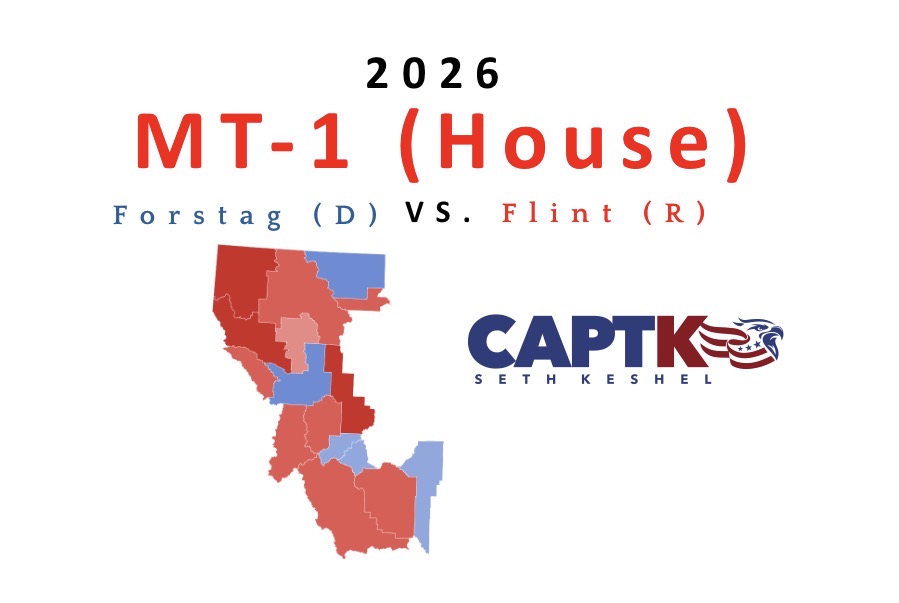
Aaron Flint (R) vs. Sam Forstag (D)
I. The Race
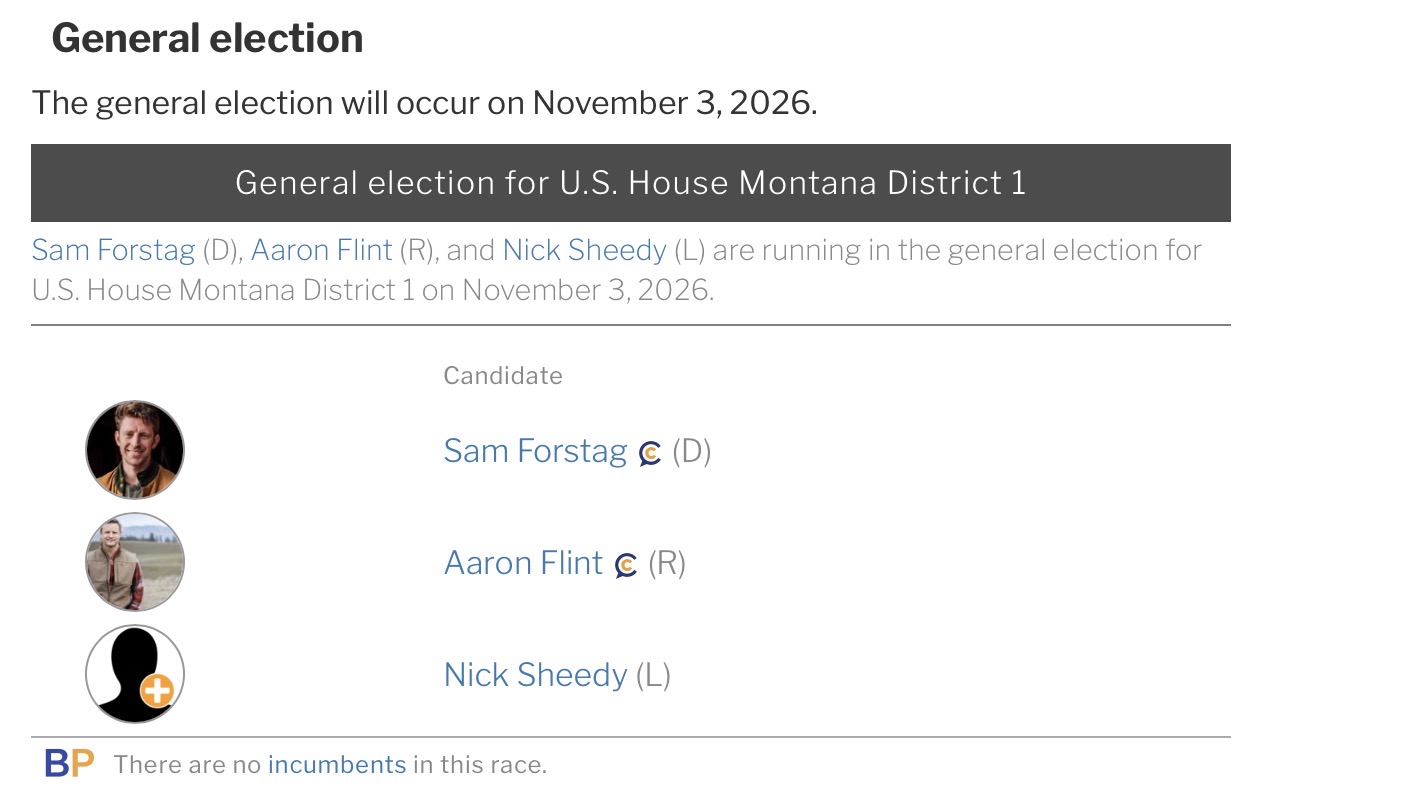
Aaron Flint (Republican) is a well-known radio talk-show host and Army veteran. He’s new to elected politics and looking to replace Ryan Zinke, who served MT-1 for two terms.
Sam Forstag (Democrat) is a union man and smokejumper running a populist Democrat campaign with limited animosity toward the Trump administration. Most of it is boilerplate red state Democrat campaign fluff, but he’s adamant about bleeding the wealthy dry with taxes. I’m not sure how that’s going to fly with all of the people who watched Yellowstone and took their money north for a dream estate.
II. District Geography
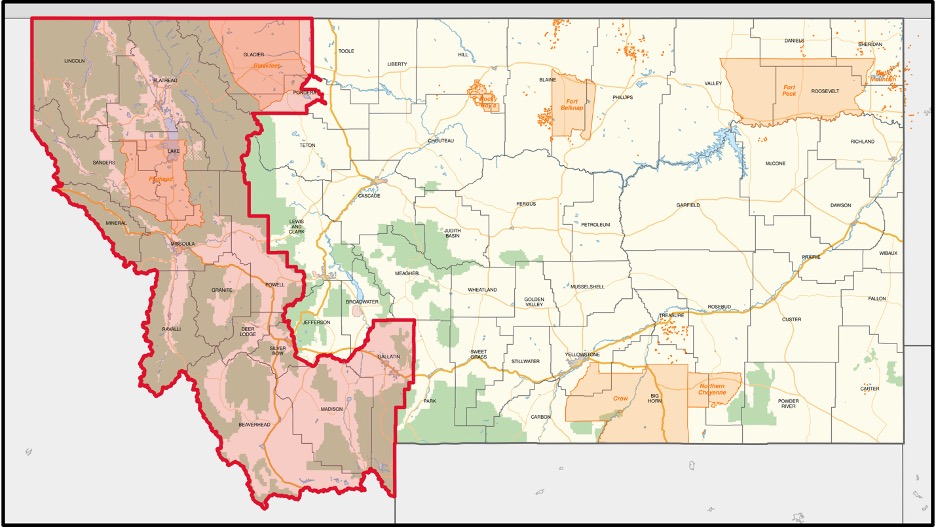
Montana’s 1st Congressional District (MT-1) is new. Montana’s population growth gave it a second seat in the U.S. House, and the at-large district it once had split in two. The people who drew the seat really failed Gerrymandering 101, because it is a tough district that could easily be lost in a Democrat wave year. It features all but a handful of Montana’s major cities – like Bozeman, Butte, Missoula, and Kalispell. All four of those except for Kalispell are trouble cities for the GOP that require high rural margins to override.
Bozeman is in Gallatin County. To provide an idea of how much the high tech development of this portion of Montana has hurt GOP margins, here’s a chart:
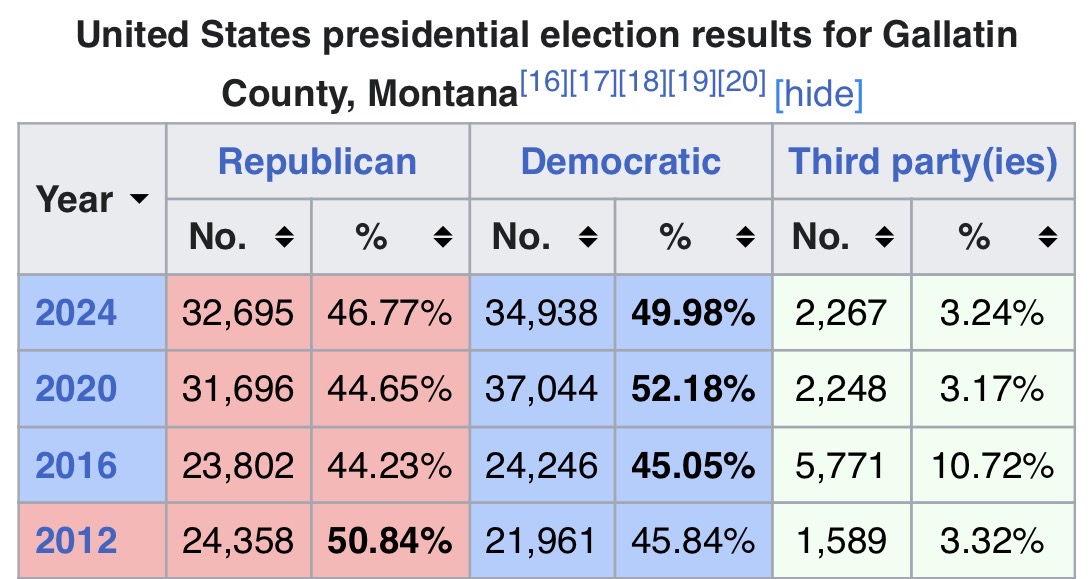
It has swung roughly 8 points left since 2012, and while not many raw votes have moved, the trajectory of Gallatin County (complete with an expanding tech industry and saddled with Montana State University) tracks like a standard Colorado urban area. Missoula County, home to the University of Montana, has provided Democrat presidential nominees with comfortable margins, although the GOP candidates normally park in the high 30s as a share of the vote. Outside of those areas, it’s cowboy country like the rest of Montana, with nice margins in places like Flathead County (Trump +33.8% in 2024) – home of some of the most amazing scenery anywhere in the world.
Presidential Margins
2016 Trump +12
2020 Trump +7
2024 Trump +11
Key Statistics
84.8% White, 4.4% Native American
III. Market Assessment
Despite the open seat and competitive nature of western Montana, Republican Flint remains a roughly two-to-one favorite on Polymarket.
IV. History
MT-1’s history, at least as an individual U.S. House seat, is new. Ryan Zinke, who is retiring from Congress, is the first person to represent the district. He served as Secretary of the Interior in Trump’s first administration and defeated Democrat Monica Tranel in 2022 by just 3.2% (less than 8,000 votes in margin). The two rematched in 2024, and Zinke expanded his margin to +7.7%; it is important to note that he rode the Trump train (which had a margin of +11%) to victory and ran 3.3% behind it.
For brevity’s sake, it is easy to understand why the president is rallying in Montana; it’s not for the U.S. Senate race.
V. Analysis of 2026 Primary Results
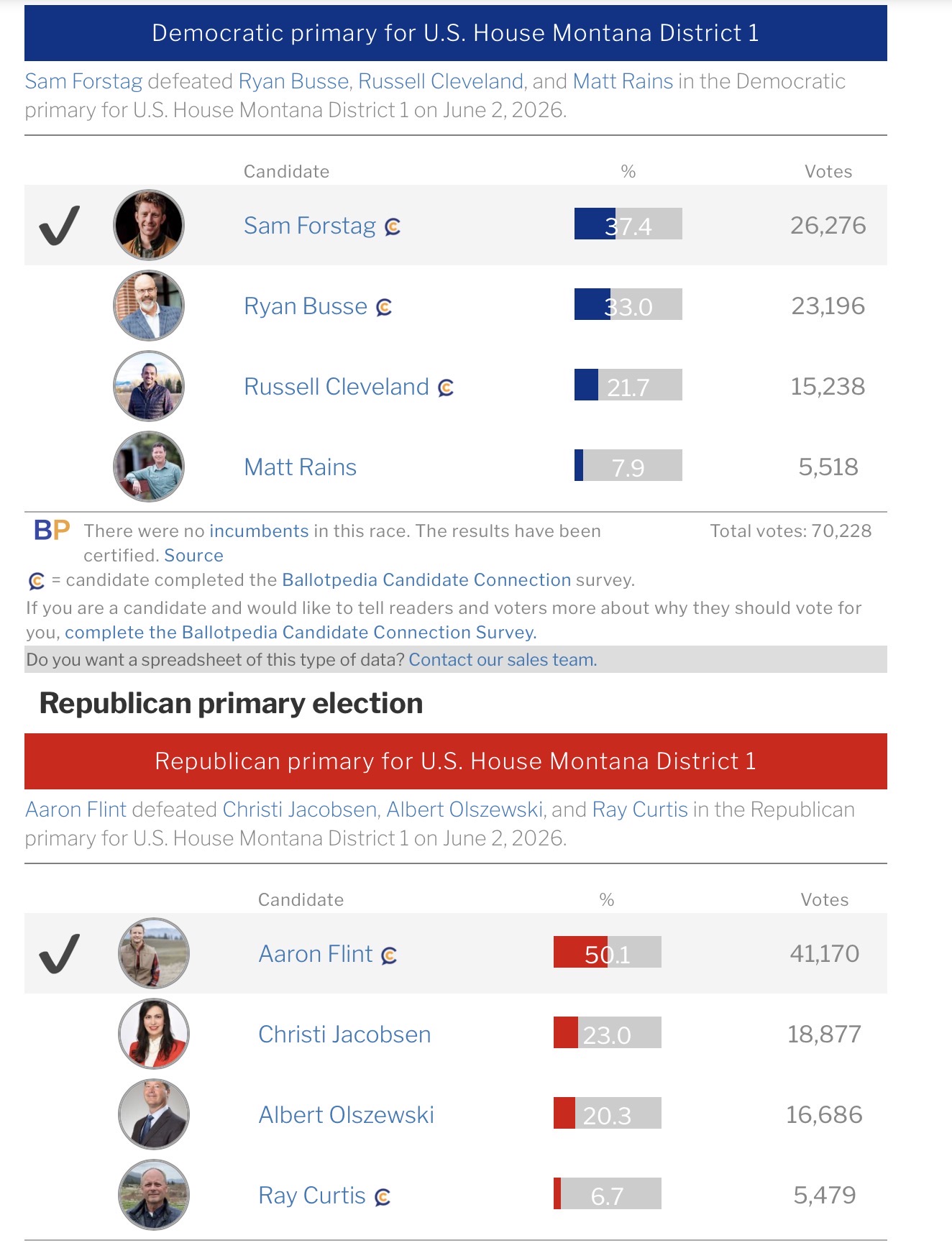
Both parties had crowded fields to nominate someone for the open seat. Flint won a bare majority for the GOP nomination, but Forstag squeaked past Ryan Busse by 3,080 votes to secure the Democrat nomination.
Despite the competition, everyone emerged unscathed and there is no bitter flap in this race on either side that should be expected to weigh on the General Election.
VI. Polls
These polls were hosted by The New York Times:
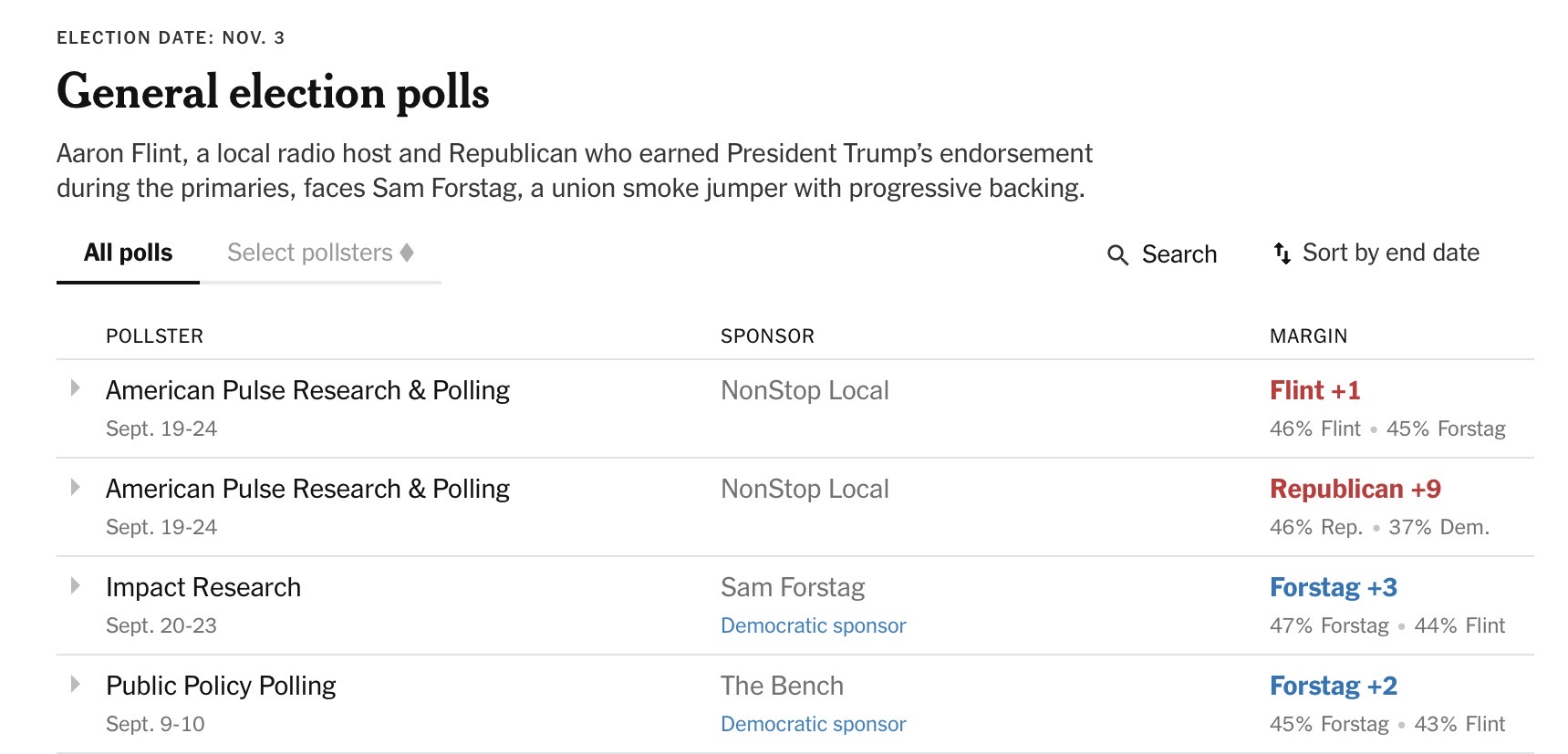
I don’t know what in the hell the Republican +9 poll is supposed to be, but that’s outside the realms of reality and logic. There are two narrow Forstag leads within the margin of error from September, and a Flint +1 that came out last month.
Polling reveals no clear advantage.
VII. Media Ratings
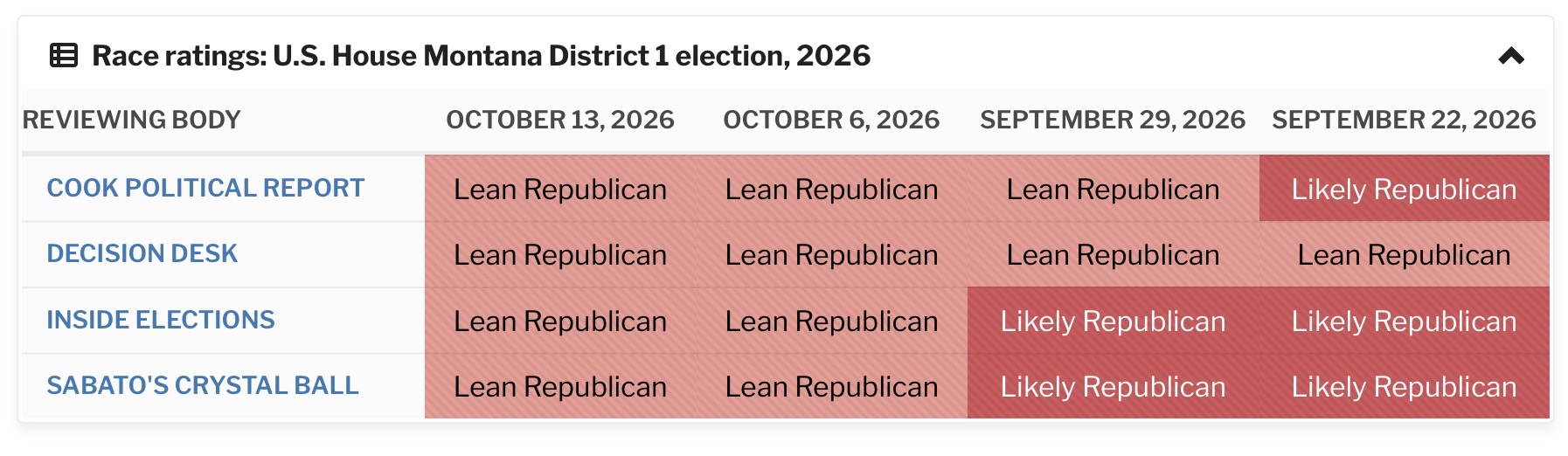
Every reviewing outlet considers the race “Lean Republican,” although three have recently downgraded from “Likely Republican” – a smart move.
VIII. Party Registration
Montana does not register voters by party; however, data tracked for movers suggests new transplants to Montana are overwhelmingly Republican – perhaps as much as R+46.
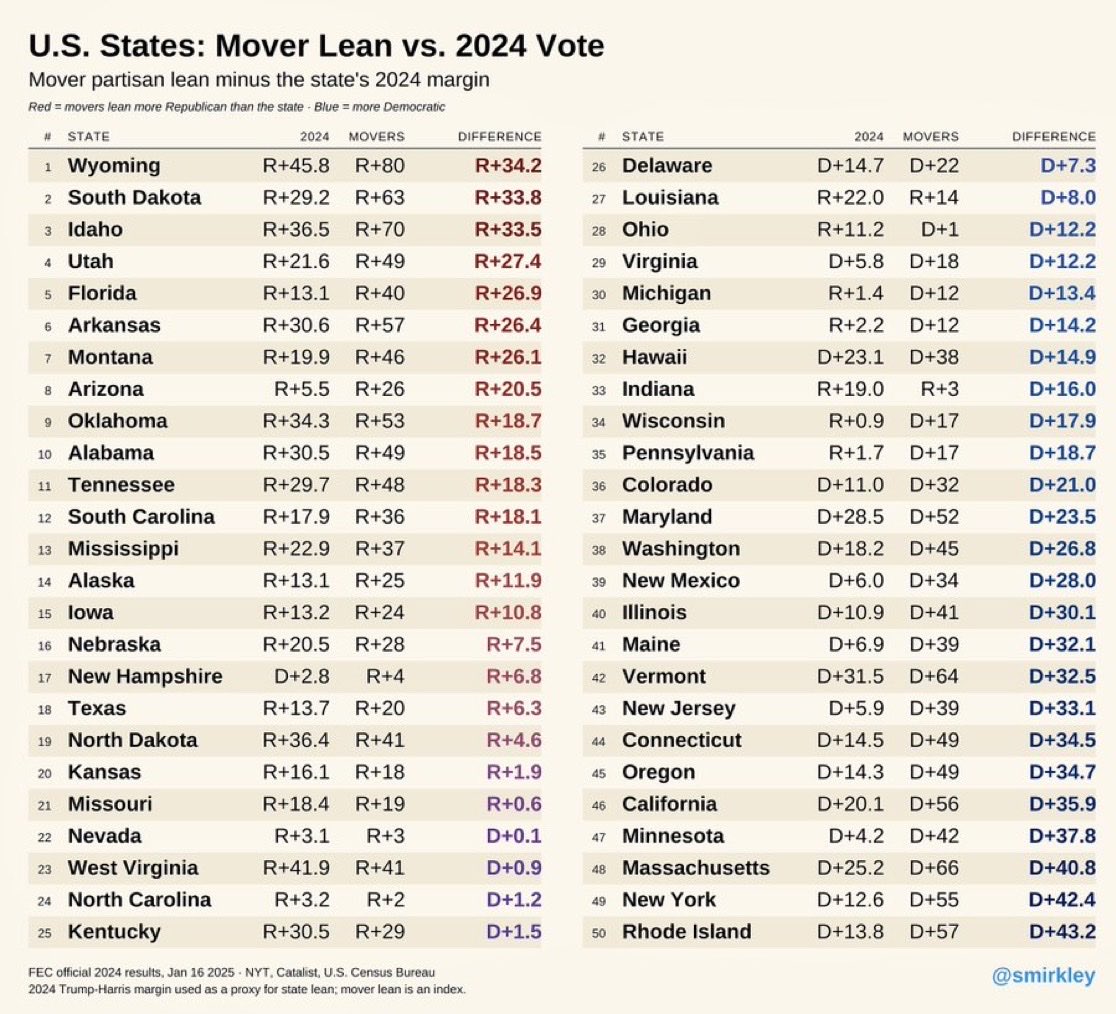
In a race that frequently comes down to tight margins, statistics like these really move the needle. I would consider this a likely stand-in advantage for party registration (if Montana tracked such data).
IX. Election Considerations
I profiled Montana’s 2024 election with regard to election integrity and found a low risk for that race.
In that article, however, I do note that the state has loose ballot harvesting laws, and independent researchers in Montana have found evidence of significant harvesting happening in Missoula and on reservations (like Blackfeet and Flathead, both inside MT-1’s boundaries). In a close race, this can be decisive.
X. Summary and Election Estimate
I don’t agree with all of President Trump’s rally locations because I think consultants and campaign strategists are buying into polling noise; however, the fundamentals of MT-1 absolutely justify increased attention, especially in a year that is ostensibly favorable to Democrats. MT-1 reminds me a little bit of AZ-2, a district with a GOP representative (Eli Crane) who didn’t get a huge margin in 2024. Crane’s base is white conservatives, especially from Yavapai and Gila Counties; they are inelastic (their margins are heavily Republican), as are the Democrat base voters (college kids, white liberals, and Native Americans).
The same is true of this race, except for that it takes place with tighter baseline margins than the race in AZ-2 does. We will know if this seat is at risk of flipping based on how engaged Missoula and Gallatin Counties appear to be (home counties of two universities). This is what my decision matrix looks like:
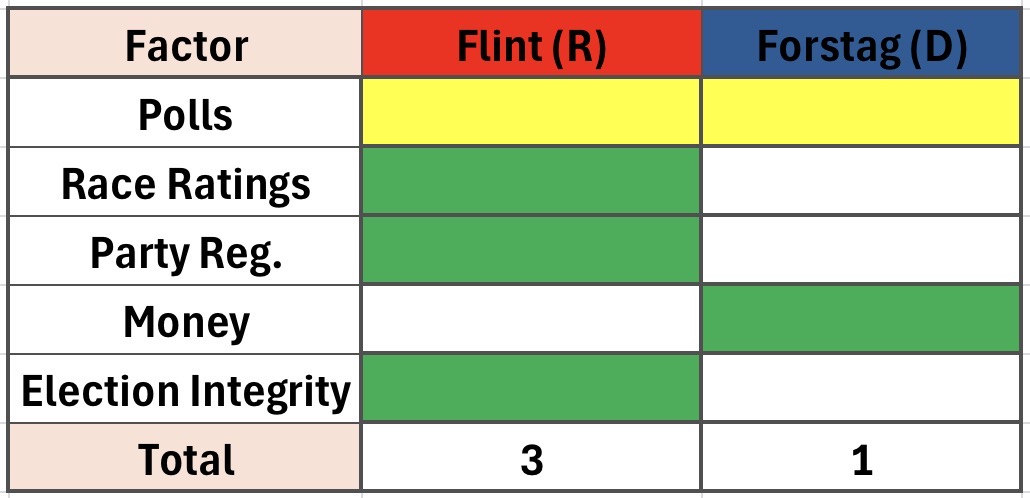
Forstag blew away Flint for receipts last quarter, although Flint has more on hand. Now is the time for him to use it, because MT-1 stands to be one of the top five upset opportunities available for Democrats in the 2026 cycle.
Forecast for MT-1 House
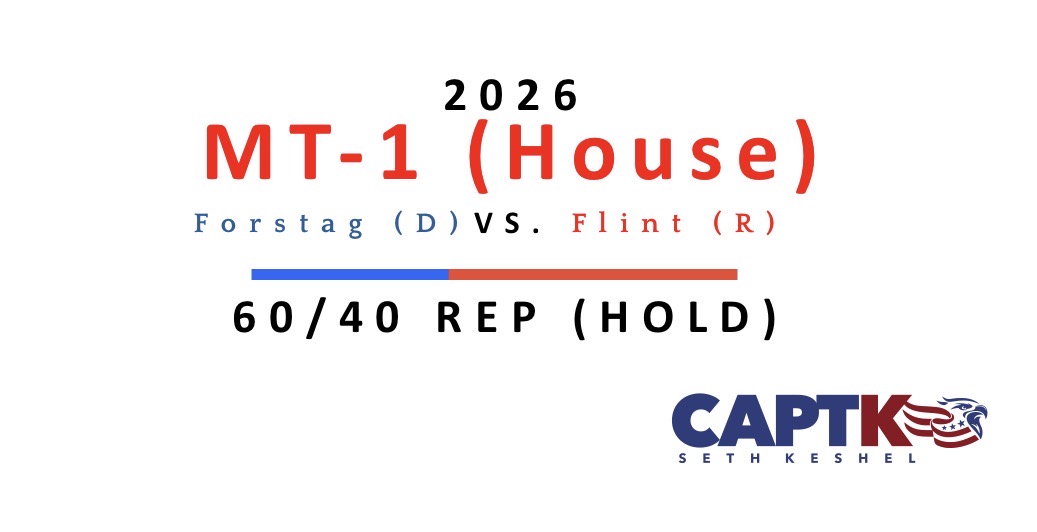
The fundamentals of this race favor Flint, and not by much. The only thing keeping me from considering this race a tossup and leaning it to Flint 55/45 is the fact that transplants to Montana are overwhelmingly Republican. In a race decided by very few votes, those movers make a huge difference, and I don’t think they’re interested in being represented by someone tied to AOC and Bernie Sanders, or who wants to tax the hell out of them. The first order of business at the first possible opportunity for Montana Republicans should be to rearrange the district lines and pull MT-1 out of the line of fire. MT-2 has a Republican margin of more than 30 points, and Bozeman would fit quite nicely inside of it while sharing a district with Billings.
Seth Keshel, MBA is a Senior Fellow at the Gold Institute for International Strategy and a retired Army Captain. He publishes Captain K’s Corner on Substack.