2026 Ten-Point Forecast: Ohio U.S. Senate

Jon Husted and Sherrod Brown, candidates in Ohio's 2026 U.S. Senate race

Jon Husted (R-inc.) vs. Sherrod Brown (D)

I. The Race
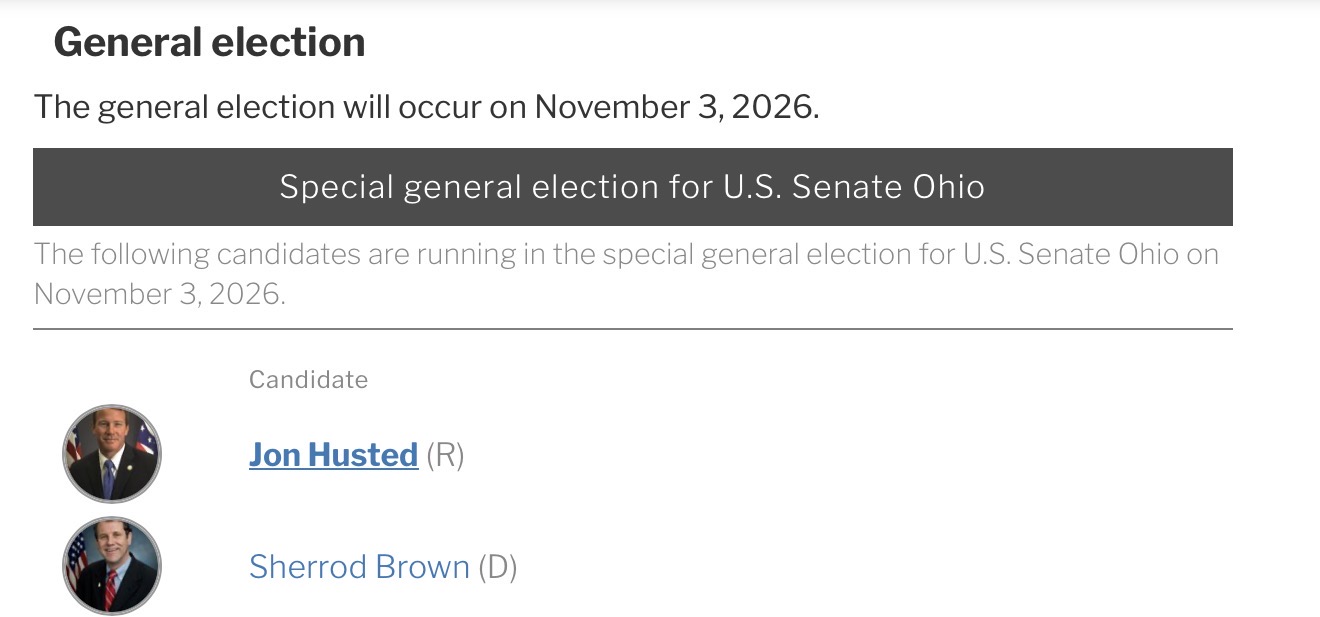
Chart from Seth Keshel’s Ohio U.S. Senate forecast: The Race

Jon Husted (Republican) is serving out the Senate term won by Vice President JD Vance in 2022, and under Ohio law is required to stand for this special election for the completion of the term. Before serving in the Senate, Husted was Ohio’s Lieutenant Governor.

Sherrod Brown (Democrat) is looking to make his way back to the Senate after having won three terms there (2006, 2012, 2018) before losing to Senator Bernie Moreno in 2024, when President Trump carried the state by 11.2%. If Brown wins, he will have to run again in 2028.

II. State Profile
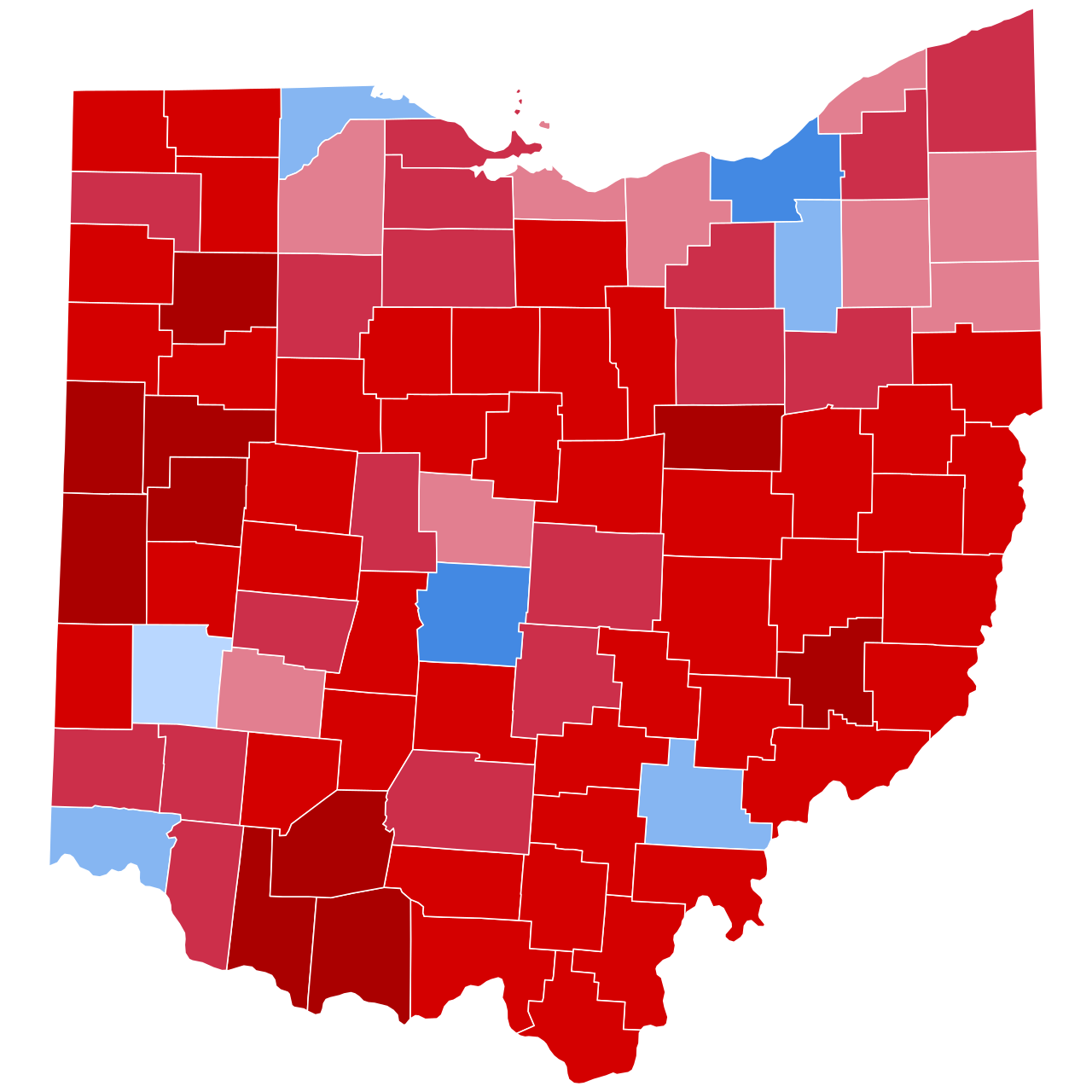
Chart from Seth Keshel’s Ohio U.S. Senate forecast: State Profile

Ohio was once the premier bellwether state in presidential politics. From 1896 through 2016, Ohio failed to vote for the winner of the presidency only twice – in 1944 and 1960. We all know the 2020 election had its issues, but I tend to believe Ohio would have stuck with its record as an accurate predictor in a fair race.

Kamala Harris won 6 of 88 counties in Ohio’s 2024 presidential elections. Only five of them have meaningful vote counts:

• Cuyahoga County (Cleveland)
• Franklin County (Columbus)
• Hamilton County (Cincinnati)
• Lucas County (Toledo)
• Summit County (Akron)

Contrast the above results with how the map looked in 2008:
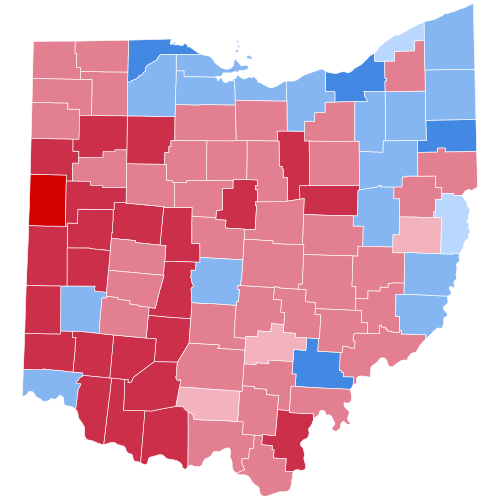
Chart from Seth Keshel’s Ohio U.S. Senate forecast: State Profile
2008 Presidential Election in Ohio

The interior of Ohio, while won by McCain, was mostly just pink. Key Trump-backing counties in the northeast, such as Mahoning County, were still plenty blue. Despite being a two-time Obama state, Trump had no trouble carrying the Buckeye State all three times he ran:

2016 Trump +8.1%

2020 Trump +8.0%

2024 Trump +11.2%

The key to understanding Ohio in 2026 is to first recognize it is nothing like the state Brown first won election to the Senate in back in 2006.

Key Statistics

• 69.3% White, 15.5% Black, 8.5% Hispanic

III. Market Assessment

Polymarket bettors give Brown better than two-to-one odds to unseat Husted and return to the Senate.

IV. History

The seat Brown currently seeks has been in Republican hands since 1998, when George Voinovich won the seat and held it for two terms. He gave way to Rob Portman, who won it in 2010 and 2016 before stepping away for Vance:
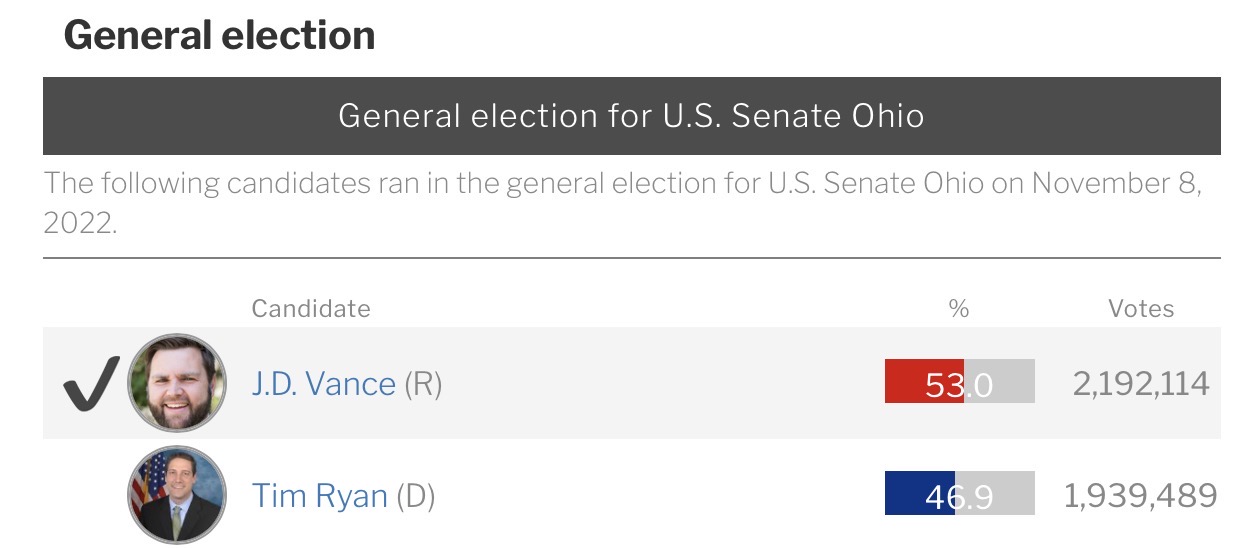
Chart from Seth Keshel’s Ohio U.S. Senate forecast: History

It is important to note that Vance, running for an open seat, prevailed over Tim Ryan – who once had impeccable blue collar Democrat credentials that far surpass those Brown seeks to impute to himself.

Brown held the other Ohio Senate seat for three terms after knocking off none other than Mike DeWine, Ohio’s current Republican governor and resident Trump hater in the mold of John Kasich, in 2006. He was reelected in 2012, and again in 2018 with a high turnout:
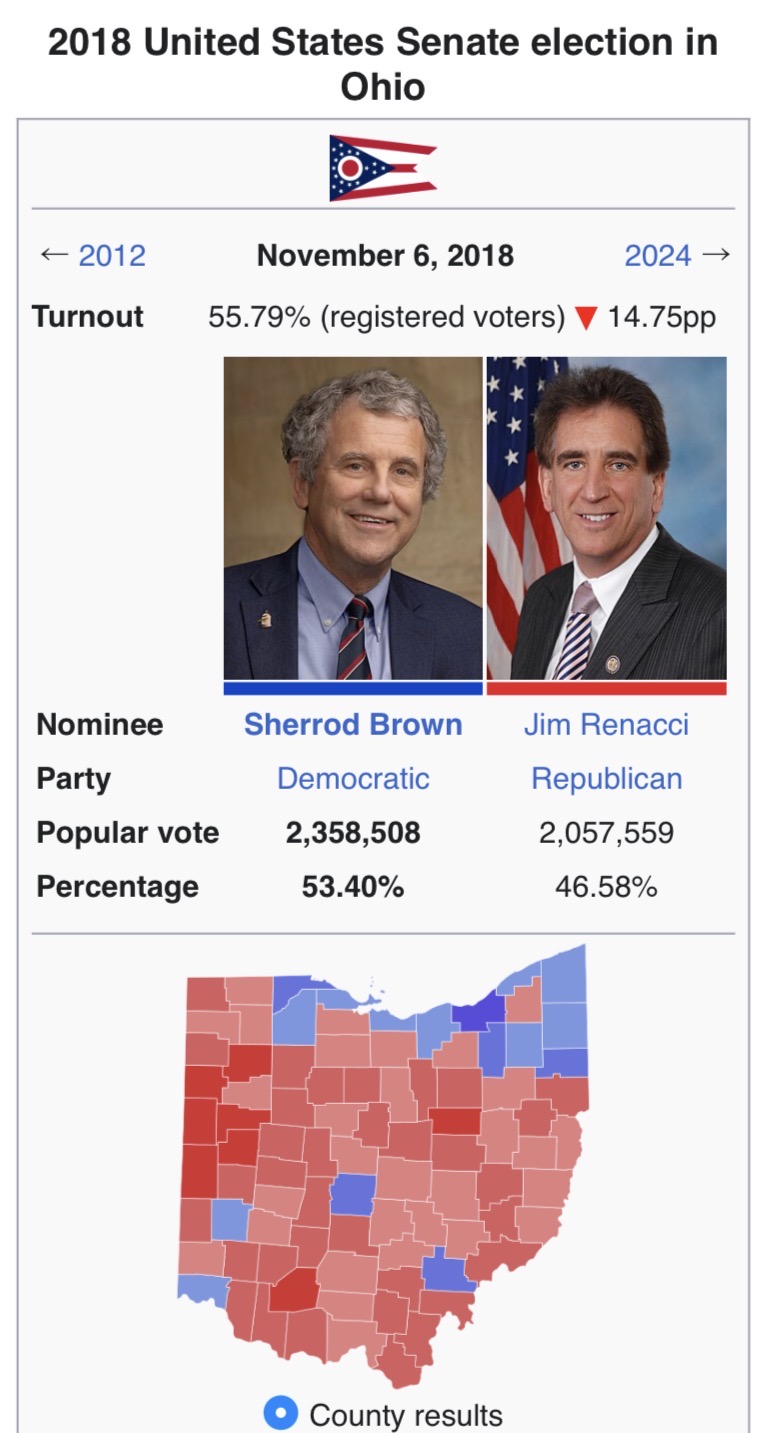
Chart from Seth Keshel’s Ohio U.S. Senate forecast: History

Those bullish on Brown’s chances today will point to a swing of 14.9% away from the 2016 presidential margin to Brown in 2018, but Ohio is much different today than it was even then and has gone more the way of Indiana than it has remained in the mold of “Trumplican” states like Pennsylvania or Michigan. Just in the map above, it will be difficult for Brown to carry northeastern counties and avoid the crimson-shaded margins of the interior his opponent is likely to pile up.

V. Analysis of 2026 Primary Results

Husted ran unopposed in his primary to secure the GOP nomination. Brown faced a primary challenger, but ran over him like Ohio State would a MAC squad in September:
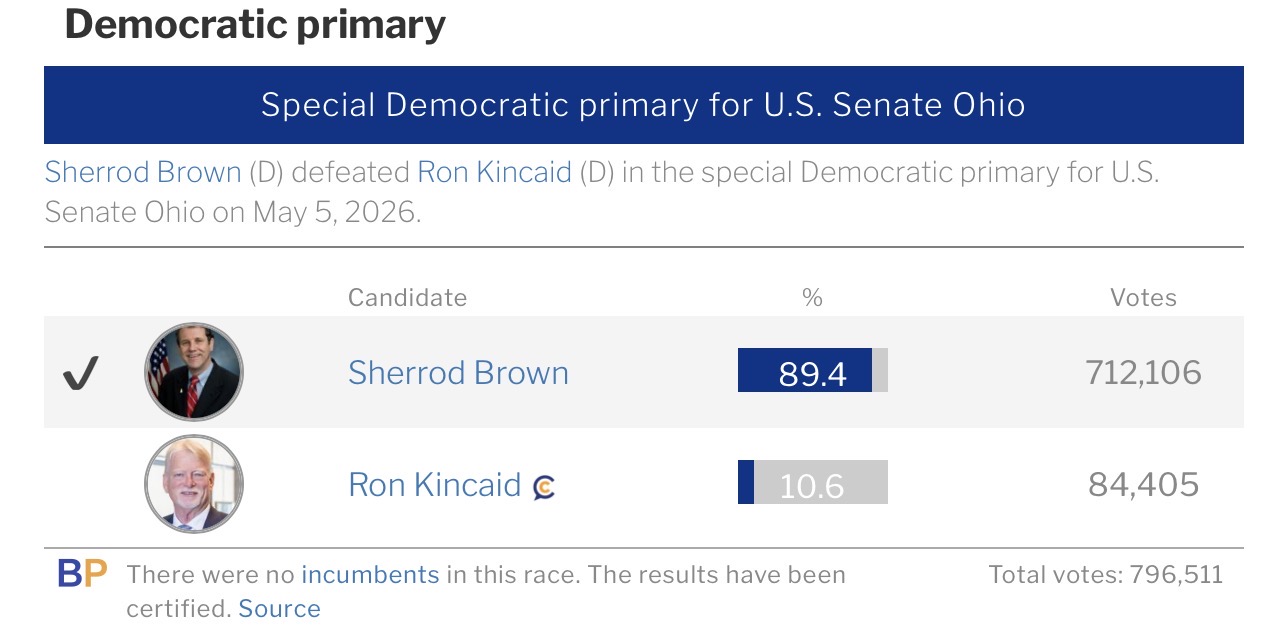
Chart from Seth Keshel’s Ohio U.S. Senate forecast: Analysis of 2026 Primary Results

VI. Polls

Despite Husted having led in several recent polls, pro-Brown pollsters (some disreputable) have flooded the zone and given him an average lead of 2.6% in the RCP file:
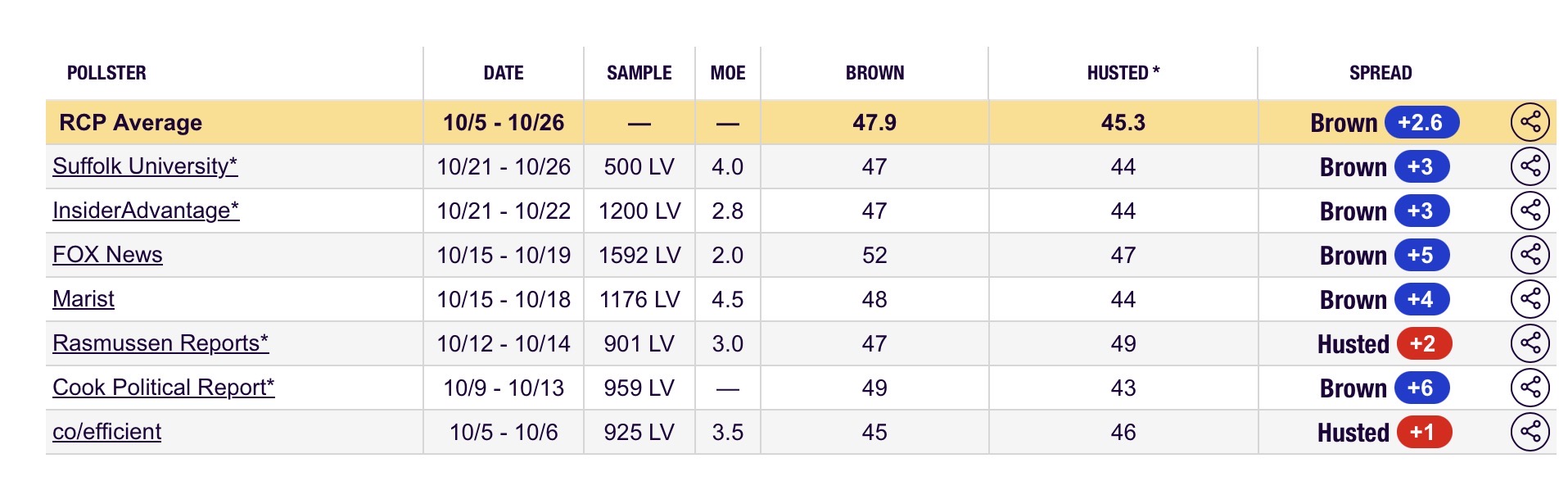
Chart from Seth Keshel’s Ohio U.S. Senate forecast: Polls

VII. Media Ratings

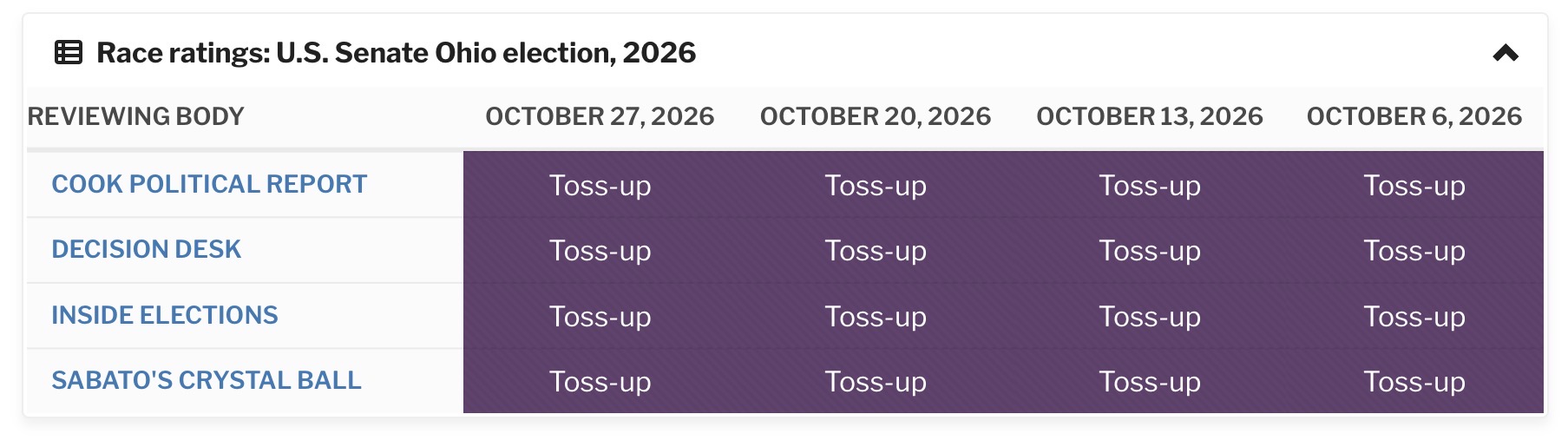
Chart from Seth Keshel’s Ohio U.S. Senate forecast: Media Ratings

It doesn’t appear to me that any of the reviewing bodies are buying the polling and have all chosen the safety of the “toss-up” rating.

VIII. Voter Registration by Party

Ohio does not register voters by party. It closely resembles Pennsylvania, which does register by party and has a strong rightward trend for more than a decade.

IX. Election Considerations

Here is what I had to say in my write-up of the greatest unforced error in the race for the majority, OH-7:

Fortunately for Miller, Ohio has done a relatively strong job of sealing up election loopholes and has ensured they have control over the limited mail-in balloting that exists in the Buckeye State. I wrote up Ohio’s election details in the aftermath of the 2024 election for those of you interested in understanding how election integrity impacts races there. In short, there will be no late night ballot dumps impacting this race.

Industrial Midwest – 2024 Election Compendium

X. Summary and Election Estimate

Ohio has had a solid decade to marinate in its new Republican orientation. This means the interior counties are much more crimson-shaded than they once were, establishing a higher presidential baseline for Brown, no longer the incumbent, to overcome. Democrats, as they struggle in other states, require overwhelming margins in Cuyahoga and Franklin Counties to stand a chance in statewide races now that the white working class has shifted to Trump’s GOP. And therein lies the problem for Brown.

I keep a daily tracker assessing Ohio’s turnout each day for mail returns and in-person early voting. I then sort it by percentage of the 2024 presidential vote already cast. Franklin and Cuyahoga, which are presumably front-loading Democrat-heavy early votes, languish well into the bottom half of 88 counties sorted by this measure; until just a few days ago, Montgomery County (Dayton) was dead last.

MAGA counties dominate the list of counties sorted by 2024 presidential vote county already cast in this state that has a massive in-person on Election Day voting propensity. If Brown isn’t going to cash in massive margins in Cuyahoga County, where the City of Cleveland itself is lagging big-time, and the crazies in Columbus (Franklin County) aren’t into the election, then where in the hell is he going to get his votes from?
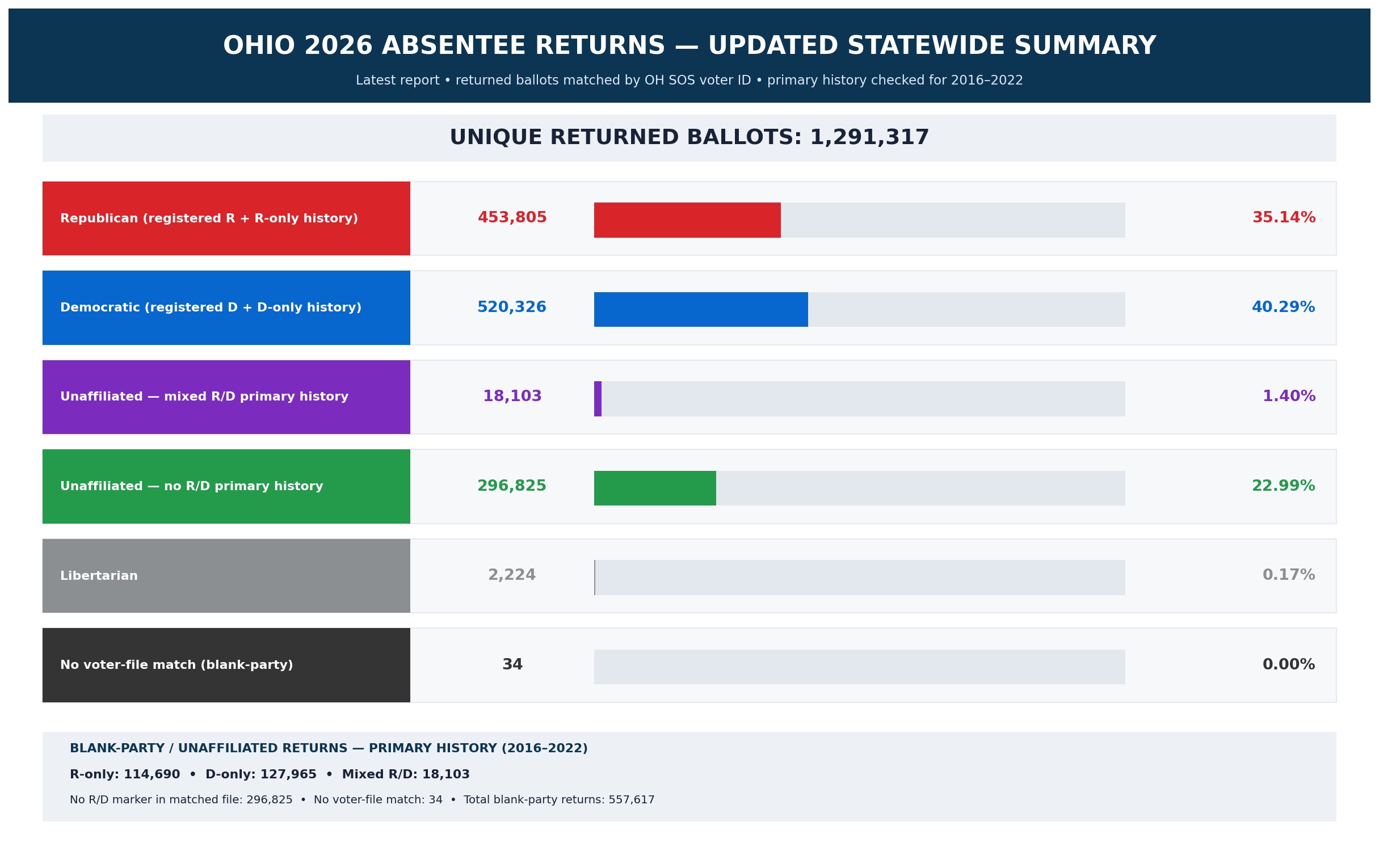
Chart from Seth Keshel’s Ohio U.S. Senate forecast: Summary and Election Estimate

The above graphic shows implied partisan turnout through yesterday using primary voting history. It stands at just D+5.2%, which is redder at this point in time than 2024, when Trump won by +11.2%. Election Day in Ohio is overwhelmingly red, and if Cleveland and Columbus are dragging heavily on turnout, the incumbent Husted has a major edge.

The decision matrix narrowly favors Brown:
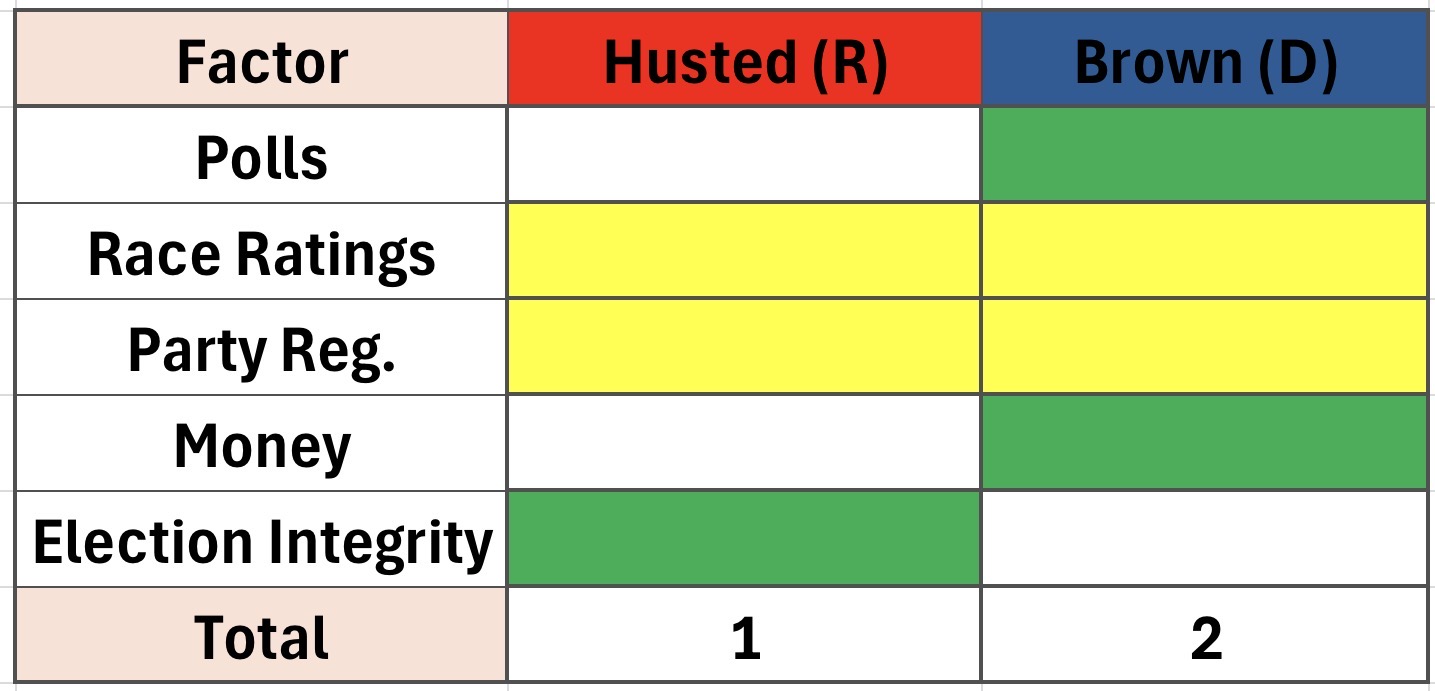
Chart from Seth Keshel’s Ohio U.S. Senate forecast: Summary and Election Estimate

Yet the political makeup of modern-day Ohio and the turnout patterns in early voting place Brown at a major disadvantage despite his name recognition and prior success with Trump in the White House.

Forecast for OH Senate
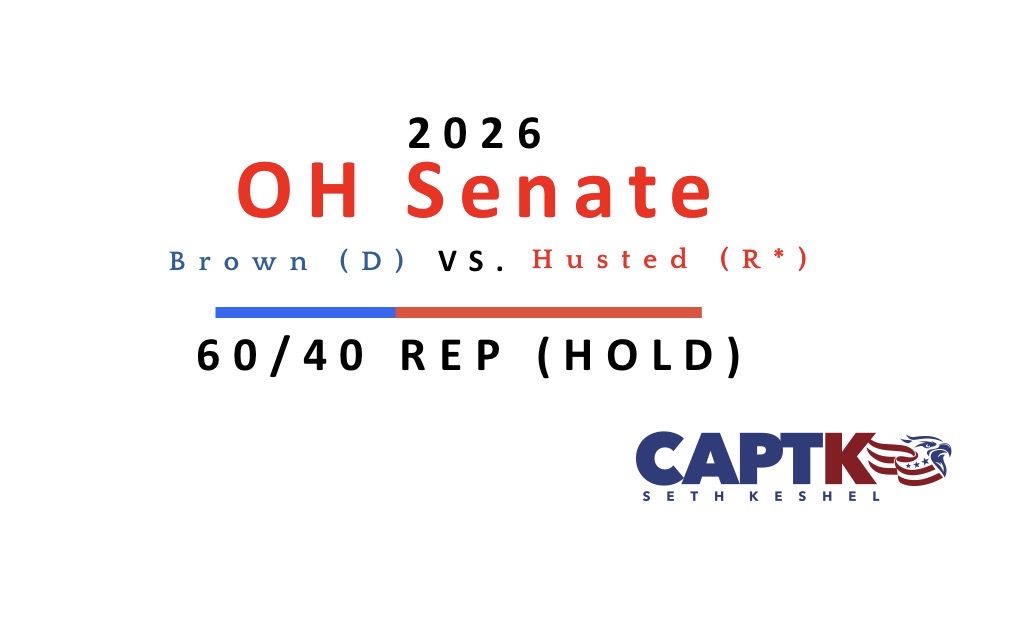
Chart from Seth Keshel’s Ohio U.S. Senate forecast: Summary and Election Estimate

If Ohio red counties do what they do on Election Day, voters remain old, and urban turnout stays in the toilet, this race is Husted’s – and potentially with some breathing room to spare. Brown’s ceiling at this point is very low.

Seth Keshel, MBA is a Senior Fellow at the Gold Institute for International Strategy and a retired Army Captain. He publishes Captain K’s Corner on Substack.

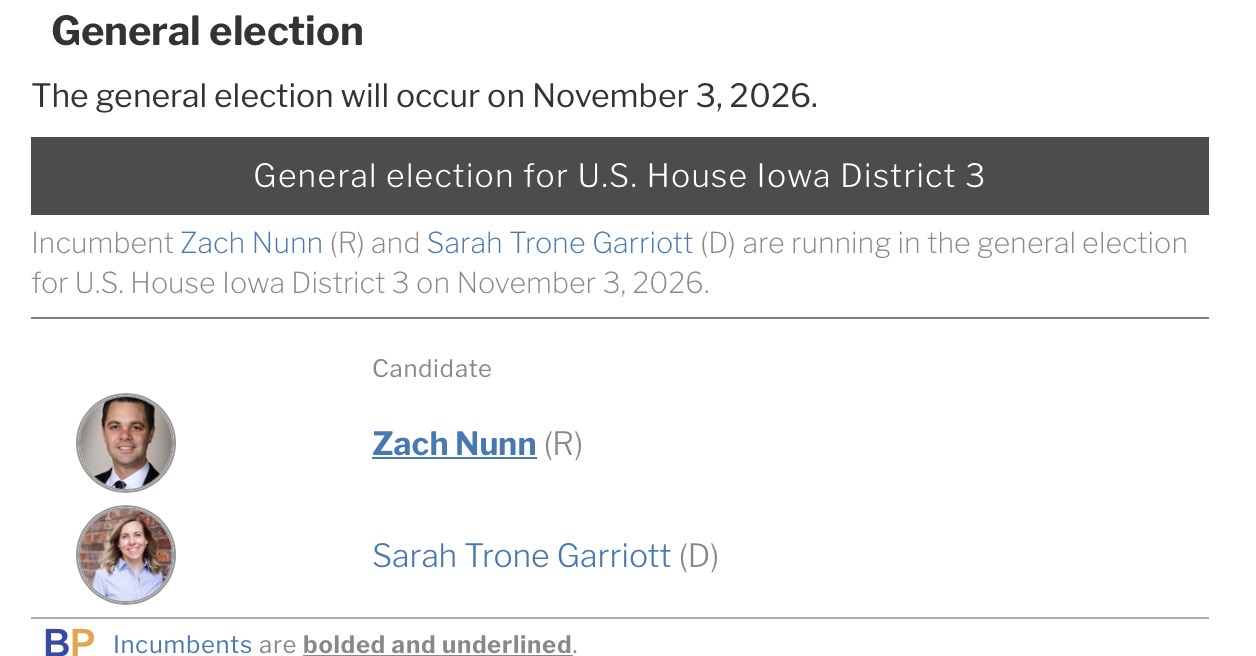
2026 Ten-Point Forecast: IA-3 (U.S. House – Decisive)

2026 Ten-Point Forecast: IA-3, Zach Nunn vs. Sarah Trone Garriott

Zach Nunn (R-inc.) vs. Sarah Trone Garriott (D)

I. The Race

Zach Nunn (R) and Sarah Trone Garriott (D), the candidates in Iowa's 3rd Congressional District

Zach Nunn (Republican) is an Air Force Reserve Colonel with serious combat experience. He was once a member of the Iowa legislature, and has represented IA-3 since first being elected in the 2022 GOP House victory and now seeks his third term.

Sarah Trone Garriott (Democrat) is an Iowa state senator with a background in religious studies. She is running a “kitchen table” campaign that is relatively careful about not becoming “Trump-centered,” with the understanding that Iowa supported Trump by a wide margin. This is her first attempt at Congress.

II. District Geography

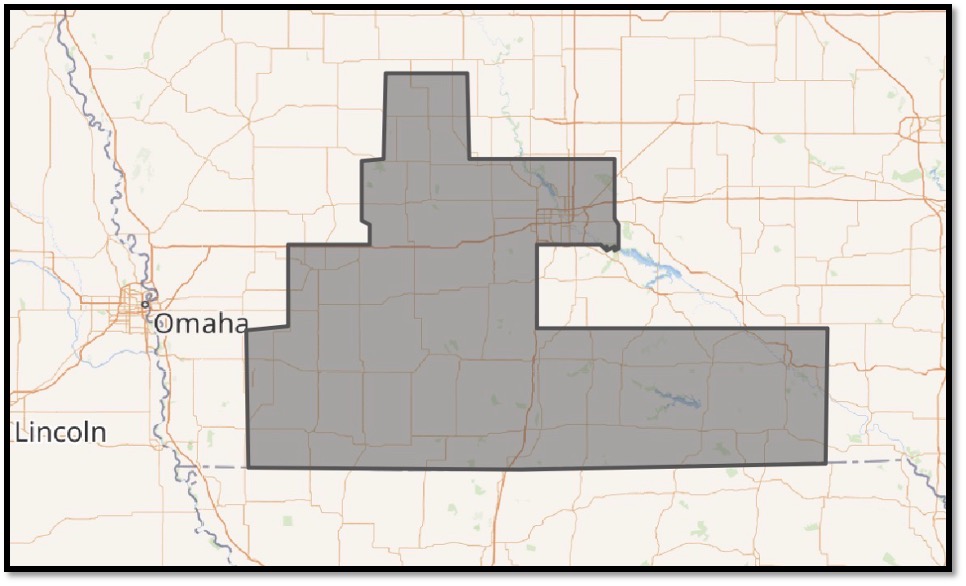
Map of Iowa's 3rd Congressional District in southwest Iowa

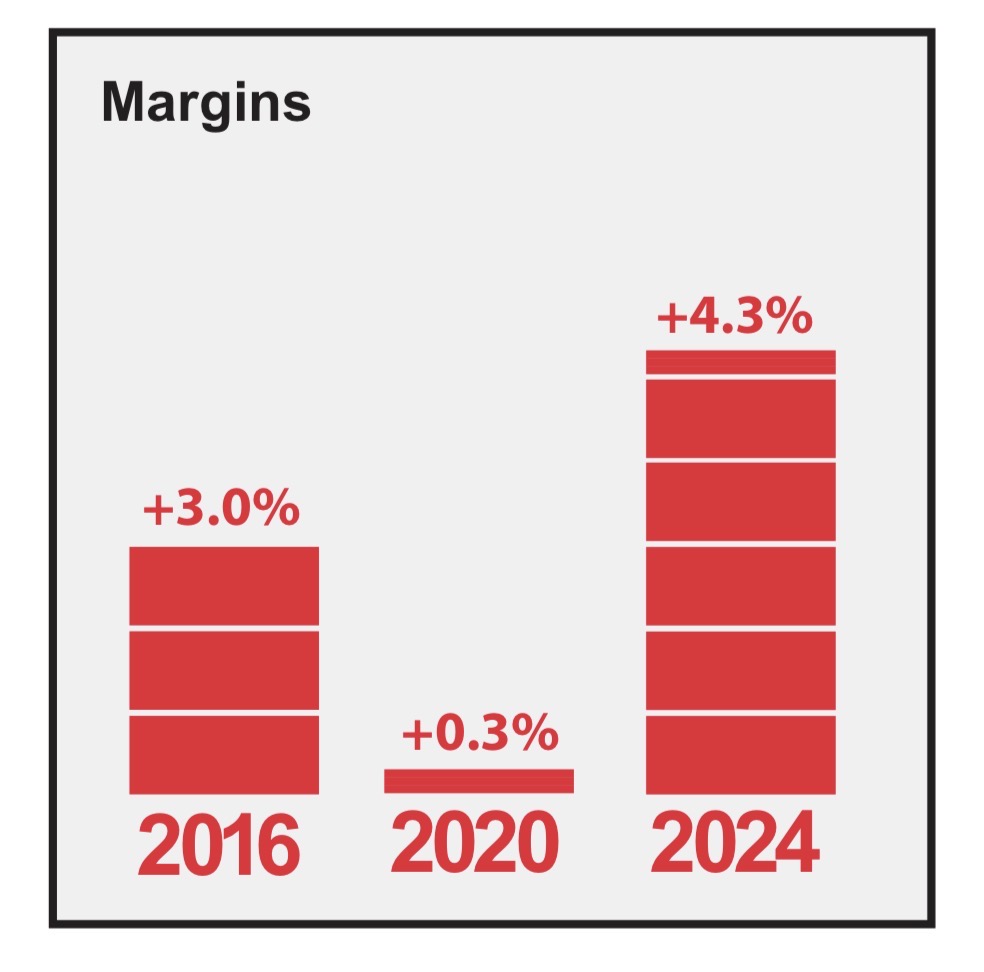
Iowa’s 3rd Congressional District (IA-3) occupies the southwestern portion of the state (all but the very corner), and contains the capital city of Des Moines and its most electorally significant suburban areas – and a total of 21 counties. Since Iowa doesn’t gerrymander, this seat (just like IA-1) is extremely competitive. A Republican state that wanted to win would figure out how to split half of Des Moines into IA-4, which is overwhelmingly red. As such, the clash between urban/suburban and farmland produces tight margins in presidential and House elections. Here is how President Trump fared in all three of his races in the current boundaries of IA-3:

Trump's margins in the current IA-3 boundaries, 2016 to 2024

IA-3 sits well to the left of the state as a whole. Trump had to carry Iowa by over 13 points in 2024 just to take IA-3 by 4.3%; he hasn’t been helped by the suburban drift of Dallas County, which is just west of Polk County (Des Moines), that has taken place over the past decade. The rurals are about volume of turnout. The metropolitan Des Moines area is about persuasion.

III. Market Assessment

Polymarket bettors overwhelmingly favor Trone Garriott, who is vastly overpriced.

IV. History

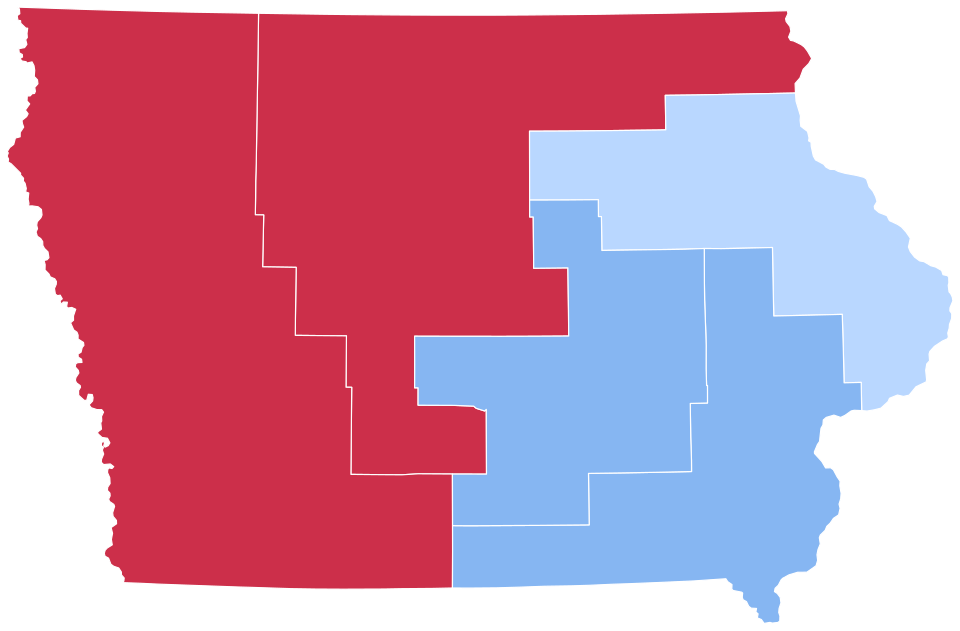
Des Moines and the rest of Iowa’s districts have moved around a lot in recent decades. In 2010, the last election of the first decade of the 21st century, Iowa’s U.S. House map looked like this:

Iowa U.S. House results map, 2010
Iowa U.S. House Results – 2010

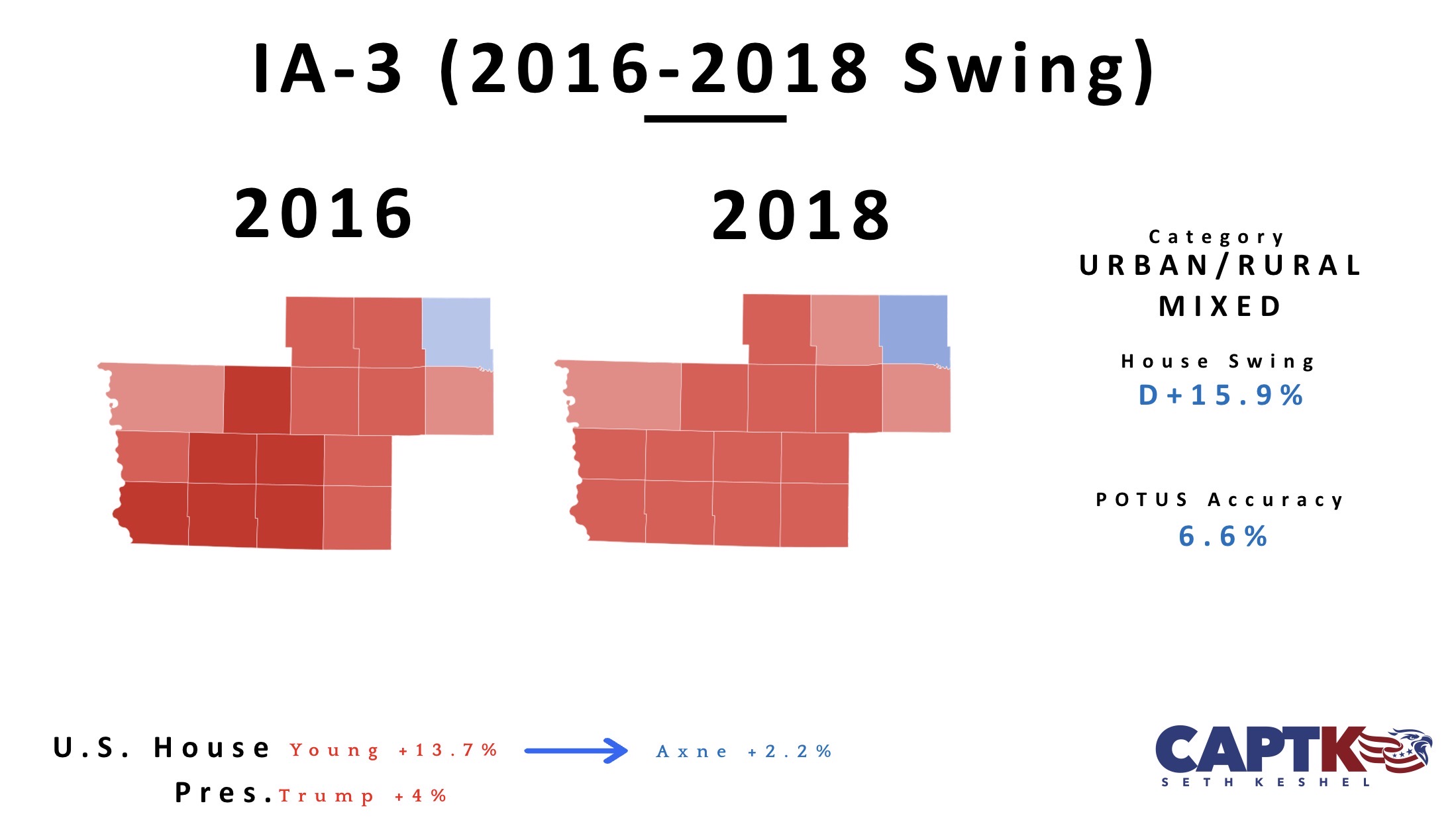
Iowa lost an electoral vote going into the next decade and then split its lines in a different pattern, putting Des Moines and IA-3 into a district more closely resembling the one Nunn is defending now. Republican David Young, running for reelection alongside President Trump’s first campaign in Iowa, won his 2016 race by 13.7%. Young then turned around in 2018 and lost the seat by 2.2% to Cindy Axne, who proceeded to narrowly defeat him in a 2020 rematch.

IA-3 House results from 2016 to 2020

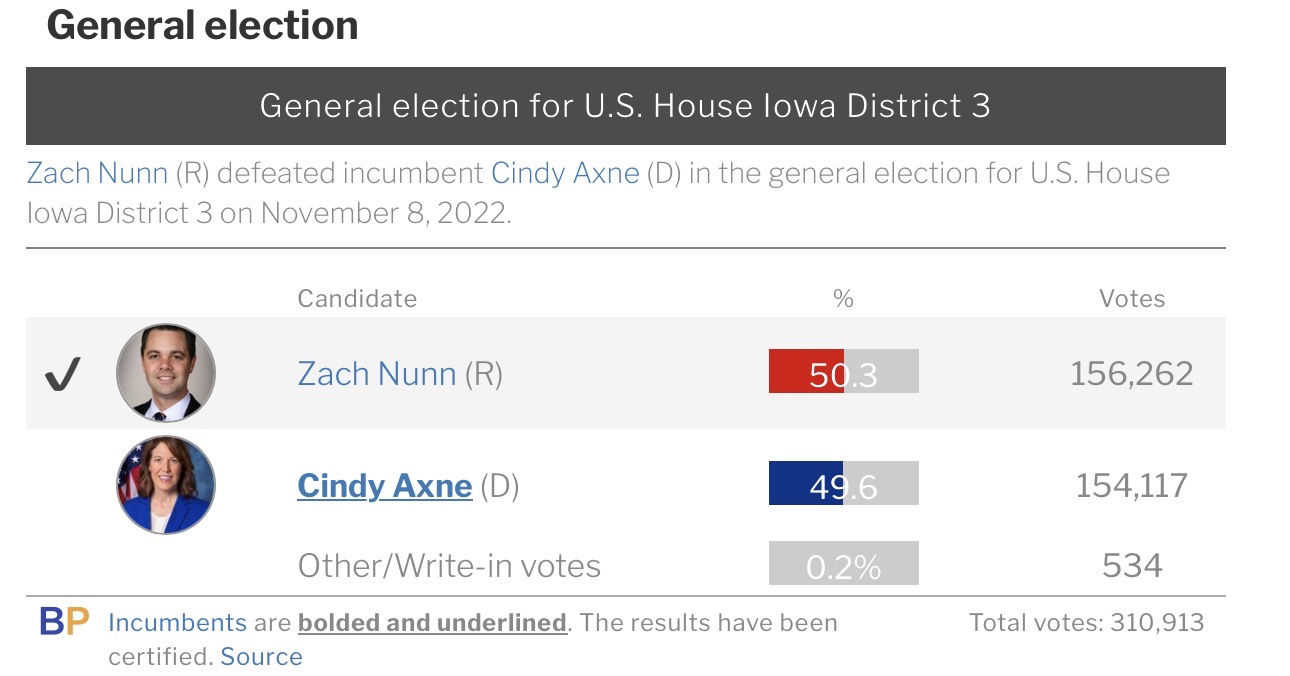
IA-3 met the key warning sign for a 2018 flip – a seat with a major metropolitan area in which President Trump massively underperformed the Republican House candidate. The districts were redrawn yet again, and in their current form, Nunn knocked Axne out in the 2022 GOP House takeover, and by a very narrow margin of just 0.7%:

IA-3 2022 U.S. House result, Nunn vs. Axne

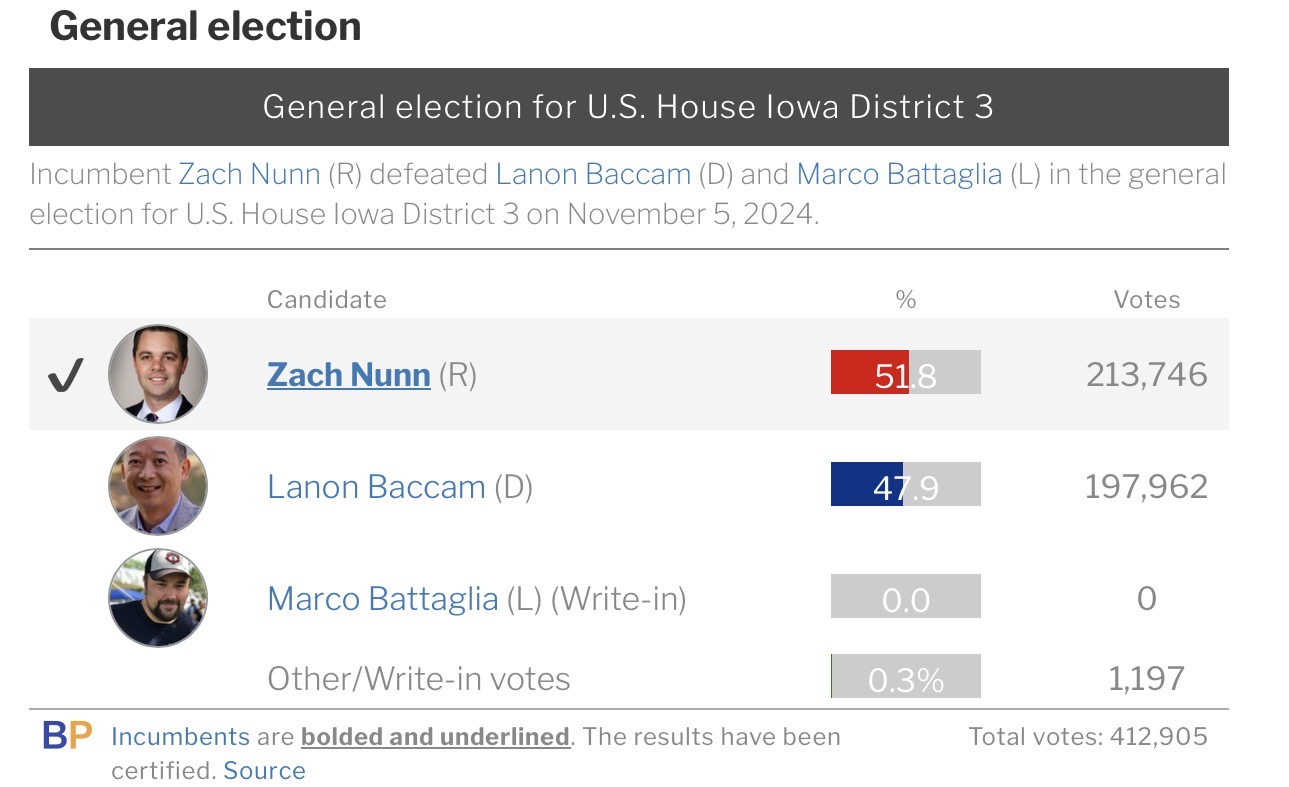
Thanks to Trump’s statewide blowout, Nunn ran up a very impressive margin compared to what IA-3 is normally capable of:

IA-3 2024 U.S. House result

Nunn must hope that rural turnout is overwhelming knowing just how strong the shift in metropolitan Des Moines was in 2018.

V. Analysis of 2026 Primary Results

Neither Nunn nor Trone Garriott faced a serious primary challenger; therefore, there is no lingering drama impacting either party for the General Election.

VI. Polls

No mainstream polls have run for this race since March.

VII. Media Ratings

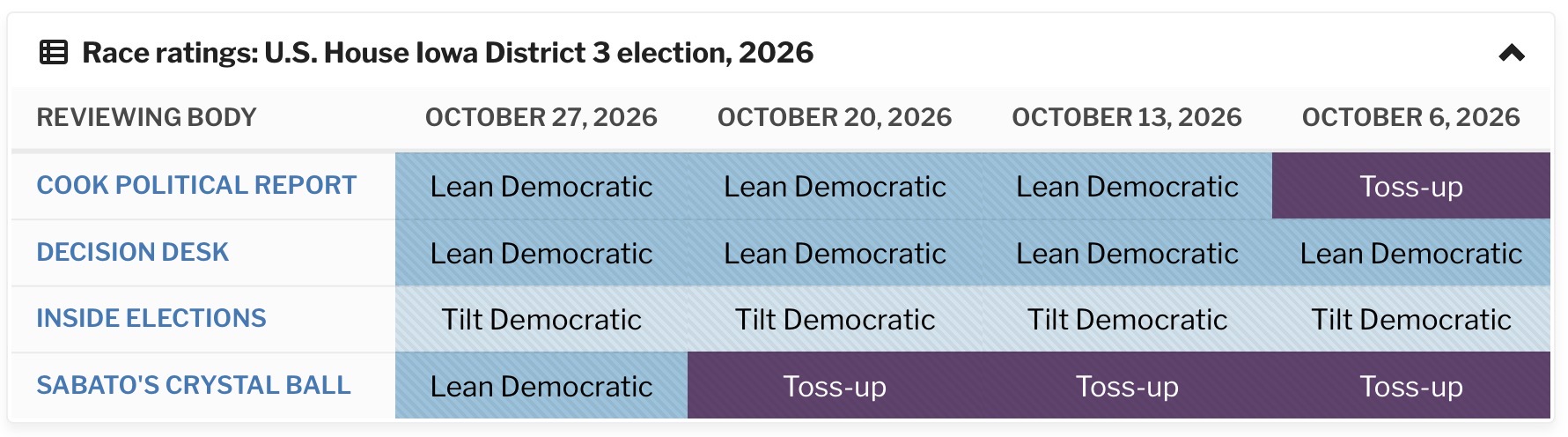
Media race ratings for IA-3

Every major reviewer favors Trone Garriott; Inside Elections is the only one thinking it may come down to the wire.

VIII. Party Registration

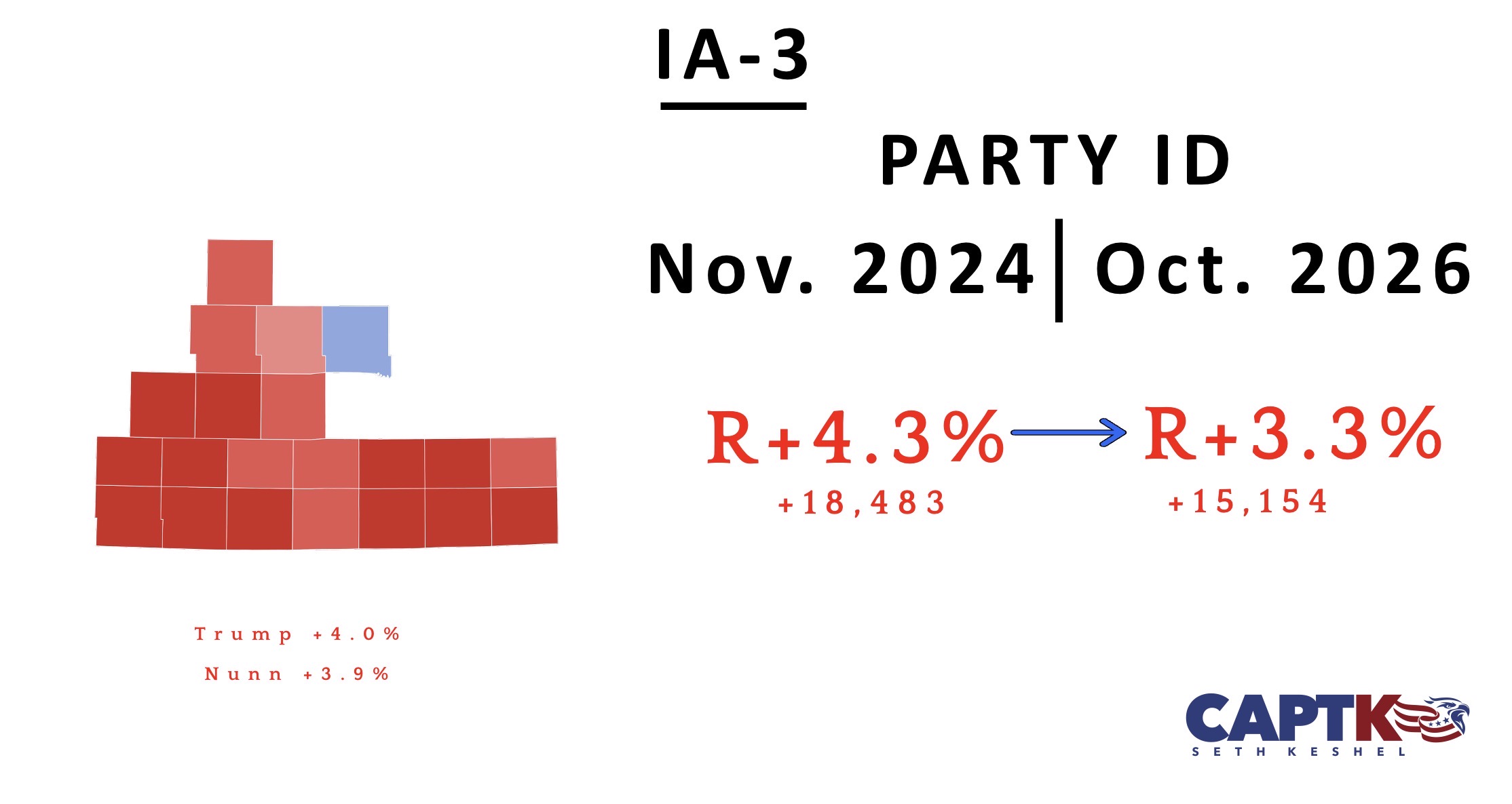
IA-3 party registration changes since November 2024

While Republicans have a larger numerical advantage over Democrats today than they did in November 2024, this isn’t the case in IA-3. Democrats have made up 3,129 net registrations, dropping the Republican advantage by a full point. Most of this damage has been sustained in Polk County, where Democrats have out-registered Republicans roughly two to one. Unlike cases in which a registration gain is tied to roll maintenance, this is a legitimate Democrat gain.

IX. Election Considerations

This is what I had to say about Iowa’s elections in my IA-1 piece:

One thing is for certain, and that is that Iowa runs excellent elections. A lot of this is owed to the current treasurer, Roby Smith, who started turning the screws on election reforms as a state legislator before the 2020 election. Iowa has manageable early voting windows, control over the mail-in balloting process, and a voter registration system that doesn’t automatically register voters.

X. Summary and Election Estimate

Nunn is sitting in a seat that, much like AZ-1, has stabilized its political leanings. Trump underperformed in the old boundaries in 2016 relative to the GOP representative, and that representative was bounced in 2018 when the “suburban swing” bill came due.

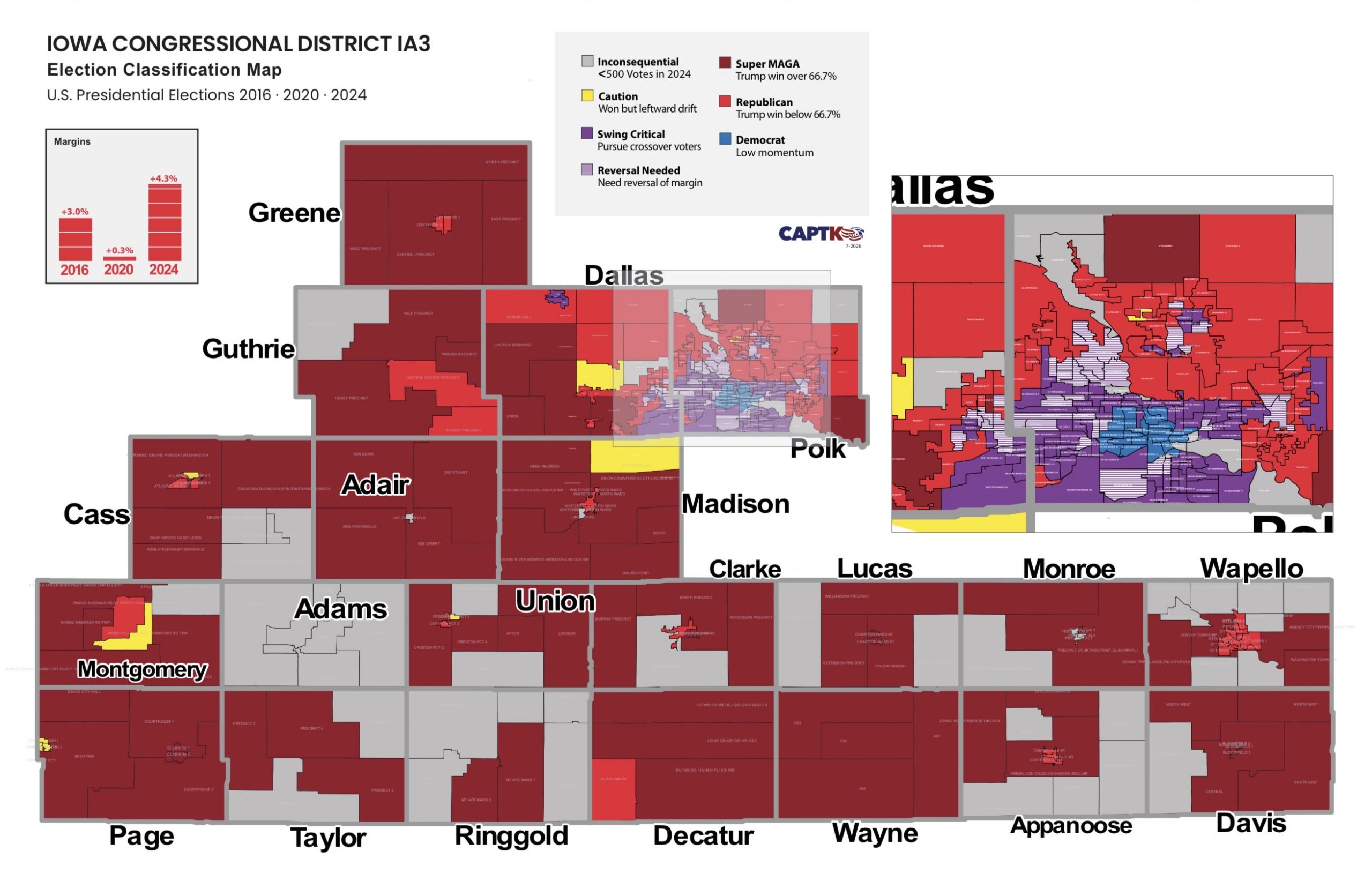
Captain K proprietary precinct mapping of IA-3, Polk and eastern Dallas Counties
Captain K Proprietary Mapping of IA-3

My proprietary mapping of IA-3 above shows a zoomed-in bubble of Polk County and the eastern edge of Dallas County, which contains key suburban territory Nunn will need to hold his ground in. Any suburban swing, plus high turnout in core Des Moines in the blue-coded (“Democrat”) precincts combined with lagging rural turnout puts this election on ice and gives Democrats a key flip in what is one of the most important races for the House majority.

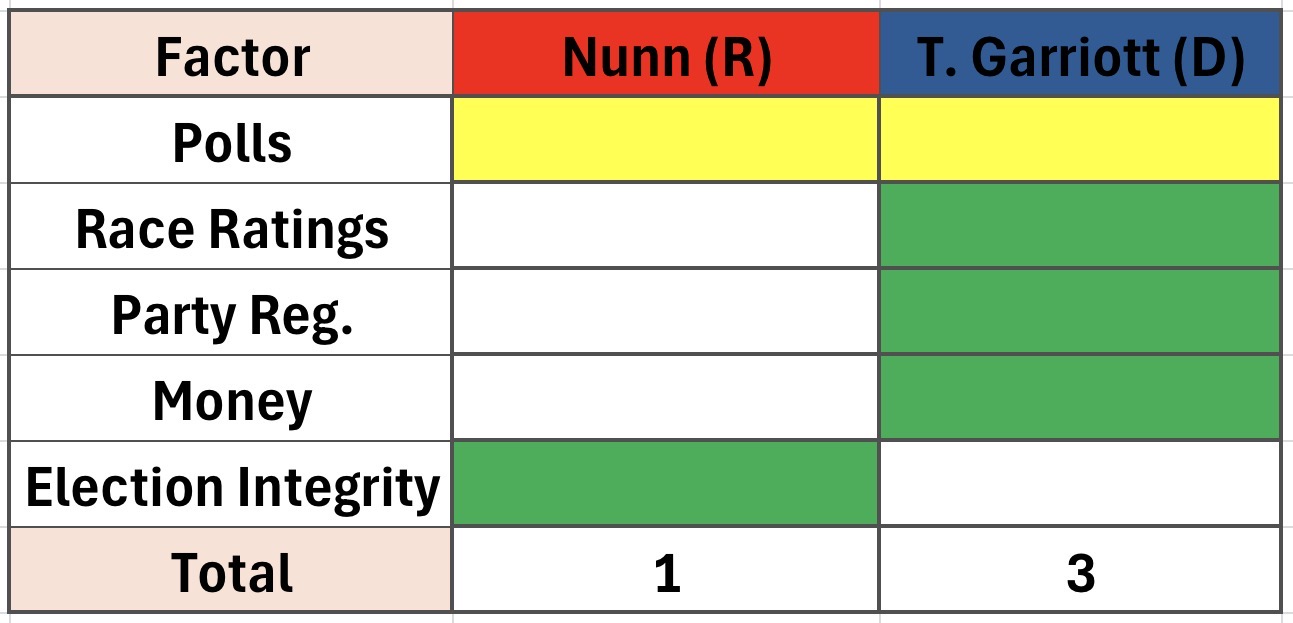
The decision matrix favors Trone Garriott:

Keshel decision matrix for IA-3

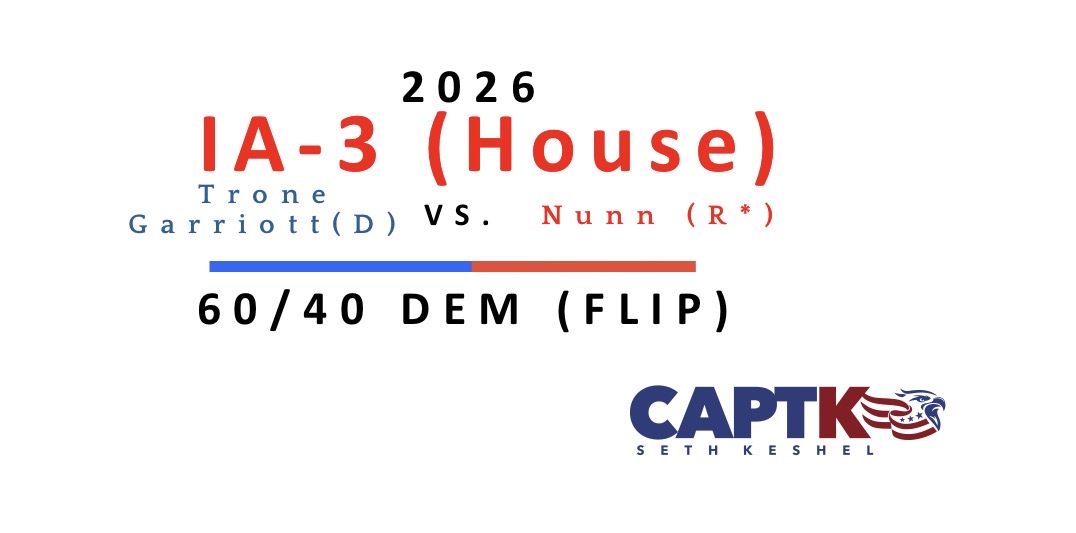
Based on the established swing of IA-3 and the Des Moines metro in the first Trump midterm, legitimate Democrat gains in voter registration, and Trone Garriott’s money advantage, I consider her the favorite. I would normally be inclined to rate her at 65/35, but given Nunn’s popularity, success, and early voting splits similar to his 2024 win, I think he has a better-than-normal chance to hold the seat – certainly much better odds than Mariannette Miller-Meeks has to hold IA-1.

Forecast for IA-3 House

Keshel forecast for IA-3 House

Seth Keshel, MBA is a Senior Fellow at the Gold Institute for International Strategy and a retired Army Captain. He publishes Captain K’s Corner on Substack.