

Mike Rogers (R) vs. Abdul El-Sayed (D)
I. The Race
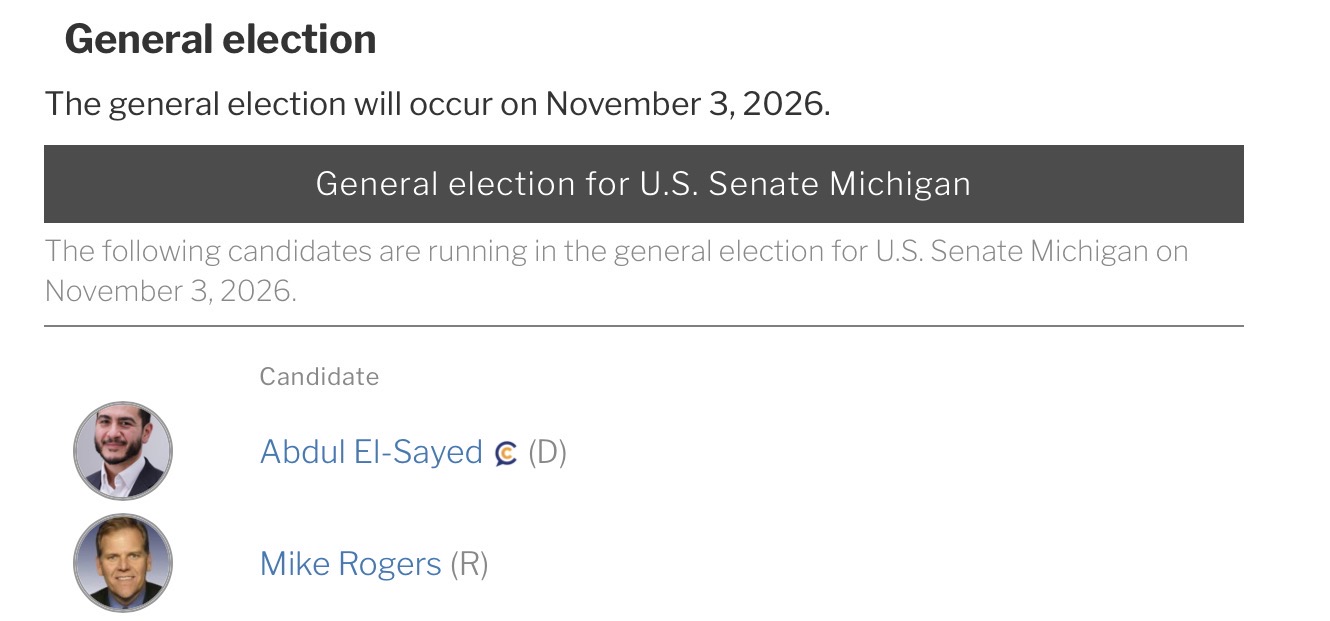
Mike Rogers (Republican) has been at the political game a long time. He is a former Army officer and FBI agent who then served seven terms representing the old MI-8 in the U.S. House. He ran “unsuccessfully” for Michigan’s other Senate seat in 2024, which was “won” by Elissa Slotkin with late mail dumps after Trump had been declared the winner of the state. Now he takes aim at the other seat, which is open due to the retirement of Democrat Gary Peters.
Abdul El-Sayed (Democrat) is 42 and born in Michigan to Egyptian immigrants. He calls himself a “physician” due to his medical education, but is not a licensed practicing physician. If elected, he will be the first Muslim U.S. Senator, but he must first get past the obstacles of many Democrat groups opposing his candidacy and his DSA-aligned positions like the abolition of ICE and adoption of Medicare-for-all in a Trump-won state.
II. State Profile
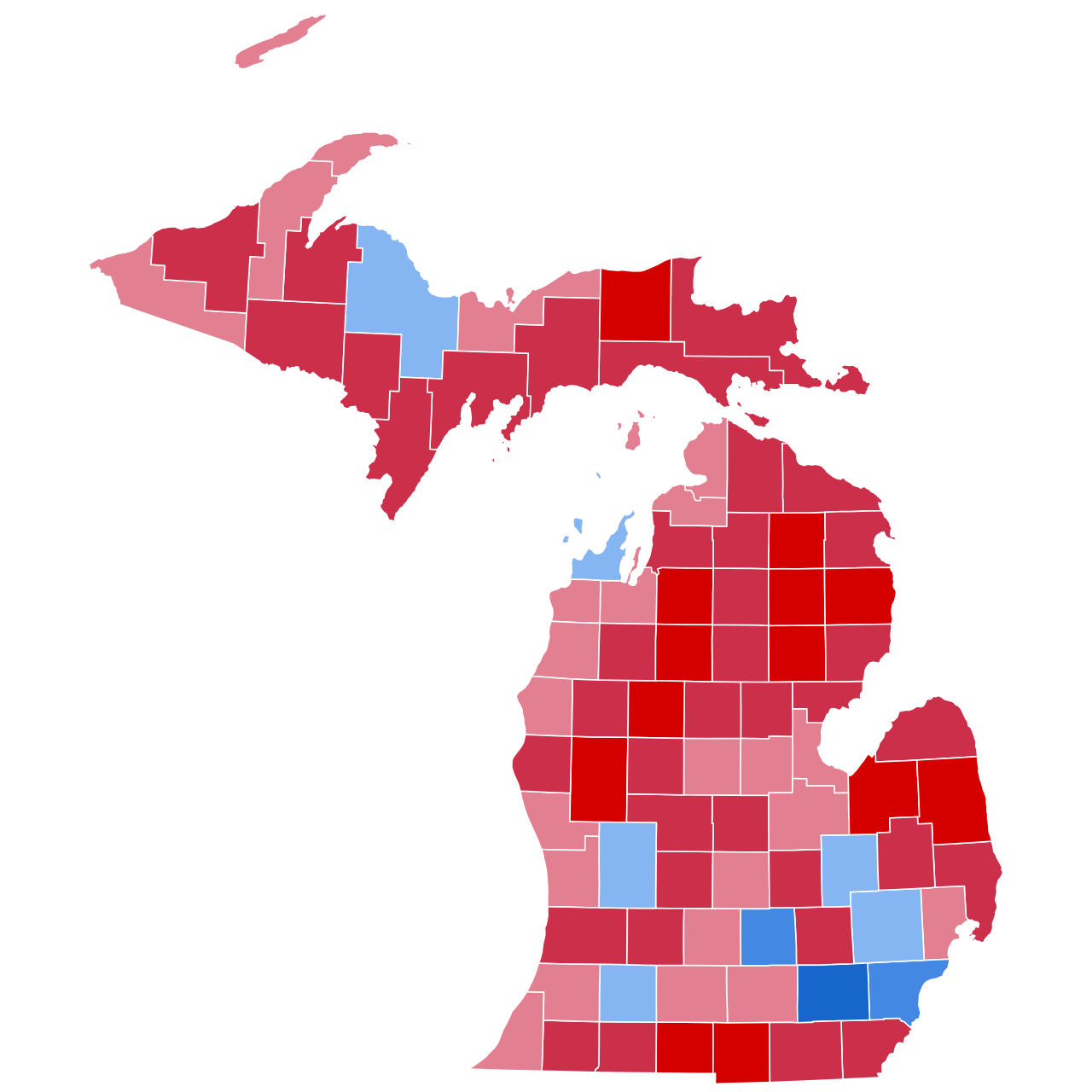
Michigan has come the longest way from the pits of a massive Obama margin than any other state. Here is what the state looked like for a +16.4% Democrat win in 2008:
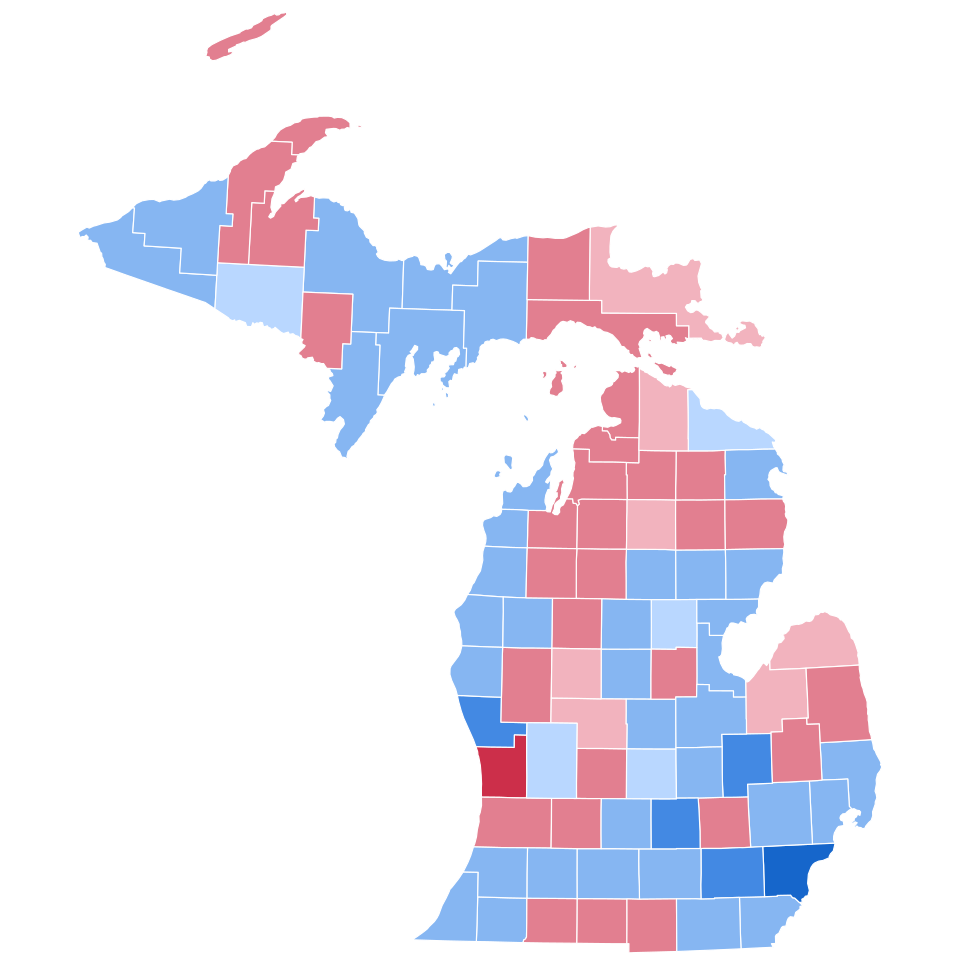
Obama won 46 of Michigan’s 83 counties that year; for context, Kamala Harris only carried 9 counties in 2024. He even had more votes in 2008 than Donald Trump did in 2024. This is largely owed to the disintegration of the Democrats’ stranglehold over the white working class voter, which we’ve also seen take place in Ohio, Pennsylvania, Iowa, Wisconsin, and Minnesota. This trend began with the 2010 midterm Tea Party wave and was visible in Michigan’s 2012 presidential returns when Obama still won the state by a comfortable margin (+9.5%), but coughed up 26 counties he had carried in 2008:
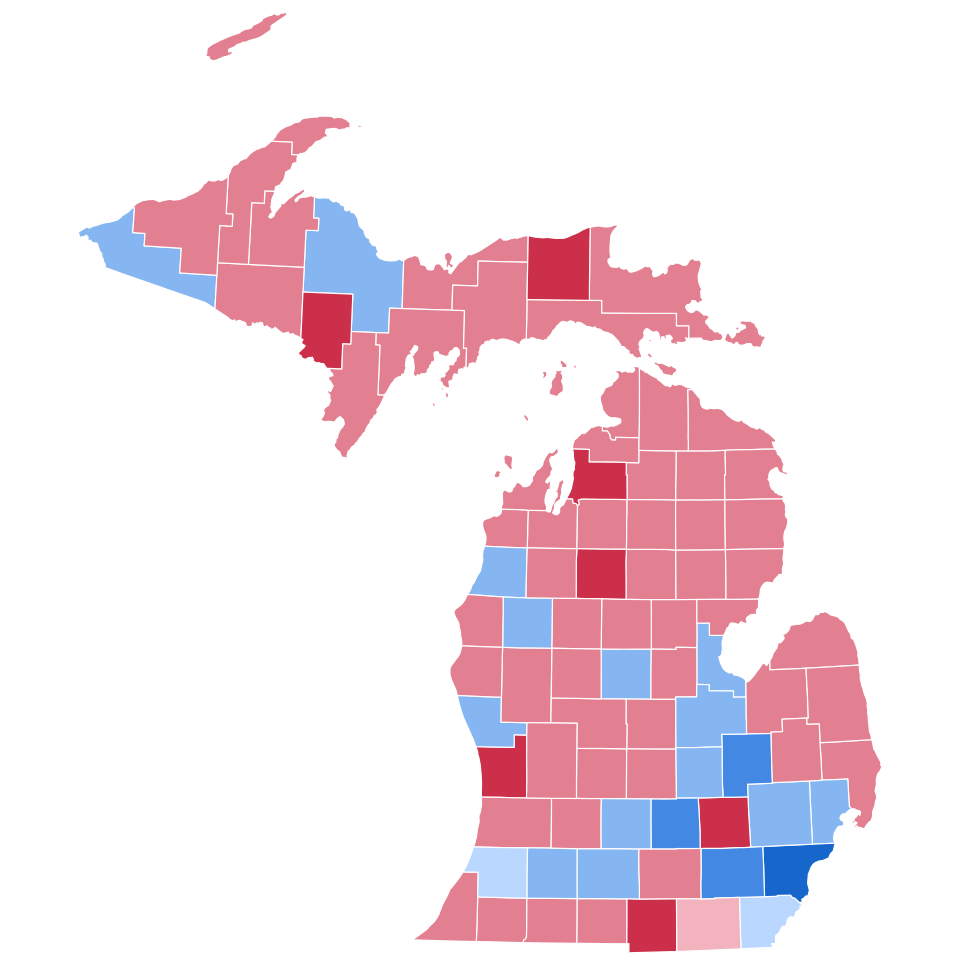
Along came a GOP presidential nominee who, unlike Romney, picked up these disaffected former Democrat voters in droves and snuck past Hillary Clinton in 2016:
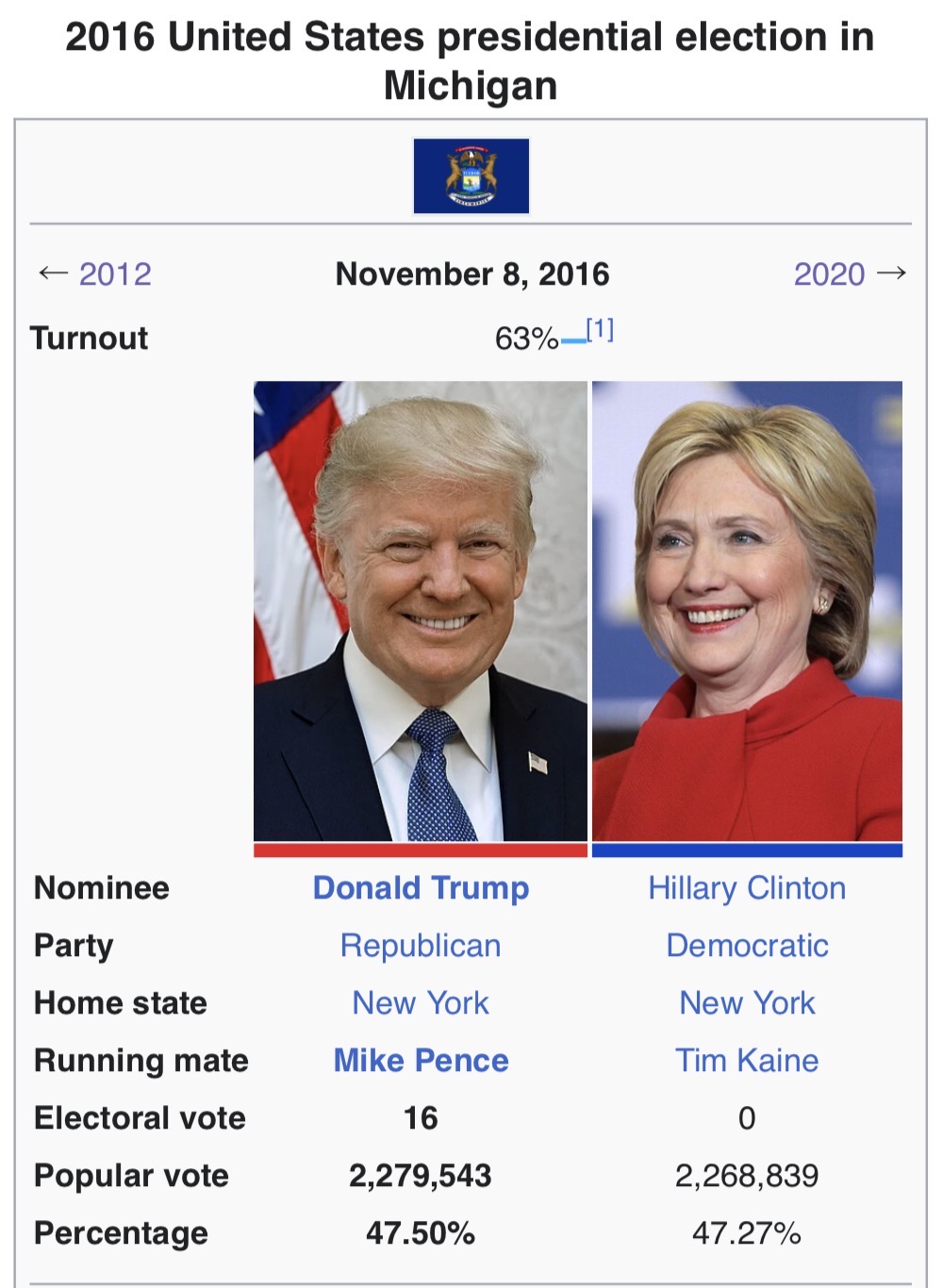
Trump “lost” the state in the criminally corrupt 2020 election, which saw the use of mail-in ballots double from 2016 and his massive lead reverse itself while America slept, but made things “too big to rig” in 2024. Here are Trump’s presidential margins in three races:
2016 Trump +0.2%
2020 Biden +2.8%
2024 Trump +1.4%
In the old school of Republican thought, the way to make Michigan red was to use Monroe and Macomb Counties to cancel out Wayne County, and then ride the tide in the rest of the state. Democrats get most of their punch from Wayne (Detroit), but also huge margins from Oakland (the former Republican suburban county north of Detroit) and Washtenaw Counties (home of Ann Arbor and the University of Michigan. Macomb County, which features the key House race for MI-10’s open seat, is perhaps the most instrumental county in Trump’s transformation of the Great Lakes State:
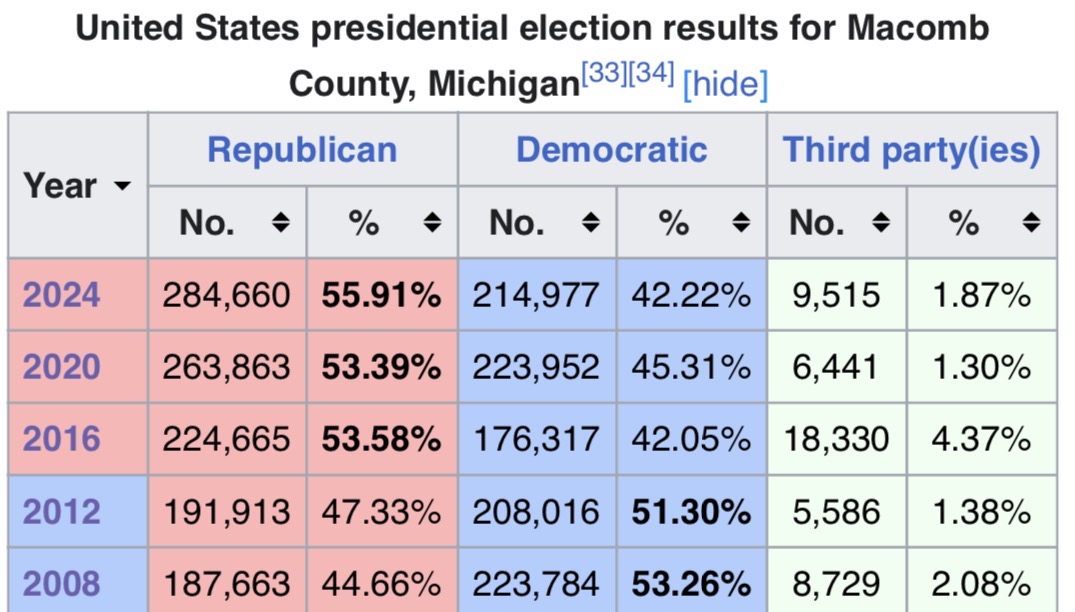
Macomb, essentially the home of the “Reagan Democrat,” has gone from giving Obama a margin of +36,121 in 2008 to +69,683 for Trump in 2024. That’s a movement of 105,804 net votes toward Trump from the 2008 Obama blowout (and this is even counting the Democrat mastery of mail-in ballot collection in the Midwest, so it would be much higher).
Rogers must keep the Trump coalition intact, and is well positioned to do so given El-Sayed’s various weak points and Rogers’s own establishment Republican leanings, which will play well for him in the traditionally Republican strongholds in western Michigan dating back to the 19th century, such as Ottawa County and parts of Kent County (Grand Rapids), which has been lost in the Trump era.
Key Statistics
• 68.2% White, 15.5% Black, 8.3% Hispanic
III. Market Assessment
Yet another market swung by polling and narratives shows the Democrat nominee significantly over-valued.
IV. History
Michigan’s last Republican Senator was Spencer Abraham, who was elected in the 1994 “Republican Revolution.” He only made it one term before being ousted in 2000 by Debbie Stabenow, who has all the charisma of a cardboard box. Still, she managed to get reelected three times, having the luxury of running with two Democrat midterm tailwinds (2006 and 2018) and alongside an Obama statewide victory (2012). The 2018 margin for the three-term incumbent Stabenow tells us a lot about this year’s race between Rogers and El-Sayed:
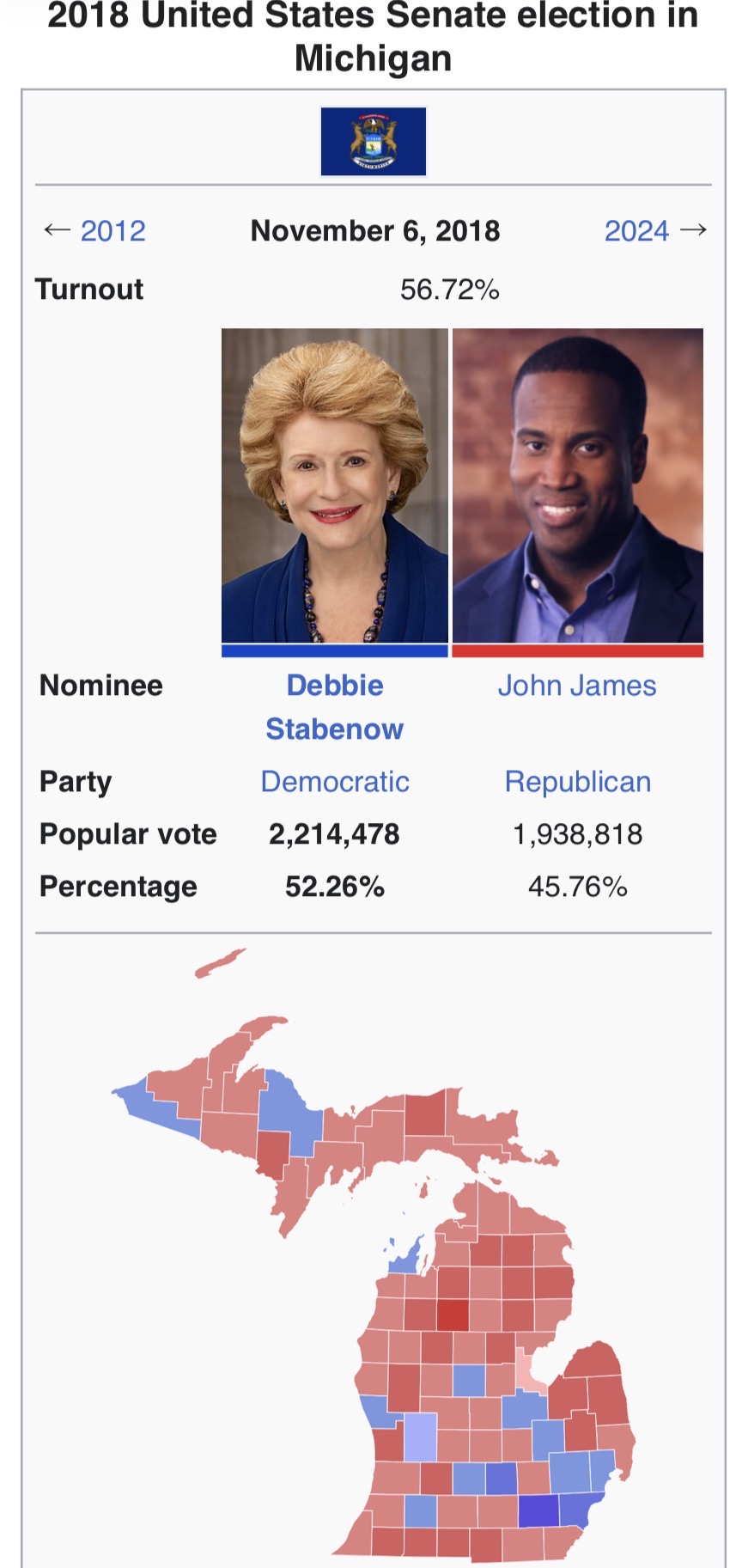
Running into a 2018 headwind, up-and-comer John James (who is the Congressman for MI-10 running now for Governor this year) lost to Stabenow by just 6.5% – a margin 3.1% to the right of Gretchen Whitmer’s concurrent first gubernatorial victory. Keep in mind that Stabenow was the incumbent with maximum name recognition running in a year in which these midwestern state’s hadn’t become heavily “MAGA” down-ballot after Trump’s shock victories. This election example alone should rule out some of these ridiculous poll margins El-Sayed has been credited with recently.
Stabenow retired, and then handed her seat over to seditionist Elissa Slotkin, a useless spook who should be prosecuted. Not that I have much of an opinion on the matter:
Don’t Ignore the Color Revolution Sitting in Plain Sight
Turned away in 2024, Rogers is now after the other seat. Democrat Carl Levin won it in 1978, and then held onto it for six terms. Gary Peters ran upon news of Levin’s retirement in 2014 and won an impressive margin despite a dominant GOP year, but then ran into the Trump momentum and barely held on (an election he would have lost if fair) against James in 2020 (1.7% margin). Smelling the coffee of a reddening Michigan, Peters is now moving for retirement and letting Rogers and El-Sayed battle for the prize.
One final note – Gretchen Whitmer would have walked into this seat this year. She didn’t, and that is your tell that she will probably be announcing for president next year.
V. Analysis of 2026 Primary Results
Rogers ran uncontested for the GOP nomination. The Democrat Senate primary was a Category 5 dumpster fire that has massive implications for the General Election contest:
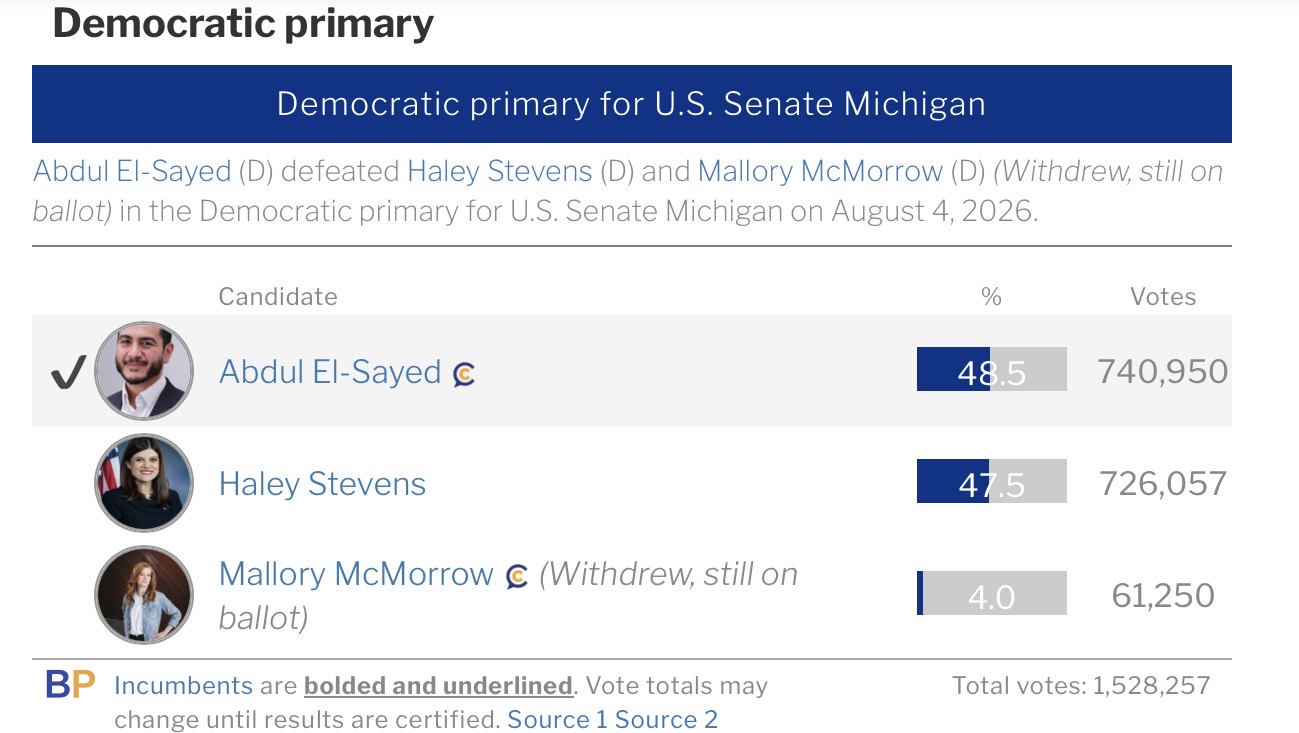
El-Sayed squared off against Haley Stevens and Mallory McMorrow, who both fit the mold of “boring Midwestern white woman.” Democrats have become experts at fielding them for Wisconsin Supreme Court seats and others throughout the Midwest, realizing they are losing their base. Either of those two candidates would have beaten Rogers by 3 or 4 points this year. McMorrow hilariously got driven from the race by completely made-up polling from “Wedgewood Polls” and aired out her feelings last week:
As one of the candidates featured in these polls – the infamous one in late June that showed me plummeting into single digits (which was at odds with our internals) – here's the impact of this "experiment"
– Donations dried up
– Volunteers were devastated and pleading for https://t.co/kJL9N7o7X3…Mallory McMorrow (@MalloryMcMorrow), Oct 20, 2026
El-Sayed dramatically underperformed his polling, and barely squeaked past Stevens, a U.S. House Representative, by 14,893 votes. I personally believe the Democrat machine in Detroit was playing games with mail-in ballots and blaming it on massive black support for Stevens that somehow didn’t appear during in-person voting. You can read a deep-dive on this dysfunctional primary here:
Did Michigan Give Us a Gift or a Curse?
El-Sayed primary victory has led to a rift like none other in the country today, and it makes the Texas GOP drama look like a picnic. Special interest Democrat groups, including Jewish and Black groups, are openly against him and expressing this opposition in very public fashion. Voters are giving interviews talking about voting Republican for the first time, and black public officials in Detroit are campaigning to have people leave that race blank. Bad, bad, bad for the guy who is an overwhelming favorite in the betting markets.
VI. Polls
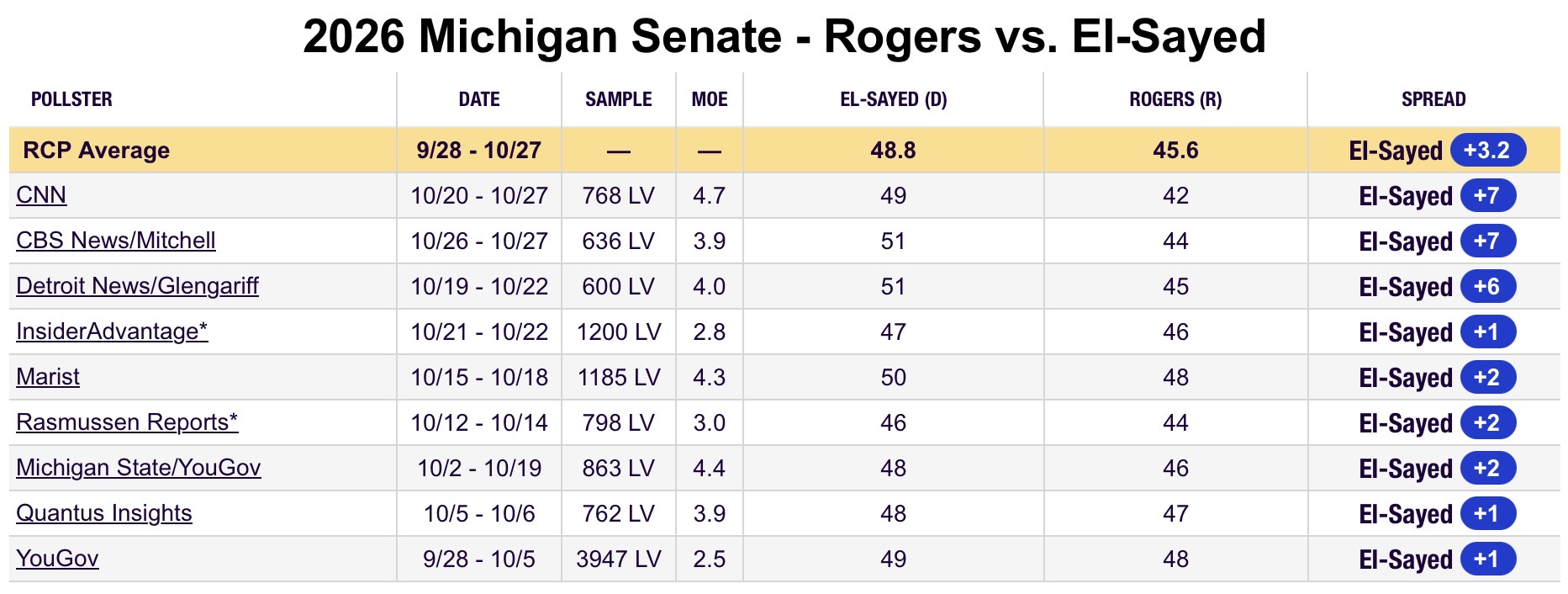
It seems like just yesterday we were getting polls showing Rogers leading. From the end of September through just last week, El-Sayed led the RCP average by just 1.5%, well within the margin of error. Now, we have three polls showing El-Sayed up by 6 or more, which has bloated the overall average to +3.2%. A 7-point margin for El-Sayed appears absolutely ludicrous given his liabilities as a candidate and the open opposition against his candidacy.
VII. Media Ratings
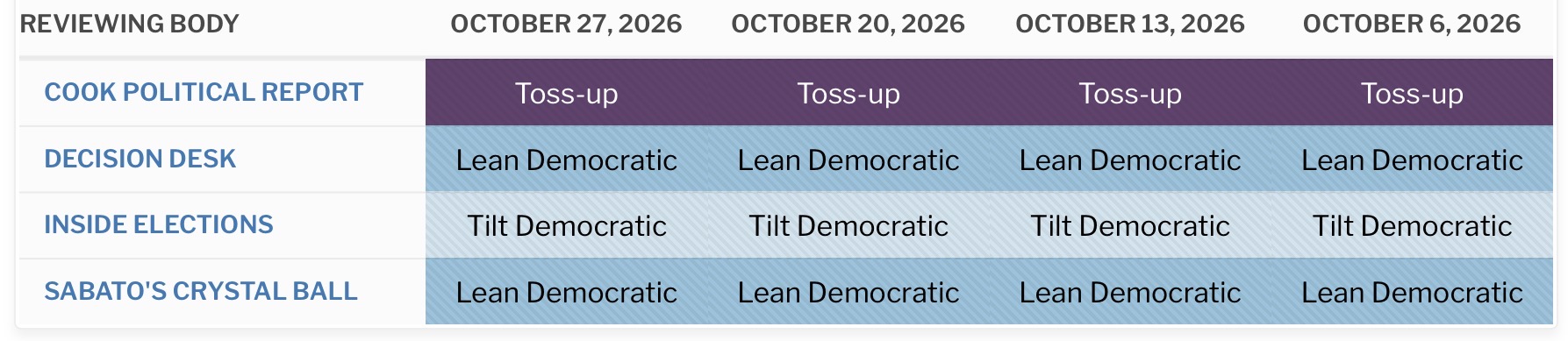
Three of the four reviewing bodies tilt or lean the race for El-Sayed. My views are more in line with Cook, who calls it a “toss-up” – clearly not buying the polling.
VIII. Party Registration
Michigan does not register voters by party; however, it has very strong correlation to voter movement in Pennsylvania, which has a long-standing Republican drift that has only recently been interrupted in the run-up to the primaries. This has made for a fundamentally different race than the one Stabenow held by a relatively unimpressive margin in 2018.
IX. Election Considerations
Here is a compilation of what I’ve written in my MI-7 and MI-10 forecasts:
· Unique Corruption – Michigan has been exposed for covering up voter registration fraud rings, particularly in a major 2023 news story involving one in Muskegon County active during the 2020 election. Notably, similar registration fraud rings were exposed this cycle in Pennsylvania in multiple large counties. The state’s Attorney General, Dana Nessel, has threatened election integrity activists with imprisonment and police persecution for drawing attention to Michigan’s endless examples election-related malfeasance.
· Automatic Voter Registration – Michigan operates Automatic Voter Registration, which has only entrenched Michigan’s voter registration corruption, as evidenced by the state having hundreds of thousands of more voters registered than there is an available pool of eligible voters statewide. The Secretary of State, Jocelyn Benson, has suggested the state is helpless to clean its voter rolls and responds harshly to citizens who expect the state to run fair elections. As a reminder, more than 83% of Michigan’s total population (including minors) is registered to vote, when only 77% of any population is over the age of 18 and therefore old enough to cast a ballot.
As I wrote in the MI-7 article:
No state with the number of registered voters exceeding voting-age population can be trusted to run fair elections, and if control of the House hinges on MI-7, even the Democrat establishment will go to bat for Lawrence and trust they can bend him to their will in a hypothetical majority.
Michigan, thanks to the work of Jocelyn Benson as Secretary of State, does not run an elections system any real analyst should consider secure of trustworthy. Ask Mike Rogers, who lost to Elissa Slotkin in the wee hours of the morning once all the mail-in ballots came in after Trump was declared the winner of the state.
My evaluation of Michigan’s 2024 election with regard to election integrity can be found here:
Michigan – 2024 Election Compendium
X. Summary and Election Estimate
In 2018, Stabenow managed to carry Macomb County narrowly over James, who almost won Kent County, which has since drifted away from the GOP. Rogers won Macomb by almost 10 points against Slotkin in 2024; granted, he was running with Trump on the ticket, but Slotkin presented herself as a well-rounded moderate. El-Sayed pretends to be nothing of the sort, and has entire voting blocs aligned against him. Stabenow was able to limit the damage in the overwhelmingly red rural counties still adjusting to Trump’s surprise 2016 victory; Rogers will dominate those.
The biggest variable to me comes by way of what happens in Wayne County. Stabenow won it by over 264,000 margin in 2018 over James. The black population of Wayne County is nearly 37%, and if they are sitting out, crossing over in even modest numbers, or leaving the ballots blank, then it will doom El-Sayed’s campaign. Right now, Wayne County ranks 18th out of 83 counties for its share of the 2024 presidential vote put in, but in-person early voting has been up for a week and Democrats are known to front-load their votes. It is very possible, with over 350,000 ballots left to go to even match their 2022 gubernatorial count, that Wayne will have a turnout disaster like we are watching unfold in Cuyahoga County, Ohio, impacting the Brown-Husted race. Genesee County, home to Flint, lags behind Wayne County and may wind up even worse off in a place where Democrats need the votes.
El-Sayed, for all his shortcomings, still dominates the decision matrix (at the mercy of ratings and polls that aren’t always right):
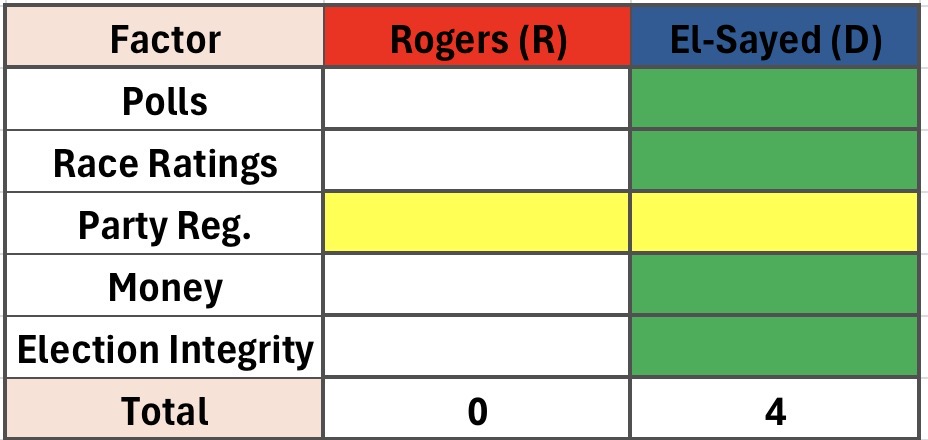
If nominated, McMorrow and Stevens would have led in those same four categories. I would have favored them both to win this race, along 70/30 odds with a likely margin of victory around 3.5%. El-Sayed the candidate is the difference maker in this race. He has a definite chance to win, but based on where the 2018 election with an established incumbent landed, the decade-long trend of Michigan, and all of the groups Democrats need on their side opposing El-Sayed, I consider his ceiling excruciatingly low – perhaps 1.5% or less.
This race is potentially going to be the closest Senate battleground race, and I think Democrats will be lacking for turnout in areas they need it most. Based only on what I think are unique circumstances surrounding El-Sayed, I am nudging this toss-up toward Rogers, who has his own likely low ceiling owed to Michigan’s Republican headwinds.
Forecast for Michigan U.S. Senate
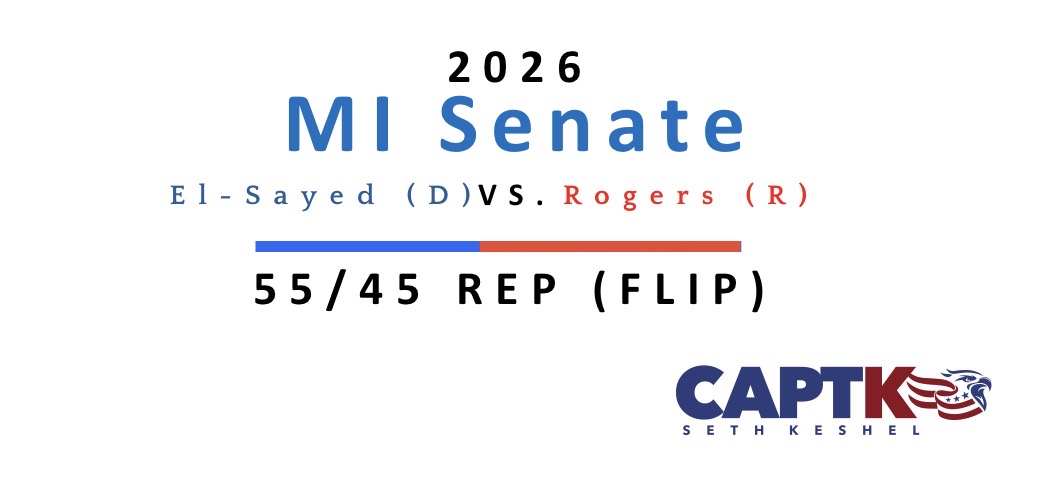
I don’t leave things on “toss-up.” This is merely based on what I think will arise due to El-Sayed’s major liabilities as a candidate.
Seth Keshel, MBA is a Senior Fellow at the Gold Institute for International Strategy and a retired Army Captain. He publishes Captain K’s Corner on Substack.