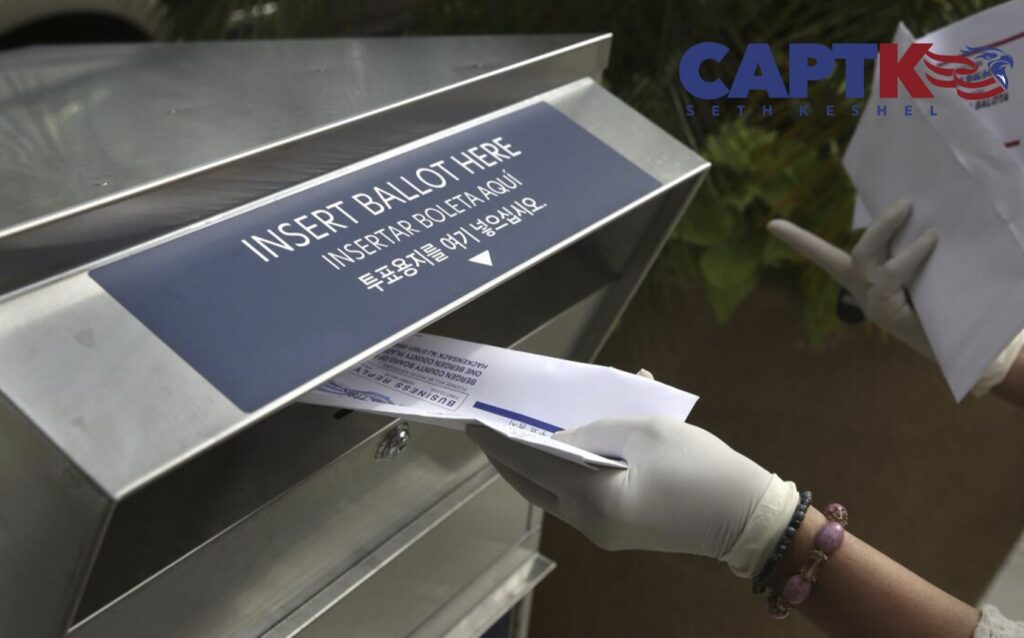
Ready to take effect for 2026 midterms
Potentially big news broke Saturday as the United States Postal Service provided a 95-page ruling as to how they will be handling mail-in ballots pending favorable relief from the courtroom (hence the asterisks in the title and sub-title of this article). From Reuters:
USPS said it was issuing its 95-page rule so it could take immediate effect if a court lifted its injunctions on it and be in place for the upcoming election. Under the rule, USPS would not deliver ballots in states that do not comply with the rule’s new standards.
You can also find the full document at my Telegram page in a forwarded post.
The USPS cuts right to the chase and points fingers at the ridiculous courts in this country, which are doing everything they can to get in the way of communists being thrown out of power everywhere in America. From the document:
Given injunctions currently in place in State of California v. Trump, No. 26-cv-11581 (D. Mass. June 25, 2026), and League of Women Voters of Massachusetts v. Trump, No. 26-cv-11549 (D. Mass. Aug. 11, 2026), the Postal Service will not take actions to implement the rule specifically for the 2026 election unless and until the government obtains relief from those injunctions.
Essentially, the USPS tells us in the first two pages they are trying to execute the President’s executive order intended to “…reduce the risk of fraud, and help protect the integrity of federal elections.” Of course, every nation on Earth realizes the problems with mail-in balloting, which is why you can barely spin the globe without your finger landing on a nation that hasn’t already banned the practice; that is, every nation not filled with left-wing idiots jamming up the courts and praying they can threaten and blackmail themselves to some half-baked ruling from a tyrant in a robe on the enemy’s payroll that furthers their sick agendas.
This article, as I am fond of doing, will outline the Top Five Points of the USPS’s ruling for your edification and understanding:
I. Timing
The USPS is on point and getting ahead of anything new, specifically aiming these reforms with a court order in mind. The Trump administration is awaiting an emergency Supreme Court ruling on their filings pushing back against the lawsuits from states listed above. Most recently, the Supreme Court (thanks to Amy Coney Barrett) gave us the shaft by allowing states to count mail-in ballots arriving after Election Day.
It remains to be seen whether that ruling will have any impact on Trump’s USPS executive order (14399). Still, I find it promising that the USPS is bullish enough on the validity and necessity of that order to produce such a thorough document that suggests they acknowledge the vulnerabilities of the present system and the potential for fraud and abuse. Simply put, the USPS is ready and eager to implement these changes. Timing is essential, since states like Virginia and Pennsylvania will start pushing mail ballots out within the next month.
II. Federal Mail-In Ballot Portal
This is a huge piece, and the resistance of the mail-in heavy states to it is essentially a tell that they all know the system is beyond redemption. This portion requires officials to enter data for every outbound federal mail-in ballot before they are sent out. Remember, the eight states participating in Universal Mail-In Voting (CA, CO, HI, NV, OR, UT, VT, WA) send out ballots to every registrant on the rolls, no matter if that person is still living or is even a citizen (or was ever real to begin with). Other states, like Arizona, operate massive mail lists voters may enroll in, but stop short of Universal.
The states guilty of mail-in ballot rigging realize that by providing advanced notice of which registrations are receiving ballots, they are condemning themselves to being found out by federal investigators who will now be able to fully quantify how many of these ballots have no business being sent out. The lawfare is the easiest and most expected route for the rogue states.
III. Envelope Design Standards
If you’re using the federal mail service for federal elections, then we expect you to play by our rules. This portion lays out the requirements for envelopes, including specific security measures such as barcodes to guarantee authenticity of ballots and provide effective measures to quickly track and sort ballots.
Measures like these make it hard for ballots to go missing and ensure chain-of-custody for mailed ballots, which would likely have much higher rates of return once verified on an official portal ensuring only real people can receive them.
IV. Criteria for Verification and Acceptance
USPS employees will check presented mail ballots for compliance with the portal described above, and also examine the envelopes for design compliance (also listed above in point three). Non-matches with the portal and out-of-standard envelope specifications will force each non-compliant piece back to the mailing entity for reassessment.
This is another safety measure against groups seeking to deceive the postal service by mailing counterfeit ballots, and to ensure that only entries listed on the portal are receiving ballots. Additionally, insertion of large quantities of fraudulent ballots in the mail are easily spotted.
V. What It Does Not Do
This guidance does not mean that:
The USPS determines voter eligibility
The USPS examines citizenship
The USPS opens or examines ballots upon return
The USPS extends these procedures to UOCAVA (Uniformed and Overseas Citizens Absentee Voting Act)
Conclusion
I consider it a positive sign that the USPS thinks the Trump administration will win this case promising for more security for mail-in balloting than is present today. Most bureaucratic organizations won’t lift a finger to move on anything no matter how imperative the cause is; the USPS drafting a 95-page document waiting on the word “go” to implement massive changes is hard to overlook.
Should the proper relief be granted, I consider it highly likely that we will have a midterm fiasco of mail-in-reliant states not having complied with the requirements of portal entries or envelope design because they were too busy resisting the logic and simple rationale of the executive order and expecting courts to continue to be in their pockets. This would give grounds for suing over lost House and Senate races, of which there are several in the eight Universal Mail-In Voting states and many more in other states that have hundreds of thousands (or even millions) of mail-in ballots flying around.
Seth Keshel, MBA is a Senior Fellow at the Gold Institute for International Strategy and a retired Army Captain. He publishes Captain K’s Corner on Substack.