So goes Florida…
With Florida’s 2026 primary fading into the rearview mirror, we are just about wrapped up and in General Election mode. A few blue state primaries remain in September, as well as Oklahoma runoffs, but things are just about set pending some nominees in competitive or marginally competitive races in New Hampshire.
Florida is rapidly emerging as the king of Republican states, supplanting Texas, which had a strong run at the top for the past two decades. That’s not to say that I think Texas is doomed to blue statehood, but it’s a state that is unfortunately capable of marginally competitive races and one that Republicans are going to have to spend money on this year in the U.S. Senate to avoid a Ted Cruz-style clunker like he had in 2018. In Florida, it’s a damn cakewalk.
As I have written recently on X, Florida affords an analyst something Texas does not. It has party registration, and the impact is immense. You don’t see too many fake polls flying around regarding anything going on in Florida, which very recently held statewide races that would return a one-point race between an ice cream cone and a kick in the throat.
“The single biggest tell that Texas polls are trash are the polls showing Abbott in a tight race. Looking at the 2022 polls, you’ll find plenty from Aug-Sep showing a 3-5 point race. Echelon had it at +2 in September. Abbott won by 11% and has never had less than 54.8% of the” — Seth Keshel (@RealSKeshel), August 7, 2026
This is how much Florida has shifted Republican even since Trump’s +13.1% not yet two years ago:
Four hundred twenty-nine thousand seven hundred seventeen registrations redder than it was at the time of the largest GOP presidential landslide in the state in 36 years. For the love of God, people, the mountains of north Georgia and the suburbs of Wilmington are nice, too – just in case you’ve given thought to living anywhere else.
Nevertheless, the weight of the party registration trend in Florida is immense, and last night’s three key takeaways prove my point:
Three Key Takeaways of the Florida Primaries
I. The Count Itself
Does anyone remember July 10? Not so long ago – that was the date California finished counting 9,446,461 ballots for their June 2 primary. 38 days at an average of 248,591 per day, with a few delays to rig a race here and there.
Now check this out:
Florida has counted 2,767,080 gubernatorial votes in roughly twelve hours, and is practically all finished. This is a state that learned its lesson from being the butt of all election administration jokes in the 2000 election – and that was just one county! There are plenty of Floridians (and outsiders) who have issues with how certain races went, but none of them have a single bone to pick with how the results were presented. This is because the speed and transparency of the count matters to public acceptance of the results.
California’s mail-in ballot antics are highly fraudulent, and the biggest revelation about states like that, including Arizona, Washington, Oregon, and others, is that if they wanted to, they could fix the election crisis. The fact that these issues persist despite one of our largest states having a seamless system is a dead giveaway that certain states require the extended time period to craft results they have predetermined to be necessary.
II. TDS is an Internet Phenomenon
Trump Derangement Syndrome (TDS) is something we’ve all seen. It’s an ugly thing, robbing many once promising people of the ability to form independent thoughts or tolerate the slightest of disagreements with friends, family, or colleagues. It usually manifests itself with bluish-pinkish hair and bull rings through the nose, but sometimes can be concealed in a business suit and swanky bars after hours.
Make the mistake of clicking or interacting with one X post made by a TDS victim, and your algorithm will send hundreds of them your way. Soon, you may find yourself inundated with this hatred:
- Praising former Republican leaders as civilized and statesmanlike, as if the left didn’t call John McCain and Mitt Romney Nazis, racists, and Klansmen, too
- Accusations of Trump and his close associates as foreign assets
- Using lawsuit claims as direct fact to prove a point all of their friends already buy into, anyway
- Cheering for natural disasters to destroy entire regions that voted for Trump
- Condemnation of all family who vote differently
You’d think these feelings were widespread. Maybe someone should tell that to Democrat primary voters in Florida, then?
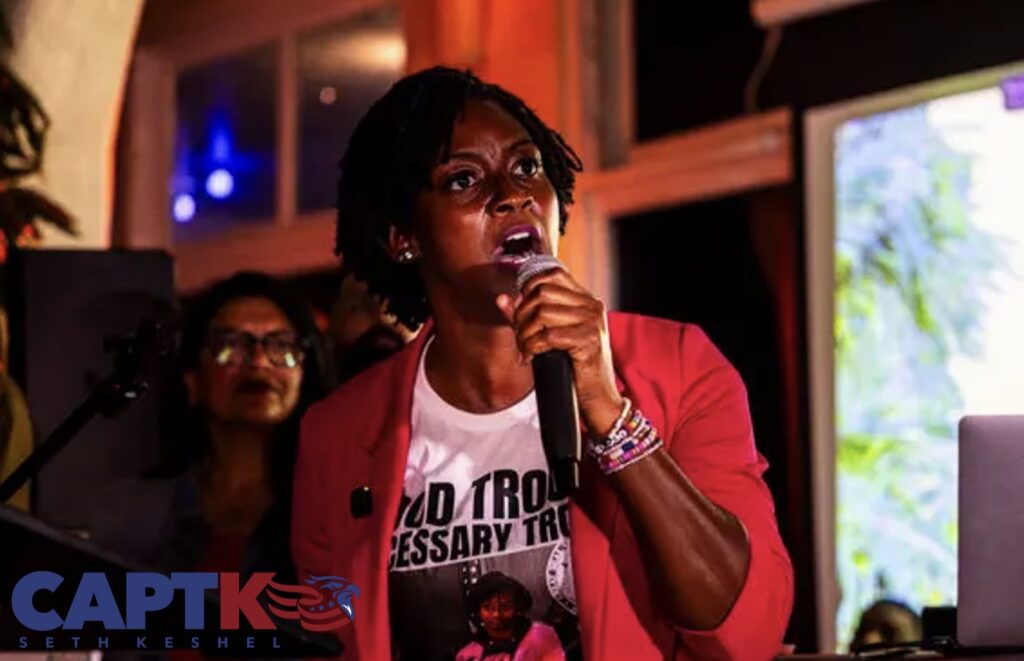
You read that right, the traitor Alexander Vindman, who was widely expected to emerge as the Democrat nominee losing to Ashley Moody this November, got smoked by 12.2% by a DSA candidate named Angie Nixon, who happens to be a complete psychopath. Vindman, loaded with cash, was such a sure shot as a darling of the TDS base that I couldn’t even find any polling of his race against Nixon. This woman has it right on the money:
“BREAKING: Whistleblower says Alexander Vindman’s concession phone call was improper.” — Kate Hyde (@KateHydeNY), August 18, 2026
TDS first emerged in the form of deranged Trump attacks from the left. The model since Trump took office for the second time has been to attack from the perceived right in order to demoralize the MAGA base, which is very susceptible to online demoralization tactics given the existence of screen addiction. James Fishback, who garnered 10.5% of the vote in the GOP primary, seized on that operation and presented the standard “chronically online” platform of things the new Trump skeptics think they understand. As I’ve made clear before, I support no foreign countries and don’t even trust my own government. But a lot of folks, such as Tucker Carlson, Marjorie Taylor Greene, and of course, Fishback, have focused on online blurbs and viral sound bites rather than meaningful platforms. As the results show, shallowness fizzles and the results prove TDS is primarily an internet phenomenon.
III. GOP Bloodbath and Blue Wave Immunity
People ask me all the time, “If the GOP is gaining in registrations why did they lose this school board race in a special Thursday lunch election in Minot, North Dakota?” Well, the registration indexes are most predictive for presidential elections, but in the long run, point to the overall health of a party. Florida is now red enough to where it is immune from Democrat victories at the statewide level, even in a national blue wave year. Simply put, if you are over the age of 40 and never want to live in a state that can turn blue, then join everyone else and move to Florida.
Florida is R+11.4% by registration today (11.4% more registered Republicans than Democrats). Given the dynamics of 2026, a year the Democrats should do well in midterms, I could understand if yesterday’s turnout did not reach R+11.4%. After all, Democrats outvoted Republicans in Texas this year (as they did in 2020 and 2008, when the state did not turn blue). Anyway, out of 2,767,080 gubernatorial votes tabulated at the time of this article’s publication, 1,696,335 were Republican. That means the turnout at the top of the ticket was 61.3% Republican and just 38.7% Democrat. The top of the ticket turnout in Florida was R+22.6% in an R+11.4% state in a Democrat-leaning year nationally.
It seems that Florida’s days of being predictive of other states may be nearing their end. That’s unfortunate, because it’s been useful for pegging the movement of states like Pennsylvania and Michigan, or identifying national outcomes (like the GOP having never won Miami-Dade County in a presidential election while losing the presidency). This happened to Ohio, which simply became red beyond belief and I suspect is no longer predictive as a national bellwether (meaning the Republicans can win Ohio now and lose the presidency).
Conclusion
Florida is red. None of the statewide races will be close, and I wouldn’t be surprised if Ashley Moody wins every county against Nixon, or gets very close to doing so. Byron Donalds will be the next governor, with massive shoes to fill.
The internet does not reflect real life opinion or voter sentiment. Be careful in discerning fact from fiction online.
The R+22.6% top of the ticket turnout is devastating for Democrats down ballot. The one seat I am uncertain of, FL-25, seems more promising for Republicans than it did 24 hours ago. If they win that one, they’re in good position to make a run at holding the majority in a year they have little business doing so given 92 years of political history.
Ryan Elijah unseated Cory Mills in FL-7, which removes any risk of a Democrat upset in November against someone who has turned out to be a complete dirtbag plagued by scandal.
All Republican states should seek to emulate Florida. It appears to be immune to the Democrat virus, and if delegations don’t start arriving in Tallahassee for instruction, I’m going to have no choice but to question their priorities.
Seth Keshel, MBA is a Senior Fellow at the Gold Institute for International Strategy and a retired Army Captain. He publishes Captain K’s Corner on Substack.