(This article was written by Brigadier General (Ret.) Ernie Audino and appeared in The Washington Times.) Nothing is more dangerous than a nuclear ayatollah. That’s why President Trump did something about it. He deserves credit, and humanity deserves the victory. Although American attention has now shifted elsewhere, Iran still holds cards to play…
Continue readingLeft Ignores Africa’s Stability, Growth, Dignity, and Truth
Tanzania map
Continue readingAdelle Nazarian: “Tariffs are like shock therapy”
Adam Lovinger: China’s Strategic Role in Fomenting Global Anti-Semitism
Adam Lovinger, VP for Strategic Affairs at the Gold Institute for International Strategy, recently joined the D.C. Defense Strategy Meeting to unpack a deeply unsettling trend: China’s emerging role in amplifying modern antisemitism. Drawing on his years in the Pentagon’s Office of Net Assessment, Adam traces how Chinese elites have studied Jewish survival and success for decades, and how today that long-range civilizational competition is increasingly playing out through information warfare, bot networks, and efforts to fracture the relationship between Jews and Christians in the West.
In this video, Adam walks through the little-known history of Chinese research institutes on “the Jewish secret to success,” the limits they found in trying to emulate it, and the disturbing conclusion that great powers which seek to destroy the Jewish people ultimately destroy themselves. He then connects that history to the post–October 7 environment, where foreign adversaries weaponize antisemitism and social division as tools of strategic competition rather than mere prejudice.
Watch the full remarks, and if you value this kind of long-range strategic analysis, please consider supporting the Institute by clicking DONATE on the site.
The Bondi Beach Hanukkah Massacre and the Islamist Blind Spot the West Refuses to Confront
(This article was written by Adelle Nazarian and appeared in The Western Journal. The Bondi Beach Hanukkah Massacre and the Islamist Blind Spot the West Refuses to Confront)
Bondi Beach should have been a place of light.
On that warm December evening, Jews gathered along Sydney’s shoreline for Chanukah by the Sea, a public Hanukkah celebration marked by prayer, music, and remembrance. Children clutched candles. Rabbis offered blessings. Holocaust survivors stood as living witnesses to resilience.
What followed was not merely an act of violence, but a devastating failure of imagination by Western security establishments that still refuse to confront how transnational Islamist networks radicalize across borders, cultures, and identities. The accused attackers are a father and son of Indian Muslim origin, now central to Australia’s most serious anti-Semitic terror investigation.
They did not emerge from a vacuum. They were not driven by poverty, exclusion, or race. They were animated by ideology, shaped by networks, and enabled by a long-standing Western reluctance to interrogate so-called “non-violent” Islamist movements that repeatedly appear upstream of jihadist violence. Authorities allege the Bondi Beach massacre was inspired by ISIS ideology.
The symbolism alone — targeting Jews during Chanukah by the Sea — leaves little doubt about motive. Yet focusing exclusively on ISIS branding offers a comforting but incomplete explanation. It allows policymakers to treat such attacks as sudden eruptions, rather than the end result of a long radicalization process. The more difficult question remains unanswered: How do individuals living for decades in liberal democracies come to see mass murder as a religious duty?
The answer lies not only with designated terrorist organizations, but with the ideological ecosystems that normalize absolutism, grievance, and separation from pluralistic society long before violence occurs. These environments rarely make headlines, because they operate below the threshold of criminality. But they matter. And they recur.
One such movement, consistently overlooked by Western governments, is Tablighi Jamaat.
Tablighi Jamaat presents itself as a quietist Islamic missionary movement devoted to personal piety. It is not formally designated a terrorist organization, and its defenders lean heavily on that distinction. Yet counterterrorism history tells a far more troubling story. Tablighi Jamaat is not banned in Australia or the West. But legality does not negate ideological influence.
During the height of ISIS recruitment between 2014 and 2019, intelligence services across Europe, South Asia, and Southeast Asia documented disproportionate numbers of ISIS recruits who had passed through Tablighi Jamaat environments. This was not because the movement openly endorsed violence — it did not — but because it created ideological and social conditions that jihadist recruiters knew how to exploit.
Tablighi Jamaat promotes rigid Deobandi interpretations of Islam, rejection of Western civic identity, withdrawal from pluralistic society, and deference to insular religious authority over secular law.
That worldview does not pull the trigger, but it conditions the mind for those who will. It is the difference between radicalization as an event and radicalization as a process.
Understanding that process requires acknowledging the movement’s undeniable global reach.
Tablighi Jamaat was founded in 1926 in the Mewat region of India (then British India), near Delhi, by Maulana Muhammad Ilyas Kandhlawi, a Deobandi Islamic scholar.
TJ’s operational leadership consolidated over time in Pakistan, with vast infrastructure in Bangladesh and entrenched presences across Europe, Australia, North America, and Africa. Its global nerve center at Raiwind, Pakistan, and its massive annual gatherings, some drawing millions, provide unparalleled reach, anonymity, and mobility.
The movement recruits across race and ethnicity, including Western converts, making it uniquely effective inside diaspora communities.
In Bangladesh, this ecosystem is further reinforced by the presence of Jamaat-e-Islami, a political Islamist movement that has long shaped religious discourse and activism, creating ideological adjacency between missionary revivalism and overtly political Islamism. This transnational structure is precisely why jihadist groups have long viewed Tablighi Jamaat spaces as ideal recruiting pools. The West’s persistent error has been to equate “non-violent” with “non-threatening.” History has repeatedly proven otherwise.
The Bondi Beach massacre also shatters another comforting illusion: that Islamist extremism is confined to certain nationalities or conflict zones.
Indian Islamism or Islamism originating in the West, particularly currents influenced by Salafi ideology, has long intersected with Pakistani and Bangladeshi networks through movements like Tablighi Jamaat.
These ideological pipelines do not stop at borders, nor do they dissolve when individuals migrate to Western democracies. Treating radicalization as geographically contained is not merely inaccurate; it is dangerous.
This is not an indictment of India, Muslims, or immigration. It is an indictment of ideological denial; the belief that Islamist extremism announces itself only at the moment of violence, rather than developing quietly over years.
One constant runs through these movements, regardless of geography: anti-Semitism. It is not incidental — it is doctrinal.
Across ISIS, al-Qaida, Hamas, and their ideological feeders, Jews are framed not as political adversaries, but as cosmic enemies. That framing allows ordinary men — fathers, sons, neighbors — to rationalize slaughter as a sacred duty.
Western societies often misdiagnose anti-Semitic jihad as “foreign conflicts spilling over.” In reality, anti-Semitism is the emotional accelerant of global jihad.
Bondi Beach was not random. Chanukah by the Sea was chosen deliberately.
Australia, like the United States and much of Europe, has relied on an outdated counterterrorism framework that draws a bright line between “violent extremists” and “non-violent Islamists.”
That line exists largely to avoid political discomfort, not because it reflects reality.
Non-violent Islamist movements shape identity, grievance, and loyalty. Violent groups merely harvest what has already been planted.
Until Western governments are willing to scrutinize transnational missionary networks, track ideological convergence rather than weapons alone, and acknowledge gateway movements without fear of offense, mass-casualty attacks will continue to arrive “unexpectedly.” The blood spilled at Chanukah by the Sea demands more than condolences. It demands courage: the courage to say that faith is not the problem, but ideology is. The courage to admit that some movements function as radicalization corridors, even without firing a shot. The courage to protect Jewish communities not after attacks, but before them.
If the West continues to treat ideological blindness as tolerance, it will keep learning the truth the same way it did in Bondi — after the candles are extinguished and the bodies are counted.
Adelle Nazarian is a Senior Fellow at the Gold Institute for International Strategy, a Washington D.C. based foreign policy and defense think tank.
The War on Dogs
(This article was written by Hermann Tertsch and appeared in El Debate. La guerra de los perros)
The Heraldo de México is not the only outlet fascinated by the news of what they have taken to calling hobby dogging, which, according to social media and various outlets, has become fashionable in Germany and consists of taking the dog out for a walk on a lead, but without the dog. You go out with the lead and make all the usual gestures one makes when taking a dog for a walk on a leash. That newspaper says that hobby dogging “is presented as a leisure activity for animal lovers who want to avoid the nuisances and costs of having a real pet, such as veterinary bills, cleaning up faeces, drooling or aggressive behaviour”.
I do not believe it is going to be a “fashion”, nor do I believe there are animal lovers who would consider it gratifying to take out for a walk a lead with no animal on it. What I do believe is that its appearance may be a response to phenomena of greater substance than laziness. Because in many neighbourhoods in Germany and other European countries, and of course in the United Kingdom, taking a dog out for a walk around the neighbourhood has become a disquieting activity when not a risky one.
And that is because their neighbourhoods have filled up, especially over the past decade, with neighbours who hate dogs. Who consider dogs in particular an impure and repugnant animal, and their being kept close to human beings an offence to their religious ideology. Almost as much as the pig. There are more and more conflictive situations arising between members of Muslim communities and dog owners in cultivated Western societies accustomed for millennia to love of the domestic animal.
And so it happens that more and more dog walkers are warned by elements who have set themselves up as guardians of Muslim essences in cities that until very recently were clearly Christian, not to take their animals along certain streets or squares which they already consider theirs and where they have institutionalised their ever greater control over public space in European cities. This unofficial “sharia police”, or police of mere Islamic morality, will just as readily berate women for having bare arms, a short skirt or hair uncovered by a veil as for walking a poodle or a German shepherd.
In the large British cities, now almost all governed by Muslim mayors thanks to the left, these confrontations have become habitual, with the powerless phrases of the dog’s owner, who tries to defend himself by invoking his condition as a native, born in the neighbourhood, and his right to walk his dog. And the answers from that guard of Mohammedan decorum warning that if they see the dog in that area again, it is a dead dog.
Just as there are bathing areas in the lakes around Berlin which Germans have no longer been able to access because they do not comply with the dress codes of Islam. Those who tried ran into burly enforcers of Islamic morality who expelled them without ceremony.
There is already clear evidence that the most militant sectors of the Muslim communities, which it must be said are never criticised, at least publicly, by the rest of those communities, have entered a new and higher phase of activism. This goes beyond the bloody attacks and the demonstrations in support of Hamas and other Islamist terrorist groups, which have shown their will to take control and impose themselves by way of intimidation and violence in the Western societies that have taken them in. Societies that grant free housing, sustenance and services to the largely non-contributing part of this mass immigration.
In the last two years attacks on Christian symbols have intensified brutally, the smashing of crosses and images, incursions into churches, harassment of Christian masses, the burning of Christmas trees and nativity scenes. There has also been an intensification of the message from Muslim leaders who warn that they have come to Western societies not to adapt to the civilisation that receives them but to destroy it by way of conversion to a religious ideology that produces nothing but failed states.
Since they consider it incompatible with their radical will to impose Islam, which is the only religion that deserves to survive, because it is the only one that answers to the will of their pitiless, brutal and implacable god.
More and more of them, on social media and in public, warn that all those who do not end up accepting their fate under Islam will be subjugated or destroyed. But if this Islamist vanguard is worrying, no less so is the fact that there is nobody in the Muslim communities who contradicts them. And they all help to impose on the Western authorities concessions that display the weakness of the positions of the Western host society. Each concession, as in regions of Spain with the ban on pork in school menus, is followed by another demand.
The attempts to abolish every expression of Christendom such as Christmas or Holy Week follow one after another, at the same time as public demonstrations multiply with Muslim prayers that paralyse streets and squares or encircle cathedrals, as has been happening lately. Meanwhile, in a short space of time millions of Muslims have arrived, in their vast majority young men of military age, who are not fleeing any famine. They have entered without any control at all and many of them necessarily have terrorist or military experience.
Everything indicates that the Muslim Brotherhood, which is the organisation that directs the large-scale operations, from terrorism to the processes of hybrid religious and cultural war against Christianity, considers that it already has sufficient critical mass for an assault on greater power throughout the West. The massive financing and the lobbies of Qatar, of Turkey, of Morocco or Saudi Arabia, and paradoxically and regrettably also the European Union’s financing of NGOs and initiatives of the Muslim Brotherhood, accelerate this process. The only Western countries that stand up to this tragic development, with Hungary at their head, are punished, harassed and trampled on by the European authorities.
Massacres of Christians in Africa have soared, the Middle East, the cradle of Christianity, is being left without churches and faithful, while in Europe and the Americas mosques spring up like mushrooms with an aggressive and totalitarian discourse of total contempt for the host societies. Societies that possibly deserve it for their lack of will, presence of mind and muscle to defend what is their own.
And for having elites and ruling political classes that combine their insatiable greed for the money of Islam with their intentions of destroying the historic Western nations for the sake of a globalism for which they believe they hold their great trump card in the alliance of the left with Islam.
There is still hope that Western civilisation will recover its will to exist and to recover the virtues that made it the best fortune of humanity. There are very clear signs of this rebirth throughout the West. But it must be clear that the rearmament of the nations has to be as robust and firm as it is urgent, because the process of reconquest is going to be traumatic in many places, and the expulsion of the declared enemies of freedom, of compassion, of coexistence and of prosperity will have to be forceful and urgent or it will not happen at all.
Hermann Tertsch is a Distinguished Fellow (Honorary) at the Gold Institute for International Strategy, a Washington D.C.-based foreign policy and defense think tank.
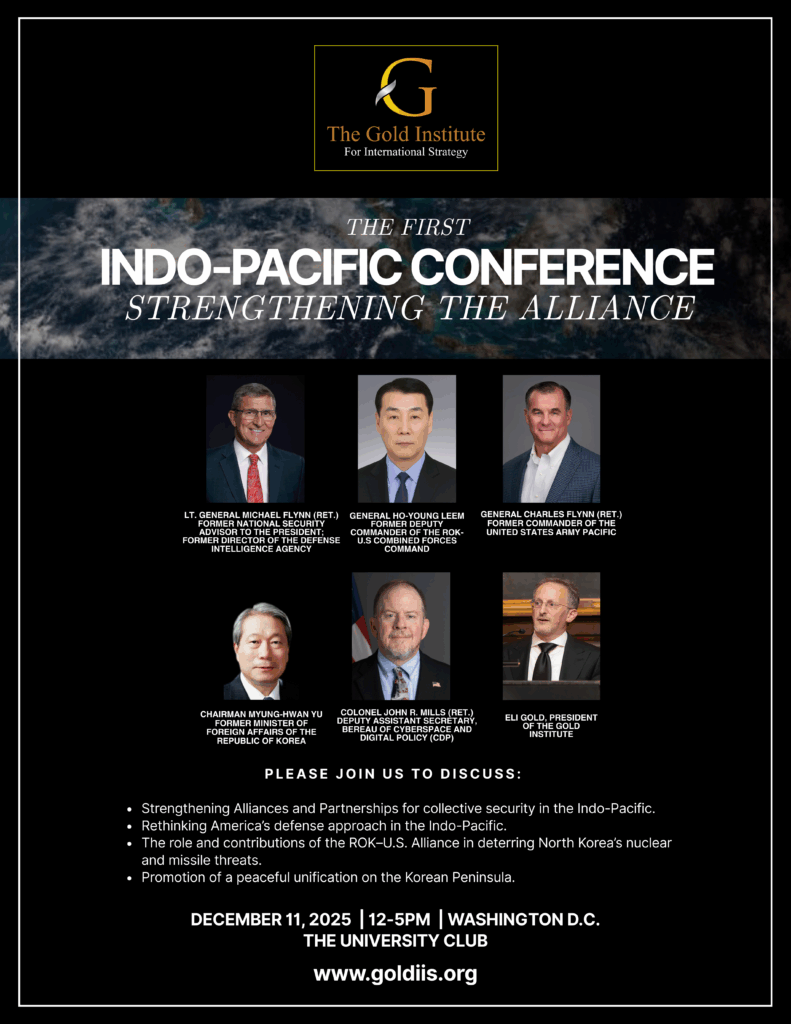
WASHINGTON TIMES: Top retired U.S., Korean generals detail tensions in Indo-Pacific
(This article, written by Mike Glenn, appeared in the Washington Times. https://www.washingtontimes.com/news/2025/dec/12/top-retired-us-korean-generals-detail-tensions-indo-pacific/)
If America’s relationship with Europe defined the 20th century, then the 21st century will be marked by Washington’s connections to the Indo-Pacific.
However, the former commander of U.S. Army troops in the region said some people can’t grasp its complexities or immense distances without a map.
In an address to the Gold Institute think tank, retired Gen. Charles Flynn on Thursday noted that the flying time from Hawaii to Guam, America’s farthest western territory, is roughly the same as a flight from Hawaii to the District of Columbia.
“When you’re in Guam, you’re in the second island chain. That’s how big this area of operations is. It’s massive,” Mr. Flynn said.
The Indo-Pacific encompasses two continents — Asia and Australia — and the Southeast Asia archipelago, which serves as a land bridge connecting both. By some estimates, 7 out of 10 people on the planet will be in the region by 2040, he said.
China, which the Biden administration referred to as America’s “pacing challenge,” is amid a construction frenzy. The buildup is part of its Belt and Road Initiative, a Beijing-led global infrastructure and investment program launched in 2013 by President Xi Jinping that aims to connect Asia, Europe, Africa and beyond through land and sea routes.
China is moving ahead with explicitly military building projects as well, including along its mountainous border with India, known as the Line of Actual Control. About 20,000 to 30,000 Chinese troops regularly rotate in and out of the area, Mr. Flynn said.
“In the last five to seven years, they’ve built rail and road infrastructure to move laterally. They’ve also put surface-to-air missile systems there,” he said.
China is continuing to flex its economic muscles by applying pressure to several countries in Southeast Asia, from Cambodia and Laos to Bhutan and Myanmar. Beijing’s coercive campaign is becoming a dangerous security situation, Mr. Flynn said.
“That is why it’s really important for the United States to maintain relations with Vietnam, Thailand and India, the sort of bookends of countries in South Asia,” he said. “And by the way, Thailand is a treaty ally of the United States.”
China’s strategy is to float high-interest construction loans to countries it wants to exploit. When the country can’t repay the loan, Beijing moves in and assumes control over the project, whether it’s a port facility or an airfield. That also means access to its information technology system or electrical grid.
“We have one hell of a time getting them out of these small countries,” Mr. Flynn said.
The U.S. is an Indo-Pacific country not just because of its far-reaching military power, but also because “it has skin in the game.” The people living in Guam and the Northern Marianas are U.S. citizens.
“We can’t forget about this part of the homeland,” Mr. Flynn said.
Retired South Korean Gen. Leem Ho-young, a former deputy commander of the U.S.-Korea Combined Forces Command, said most discussions about possible military action in the Indo-Pacific seem to focus on whether China will invade neighboring Taiwan.
“It seems like they don’t really discuss much about the threat that exists on the Korean peninsula because the two Koreas — the North and the South — are charging up,” Mr. Leem said.
He said President Trump — whom he called “The Global Peacemaker” — will likely prevent any cross-strait invasion of Taiwan.
The Korean Peninsula is another story. Mr. Leem said he spent most of his military career along the tense Demilitarized Zone between the North and South.
“For 50 kilometers to the north and 50 kilometers to the south [of the DMZ], there are about 1 million soldiers there pointing their guns at each other,” he said.
While North Korean officials mouth communist slogans, Mr. Leem said it would be more accurate to call the country a feudal dynasty. The Kim family has run the country since its founding in 1948 by Kim Il-sung.
The current supreme leader, Kim Jong-un, has signaled that his chosen heir is his daughter, Kim Ju-ae, who is believed to be 12 or 13. That could be a problem for stability in North Korea, Mr. Leem said, where women are looked down upon.
Mr. Kim is overweight, smokes four packs of cigarettes a day and drinks up to 10 bottles of wine daily. Mr. Leem noted that his father and grandfather died as a result of bad hearts.
“It’s in his bloodline. It wouldn’t be surprising at all if he dropped dead today,” he said. “If that happens, there’s going to be a power struggle in North Korea. The power will be given to the person with a gun. China will pick a faction and support that faction.”
Mr. Leem said he wouldn’t be surprised if the other side in a North Korean internal dispute reaches out to South Korea or even the U.S. for backing.
“If that happens and there are two different military factions in conflict in North Korea, this could lead to a conflict between China, which represents communism, and the U.S. and South Korea, which represent the powers of freedom,” he said. “The issues surrounding Taiwan will seem small by comparison.”
• Mike Glenn can be reached at mglenn@washingtontimes.com.
Rob Roos: Restoring National Sovereignty Across Europe
In his January 2025 European Parliament speech, Rob Roos presented that President Trump’s reelection represents a mandate for restoring national sovereignty and reversing progressive policies that have eroded European identities and freedoms. Due to the current tensions between EU bureaucrats and the Trump administration we are republishing the January speech.
Change will not come if we wait for someone else, or if we delay for another time. The words of Barack Obama, spoken during his historic campaign in 2008, still resonate—but today, they carry a very different meaning. It is a rallying cry for patriots, conservatives, and all who believe in freedom, sovereignty, and the dignity of our nations to stand together. We are the ones we’ve been waiting for. We are the change that we seek.
In 2008, Obama’s words signaled the dawn of a new era: one marked by social justice campaigns and the rise of “wokeism.” For years, these ideas were cloaked in promises of progress and inclusivity.
But what have they truly delivered? Today, we see the devastating consequences—fractured societies, eroded national identities, and an alarming loss of freedoms.
But, the tide is turning. The reelection of President Trump has sent a clear and powerful message from the people of the United States. The message is simple: We want our country back.
We want to be proud of our flag, our culture, and our heritage. We demand affordable, reliable energy to power our homes and businesses. We seek real food from our farmers, not synthetic substitutes dictated by unelected technocrats. We want secured borders, prosperity, peace, and the ability to pursue happiness without interference.
The overwhelming MAGA victory—President Trump reclaiming the presidency, the Senate, the House, and the popular vote—reflects a mandate that can not be ignored
For too long, the radical left has sought to dismantle the pillars of our civilization. Obama’s policies, often presented as ‘progress’, initiated a chain of events with devastating effects. I’ll give you four examples:
- The Arab Spring, spurred by social media campaigns, unleashed waves of instability that flooded Europe with millions of migrants. Our historic continent—once a beacon of cultural and intellectual achievements—is now grappling with security threats and the erosion of its identity and culture.
- The war in Ukraine, provoked by Obama’s NeoCon allies, has brought untold suffering. It began with the removal of Ukraine’s democratically elected leader in 2014, setting the stage for
conflict. These NeoCons, in collusion with the Military-Industrial Complex, are as culpable as any aggressor.
- Critical Race Theory, a twisted ideology. It is nothing short of racism repackaged, weaponized to pit communities against each other.
- Censorship and suppression of free speech. Through NGOs and the so-called “Censorship Industrial Complex,” they controlled narratives and silenced dissenting voices.
Their strategy has always been sophisticated—using fear, globalist policies, the illusion of moral superiority, and ‘democracy’ of institutions instead of democracy of the people.
The United Nations’ Sustainable Development Goals, the Green Deal, and the WHO’s pandemic overreach are all symptoms of a broader agenda: a transfer of power from the people to unaccountable elites.
Even NATO, once a coalition of nations united against foreign aggression, has now also become a tool wielded to suppress populist movements among its own people.
But we are not powerless. We the People represent true democracy. If we unite, we can reverse this destructive course. The momentum of the MAGA movement can inspire change across Europe and beyond. Now is the time to build a unified front that transcends party lines and minor disagreements.
We must Make Europe Great Again by:
- Restoring Free Speech: Reverse the Digital Services Act and protect public discourse.
- Ensuring Freedom: No Central Bank Digital Currencies. No digital IDs. We are born free and do not need technocratic controls.
- Dismantling the Green Deal: End this social engineering project that sacrifices our economies and energy and food security for an illusion of environmental progress.
- Defending Our Borders: Protect our nations from uncontrolled migration that threatens both safety and cultural heritage. National civil rights must take precedence over globalist human rights.
- Exposing Corruption: Demand full transparency in dealings with corporations and NGOs.
- Deregulating Economies: Empower small and medium-sized businesses—the backbone of our prosperity. Deregulation fuels innovation and competitiveness.
- Restoring National Sovereignty: Renegotiate or cancel harmful international agreements and treaties.
Change will not come if we wait for someone else or another time. We are the ones we’ve been waiting for. We are the change that we seek. Obama’s words, once a banner for radical policies, now serve as a call to reverse the damage inflicted on our nations and it’s people.
Let us unite, work together, and make this a reality. Let us Make Europe Great Again.
Rob Roos is a distinguished fellow at the Gold Institute for International Strategy, a Washington, DC based foreign policy and defense think-and-do tank.
Indo Pacific Conference Dec 11, 2025
Facing Facts & Rolling Back Mythologies: The New National Security Strategy
(This article was written by Peter Huessy and appeared in RealClearDefense. Facing Facts & Rolling Back Mythologies: The New National Security Strategy)
The new National Security Strategy is addressing some established foreign policy mythologies, a long overdue analysis. Though a relatively new way of laying out the U.S. strategy, it was very important that it do so.
The biggest drawback of the strategy is the lack of assessment of what security danger Russia poses to the U.S. and its allies even should the war in Ukraine be ended.
But the importance of the document is that it does address ten mythologies that have been largely conventional wisdom over the past many decades for the U.S. foreign policy establishment. These are rejected by the Trump administration with many additional details part of Secretary War Hegseth’s remarks at the Reagan Defense Forum on December 6th at the Simi Valley Reagan Library.
The most provocative section is the analysis of the direction which Europe has been moving—very low birthrates, massive and often illegal migration of people that reject western civilization, an absence of a commitment to defense spending, rejecting a robust nuclear deterrent and missile defense, (currently being adjusted), vastly too much regulation and government coercion (being partially undone with Brexit), and a deliberate policy of making energy expensive and scarce (also currently being partially rolled back).
Important is the high priority given to both nuclear deterrence and missile defense. After the breakup of the USSR, it was assumed nuclear weapons were largely irrelevant. And that Russia and China would become largely cooperative nuclear powers, such as with the Nunn-Lugar program cutting down “loose nukes” in the former USSR.
By 2010, the Nuclear Posture Review emphasized both the benefits of U.S. restraint in nuclear deployment and seeking a general policy of seeking the eventual abolition of nuclear weapons.
The new strategy underscores how nuclear deterrence is and remains central to U.S. security and for the need for major investments in nuclear modernization. In 1991, even with the collapse of the USSR, Senator Sam Nunn urged that the National Defense University Foundation (NDUF) continue a long standing program of Hill nuclear seminars as he warned that nuclear dangers were not going away and would certainly re-emerge. Instead, the elites went on a 40-year holiday from history and put nuclear investments at the bottom of the priority requirements for the past Cold War era.
The new strategy also jettisons the false assumption that missile defense is dangerous or destabilizing, firmly foot-stomping that defenses are a critical adjunct and insurance policy for the U.S. as General Michael Guetlein Director of Golden Dome emphasized on December 6th at the Reagan Defense Forum.
The strategy also captures an entire series of economic initiatives that are critical to U.S. security, for which it has been strangely criticized. In 1981, the National Governors Association assumed the U.S. did not need a steel industry as we could always buy cheap steel from China. The new Japanese investment in the U.S. steel industry and reshoring of U.S. industry is a welcome rebuff to the multiple decades hollowing out of U.S. manufacturing and heavy industry. And the key understanding that U.S. mineral mapping, mining, and milling is also critical to U.S. security is also welcome, as the recent mineral/trade deals have made clear.
On the Middle East, the strategy rejects the false notion that as former President Clinton noted in 2014, terrorism was largely related to Israel failing to offer the Palestinians a state. And implicitly reject the idea that Islamic jihad is some kind of peaceful religious individual empowerment as opposed to an ideology of conquest and murder. Keeping Iran from dominating the Middle East hydrocarbon reserves and engaging in terrorism while also being allied with Israel are priorities which is a welcome change from the embrace of Oslo, “the peace process” and Palestinian demands.
The strategy’s western hemisphere embrace is a welcome switch. For decades, the U.S. assumed open borders was a welcome adjunct to U.S. economic requirements. It was assumed migrants were largely agricultural workers, unrelated to a massive illegal drug and human trafficking business closely associated with a campaign of “unrestricted warfare” by China against the United States and also including North Korea, Iran, Russia, and Venezuela. And conventional wisdom assumed 100,000 drugs deaths a year was just the price one pays for a free and open society.
Critical to reforming our Western Hemisphere strategy is to understand the problem with an open border for agricultural workers is that it opens the borders to all potential “workers” including drug dealers and traffickers. And an open border with Mexico is also open to the rest of the world. That is why the section on Europe addresses that Europe is killing itself with mass migration of people that do not accept western civilization, but embrace Hamas and Jihad, condemn Israel, all of which itself will undermine the extent to which Europe can be an effective NATO ally and strengthen its western civilization heritage. As one top scholar recently surmised, Christendom may lose upwards of one billion or 50% of its adherents given current trends, especially in Europe, where hundreds of mosques are being built on top of what were Christian churches.
The requirement to keep Iran from its terrorism ways and its search for a nuclear weapons lever is also a welcome security plank. Gone is the strange notion the U.S. engineered a coup in Iran in 1954 or that because Khomeini was a “man of the cloth” his regime was benign.
Gone too is the notion that scarce, expensive, and hard to secure energy is a great idea as the former Secretary of Energy and green energy mandates assumed. Coupled with establishing secure sources of minerals, both mining and milling, as recent deals with Australia, Malaysia, the Kingdom of Saudi Arabia, and others have done will further improve U.S. security and end our reliance upon China for rare earth and other key minerals.
For decades, NATO did not even meet its own 2% of GDP for defense spending as an unstated assumption was that NATO was special and although 80 years removed from WWII, NATO was special and couldn’t spend a lot on defense because Europe had to have a huge welfare state to prevent another Hitler from coming to power.
The strategy also drowns the idea that military strength is provocative and unnecessarily aggressive, a widespread assumption embraced by foreign policy elites through the Cold War, the era of détente and peaceful coexistence and most loudly during the Reagan “peace through strength” military buildup, which of course successfully led to the end of the USSR which fundamentally was in fact an explicit economic war against the USSR, as outlined by Warren Norquist in his 2000 essay in the National Intelligentser. The extent to which the Reagan administration used economic measures to dissolve the USSR is seriously underappreciated and leads to a continued in ability to understand how effective such measures could be especially as the U.S. confronts two nuclear armed peer adversaries.
Warren Norquist details what Reagan confronted in 1981, nut unlike what President Trump also faced when in 2025 taking office for a second time. “The incoming Reagan Administration faced many challenges: Western Europe was making loans to the USSR at half the normal interest rate. Sweden was buying restricted high technology needed by the Soviets and reselling the items with all the necessary instructions. Many western firms were selling restricted technology to companies fronting for the USSR. The technologies the Soviets could not buy they were trying to steal.
The USSR was earning hard currency by selling oil at three times its production cost. The USSR was earning hard currency by selling weapons to oil rich countries like Iran, Iraq, and Libya. Europe was financing two gas pipelines from Siberia. If completed, West Germany, for instance, would become dependent on Moscow for 60 percent of its energy and Soviet hard currency earnings would double to $60 billion per year. The Soviets had effectively taken over Angola and Mozambique, and the Soviet military was providing aid and advice to many countries in Africa.
U.S. military spending had declined from 9.2 percent of Gross Domestic Product (GDP) under President John Kennedy in 1962 to less than 4.6 percent under President Jimmy Carter in 1979 according to the Federal Government Historical Budget, Tables 3.1 and 10.1.
In Nicaragua, the USSR financed equipment and thousands of trainers to ‘… build … an army of 60,000 regulars backed by an equal number … militia” … armed with heavy weapons.” The plan was to expand to 500,000 under arms according to General Jack Singlaub. The Soviets were positioning themselves to threaten Western Europe into less cooperation with the United States. And the USSR had invaded and was assumed to be winning in Afghanistan.”
The economic agenda for the new security strategy is very innovative but also most needed. The security strategy gets many things right especially including China, the Middle East, the Western Hemisphere as well as the twin defense needs of nuclear modernization and missile defense. Particularly welcome is the emphasis on preserving elements of Western civilization and the implied negative impact of rejecting religious faith, rejecting the need to acculturate legal immigrants and to halt illegal immigration and its companion twin evils of trafficking and drug running.
Peter Huessy is a Senior Fellow at the Gold Institute for International Strategy, a Washington D.C.-based foreign policy and defense think tank.