President Trump’s Reframing of the U.S.–South Korea Alliance: Alliance or Reliance?

(This article originally appeared in Korea On Point: https://koreaonpoint.org/articles/article_detail.php?idx=509&start=# )

Key takeaways:

– This distinction matters because burden-shifting implies withdrawal, while responsibility-sharing implies empowerment and inclusion.

– In effect, he challenged Seoul to embrace a self-conception aligned with its actual capabilities, that of a global actor critical to shaping Indo-Pacific stability, not merely a frontline state facing North Korea.

– By demanding more of Seoul and, in turn, granting it greater agency, he helped catalyze the transformation of the U.S.–ROK alliance from a mentorship into a mutual enterprise, from reliance to alliance.


Since the early months of his presidency, President Donald J. Trump’s approach to America’s alliances has been both disruptive and revelatory. For South Korea, one of Washington’s most steadfast defense partners in Asia, his method was particularly transformative. At first glance, President Trump’s insistence that U.S. allies increase their defense contributions seemed to signal a transactional mindset that risked unsettling long-established bonds. Yet beneath that rhetoric lay something more consequential, a reframing of the U.S.–Republic of Korea (ROK) relationship not as patron to client, but as a partnership between equals tasked with jointly defending and advancing shared strategic interests in the Indo-Pacific. His message to Seoul was clear, the time had come for South Korea to step fully into its role as a capable, self-confident regional power, not simply as a beneficiary of U.S. protection. Far from abandoning the alliance, this approach sought to mature it and transform an asymmetrical relationship rooted in the Cold War into a modern strategic compact befitting a South Korea that had emerged among the world’s foremost economies, democracies, and security contributors.​

President Trump’s entrance forced these issues into the open because his direct questioning of alliance costs and responsibilities unsettled policymakers on both sides. Critics often described his push for higher South Korean defense spending and cost-sharing as crude burden-shifting that reduced the alliance to a transactional ledger. But this reading overlooks the continuity between his rhetoric and a deeper tradition of strategic recalibration that expects capable allies to share not just fiscal, but also strategic responsibility for collective defense. At times inelegantly, President Trump articulated an expectation that America’s wealthiest and most capable partners should carry a larger share of the load in defending the free world, rather than relying indefinitely on U.S. subsidies.​

This distinction matters because burden-shifting implies withdrawal, while responsibility-sharing implies empowerment and inclusion. President Trump sought to make clear that the United States, while remaining the bedrock of regional security, would not forever subsidize an order in which others underinvest in their own defense. South Korea, endowed with advanced capabilities and national resilience, was precisely the kind of ally Washington wanted to see take on greater leadership. Under his administration, negotiations over the Special Measures Agreement on host-nation support for U.S. forces were contentious but clarifying, as Washington pressed for steep increases and Seoul maneuvered to frame any rise in its contribution as part of a more strategic, long-term alliance modernization. Seoul’s willingness to increase its contributions, while simultaneously expanding coordination on missile defense, intelligence-sharing, and joint exercises, demonstrated that shared responsibility could strengthen rather than strain the alliance.​

Behind President Trump’s demands lay an implicit invitation to equality. He signaled that Seoul’s growing strength and global stature were not inconvenient realities to be managed, but welcome assets to be fully integrated into a shared strategy. By insisting on more equitable participation, President Trump upended the traditional U.S.–ROK dynamic in which reassurance flowed one way, from Washington to Seoul, and dependency shaped expectations on both sides. His language often suggested impatience, but his strategic instinct reflected a belief in South Korea’s potential to act as an equal partner rather than as a perpetual security dependent. In effect, he challenged Seoul to embrace a self-conception aligned with its actual capabilities, that of a global actor critical to shaping Indo-Pacific stability, not merely a frontline state facing North Korea.​

Rather than undermining deterrence, this recalibration strengthened it. A South Korea increasingly confident in its own defense capabilities enhances, rather than diminishes, the credibility of U.S. commitments by signaling that any aggression would face not only U.S. power, but a capable and determined local ally. Deterrence in the Indo-Pacific now depends not solely on American military might, but on a constellation of capable partners willing to act in concert to resist coercion and revisionism. President Trump’s approach anticipated this architecture, even as many observers focused primarily on his rhetoric and style. In this context, “equal partnership” in security terms is not a euphemism for U.S. withdrawal, but a pathway to more durable stability rooted in shared will and distributed capabilities.​

In the broader Indo-Pacific competition, the U.S.–South Korea alliance has implications far beyond the Korean Peninsula. President Trump’s emphasis on equality resonated with his administration’s goal of building a network of self-reliant partners capable of collectively deterring coercion by major powers. By viewing South Korea as a co-equal stakeholder, Washington effectively widened the scope of Seoul’s expected engagement, from a narrow focus on North Korea to a broader role in regional security, maritime domain awareness, and supply-chain resilience. The administration encouraged South Korea to find greater synergies with like-minded democracies such as Japan, Australia, and India, reflecting an understanding that Indo-Pacific resilience would depend as much on allied initiative as on American leadership.​

President Trump’s re-envisioning of equality extended beyond defense into economic and technological domains that shape long-term strategic outcomes. In trade, he pressed for recalibration of KORUS that recognized South Korea’s advanced, globally competitive economy as a peer, not a dependent market, while continuing to support robust bilateral commerce. In technology, the administration promoted cooperation with allies on critical sectors such as 5G, semiconductors, and digital infrastructure to reduce reliance on Chinese supply chains and standards. This approach implicitly cast South Korea, home to world-leading chip and electronics firms, as a technological partner of first order, whose choices would significantly influence the balance of economic security in the region.​

No dimension of President Trump’s engagement tested the alliance more visibly than his first-term diplomacy with North Korea. The high-profile summits in Singapore and Hanoi triggered anxiety in Seoul, where policymakers feared marginalization or abrupt shifts in U.S. posture. Yet his direct engagement with Pyongyang, however unconventional, also highlighted that peace and stability on the peninsula were joint challenges requiring close U.S.–ROK coordination. His administration expected Seoul not to remain a passive observer, but to participate actively in post-summit diplomacy and contingency planning, reinforcing the idea of co-ownership of the peninsula’s future. The experience of navigating the uncertainties of U.S.–North Korea diplomacy pushed South Korea to strengthen its own diplomatic capacity, inter-Korean initiatives, and regional outreach.​

Alliance management is as much psychological as it is strategic, and the U.S.–ROK partnership has long been shaped by narratives of protection, vulnerability, and dependency. President Trump disrupted those narratives with a message that to many Koreans sounded provocative but also validating, South Korea is strong enough to do more and should act accordingly. To some, this seemed dismissive of past sacrifices; to others, it was a long-overdue acknowledgment of the country’s transformation into a confident middle power. Over time, this shift carries potential long-term benefits because equal partners tend to make clearer decisions, share risks more fairly, and build deeper trust. As the emotional premise of the alliance evolves from gratitude to solidarity, the relationship becomes better positioned to weather tactical disagreements while preserving strategic alignment.​

Policy analysts often measure alliance health in budgets, bases, and formal agreements, but beneath those metrics lies a deeper element, tone. President Trump’s unapologetically assertive tone changed how both nations spoke about their partnership, moving the discourse from deference to dialogue. High-level interactions increasingly encompassed not only defense coordination, but also cooperation on broader issues such as regional economic security, pandemic response, and supply-chain restructuring, even if those agendas were more fully articulated after his term. The relationship thus became more multidimensional, capable of friction, yet resilient because it rested on shared interests and values rather than one-sided dependence.​

History will continue to debate the style and substance of President Trump’s diplomacy, but the structural impact of his approach toward South Korea is likely to endure. By demanding more of Seoul and, in turn, granting it greater agency, he helped catalyze the transformation of the U.S.–ROK alliance from a mentorship into a mutual enterprise, from reliance to alliance. The result is a partnership better suited to confront the strategic realities of the 21st century, North Korea’s evolving threat, China’s regional assertiveness, and global challenges that no single nation can manage alone. Far from diminishing American leadership, this model amplifies it through empowered allies whose strength contributes directly to a more stable order. A South Korea that stands shoulder to shoulder with the United States strengthens not only deterrence on the Korean Peninsula, but also the resilience of the entire Indo-Pacific architecture. President Trump’s conviction that strong allies make strong alliances helped recast a foundational relationship for a new era, opening the door to a U.S.–ROK partnership defined by mutual commitment and co-equal strategic stakes rather than by the asymmetries of the past.

Eli M. Gold is the president of the Gold Institute for International Strategy, a Washington, DC based think-and-do tank.

Washington Declares Europe Civilisationally Bankrupt, and Brussels Works Hard to Prove It Right

A view of the US Capitol dome with the flag against a blue sky in Washington DC

(This article was written by Hermann Tertsch and appeared in El Debate. Washington declara a Europa en quiebra civilizacional y en Bruselas se esfuerzan por darle la razón)

The political leadership and the colossal institutional bureaucracy of the European Union hate and fear Donald Trump as much as they do the European national, conservative and sovereigntist forces. They know in Brussels that there is a direct relationship between this president’s second arrival at the White House and the conservative revolution spreading across the United States, Europe and now also Ibero-America, which makes the forces that are at least partly in political tune with the North American president grow without pause.

Now in Brussels, Berlin and Paris they have more reason to hate Trump. On the one hand, they have the 33-page United States Strategic Policy document, which warns that the economic decline and the political and social degradation in Europe are no longer problems of circumstance but a crisis of civilisation that makes the countries of the European Union, dragged along by a destructive ideology, weak societies incapable of being reliable and valid allies for the United States.

That is how serious they see the situation in Washington, and that is how serious many of us in Europe see it. And the media and the political caste of Brussels may eclipse and silence those of us Europeans who think this way, but not the administration of the United States. That does an enormous favour to the truth, which enters through new cracks in the perfectly mendacious and failed discourse of the European Commission and of governments as failed and weak as the German and the French.

One of the causes identified in the report as the origin both of the political degradation and of the economic decline is the fear of freedom and the ever greater censorship and persecution of dissent. Well, the European Union rushed to prove the White House report right before it had even been published by announcing a fine against Elon Musk’s platform, X. They cite misleading advertising, but everyone knows that the European Commission and its attack dogs against the national and anti-socialist forces cannot bear the degrees of freedom of expression that Elon Musk reintroduced at X when he bought the platform. And Musk himself has confirmed that the EU offered him a way to avoid fines if he went back to applying censorship to certain opinions, which are always the same ones, the conservative and national ones.

We members of the European Parliament are witnesses to a European Commission policy marked by the same panic felt by the social-democratic majorities of the People’s Party and the socialists in Germany, in Austria or in France, who block national governments that are already the leading force. The president of the European Commission feels no ridicule at all when she states that they are going to make a great deal of money available to independent media. Nor do they feel any shame when they are confronted with facts that are hard to call legal, such as the subsidising with thousands of millions in past years of NGOs, all of them leftist and with woke ideology, always devoted to the war against the conservative forces. Now with the Digital Services Act (DSA), which they have used to fine X, and with the “Democracy Shield”, which is the programme against supposed disinformation and attacks by external enemies but which is in reality first and foremost the joint command of extraordinary measures to combat the national, conservative and sovereigntist forces that grow ever stronger in the member states.

The direct relationship between Trump’s election and the spectacular growth of these forces of the real right does exist. But it is not that this spectacular conservative expansion across countries in the Americas and Europe was caused by a president who personally is not a conservative. The change of era has been maturing for years because the failure of social-democratic policies and their ideological hobbyhorses of climate, gender, immigration, multiculturalism, degrowth and impoverishment is a catastrophe that endangers the whole of Western civilisation in Europe.

The direct relationship that most unites these forces with Washington is the certainty that the arrival of the new Trump administration has prevented the social-democratic majority of the People’s Party, socialists and greens in Europe, which has imposed its policy for decades, from having a free hand to crush, by methods that are in no way orthodox, in no way democratic and very often in no way legal, the national forces that keep on growing.

They do not have a free hand because the European national forces are ever larger, but most especially because Washington denounces them and holds up a mirror to the European democracies that makes all their contradictions explode. One of the first, and much talked about, came in Munich at the beginning of the year from the mouth of Vice President JD Vance. This strategic paper is no less significant.

The whole political caste and the European elites bet on an electoral tandem as grotesque, mediocre and leftist as Kamala Harris and Tim Walz on the Democratic ticket in 2024, because with them globalist social engineering would already have been launched in unrestrained and perhaps irreversible fashion. It is no exaggeration to state that a victory by Harris and Walz would have brought with it in Europe a wave of bans on national parties. And that with a leftist administration in Washington they would not have exerted themselves much in looking for pretexts to impose that ancient and well-worn practice of prohibiting forces that in freedom could wrest power from them from speaking, acting and standing for election.

The North American administration says in its paper on Strategic Policy that Europe faces serious problems caused by the policy of the European Union and other transnational organisations which undermine the political freedoms and the sovereignty of nations and encourage an immigration that is transforming the continent and creating conflicts, the imposition of censorship, repression of freedom of expression in general and suppression of political opposition, in addition to the collapse of the birth rate, with a loss of national identity and self-esteem.

It is a pity that in the European Union there is not enough honesty to publish similar documents, and that when strategic papers are commissioned it is always done in the knowledge that they will be written by some member of the Europeanist caste who endorses the failed EU policy of past decades or at least does not openly fight it. Without allowing within the institutions any opinions other than the inbred ones of the two-party social-democratic caste, failure is assured. And Trump’s enemies once again prove him right.

Hermann Tertsch is a Distinguished Fellow (Honorary) at the Gold Institute for International Strategy, a Washington D.C.-based foreign policy and defense think tank.

Rob Roos: From bureaucracy to freedom | The Hague 2025

From bureaucracy to freedom

In his December 2, 2025 speech in The Hague, Rob Roos launched the “Living Together in Freedom” foundation, presenting the case that the current political system has devolved into a “corporatocracy” controlled by unelected technocrats and requiring an urgent shift toward decentralization. Due to the ongoing expansion of EU bureaucracy and the increasing threat of digital control mechanisms like CBDCs, we are publishing the full text of his address.

Ladies and gentlemen,

A very warm welcome to all of you. It’s wonderful to see so many of you here today. On behalf of the board of the foundation Samen Leven in Vrijheid (Living Together in Freedom), thank you sincerely for your presence. Today promises to be a meaningful event, especially with our very special guest from Argentina—more on that shortly.

But first, allow me to introduce our new foundation: Living Together in Freedom. A name that’s deliberately non-political—because we are not, and will never become, a political party. Frankly, there are already more than enough political parties in this country.

So what are we?

We are a civic movement. A growing initiative aimed at mobilizing citizens, entrepreneurs, politicians and everyone who cherishes one of the most essential pillars of human dignity: freedom.

We defend freedom in all its forms:

  • Freedom of thought, belief, and expression
  • Freedom of assembly and political participation
  • Bodily and personal autonomy
  • Privacy and communication rights
  • Legal and constitutional freedoms
  • Economic and social liberties
  • Educational, family and societal freedoms
  • And yes—freedom in the digital age

If we’re serious about protecting freedom, we cannot ignore politics. Political conflict is often not about freedom versus oppression, but about which freedoms take priority, and whether the state protects or dictates.

Our foundation believes in minimal government.

Self-reliance and personal responsibility must return to the forefront of our society.

Our mission is clear: to connect freedom loving people, thinkers and doers in order to safeguard liberty, sovereignty and prosperity. We aim to influence public discourse and policy—not through slogans, but through reason, dialogue and solutions. We believe the debate must return to where it belongs: – with the people.

We envision a future in which the Netherlands is free, sovereign, and prosperous. Like we used to be for a long time. Freedom, democracy, and entrepreneurship are not just values—they are the very foundation of a functioning society. But they do not maintain themselves. They require care, protection, and courage—from all of us.

We stand firmly for:

  • Freedom & Open Debate – to think, speak, and live without excessive government interference. Freedom also means responsibility—for oneself and for others.
  • We stand for Democracy & Sovereignty – politics should serve citizens, not global technocracies. Our constitution, not foreign treaties, should form the bedrock of our democracy.
  • We stand for Prosperity & Entrepreneurship – true wealth is the ability to build something meaningful. That requires low taxes, innovation, and a state that facilitates—not suffocates.

Three weeks ago, I traveled from Hanoi to Saigon in Vietnam—a one-party communist country. What struck me was remarkable: capitalism thrives on every street corner. People trade, sell, and build—despite the system.

Why? Because in 1986, the Vietnamese government allowed citizens to own small plots of land and trade surplus produce. Within two years, the country went from starvation to becoming a food exporter.

The lesson? Decentralization works. Give people ownership and responsibility, and they will build a better life. Centrally planned economies fail not because of bad intentions—but because no government can ever gather enough information to make the right decisions for millions of individuals. It leads to bureaucracy, stagnation, and despair.

You see the same in every failed system—North Korea vs South Korea, Cuba, Venezuela. Socialism has never brought wealth or freedom. Not once.

The only sustainable path forward is decentralization—of both economic and political power. And yet, Europe – with the European Union – is moving in the opposite direction. We have a government over our government. And with that I mean that the unelected European Commission rules over our elected parliament and our government. The European Commission becomes more powerful by the day. More money, more competences, and we already said ‘NO’ in 2005. We voted against the European Constitution. But it was adopted in the form of the Lisbon Treaty. So, voting for our national parliament is nowadays more for the show. The last two decades it has become clear that “We The People” are not able to change things via our democratic vote. So, besides politics we need a grass root movement.

We’ve developed ten core principles. I won’t cover them all today, but allow me to highlight number three:

3. Economy, Work and Entrepreneurship – We support lower taxes, less bureaucracy, and a strong focus on small businesses and innovation. Prosperity must be accessible to all citizens.

Ideological policies have created a flood of unnecessary rules, wasted public funds, and restricted our freedoms. Look at climate policy: it leads to higher taxes, more bureaucracy, and less freedom. And it is not helping our nature and environment either. Of course we have to take care of the planet. But not via this Ponzi scheme called Net Zero. This must stop—not slowly, not half-heartedly, but immediately.

We will not accept a digital prison. No digital ID. No CBDC. No ChatControl. No Media Freedom Act, no Digital Services Act. These are tools of Brussels bureaucracy, not of democracy. It’s not about “safe” speech—it’s about controlled speech. Not a free press, but state-approved journalism. Not free citizens, but monitored subjects. Ladies and gentlemen, I hate to say it but this is no democracy anymore. These same laws are used by tyrannic states.

Centralized power is the enemy of liberty. Ronald Reagan said it best and I quote: “Man is not free unless government is limited. There’s a clear cause and effect here – that is as neat and predictable as a law of physics: As government expands, liberty contracts”. End of quote.

Even the EU’s own treaties—Article 5—call for subsidiarity and proportionality. Yet power is hoarded in Brussels, when it should return to The Hague—and from The Hague to your local community.

Decentralization is not ideology—it’s necessity. Because the current system is not free capitalism—it’s a corpora-tó-cracy. Where elites, backed by mega-funds like BlackRock and Vanguard, dictate the rules in Davos. Where “public-private partnerships” mean backroom deals instead of democratic debate. This immense economic power leads to political power without any mandate. It circumvents our parliaments. It circumvents “We The People”.

We don’t need more multinational control—we need a thriving middle class and strong small businesses to carry the economy.

With this foundation, we hope to contribute to the future of our country. A beautiful country that is worth fighting for. Complaining won’t help. Running away, won’t solve it. Only action can turn the tide. And yes it will not be easy. But suffering pain is temporary – giving up is forever.

The political right is too divided—even when we agree on so much. Our goal is to unite people, build bridges, and create a real counterforce.

This is not about ego. We bear a duty—to preserve a free and prosperous Netherlands for the next generation, just as our ancestors did for us.

But we cannot do it alone. We need thinkers. We need doers. We need your support—moral, practical, and yes, also financial.

You are invited to respond to all three.

Thank you for your attention. I wish you an enjoyable lecture by Minister Sturzenegger. I look forward to building our future together.

Rob Roos is a distinguished fellow at the Gold Institute for International Strategy, a Washington, DC-based think-and-do tank.

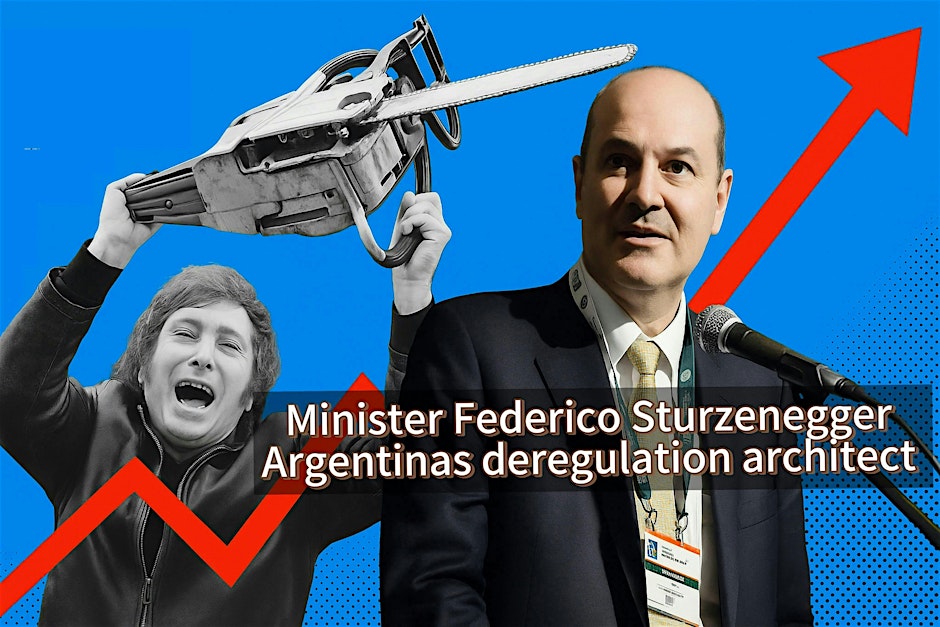
Argentina’s Deregulation Plan Unveiled Dec 2, 2025

Argentina’s Deregulation Plan Unveiled

 
Unlock the future of economic freedom—discover how Dr Sturzenegger is tearing down red tape and reshaping Argentina’s bureaucratic landscape

Step Inside the Engine Room of Reform – Live at Diligentia with Argentina’s Minister of Deregulation, Federico Sturzenegger

Discover how bold policy meets real-world impact in this exclusive event featuring one of Latin America’s most influential reformers. Minister Federico Sturzenegger will take the stage to unveil the strategies behind Argentina’s ambitious push to dismantle red tape, modernize government, and unlock economic dynamism.

Whether you’re a policymaker seeking actionable reforms, a business leader navigating international markets, or simply fascinated by the machinery of government transformation—this is your front-row seat to change in motion.

Seats are limited. Reserve now and be part of the conversation reshaping the future of governance.