Op-Ed: Sparing Our Children from a Nuclear Iran

A bright missile trail arcs through a starry night sky

(This article was written by Trent Franks and appeared in the Epoch Times. Op-Ed: Sparing Our Children from a Nuclear Iran)

For approaching half a century, the world has borne witness as the Islamic Republic of Iran has, directly and through its terrorist proxies, murdered hundreds of Americans, thousands of Israelis, and tens of thousands of its own civilians, all the while maintaining a brazen and menacing march toward nuclear weapons with which to terrorize the world.

We have also observed the insane left under Presidents Bill Clinton, Barack Obama, and Joe Biden embrace policies that have allowed that relentless march to proceed.

The current Iranian regime is unalterably determined to delay, demagogue, falsify, and then ignore any honest implementation of any agreement they sign that would prevent them from eventually acquiring nuclear weapons.

They have so glaringly demonstrated for decades (up to this very hour) that their word means absolutely nothing. How can they possibly make this any clearer than they already have?

It is vital that the Trump administration and all Americans remember that the mullahs of Iran are not a traditional government as much as they are a ruthless religious cult whose unalterable mindset and primary reason for existence is the ultimate subjugation of all “nonbelievers” in the world.

In their pursuit of that end, apocalypse becomes an inducement rather than a deterrent.

Do we truly understand the potential reality of Iranian nuclear warheads being detonated in American cities?

Coherent Americans clearly understand that any outcome in Iran that ultimately allows the current cancerous regime to survive by the thinnest thread will be falsely hailed by them as a glorious victory and potentially allow them to come away with a tighter long-term death grip on their nuclear ambitions than ever before.

This entire equation could become even more relevant in light of the potential threat posed by Iran’s development of facilities beneath Pickaxe Mountain, which has heretofore been largely absent from the discussion.

Without American control of the Straits of Hormuz and the displacement capability of committed ground forces comprised of Iran’s own noble and freedom-loving people, the mullah government of Iran will attempt to run out the clock with convoluted, false pursuits of any pretend agreement, only to jettison it on the most capricious grounds when Donald Trump is no longer leader of the free world.

We should all remember that the Clinton administration negotiated a nuclear weapons agreement with North Korea, only to see it later vaporize, with the result being a nuclear-armed North Korea.

We should further remember that this same ideological mindset was responsible for the Joint Comprehensive Plan of Action, or JCPOA, in which the Obama administration financially empowered and placed Iran on a certain path to nuclear arms until Donald Trump intervened.

North Korea and Iran drastically differ in that one is a police state dedicated singularly to its own survival, and the other is an insidious theocracy zealously dedicated to the religious conquest of the human race.

Going forward, God help us all to understand that any military, economic, or political costs necessary to depose the current regime and their ravenous quest for nuclear weapons will pale in insignificance compared to the costs of dealing with such a regime or their ideological successors when they do possess nuclear weapons.

President Donald Trump has survived at least three assassination attempts, two preposterous impeachments, over 80 lawfare-driven indictments, and a demagogic hatred by the left that is simply unparalleled in American history.

Yet, he remains one of the very most consequential and successful presidents ever to occupy the White House. He may now be standing on the historic threshold that either defeats the evil ghouls currently leading the world’s most sinister sponsor of terrorism or allows them to stealthily slip past him into the hellish darkness of worldwide nuclear terrorism.

May Senate Republicans find the courage and wisdom to use the collective capability they currently possess to arrest this relentless Democrat obstruction and level the playing field in these fleeting moments before the midterm elections.

Moreover, for the sake of this and coming generations, may President Donald Trump find the courage and wisdom to finish his valiant and imperative quest to conclusively displace the malignant regime in the Islamic Republic of Iran.

Trent Franks was Vice Chairman of the Strategic [Nuclear] Forces Subcommittee in the United States Congress and called for Iran to be referred to the Security Council in 2005.

Congressman Trent Franks is a Fellow at the Gold Institute for International Strategy, a Washington D.C. based foreign policy and defense think tank.

Why I’m Not Worried About the Senate

U.S. Senate chamber and Capitol

History is the best guide and gives a framework for Senate volatility that should set reasonable expectations

Last month, I wrote an article outlining the uphill challenge Democrats face in seeking to obtain a majority in the United States Senate. That article is open for all readers: End of June 2026 Senate Majority Race Update.

Here are the nine races that will determine which party wins the chamber majority:

Key Races

  • Georgia (Jon Ossoff – D, incumbent)
  • Maine (Susan Collins – R, incumbent)
  • Michigan (Democrat-held, incumbent retiring)
  • New Hampshire (Democrat-held, incumbent retiring)
  • North Carolina (Republican-held, incumbent retiring)

Second-Tier Races

  • Alaska (Dan Sullivan – R, incumbent)
  • Iowa (Republican-held, incumbent retiring)
  • Ohio (Jon Husted – R, incumbent)
  • Texas (Republican-held, incumbent defeated in primary)

Democrats could win all five key races, which I do not consider likely given the strength of Susan Collins in Maine, a developing race against a radical DSA-aligned candidate in Michigan, and the Sununu name in New Hampshire. But let’s say they do win them all. That would have Republicans in the lead 51 to 49, requiring Democrats to win two of Alaska, Iowa, Ohio, and Texas for a clear majority. They have a pathway to victory; but it’s not a realistic one.

Today, I have done the research and I’m going to demonstrate why I consider the Republicans a strong favorite to hold the Senate.

Trump 2024 Margins for Second-Tier Races

Alaska +13.1%
Iowa +13.2%
Ohio +11.2%
Texas +13.7%

2022 Midterm Analysis

2022 Senate midterm drift analysis table

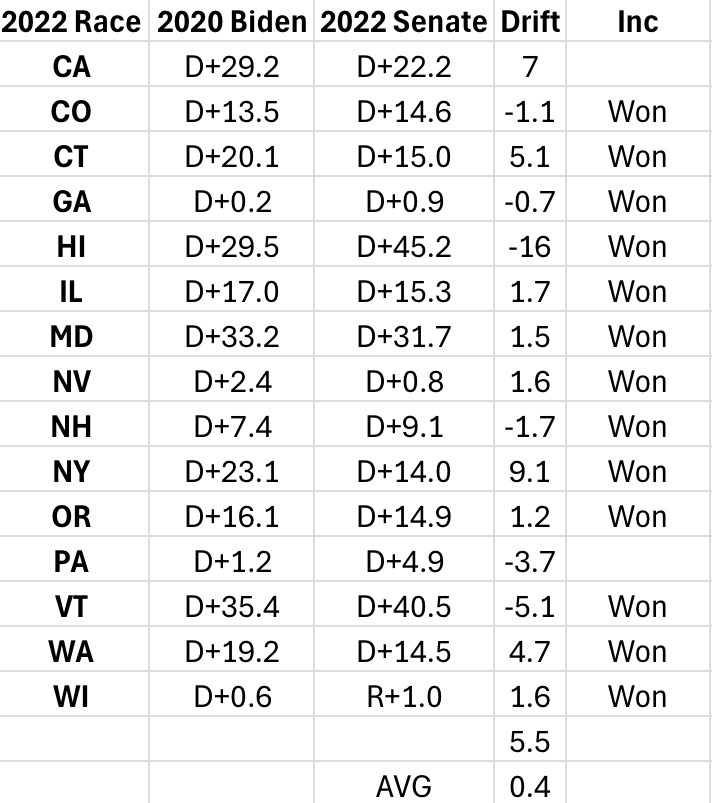
All analysis is from the perspective of the president’s party, given that we are facing a GOP-president midterm in November.

Here’s how to read the table above, using California as the example. In 2020, Joe Biden won California by a certified margin of 29.2% (yes, I know, it is artificially inflated). In 2022, the Democrat Alex Padilla won the Senate seat by 22.2%. That is seven points to the right of the 2020 presidential margin, indicated by a positive number in the “drift” column. Padilla was not an incumbent.

The table includes 15 Senate races, all in states Biden carried in 2020. The only state Biden won (“won” in this case) in which the Republican won in 2022’s Senate contests was Wisconsin, and incumbent Ron Johnson held his seat 1.6% right of the 2020 presidential margin.

Incumbents held 13 of 13 seats in Biden-won states.

9 of 15 seats had rightward drift from the 2020 presidential election.

Hawaii is the extreme outlier with leftward drift of 16.0%, driven by a weak Republican challenger to a strong Democrat incumbent (Schatz). Even keeping this outlier in the numbers, the average drift in these 15 Biden seats comes out to 0.4% rightward. This underscores why 2022 was a “pink trickle” rather than a red wave, and should help you understand why many are pondering if 2026 will be like a “reverse 2022” (Democrats expecting big gains but disappointed in outcome).

Hawaii excluded, none of the Senate seats won by the president had enough drift in either direction to flip any of the second-tier Senate races up in 2026.

2018 Midterm Analysis

2018 Senate midterm drift analysis table

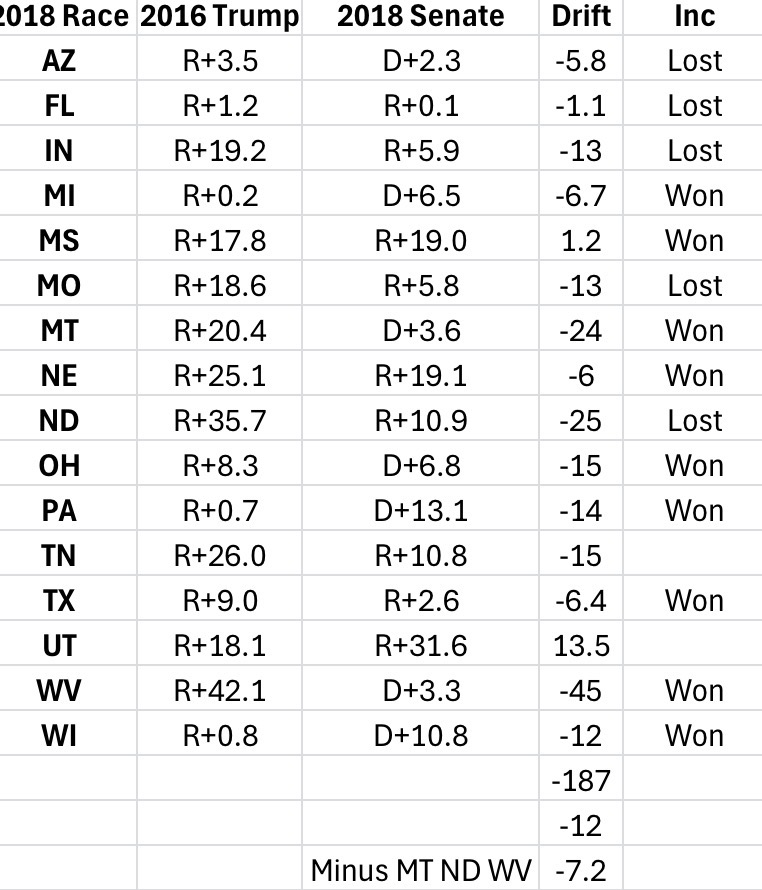
The 2018 Senate cycle appears ominous at first glance, given that 14 of 16 races ran left of the 2016 presidential margin and the presence of some really big drift numbers in Trump-won states. However, the GOP made a net gain in the Senate, driven by Rick Scott’s win over Bill Nelson in Florida, Mike Braun’s over Joe Donnelly in Indiana, Josh Hawley’s in Missouri over Claire McCaskill, and Kevin Cramer’s in North Dakota of Heidi Heitkamp. The latter three races, requiring the ouster of Democrat incumbents from Trump landslide states, had left drifts of -13.3%, -12.8%, and -24.8%, respectively.

Then there were the Democrats in similar races who managed to hold on, like Jon Tester in Montana running 24 points left of Trump’s 2016 margin, and Joe Manchin in West Virginia, at 45.4% left of Trump. Tester and Manchin are now gone, and with them, the blue dog coalition finds John Fetterman as its last surviving member (for now).

Pennsylvania, Ohio, and Wisconsin had big swings from Trump’s unexpected success in 2016, but Casey was a strong incumbent (out in 2024), Sherrod Brown held on for one last term, and so did Tammy Baldwin, who also almost lost in 2024. The fates of those three Senators (two former) suggest the overall electorate has adjusted since the 2016-18 timeframe and settled well to the political right, meaning the 2018 cycle was one of significant sorting.

Ken Paxton survives a 6.4% leftward drift in 2026 given Trump’s 2024 blowout in the Lone Star State, and Sherrod Brown would only win Ohio by 3.9% with the same differential he had in 2018 as an incumbent. My bet is he doesn’t have it in him.

Deducting extreme outliers Montana, North Dakota, and West Virginia, the 2018 Senate races in Trump-won states ran 7.2% left of presidential performance. All four second-tier states remain Republican with that differential this year, which is unlikely given the volatility of the Midwest in 2018 compared to today.

2014 Midterm Analysis

2014 Senate midterm drift analysis table

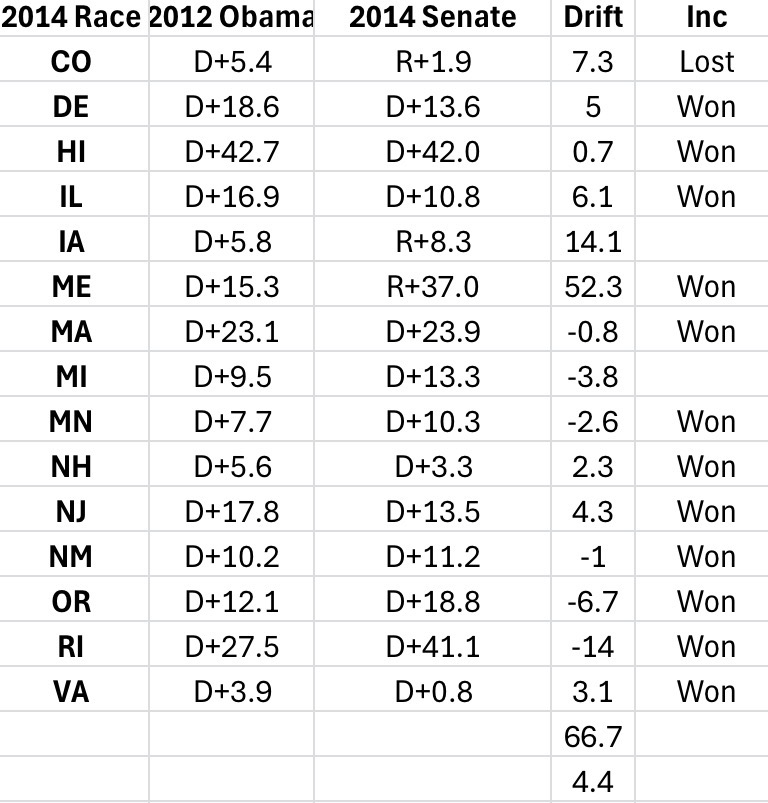
15 Obama-won states had Senate races up for grabs in 2014, a year marked by low turnout and a continuation of the 2010 Tea Party wave, but with a lot less volatility. Much of what the Rust Belt and greater Midwest would become was beginning to manifest in 2014, and we also got the last gasp of Republican Colorado here with Cory Gardner’s ouster of Democrat Mark Udall.

12 of 13 incumbents in Obama states won, including Susan Collins, who ran 52.3% right of Obama’s 2012 margin. She only needs to run 7.0% right of Harris’s 2024 margin to hold her seat in 2026.

Matching the 2022 midterms, 9 of 15 states had rightward drift in 2014 from the 2012 presidential election. Throwing out the extreme Collins outlier, the 2014 Obama-state Senate races had rightward drift of 1.1%.

Conclusion

Leftward drift can be expected in all four second-tier Senate races this year in Trump-won states Alaska, Iowa, Ohio, and Texas, on account of the president’s over-performances in all four in 2024.

Paxton is safe with Cruz’s 2018 differential, even if doubled.

Volatility in the Midwest has died off substantially since the first Trump midterm, and is likely to save Jon Husted (Ohio) and Ashley Hinson (Iowa), even though the latter is a non-incumbent.

Alaska doesn’t fit the pattern of volatile Midwestern state, and 2016 Trump states without a blue dog incumbent Democrat showed less volatility (Florida, Mississippi, Nebraska, and Texas as prime examples).

Democrats remain severe underdogs and need to sweep all five key races to have a puncher’s chance at the narrowest of Senate majorities.

Seth Keshel, MBA is a Senior Fellow at the Gold Institute for International Strategy and a retired Army Captain. He publishes Captain K’s Corner on Substack.