History is the best guide and gives a framework for Senate volatility that should set reasonable expectations
Last month, I wrote an article outlining the uphill challenge Democrats face in seeking to obtain a majority in the United States Senate. That article is open for all readers: End of June 2026 Senate Majority Race Update.
Here are the nine races that will determine which party wins the chamber majority:
Key Races
- Georgia (Jon Ossoff – D, incumbent)
- Maine (Susan Collins – R, incumbent)
- Michigan (Democrat-held, incumbent retiring)
- New Hampshire (Democrat-held, incumbent retiring)
- North Carolina (Republican-held, incumbent retiring)
Second-Tier Races
- Alaska (Dan Sullivan – R, incumbent)
- Iowa (Republican-held, incumbent retiring)
- Ohio (Jon Husted – R, incumbent)
- Texas (Republican-held, incumbent defeated in primary)
Democrats could win all five key races, which I do not consider likely given the strength of Susan Collins in Maine, a developing race against a radical DSA-aligned candidate in Michigan, and the Sununu name in New Hampshire. But let’s say they do win them all. That would have Republicans in the lead 51 to 49, requiring Democrats to win two of Alaska, Iowa, Ohio, and Texas for a clear majority. They have a pathway to victory; but it’s not a realistic one.
Today, I have done the research and I’m going to demonstrate why I consider the Republicans a strong favorite to hold the Senate.
Trump 2024 Margins for Second-Tier Races
Alaska +13.1%
Iowa +13.2%
Ohio +11.2%
Texas +13.7%
2022 Midterm Analysis
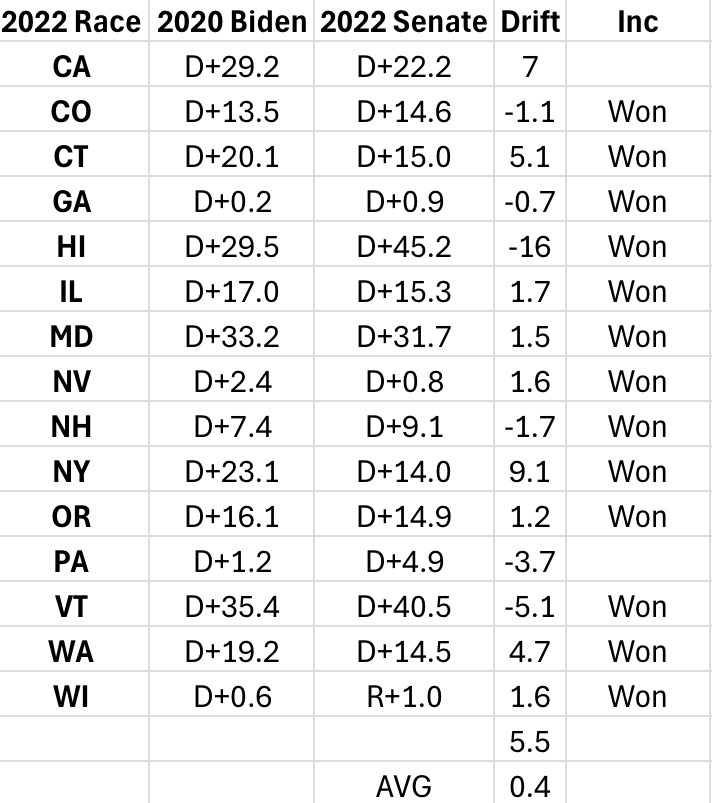
All analysis is from the perspective of the president’s party, given that we are facing a GOP-president midterm in November.
Here’s how to read the table above, using California as the example. In 2020, Joe Biden won California by a certified margin of 29.2% (yes, I know, it is artificially inflated). In 2022, the Democrat Alex Padilla won the Senate seat by 22.2%. That is seven points to the right of the 2020 presidential margin, indicated by a positive number in the “drift” column. Padilla was not an incumbent.
The table includes 15 Senate races, all in states Biden carried in 2020. The only state Biden won (“won” in this case) in which the Republican won in 2022’s Senate contests was Wisconsin, and incumbent Ron Johnson held his seat 1.6% right of the 2020 presidential margin.
Incumbents held 13 of 13 seats in Biden-won states.
9 of 15 seats had rightward drift from the 2020 presidential election.
Hawaii is the extreme outlier with leftward drift of 16.0%, driven by a weak Republican challenger to a strong Democrat incumbent (Schatz). Even keeping this outlier in the numbers, the average drift in these 15 Biden seats comes out to 0.4% rightward. This underscores why 2022 was a “pink trickle” rather than a red wave, and should help you understand why many are pondering if 2026 will be like a “reverse 2022” (Democrats expecting big gains but disappointed in outcome).
Hawaii excluded, none of the Senate seats won by the president had enough drift in either direction to flip any of the second-tier Senate races up in 2026.
2018 Midterm Analysis
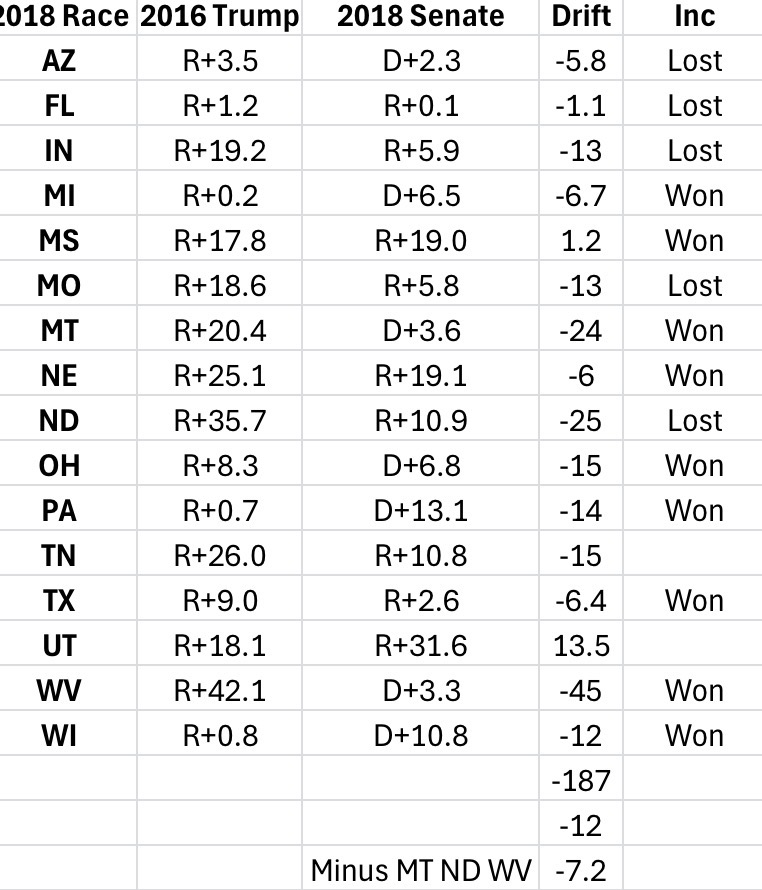
The 2018 Senate cycle appears ominous at first glance, given that 14 of 16 races ran left of the 2016 presidential margin and the presence of some really big drift numbers in Trump-won states. However, the GOP made a net gain in the Senate, driven by Rick Scott’s win over Bill Nelson in Florida, Mike Braun’s over Joe Donnelly in Indiana, Josh Hawley’s in Missouri over Claire McCaskill, and Kevin Cramer’s in North Dakota of Heidi Heitkamp. The latter three races, requiring the ouster of Democrat incumbents from Trump landslide states, had left drifts of -13.3%, -12.8%, and -24.8%, respectively.
Then there were the Democrats in similar races who managed to hold on, like Jon Tester in Montana running 24 points left of Trump’s 2016 margin, and Joe Manchin in West Virginia, at 45.4% left of Trump. Tester and Manchin are now gone, and with them, the blue dog coalition finds John Fetterman as its last surviving member (for now).
Pennsylvania, Ohio, and Wisconsin had big swings from Trump’s unexpected success in 2016, but Casey was a strong incumbent (out in 2024), Sherrod Brown held on for one last term, and so did Tammy Baldwin, who also almost lost in 2024. The fates of those three Senators (two former) suggest the overall electorate has adjusted since the 2016-18 timeframe and settled well to the political right, meaning the 2018 cycle was one of significant sorting.
Ken Paxton survives a 6.4% leftward drift in 2026 given Trump’s 2024 blowout in the Lone Star State, and Sherrod Brown would only win Ohio by 3.9% with the same differential he had in 2018 as an incumbent. My bet is he doesn’t have it in him.
Deducting extreme outliers Montana, North Dakota, and West Virginia, the 2018 Senate races in Trump-won states ran 7.2% left of presidential performance. All four second-tier states remain Republican with that differential this year, which is unlikely given the volatility of the Midwest in 2018 compared to today.
2014 Midterm Analysis
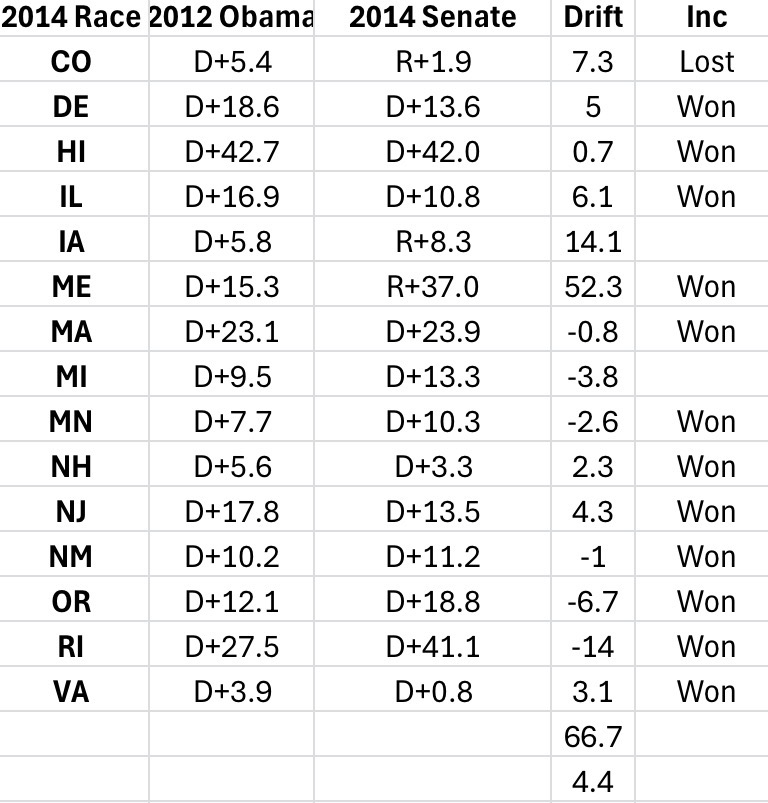
15 Obama-won states had Senate races up for grabs in 2014, a year marked by low turnout and a continuation of the 2010 Tea Party wave, but with a lot less volatility. Much of what the Rust Belt and greater Midwest would become was beginning to manifest in 2014, and we also got the last gasp of Republican Colorado here with Cory Gardner’s ouster of Democrat Mark Udall.
12 of 13 incumbents in Obama states won, including Susan Collins, who ran 52.3% right of Obama’s 2012 margin. She only needs to run 7.0% right of Harris’s 2024 margin to hold her seat in 2026.
Matching the 2022 midterms, 9 of 15 states had rightward drift in 2014 from the 2012 presidential election. Throwing out the extreme Collins outlier, the 2014 Obama-state Senate races had rightward drift of 1.1%.
Conclusion
Leftward drift can be expected in all four second-tier Senate races this year in Trump-won states Alaska, Iowa, Ohio, and Texas, on account of the president’s over-performances in all four in 2024.
Paxton is safe with Cruz’s 2018 differential, even if doubled.
Volatility in the Midwest has died off substantially since the first Trump midterm, and is likely to save Jon Husted (Ohio) and Ashley Hinson (Iowa), even though the latter is a non-incumbent.
Alaska doesn’t fit the pattern of volatile Midwestern state, and 2016 Trump states without a blue dog incumbent Democrat showed less volatility (Florida, Mississippi, Nebraska, and Texas as prime examples).
Democrats remain severe underdogs and need to sweep all five key races to have a puncher’s chance at the narrowest of Senate majorities.
Seth Keshel, MBA is a Senior Fellow at the Gold Institute for International Strategy and a retired Army Captain. He publishes Captain K’s Corner on Substack.