Nuclear Insurance You Can Bank On

A B-52H Stratofortress parked on the flight line during Exercise Global Thunder 26 at Minot Air Force Base, North Dakota

This article was written by Peter Huessy and appeared in RealClearDefense. Nuclear Insurance You Can Bank On.

The Congressional Budget Office is charged by Congress to carefully examine the spending implications of government funded programs including those in the Department of War. Some decades ago, CBO assessed the cost of the nation’s nuclear deterrent particularly the Triad of strategic bombers, submarines and the sea launched ballistic missiles they carried and the land-based ICBMs in silos. The CBO also estimated the cost of the warhead and nuclear laboratories maintained by the Department of Energy (now the National Nuclear Security Administration within DOE) and the cost of our Nuclear Command, Control, and Communications (NC3). One early report garnered a lot of national attention because CBO headlined its report with the startling estimate that the nation’s nuclear deterrent was going to cost $1 trillion. Even in Washington, D.C., that was a lot of money.

But CBO played a few clever tricks to get to that number. First, CBO said this was the cost of “nuclear modernization” or the new nuclear weapons systems. It was that but a lot more. All the current legacy and very old system costs were also included, systems that now are from 40-70 years old, hardly what one would include under the rubric of “modernization.” Second, CBO also included all 100 strategic B21 bombers although only 20 of the bombers were going to be in the deployed nuclear arsenal. Third, CBO arbitrarily decided that the estimated costs would be for three decades, triple the length or duration of budgets usually presented by an administration in February of each year when the Federal budget proposals are required to be submitted to the U.S. Congress. And fourth and finally, CBO decided to add a 3% inflation kicker over the three decades which mathematically more than doubled the actual costs of the nuclear modernization enterprise.

So, in their 2013 report, for example, CBO trumpeted that nuclear forces would cost $1 trillion (over the next 30 years), generating headlines across the news media, engendering the shock and awe they wanted to create, hoping strong opposition in Congress would develop that would cut back significantly on the modernization effort. And just so Congress would get the message, another favorite regular past time of CBO was to do a regular excursion of killing the land based silo ballistic missiles to examine what force alternatives would provide what kind of budget savings.

CBO was strongly criticized for these sleight of hand magic tricks and eventually CBO made two key adjustments—they estimated the bomber costs at the 20 not 100 to be in the force. And CBO admitted that modernization should not include the ongoing sustainment and maintenance of the current legacy force.

Nonetheless CBO as one senior USAF general told me got its “bumper sticker and press release headline” and made nuclear investments look out of line with the rest of government requirements. The nuclear abolition enthusiasts took the number and ran with it and even came up with their own estimates near the $2 trillion mark by making the same mistakes that CBO was making but also adding even more of their own.

Senator John Hoeven of North Dakota (R-ND) put things in perspective two years ago when he explained that as a member of the defense appropriations subcommittee in the Senate, he had a front row seat when examining the nuclear portion of the defense budget. And yes, the Senator supports in his state two elements of the U.S. nuclear Triad—150 Minuteman missile silos and B52 strategic bombers, the only state with two parts of the nuclear Triad. Senator Hoeven laid out in late 2024 that the entirety of the nuclear Triad modernization cost for FY2025 for the nation was $18.6 billion annually for the B21 bombers, the Columbia-class submarines and companion upgraded D-5 missile and the Sentinel ICBM. One could add the costs of the associated NC3 and warheads, but whether or not the U.S. modernized the Triad these other elements would have had to be acquired irrespective of whether for the legacy or modernized force.

Now to be fair those Triad costs are now upwards of $26 billion as the country moves toward full annual production of each of the Triad elements. As acquisition costs increase, research and development costs decline. Also, sustainment and maintenance of our legacy forces continues, with some of those costs rising as much as 17% annually. What is remarkable is that despite being 55 years in service, the 20th USAF commanders have been able to sustain the Minuteman III force at a 98% alert rate, an extraordinary achievement, and a tribute to the leadership of 20th USAF that has recently changed hands with the retirement of USAF Maj Gen Stacy Huser. [And hats off to our Ohio-class sub and B52/B2 bomber folks as well.]

CBO largely misses any acknowledgement of such challenges to sustaining the U.S. legacy nuclear force. After the collapse of the USSR, CBO went on many alternative defense budget excursions that had at their core an assumption (often reflecting the tenor of some Congressional initiatives) that U.S. restraint and minimum investments in defense including nuclear forces was the way to proceed. This included a parallel and nearly zero attention to the looming threat of China as a possible nuclear peer competitor. [Although the U.S.-China Economic and Security Commission regularly and fairly examined the national security dangers facing the U.S. due to China’s rapid and accelerating defense and technology investments.]

In looking into the future, CBO also largely missed another aspect of the entirety of the budget requirements for the nation’s nuclear deterrent. The Columbia class submarine and the Sentinel ICBM forces will both remain in the force through 2080-5. That means these two elements of the nuclear Triad will have to be replaced, under currently projected conditions, but not for half a century or more. Using the current estimates for the research, development, and acquisition costs of Sentinel ($140 billion) and Columbia ($138 billion), plus $15 billion for the requited new and life extended warheads, the costs now to the U.S. taxpayers for each of the next 30 years comes to roughly $9.76 billion a year, which is more than what Americans spend for food on the 4th of July ($7 billion) and 1/122nd of what Americans spend on insurance each year. And for 80 years that nuclear insurance policy called deterrence has never had to cash out.

Written by Peter Huessy Senior Fellow, Gold Institute for International Strategy

Living Through What We All Hate

Saguaro cacti under a sunny sky in Tucson, Arizona

How big lobbies ruin politics for everyone

Most readers of Captain K’s Corner know that I am married to State Representative Rachel Keshel, who represents Arizona’s 17th Legislative District. I gave an overview of her campaign on Saturday, August 1, and readers responded with a very strong fundraising drive:

It was badly needed, because the Democrats smell blood in the water and are looking to flip both the House and Senate chambers by running right through LD-17. The district looks good on paper, but runs far to the left of party registration because of a few key spots in the district loaded with voters who represent a brand of Republican voter at odds with the grassroots brand – which Rachel comes from, and which President Trump most definitely comes from. To top it off, Arizona is one of a few states that has two representatives per district, meaning it’s difficult to throw a punch without messing up the ranking of candidates and thereby imperiling your own election (or that of your running mate). All the candidates run in the same field of four, and not in separate races for Seat A or Seat B.

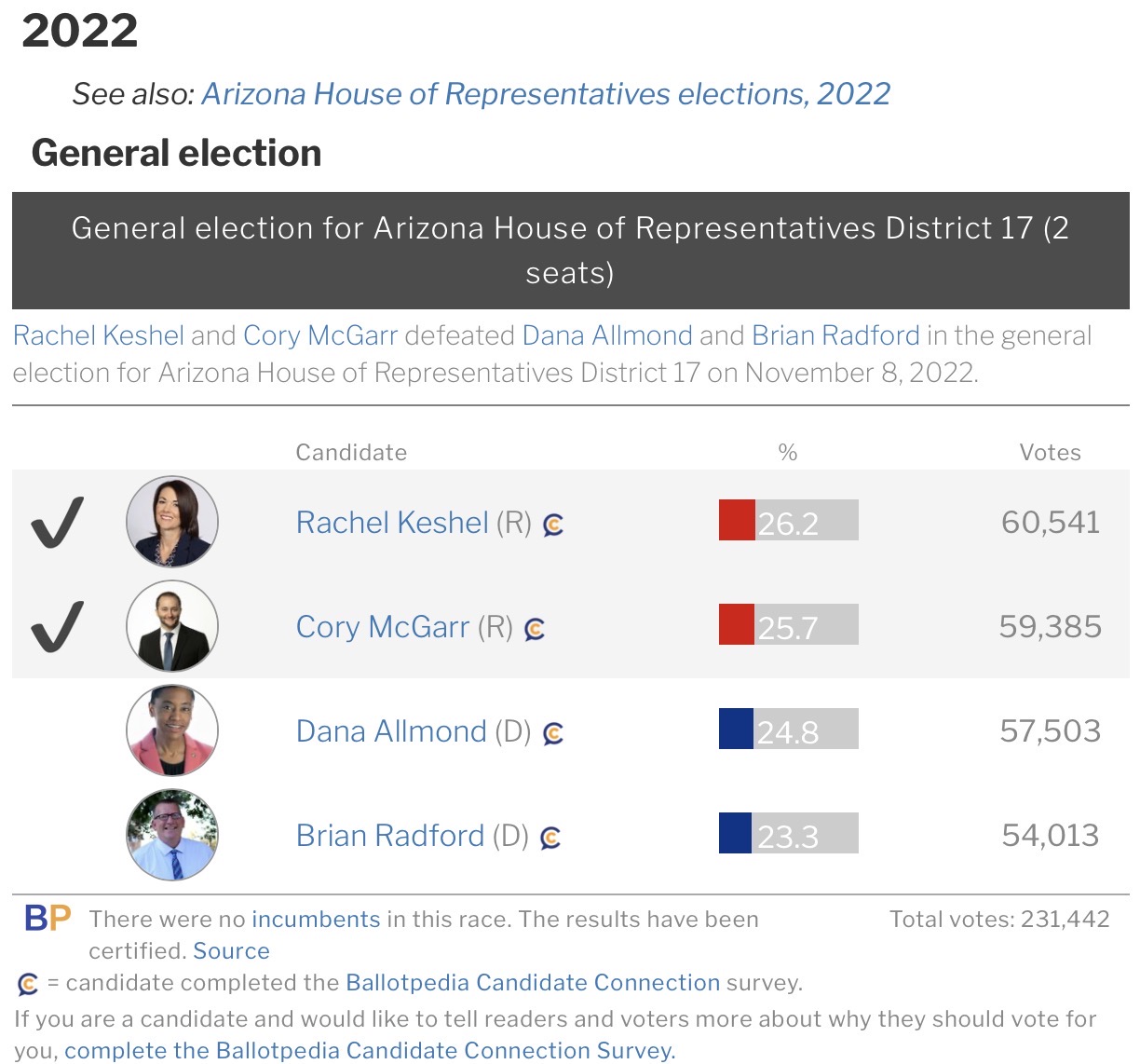
Rachel and her old seatmate, Cory McGarr, won in the 2022 election alongside the Katie Hobbs gubernatorial rig-job, by beating two Democrat newcomers in what was then a freshly drawn district:

Arizona LD-17 2022 state House results

McGarr was a great legislator, and both GOP candidates ran for reelection in 2024. Enter what is known as a single shot – when the underdog party runs one candidate. This concentrates all the Democrat vote on one guy (or gal), and any independents looking to split a ticket have just one choice of Democrat. It works in reverse for Republicans in blue-leaning districts, and that is exactly how Michelle Pena got elected in LD-23. Unfortunately, Gary Garcia Snyder refuses to drop his candidacy alongside her in LD-23 this year and will almost certainly cost Republicans Pena’s seat, and potentially the majority.

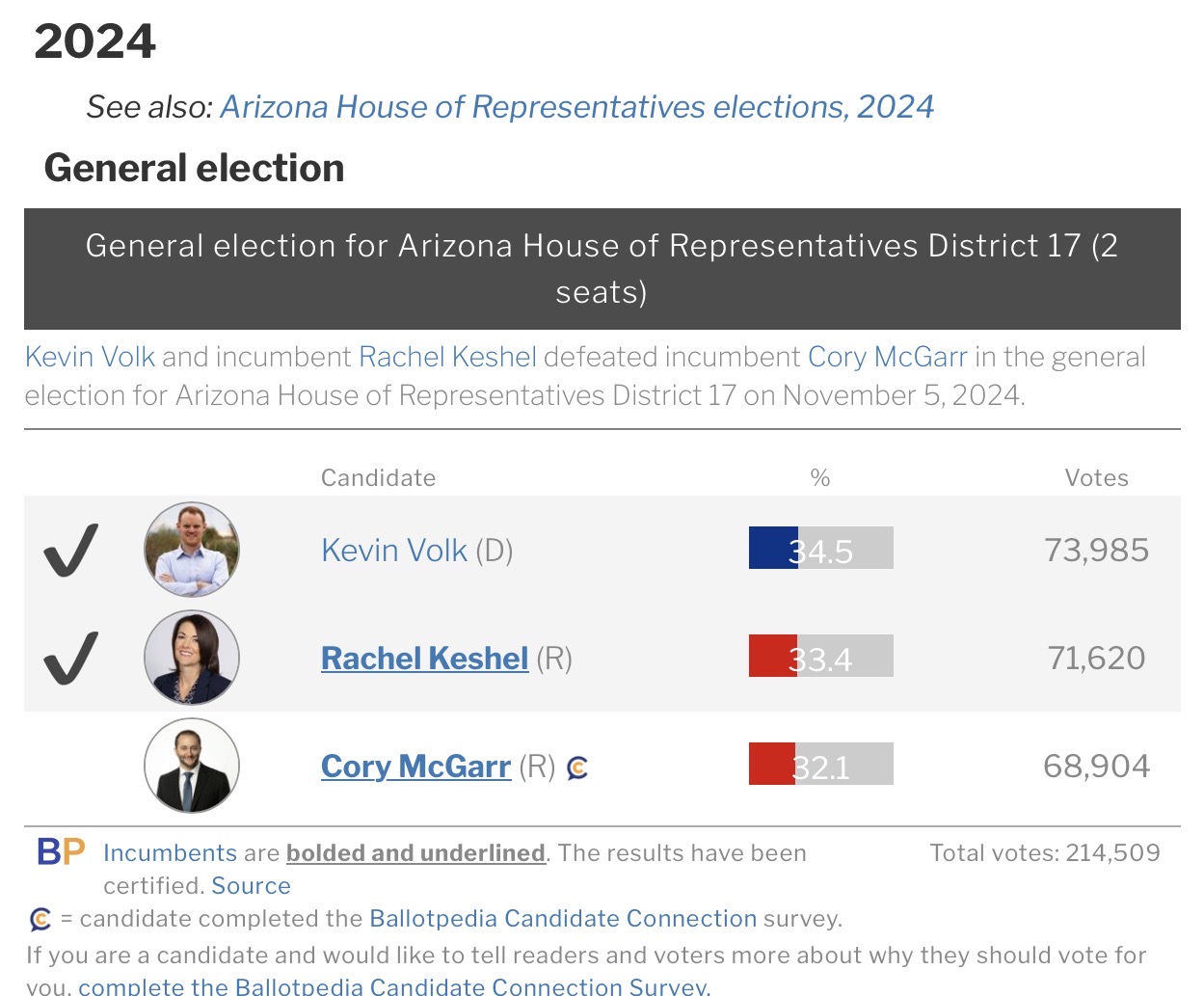
In 2024, Democrats single shotted a candidate named Kevin Volk, whose family is well-known in the Tucson business community, and the results came out like this:

Arizona LD-17 2024 state House results

Volk elected, Rachel reelected, and McGarr on the outside looking in. LD-17 was the only district out of 30 statewide in which President Trump ran left of his 2020 numbers (in a state that had a terrible 2020 election, mind you); the Arizona GOP expanded its majorities in both the State Senate and State House nevertheless. Volk has a problem this year:

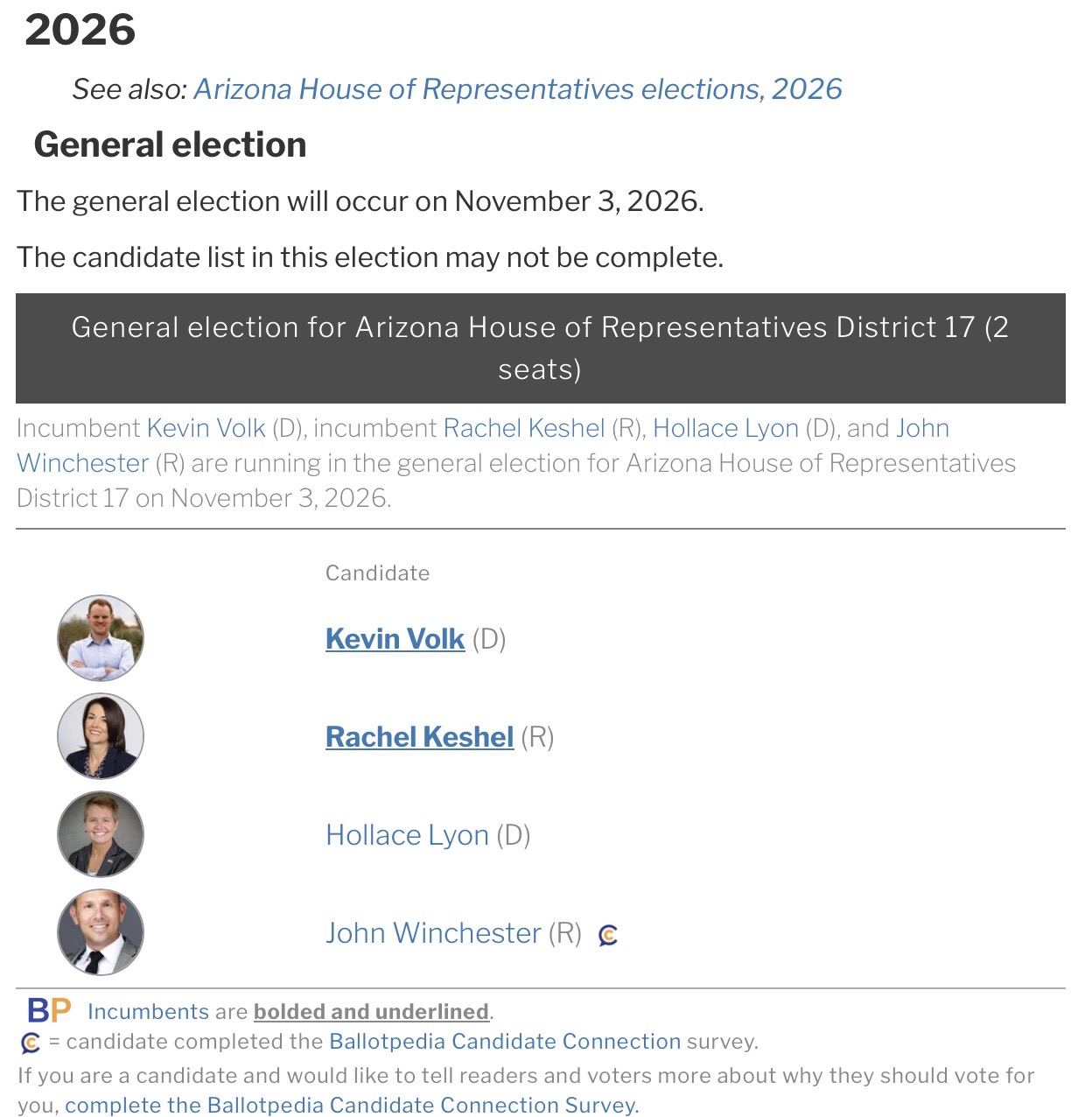
Arizona LD-17 2026 Democratic primary results

He is joined on the ticket by Holly Lyon, a retired Air Force officer who has run for the legislature before, albeit in a much redder district than LD-17. She ran slightly ahead of Volk in the primary, which doesn’t predict much because it will come down to how many Republicans run left of normal, and how non-partisans in a few key precincts split tickets. Rachel ran behind McGarr substantially in the 2024 primaries because another female Republican mounted a primary challenge, and the results shook out differently with a full electorate in November.

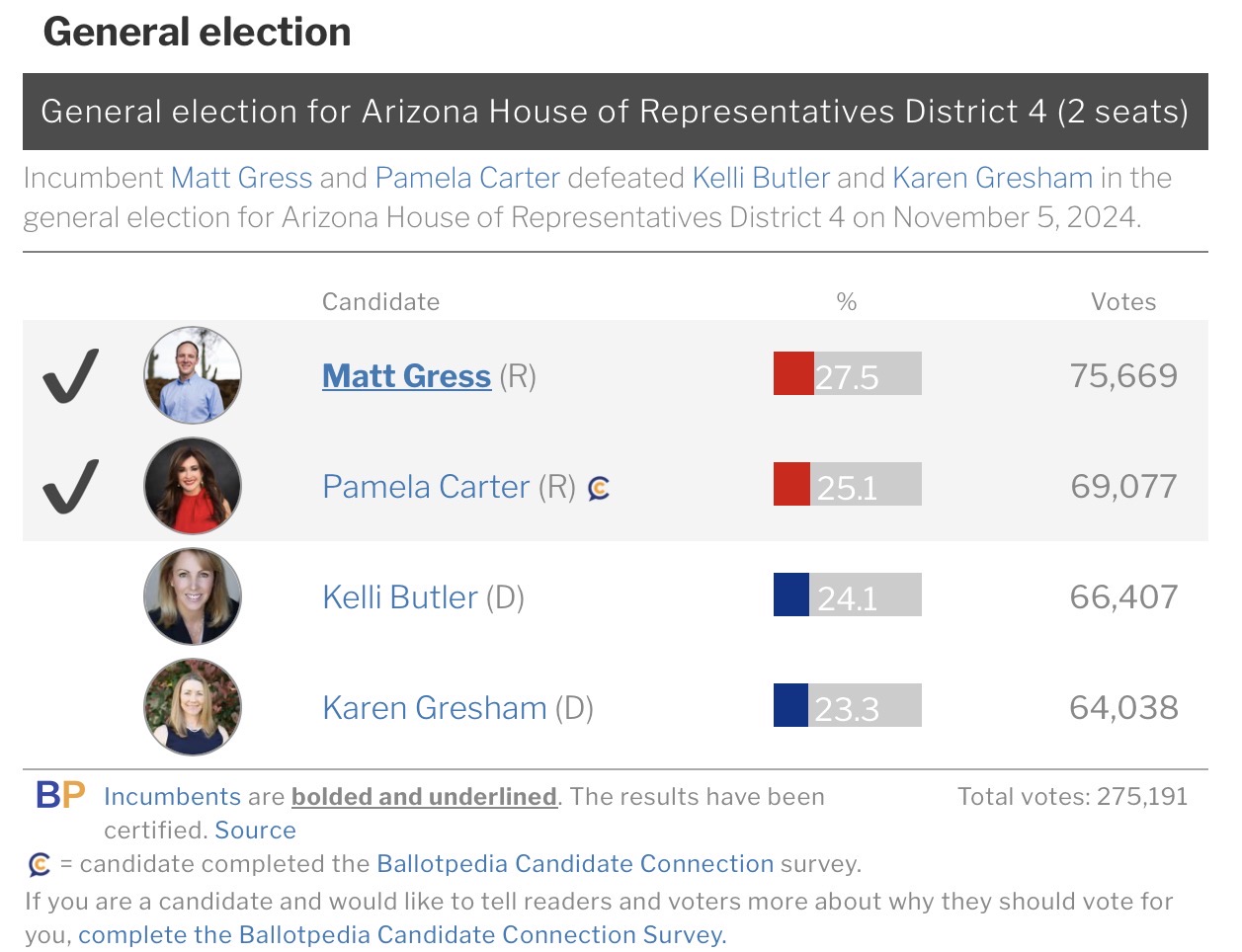
So – no more single shot. There will be no more sole concentration of all Democrat votes on one candidate, with no capacity to receive all independent votes looking for a split ticket to one Democrat. Democrats got greedy in LD-4 after a successful single shot in 2022, and the GOP took both seats in 2024 in the most dangerous electoral turf that suburbia has to offer in Maricopa County:

Arizona LD-4 2024 state House results

With the single shot off the table, and from feedback from the cigar room, the consensus is that Republicans are likely to win both House seats in LD-17 this year, despite Hobbs appearing to be on her way to reelection and the standard winds of a midterm environment. Rachel’s running mate this time is John Winchester, born and raised in Tucson and someone deeply connected to institutions and organizations. We didn’t know what to think of Winchester when he announced for the race, but we’ve come to like him and believe that he, a traditional conservative, and Rachel, the populist firebrand, make a strong pair that thoroughly represents the range of modern Republican politics that should go on to serve in Phoenix together.

Now, let me show you, with greatly enhanced odds of a double GOP victory in LD-17 on the table from two years ago, what the corrupt system is doing to game this race:

I was tipped off today that powerful lobbies plan to launch a push promoting a joint ticket of John Winchester (R) and Kevin Volk (D) in LD-17. John and I are encouraging everyone to “vote both Republicans” and let the chips falls where they may. I take it as a badge of honor…

AZ Representative Rachel (Jones) Keshel (@RJ4arizona), September 20, 2026

Powerful lobbies indeed – organizations from Phoenix and throughout the state – are looking to throw Rachel overboard and promote a purple ticket to persuade voters to elect a Winchester/Volk ticket. Let it be known before I move the balance of this article for paid subscribers – Rachel has already gone to Winchester with this, and he said, “I don’t want my face on anything with Volk’s.” We are at peace with whatever happens in November, but would at least appreciate a straight shot without having to wade through political minefields laid by special interests.

This level of outside support in our elections, despite its aims, has unpredictable impact. It could do what it intends and force a split ticket aiding Winchester and saving Volk, or it could backfire and piss off the substantial grassroots base of LD-17 – forcing members to single shot in favor of Rachel – which we do not want because the goal is to win both seats.

Detailing the Outside Impact on the LD-17 Race and Why Voters Hate It

Let me connect the dots and expand on how our elections are rigged to benefit the few:

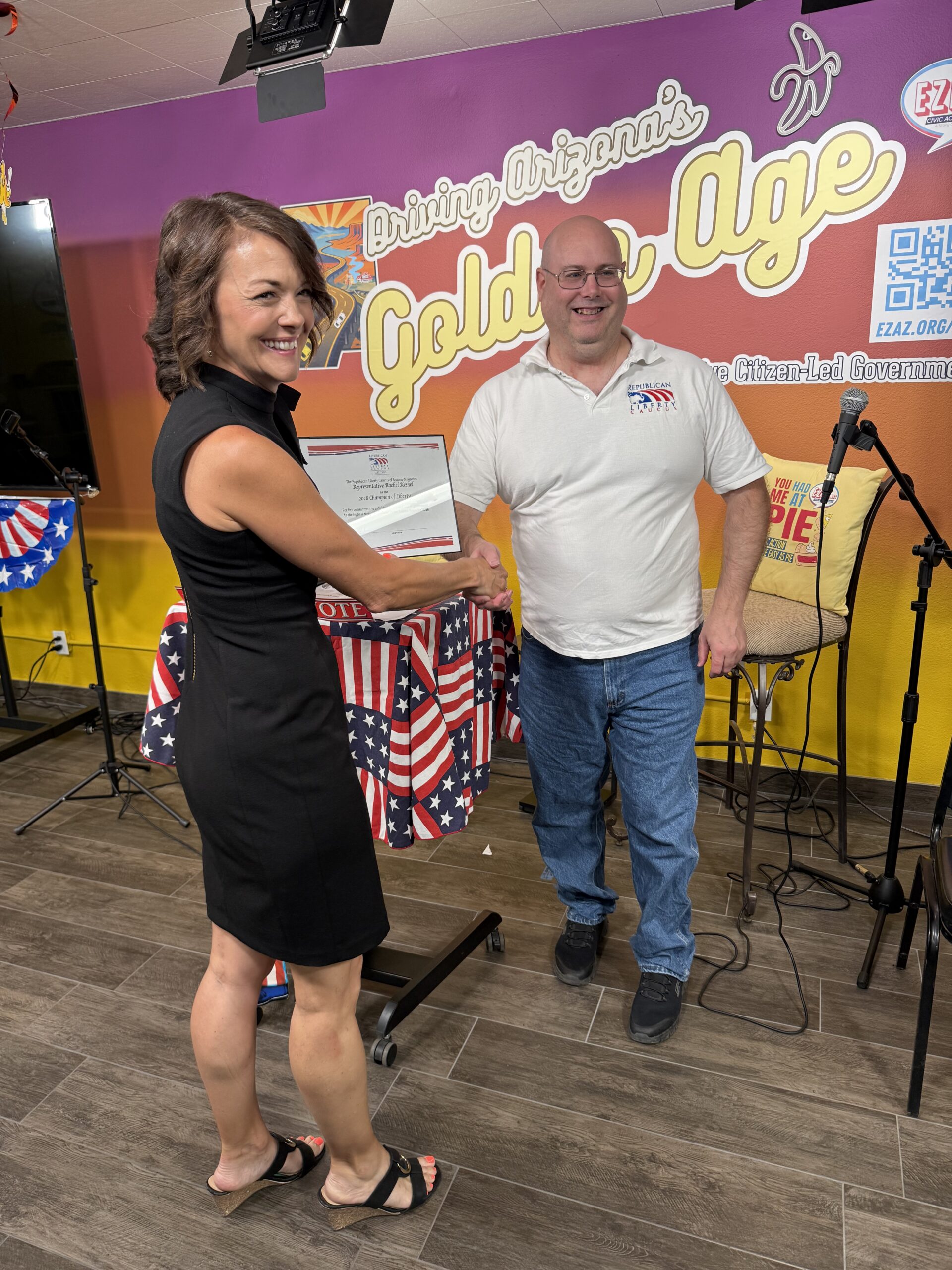
None of what Rachel wrote in that post is fair to Lyon, the new Democrat in the race, either. It disenfranchises her many supporters, just as big business and big establishment voices look to mute grassroots voices on the GOP side. If you read about Rachel’s track record, you will note that she was named “2026 Champion of Liberty” by the Republican Liberty Caucus of Arizona:

Rep. Rachel Keshel named 2026 Champion of Liberty

You will also see that as Vice Chairman of the Federalism, Military Affairs, and Elections committee, Rachel carries significant impact in a state with terribly corrupt elections and has been instrumental in advancing reforms directly to the ballot (like this year’s huge measure) and to the point of needing a gubernatorial signature, which represents its own problems given Hobbs’s presence in that office.

Rachel has also been a stalwart in family court reform. Arizona family courts are notorious for handing children to abusive parents, often with catastrophic consequences. Read my September 4 article to understand the level of depravity we are dealing with here:

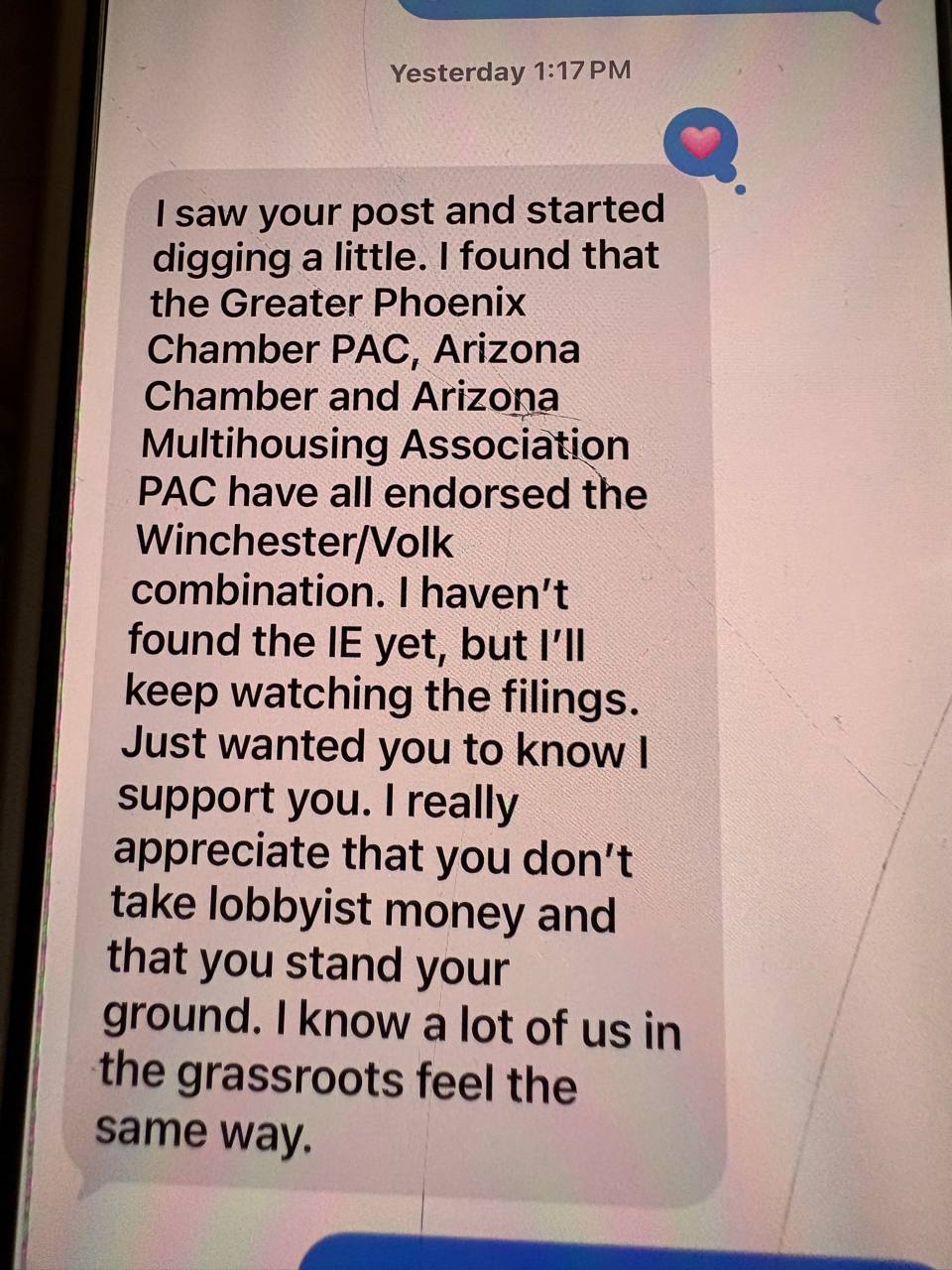
A fair amount of research and investigation into any legislator’s voting record and list of friends and enemies often answers every question voters may have. Rachel’s credentials, in this regard, are impeccable. That is what makes the intervention of outside interests so offensive. What we are told specifically is coming is an independent expenditure (not paid for by any campaign directly) targeting swing voters and pitching specifically the purple ticket of Winchester and Volk – which is publicly against the stated aims of both campaigns. Lest you think I’m pointing at some imaginary monster in the sky, here are the villains seeking to mislead voters:

  • Greater Phoenix Chamber PAC
  • Arizona Chamber
  • Arizona Multihousing Association PAC

A source in Tucson tipped us off that the looming advertising bombardment is likely coming from any combination of these three.

Image from Seth Keshel's article on outside spending in Arizona LD-17

What am I getting at here?

I am not bellyaching at all. The four-way races are their own problem, forcing four people to essentially compete against one another in a team sport. Every campaign puts endless hours, resources, and emotional energies into these contests, and watching special interests insert themselves into this is exactly what voters of all sides (and even the candidates who stand to be personally impacted) hate about the way our politics have developed. Why should candidates who can’t be bought be continuously targeted by organizations that want to control the political discourse with a death grip?

If big money buys political outcomes, or attempts to alter them, then what does that say for why average Americans avoid the political process? Isn’t that the problem altogether? What we want in this race is a straight race – two Republicans against two Democrats. We are at peace with how that shakes out. We are not at peace with having to navigate further minefields, even if the consequences of these minefields favor Rachel by making Republican voters angry at Winchester over something he didn’t initiate.

The insertion of high-powered special interests seeking to alter the trajectory of key races thought to impact who controls the legislative majorities is unfair to candidates Keshel, Winchester, and Lyon, the other Democrat in this race, and should be opposed by all voters regardless of partisanship or ideology. It is often said that you can tell a lot about someone by who their enemies are – and you should all understand that the machine will go to great lengths to remove people who threaten to expose and eliminate corruption in family courts, elections, special interests, and every arena plaguing our political discourse.

Seth Keshel, MBA is a Senior Fellow at the Gold Institute for International Strategy and a retired Army Captain. He publishes Captain K’s Corner on Substack.

The leader of the Lebanese mafia in Germany congratulated Berlin’s new communist mayor in person

Majestic view of Berlin's Rotes Rathaus showcasing historic red brick architecture.

This article was written by the editors and appeared in La Derecha Diario. El líder de la mafia libanesa en Alemania felicitó en persona a la nueva alcalde comunista de Berlin.

Featuring Hermann Tertsch, Distinguished Fellow, Gold Institute for International Strategy

The appearance of Issa Remmo, identified by German media as the head of the well-known Remmo clan, at an election party of Die Linke (The Left) sparked a heated controversy in Berlin. The episode occurred during the party’s election celebration in Neukölln and quickly raised questions about the ties and the controls at events of the German left.

Hermann Tertsch

The image of the clan leader alongside guests at the party was spread on social media and also picked up by various German media outlets. The Spanish journalist and MEP Hermann Tertsch sharply questioned the episode and pointed out that Remmo is considered a figure linked to Berlin’s criminal underworld.

Issa Remmo appeared at Die Linke’s election party

According to the German press, Remmo showed up at the party’s election celebration in Neukölln, where he even gave statements to the Berliner Morgenpost about the accusations of antisemitism hanging over parts of Die Linke.

Remmo himself told the German outlet that he felt “supported by a party for the first time” in Germany. He also defended Die Linke against the accusations of antisemitism and said he would not vote for a politician who was anti-Jewish.

The episode is especially striking because Die Linke was celebrating its election result in Berlin, while the presence of a figure publicly associated with the Remmo clan was drawing criticism from various political quarters.

The German left distanced itself from the visitor

After Remmo’s presence became public, representatives of Die Linke tried to distance themselves.

Die Linke’s Neukölln organization maintained that it was a public event that people who had not been invited could attend, and stated that Remmo was not on the guest list.

“The person and his specific presence were unknown to us,” explained a party spokeswoman, who added that there are no political or personal ties with Remmo.

Die Linke’s candidate, Elif Eralp, also later maintained that Remmo had not been invited and that he was removed from the venue.

Kai Wegner questioned Remmo’s presence

The mayor of Berlin, Kai Wegner, also reacted publicly to the episode and described Remmo’s appearance as a worrying sign.

Wegner argued that a political force that aims to take on the responsibilities of government in Berlin must make clear that there is no closeness of any kind to structures linked to organized crime. He also demanded an explanation of how it was possible for Remmo to get into the celebration.

The controversy later gained another element: German media reported that Ibrahim Ibrahim, singled out by German organizations and media for his support for the terrorist organization PFLP and linked to anti-Israel activism, appeared alongside Remmo.

The episode thus opened a new debate about Die Linke, its political spaces and the controls over who takes part in its activities, amid an intense discussion about security, antisemitism and extremism in Berlin.

Read the full article at La Derecha Diario

Hermann Tertsch is a Distinguished Fellow at the Gold Institute for International Strategy, a Washington, D.C. foreign policy and defense think tank.