Jon Ossoff (D-inc.) vs. Mike Collins (R)
Author’s Note: Other 2026 forecasts can be found in the Central File.
I. The Race
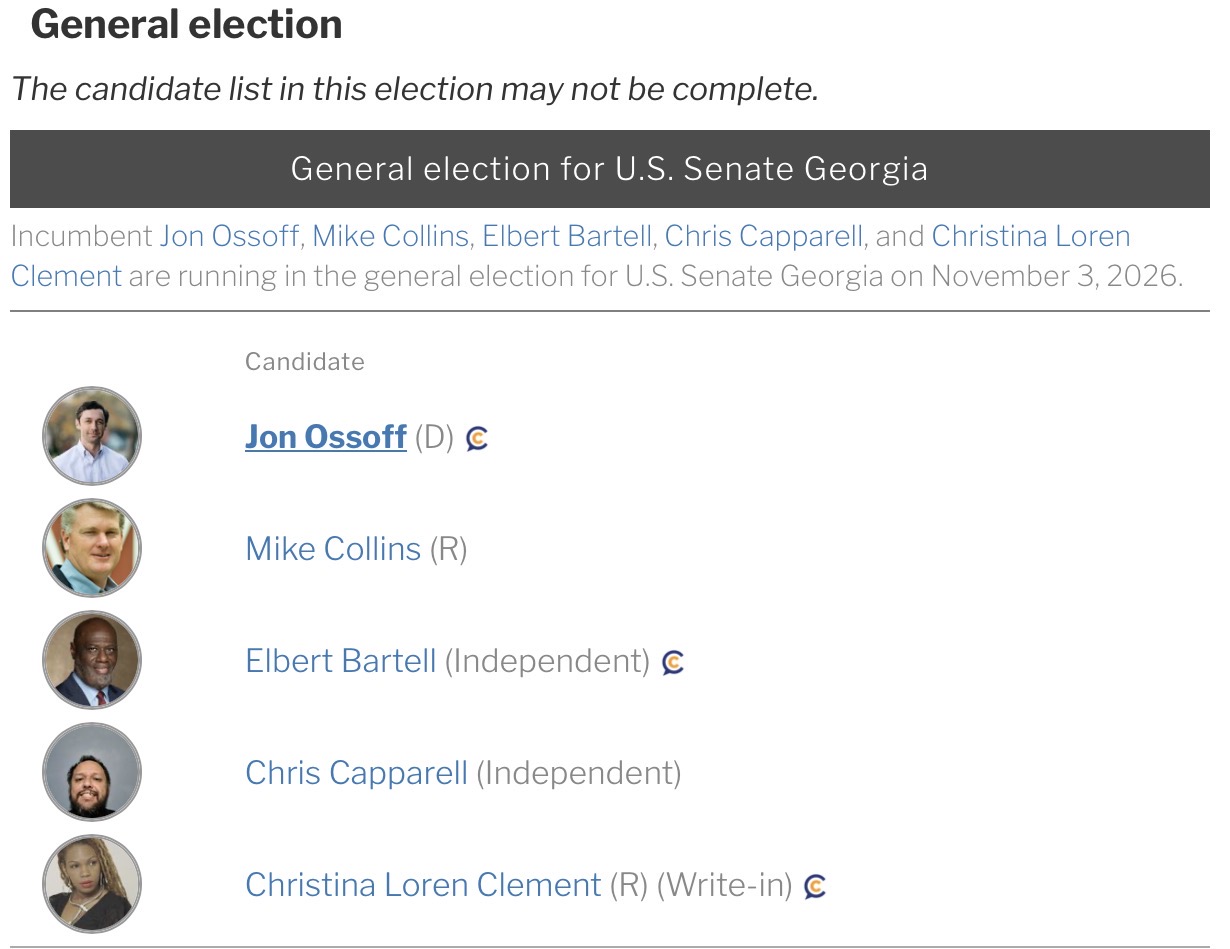
Jon Ossoff (Democrat) is seeking his second term in the U.S. Senate, having first been elected in a January 2021 runoff after the controversial November 2020 election held both Georgia Republican Senators under 50%. Ossoff is 39 and thought to be a contender for the 2028 (or future) Democrat presidential nomination.
Mike Collins (Republican) is finishing up his second term as the U.S. Representative of GA-10, a district covering parts of northeastern Georgia. His voter base is mostly rural and the district is not competitive.
II. State Profile
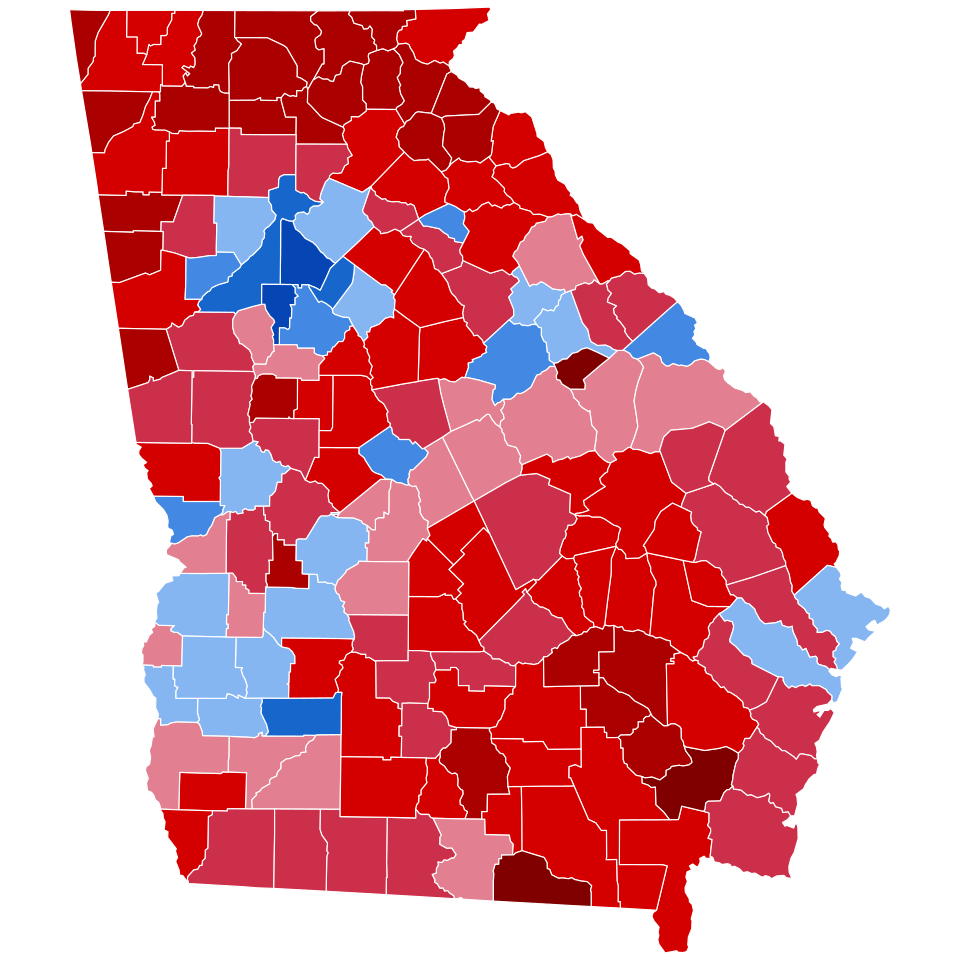
Georgia has recently become one of America’s most hotly contested battlegrounds and was carried by Donald Trump in 2024 by just 2.2%. Prior to the 2020 election, it had backed six consecutive GOP presidential candidates.
Demographic Statistics
- 53.2% White, 32.3% Black, 10.5% Hispanic
III. Market Assessment
Betting markets overwhelmingly favor Ossoff, as incumbent, against Collins.
IV. History
Warnock’s seat: Georgia, a former “Solid South” Democrat stronghold and the home of Jimmy Carter, was free of Republicans representing them in the U.S. Senate from the time of Reconstruction until 1981, when Mack Mattingly took office after having been elected in 1980. Mattingly only made it one term, but that seat was recaptured in 1992 by Paul Coverdell, who died in office and was replaced by a Democrat (thanks to a Democrat Governor). Republicans, in keeping with the new partisan loyalty to the GOP, recaptured the seat in 2004 and held it with two different Senators until Kelly Loeffler ran into the 2020 COVID election buzzsaw and dropped the seat to Raphael Warnock.
Ossoff’s seat: Republicans pried this seat from Democrats in the 2002 midterms, winning it three times before David Perdue got smacked in the face by mail-in ballots on November 3, 2020, prompting a runoff that Ossoff (along with Warnock for the other seat) won. It turns out that it wasn’t just Joe Biden needing every extra mail-in ballot that was counted after Election Day:
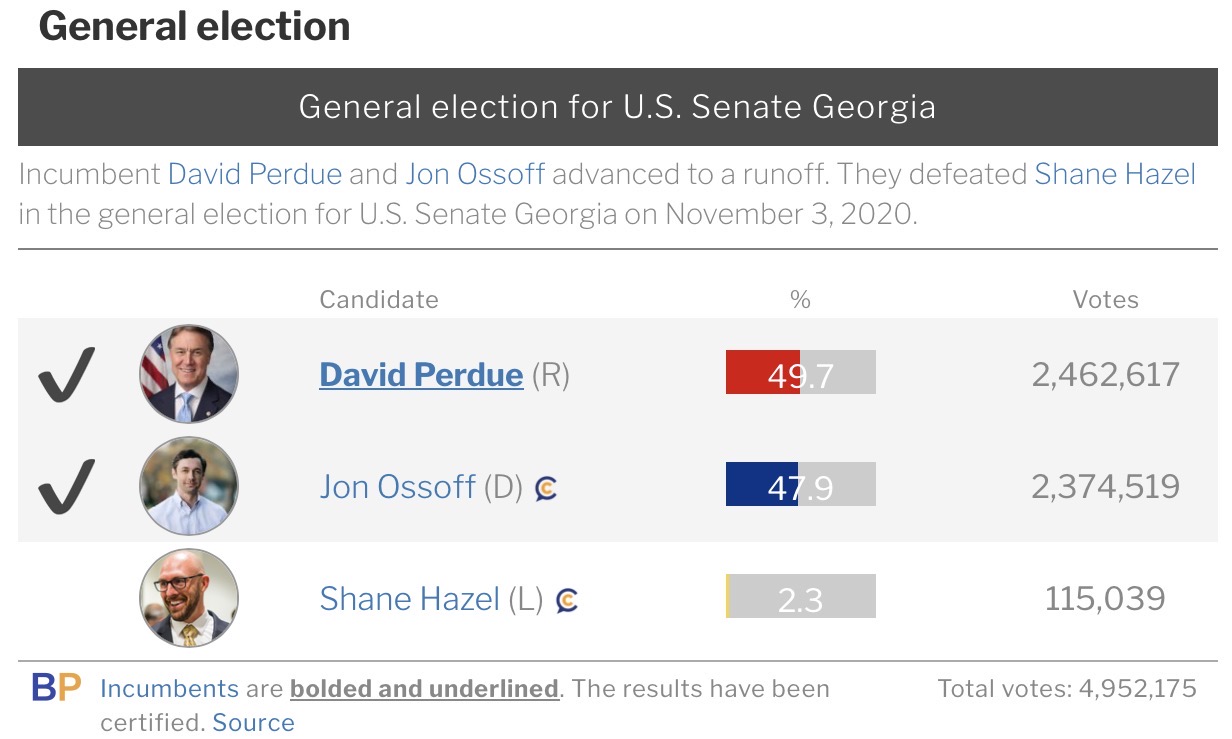
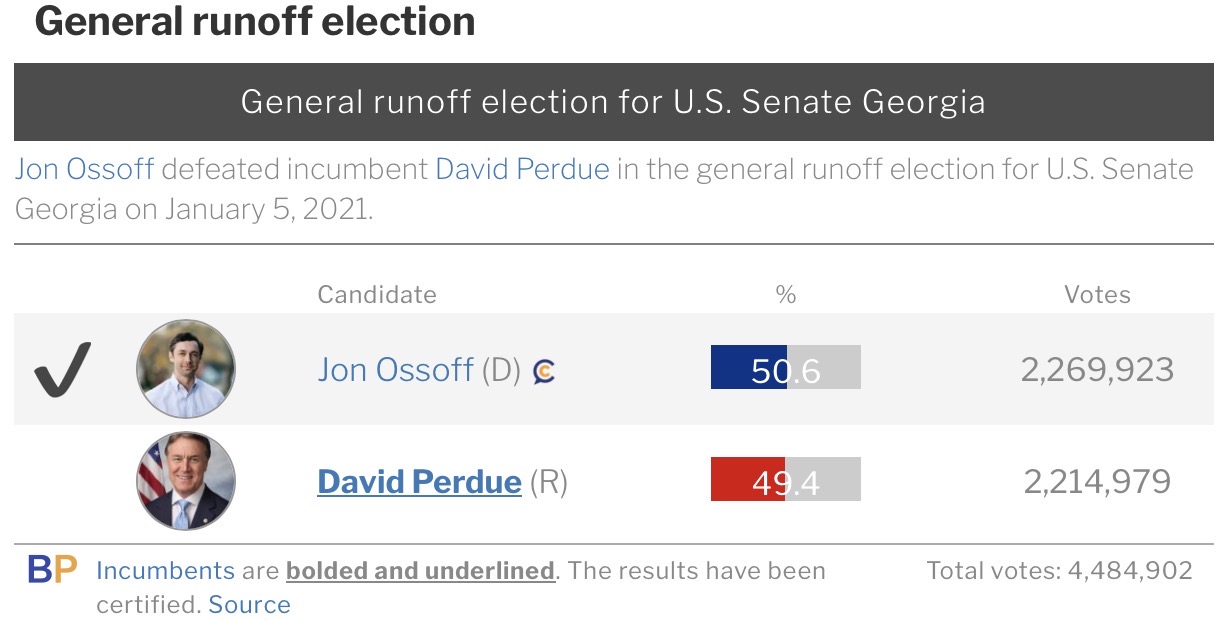
These seats have very strong correlation to Georgia’s presidential voting tendencies, which are presently extremely competitive.
V. Analysis of 2026 Primary Results
Ossoff breezed to renomination with no contender for his spot. Collins, on the other hand, had to navigate the typical GOP minefield for his – with a runoff necessary:
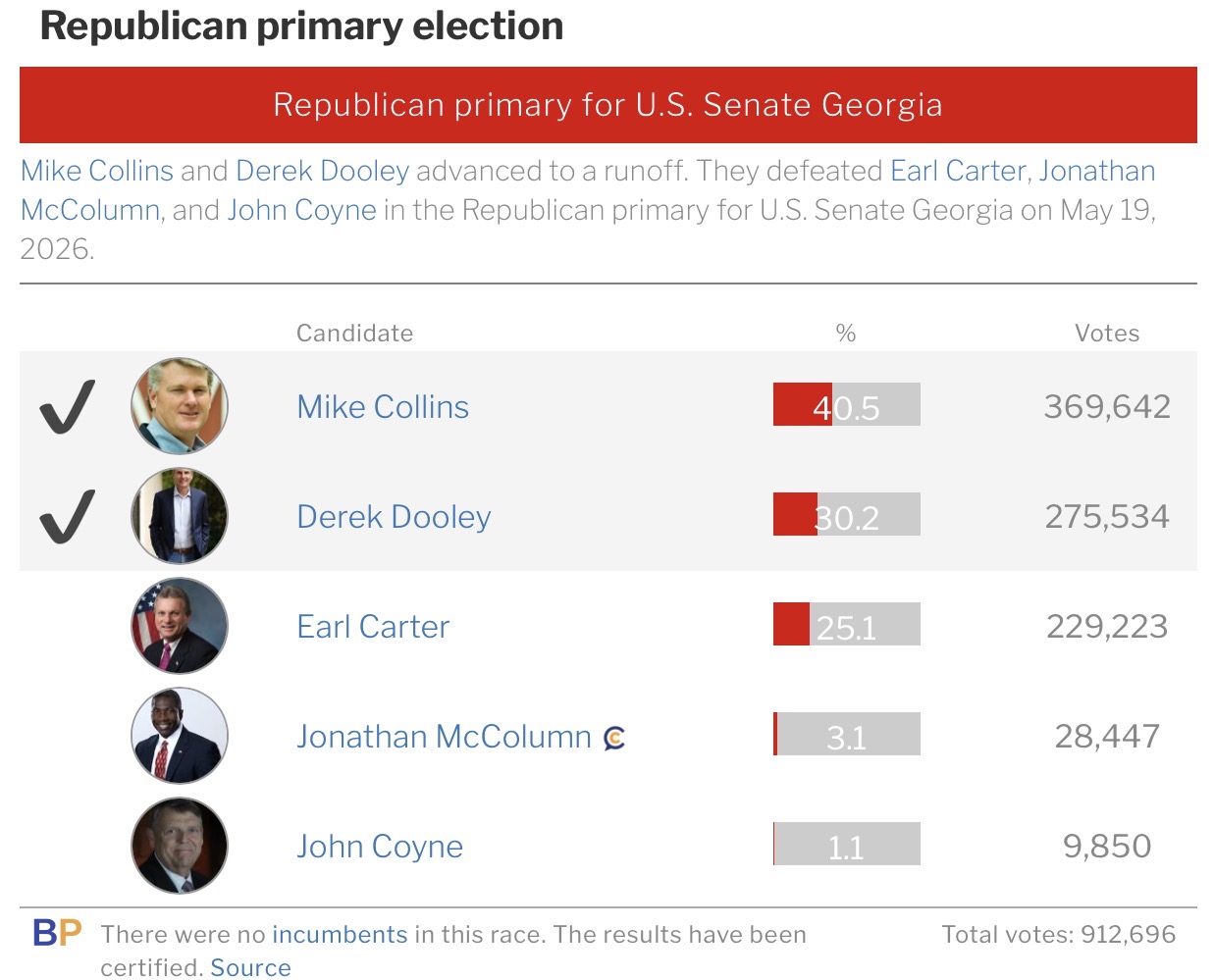
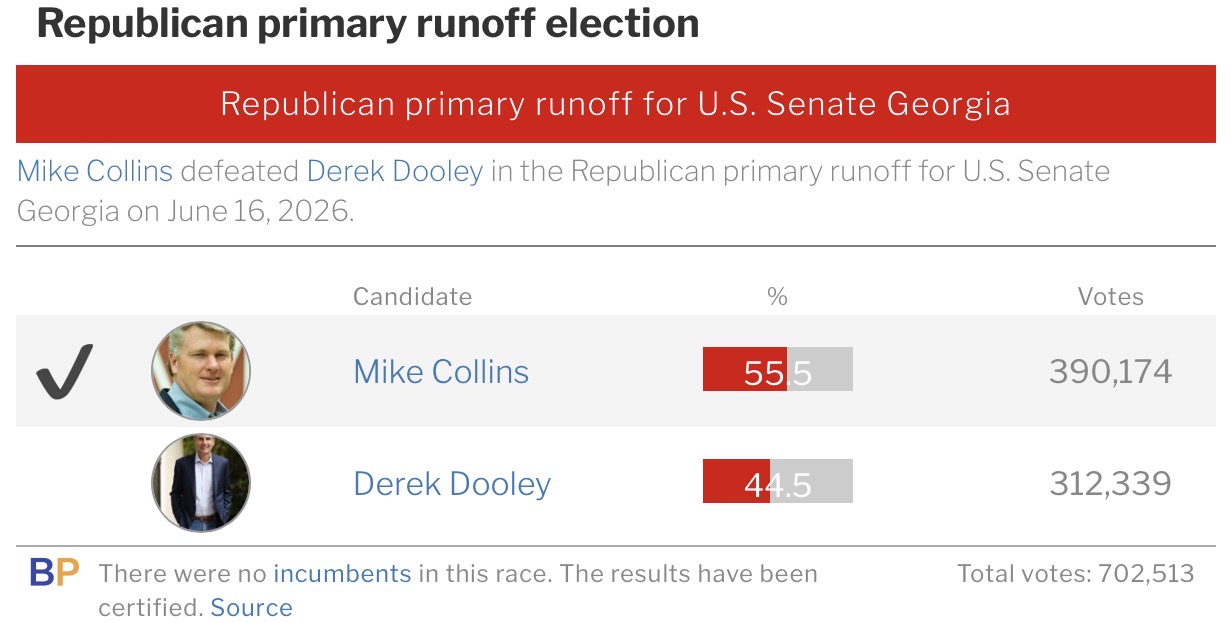
Collins defeated former football coach Derek Dooley in the ensuing runoff. Earl Carter, his opponent in the first round, is the sitting U.S. Representative for GA-1, based on the Atlantic Coast and also far removed from the cosmopolitan political environment of Atlanta that GOP gubernatorial nominee Rick Jackson navigated.
Notice the regional splits here, with Fulton County highlighted:
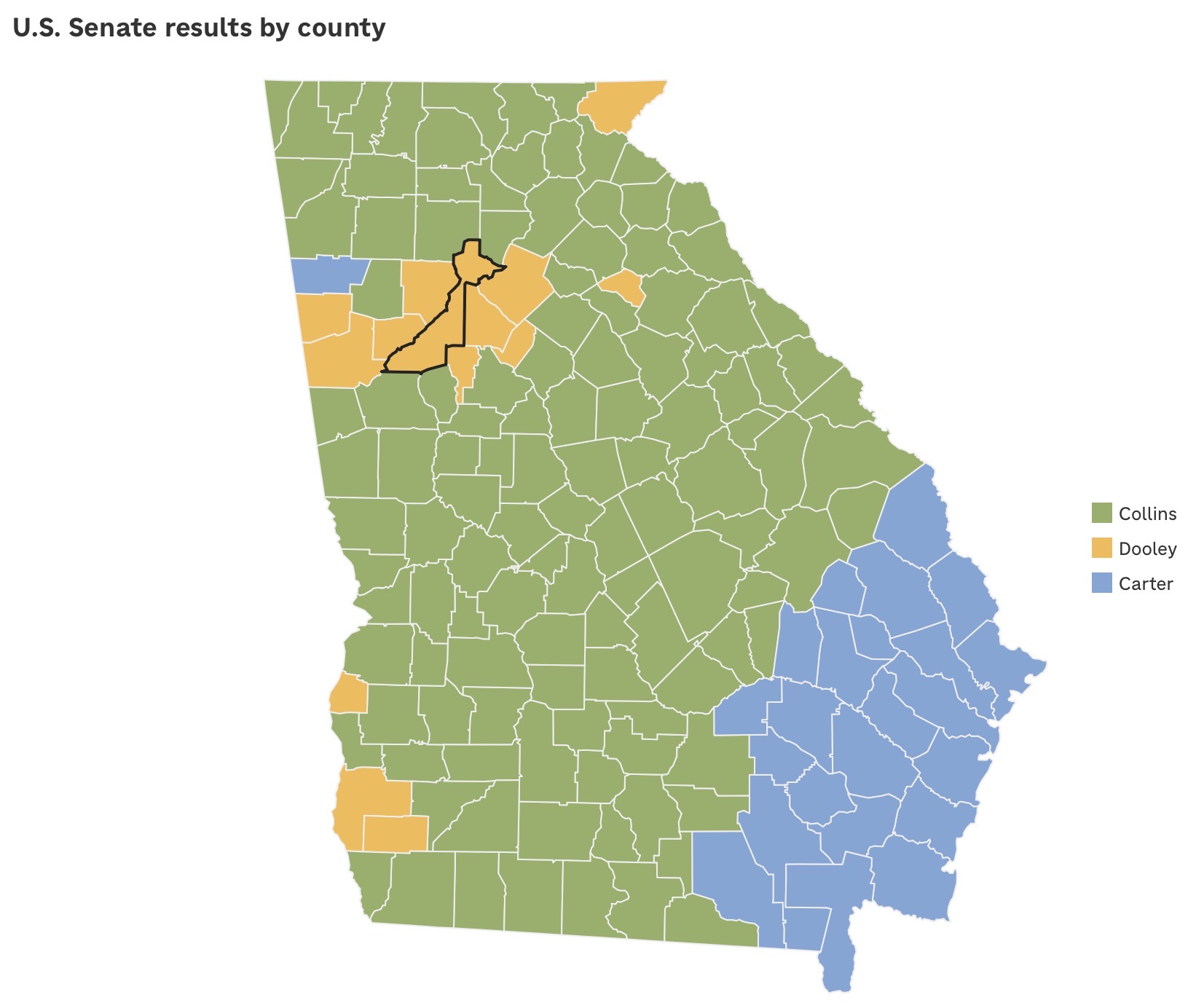
The Atlanta metro didn’t get its guy, and that’s bad news for Collins given the overblown influence Atlanta now enjoys in statewide politics.
VI. Polls
RCP Average: Ossoff +8%
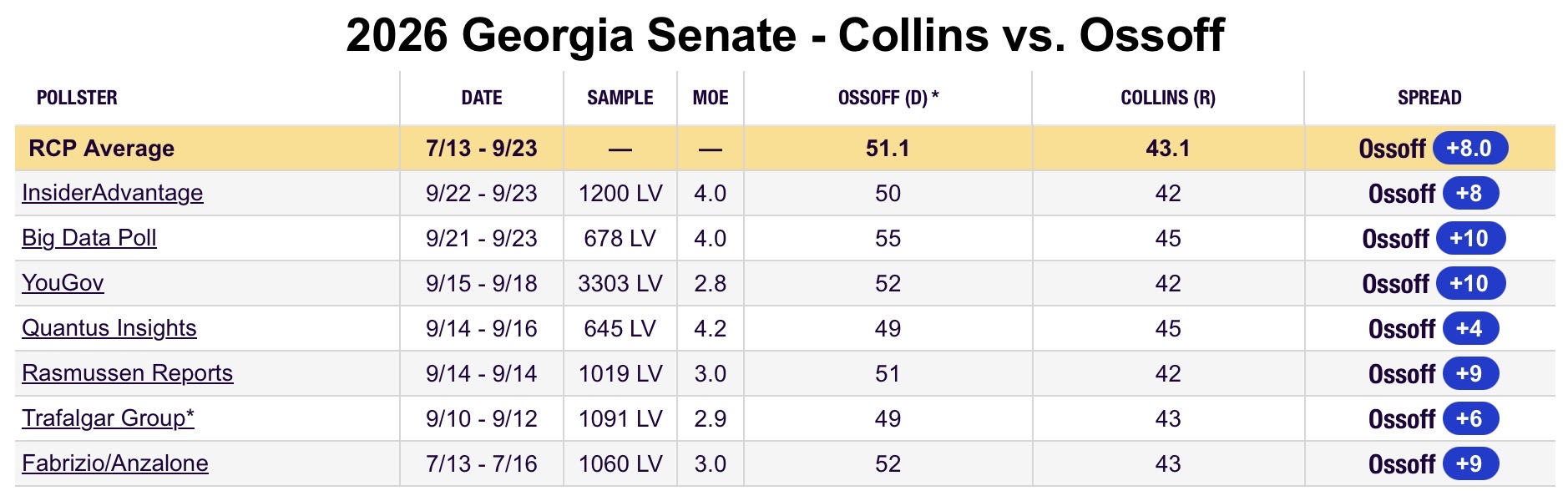
Polling this cycle is all over the place, but with the exception of Quantus, no recent polling has shown a competitive race.
VII. Media Ratings
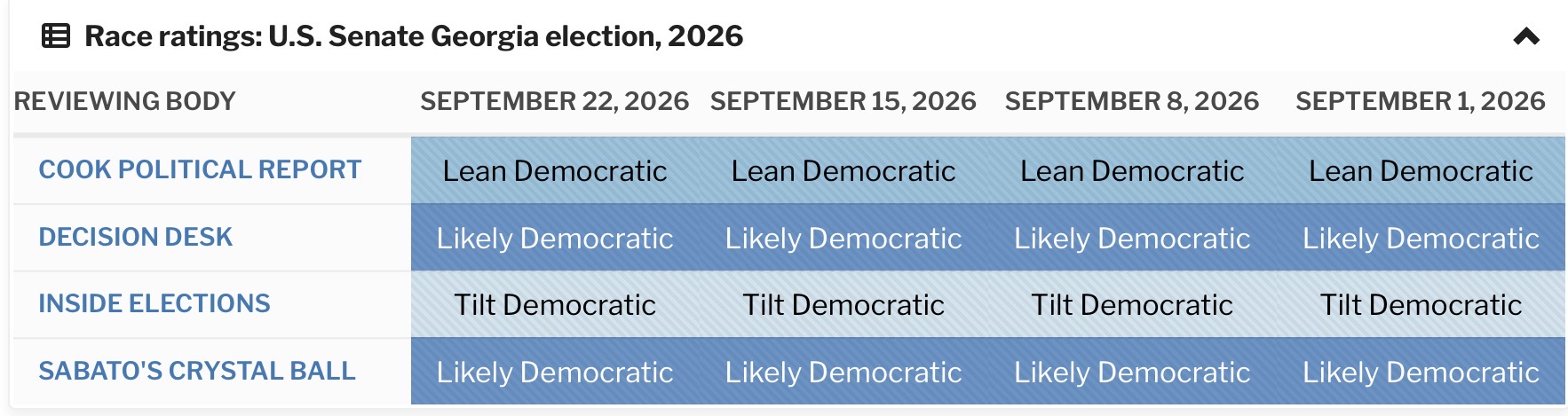
The four major aggregators all have Ossoff favored, and I must say I’m surprised Inside Elections has this as a “tilt” race. “Tilt” usually means a margin inside two points. Georgia is also too competitive with too much overwhelming red geography to allow for a blowout Democrat win – at least for now. Ask me again in 2036 if current trends continue:
Why Georgia May Be Doomed* (Capt. Seth Keshel, June 17)
VIII. Party Registration
Georgia doesn’t register voters by party; however:
When I made my final forecast (accurate) for Trump’s 2024 victory in Georgia, I noted that my research had revealed a parallel for voter registration in nearby Duval County, Florida (Jacksonville metro), that had tracked with the presidential movement of Georgia for two decades. When Duval moved left, so did Georgia. When it moved right, so did Georgia. This trend lived on in 2024, as Trump flipped both Duval County and Georgia in actual results.
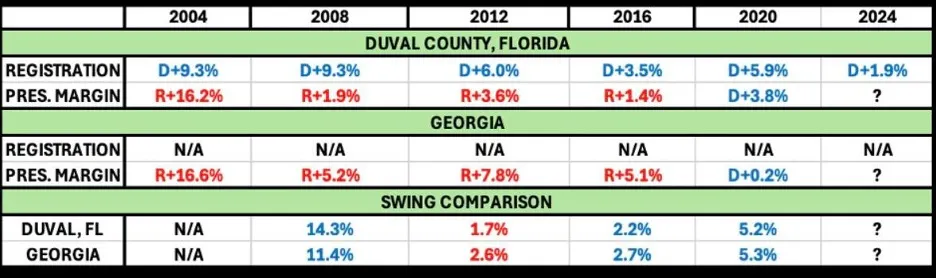
Duval County is nearly one point to the right in registration from the November 2024 election as it stands today:

This is a likely sign that Georgia is still winnable at the presidential level, but I wouldn’t expect it to be a sign that this Senate race is going to Collins given standard midterm and incumbency dynamics.
IX. Election Considerations
Secretary of State Brad Raffensperger, one of the most notorious 2020 election personalities still in office, claims the state runs amazing elections. Those of us who have studied election integrity for years would disagree:
- Automatic Voter Registration
- Urban Domination
- Expanded mail-in balloting (634% increase from 2016 to 2020)
You can read about the rest of the election-related deficiencies in Georgia in my 2024 recap:
Georgia – 2024 Election Compendium (Capt. Seth Keshel, December 9, 2024)
There are definitely states that are worse off, but Georgia is firmly within the “elevated concern” category when ranked nationally, and the election integrity picture there doesn’t favor Collins.
X. Summary and Election Estimate
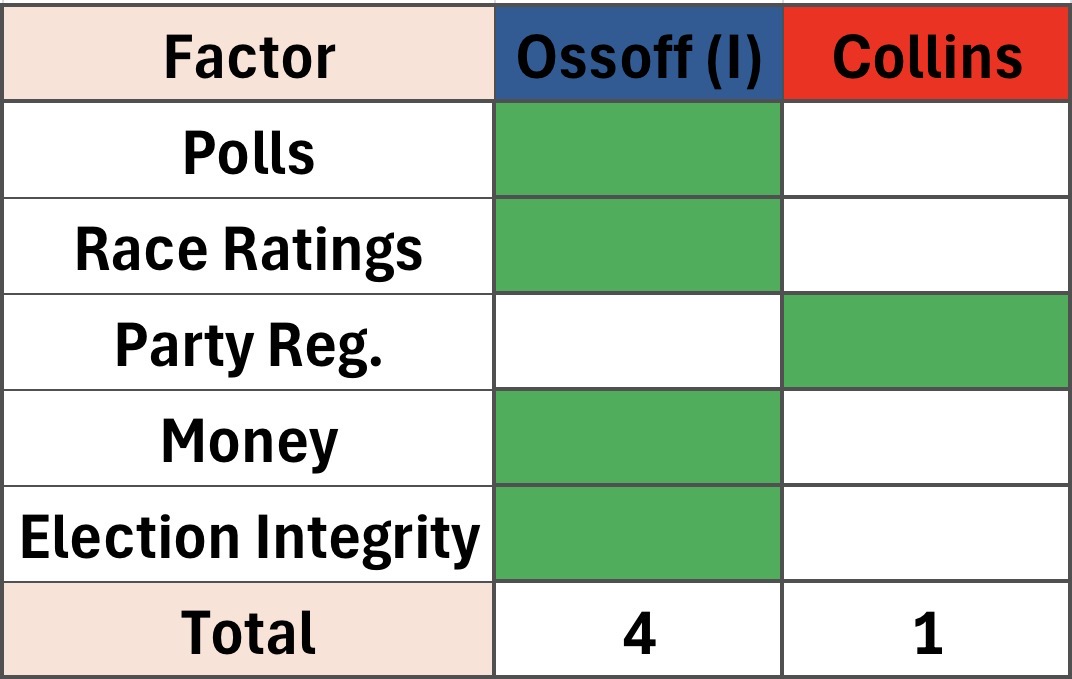
These are the major factors for the U.S. Senate race in Georgia:
- Ossoff is running a Democrat incumbent in a Democrat-favorable midterm year in a state that is increasingly competitive, with Senate races tracking with presidential disposition.
- Collins ran the rural route through a state now dominated by urban politics; the GOP suburban and grassroots split is a its worst right now, and while Jackson will appeal to the soft moderate vote in Gwinnett and Cobb Counties, Collins won’t.
- Ossoff is being floated as a 2028 presidential contender, is not seen as a threatening candidate (policies excluded), and is keeping enough distance from dumpster fire Democrat gubernatorial candidate Keisha Lance Bottoms to maintain his “moderate” image.
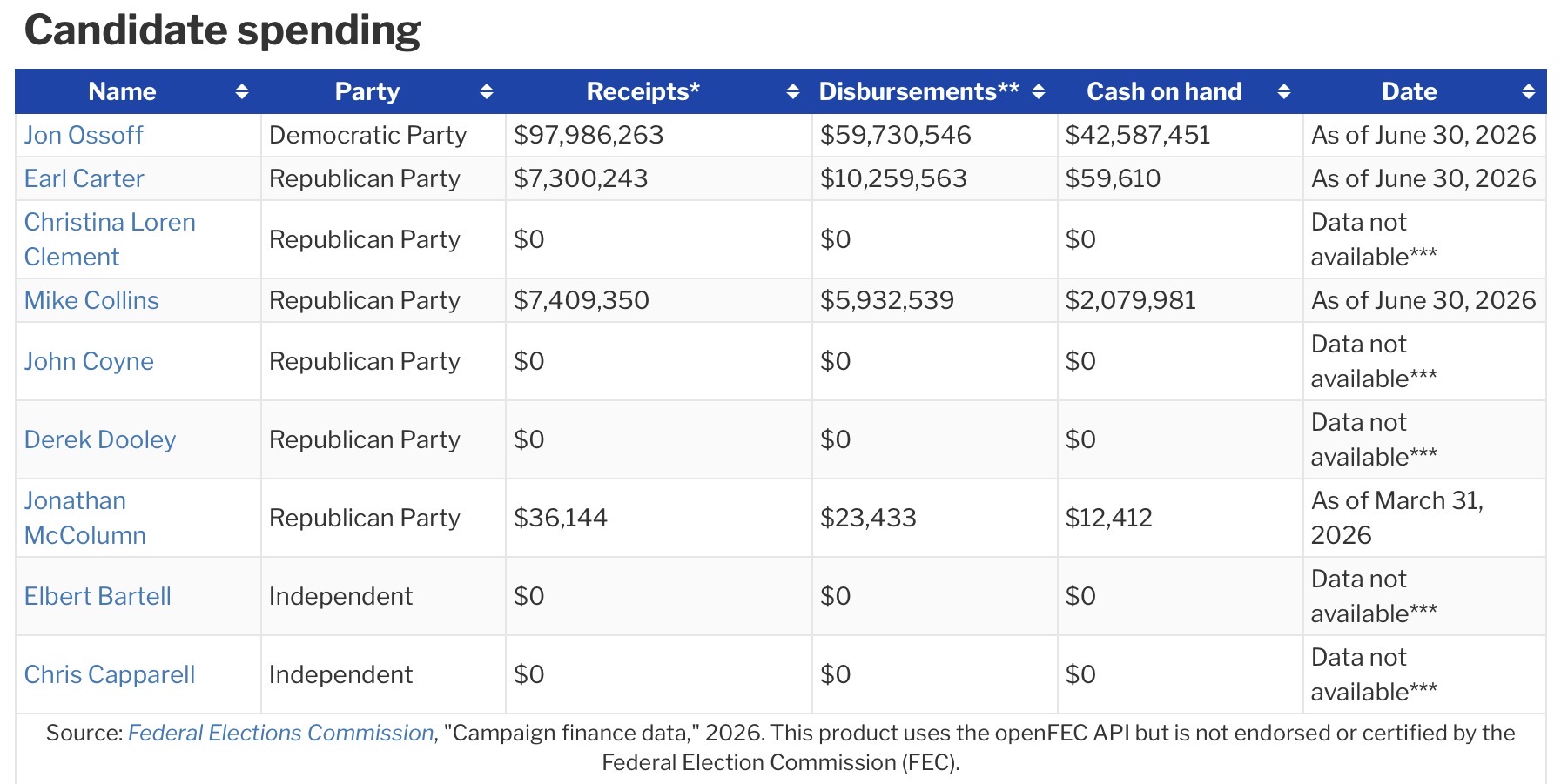
- Finally, Ossoff has roughly 20 times as much cash on hand as Collins does.
Here is how the key factors in this race stack up:
Forecast for Georgia U.S. Senate
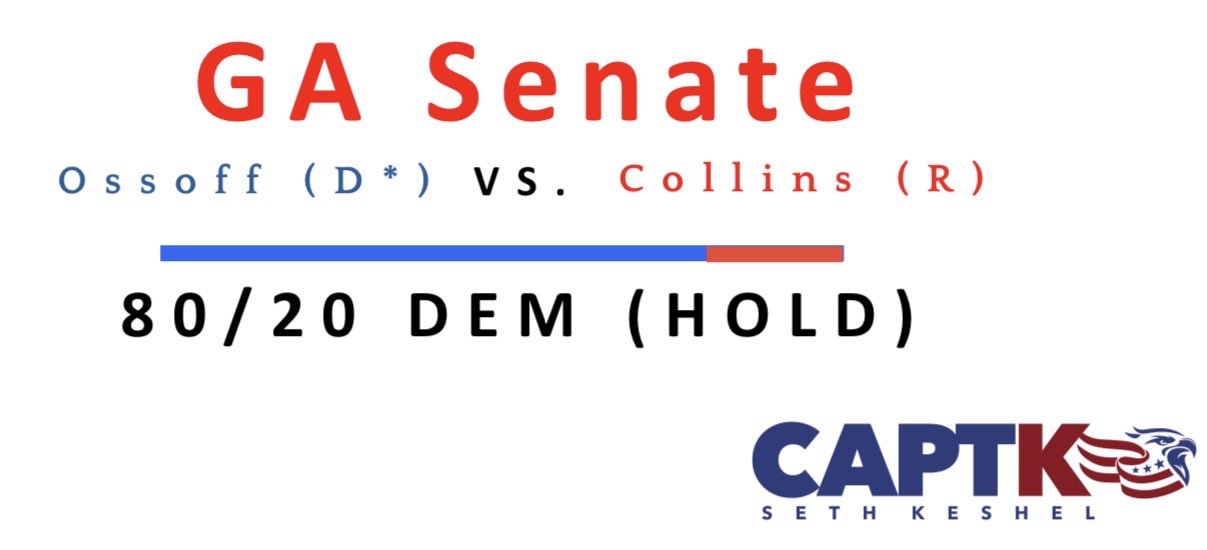
Ossoff is limited in terms of margin by the states deeply polarized electorate and is most likely to capture the swingy suburban vote that was once reliably Republican. I must caveat, however, that black turnout in other states in which data can be found appears to be down a lot from previous cycles. It is still early and this can change, but Democrats rely on maximum black participation and support levels throughout the state (especially core Atlanta). Collins’s only real shot here is if that turnout tanks. If it does, I will reassess this race closer to the election.
Ossoff, as of late September, is on his way to a fairly easy reelection win.
Seth Keshel, MBA is a Senior Fellow at the Gold Institute for International Strategy and a retired Army Captain. He publishes Captain K’s Corner on Substack.