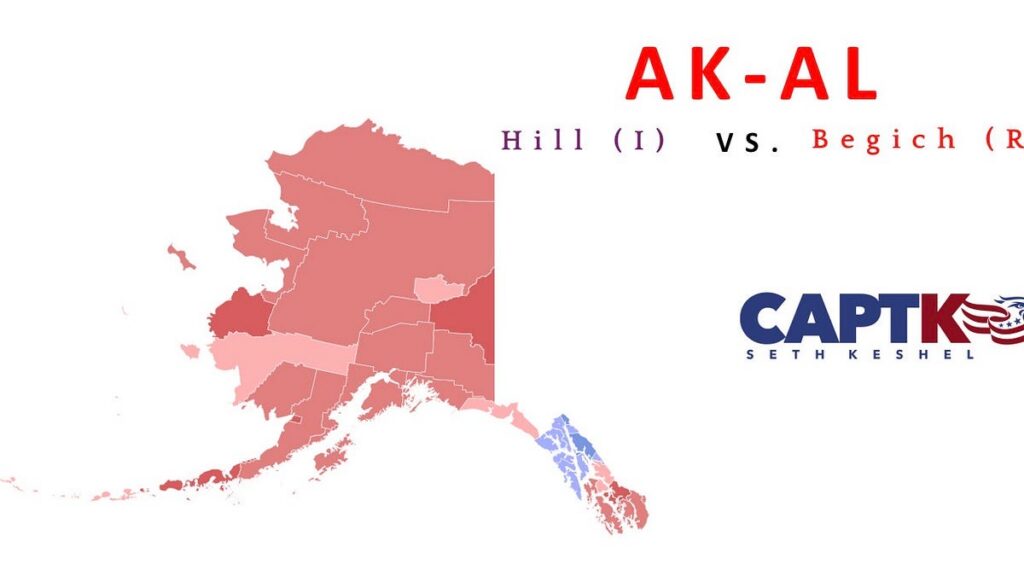
Nick Begich (R-inc.) vs. Bill Hill (I) vs. Eric Hafner (D) vs. Jim McDermott (L)
Author’s Note: Today’s release unveils the first of many U.S. House and Senate forecasts to come now that we have reached election season. For free subscribers, the open portion of this release will help you grasp the depth of my assessments and how distinguished they are from slop polling that is in great abundance these days. All detailed election forecasts will be reserved for paid subscribers.
Until recently, Alaska-At Large was designated a decisive seat. With significantly more information available to me now, I have downgraded it to leaner status and have replaced it in the decisive category with NC-1. Our electoral environment is a moving target, and as such, my estimates can and will change.
I. The Race
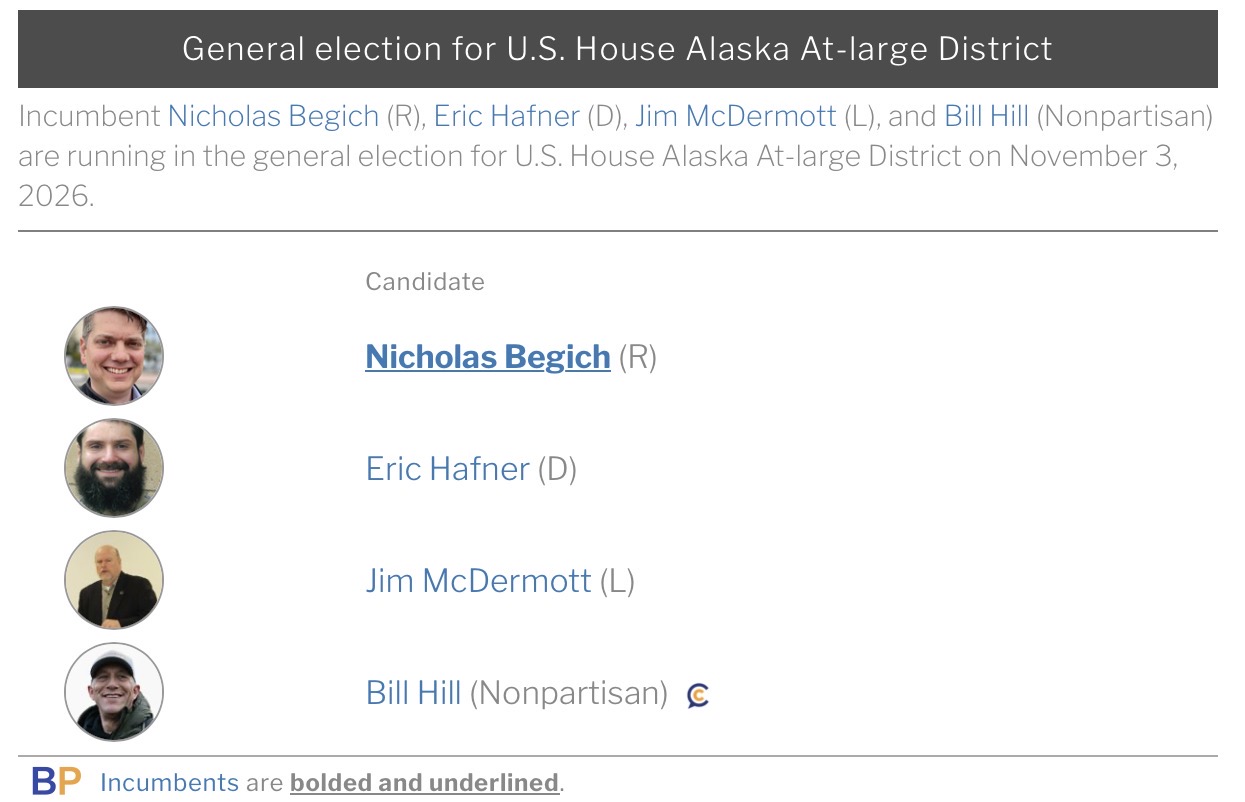
Nick Begich (Republican) is in pursuit of a second term in the U.S. House running into standard midterm headwinds.
Bill Hill (Independent) is thought to be his primary challenger, as made clear by primary results, which will be analyzed further down in the article. Hill is a lifelong fisherman and a construction union man. He is running the “working class” motif for his campaign, which pales in comparison financially to Begich’s campaign.
Eric Hafner (Democrat) is the token Democrat in the race and a fresh face for the party after Mary Peltola’s recent runs for this seat.
Jim McDermott (Libertarian) rounds out the ticket.
Alaska’s ridiculous election system pits four candidates against each other in a jungle format held under Ranked Choice Voting. The winner is the first to reach 50%, which can be done in the First Choice Round outright, or after multiple rounds of ballot redistribution. To understand how Ranked Choice Voting, also called Instant Runoff Voting, works – check out the article I wrote before the 2022 Senate showdown in Alaska.
II. District Geography
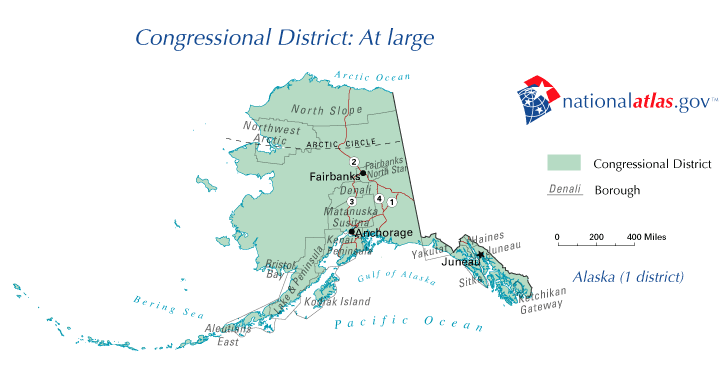
The entire state of Alaska, allotted just one U.S. House Representative, makes up the Alaska-At Large U.S. House district (AK-AL).
Key Statistics
- 57.5% White, 14.8% Native Alaskan
- 65.7% Urban, 34.3% Rural
III. Market Assessment
The market above doesn’t price in the “Independent” candidate (Hill), but Begich hasn’t priced as far down as the 60s since May. Bettors clearly expect the Republican Party to hold the seat, and there are many reasons why which will be explored in depth in the balance of this forecast.
IV. History
Alaska hasn’t voted for the Democrat presidential nominee since Lyndon Johnson’s 1964 national landslide. Given their allotment of just one U.S. House seat, it shouldn’t surprise you that the state has stuck with its presidential stripes almost as long as it has been in the union.
At the age of 39, Don Young was elected in a 1973 special election, putting the seat in GOP hands. Young held the seat until he died in 2022 at the age of 88. This prompted a special election that summer that yielded these First Choice Round results, yet a rather dubious final result.

You read that right. Nearly 3 in 5 votes of the First Choice Round went to Republicans, yet Mary Pelota, the Democrat, won with the ridiculous Ranked Choice Voting system Alaskans have inflicted upon themselves.
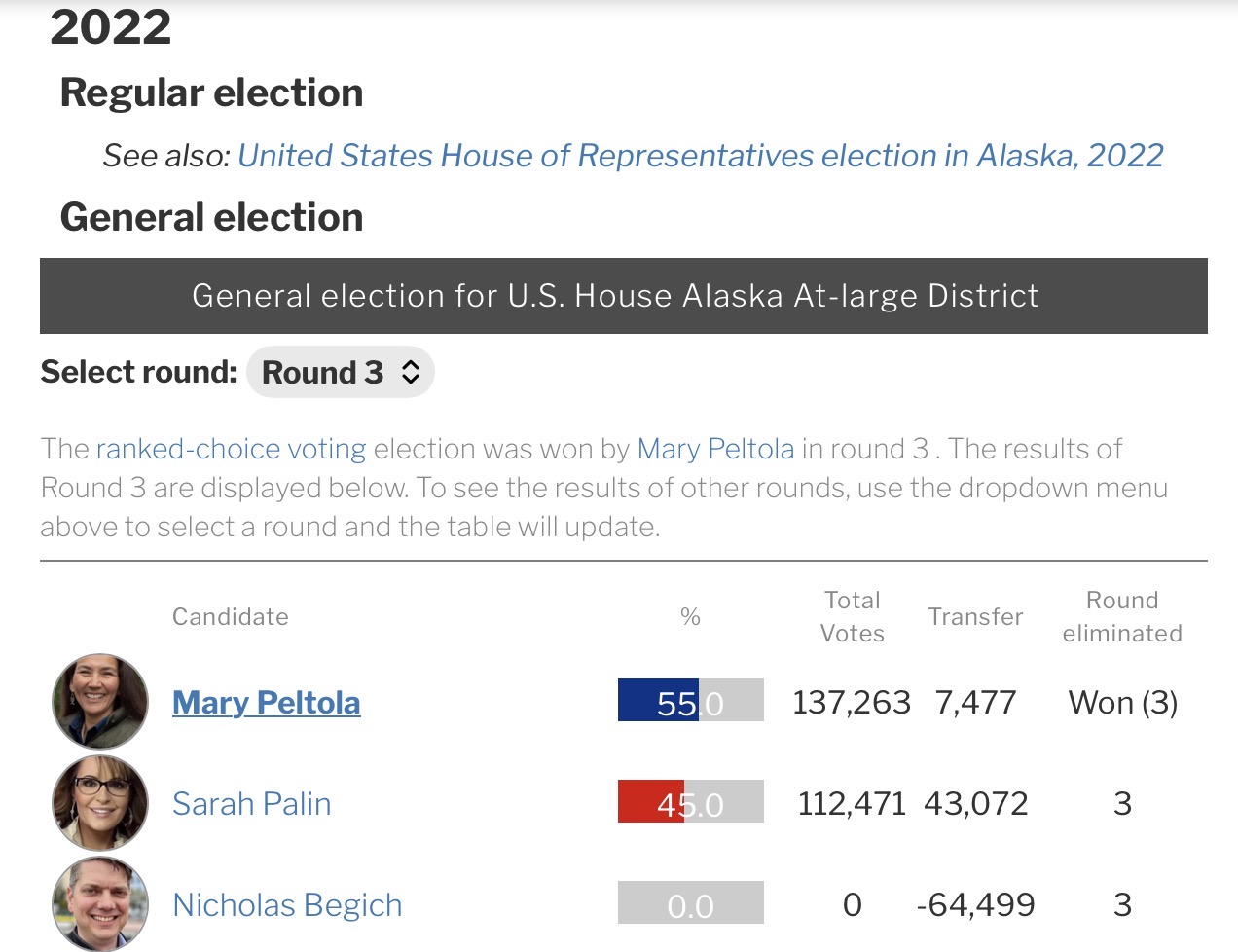
Peltola went on to win again in the General Election that fall, once again aided by Sarah Palin and Begich splitting the GOP vote:
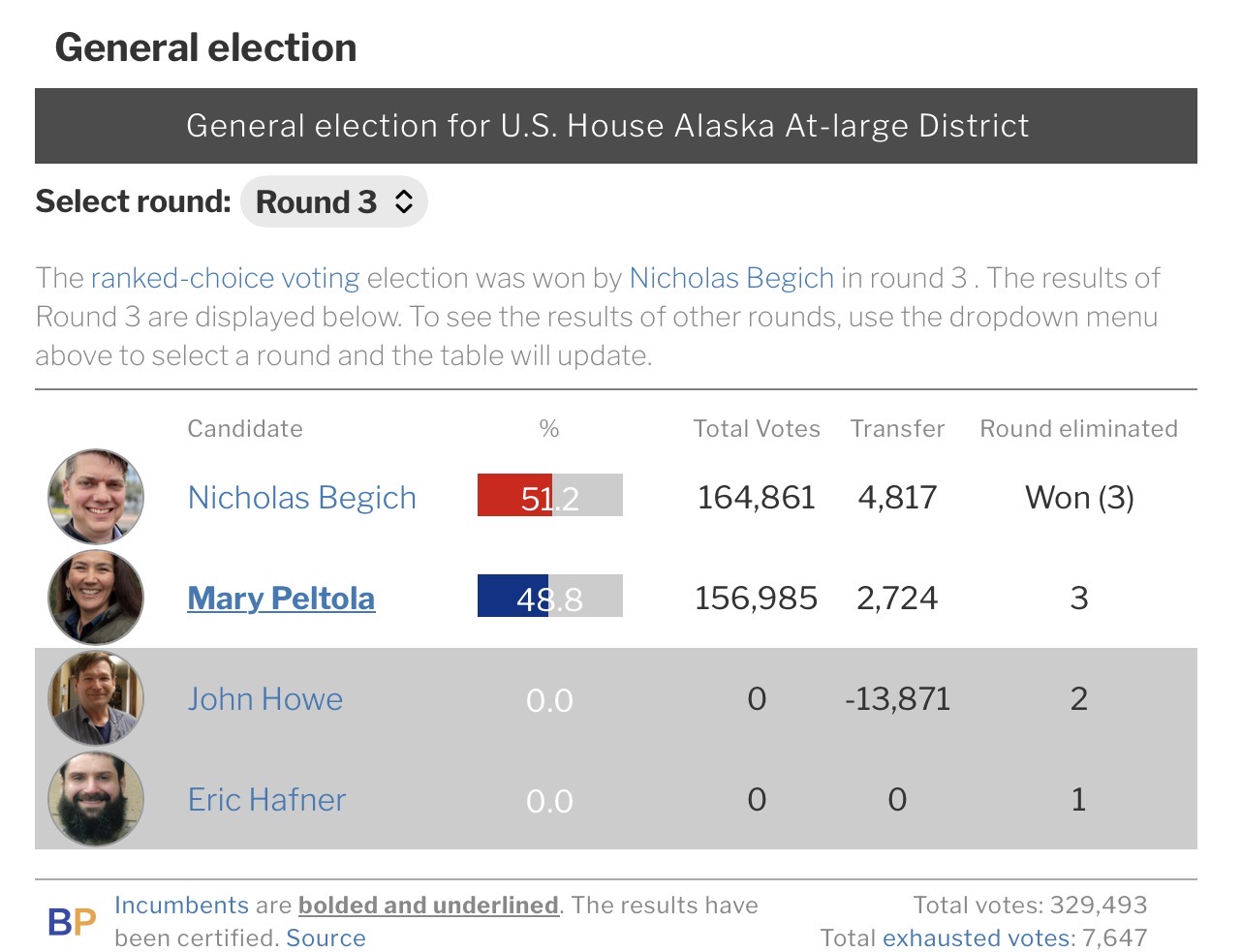
In 2024, the GOP got it figured out and ran only one major candidate, knocking Peltola out in a state Trump won by more than 13 points:
V. Analysis of 2026 Primary Results
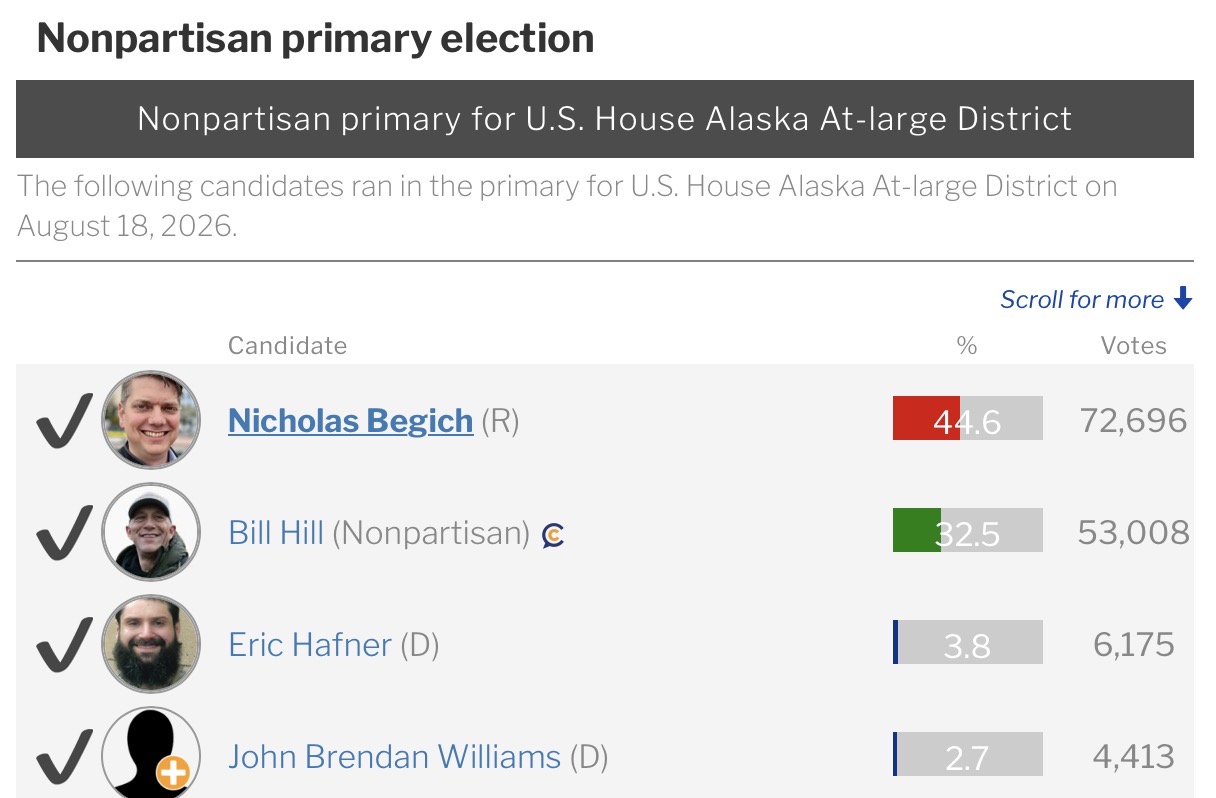
Begich, with no legitimate Democrat-branded opponent, cruised to the top spot with 44.6% of the jungle primary vote. Williams, the fourth-place finisher, has removed himself from the General Election ballot in favor of Libertarian-backed McDermott. There is no GOP primary damage inflicted on Begich requiring coalition consolidation.
VI. Polls
Average: Begich +16
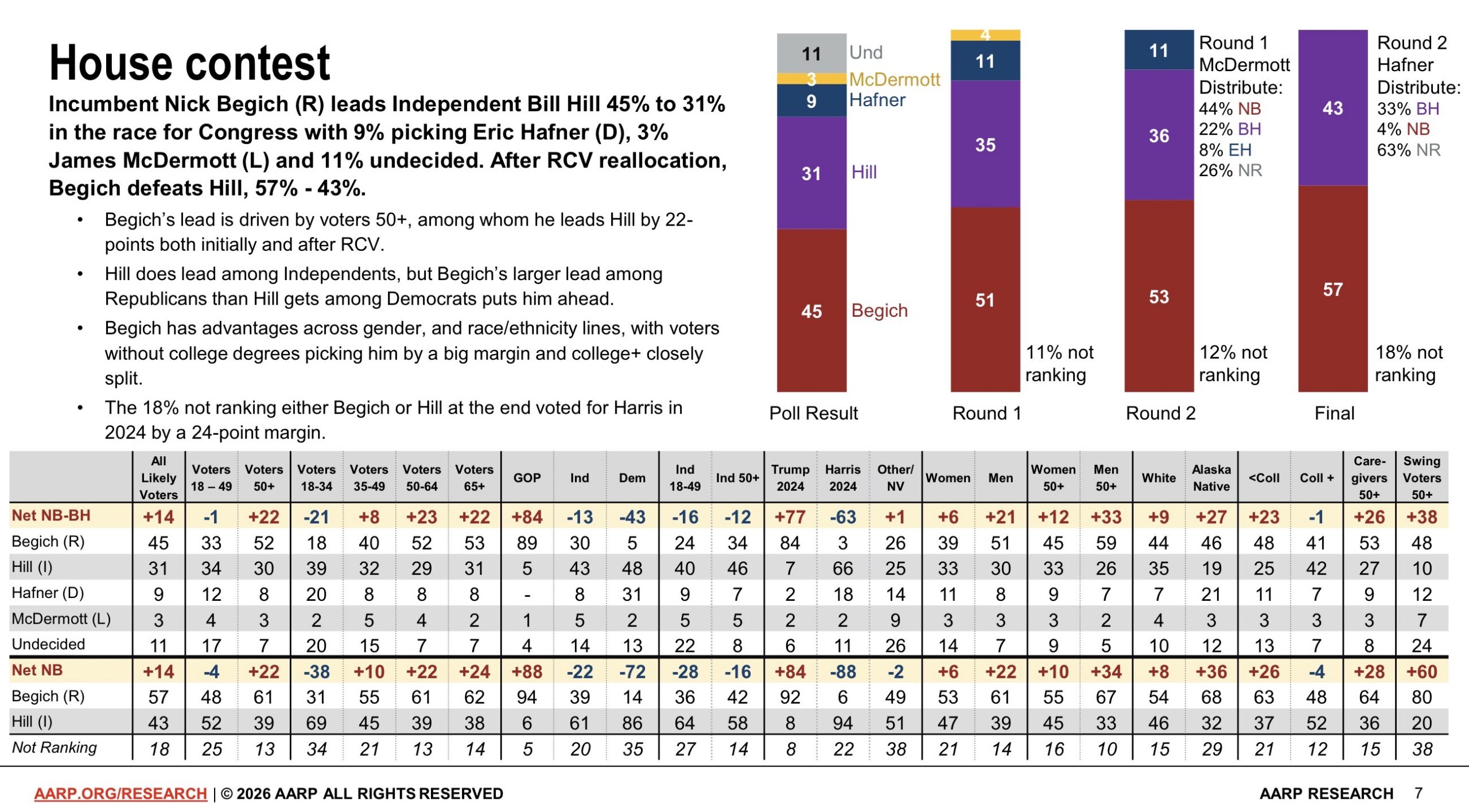
Only one major poll has run on this race, by Fabrizio Ward/Impact Research. It shows Begich winning the First Choice Round with an outright majority and +16 margin.
VII. Media Ratings
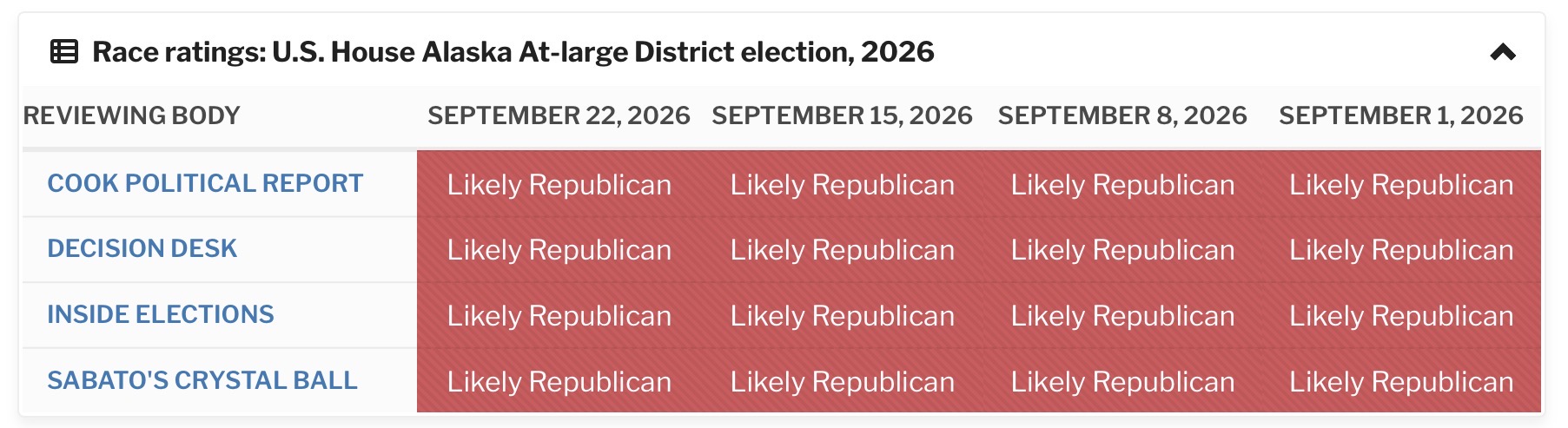
No major ratings outlet is expecting an upset in this race.
VIII. Party Registration
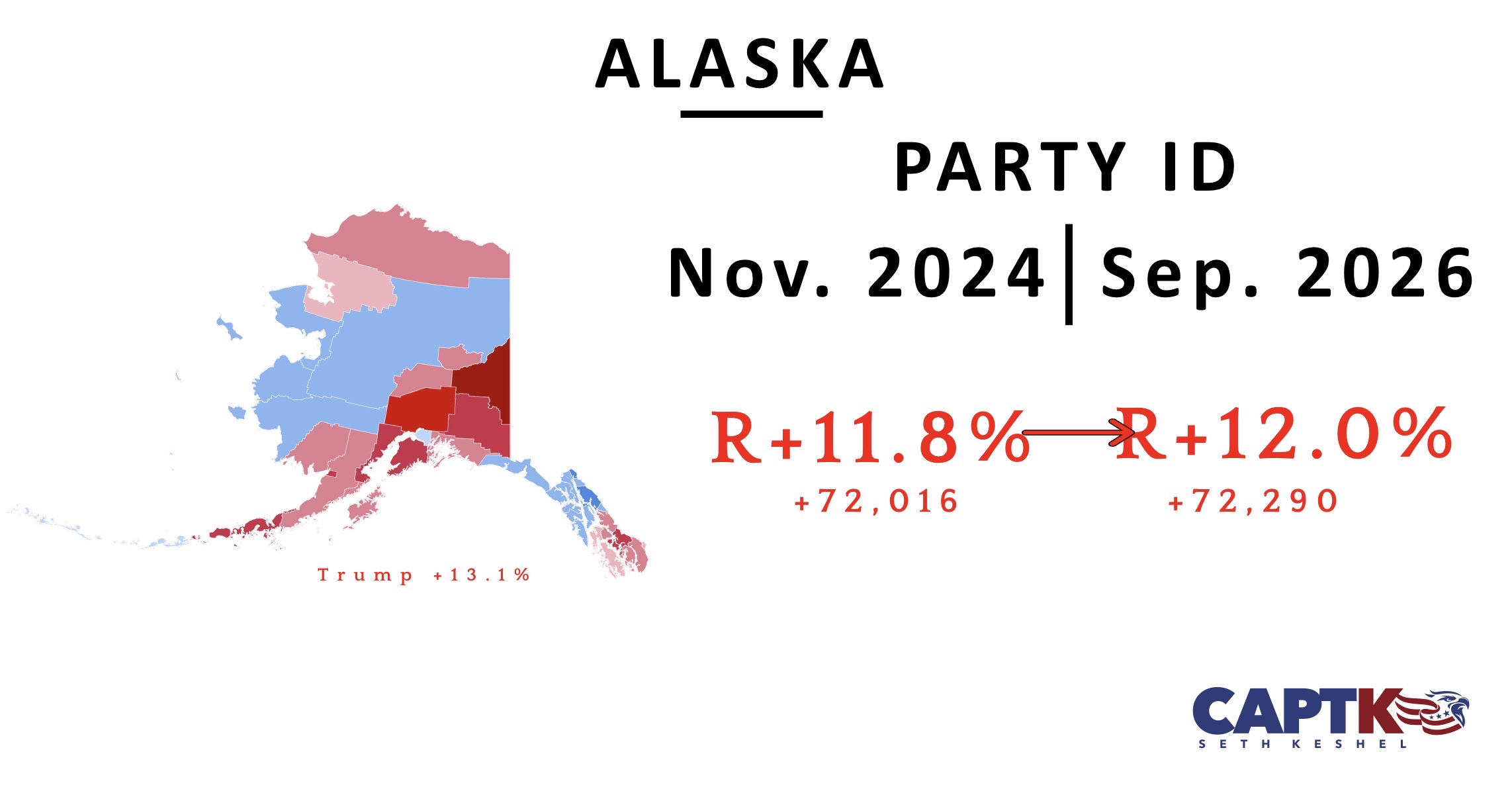
Democrats have made no progress in voter registration in Alaska, even inching backward since Trump’s +13.1% win there in 2024. There is no warning of a Democrat realignment of the state.
IX. Election Considerations
Alaska runs some of the worst elections in the country. I detailed this in a recent article decrying the Senate picture, which I will paint in full within these virtual pages soon:
Why Alaska Can’t Have Nice Things (Capt. Seth Keshel, August 21)
Alaska has roughly 1/23rd the population of Florida, yet requires two weeks to count them all, aided largely by expanded mail-in voting and the ridiculous Ranked Choice Voting reallocation process if a candidate doesn’t secure a majority in the First Choice Round. I expect these concerns to be a major factor in the Senate race, but not so much in this House race. You can read about the pitfalls of Alaska’s election system in detail here:
Far West – 2024 Election Compendium (Capt. Seth Keshel, January 10, 2025)
X. Summary and Election Estimate
Three factors greatly favor Begich:
- Member of a well-known Alaskan political family
- Democrats ran their only viable federal candidate for the U.S. Senate seat
- He isn’t even facing a serious Democrat, which will defuse polarization animosity
Otherwise, he would be in for a serious campaign. Young, who ran almost dead even with Trump in 2016, lost 7.7% of his margin in the 2018 midterm swing:
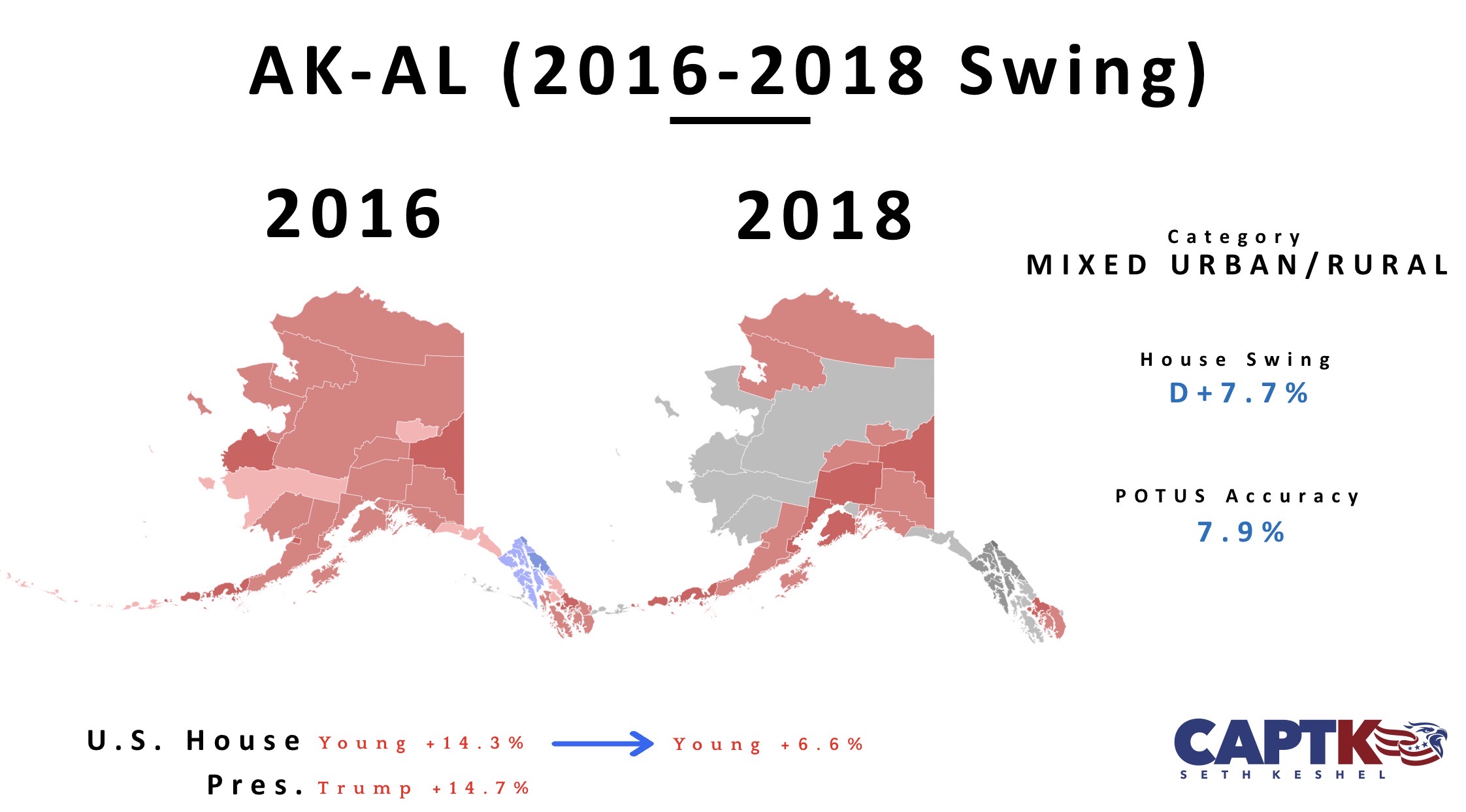
That swing in 2026 would doom Begich, who won by 2.4% in 2024, by over 5 points.
Here is how the key factors in this race stack up:
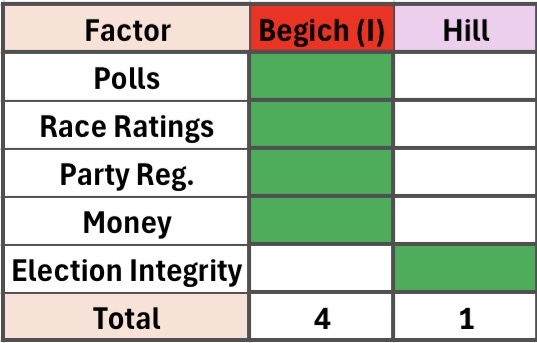
Forecast for AK-AL
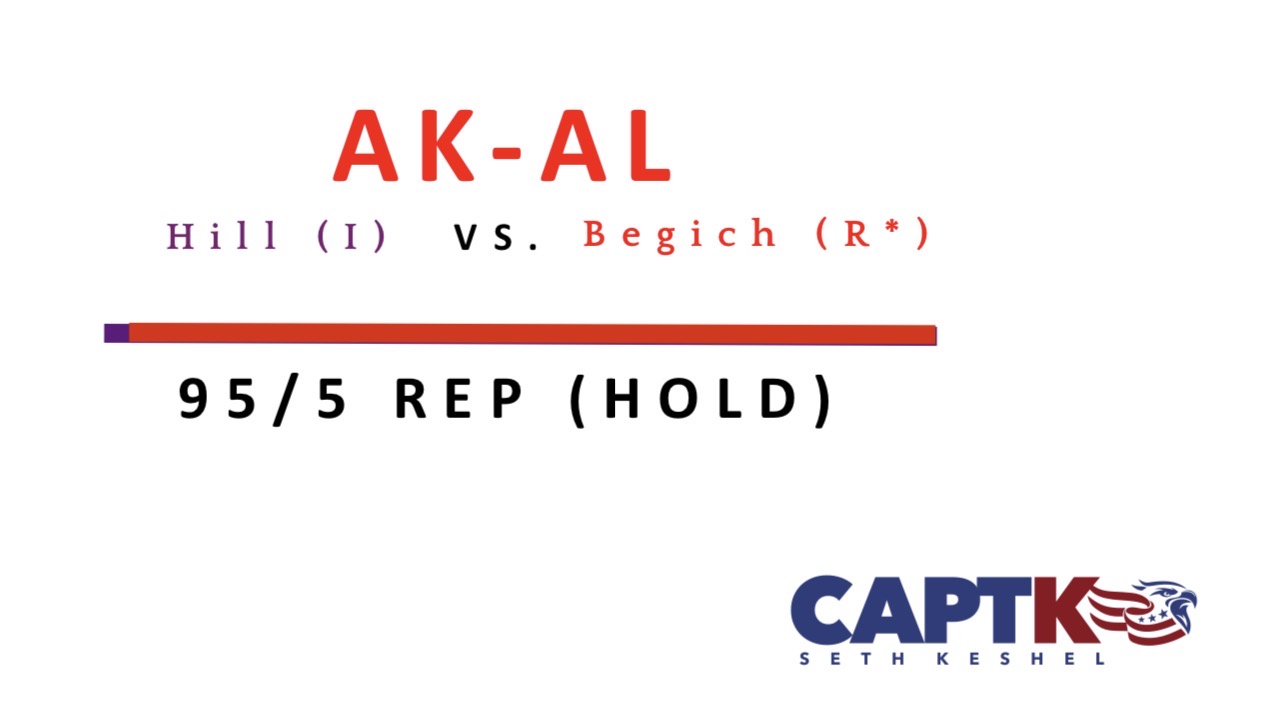
Rep. Begich is highly likely to hold his seat, which is a must-win for the GOP and only downgraded to leaner because of the factors listed above.
Seth Keshel, MBA is a Senior Fellow at the Gold Institute for International Strategy and a retired Army Captain. He publishes Captain K’s Corner on Substack.