“Silent Majority” is a Stupid Term

Arizona Senate polls from September 2024

Why “We the People” must become the new “establishment”

Years ago, Larry Schweikart used to tell people that he doesn’t “hold hands” over bad polling. His comments on X, then Twitter, were always filled with “what about that poll from (state)?” He got sick of it, warned people he would block them if all the concerns persisted, and now people finally understand that Larry doesn’t “do” polls. Thankfully, due to the utter trash that makes up modern polling, most people realize it, too.

Arizona Senate polls from September 2024

Above, you can see some examples of what passes for polling these days. Those are snapshots of the Arizona Senate race from this exact week in 2024, showing some wild misses, including Marist’s. Marist yesterday did their “look at me” routine over Texas. Despite being critical of polling, I have a sober view of what elections may bring us this fall:

For some reason, people think because I’m critical of polling it must mean I think it will be a GOP wave this year. This couldn’t be more distant from the truth. I’ve been realistic about midterms for the past 18 months. The House is only competitive as far as a majority…

Seth Keshel (@RealSKeshel), September 22, 2026

I am here to help candidates and campaigns win. I am in touch with one major U.S. Senate candidate on a nearly daily basis now over his race. I have produced serious analysis on the U.S. House races that will decide that chamber’s majority, and they have made their way all the way to the candidates and the top of the Republican Party. Still, I center my assessments on historical precedence and political reality, and don’t get caught up in all the noise and “red wave” cheerleading that defies reality.

The goal of a midterm with your party’s president in office is survival. Should Democrats win the House (or even the Senate) in November, many people will go off the ledge, thinking the MAGA movement is dead or giving up hope for the good fight of liberty. In reality, a Democrat majority will arguably do more to advance the MAGA agenda and strengthen the likely Vance/Rubio (or Rubio/Vance) ticket in 2028 than defying the odds and holding the House will. Imagine what they’ll do:

  • Convene investigative panels and committees to go after Trump on personal issues, made-up financial affairs, and now, Iranian military action
  • Impeach Trump multiple times, despite being unable to secure a conviction in the Senate
  • Hold up all of Trump’s popular legislative ideas, which he will almost certainly lob at them just so they screw themselves

Stop worrying about impeachment and removal. If it didn’t happen after J6, it won’t happen. The effort to impeach Bill Clinton backfired on the Republican Party, and my guess is that Trump’s economy will boom in the last two years of his tenure, as it has already shown some signs of doing with expected Q3 growth. Aircraft carriers take a long time to turn around, and that is not something a society mired in instant gratification wants to hear.

Still, the question remains – can we fix this politically? Can America be set on a pathway to success, see evil-doers punished, be rid of political and institutional corruption using the political process? I tire of seeing anonymous wannabe revolutionaries online and have begun to clap back:

The problem with sentiments like this is that no one seems to want to provide an alternative plan. We are all stupid for participating in the political system. Yet they always fall just short of organizing or leading or calling for an overthrow of government. There are two…

Seth Keshel (@RealSKeshel), September 22, 2026, replying to @magisterium17: “Politicians won’t help us resolve, fix, or improve anything. Cheerleading and focusing on the candidates in a corrupt election system is only perpetuating the lie. We have the illusion of choice.”

You only have two choices regarding America’s current issues: Fix the political process or commence the process of abolishing government that Thomas Jefferson detailed. For the written record, I do not endorse “the big ugly” that the latter point entails, and think people of good faith must first put shoulder to plow to fix the political process. Are we doing that? Let us examine together:

THREE SIGNS WE DON’T “GET IT”

I. Checked Out and Asleep at the Wheel

You and I “get it.” You read this newsletter because you have interest in American politics and presumably prefer the first option listed above, which is to engage in fixing American politics. 34,000 email addresses get this newsletter, and I am ranked in the Top 100 in the U.S. politics genre for paid subscriptions, which constitute less than 10% of my email list. There are precincts in Pima County, Arizona, that register more votes tallied in a presidential election than there are paid subscribers to my newsletter.

I have 85,000 followers on X. There are nearly that many Democrat presidential votes in Pinal County, Arizona, which Kamala Harris lost by 22.1%. The problem here is that we, the people who pay attention to this stuff, think everyone feels the same way or considers the same issues we fret over to be existential issues. It is a huge world out there, and my Dad always said, “10% of the people lead the way; 90% are just along for the ride.”

You may not realize it, but there are a lot of people who have no idea an election is even upon us. We are aware of this unfortunate fact (that people don’t realize an election is coming up) because we are busy as hell trying to win reelection in the Arizona House:

Living Through What We All Hate (Capt. Seth Keshel, September 21)

Let me explain why midterms usually hurt the president’s party in layman’s terms:

  • Trump wins a tense, drama-filled election for all the marbles
  • Trump’s voters are happy and come down from high alert
  • Harris’s voters are filled with irrational hatred and insanity, and eat, sleep, and breathe politics and consider voting their own act of religious devotion to the cause
  • Midterms come around and the Harris voters, joined by a few swing voters who vote on gas prices or other issues that have arisen since the previous presidential election, vote in high numbers
  • Trump’s voters, asleep at the wheel and generally happy, turn out in smaller numbers – enough to upend the more narrowly held seats

Despite what you may read on X, which I use out of necessity and not personal enjoyment, Trump’s voters are happy. You can see it in the data outlining his approval within the Republican Party. The average Joe out there who showed up to vote because he was convinced our southern border imperiled America doesn’t sit around all day thinking about Iran, Israel, tariffs, or circuit judge nominations. We, the people who follow politics impulsively, are the ones who do that. We are going to vote. Average Joe “shut the border” Smith is busy running a business and watching his kids play sports, and it kills our momentum when the results come out.

II. The Real Elections are the Primaries in Most Races

Watching all of the Susan Collins drama unfold has helped shape my opinion on squishes more than anything. Yes, Collins is a squish. She is a 50/50 proposition at best when it comes to highly charged votes; however, she votes with President Trump on just about everything else, whereas a Democrat of any stripe from Maine would vote against practically everything. I’ve written about why mounting a primary campaign against her would be a mistake:

Primarying Susan Collins is a Mistake (Capt. Seth Keshel)

The greater issue within the Republican Party, therefore, is that we continue to nominate squishes for seats that are overwhelmingly red and would elect a brown paper bag if it had an (R) next to its name. We have a number of legislative districts in Arizona that are of this crimson stripe that are represented in the House and Senate by people who have no desire to bring about election integrity or to sling one word downrange in the ongoing culture wars.

Just this past week, I’ve written about Maria Elvira Salazar’s public contradiction of the Trump administration’s immigration enforcement operations. Salazar is sitting in a seat Trump won by almost 20 points, outside the margin of 2018 flips and an almost certain reelection victory for her even in a bad 2026 year. Clearly she is reading the fraudulent polling to come out and “step on it” as badly as she has, which has prompted people to ask me why we didn’t primary her. Well, that’s a good question:
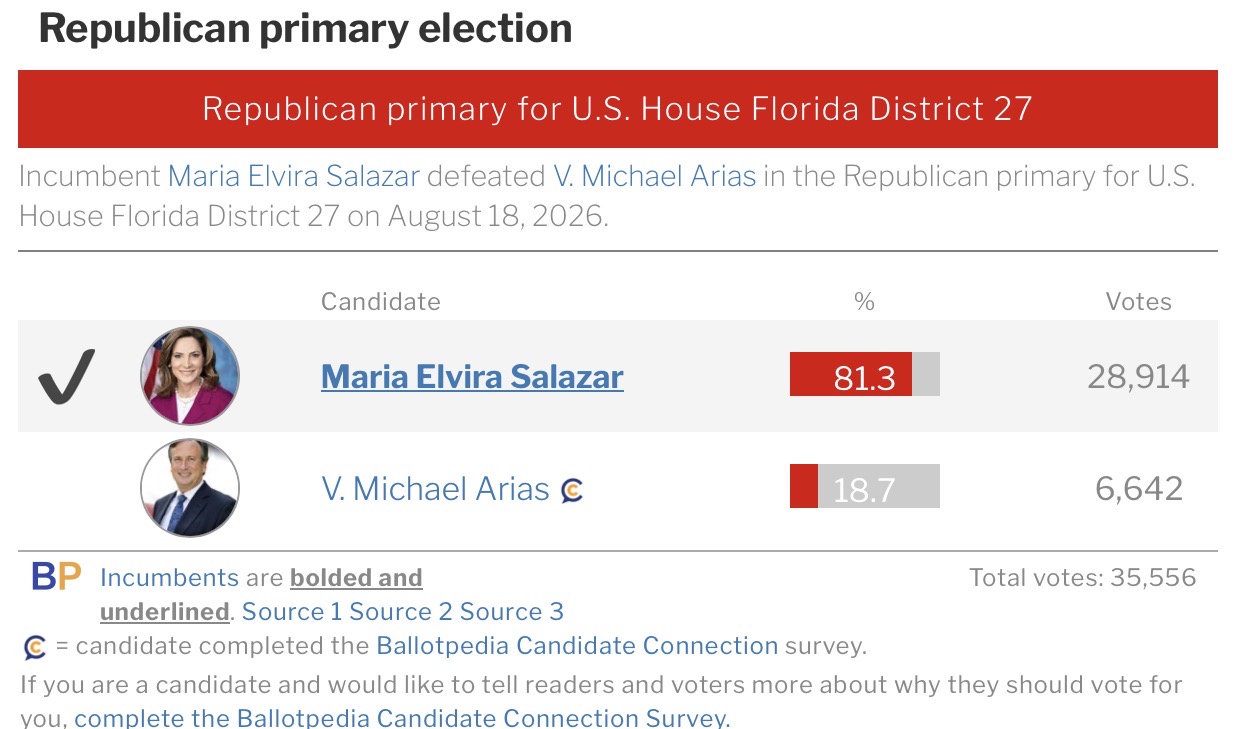
FL-27 2026 Republican primary results

Less than 1% of the population of FL-27 showed up to vote for her primary opponent in 2026. Roughly 4% of the population, or 1 in 25 people, showed up to renominate Salazar, who commands the massive dollars and the supposed security of incumbency. We’ve known for years she is a squish and an amnesty pusher, yet in this seat she won by over 20 points in 2024, no one with money, influence, and impact mounted a serious campaign to replace her in a seat a generic Republican should win even in a blue year (or would win back in the next normal year anyway, rendering the presumptive Democrat gain moot).

Do you want to know why the President often endorses crappy candidates like her? Because there is most often no viable alternative. When Republican voters start taking primary elections seriously, I will believe we are doing all we can to alter the current political crisis using the desired methods available to us.

III. Are We Truly Doing All We Can?

If I hear the term “silent majority” again, I’m going to puke. I’m so sick of hearing that term or being remotely associated with it. If you’re still silent, why? Why are you using an anonymous account? Why are you afraid of man? Most of you reading this are people of faith – we should only fear God.
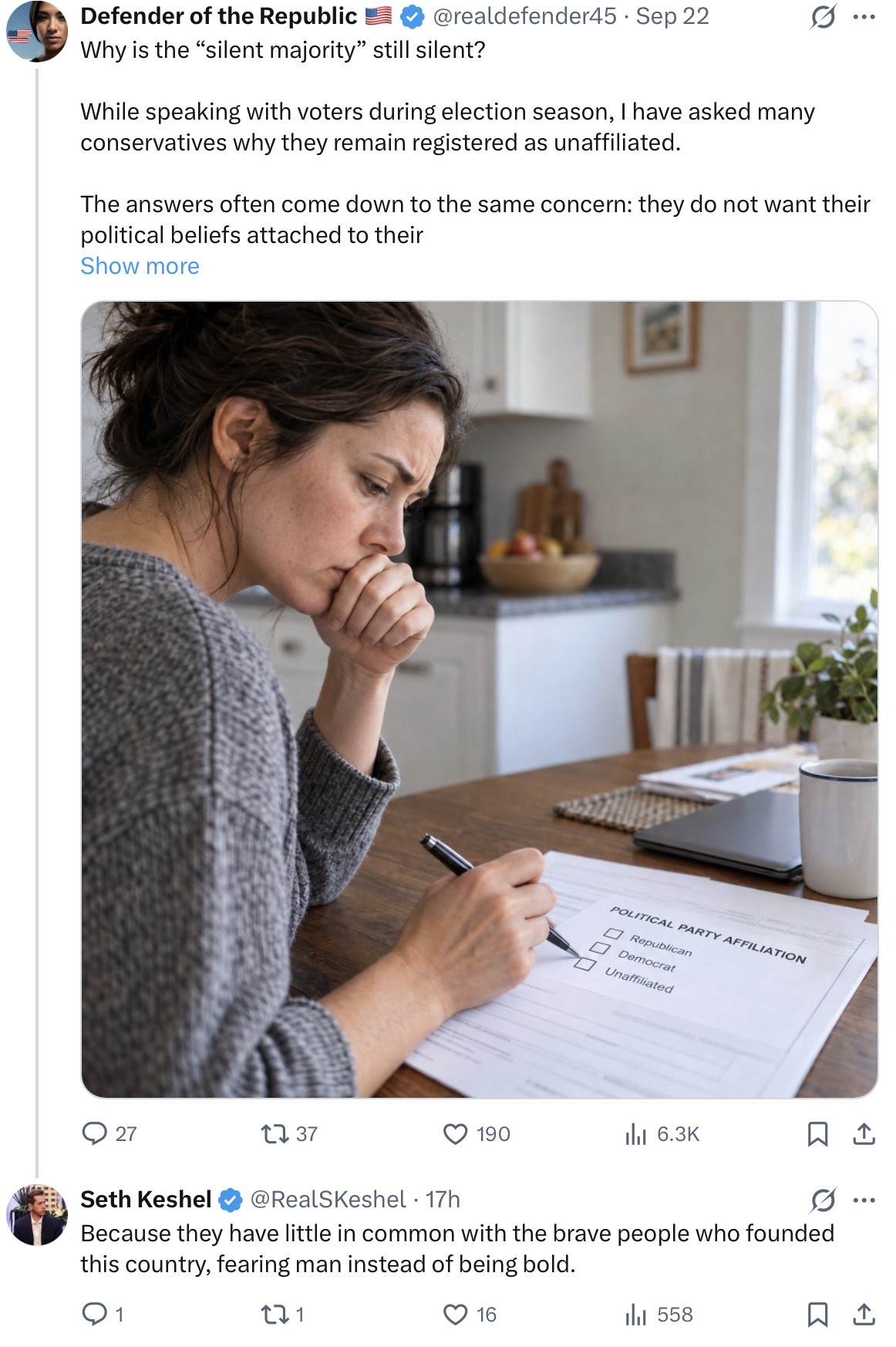
Image from Seth Keshel's article on the silent majority

It has never been more clear to me just how important Charlie Kirk was (and still is, in memory). We are talking about a guy with a brilliant mind and the gravitas to inspire young people to take an active role in Republican politics. I have spoken in front of many local groups over the years that have the same head count, same members, and same goals for every meeting. They are essentially social clubs for older Republicans rather than an outward-facing organization rebuffing the term “silent majority” altogether.

Elections are games of math. In a tossup race, both sides are going to have 45 percent. It’s what happens to the other 10 percent that decides how it all shakes out. If you need to get people who normally vote for the other side to vote for your side, how in the hell is that going to be done if the mantra is “I’m part of the silent majority, please don’t report me to H.R.?” Maricopa County remains ground zero for the 2020 election, yet less than half of all precinct committeeman spots are filled. Out of those that are filled, normally less than 10% of those committeemen actively engage voters in their precincts.

Are we truly leaving it all on the field?

SPIRIT WILLING, FLESH WEAK

Anyone can complain online all day. If this year’s midterms wind up being a true blue wave, including one that washes away the Senate, you can thank the online negativity chambers for depressing base turnout and discouraging those who truly care from engaging with the low propensity voters who come out for Trump, but whose votes we need in lower turnout elections and for ensuring good people are elected to local offices. If this article convicted you, then here are four things you can do to take action:

  1. Volunteer to be a precinct committeeman/precinct captain, and get to work knowing voters in your precinct
  2. Commit to recruiting good candidates for all races ahead of time, not when everyone is in a rush and at one another’s throats during primary season
  3. If you’re a member of a Republican/conservative club, commit to bringing one person with you to the next meeting, and even paying for a year’s membership – political clubs cannot simply be “social clubs” for bored people
  4. Stop worrying about annoying people; get your friends to commit to voting in the midterms, even if you think they will without being prompted

We don’t need to turn water into wine. We need to repeat basic fundamentals over and over again and grow an organization capable of winning elections and changing hearts and minds for the long run. After all, Benjamin Franklin warned us that we have a Republic only if we “can keep it.”

Seth Keshel, MBA is a Senior Fellow at the Gold Institute for International Strategy and a retired Army Captain. He publishes Captain K’s Corner on Substack.

“Sooner or Later, Delcy Should End Up in a Cell Next to Maduro’s”: MEP Hermann Tertsch on the Chavista Leader’s Visit to New York

Delcy Rodríguez

This segment aired on NTN24. La Mañana, 22 September 2026.

Featuring Hermann Tertsch, Distinguished Fellow (Honorary), Gold Institute for International Strategy

In brief

Hermann Tertsch spoke on NTN24’s La Mañana about Delcy Rodríguez’s appearance at the UN General Assembly in New York.

From NTN24’s report, translated: Hermann Tertsch, MEP for Spain’s VOX party, analyzed on NTN24 the 81st UN General Assembly under way in New York, an edition marked by the presence of the Venezuelan regime’s caretaker, Delcy Rodríguez. On the Chavista leader’s visit and speech in the United States, Tertsch said that it “will be of no importance because she has always lied, and at the podium she will look the same.”

The interview is conducted in Spanish.

Watch the full segment at NTN24

Hermann Tertsch is a Distinguished Fellow (Honorary) at the Gold Institute for International Strategy, a Washington, D.C. foreign policy and defense think tank.

California can fix its women’s prison rape crisis now. Why won’t they?

Surveillance camera and exit sign in a cell block corridor.

This article was written by Adelle Nazarian and appeared in Washington Examiner. California can fix its women’s prison rape crisis now. Why won’t they?.

Bodily autonomy is a cornerstone of women’s rights in California. But behind prison walls, incarcerated women can face a very different reality in which the state holds enormous power.

Last month, the U.S. Department of Justice delivered a damning assessment of California’s two state prisons for women. Federal investigators concluded that the California Department of Corrections and Rehabilitation and its two women’s prisons — the Central California Women’s Facility in Chowchilla and California Institution for Women in Chino — are violating the Constitution by failing to protect female prisoners from sexual abuse and harassment by staff.

Investigators found a long-standing pattern of staff sexual misconduct, inadequate safeguards, flawed investigations, and insufficient accountability, concluding that CDCR, CCWF, and CIW fail to adequately and effectively implement the Prison Rape Elimination Act.

Washington now faces its own test: The Justice Department gave California 49 days to satisfactorily address its findings before the attorney general may initiate litigation. With that window closing in early October, the Trump administration should insist on measurable protections for incarcerated women, and Congress should demand answers about why its landmark prison-rape law remains so poorly implemented.

For a state that prides itself on women’s rights and criminal-justice reform, that should be intolerable. And California cannot claim it wasn’t warned. In 2023, the state paid millions to settle claims involving former prisoners who alleged sexual assault by CCWF correctional officer Gregory Rodriguez, who was later convicted of dozens of sexual-abuse charges. This year, California agreed to pay another $1.9 million to 13 women who alleged prison staff retaliated violently against them for reporting sexual misconduct.

It was not an isolated incident. In 2024, the federal government agreed to pay nearly $116 million to 103 survivors of the now-shuttered federal women’s prison FCI Dublin in the Bay Area that became so notorious for staff sexual abuse it was nicknamed “rape club.” In 2023, an Illinois federal jury awarded $19.3 million to a former Logan Correctional Center prisoner who was repeatedly sexually assaulted by a prison counselor; an appeals court later upheld liability findings against prison officials but ordered a new trial on damages. In 2021, New Jersey agreed to pay nearly $21 million to resolve sexual-abuse and misconduct claims involving the Edna Mahan Correctional Facility for Women.

Congress passed PREA in 2003 with a clear mandate: eliminate sexual abuse in the nation’s detention facilities. More than two decades later, California’s own prisons show how far reality has fallen short of that promise and how disproportionately women bear the gap. According to a Bureau of Justice Statistics analysis of substantiated incidents from 2016 to 2018, women made up just 10% of the combined U.S. prison and jail population, yet accounted for 27% of all victims of staff sexual misconduct. The same BJS data show incarcerated women are roughly three times as likely as incarcerated men to be sexually victimized by staff. Twenty-three years of federal law have not closed that gap.

The Justice Department’s notice of required remedial measures for CCWF and CIW includes expanded camera coverage, enhanced confidential reporting channels, strengthened investigative protocols, improved staff training and monitoring, and implementation of PREA-compliant safeguards. Companies are working to fill that gap. Texas-based LEO Technologies recently launched Verus Vision AI, which turns correctional cameras into real-time monitoring systems through agentic AI, capable of detecting behaviors and conditions that may signal developing threats.

LEO Technologies’ products give correctional officers another set of eyes where humans cannot possibly watch every camera, corridor, and cellblock simultaneously. The company frames the tool as flagging risk before harm occurs to enhance the ability of human judgment to take the proper course of action, not to replace the human component of the process.

That distinction matters because technology is not a substitute for accountability. Two decades after PREA became law, California still hasn’t been able to improve its implementation. Cameras go unmonitored, incidents go undocumented and uninvestigated, and reports vanish into a bureaucracy without consequences.

California is home to some of the most sophisticated technology companies in the world. It should be equally sophisticated about protecting the women whose safety it has taken into its own hands. PREA set the standard in 2003, but California is still failing to meet it. When incarceration is the punishment, sexual abuse should never be part of the sentence.

Written by Adelle Nazarian Senior Fellow, Gold Institute for International Strategy

The Death of Adenauer’s Party

Front view of the historic Reichstag building in Berlin, Germany, featuring classical architecture.

This article was written by Hermann Tertsch and appeared in La Gaceta de la Iberosfera. La muerte del partido de Adenauer.

The Frankfurter Allgemeine Zeitung (FAZ), once the venerable, today far less so, conservative daily of Germany, has declared Konrad Adenauer’s Christian Democratic Union (CDU) dead. It is nothing less than announcing the demise of the main people’s party in the history of the Federal Republic of Germany. The paper illustrates this terrible assertion on its front page with a defeated Chancellor Friedrich Merz, looking down into the depths of the abyss that has opened beneath his feet. The CDU is dead, Germany needs another party.

Well, I am going to contradict the FAZ, whose historic editors and columnists, in its days as the absolute authority, defended the political positions, values and virtues that the Alternative for Germany (AfD) defends today. Today the paper, ever less influential in its progressive drift that would shame its founders and legendary bylines, does nothing but attack the AfD and defend those who, fewer and fewer, refuse the logical alliance of the forces of the right that would form a large majority. Germany does not need another party, but rather the alliance of the one that lost its way, the CDU/CSU, and the one that emerged to recover it, the AfD.

Together they can carry out all the reforms that the CDU has promised and cannot deliver because it has condemned itself to being the eternal ally of the left. The AfD leader, Alice Weidel, has just offered it again from the position of political leadership across all of Germany, because she is 10 points ahead of the CDU in the federal polls.

The CDU has to ally itself with the AfD to help Germany climb out of the cesspit into which the CDU has plunged it with its accursed alliances with socialists and Greens, under the disastrous leadership of Angela Merkel and with its socialist, ecological, climate and multicultural idealisms and fanaticisms. If the CDU does not do it, it will disappear, and the Alternative for Germany will have to do it alone.

Written by Hermann Tertsch Distinguished Fellow, Gold Institute for International Strategy

POW MIA Recognition Day – A Great Day to Come Together as Americans

"POW MIA Recognition Day: You Are Not Forgotten" graphic with barbed wire and the American flag

This article was written by Ernie Audino and appeared in Frontlines of Freedom. POW MIA RECOGNITION DAY – A GREAT DAY TO COME TOGETHER AS AMERICANS.

The 3rd week of every Sept, we Americans commemorate National POW/MIA Recognition Day. This year the White House set it on the 18th. To me, like Memorial Day, it’s two things. One, a day to recognize the tremendous, REAL sacrifice that many brave Americans have made for the rest of us. And two, a day for every one of us back here, enjoying the great blessings of this nation to pause and give thanks.

Our Defense POW/MIA Accounting Agency (DPAA) (which I’ve had some personal experience with during my career) is tracking approximately 82,000 soldiers, airmen, marines, sailors who have not returned home. Think of the absolute horror they and their families have endured because of that. And for that matter, right now, I sit here enjoying a coffee in an air-conditioned office….and no one is shooting at me anymore…but yet, at some level, I feel some guilt. I can’t explain it. But this I know: the next time I gripe about paying $4.50 for a gallon of gas, how about I just give thanks that I don’t have to pay with my life or my freedom?

I strongly recommend doing an online search for Army Colonel Hal Kushner, or pull up the first two episodes of the Frontlines Report, where we interviewed Hal. He is a close friend and the most inspiring man I’ve ever met. Hal spent almost 6 years as POW in Vietnam…nearly 4 in the squalor and inhumanity of VietCong prison camps, and then another 2 years at the Hanoi Hilton. Listen to Hal speak. It will bring tears to your eyes. Consider this: after 4 years POW of the Viet Cong, after a forced marched, barefoot, 57 days to Hanoi, Hal says, “And then life got a little better in the Hanoi Hilton.” Life got better in the Hanoi Hilton?!!! And here we are complaining about gas prices.

Certainly, fellow Americans of all stripes can be jointly humbled and grateful for such bravery and sacrifice.

Our guest on the show this week is a 39-year Army veteran of infantry, Special Forces, PSYOPS and Civil Affairs. Chuck Fowler, LTC US Army (retired), achieved great commercial success after the Army and founded 1Nation, his worthy effort to help Americans regain unity and pursue common good. We covered all of the above PLUS his military experience and how lessons/skills from that helped him achieve entrepreneurial success and a commitment to give back to veterans and all Americans. Click on the link to hear the discussion: https://frontlinesoffreedom.com/show-978/

The U.S. Armed Forces Code of Conduct beside the Army Soldier's Creed
Written by Ernie Audino Senior Military Fellow, Kurdistan Program (U.S. Chair), Gold Institute for International Strategy

Living Through What We All Hate

Saguaro cacti under a sunny sky in Tucson, Arizona

How big lobbies ruin politics for everyone

Most readers of Captain K’s Corner know that I am married to State Representative Rachel Keshel, who represents Arizona’s 17th Legislative District. I gave an overview of her campaign on Saturday, August 1, and readers responded with a very strong fundraising drive:

It was badly needed, because the Democrats smell blood in the water and are looking to flip both the House and Senate chambers by running right through LD-17. The district looks good on paper, but runs far to the left of party registration because of a few key spots in the district loaded with voters who represent a brand of Republican voter at odds with the grassroots brand – which Rachel comes from, and which President Trump most definitely comes from. To top it off, Arizona is one of a few states that has two representatives per district, meaning it’s difficult to throw a punch without messing up the ranking of candidates and thereby imperiling your own election (or that of your running mate). All the candidates run in the same field of four, and not in separate races for Seat A or Seat B.

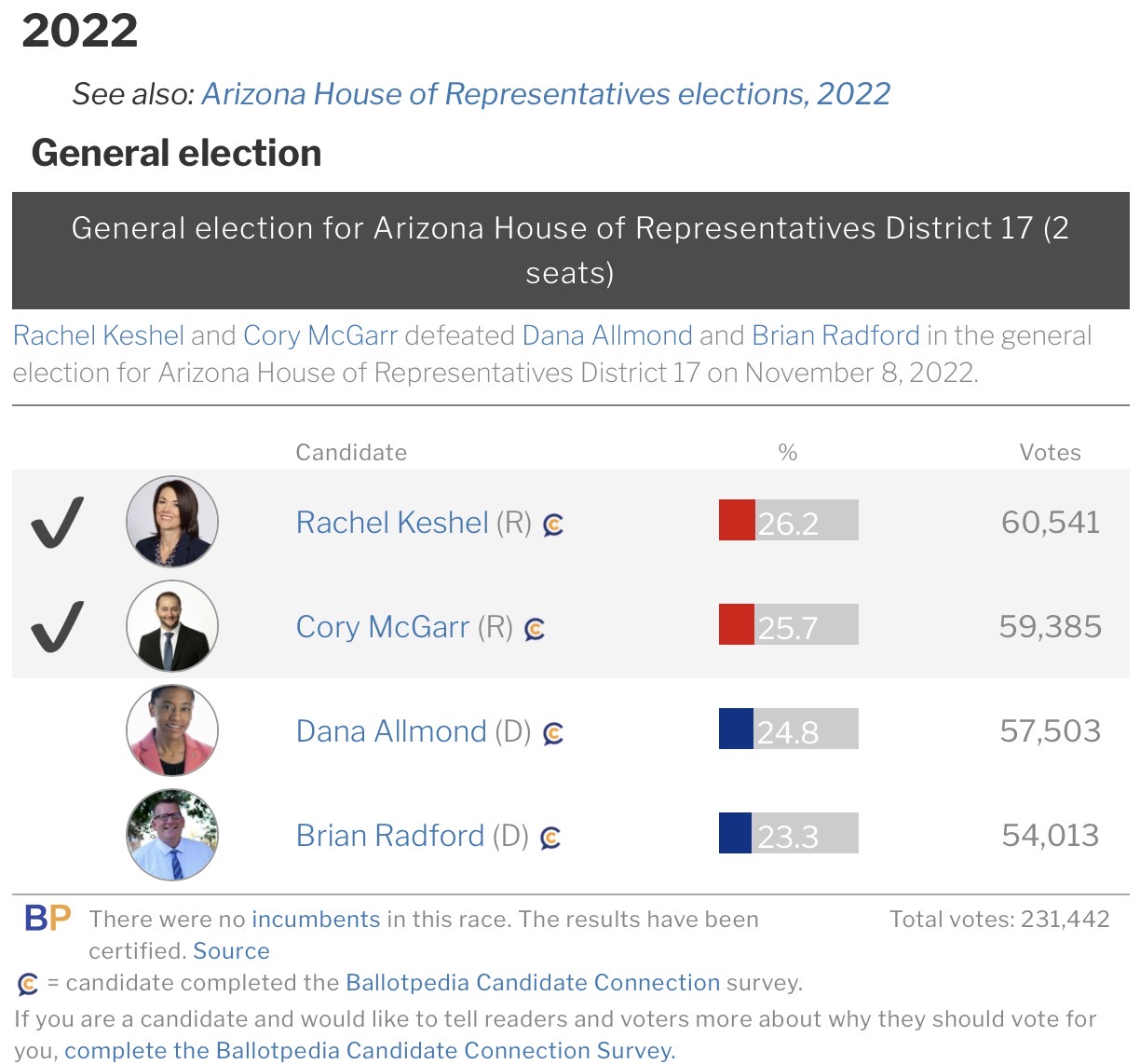
Rachel and her old seatmate, Cory McGarr, won in the 2022 election alongside the Katie Hobbs gubernatorial rig-job, by beating two Democrat newcomers in what was then a freshly drawn district:

Arizona LD-17 2022 state House results

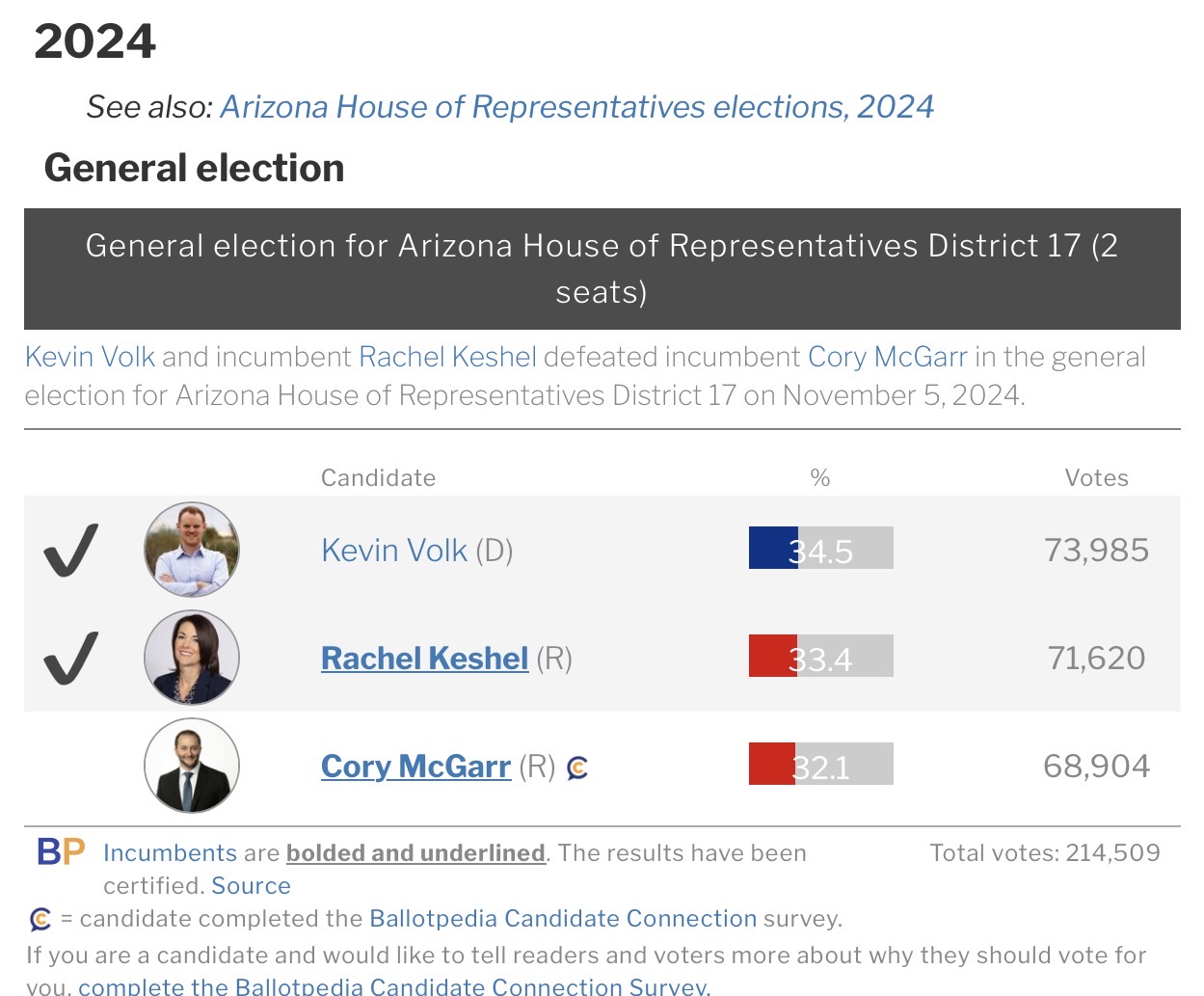
McGarr was a great legislator, and both GOP candidates ran for reelection in 2024. Enter what is known as a single shot – when the underdog party runs one candidate. This concentrates all the Democrat vote on one guy (or gal), and any independents looking to split a ticket have just one choice of Democrat. It works in reverse for Republicans in blue-leaning districts, and that is exactly how Michelle Pena got elected in LD-23. Unfortunately, Gary Garcia Snyder refuses to drop his candidacy alongside her in LD-23 this year and will almost certainly cost Republicans Pena’s seat, and potentially the majority.

In 2024, Democrats single shotted a candidate named Kevin Volk, whose family is well-known in the Tucson business community, and the results came out like this:

Arizona LD-17 2024 state House results

Volk elected, Rachel reelected, and McGarr on the outside looking in. LD-17 was the only district out of 30 statewide in which President Trump ran left of his 2020 numbers (in a state that had a terrible 2020 election, mind you); the Arizona GOP expanded its majorities in both the State Senate and State House nevertheless. Volk has a problem this year:

Arizona LD-17 2026 Democratic primary results

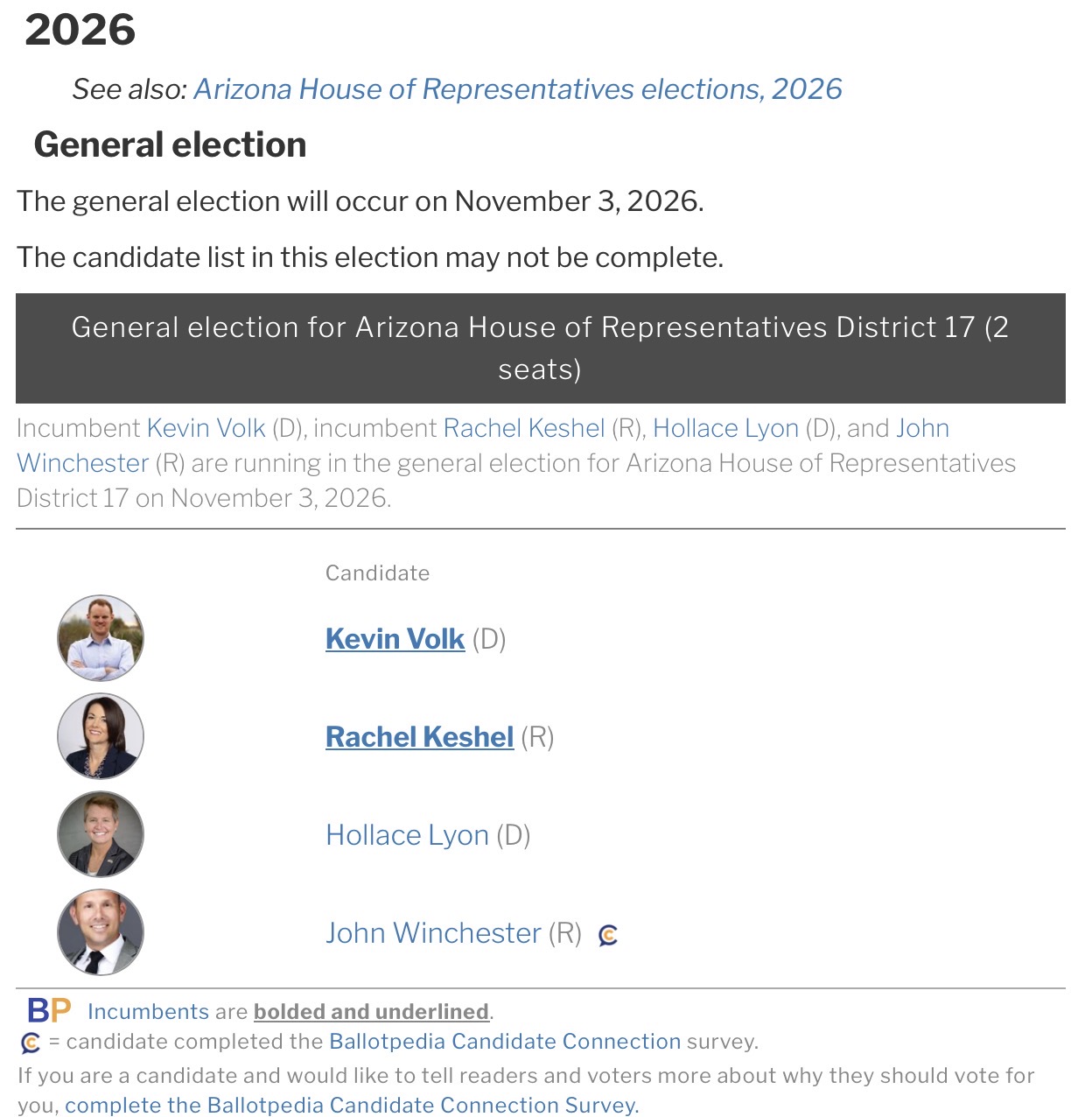
He is joined on the ticket by Holly Lyon, a retired Air Force officer who has run for the legislature before, albeit in a much redder district than LD-17. She ran slightly ahead of Volk in the primary, which doesn’t predict much because it will come down to how many Republicans run left of normal, and how non-partisans in a few key precincts split tickets. Rachel ran behind McGarr substantially in the 2024 primaries because another female Republican mounted a primary challenge, and the results shook out differently with a full electorate in November.

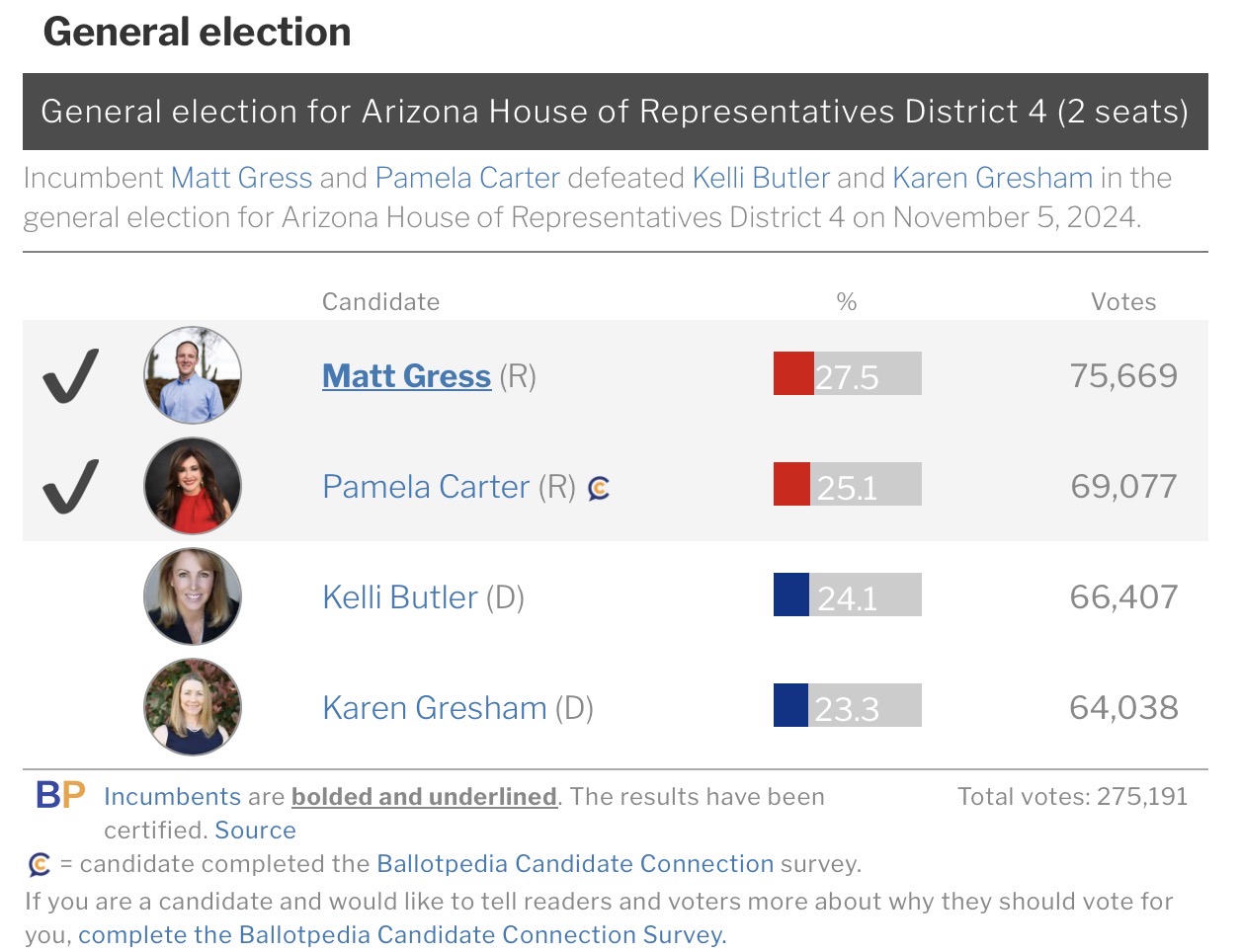
So – no more single shot. There will be no more sole concentration of all Democrat votes on one candidate, with no capacity to receive all independent votes looking for a split ticket to one Democrat. Democrats got greedy in LD-4 after a successful single shot in 2022, and the GOP took both seats in 2024 in the most dangerous electoral turf that suburbia has to offer in Maricopa County:

Arizona LD-4 2024 state House results

With the single shot off the table, and from feedback from the cigar room, the consensus is that Republicans are likely to win both House seats in LD-17 this year, despite Hobbs appearing to be on her way to reelection and the standard winds of a midterm environment. Rachel’s running mate this time is John Winchester, born and raised in Tucson and someone deeply connected to institutions and organizations. We didn’t know what to think of Winchester when he announced for the race, but we’ve come to like him and believe that he, a traditional conservative, and Rachel, the populist firebrand, make a strong pair that thoroughly represents the range of modern Republican politics that should go on to serve in Phoenix together.

Now, let me show you, with greatly enhanced odds of a double GOP victory in LD-17 on the table from two years ago, what the corrupt system is doing to game this race:

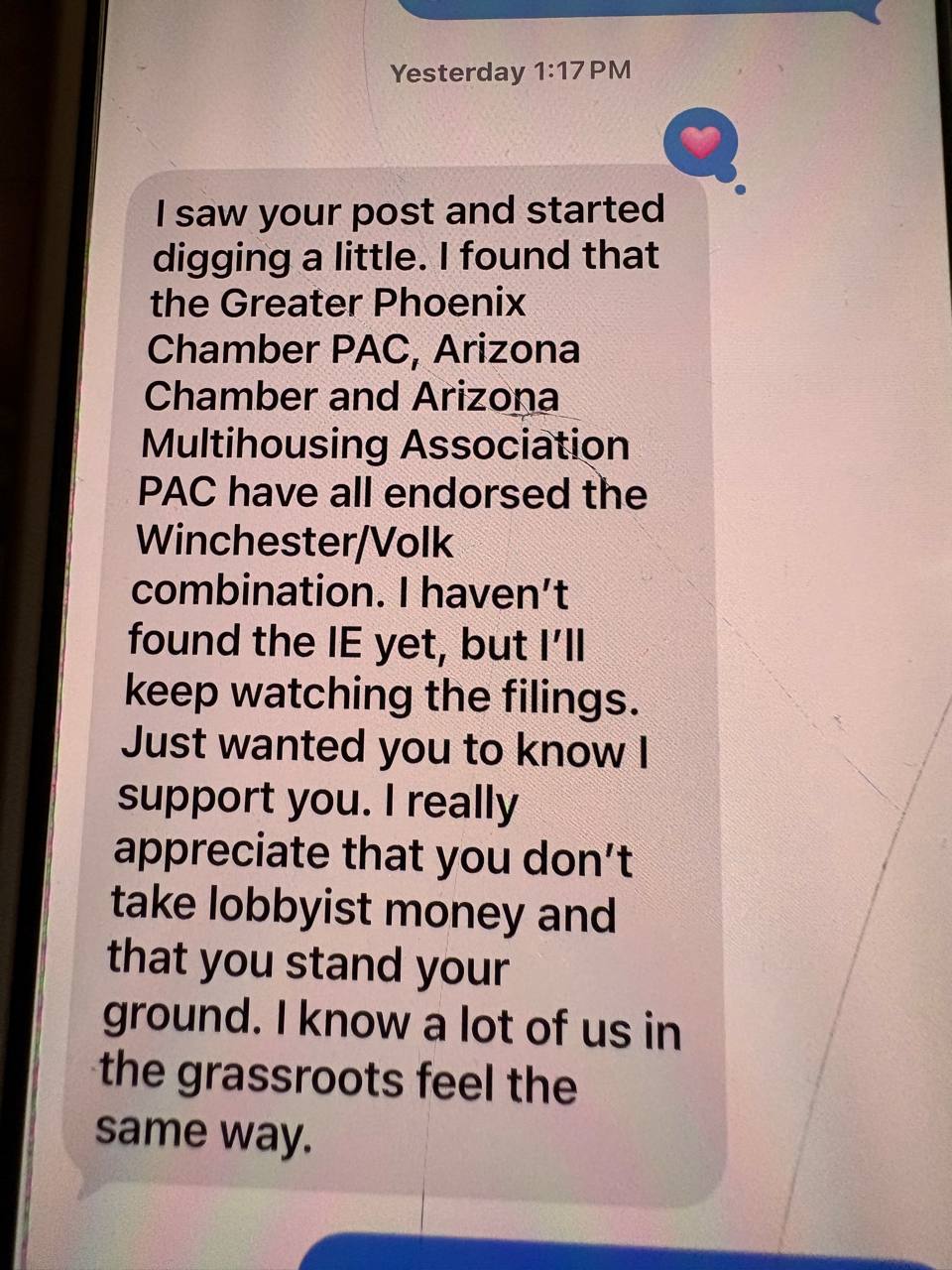
I was tipped off today that powerful lobbies plan to launch a push promoting a joint ticket of John Winchester (R) and Kevin Volk (D) in LD-17. John and I are encouraging everyone to “vote both Republicans” and let the chips falls where they may. I take it as a badge of honor…

AZ Representative Rachel (Jones) Keshel (@RJ4arizona), September 20, 2026

Powerful lobbies indeed – organizations from Phoenix and throughout the state – are looking to throw Rachel overboard and promote a purple ticket to persuade voters to elect a Winchester/Volk ticket. Let it be known before I move the balance of this article for paid subscribers – Rachel has already gone to Winchester with this, and he said, “I don’t want my face on anything with Volk’s.” We are at peace with whatever happens in November, but would at least appreciate a straight shot without having to wade through political minefields laid by special interests.

This level of outside support in our elections, despite its aims, has unpredictable impact. It could do what it intends and force a split ticket aiding Winchester and saving Volk, or it could backfire and piss off the substantial grassroots base of LD-17 – forcing members to single shot in favor of Rachel – which we do not want because the goal is to win both seats.

Detailing the Outside Impact on the LD-17 Race and Why Voters Hate It

Let me connect the dots and expand on how our elections are rigged to benefit the few:

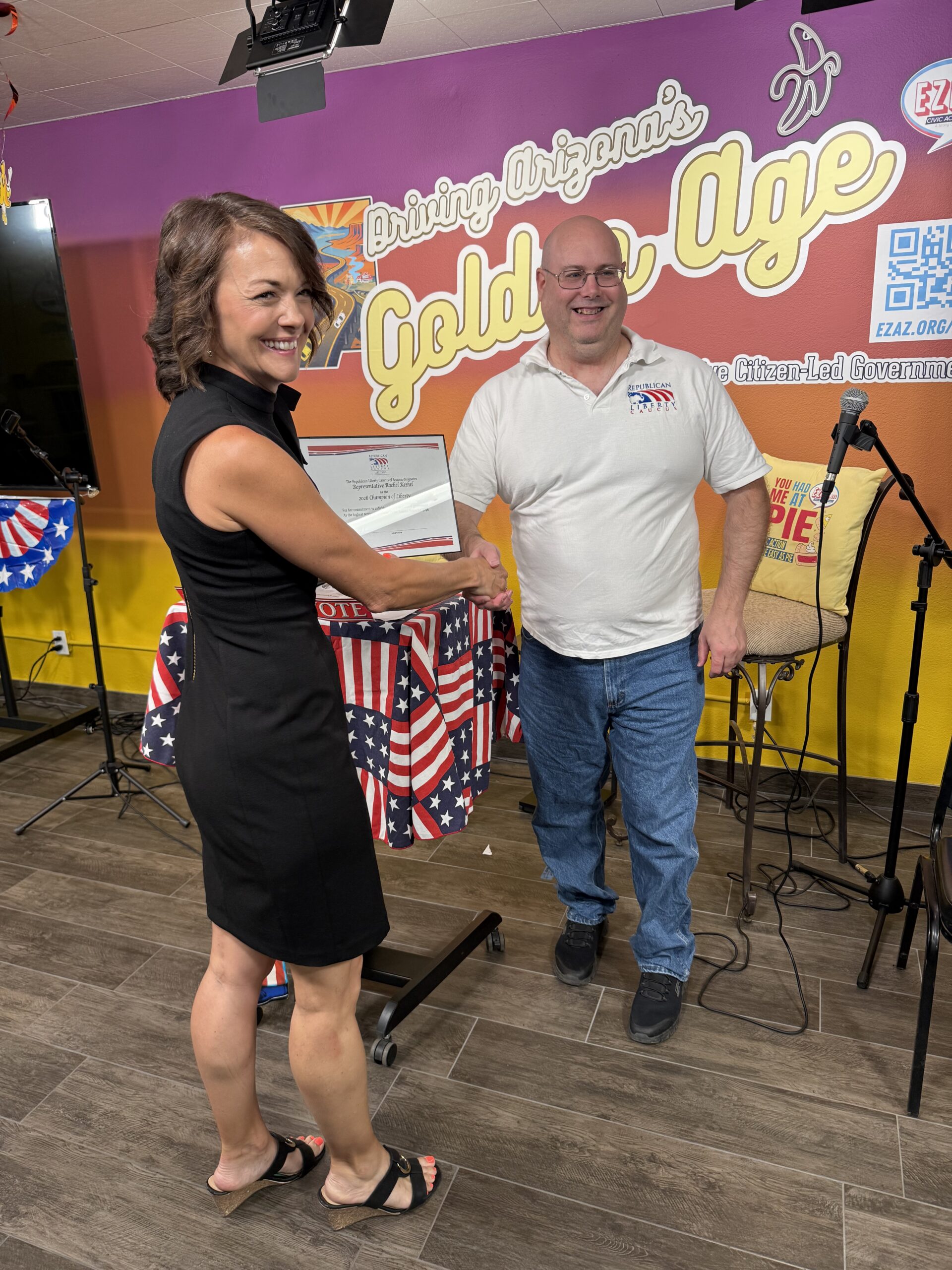
None of what Rachel wrote in that post is fair to Lyon, the new Democrat in the race, either. It disenfranchises her many supporters, just as big business and big establishment voices look to mute grassroots voices on the GOP side. If you read about Rachel’s track record, you will note that she was named “2026 Champion of Liberty” by the Republican Liberty Caucus of Arizona:

Rep. Rachel Keshel named 2026 Champion of Liberty

You will also see that as Vice Chairman of the Federalism, Military Affairs, and Elections committee, Rachel carries significant impact in a state with terribly corrupt elections and has been instrumental in advancing reforms directly to the ballot (like this year’s huge measure) and to the point of needing a gubernatorial signature, which represents its own problems given Hobbs’s presence in that office.

Rachel has also been a stalwart in family court reform. Arizona family courts are notorious for handing children to abusive parents, often with catastrophic consequences. Read my September 4 article to understand the level of depravity we are dealing with here:

A fair amount of research and investigation into any legislator’s voting record and list of friends and enemies often answers every question voters may have. Rachel’s credentials, in this regard, are impeccable. That is what makes the intervention of outside interests so offensive. What we are told specifically is coming is an independent expenditure (not paid for by any campaign directly) targeting swing voters and pitching specifically the purple ticket of Winchester and Volk – which is publicly against the stated aims of both campaigns. Lest you think I’m pointing at some imaginary monster in the sky, here are the villains seeking to mislead voters:

  • Greater Phoenix Chamber PAC
  • Arizona Chamber
  • Arizona Multihousing Association PAC

A source in Tucson tipped us off that the looming advertising bombardment is likely coming from any combination of these three.

Image from Seth Keshel's article on outside spending in Arizona LD-17

What am I getting at here?

I am not bellyaching at all. The four-way races are their own problem, forcing four people to essentially compete against one another in a team sport. Every campaign puts endless hours, resources, and emotional energies into these contests, and watching special interests insert themselves into this is exactly what voters of all sides (and even the candidates who stand to be personally impacted) hate about the way our politics have developed. Why should candidates who can’t be bought be continuously targeted by organizations that want to control the political discourse with a death grip?

If big money buys political outcomes, or attempts to alter them, then what does that say for why average Americans avoid the political process? Isn’t that the problem altogether? What we want in this race is a straight race – two Republicans against two Democrats. We are at peace with how that shakes out. We are not at peace with having to navigate further minefields, even if the consequences of these minefields favor Rachel by making Republican voters angry at Winchester over something he didn’t initiate.

The insertion of high-powered special interests seeking to alter the trajectory of key races thought to impact who controls the legislative majorities is unfair to candidates Keshel, Winchester, and Lyon, the other Democrat in this race, and should be opposed by all voters regardless of partisanship or ideology. It is often said that you can tell a lot about someone by who their enemies are – and you should all understand that the machine will go to great lengths to remove people who threaten to expose and eliminate corruption in family courts, elections, special interests, and every arena plaguing our political discourse.

Seth Keshel, MBA is a Senior Fellow at the Gold Institute for International Strategy and a retired Army Captain. He publishes Captain K’s Corner on Substack.

Nuclear Insurance You Can Bank On

A B-52H Stratofortress parked on the flight line during Exercise Global Thunder 26 at Minot Air Force Base, North Dakota

This article was written by Peter Huessy and appeared in RealClearDefense. Nuclear Insurance You Can Bank On.

The Congressional Budget Office is charged by Congress to carefully examine the spending implications of government funded programs including those in the Department of War. Some decades ago, CBO assessed the cost of the nation’s nuclear deterrent particularly the Triad of strategic bombers, submarines and the sea launched ballistic missiles they carried and the land-based ICBMs in silos. The CBO also estimated the cost of the warhead and nuclear laboratories maintained by the Department of Energy (now the National Nuclear Security Administration within DOE) and the cost of our Nuclear Command, Control, and Communications (NC3). One early report garnered a lot of national attention because CBO headlined its report with the startling estimate that the nation’s nuclear deterrent was going to cost $1 trillion. Even in Washington, D.C., that was a lot of money.

But CBO played a few clever tricks to get to that number. First, CBO said this was the cost of “nuclear modernization” or the new nuclear weapons systems. It was that but a lot more. All the current legacy and very old system costs were also included, systems that now are from 40-70 years old, hardly what one would include under the rubric of “modernization.” Second, CBO also included all 100 strategic B21 bombers although only 20 of the bombers were going to be in the deployed nuclear arsenal. Third, CBO arbitrarily decided that the estimated costs would be for three decades, triple the length or duration of budgets usually presented by an administration in February of each year when the Federal budget proposals are required to be submitted to the U.S. Congress. And fourth and finally, CBO decided to add a 3% inflation kicker over the three decades which mathematically more than doubled the actual costs of the nuclear modernization enterprise.

So, in their 2013 report, for example, CBO trumpeted that nuclear forces would cost $1 trillion (over the next 30 years), generating headlines across the news media, engendering the shock and awe they wanted to create, hoping strong opposition in Congress would develop that would cut back significantly on the modernization effort. And just so Congress would get the message, another favorite regular past time of CBO was to do a regular excursion of killing the land based silo ballistic missiles to examine what force alternatives would provide what kind of budget savings.

CBO was strongly criticized for these sleight of hand magic tricks and eventually CBO made two key adjustments—they estimated the bomber costs at the 20 not 100 to be in the force. And CBO admitted that modernization should not include the ongoing sustainment and maintenance of the current legacy force.

Nonetheless CBO as one senior USAF general told me got its “bumper sticker and press release headline” and made nuclear investments look out of line with the rest of government requirements. The nuclear abolition enthusiasts took the number and ran with it and even came up with their own estimates near the $2 trillion mark by making the same mistakes that CBO was making but also adding even more of their own.

Senator John Hoeven of North Dakota (R-ND) put things in perspective two years ago when he explained that as a member of the defense appropriations subcommittee in the Senate, he had a front row seat when examining the nuclear portion of the defense budget. And yes, the Senator supports in his state two elements of the U.S. nuclear Triad—150 Minuteman missile silos and B52 strategic bombers, the only state with two parts of the nuclear Triad. Senator Hoeven laid out in late 2024 that the entirety of the nuclear Triad modernization cost for FY2025 for the nation was $18.6 billion annually for the B21 bombers, the Columbia-class submarines and companion upgraded D-5 missile and the Sentinel ICBM. One could add the costs of the associated NC3 and warheads, but whether or not the U.S. modernized the Triad these other elements would have had to be acquired irrespective of whether for the legacy or modernized force.

Now to be fair those Triad costs are now upwards of $26 billion as the country moves toward full annual production of each of the Triad elements. As acquisition costs increase, research and development costs decline. Also, sustainment and maintenance of our legacy forces continues, with some of those costs rising as much as 17% annually. What is remarkable is that despite being 55 years in service, the 20th USAF commanders have been able to sustain the Minuteman III force at a 98% alert rate, an extraordinary achievement, and a tribute to the leadership of 20th USAF that has recently changed hands with the retirement of USAF Maj Gen Stacy Huser. [And hats off to our Ohio-class sub and B52/B2 bomber folks as well.]

CBO largely misses any acknowledgement of such challenges to sustaining the U.S. legacy nuclear force. After the collapse of the USSR, CBO went on many alternative defense budget excursions that had at their core an assumption (often reflecting the tenor of some Congressional initiatives) that U.S. restraint and minimum investments in defense including nuclear forces was the way to proceed. This included a parallel and nearly zero attention to the looming threat of China as a possible nuclear peer competitor. [Although the U.S.-China Economic and Security Commission regularly and fairly examined the national security dangers facing the U.S. due to China’s rapid and accelerating defense and technology investments.]

In looking into the future, CBO also largely missed another aspect of the entirety of the budget requirements for the nation’s nuclear deterrent. The Columbia class submarine and the Sentinel ICBM forces will both remain in the force through 2080-5. That means these two elements of the nuclear Triad will have to be replaced, under currently projected conditions, but not for half a century or more. Using the current estimates for the research, development, and acquisition costs of Sentinel ($140 billion) and Columbia ($138 billion), plus $15 billion for the requited new and life extended warheads, the costs now to the U.S. taxpayers for each of the next 30 years comes to roughly $9.76 billion a year, which is more than what Americans spend for food on the 4th of July ($7 billion) and 1/122nd of what Americans spend on insurance each year. And for 80 years that nuclear insurance policy called deterrence has never had to cash out.

Written by Peter Huessy Senior Fellow, Gold Institute for International Strategy

The leader of the Lebanese mafia in Germany congratulated Berlin’s new communist mayor in person

Majestic view of Berlin's Rotes Rathaus showcasing historic red brick architecture.

This article was written by the editors and appeared in La Derecha Diario. El líder de la mafia libanesa en Alemania felicitó en persona a la nueva alcalde comunista de Berlin.

Featuring Hermann Tertsch, Distinguished Fellow, Gold Institute for International Strategy

The appearance of Issa Remmo, identified by German media as the head of the well-known Remmo clan, at an election party of Die Linke (The Left) sparked a heated controversy in Berlin. The episode occurred during the party’s election celebration in Neukölln and quickly raised questions about the ties and the controls at events of the German left.

Hermann Tertsch

The image of the clan leader alongside guests at the party was spread on social media and also picked up by various German media outlets. The Spanish journalist and MEP Hermann Tertsch sharply questioned the episode and pointed out that Remmo is considered a figure linked to Berlin’s criminal underworld.

Issa Remmo appeared at Die Linke’s election party

According to the German press, Remmo showed up at the party’s election celebration in Neukölln, where he even gave statements to the Berliner Morgenpost about the accusations of antisemitism hanging over parts of Die Linke.

Remmo himself told the German outlet that he felt “supported by a party for the first time” in Germany. He also defended Die Linke against the accusations of antisemitism and said he would not vote for a politician who was anti-Jewish.

The episode is especially striking because Die Linke was celebrating its election result in Berlin, while the presence of a figure publicly associated with the Remmo clan was drawing criticism from various political quarters.

The German left distanced itself from the visitor

After Remmo’s presence became public, representatives of Die Linke tried to distance themselves.

Die Linke’s Neukölln organization maintained that it was a public event that people who had not been invited could attend, and stated that Remmo was not on the guest list.

“The person and his specific presence were unknown to us,” explained a party spokeswoman, who added that there are no political or personal ties with Remmo.

Die Linke’s candidate, Elif Eralp, also later maintained that Remmo had not been invited and that he was removed from the venue.

Kai Wegner questioned Remmo’s presence

The mayor of Berlin, Kai Wegner, also reacted publicly to the episode and described Remmo’s appearance as a worrying sign.

Wegner argued that a political force that aims to take on the responsibilities of government in Berlin must make clear that there is no closeness of any kind to structures linked to organized crime. He also demanded an explanation of how it was possible for Remmo to get into the celebration.

The controversy later gained another element: German media reported that Ibrahim Ibrahim, singled out by German organizations and media for his support for the terrorist organization PFLP and linked to anti-Israel activism, appeared alongside Remmo.

The episode thus opened a new debate about Die Linke, its political spaces and the controls over who takes part in its activities, amid an intense discussion about security, antisemitism and extremism in Berlin.

Read the full article at La Derecha Diario

Hermann Tertsch is a Distinguished Fellow at the Gold Institute for International Strategy, a Washington, D.C. foreign policy and defense think tank.

Selective scrutiny is bigotry: The manufactured smear of Hindu America

New York City skyline with skyscrapers and Central Park trees

This article was written by Adelle Nazarian and appeared in Washington Examiner. Selective scrutiny is bigotry: The manufactured smear of Hindu America.

When Rashtriya Swayamsevak Sangh chief Dr. Mohan Bhagwat addressed roughly 5,000 people at Madison Square Garden on Aug. 29, his opponents had already mobilized against his appearance.

The Raksha Bandhan-inspired Universal Oneness Celebration brought together leaders from 16 faith and wisdom traditions. Bhagwat described diversity as the decoration of unity and urged Hindu Americans to remain loyal to the United States (their karma bhumi) — while exuding the values of their matru bhumi, or motherland.

Whatever one thinks of the RSS, that was the gathering’s stated message. Outside the hall, however, Bhagwat was denounced as “far-right,” “supremacist,” and “paramilitary.” Prism Reports portrayed his appearance as an RSS “influence operation,” relying heavily on Savera, a coalition organized to combat what it calls “Hindu supremacy.” Yet the organizations demanding transparency from Bhagwat’s hosts receive remarkably little scrutiny of their own affiliations, funders, and coordinated campaigns.

That double standard is the real story.

Among the organizations campaigning against the appearance was Hindus for Human Rights, which describes its mission as opposing Hindu nationalism and caste, while focusing heavily on the RSS, Narendra Modi, the Ram temple, and India’s government — cofounded by Sunita Viswanath. Ahead of the event, HfHR urged supporters to call and email Madison Square Garden to demand its cancellation, providing a script describing Bhagwat’s politics as hateful and exclusionary.

HfHR’s development was closely tied to Jewish Voice for Peace. Viswanath’s husband, Stephan Shaw, is a JVP activist. Jewish Currents reported that former JVP Deputy Director Alissa Wise trained HfHR’s staff and board, coached its leadership, and facilitated retreats. Shaw called it a “JVP for Hindus.”

HfHR has also repeatedly worked alongside the Islamic Circle of North America’s Council for Social Justice. In September 2019, ICNA-CSJ said it “took the lead” in coordinating a massive anti-Modi demonstration outside the United Nations. ICNA organized volunteers and buses for the demonstration. HfHR cosponsored it, and Viswanath addressed the crowd.

In December 2021, HfHR and ICNA-CSJ joined other organizations in urging then-Secretary of State Antony Blinken to designate India a “Country of Particular Concern.” These examples demonstrate recurring political cooperation.

ICNA is legally separate from Jamaat-e-Islami, and cooperation with ICNA does not prove control by Jamaat. But the history is relevant. Historian and anthropologist Karen Leonard has written that ICNA was founded by Pakistani members of Jamaat-e-Islami. Contemporary American Religion describes ICNA as “deeply influenced” by the writings of Jamaat founder Abul A’la Maududi. Brookings has called Jamaat-e-Islami Pakistan the country’s “Muslim Brotherhood analogue.”

Savera’s network includes HfHR, the Indian American Muslim Council, and India Civil Watch International. HfHR lists them and Savera among its partners or coalitions. Several groups within this network also supported the controversial 2021 Dismantling Global Hindutva conference, where Madhu Hebbar has argued that some speakers crossed from opposing nationalism into portraying Hinduism and its scriptures as inherently oppressive.

Here, Savera’s methodology deserves a mirror test. HfHR’s collaboration with ICNA-CSJ and its organizational training, conducted by a former JVP leader, are documented connections. They do not establish foreign direction. The same distinction should guide scrutiny of Hindu American organizations: shared events, personnel, and ideas warrant questions, but claims of foreign control require evidence of that control.

ICNA states that ICNA-CSJ was established by ICNA. This establishes an operational alliance with an American institution born from the Jamaat milieu — a stronger connection than the cultural affinity Savera invokes to portray Hindu-American organizations as components of a foreign-controlled network.

Meanwhile, Hindu Swayamsevak Sangh USA (HSS USA) is a separately registered 501(c)(3) nonprofit group with public federal filings. That status does not settle questions about its relationship with the RSS. Those questions should be examined through evidence of governance, funding, and operations, applying the same standards used for other advocacy organizations.

A database compiling IRS-derived grant records lists approximately $2.2 million in grants to HfHR between 2020 and 2024, including $1.3 million from the Tides Foundation, its largest identified funder. Those figures warrant verification against the underlying filings, but the principle is straightforward: questions about institutional funding should apply consistently to advocacy groups across this debate.

The RSS, HSS, and Bhagwat’s American hosts should answer legitimate questions about their organizations and disclosures. So should their accusers. Hindu Americans should not face a political litmus test under which attending a cultural gathering, donating to an organization, or participating in Raksha Bandhan outreach becomes evidence of foreign subversion.

Scrutiny is not bigotry. Selective scrutiny at the behest of foreign influence is.

Written by Adelle Nazarian Senior Fellow, Gold Institute for International Strategy