Iran-Iraq War (1980-1988) & the “Poisoned Chalice”: Does It Provide Insight Into the Islamic Republic Today?

Ayatollah Khomeini seated on the floor of a bare room, captioned "20 July 1988 - Ayatollah Khomeini Agreed to A Ceasefire. Is There A Lesson for Today?"

This week is the 46th anniversary of the start of the Iran-Iraq War, 22Sep80. A brutal war with at least 1 million casualties, trench-warfare, human-wave attacks, “strategic” bombing of cities, missiles, drones (yes, drones), destruction of Kharg Island, attacks on oil infrastructure, the Tanker War, mining the Strait of Hormuz, and even employment of chemical weapons….yet after 8 years, no terrain was gained and neither side was victorious. Saddam Hussein vs Ayatollah Khomeini.

But on 20 July 1988 Ayatollah Khomeini spoke these words:

“Happy are those who have departed through martyrdom. Happy are those who have lost their lives in this caravan of light. Unhappy am I that I still survive and have drunk the poisoned chalice…”

With that, he accepted UN Resolution 598 and the terms of ceasefire. Why? What brought him to that point? Damned good questions for today. Consider this:

First…despite the use of Iraqi chemical weapons on Iran, the international response was tepid, at best. Crickets. NOTHING could be construed as Western sympathy for Iran.

Second…despite an American shootdown (accidental) of an Iranian airliner, the international response was still tepid. Again, sympathy for Iran was lacking.

Third…by 1988 Iranian citizens had become seriously war-weary and morale in the military had evaporated. Money was no longer any good. Inflation in Iran was over 50%. Iranian oil exports were down 75%. The economy was crushed. Iranian battlefield failures had become routine. The Ayatollah’s continued calls for volunteers for “Martyrdom” were falling on deaf ears. No one was volunteering for military service, and the incessant infighting and distrust between the IRGC and Army had left them ineffective and the Islamic Republic vulnerable to collapse.

Fourth…by 1988 Saddam had managed to rebuild his army to 1M men…the 4th largest in the world. At the same time, Iran’s national security advisor had concluded that for Iran to be victorious, it would need an army 8 times larger and take 5 more years.

Facing overwhelming combat power, a collapsed economy, and an international community that had no intention of constraining either Iraq or the USA from doing whatever was necessary to end his regime, Ayatollah Khomeini chose to drink from the “poisoned chalice.”

But the Islamic Republic survived.

My guest on the show this week is Ambassador Stan Escudero, who was on the ground and undercover in Tehran during the Islamic Revolution in 1979. He was also the POLAD to CENTCOM during Operation Praying Mantis in 1988 when we sunk half the Iranian navy. He knows Iran like few others. He has absolutely fascinating insight into the regime. Click on the link to listen to our discussion and Lessons Learned: https://frontlinesoffreedom.com/show-979/

Written by Ernie Audino Senior Military Fellow, Kurdistan Program (U.S. Chair), Gold Institute for International Strategy

Venezuela Demands the End of Delcy

Venezuelans wave their national flag at a street protest for freedom and change.

This article was written by Hermann Tertsch and appeared in El Debate. Venezuela exige el fin de Delcy.

Donald Trump deserves colossal credit for the historic advances that have taken place across Ibero-America during his term. For now he deserves statues in the capitals of many Spanish-American countries, just as Ronald Reagan deserved them, and has them, in the countries of Central Europe.

Trump and his Secretary of State Marco Rubio have managed in these two years to transform the Ibero-American political landscape so much for the better that it would be a shame for him to squander all that capital and pull down the statues before they are even erected. And to do so, moreover, for nothing, blinded by oil that will always be at his disposal and by flatterers who think only of how easy it is to make money with criminals.

It has been highly significant to see the leaders of Ibero-America’s new patriotic forces in New York demand, one after another, those elections in Venezuela and a timetable to end this interim period under a criminal president such as Delcy Rodríguez.

It is an interim period in which the same people who ruled, stole and abused under Maduro still rule, steal and abuse. And many of the decent, patriotic Venezuelans whom Maduro and Delcy put in prison remain behind bars.

It could be justified for a few months, even a year, after Maduro’s capture. But the lack of a timetable for those elections is unbearable and a permanent insult to the Venezuelans who want to join, as soon as possible, the great movement Trump unleashed when he put an end to USAID and stopped the criminals with threats and more expeditious methods. He thereby allowed the democratic and conservative forces in so many countries to fight for power, and to do so successfully. And now all of them, Trump’s allies in the Shield of the Americas, want to open a radically new chapter across the entire continent.

That is incompatible with the survival in power of Delcy Rodríguez and her regime of murderers, drug traffickers, terrorists and paid journalists. Neither Trump’s prestige nor the alliances of all the other leaders with Washington can withstand this dramatic contradiction; they are equally discredited by complicity with Delcy Rodríguez’s murderous regime.

That is why the immediate establishment of an electoral timetable for Venezuela is so important, along with the return to her homeland of María Corina Machado, the undisputed Nobel Peace Prize laureate, leader and representative of the Venezuelan democratic will. Several Ibero-American leaders allied with Trump have met with Delcy Rodríguez, which the propagandists of Caracas’s criminal cave have tried to present as a legitimization of the delinquent. It is not. All of them have told her, and said in public, that there is an absolute need for a timetable for those elections to be imposed now, for all the prisoners to be released at once, and for the democratic process to be set on course now.

Venezuelans have begun taking to the streets to defend this single option, which is also the best one for President Trump. Delcy is betting on a Republican defeat and Trump’s subsequent weakness in order to entrench herself in power and perpetuate her dictatorship. Allowing it would be suicidal for Venezuelans, but also for all Ibero-Americans, who would once again have a criminal, narco-terrorist, subversive hotbed, one that would moreover carry the prestige of having beaten the Empire in a test of strength. And it would be suicidal for the United States too, which would once again face a direct and massive threat to its national security where, by logic, free will and democracy, it could have a Venezuela firmly united with the U.S. for the benefit of both, under those who truly believe in freedom, in prosperity and in friendship with the best democracy in the world: that immense majority of Venezuelans who are represented by María Corina and who see Delcy Rodríguez for what she is, a murderer and drug trafficker who hates freedom as much as she hates the United States.

Written by Hermann Tertsch Distinguished Fellow, Gold Institute for International Strategy

2026 Ten-Point Forecast: Alaska At-Large (U.S. House – Leaner)

Cover image for Seth Keshel's 2026 forecast of Alaska's at-large U.S. House race.

Nick Begich (R-inc.) vs. Bill Hill (I) vs. Eric Hafner (D) vs. Jim McDermott (L)

Author’s Note: Today’s release unveils the first of many U.S. House and Senate forecasts to come now that we have reached election season. For free subscribers, the open portion of this release will help you grasp the depth of my assessments and how distinguished they are from slop polling that is in great abundance these days. All detailed election forecasts will be reserved for paid subscribers.

Until recently, Alaska-At Large was designated a decisive seat. With significantly more information available to me now, I have downgraded it to leaner status and have replaced it in the decisive category with NC-1. Our electoral environment is a moving target, and as such, my estimates can and will change.

I. The Race

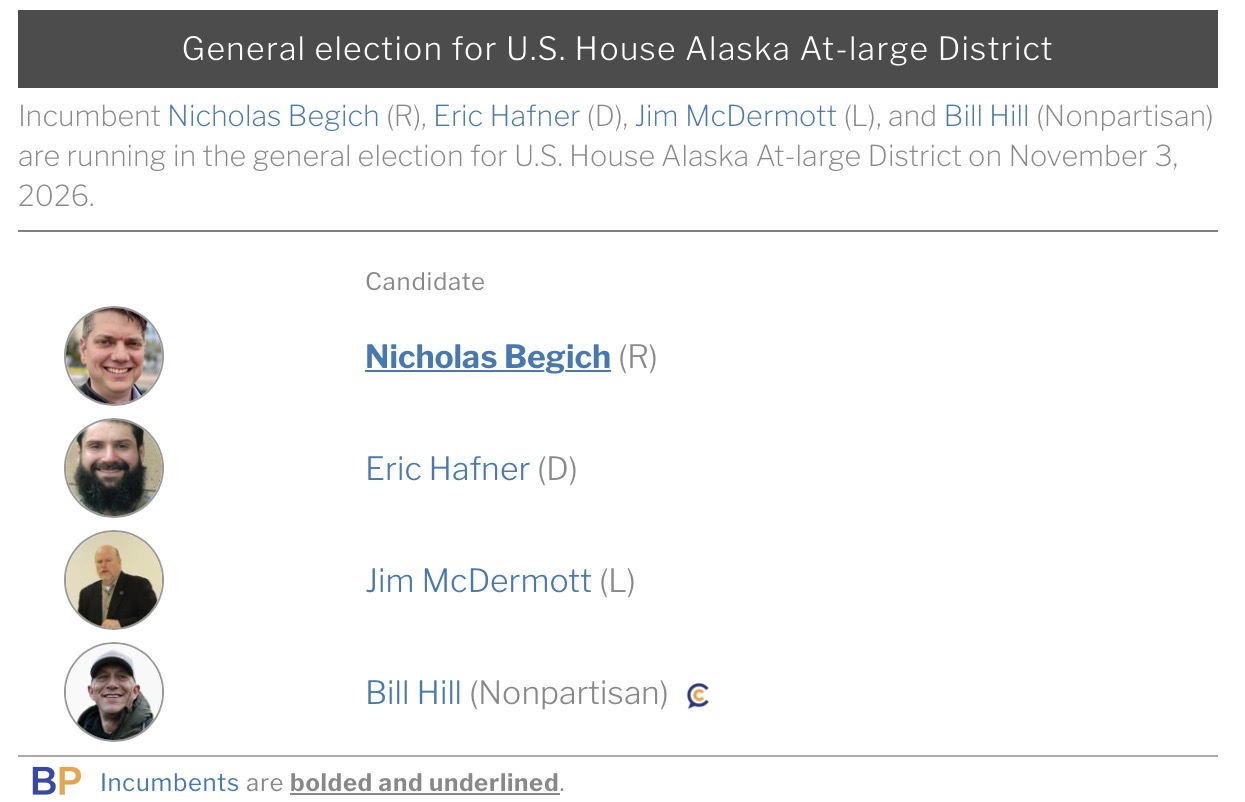
Candidates for Alaska's at-large U.S. House seat

Nick Begich (Republican) is in pursuit of a second term in the U.S. House running into standard midterm headwinds.

Bill Hill (Independent) is thought to be his primary challenger, as made clear by primary results, which will be analyzed further down in the article. Hill is a lifelong fisherman and a construction union man. He is running the “working class” motif for his campaign, which pales in comparison financially to Begich’s campaign.

Eric Hafner (Democrat) is the token Democrat in the race and a fresh face for the party after Mary Peltola’s recent runs for this seat.

Jim McDermott (Libertarian) rounds out the ticket.

Alaska’s ridiculous election system pits four candidates against each other in a jungle format held under Ranked Choice Voting. The winner is the first to reach 50%, which can be done in the First Choice Round outright, or after multiple rounds of ballot redistribution. To understand how Ranked Choice Voting, also called Instant Runoff Voting, works – check out the article I wrote before the 2022 Senate showdown in Alaska.

II. District Geography

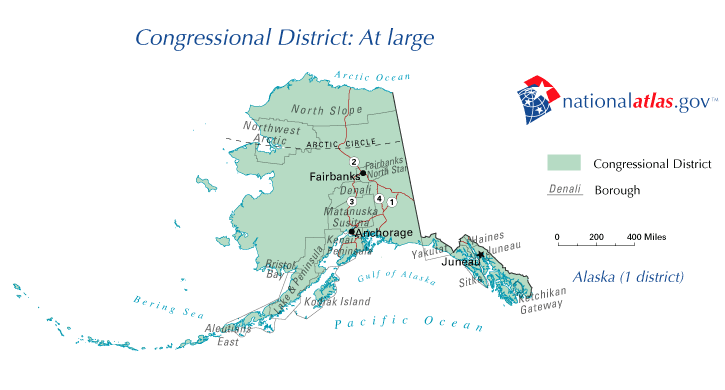
Map of Alaska's at-large congressional district

The entire state of Alaska, allotted just one U.S. House Representative, makes up the Alaska-At Large U.S. House district (AK-AL).

Key Statistics

  • 57.5% White, 14.8% Native Alaskan
  • 65.7% Urban, 34.3% Rural

III. Market Assessment

The market above doesn’t price in the “Independent” candidate (Hill), but Begich hasn’t priced as far down as the 60s since May. Bettors clearly expect the Republican Party to hold the seat, and there are many reasons why which will be explored in depth in the balance of this forecast.

IV. History

Alaska hasn’t voted for the Democrat presidential nominee since Lyndon Johnson’s 1964 national landslide. Given their allotment of just one U.S. House seat, it shouldn’t surprise you that the state has stuck with its presidential stripes almost as long as it has been in the union.

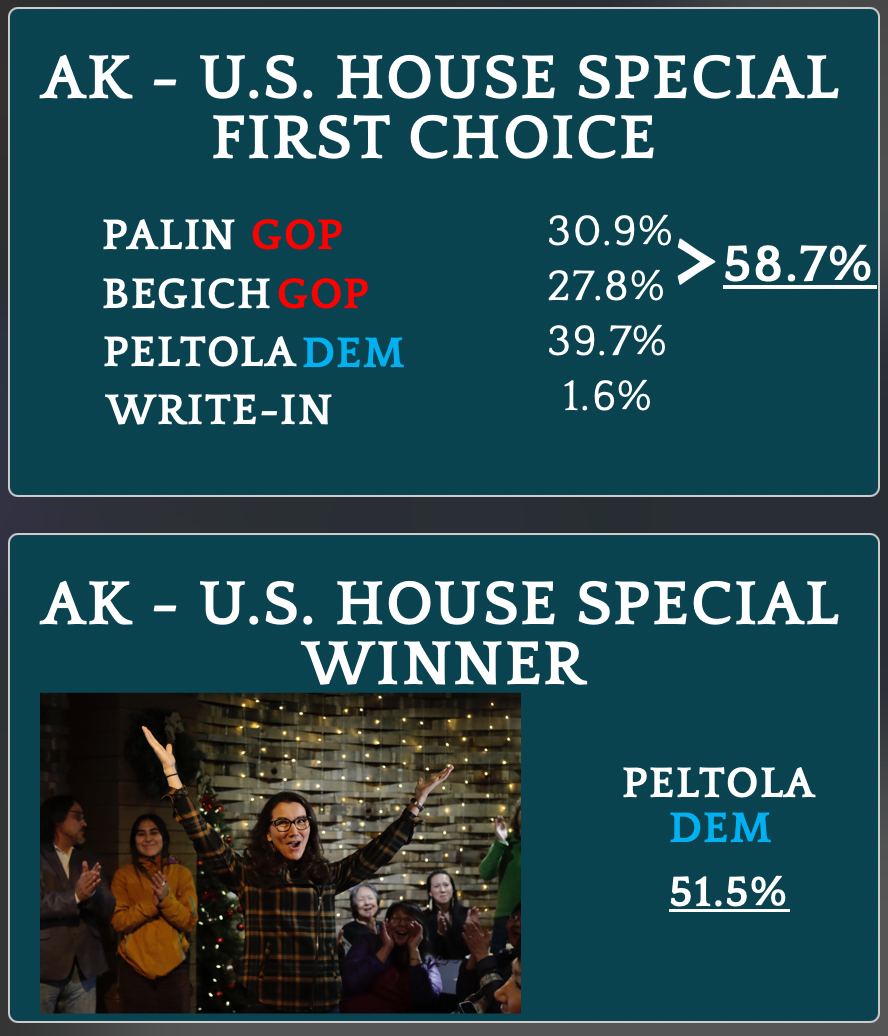
At the age of 39, Don Young was elected in a 1973 special election, putting the seat in GOP hands. Young held the seat until he died in 2022 at the age of 88. This prompted a special election that summer that yielded these First Choice Round results, yet a rather dubious final result.

Alaska 2022 special election First Choice Round results

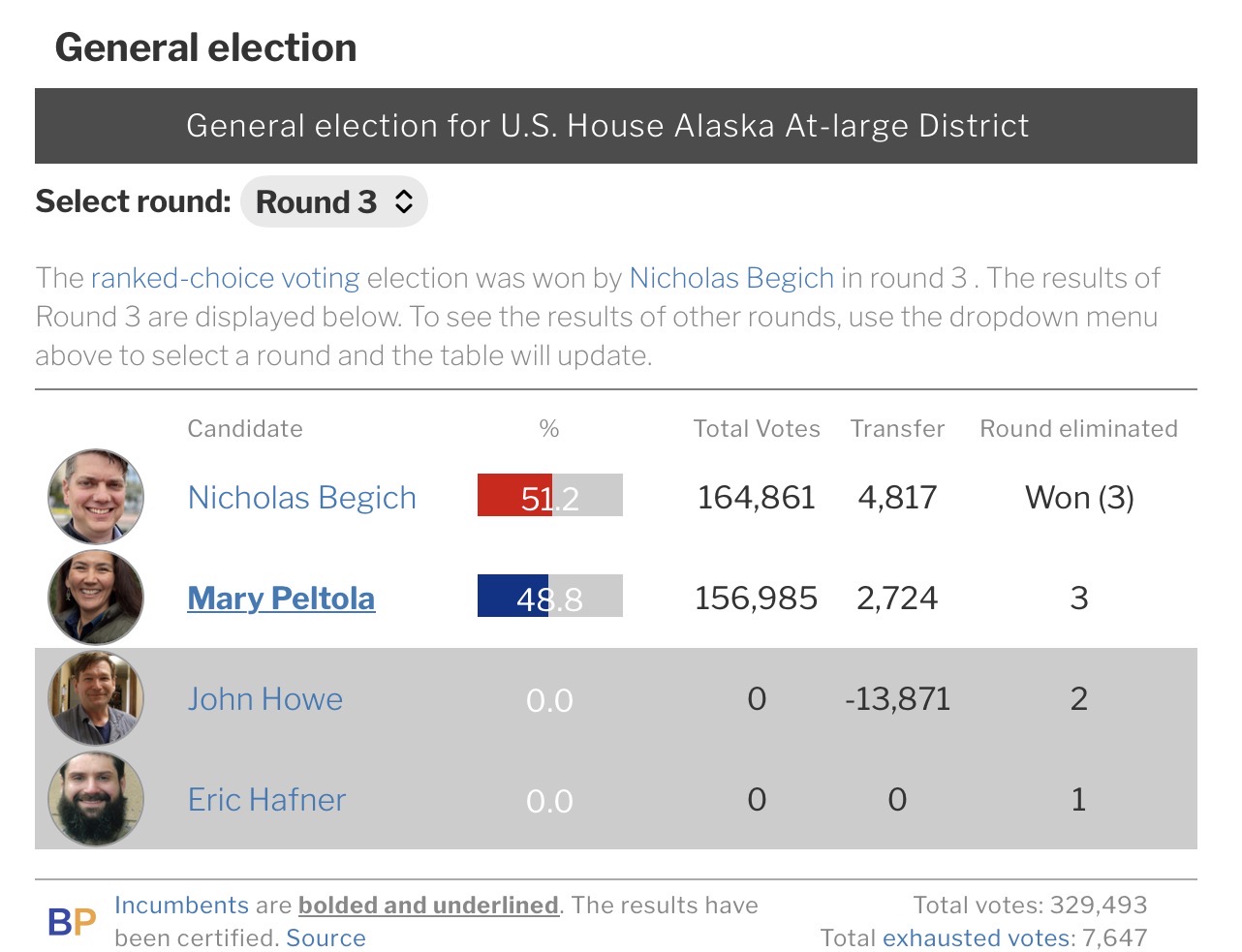
You read that right. Nearly 3 in 5 votes of the First Choice Round went to Republicans, yet Mary Pelota, the Democrat, won with the ridiculous Ranked Choice Voting system Alaskans have inflicted upon themselves.

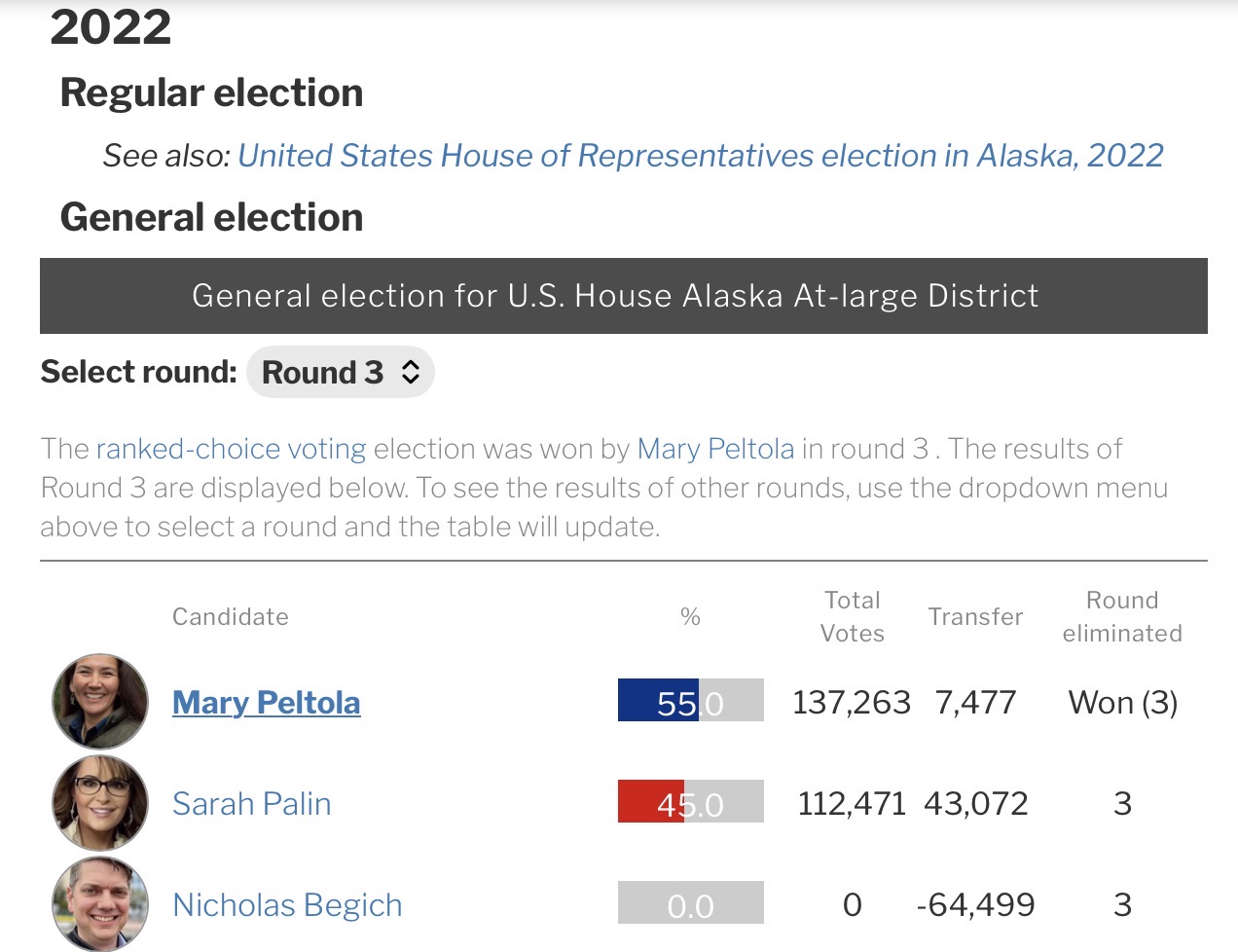
Peltola went on to win again in the General Election that fall, once again aided by Sarah Palin and Begich splitting the GOP vote:

Alaska 2022 general election results for the at-large House seat

In 2024, the GOP got it figured out and ran only one major candidate, knocking Peltola out in a state Trump won by more than 13 points:

Alaska 2024 at-large House election results

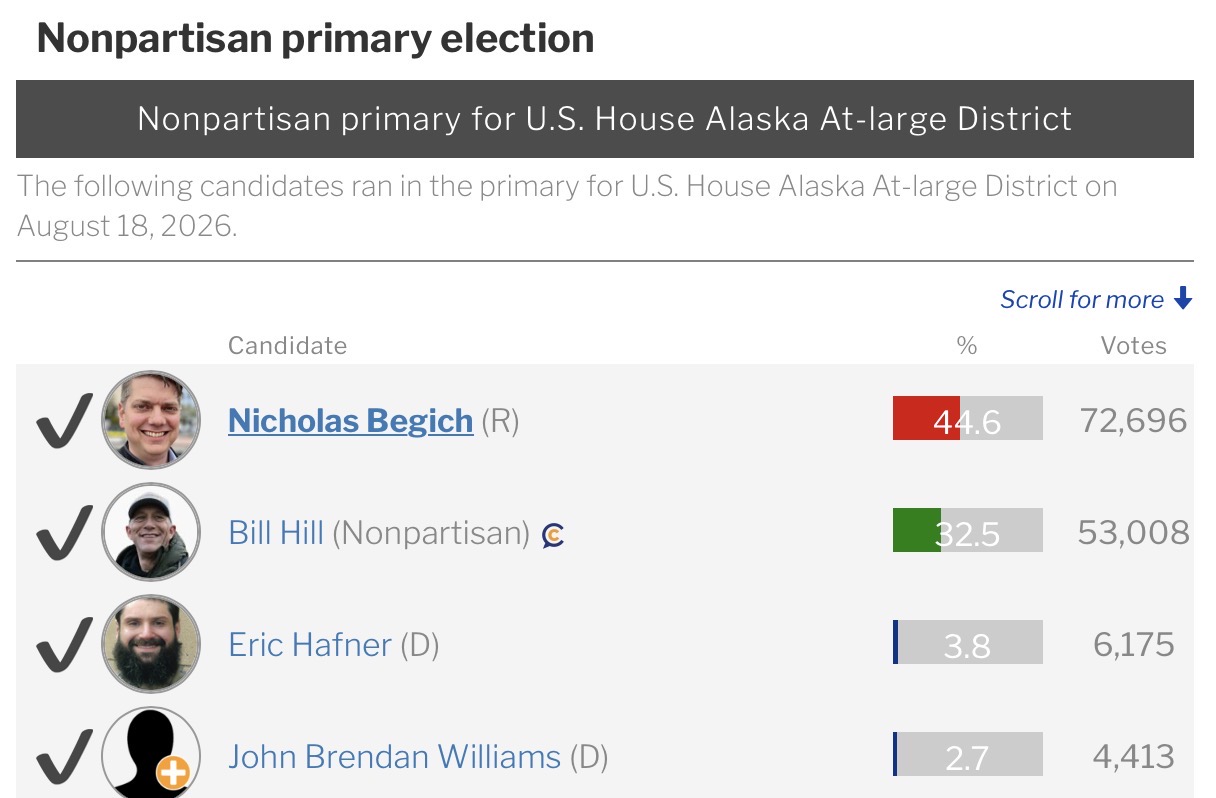
V. Analysis of 2026 Primary Results

Alaska 2026 at-large House primary results

Begich, with no legitimate Democrat-branded opponent, cruised to the top spot with 44.6% of the jungle primary vote. Williams, the fourth-place finisher, has removed himself from the General Election ballot in favor of Libertarian-backed McDermott. There is no GOP primary damage inflicted on Begich requiring coalition consolidation.

VI. Polls

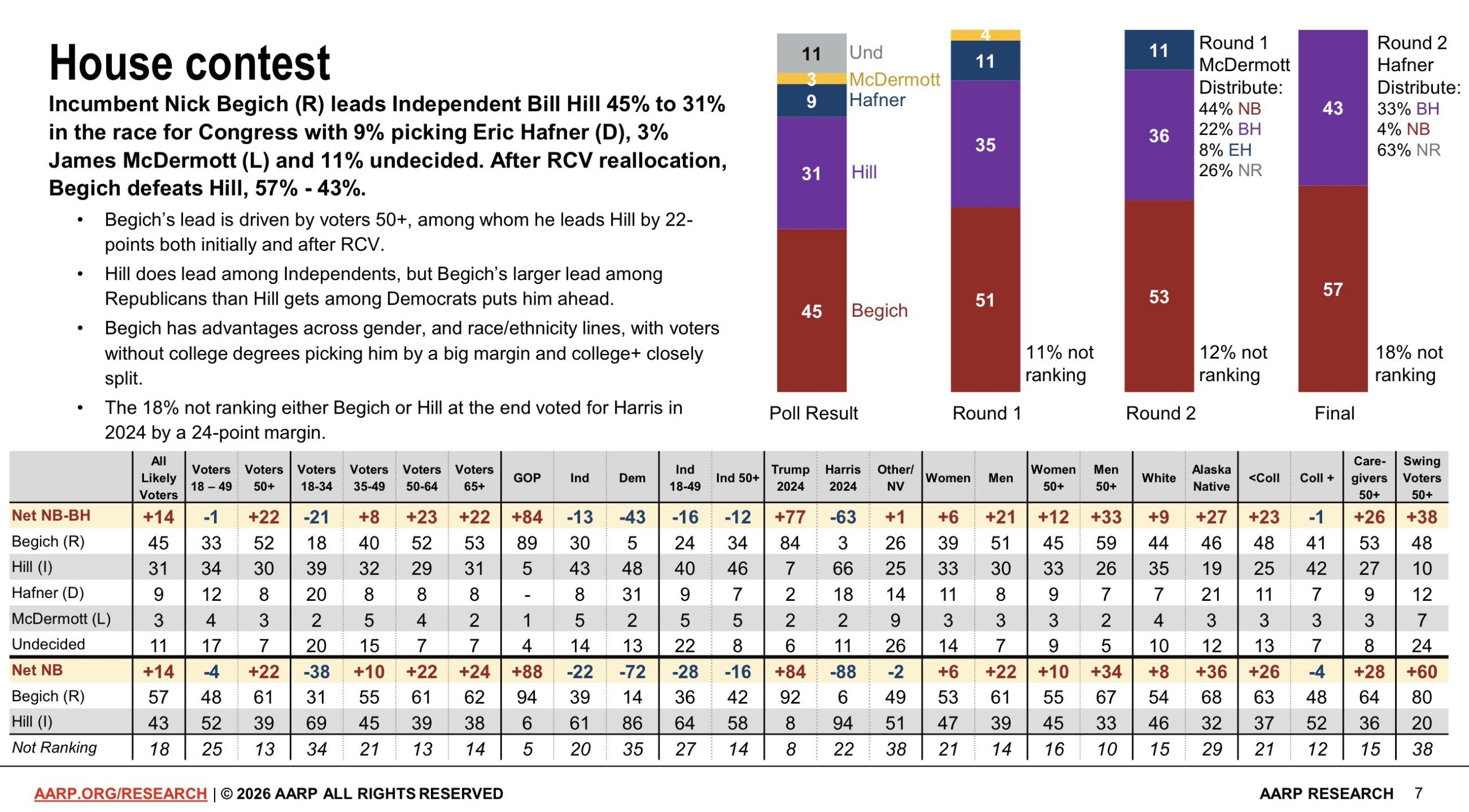
Average: Begich +16

Polling for Alaska's at-large House race

Only one major poll has run on this race, by Fabrizio Ward/Impact Research. It shows Begich winning the First Choice Round with an outright majority and +16 margin.

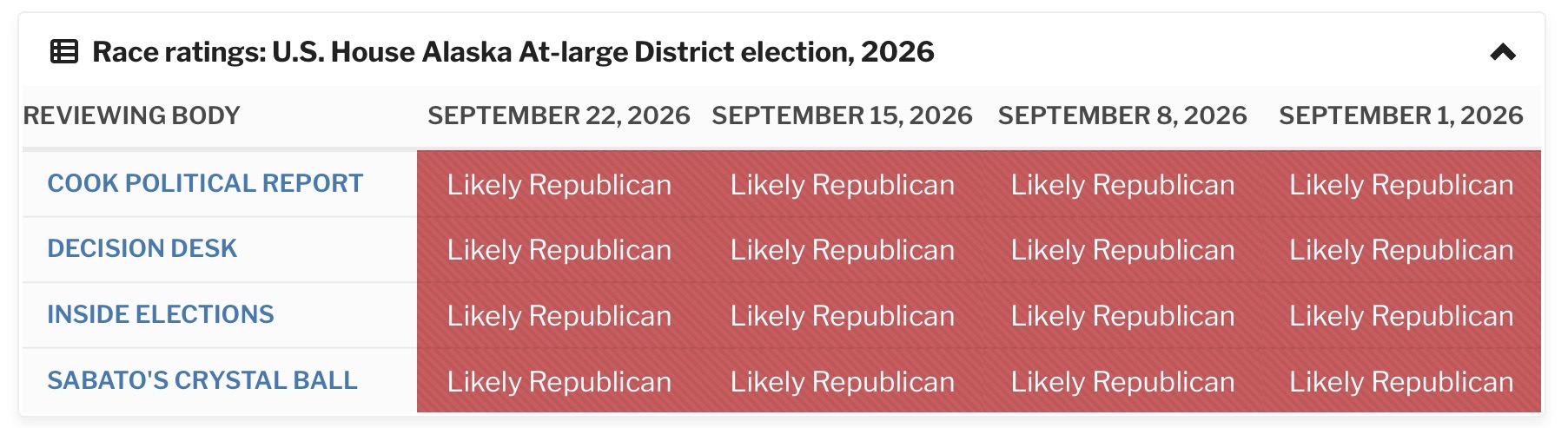
VII. Media Ratings

Media ratings for Alaska's at-large House race

No major ratings outlet is expecting an upset in this race.

VIII. Party Registration

Alaska voter registration by party

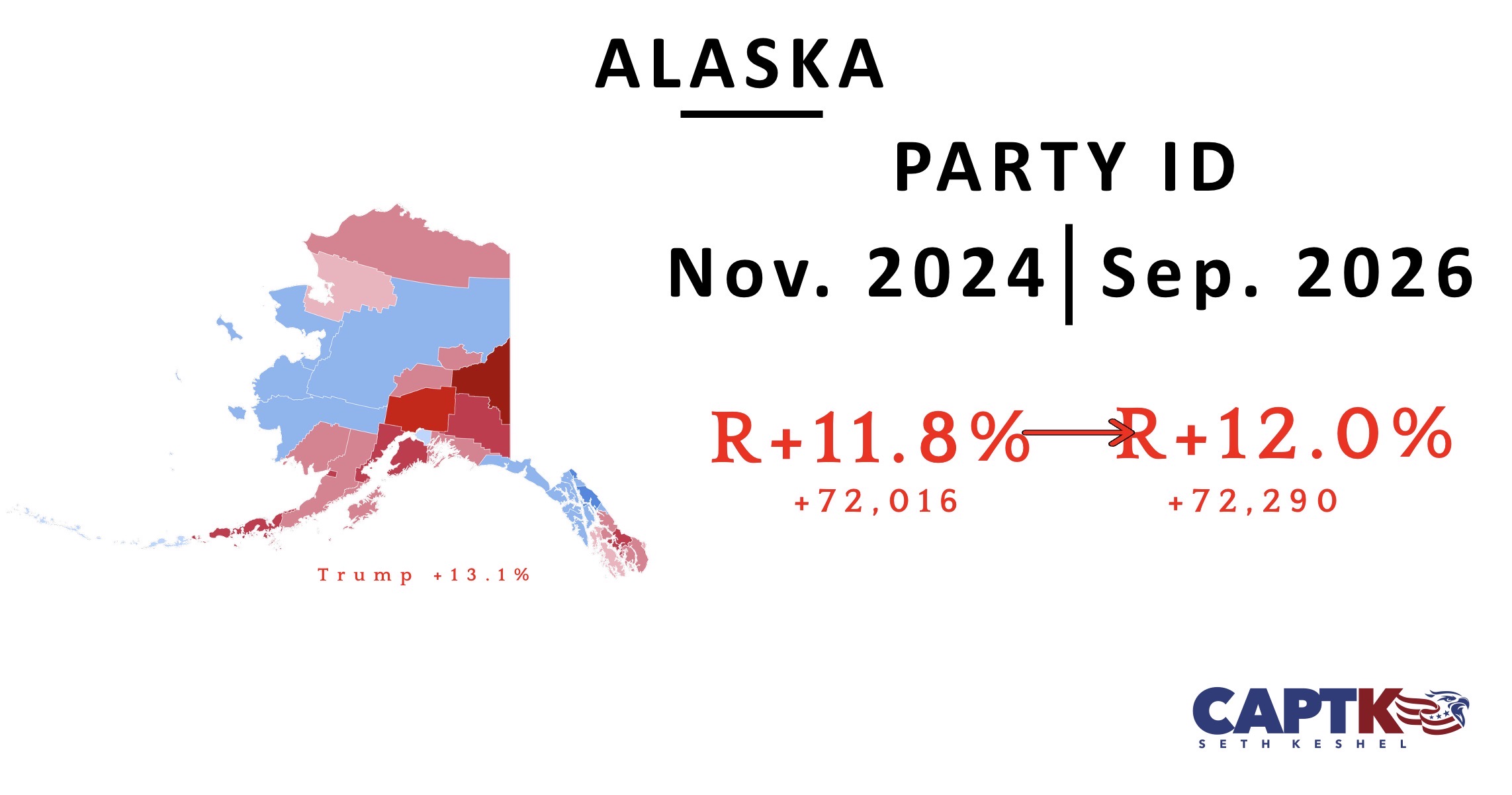
Democrats have made no progress in voter registration in Alaska, even inching backward since Trump’s +13.1% win there in 2024. There is no warning of a Democrat realignment of the state.

IX. Election Considerations

Alaska runs some of the worst elections in the country. I detailed this in a recent article decrying the Senate picture, which I will paint in full within these virtual pages soon:

Why Alaska Can’t Have Nice Things (Capt. Seth Keshel, August 21)

Alaska has roughly 1/23rd the population of Florida, yet requires two weeks to count them all, aided largely by expanded mail-in voting and the ridiculous Ranked Choice Voting reallocation process if a candidate doesn’t secure a majority in the First Choice Round. I expect these concerns to be a major factor in the Senate race, but not so much in this House race. You can read about the pitfalls of Alaska’s election system in detail here:

Far West – 2024 Election Compendium (Capt. Seth Keshel, January 10, 2025)

X. Summary and Election Estimate

Three factors greatly favor Begich:

  • Member of a well-known Alaskan political family
  • Democrats ran their only viable federal candidate for the U.S. Senate seat
  • He isn’t even facing a serious Democrat, which will defuse polarization animosity

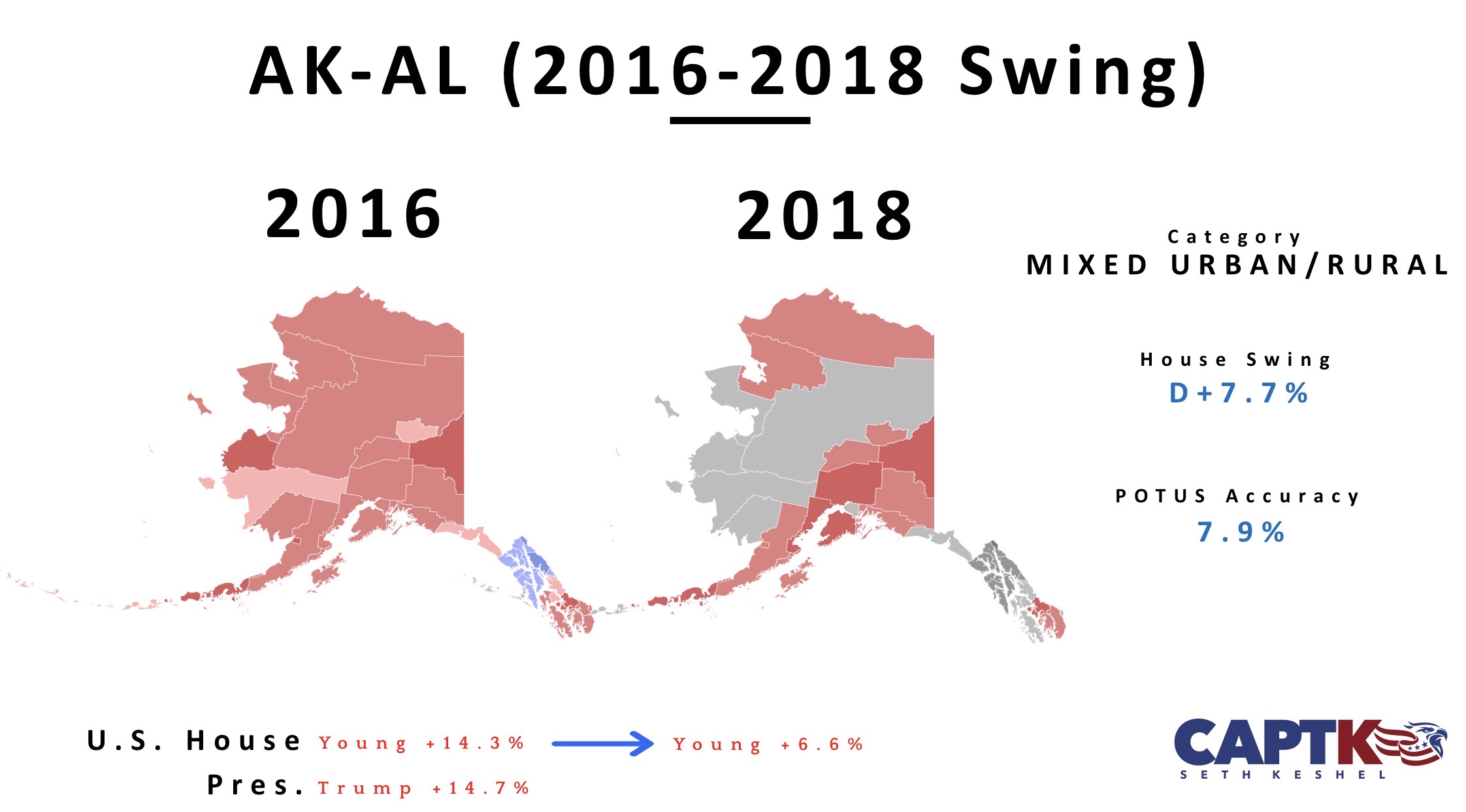
Otherwise, he would be in for a serious campaign. Young, who ran almost dead even with Trump in 2016, lost 7.7% of his margin in the 2018 midterm swing:

Don Young's 2016 and 2018 results compared

That swing in 2026 would doom Begich, who won by 2.4% in 2024, by over 5 points.

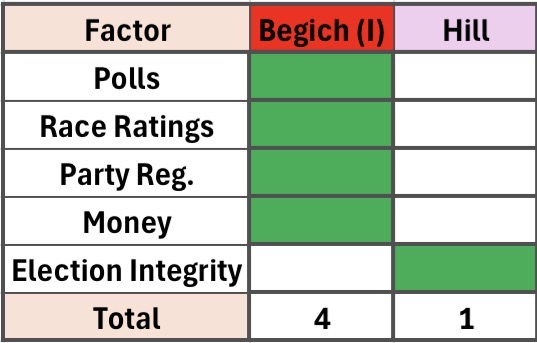
Here is how the key factors in this race stack up:

Key factors in Alaska's at-large House race

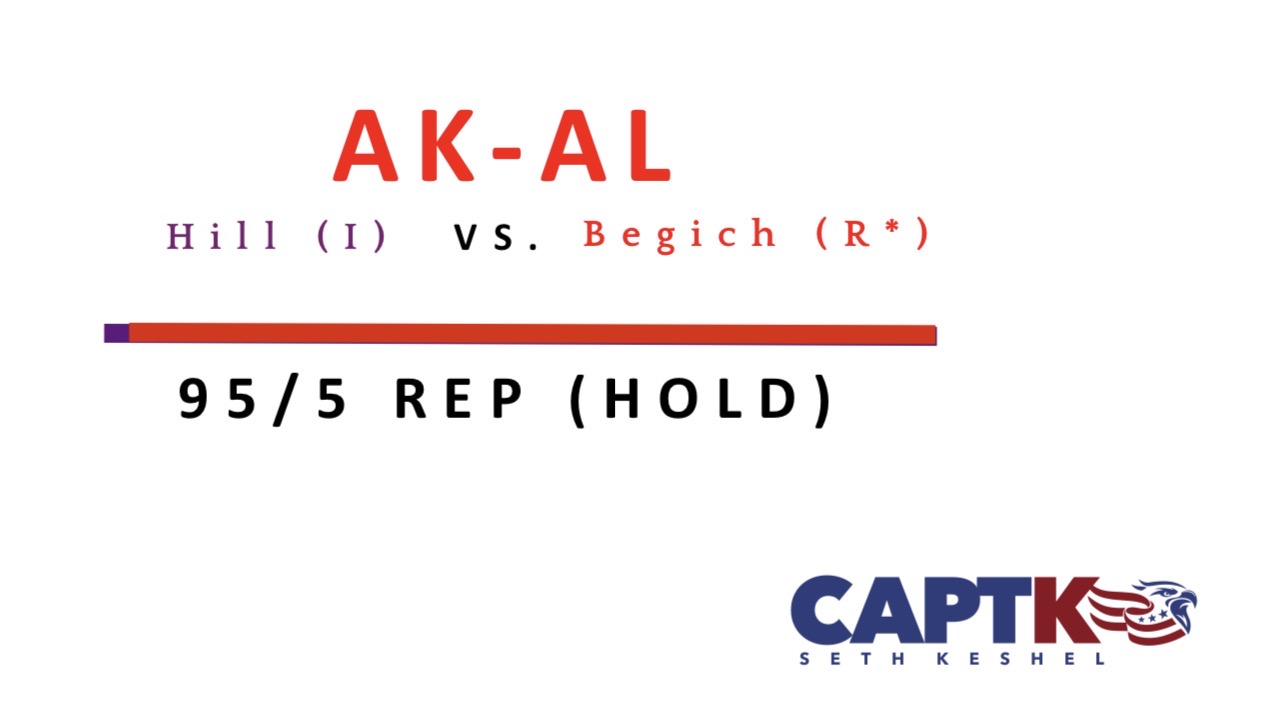
Forecast for AK-AL

Forecast for Alaska's at-large House seat

Rep. Begich is highly likely to hold his seat, which is a must-win for the GOP and only downgraded to leaner because of the factors listed above.

Seth Keshel, MBA is a Senior Fellow at the Gold Institute for International Strategy and a retired Army Captain. He publishes Captain K’s Corner on Substack.

Peter Huessy on Nuclear Deterrence and the Challenge of Modernizing America’s Triad

Episode art for The John Batchelor Show segment with Peter Huessy

Senior Fellow Peter Huessy joined The John Batchelor Show to discuss nuclear deterrence and the challenges of modernizing America’s nuclear forces.

On The John Batchelor Show, Peter Huessy reflects on Cold War nuclear civil defense drills and examines modern nuclear strategy. He outlines the history of arms control, explaining that the US exited the 1972 ABM Treaty in 2002 to deploy ballistic missile defenses against emerging threats like North Korea. Huessy emphasizes the urgent necessity of modernizing America’s aging nuclear triad (55-year-old Minuteman III missiles, 40-year-old submarines, and 70-year-old B-52 bombers) to maintain effective deterrence against Russia’s vast tactical nuclear arsenal.

Peter Huessy is a Senior Fellow at the Gold Institute for International Strategy, a Washington D.C. based foreign policy and defense think tank.

Listen on The John Batchelor Show

Syria’s al-Sharaa Tells Kurdistan 24 Damascus Has Good Ties with KRG and Barzani Leadership

Syrian President Ahmad al-Sharaa at an Atlantic Council meeting in New York

This article was written by Sangar Akrayi and appeared in Kurdistan24. Syria’s al-Sharaa tells Kurdistan 24 Damascus has good ties with KRG and Barzani leadership.

Featuring Rahim Rashidi, Media Fellow, Gold Institute for International Strategy

ERBIL (Kurdistan 24) – Syrian President Ahmad al-Sharaa told Kurdistan 24 in an exclusive exchange that Damascus enjoys good economic and security ties with the Kurdistan Regional Government and with President Masoud Barzani, President Nechirvan Barzani, and other Kurdish political groups, describing the relationship as still in its early stages while expressing confidence that the two sides can build on these foundations and develop their relationship further in the future.

Rahim Rashidi

The statement was made in response to a question from Kurdistan 24 Bureau Chief Rahim Rashidi at a Meeting organized by Atlantic Council in New York about the state of relations between Syria and the Kurdistan Region.

Al-Sharaa’s characterization of the ties as good across both economic and security dimensions is significant, given the complexity of the relationship between Damascus and the Kurdish-led Autonomous Administration of North and East Syria, also known as DAANES, which controls a large portion of northeastern Syria. The distinction al-Sharaa draws between his ties with the Kurdistan Regional Government in Erbil and the broader Kurdish political landscape, naming both President Barzani and Nechirvan Barzani alongside other groups, suggests Damascus is engaging with the full spectrum of Kurdish political actors rather than limiting its engagement to a single party or institution.

The description of the relationship as being in its early stages is an honest acknowledgment that the post-Assad transition has only recently created the political conditions for normal relations between Damascus and Erbil to develop. Under Assad, Syria’s relationship with the Kurdistan Region was shaped by the broader regional dynamics of Iranian influence, PKK presence in Syria, and the closed border that limited economic interaction. With Assad gone, sanctions lifted, and Syria reintegrating into the regional and international community, the relationship between Damascus and Erbil is genuinely starting from a new baseline.

The interview comes as Syria is simultaneously pursuing a security agreement with Israel, managing the integration of SDF forces into its national army, rehabilitating the Ottoman-era railway connecting Europe to the Red Sea in partnership with Türkiye and Saudi Arabia, and positioning itself as a regional energy transit hub through the Basra-to-Baniyas oil corridor backed by a Chevron-led $5.7 billion pipeline contract. The Kurdistan Region’s own strategic importance as a stable and internationally connected entity on Syria’s eastern frontier makes building ties with Erbil a natural component of Damascus’s broader regional integration strategy.

Read the full article at Kurdistan24

Rahim Rashidi is a Media Fellow at the Gold Institute for International Strategy, a Washington, D.C. foreign policy and defense think tank.