
Toshio Masuda argues that Japanese Prime Minister Sanae Takaichi struck at the weak points of both President Trump and Xi Jinping for Taiwan’s sake, in the October 2, 2026 edition of his Free Internet Seminar.
Continue reading
Toshio Masuda argues that Japanese Prime Minister Sanae Takaichi struck at the weak points of both President Trump and Xi Jinping for Taiwan’s sake, in the October 2, 2026 edition of his Free Internet Seminar.
Continue reading
Recognizing Somaliland would force Washington to weigh territorial integrity against self-determination, stability and strategic access to the Red Sea.
Continue reading
This article was written by Jeury Ruiz and appeared in RCC Noticias. Diputado español dice no hay condiciones para elecciones en Venezuela mientras Delcy siga en el poder; la califica de “criminal”.
Featuring Hermann Tertsch, Distinguished Fellow (Honorary), Gold Institute for International Strategy
Spanish MEP Hermann Tertsch of the Vox party, a journalist, said that the conditions needed to hold free elections in Venezuela do not currently exist as long as Delcy Rodríguez remains in power, while maintaining that the vast majority of Venezuelans aspire to a democratic outcome and to the return of the millions of citizens living outside the country.
During an interview given to the program Rumbo Radio, Tertsch called Rodríguez a “criminal.”
“Delcy is a criminal, just like everyone who is part of the repressive apparatus in Venezuela under chavismo. I mean to say that there is no explanation or justification for Delcy to remain there. It is an absolutely untenable situation and, in the United States, in Washington, they are beginning to realize it; more and more voices are saying so,” the lawmaker said.
He questioned her continuing at the head of Venezuela, considering that her remaining in power makes it unfeasible, under current circumstances, to hold an electoral process that could be considered truly free.
“Right now the conditions do not exist with Delcy in power; there are no conditions for elections,” said Tertsch, who nevertheless considered that they could be created within six months if a transition process begins to move forward with the participation of Venezuelans and the backing of the United States.
The writer also maintained that Venezuela needs a date for the elections and a timetable that lets the population know the steps and deadlines of the transition. In his view, that process must lead to a democratic outcome and allow the return of Venezuelans who are abroad.
Tertsch said that most Venezuelans want a democratic solution and that the roughly eight million citizens who, as he mentioned, are outside the country should be able to return. “The immense majority, 90-some percent of Venezuelans, want a democratic exit that is scheduled,” he said during the conversation.
“The Venezuelan regime is a Cuban regime”
At another point in the interview, Tertsch maintained that the Venezuelan political system answers to a “Cuban regime,” which he described as a model of great “perversity” and sophistication in its mechanisms of control and destabilization.
“The regime is a Cuban regime, and the Cuban regime is of an immense perversity and sophistication in its perversity,” he maintained.
The Spanish politician called on Venezuelans to avoid provocations, but at the same time to make clear that there is a majority demand for a democratic transition with concrete dates and conditions. “Do not fall for provocations,” he urged, warning about what he considers mechanisms used by the regime to generate fear and discourage any movement toward a transition.
Says María Corina Will Return to Venezuela Soon
The Spanish MEP said that Venezuelan opposition leader María Corina Machado will return to the country “very soon,” despite attempts that, he said, have been thwarted. His statements came while addressing the political transition process in Venezuela and the conditions for holding future elections.
Hermann Tertsch maintained that Machado’s participation will be fundamental in any electoral process seeking to advance toward a democratic transition and considered it necessary that Venezuelans be able to return to the country and freely express their political will.
“I believe she is going to go to Venezuela, and she is going to go to Venezuela very soon. There are no elections without María Corina, there are no elections of any kind without Venezuelans returning and Venezuelans being able to express themselves freely,” he stated.
The MEP also proposed that Venezuela must advance toward an “orderly” democracy and said that process must respond to the criteria of Venezuelans themselves. He also expressed his expectation that progress will be made relatively soon in the country’s political transition.
His statements come amid the debate over Venezuela’s political future and the conditions that should be established for an eventual call for elections.
Read the full article at RCC Noticias
Hermann Tertsch is a Distinguished Fellow (Honorary) at the Gold Institute for International Strategy, a Washington, D.C. foreign policy and defense think tank.

This article was written by Peter Huessy and appeared in RealClearDefense. President Kennedy: MAD & the Lessons of Berlin and Cuba.
Nuclear weapons and the deterrent strategy accompanying their deployment are sometimes poorly understood. For the general public that is understandable given the complexities of preventing nuclear war. What is most worrisome are those “experts” who widely seek the abolition of nuclear weapons but are often confused about the real American nuclear deterrent necessary to prevent war.
For example, the most misunderstood idea is often referred to as MAD or mutual assured destruction. This is the assumption that U.S. strategy relies on the idea that should the U.S. be attacked with nuclear weapons, our only option would inevitably lead to the exchange of such overwhelming nuclear force as to destroy both our own country and the adversary nation. A second bad assumption is that since MAD if carried out would get us all killed, reductions toward zero nuclear weapons—abolition–should be our highest priority. And since it’s still an all or nothing MAD strategy, prudence would jettison the idea of nuclear deterrence altogether. Including any call for any flexible or limited regional response capability.
Over sixty years ago, President Kennedy warned that having just two unpalatable choices — risk MAD (all-out nuclear war) or surrender — was a prescription for more war. In two nuclear crises of his administration, in Berlin in 1981 and in Cuba in 1962, the U.S. had both force flexibility (new SLBM & ICBM missiles) and just plain luck (Khrushchev wasn’t completely reckless) that brought the crises to an end without war.
In August 1961, for example, Kennedy had previously told the Soviet leader that a threatened Russian attack on the American military garrison in Berlin meant nuclear war. We had significant (3900) battlefield nuclear forces in Germany. But we also had a newly deployed strategic sea-launched long-range missile aboard submarines which Kennedy thought saved the day and which he later would personally thank the Lawrence Livermore team for developing. Thus, Khrushchev knew Kennedy meant business. Although the General Secretary eventually didn’t attack, he went and built the Berlin Wall, an off ramp critical to standing down from nuclear war.
Bu the USSR leader wasn’t done. A year later, October 1962, U.S. intelligence determined the Soviets had placed nuclear armed missiles in Cuba. On that very day, coincidentally, the USAF had just deployed the very first Minuteman ICBMs in Montana. A key to the crisis resolution was a secret deal. Kennedy then knew Minuteman meant the U.S. no longer needed the U.S. medium range missiles in Turkey—close enough to strike key targets in the Soviet Union. The new Minuteman missiles could also reach Moscow. Kennedy later declared that “Minuteman was my ace in the hole” as he secretly traded away the U.S. missiles based in Turkey for the Soviets removing the close-in missiles in Cuba.
In both cases, the U.S. avoided nuclear war. Deterrence held, albeit with some fortuitous help.
But could we continue to rely on just in time new technologies that saved the day or the good sense of our adversaries? How best to continue?
According to nuclear expert Frank Miller, since the very beginning of the Truman administration, it was American strategy to go after key overall Soviet military capabilities. Over time, as missile accuracy improved, U.S. strategy was to go after Soviet military systems themselves such as missile silos. The key reason the U.S. needed such flexible nuclear firepower was that President Eisenhower knew it would have bankrupted the USA to build the conventional force necessary to match the Soviet and Warsaw Pact conventional forces. The Kennedy administration emphasized the targeting of Soviet warmaking assets, despite Secretary of Defense McNamara later shielding the U.S. move toward keeping at risk Soviet military assets by falsely claiming the U.S. still operated under the strategy of MAD.
The U.S. thus from the very early years of the nuclear age had response options other than simple massive retaliatory strikes on urban areas. Eventually the deterrent strategy the U.S. adopted, in place now for decades, held at risk those elements of power of great importance to the leaders of the Soviet Union and China, for example and explicitly took off the table city busting. And after the 1957 Soviet launch of Sputnik, the U.S., in an extraordinary technological feat built both a submarine and a companion sea launched ballistic missile by 1960, and an ICBM silo-based missile called Minuteman by 1962 to carry out just such a strategy as eventually adopted.
Why is this important? Without a U.S. capability to target the military forces of the USSR or China, their war forces would be in a sanctuary from which they could attack the United States or its allies with impunity. Having only the capability to deliver MAD is not a credible deterrent as President Kennedy warned.
As Miller writes, such a flexible strategy has been U.S. policy since at least the Truman administration when U.S. policy was to destroy the capability of the USSR to “wage aggressive war,” and destroy those elements of the Soviet military that would “halt aggression.” Thus, 14 American Presidents from 20 administrations, over 75 years have used such a strategy to avoid direct military conflict between nuclear armed powers.
Now the U.S. unilaterally got rid of over 90% of its theater nuclear weapons in 1991 as the Cold War was over, and as we thought at the time, a Russian led assault on Western Europe was no longer a threat. The U.S. also reduced our strategic nuclear forces from roughly 10,000 to 1550, as we assume Russia did too in three landmark arms deals (START I, the Moscow deal and New START.)
At the time of the 1991 Presidential Nuclear Initiative, (PNI) the Europeans insisted the U.S. have an insurance policy—leave behind, a small extended nuclear force in Western Europe. The U.S. did so with a few hundred gravity bombs in Europe. This was not any plan to start or initiate a nuclear war, contrary to some recent muddled commentary. It was to give the President options other than the threatened all-out use of strategic long range nuclear forces to deter adversaries from attacking the U.S. and Europe in the first place. It has turned out not to be enough.
The Russians in 1991 did not follow suit with a PNI of their own, and the Russians kept at least 2000 and as many as 4000 such “battlefield” nuclear forces.
Then on April 30, 1999, a new nuclear policy was crafted by a small group of top Russian officials. President Yeltsin in a secret meeting of the Politburo called for Russia to develop highly accurate and very low yield nuclear weapons able to be used on the conventional battlefield. Mr. Putin as President put the decree into force. The strategy has variously been described as “escalate to win” or “escalate to de-escalate,” or the use of such battlefield nuclear forces to exercise blackmail, coercion or actual terror, and swiftly change the direction of conventional conflicts toward Russia’s favor.
While the U.S. does have a small number of theater nuclear forces now in Great Britain, the U.S. needs more flexible forces to better hold at risk our adversary’s military capability. Although it is not explicitly known, the lack of sufficient U.S. and allied deterrent choices at the regional/battlefield level may have been a factor in the Russian decision in 2014 and 2012 to invade Ukraine, as well as previous aggression against Georgia and Moldova. Despite declaring that the independence of Ukraine is an existential issue, NATO has not sent its own forces to fight the Russians but only some conventional weapons delivered to Ukraine. To many in Russia, that “inaction” by NATO means NATO is deterred especially as Putin and officials within the Russian Federation routinely threaten the use of such theater nuclear weapons against Ukraine and NATO forces should Ukraine or its allies deploy certain kinds of weapons or attack certain Russian targets.
The Strategic Posture Commission concluded in 2023 that the United States needed additional regional or theater nuclear forces that were survivable, mobile, and prompt to deter Russian from escalating a conventional conflict to the nuclear level. The support was both bipartisan and unanimous. The deployment of a Navy nuclear armed sea-launched cruise missile is an added theater capability that can deliver deterrence and help keep the peace. It is supported by the U.S. Navy and funded by Congress. Such forces give the President options other than ending the world and have nothing to do with “starting” a nuclear war. True, the folks in Moscow and Peking see such theater/battlefield weapons as instruments of war that make aggression possible. But the U.S. and its allies believe nuclear and conventional forces are to deter and prevent war. That is how U.S. nuclear modernization and a flexible response capability will keep the nuclear peace.

Pete Ricketts (R-inc.) vs. Dan Osborn (I)
I. The Race
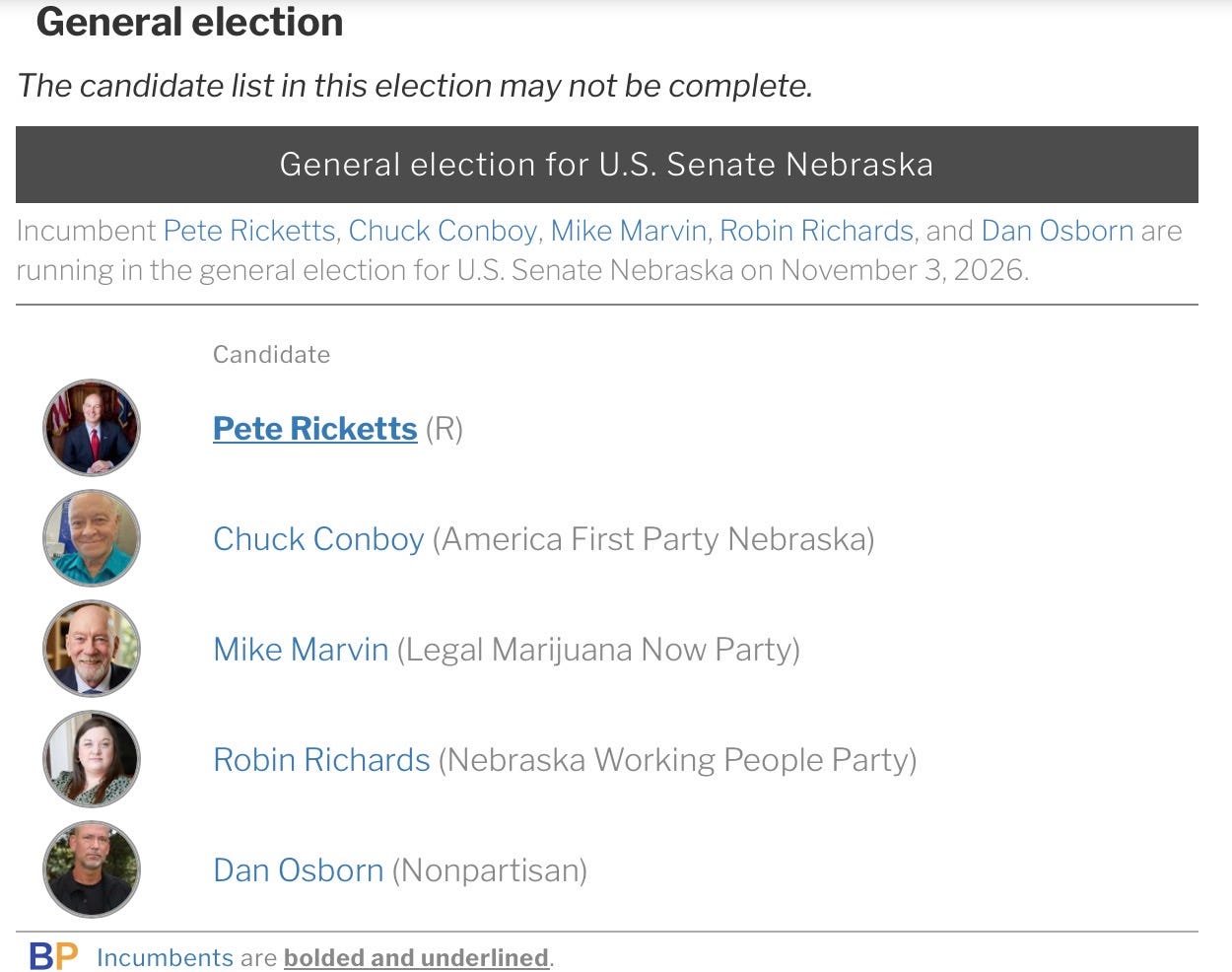
Pete Ricketts (Republican), the state’s former governor, stepped in to complete Ben Sasse’s second term as Nebraska’s junior senator by winning a special election in 2024. He outran President Trump by 4.7%, and senior senator Deb Fischer, running against Osborn on the same ticket, by 18.5%. His run this year requires a quick campaign turnaround, as it falls into the standard six-year slot for his seat.
Dan Osborn (“Independent”) is the labor union leader and faux Democrat taking his second consecutive crack at the United States Senate after giving Fischer a run for her money in 2024. There are three minor candidates officially in the race, but everyone knows it’s a two-man show between Ricketts and Osborn.
II. State Profile
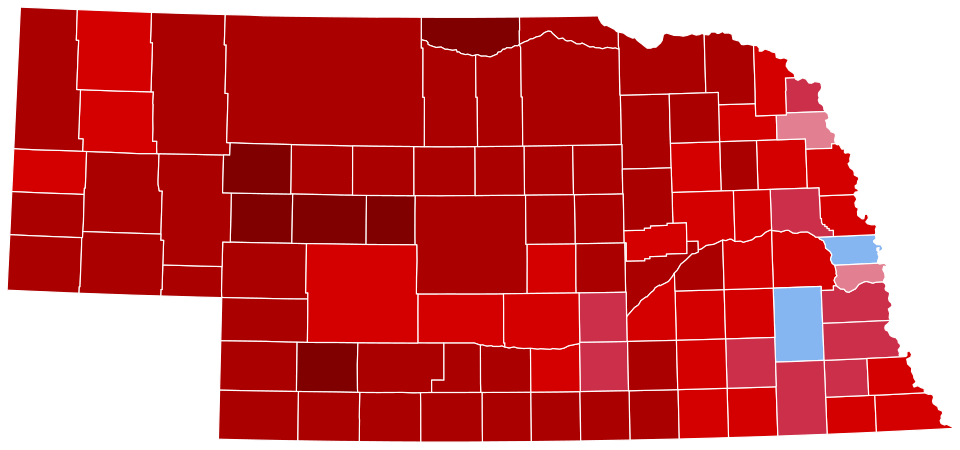
Nebraska is a presidential carbon copy of Kansas, except further to the right. It hasn’t supported a Democrat for president since 1964’s national landslide for Lyndon B. Johnson; however, it used to play Democrat ball in other races, and as recently in 2006 when it reelected Ben Nelson to the U.S. Senate instead of (ironically) electing Ricketts – whom Nelson stomped. Once Nelson retired, the state’s partisan lean took over and began sending two Republicans to Washington, D.C., to represent Nebraskans in the Senate.
Kamala Harris carried just two counties in 2004 – Douglas (metro Omaha) and Lancaster (metro Lincoln/University of Nebraska). Unfortunately, because the unicameral legislature is run by fools with little desire to win, Nebraska’s 2nd Congressional District is becoming unwinnable for GOP presidential candidates and will probably be won by the Democrats this year in the U.S. House race (to be profiled soon) now that the seat is open. Fischer beat Osborn in 2024 despite running a lazy campaign; the gray-shaded precincts below are the ones Osborn carried:
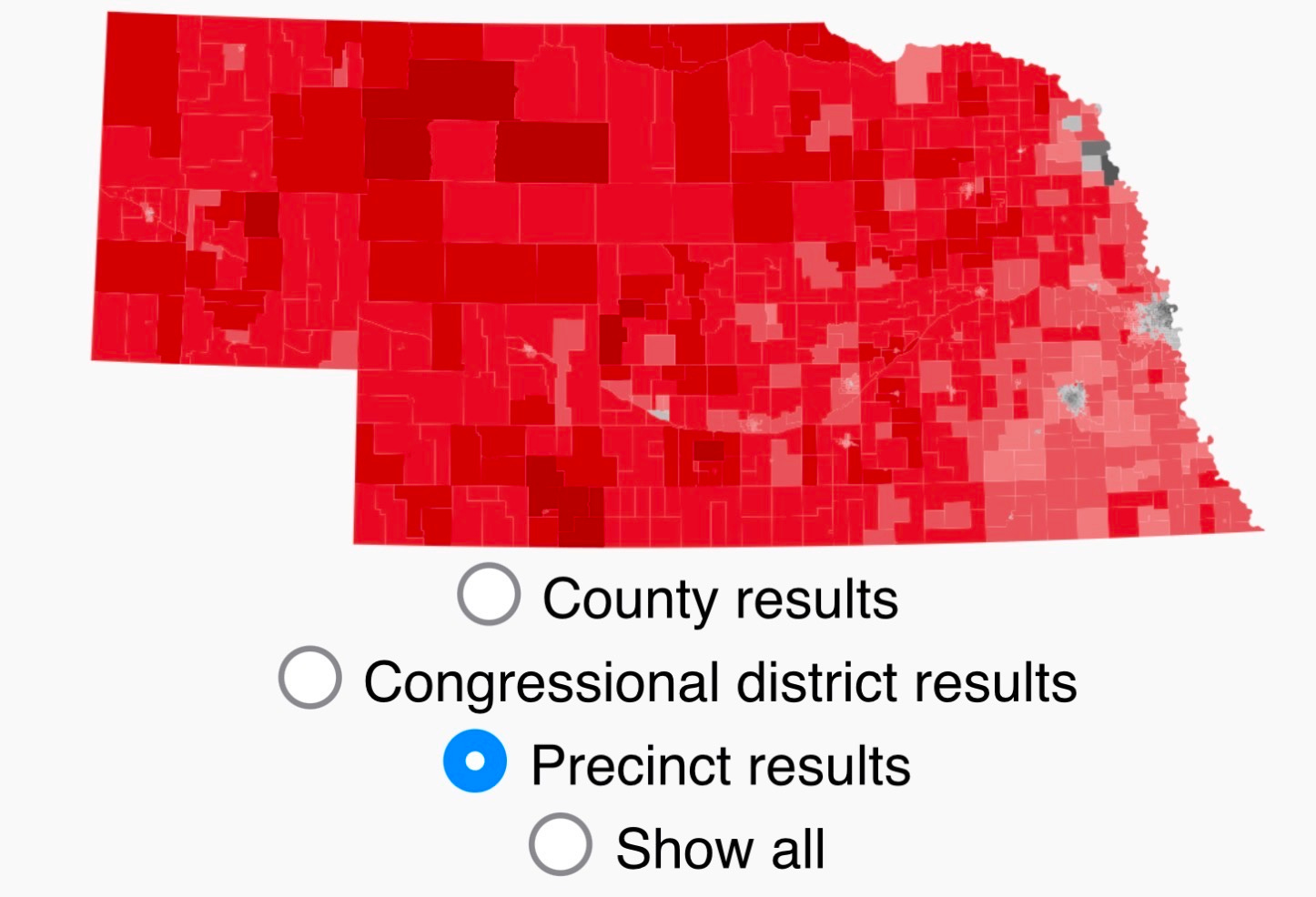
Other than a few outliers in the northeast, he did his damage in Omaha and Lincoln; however, as shown in the precinct map, the key to a presumptive win in 2026 will be to further erode the margins Republican strongholds, allowing the urban areas to put him over the top. The map in terms of red and gray (blue) will not look much different than the one above and will only vary in terms of intensity one way or the other. Osborn is currently doing all he can to make sure the red shades are deeper in intensity, as I will reiterate later in this piece.
Demographic Statistics
• 75.7% White, 12.0% Latino, 4.8% Black
III. Market Assessment
Despite the relatively close call in 2024, Polymarket bettors consider Ricketts a clear favorite, with even higher odds than Roger Marshall in Kansas.
IV. History
Osborn ran a close race in 2024 by posing as an “independent voice” against Fischer, the weaker of Nebraska’s two Senators (+15.5% margin in 2012, +19.1% margin in 2018). In contrast, Ben Sasse won in 2014 by +32.9%, and then again in 2020 by +38.3%. Sasse’s 2020 performance, even normalized to give all of his opponents’ vote shares to the Democrat alone, ran well ahead of Trump’s large presidential margin.
With Sasse out of the picture, enter Governor Ricketts. His margins for governor land in between Fischer’s for Senate (+17.9% in 2014, +18.0% in 2018), but he carries significant clout. His father, Joe, is a billionaire who founded TD Ameritrade and essentially owns the Chicago Cubs and Wrigley Field. With Osborn having come close in 2024, there is no more “sneaking up,” and Ricketts’ funding will serve as a means of simply turning out the “red” vote.
Nebraska’s days of electing straight-blue politicians to federal office are over. That is why Osborn is running as an “independent” – he knows the history and understands the partisanship.
V. Analysis of 2026 Primary Results
Ricketts faced no real opposition, taking 81.5% in the GOP Senate primary this year. Osborn, running with an “independent” label, didn’t have a primary, but the Democrats did:
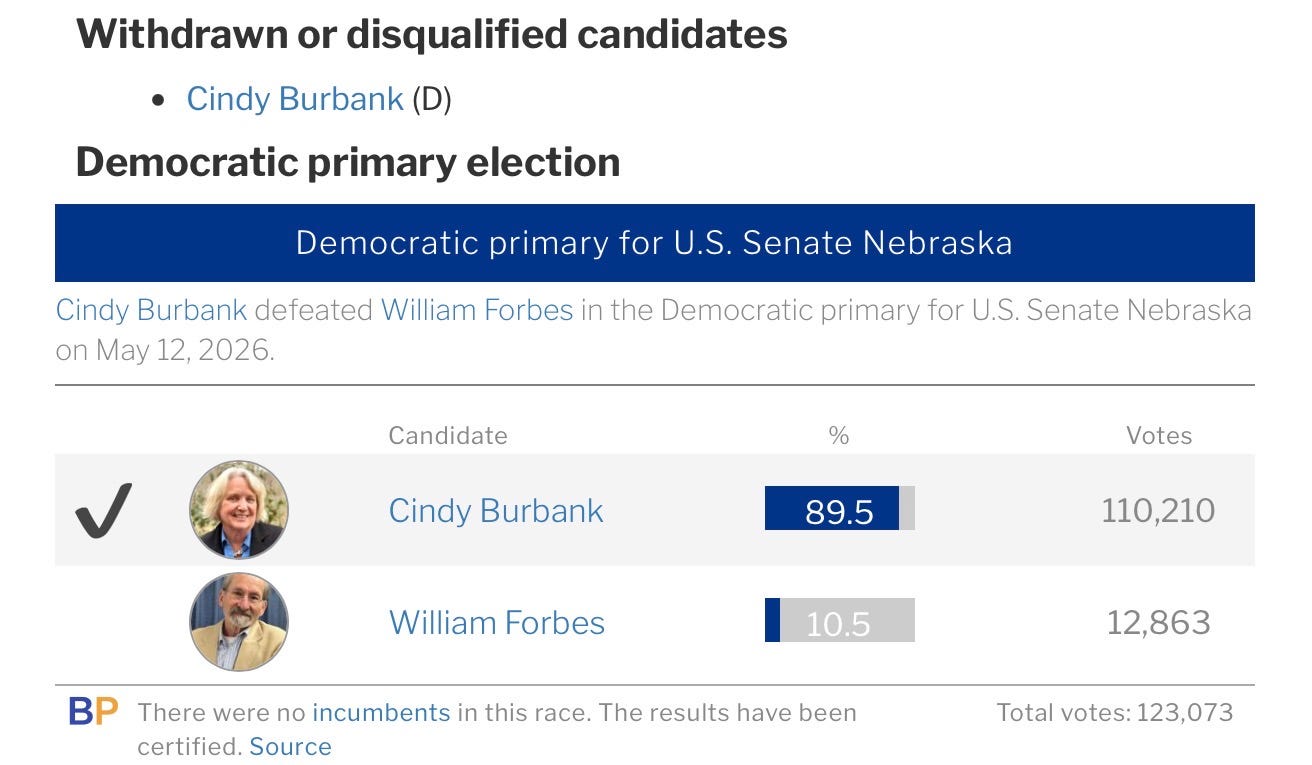
One major tell that Osborn is no “independent” is that Burbank won the primary and immediately withdrew. She ran to block any ambitious Democrat, or a Ricketts plant, from winding up on the ballot and splitting Osborn’s share of support. Ricketts should run crazy reminding voters that Osborn is the Democrat that party knows it can’t run with official branding.
VI. Polls
Pollsmax average: Even

RCP isn’t tracking all available polls, so I found the three most recently released on Pollsmax to calculate an “even” polling average. The SurveyUSA poll appears to be a Democrat internal that gives Ricketts just a 42% share of the vote, while having Osborn’s own share lower than the “even” poll or the Ricketts +4 poll. Tossing the SurveyUSA poll gives Ricketts a +2 average, right in line with where polling in Kansas has Marshall.
Market betting information suggests people aren’t putting much faith into these polls.
VII. Media Ratings
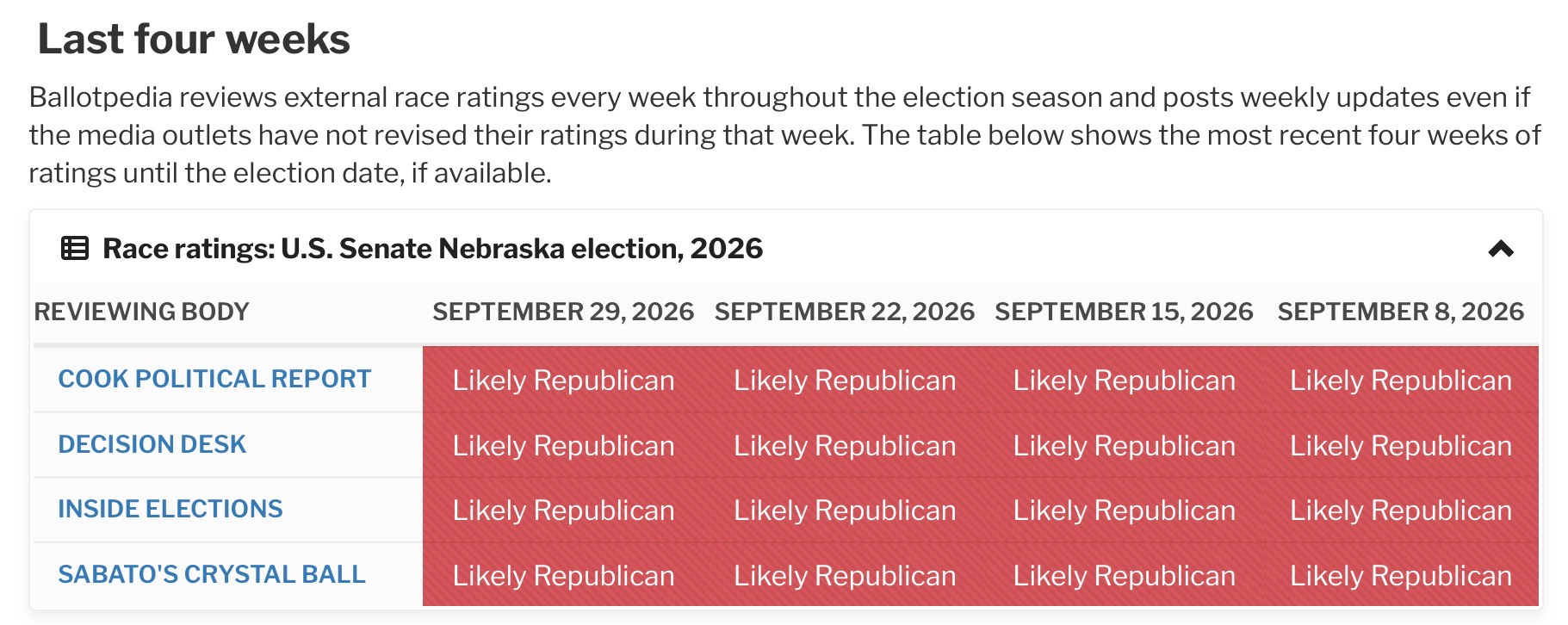
None of the major analysis think tanks are buying the Osborn hype – with “Likely Republican” the diagnosis across the board.
VIII. Party Registration
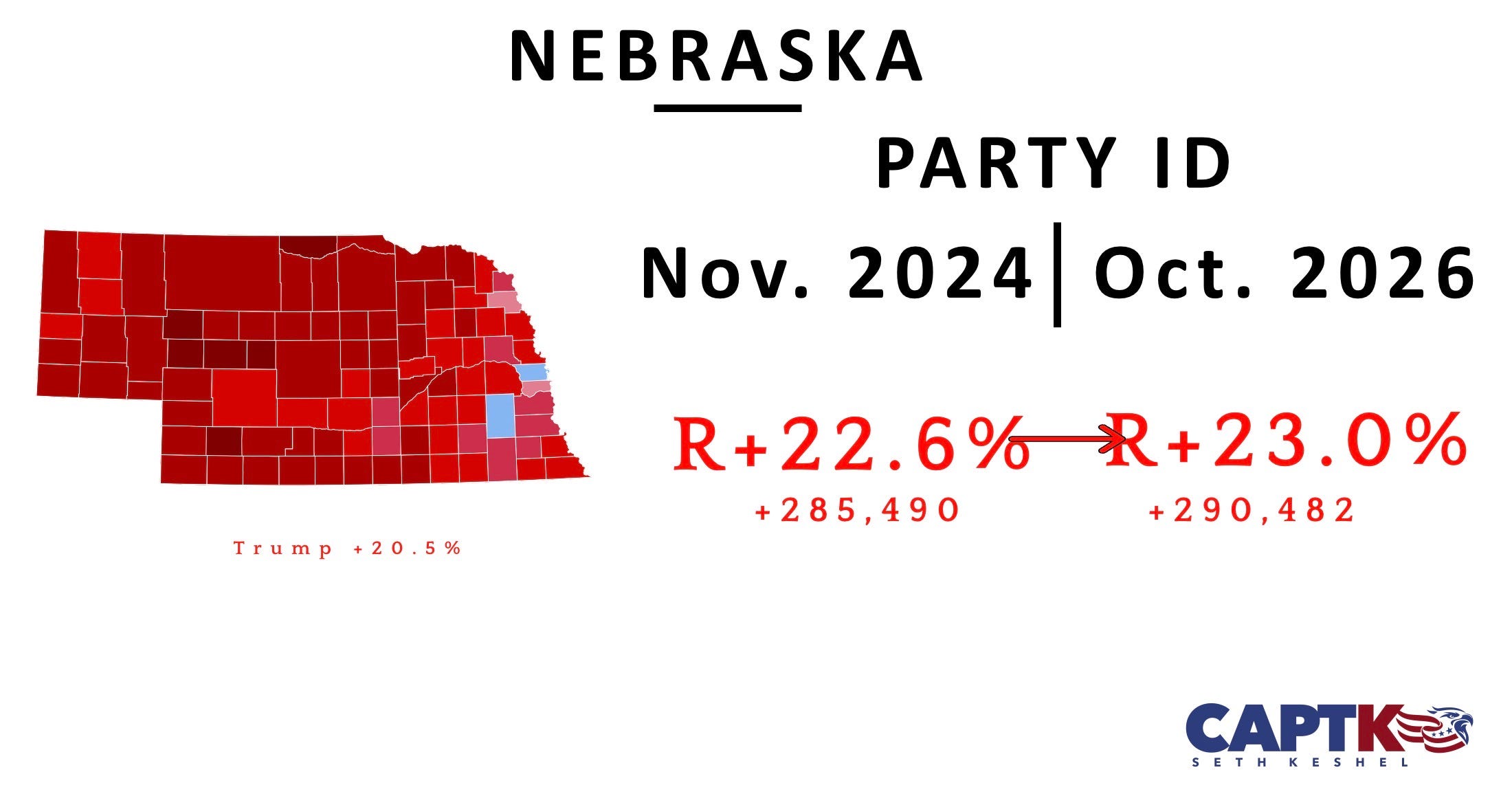
Nebraska, despite some recent Democrat gains in urban areas, is nearly 5,000 net registrations redder than it was in November 2024, when Osborn ran a relatively close race against Fischer alongside a Trump blowout.
IX. Election Considerations
Every state has issues with election administration, but the Great Plains region has low risk for rampant corruption thanks to laws preventing the worst practices, like mass mail-in voting.
X. Summary and Election Estimate
These are the major factors for the U.S. Senate race in Nebraska:
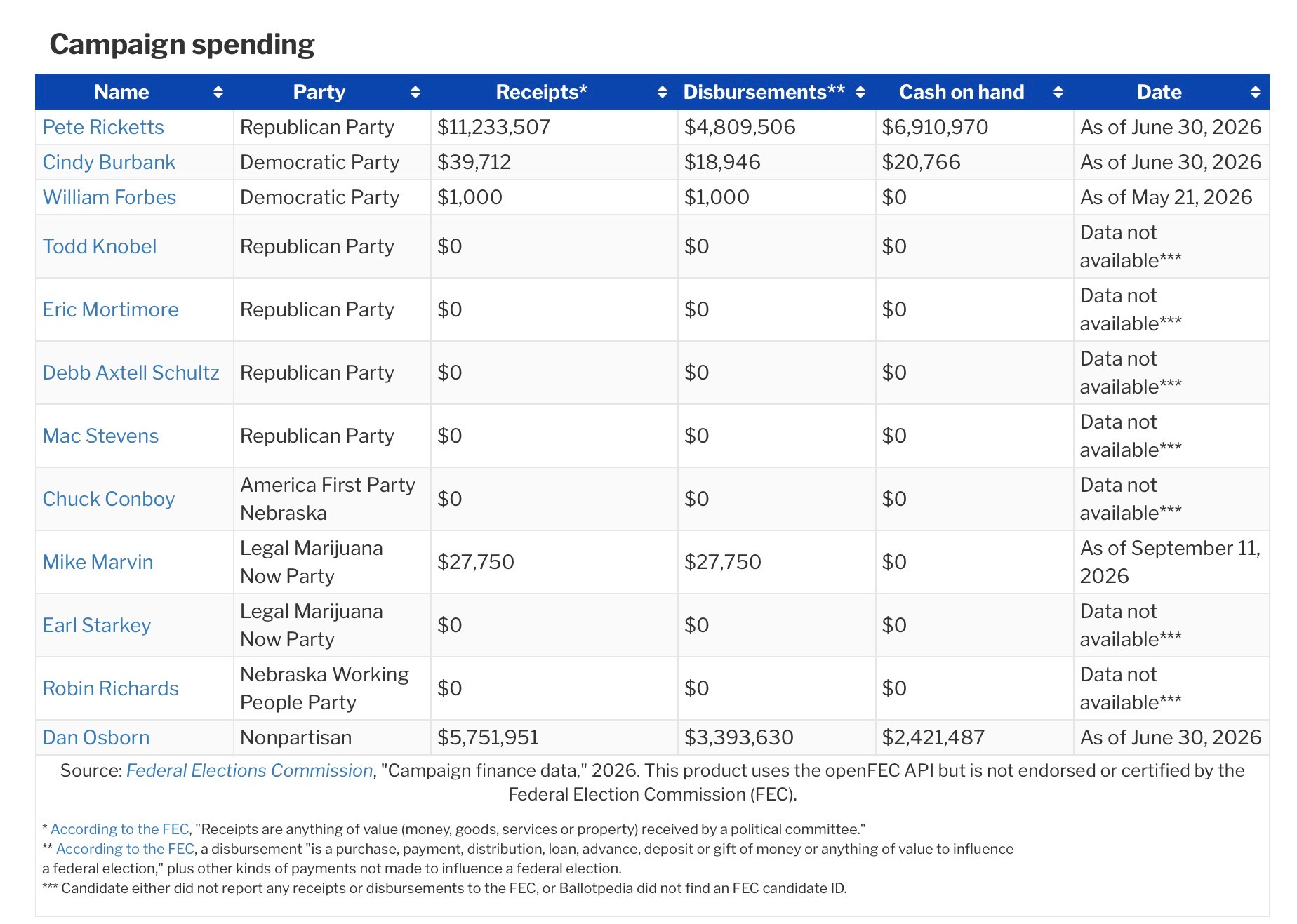
Money, money, money. The Ricketts machine has it, and will spend it all before they lose this seat:
Fischer, running an underprepared campaign relying on GOP party identification advantage, didn’t take Osborn seriously until after Labor Day in 2024. Thanks to the close call, Osborn isn’t sneaking up on anyone. Fischer “spotted the sniper,” just like Ted Cruz spotted Beto O’Rourke – who faded after his 2018 run. President Trump’s Grand Island rally planned for October 5 is proof that the element of surprise is gone for Osborn.
Ricketts is defining Osborn as “Democrat Dan,” and Osborn has been stepping in it frequently, being recorded proclaiming his support for radical positions that he won’t publicly back, and trashing the rural voters he needs to peel from Ricketts:
“Billy Bob in f—— Red Cloud, Nebraska, who lives next door to the f—— Trump store as you pull into town and is waving the Trump flag, all he knows is he’s like on the winning team,” Osborn said in the recording. “It’s really that simple. And Trump, and that is why he’s been so effective. He’s been so effective at taking Billy Bob and his wife Mary Jane or Mary Jo and telling them, ‘Look, we’re winning. You’re on the winning team.’ And that’s all they care about, because their lives probably suck so f—— much.”
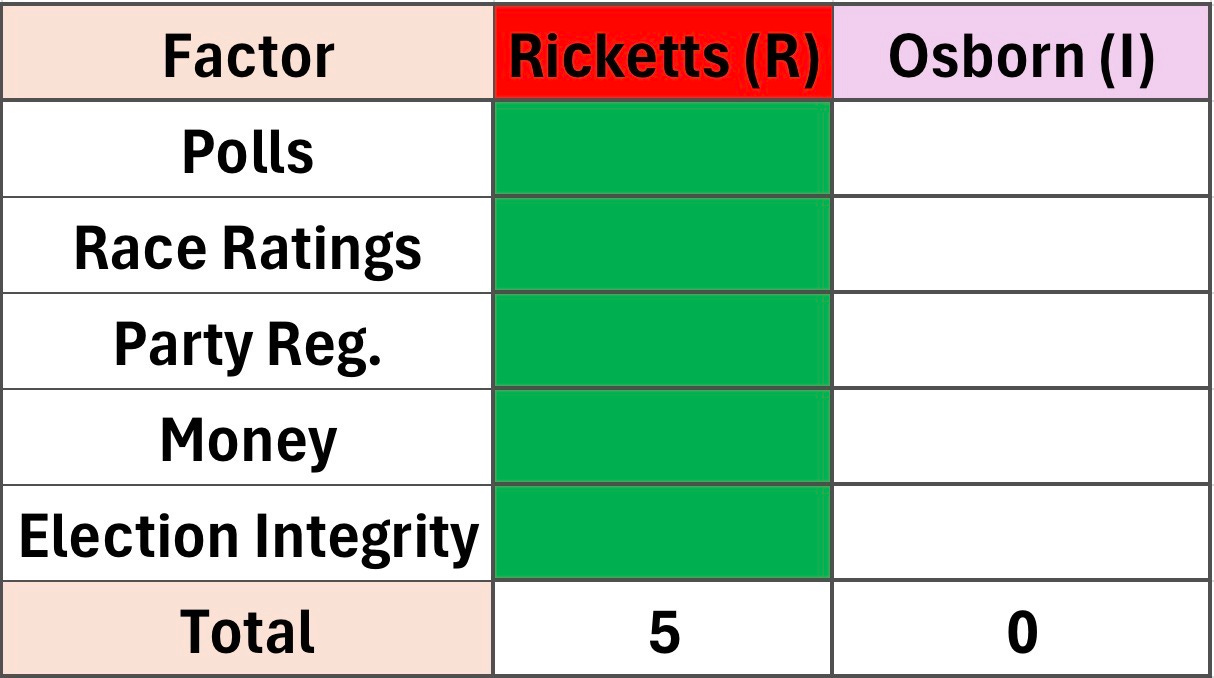
Here is how the key factors in this race stack up:
Forecast for Nebraska U.S. Senate
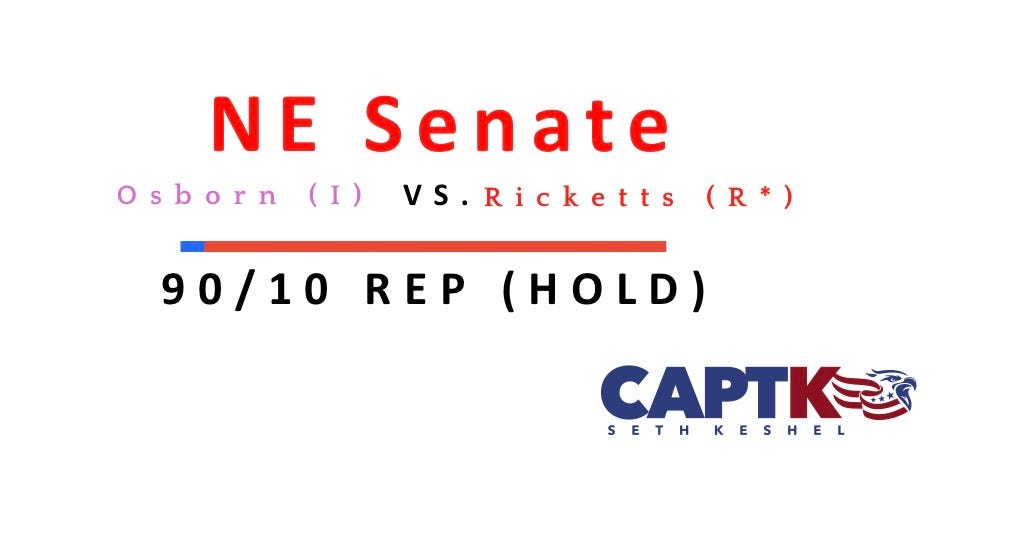
Osborn had his best shot in 2024 against an underwhelming opponent who didn’t take his campaign seriously until the last minute. Ricketts has overwhelming financial backing and is now armed with plenty of evidence portraying Osborn as someone who resents Trump’s rural voting base and who is in line with Democrat priorities. Because of midterm dynamics and the “independent” ruse, Ricketts isn’t likely to win this race by standard Republican margins, but I don’t think it will be uncomfortably close.
Seth Keshel, MBA is a Senior Fellow at the Gold Institute for International Strategy and a retired Army Captain. He publishes Captain K’s Corner on Substack.