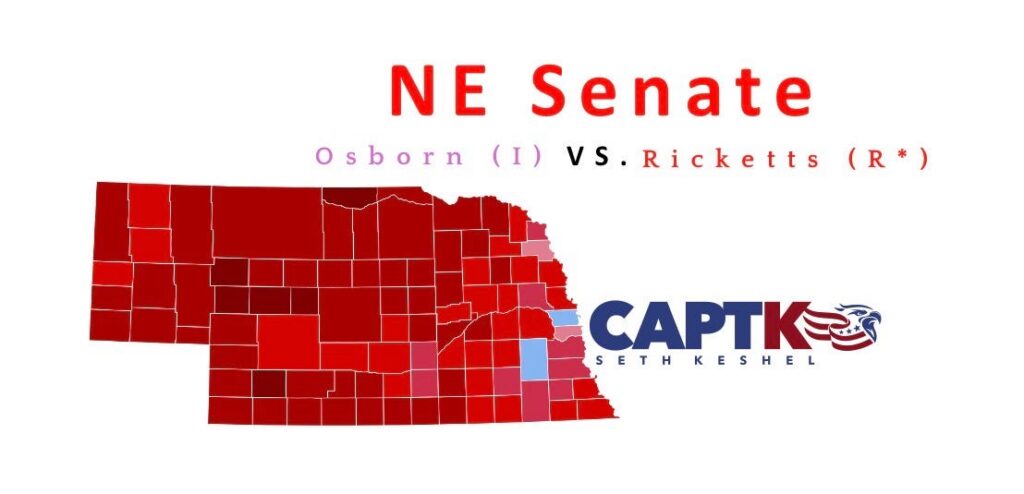
Pete Ricketts (R-inc.) vs. Dan Osborn (I)
I. The Race
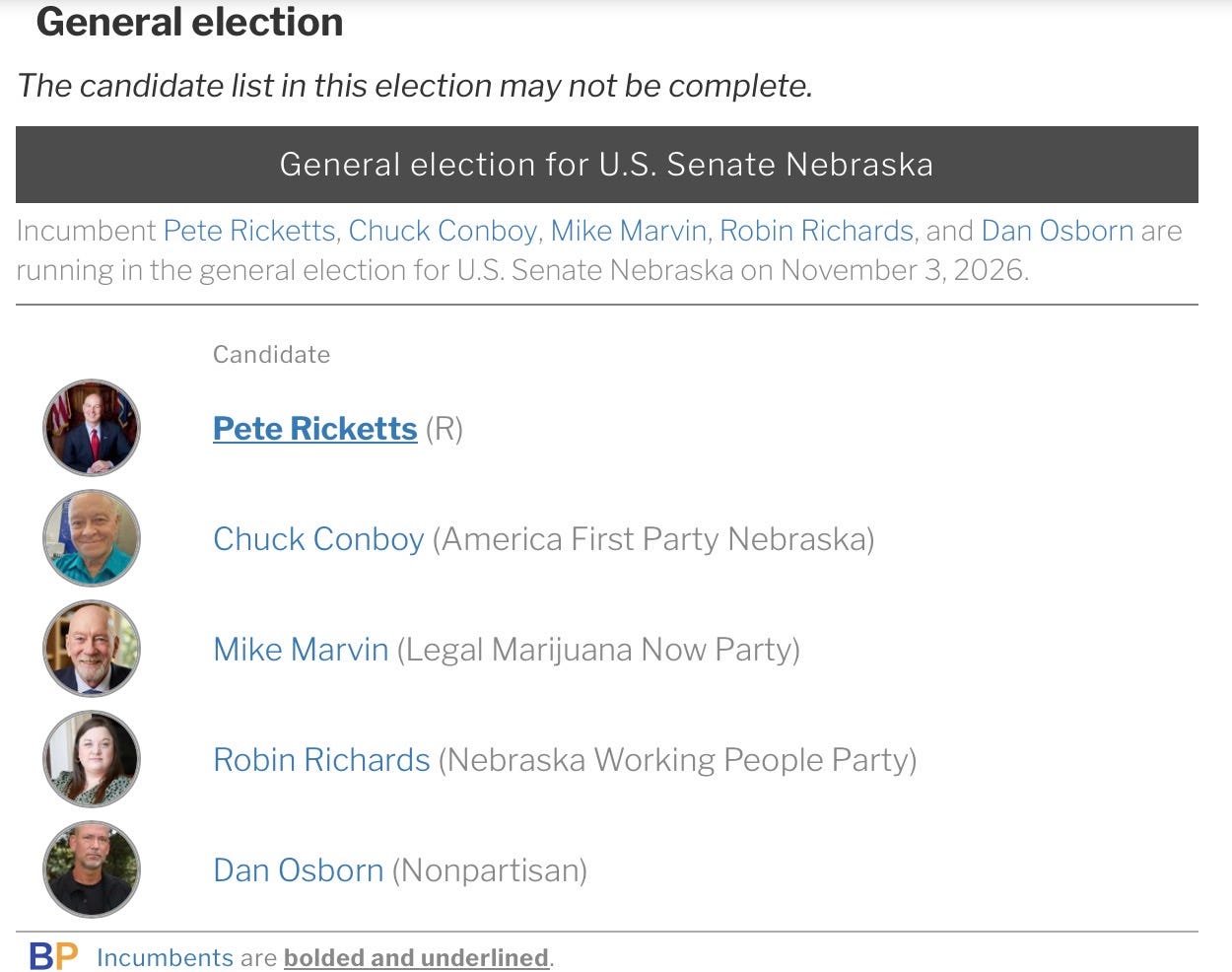
Pete Ricketts (Republican), the state’s former governor, stepped in to complete Ben Sasse’s second term as Nebraska’s junior senator by winning a special election in 2024. He outran President Trump by 4.7%, and senior senator Deb Fischer, running against Osborn on the same ticket, by 18.5%. His run this year requires a quick campaign turnaround, as it falls into the standard six-year slot for his seat.
Dan Osborn (“Independent”) is the labor union leader and faux Democrat taking his second consecutive crack at the United States Senate after giving Fischer a run for her money in 2024. There are three minor candidates officially in the race, but everyone knows it’s a two-man show between Ricketts and Osborn.
II. State Profile
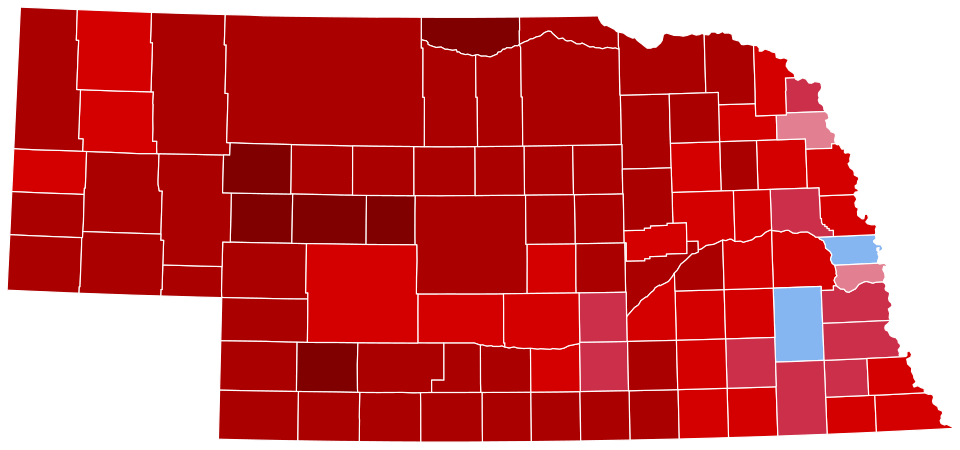
Nebraska is a presidential carbon copy of Kansas, except further to the right. It hasn’t supported a Democrat for president since 1964’s national landslide for Lyndon B. Johnson; however, it used to play Democrat ball in other races, and as recently in 2006 when it reelected Ben Nelson to the U.S. Senate instead of (ironically) electing Ricketts – whom Nelson stomped. Once Nelson retired, the state’s partisan lean took over and began sending two Republicans to Washington, D.C., to represent Nebraskans in the Senate.
Kamala Harris carried just two counties in 2004 – Douglas (metro Omaha) and Lancaster (metro Lincoln/University of Nebraska). Unfortunately, because the unicameral legislature is run by fools with little desire to win, Nebraska’s 2nd Congressional District is becoming unwinnable for GOP presidential candidates and will probably be won by the Democrats this year in the U.S. House race (to be profiled soon) now that the seat is open. Fischer beat Osborn in 2024 despite running a lazy campaign; the gray-shaded precincts below are the ones Osborn carried:
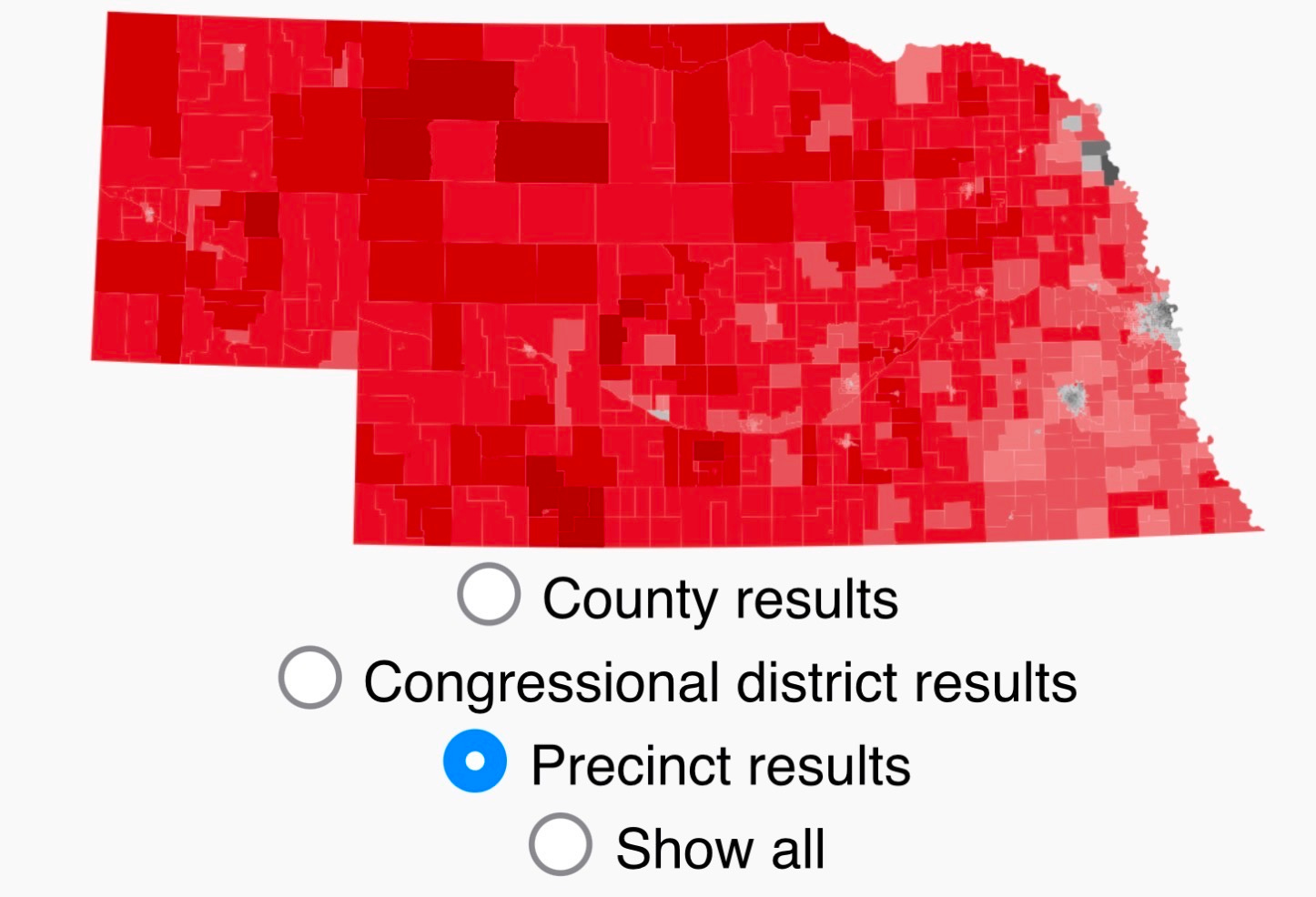
Other than a few outliers in the northeast, he did his damage in Omaha and Lincoln; however, as shown in the precinct map, the key to a presumptive win in 2026 will be to further erode the margins Republican strongholds, allowing the urban areas to put him over the top. The map in terms of red and gray (blue) will not look much different than the one above and will only vary in terms of intensity one way or the other. Osborn is currently doing all he can to make sure the red shades are deeper in intensity, as I will reiterate later in this piece.
Demographic Statistics
• 75.7% White, 12.0% Latino, 4.8% Black
III. Market Assessment
Despite the relatively close call in 2024, Polymarket bettors consider Ricketts a clear favorite, with even higher odds than Roger Marshall in Kansas.
IV. History
Osborn ran a close race in 2024 by posing as an “independent voice” against Fischer, the weaker of Nebraska’s two Senators (+15.5% margin in 2012, +19.1% margin in 2018). In contrast, Ben Sasse won in 2014 by +32.9%, and then again in 2020 by +38.3%. Sasse’s 2020 performance, even normalized to give all of his opponents’ vote shares to the Democrat alone, ran well ahead of Trump’s large presidential margin.
With Sasse out of the picture, enter Governor Ricketts. His margins for governor land in between Fischer’s for Senate (+17.9% in 2014, +18.0% in 2018), but he carries significant clout. His father, Joe, is a billionaire who founded TD Ameritrade and essentially owns the Chicago Cubs and Wrigley Field. With Osborn having come close in 2024, there is no more “sneaking up,” and Ricketts’ funding will serve as a means of simply turning out the “red” vote.
Nebraska’s days of electing straight-blue politicians to federal office are over. That is why Osborn is running as an “independent” – he knows the history and understands the partisanship.
V. Analysis of 2026 Primary Results
Ricketts faced no real opposition, taking 81.5% in the GOP Senate primary this year. Osborn, running with an “independent” label, didn’t have a primary, but the Democrats did:
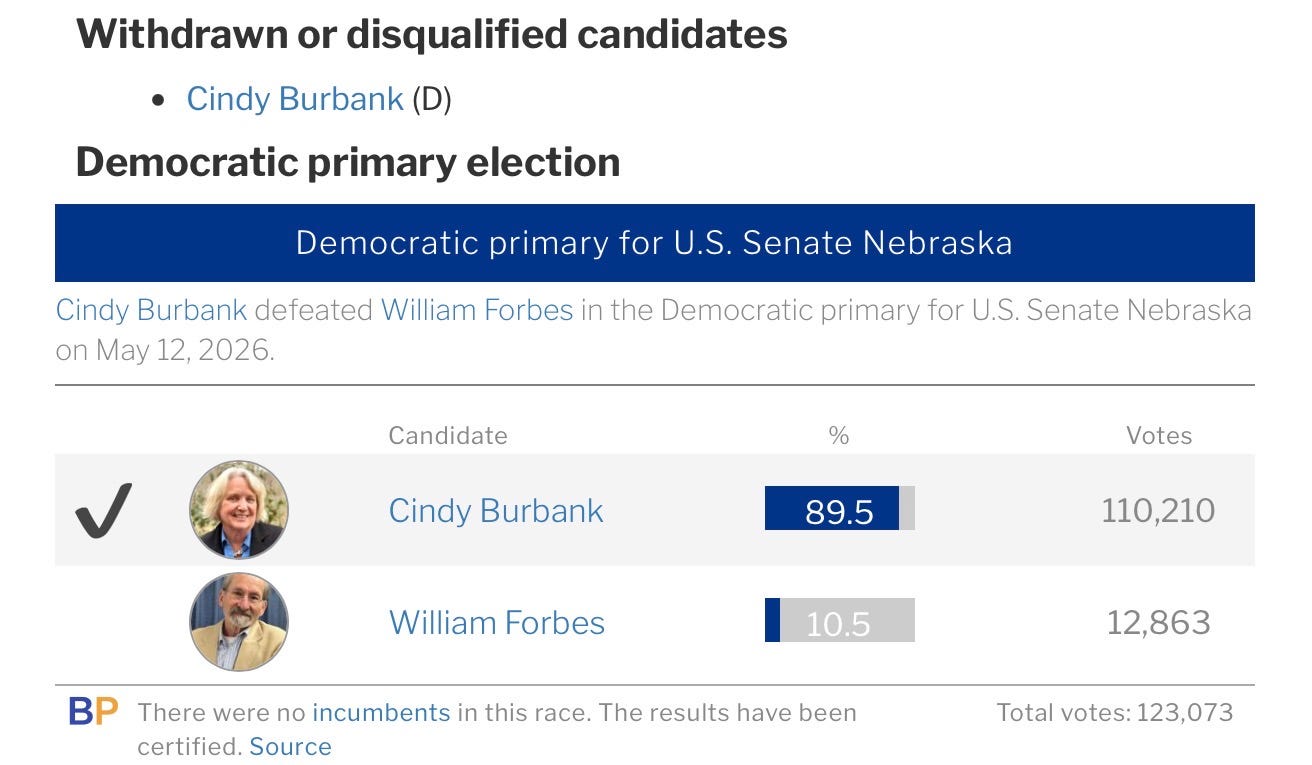
One major tell that Osborn is no “independent” is that Burbank won the primary and immediately withdrew. She ran to block any ambitious Democrat, or a Ricketts plant, from winding up on the ballot and splitting Osborn’s share of support. Ricketts should run crazy reminding voters that Osborn is the Democrat that party knows it can’t run with official branding.
VI. Polls
Pollsmax average: Even

RCP isn’t tracking all available polls, so I found the three most recently released on Pollsmax to calculate an “even” polling average. The SurveyUSA poll appears to be a Democrat internal that gives Ricketts just a 42% share of the vote, while having Osborn’s own share lower than the “even” poll or the Ricketts +4 poll. Tossing the SurveyUSA poll gives Ricketts a +2 average, right in line with where polling in Kansas has Marshall.
Market betting information suggests people aren’t putting much faith into these polls.
VII. Media Ratings
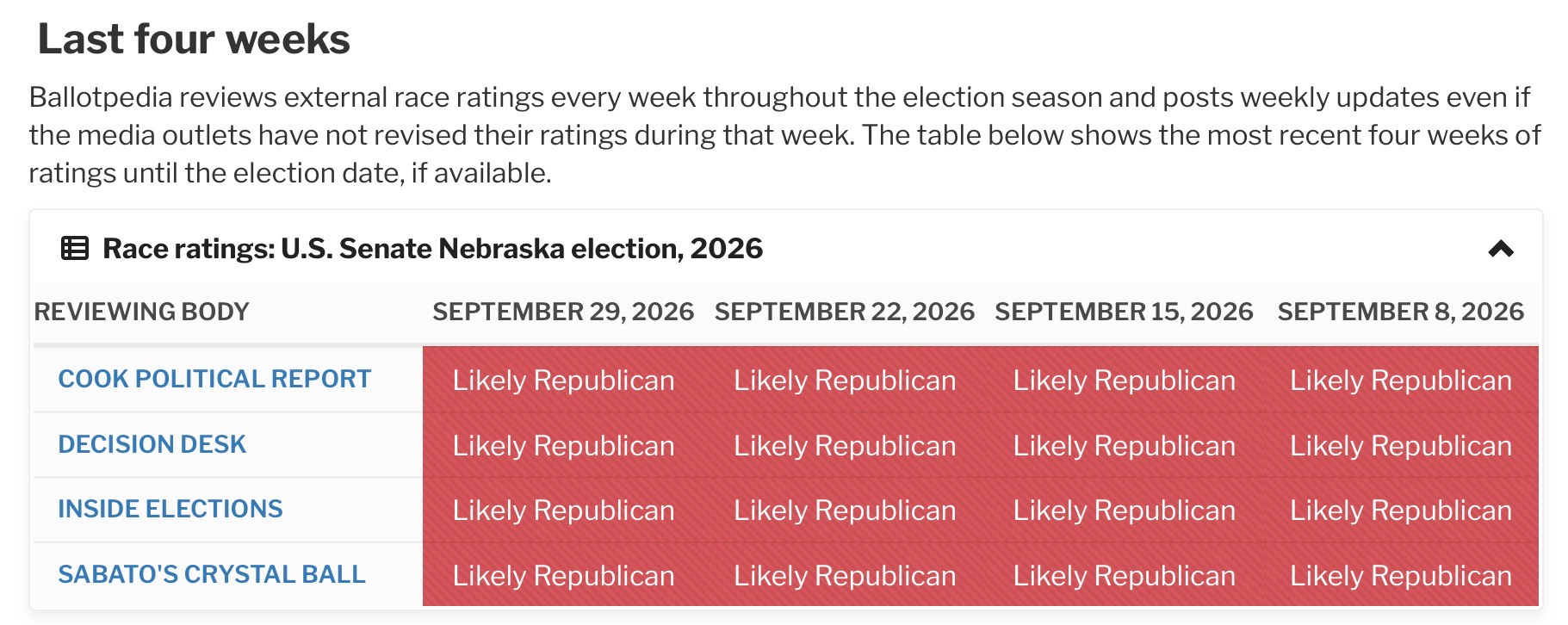
None of the major analysis think tanks are buying the Osborn hype – with “Likely Republican” the diagnosis across the board.
VIII. Party Registration
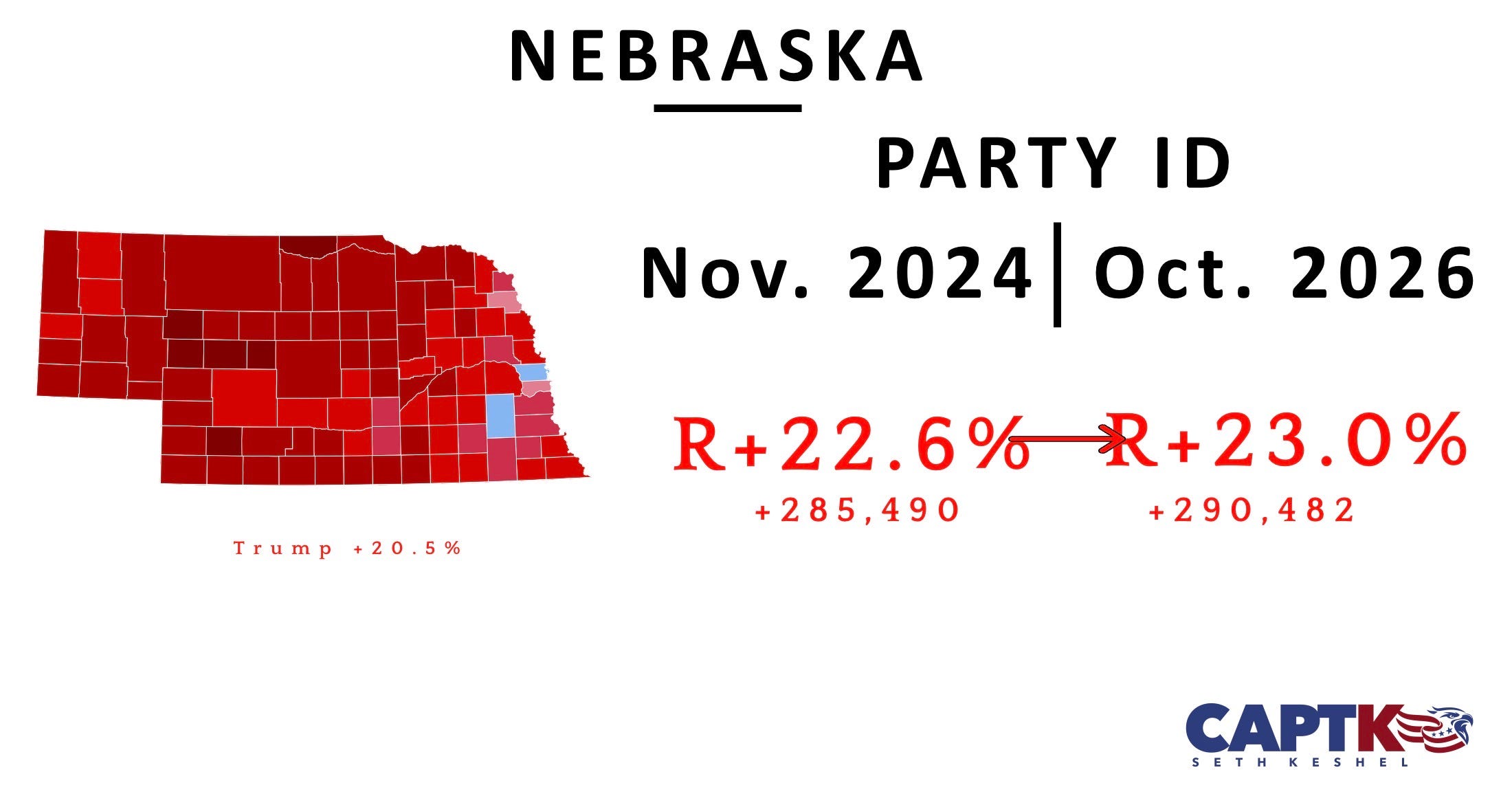
Nebraska, despite some recent Democrat gains in urban areas, is nearly 5,000 net registrations redder than it was in November 2024, when Osborn ran a relatively close race against Fischer alongside a Trump blowout.
IX. Election Considerations
Every state has issues with election administration, but the Great Plains region has low risk for rampant corruption thanks to laws preventing the worst practices, like mass mail-in voting.
X. Summary and Election Estimate
These are the major factors for the U.S. Senate race in Nebraska:
Money, money, money. The Ricketts machine has it, and will spend it all before they lose this seat:
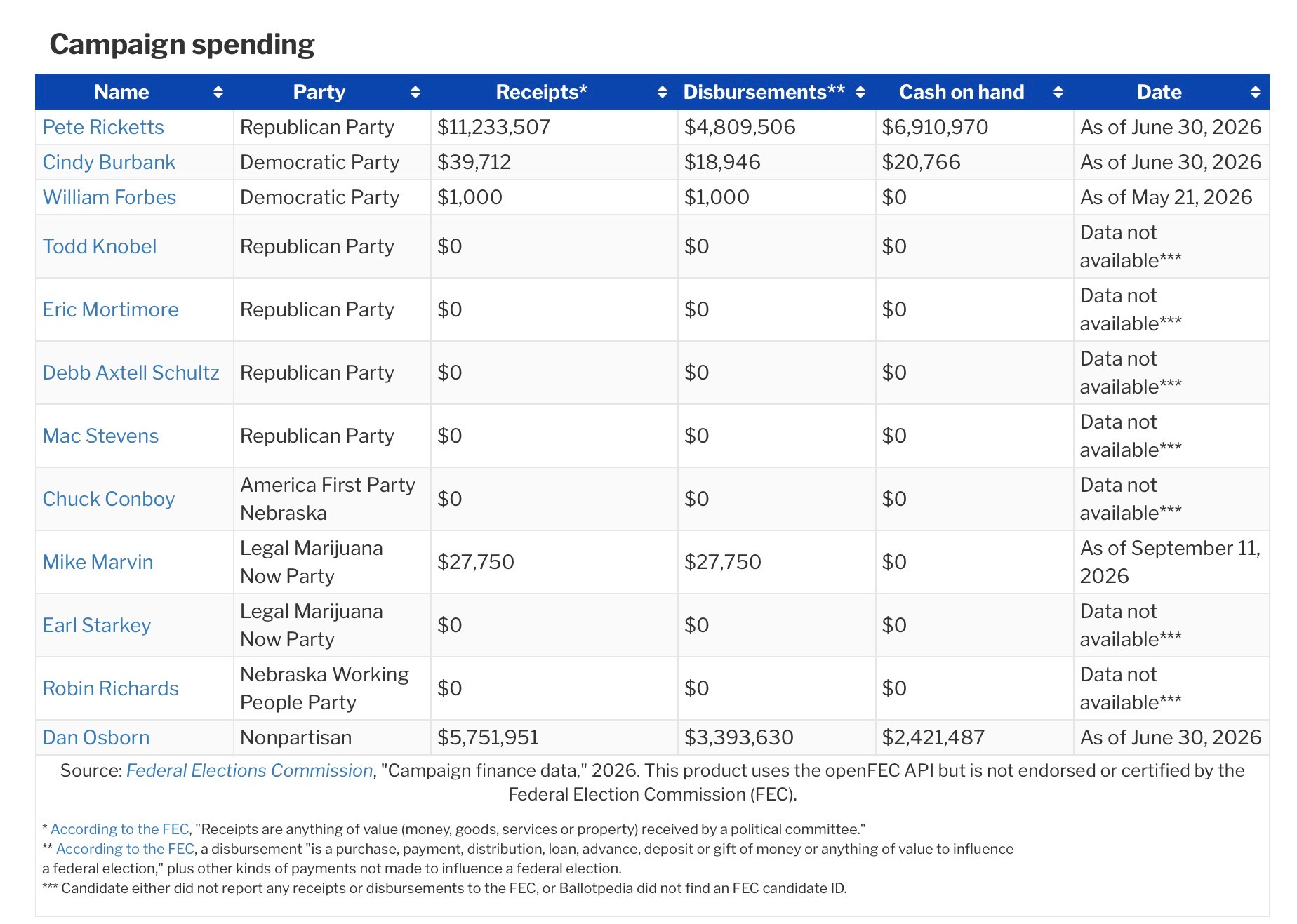
Fischer, running an underprepared campaign relying on GOP party identification advantage, didn’t take Osborn seriously until after Labor Day in 2024. Thanks to the close call, Osborn isn’t sneaking up on anyone. Fischer “spotted the sniper,” just like Ted Cruz spotted Beto O’Rourke – who faded after his 2018 run. President Trump’s Grand Island rally planned for October 5 is proof that the element of surprise is gone for Osborn.
Ricketts is defining Osborn as “Democrat Dan,” and Osborn has been stepping in it frequently, being recorded proclaiming his support for radical positions that he won’t publicly back, and trashing the rural voters he needs to peel from Ricketts:
“Billy Bob in f—— Red Cloud, Nebraska, who lives next door to the f—— Trump store as you pull into town and is waving the Trump flag, all he knows is he’s like on the winning team,” Osborn said in the recording. “It’s really that simple. And Trump, and that is why he’s been so effective. He’s been so effective at taking Billy Bob and his wife Mary Jane or Mary Jo and telling them, ‘Look, we’re winning. You’re on the winning team.’ And that’s all they care about, because their lives probably suck so f—— much.”
Here is how the key factors in this race stack up:
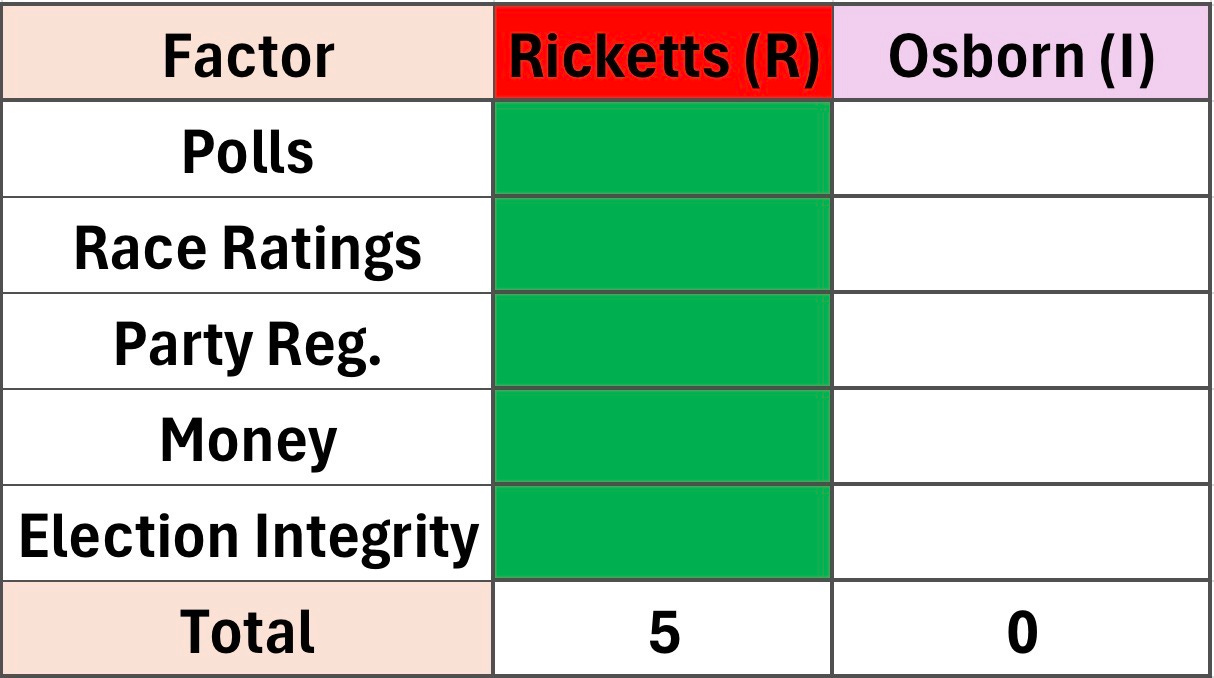
Forecast for Nebraska U.S. Senate
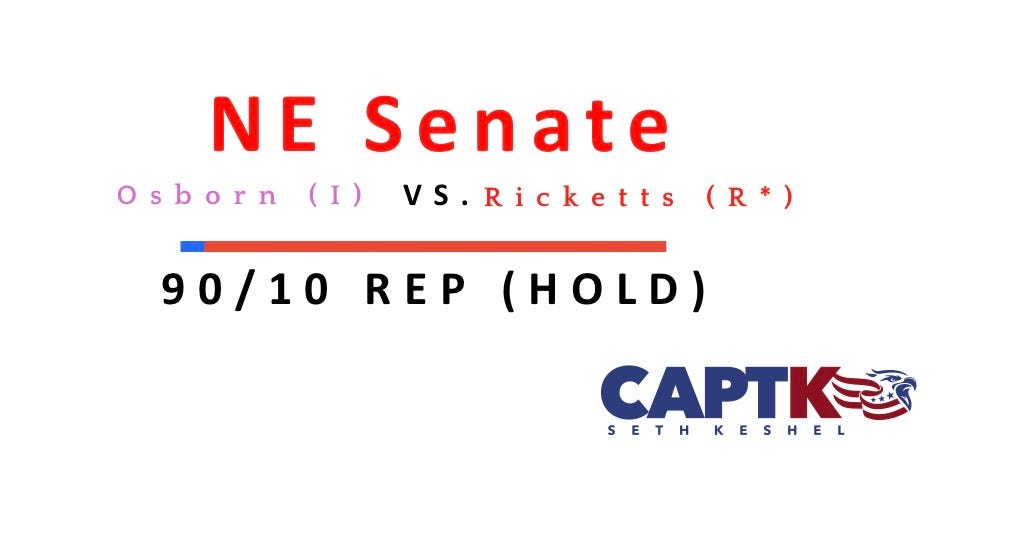
Osborn had his best shot in 2024 against an underwhelming opponent who didn’t take his campaign seriously until the last minute. Ricketts has overwhelming financial backing and is now armed with plenty of evidence portraying Osborn as someone who resents Trump’s rural voting base and who is in line with Democrat priorities. Because of midterm dynamics and the “independent” ruse, Ricketts isn’t likely to win this race by standard Republican margins, but I don’t think it will be uncomfortably close.
Seth Keshel, MBA is a Senior Fellow at the Gold Institute for International Strategy and a retired Army Captain. He publishes Captain K’s Corner on Substack.