2026 Ten-Point Forecast: North Carolina U.S. Senate

North Carolina U.S. Senate race forecast

Michael Whatley (R) vs. Roy Cooper (D)

I. The Race
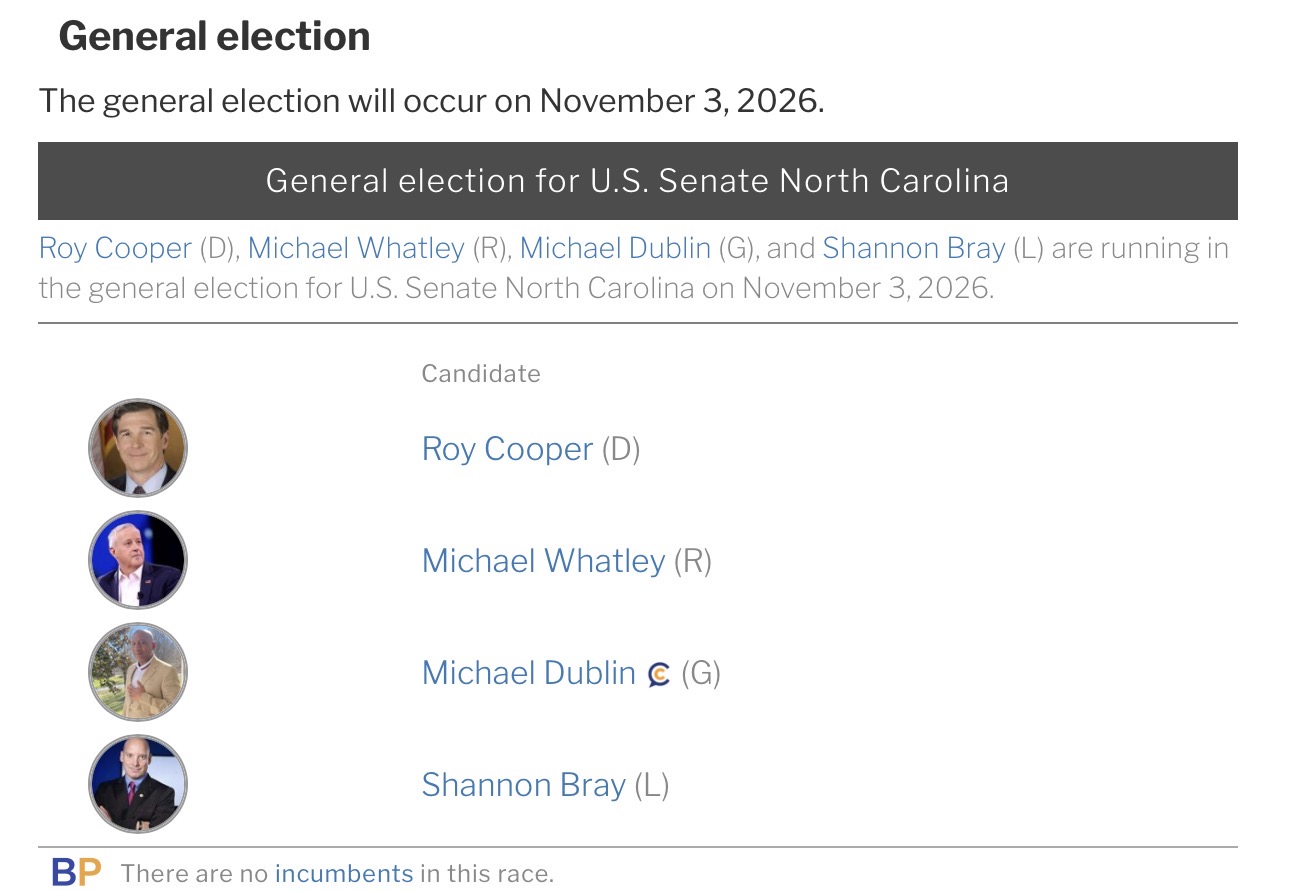
North Carolina Senate candidates Michael Whatley and Roy Cooper

Michael Whatley (Republican) is an attorney who served in the Bush 43 administration before working in the energy industry and chairing the North Carolina Republican Party. He was RNC chairman during President Trump’s winning 2024 campaign, and now looks to fill the Senate seat being vacated by noted backstabber, Thom Tillis.

Roy Cooper (Democrat) has been a politician for 40 years, serving in the state legislature, as Attorney General, and then as governor from 2017 through 2025, when he was replaced by current governor, Josh Stein. He looks to become the first Democrat elected to represent North Carolina in the U.S. Senate since Kay Hagan, who won her last race in 2008.

II. State Profile
Map of North Carolina for the state profile

North Carolina has grown tremendously since the start of the century, when George W. Bush won it twice by more than 12 points. It represented, perhaps after only Indiana, Barack Obama’s most significant upset in the 2008 election:
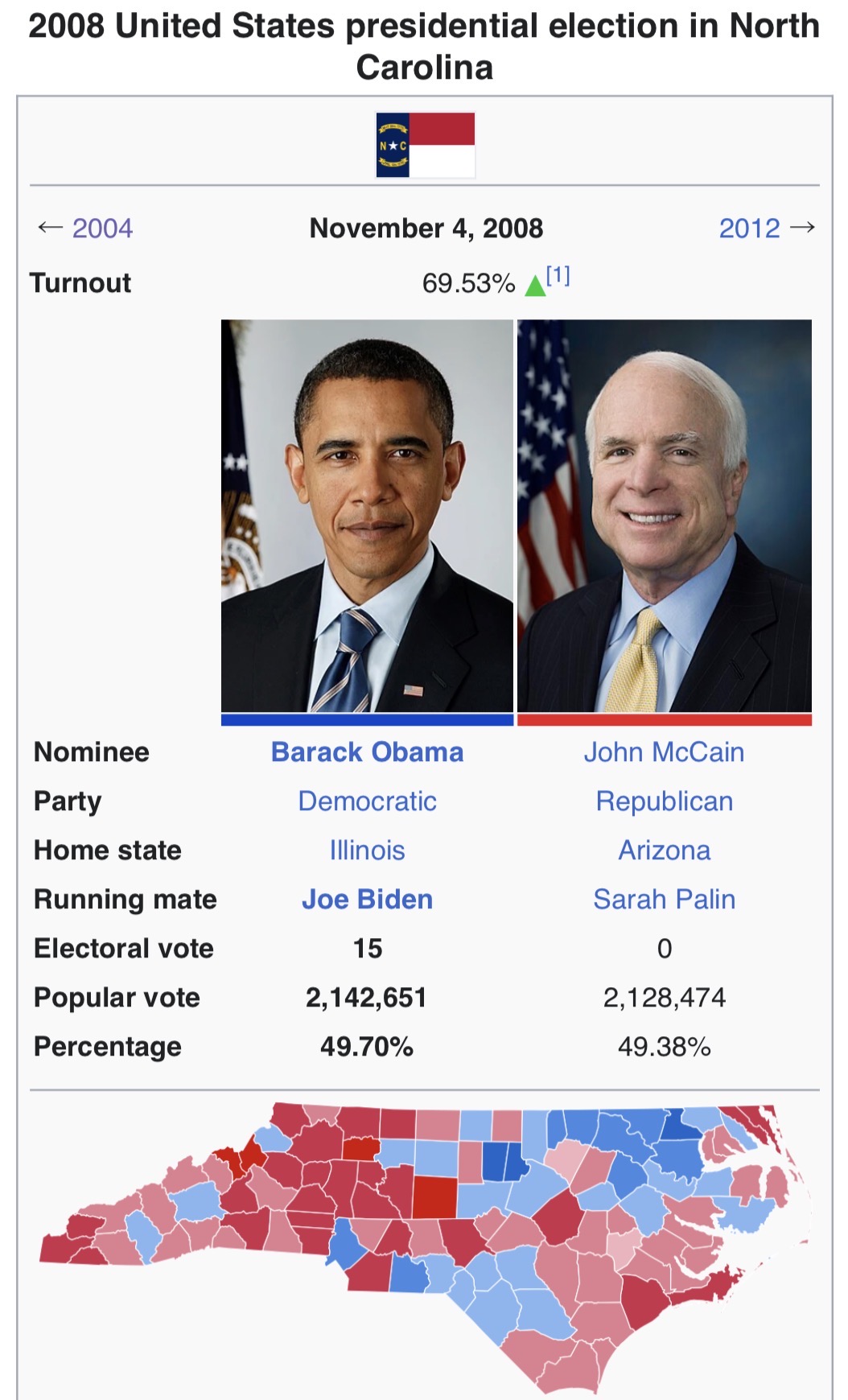
2008 presidential election result in North Carolina

Since then, it has been won by four consecutive GOP presidential nominees:

2012 Romney +2.0%
2016 Trump +3.7%
2020 Trump +1.3%
2024 Trump +3.2%

That 2020 result, which ran 2.4% left of 2016 despite a monumental move in voter registration toward Republicans, has ironically put me at odds with Whatley for five years. I argue that election was tainted by the expansion of mail-in balloting, and he has rebutted my positions repeatedly. Nevertheless, the state is constantly growing and changing, and risks turning into Georgia if Republicans don’t right the ship. The difference between a Democrat presidential win of North Carolina and a Republican one is much different than we would have envisioned it 20 years ago.
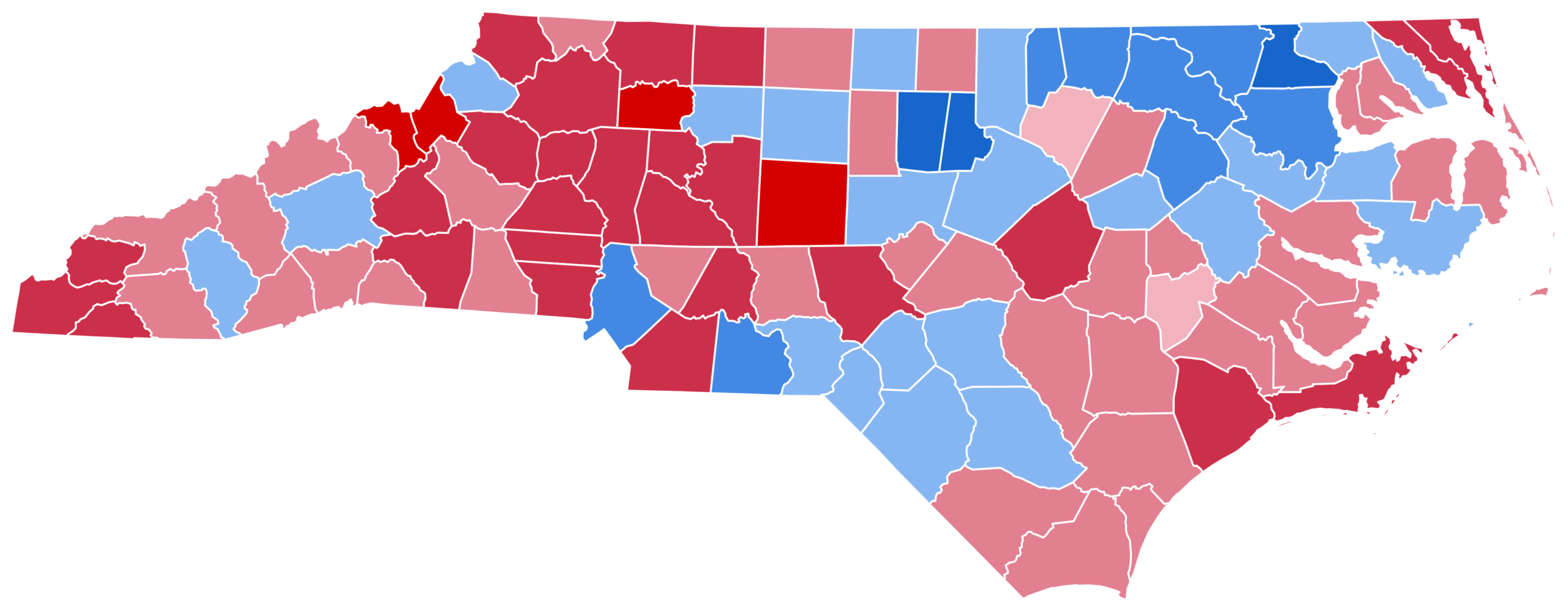
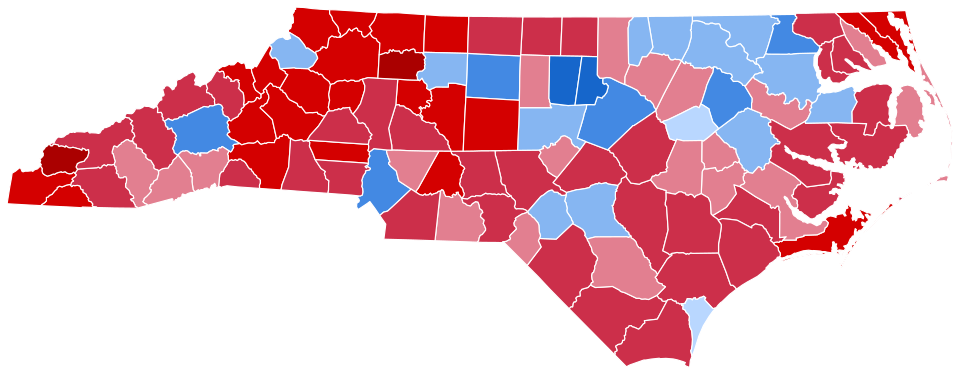
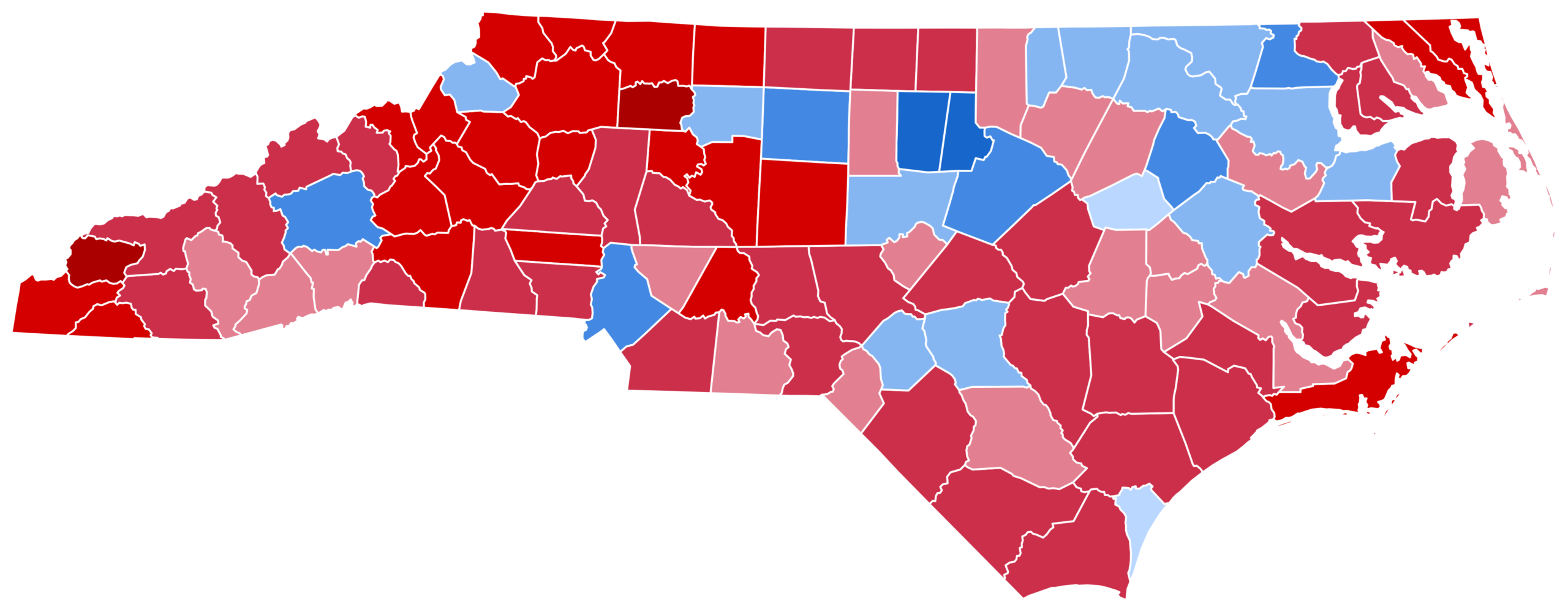
County map of the 2008 presidential election in North Carolina
2008 Presidential Election in North Carolina
County map of the 2024 presidential election in North Carolina
2024 Presidential Election in North Carolina

North Carolina’s Appalachian west and the southeastern coastal areas have turned a hard shade of red, whereas they were once Democrat-leaning or light pink. In the Trump era, Mecklenburg and Wake Counties (Charlotte and Raleigh, respectively) have become real liabilities – countered only by the reddening of the perimeter of the state. Had Trump won Romney’s margins outside of Wake and Mecklenburg, he’d have lost the state in 2020 and 2024.

North Carolina, as evidenced by their frequent Democrat governors, do split tickets. Here is the map from Stein’s 2024 victory, concurrent with Trump on the ticket:
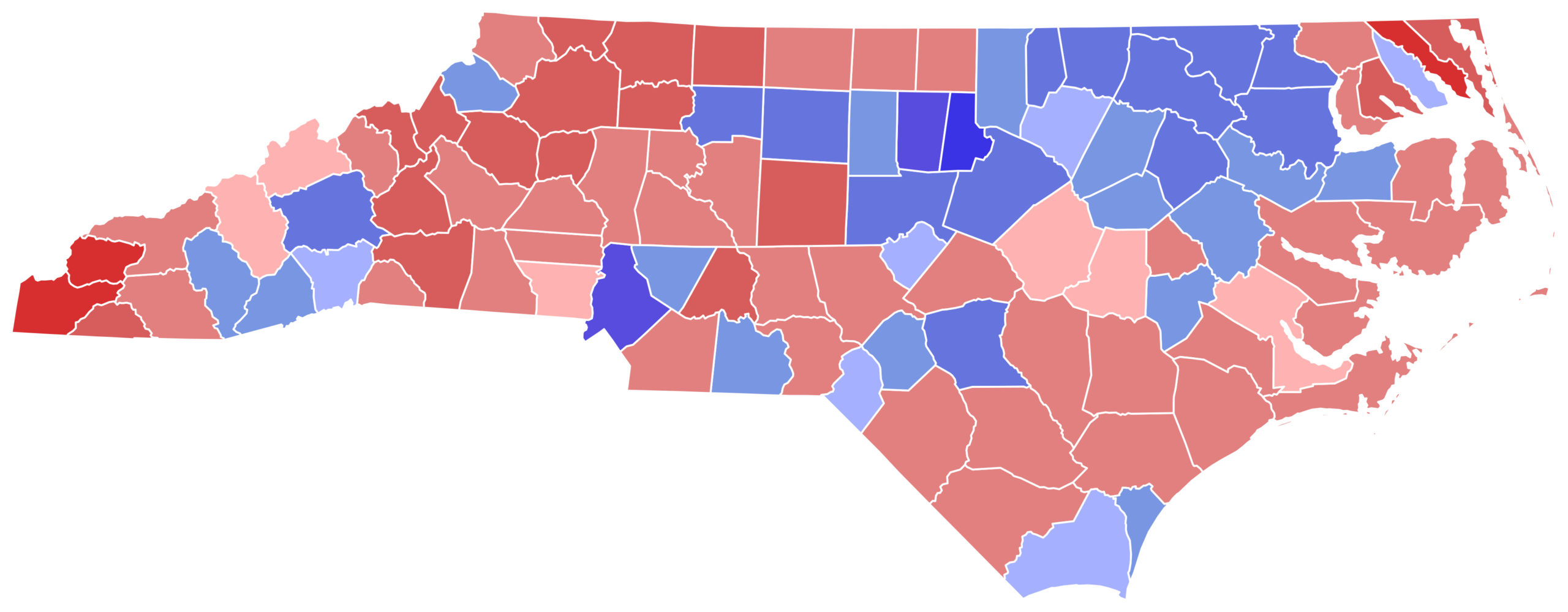
County map of the 2024 gubernatorial election in North Carolina
2024 Gubernatorial Election in North Carolina

As I will demonstrate with party registration figures later in this article, North Carolina does not possess widespread loyalty to the Republican Party, especially in rural areas like it does in states like Texas, Georgia, or in the heartland. The largest metro areas are hardcore Democrat strongholds now, and the combination of these two factors gives Democrats a chance to win despite GOP progress throughout most of the state’s geography.

Key Statistics

60.5% White, 20.2% Black, 10.7% Hispanic

III. Market Assessment

Polymarket bettors feel even more confident in Roy Cooper than they do in Jon Ossoff in neighboring Georgia.

IV. History

Republican Jeter Pritchard left the United States Senate in 1903, and with it, so did North Carolina’s GOP influence on the chamber for many decades. It was until 1972 that the Tar Heel State elected another Republican when it sent Jesse Helms to Washington, D.C. He declined to run for a sixth term in 2002, and was replaced by Elizabeth Dole, whose husband was none other than the legendary Bob Dole.

Her opponent in 2008, Kay Hagan, rode Obama’s statewide upset and ancestral Democrat strength to her own victory, and by a large margin:
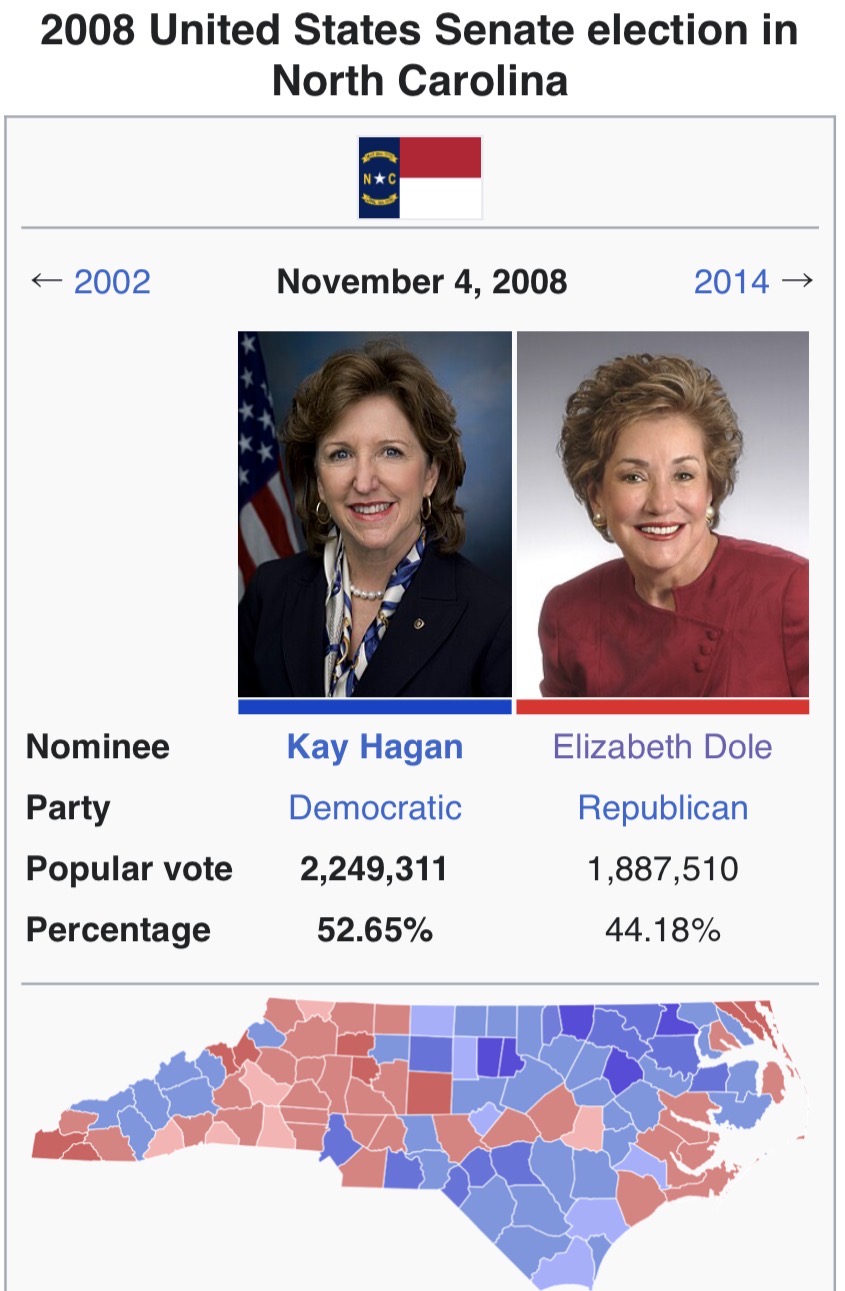
2008 U.S. Senate election result in North Carolina

With North Carolina trending red during the Obama days, Hagan was ousted by Tillis in the 2014 GOP wave in a 1.6% squeaker in which hardly anyone voted:
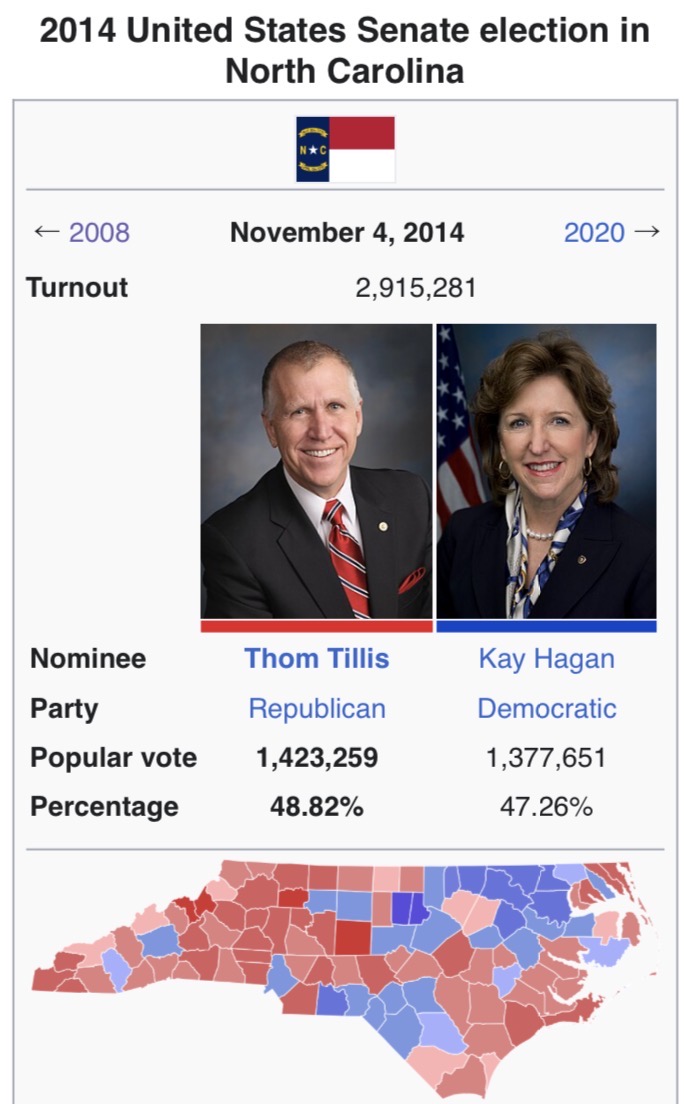
2014 U.S. Senate election result in North Carolina

Tillis was reelected in 2020, and only by 1.7%, after Democrat Cal Cunningham had a late-breaking scandal that most likely shifted things to the incumbent. Tillis then went on to antagonize the Republican base and hamstring President Trump at every turn, leading to Trump making it clear that he could retire or be brutally primaried like John Cornyn or Bill Cassidy.

The other Senate seat, currently occupied by Republican Ted Budd, has had a mix of Democrats and Republicans stretching back to 1981. In short, history shows Democrat competitiveness in the Senate even in recent, redder times, with an incumbent who never won by more than 1.7% leaving the seat open in a year that is supposed to be favorable to Democrats.

V. Analysis of 2026 Primary Results

Cooper faced five candidates in the Democrat primary, but bludgeoned them mercilessly in taking 92.0% of the vote. It was decisive, and as a result, there is no Democrat intraparty drama in the way of the General Election.

Whatley also prevailed by a decisive margin, beating Don Brown by 49.0%.
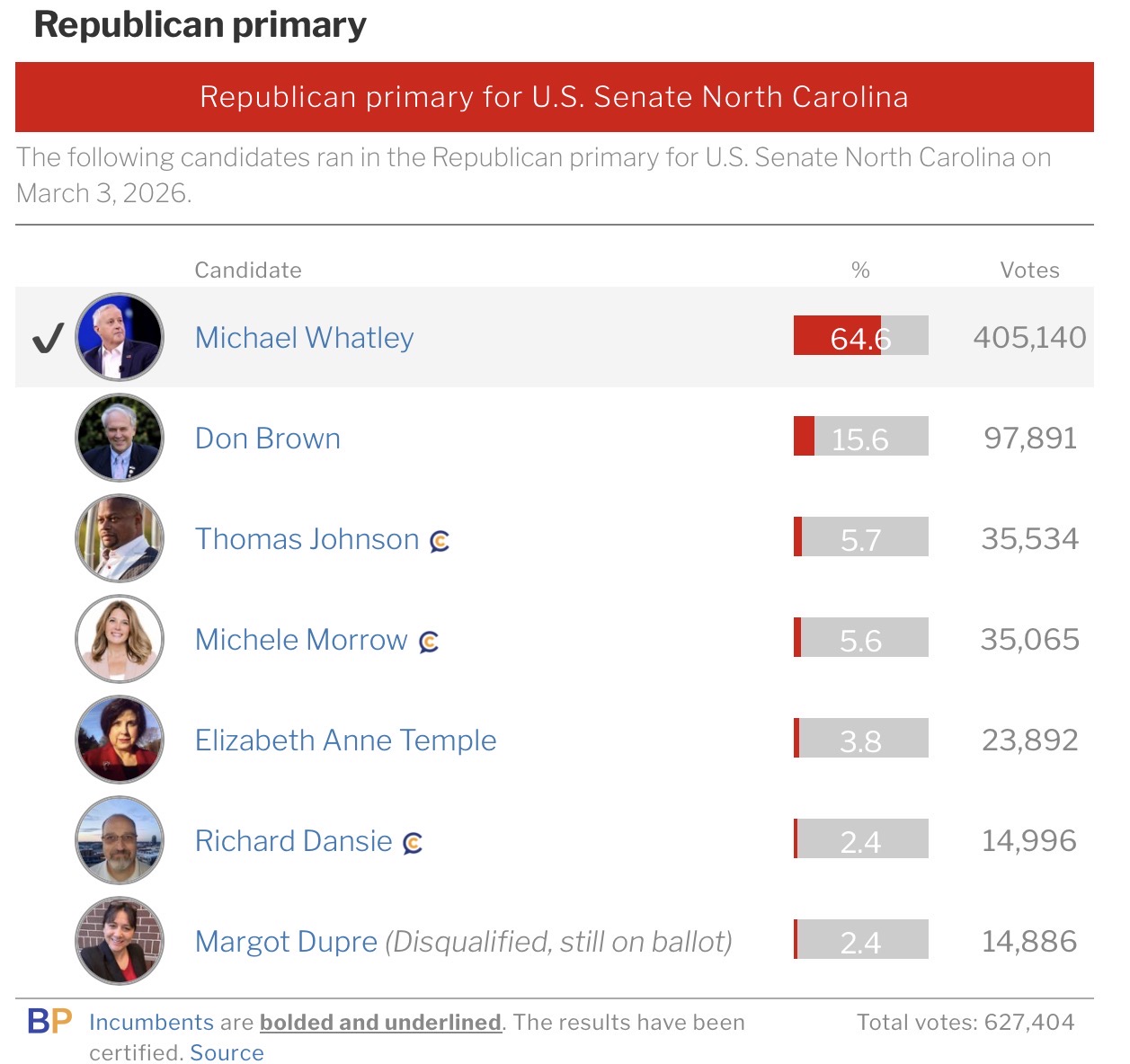
2026 North Carolina Senate primary results

Brown said after the primary that he was “1,000 percent” behind Whatley and would do everything he could to help him defeat Cooper. The field of GOP candidates hasn’t contributed to any drama, but there exists a serious divide between Republican factions that has given the party unity advantage to Democrats in a big way.

VI. Polls

Removing outliers from the RCP Average, the standard poll of the Senate race shows Cooper up 7-10 points over Whatley.
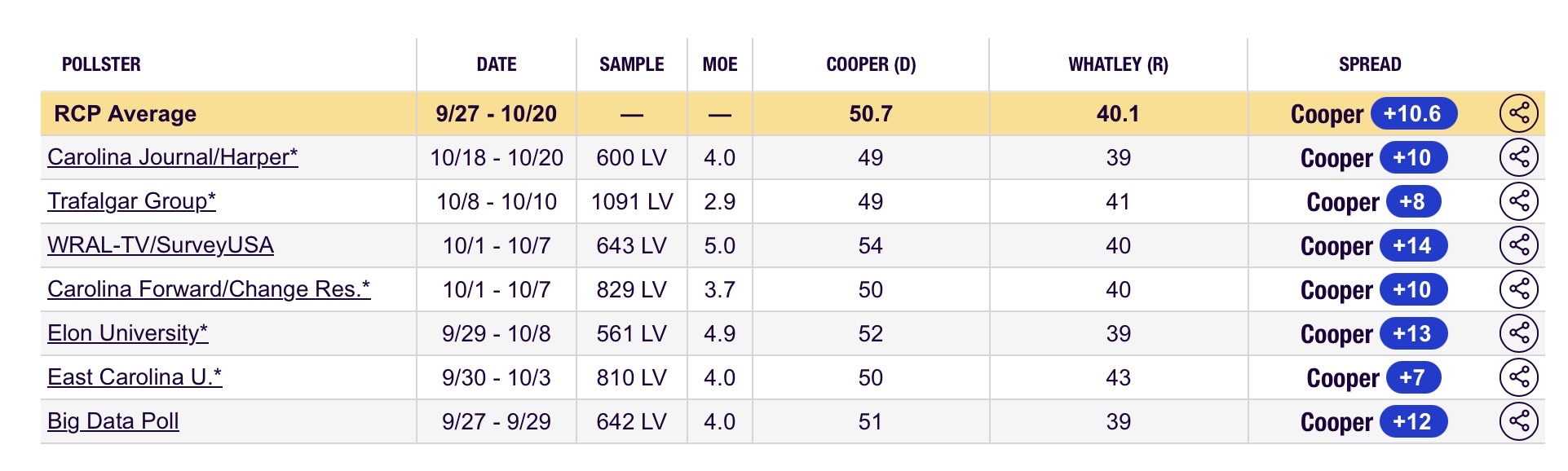
Table of North Carolina Senate polls

It should be noted that Cooper drastically underperformed his polling during his 2020 reelection bid, and I expect the same will be true in 2026.

VII. Media Ratings
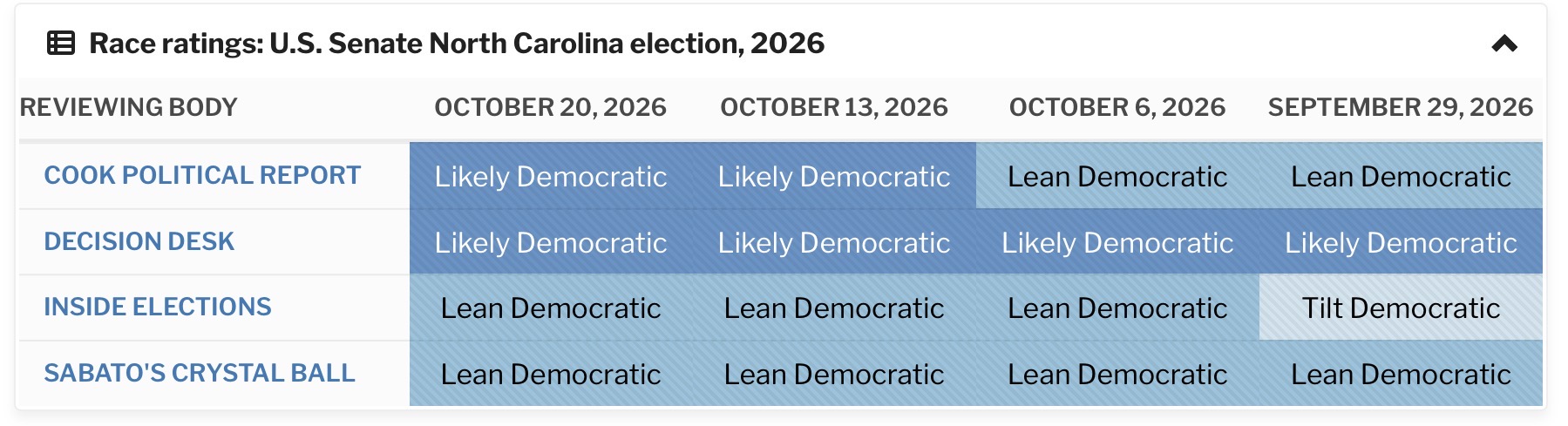
Media ratings of the North Carolina Senate race

While all reviewers favor Cooper, it appears Inside Elections and Sabato think the polls are overstating Cooper’s strength, as well.

VIII. Party Registration
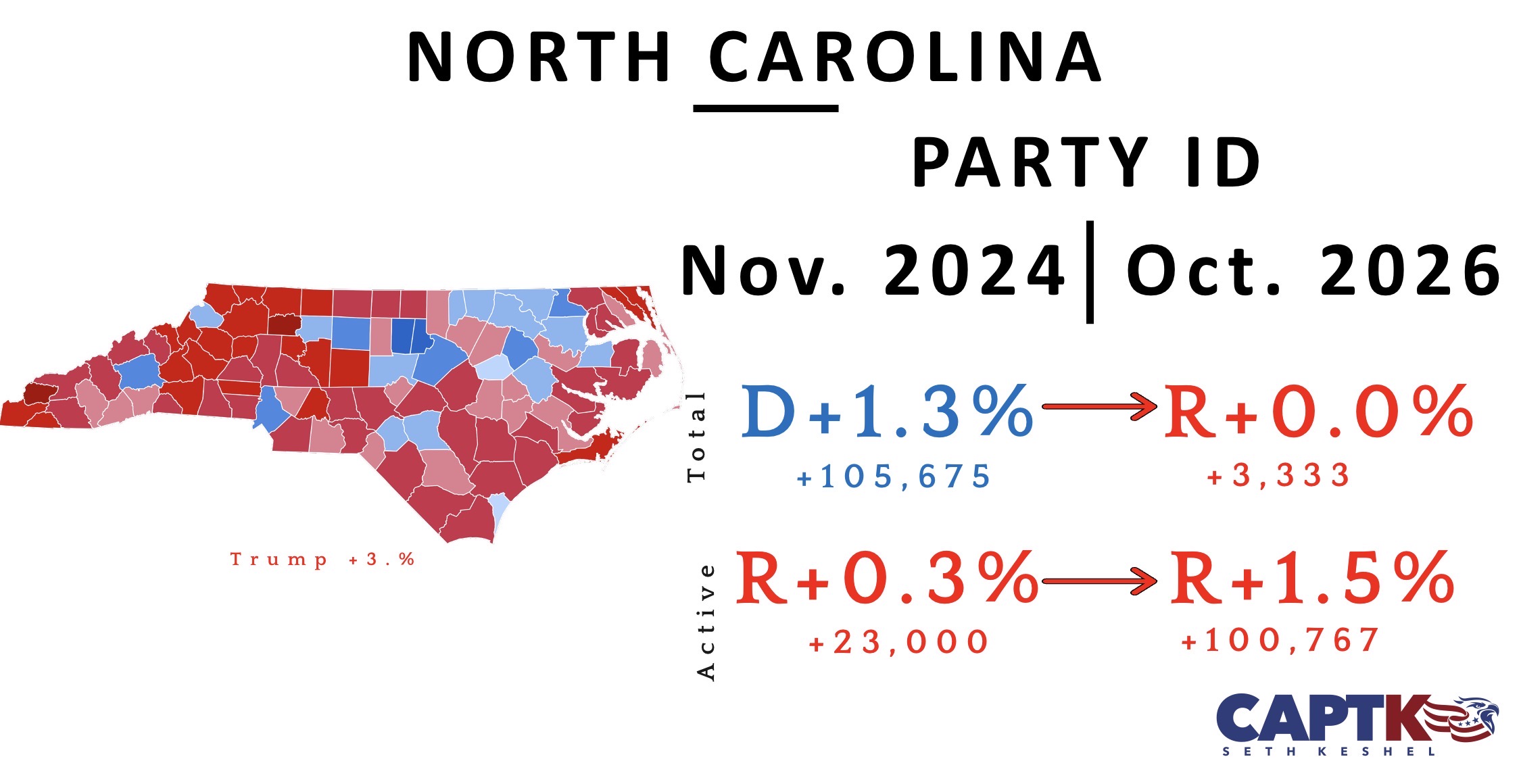
North Carolina party registration figures

This is going to be a split decision. North Carolina sits nicely to the right of its 2024 voter registration index both in terms of overall and active registrations, giving a more optimistic GOP outlook for the long run than I can provide here in the short run. On the flip side of the coin, Democrats have made modest but noticeable gains in voter registration since summer, and have even barely flipped back the overall registration lead at the closing of the books leading into this election (numbers above reflect the balance at the beginning of October).

This is a push – Whatley has a deeper bench to pull from than Trump did, but Cooper has the recent momentum – which is mostly confined to urban areas like Wake, Mecklenburg, and Durham Counties.

IX. Election Considerations

I have posted at length about North Carolina elections in my posts forecasting the House races in NC-1 and NC-11, and don’t need to reinvent the wheel here.

North Carolina only recently passed Voter ID, and has reasonably basic safeguards in place. It is not extremely easy to cheat in the state (exempting the mail-in heavy 2020 quasi election), but loopholes exist in the event of a close election, like that for the Supreme Court in 2024 – when the Democrat candidate “won” by 734 ballots after weeks of UOCAVA and provisional ballot drips.

X. Summary and Election Estimate

Republicans are off to a rough start in North Carolina’s early voting period, but take heart – it’s not because they’re not voting. They actually have more votes banked now than at this point in 2022. The Democrats are busy front loading. Key blue strongholds Chatham, Orange, Durham, and Buncombe Counties hold the top four spots for percentage of the 2024 presidential vote already turned out in 2026, and the GOP rurals occupy almost all of the bottom 40 percent of 100 counties in the same measure.

The good news here is that this will close a lot this week. Democrats are front-loading their high propensity voters, and can’t sustain that pace. North Carolina has a much stronger Republican preference in federal elections than statewide elections, so I suspect that Cooper’s ceiling is limited and not likely to reach double digits. Regardless, Cooper has a serious advantage in my decision matrix:
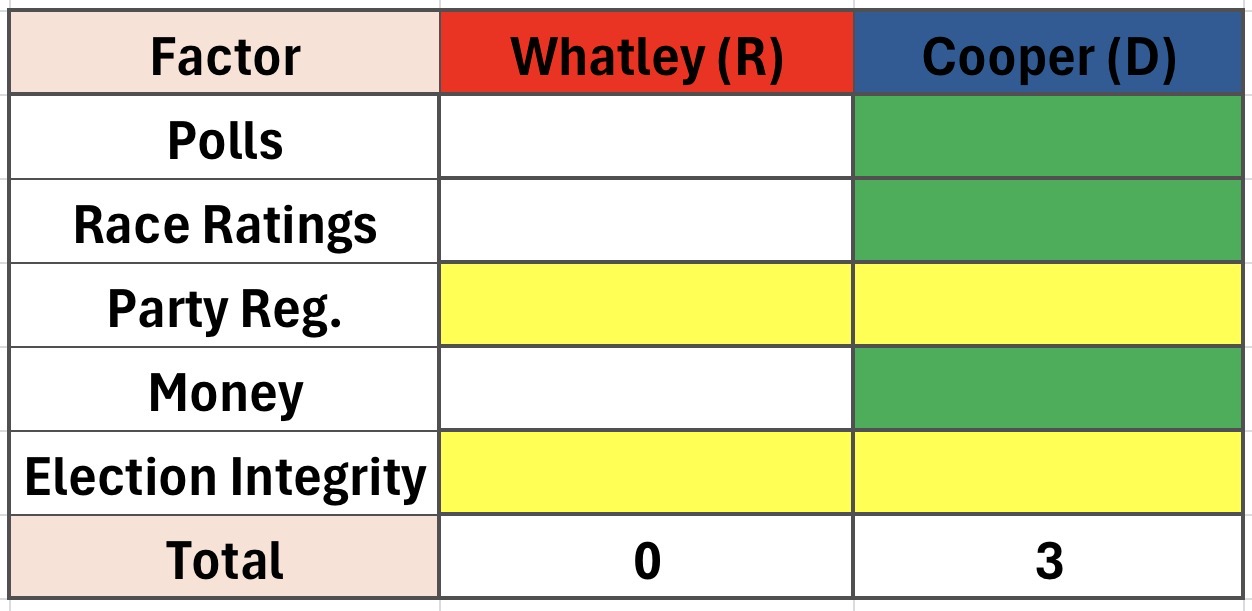
Keshel's ten-point decision matrix for the North Carolina Senate race

Cooper has roughly four times the receipts and twelve times the cash on hand that Whatley does; it has been noted that Whatley’s advertising has been rolled back and the GOP has moved on to other races as funding priorities. These are not good signs, and spoken plainly with an understanding of North Carolina’s ancestral Democrat tendencies and competitive Senate races even in GOP years like 2022, Cooper is clearly on his way to a win that could only be upset by a massive drop-off in urban participation this week:

Forecast for NC Senate
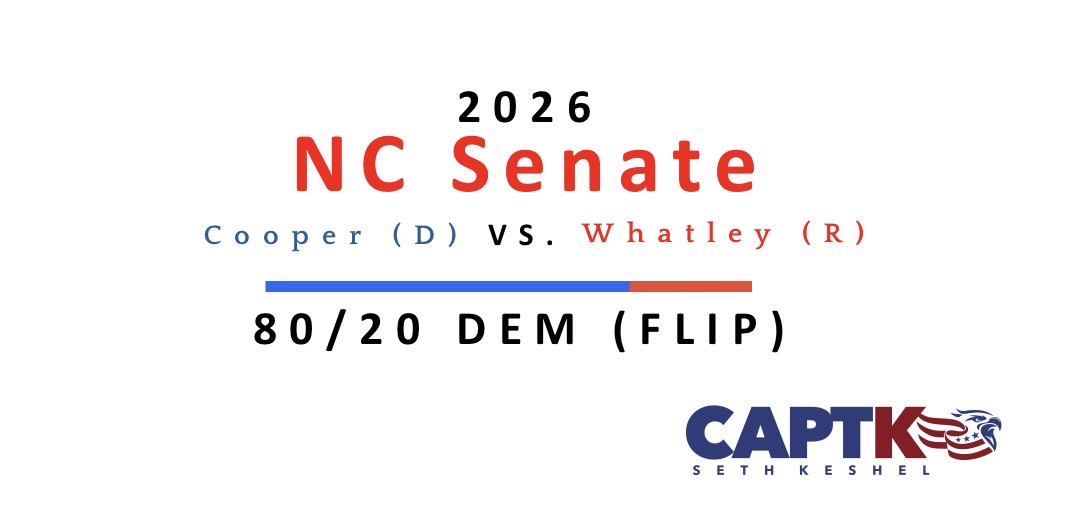
Keshel's forecast for the North Carolina Senate race

The biggest risk to mailing it in on this Senate race is that Republicans will depress turnout needed to flip NC-1 and hold onto NC-11, and a good long-term goal given Democrat functionality in a few key metros would be for Republicans to start investing heavily in an urban strategy so North Carolina doesn’t turn into another Georgia. This race is a must-win for Democrats, and without it, there is no path to a Democrat majority in the Senate.

Seth Keshel, MBA is a Senior Fellow at the Gold Institute for International Strategy and a retired Army Captain. He publishes Captain K’s Corner on Substack.

2026 Ten-Point Forecast: AZ-1 (U.S. House – Decisive)

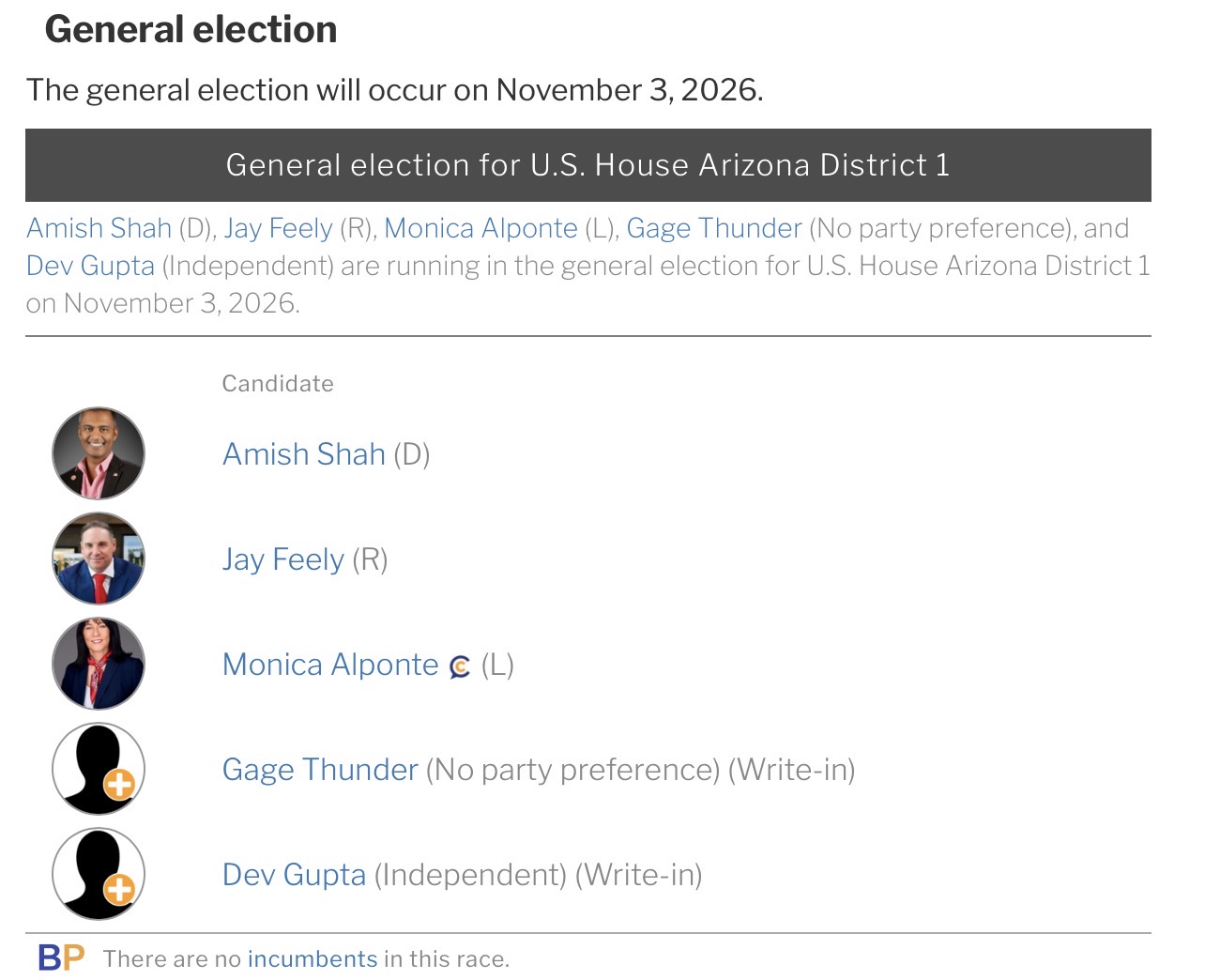
2026 Ten-Point Forecast: AZ-1, Jay Feely vs. Amish Shah

Jay Feely (R) vs. Amish Shah (D)

I. The Race

Jay Feely (R) and Amish Shah (D), the candidates in Arizona's 1st Congressional District

Jay Feely (Republican) is a former NFL kicker and TV sports analyst now trying his hand at politics. He is looking to replace David Schweikert, who is leaving AZ-1 open after eight terms in the U.S. House because he decided to run for governor and get absolutely destroyed by Andy Biggs.

Amish Shah (Democrat) is a physician and former member of the Arizona House of Representatives. He failed to unseat Schweikert in 2024 and, although he has a reputation as a moderate from the legislature, has recently cozied up to many DSA-adjacent figures and positions.

II. District Geography

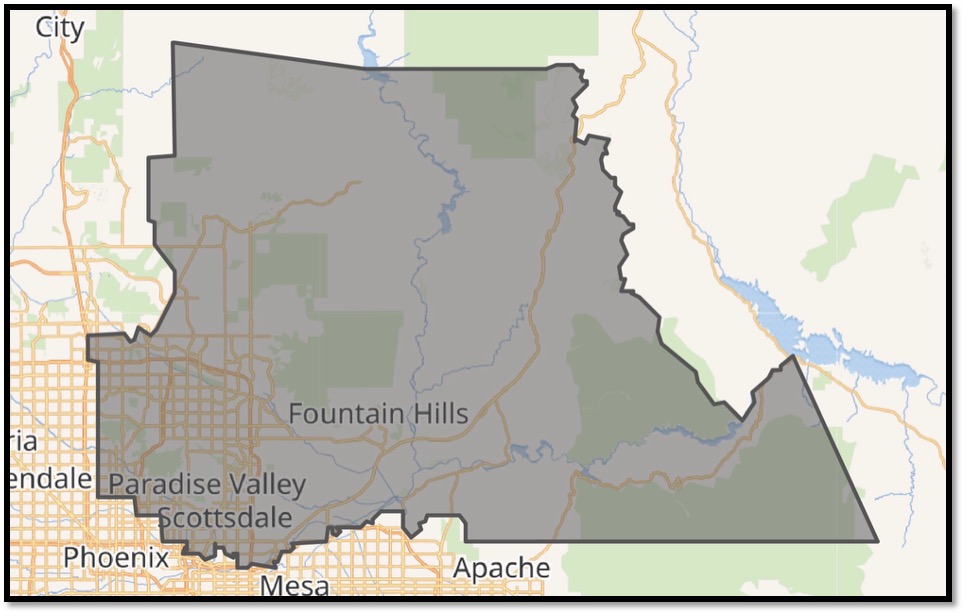
Map of Arizona's 1st Congressional District in northeastern Maricopa County

Arizona’s 1st Congressional District (AZ-1) occupies the northeastern corner of Maricopa County, including affluent cities like Paradise Valley, Scottsdale, and Fountain Hills, as well as segments of northeast Phoenix, which are more favorable for Democrats.

Despite its considerable Republican voter registration advantage, this district’s boundaries have been tough for President Trump and aligned Republicans for the past decade.

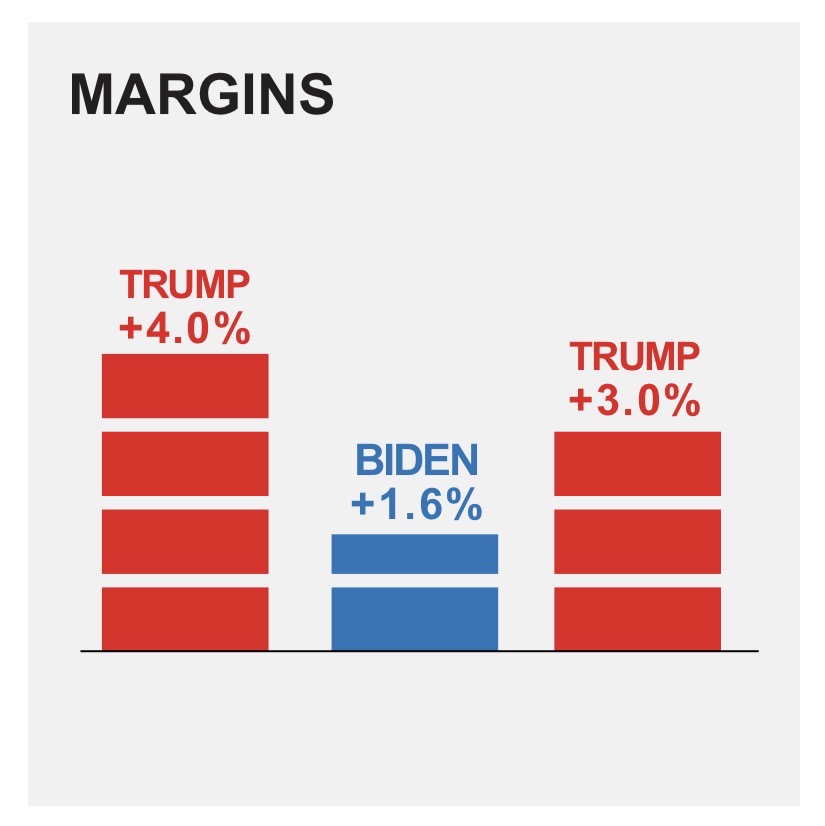
Presidential Margins

Chart of presidential margins and Republican registration advantage in AZ-1

Practically everyone reading this will agree that the 2020 election in Arizona warped a lot of figures, including the margin in what is now AZ-1. Still, the Trump margins for all three of his races run far to the left of the GOP registration advantages for each year, and are mostly linked to GOP defectors in swanky places like Scottsdale and Paradise Valley, which featured nice gains for Trump in 2024 (which I will dive into in Section X).

Key Statistics

• 69.9% White, 16.4% Hispanic
• 91.5% Urban, 8.5% Rural

III. Market Assessment

Polymarket bettors have wagered heavily on Shah, whose shares are clearly overpriced.

IV. History

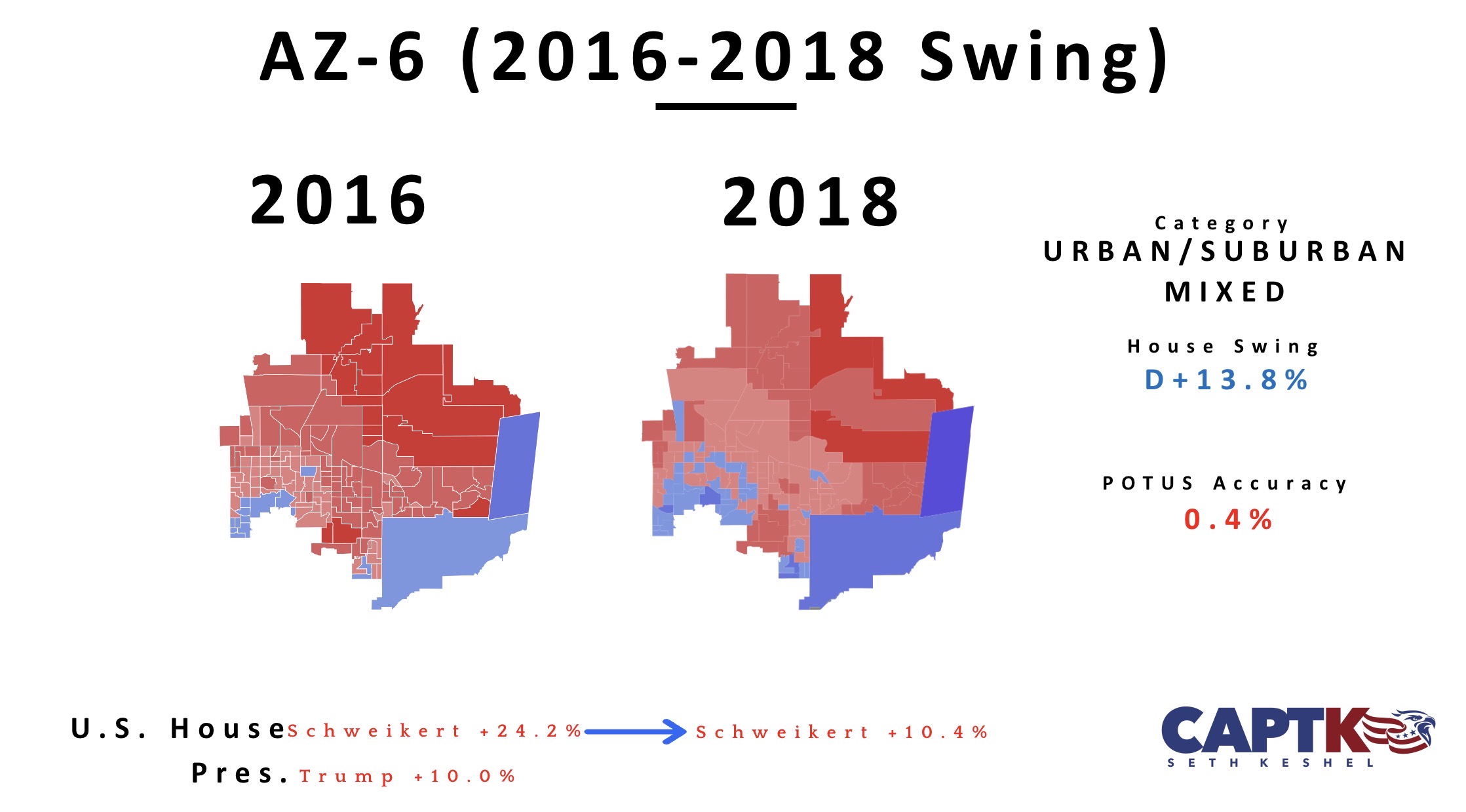
Prior to the 2022 election, most of the territory of what is now AZ-1 was called AZ-6, represented by Schweikert. Trump won those boundaries even in the 2020 election by roughly 4 points. The redistricting of Arizona post-2020 cut out more Republican-friendly areas of north Phoenix and replaced them with more Democrat-friendly neighborhoods closer to downtown, hence the reason for paper-thin margins this decade. Here is how the old boundaries, which still included the affluent establishment Republican areas in the district today, shifted from 2016 to 2018:

Results in the old AZ-6 boundaries, 2016 to 2018

Despite being an overwhelmingly Republican district at the time, the 2016-18 shift met all the warning signs prominent that year. Trump underperformed Schweikert in the district thanks to the McCain feud and his perceived lack of Republican “street cred” in 2016, and in 2018, the margin essentially matched Trump’s. This was good enough to hold the seat, but the gaps in KS-3, CO-6, and other suburban seats weren’t enough to give the GOP incumbents room to breathe.

This anti-Trump trend continued through the awful 2020 election, when Schweikert held on by just 4.4% against Hiral Tipirnini. In two races since the seat has been redrawn, Schweikert’s margins have been equally uncomfortable:

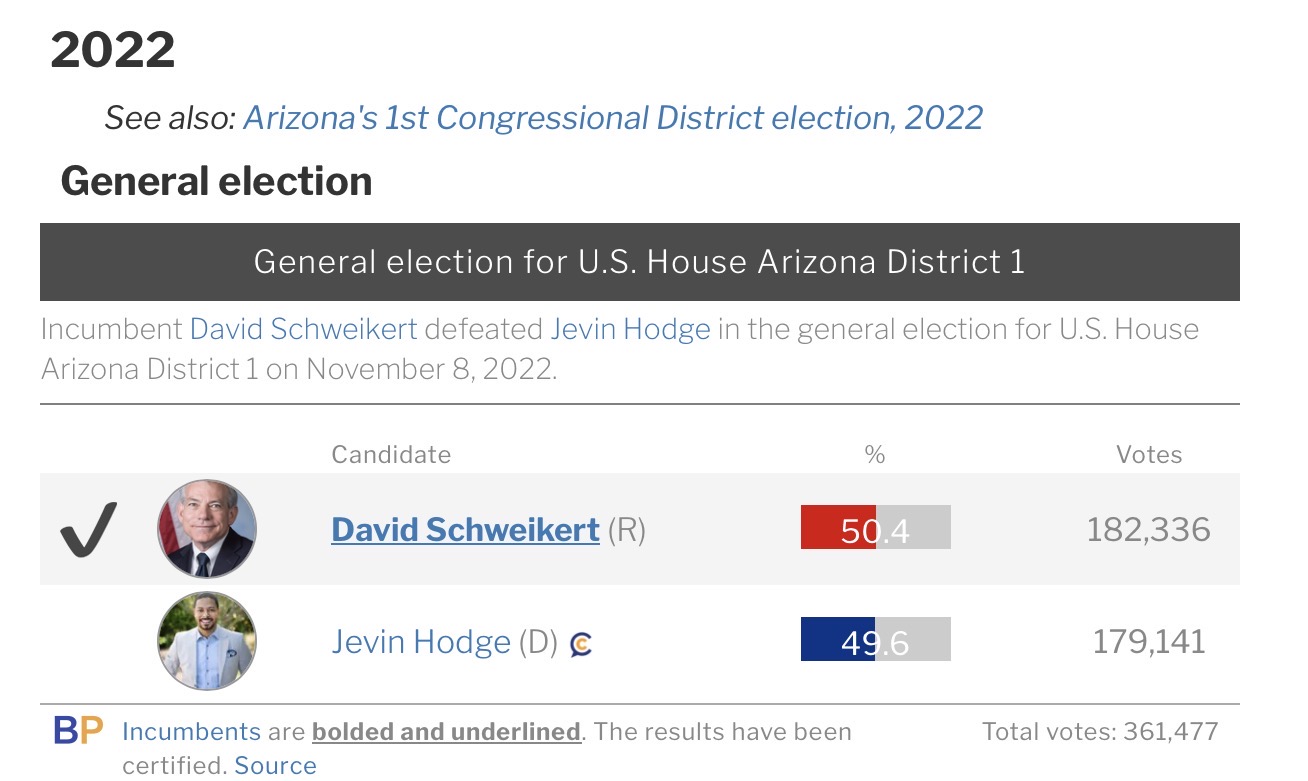
• 2022 +0.8%

AZ-1 2022 U.S. House result

• 2024 +3.8%

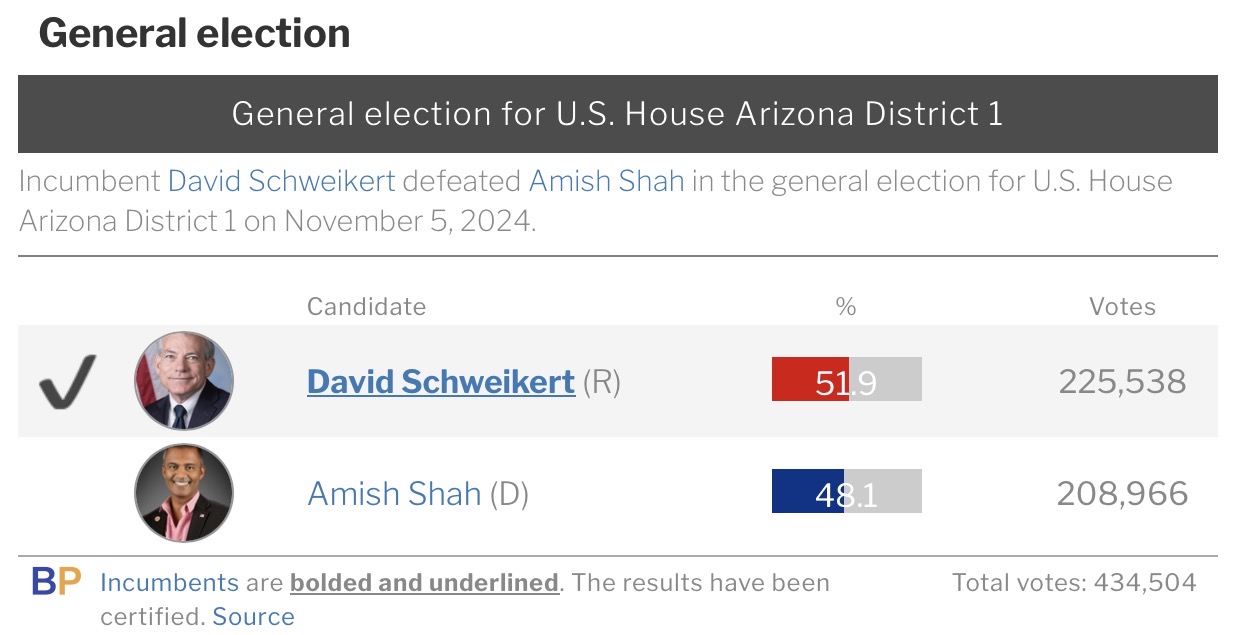
AZ-1 2024 U.S. House result

I would have expected Schweikert to have a larger margin in 2022, a GOP House popular vote midterm victory, than I would have thought he’d get in 2024, when he won by 3.8% against Shah; this seems like a positive sign that Shah is seen as out of touch with the district and not likely to capture a tailwind like the one we saw in 2018 (which Republicans also didn’t see as vulnerable, and spend accordingly).

V. Analysis of 2026 Primary Results

Both parties had seriously contested primaries, and Democrats have the worst fallout.

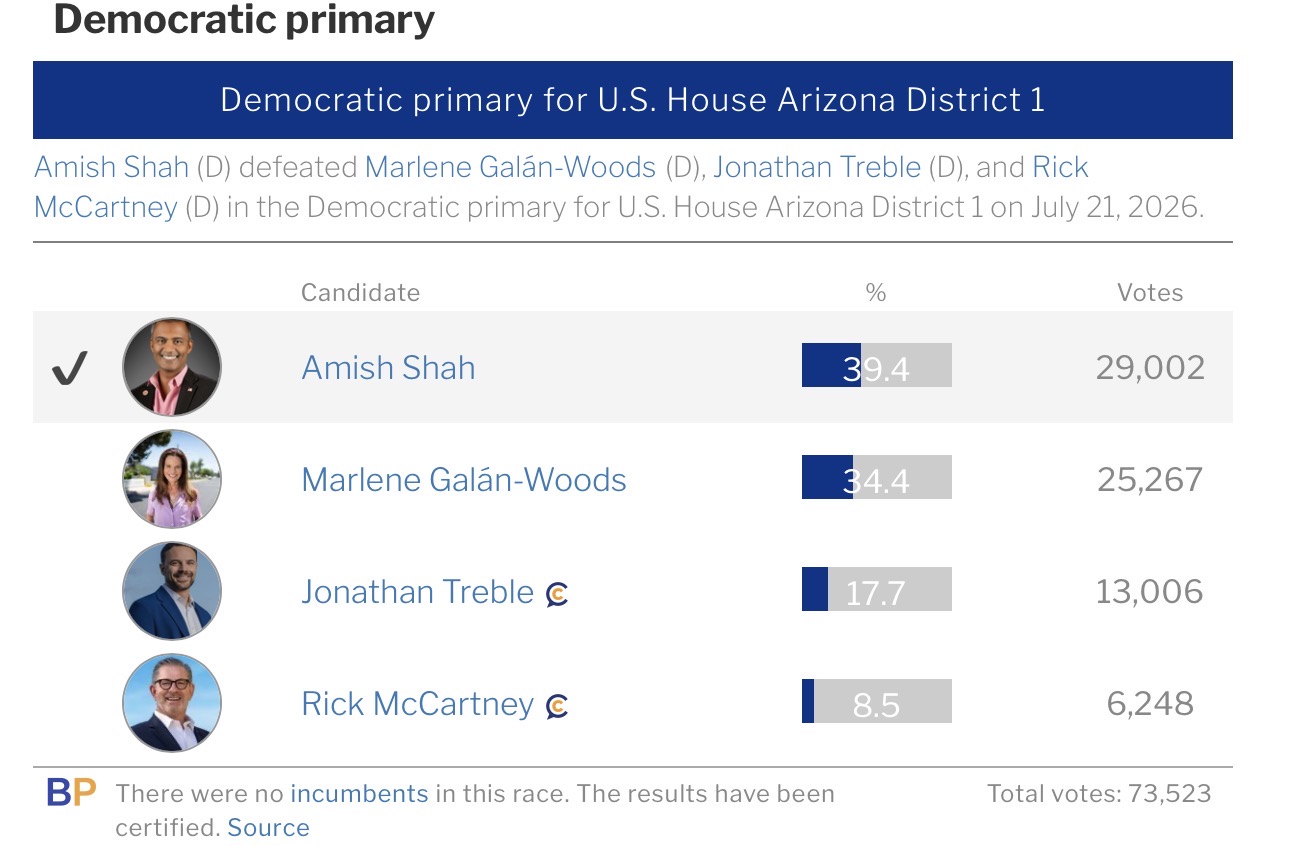
AZ-1 2026 Democratic primary results

The deep pockets, lobbyist groups, and Democrat establishment all wanted broadcast journalist Marlene Galan-Woods to win the Democrat nomination. She came up 5 points short to Shah, who had no choice but to run toward the left-wing grassroots organizations – a pathway to victory in the primary but a potential millstone for the General Election.

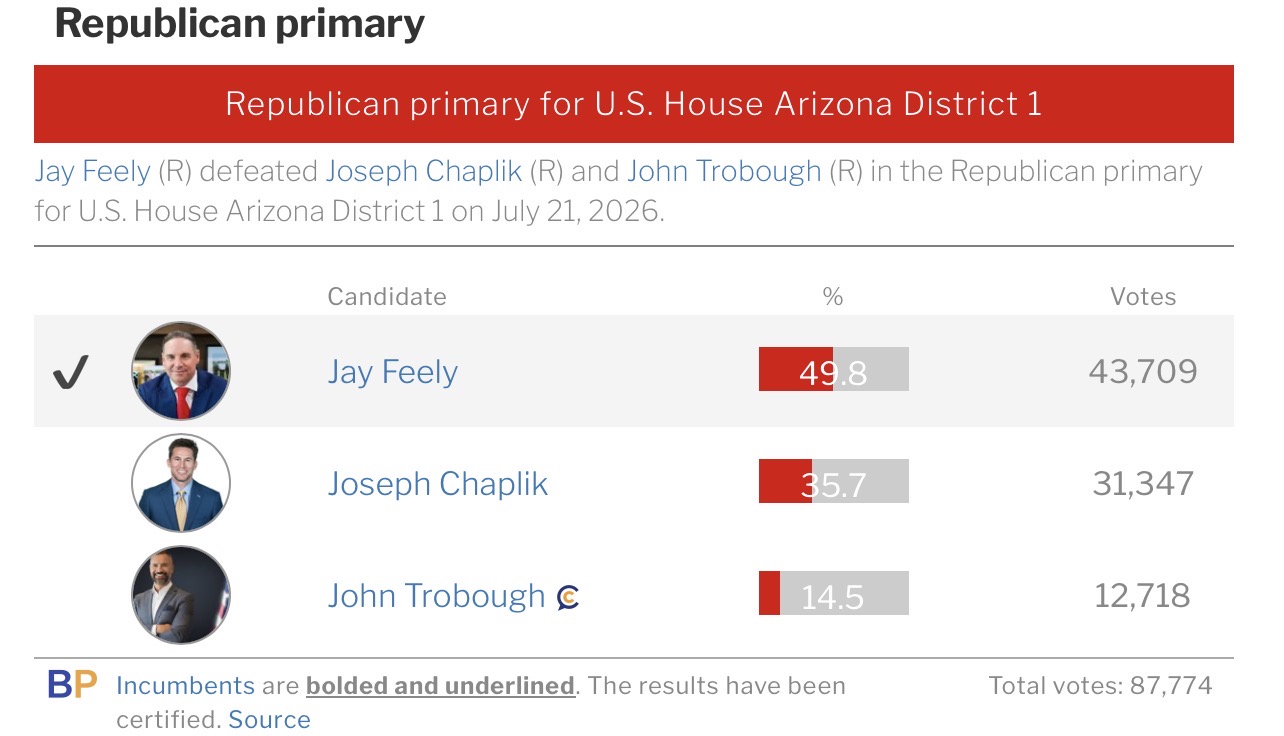
AZ-1 2026 Republican primary results

Republicans also had a hotly contested primary. Rachel and I were pulling for former State Representative Joseph Chaplik, who is more aligned with the grassroots, but Feely pulled 49.8% of the vote and won the nomination, highlighting the continued divide between Republican establishment and the MAGA coalition in Arizona.

VI. Polls

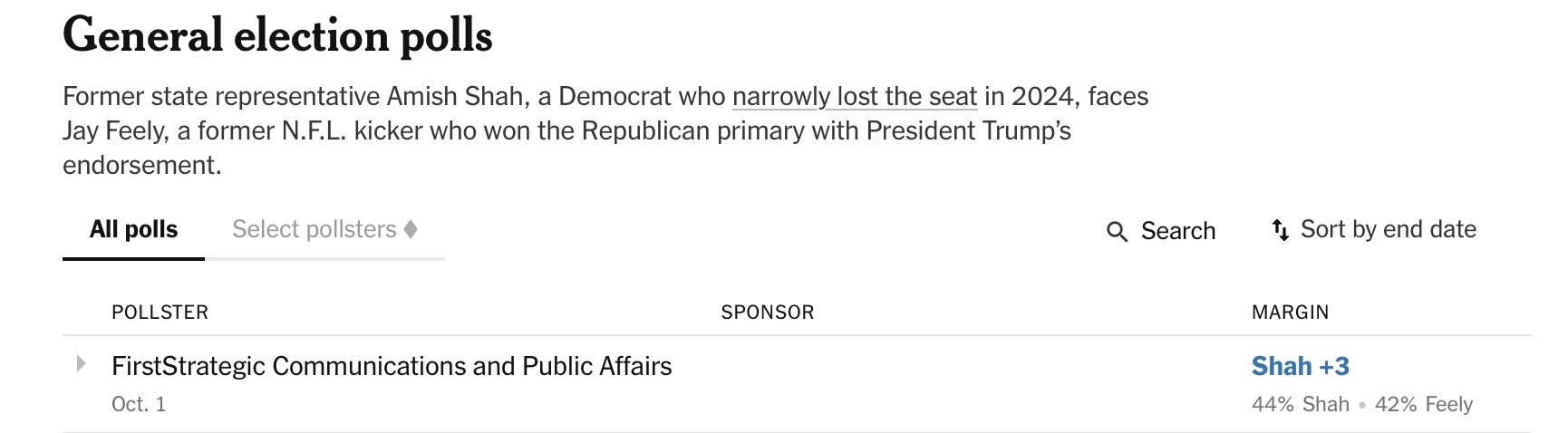
Poll sourced from The New York Times:

AZ-1 polling table from The New York Times

Only one poll is on file for this stretch run, and it tells us next to nothing with 14% undecided and the race within the margin of error.

VII. Media Ratings

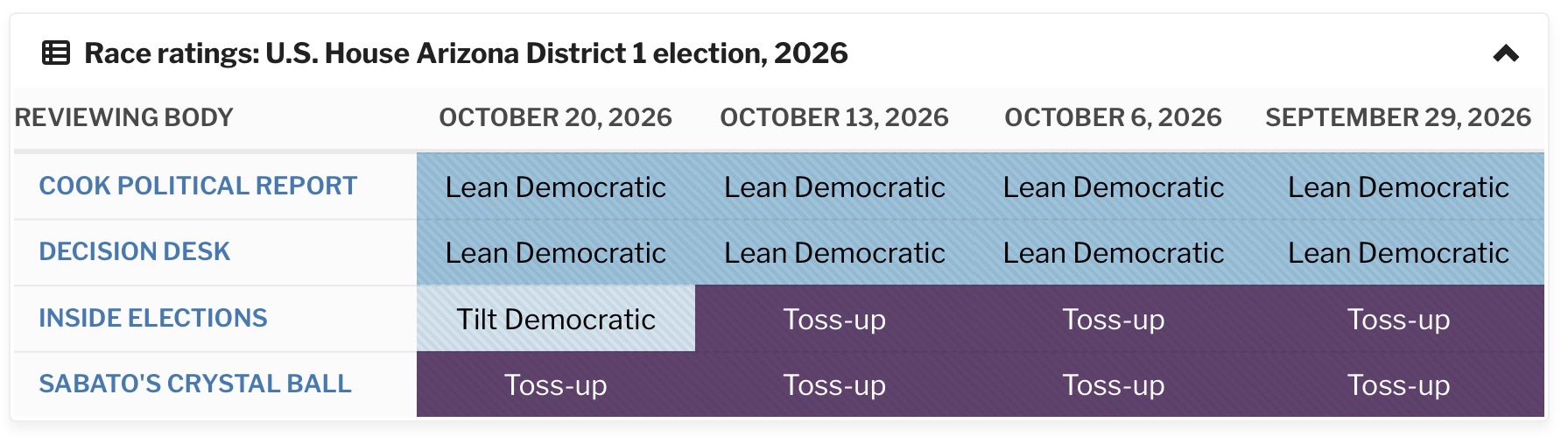
Media race ratings for AZ-1

Sabato has this race as a “toss-up,” but the other three favor Shah by varying degrees likely predicated by the 2018 swing.

VIII. Party Registration

AZ-1 party registration changes since 2014

Party registration changes in AZ-1 only slightly favor Shah, as Democrats have closed the gap by less than 3,000, and less than half of a percentage point. These are net gains, a product of both parties losing membership since the 2014 election. It gives TPUSA a slightly diminished bench from which to chase ballots, but isn’t representative of a fundamental shift in voter behavior evident by registration analysis.

IX. Election Considerations

It will come as absolutely no surprise to anyone who has followed the battle for election integrity in America that Arizona is one of the worst states in the country for transparency, handling of mail-in ballots, long counts, and “bipartisan” cover for these activities. The Maricopa County Board of Supervisors, supposedly four Republicans to one Democrat, have constantly interfered with the efforts of Justin Heap, the new County Recorder, to streamline as much of this process as possible in a short period of time.

X. Summary and Election Estimate

At face value, AZ-1 looks like a perilous contest for the Republicans, facing an open seat, in a midterm year that is supposed to favor Democrats; however, there are three factors that give the Republicans the best odds of the two decisive house seats in the state:

Candidates. Shah beat out Galan-Woods, the media personality the Democrat and Maricopa establishment was trying to nominate for the race. He has had to adapt his positions and while he’s not a card-carrying DSA member, appealing to the new left is what got him the nomination. On the other side of that coin, Republicans nominated the establishment candidate, too.

Unfortunately for Shah, AZ-1 is a very establishment district, as observable by how far left of its registration it has been voting in the Trump era. Feely has come under fire for his positions on guns and for being wishy-washy with his past statements (and for some of his alliances, like those with the Clintons). It will be impossible to hang the “too extreme” label on Feely, as Chaplik’s opponents would have done with him.

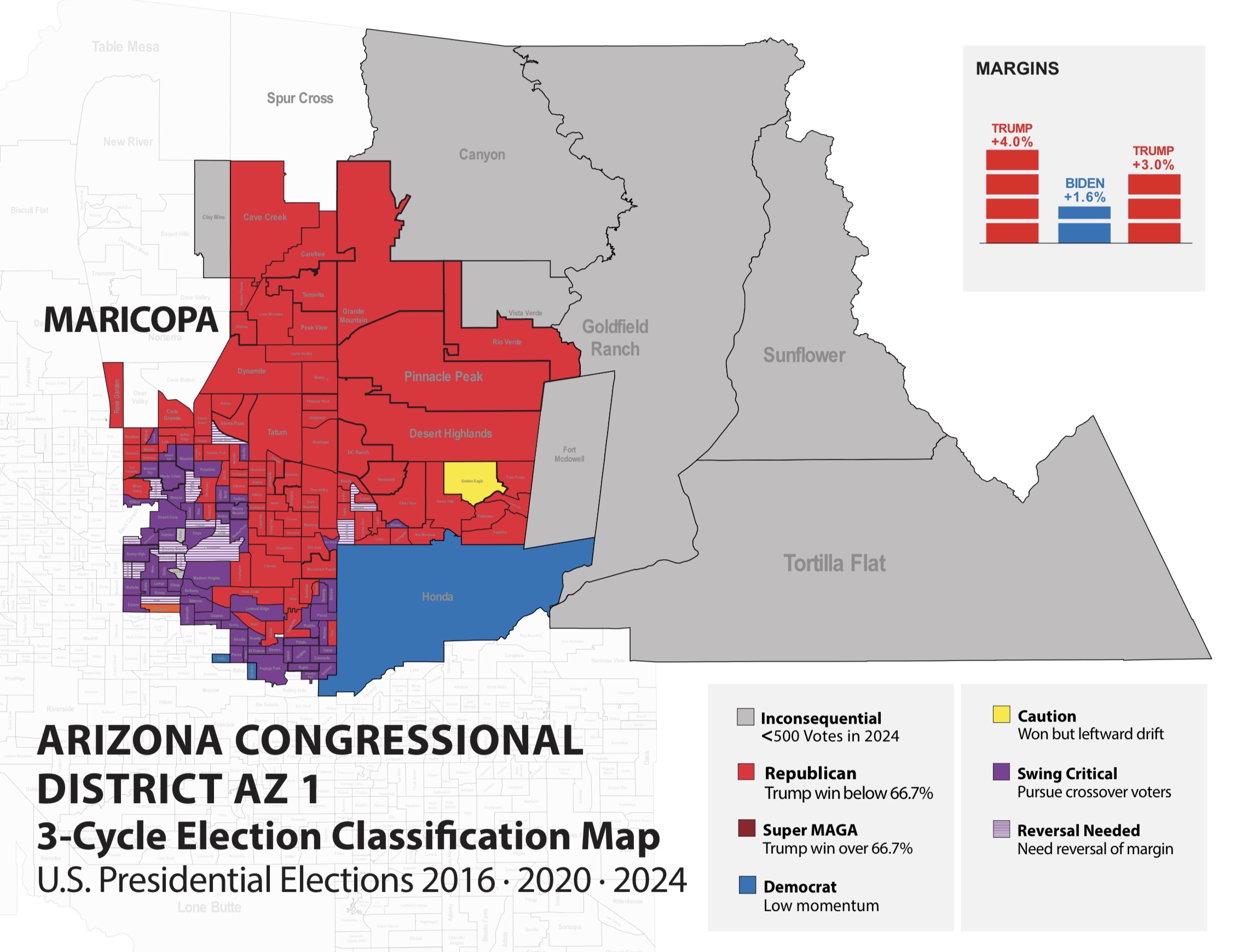
The turbulence has settled down. There was a lot of volatility in this portion of Maricopa County at the beginning of the Trump era, but the almost all of the Republican precincts became more favorable for Trump in 2024. Here is my proprietary mapping of the district:

Captain K proprietary precinct mapping of AZ-1
Captain K Proprietary Mapping of AZ-1

There are no “Super MAGA” (Trump with over 66.7% of the vote), but the positive indication here is that unlike VA-2, the district isn’t covered in yellow (precincts won by Trump but with at least 3% of leftward drift). The red precincts here are, for the time being, “friendlies.” The precincts in purple are heavily Latino, and those with solid coloring had movement toward Trump despite going for Harris overall.

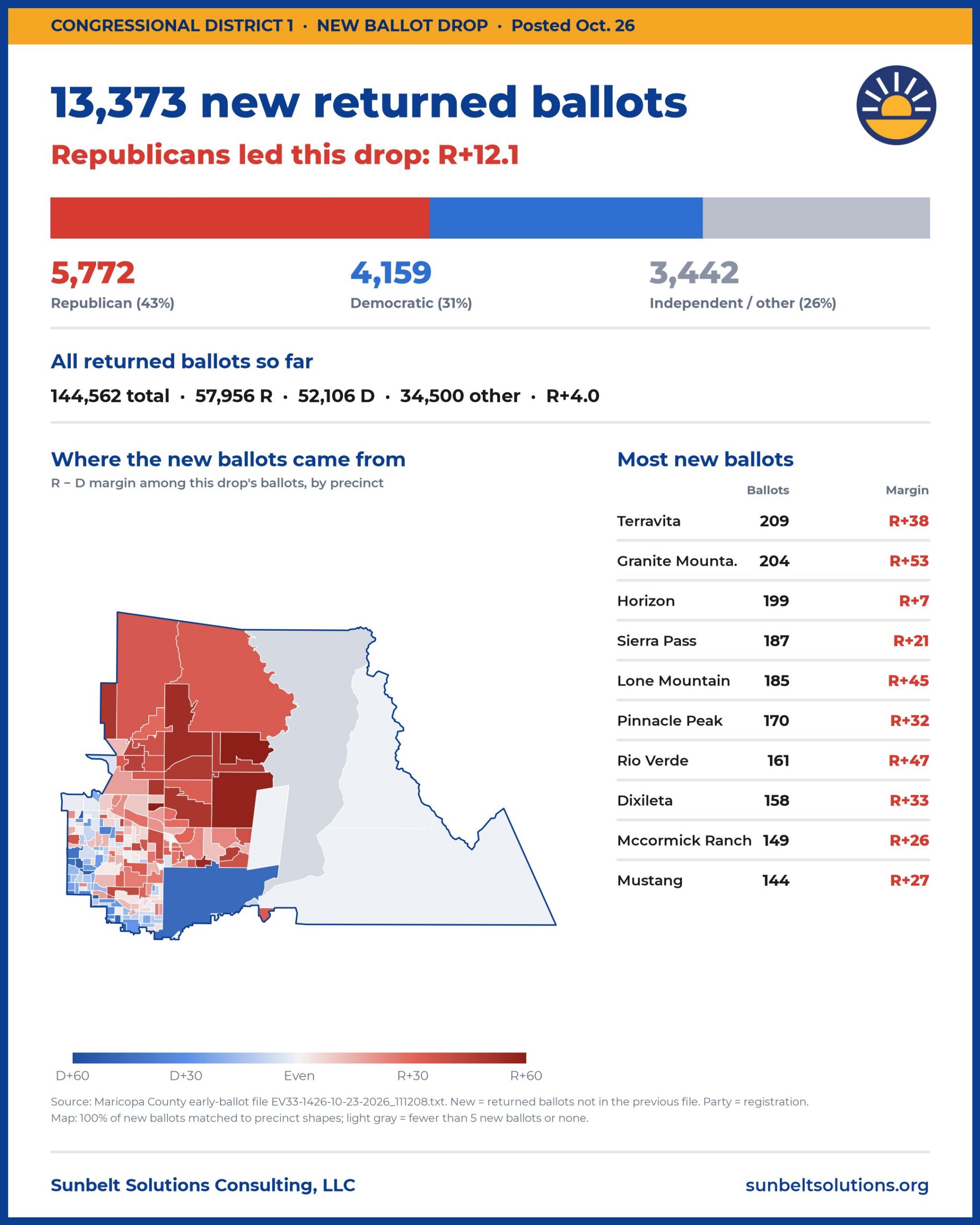
Early turnout. As I sat down to write this assessment, Maricopa County released a bunch of ballots that went R+12.1%:

Maricopa County early ballot drop in AZ-1, R+12.1%

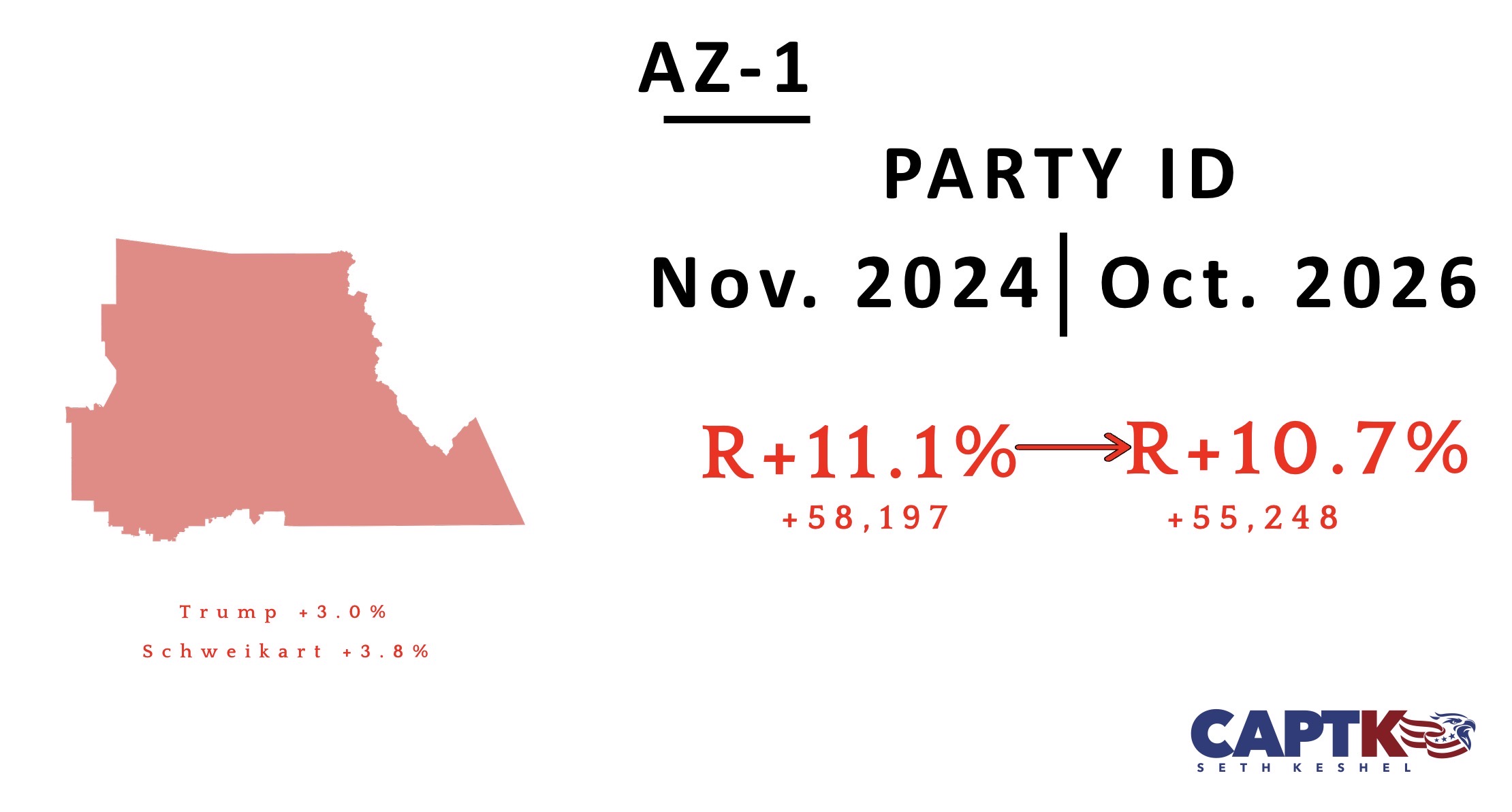
To understand how massive that is, it’s eight days until the election and Republicans just secured a drop that ran right of overall registration (R+10.7%, shown above). Overall returns in AZ-1 sit at R+4.1%. As this trend escalates, likely due to Latino voters sitting on their hands with lower enthusiasm, Feely will become more and more likely to hold the seat.

🚨NEW SWING SEAT UPDATE: Arizona Republicans are showing up for @jayfeely. Today’s Maricopa drop in CD1: 13,373 ballots @ R+12.1. GOP lead in early returns grew from R+3.2 to R+4.0. 5,850 more R than D ballots.

Ari Daniel Bradshaw (@AriBradshawAZ), Oct 26, 2026

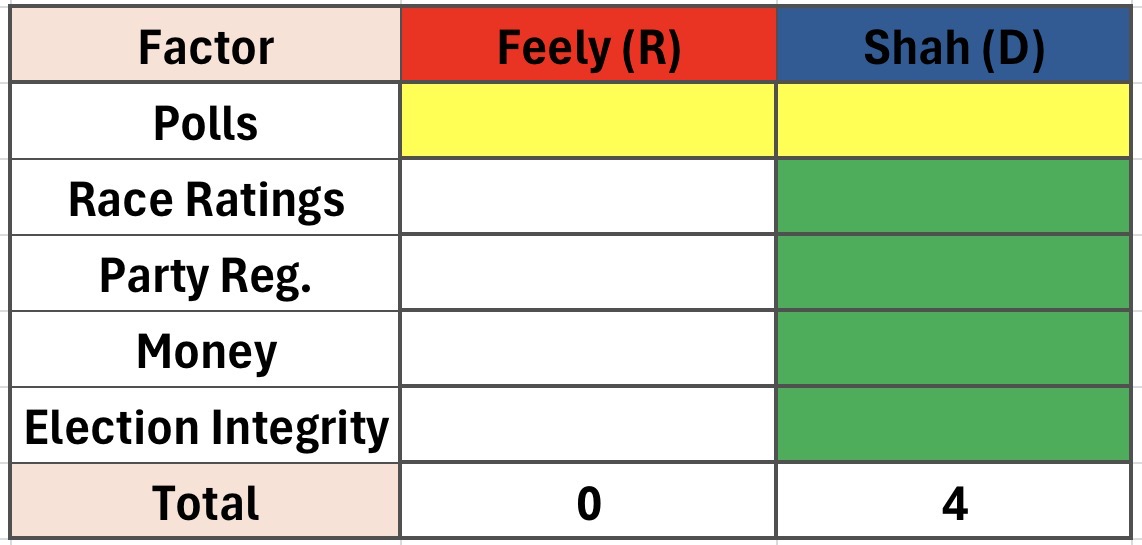
Shah leads every applicable category in my decision matrix, although Feely has plenty of money coming in from outside spending:

Keshel decision matrix for AZ-1, including outside spending

However, despite having these advantages at his disposal, I think candidate quality and the TPUSA ballot chase differential puts this race on its head:

Forecast for AZ-1 House

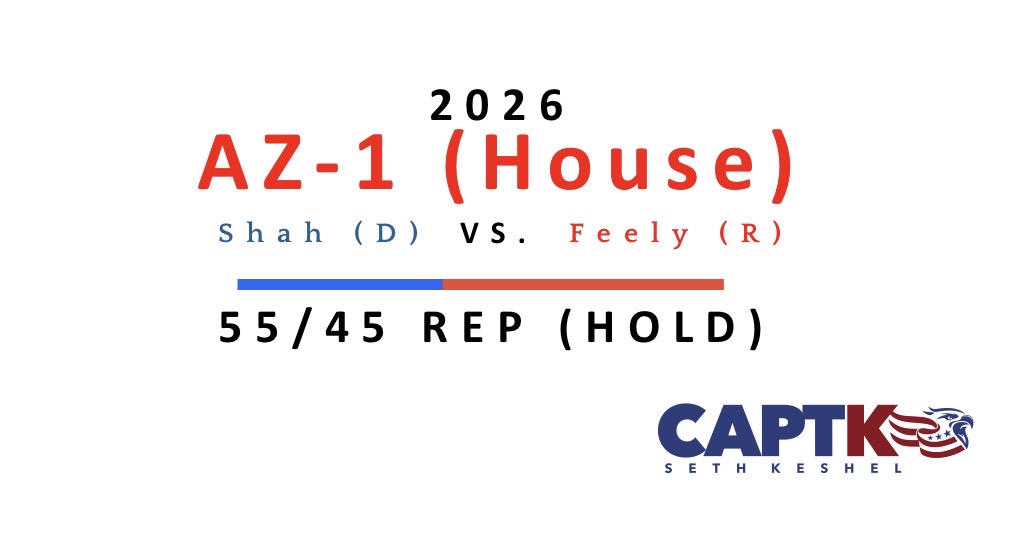
Keshel forecast for AZ-1 House: 55/45 lean Feely

As with all of my 55/45 calls, I consider this race a flip of the coin, with the lean being owed to either the core set of fundamentals or, in this case, a steady stream of data. The latest ballot drop and the success in low prop voter turnout appears to be making a dent, and I think Feely is massively undervalued in this race. Shah will need to see a major uptick in Latino Democrat turnout and hope there are a lot of soft Republicans voting for Hobbs that will tick Democrats all the way down the ballot.

Seth Keshel, MBA is a Senior Fellow at the Gold Institute for International Strategy and a retired Army Captain. He publishes Captain K’s Corner on Substack.