The goals of the left always require a deeper dive to understand
I just love it when we all get dragged kicking and screaming into all that “affordability” has to offer. That was the campaign tagline for Democrats everywhere, including in Arizona. But instead of affordability everywhere and miraculous suspensions of the laws of supply and demand, surprise! We get to tinker with an already lousy election system no one trusts:
Arizona Dems’ Immediate Priority: Cover Tracks
I’ve already explained here that I’m having a difficult time pleasing everyone who has followed my work for six years. I remain highly critical of election corruption and have written about it here in these virtual pages and also on X in recent weeks, and do so any time I find it, like today:
Yet at the same time, I have six years’ worth of experience getting smacked upside the face with “no evidence” shrug-offs when in fact we will never have more evidence of election rigging than we did in 2020 – short of the Trump administration turning the tables and discovering massive cyber intrusion and fraud that I currently am unable to examine or quantify myself. I have not ruled this out, and I encourage all Republicans to start digging into their own elections when they win instead of only waiting to do so when they lose (or suffer a perceived or reported loss).
We are doing ourselves a major disservice if we pretend there are no political lessons to be learned from the midterms, or that there are practically no voters who would show up to burn everything to the ground. Unless votes are being digitally removed from GOP candidates, then it appears Republican turnout was lower than any midterm since 2014 when considering votes for the U.S. House alone. So, yes:
• Elections are corrupt and no more verifiable than they’ve been at any point in the electronic elections era
• We are politically outgunned, outrun, and out-strategized by an enemy that unifies behind the singular goal of conquest
We said they were weird, and they came out with “affordability.” Whether they stole every race or legitimately turned into invincible electoral forces, that was the rallying cry. We sold vegetables, they sold cotton candy. Federal Democrats are now on board with witch hunts, impeachments, subpoenas, and amnesty, and are talking about future ambitions they’ll play with in 2029 if they hold the House for another cycle and get one of their own into the White House.
One of the most radical left-wing ideas is that of the National Popular Vote Interstate Compact (NPVIC). It is a serious play to subvert the Electoral College’s system of electing the president and vice president by allotting a certain number of electors (equal to the sum of representatives and senators assigned to that state), and its final adjudication will rest in a messy legal fight.
States that have joined the compact total 222 electoral votes. They need 270 to have enough electoral votes to create an Electoral College majority by themselves, and they’ve agreed that once they hit 270 or more collectively, they’ll throw their electoral votes behind the winner of the “national popular vote.”
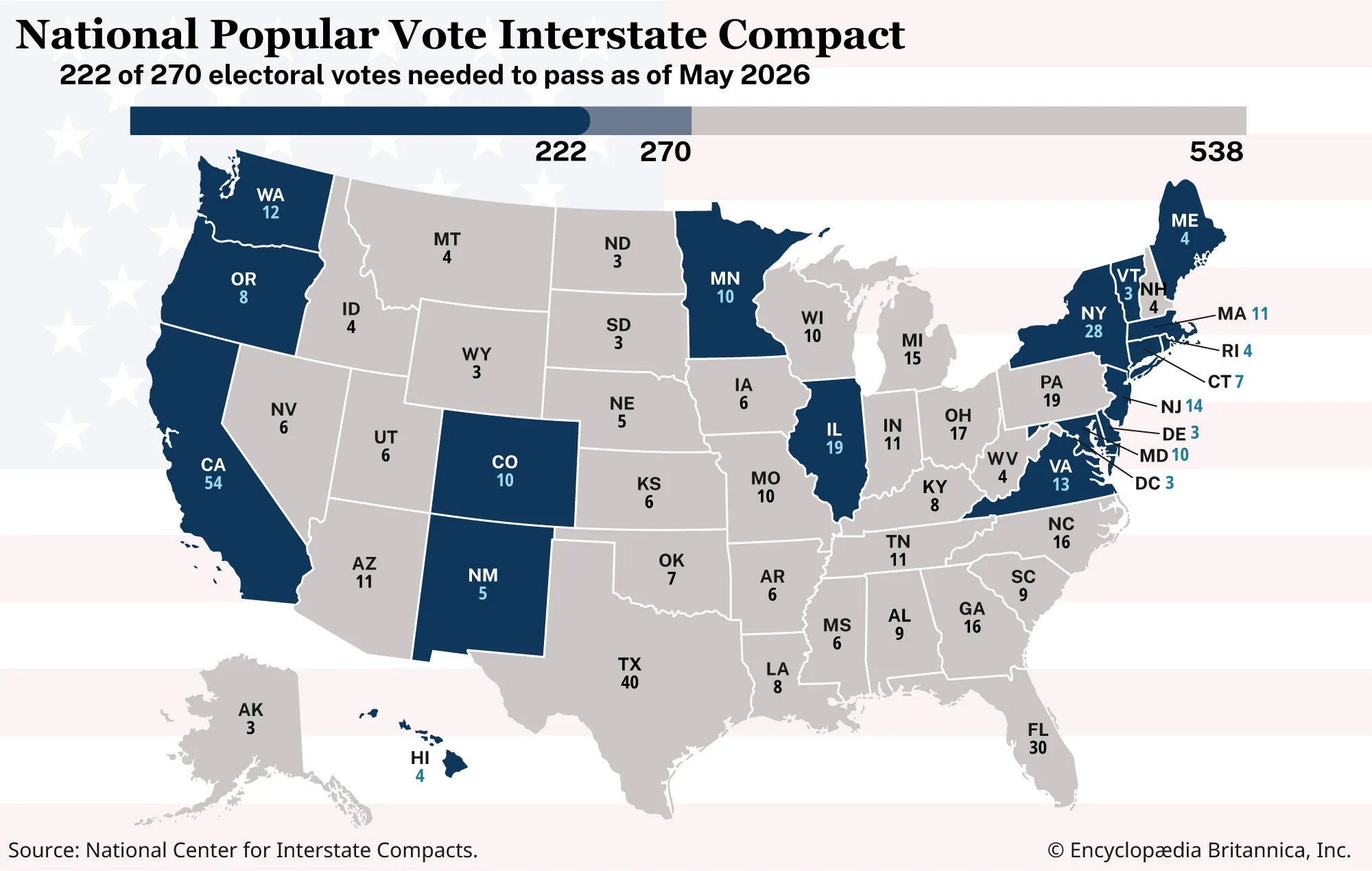
As of this midterm, five states now have the Democrat legislatures and governors necessary to join the compact.
• Pennsylvania (19 electoral votes)
• Michigan (15)
• Arizona (11)
• Wisconsin (10)
• Nevada (6)
Wisconsin’s outgoing governor, Tony Evers, doesn’t favor the compact, but his opinion will soon be moot. I’d be surprised if the other states don’t leap at the opportunity to join. If all of these states adopt it, then the NPVIC will be at 283, triggering a legitimate Constitutional crisis.
CRISIS EXPLAINED
The Electoral College was designed to protect small states from the ravages of pure “democracy.” Here is the allotment of electoral votes from the 1792 presidential election:
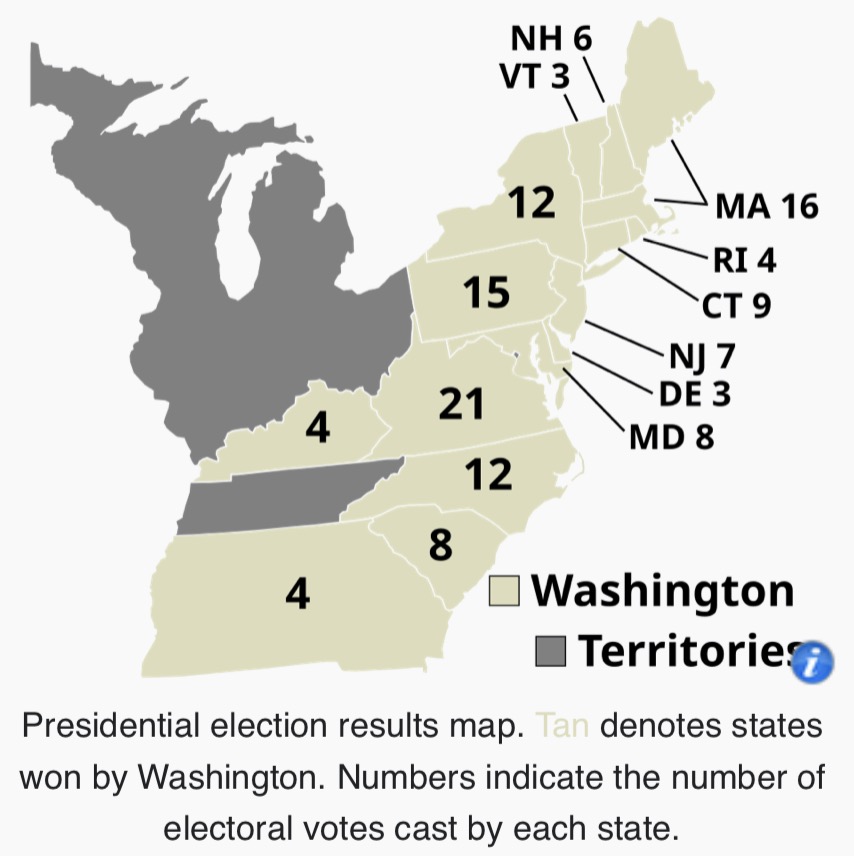
The Constitution had been drafted five years earlier; statesmen from the dominant states of Virginia, Pennsylvania, New York, and Massachusetts willingly ceded power to smaller states, who were all concerned their interests would be overrun by those with sheer numbers, in order to form the Union.
This is proof positive that the modern-day rulers of states like Vermont, Delaware, Rhode Island, and Hawaii are left-wing ideologues who would sacrifice their states’ interests to the larger states (particularly California, New York, and Illinois) rather than understand and preserve the system designed to give them their proper seat at the table of government. If (when) the NPVIC reaches more than 270 electoral votes in membership, a massive legal battle will ensue that will almost certainly be decided by the Supreme Court.
That means this is potentially in play for 2028.
Proponents of the NPVIC argue that this compact doesn’t abolish the Electoral College. Technically, they are correct. It only abolishes it as it was intended to function (to limit the impact of the most dominant states), but in order to have their way, they’ll merely specify that their electors are to vote for the winner of the national popular vote – prioritizing the votes of larger states and possibly disenfranchising the presidential choice of their own citizens.
Just as Nebraska and Maine have created systems awarding electors by winners of congressional districts, these states are taking it a step further in modifying how they award electoral votes. My instinct here is that they all know the intent of why we have the Electoral College we have, and are warping their interpretation of it in a way the Founders never imagined would be possible because in their world, people came together to form a Union and protect small states, even if it meant less power for their own state.
As infuriating as the NPVIC is, there is only one available defense – the Compact Clause (Art. I, §10). That forbids states from joining compacts without Congressional approval; in this case, the compact is even more insidious because it represents an end-run to disenfranchise states that don’t want to be blotted out by enormous states and forced into a system no one asked for until the left lost two presidential elections this century while winning the fabled “popular vote.”
PRACTICAL IMPACTS
The Electoral College is brilliant because it forces a presidential campaign to form a coalition. Trump’s coalition was, at first, white evangelicals from the Sun Belt and South and working-class voters from the Midwest. It expanded in 2024 to include a large minority support base. The battlegrounds of 2024 (PA, MI, WI, GA, NV, AZ) were much different from the battlegrounds of 2004 (IA, OH, FL, NV, CO, NM), and these evolve as issues and campaigns do.
Under an NPVIC allowed to stand, presidential elections would immediately shift to focus primarily on five states:
• Florida
• Texas
• California
• New York
• Illinois
Major dollars would be dropped in markets like Philadelphia, Atlanta, Phoenix, Detroit, and Seattle, but the days of giving a hoot in hell about flipping burgers and hot dogs at some far-flung county fair in Iowa will be long gone. And so will anyone’s concern about what happens in the heart of America. Even worse, the NPVIC opens up an already-rotten system to abuse of the worst possible kind.
Can you imagine a scenario in which the national popular vote hung in the balance and we had to watch California do its late-count routine into December? Tensions are already high in this country, and a California cheat-fest overriding the collective votes of 49 other states would ignite a powder keg no one is prepared to see go off. Elections would be meaningless, and all political power would rest in the hands of a handful of states.
Sure, there would be GOP voters coming out to vote in states written off as blue, and there will be Democrats doing the same in states like South Carolina or Tennessee; you can even make the case that, just like Trump’s popular vote win in 2024, the future may favor GOP candidates in the popular vote as minority voters normalize their voting trends. No matter the position you take, no one can argue that American elections wouldn’t be fundamentally transformed for the worse.
SHORT-TERM PREDICTION
I think Democrats will push the NPVIC over the 270 threshold in the 2027 legislative sessions. That means their state laws, now activated with member states exceeding 270 electoral votes, will require electors to support the winner of the national popular vote. This will immediately trigger the legal crisis described above and the two dueling arguments:
• “We have the authority to assign electoral votes how we see fit”
• “This is an illegal compact that disenfranchises other states unwilling to be part of this system”
This Supreme Court has been a major disappointment, and the president has expressed the same frustration. They blew it on mail-in ballots, they’ve blown it on birthright citizenship. Yet I think, given the age and lean of the court, that they will sideline any move to abolish the Electoral College – if anything because they wouldn’t want to be associated with the inevitable kinetic powder keg they would ignite when they hand all perceived power to a few very large, urban monstrosities posing as states.
I also believe it was a terrible oversight not to have Justices Alito and Thomas retire in the first two years of the Trump 47 term. With the Senate out of reach for Republicans for at least six years, and no predictable timeline available for holding the presidency, it is highly possible Democrats will have a 5-4, if not 6-3, majority available to them within the next decade. That Court would be more than willing to shove the NPVIC compact through.
That means it is absolutely essential that Republican lawyers not go into the inevitable legal showdown in a half-assed manner, because once this egg is cracked, there’s no unscrambling it. The only hope of maintaining any sense or order would hinge on forcing a federal election system with all key election integrity checks, nullifying large states having special rules in place to disenfranchise others.
Seth Keshel, MBA is a Senior Fellow at the Gold Institute for International Strategy and a retired Army Captain. He publishes Captain K’s Corner on Substack.