2026 Ten-Point Forecast: FL-25 (U.S. House – Decisive)

Scott Singer and Jared Moskowitz, candidates in Florida's 25th Congressional District

Scott Singer (R) vs. Jared Moskowitz (D)

I. The Race
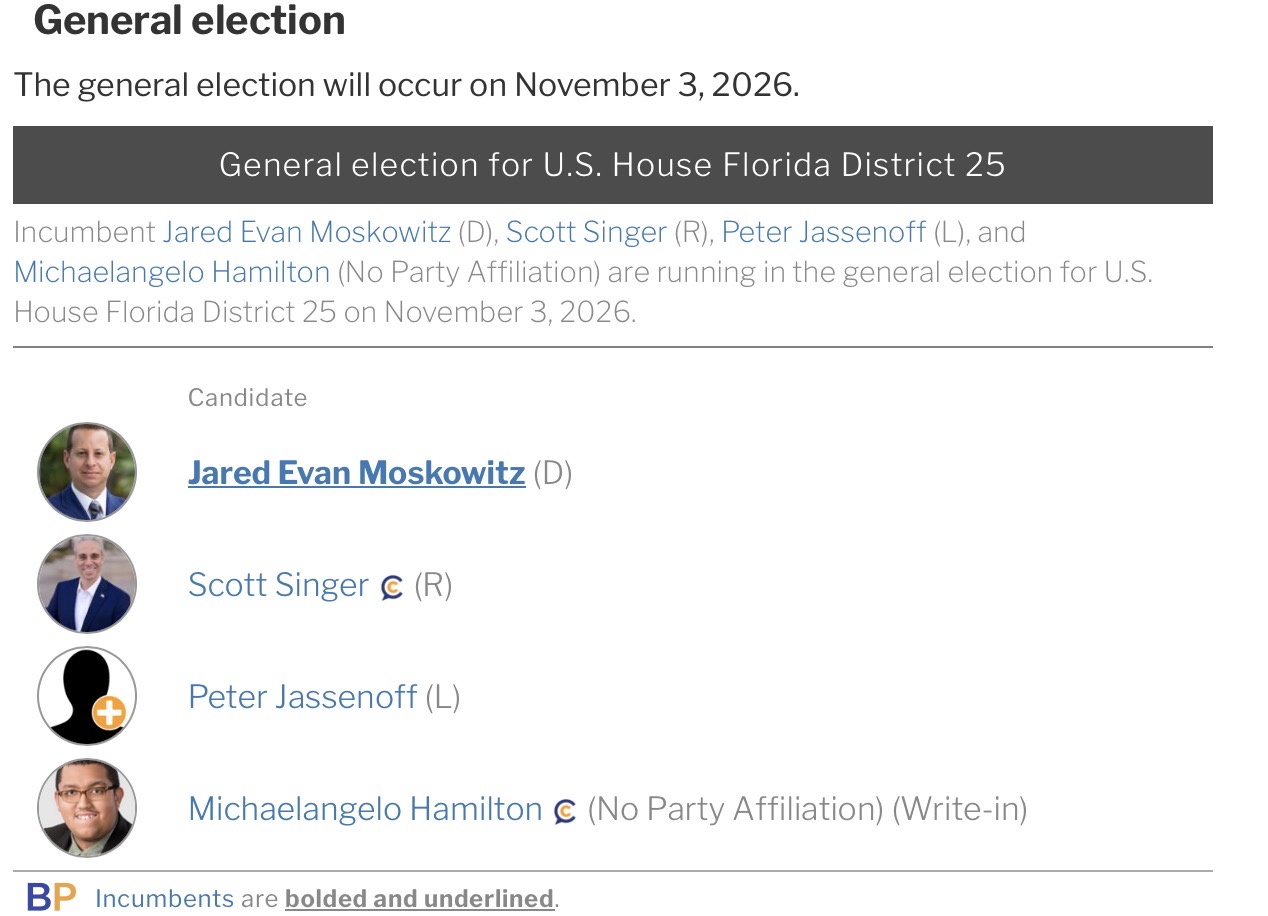
Chart from Seth Keshel’s FL-25 (U.S. House - Decisive) forecast: The Race

Scott Singer (Republican) is a south Florida native and attorney who served three terms as the mayor of Boca Raton. He chairs the Mayors’ Council of the America First Policy Institute and is looking to represent the newly redrawn FL-25 in Congress.

Jared Moskowitz (Democrat) was elected to represent the old FL-23 in 2022 and is one of the smartest Democrats in Congress. He was twice appointed to special roles by Governor DeSantis before entering Congress; once he was there, he supported the DOGE push to maximize government efficiency and was part of the bipartisan task force investigating the assassination attempt against President Trump.

II. District Geography
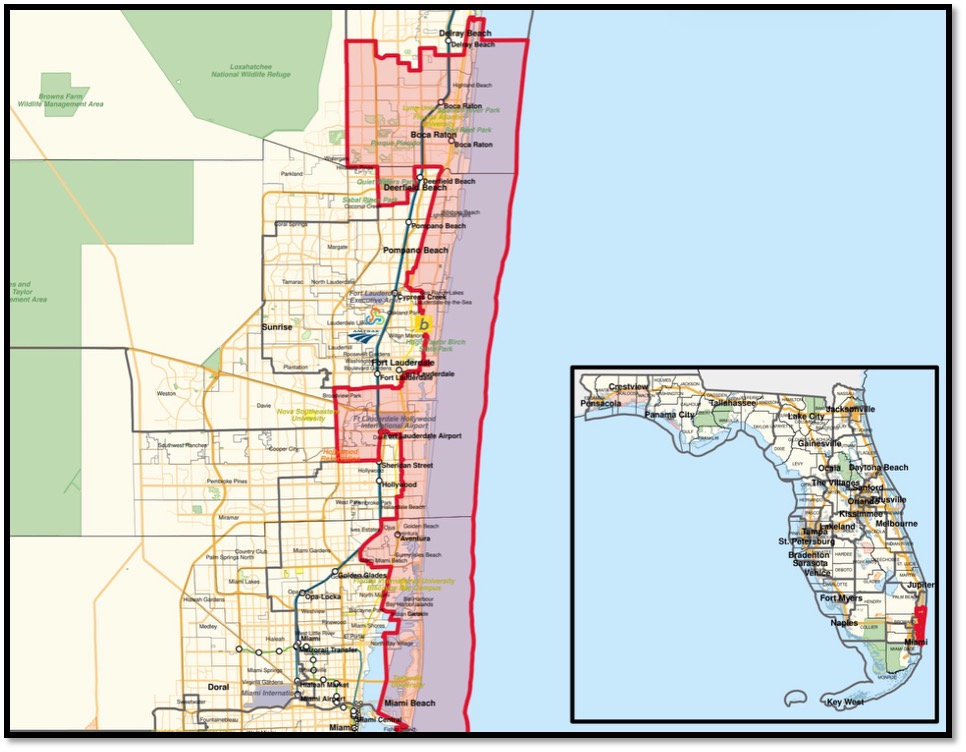
Chart from Seth Keshel’s FL-25 (U.S. House - Decisive) forecast: District Geography

Florida’s 25th Congressional District (FL-25) isn’t even in existence yet; this is the first General Election held under these boundaries following Florida’s 2026 redistricting effort that looks to give Republicans up to four additional U.S. House seats. These efforts upended Moskowitz from his old boundaries and prompted him to file for the race for this new FL-25.

This district looks like a skinny, vertical sliver spanning three counties – Miami-Dade, Broward, and Palm Beach. It avoids the major cities of those counties (Miami, Fort Lauderdale, and West Palm Beach, respectively) and includes cities like Miami Beach, Boca Raton, and other communities situated along the shoreline.

These boundaries create a district that reminds me a lot of the new TX-34, another decisive U.S. House seat that is thought to be competitive because of the major progress President Trump made with Latino voters. The only difference is that in South Florida, you’re talking about Venezuelans, Cubans, and Puerto Ricans more than Mexicans in Texas. On paper, these boundaries went red enough for President Trump that they seem like automatic GOP pickups; a closer look at the trends and down ballot impacts suggests otherwise even though this new district is much whiter (non-Hispanic, anyway) than TX-34 is.

Presidential Margins
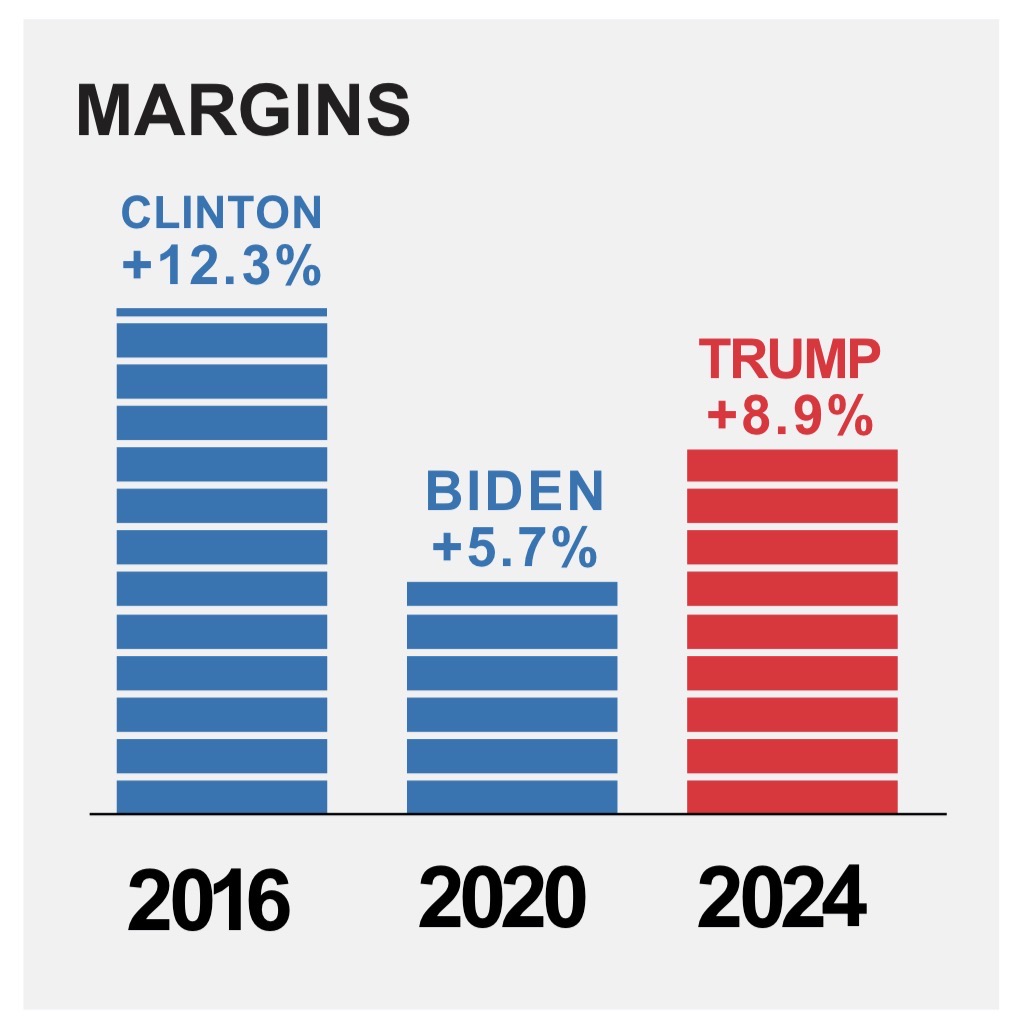
Chart from Seth Keshel’s FL-25 (U.S. House - Decisive) forecast: District Geography

In his 1.2% statewide win of then-battleground Florida in 2016, Trump lost these boundaries by 12.3%. Then, with progress made in a 3.4% statewide win in 2020, Trump lost them by 5.7% – narrowly missing out on a flip of Miami-Dade County. Trump’s huge margins in 2024 everywhere in the Sunshine State brought new optimism for another GOP district in South Florida; his +8.9% margin in the new boundaries sits 21.2% to the right of where it was in 2016.
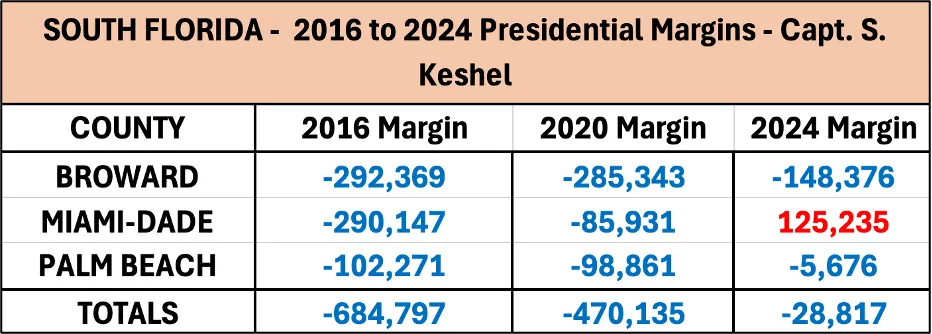
Chart from Seth Keshel’s FL-25 (U.S. House - Decisive) forecast: District Geography

Singer’s challenge, not being named Donald J. Trump or Ron DeSantis himself, will be to hold the Trump coalition together against the Democrat-blowing headwinds of a midterm – especially against a Democrat who notably displays no Trump Derangement Syndrome. Both candidates are Jewish in a 25% Jewish district.

Key Statistics

• 54% White, 28% Hispanic, 18% Black/Other

III. Market Assessment

Despite the major progress made within these new boundaries, Polymarket bettors favor Moskowitz four-to-one.

IV. History

The district as presently drawn for the 2026 election was broken up over other districts in 2018, most notably what was then FL-25 in the north end of the district, and what was then FL-27 in the southern end of the district, extending down into parts of core Miami. Representative Mario Diaz-Balart held his seat in FL-25 by an impressive margin of 21 points, only down a few notches from 2016.

2018’s FL-27 is the portion of the present district (FL-25) that gave Republicans fits. The retirement of GOP Representative Ileana Ros-Lehtinen, who won by 9.8% in 2016, left an open seat for Democrat Donna Shalala and Republican Maria Elvira Salazar (the amnesty queen now representing today’s FL-27) to battle over. Shalala won by six points, representing a 15.8% swing from 2016.
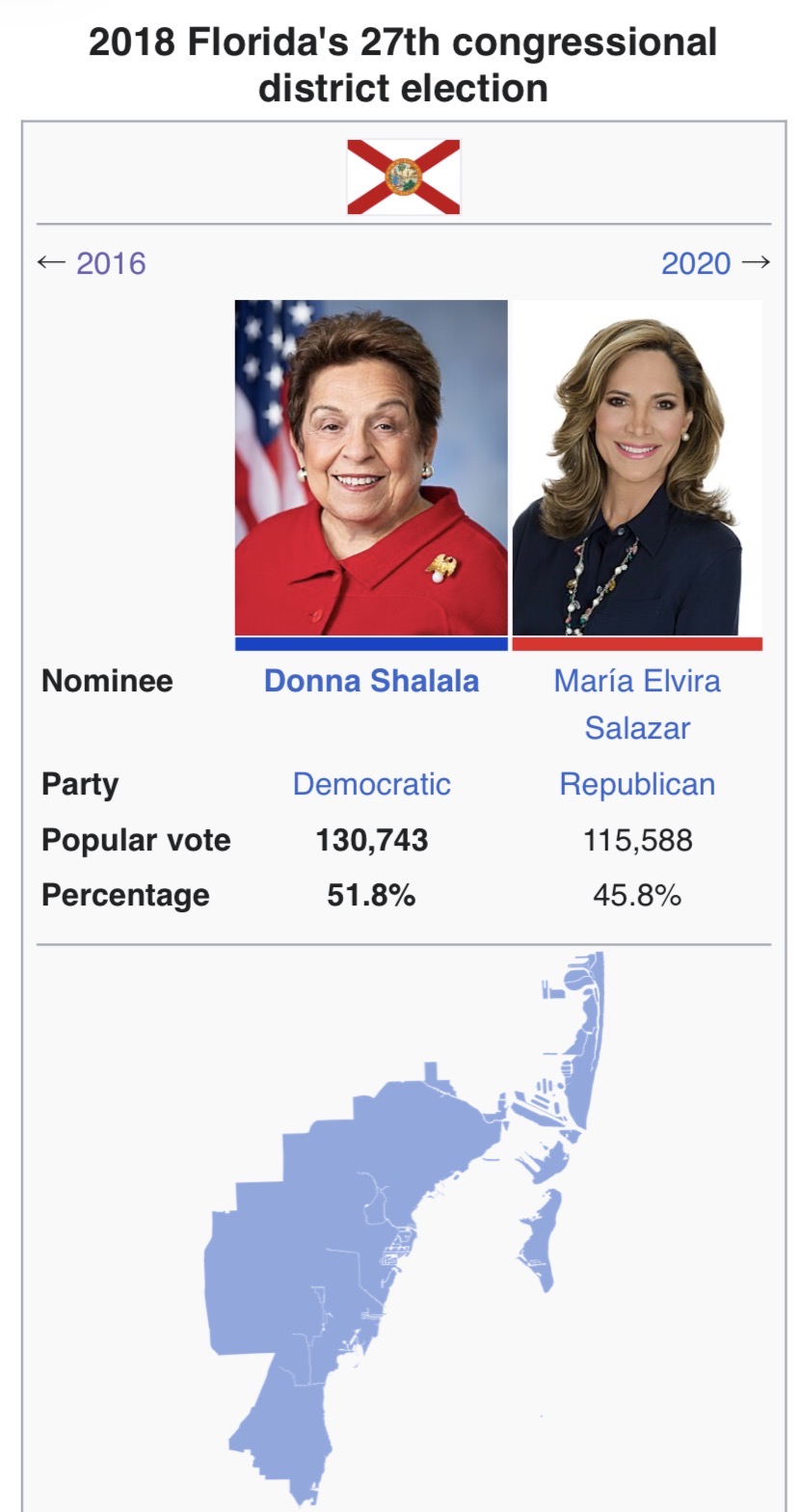
Chart from Seth Keshel’s FL-25 (U.S. House - Decisive) forecast: History

Moskowitz won his current seat (FL-23 before the change) by 4.8% in 2022, then again by the exact same margin in 2024:
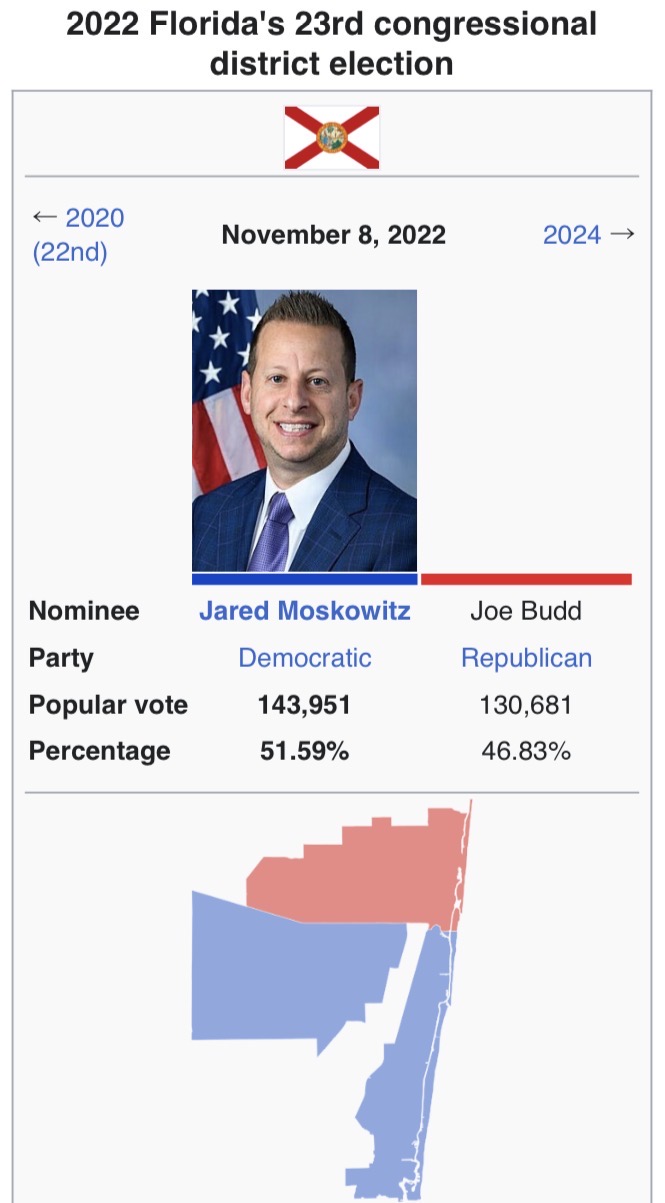
Chart from Seth Keshel’s FL-25 (U.S. House - Decisive) forecast: History

Trump only lost those boundaries by 1.9%.

V. Analysis of 2026 Primary Results

Fortunately for Democrats, especially in a state trending as hard to the right as Florida, Moskowitz soundly defeated radical left-winger Oliver Larkin in the Democrat primary.

Singer narrowly prevailed over a crowded field of candidates, winning a plurality with 31.4% of the vote on a 3.9% margin.
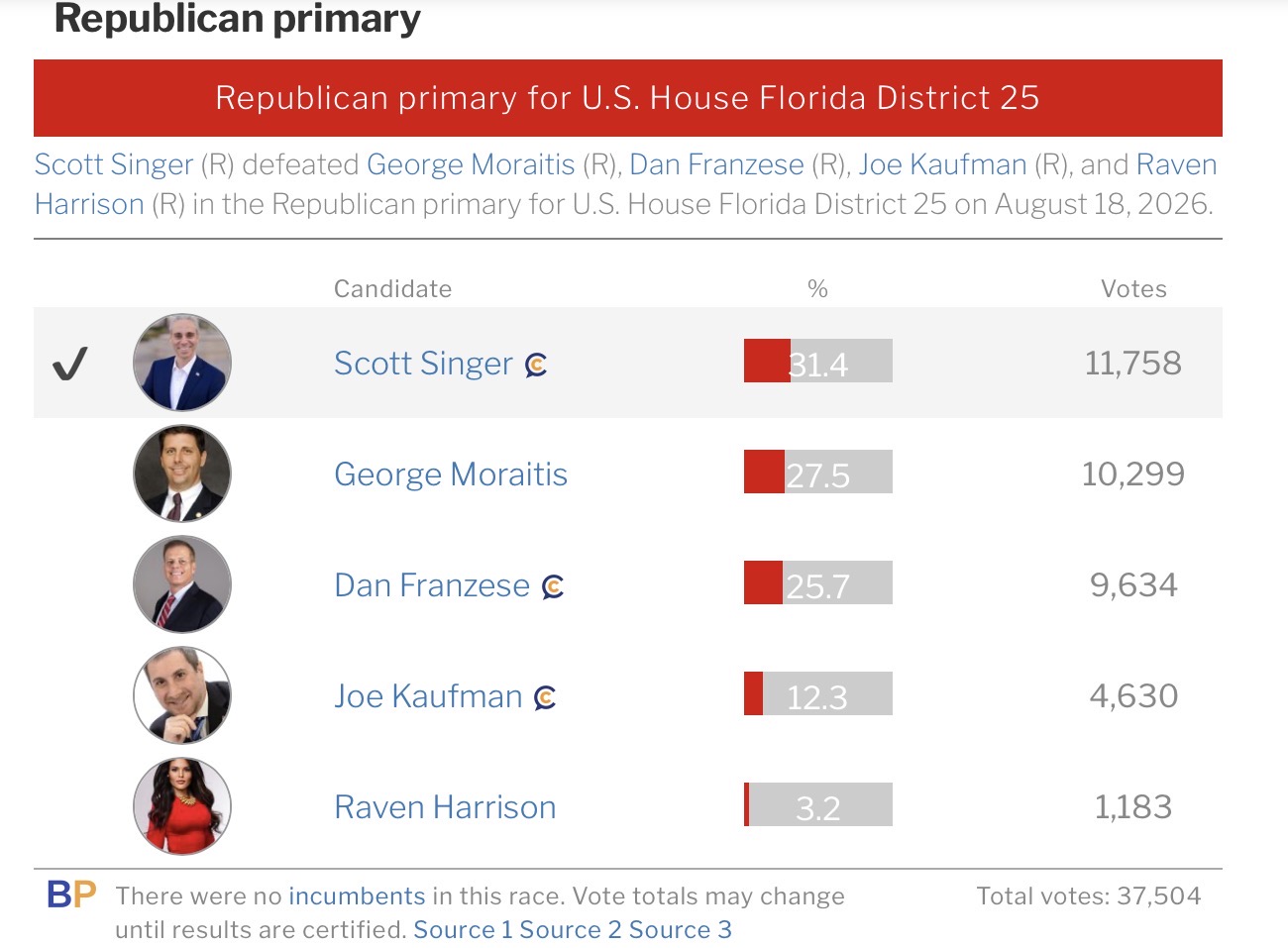
Chart from Seth Keshel’s FL-25 (U.S. House - Decisive) forecast: Analysis of 2026 Primary Results

The Republicans, as usual, ran a brutal primary. Fortunately, they appear to have come together since the contest wrapped up.

VI. Polls

I found three polls listed by The New York Times:
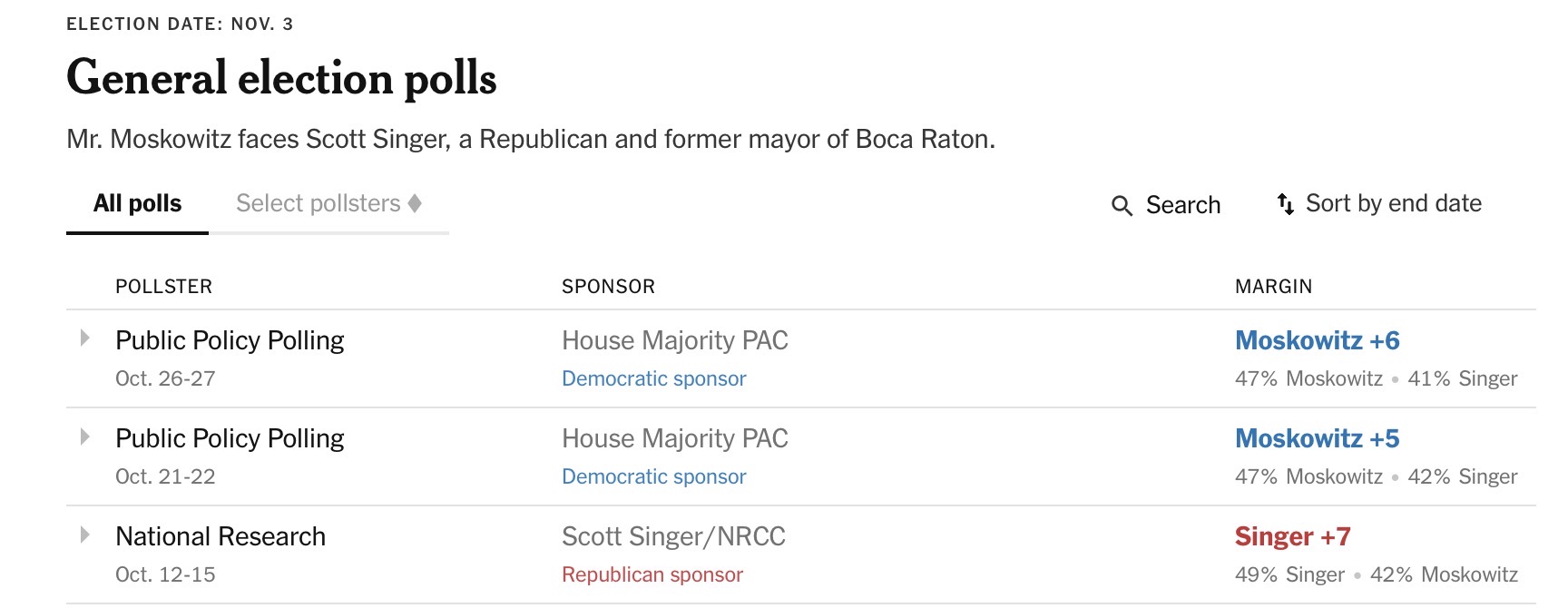
Chart from Seth Keshel’s FL-25 (U.S. House - Decisive) forecast: Polls

As usual, polling displays its increasing futility. Two Democrat-sponsored polls show Moskowitz in command of the race, and a GOP-sponsored poll has Singer up by 7 points and near an outright majority.

VII. Media Ratings
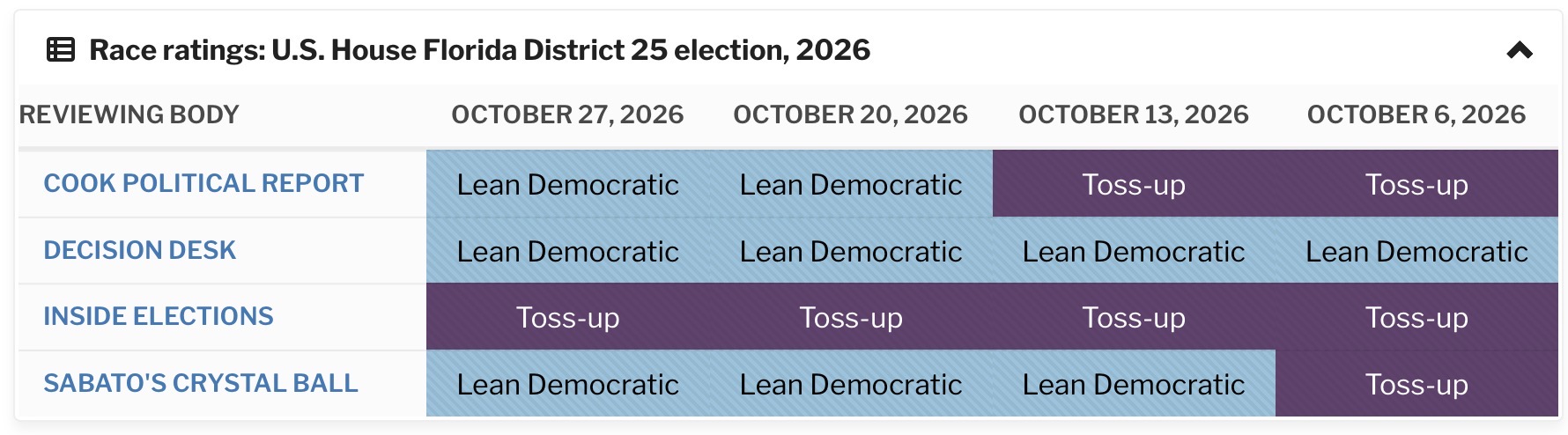
Chart from Seth Keshel’s FL-25 (U.S. House - Decisive) forecast: Media Ratings

Reflecting the likelihood of a tight contest, three of four major reviewers have this leaning for Moskowitz.

VIII. Party Registration

Florida itself is on a massive GOP registration surge, and has moved nearly four full points more Republican than it was when Trump won it by over 13 points in 2024.

Florida’s book closing report gives the registration statistics for the new FL-25 like this:

Republicans 163,894 (35.7%)

Democrats 139,891 (30.4%)

Total 459,448

Advantage R+5.2% (R+24,003)

Reports from spring suggest Republicans have made substantial progress in voter registration in the new district since it was first established by DeSantis’s signature. From Florida Politics:

Moskowitz’s campaign also noted that voters registered without a political party make up a plurality of the constituency in the new CD 25. About 35.9% are independent voters, while 32.9% are Republicans and 31.2% are Democrats.

I don’t have official figures to go on for what the registration splits in these new boundaries would have been if they were notated at the time of the 2024 election, but if Florida Politics is accurate, the district has run another 3.5% right since May by registration.

Notably, Moskowitz won his 4.8% reelection margin in 2024 in the old FL-23 with a district that was D+6.5% by registration. That means the margin ran 1.7% right of registration, which could be a huge red flag for him in a new R+5.2% district that may vote right of registration like South Florida has been trending.

IX. Election Considerations

I summed up Florida’s election picture, highlighting DeSantis’s landmark legislation, in my piece previewing Florida’s Senate and gubernatorial races:

People frequently ask me which states have made the most important reforms to elections since the 2020 quasi election. “Florida” is my hands-down answer. Governor DeSantis signed Senate Bill 524 in 2022, creating the election crimes task force and ensuring that the state would have proper control over mail-in balloting (requiring voters to request a ballot and confirm the address the ballot would be sent to). While it is a large state full of opportunities to attempt fraud, it has done an incredible job at preventing mass fraud. Here is my review of the 2024 election encompassing these changes:

Florida – 2024 Election Compendium

Notably, Florida sets the “gold standard” for counting millions of ballots, nearly the entire statewide count, by the time people wake up the next day. They learned how important public trust in elections is after the 2000 “hanging chads” debacle and have set the standard for the rest of the country.

X. Summary and Election Estimate

All seats with fresh boundaries, especially those merging several districts, make analysis a tall order. I have little doubt no one is winning this race by a wide margin, especially not Moskowitz. While Moskowitz is one of the more rational Democrats and clearly accepted by a heavily Jewish voting base, Singer is an experienced mayor of a major city in the district and also Jewish. No one will have the market cornered on American-Israeli affairs, neutralizing Moskowitz’s bread-and-butter issue. My decision matrix shows a very balanced battle:
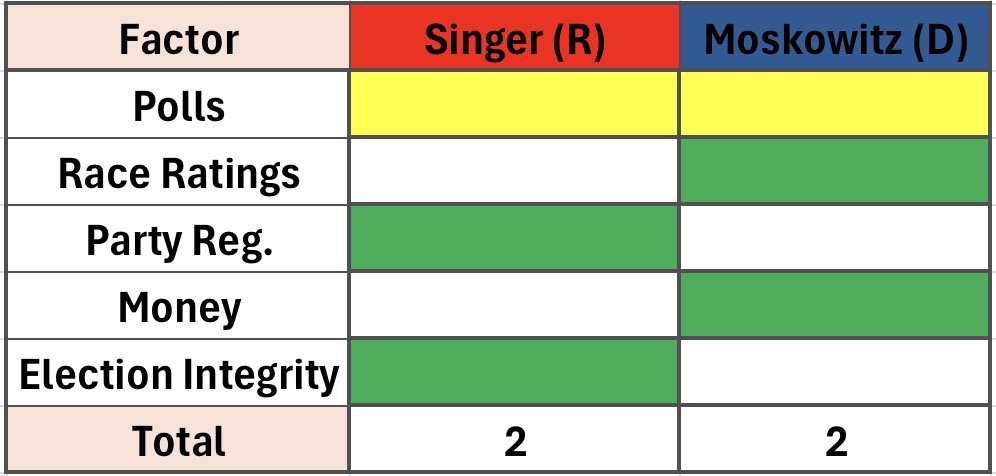
Chart from Seth Keshel’s FL-25 (U.S. House - Decisive) forecast: Summary and Election Estimate

Moskowitz has a built-in advantage with his Congressional experience and has managed his public commentary in such as way so as not to ensure his opponents show up in force to ensure he loses. If this election were in a presidential year, all the data suggest Singer is a strong favorite – especially the weight of party registration trends in south Florida. To get a win this year, with a presumptive Democrat tailwind, he will need to keep Trump’s gains with Latino and Jewish voters. Here is a look at my proprietary mapping of the new FL-25:
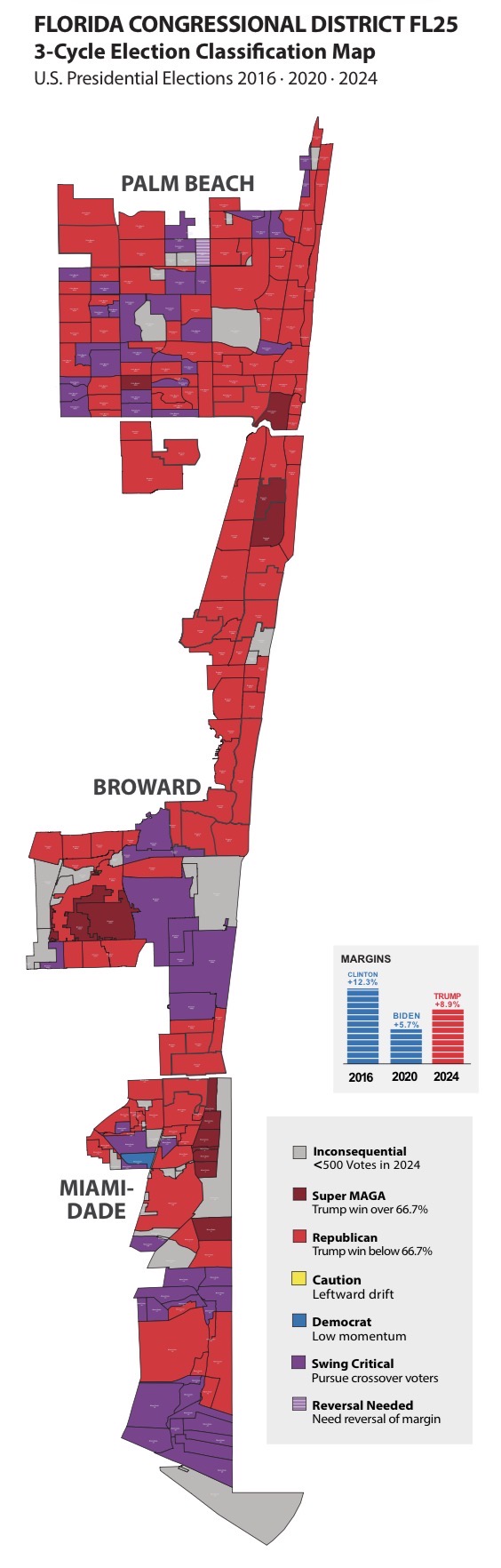
Chart from Seth Keshel’s FL-25 (U.S. House - Decisive) forecast: Summary and Election Estimate
Captain K Proprietary Mapping of FL-25

Many of the red precincts have long been Republican strongholds, especially those shaded in crimson. The purple-shaded precincts (Trump losses, but with more than 30% of the vote and a rightward shift in 2024 if solid purple) are essential for Singer to maintain margin; if they slide too much and turnout lags in strong precincts, Moskowitz can win the race.

Forecast for FL-25 House
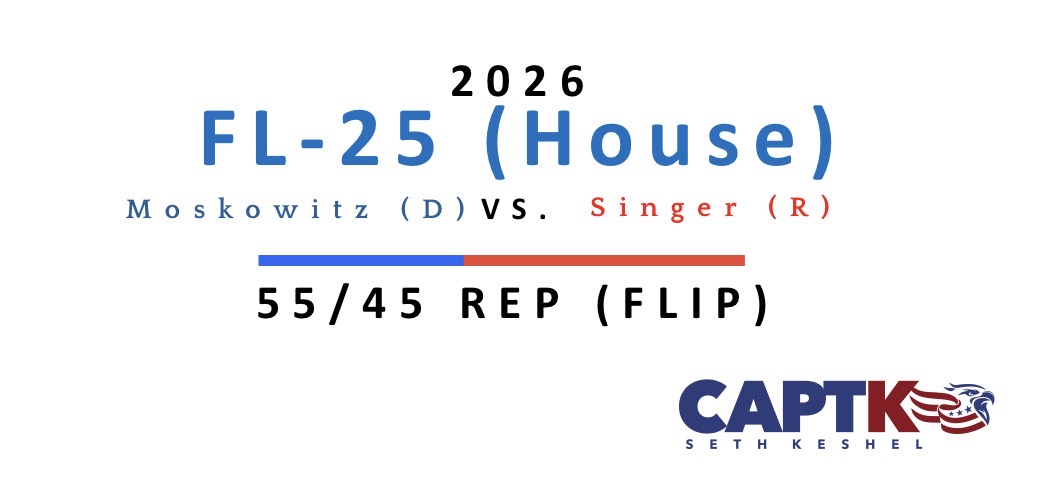
Chart from Seth Keshel’s FL-25 (U.S. House - Decisive) forecast: Summary and Election Estimate

I am bullish on Singer because I believe the registration data point to continued Republican success with Latino and Jewish voters, who continued to come around to Trump over his three runs. Moskowitz, given his experience and familiarity with parts of the new district, is absolutely in the running, and may have reason to be hopeful based on weaker-than-expected GOP in-person early voting turnout. I am not worried about this for statewide races, and all signs point to an overwhelmingly red Election Day using a much heavier registration advantage than last time around.

I feel slightly more optimistic for Republicans about this race than I do the very similar TX-34 race, primarily because Cuban and Venezuelan voters are a stronger Republican constituency than those of Mexican ancestry prevalent throughout Texas.

Seth Keshel, MBA is a Senior Fellow at the Gold Institute for International Strategy and a retired Army Captain. He publishes Captain K’s Corner on Substack.

Col. (ret.) Myles Caggins on mass protests in Europe and dangerous influences in Syria

Frontlines of Freedom podcast cover art: a U.S. soldier silhouetted against an American flag at sunset

Col. (ret.) Myles Caggins, a former communications official for the National Security Council and the anti-ISIS coalition, joined Brig. Gen. Ernie Audino on Frontlines of Freedom to discuss mass protests in Europe and dangerous influences in Syria.

On Frontlines of Freedom, Col. (ret.) Myles Caggins joined the program to discuss who may be organizing the recent mass protests in Europe and how they compare with earlier waves of unrest there. He also gave his view of Syria’s power structure, its military and economic conditions, the roles of militant and armed groups, and the outlook for Syria’s relationship with the United States.

Brig. Gen. Ernie Audino, US Army (Ret.), is a Senior Military Fellow at the Gold Institute for International Strategy, a Washington D.C. based foreign policy and defense think tank. He hosts Frontlines of Freedom, a nationally syndicated military news and talk radio program.

Listen on Spreaker Listen on Apple Podcasts

2026 Ten-Point Forecast: Georgia Governor

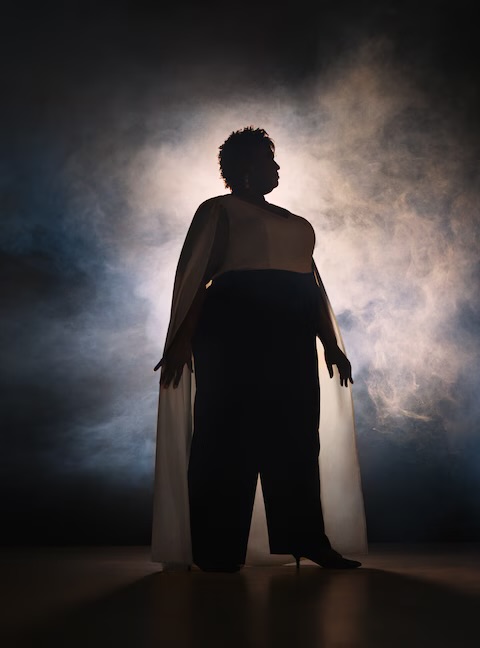
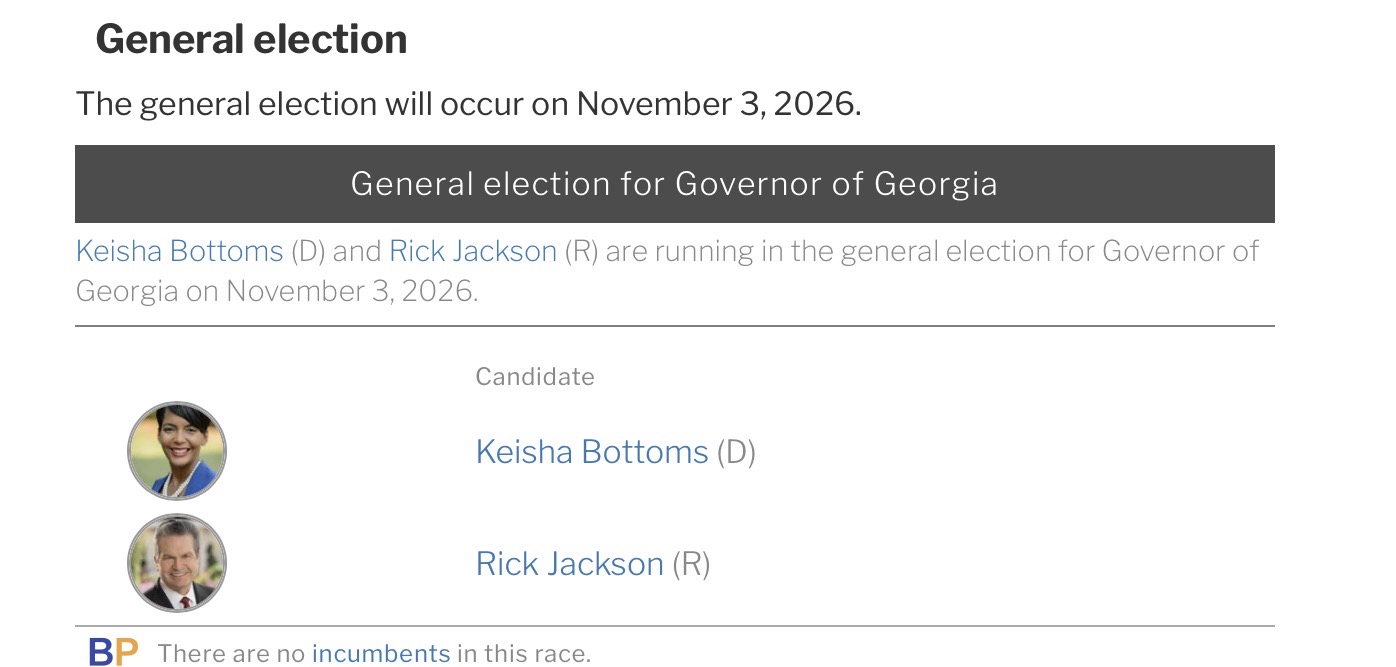
Rick Jackson and Keisha Lance Bottoms, candidates in Georgia's 2026 governor race

Rick Jackson (R) vs. Keisha Lance Bottoms (D)

I. The Race

Chart from Seth Keshel’s Georgia Governor forecast: The Race

Rick Jackson (Republican) is a billionaire healthcare executive who came out of nowhere to take the GOP gubernatorial nomination from a crowded field of candidates, including Trump-endorsed Lieutenant Governor Burt Jones. He has a relatable story from growing up in poverty and contributed large sums of his own money to finance his campaign.

Keisha Lance Bottoms (Democrat) was once mayor of Atlanta (2018-2022) and later worked in the Biden administration. Her campaign is very loudly anti-Trump to distract from her lack of meaningful achievement as Atlanta’s mayor; if elected, she would be the first black woman to govern an American state.

II. State Profile

Chart from Seth Keshel’s Georgia Governor forecast: State Profile

Simply put, Georgia is a looming catastrophe of epic proportions for the Republicans. Perhaps not this year for governor, but almost certainly for U.S. Senator. Without a major change in racial voting patterns, Georgia looks like a blue state to me by 2036 – close enough to get excited about when the first votes drop, but urban and polarized enough to remember better days not so long ago.

President Trump carried Georgia by 5.1% in 2016, and barely had to campaign there despite his lack of political experience. Trump then gained a massive heap of net new votes and ran into Secretary of State Brad Raffensperger’s corrupt elections system and a 634 percent increase in mail-in ballot usage from 2016 to 2020. He managed to keep driving up his vote total in a re-try in 2024, and despite a prodigious performance, carried the Peach State by a measly 2.2%.

Presidential Margins

2016 Trump +5.1%

2020 Biden +0.2%

2024 Trump +2.2%

If you want to get into the weeds and details of the 2020 election in Georgia and other states, read my book, The American War on Election Corruption.

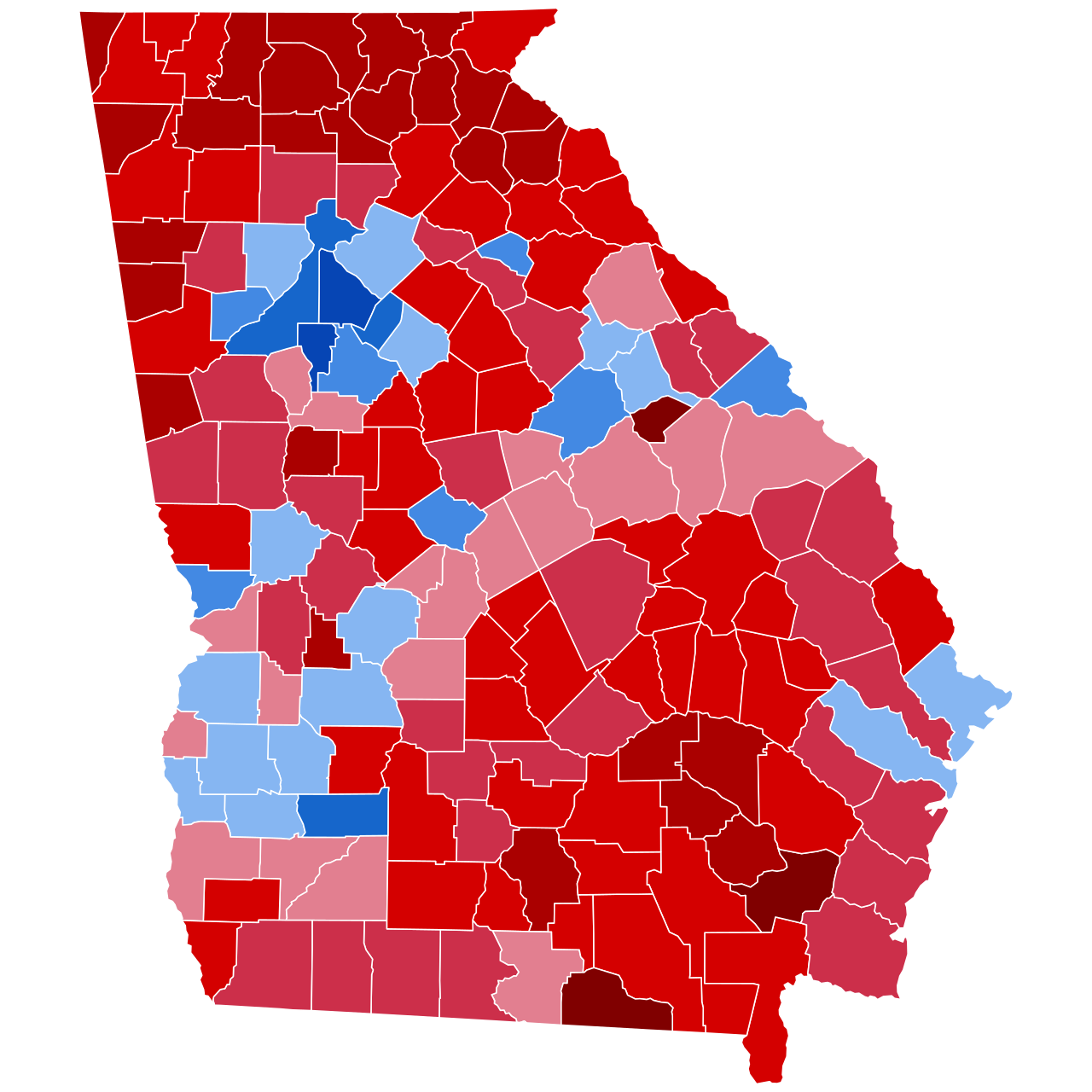
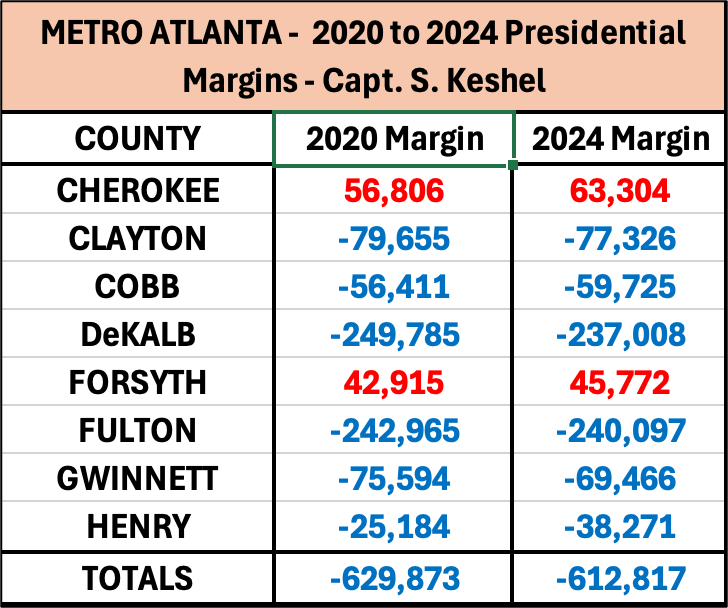
Georgia still has plenty of issues with public confidence in election results, but its political problems remain. The Atlanta metro dominates the rest of the state. Fulton and DeKalb Counties are the two Democrat strongholds making up core Atlanta. They are flanked by Cobb and Gwinnett Counties, two former Republican strongholds of the suburban variety that both flipped in 2016 and gotten bluer and bluer. The graphic below illustrates just how badly President Trump has been smoked in metro Atlanta:

Chart from Seth Keshel’s Georgia Governor forecast: State Profile

Southern black voters are more loyal to Democrats than black voters anywhere else. In Georgia, from the 1990s until only recently, they were easily outvoted by the extremely conservative white voter base. Unfortunately for Republicans, the turn to Republican populism (“MAGA”) has created a moderate wing of the party that is confined to metro Atlanta that has been instrumental for declining margins not only in northern Fulton County, but also in suburban counties like Forsyth and Cherokee Counties.

The rural counties of Georgia (outside of the “Black Belt” rural counties that support Democrats) are overwhelmingly red. The issue is that they are maxed out and practically incapable of producing notably larger margins in absolute votes. Any major growth in Atlanta without progress with voters there, or further slippage in suburban counties, makes a blue Georgia increasingly likely in coming years.

Key Statistics

• 53.2% White, 32.3% Black, 10.5% Hispanic

III. Market Assessment

Polymarket bettors favor Bottoms, but Jackson is still considered competitive and subject to the same wild swings in these markets impacting all GOP candidates.

IV. History

Georgia’s gubernatorial history closely resembles Texas’s, even if the current chapter started eight years later than the Lone Star State’s. In 2002, Sonny Perdue was elected governor of Georgia, defeating Roy Barnes. In winning that race, Perdue became the first Republican governor of the Peach State since Reconstruction. He served two terms and gave way to Nathan Deal, a former Democrat, who won in 2010 and took over in January 2011.

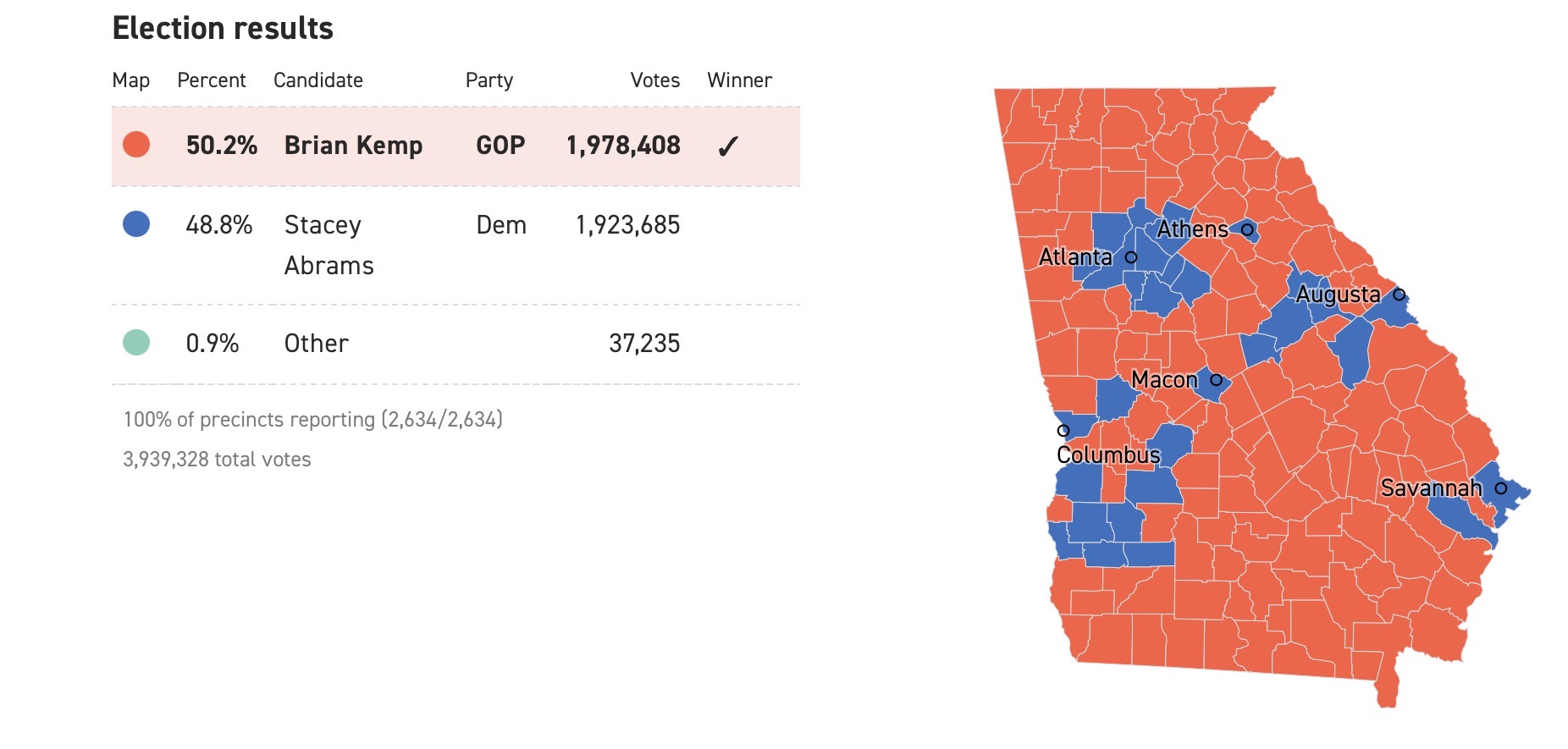
In 2018, the first electoral test of the state since Trump’s election win, Secretary of State Brian Kemp was the GOP nominee for governor in a race everyone overlooked. It nearly backfired, but Kemp held on by a tiny margin over progressive favorite Stacey Abrams.

Chart from Seth Keshel’s Georgia Governor forecast: History

Just 54,723 votes, 1.4%, separated Kemp and Abrams, thus preventing the good people of Georgia from having this individual as their governor:

Chart from Seth Keshel’s Georgia Governor forecast: History

Kemp wound up waffling on his pledge to root out the corruption of the 2020 election and sided with Raffensperger over Trump; this earned Trump’s ire, so he endorsed former Senator David Perdue to primary Kemp in 2022. Kemp throttled Perdue, then wen t on to beat Abrams soundly in a rematch in the General Election (+7.5% margin).

To conclude, the modern history of Georgia suggests the state prefers Republican governors. It should not surprise you that an anti-Trump state rewarded the governor who stuck it to Trump the most, and this is an important thing for understanding how things next week will likely unfold.

V. Analysis of 2026 Primary Results

This is going to highlight a major Republican problem that will be a recurring theme in Georgia.

First, the easy part. Bottoms advanced with a majority in the Democrat primary to become the party nominee. She blitzed past six opponents, including former Republican quisling Geoff Duncan, who was once the state’s Lieutenant Governor. He preached all the “conservative” talking points, went on cable news to bash Trump, and then when he realized his career was dead in the water, changed his views on abortion to become a Democrat and pander around Atlanta. He reminds me very much of the hunchback in the movie 300; he betrayed Leonidas and then the enemy he helped threw him to the side, too.

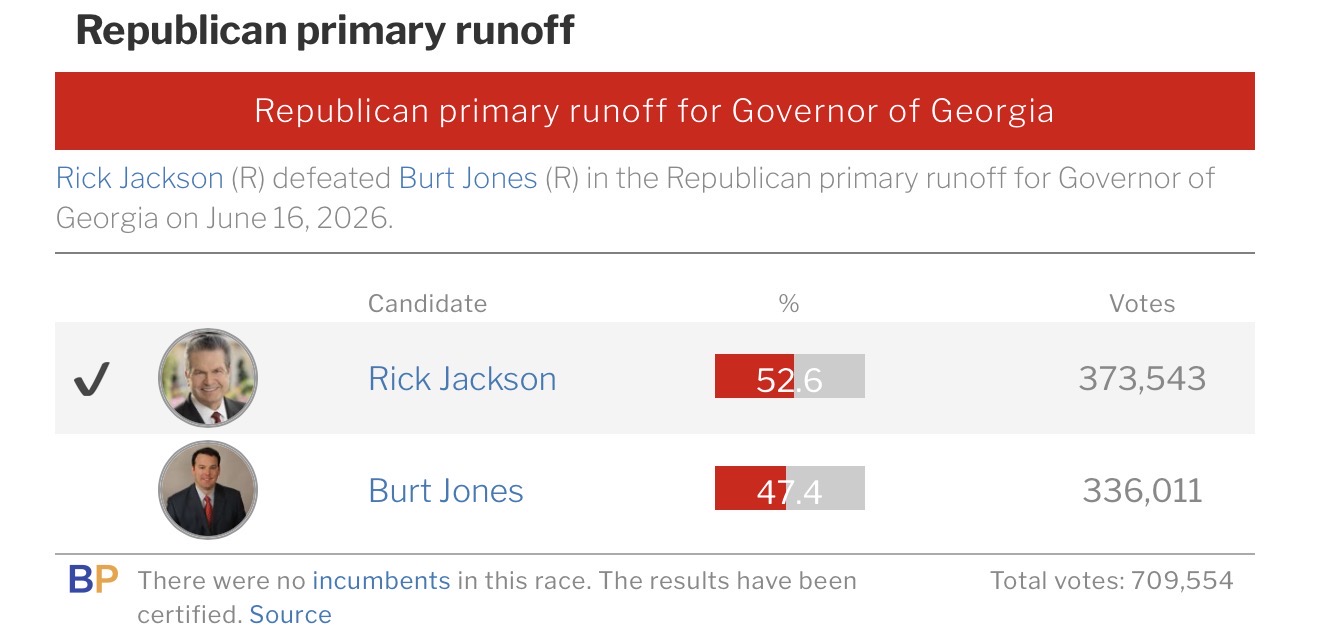
Now, on to the Republicans. Jones, Trump’s endorsed pick popular with the grassroots wing of the GOP, beat Jackson in the first go-around, but didn’t get to a majority. Jackson won in the June 16 run-off:

Chart from Seth Keshel’s Georgia Governor forecast: Analysis of 2026 Primary Results

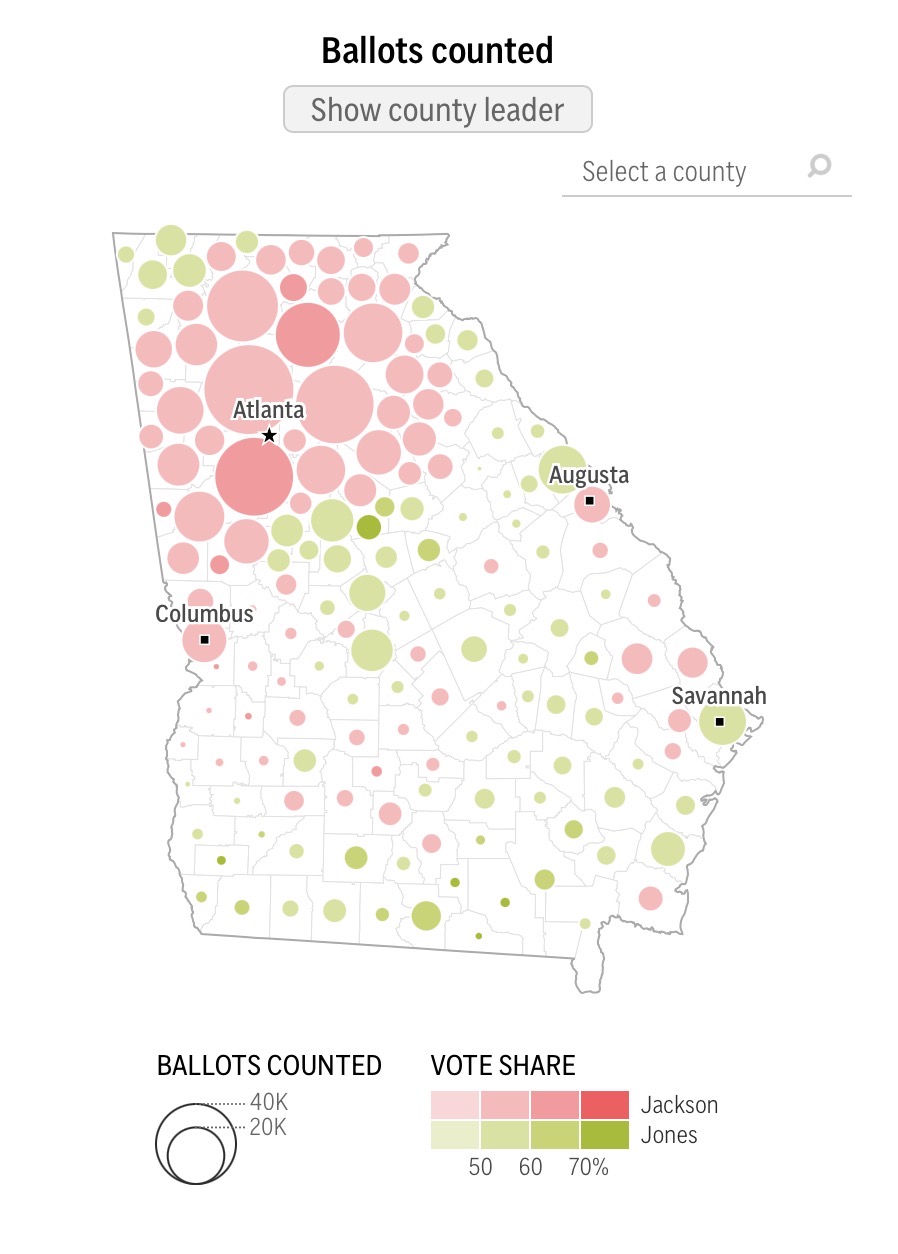
Notably, Jackson dominated Jones inside the Atlanta metro:

Chart from Seth Keshel’s Georgia Governor forecast: Analysis of 2026 Primary Results

Tensions have remained escalated with no end in sight. The candidates have traded campaign-related lawsuits, and recently Jones declined to attend a Trump rally because Jackson was going to attend. This can only harm the GOP’s chances in a state they’re already struggling to compete in. The root issue is the rift between the rural grassroots and suburban voters who are needed to chip Atlanta’s margins.

VI. Polls

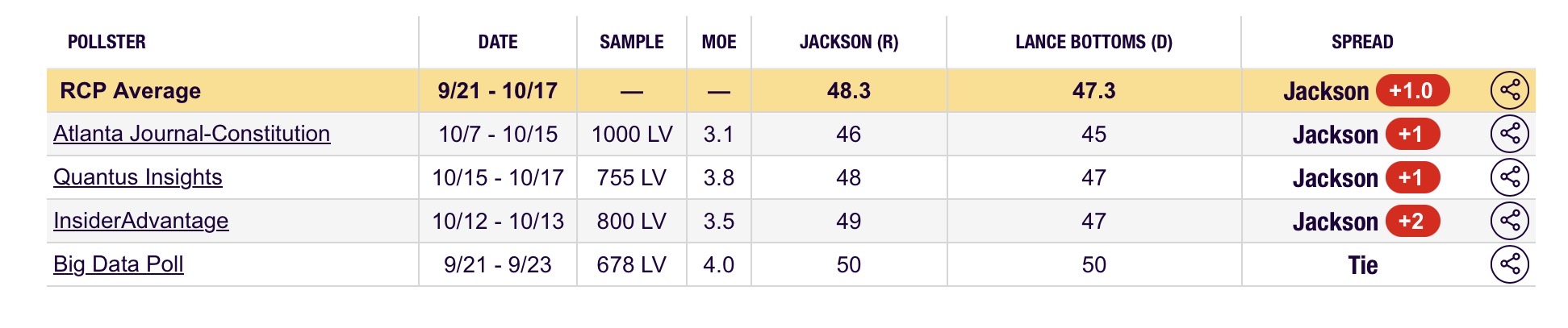
Chart from Seth Keshel’s Georgia Governor forecast: Polls

Jackson leads the average of polls by one single percentage point, according to the RCP file – but hasn’t hit 50% in any of those he leads.

VII. Media Ratings

Chart from Seth Keshel’s Georgia Governor forecast: Media Ratings

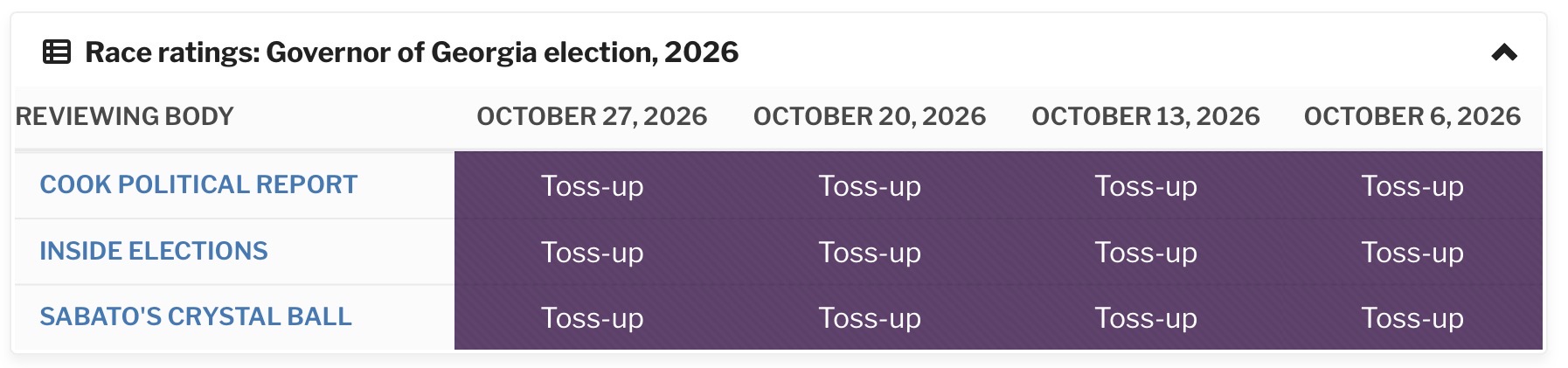
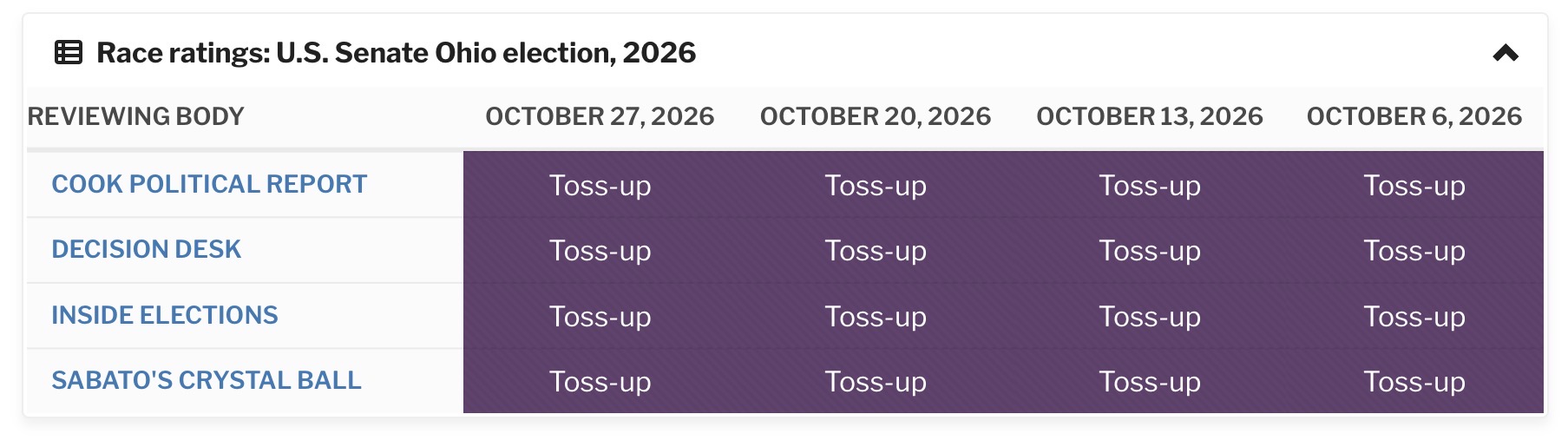
Everyone is keeping their powder dry regarding this race; they’ve all been stuck at “toss-up” for weeks, possibly due to the bad blood between Jones and Jackson.

VIII. Party Registration

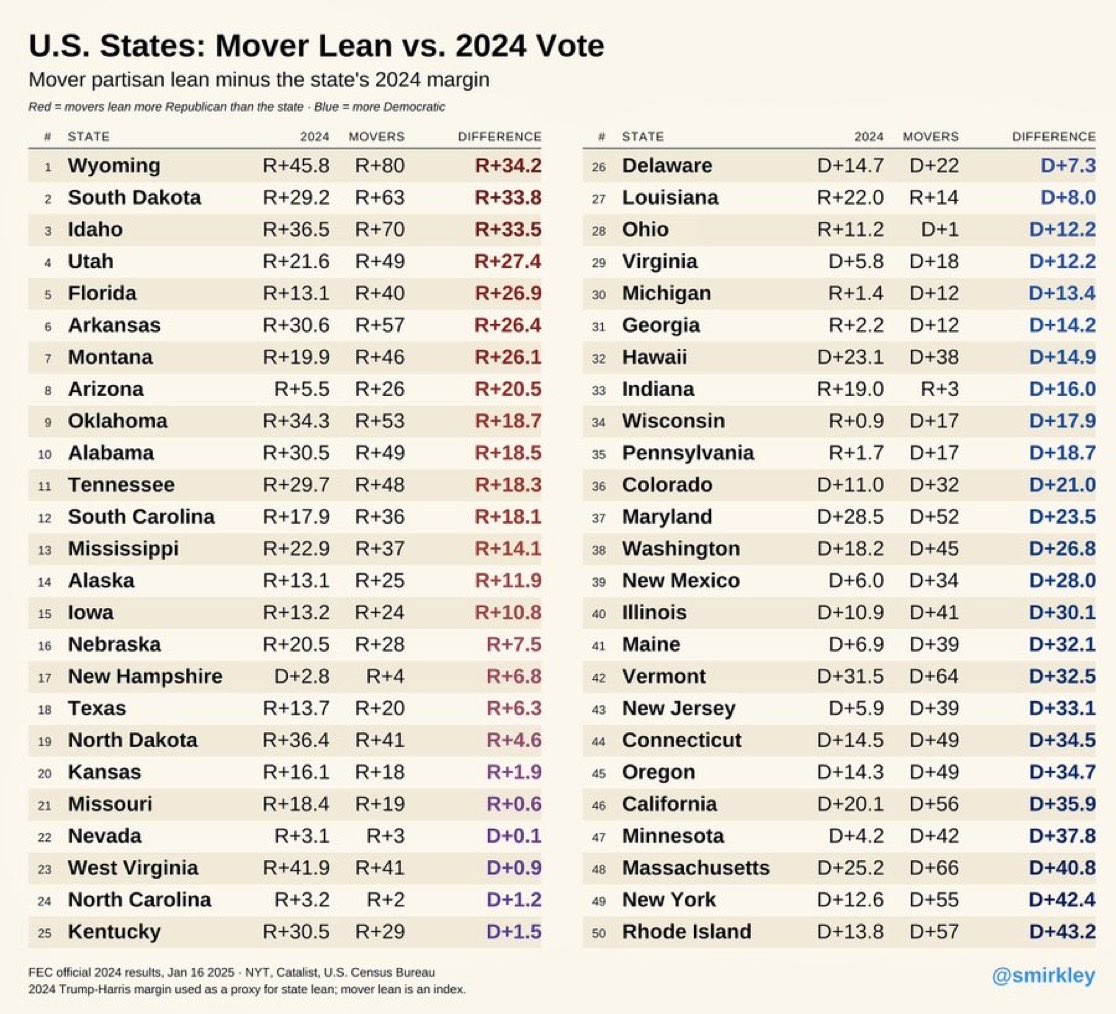
Georgia does not register voters by party; however, new transplants over significantly Democrat:

Chart from Seth Keshel’s Georgia Governor forecast: Party Registration

IX. Election Considerations

Georgia has Automatic Voter Registration, a lot more mail-in voting than it had a decade ago, a dominant Democrat super-center of an urban area, and a Secretary of State (on his way out) very few trust to administer elections after the 2020 debacle.

Fortunately, the legislature has made a few incremental changes to improve things, and the primary method of voting is early in-person voting with Voter ID. You can read more about Georgia’s overrated and vulnerable election system in my 2024 review of the topic:

Georgia – 2024 Election Compendium

X. Summary and Election Estimate

The nominations of both parties for governor and the U.S. Senate offer quite the contrast.

Republicans nominated the uber-conservative grassroots fighter that appeals to rural voters, but not suburban voters, in an attempt to knock off Jon Ossoff that is widely expected to come up short (including by yours truly). Through the run-off, they also nominated Jackson, who lacks bona fide conservative credentials and the pro-Trump background he would have needed to be nominated in a state like Arizona or Texas. While that may not animate the base, the prospect of Keisha Lance Bottoms as governor will.

Bottoms declined to run for reelection as mayor of Atlanta, and for good reason. She was in charge during the COVID-19 crisis and also oversaw a massive uptick in violent crime in her four years. She is widely associated with being a failed leader and didn’t give herself much time out of the spotlight before jumping back in.

The impact of her failure in Atlanta will be exactly what Jackson needs in Cobb and Gwinnett County; Kemp lost both of them in 2022, but cleared 47% in Cobb and 44% in Gwinnett – meaningfully higher shares than Trump was able to secure in 2024. Jackson’s non-MAGA credentials will also play well in north Fulton County, which has a large establishment-oriented voting bloc that will come back to him rather than back Bottoms.

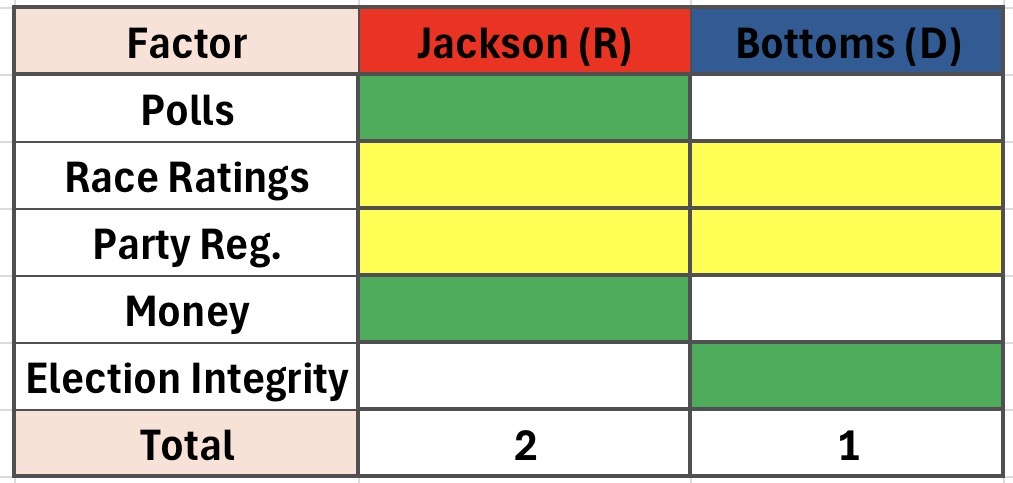
Jackson has a slight edge in my decision matrix:

Chart from Seth Keshel’s Georgia Governor forecast: Summary and Election Estimate

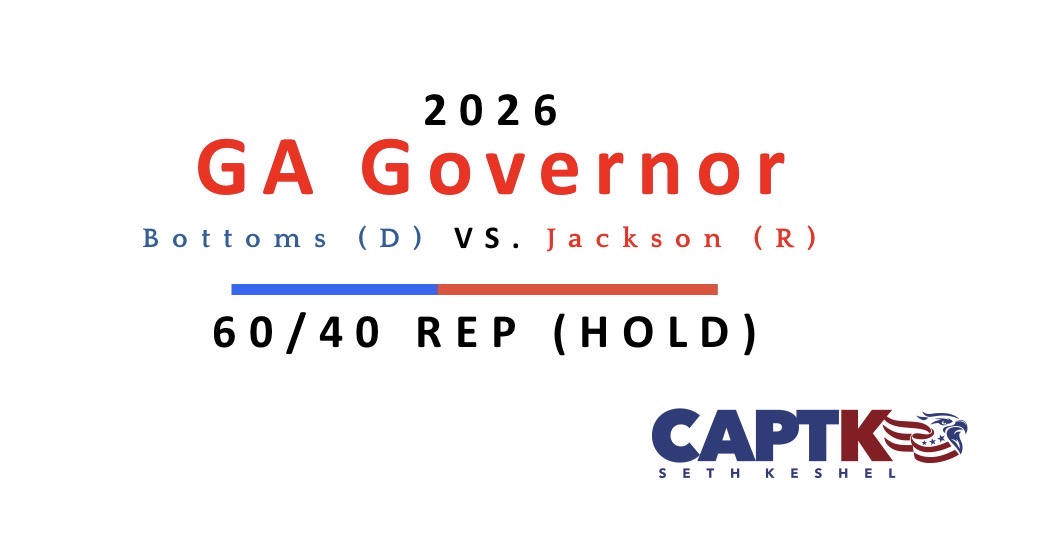
Forecast for GA Governor

Chart from Seth Keshel’s Georgia Governor forecast: Summary and Election Estimate

Based on Georgia’s preference for GOP governors, recent retention of two Republican-aligned Supreme Court justices, Jackson’s non-MAGA disposition, and Bottoms’s bad track record as Atlanta mayor, I feel confident this race leans toward Jackson. Without the warring going on between Jackson and Jones, I’d feel extremely confident, especially since Jackson has Bottoms beat about 10-to-1 on finances. Black rural turnout is down, but a bad Election Day from the Republican rurals, tied to the Jackson-Jones rift, is what could derail the GOP train and get Georgia’s misery started ahead of schedule.

Seth Keshel, MBA is a Senior Fellow at the Gold Institute for International Strategy and a retired Army Captain. He publishes Captain K’s Corner on Substack.
Living in Fear of Their Own

The Reichstag building in Berlin with the German flag

This article was written by Hermann Tertsch and appeared in El Debate. Vivir con miedo a los suyos.

Islamism holds ever more sway in the parties of the European left

For some years now it has been evident that totalitarian Islamist forces play an ever larger role in the parties and movements of the left in the West. Muslim candidates are multiplying on the left and, thanks to the left, radical Islamists are winning power, as in the New York mayoralty or in the local governments of dozens of British cities. Muslims are 7% of the population of the United Kingdom, but Muslim mayors govern more than 60% of the British population. And so, every day, they further transform daily life and, above all, cultural policy and police conduct to the benefit of Muslim interests. Islamic penetration of the administration and of local power is constant and immensely effective

In Germany, it is now the turn of the capital, which has been degrading for decades, also thanks to the woke drift of part of the CDU. After two decades of governments led by the Socialists with the Greens and the Communists, a brief CDU government changed almost nothing, and now the Communists stand as the leading force for the first time, thanks to the Muslim vote. Everyone knew that the Muslim vote in the neighborhoods with the most immigration is controlled by Islamist groups that follow the instructions of the Muslim Brotherhood and of the organized crime clans.

But few knew the extent to which radical Islamist groups have control and power within the parties of the German left, and especially within Die Linke, the Communists, heirs of East Germany’s Socialist Unity Party (SED). The mistaken sending of some confidential notes along with the answers to an interview that the Communist leader of Berlin and the city’s next head of government, Elif Eralp, gave to the magazine Der Spiegel has revealed that this Communist politician of Turkish origin lives terrified and under pressure and coercion from agents of Hamas, the Palestinian terrorist organization, and its partners, the Muslim criminal clans of the Arab world, especially Syrian and Lebanese ones.

Die Linke’s election victory party in Berlin, with Elif Eralp as the great winner, turned into a parade of figures linked to Palestinian terrorism and to the Arab organized crime clans omnipresent in the Berlin underworld. The notes mistakenly added to the corrected interview answers revealed the fear that the Communist Eralp, from a Muslim family, has of the party’s Islamic milieu, and made clear that she considers both herself and her family threatened by it. As she stresses, her husband also shares that fear.

Things being as they are, the Social Democrats and the Greens, who call themselves virulent opponents of antisemitism, are going to ally in Berlin with a Communist who lives under the coercion and influence of Islamist and Palestinian terrorism, which has a broad majority of supporters in Berlin’s Muslim community. Through money from the mosques, from the underworld clans and also from abroad, the pro-Hamas movement has achieved great strength and activism in Berlin and other German cities against the State of Israel and also against the increasingly threatened Jewish community.

The three forces of the left in Germany, as is happening in France with Mélenchon and in the United Kingdom with the Labour governments, have intensified their aggressive militancy against Israel, against the Jews and against Western society itself as Muslim candidates and groups have gained relevance, power and presence. The threat that parts of Europe will be governed by a left in the service of Islamism has already come to pass in many corners of the Old Continent. Berlin is next, and certainly very symbolic.

Written by Hermann Tertsch Distinguished Fellow (Honorary), Gold Institute for International Strategy

Attempted Coup in Poland

The Presidential Palace in Warsaw with a stone lion statue

This article was written by Hermann Tertsch and appeared in La Gaceta. Intento de golpe en Polonia.

Without X, no one in Europe would have found out what happened in Poland last night. The head of government, Donald Tusk, carried out an attempted coup d’état, taking advantage of the head of state, Karol Nawrocki, being on a trip abroad. He stormed the Constitutional Tribunal with the police and tried to remove the president and vice president of the Constitutional Tribunal using a loyal judge with no authority to do so.

But he did not count on the president, who, once informed, ordered his plane to turn around while it was flying over Spain. He returned to Warsaw, forced his way into the Constitutional Tribunal building ahead of his own escorts despite the cordon of Tusk’s police, and convened all the highest bodies of the Supreme Court and the Constitutional Tribunal to restore constitutional order.

Although the crisis continues, it seems clear that the Tusk government, the puppet of Von der Leyen that would never have carried out this assault without Brussels’ permission, has its days numbered. But remember: public and private media across Europe have been accomplices to the coup by silencing the whole operation. Only social media alerted Poles and Europeans. That is why they want to take control of it.

Written by Hermann Tertsch Distinguished Fellow (Honorary), Gold Institute for International Strategy

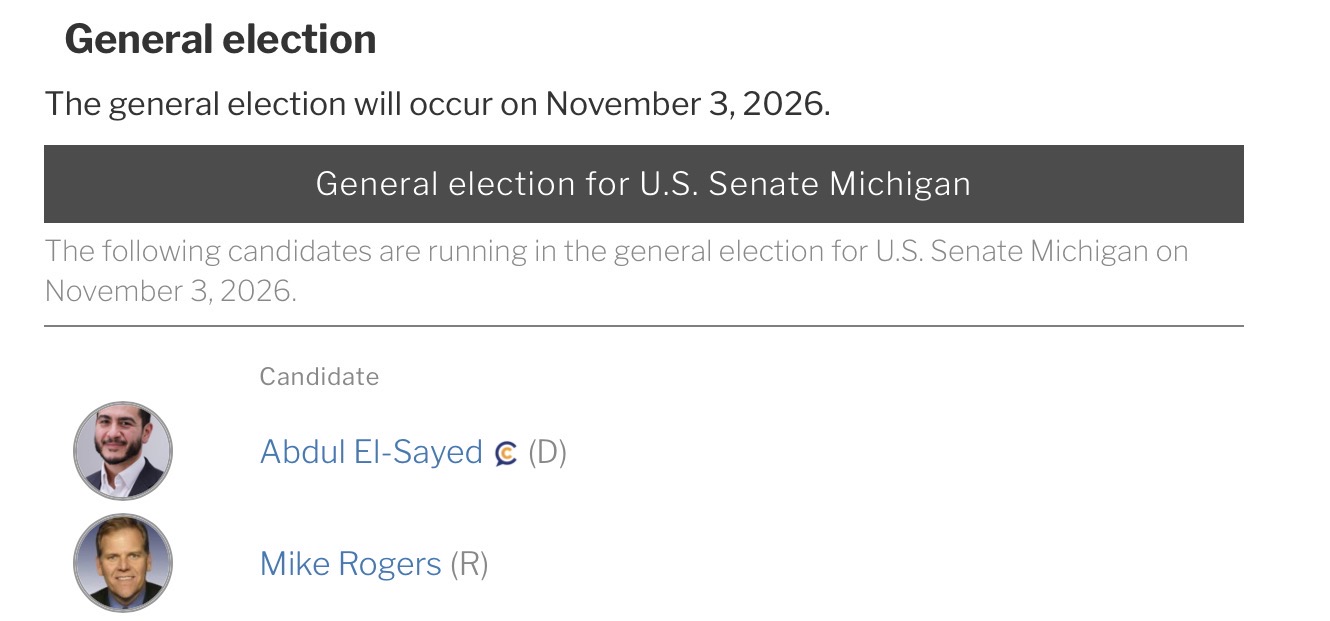
2026 Ten-Point Forecast: Michigan U.S. Senate

Mike Rogers and Abdul El-Sayed, candidates in Michigan's 2026 U.S. Senate race

Mike Rogers (R) vs. Abdul El-Sayed (D)

I. The Race

Chart from Seth Keshel’s Michigan U.S. Senate forecast: The Race

Mike Rogers (Republican) has been at the political game a long time. He is a former Army officer and FBI agent who then served seven terms representing the old MI-8 in the U.S. House. He ran “unsuccessfully” for Michigan’s other Senate seat in 2024, which was “won” by Elissa Slotkin with late mail dumps after Trump had been declared the winner of the state. Now he takes aim at the other seat, which is open due to the retirement of Democrat Gary Peters.

Abdul El-Sayed (Democrat) is 42 and born in Michigan to Egyptian immigrants. He calls himself a “physician” due to his medical education, but is not a licensed practicing physician. If elected, he will be the first Muslim U.S. Senator, but he must first get past the obstacles of many Democrat groups opposing his candidacy and his DSA-aligned positions like the abolition of ICE and adoption of Medicare-for-all in a Trump-won state.

II. State Profile

Chart from Seth Keshel’s Michigan U.S. Senate forecast: State Profile

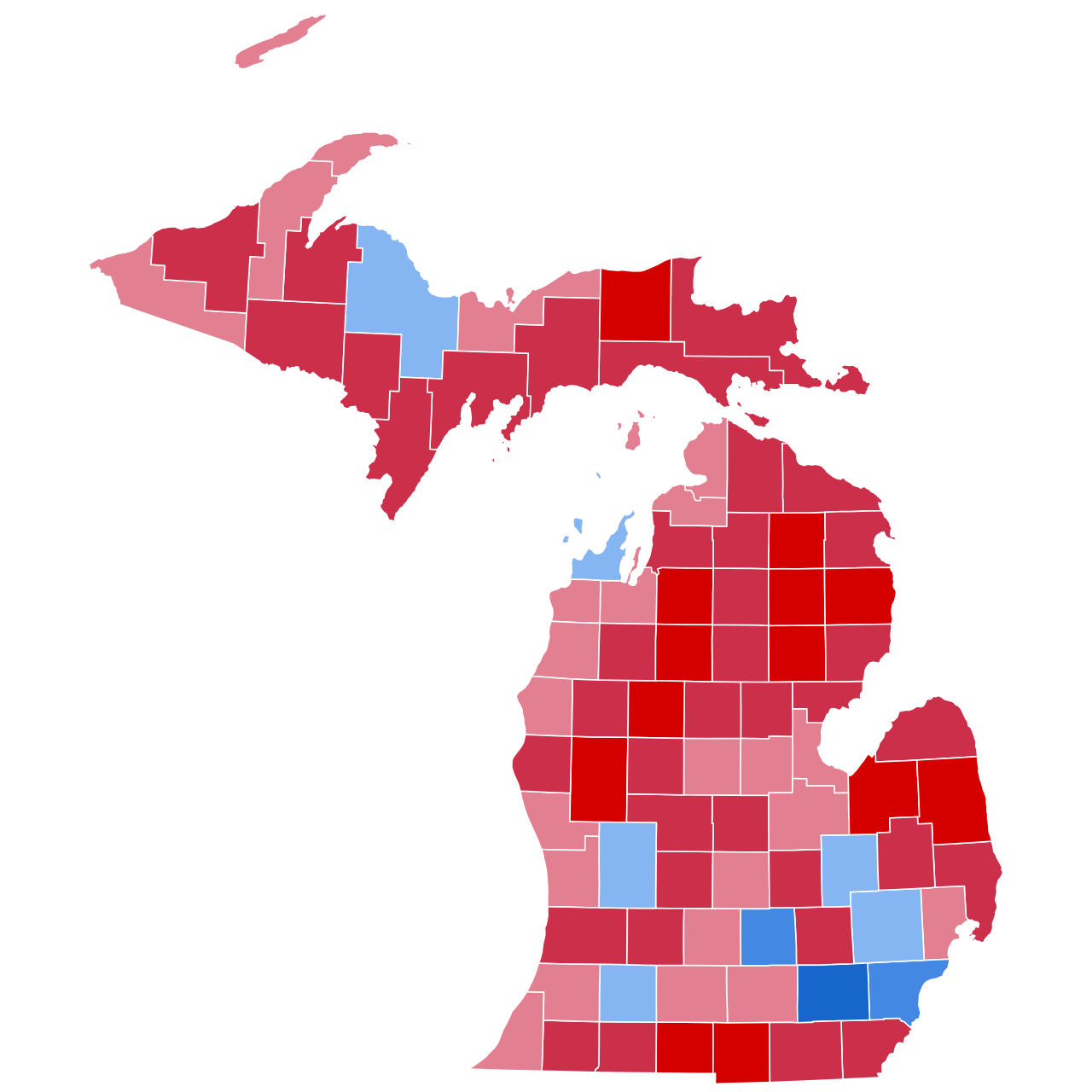
Michigan has come the longest way from the pits of a massive Obama margin than any other state. Here is what the state looked like for a +16.4% Democrat win in 2008:

Chart from Seth Keshel’s Michigan U.S. Senate forecast: State Profile
2008 Presidential Election in Michigan

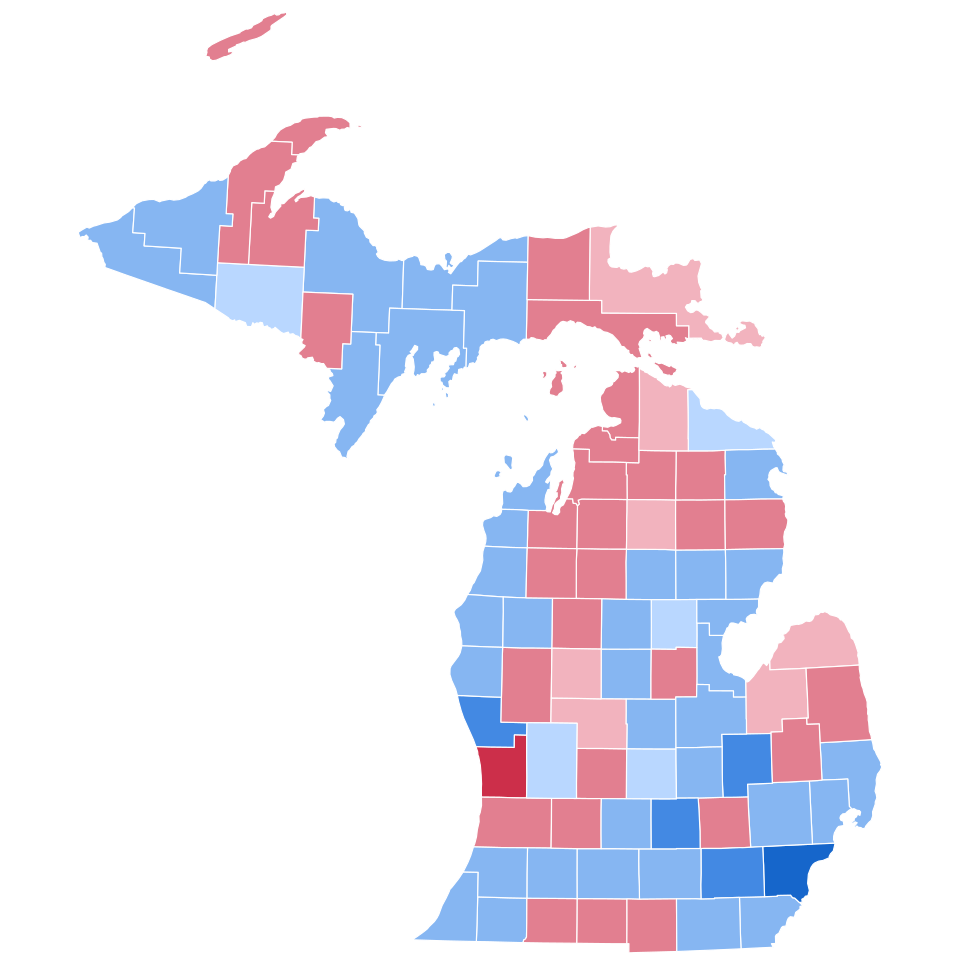
Obama won 46 of Michigan’s 83 counties that year; for context, Kamala Harris only carried 9 counties in 2024. He even had more votes in 2008 than Donald Trump did in 2024. This is largely owed to the disintegration of the Democrats’ stranglehold over the white working class voter, which we’ve also seen take place in Ohio, Pennsylvania, Iowa, Wisconsin, and Minnesota. This trend began with the 2010 midterm Tea Party wave and was visible in Michigan’s 2012 presidential returns when Obama still won the state by a comfortable margin (+9.5%), but coughed up 26 counties he had carried in 2008:

Chart from Seth Keshel’s Michigan U.S. Senate forecast: State Profile
2012 Presidential Election in Michigan

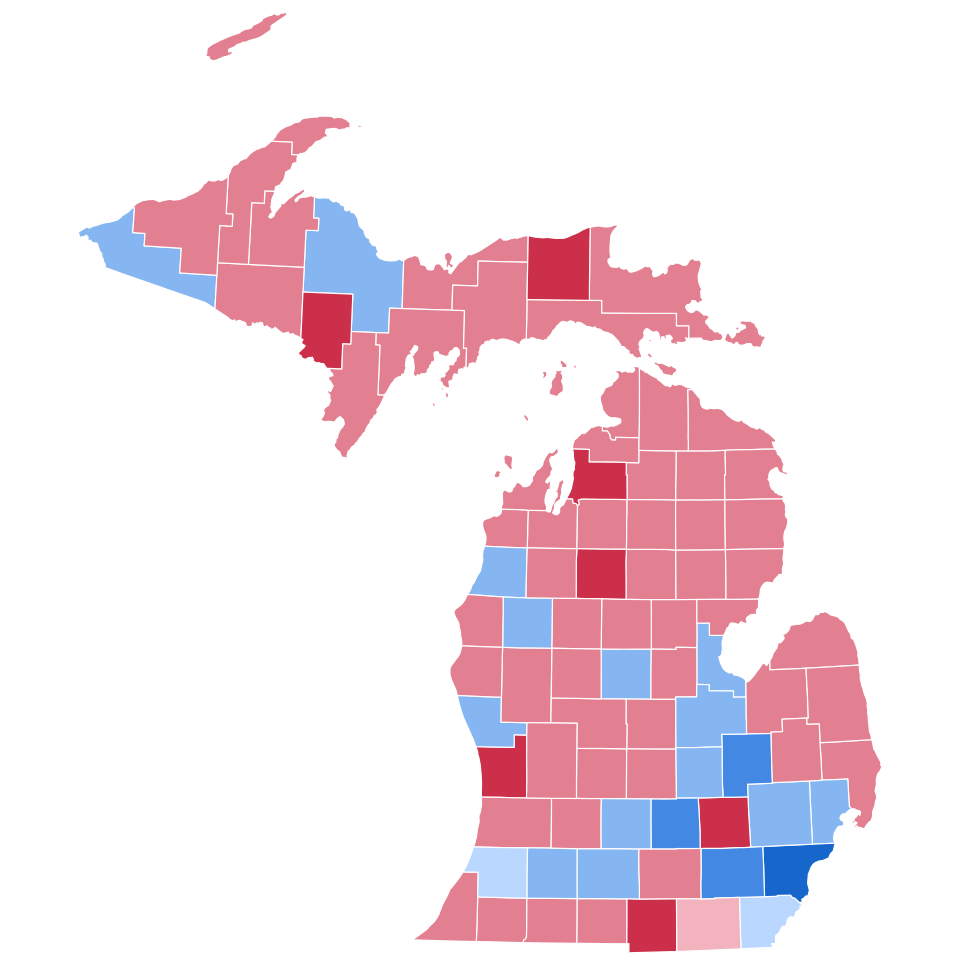
Along came a GOP presidential nominee who, unlike Romney, picked up these disaffected former Democrat voters in droves and snuck past Hillary Clinton in 2016:

Chart from Seth Keshel’s Michigan U.S. Senate forecast: State Profile

Trump “lost” the state in the criminally corrupt 2020 election, which saw the use of mail-in ballots double from 2016 and his massive lead reverse itself while America slept, but made things “too big to rig” in 2024. Here are Trump’s presidential margins in three races:

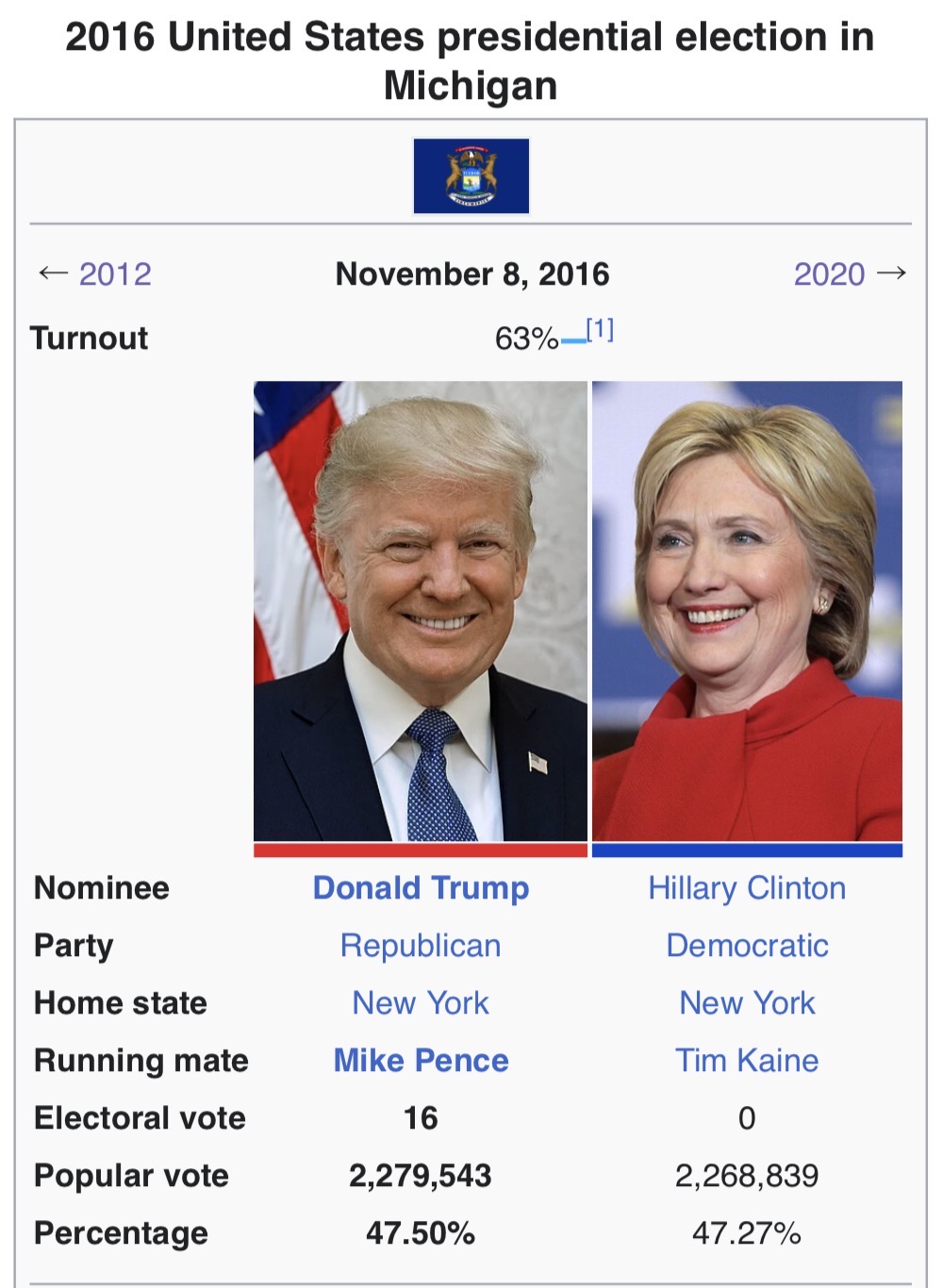
2016 Trump +0.2%

2020 Biden +2.8%

2024 Trump +1.4%

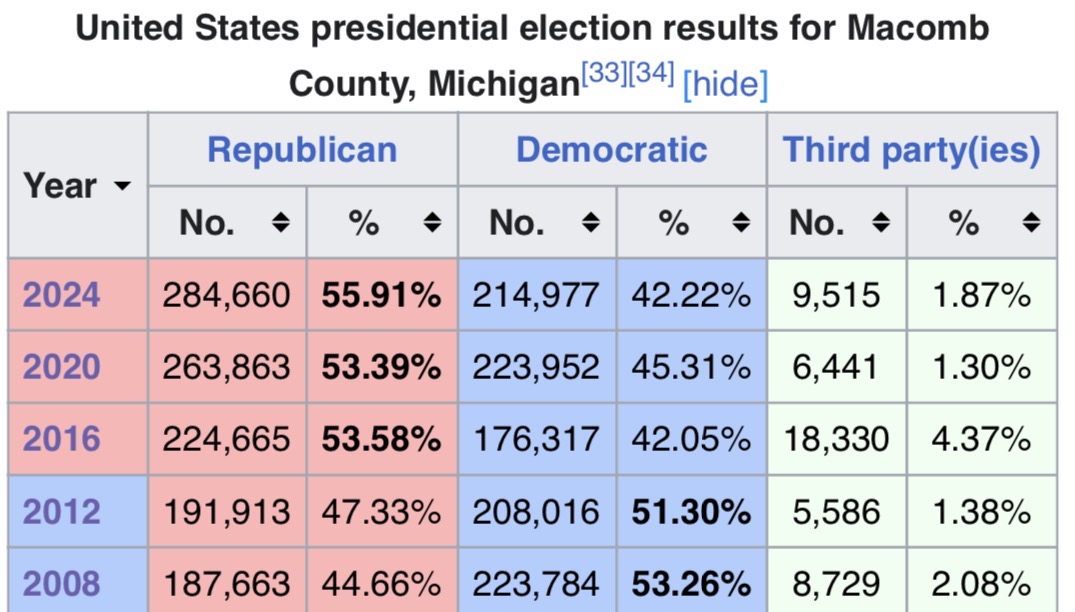
In the old school of Republican thought, the way to make Michigan red was to use Monroe and Macomb Counties to cancel out Wayne County, and then ride the tide in the rest of the state. Democrats get most of their punch from Wayne (Detroit), but also huge margins from Oakland (the former Republican suburban county north of Detroit) and Washtenaw Counties (home of Ann Arbor and the University of Michigan. Macomb County, which features the key House race for MI-10’s open seat, is perhaps the most instrumental county in Trump’s transformation of the Great Lakes State:

Chart from Seth Keshel’s Michigan U.S. Senate forecast: State Profile

Macomb, essentially the home of the “Reagan Democrat,” has gone from giving Obama a margin of +36,121 in 2008 to +69,683 for Trump in 2024. That’s a movement of 105,804 net votes toward Trump from the 2008 Obama blowout (and this is even counting the Democrat mastery of mail-in ballot collection in the Midwest, so it would be much higher).

Rogers must keep the Trump coalition intact, and is well positioned to do so given El-Sayed’s various weak points and Rogers’s own establishment Republican leanings, which will play well for him in the traditionally Republican strongholds in western Michigan dating back to the 19th century, such as Ottawa County and parts of Kent County (Grand Rapids), which has been lost in the Trump era.

Key Statistics

• 68.2% White, 15.5% Black, 8.3% Hispanic

III. Market Assessment

Yet another market swung by polling and narratives shows the Democrat nominee significantly over-valued.

IV. History

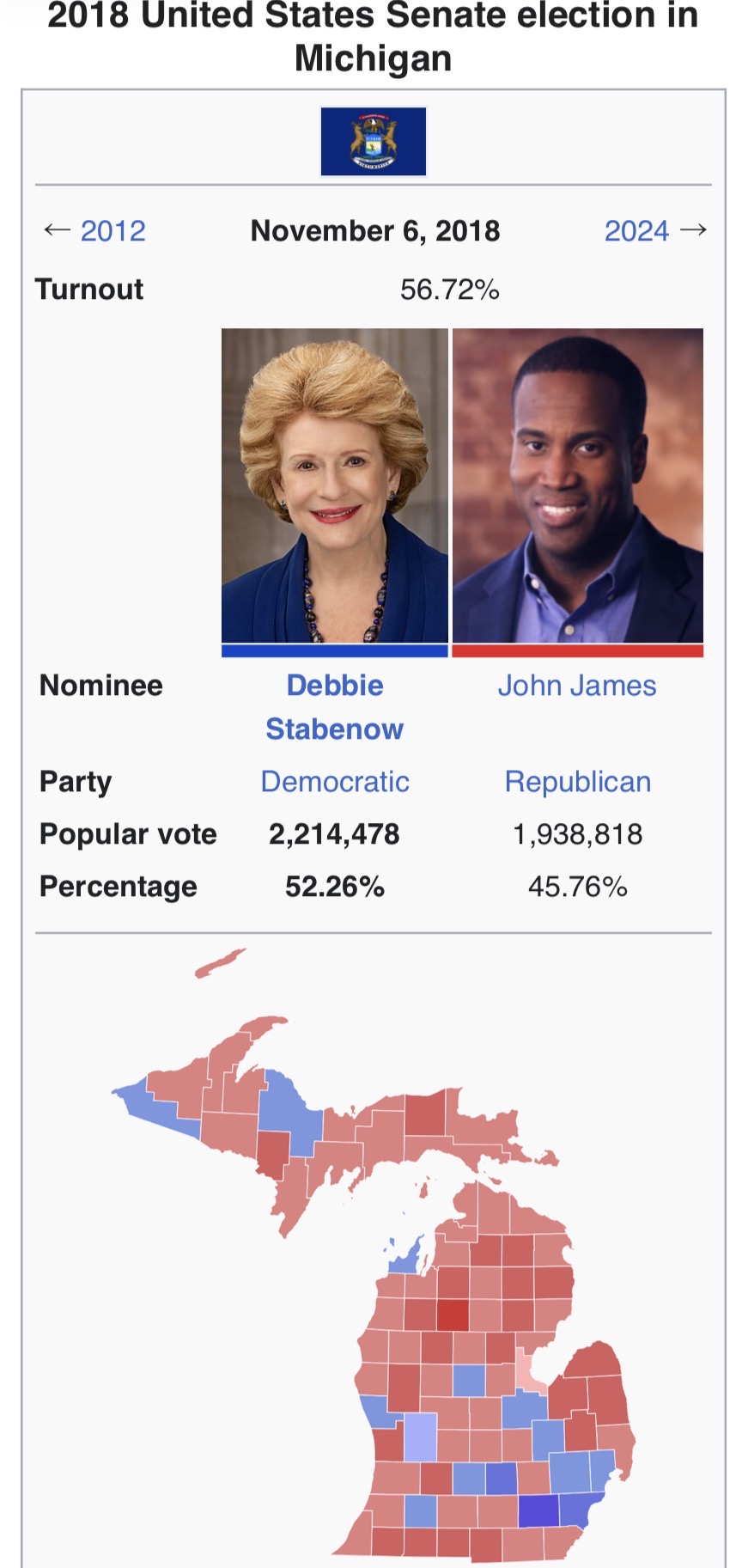
Michigan’s last Republican Senator was Spencer Abraham, who was elected in the 1994 “Republican Revolution.” He only made it one term before being ousted in 2000 by Debbie Stabenow, who has all the charisma of a cardboard box. Still, she managed to get reelected three times, having the luxury of running with two Democrat midterm tailwinds (2006 and 2018) and alongside an Obama statewide victory (2012). The 2018 margin for the three-term incumbent Stabenow tells us a lot about this year’s race between Rogers and El-Sayed:

Chart from Seth Keshel’s Michigan U.S. Senate forecast: History

Running into a 2018 headwind, up-and-comer John James (who is the Congressman for MI-10 running now for Governor this year) lost to Stabenow by just 6.5% – a margin 3.1% to the right of Gretchen Whitmer’s concurrent first gubernatorial victory. Keep in mind that Stabenow was the incumbent with maximum name recognition running in a year in which these midwestern state’s hadn’t become heavily “MAGA” down-ballot after Trump’s shock victories. This election example alone should rule out some of these ridiculous poll margins El-Sayed has been credited with recently.

Stabenow retired, and then handed her seat over to seditionist Elissa Slotkin, a useless spook who should be prosecuted. Not that I have much of an opinion on the matter:

Don’t Ignore the Color Revolution Sitting in Plain Sight

Turned away in 2024, Rogers is now after the other seat. Democrat Carl Levin won it in 1978, and then held onto it for six terms. Gary Peters ran upon news of Levin’s retirement in 2014 and won an impressive margin despite a dominant GOP year, but then ran into the Trump momentum and barely held on (an election he would have lost if fair) against James in 2020 (1.7% margin). Smelling the coffee of a reddening Michigan, Peters is now moving for retirement and letting Rogers and El-Sayed battle for the prize.

One final note – Gretchen Whitmer would have walked into this seat this year. She didn’t, and that is your tell that she will probably be announcing for president next year.

V. Analysis of 2026 Primary Results

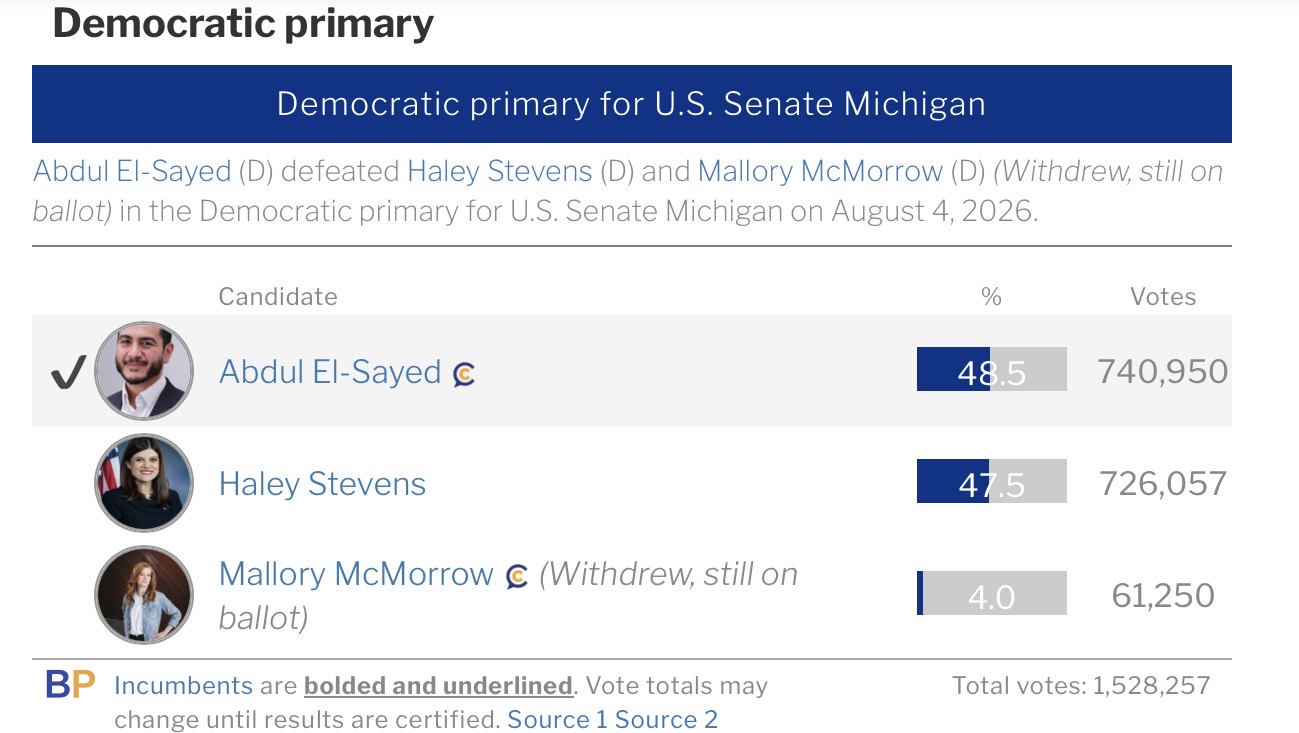
Rogers ran uncontested for the GOP nomination. The Democrat Senate primary was a Category 5 dumpster fire that has massive implications for the General Election contest:

Chart from Seth Keshel’s Michigan U.S. Senate forecast: Analysis of 2026 Primary Results

El-Sayed squared off against Haley Stevens and Mallory McMorrow, who both fit the mold of “boring Midwestern white woman.” Democrats have become experts at fielding them for Wisconsin Supreme Court seats and others throughout the Midwest, realizing they are losing their base. Either of those two candidates would have beaten Rogers by 3 or 4 points this year. McMorrow hilariously got driven from the race by completely made-up polling from “Wedgewood Polls” and aired out her feelings last week:

As one of the candidates featured in these polls – the infamous one in late June that showed me plummeting into single digits (which was at odds with our internals) – here's the impact of this "experiment"

– Donations dried up
– Volunteers were devastated and pleading for https://t.co/kJL9N7o7X3…

Mallory McMorrow (@MalloryMcMorrow), Oct 20, 2026

El-Sayed dramatically underperformed his polling, and barely squeaked past Stevens, a U.S. House Representative, by 14,893 votes. I personally believe the Democrat machine in Detroit was playing games with mail-in ballots and blaming it on massive black support for Stevens that somehow didn’t appear during in-person voting. You can read a deep-dive on this dysfunctional primary here:

Did Michigan Give Us a Gift or a Curse?

El-Sayed primary victory has led to a rift like none other in the country today, and it makes the Texas GOP drama look like a picnic. Special interest Democrat groups, including Jewish and Black groups, are openly against him and expressing this opposition in very public fashion. Voters are giving interviews talking about voting Republican for the first time, and black public officials in Detroit are campaigning to have people leave that race blank. Bad, bad, bad for the guy who is an overwhelming favorite in the betting markets.

VI. Polls

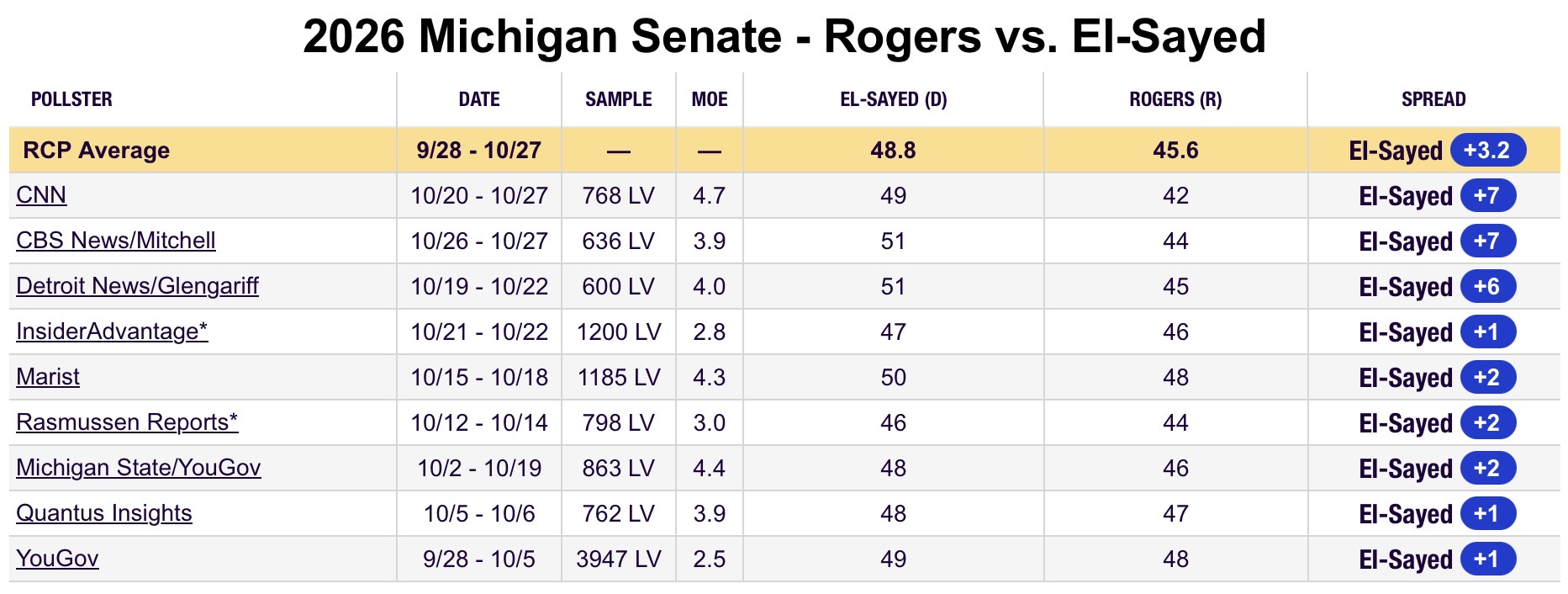
Chart from Seth Keshel’s Michigan U.S. Senate forecast: Polls

It seems like just yesterday we were getting polls showing Rogers leading. From the end of September through just last week, El-Sayed led the RCP average by just 1.5%, well within the margin of error. Now, we have three polls showing El-Sayed up by 6 or more, which has bloated the overall average to +3.2%. A 7-point margin for El-Sayed appears absolutely ludicrous given his liabilities as a candidate and the open opposition against his candidacy.

VII. Media Ratings

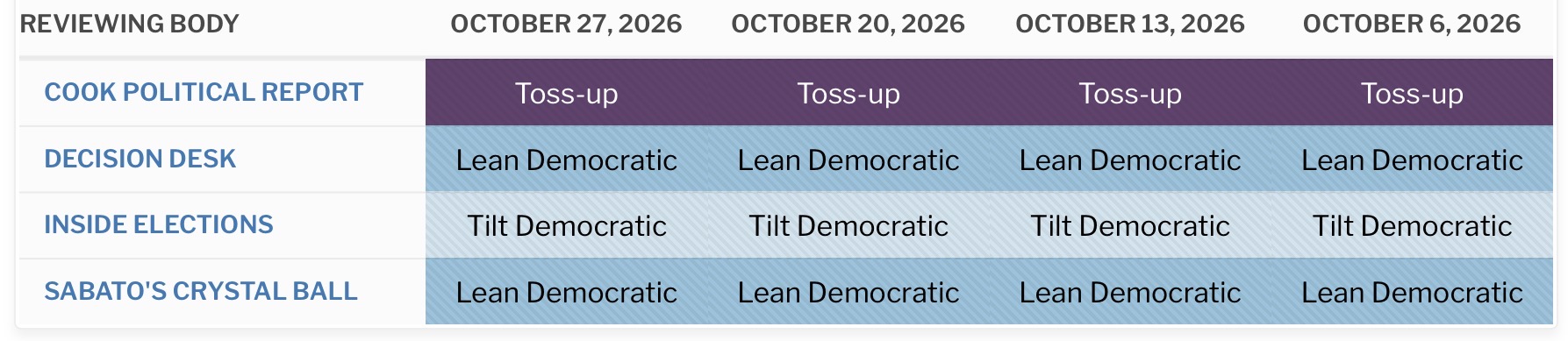
Chart from Seth Keshel’s Michigan U.S. Senate forecast: Media Ratings

Three of the four reviewing bodies tilt or lean the race for El-Sayed. My views are more in line with Cook, who calls it a “toss-up” – clearly not buying the polling.

VIII. Party Registration

Michigan does not register voters by party; however, it has very strong correlation to voter movement in Pennsylvania, which has a long-standing Republican drift that has only recently been interrupted in the run-up to the primaries. This has made for a fundamentally different race than the one Stabenow held by a relatively unimpressive margin in 2018.

IX. Election Considerations

Here is a compilation of what I’ve written in my MI-7 and MI-10 forecasts:

· Unique Corruption – Michigan has been exposed for covering up voter registration fraud rings, particularly in a major 2023 news story involving one in Muskegon County active during the 2020 election. Notably, similar registration fraud rings were exposed this cycle in Pennsylvania in multiple large counties. The state’s Attorney General, Dana Nessel, has threatened election integrity activists with imprisonment and police persecution for drawing attention to Michigan’s endless examples election-related malfeasance.

· Automatic Voter Registration – Michigan operates Automatic Voter Registration, which has only entrenched Michigan’s voter registration corruption, as evidenced by the state having hundreds of thousands of more voters registered than there is an available pool of eligible voters statewide. The Secretary of State, Jocelyn Benson, has suggested the state is helpless to clean its voter rolls and responds harshly to citizens who expect the state to run fair elections. As a reminder, more than 83% of Michigan’s total population (including minors) is registered to vote, when only 77% of any population is over the age of 18 and therefore old enough to cast a ballot.

As I wrote in the MI-7 article:

No state with the number of registered voters exceeding voting-age population can be trusted to run fair elections, and if control of the House hinges on MI-7, even the Democrat establishment will go to bat for Lawrence and trust they can bend him to their will in a hypothetical majority.

Michigan, thanks to the work of Jocelyn Benson as Secretary of State, does not run an elections system any real analyst should consider secure of trustworthy. Ask Mike Rogers, who lost to Elissa Slotkin in the wee hours of the morning once all the mail-in ballots came in after Trump was declared the winner of the state.

My evaluation of Michigan’s 2024 election with regard to election integrity can be found here:

Michigan – 2024 Election Compendium

X. Summary and Election Estimate

In 2018, Stabenow managed to carry Macomb County narrowly over James, who almost won Kent County, which has since drifted away from the GOP. Rogers won Macomb by almost 10 points against Slotkin in 2024; granted, he was running with Trump on the ticket, but Slotkin presented herself as a well-rounded moderate. El-Sayed pretends to be nothing of the sort, and has entire voting blocs aligned against him. Stabenow was able to limit the damage in the overwhelmingly red rural counties still adjusting to Trump’s surprise 2016 victory; Rogers will dominate those.

The biggest variable to me comes by way of what happens in Wayne County. Stabenow won it by over 264,000 margin in 2018 over James. The black population of Wayne County is nearly 37%, and if they are sitting out, crossing over in even modest numbers, or leaving the ballots blank, then it will doom El-Sayed’s campaign. Right now, Wayne County ranks 18th out of 83 counties for its share of the 2024 presidential vote put in, but in-person early voting has been up for a week and Democrats are known to front-load their votes. It is very possible, with over 350,000 ballots left to go to even match their 2022 gubernatorial count, that Wayne will have a turnout disaster like we are watching unfold in Cuyahoga County, Ohio, impacting the Brown-Husted race. Genesee County, home to Flint, lags behind Wayne County and may wind up even worse off in a place where Democrats need the votes.

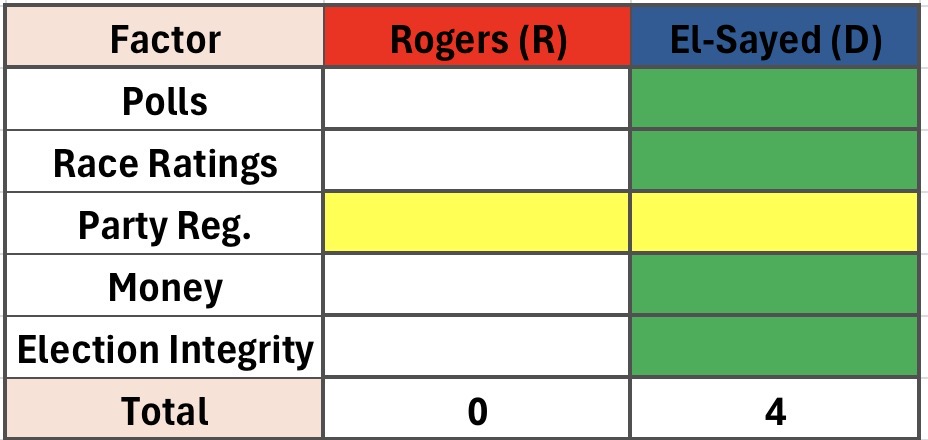
El-Sayed, for all his shortcomings, still dominates the decision matrix (at the mercy of ratings and polls that aren’t always right):

Chart from Seth Keshel’s Michigan U.S. Senate forecast: Summary and Election Estimate

If nominated, McMorrow and Stevens would have led in those same four categories. I would have favored them both to win this race, along 70/30 odds with a likely margin of victory around 3.5%. El-Sayed the candidate is the difference maker in this race. He has a definite chance to win, but based on where the 2018 election with an established incumbent landed, the decade-long trend of Michigan, and all of the groups Democrats need on their side opposing El-Sayed, I consider his ceiling excruciatingly low – perhaps 1.5% or less.

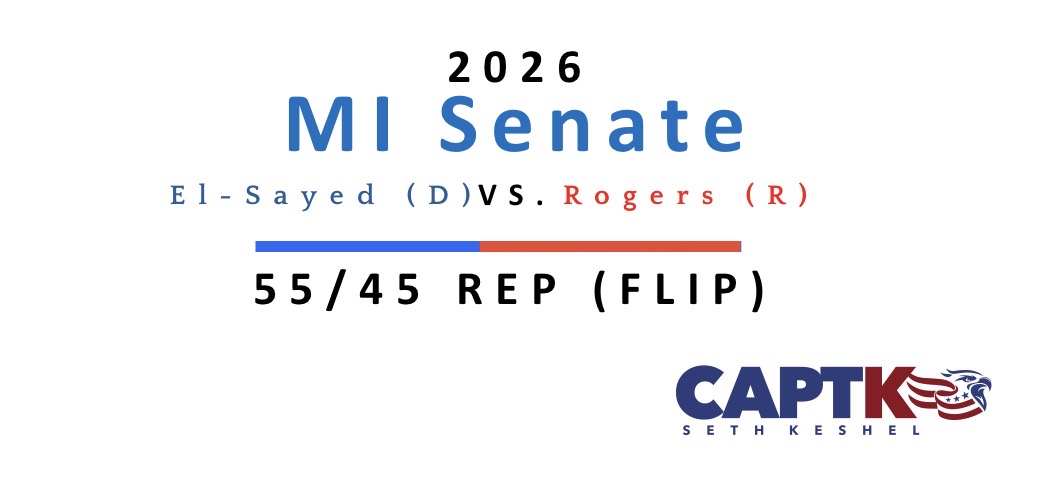
This race is potentially going to be the closest Senate battleground race, and I think Democrats will be lacking for turnout in areas they need it most. Based only on what I think are unique circumstances surrounding El-Sayed, I am nudging this toss-up toward Rogers, who has his own likely low ceiling owed to Michigan’s Republican headwinds.

Forecast for Michigan U.S. Senate

Chart from Seth Keshel’s Michigan U.S. Senate forecast: Summary and Election Estimate

I don’t leave things on “toss-up.” This is merely based on what I think will arise due to El-Sayed’s major liabilities as a candidate.

Seth Keshel, MBA is a Senior Fellow at the Gold Institute for International Strategy and a retired Army Captain. He publishes Captain K’s Corner on Substack.
2026 Ten-Point Forecast: Ohio U.S. Senate

Jon Husted and Sherrod Brown, candidates in Ohio's 2026 U.S. Senate race

Jon Husted (R-inc.) vs. Sherrod Brown (D)

I. The Race

Chart from Seth Keshel’s Ohio U.S. Senate forecast: The Race

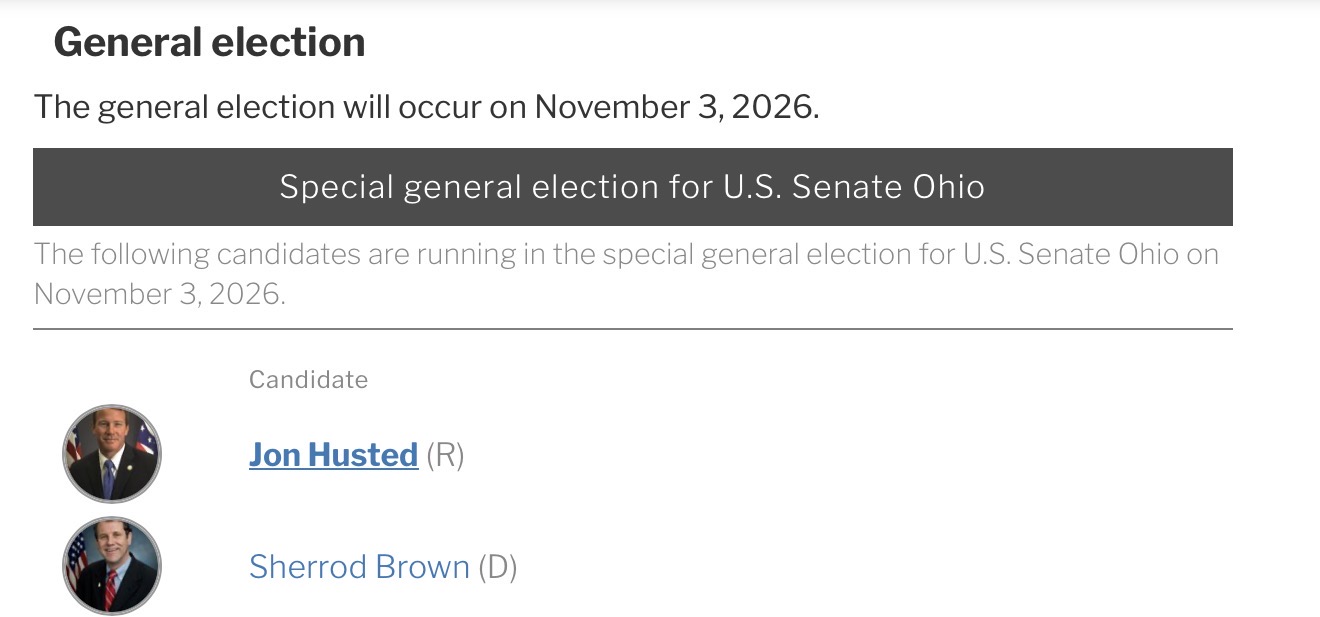
Jon Husted (Republican) is serving out the Senate term won by Vice President JD Vance in 2022, and under Ohio law is required to stand for this special election for the completion of the term. Before serving in the Senate, Husted was Ohio’s Lieutenant Governor.

Sherrod Brown (Democrat) is looking to make his way back to the Senate after having won three terms there (2006, 2012, 2018) before losing to Senator Bernie Moreno in 2024, when President Trump carried the state by 11.2%. If Brown wins, he will have to run again in 2028.

II. State Profile

Chart from Seth Keshel’s Ohio U.S. Senate forecast: State Profile

Ohio was once the premier bellwether state in presidential politics. From 1896 through 2016, Ohio failed to vote for the winner of the presidency only twice – in 1944 and 1960. We all know the 2020 election had its issues, but I tend to believe Ohio would have stuck with its record as an accurate predictor in a fair race.

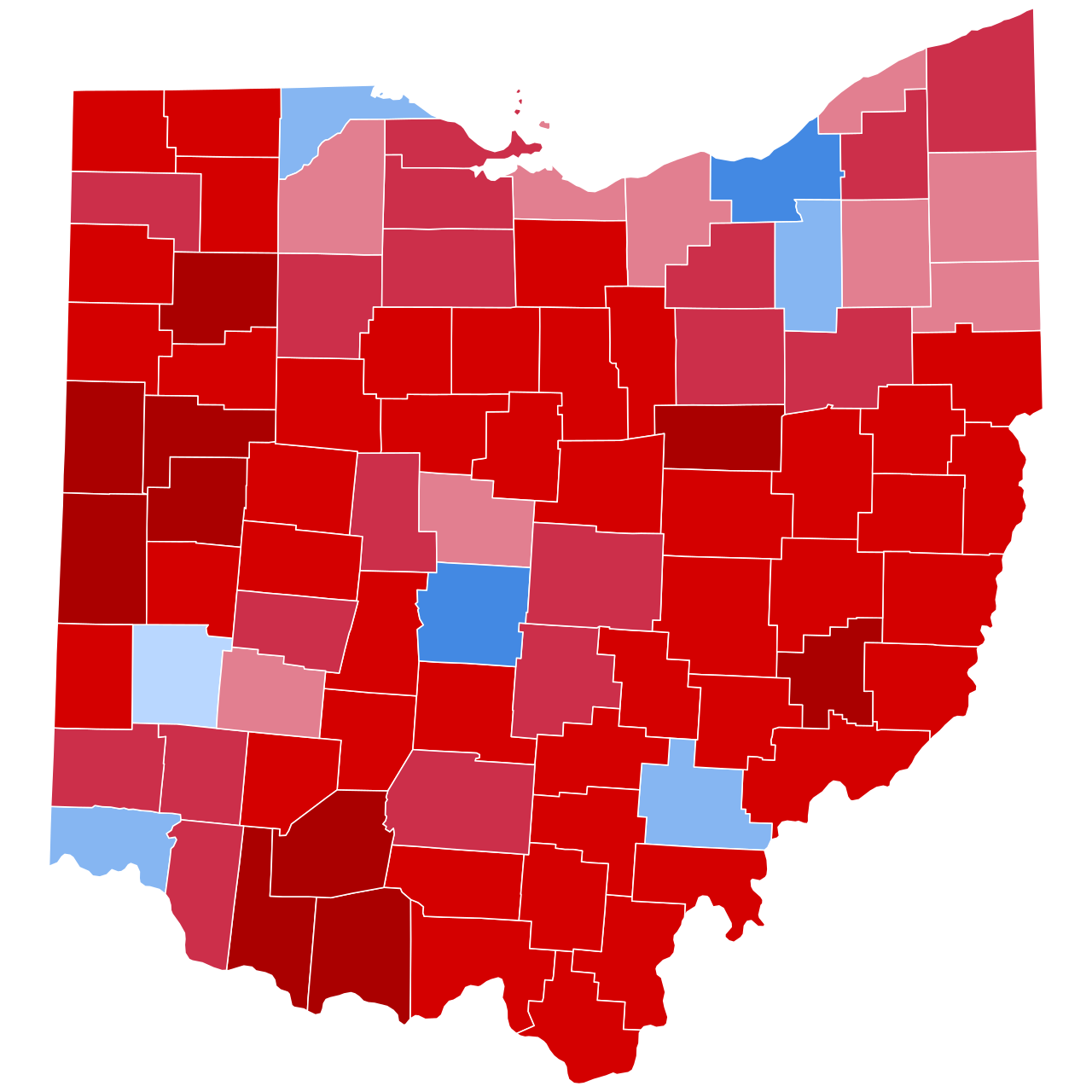
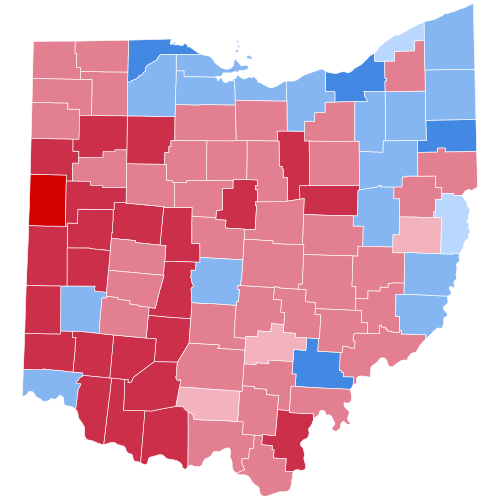
Kamala Harris won 6 of 88 counties in Ohio’s 2024 presidential elections. Only five of them have meaningful vote counts:

• Cuyahoga County (Cleveland)
• Franklin County (Columbus)
• Hamilton County (Cincinnati)
• Lucas County (Toledo)
• Summit County (Akron)

Contrast the above results with how the map looked in 2008:

Chart from Seth Keshel’s Ohio U.S. Senate forecast: State Profile
2008 Presidential Election in Ohio

The interior of Ohio, while won by McCain, was mostly just pink. Key Trump-backing counties in the northeast, such as Mahoning County, were still plenty blue. Despite being a two-time Obama state, Trump had no trouble carrying the Buckeye State all three times he ran:

2016 Trump +8.1%

2020 Trump +8.0%

2024 Trump +11.2%

The key to understanding Ohio in 2026 is to first recognize it is nothing like the state Brown first won election to the Senate in back in 2006.

Key Statistics

• 69.3% White, 15.5% Black, 8.5% Hispanic

III. Market Assessment

Polymarket bettors give Brown better than two-to-one odds to unseat Husted and return to the Senate.

IV. History

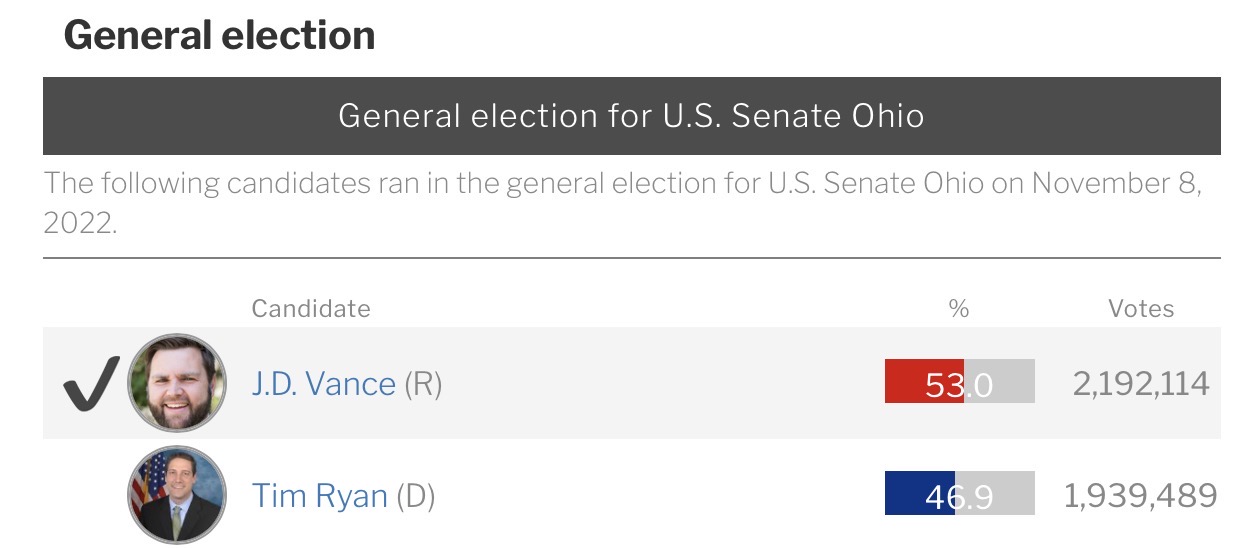
The seat Brown currently seeks has been in Republican hands since 1998, when George Voinovich won the seat and held it for two terms. He gave way to Rob Portman, who won it in 2010 and 2016 before stepping away for Vance:

Chart from Seth Keshel’s Ohio U.S. Senate forecast: History

It is important to note that Vance, running for an open seat, prevailed over Tim Ryan – who once had impeccable blue collar Democrat credentials that far surpass those Brown seeks to impute to himself.

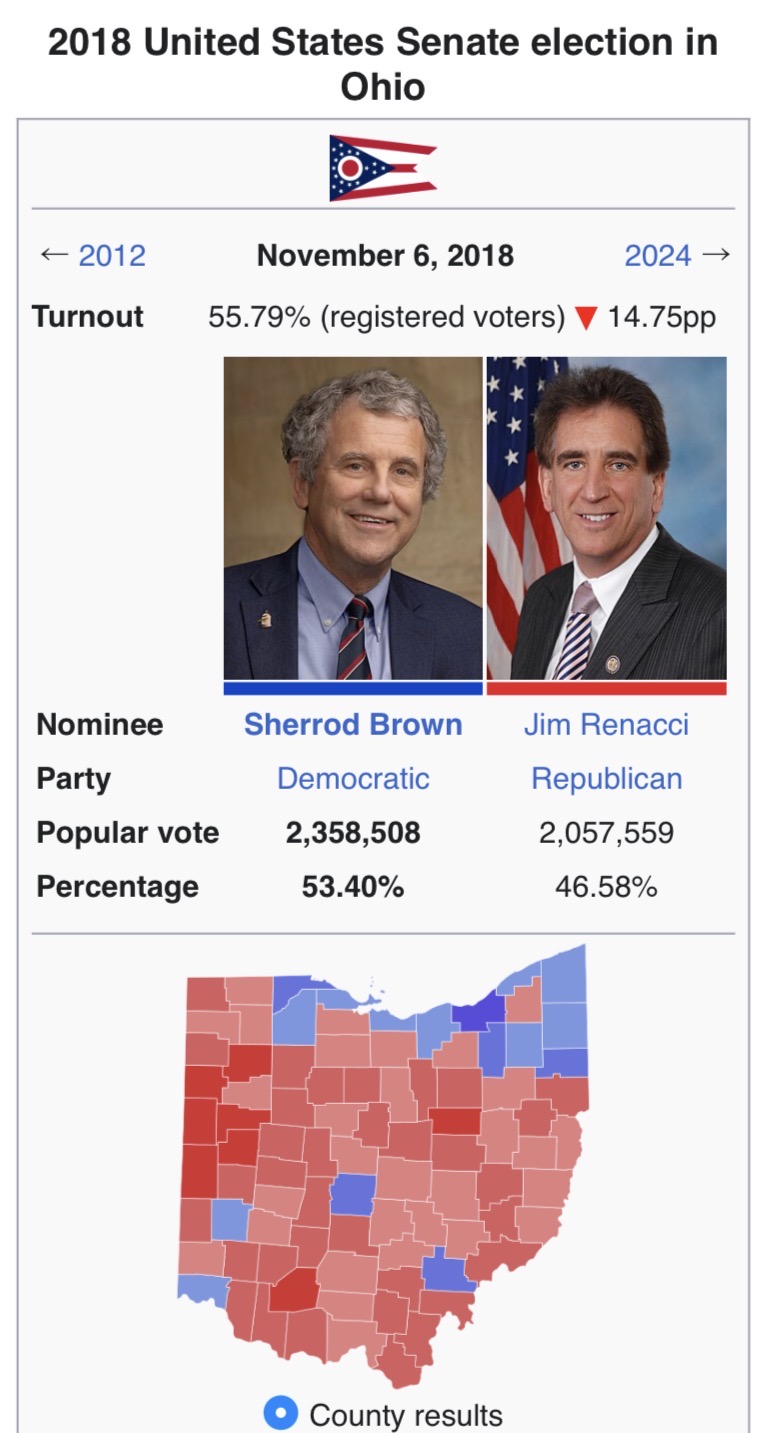
Brown held the other Ohio Senate seat for three terms after knocking off none other than Mike DeWine, Ohio’s current Republican governor and resident Trump hater in the mold of John Kasich, in 2006. He was reelected in 2012, and again in 2018 with a high turnout:

Chart from Seth Keshel’s Ohio U.S. Senate forecast: History

Those bullish on Brown’s chances today will point to a swing of 14.9% away from the 2016 presidential margin to Brown in 2018, but Ohio is much different today than it was even then and has gone more the way of Indiana than it has remained in the mold of “Trumplican” states like Pennsylvania or Michigan. Just in the map above, it will be difficult for Brown to carry northeastern counties and avoid the crimson-shaded margins of the interior his opponent is likely to pile up.

V. Analysis of 2026 Primary Results

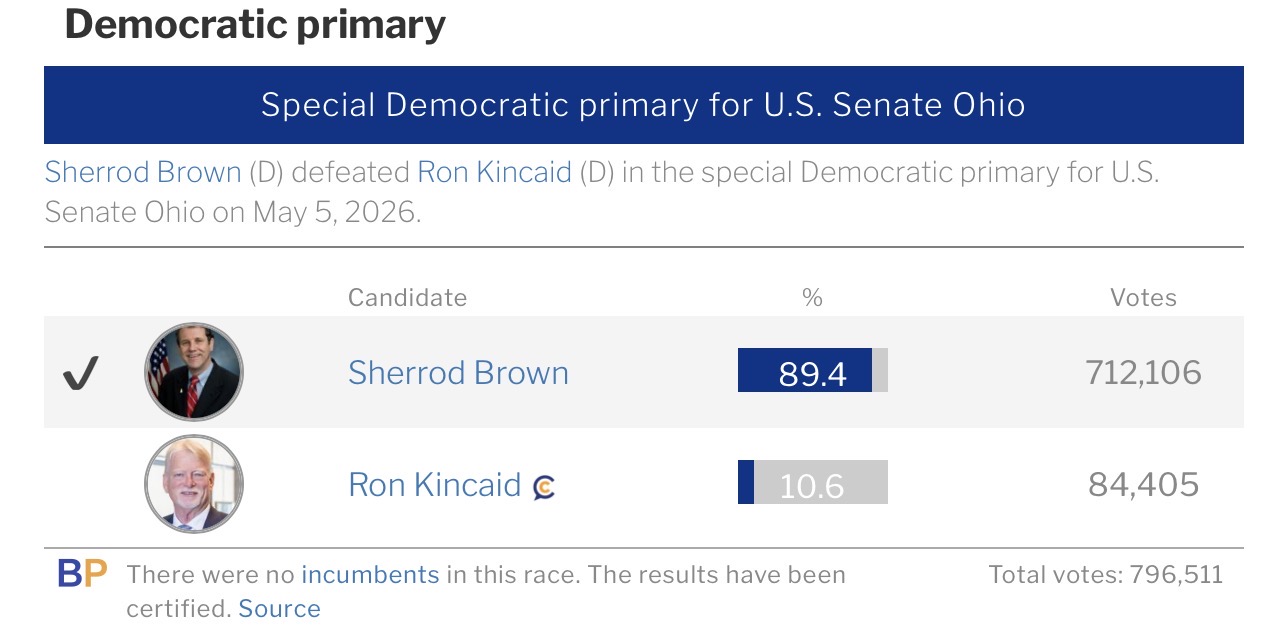
Husted ran unopposed in his primary to secure the GOP nomination. Brown faced a primary challenger, but ran over him like Ohio State would a MAC squad in September:

Chart from Seth Keshel’s Ohio U.S. Senate forecast: Analysis of 2026 Primary Results

VI. Polls

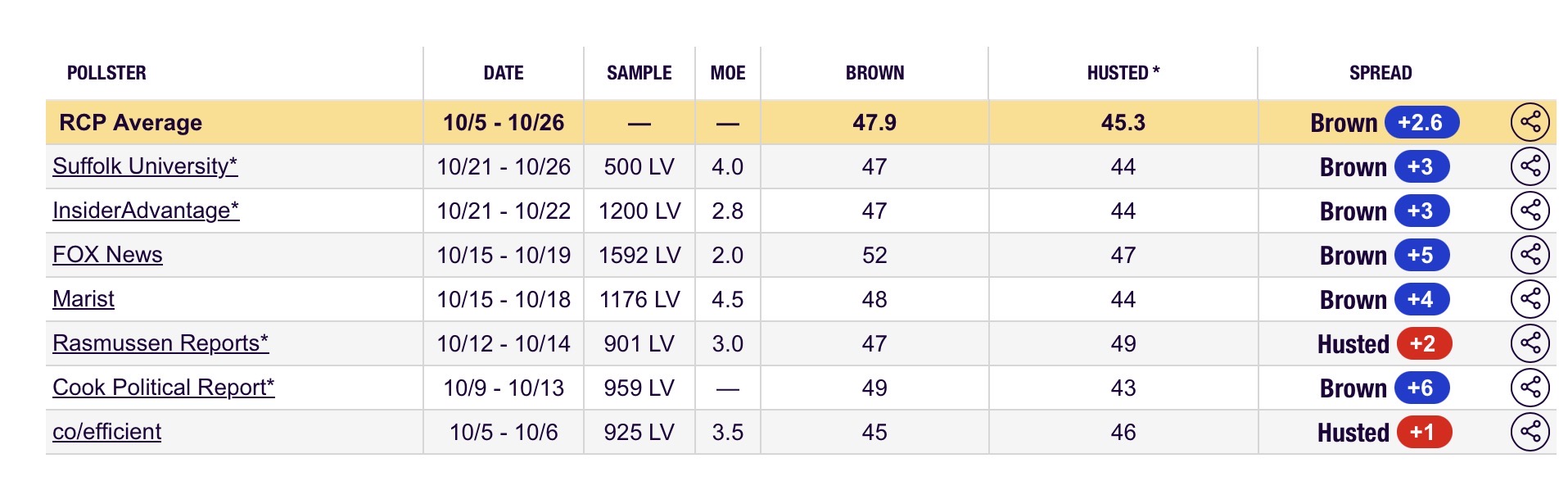
Despite Husted having led in several recent polls, pro-Brown pollsters (some disreputable) have flooded the zone and given him an average lead of 2.6% in the RCP file:

Chart from Seth Keshel’s Ohio U.S. Senate forecast: Polls

VII. Media Ratings

Chart from Seth Keshel’s Ohio U.S. Senate forecast: Media Ratings

It doesn’t appear to me that any of the reviewing bodies are buying the polling and have all chosen the safety of the “toss-up” rating.

VIII. Voter Registration by Party

Ohio does not register voters by party. It closely resembles Pennsylvania, which does register by party and has a strong rightward trend for more than a decade.

IX. Election Considerations

Here is what I had to say in my write-up of the greatest unforced error in the race for the majority, OH-7:

Fortunately for Miller, Ohio has done a relatively strong job of sealing up election loopholes and has ensured they have control over the limited mail-in balloting that exists in the Buckeye State. I wrote up Ohio’s election details in the aftermath of the 2024 election for those of you interested in understanding how election integrity impacts races there. In short, there will be no late night ballot dumps impacting this race.

Industrial Midwest – 2024 Election Compendium

X. Summary and Election Estimate

Ohio has had a solid decade to marinate in its new Republican orientation. This means the interior counties are much more crimson-shaded than they once were, establishing a higher presidential baseline for Brown, no longer the incumbent, to overcome. Democrats, as they struggle in other states, require overwhelming margins in Cuyahoga and Franklin Counties to stand a chance in statewide races now that the white working class has shifted to Trump’s GOP. And therein lies the problem for Brown.

I keep a daily tracker assessing Ohio’s turnout each day for mail returns and in-person early voting. I then sort it by percentage of the 2024 presidential vote already cast. Franklin and Cuyahoga, which are presumably front-loading Democrat-heavy early votes, languish well into the bottom half of 88 counties sorted by this measure; until just a few days ago, Montgomery County (Dayton) was dead last.

MAGA counties dominate the list of counties sorted by 2024 presidential vote county already cast in this state that has a massive in-person on Election Day voting propensity. If Brown isn’t going to cash in massive margins in Cuyahoga County, where the City of Cleveland itself is lagging big-time, and the crazies in Columbus (Franklin County) aren’t into the election, then where in the hell is he going to get his votes from?

Chart from Seth Keshel’s Ohio U.S. Senate forecast: Summary and Election Estimate

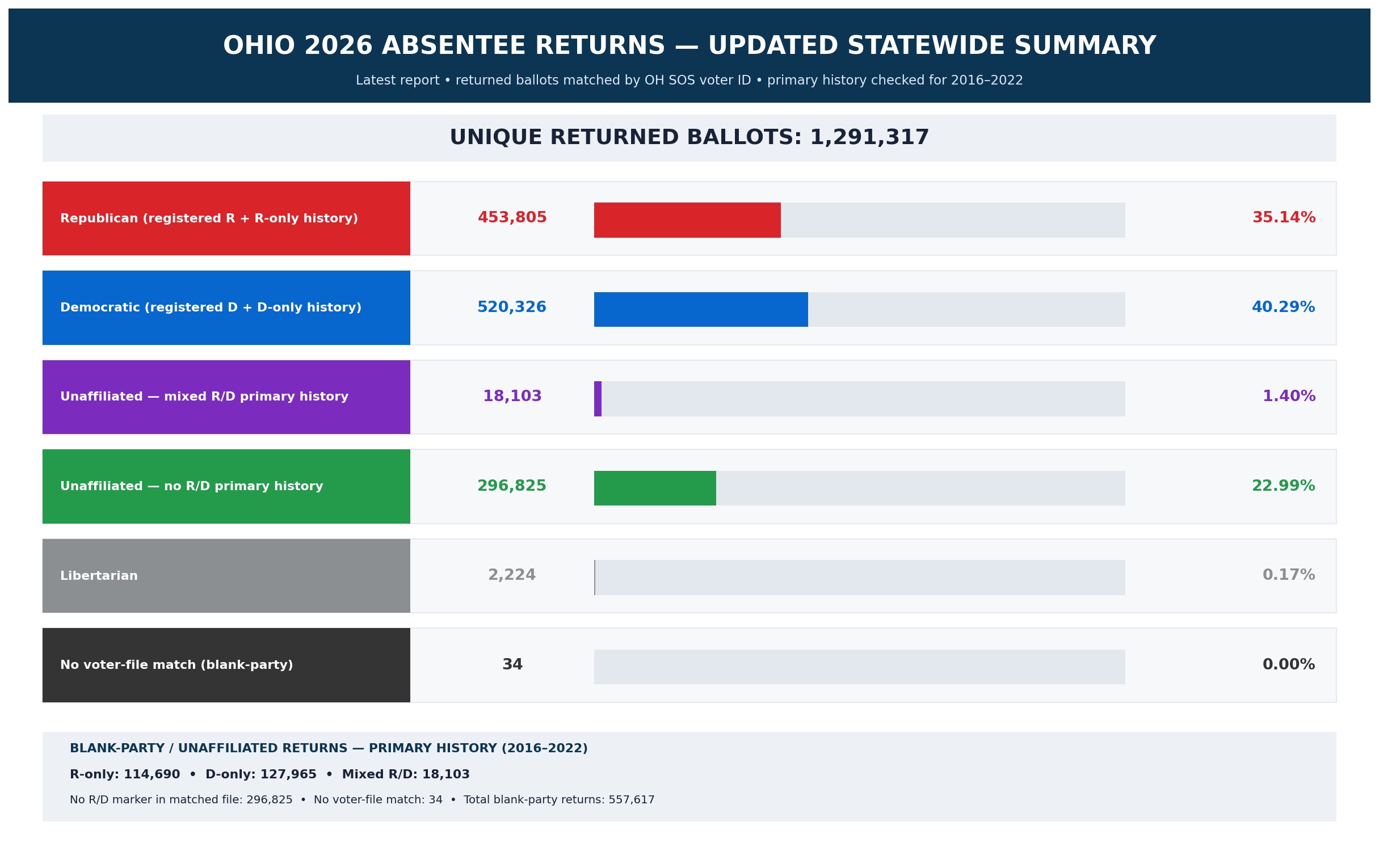
The above graphic shows implied partisan turnout through yesterday using primary voting history. It stands at just D+5.2%, which is redder at this point in time than 2024, when Trump won by +11.2%. Election Day in Ohio is overwhelmingly red, and if Cleveland and Columbus are dragging heavily on turnout, the incumbent Husted has a major edge.

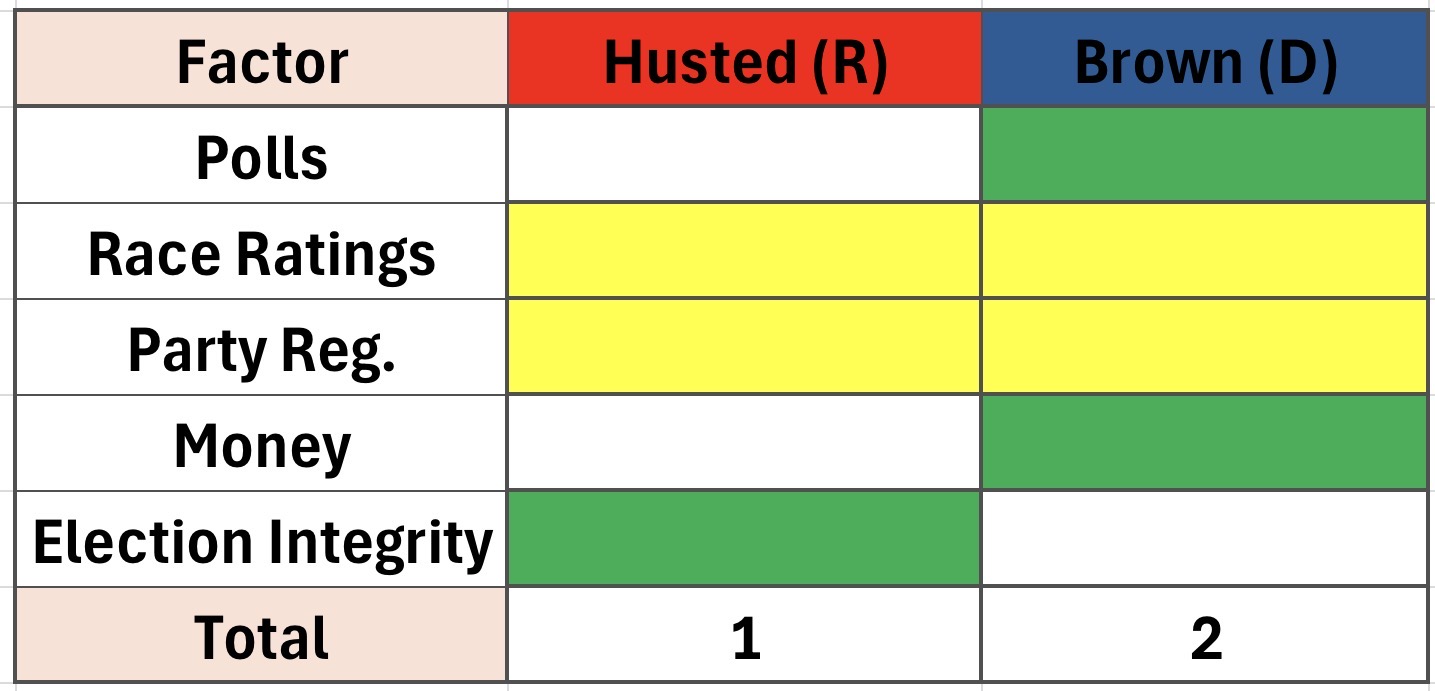
The decision matrix narrowly favors Brown:

Chart from Seth Keshel’s Ohio U.S. Senate forecast: Summary and Election Estimate

Yet the political makeup of modern-day Ohio and the turnout patterns in early voting place Brown at a major disadvantage despite his name recognition and prior success with Trump in the White House.

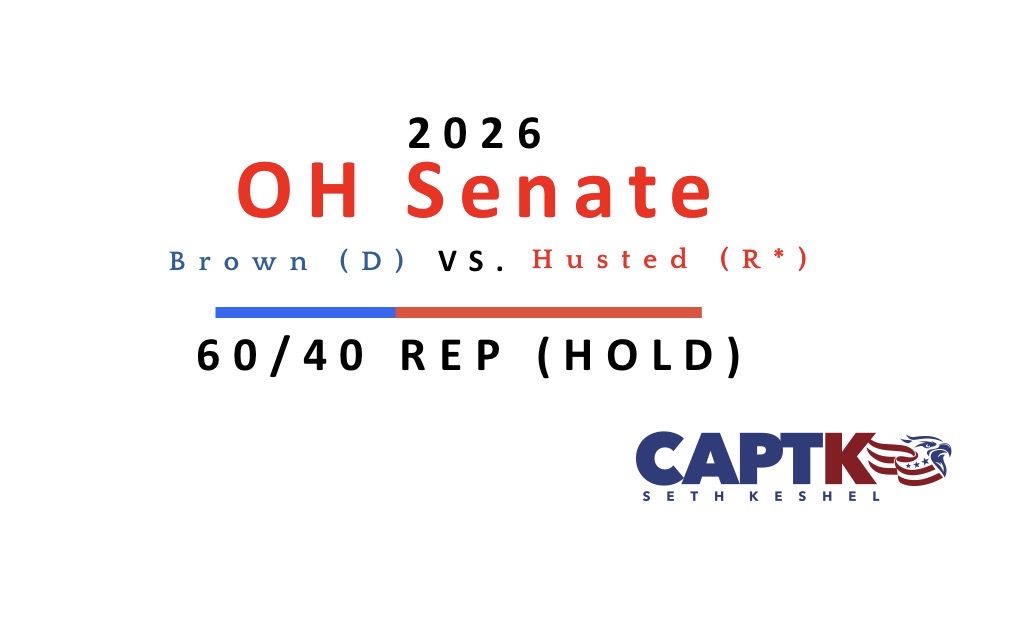
Forecast for OH Senate

Chart from Seth Keshel’s Ohio U.S. Senate forecast: Summary and Election Estimate

If Ohio red counties do what they do on Election Day, voters remain old, and urban turnout stays in the toilet, this race is Husted’s – and potentially with some breathing room to spare. Brown’s ceiling at this point is very low.

Seth Keshel, MBA is a Senior Fellow at the Gold Institute for International Strategy and a retired Army Captain. He publishes Captain K’s Corner on Substack.
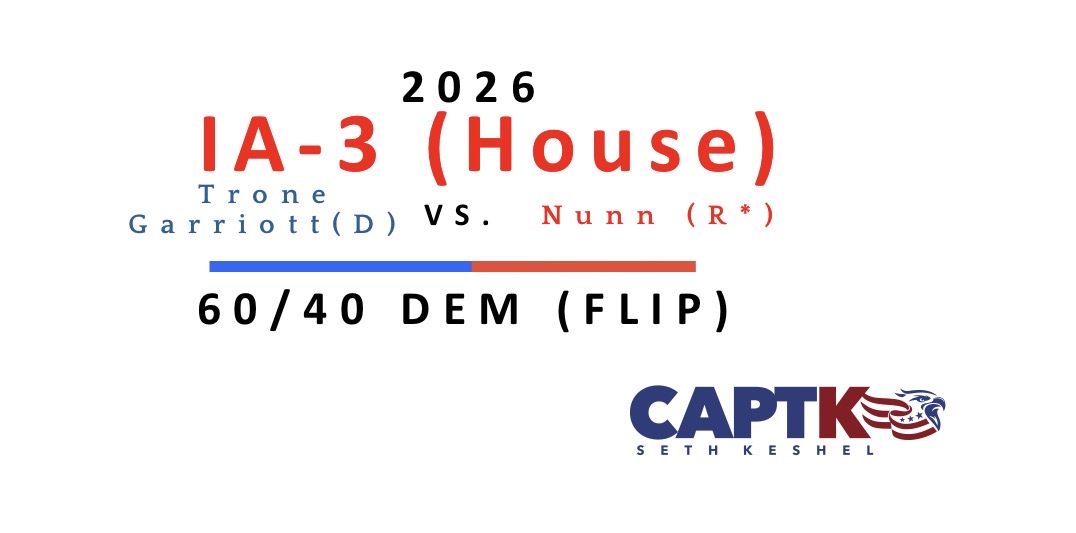
2026 Ten-Point Forecast: IA-3 (U.S. House – Decisive)

2026 Ten-Point Forecast: IA-3, Zach Nunn vs. Sarah Trone Garriott

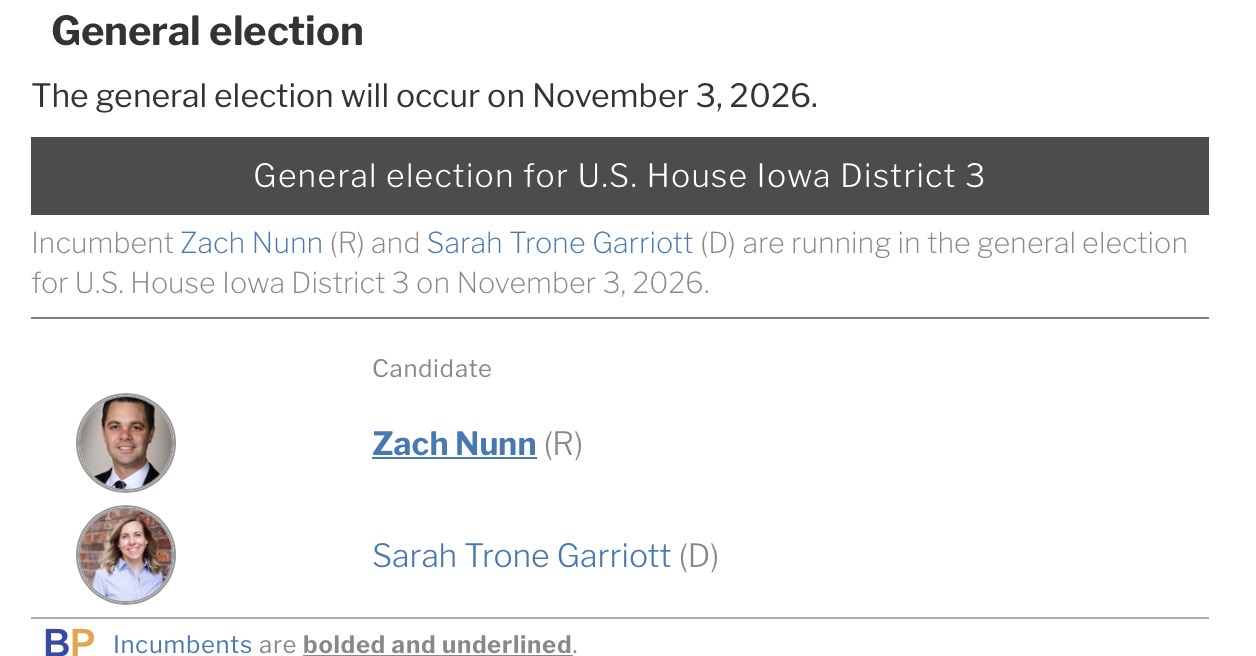
Zach Nunn (R-inc.) vs. Sarah Trone Garriott (D)

I. The Race

Zach Nunn (R) and Sarah Trone Garriott (D), the candidates in Iowa's 3rd Congressional District

Zach Nunn (Republican) is an Air Force Reserve Colonel with serious combat experience. He was once a member of the Iowa legislature, and has represented IA-3 since first being elected in the 2022 GOP House victory and now seeks his third term.

Sarah Trone Garriott (Democrat) is an Iowa state senator with a background in religious studies. She is running a “kitchen table” campaign that is relatively careful about not becoming “Trump-centered,” with the understanding that Iowa supported Trump by a wide margin. This is her first attempt at Congress.

II. District Geography

Map of Iowa's 3rd Congressional District in southwest Iowa

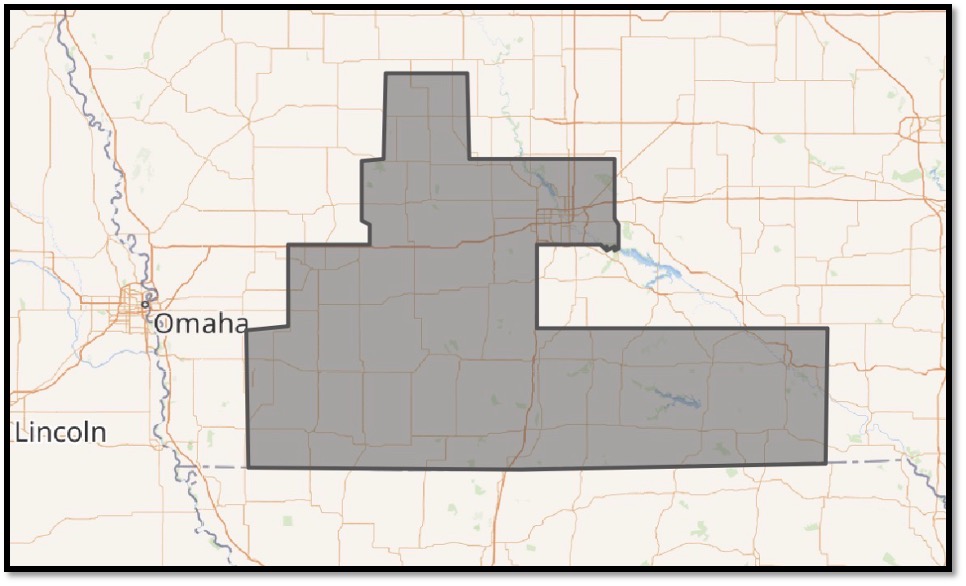
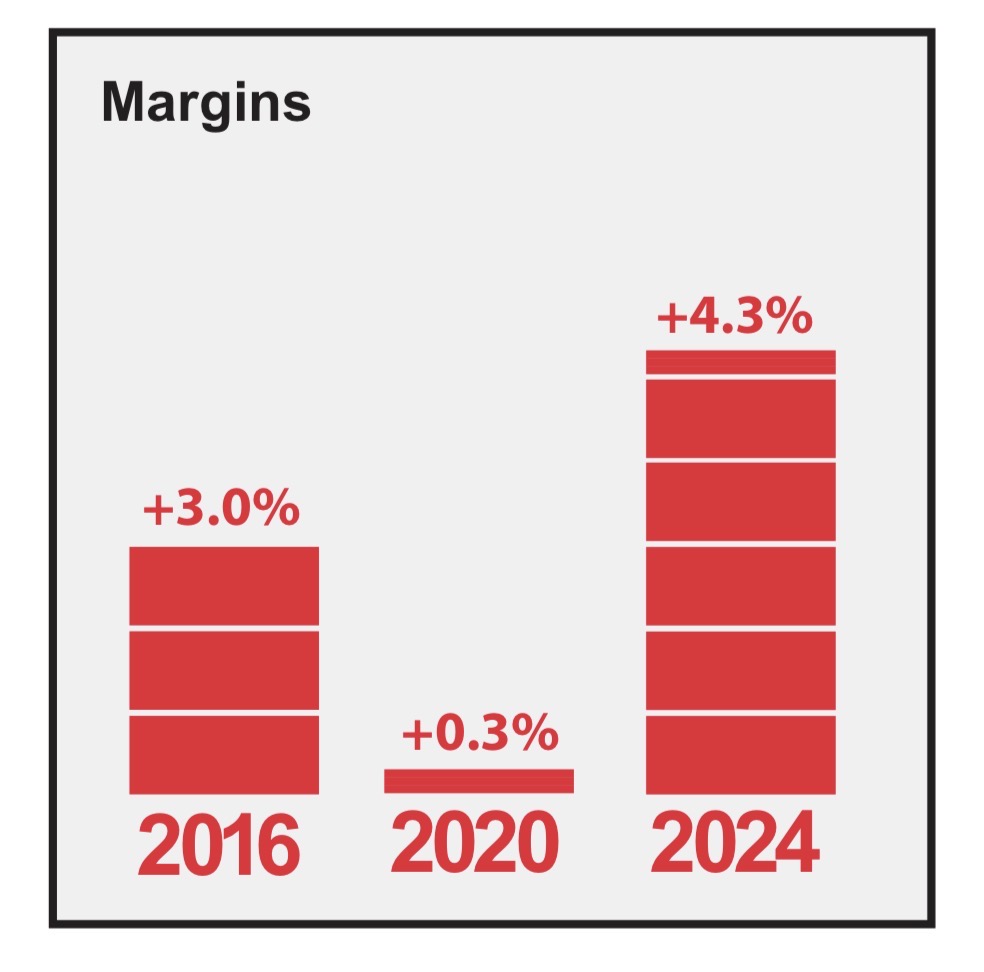
Iowa’s 3rd Congressional District (IA-3) occupies the southwestern portion of the state (all but the very corner), and contains the capital city of Des Moines and its most electorally significant suburban areas – and a total of 21 counties. Since Iowa doesn’t gerrymander, this seat (just like IA-1) is extremely competitive. A Republican state that wanted to win would figure out how to split half of Des Moines into IA-4, which is overwhelmingly red. As such, the clash between urban/suburban and farmland produces tight margins in presidential and House elections. Here is how President Trump fared in all three of his races in the current boundaries of IA-3:

Trump's margins in the current IA-3 boundaries, 2016 to 2024

IA-3 sits well to the left of the state as a whole. Trump had to carry Iowa by over 13 points in 2024 just to take IA-3 by 4.3%; he hasn’t been helped by the suburban drift of Dallas County, which is just west of Polk County (Des Moines), that has taken place over the past decade. The rurals are about volume of turnout. The metropolitan Des Moines area is about persuasion.

III. Market Assessment

Polymarket bettors overwhelmingly favor Trone Garriott, who is vastly overpriced.

IV. History

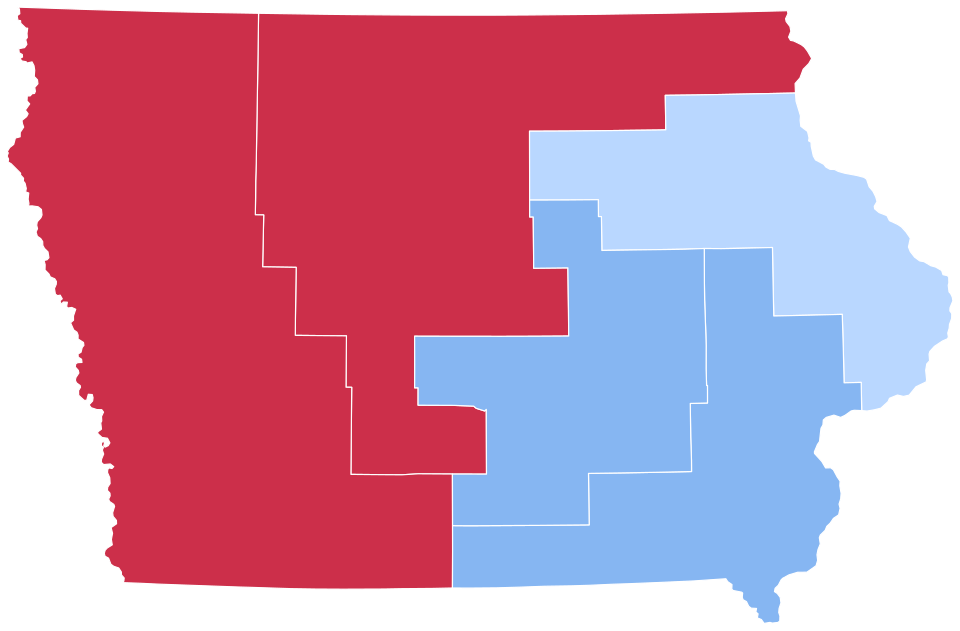
Des Moines and the rest of Iowa’s districts have moved around a lot in recent decades. In 2010, the last election of the first decade of the 21st century, Iowa’s U.S. House map looked like this:

Iowa U.S. House results map, 2010
Iowa U.S. House Results – 2010

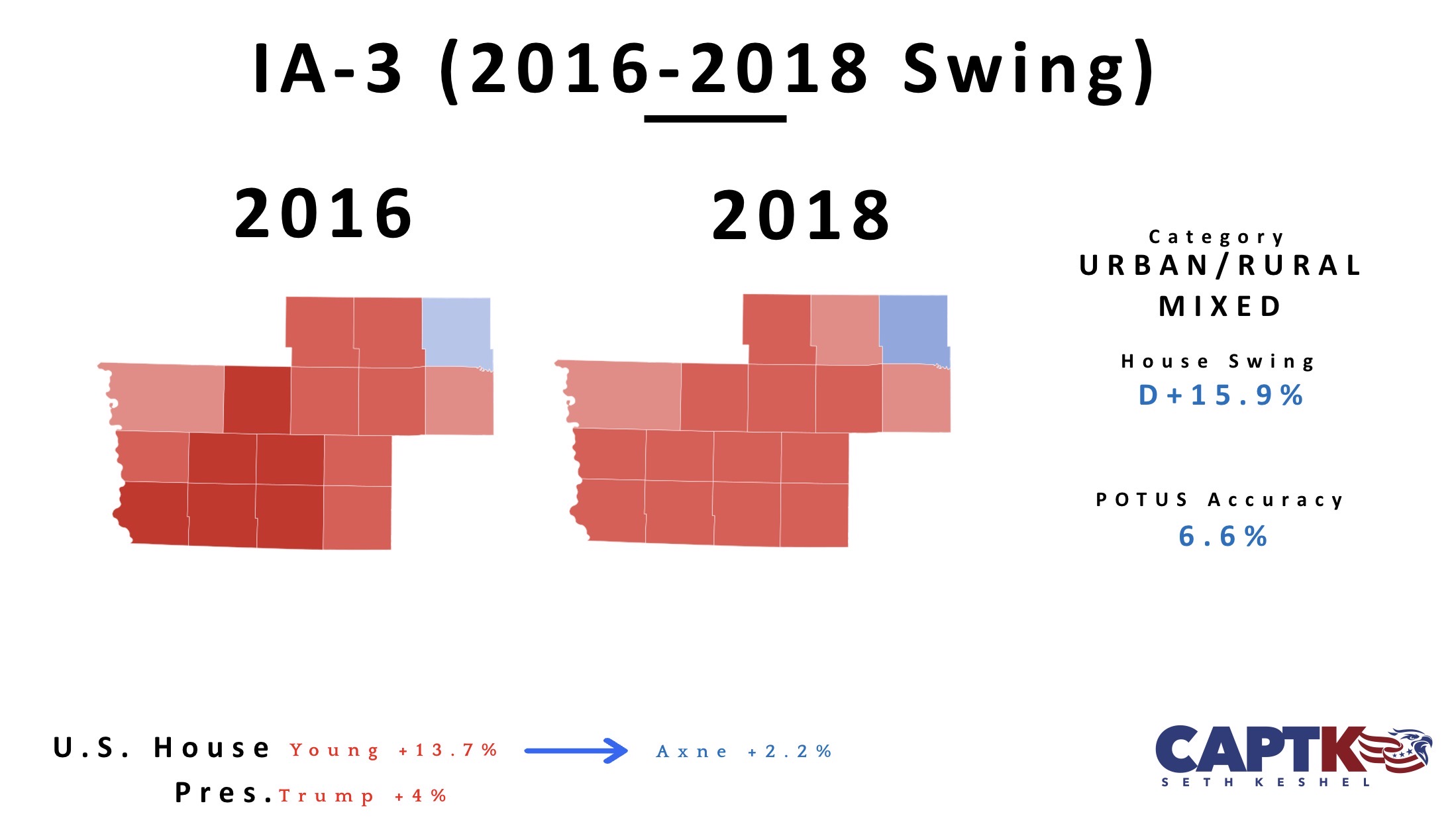
Iowa lost an electoral vote going into the next decade and then split its lines in a different pattern, putting Des Moines and IA-3 into a district more closely resembling the one Nunn is defending now. Republican David Young, running for reelection alongside President Trump’s first campaign in Iowa, won his 2016 race by 13.7%. Young then turned around in 2018 and lost the seat by 2.2% to Cindy Axne, who proceeded to narrowly defeat him in a 2020 rematch.

IA-3 House results from 2016 to 2020

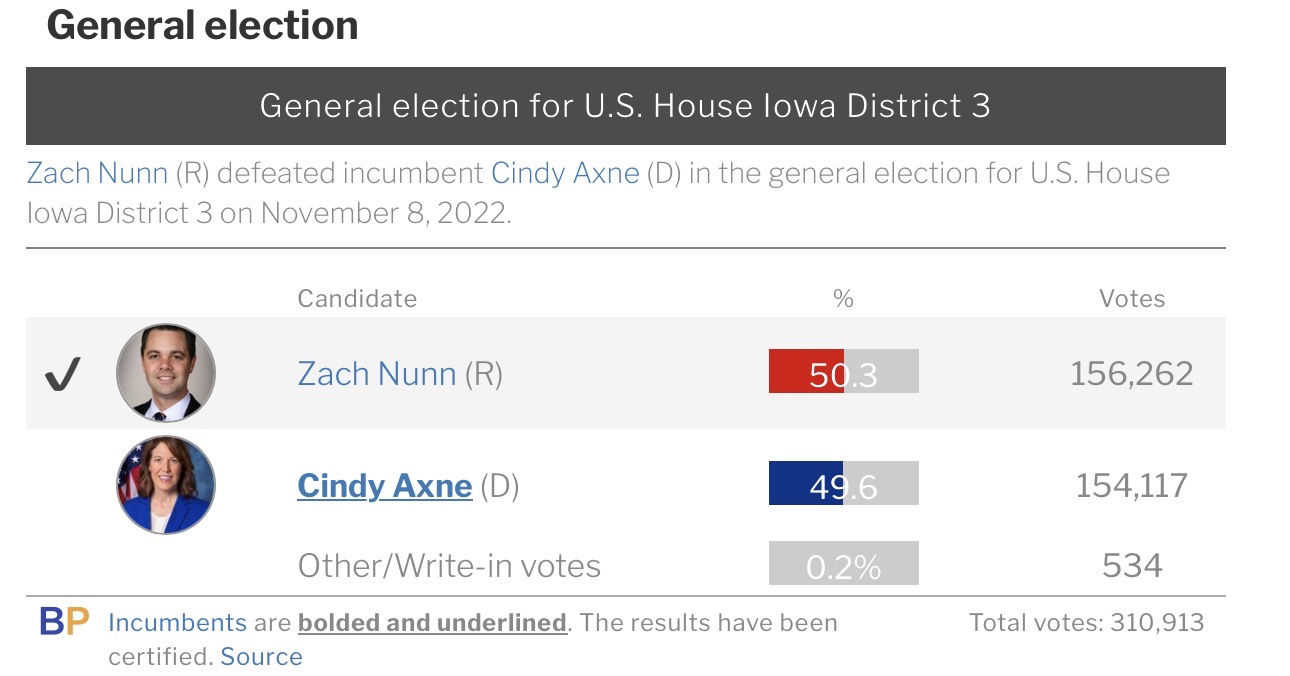
IA-3 met the key warning sign for a 2018 flip – a seat with a major metropolitan area in which President Trump massively underperformed the Republican House candidate. The districts were redrawn yet again, and in their current form, Nunn knocked Axne out in the 2022 GOP House takeover, and by a very narrow margin of just 0.7%:

IA-3 2022 U.S. House result, Nunn vs. Axne

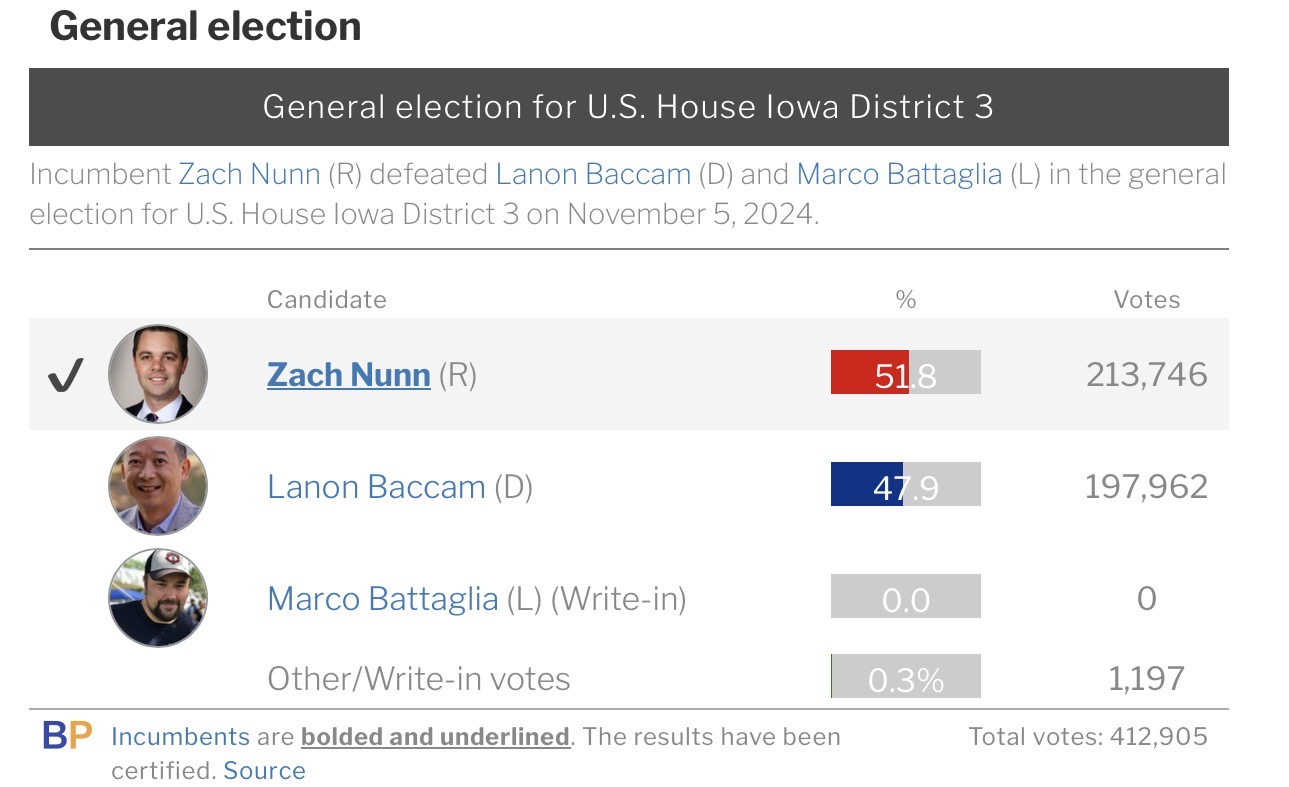
Thanks to Trump’s statewide blowout, Nunn ran up a very impressive margin compared to what IA-3 is normally capable of:

IA-3 2024 U.S. House result

Nunn must hope that rural turnout is overwhelming knowing just how strong the shift in metropolitan Des Moines was in 2018.

V. Analysis of 2026 Primary Results

Neither Nunn nor Trone Garriott faced a serious primary challenger; therefore, there is no lingering drama impacting either party for the General Election.

VI. Polls

No mainstream polls have run for this race since March.

VII. Media Ratings

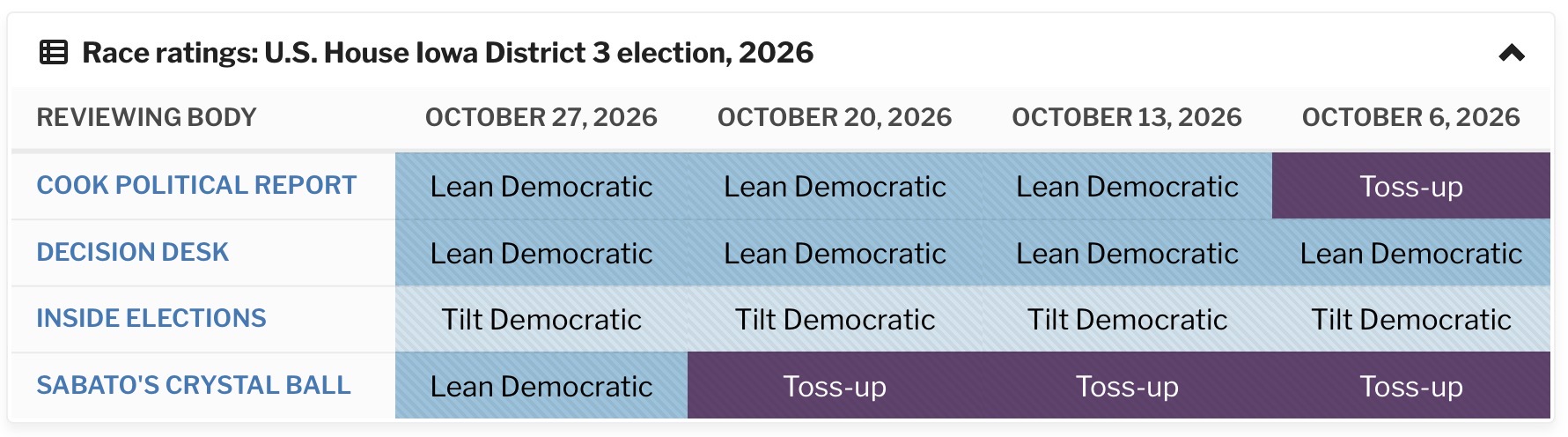
Media race ratings for IA-3

Every major reviewer favors Trone Garriott; Inside Elections is the only one thinking it may come down to the wire.

VIII. Party Registration

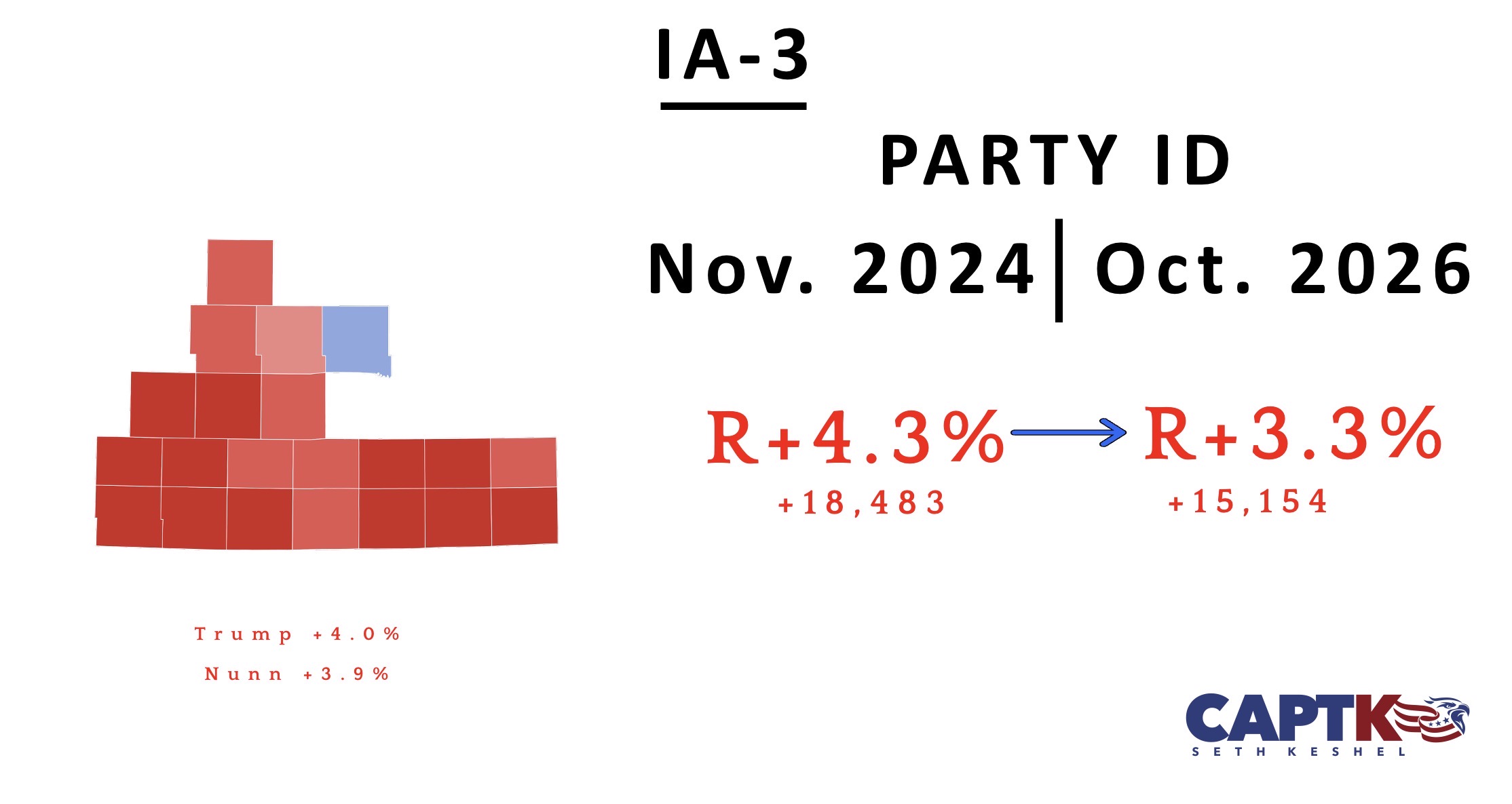
IA-3 party registration changes since November 2024

While Republicans have a larger numerical advantage over Democrats today than they did in November 2024, this isn’t the case in IA-3. Democrats have made up 3,129 net registrations, dropping the Republican advantage by a full point. Most of this damage has been sustained in Polk County, where Democrats have out-registered Republicans roughly two to one. Unlike cases in which a registration gain is tied to roll maintenance, this is a legitimate Democrat gain.

IX. Election Considerations

This is what I had to say about Iowa’s elections in my IA-1 piece:

One thing is for certain, and that is that Iowa runs excellent elections. A lot of this is owed to the current treasurer, Roby Smith, who started turning the screws on election reforms as a state legislator before the 2020 election. Iowa has manageable early voting windows, control over the mail-in balloting process, and a voter registration system that doesn’t automatically register voters.

X. Summary and Election Estimate

Nunn is sitting in a seat that, much like AZ-1, has stabilized its political leanings. Trump underperformed in the old boundaries in 2016 relative to the GOP representative, and that representative was bounced in 2018 when the “suburban swing” bill came due.

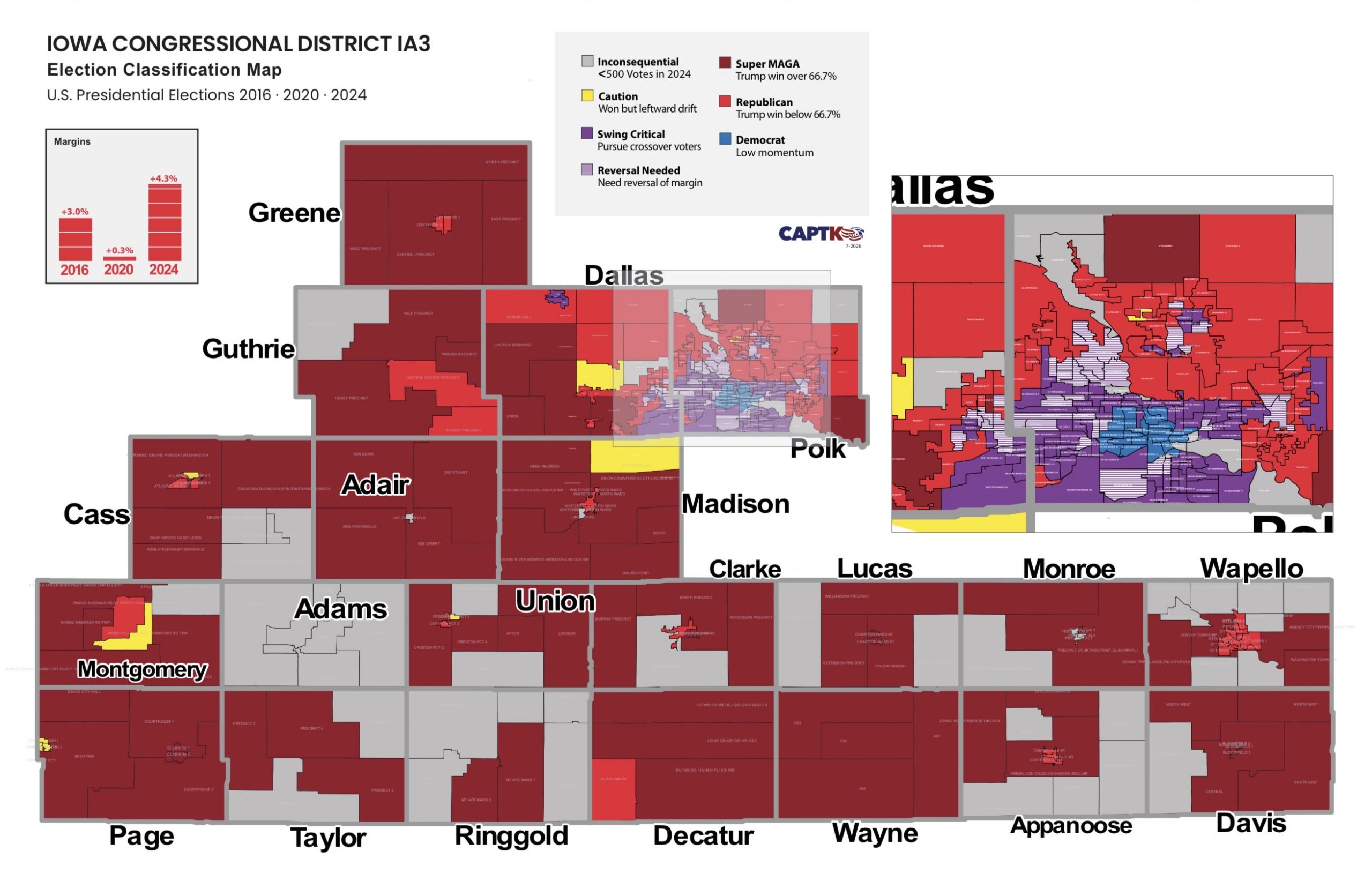
Captain K proprietary precinct mapping of IA-3, Polk and eastern Dallas Counties
Captain K Proprietary Mapping of IA-3

My proprietary mapping of IA-3 above shows a zoomed-in bubble of Polk County and the eastern edge of Dallas County, which contains key suburban territory Nunn will need to hold his ground in. Any suburban swing, plus high turnout in core Des Moines in the blue-coded (“Democrat”) precincts combined with lagging rural turnout puts this election on ice and gives Democrats a key flip in what is one of the most important races for the House majority.

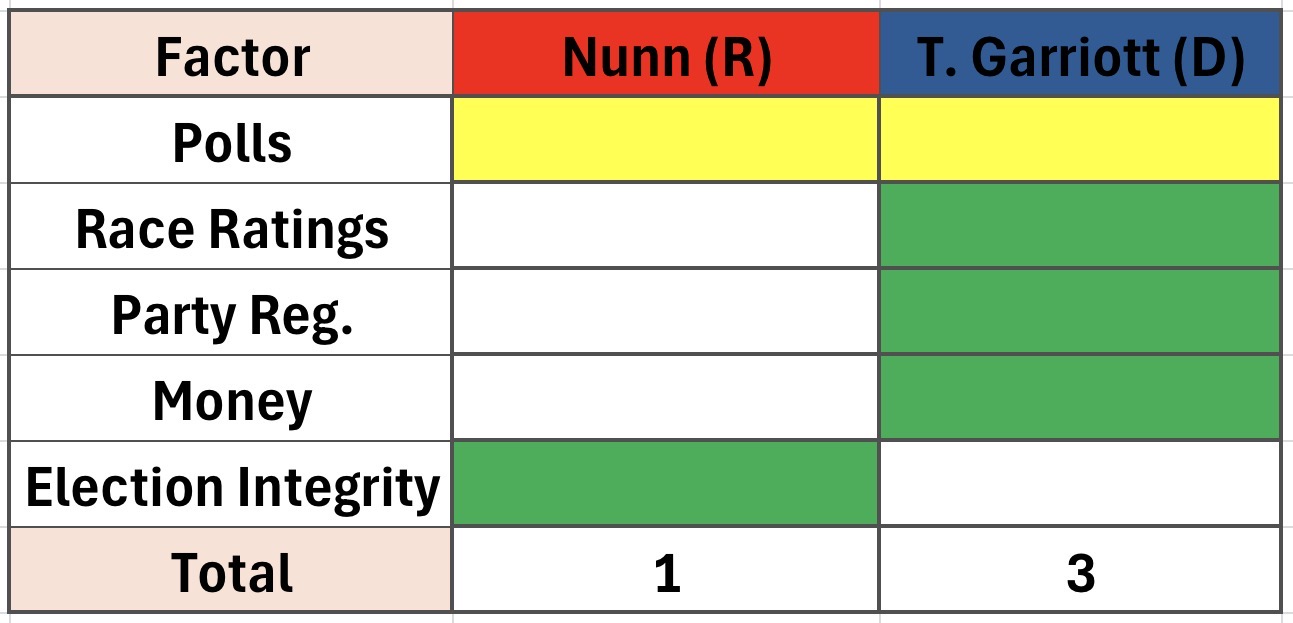
The decision matrix favors Trone Garriott:

Keshel decision matrix for IA-3

Based on the established swing of IA-3 and the Des Moines metro in the first Trump midterm, legitimate Democrat gains in voter registration, and Trone Garriott’s money advantage, I consider her the favorite. I would normally be inclined to rate her at 65/35, but given Nunn’s popularity, success, and early voting splits similar to his 2024 win, I think he has a better-than-normal chance to hold the seat – certainly much better odds than Mariannette Miller-Meeks has to hold IA-1.

Forecast for IA-3 House

Keshel forecast for IA-3 House

Seth Keshel, MBA is a Senior Fellow at the Gold Institute for International Strategy and a retired Army Captain. He publishes Captain K’s Corner on Substack.
Ernie Audino at the Jerusalem Center: “There Was No Fight Against ISIS and al-Qaeda Without the Kurds”

The Kurdistan flag seen through the brick wall of the Erbil Citadel

This segment aired on Jerusalem Center for Security and Foreign Affairs. JCFA conference on Israel’s defensible borders, October 28, 2026.

Featuring Ernie Audino, Senior Military Fellow, Kurdistan Program (U.S. Chair), Gold Institute for International Strategy

In brief

Ernie Audino speaks at a Jerusalem Center for Security and Foreign Affairs conference on Israel’s defensible borders about serving alongside Kurdish Peshmerga fighters in Iraq.

From the Jerusalem Center for Security and Foreign Affairs: “There was no fight against ISIS and al-Qaeda without the Kurds.” Speaking at a JCFA conference on Israel’s defensible borders, U.S. Brig. Gen. (Ret.) Ernest Audino shared his firsthand experience serving alongside Kurdish Peshmerga fighters in Iraq. After surviving Saddam Hussein’s chemical attacks and decades of persecution, the Kurds became some of the most capable and loyal allies in the fight against ISIS. Audino emphasized that moderate forces across the Middle East need more than recognition. They need security, protection, and support to stand against extremism.

Watch the full segment at Jerusalem Center for Security and Foreign Affairs

Ernie Audino is a Senior Military Fellow, Kurdistan Program (U.S. Chair) at the Gold Institute for International Strategy, a Washington, D.C. foreign policy and defense think tank.
2026 Ten-Point Forecast: Texas Governor

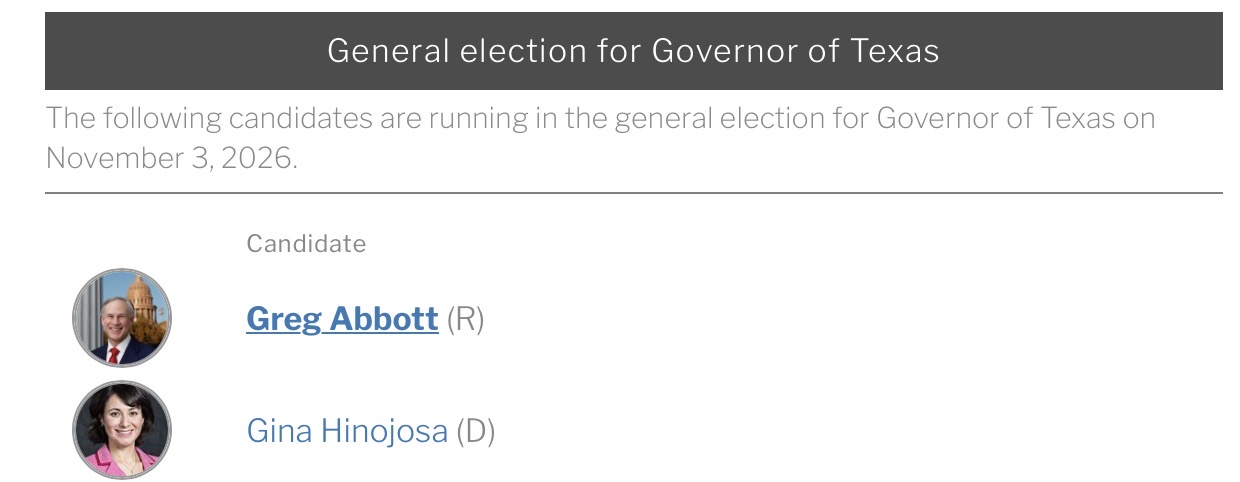
2026 Ten-Point Forecast: Texas Governor, Greg Abbott vs. Gina Hinojosa
Greg Abbott (R-inc.) vs. Gina Hinojosa

I. The Race

Greg Abbott (R) and Gina Hinojosa (D), candidates for Texas governor

Greg Abbott (Republican) seeks his fourth term as Texas governor, the office he was elected to in 2014. Prior to that, he served as Texas Attorney General for almost the entirety of Rick Perry’s tenure as governor.

Gina Hinojosa (Democrat) is a union lawyer and sitting member of the Texas House of Representatives. She was first elected to that chamber, and seeks to become the first Democrat to win the governorship since Ann Richards did so in 1990.

II. State Profile

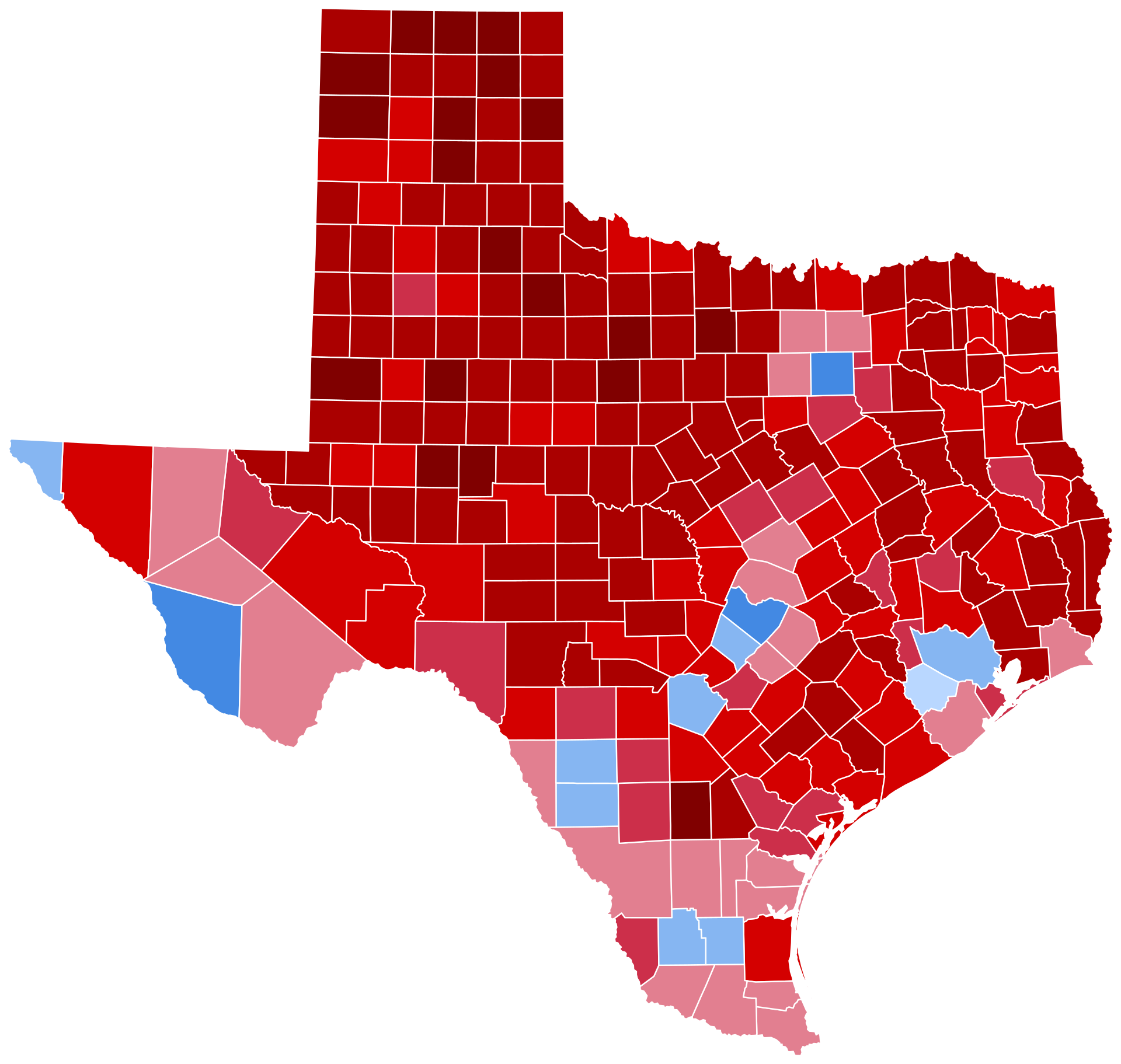
Map of Texas county results

The overwhelming theme of all 2026 analysis of Texas should be the same – if all of that red votes, then Texas will be red. The struggle with all of the work put into that endeavor so far ties directly to the fact that Texas has open primaries and does not register voters by party, whereas Florida closes primaries and does have party registration. We can watch it live as every vote comes in and know definitively in which direction the electorate is headed.

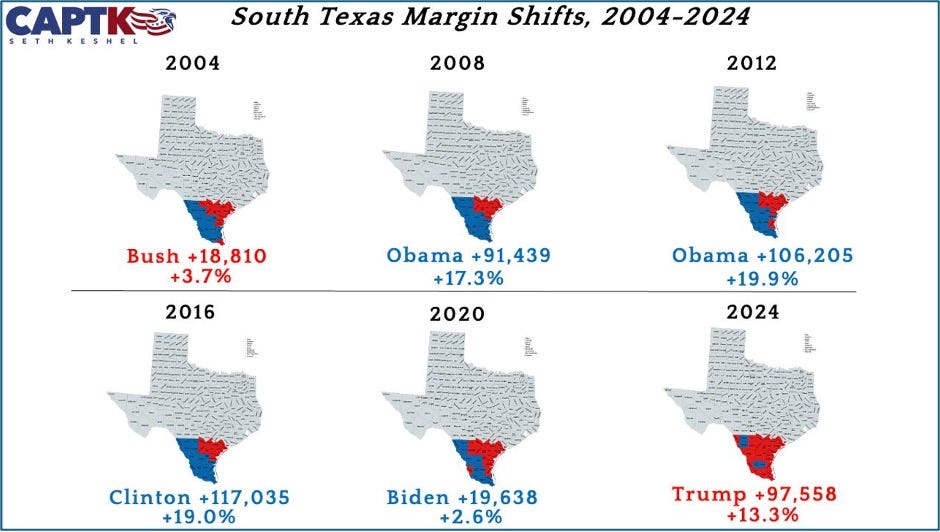
Texas’s presidential baseline is perhaps more imposing to Democrats’ long-term hopes than any before it, even those elections George W. Bush won by more than Trump’s +13.7% margin in 2024. The bedrock of that victory was a historic performance with Latino voters – 55% of them backed Trump:

Texas Latino vote in 2024: 55% backed Trump

While some of its urban counties, especially Dallas and Travis, have gone the way of their counterparts in the past 20 years (mega-blue), Harris (which contains Houston) and Bexar (San Antonio) have large working-class populations which have kept the county margins from getting out of control against Republicans. The rural areas of Texas are overwhelmingly Republican, and even more so now that rural South Texas has lurched in the same direction.

Democrats must have low Republican turnout, large swings in a small handful of counties, and overwhelming turnout in four blue bubbles (Harris, Bexar, Travis, Dallas Counties) to win a statewide election in Texas – something they haven’t done since 1994.

2026, thanks to its place on the calendar and in the electoral cycles, gives them their best shot in years to do just that, and they mostly have their eyes set on the Senate race between James Talarico and Ken Paxton, which I will profile after the end of in-person early voting.

Presidential Margins

• 2016 Trump +9.0%
• 2020 Trump +5.6%
• 2024 Trump +13.7%

Key Statistics

• 40.2% Hispanic, 39.3% White, 11.6% Black, 5.1% Asian

III. Market Assessment

Polymarket bettors find Abbott the favorite, but by far lower odds than they would have in any of his three runs had these platforms been widely used in the past.

IV. History

In 1978, Republican Bill Clements rode a midterm wave to become the first Republican governor of Texas since Reconstruction. What followed behind him throughout Texas was a windfall very much like the one observers have seen materialize in Florida under Ron DeSantis. In 1980, Ronald Reagan flipped Texas’s electoral votes, thus beginning a streak of 12 consecutive Republican presidential wins remaining intact to this day.

Clements was unseated in 1982, but won the office back in 1987 and served another term. Democrat Ann Richards became the last from her party to serve as Texas governor when she won it in 1990 against human gaffe machine Clayton Williams, whose undisciplined commentary and antics cost him the race. Richards, in hindsight, is more conservative than most governors who call themselves Republican today; however, the partisan realignment caught up to her in 1994 and she was ousted by our future 43rd president, George W. Bush. As indicated above, 1994 was also the last year Democrats carried any statewide offices.

Thus began the stretch of GOP dominance in the governor’s mansion that remains intact today.

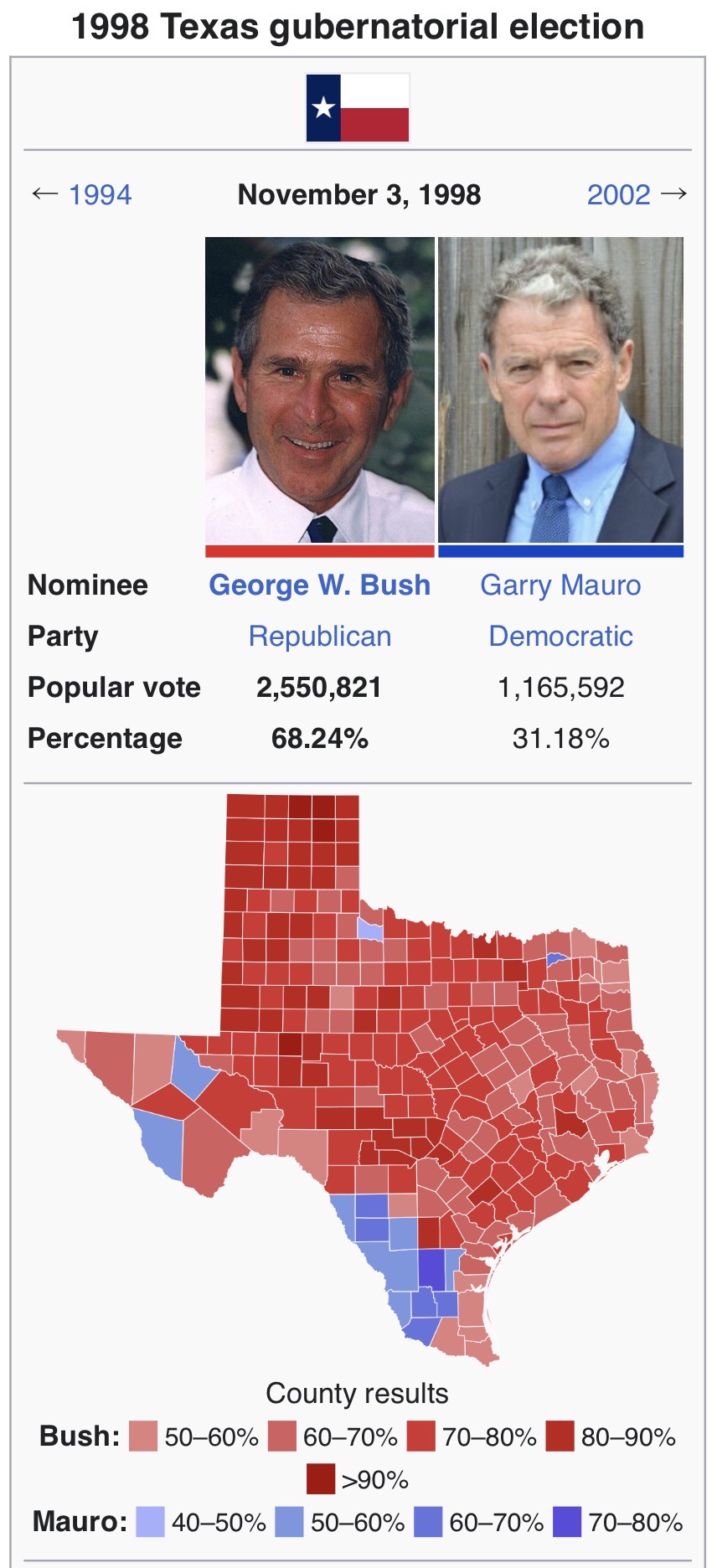
Bush won reelection in an absolute massacre in 1998 that is as red as Trump’s 2024 map:

George W. Bush's 1998 Texas governor reelection map and result

He then won the presidency and handed the office off to Rick Perry, who was then serving as Lieutenant Governor (elected in 1998, first Republican in position since Reconstruction). Perry won the office in 2002 and was reelected in 2006 and 2010. Abbott, if reelected, will pass Perry as longest-tenured Texas governor provided he serves out the entirety of his fourth term.

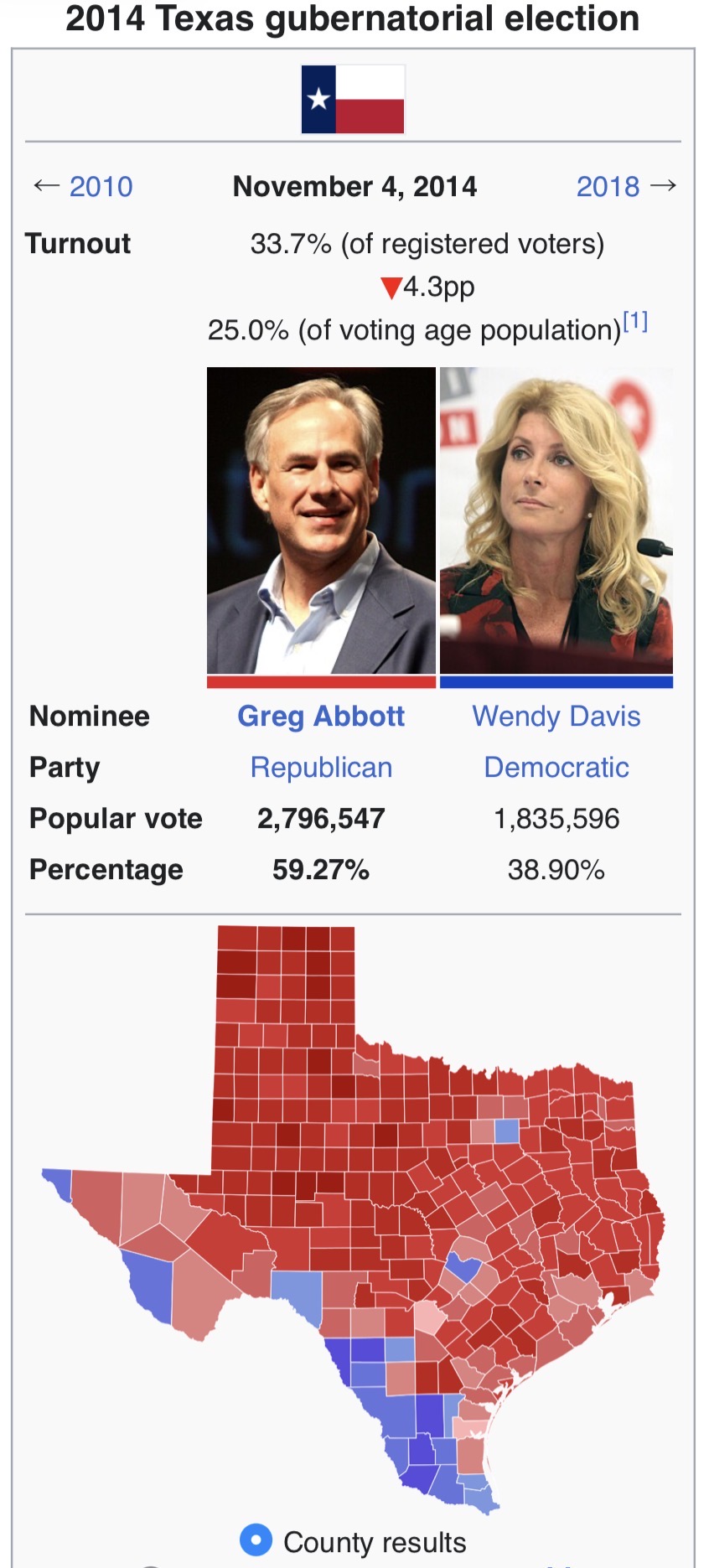
Abbott swept into office in the 2014 midterm wave, and believe it or not, there was plenty of tough talk about turning Texas blue back then. The Democrats ran a state legislator named Wendy Davis, who earned the nickname “Abortion Barbie” for her looks and views on infanticide. Here is how it worked out for her:

2014 Texas governor result, Abbott vs. Wendy Davis

With Trump in office, Texas faced a strong Democrat tailwind for the first time in many years. Robert Francis “Beto” O’Rourke challenged Ted Cruz for his U.S. Senate seat, and gave him a hell of a run – even exceeding Hillary Clinton’s 2016 presidential vote count. Abbott faced a weak opponent, former Dallas sheriff Lupe Valdez, and beat her by a margin of +13.3%.

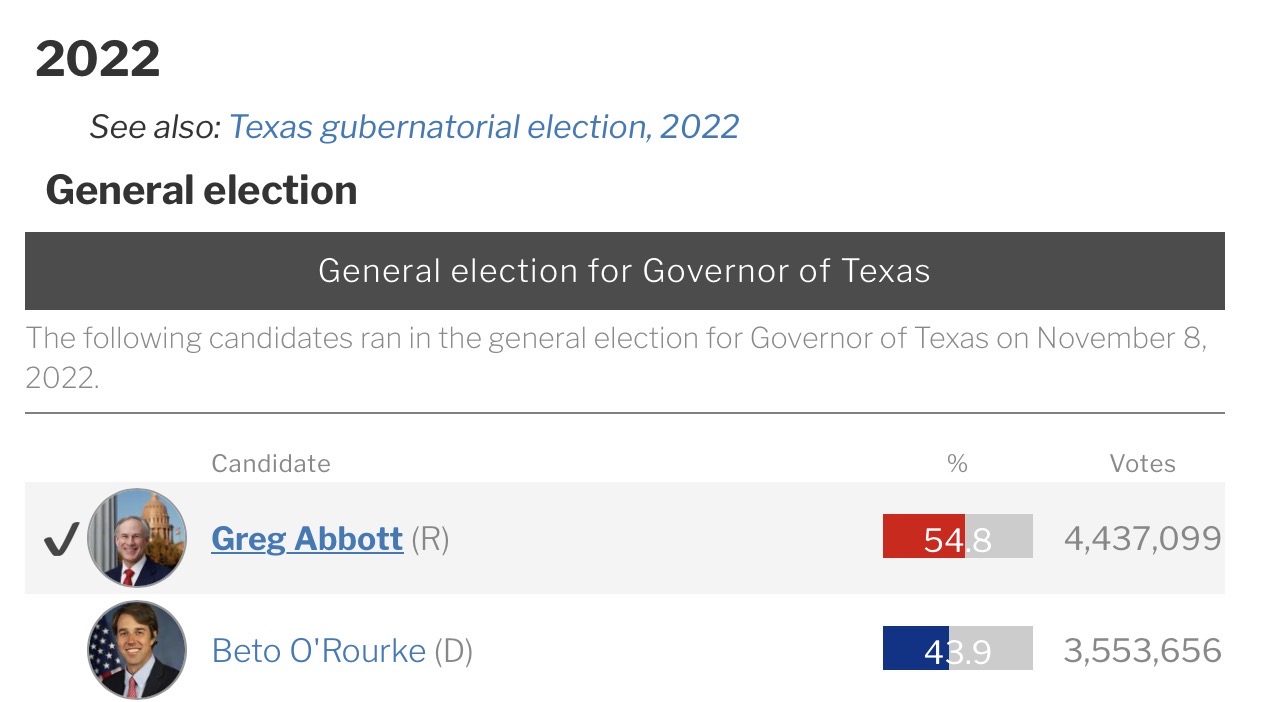
Abbott’s most recent reelection came against O’Rourke in 2022, who ran with faded star power and in the wrong cycle to attempt an upset:

2022 Texas governor result, Abbott vs. O'Rourke

The 10.9% margin of victory was Abbott’s lowest yet, but there was very little expectation that Texas was in play and no one was overly invested in making sure the pedal was slammed to the floorboard like they are today in pursuit of turnout. Trump cleared Abbott’s vote count by more than two million just two years later.

V. Analysis of 2026 Primary Results

Abbott faced a primary in 2026, but wound up beating Pete Chambers by over 70 points. Despite the frustration of grassroots Republicans with some of his policies responsible for transforming DFW and Central Texas into unrecognizable messes, the requirement to defeat Democrats will ensure he carries practically every rank-and-file GOP vote.

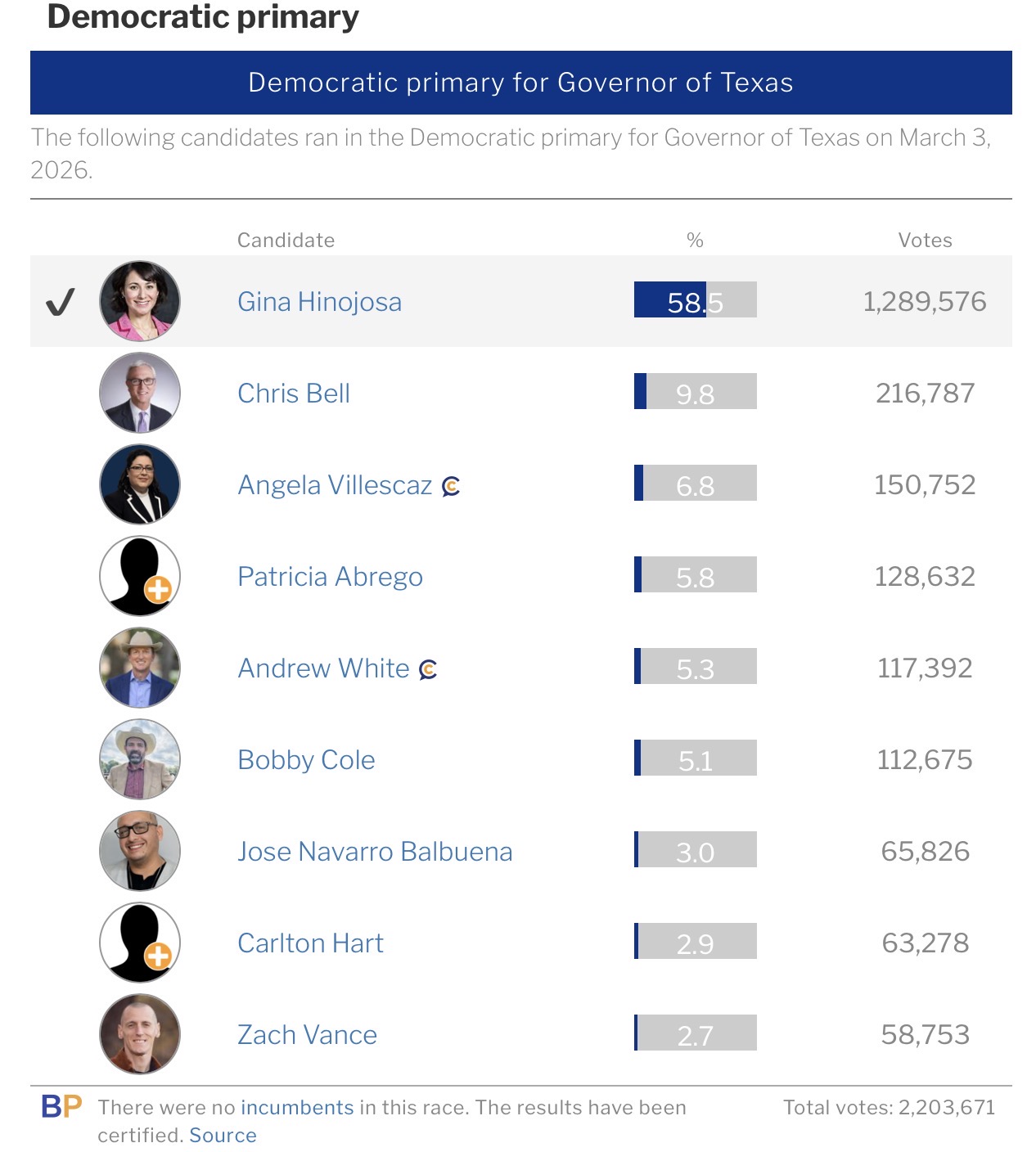
Hinojosa made her way through a weak primary field, and won convincingly:

2026 Texas Democratic primary for governor results

VI. Polls

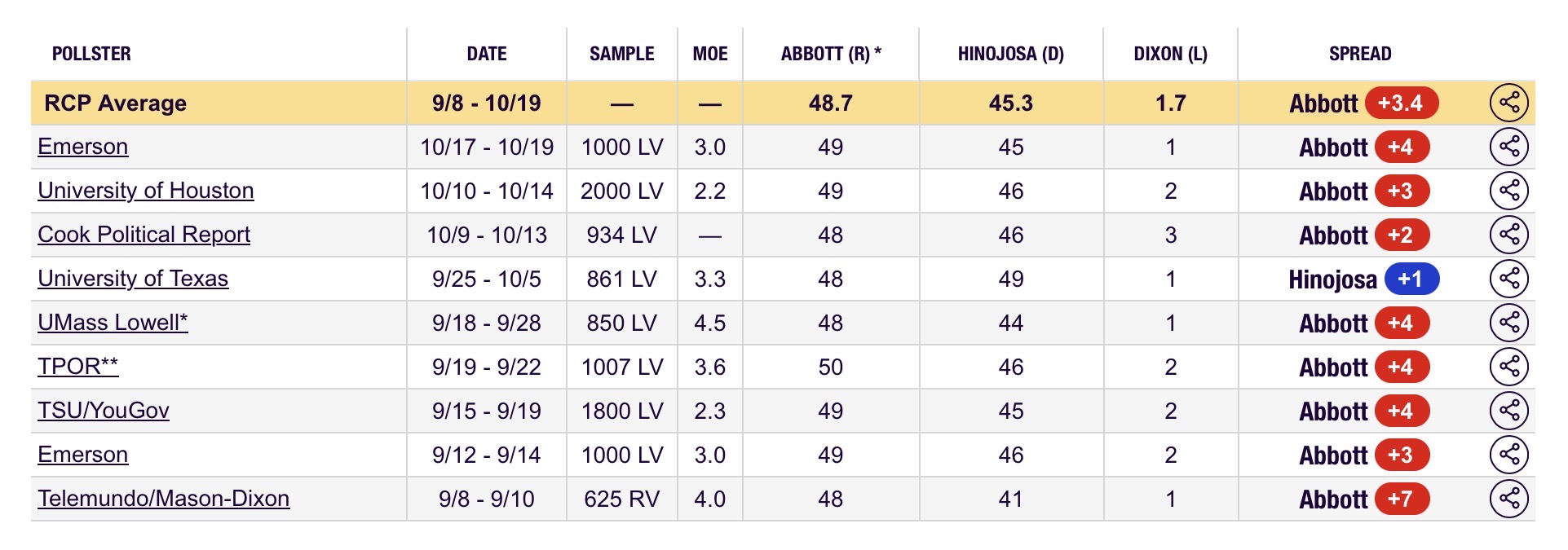
RCP shows Abbott’s polling average at +3.4%, with almost none willing to put him over a majority of the vote. This is a bit strange considering he’s never won less than 54.9% while running for governor.

RealClearPolitics polling for the Texas governor race

This also happens to be the time of year when polls magically show a burst in support for Republicans in Texas, but I’m not so sure that is coming soon given the importance of the Senate race to the national propaganda narrative.

VII. Media Ratings

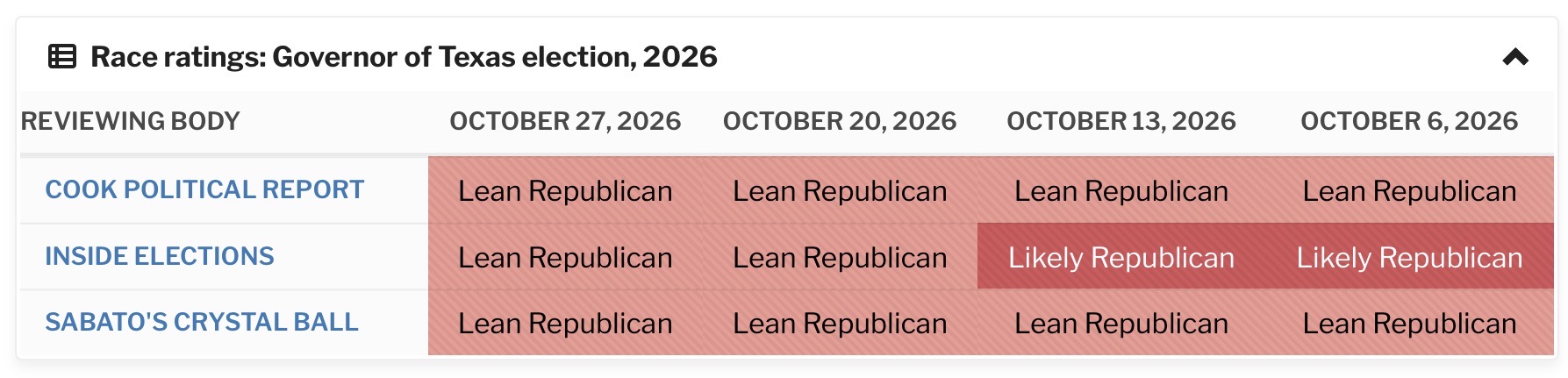
Media race ratings for the Texas governor race

Only three reviewers have a hat in the ring in this race, and they all “lean” for Abbott – taking the cautious route.

VIII. Party Registration

Texas does not register voters by party, but it has become painfully obvious to many that they absolutely should. I am in full support as an analyst because I’m sick of being gaslit by flawed primary participation models.

IX. Election Considerations

Rather than reinvent the wheel, I’m relaying what I wrote in my assessment of the decisive House race, TX-34:

Texas, being such a huge state with an overwhelmingly urban and suburban population, has people rung up on election corruption charges all the time – including in South Texas.

Still, Texas has strong control over what few mail-in ballots are sent out, and the risk for widespread corruption in this race (relative to others I’ve profiled) is low.

X. Summary and Election Estimate

I am going to start off by saying that one of the things I most look forward to about this cycle concluding is that it will be another two years until I have to watch Texas politicians go on news television or podcasts, spin up giant crocodile tears, and tell the audience that this is the time Texas is turning blue.

No blue states have politicians that act like that, even in states that are turning red. All of my figures, as I presented consistently in 2024, showed that Trump was going to win Pennsylvania, Michigan, Wisconsin, Nevada, and Arizona, which all had either Democrat governors (not Nevada) or significant Democrat political power in the state. You know why? Because saying crap like that makes sure your enemy keeps the turnout surge going and beats you.

I’ve heard it over and over – “if all the votes currently in were counted, we would lose!” Yea, and if we stopped the game after the road team scored a run in the top of the first, the home team would lose, too. So, I have a compromise. How about we put the next 4 million or more votes in the ballot box, and then count?

History suggests strongly that Abbott will be reelected, and so does this handy, dandy graphic:

Graphic on the implied partisanship of new Texas transplants

New transplants to Texas, if you believe this graphic (and I do), are R+20 by implied partisanship. They are to the right of the existing electorate, which hasn’t elected a Democrat in a statewide race since 1994. These people, hundreds of thousands between every election cycle, did not move to Texas just to see it turn blue, and I can assure you they are the highest propensity GOP voters you will find. They are all going to vote, and will vote for Abbott and Paxton 1:1, along with Bo French and all other GOP candidates on the ballot.

Now they are turning out, even in the assessments of the left-wing modelers who want to wish-cast blue Texas into existence. It is imperative that every Republican turns out to vote. While I am confident in Abbott’s reelection, I have no doubt (as proven by Cruz underperforming Abbott by 10.7% in 2018) he will run ahead of Paxton. Abbott needs to win in a blowout, preferably north of ten points. Another positive sign is that Andy Beshear, head of the Democratic Governors Association, won’t throw serious money at Hinojosa’s effort to oust Abbott.

It seems like they know the polls are off, which is good news for Paxton, too.

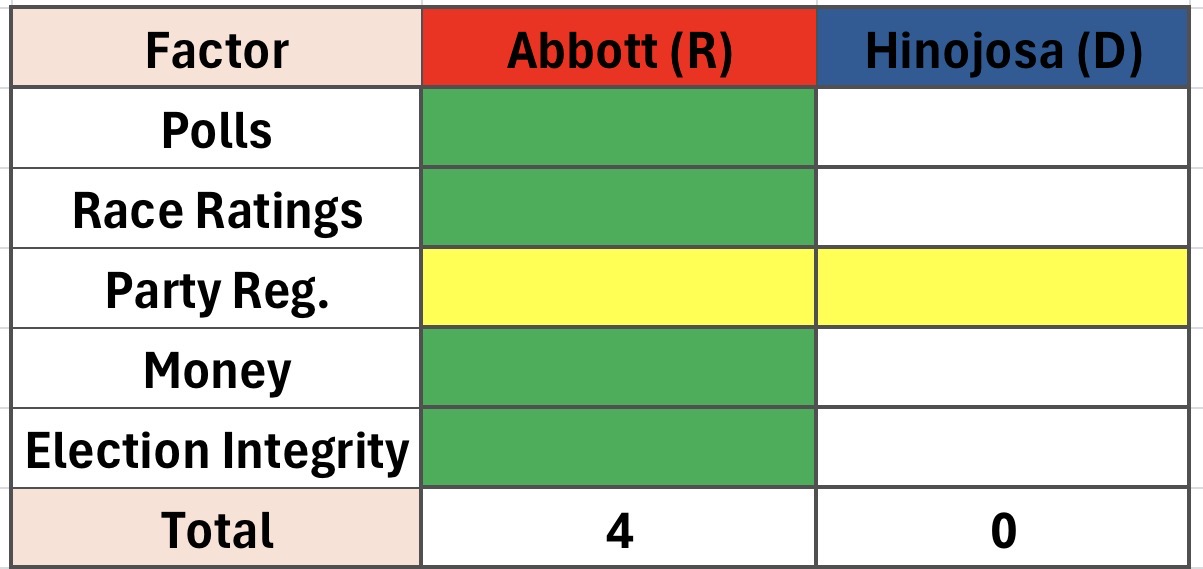
Abbott is trouncing Hinojosa financially, and leads every applicable category in my decision matrix:

Keshel decision matrix for the Texas governor race

Forecast for TX Governor

Keshel forecast for Texas governor

Texas Republican governors, like those in Georgia, have a longer leash because the suburbanites willing to stab the party in the back down ballot don’t really want someone running the state to increase taxes and turn it into failed states they see in the news. It is possible that Abbott, running for a fourth term, may post his lowest margin yet if turnout is through the roof – but that same high turnout will ensure enough red on the map votes to keep him in there. Abbott has also done well with Hispanic voters and stands to benefit from the massive realignment in that demographic pulled off by President Trump.

Abbott needs to win big, and that will help everyone relax over the Senate race. If everything falls into place, given Hinojosa’s lack of appeal, a 2018 margin isn’t out of the question.

Seth Keshel, MBA is a Senior Fellow at the Gold Institute for International Strategy and a retired Army Captain. He publishes Captain K’s Corner on Substack.