Gold Institute Hosts H.E. Robie Kakonge, Ambassador of the Republic of Uganda

Gold Institute Ambassador Dinner Series invitation for the private dinner with H.E. Robie Kakonge, Ambassador of the Republic of Uganda

On the evening of July 15th, the Gold Institute for International Strategy hosted a private dinner with H.E. Robie Kakonge, Ambassador of the Republic of Uganda to the United States and to the World Bank, the International Monetary Fund, and the International Telecommunications Satellite Organization. President Eli M. Gold hosted the evening for a select group of guests, among them business leaders representing several countries, a representative of the World Bank, and members of leading policy organizations.

The intimate setting allowed for a candid conversation with the Ambassador on Uganda’s economic trajectory and its emerging role as a strategic commercial gateway in East Africa. The discussion was held under the Chatham House Rule to encourage a frank and open exchange. Ambassador Kakonge outlined the specific areas where the country is seeking serious private-sector partners, offering guests a direct view of Uganda’s priorities and the opportunities taking shape across its economy.

The discussion spanned a broad range of priority sectors, including infrastructure and construction, energy and extractives, manufacturing and industrial development, value-added agriculture, financial services and fintech, information and communications technology, tourism, logistics and transportation, healthcare, and education. Together, these sectors reflect Uganda’s comprehensive growth strategy and its effort to harness one of the youngest and fastest-growing populations in the world.

For the business and policy leaders in attendance, the evening offered an opportunity not only to better understand Uganda’s priorities, but also to explore how practical, mutually beneficial partnerships might be structured in the years ahead.

The dinner reflected the Gold Institute’s continuing commitment to convening serious leaders for substantive dialogue on the economic and strategic questions shaping international partnerships.

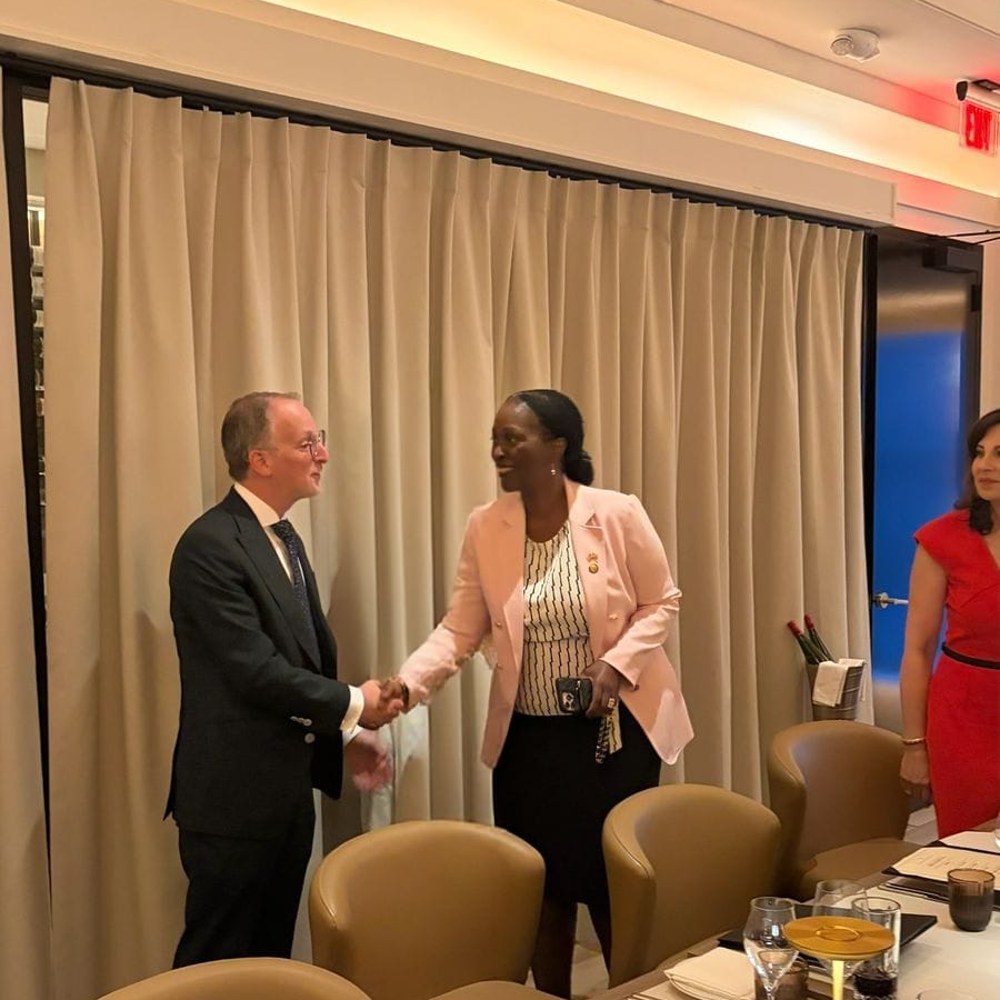
President Eli M. Gold welcomes Ambassador Robie Kakonge to the Gold Institute private dinner

Ambassador Robie Kakonge is welcomed by President Eli M. Gold.
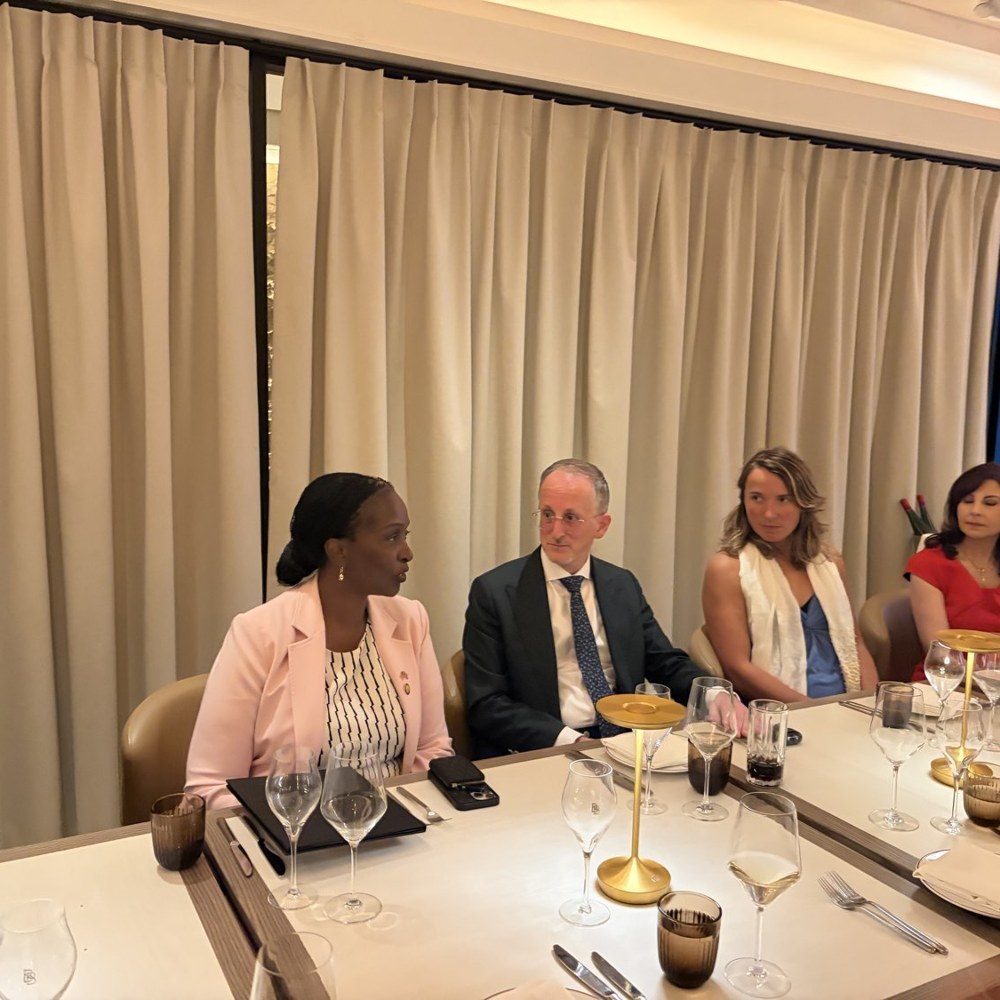
Ambassador Robie Kakonge speaks with guests during the Gold Institute dinner

Ambassador Robie Kakonge discusses Uganda’s economic priorities with guests.
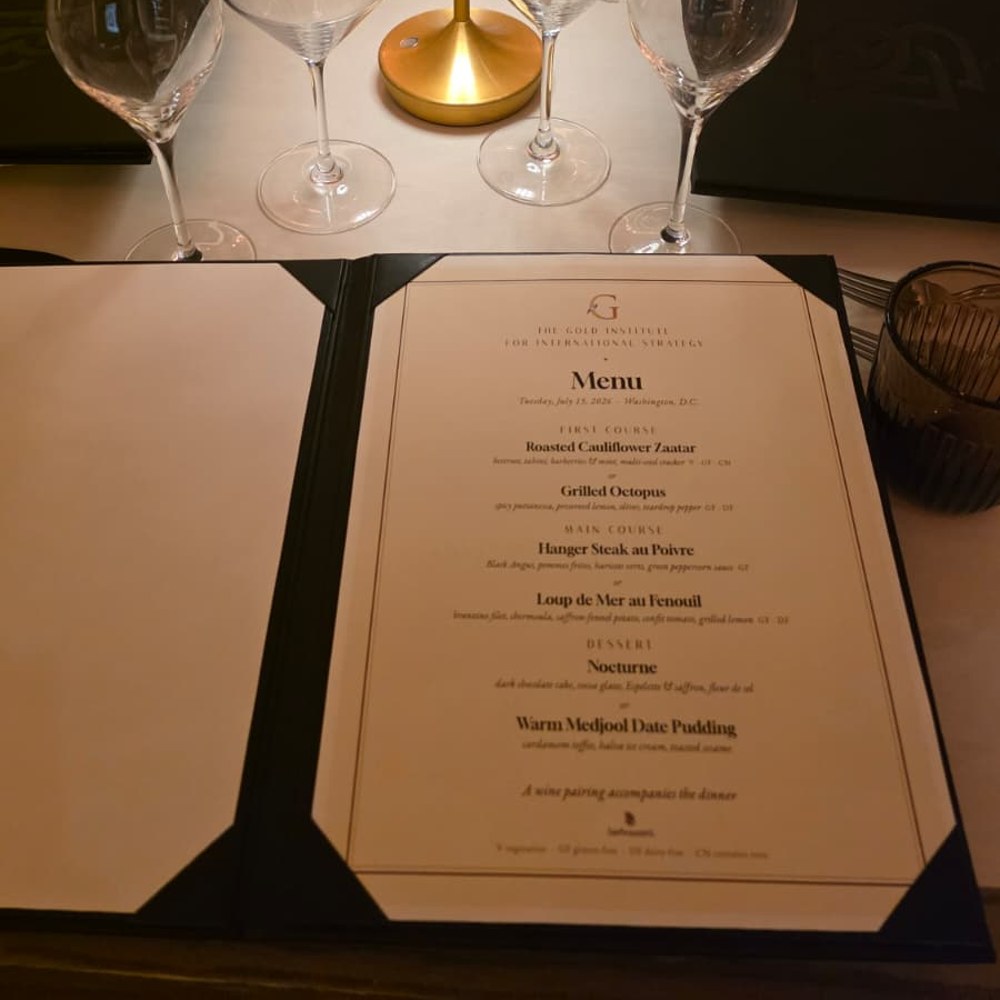
The evening's menu at the Gold Institute private dinner

The evening’s menu.

How Not to Turn Iran into Vietnam

U.S. Navy warships and aircraft transit the Arabian Sea

(This article was written by Ernie Audino and appeared in RealClearDefense. How Not to Turn Iran into Vietnam)

It’s not by heeding the tired, old line that Americans don’t tolerate casualties. We do. We just don’t tolerate casualties for something of little value. And it’s not that the war with Iran is for something of little value, because there’s nothing more dangerous than a nuclear ayatollah. It’s by way of political leadership that decides why we initiated combat on Iran, and what we want out of it. If a president is uncertain of his political objective, how on Earth can the generals prosecute a strategy to achieve it? They can’t.

It largely comes down to a clear understanding of politics’ role in war.

Consider the West’s most influential theorist on war, Carl Von Clausewitz, who explains it well: “No one starts a war — or rather, no one in his senses ought to do so — without first being clear in his mind what he intends to achieve by that war and how he intends to conduct it. The former is its political purpose; the latter it’s operational objective.”

During the Vietnam War, no clear, strategic objective drove our operations. Battlefield commanders (and a nation) were left asking:

Is it to contain Soviet or Chinese communism?
Is it to defeat North Vietnam?
Is it to defend South Vietnam?
Is it to defeat an insurgency?

Moreover, our inability to understand a comprehensible objective in Vietnam meant our citizens could not attribute a high value to it. Without that, no nation will muster sufficient domestic support to do what’s necessary to win, nor endure what’s required to achieve victory. Again, Clausewitz says it best: “Since war is not an act of senseless passion but is controlled by its political object, the value of this object must determine the sacrifices to be made for it in magnitude and also in duration.”

And so, with little domestic support for the war in South Vietnam, there was certainly no support for our taking the war to North Vietnam to destroy the North Vietnamese Army (NVA), the center of gravity (COG) for our enemy’s ability to operate. Consequently, we never went on the strategic offensive to achieve outright victory and imposition of our terms, choosing instead a limited war that incorporated civilian theories of economics. We saw limited war as a way to bargain. We even applied to it a novel, smart-sounding term, “graduated response,” which pin-striped advocates asserted would progressively “signal” to the north that we meant business and in turn motivate them to negotiate.

It signaled just the opposite…that we didn’t have the will to win.

No will to win, no hope of imposing our terms. No chance for victory.

Unfortunately, we’ve charted a similar course with Iran. Let’s start with our strategic objective. After the uprising began in December, the President said, “Help is on the way.”

Did that mean our objective was to topple the regime? Many interpreted it that way.

Was our objective, “total surrender”? The President said it was.
Was our objective a permanently non-nuclear Iran? After all, he did say he would not allow Iran to possess a nuclear weapon.
Is our objective now to reopen Hormuz? Or is it to close Hormuz with a blockade?
Maybe it’s just to get Iran to agree to another ceasefire?

Should that first-order confusion remain, our generals can brilliantly accomplish their operational objectives, and they have, yet our nation will never transform that into strategic, political success. So far, our military has downed every aircraft in the Iranian air force. We’ve sunk every warship in the Iranian navy. We’ve destroyed a staggering amount of Iran’s drones and ballistic missiles and launchers, and we’ve disrupted Iran’s entire defense industrial base. And yet, the regime remains hostile. Given that we’ve not violently imposed our will on the enemy, no one should be surprised that we’ve been unable to demand terms and achieve political success.

But here’s the inexplicable part – we then unilaterally chose to cease combat and try bargaining. Our adversary presented no compelling military reality to cause us to stop fighting, but we chose to stop just the same and negotiate. We chose not to violently end the regime’s nuclear weapons ambitions, but somehow, we told ourselves they’ll do it now, because we’re asking them politely. We chose not to force open the Strait of Hormuz, but we subsequently expected to do that with a signature. To be sure, we simultaneously signaled more painful strikes in the future, but just as in Vietnam, this does not signal a will to win. Worse, when we hit Iranian assets during our self-imposed ceasefire, we sometimes were quick to communicate that it was done in self-defense. It’s almost like we were apologizing.

There’s no question that we adopted a strategic defensive, but that can only make sense for us if time is not of the essence. Clausewitz observed that those who adopt the defense assume that the situation will improve over time if they just wait for it.

The irony is our situation with Iran is NOT improving, and we don’t have all the time in the world to wait. We’ve proffered an endless series of negotiations. We’ve engaged in repeated, humiliating supplications. The conditions didn’t change. The behaviors didn’t change. Yet, somehow, we expected a different result lurked just around the corner. Meanwhile, the calendar continued scrolling to the right, toward our mid-term elections.

President Trump now says the ceasefire is over. Good. So, rather than repeat our strategic missteps in Vietnam, how do we learn from them?

Let’s start with the objective. Not only must it secure for us a vital national interest (in this case, a permanently non-nuclear Iran), but its great stakes and high value must be clearly understood by American citizens. The duty to make that case resides with the president. It’s his responsibility to convince us that it’s worth fighting for, and it’s worth winning.

Unfortunately, destroying Iran’s air force can’t win it by itself. Neither will sinking all their boats. Nor will destroying the drones and missiles and defense industrial base. And gaining a signature on a piece of paper sure can’t do it. Only a stated objective to end the Islamic Regime can generate a suitable effort capable of terminating Iran’s ambition to build or acquire a nuclear weapon. So far, President Trump has ruled out ending the regime.

Should he change his mind, ending the regime won’t happen by magic. It will require the transition of all elements of national power to the strategic offensive, something we were unable to do in Vietnam, but something entirely possible in Iran. In 1967 that would have required bringing the decisive fight to Hanoi to destroy the enemy’s COG, the North Vietnamese Army. Today our enemy’s COG is the Islamic Revolutionary Guards Corps (IRGC). Its remaining hardliners must be brought to the psychological tipping point where they conclude that their survival as an organization is no longer inevitable, and that their physical destruction is likely. They must be brought to the point where they fear the Iranian population more than the population fears the regime’s levers of repression and internal control. To the apocalyptic core of the IRGC, costs incurred are irrelevant, but losing the ability to physically control the population is not.

Iranian citizens overthrew a regime in 1979, and they did it without the support of the world’s greatest superpower. They can do it again in 2026, but they cannot do it today without a major power first setting conditions on the ground for them. They cannot do it without close air support. And they WILL NOT do it without hearing President Trump say his objective is to topple the regime and commit to a strategic offensive to accomplish it.

And he must mean it.

Brigadier General Ernie Audino (US Army, ret.) is a Senior Military Fellow, Kurdistan Program (U.S. Chair) at the Gold Institute for International Strategy, a Washington D.C. based foreign policy and defense think tank.

Is America Going to Full Scale WAR?

Dear America,

Never forget that in warfare the enemy has a vote & they also have spies everywhere, to include inside the very decision making systems we believe we control.

Additionally, don’t take our eyes off Russia nor any of the “watch” conditions surrounding China’s actions. Our actions (or lack of them) equate to their strategic counteractions (all sides).

Then what are the strategic indicators that a nation is about to go to full scale war?

Key signs a nation is preparing for full scale war include sudden military mobilization, stockpiling supplies, heightened cyber activity, & aggressive rhetoric from leadership. Watch for diplomatic evacuations, sanctions buildup, or unusual troop movements near borders. These often signal intent before shots are fired.

Russia & Ukraine are well past these steps.

We need to ask the question, what is China’s posture just across the straits of Taiwan?

Does America have all the options in place for our success there (ie., if we decide to go full scale into Iran)?

Does movement of strategic assets such as NUCLEAR weapons, ballistic weapons, large-scale logistics capabilities indicate additional scaling up of major WAR preparation?

Movement of these type capabilities is one of the strongest indicators & there appears to be some of these indicators in Russia. When you see NUCLEAR or ballistic missile repositioning, especially to forward bases or hardened sites, this is among the strongest indicators of escalation intent. Large-scale logistics like fuel convoys (especially unusual types of fuel), ammunition trains, or hospital ship deployments signal sustained conflict prep, not just posturing. When you see all three together, it’s rarely a bluff. However, sustaining the sustainers is a monumental task for any nation.

Have we pre-positioned any military or strategic assets that indicate total war in and around the Persian Gulf? Are we ready for a breakout in the Pacific?

In the Middle East, the answer is YES. The U.S. has significantly reinforced the Persian Gulf with at least two carrier strike groups, with their dozens of destroyers, Marine expeditionary units, additional fighter squadrons, & mine countermeasures ships.

This buildup, the largest since 2003 (pre-invasion of the disastrous Iraq invasion), supports ongoing operations against Iran, with forces positioned for sustained combat, blockade enforcement, & potential escalation. No public evidence of NUCLEAR weapons movements, but the scale of conventional assets signals high readiness for major conflict.

Are there any U.S. Marine or Army logistics units that have been deployed to the Middle East (these are major indicators for ground operations)?

At least two Marine Expeditionary Units have deployed to the region with their full logistics combat elements for self-sustainment. Reported Army units like elements of the 82nd ABN and others are there too, which always bring attached sustainment & logistics support. No standalone large Army logistics units have been publicly flagged, but the overall force posture in the ME is robust.

Assume our President has all this information as well as many other strike & sustainment packages required for large scale Middle East operations.

Are we prepared elsewhere around the world or do we only possess a one Major Regional Conflict military?

Decades of sustained WAR & deterioration & diminishment in the ranks of key leaders for slog it out type warfare are questions our nation MUST address.

WARs (or Stupid Wars), once engaged (and we are fully engaged in the ME & are in close contact in Eastern Europe & in the Pacific region), MUST achieve victory at all costs. Any other outcome will change the strategic direction of the United States forever.

Our nation MUST pray for our President & peace. However, if America is placed in a position where we MUST fight, then we MUST win.

There are no other acceptable outcomes.

Michael T. Flynn, LTG USA (Ret.) is the chairman of the Gold Institute for International Strategy, a Washington, DC-based think-and-do tank.

Storm Clouds Gather Around Thursday Night

Four possible courses of action tied to the president’s address

President Trump is set to address the nation tomorrow evening on a matter of grave importance. Leaks and media coverage are all over the place, but they seem to have the range dialed in: election interference. Be mindful that engagement seekers online are willing to throw out anything to catch your attention – “this is about Georgia’s senators,” or “they found the hackers” and similar comments are everywhere. Until we hear from the man himself, all bets are off.

To my wonderful subscribers here, please understand I have no choice but to keep things at surface level today. Friday, should there be no change in plans in scheduling or plan (delayed speech, etc.), you can expect a full review of exactly what is made known to the public, with no obligation for me to continue to be cagey. As such, this article is shorter than most; still, given the subject matter, it is of vital national importance.

President Trump’s address tomorrow, assuming it provides evidence of catastrophic breaches, vulnerabilities, or interference pertaining to our election infrastructure, stands to bring out any combination of four outcomes:

I. Nothingburger

“If the left really thought a nothing burger was coming down the pipe Thursday night, they wouldn’t be using up so much damn energy trying to get in front of it, or coordinating their messaging across the entire Uniparty network of oxygen thieves.” — Seth Keshel (@RealSKeshel), July 14, 2026

The odds of this being a nothingburger or “rug pull” along the lines of digital trading cards are approximately zero percent. You can tell just by watching the preemptive defensive tactics adopted by media and leftists. We’ve heard from both Georgia senators, who were in fact illegitimately elected in 2020 when David Perdue and Kelly Loeffler, despite finishing first on November 3, 2020, were artificially held below 50% and forced into runoffs, which both Democrats “won” on January 5, 2021. Whipped dogs yelp the loudest, I’m told.

In any case – a nothing burger would leave us where we are today – waiting for the next break in a court, or for the Senate to do something. The problem for the uniparty and their media water carriers is that this scenario is about as likely as the Republican nominee dropping Idaho to Kamala Harris in 2028.

II. Emergency Orders

If the president unveils irrefutable evidence that foreign powers interfered in our elections, or has the capacity to interfere in our elections (including databases, infrastructure, and/or actual voting systems), this could compel Trump to use national security powers, or any agency involved in what is being declassified to act within their statutory authority. My friend Joseph DeMott suggested an interesting course of action that doesn’t seem too far off-base:

“Let’s see if my Trump gut still works. I think Trump is going to declare of state of emergency on Thursday leading into the Save Act that was stapled to the Defense bill in the house today.” — Joseph DeMott (@josephdemottx), July 15, 2026

This feeds conveniently into the third point…

III. SAVE Momentum

Yesterday, House Republicans advanced the text of the SAVE America Act to the Senate as part of defense-funding legislation by a vote of 215 to 211. From The Hill:

The 215-211 vote delivers a key win for Speaker Mike Johnson (R-La.), who had spent weeks trying to unify his conference as conservative hardliners pressed leadership to take more aggressive action on the Safeguard American Voter Eligibility (SAVE) America Act and legislation to codify President Trump’s border policies.

There have already been rumblings that the Republican “surrender caucus” may be willing to bite the bullet in honor of Lindsey Graham to get the SAVE America Act in the rear view mirror. Compelling evidence of our election systems being compromised will provide one hundred times more pressure on the Senate to act than we’ve been able to muster thus far (and that has been a lot of pressure).

IV. Narrative: Ruined

Christopher Krebs must be on a boat to some isolated nation, given that he is the guy who gave us the lie of “the most secure election in American history” to describe the 2020 quasi election. We’ve been assured that anyone challenging the 2020 election, or any other garbage since like the Kari Lake race or Spencer Pratt’s primary effort, is arguing in bad faith and simply suffers from poor sportsmanship.

Since we were all told to believe everything the government had to say about the 2020 election so far, and were persecuted into complying with COVID-19 tyranny based on junk science and magic eight ball shakes, then I would imagine the government coming out with new documentation regarding the state of our election infrastructure must be unimpeachable, right?

It all depends on what kind of proof is made public – but I dare say the narrative of “American elections are fraud-free” is on the ventilator right now, preparing for the plug pull.

Conclusion

I wish I could say more. Media will spin and find loopholes, but I’d wager the damage has been done for good if it is made public that our elections are susceptible to outside interference. If intrusions are not only possible, but documented, we are likely to see unprecedented action taken to provide needed public confidence that we are indeed represented by a government of, by, and for the people.

Remember: Trump hasn’t given up the fight for free and fair elections, and neither should you.


Seth Keshel, MBA is a Fellow at the Gold Institute for International Strategy and a retired Army Captain. He publishes Captain K’s Corner on Substack.