Gaza – “Just War Doctrine” and Israel’s War on Hamas

IDF soldiers uncover a Hamas tunnel shaft in Gaza

This article was written by Ernie Audino and appeared in Frontlines of Freedom. GAZA – “JUST WAR DOCTRINE” and ISRAEL’S WAR on HAMAS.

There’s no shortage of breathless talking heads criticizing the Israeli ops to eliminate the Hamas terror threat in Gaza. Many of them insinuate/assert that Israel’s war on Hamas is somehow unjust. Many (if not most) of these talking heads have neither wartime military experience nor professional experience with the Hague and Geneva conventions, which apply.

The Conventions incorporate Just War Doctrine as articulated by St. Augustine in the 5th Century. Of the several tenets of Just War Doctrine, the big three are Just Cause, Proportionality, and Discrimination.

Just Cause – Per the doctrine, war can be just if it’s defensive or waged to right a grave injustice.

Proportionality – Per the doctrine, the application of military force must be enough to achieve the military objective or defeat the threat, but no more. This tenet is widely misunderstood, however. Many wrongly assume that military force must be proportional to the adversary’s military force or to balance the harms…an eye for an eye, so to speak, i.e. “The enemy killed 1,200 of us, so we can only kill 1.200 of them.” This is a fundamental misunderstanding and couldn’t be further from the truth.

Discrimination – Per the doctrine, parties to war must discriminate combatants from noncombatants. Civilians must be protected from intentional targeting. Targets must be legitimate, military targets. All reasonable measures must be employed to protect civilians, but collateral civilian deaths are expected and tragic. Unintended civilian deaths do not necessarily make the war unjust.

So, let’s apply these to the IDF ops to destroy the Hamas threat in Gaza.

Does Israel have a Just Cause? Yes. The Hamas atrocities of 7Oct provide indisputable justification for Israel’s counterattack and the ongoing military effort to eliminate all continuing threat of re-occurrence. No reasonable person can argue otherwise.

Is Israel’s response Proportional to the objective of eliminating that threat? Yes. The Hamas attack on 7Oct was made possible by a preceding 21 years of terrorist stockpiling of arms & ammunition, 21 years training specifically to kill non-combatants, 21 years to build its manpower to 30,000+ fighters, most intentionally arrayed within civilian neighborhoods, schools, hospitals, mosques, and of course, deep within a network of 500 kms of tunnels, most of which were intentionally emplaced beneath civilian infrastructure. It took Hamas 21 years to build all the above. Only a serious effort can dismantle it.

• Against Hamas (and by my best count), the IDF presents a peak of 14 IDF brigades engaged in active ops at any one time on the ground in Gaza. So, at 4,000 troops or so per brigade, that totals to roughly 56,000 on the ground at any one time to confront the 30,000 Hamas terrorists. The ratio of IDF to Hamas on the battlefield is not even 1.9:1. That’s WAY below the 6:1 force ratio historically considered optimal for offensive operations, AND that’s even below the 3:1 force ratio considered minimally acceptable for offensive ops.

Do IDF ops discriminate combatants from non-combatants? Yes, and to extremes I’ve never personally experienced on the battlefield. For example, in advance of each, specific operation, the IDF makes phone calls and sends texts to the families and households in/near the objective and warns them of the upcoming operation. It directs them toward safe zones established for their relocation. The IDF uses loudspeakers, radio announcements and leaflets for the same purposes. And the IDF has postponed or delayed kinetic ops until all reasonable efforts to remove civilians from the target area had been exhausted. So, what are the numbers?

• More than 42,000 phone calls
• More than 4,000,000 leaflets
• More than 12,000,000 recorded messages
• More than 15,000,000 texts

And keep in mind, every time IDF commanders issue these warnings in advance of upcoming ops, they are wittingly assuming additional risk upon themselves. As a matter of pure military logic, no commander in his right mind would choose to disclose his upcoming ops. We call it OPSEC (Operational Security).

So, do your own analysis, and don’t rely on headlines.

We discussed all of the above and more on the show this week. My guest is British Army Colonel (ret) Richard Kemp. You’ve likely seen him on TV or in the news. He’s a Commander of The Order of The British Empire and recipient of the Queen’s Commendation for Bravery. He has led troops everywhere from Northern Ireland to Bosnia to Iraq to Afghanistan, and he’s recently spent a fair amount of time inside Gaza. He knows of what he speaks. Click on the link to hear our discussion: https://frontlinesoffreedom.com/show-983/

Illustration of St. Augustine and the tenets of Just War Doctrine: right intention and discrimination
Written by Ernie Audino Senior Military Fellow, Gold Institute for International Strategy

2026 Ten-Point Forecast: OH-7 (U.S. House – Decisive)

OH-7 U.S. House race forecast

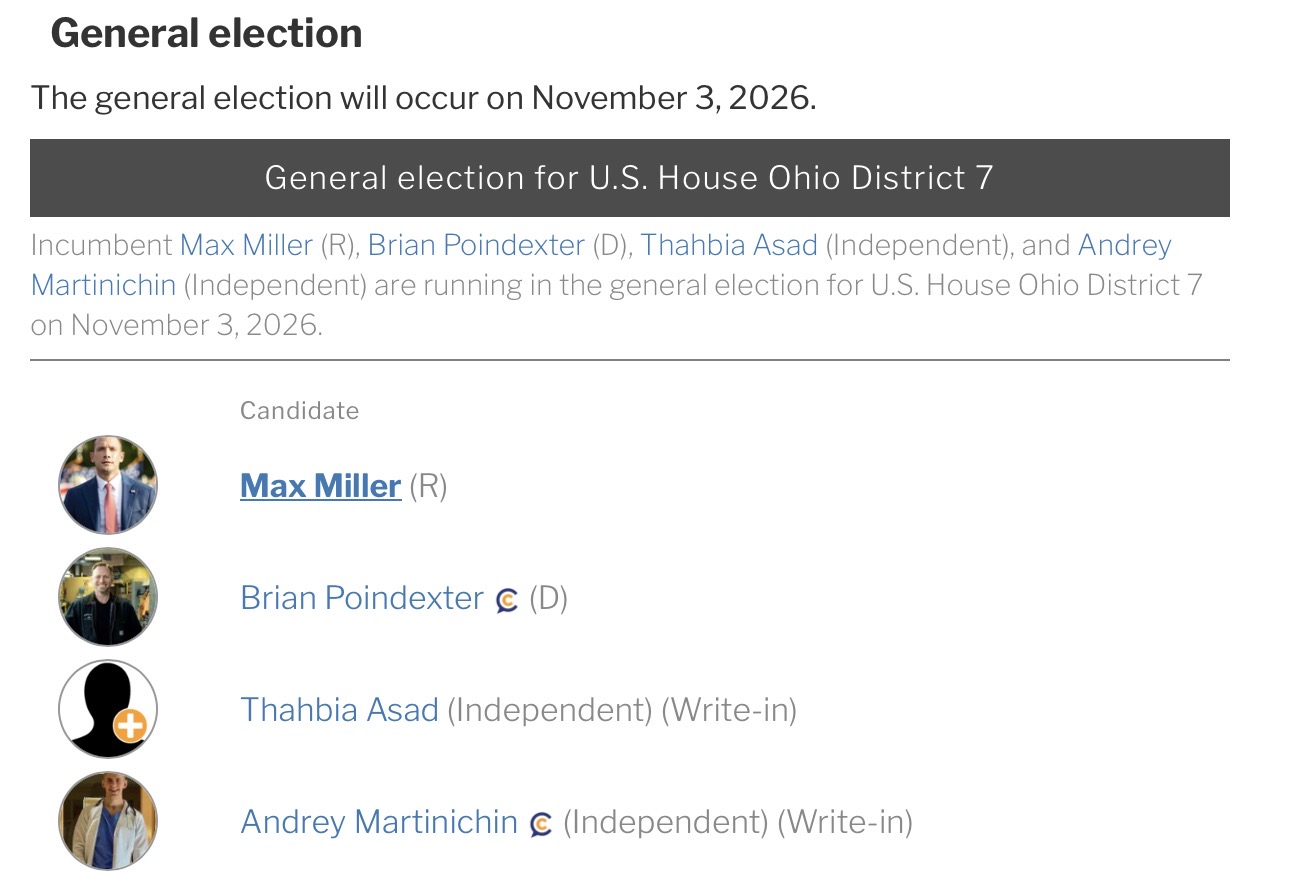
Max Miller (R-inc.) vs. Brian Poindexter

I. The Race

OH-7 candidates Max Miller and Brian Poindexter

Max Miller (Republican), a former Marine Corps reservist, ran for the open OH-7 seat, which was redrawn for 2022; he had initially expected to face incumbent Anthony Gonzalez for the seat, but Gonzalez declined to run again in 2022 after he smelled a primary defeat as the cost for his Trump Derangement Syndrome. Miller won in the General Election and was reelected in 2024. His campaign is plagued by abuse allegations and divorce fallout with his ex-wife, who is the daughter of Ohio U.S. Senator Bernie Moreno.

Brian Poindexter (Democrat) is a 46-year-old union man and former Brook Park city council member. This is his first run for major office, and he’s running a “hard hat” campaign on the populist economic left while seeking to highlight Miller’s personal issues.

II. District Geography

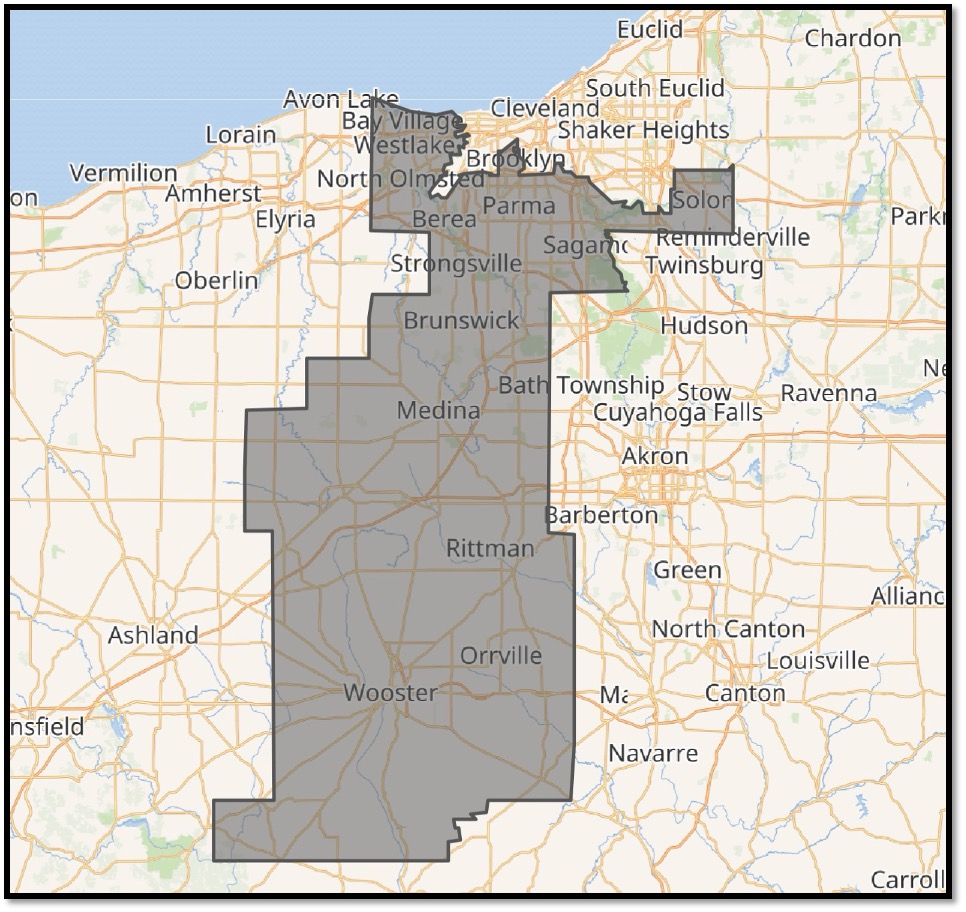
Map of Ohio's 7th Congressional District

Ohio’s 7th Congressional District (OH-7) was redrawn for the 2022 and 2024 elections, but because Ohio law required new maps for 2026 since the 2022/2024 maps were adopted without bipartisan support, the district underwent yet another makeover.

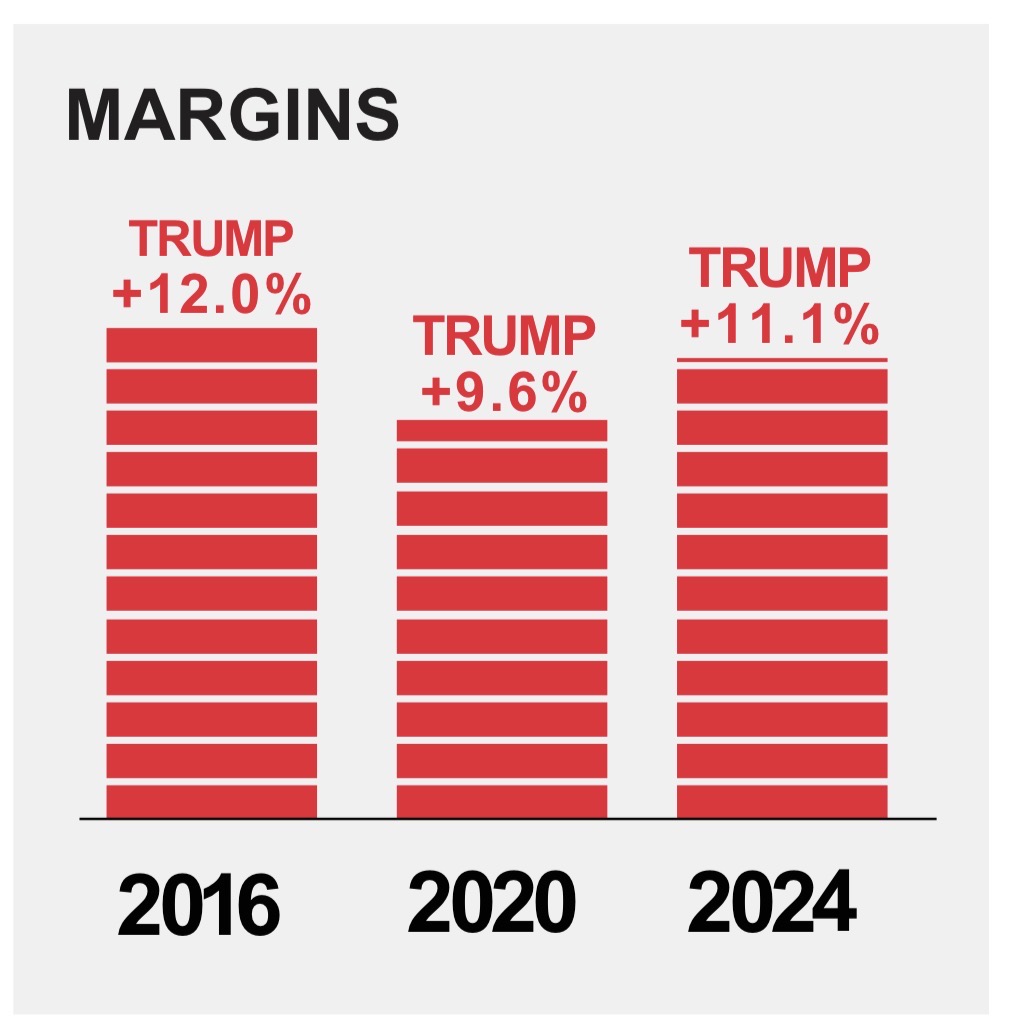
As it gears up for its first General Election test under the new boundaries, OH-7 consists of the southern portion of Cuyahoga County (dodging core Cleveland), all of Medina (Trump +24.7%) and Ashland (Trump +49.8%) Counties, and the northern portion of Wayne County. The previous boundaries lacked Ashland, but included all of Medina and the northern portion of Holmes County. Trump carried the old boundaries in 2024 by 11 points, closely matching the margin for the new district. Here are the last three presidential margins for boundaries as drawn today:

Table of presidential margins in OH-7

Trump’s margin sank in 2020 thanks to the swing of the Cuyahoga suburbs, and when they stiffened up for him in 2024, he ran his margin up another 1.5%. The new district is comparable to the old.

Key Statistics

86.4% White, 3.7% Hispanic

III. Market Assessment

Polymarket bettors are buying the Poindexter hype big-time. Miller’s unique issues have made him a tremendous liability for his party, but this is a massive overvaluation.

IV. History

There is no previous history for these exact boundaries in a U.S. House race, but since the presidential margins closely match and the district was only nominally redrawn, it makes sense to review Miller’s two previous performances.

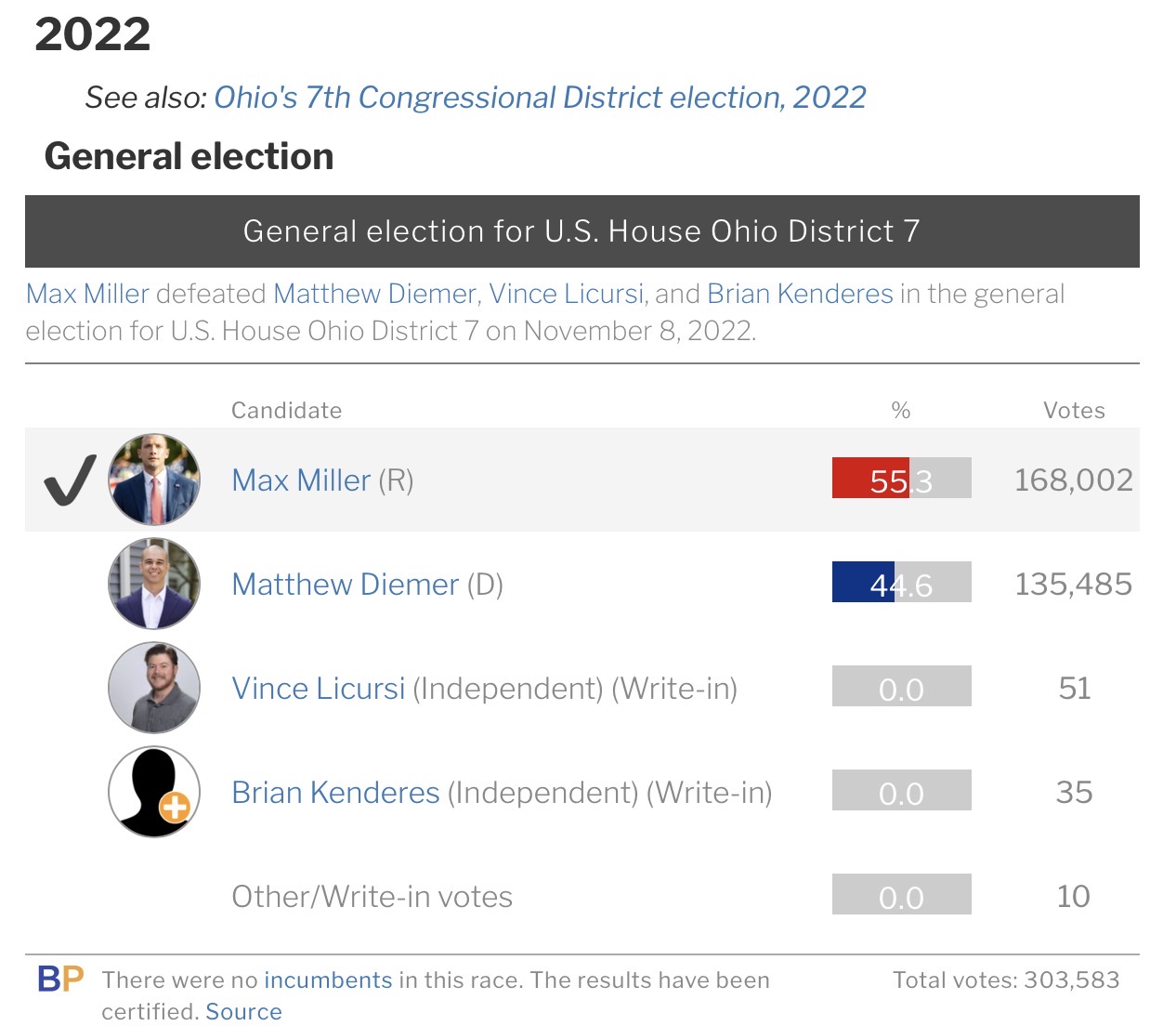
In 2022, after notching the GOP nomination, Miller rode a 2022 House popular vote victory to a +10.7% victory over Matthew Diemer.

2022 OH-7 House election result

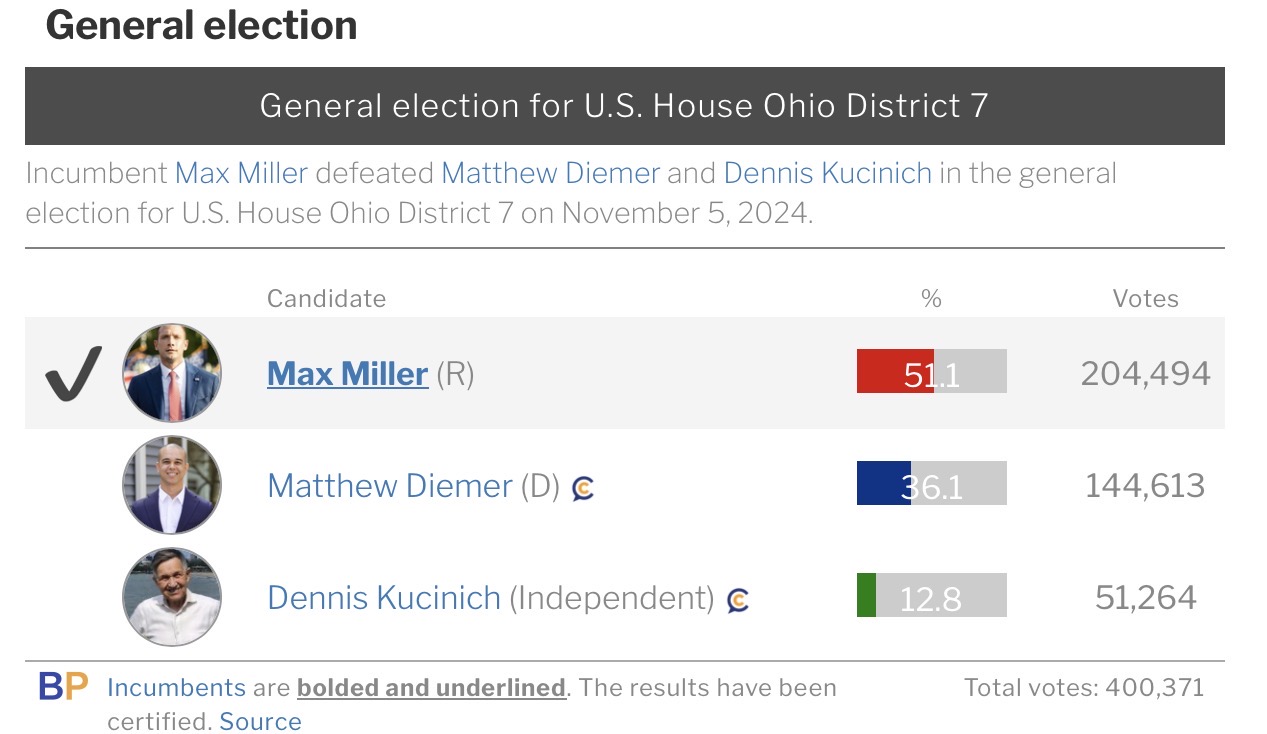
Miller then secured a +15.0% margin in his 2024 reelection, although an independent candidate skewed the margins by taking a lot of the vote:

2024 OH-7 House election result

Either way, in two favorable conditions (a midterm House popular vote win and a large presidential win), Miller ran closely aligned to the district’s presidential baselines. His seat, with the GOP looking strong in the Midwest, wouldn’t be imperiled this year if not for his very serious personal issues, which I’ll discuss later in this piece. OH-7 would likely be carried by Miller this year by 6-8 points under normal circumstances.

V. Analysis of 2026 Primary Results

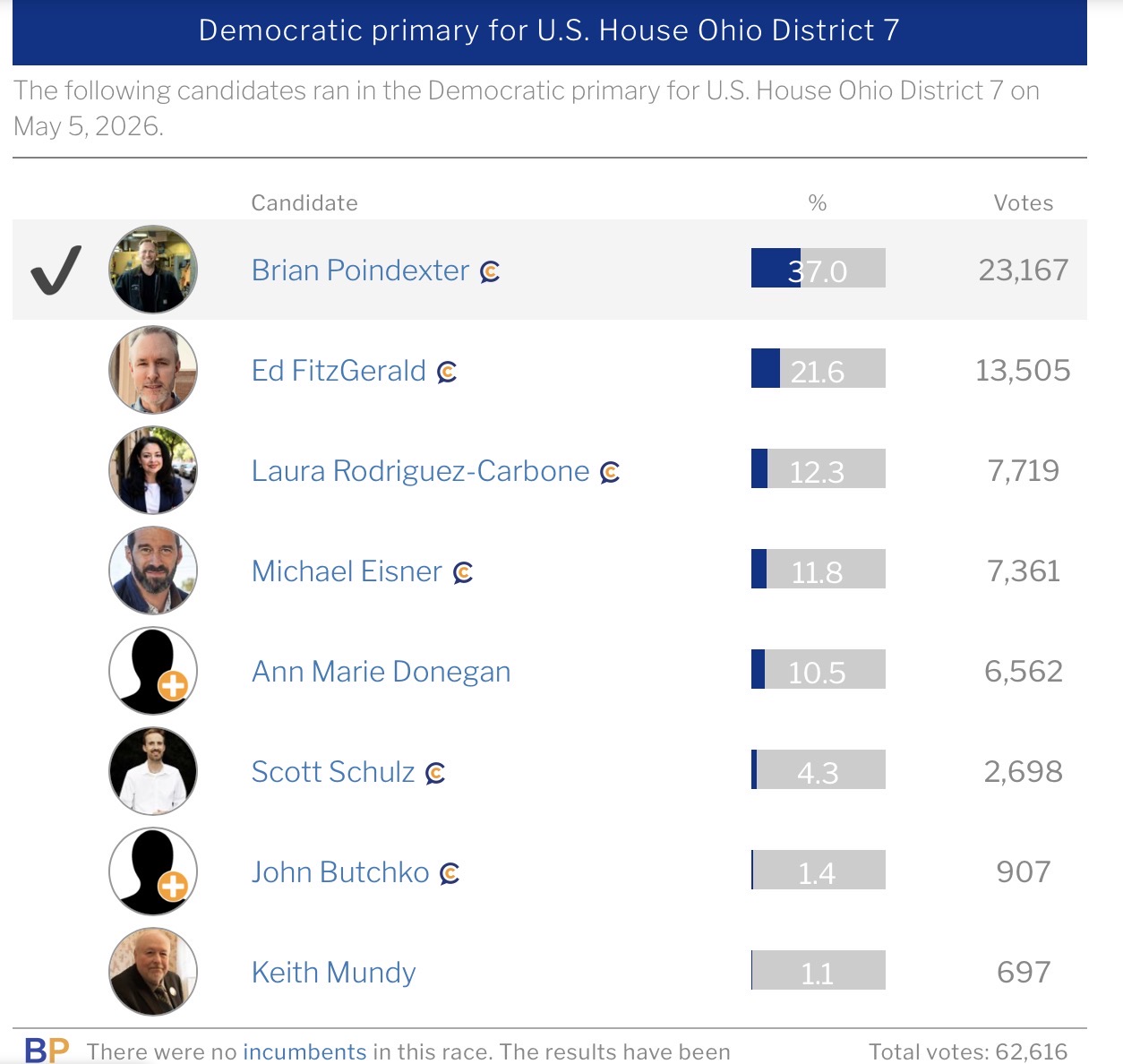
Miller, keeping his issues close to the chest, ran unopposed in the GOP primary when in fact Republican voters should have been engaged in choosing his replacement. Poindexter ran in a crowded field for the Democrats and won with a plurality of the vote:

2026 OH-7 Democratic primary result

The Democrat primary had some standard infighting along the lines of who supported whom (and who funded whom), but after Poindexter won, the drama went away. There is no reason to believe they will be hampered by the primary proceedings like Democrats are just north in MI-7.

VI. Polls

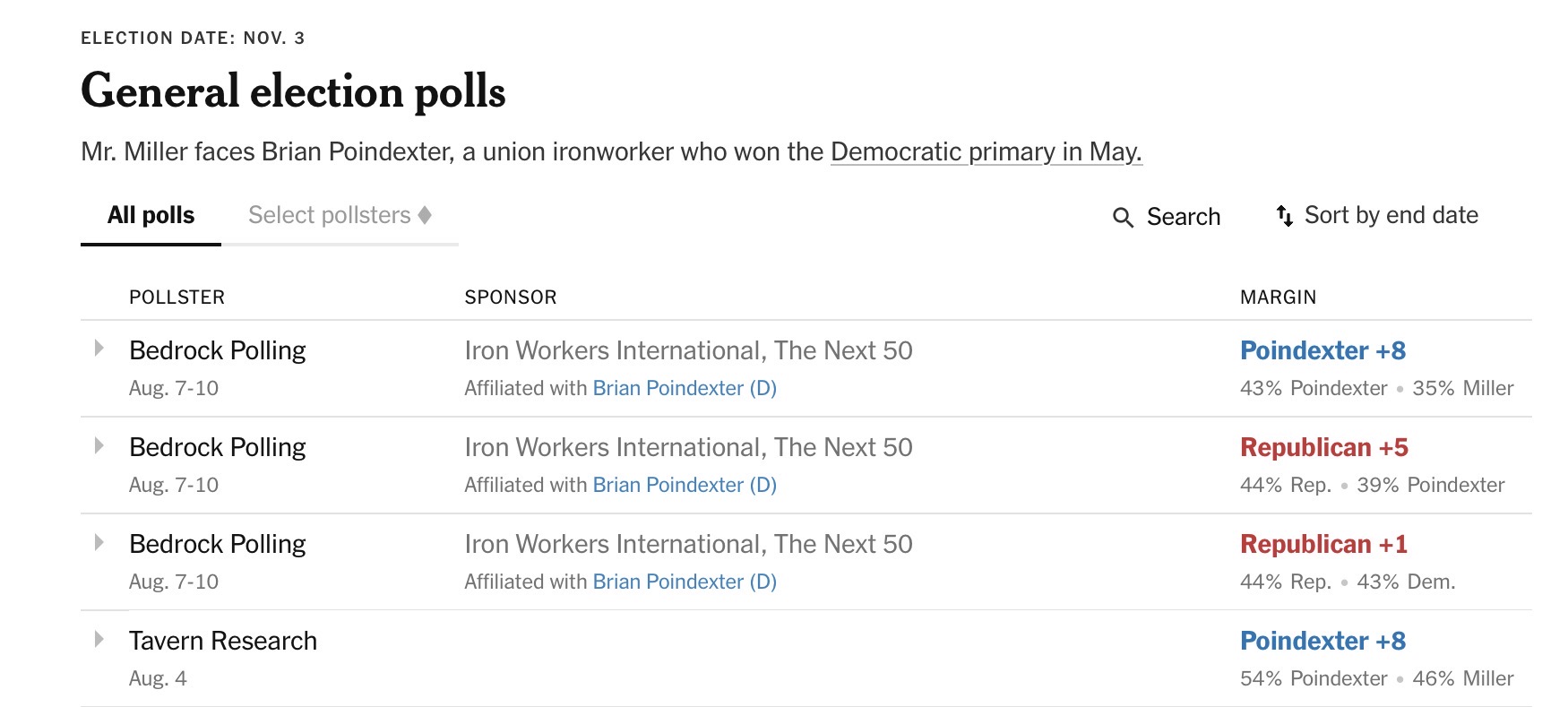
Limited polling was pulled from The New York Times:

Table of OH-7 polls

One set showed Poindexter losing the district to any generic Republican (not Miller), but him (Poindexter) beating Miller by 8 points in a head-to-head matchup shortly after Miller’s personal issues came to light.

VII. Media Ratings

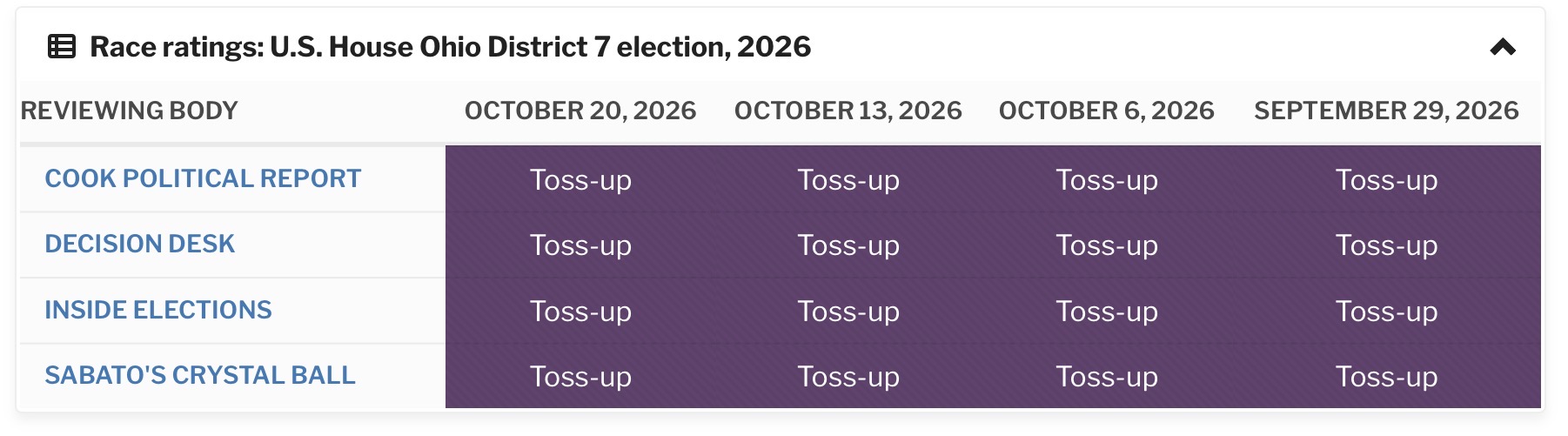
Media ratings of the OH-7 race

In the first week of August, most of the reviewers had the race as a near-certain Miller victory. Now that his drama is out in the open, everyone here is just as confused as any standard election observer. No one wants to call it a Democrat gain thanks to the pro-Trump lean of the district, so it’s been parked universally as a “toss-up.”

VIII. Party Registration

Ohio does not register voters by party, and since the suburban Cuyahoga portion is swingy, it is difficult to get a read on the inclination of the district without Miller’s personal drama, let alone with it.

IX. Election Considerations

Fortunately for Miller, Ohio has done a relatively strong job of sealing up election loopholes and has ensured they have control over the limited mail-in balloting that exists in the Buckeye State. In short, there will be no late night ballot dumps impacting this race.

X. Summary and Election Estimate

This election makes me think of two other elections. The first is the ongoing race for the open seat in NC-11, which was vacated thanks to Chuck Edwards’s own scandal involving him running off to Washington, D.C., to chase interns. Edwards, free of this dilemma, would have carried NC-11 by a comfortable margin. Now, I may re-evaluate my previous delicate GOP lean (55/45) if Asheville keeps voting like crazy over the red counties. Edwards committed a series of unforced errors and placed an easy hold in the line of fire.

Likewise, Miller owed it to the party and to his constituents to bow out of this race long before the primaries. I am no judge of divorce proceedings, having been there myself, but the abuse allegations against Miller are very detailed and very serious. To save myself the legal drama and liabilities, and because ex-wives involved in custody disputes often exaggerate, I will not comment further on them.

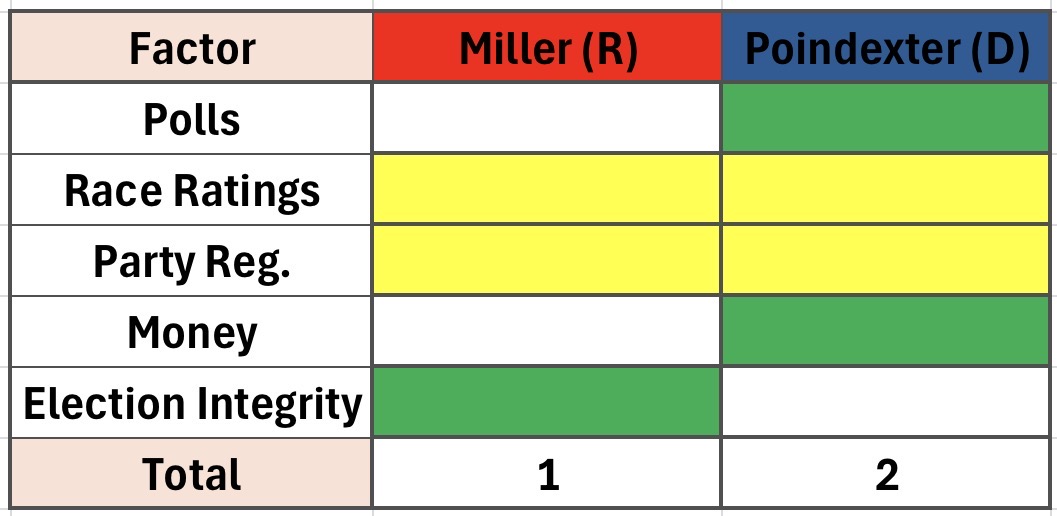
Miller had been pressed to drop out of the race by the early August deadline, including by President Trump. He, choosing self over team, stayed in the race. Now we get to face the music. Here’s what the decision matrix looks like:

Keshel's ten-point decision matrix for OH-7

While many of these matrices showing Democrats with the money advantage only offer a narrow advantage, this one does not. Poindexter is crushing Miller both in receipts, and cash on hand. No one is donating to Miller’s campaign, especially after the news of his personal drama broke. To make matters worse, Miller’s former father-in-law, Senator Moreno, has been chirping about Miller on social media all year, House majority be damned. Those two need to meet up in a bar somewhere and settle this somewhere other than the public eye.

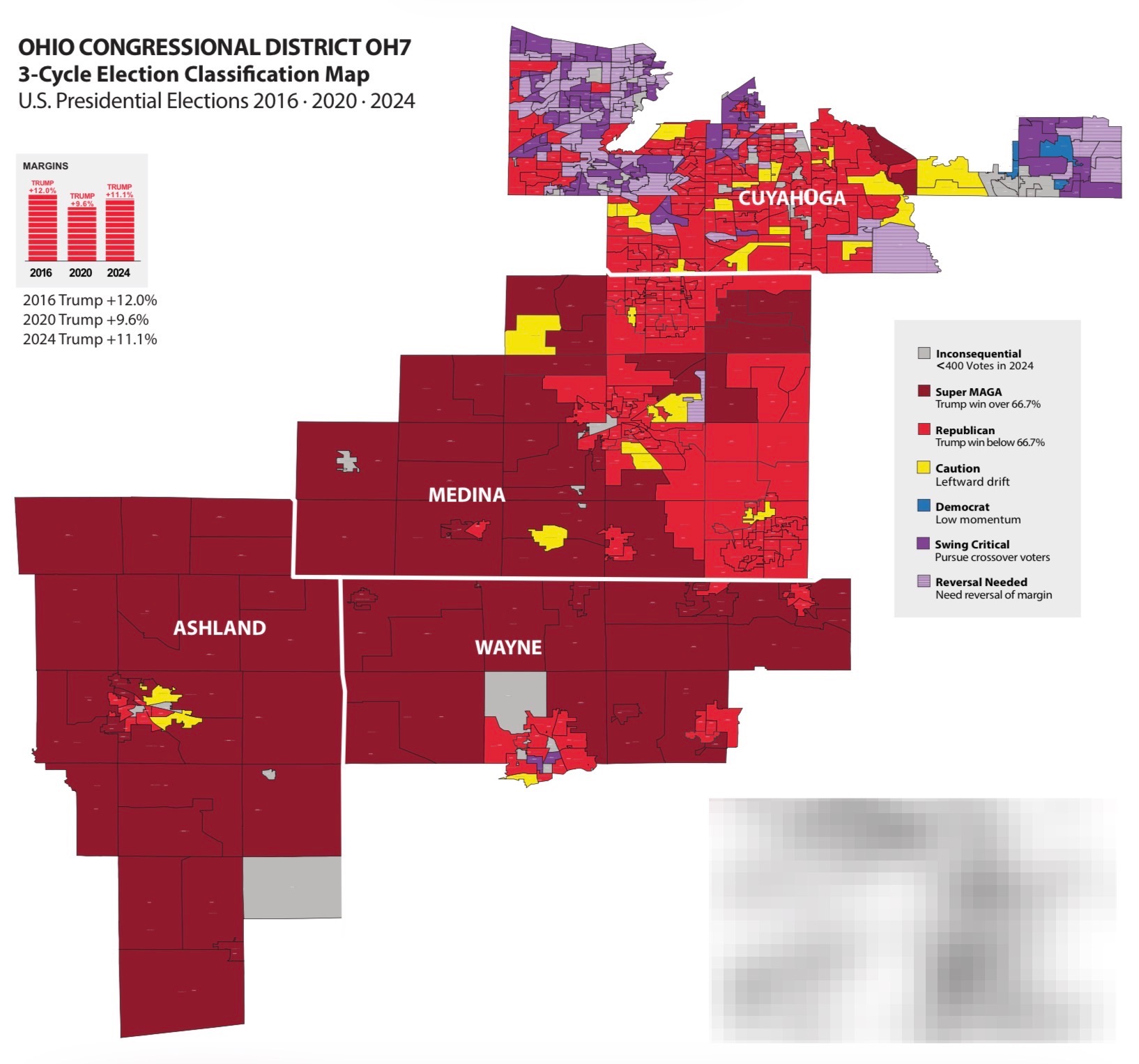
Captain K proprietary mapping of OH-7
Captain K Proprietary Mapping of OH-7

Needless to say, Miller’s likely 6-8 point margin is clearly left of that thanks to these issues. I think, given the fact that there are enough suburban areas in Cuyahoga County (see proprietary mapping shown above), Poindexter has everything he needs to flip this seat from Miller, especially given the fundraising disparities that have arisen.

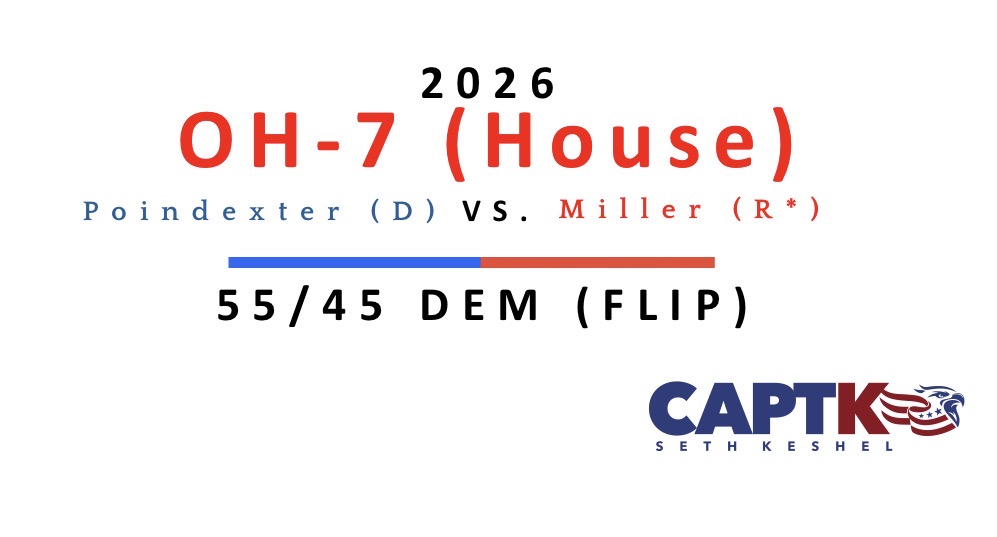
Forecast for OH-7 House

Keshel's forecast for the OH-7 House race

Now that I see Poindexter’s edge in the race, and have it 55/45 (essentially a 50/50 that I refuse to leave tied) in his favor, I can tell you about the second race it reminds me of. It reminds me of the 2025 Virginia Attorney General race, in which Democrat Jay Jones (the current state AG) took on incumbent Republican Jason Miyares. Jones had been stunningly exposed in the run-up to the election for wishing to kill the children of a political opponent, a shocking thing for an aspiring top law enforcement official of a state to say. In one of my few missed predictions, I (along with many others) expected Miyares to be the lone Republican to avoid the statewide Democrat wave. Why?

Because Democrat partisans got over it. There is enough Trump county in OH-7, if Cuyahoga turnout is weak or doesn’t shift enough for Poindexter, for Miller to win on sheer partisan strength. If he does, it will be a squeaker. Poindexter, if elected, will be easily ousted in 2028, certainly by someone other than Miller.

This is one of the most difficult races to assess because the fundamentals clearly favor the GOP candidate; his personal liabilities with regard to voter behavior are very hard to assess. If the seat is lost, this falls 100% on Miller, and should come with a lesson that candidates owe it to voters and to the party to brief them on emerging scandals that could cost safe seats in a year in which the majority may be very narrowly decided.

Seth Keshel, MBA is a Senior Fellow at the Gold Institute for International Strategy and a retired Army Captain. He publishes Captain K’s Corner on Substack.

Col. (ret.) Richard Kemp on Hamas terrorists vs. the IDF in Gaza

Frontlines of Freedom podcast cover art: a U.S. soldier silhouetted against an American flag at sunset

Retired British Army Colonel Richard Kemp joined Brig. Gen. Ernie Audino on Frontlines of Freedom to discuss the fighting between Hamas and the IDF in Gaza.

On Frontlines of Freedom, Col. Richard Kemp joined the program after recently returning from Gaza to report on the current fighting between the IDF and Hamas. Kemp served in the British Army’s Royal Anglian Regiment from 1977 to 2006, holds the Commander of the Order of the British Empire and the Queen’s Commendation for Bravery, and has been in and around Gaza several times since the October 7, 2023 Hamas attacks. The discussion covers what is true versus disinformation, how Hamas uses civilians for cover, and what the IDF does to minimize civilian casualties. In his opening comments, Gen. Audino looks back at the Hezbollah bombing of the U.S. Marine barracks in Beirut 43 years ago and asks whether Israel’s war in Gaza complies with Just War Doctrine.

Brig. Gen. Ernie Audino, US Army (Ret.), is a Senior Military Fellow at the Gold Institute for International Strategy, a Washington D.C. based foreign policy and defense think tank. He hosts Frontlines of Freedom, a nationally syndicated military news and talk radio program.

Listen on Spreaker Listen on Apple Podcasts

Peter Huessy on Russian Nuclear Doctrine and Strategic Coercion

Series of missile launchers displayed at historic Belgrade Fortress in Serbia.

Senior Fellow Peter Huessy joined The John Batchelor Show to discuss Russian nuclear doctrine and strategic coercion.

On The John Batchelor Show, Peter Huessy assesses Russia’s nuclear arsenal and argues that Vladimir Putin uses strategic weapons primarily for coercion, intimidation and blackmail. He also covers Russia’s aggressive first-use nuclear doctrine and the threat posed by heavy Satan 2 ICBMs, and argues that the United States must strengthen its regional theater nuclear deterrent capabilities.

Peter Huessy is a Senior Fellow at the Gold Institute for International Strategy, a Washington D.C. based foreign policy and defense think tank.

Listen on The John Batchelor Show

2026 Ten-Point Forecast: WI-3 (U.S. House – Decisive)

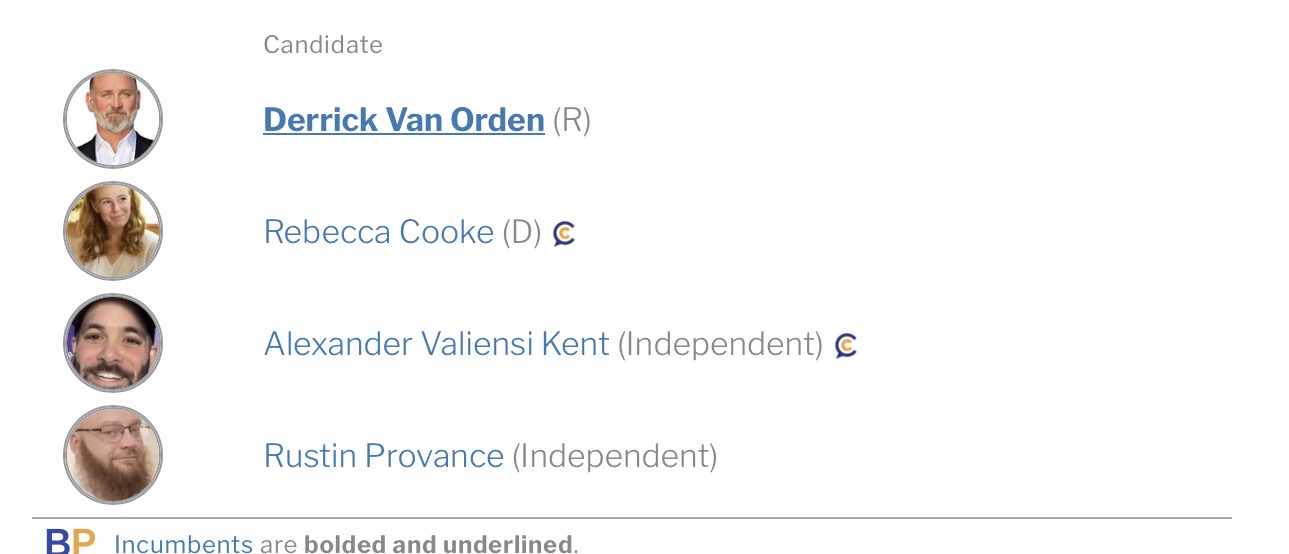
Wisconsin's 3rd Congressional District race: Derrick Van Orden vs. Rebecca Cooke

Derrick Van Orden (R-inc.) vs. Rebecca Cooke (D)

I. The Race

WI-3 candidates Derrick Van Orden and Rebecca Cooke

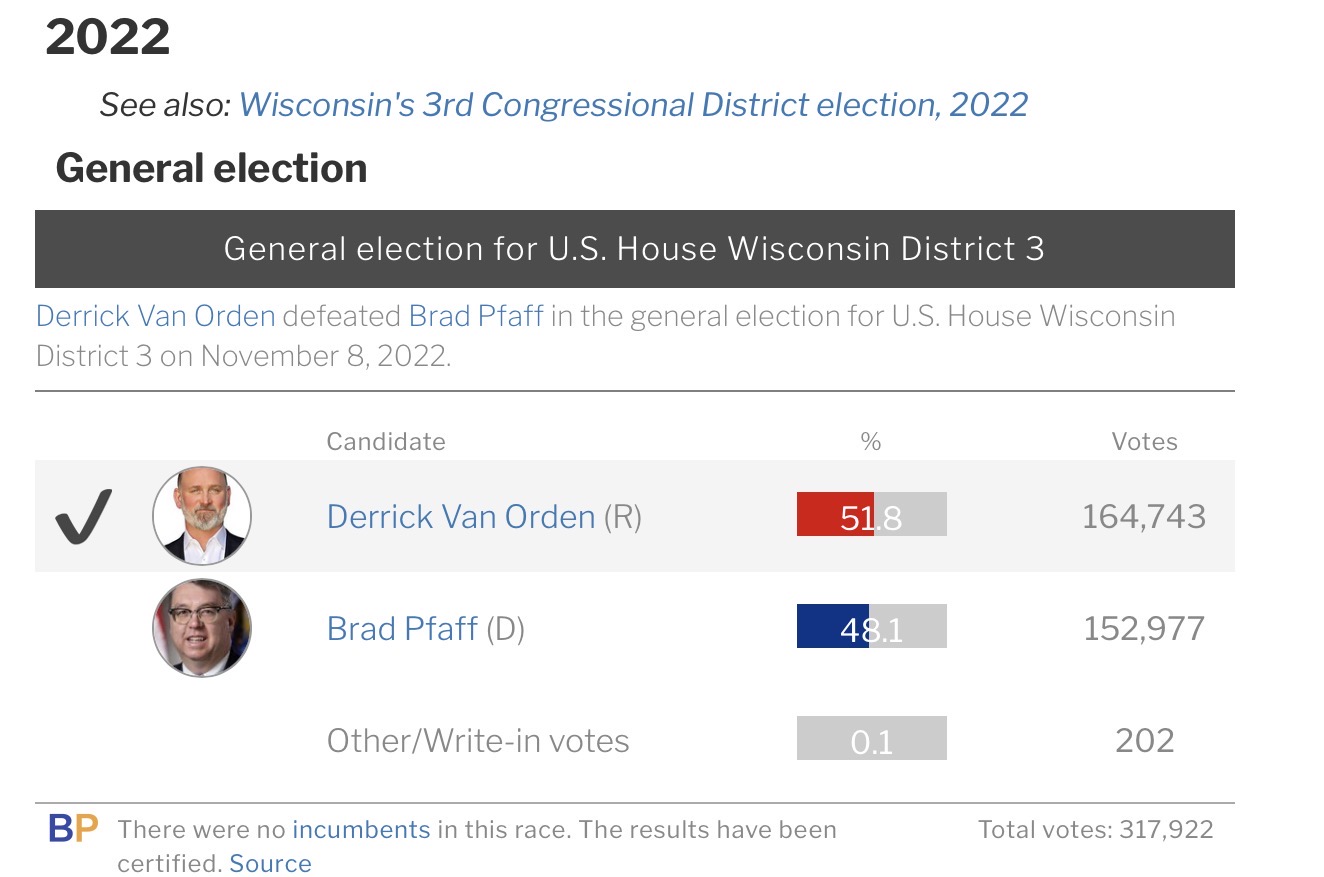
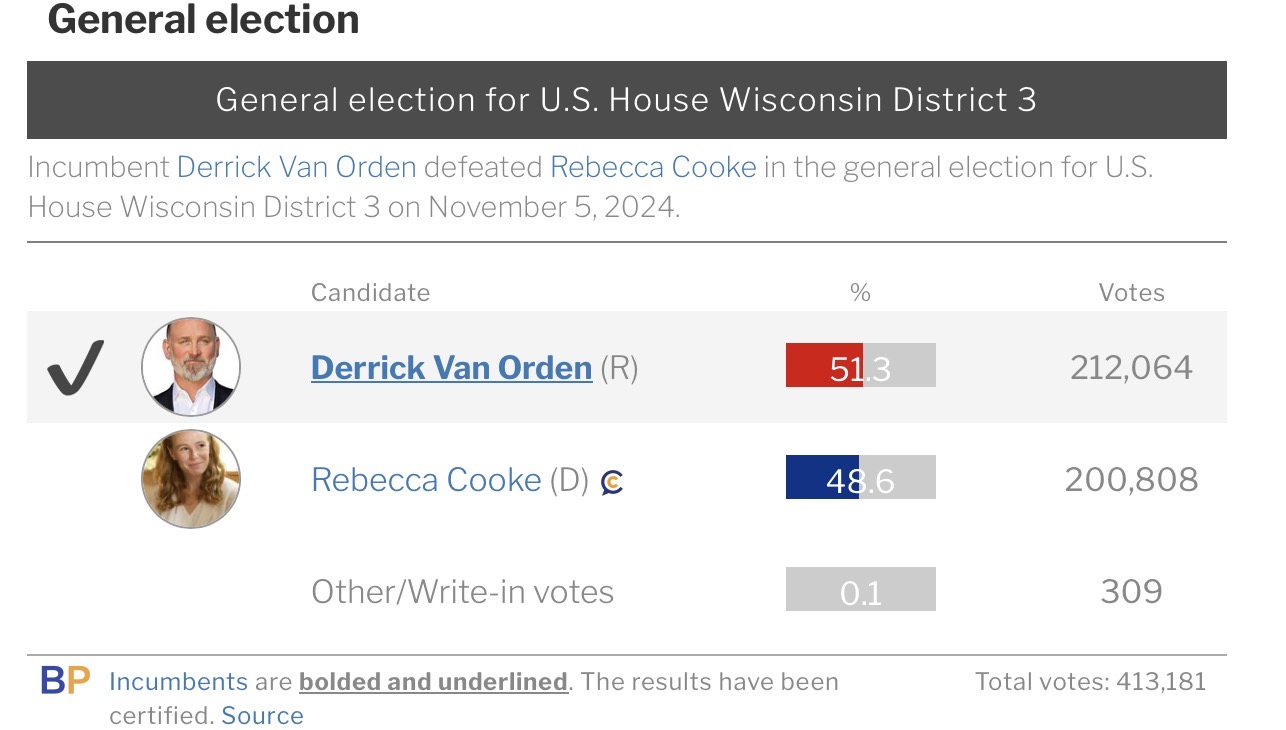
Derrick Van Orden (Republican) is a retired Navy SEAL and small business owner who flipped WI-3 in the 2022 Republican House takeover. He defeated his 2026 opponent in 2024 by a margin of +2.7% and is currently seeking a third term in the U.S. House.

Rebecca Cooke (Democrat) makes her third run at WI-3 after having lost the Democrat primary in 2022 and to Van Orden in 2024. She is aiming for the proven Wisconsin Democrat platform of “salt of the earth, moderate, boring midwestern white woman” that has won them one seat after another on the State Supreme Court, emphasizing her dairy farm roots.

II. District Geography

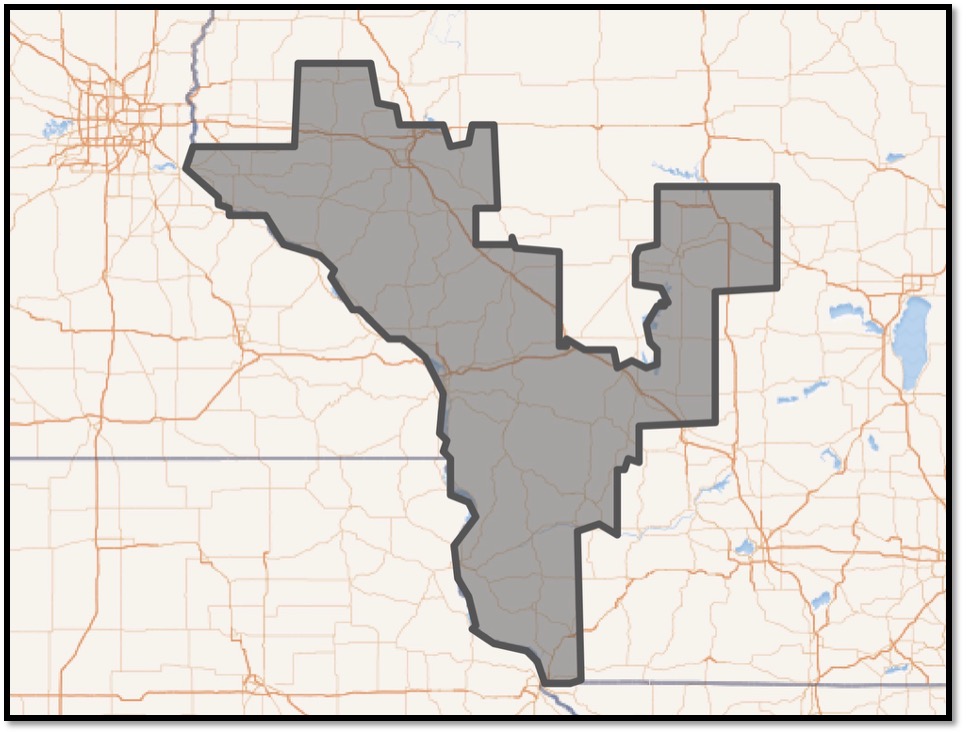
Map of Wisconsin's 3rd Congressional District

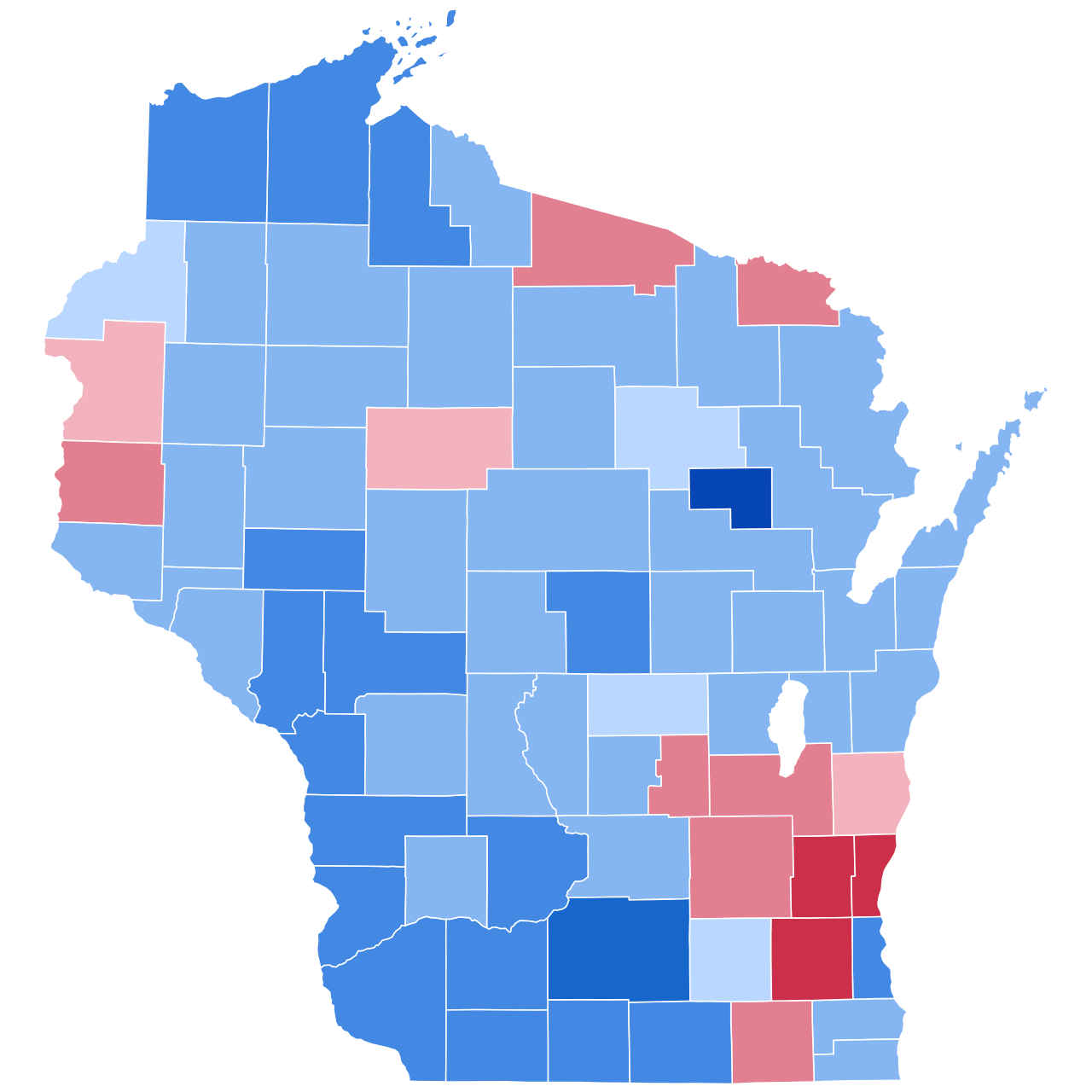
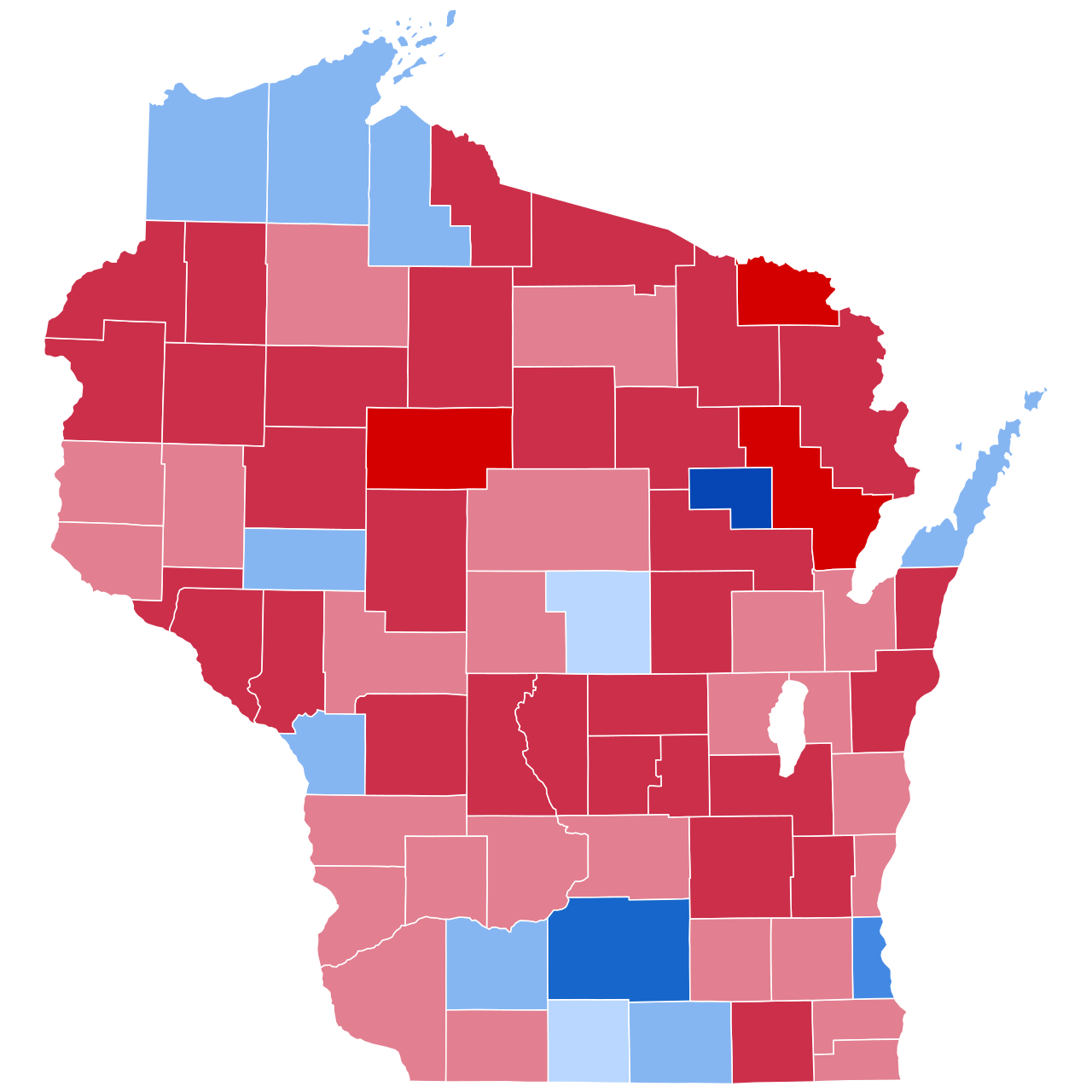
Wisconsin’s 3rd Congressional District (WI-3) is a massive district. It stretches from the outskirts of Minnesota’s Twin Cities all the way to the Illinois state line, and halfway across Wisconsin. It contains all or parts of 19 counties, including Democrat leaners Eau Claire and La Crosse Counties, which together make up over 30% of the population. WI-3 has traditional Democrat undertones and only began to trend Republican under Donald Trump and the MAGA movement’s success with the white working class. The problem with WI-3 this year is that Trump isn’t on the ticket. Pay attention to the transformation of the southwest quadrant of Wisconsin from Obama’s 2008 statewide win all the way through Trump’s 2024 win:

County map of the 2008 presidential election in Wisconsin
2008 Presidential Election in Wisconsin
County map of the 2024 presidential election in Wisconsin
2024 Presidential Election in Wisconsin

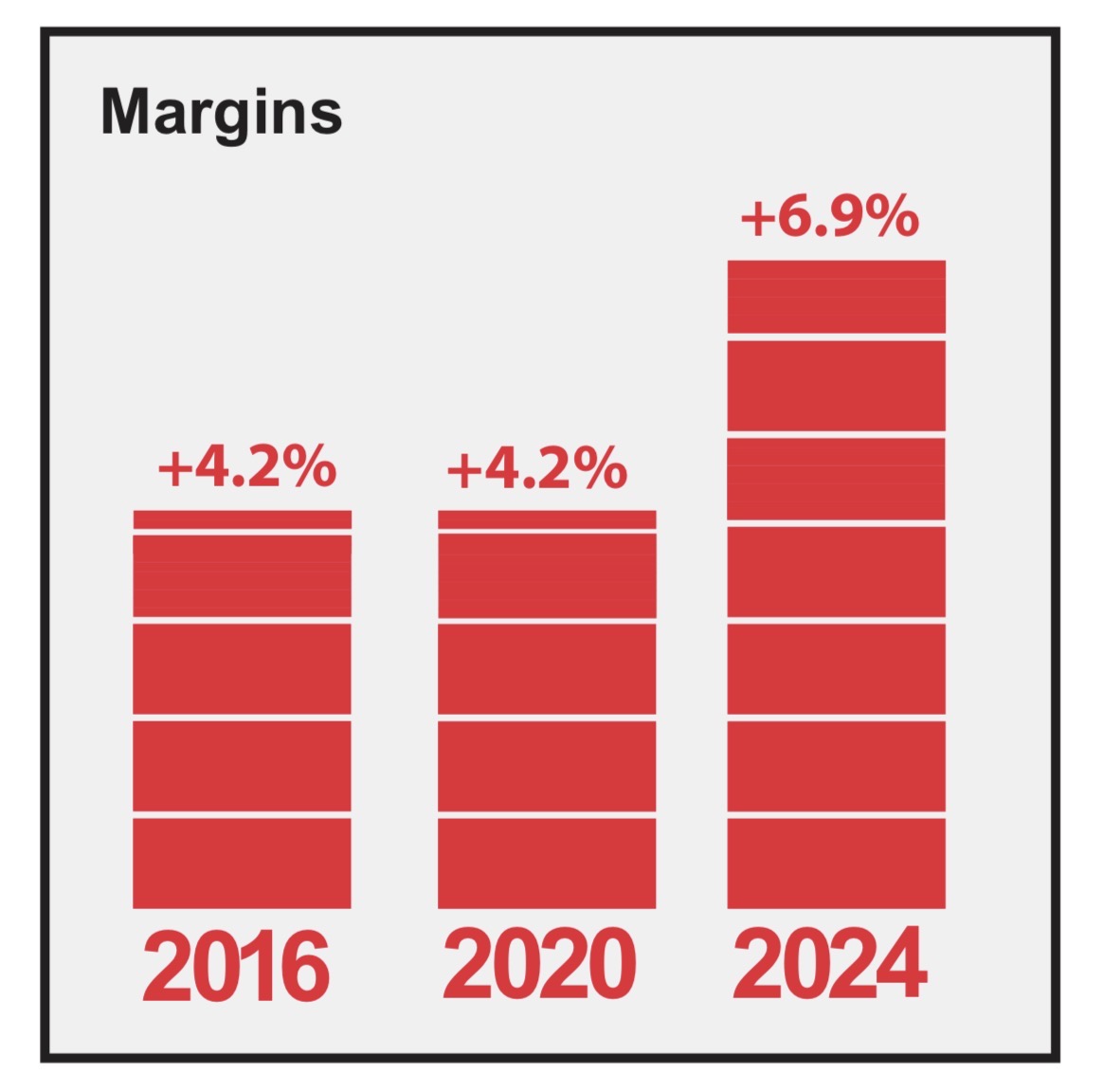
Trump’s tremendous progress in WI-3 was instrumental in his 2016 flip of Wisconsin, his 2020 should-have-won campaign, and his 2024 recapture. Here are the presidential margins in today’s boundaries:

Presidential Margins

Table of presidential margins in WI-3 under today's boundaries

On all three occasions, Trump ran ahead of the GOP nominee for U.S. House. Trump’s presence on the ballot is important for getting these voters to turn out and change sides, given that they all widely supported Obama twice.

Key Statistics

89.1% White, 3.3% Hispanic

56.9% Rural, 43.1% Urban

Market Assessment

Polymarket bettors are behind Cooke, valuing her shares at 77 cents each.

IV. History

Ron Kind, a blue dog Democrat from La Crosse, won the open WI-3 seat in what was then a rare Democrat victory in the district. He held the seat for more than two decades, surviving the 2010 and 2014 Republican waves and even running uncontested in 2016, when Trump won the state. After a close call against Van Orden in 2020, with a margin of just +2.7%, a whiff of the pro-Trump trend in the district plus a view of a coming 2022 Republican House popular vote victory were enough to get Kind to call it a career. Van Orden took the open seat by a margin of 3.7%:

2022 WI-3 House election result

Cooke had lost the 2022 Democrat primary to Brad Pfaff, but she won it in 2024 for the right to challenge Van Orden. Riding shotgun with Trump, he held his seat:

2024 WI-3 House election result

His margin was +2.7%, just 11,256 votes. He ran 4.2% behind Trump’s margin in the district. Having won the seat twice, once in a House popular vote midterm and again in a presidential win of Wisconsin, Van Orden finds himself facing headwinds for the first time in 2026, and in a similar position such as the one Kind found himself in looking at 2022.

V. Analysis of 2026 Primary Results

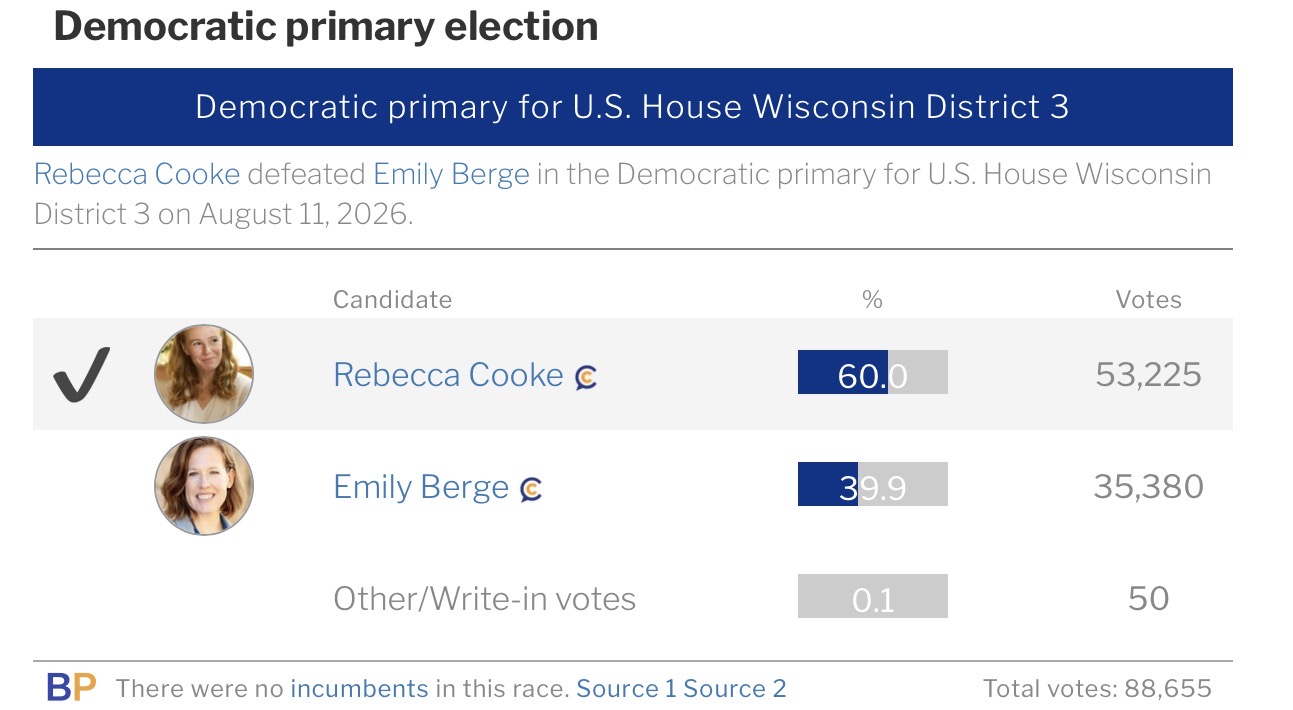
Van Orden ran unopposed this year for the GOP nomination. Cooke prevailed over Emily Berge, taking 60.0% of the vote.

2026 WI-3 Democratic primary result

Cooke and Berge had a contentious primary, which included Berge accusing the Democrats of buying the race for Cooke, but things seem to have been smoothed over.

VI. Polls

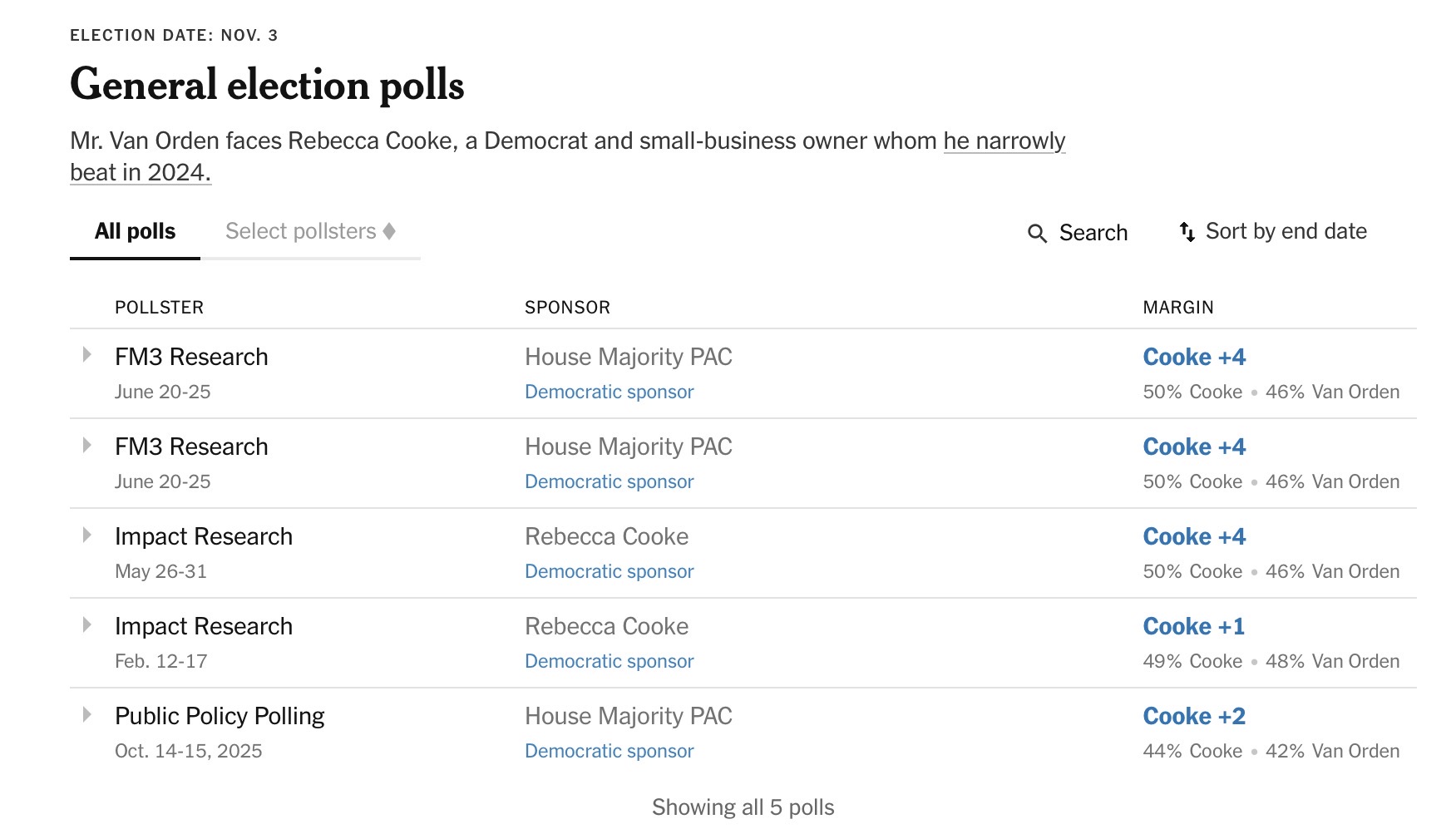
These polls were pulled from The New York Times:

Table of WI-3 polls

Nothing new since June, when Cooke was leading Democrat internals by 4.

VII. Media Ratings

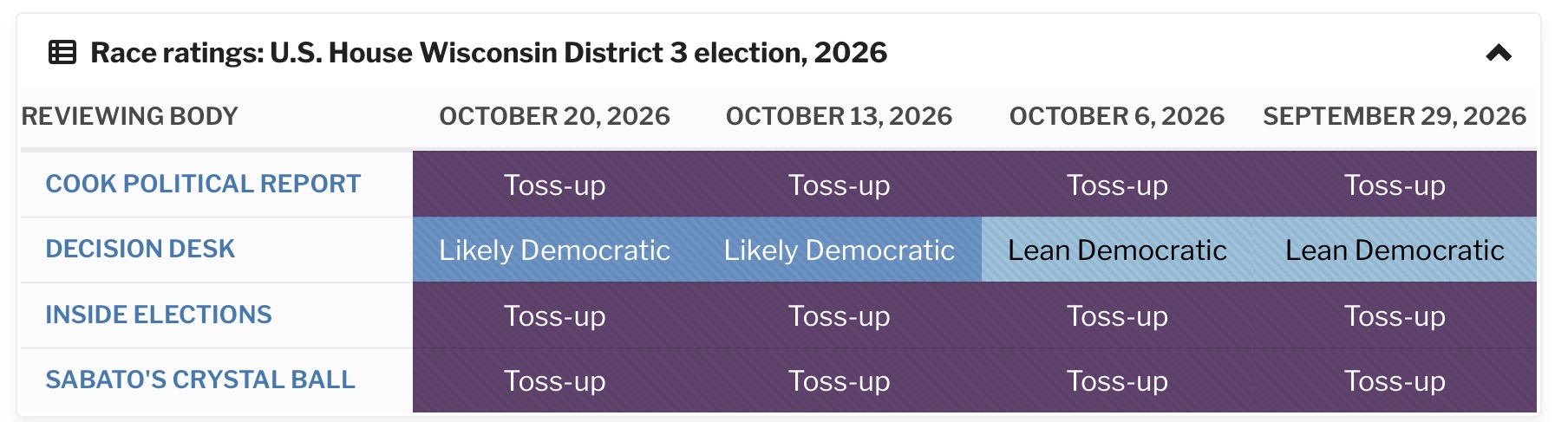
Media ratings of the WI-3 race

Three of four major reviewers consider the race a “toss-up,” while Decision Desk is super bullish on Cooke.

VIII. Party Registration

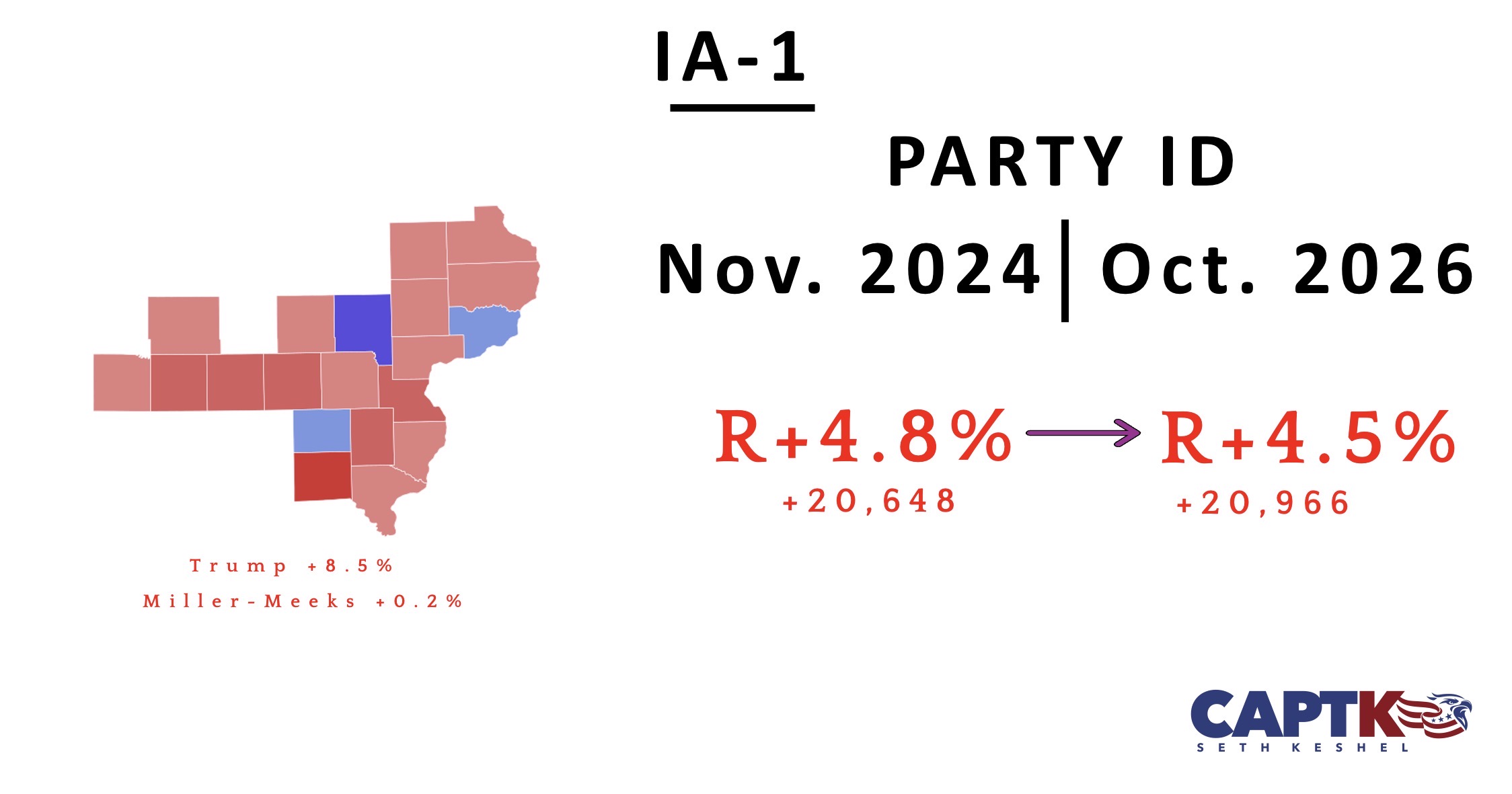
Wisconsin does not register voters by party; however, in nearby IA-1, which features a very similar Obama-to-Trump electorate, Republicans have added to the raw GOP advantage, while giving a little ground on the overall percentage thanks to more non-affiliated voters in the electorate:

Party registration trend in IA-1

It is likely the overall disposition of the electorate closely resembles the one that voted in 2024.

IX. Election Considerations

Wisconsin, which lacks Automatic Voter Registration, uses same-day voter registration as a loophole to increase the state’s voter roll by as much as 10% on Election Day alone. While this has limited impact in a rural district like WI-3, it completely reshapes the conversation due to the impact it has on late ballot dumps in Milwaukee and Dane County.

X. Summary and Election Estimate

Van Orden, winner of two narrow contests held under favorable conditions (a House popular vote win in 2022 and a presidential win in 2024), now tests the waters when there is a Democrat headwind and a tenacious challenger hoping that the third time is a charm. I think this is a very hard-fought race with polarizing factions squaring off, which essentially turns it into a battle of turnout between the rural counties and La Crosse/Eau Claire Counties, which will lean hard for Cooke.

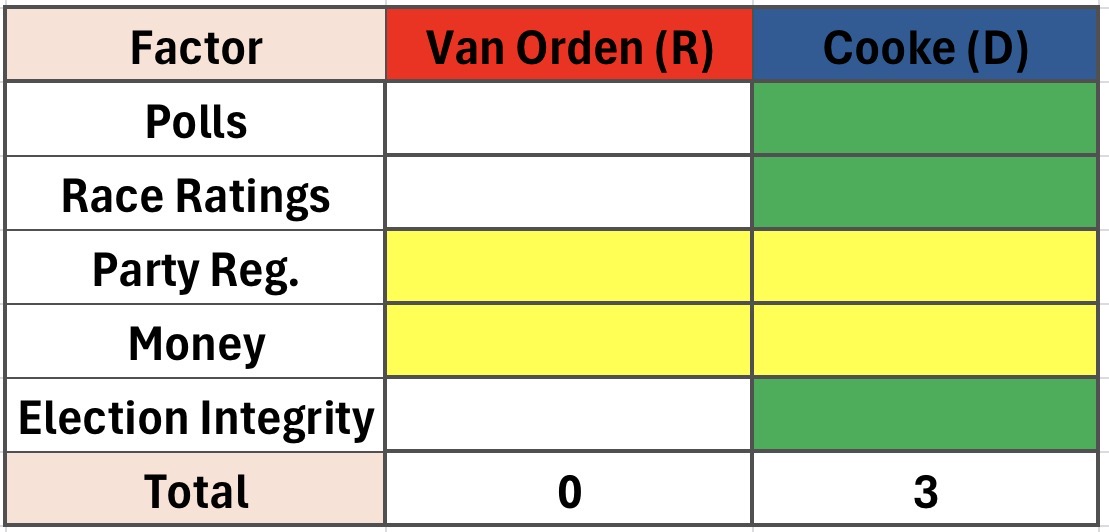
This is how my decision matrix looks:

Keshel's ten-point decision matrix for WI-3

I called “money” a tie because while Cooke has raised about one-third more than Van Orden, she has far less on hand than he does here in the stretch run. The most concerning early sign for Van Orden is that La Crosse County is ranked 8th of 72 counties in percentage of its 2024 presidential vote already cast (with Eau Claire 18th), while Van Orden’s rural strongholds lag far behind, with 9 counties ranked at 50th or worse.

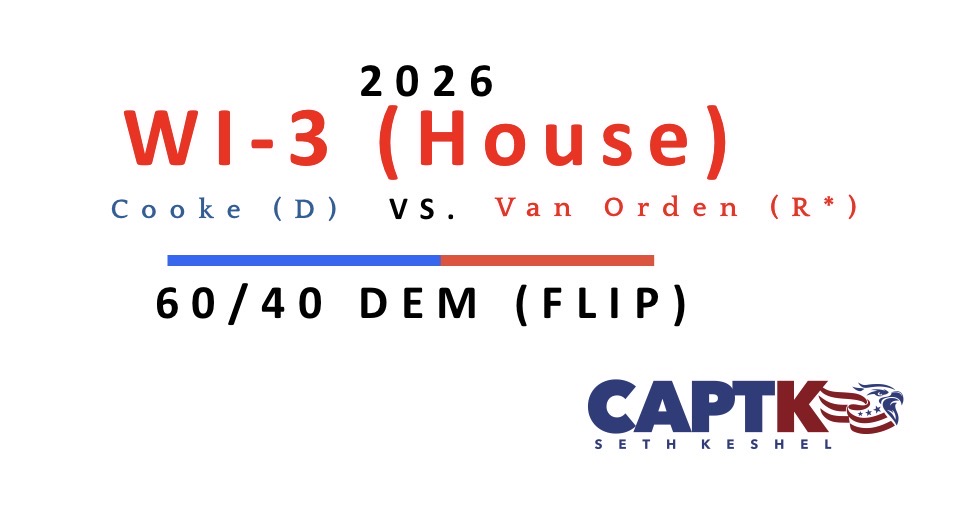
I think this year’s headwinds and the nature of WI-3’s “Trump or bust” disposition renders Cooke a clear favorite, although not inevitable.

Forecast for WI-3 House

Keshel's forecast for the WI-3 House race

Seth Keshel, MBA is a Senior Fellow at the Gold Institute for International Strategy and a retired Army Captain. He publishes Captain K’s Corner on Substack.

2026 Ten-Point Forecast: NC-1 (U.S. House – Decisive)

NC-1 U.S. House race forecast

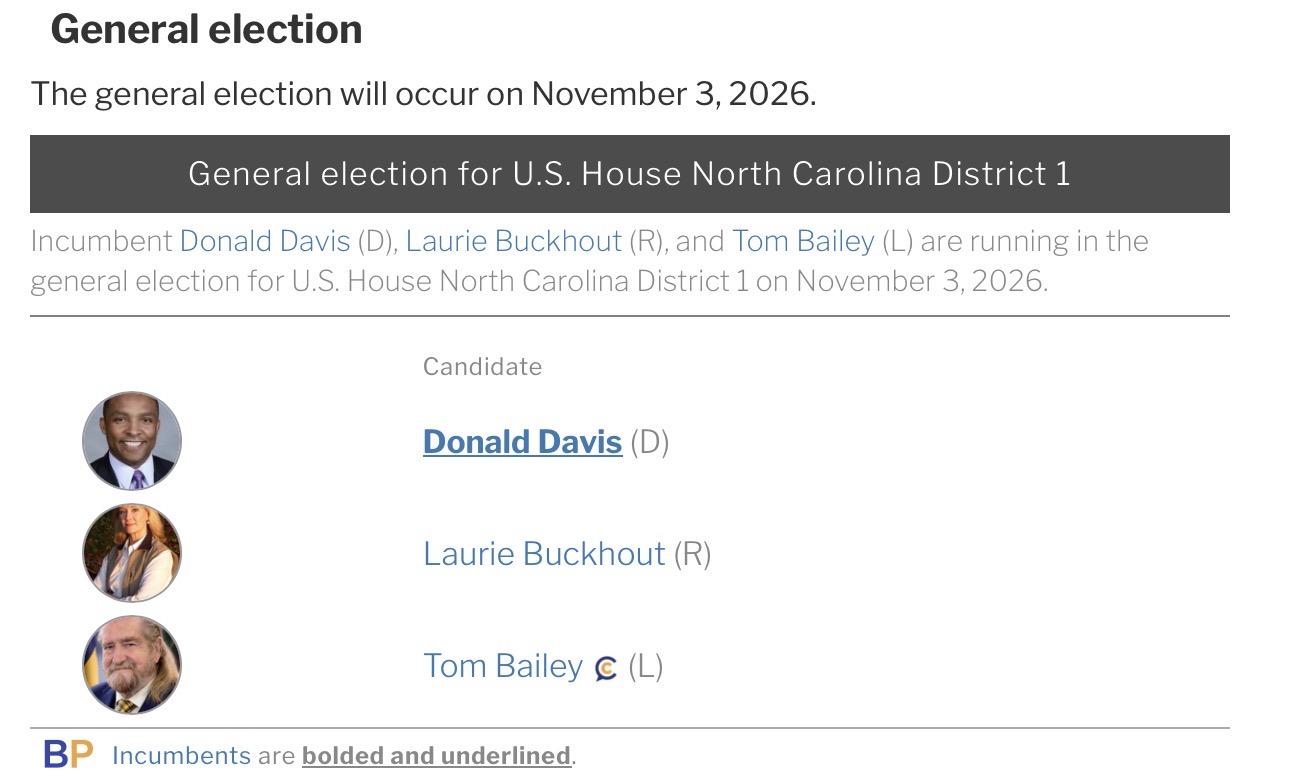
Laurie Buckhout (R) vs. Don Davis (D-inc.)

I. The Race

NC-1 candidates Laurie Buckhout and Don Davis

Laurie Buckhout (Republican) is challenging Davis for a second time, but under new district boundaries in NC-1. She is a retired Army officer, and served in the Trump administration in 2025 as acting Assistant Secretary of Defense for Cyber Policy.

Don Davis (Democrat) is a former Air Force officer who ran for the Democrats when G.K. Butterfield retired from Congress. He won NC-1 in 2022 by 4.8%, and barely held on by 1.7% with Trump on the ballot in 2024. He faces very difficult new boundaries in 2026 as he looks for a third term.

II. District Boundaries

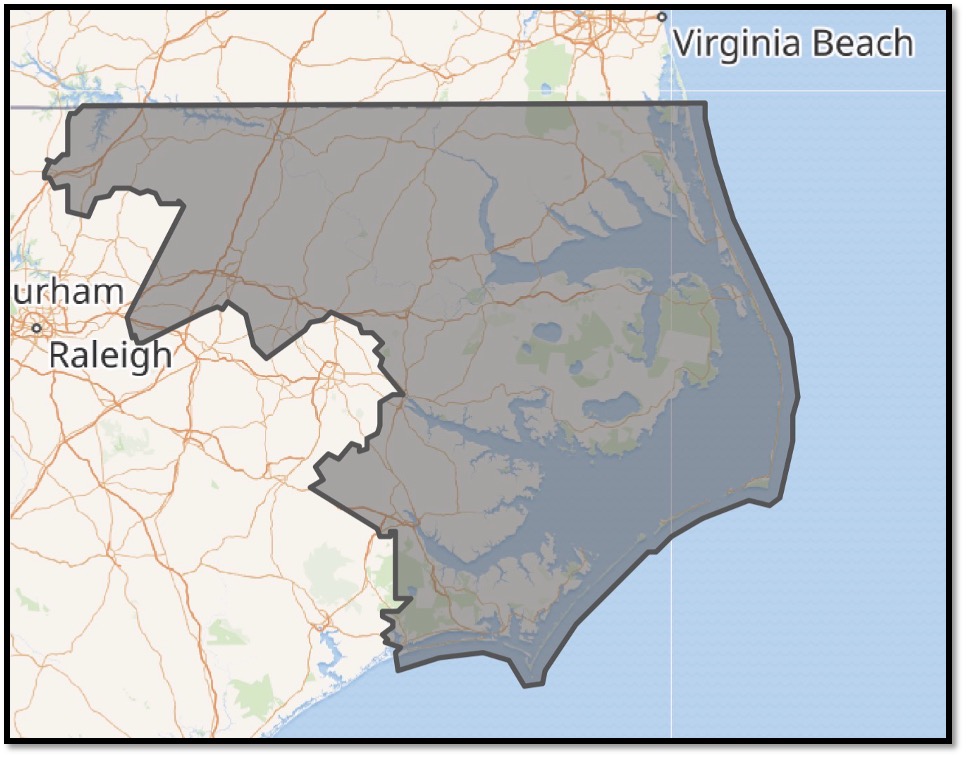
Map of North Carolina's 1st Congressional District

North Carolina’s 1st Congressional District (NC-1) is the far northeastern district in the state, stretching from rural “Black Belt” counties north of Raleigh over to the Outer Banks on the Atlantic coast. It was redrawn in October 2025 by the North Carolina legislature and gave Wayne, Wilson, Lenoir, and Greene Counties to NC-3, while picking up six red counties, including Beaufort, Craven, and Carteret, home of the outstanding patriot Lynn Carraway – a loyal and dedicated reader of Captain K’s Corner.

The change is drastic, and the swap nets the Republican Party roughly 35,000 margin in a presidential election. Davis is swimming upstream against a massive wall of MAGA-trending counties while relying on overwhelming black turnout from rural counties struggling to hold population and keep turnout at reasonable levels.

Presidential Margins (new NC-1 boundaries)

2016 Trump +5
2020 Trump +7
2024 Trump +11

Key Statistics

48.1% White, 38.3% Black, 7.6% Hispanic

III. Market Assessment

Polymarket bettors appear stuck in the past and favor Davis in an absolute rout. Buckhout is a great value at her current price.

IV. History

Although districts change in composition from time to time, NC-1 has been a longstanding Democrat bastion. It hasn’t been held by a Republican since Democrats took it over in 1883. G.K. Butterfield held the seat for two decades before giving way to Davis. Now, thanks to the actions of the North Carolina legislature, Republicans have a great shot at finally taking it over despite Buckhout’s close call in 2024 under the old, far less friendly boundaries.

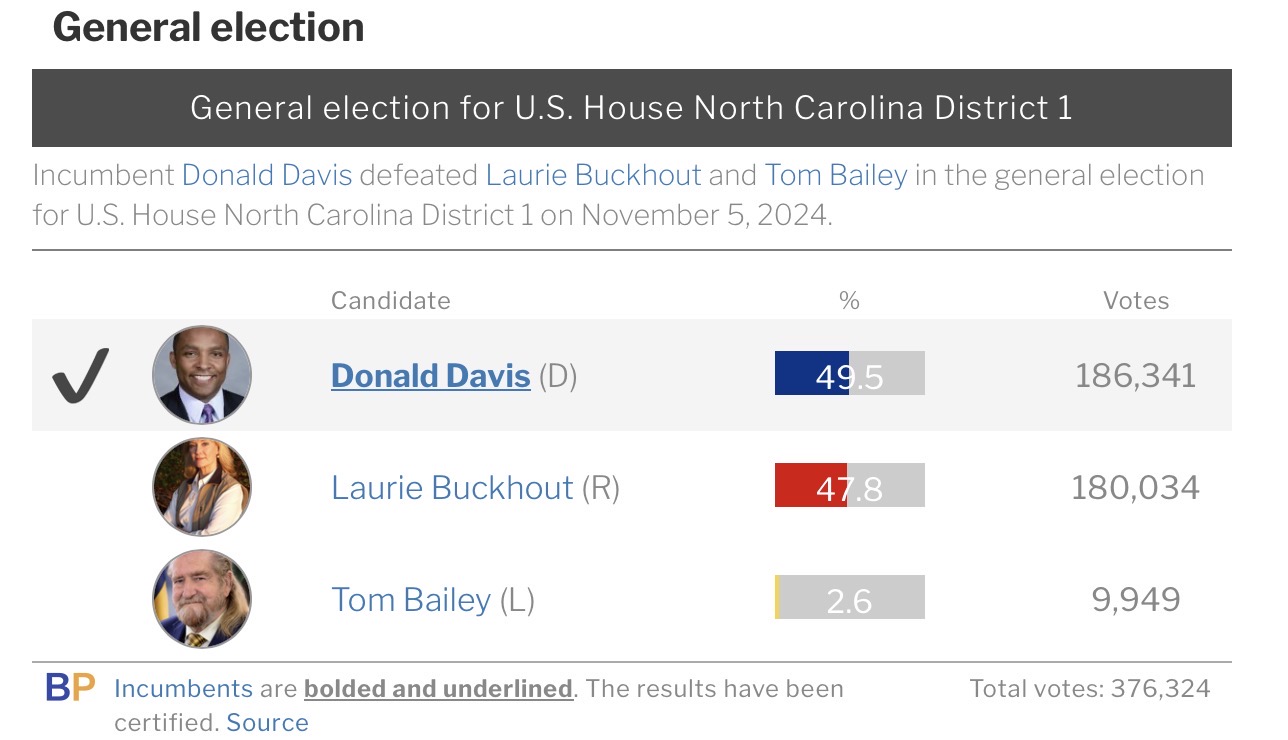
2024 NC-1 House election result

It is possible Buckhout had her bid spoiled by the libertarian, Tom Bailey; regardless, had she won, the legislature may not have carved out what looks to be a much more favorable seat. The recent history of this seat shows multiple competitive races owed to declining black turnout and reddening coastal counties. Now it will face a serious test with a much more fundamentally Republican electorate.

V. Analysis of 2026 Primary Results

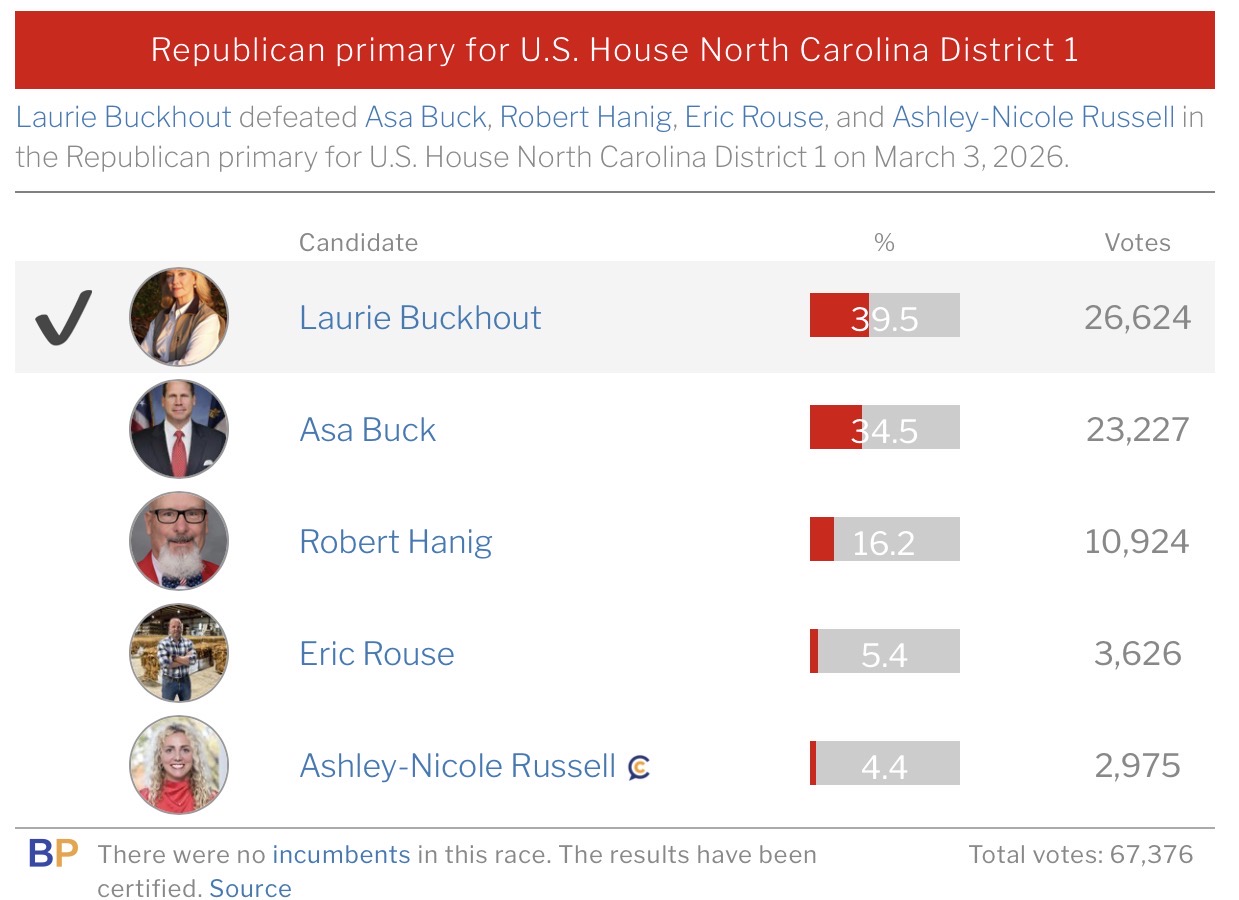
Davis did not face a primary challenge. The Republicans had a hard-fought battle with three serious candidates:

2026 NC-1 Republican primary result

Buckhout prevailed over Asa Buck by 5.0%. Her opponents questioned her sincerity in running a second time after she had told people she was worn out from the first campaign against Davis; regardless, Buckhout won and the party quickly circled the wagons around her effort to oust Davis.

VI. Polls

This poll was pulled from The New York Times:

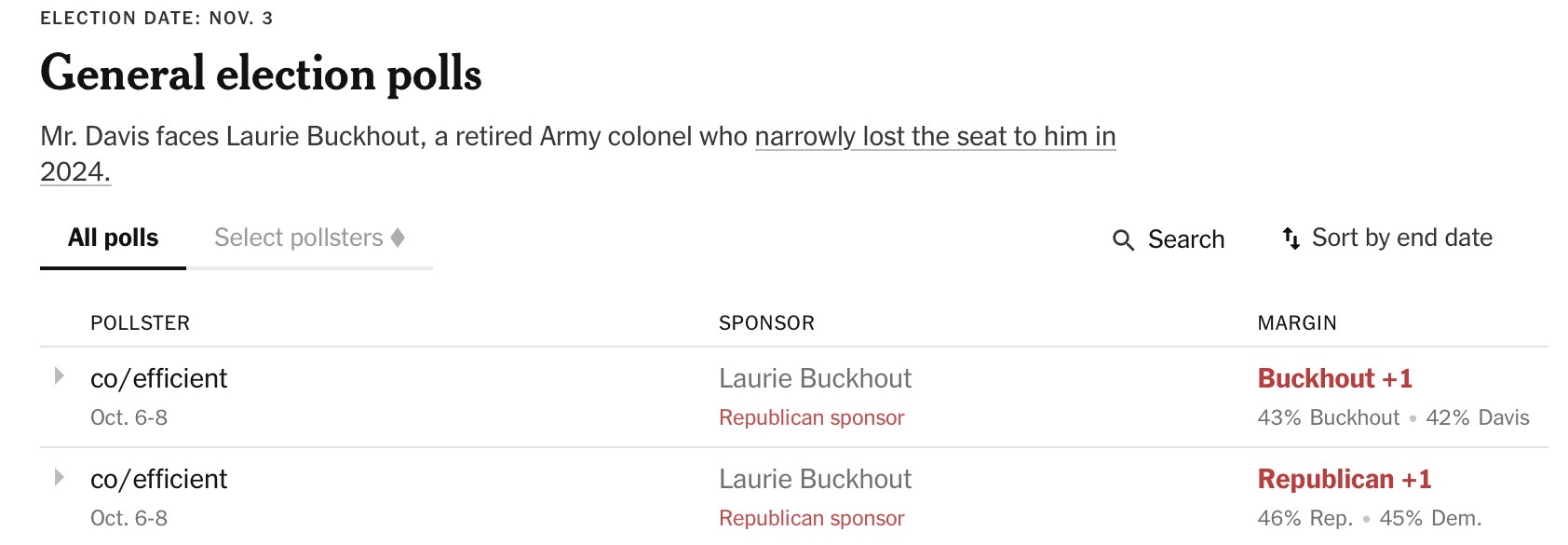
Table of NC-1 polls

The only serious poll conducted in NC-1 was from co/efficient in early October, showing Buckhout leading by a point with 15% undecided.

VII. Media Ratings

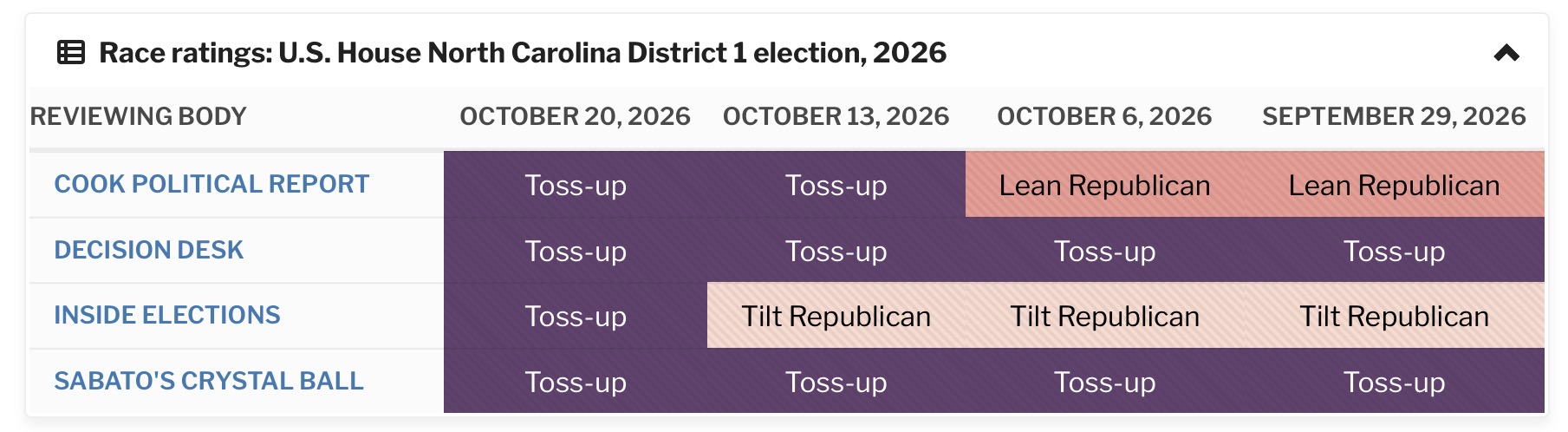
Media ratings of the NC-1 race

All reviewing bodies have this race currently rated “toss-up,” which is a downgrade from two who recently favored Buckhout.

VIII. Party Registration

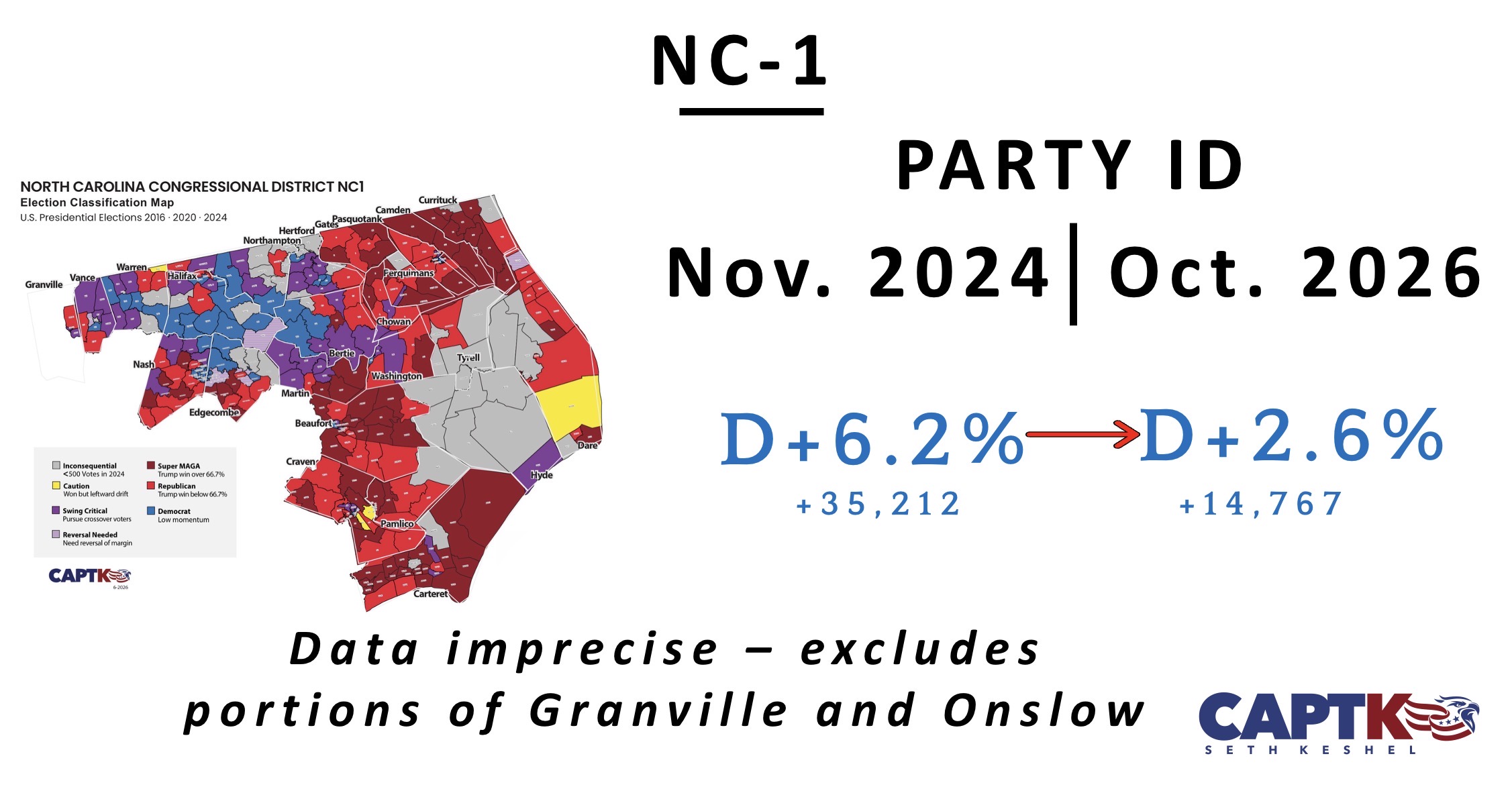
Party registration change in NC-1

Like many parts of North Carolina, many counties retain or are shedding ancestral Democrat voter registration advantages. In the new boundaries of NC-1, Democrats have given up a net of 20,445 registrations – hemorrhaging them through the district and especially in majority black counties Davis needs to stop Buckhout.

IX. Election Considerations

My review of NC-11 includes an overview of North Carolina’s election integrity picture:

North Carolina only recently passed Voter ID, and has reasonably basic safeguards in place. It is not extremely easy to cheat in the state (exempting the mail-in heavy 2020 quasi election), but loopholes exist in the event of a close election, like that for the Supreme Court in 2024 – when the Democrat candidate “won” by 734 ballots after weeks of UOCAVA and provisional ballot drips.

X. Summary and Election Estimate

Republicans got off to a cold start in North Carolina early voting, but are starting to pick up the pace. While the U.S. Senate race is thought to be a tough draw this year, NC-1 and NC-11 remain live races that are instrumental to the developing majority. Davis is now in a seat that voted 17 points right of its party registration for president, and that has moved almost four points right by registration since the November 2024 election. The Republican presidential nominee for 2028 would likely carry the district by close to 15 points.

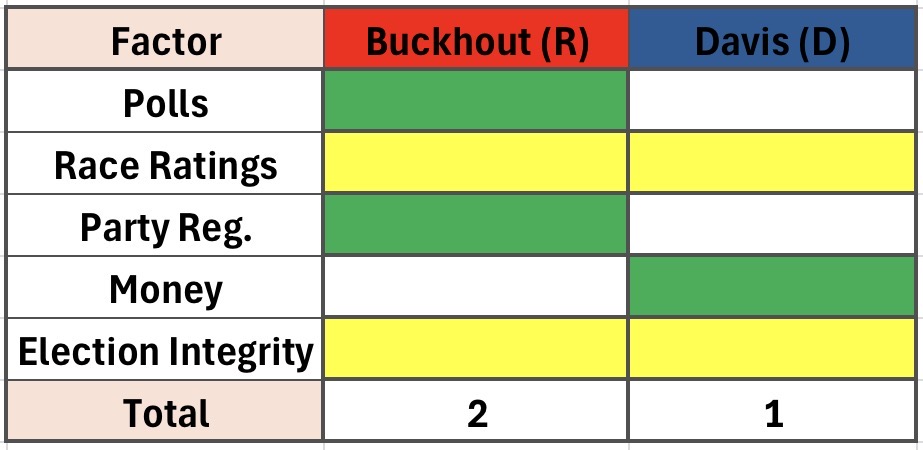
Davis’s only real advantage is incumbency, which matters nothing to the six counties that were moved from NC-3 to NC-1. That is why the decision matrix looks like this:

Keshel's ten-point decision matrix for NC-1

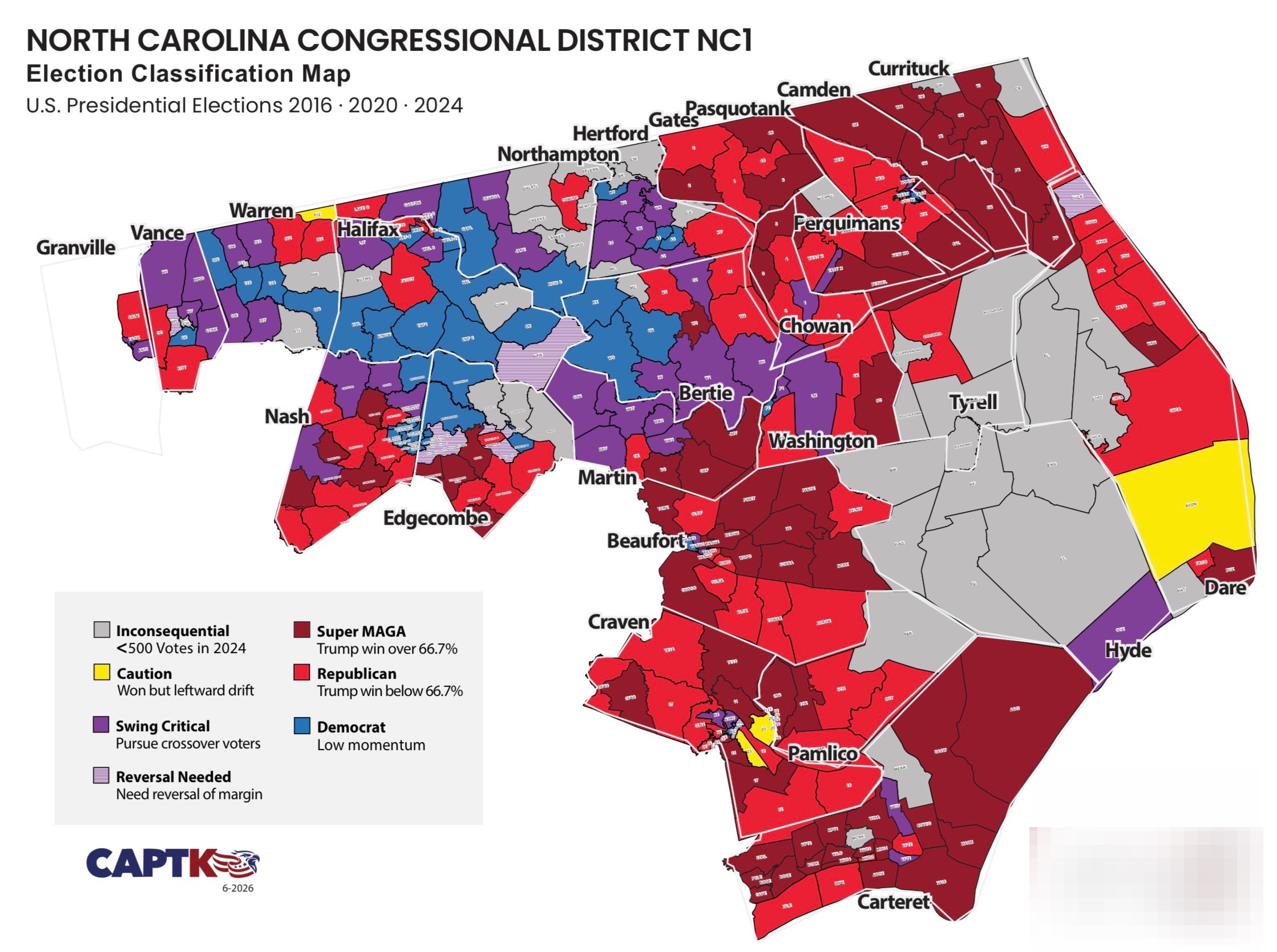
Davis has to mobilize a massive army of black voters that have waned in their loyalties to Democrats since the Obama high point of 2008. They are densely packed in the northwestern portion of NC-1, but up against much higher propensity white voters in the coastal counties. Additionally, most of the Trump-won precincts are classified as “Super MAGA” precincts in my proprietary mapping – denoting a 66.7% or higher share of the vote for Trump in 2024:

Captain K proprietary mapping of NC-1
Captain K Proprietary Mapping of NC-1

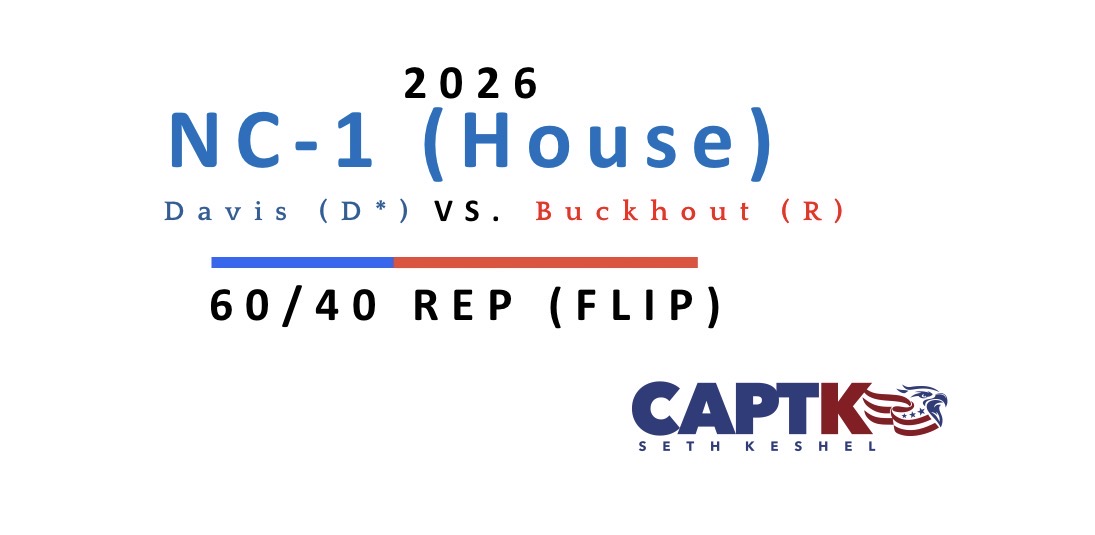
This is a Trump plus double digits seat with waning Democrat strength with a Republican facing an incumbent half the district is unfamiliar with. I think Buckhout has a fundamental edge, and by Election Day could have a very clear edge based on how partisan turnout shapes up next week.

Forecast for NC-1 House

Keshel's forecast for the NC-1 House race

This would constitute a successful redistricting flip; I feel better now about NC-1 than I do about NC-11, which is a very possible Democrat flip in a very red area thanks to candidate issues.

Seth Keshel, MBA is a Senior Fellow at the Gold Institute for International Strategy and a retired Army Captain. He publishes Captain K’s Corner on Substack.

Eli M. Gold and Omer Haim: Israel Two Years After October 7

Israeli flag waving at the Western Wall in Jerusalem

In brief

Eli M. Gold in conversation with Omer Haim at Remembrance and Renewal: An Evening for a Stronger Israel, the Gold Institute gala at the Waldorf Astoria Beverly Hills, on Israel two years after October 7.

Omer Haim, Distinguished Fellow and former Israel Ministry of Defense Representative in Washington, recounts October 7 from inside Israel’s defense establishment in Washington and discusses the war with Hamas, the question of who will govern Gaza, and how Israel and its partners can prevent another October 7.

Presented by Eli M. Gold, President President, Gold Institute for International Strategy