

Derek Merrin (R) vs. Marcy Kaptur (D-inc.)
I. The Race
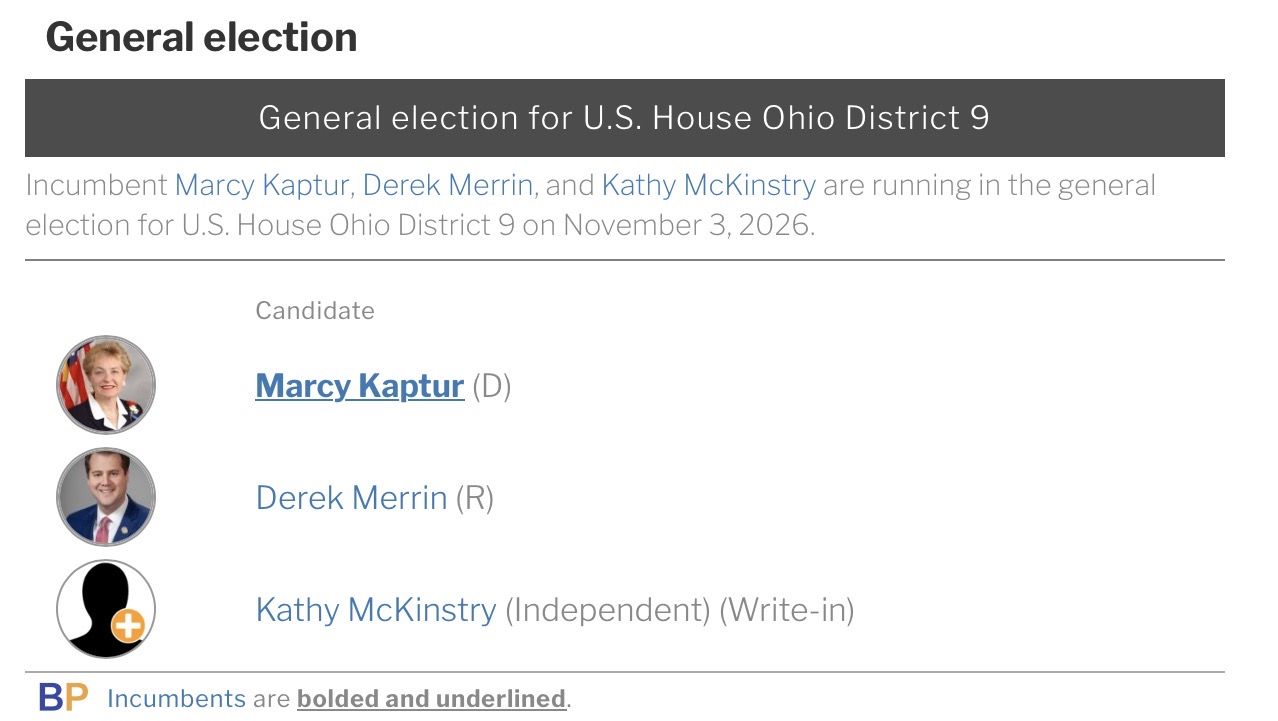
Derek Merrin (Republican) is a former member of the Ohio House of Representatives who is locked into a 2024 rematch with Kaptur, but this time with much friendlier district boundaries at his disposal.
Marcy Kaptur (Democrat) is the longest-tenured woman in Congress, and seeking a twenty-third term after barely surviving Merrin’s surge in President Trump’s statewide romp in 2024. For perspective, I turn 42 next month; Kaptur was wrapping up her first term when I was born.
II. District Geography
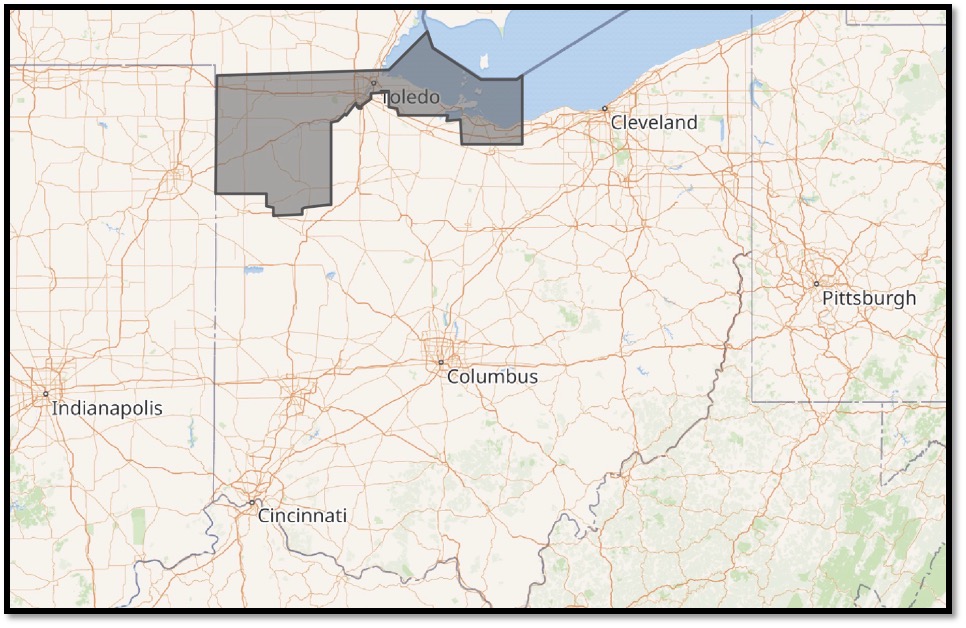
Ohio’s 9th Congressional District (OH-9) occupies the northwest corner of the Buckeye State and contains Toledo as its major metro area. These boundaries have been redrawn since the 2024 election thanks to the requirements of Ohio law, and OH-9 seems to be the seat in the bipartisan arrangement that was most gift-wrapped for Republicans to take over. OH-13, held by Democrat Emilia Sykes, was close in 2024 but made bluer by the redistricting commission, and OH-1 covering the southwest corner and Cincinnati was weakened (for Democrats) a little, but probably not enough to tip over in the 2026 cycle.
The new map removed the following from OH-9:
• Sandusky County
• The northeastern edge of Wood County closest to Toledo
The map added these counties:
• Henry County (Trump +46.5%)
• Paulding County (Trump +55.9%)
• Putnam County (Trump +68.5%)
Trump won the boundaries of OH-9 as they were in 2024 by 7 points. His performance was not quite enough to get Merrin past the entrench Kaptur.
Here are the approximate recent presidential margins for the new boundaries:
• 2016 Trump +5.0%
• 2020 Trump +6.0%
• 2024 Trump +11.0%
Key Statistics
• 74.5% White, 12.0% Black, 7.2% Hispanic
• 86.0% Urban, 14.0% Rural
III. Market Assessment
Despite the geographical disadvantage, Polymarket bettors are still throwing in with Kaptur – a heavy favorite in the market.
IV. History
To write a history of OH-9 in its various shapes and descriptions over the past four decades would essentially be to write a biography of Kaptur. She has hogged the seat for far too long as a career politician posing as a public servant.
Prior to the 2024 race, and thanks to much friendlier ideologies and boundaries, Kaptur never had a close call. She often won by Pelosi margins, taking over 70% of the vote. In 2024, with Trump on his way to a +11.2% win statewide in Ohio, Kaptur barely held the line against Merrin:
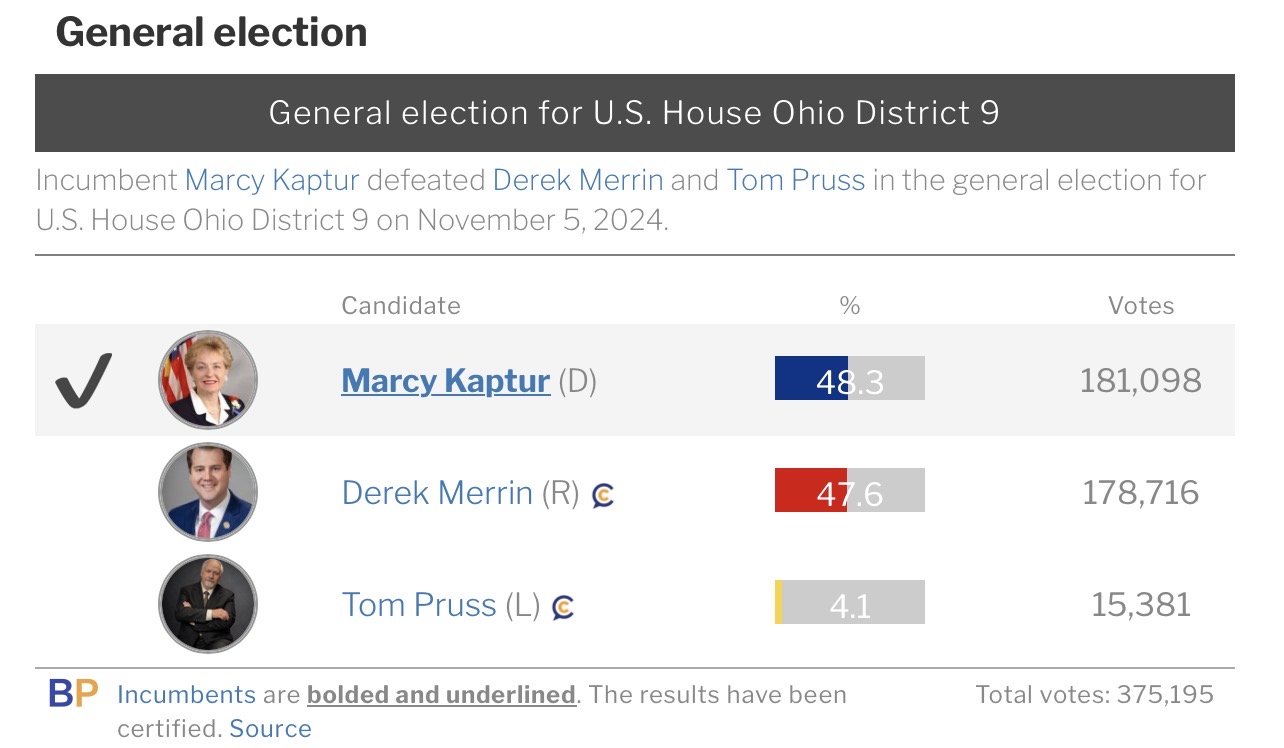
2,382 votes, just 0.7%, separated her from her GOP challenger. Tom Pruss, the libertarian on the ticket, and given who is voting Democrat in OH-9, I’d bet his presence on the ticket hurt Merrin the most. Either way, Merrin is back for round two, and this time in a district with four more points of presidential margin at his back.
V. Analysis of 2026 Primary Results
Kaptur, unlike many entrenched Democrats, faced no challenger in the Democrat primary.
Merrin had to fend off a field of opponents, and prevailed by a +18.8% margin over Josh Williams, the second place finisher:
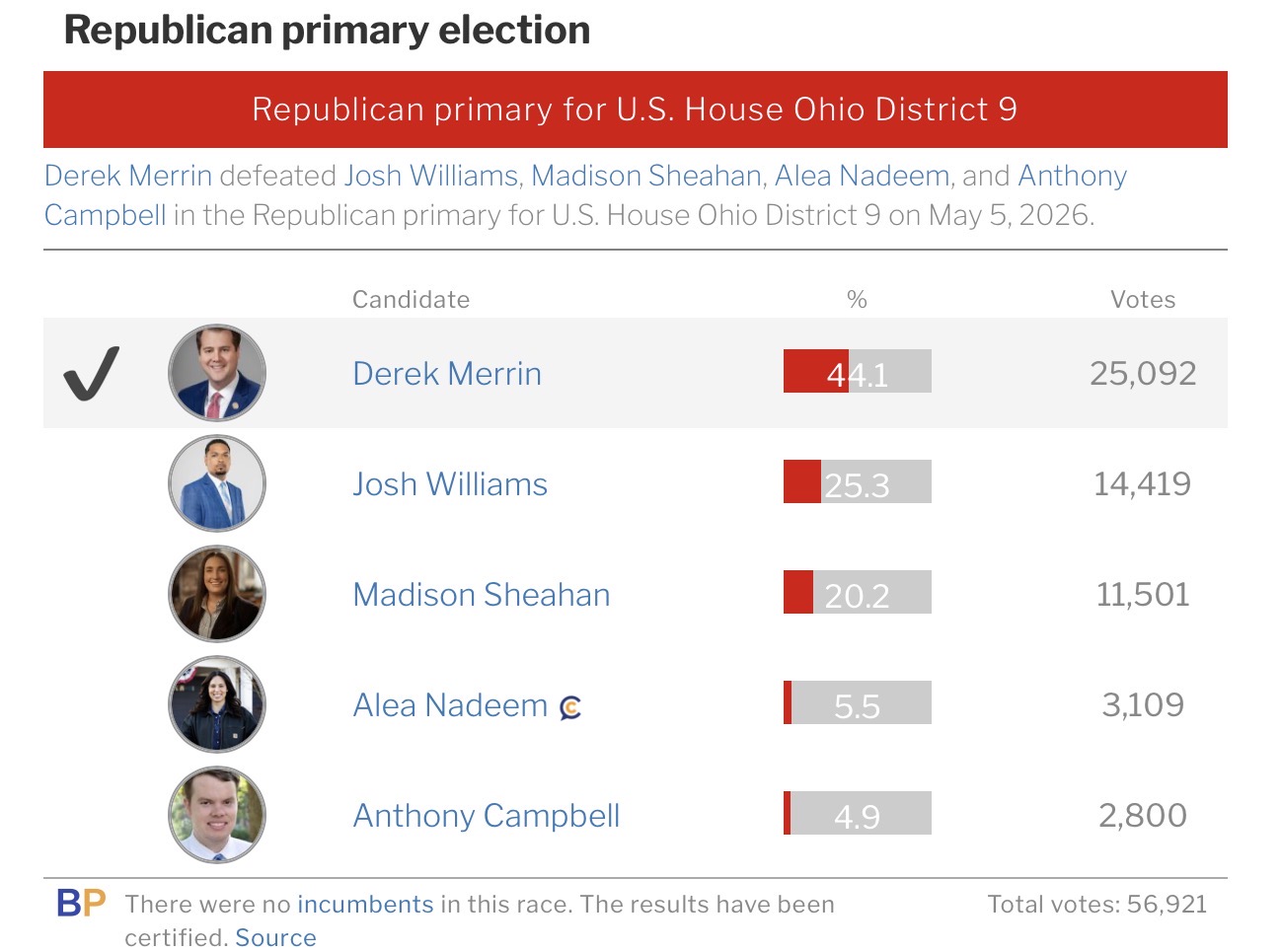
The GOP primary was full of mud-slinging and personal attacks, but the candidates have moved on and backed Merrin – and so has President Trump.
VI. Polls
These polls were pulled from The New York Times:
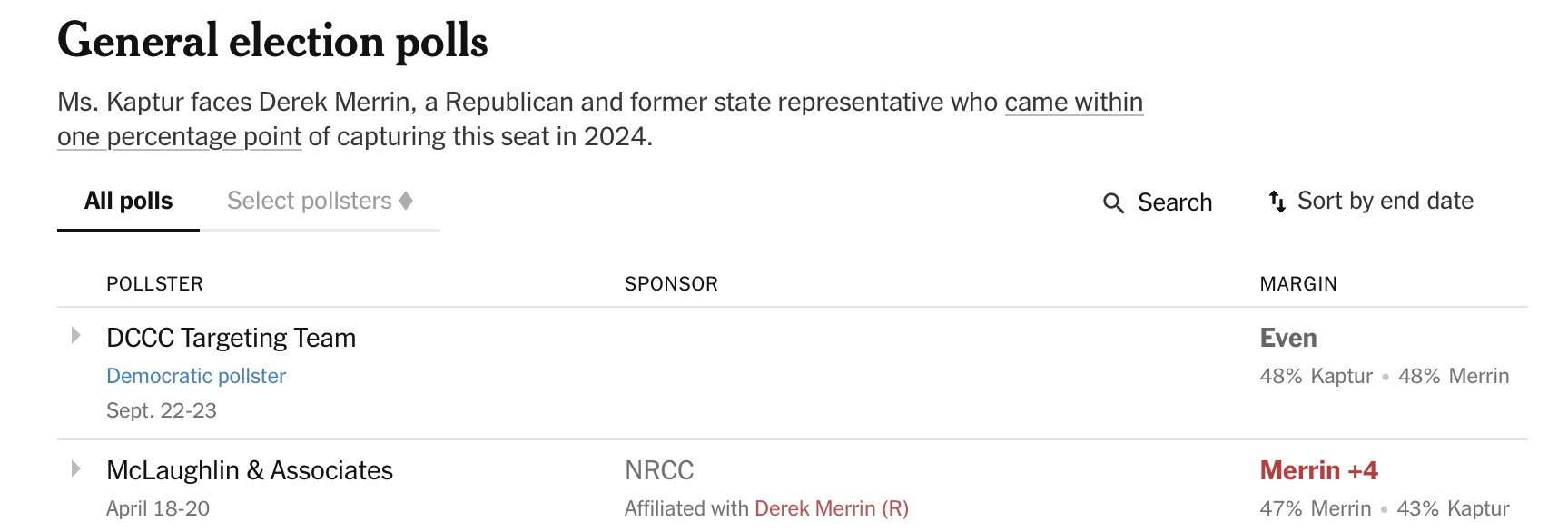
The McLaughlin poll is old, but shows a four-point lead for Merrin. A recent Democrat-sponsored poll shows a tie, which is not a good poll for Kaptur given who paid for the result. I will award a slight edge to Merrin in this category.
VII. Media Ratings
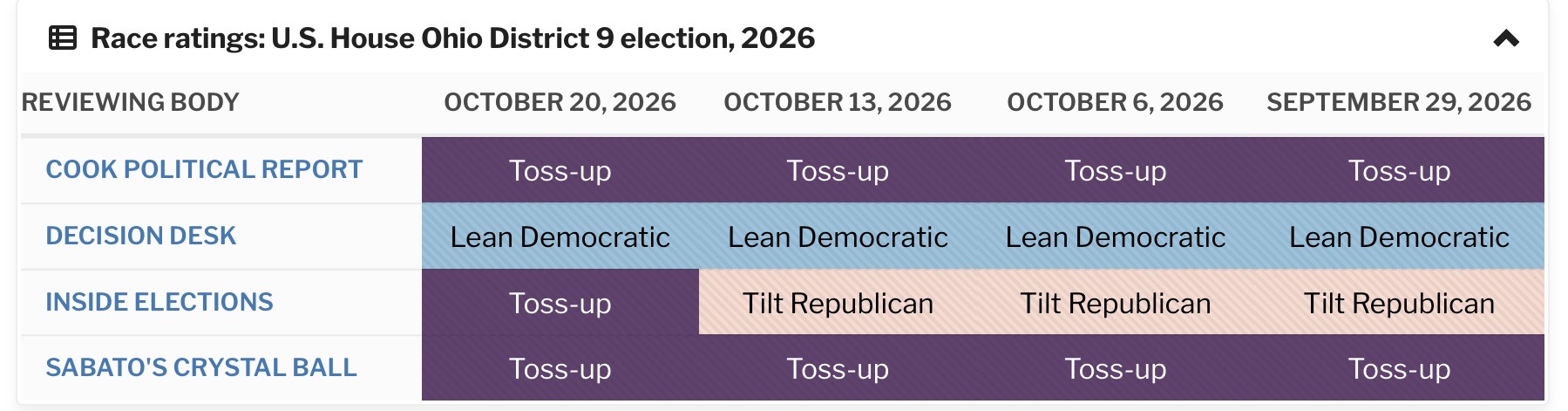
Decision Desk is a Kaptur believer, but the three other reviewing bodies I consider have the race scored a “toss-up.” Until the most recent update, Inside Elections favored Merrin, albeit narrowly.
VIII. Party Registration
Ohio does not register voters by party; however, based on similar county profiles in Pennsylvania, it is highly likely OH-9 would have a notable rightward drift in registration if we had such information.
IX. Election Considerations
Here is what I had to say in my write-up of the greatest unforced error in the race for the majority, OH-7:
Fortunately for Miller, Ohio has done a relatively strong job of sealing up election loopholes and has ensured they have control over the limited mail-in balloting that exists in the Buckeye State. I wrote up Ohio’s election details in the aftermath of the 2024 election for those of you interested in understanding how election integrity impacts races there. In short, there will be no late night ballot dumps impacting this race.
X. Summary and Election Estimate
Ohio Republicans, at fault for showing mercy to Democrats when they could have flipped three seats, got the redistricting job done enough to imperil Kaptur’s seemingly endless career. They have set OH-9 up for a clash of two worlds: MAGA-land vs. Toledo. Have a look at my proprietary mapping of the new boundaries:
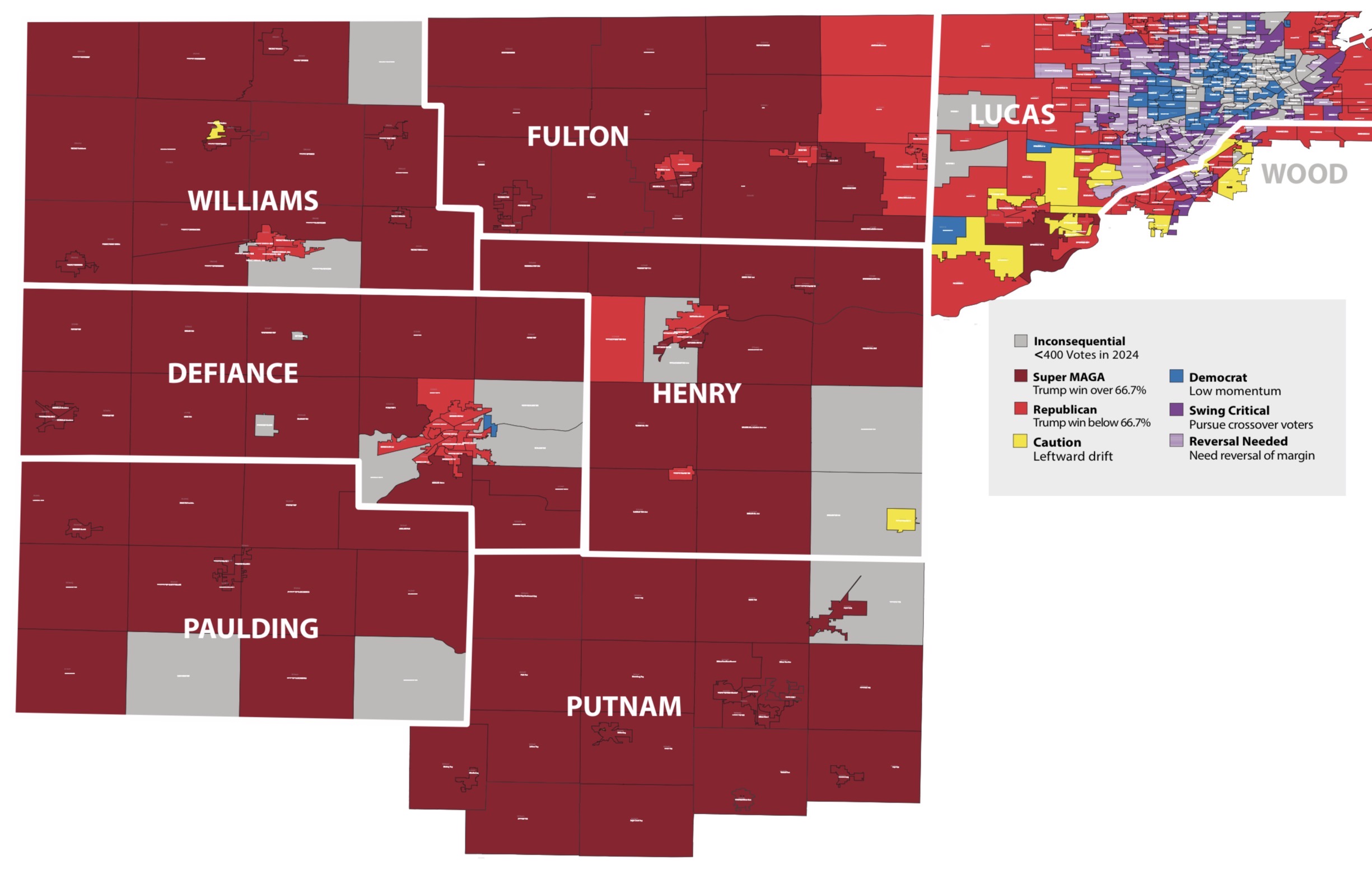
This map excludes some of the far northeastern portion of the district, but I’m presenting the snippet this way with clarity in mind. Those crimson-shaded precincts are what I label “Super MAGA” precincts. Trump had 66.7% or more of the vote there in 2024, and there are no signs of leftward lurching. Lucas County, the home of Toledo, even has some friendly Republican precincts (regular red shade, no leftward drift, won by Trump but with less than 66.7% of the vote), so the entire county isn’t destroyed by the urban spread.
Toledo itself has a mix of Democrat-rated precincts (blue, Trump at less than 30% of the vote and often in low single digits for overwhelmingly black precincts) and working-class precincts with rightward momentum (solid purple). In a geographic arrangement like we find in the new OH-9, Kaptur needs two things to happen to win:
• Poor turnout in the crimsons
• Massive turnout in the blues of Lucas County
Right now, Lucas County ranks 62nd out of 88 counties in Ohio, close to the bottom quarter, in terms of how much of its 2024 presidential vote count it has already turned out in 2026. To make matters worse, the turnout in Lucas County that has already happened is disproportionately from precincts less likely to overwhelmingly back Kaptur. If the city doesn’t vote, she can’t win.
The decision matrix for this race looks like this:
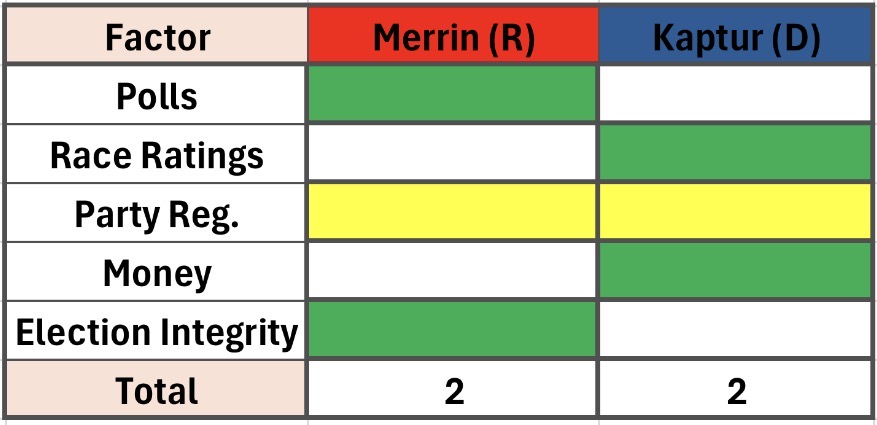
Just as I have given Merrin the edge for inconclusive (but telling) polls, I gave Kaptur an edge for race ratings because she has just one outlet thinking she will win. Kaptur’s only real advantage is with money, a field in which she has massively benefitted because every special interest group in America is trying to save her career from what looks likely based on what I can read (and I don’t read polls).
Forecast for OH-9 House
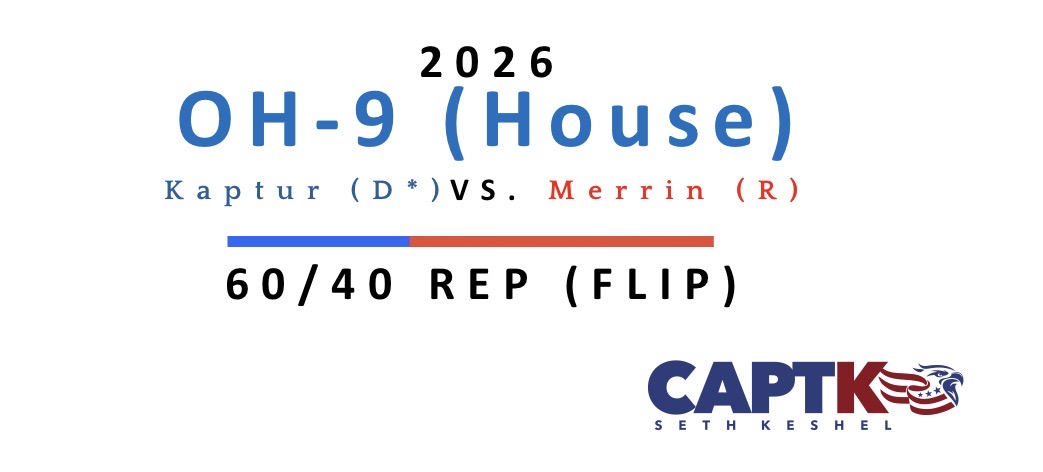
I feel fairly confident Kaptur has reached the end of the line. This seat, just like the redrawn NC-1 seat, is a must-win for Republicans if they hope to hold their majority in the House. It is too strong presidentially, with voters trending almost uniformly in the right direction, to lose unless the entire brand is weighed down with too much baggage to defend all the seats up for grabs successfully.
Democrats can take the House without holding OH-9 (and NC-1), but if they manage to keep this seat, then I don’t see them missing out on the majority. Still, the fundamentals remain – if Toledo doesn’t vote, Kaptur goes into retirement.
Seth Keshel, MBA is a Senior Fellow at the Gold Institute for International Strategy and a retired Army Captain. He publishes Captain K’s Corner on Substack.

