And South Carolina, and Iowa, and Kansas, and Mississippi…
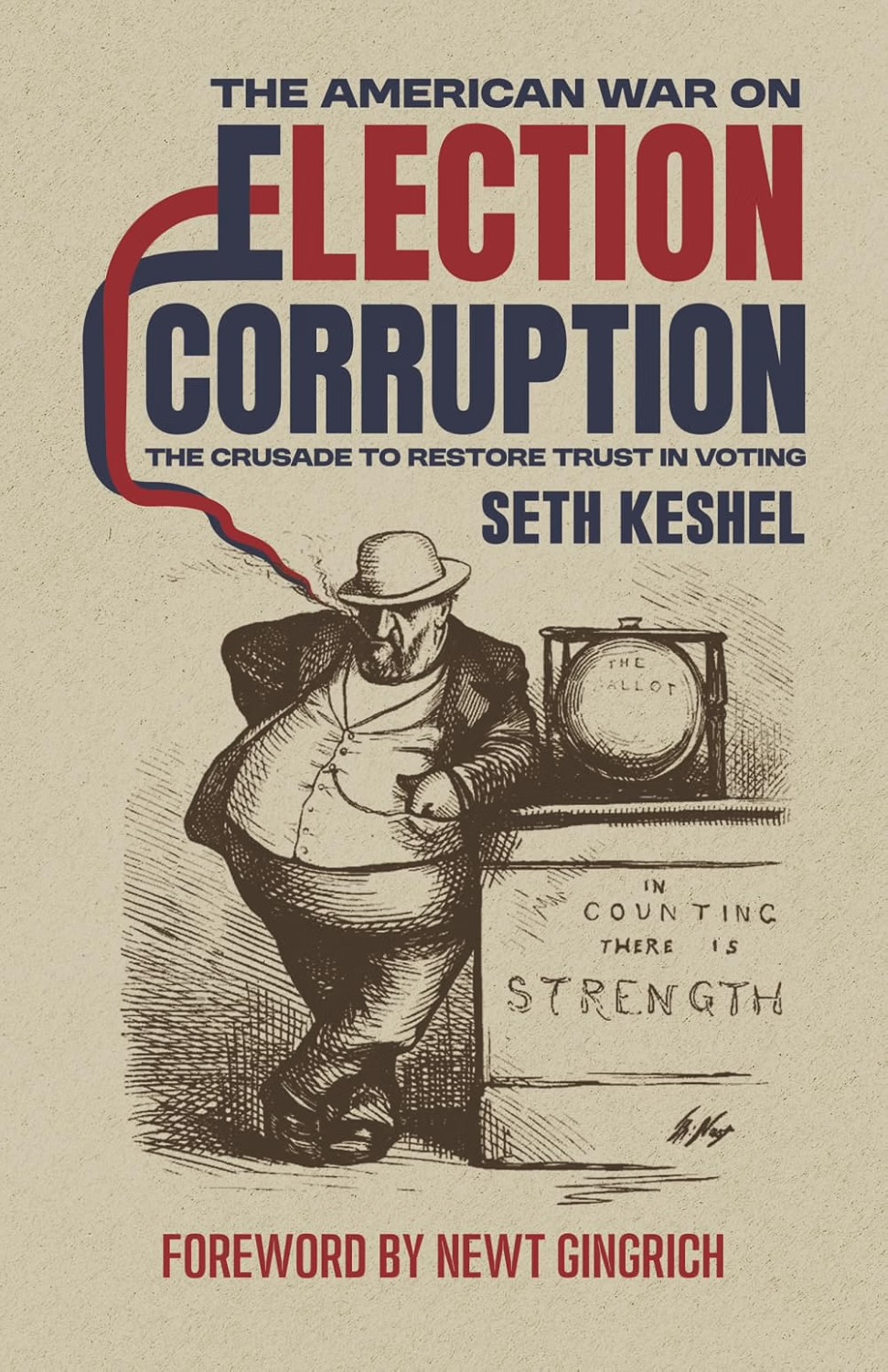
A lot of you reading my newsletter know I got my public start in the aftermath of the 2020 election. For years, I traveled the country providing statistical proof of cheating (some of it legalized) that impacted the distribution of electoral votes favoring Joe Biden’s rise to the White House. President Trump magnified my work, and I even wrote a book about it:
Do you know what has been instrumental in my capacity to gain an audience on this topic? Credibility. That’s why someone like Newt Gingrich, who has been in the political world longer than I’ve been alive, wrote the foreword to The American War on Election Corruption. If we are going to raise our swords on a topic that impacts the fate of the West, then we must ensure we have our ducks in a row before we put out any wrong information discrediting the effort to save America’s elections.
And this is where I need you to read on, and not misread what I’m saying even now. I have been under a lot of pressure since last week to come out and declare every loss – especially the losses in Texas – as stolen. Because I don’t aim to be first, loudest, or most dramatic with any announcement, and haven’t been any of those things since last Tuesday, some think someone “got to me,” or that I’ve lost my nerve. Meanwhile, I am probably the only person you read who thought we ran garbage elections in 2024 – a GOP popular vote win for the presidency and a hold of the House and Senate. Here’s your proof:
National Recap – 2024 Election Compendium
Elections rely on the public trust that their outcomes are verifiable, genuine, and reflect the real intent of legal voters. I can no more prove the election of James Talarico or Gina Hinojosa than I can prove the election of William Henry Harrison as president in 1840. Society’s acceptance of election results is essentially the only thing that gives elected governments the ability to govern. We associate election outcomes like the 2020 election with the loss of a beloved figure, but the underlying trauma is to the system people no longer trust. We can observe and dissect many elections in recent years unworthy of the public trust and highly indicative of cheating that has now been enshrined in the laws of the various states.
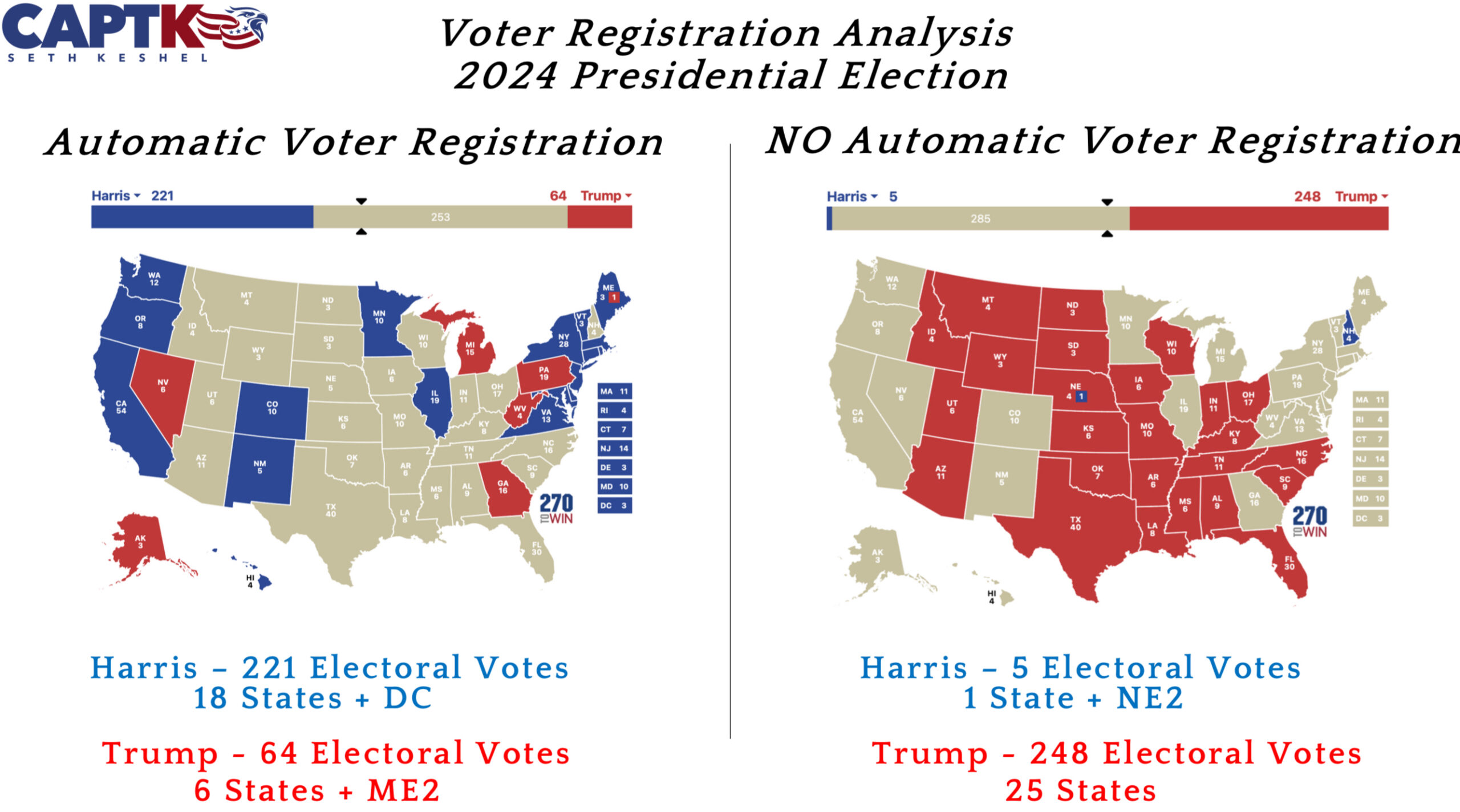
Elections, as far as my research can show me, fluctuate in quality and consistent statistical trend lines based on how well-maintained (or the reverse) their voter rolls are. States with Automatic Voter Registration have the worst voter rolls and unsurprisingly favor Democrats overwhelmingly:
New Jersey Governor Mikie Sherrill, faced with a grease fire earlier this year over her state’s system registering non-citizens, tried to get in front of what is certainly a much bigger number of registrations than she wants us to know about:
Sherrill’s Voter Roll Cover-Up is the Tip of the Iceberg in New Jersey
Essentially, if you’re new to reading my work and disappointed I haven’t landed a 90-page paper on Attorney General Paxton’s desk, I’m telling you that I believe our elections weren’t worthy of the public trust long before November 3, 2026. Ironically, the biggest impediment to getting the transparency everyone needs to either accept or deny election results can be found right in our own mirrors. I will explain this point later.
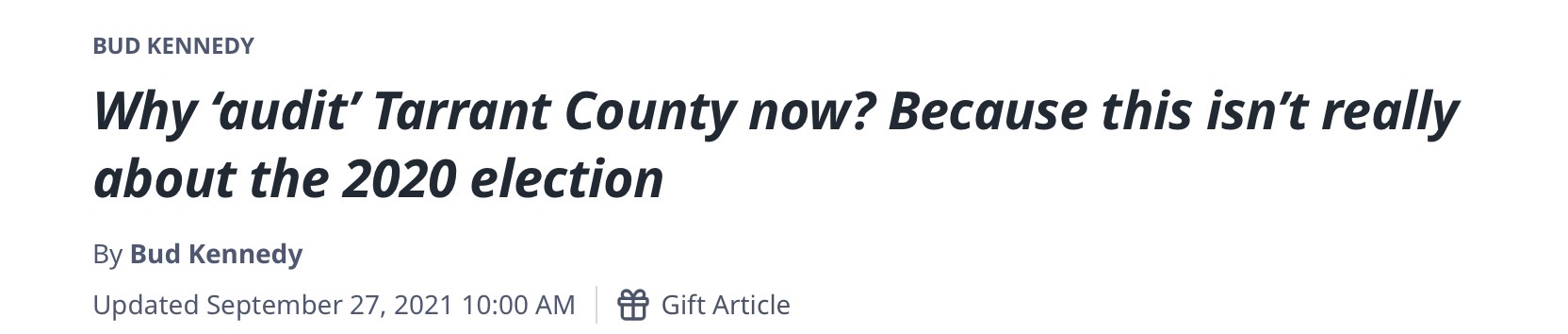
Let’s wind the clock back. Since Texas is the most traumatic of all losses Tuesday, I’ll focus there. I used to live in Texas and understand the voting characteristics of all 254 counties with tremendous familiarity. I know them so well that I cried “foul” after Trump’s win there in 2020. Here’s a local receipt from a nut job journalist from Fort Worth proving my case.
While people want to eviscerate me for exercising tactical patience on election outcomes this week, they were nowhere to be found regarding Texas in 2021 – after Trump won it. I was of the opinion that it was targeted for Biden as well, especially after an intense propaganda campaign suggesting he (Biden) was in the mix to carry it. Georgia, Arizona, and the Midwest proved to be much softer targets and there was no need (or ability) to go for broke in Texas as the results came in, so Trump took it for the 11th GOP presidential win in a row there.
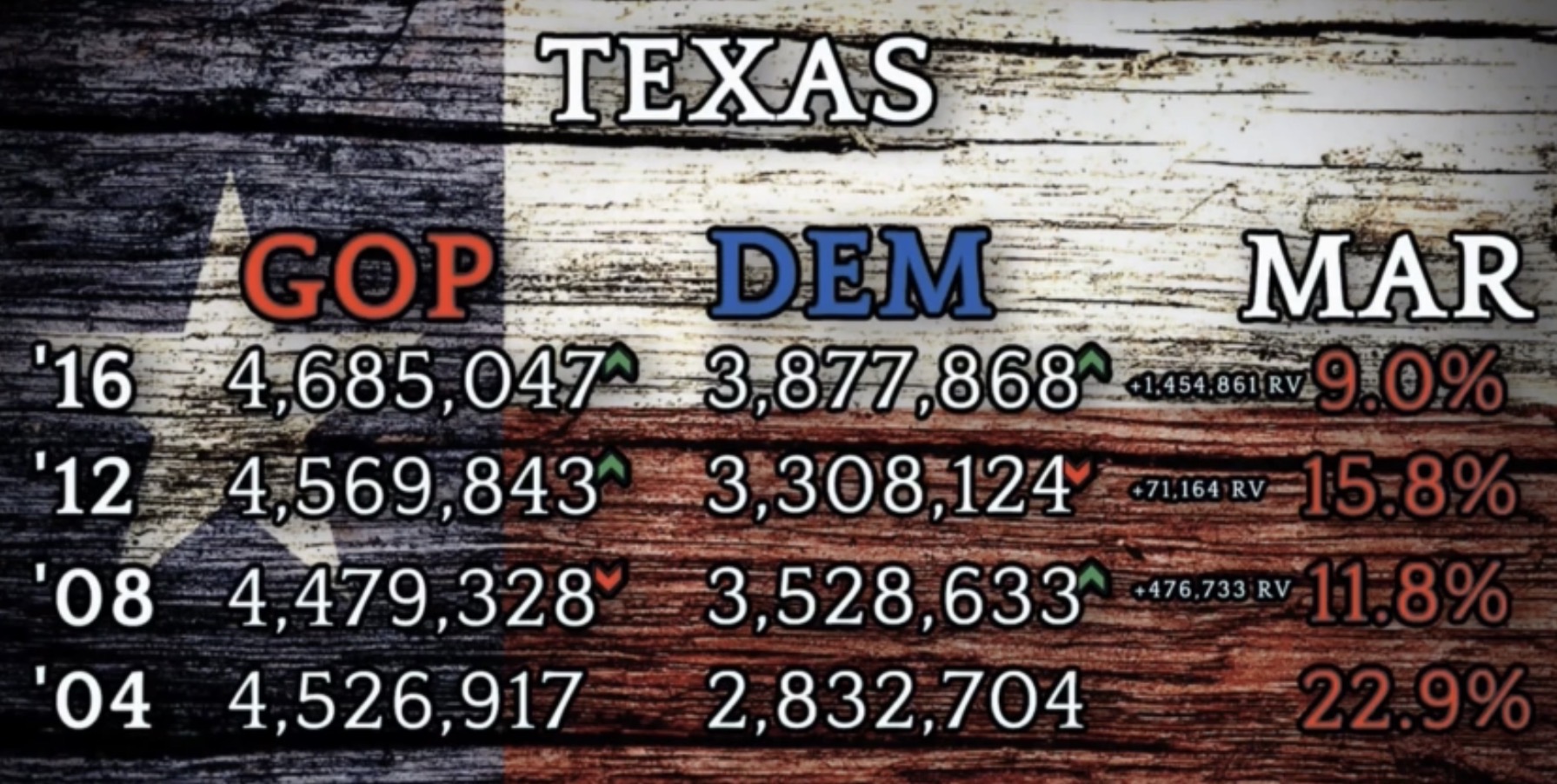
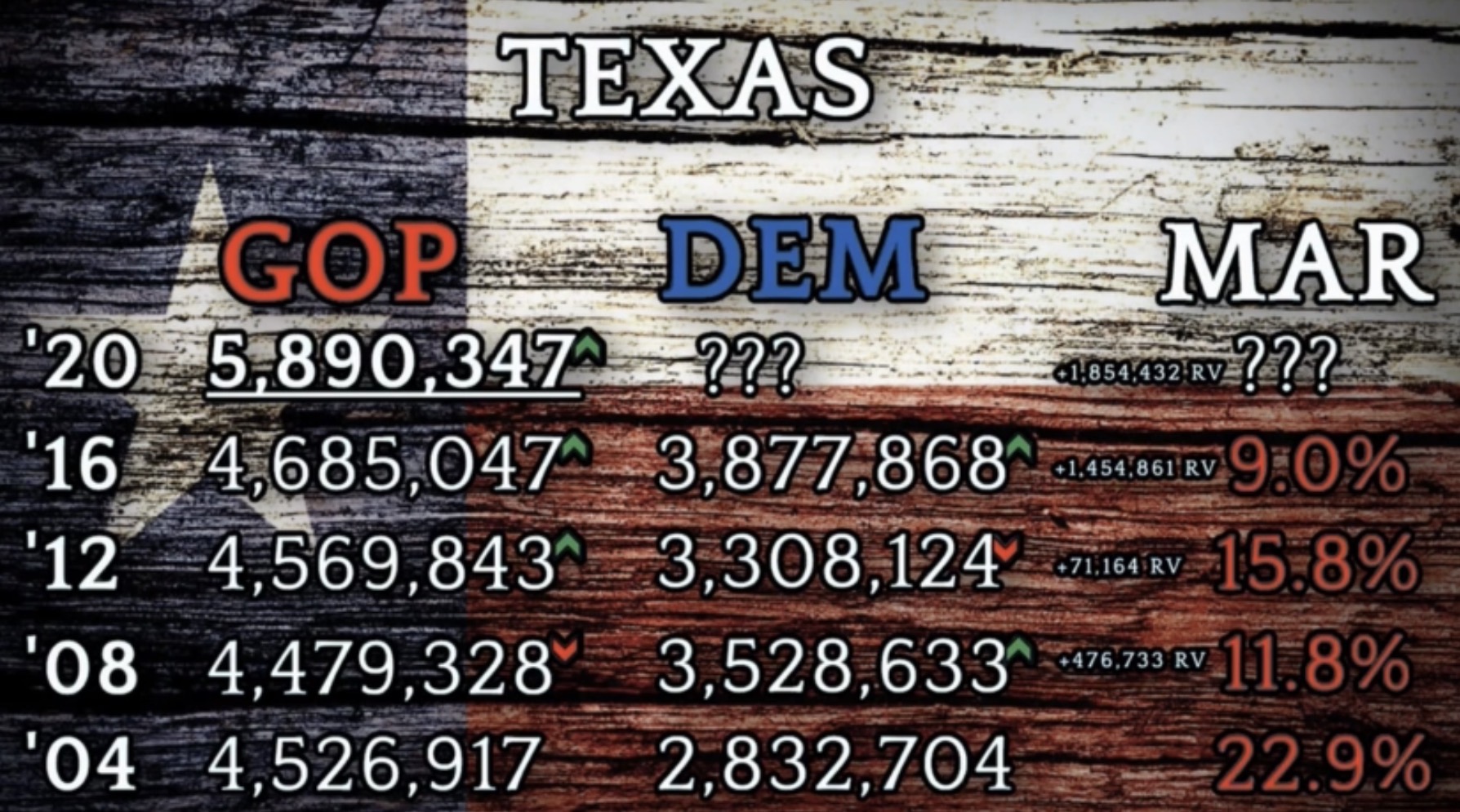
I was blown away by how many votes (or “votes”) Joe Biden had there. After last week’s results, I revisited my 2020 analysis of Texas and will go through it here. Joe Biden had up to 840,000 more votes than I would have expected based on where Trump’s 2020 performance came in. Here’s the starting point for my 2020 analysis of Texas:
GOP presidential candidates in Texas remained stuck in the same range of votes, from 4.48 million to 4.69 million, for four elections in a row. In a state the size of Texas and with its growth (especially its addition of new GOP voters), this is not good and is exactly how the opponent can catch you in a wave year, especially with so many large urban areas strewn about. Bush’s 2004 margin is artificially high given his Texas roots, but Romney’s 2012 margin recovery shows Texas as a clear double-digit red state at the dawn of the Trump era.
Trump’s feud with Ted Cruz, his strangeness to rank-and-file conservative voters, and the Hispanic and suburban arrangement of Texas all contributed to a suppressed 9% margin of victory in 2016, with Clinton +349,255 over Obama’s 2008 total and +569,744 over his 2012 total, which was down from the first-time sugar high. Trump’s total is only +115,204 up from Romney’s in 2012. The same gain in 2020 would have put Trump just over 4.8 million votes – certainly enough to fend off Democrats for another cycle even if margins continued to tighten. Here’s where Trump came in:
5.89 million votes.
Trump added over 1.2 million net new votes from 2016, a record gain for the GOP presidential nominee (including George W. Bush) for one cycle, and more than 2 million votes ahead of Clinton’s 2016 count with many flipped voters (Latino) and a reconsolidated GOP voting base no longer reeling from the Cruz-Trump debacle.
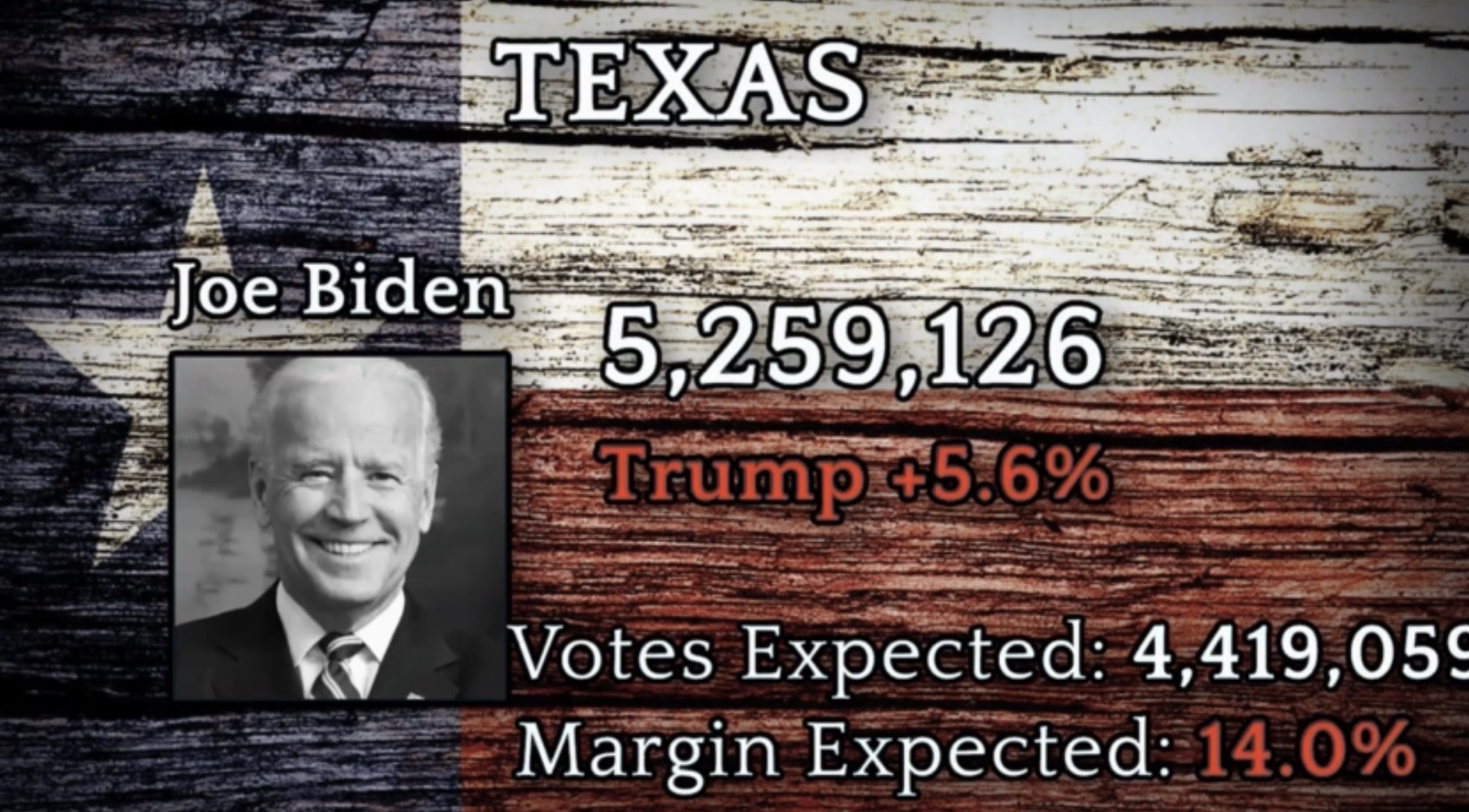
Remember when I told you that prior to Trump in 2020, Grover Cleveland in 1888 had been the only president to gain votes nationwide and not be reelected? That is because when you extend a lead you already have and take voters your opponent needs to get back into the game, you pull away. There should have been very little left in the tank of likely voters for Biden to pull from, and cracking four million votes even looked like a stretch. Even giving Biden a gain equal to Clinton’s 2016 gain over Obama would have put him at just over 4.4 million. How did Biden do?
Biden overran the Clinton estimate, already generous, by more than 800,000, and posted a net gain from 2016 of nearly 1.4 million – higher than Trump’s GOP record and putting him nearly 600,000 votes ahead of Trump’s winning total from 2016. Put simply, had Trump had the standard GOP gain from 2012 or 2016 (his own gain), he would have lost to Joe Biden by a half million votes.
And barely a soul wanted to talk about the 2020 election in Texas, despite it matching the same model that did overwhelm Arizona, Georgia, and other states on the map that year. Attorney General Ken Paxton, who hosted me in 2021, knew Democrats were after the state and didn’t trust the results:
Alright, so why were the 2020 results in Texas so bizarre? I don’t think this research will surprise you:
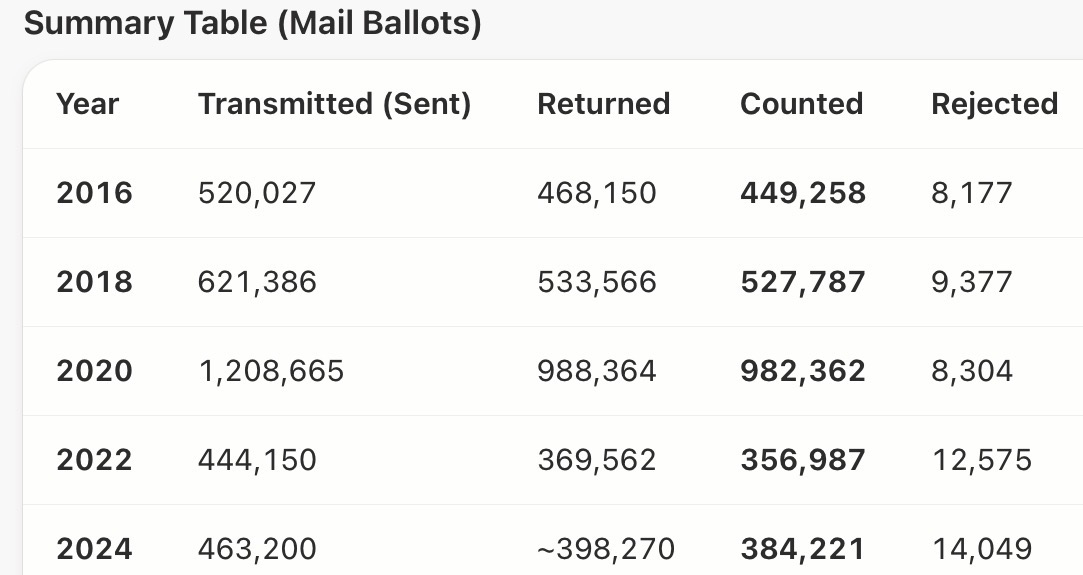
2020 – Mail-in Ballots (Texas)
Sent 1,208,665
Counted 982,362
Do you notice the difference when the 2020 election is surrounded by its adjacent elections?
It dwarfs the 2016 and 2024 presidential elections, swallows up the 2022 midterm, and distantly outpaces the 2018 midterm which featured a near flip in the Senate race between Beto O’Rourke and Ted Cruz (which had a high mail count for a midterm).
Now, how many mail-in ballots does Texas account for in its uncertified results for 2026?
266,772, according to Transparency USA. Please note, that’s an unofficial number subject to change, but it would appear Texas has whittled mail-in ballots down to its lowest count in at least a decade. Does this mean the election in Texas was clean last week?
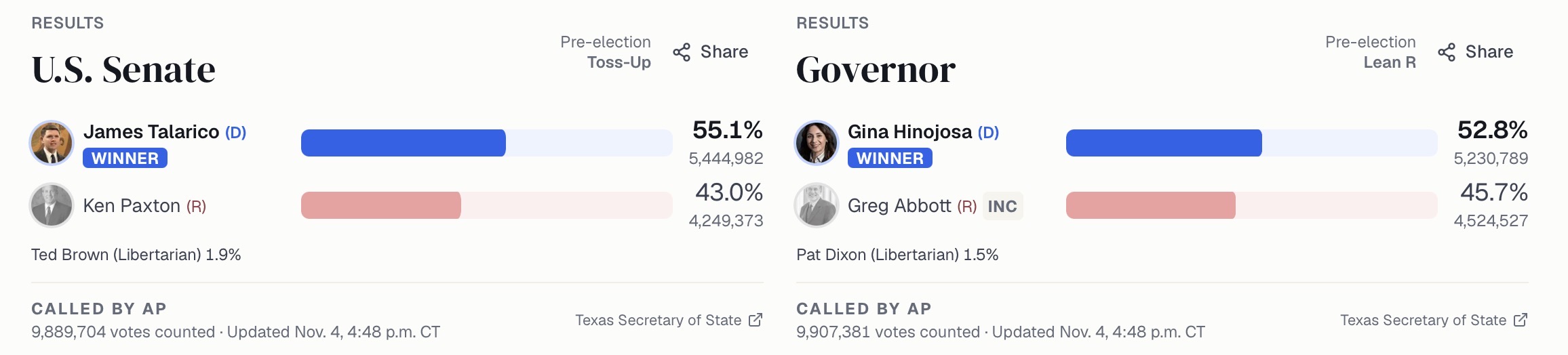
It simply means the margins below (and other statewide Democrat margins) are not contained in mail-in ballots alone:
Even if we give every mail-in ballot to the Democrat statewide candidates, their vote counts still exceed those of their Republican opponents. I have remained ambiguous on the topic for these two reasons:
If there is corruption in the 2026 election, it doesn’t match my 2020 modeling, where the GOP candidate (Trump) had booming and growing vote counts yet nearly got caught from behind. Hinojosa has a total within 1% of Biden’s 2020 count, which went uncontested but also took place before the last six years of population and registration growth. Abbott’s totals are consistent, but should be much higher with population growth and the arrival of new GOP voters from other states.
If it’s corrupt, it isn’t because of the mail. That is at a low level compared to previous elections. It would have to be machines and the electronic elections infrastructure.
My 2020 analysis makes it clear that at least several hundred thousands of Biden “votes” can be attributed to the doubling of mail-in ballots in Texas from 2016/18 to 2020. Trump should have carried the state by double digits given his massive gains and improvements with Latino voters. I was willing to say it about Texas, but no one wanted to hear me because Trump won. Republicans won up and down the ticket. COVID. Blah, blah.
And here we are in 2026, victims of our own strategies. The only candidates in Texas, or any state, in position to call for transparency (audits, reconciliations, equipment and ballot inspections, reviews of any nature) are those who won their races anyway. This is why, in the closing days of the Trump 45 administration, I urged my contacts to do everything possible to dig into North Carolina, a state that was targeted but not successfully ripped off (which is why they moved on to Georgia).
What’s 300,000+ Fictitious Votes Between Friends?
2024 was the year to pull out all the stops on election audits and reviews. Instead, people slammed the hood and said “good enough,” taking the short-term happiness and leaving behind the only real opportunity we had to get the answers we need. Read my compendium linked at the top of this article. Several House and Senate races were ripped off, especially in states Trump was declared the winner of. Some of them tipped over in the wee hours of the morning, just like in 2020, in states like Michigan and Wisconsin. It took days to knock off Sam Brown in Nevada with the mail-in balloting apparatus. Don’t look at the incoming Democrat Senate majority and call the 2024 down ballot steals anything but a travesty.
Now, we are the people crying “foul” only after the results are bad. I am not saying they’re good, but I’m telling you that if they’re bad, they’re concealed in a way designed to avoid discovery, and they will require a winning candidate to play the ultimate game of “chicken.” I am aware of at least one such candidate in this country who won his race and is planning to call for a full investigation into the results – up to and including his willingness to step aside should it be determined he did not win his race.
I hope this makes sense to you as to why I’ve been restrained in my opinions about last week’s races. I am willing to wait to see what the administration, which briefed the nation on the vulnerabilities present in our electronic elections infrastructure, will do (and willing to see what they may discover), and I continue to support transparency in every aspect of how we do elections post-2020. But the biggest setback we have in getting the answers we need, especially in light of so many red flags, comes when we win big races and people have no interest in looking at the results. The errors limiting 2026 transparency were made two years ago.
So, no – I am not weak on election corruption. I’ve just had six years’ worth of experience in presenting election data that came with far more accompanying evidence (contradictory statements, irreconcilable records, disruption of all known trends, indicators, bellwethers, and predictors, and physical efforts to obscure election transparency) than I have to work with today, and still been told that I had “no evidence.” We must adapt our tactics if we want the truth – even if it’s an ugly truth we don’t want to hear.
There are legitimate political and midterm factors that paint a less-than-rosy outlook for Republicans in a 2026 midterm environment; they aren’t what people want to discuss today, and since the number one priority is in arriving at the truth of election corruption, cyber must be the priority, and only those who won their races are in a position to drive the action.
Seth Keshel, MBA is a Senior Fellow at the Gold Institute for International Strategy and a retired Army Captain. He publishes Captain K’s Corner on Substack.