The Coming Crisis of the Republic

Cover image from Seth Keshel's piece The Coming Crisis of the Republic

The climax of the Fourth Turning?

Several years ago, I put out a list of books that I believe are important for self-development and accumulation of wisdom:

A Captain’s Library: 10 Must-Own Books for Growth and Development

One of those books is The Fourth Turning:

Neil Howe and William Strauss

A well-known classic in some circles that is often branded as conspiracy, but the generational cycles and their supporting theories are laid out in convincing fashion. The reader will discern that western, especially American, civilization is in the thick of a Fourth Turning, which is a conclusion to an 80-year cycle that has governed history for centuries, if not longer. I found it most interesting when the authors clearly described the three full cycles of American history concluding with the American Revolution, Civil War, and World War II, respectively, all roughly 80 years apart. This read is fascinating, but a bit dry and may be best on audio.

It sounds a little kooky and contrived, but when you read through the authors’ points, you’ll see that their cycles have come to fulfillment over and over again for centuries. The surviving author, Neil Howe, wrote a book called The Fourth Turning is Here in 2023, and believes we entered it around the start of the Obama era. The generational theories assert that there are four cycles lasting roughly 20 years each in a saeculum:

First Turning – the period after the climax; a time of unity and peace. Consider the post-WWII boom in America with her emergence as world super power.

Second Turning – the period of challenging and testing of institutions. Think of the radicals of the 1960s, with America still strong.

Third Turning – the period of decline. This began in the 1980s, with many negative trends related to family life, divorce, disease (AIDS epidemic), and public morality (Clinton in office). The country still has strength.

Fourth Turning – the crisis period. If we consider WWII’s end the climax of the last Fourth Turning, then we are now 80 years in the future and arguably at the climax of this crisis period and perhaps nearing the onset of the next Fourth Turning.

The three previous crisis periods in American history ended in our favor:

World War II

The Civil War

The American Revolution and the Founding of the Republic

What’s the Crisis?

Ever since I found out about the “Fourth Turning” theory a decade ago, I have been anxiously awaiting what could be the climax point. There is no guarantee it will resolve well, but if the pattern holds true, this period of great anxiety may be accelerating events that will come to pass in the very near future. As I pondered the outcome of Tuesday’s elections, it dawned on me.

I have always expected that the Democrats would take the House. I wrote about it 21 months ago, when President Trump still had positive approval and was busy checking off campaign promises – long before Iran or any other issues dragging the ticket kicked in. There is not one analyst who expected Democrats to approach 260 seats in the House.

Likewise, even the most negative analysts had trouble seeing Republicans with fewer than 47 seats. It looks like it will be 44, a true wipeout with longstanding ramifications for the judiciary. Karl Rove even thought the Senate would split at 50-50. Based on consensus expectations, many figured Democrats would have a narrow enough majority that the DSA would have a seat at the table and make it difficult for Hakeem Jeffries to wield much authority as Speaker of the House. Jeffries, thanks to the size of this majority, will face no resistance. Even a 51-49 Senate majority, especially with Fetterman representing one Democrat seat, would have made Democrat extremism hard in that chamber. Not anymore.

Democrats are almost certainly going to impeach President Trump, perhaps multiple times. We are talking about a party that made up a Russian collusion story and used their media allies to circulate it for years, with a special counsel appointed to sandbag Trump’s first administration and destroy his 2018 midterm prospects. They will go after one or more of these threads:

Iran conflict

Supposed family self-dealing

Frivolous matters related to properties, business, and estate

And to placate Democrat voters, the House will impeach with ease and have enough margin in doing so to allow red state or Trump-seat Democrats to abstain from voting for impeachment. Then, as social studies class taught you, an impeachment trial will take place in the Senate.

I am not confident the Uniparty will refrain from mounting a serious effort to convict and remove President Trump.

It would be the ultimate retaliation for more than a decade of ritual humiliation and reorienting entrenched goals away from global initiatives and forcing them to feign interest in the needs of the “forgotten man and woman.” If you think this is a pipe dream, look back to February 2021. The Senate voted 57-43 to convict Trump, including every Democrat and both independents caucusing with them. These seven Republicans voted to convict Trump:

Sasse (NE)

Murkowski (AK)

Cassidy (LA)

Burr (NC)

Toomey (PA)

Collins (ME)

Romney (UT)

This was all done with a 50-50 Senate. Of the names listed above, only Murkowski remains in the Senate; however, Romney was replaced by John Curtis, a snake in a suit from one of the weakest red states, and Collins is being replaced by Democrat Troy Jackson.

Provided Democrats win Alaska, as seems likely based on exactly what I warned about, they will have a 56-seat majority, and almost certainly 55 votes subtracting John Fetterman. They will have the support of Murkowski and Curtis to convict President Trump on whatever “trumped up” charges are forwarded from the House, leaving us with these math needs:

10 Republican Senators out of the remaining 42. Just 23.8% of the remaining Senators, who will be presented the option as if it were the way of saving the Republican Party from a grim electoral fate.

Bill Clinton didn’t come as close to President Trump’s guilty vote count in his second term; still, the effort to go after Clinton as the economy grew by leaps and bounds poisoned the GOP’s 1998 midterm hopes (leading to Democrat gains) and put Clinton on a redemption arc that outweighed his legitimate scandals and shortcomings.

I do not know if 67 votes can be mustered to convict and remove Trump, but I am confident it is going to be very close, and will be the subject of a massive news cycle that stands to rally the country to Trump’s side even though things seem bad now. If Trump is convicted and removed, all of your electoral concerns are now out the window.

America would never be the same, and the people would be left in such a predicament that the results of this Tuesday’s midterms would pale in comparison. Democrats are acting as if they will have the restraint to not seek retribution. To believe that would require you to ignore the past 20 years of their retaliatory tactics and whopping lies.

Change is coming, and when it comes, the future will look drastically different than you think it does today. Be prepared.

Seth Keshel, MBA is a Senior Fellow at the Gold Institute for International Strategy and a retired Army Captain. He publishes Captain K’s Corner on Substack.

Yakov Elizarov on Who Pays for Tariffs, and Whether America Can Rely Less on China

Thumbnail of Maria Maalouf's Capitol Show interview with Yakov Elizarov on tariffs and China

In brief

Maria Maalouf interviews Yakov Elizarov on The Capitol Show about who pays for tariffs and whether America can rely less on China.

From the channel’s description: “On The Capitol Show, Yakov Elizarov tells Maria Maaloof why American manufacturers continue to buy certain parts and raw materials overseas despite tariffs. When a component is unavailable domestically, he explains, the manufacturer must decide how much of the added cost to absorb and how much to pass on to customers. He points to Frederick County, Maryland, where companies have used a foreign-trade zone to keep production costs down.”

Interview by Maria Maalouf Senior Media Fellow, Gold Institute for International Strategy

Peter Huessy on Debating the Nuclear Abolition Agenda

A naval warship's open missile launcher bays. Photo by mingche lee on Pexels

Senior Fellow Peter Huessy joined The John Batchelor Show to discuss the nuclear abolition agenda.

On The John Batchelor Show, Peter Huessy argues that nuclear weapons abolitionists threaten global security by undermining extended nuclear deterrence. He notes that Russia and China refuse to disarm and are developing low-yield tactical nuclear weapons, and contends that weakening deterrence makes conventional conflict and nuclear proliferation more likely.

Peter Huessy is a Senior Fellow at the Gold Institute for International Strategy, a Washington D.C. based foreign policy and defense think tank.

Listen on The John Batchelor Show

Beyond Technological Advantage: The Institutional Test of Military Power

Military drones lined up on a runway

Why Operational Relevance, Speed, Industrial Capacity, and Institutional Courage Are Redefining Defense

For decades, military superiority has been closely associated with technological advantage. Advanced aircraft, intelligence systems, precision weapons, and command-and-control networks have shaped how governments plan their forces and invest in defense.

That logic remains important. Technological advantage still provides important advantages, particularly when confronting sophisticated military threats.

But recent conflicts are challenging a fundamental assumption that has guided defense planning for generations: that developing the most advanced military capability necessarily produces the greatest operational advantage.

A technologically superior system may arrive too late, cost too much to employ repeatedly, or exist in quantities too limited to influence a extended conflict. Meanwhile, less sophisticated but adaptable and widely available technologies can generate significant operational effects.

One emerging concept, increasingly discussed in defense and procurement circles, captures this challenge using four principles, known as the 4E: Good Enough, Fast Enough, Cheap Enough, and Enough Stockpiles. The last principle points out not only maintaining sufficient inventories but also the industrial capacity to replenish losses and sustain military operations over time.

These principles raise questions that reach far beyond technology and procurement. They challenge how governments define operational requirements, assign resources, manage risks, and measure military effectiveness.

If defense establishments recognize the need for faster innovation, greater adaptability, and sustainable industrial capacity, why do so many continue to rely on decision-making methods designed for a more predictable security environment? Are they still preparing for yesterday’s battlefield?

The next transformation in military power may therefore depend not only on technological innovation together with on whether defense institutions are prepared to change how they think, decide, and act.

When Technological Excellence Is Not Enough

Modern military organizations have strong reasons to pursue technical advantage.

Cutting-edge capabilities provide greater precision, operational reach, protection, intelligence, and potential advantages over an adversary.

Complex systems require long development cycles, specialized manufacturing, maintenance, testing, and dependent supply chains. As complexity grows, so can the time and resources needed to produce and sustain them.

The challenge is knowing when sophistication creates meaningful operational value and when it reduces affordability, availability, or modifiability.

Relatively inexpensive drones, commercial technologies, electronic warfare, and rapidly modified software can create significant operational effects. Their value often depends on steady adaptation rather than technological perfection.

An effective solution today may become vulnerable to a new countermeasure within months. A system developed over several years may enter service in an operational environment substantially different from the one for which it was designed.

Extended conflict places pressure on ammunition stocks, maintenance, logistics, industrial production, and national budgets.

A capability that performs exceptionally well but cannot be replaced or sustained at the required rate may gradually lose strategic relevance.

The question is no longer only whether a military possesses superior equipment.

It is whether that military can generate, maintain, adapt, and replace sufficient operational capability throughout a conflict.

Technological advantage continues to be essential. But it must be connected to operational relevance, industrial capacity, and the ability to sustain military power under pressure.

The Institutional Problem Behind Defense Procurement

Defense procurement is commonly described as a technical, financial, and bureaucratic process.

In reality, it also reflects organizational culture.

Procurement reform is unlikely to succeed without a parallel change in military doctrine. If commanders continue to imagine yesterday’s battlefield, they will write yesterday’s requirements—even when new technology is available.

Acquisition procedures exist for legitimate reasons. They protect public resources, promote accountability, reduce corruption, and prevent unsafe or ineffective systems from entering military service.

These safeguards are particularly important when decisions involve substantial public expenditure, sensitive technologies, and human lives.

But over time, the pursuit of certainty can become an institutional objective in itself. Requirements expand. Additional evaluations are requested. Organizations seek more guarantees before committing resources. Decisions pass through increasingly complex approval processes.

Collectively, they can create a system in which avoiding mistakes becomes more important than achieving operational results.

A program may comply with every administrative requirement and still deliver its capability too late, at excessive cost, or in insufficient quantities.

Political authorization and technical approval must also keep pace with operational need. A system may be relevant when first tested yet obsolete when fielded if users cannot update it quickly or adapt its employment in the field.

The consequences of approving a system that later encounters difficulties are usually visible. The decision can be examined, criticized, and attributed to specific officials.

The consequences of delaying a capability until it becomes operationally irrelevant are often more difficult to identify.

An official may face immediate criticism for approving a program that fails, while the strategic expense of postponing a necessary capability receives far less attention.

This creates incentives that favor caution, extended analysis, and additional approval rather than timely decisions under uncertainty.

Delay is itself a strategic decision, with operational consequences.

The challenge is not to abandon accountability or accept lower standards.

It is to balance the consequences of acting too early against those of acting too late.

The Hardest Transformation Is Cultural

Changing acquisition regulations may be necessary, but it will not be sufficient.

The deeper challenge concerns military and civilian leadership.

Military organizations depend on discipline, hierarchy, authority, planning, and control. These principles continue to be essential.

However, emerging technologies increasingly undermine traditional institutional structures.

The debate over autonomous systems exposes a deeper tension: operational possibilities may advance faster than public belief, legal processes, and political consent. New concepts of operations must resolve these concerns rather than assuming technology alone can resolve them.

Artificial intelligence, autonomy, electronic warfare, cyber capabilities, and software-defined technologies improve through development, testing, feedback, and modification.

Their development cannot always follow a sequential process in which requirements are finalized, products are developed, testing is completed, and equipment enters service years later.

Operational experience must increasingly become part of the development process itself.

This requires a different relationship between commanders, engineers, procurement officials, and industry.

Operational users must communicate changing requirements rapidly. Developers must receive relevant feedback. Procurement organizations must have sufficient flexibility to adapt contracts and transition successful technologies into service.

Senior leadership must recognize that some capabilities will require continuous improvement after deployment.

Can a senior commander approve a capability that meets the operational requirement even when a more sophisticated alternative might become available later?

Can procurement authorities justify selecting an adaptable system rather than waiting for a technologically superior solution?

Can political leaders support experimentation when some projects will inevitably fail?

And can institutions recognize responsible decisions made under uncertainty, instead of rewarding only those decisions that avoid visible controversy?

Governments frequently demand innovation, speed, and adaptability while preserving incentives that discourage experimentation and penalize failure. Change must shape daily decisions, not merely official declarations.

Innovation requires learning. Learning involves uncertainty. And uncertainty requires leadership willing to accept responsibility.

This does not justify careless decisions or lowered operational safety.

It requires clearly defined performance thresholds, transparent evaluation, accountable leadership, and continuous operational assessment.

The objective is not to accept greater risk indiscriminately. It is to understand which risks are acceptable, which are not, and how decisions can be made before opportunities disappear.

The real measure of institutional transformation is not how many innovation programs are established. It is whether decision-makers have the authority, incentives, and confidence to act differently.

NATO and the Challenge of Collective Transformation

The Alliance faces Russia’s military aggression, China’s expanding technological and industrial capabilities, and the growing importance of autonomy, artificial intelligence, space, cyber, and contested supply chains.

Russia and China pose different strategic challenges, but both reinforce the value and the neccicty of technological development, industrial capacity, and long-term preparedness.

For NATO, maintaining credible deterrence requires more than acquiring advanced platforms. It requires sufficient ammunition stocks, resilient logistics, expanded industrial production, interoperable systems, rapid technology adoption, and the capacity to continue operations under prolonged pressure.

Recent NATO initiatives are starting to recognize this challenge.

NATO’s Rapid Adoption Action Plan, endorsed in 2025, calls for adopting emerging technologies generally within 24 months.

The plan also recognizes that faster adoption requires accepting calculated acquisition and procedural risks, supported by political leadership and changed institutional incentives.

The Alliance’s 2026 initiatives on industrial cooperation and technology scale-up point in the same direction.

Yet identifying the problem at Alliance level does not automatically resolve it within national institutions.

The Alliance has considerable financial resources, infrastructure, and technological talent. The harder test is whether political and military leaders will use them differently—and support responsible adoption before every uncertainty has been eliminated.

Procurement systems, budget processes, industrial interests, and decision-making authorities remain largely national responsibilities.

An alliance may agree on the need for faster technological adoption while individual members continue to follow acquisition processes designed for longer development cycles.

It may recognize the need for greater industrial capacity while manufacturers remain uncertain about future demand.

Common priorities can still encounter fragmented technical requirements and procurement timelines.

The difficulty is not simply coordination. It is whether political and military leadership can translate strategic agreement into institutional change.

The central question is whether NATO can build a shared culture of operational adaptation without weakening essential standards of safety, interoperability, accountability, and responsible military use.

Ultimately, the credibility of collective defense will depend not only on the capabilities the Alliance possesses, but also on how quickly those capabilities can be fielded, integrated, sustained, and reinforced.

Competitors are also learning. Russia’s adaptation of inexpensive one-way attack drones and China’s industrial scale underline how rapidly mass, cost, and technological iteration can shape strategic competition. These are different systems and strategies, not a single coordinated model; neither allows complacency.

Beyond High-Intensity Warfare: Does the Logic Apply Everywhere?

The relationship among sophistication, affordability, speed, and quantity is often discussed in high-intensity warfare and major-power competition.

Would the same approach work in Africa, where security challenges often involve insurgencies, terrorism, fragile infrastructure, and constrained defense resources?

Could it provide a more sustainable response to the complex security environment of the Middle East, including threats associated with Iran and its regional partners and proxies?

These are not simply geographic questions. They challenge whether modern defense institutions have developed a definition of military effectiveness that can adapt to different operational environments.

Africa: Operational Effectiveness Under Resource Constraints

Across parts of Africa, security forces confront a wide range of challenges, including terrorism, insurgencies, organized armed groups, border insecurity, and increasingly accessible commercial technologies.

Low-cost drones and other commercially available systems are altering some of these security environments and expanding the capabilities available to non-state actors.

Systems needing specialized maintenance, expensive logistics, advanced infrastructure, or continuous external support may prove difficult to sustain.

More affordable and adaptable capabilities may offer important advantages, particularly when they can be maintained locally and integrated into existing operational structures.

But affordability alone is not sufficient.

The effectiveness of any capability depends on training, communications, logistics, maintenance, legal liability, and institutional capacity.

A low-cost system that cannot be maintained, operated responsibly, or integrated into an effective security structure may create little lasting value.

Should operational effectiveness be measured primarily by technical performance, or by the ability to provide reliable and sustainable security under local conditions?

The answer may require defense planners to place greater emphasis on institutional capacity, sustainment, and the realities of the operating environment.

The Middle East: The Economics of Asymmetric Pressure

Iran and armed groups aligned with it have demonstrated how missiles, drones, maritime disruption, cyber operations, and proxy warfare can place substantial pressure on more technologically sophisticated opponents.

One of the most consequential features of this environment is the imbalance between the cost of attack and the cost of defense.

Relatively inexpensive offensive systems can force defenders to employ sophisticated and costly defensive capabilities.

Even successful interceptions can create serious financial and operational pressure when attacks are repeated over time.

This does not reduce the importance of advanced air and missile defense.

Certain threats require exceptional technological performance because the consequences of failure are unacceptable.

Sophisticated defensive systems must be complemented by affordable detection technologies, electronic warfare, counter-drone capabilities, passive protection, resilient infrastructure, and better intelligence-enabled decision support.

The objective is not simply to intercept individual threats. It is to maintain an effective and economically sustainable defensive posture over time.

This raises a larger strategic question.

Can military establishments develop a force structure that is technologically advanced enough to defeat sophisticated threats, affordable enough to confront repeated low-cost attacks, and resilient enough to maintain credible deterrence?

Procurement alone cannot provide the answer. It requires integrated intelligence, operational planning, industrial capacity, economic security and resilience, and political decision-making.

The Danger of Confusing affordability against Effectiveness

The desire for faster, cheaper, and more widely available capabilities could become a justification for reducing standards or avoiding necessary investments in sophisticated technologies.

That would be a serious mistake.

Modern warfare still requires exceptional capabilities.

Strategic intelligence, integrated air and missile defense, advanced aircraft, undersea warfare, secure communications, and other critical systems may demand technological performance that cannot be replaced by larger quantities of less capable equipment.

The challenge is therefore not choosing between expensive and inexpensive systems.

Some missions require technological advantage at substantial cost. Others achieve greater effectiveness through affordability, adaptability, and availability.

Effective force design must balance these considerations according to operational requirements.

The central objective is not technological perfection or minimum cost. It is sustained operational advantage.

Achieving that balance requires judgment, disciplined requirements, and a readiness to challenge institutional assumptions.

What Must Change?

If defense establishments intend to translate these ideas into operational reality, reform must extend beyond acquisition procedures.

Operational requirements must become more disciplined, distinguishing essential mission capabilities from desirable improvements that may not justify additional cost or delay.

Procurement must increasingly support continuous development, operational feedback, modular technologies, and adaptation after deployment.

Industrial planning must provide credible demand signals and sufficient incentives to maintain production capacity, skilled workforces, and resilient supply chains.

Reform must also widen the industrial base. Small and medium-sized enterprises, civilian technology firms, and dual-use suppliers can adapt quickly, but many lack the capital and contracting access needed to scale. Governments should pair procurement opportunities with financing, predictable demand, test access, and support for production—not treat a purchase order as the whole industrial policy.

The number of contracts awarded, technological demonstrations completed, or innovation initiatives launched cannot serve as the primary indicators of modernization.

More meaningful measures include the time required to deliver operational capability, the ability to maintain and replace equipment, the speed of technological adaptation, and the capacity to sustain military operations under pressure.

Perhaps most importantly, accountability must extend beyond managing individual programs.

Someone must be responsible for whether an identified operational requirement becomes a usable capability within the necessary timeframe.

That responsibility should include both the quality of the decision and the consequences of delay.

Without such changes, governments may introduce faster procurement authorities and establish additional innovation organizations while preserving the same institutional behavior that limited earlier efforts.

Conclusion: The Leadership Challenge Behind Military Modernization

The future balance of military power will not be determined using technological advantage alone.

It will increasingly depend on the ability to connect advanced capabilities with operational relevance, industrial capacity, affordability, adaptability, and sustainable military readiness.

Defense organizations must become more comfortable making disciplined decisions under uncertainty, distinguishing essential requirements from unnecessary complexity, and accepting that some capabilities must evolve through operational experience.

They must recognize that avoiding a visible mistake does not necessarily mean avoiding strategic failure.

They must also understand that leadership involves responsibility not only for the decisions that are made, but also for the opportunities lost when decisions are delayed.

These changes are difficult because they challenge established incentives, organizational cultures, and the distribution of authority within national defense systems.

Technology will evolve. Adversaries will adapt. Industrial capacity and economic sustainability will remain central to extended conflict. Leaders will make consequential decisions with incomplete information.

The most successful defense establishments will not necessarily be those that pursue the greatest technological sophistication in every system.

They will be those capable of determining what is operationally necessary, delivering it when it matters, sustaining it under pressure, and adapting as conditions change.

The decisive question is no longer simply whether technology can advance fast enough.

It is whether the institutions responsible for national defense are willing to change fast enough to make that technology matter.

Omer Haim is a Distinguished Fellow at the Gold Institute for International Strategy, a Washington D.C. based foreign policy and defense think tank.

Now What?

Cover image for Seth Keshel's "Now What?" on the 2026 midterm results

It’s gut check time

In my travels across our country speaking on the subject of election integrity, I often tell the story of how I got into “all of this.” It all started in the wee morning hours of November 4, 2020. I was so utterly shell-shocked by what I was watching occur with that election, that I spent the entire day numb. No appetite, no sleep. No will to do anything other than feel sorry for myself and ponder the fear of an uncertain future.

Then, on November 5, I had my awakening moment. I believe it had to have been the call of the Holy Spirit to put on the armor and stand up for what I knew was right. God wrote the rest of my story. Right now, I’m waiting on my next “November 5” to roll around. I’d be lying to you if I told you I don’t feel that flicker of doubt and fear within me after last night’s electoral bloodbath.

People are looking to place blame for last night. Was it Trump? Was it Thune? How much of this can be attributed to the political pendulum, which is what I’ve been referring to as the likeliest cause for what I saw as a Democrat House takeover, or have people been radicalized to burn it down?

I’m about to take today’s post down a very personal pathway. On November 5, 2024, I posted this:

The Final Prediction*
Capt. Seth Keshel · November 5, 2024
Read full story

In it, I called all 312 electoral votes correctly for president. In doing so, I trumped The New York Times, which had written a special hit piece just for me the month before. People were blown away by the level of research and how I could account for each county’s ballot counts based on what type of laws are on the books. I have maintained since the early days of the Trump 47 administration, even when people were still happy, that Democrats would likely win the House. Yesterday, I gave them a range up to 229. They have now not only reached that number, but have surpassed it and taken many seats in such crimson-shaded Trump-won territory that not even the most ardent leftists online would have expected to gain. But now, I’m a “garbage analyst” to some because I expected the Senate to behave like it did in 2018, with states aligning with presidential baselines despite many competitive House seats flipping. Not even the most disenchanted people on the right expected to lose some of the Senate seats that were lost last night, or lose the ones they were worried about by the margins by which they were lost.

This wave cleaned out a lot of dead weight within the Republican Party. Unfortunately, it also took out a lot of amazing freedom fighters. Despite being one of the most highly regarded voices for liberty in any legislature anywhere, Rachel is going to lose her seat here in Arizona, along with her running mate, a talented guy named John Winchester who had been looking to knock the Democrat out of the other (Arizona has two representatives per legislative district). I turned down an opportunity to do Election Night with Dan Bongino in his studio because this time around, I wanted to be with my wife at her watch party. We came into it together, and we went out of it together. What she said to me last night is something I want you to take to heart.

We left the watch party after it became a funeral, with everyone watching the results come in while being heckled and jeered by leftists who crashed the event. After we left, I missed my turns many times and drove past my exit twice trying to get us home – all in a state of shock. The thing I admire about Rachel the most is that she hates politics, isn’t owned by lobbyists and special interests, and only wanted to run this once more out of hope of serving with Andy Biggs, who also lost. I masked my feelings because she’s the one who put her life on hold to run to represent We The People, but she leaned over to me when we laid down last night and said, “What’s the verse you always remind me of?”

I thought for a minute, then said: For God has not given us a spirit of fear, but of power and of love and of a sound mind.

2 Timothy 1:7. This, from the lady who did everything warranting reelection yet stands to be swept out of office in a giant wave, with Democrats taking legislative majorities here for the first time in many decades.

I am a truly rich man and no election outcome changes that.

There will be time to analyze results. It will be hard, infuriating, and arduous – but necessary. We are afforded our rights to address our grievances with government by political means. Those who do not wish to take part in the political process invite an accelerated destruction of the concept of self-government, and will be greatly troubled by what I believe is right around the corner. It will be a period of tribulation that will break more minds than all of the chaotic events of the past 18 months, including the killing of Charlie Kirk and all of the insane conspiracy theories that emerged from that event.

Two years ago, we were celebrating. Trump had returned to office, and brought majorities in both chambers with him. Now, despite the Senate map being overwhelmingly against Democrats and the House appearing to afford only a modest majority, things were far worse than anyone could have imagined. My expected margins for Republicans I favored in all Senate seats that were lost were slim, but in line with the 2018 baselines.

A lot of you are angry. But if we are supposed to have a spirit of power, love, and sound mind, then I can’t help but wonder if last night’s outcomes were ordained to tell us to stop finding our security in election wins and rely on the only power that can truly transform society. We have been trying to stave off our political demise for years. Now we get to come face to face with that which we fear, and the person in the mirror is responsible for how we respond to that.

You can and should take time to feel the sting of defeat. It is part of what makes you human, and as much as I hate it, it is nowhere near the most painful event in my life. I said goodbye to a terminally ill father when I was 25 years old so I could go spend a year in Afghanistan, knowing I’d never see him again. Those times hardened me, and so did my own failings and lessons learned over the years. The human inside of me being called dumb for under-pricing the extent of the Democrat House victory I expected, and for expecting Republican Senate seats to resist a wave as they did in 2018, doesn’t want to face the day. I understand if you want to stop sponsoring my newsletter because I missed the impact on the Senate, but for those of you who choose to continue to support my work – I will carry on the fight once again and continue to give you my best efforts as a watchman on the wall.

It is when we think things are darkest that God does what no man can, and I trust in His provision for our country and our future.

Seth Keshel, MBA is a Senior Fellow at the Gold Institute for International Strategy and a retired Army Captain. He publishes Captain K’s Corner on Substack.

Bangladesh’s Future Matters to American Security

Aerial view of heavy traffic on a busy street in Dhaka, Bangladesh, at sunset

This article was written by Adelle Nazarian and appeared in Newsmax. Bangladesh’s Future Matters to American Security.

What Did Biden’s State Department Know About Bangladesh?

When this writer asked Sajeeb Wazed what it would take to secure the release of Chinmoy Krishna Das, a Hindu monk and minority-rights advocate jailed in Bangladesh, his answer was blunt, “If the U.S. wants political prisoners to be released, the U.S. pressure would do it,” he said.

Wazed, the son and former adviser of Bangladesh’s ousted prime minister, Sheikh Hasina, has seen Washington exert that kind of pressure before.

He recalled the American response after a U.S. Embassy staffer was murdered in Bangladesh. “At the time, the U.S. Embassy was very concerned and put pressure on our government to find the killers,” he said.

“We found them. We convicted them in court.”

What Wazed alleged next ought to get the attention of Congress.

He said the interim administration led by Muhammad Yunus subsequently released people convicted in that killing.

If his account is accurate, American diplomats pressed a foreign government to bring the killers of one of our own embassy employees to justice, only to see those convictions followed by releases.

Did the State Department know?

Did anyone in Washington object?

Wazed spoke at an Oct. 19 gathering at Washington’s National Press Club.

His mother, speaking remotely, offered a grim assessment of the country she left on Aug. 5, 2024. “For terrorists it became a safe haven,” Hasina said.

“Life is very risky, nobody is safe, nobody is safe in their own house even.”

When I visited Dhaka in 2019, I saw a capital developing with visible ambition. That experience makes the warnings about Bangladesh’s trajectory especially painful. The gains ordinary people build over years can be squandered quickly.

That is the city this writer had in mind as she listened to Hasina describe that people living there now are afraid in their own homes.

Her son also alleged that releases extended to people responsible for the 2016 Holey Artisan Bakery attack.

Congress can test both claims by asking the State Department for the names, the court or executive orders authorizing any releases, and the embassy’s assessment of the risk.

Wazed’s most politically explosive charge was that the Biden administration helped bring about his mother’s ouster.

He alleged that USAID funding and American-backed democracy organizations helped mobilize groups involved in the unrest.

The Biden White House denied any American role.

The existence of a U.S. grant cannot, on its own, establish that Washington directed an uprising. But taxpayers are entitled to know who received their money, what those organizations did with it, and how closely American officials tracked the results.

There is a separate question about the advice reaching policymakers.

Wazed described sharply different views inside the State Department about Bangladesh’s Islamist party, Jamaat-e-Islami.

“In my conversations at State Department’s counterterrorism department, they considered Jamaat a terrorist organization,” he said.

“The political wing, however, considered them a legitimate political party.”

Wazed was recounting private conversations.

His account establishes no formal U.S. terrorist designation.

What Congress can determine is whether counterterrorism officials raised specific concerns about Jamaat or its associates, whether those concerns reached the officials shaping Bangladesh policy, and what those officials did with them.

Hasina’s government deserves scrutiny, too.

A United Nations investigation found systematic repression by her government and security services during the 2024 protests. Wazed himself acknowledged interference by elements of the security apparatus in the 2018 and 2024 elections.

Bangladeshis who suffered under Hasina deserve justice.

So do those facing retaliation after her departure.

Hasina says she intends to return, although her son said no date had been fixed.

Washington has little reason to wait on her travel plans.

The case of Chinmoy Krishna Das gives American diplomats somewhere to start.

They can press for access to counsel and open proceedings, and ask Bangladeshi authorities to explain the legal basis for his continued detention.

Congress should request the Biden-era grant records and diplomatic correspondence on Bangladesh. The State Department should tell Americans what it knows about the fate of those convicted in the embassy staffer’s murder.

Washington once cared enough to demand that Bangladesh find the killers.

It ought to care enough to find out whether they walked free.

Bangladesh’s future matters to American security. Washington should judge its policy by what it delivers for the people living with the consequences.

Written by Adelle Nazarian Senior Fellow, Gold Institute for International Strategy

When Citizens Step Aside, What Becomes of Our Nation?

Cover image for General Flynn's essay When Citizens Step Aside, What Becomes of Our Nation?

There are days when you’re going to say, “I can’t do this anymore.” When those moments of exhaustion and doubt inevitably come, give yourself permission to take a break. Step back, take a day off, or take a couple of days off if you need them to recharge your spirit. Rest is a necessary part of any long journey, but never confuse resting with quitting—above all else, don’t give up.

I know people across this nation are deeply tired. They’re tired of being lied to, tired of asking simple questions only to receive deflected answers and empty excuses, and tired of looking at their own government and wondering whether anybody in power actually remembers who is supposed to be in charge. The American people are resilient and can handle the plain, unvarnished truth. Tell us what happened, tell us what’s broken, and then tell us what concrete steps you’re going to take to fix it.

That fundamental honesty is how you begin to rebuild and restore trust. In my judgment, the severe lack of trust between the American people and the government sworn to serve us is the single greatest threat our country faces today. I firmly believe that this rift can be corrected, although real repair will not happen overnight. However, it will never be corrected if good, principled people simply decide they’re done and walk away from the process.

We must accept that there is no white knight on a white horse riding in to rescue us. We cannot keep passively relying on one savior or individual leader instead of relying on our own collective strength and action. We have to reach a firm, conscious point where we say, “Enough is enough. I’m going to get involved, and I’m personally going to do something about it.”

That engagement starts by actively taking control of what we can control in our immediate lives. We control our own time, our personal priorities, and the daily decisions we make. We decide whether to actively learn what is happening in our local communities, attend a school board or town hall meeting, ask a difficult question of elected officials, or encourage a friend to get involved. These are fundamental lessons in leadership, and you do not need an official title or elected office to practice them every day.

I learned a vital lesson long ago as a military officer: people constantly watch what their leaders do. If the lieutenant panics and starts running, everybody around him wants to know why. They wonder where he is going, what unseen danger he knows about, and whether they should start running too. The takeaway for effective leadership is simple and enduring: stay steady.

That principle applies just as strongly in our local communities and inside our homes. When you give up and surrender to cynicism, somebody who is watching you may give up too. But when you hold your ground and remain steadfast, you give someone else the courage and reason to keep going. Your children, grandchildren, neighbors, and friends are all watching. Some of them may never explicitly tell you how much your quiet example matters to them, but it impacts them more than you know.

I often think about my own parents and the extraordinary generation that came before us. They sacrificed, served through hardship, and built a foundation of freedom. They passed down a country brimming with opportunity and essentially said, “Here you go. You can achieve anything in the world.” Many of us benefited enormously from the nation they built, defended, and preserved. Now, we have a solemn duty to ask ourselves what kind of country we will hand over to our children.

I refuse to blame the younger generation for the challenging conditions of a world they simply inherited. Look closely at the complex world we are passing on to them and the immense responsibilities they will soon carry on their shoulders. We have a moral obligation to do everything within our power to leave them a country that is stronger and better than we found it.

At their core, most Americans simply want to raise their families, own a home, earn an honest living, and live their lives without the government unnecessarily interfering with them. You will find that people across all political backgrounds share these fundamental human aspirations. However, if we want to protect these simple freedoms, we must be willing to sacrifice for them. We must serve others, live out the Golden Rule, and accept that preserving a free nation requires meaningful commitment and effort from every single one of us.

For those of us guided by faith, that civic responsibility carries deep spiritual weight. I often hear people say, “We know how this story ends—God wins.” While I believe wholeheartedly in God, I also believe there is intentional purpose in the trials and challenges we are asked to walk through. After everything I have experienced, I have asked myself many times why certain paths were laid before me. My faith has sustained me and helped me recognize a clear purpose in continuing to show up, engage directly with people, and do whatever good I can.

We each need to evaluate our own lives and ask what more we can contribute. Can you bring a few more people into community work? Can you help someone better understand an important issue, or facilitate a thoughtful, respectful conversation within your own circle of friends? This localized effort matters tremendously in our neighborhoods, civic groups, and places of worship among ordinary citizens who care enough to organize, educate themselves, and put their values into practice.

We must also stop standing in awe of political and social titles. Whether someone holds the rank of governor, senator, president, or military general, we are all ultimately human beings subject to the same flaws and duties. We should firmly expect and demand that those entrusted with public authority answer serious questions and faithfully fulfill their duties. Becoming enamored with the prestige, glitz, and glamour of office does absolutely nothing to address or solve the real problems facing our country.

At the same time, we must uphold our own civic responsibilities. For example, I voted early in Florida because I knew I would be traveling and unable to cast a ballot on Election Day. Like many citizens, I have genuine concerns about the integrity and functioning of our election system, and I want leaders who will work to fix those issues. But I vote regardless because democratic participation is essential we must choose our representatives, demand accountability from them, and keep working long after the ballots are counted. Walking away in frustration simply surrenders those vital decisions to someone else.

If you are already engaged in your community, keep asking yourself the question I pose to people everywhere: “What more can I do?” You don’t have to solve every problem single-handedly, but you can take the knowledge, experience, and wisdom you have gained and put them to meaningful work. Start the conversation, show up when it counts, and help inspire someone else to find the courage to stand beside you.

I have children and grandchildren, and I care deeply about the country and culture they will grow up in. I was blessed to receive a nation with more freedom and opportunity than what prior generations had, and I cannot accept handing the next generation a country diminished by our own complacency or unwillingness to act. When my time comes, I want to know beyond a shadow of a doubt that I gave it everything I had. That core purpose is what drives me forward every single day.

So when you feel weary, take a deep breath, step back, and get the rest you need. Spend meaningful time with the family, friends, and neighbors who remind you why this country is worth every ounce of effort. Then come back refreshed, stay steady in your resolve, and stay actively involved.

Whatever challenges lie ahead, don’t ever give up.

Michael T. Flynn, LTG USA (Ret.) is the chairman of the Gold Institute for International Strategy, a Washington, DC-based think-and-do tank.

Final House Estimate – 2026

Cover image of Seth Keshel's Final House Estimate for 2026

Ratings and victory scenarios explained

Midterm elections in the United States House of Representatives have been very predictable for almost a century. I have been sounding the alarm long before the right-wing doom squads on social media soured on the Trump administration. Since 1934, the president’s party has lost seats in the House in 20 of 23 midterm elections, with an average loss of 27 seats.

Roughly one in eight midterms sees the president’s party gain seats. This hasn’t happened since 2002, but this year’s midterm affords Republicans a far greater chance to hold the majority than a standard cycle because of the massive redistricting efforts undertaken by many states that have pulled about 90% of seats completely out of competitiveness. Even Ronald Reagan’s GOP lost the 1986 midterms when the President enjoyed a 63% approval rating. History tends to do what history does.

As I wrote in my estimate for the Senate:

I’m here to give you what I believe is a balanced view free of polling noise and narrative propaganda.

ENTRY POINT

The House is the more volatile chamber of Congress. Mariannette Miller-Meeks, who is fighting for her political life in IA-1, won her seat by 6 votes in 2020 – out of roughly 400,000 cast. There will be races this year that are decided by potentially hundreds (if not fewer) of votes. For this reason, my running scale of House estimates is more turbulent than my Senate estimates (which more closely resemble the presidential disposition of an entire state rather than a district voting on local issues).

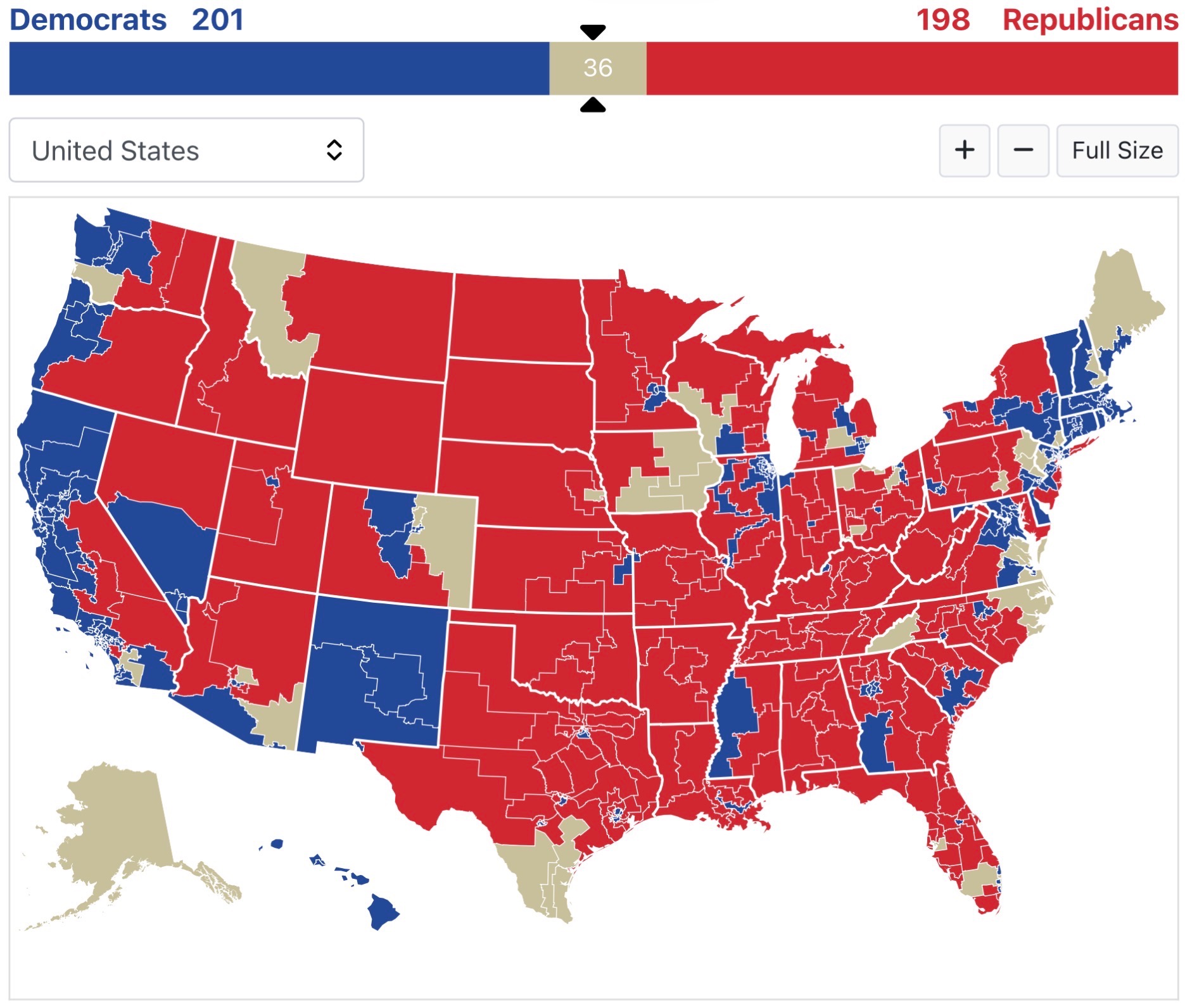
The map below, where marked for a party, does not mean a seat is 100% safe and out of range for an upset. This is just a starting point for which seats I consider highly likely to align with Democrats or Republicans:

Map of U.S. House seats rated safe for each party, the starting point of 201 Democrat and 198 Republican
U.S. House Starting Point – 11/3/2026

201 Democrat, 198 Republican

Remember, these solid reds and blues do not all align with a predicted margin. They simply create the initial boundaries for the overall assessment. They include some seats on the periphery of being flippable in a wave environment, such as AZ-2 (Eli Crane, Republican), MI-4 (Bill Huizenga, Republican), and KY-6 (open).

While I would not consider 201 seats the floor for Democrats, who as the out-party have the tailwind in competitive seats, I would say 198 seats is the absolute bottom of the barrel for the Republican Party. This is not my prediction, but it should help you understand that I view the insane betting market projections showing Democrats over 240 seats as implausible, if not fundamentally impossible. This is because of the strength of redistricting done by both parties. Obama took office in 2009 with 257 Democrats in the House; Trump took office in 2017 with 241 Republicans in the House. Those days are long gone, because parties are fighting for small majorities until at least the next reapportionment.

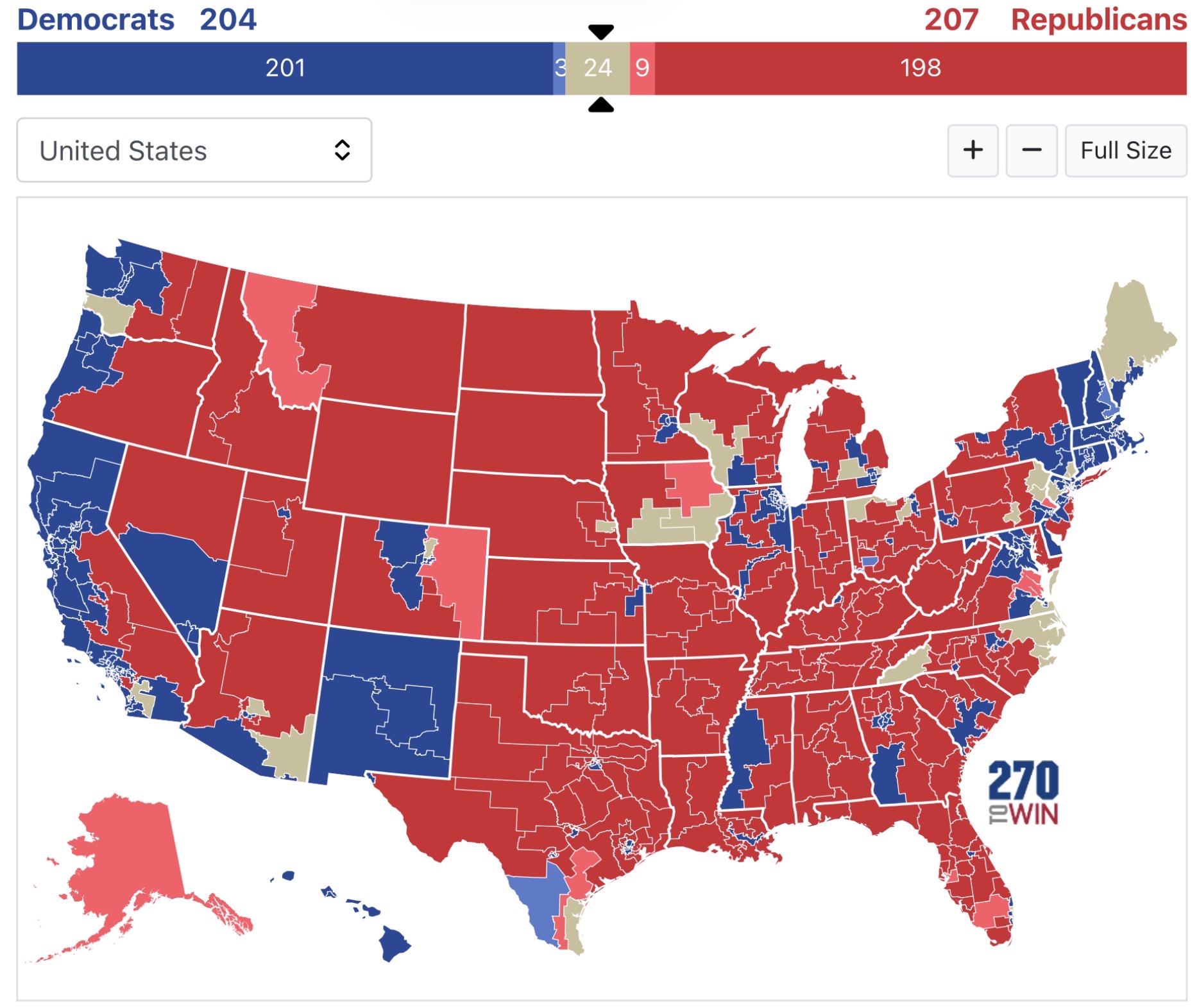
LEANERS

Map of U.S. House seats with the leaners added, 207 Republican and 204 Democrat

207 Republican, 204 Democrat

The second group of seats, which I limited to 12, includes those that usually fall into the category of “what about?” They could all qualify for upsets (some more likely than others, but other races took precedence for full analysis.

I also profiled Alaska-At Large (which would have been a real fight this year if Democrats didn’t use their best candidate on the Senate Race) and MT-1 separately.

These seats do carry risk, but if turnout for the GOP is strong, I like their chances to hold them.

Highest Risks for Republicans

• FL-14: against incumbent Kathy Castor, need strong Election Day turnout
• VA-1: Wittman looking to hold on in what appears to be one of the Democrats’ strongest states; a 2025 environment would take him out
• MT-1: poorly cut seat that included every progressive city in Montana; requires strong turnout to hold

In a nutshell, if Republicans are to position themselves to win a narrow majority, they need to hold all nine seats I’m favoring them in with “leaners.” If turnout in Cincinnati remains terrible, Democrats have an increased risk of losing OH-1 (Landsman, incumbent).

DECISIVE SEATS

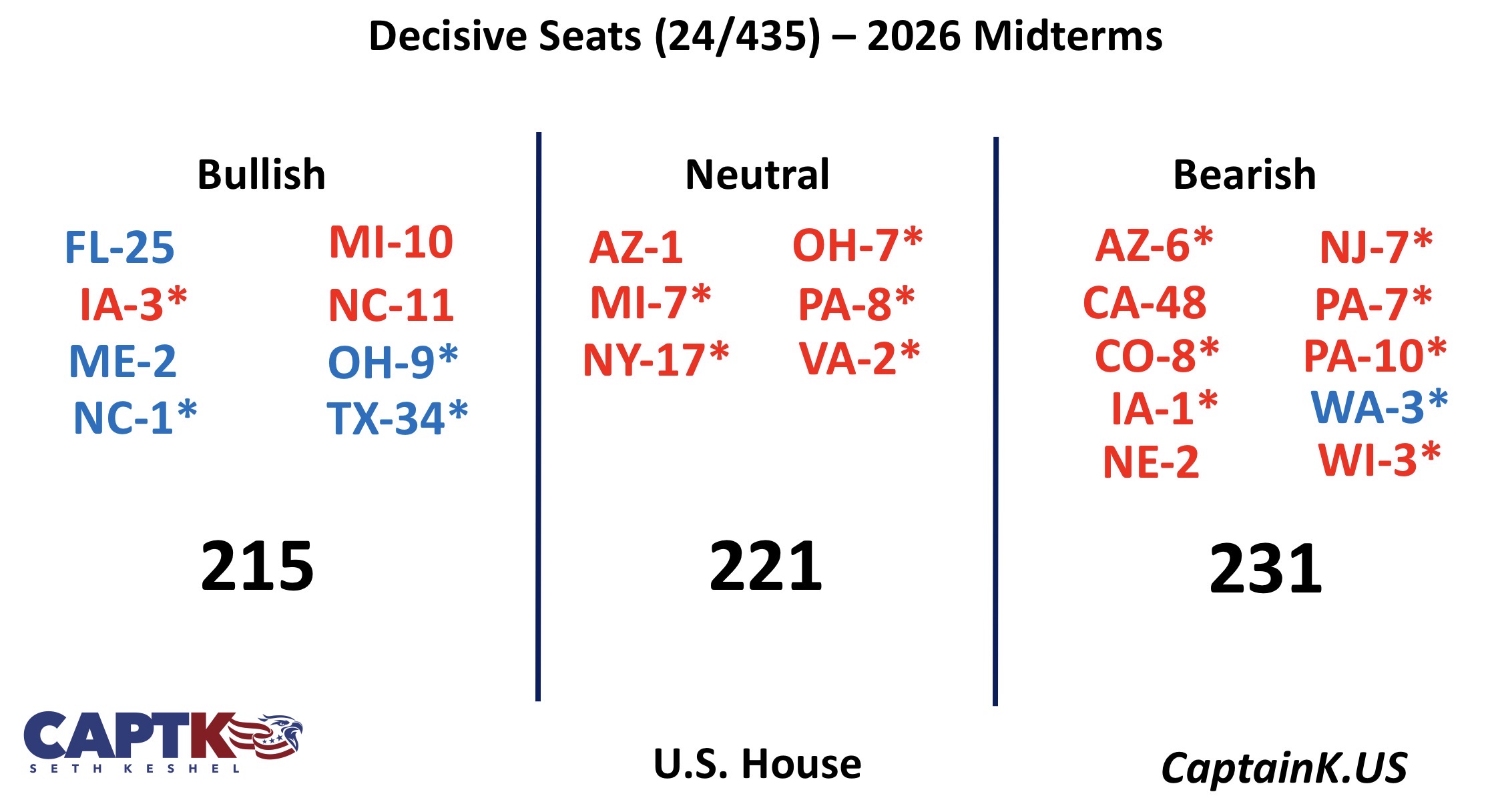
I have arrived at Election Day with 24 seats considered decisive. This is an arbitrary designation on my part, but these seats are the seats I expect to mostly align with the ultimate winner of the race to 218 or more seats:

Table of Captain K’s 24 decisive House seats for 2026 in bearish, neutral and bullish columns
Captain K’s Decisive House Seats – 2026

The color of the seats represents which party holds them now, not who I predict to win. The asterisks denote an incumbent running. The numbers beneath each column represent how many seats Republicans would hold if they hold all 207 seats through the leaners category I favor them in, and then win each seat in each respective column.

I have broken them down into three categories, rated from the GOP perspective:

• Bearish: Seats that fundamentally favor the Democrat, whether through historical trend, candidate quality, open seats, or because the election integrity picture isn’t conducive to GOP success
• Neutral: Seats that offer Republicans a heightened chance to win compared to those in the bearish category; candidate quality, presidential baselines, or election integrity improvements put seats in this middle category
• Bullish: These seats are fundamentally favorable to Republican candidates

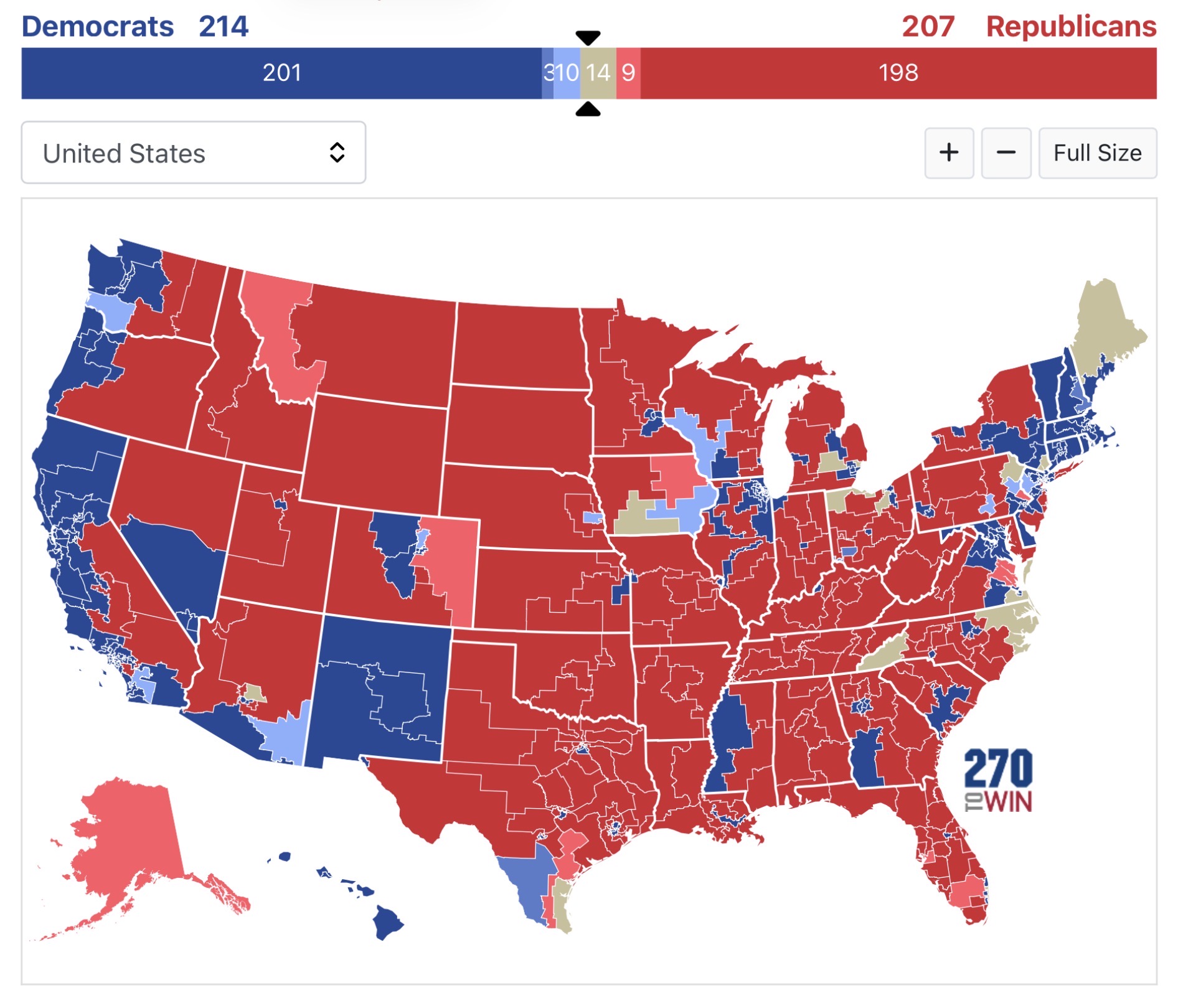
BEARISH CATEGORY

Map of U.S. House seats after the bearish category, 214 Democrat and 207 Republican

214 Democrat, 207 Republican

These seats are labeled bearish for good reason. I have leaned all 10 of these seats to favor Democrats, and by the following odds (not margins):

• AZ-6: 55/45 Democrat (Flip)
• CA-48: 70/30 Democrat (Flip)
• CO-8: 55/45 Democrat (Flip)
• IA-1: 80/20 Democrat (Flip)
• NE-2: 70/30 Democrat (Flip)
• NJ-7: 80/20 Democrat (Flip)
• PA-7: 65/35 Democrat (Flip)
• PA-10: 80/20 Democrat (Flip)
• WA-3: 70/30 Democrat (Hold)
• WI-3: 60/40 Democrat (Flip)

Please understand, in my ratings system a 55/45 race is a flip of the coin. I refuse to leave races at 50/50 to hedge like these pathetic pundits do, so I find the criteria I think will tip it, and move it in that direction.

The best candidates to hold their seats are Juan Ciscomani (AZ-6), Gabe Evans (CO-8), and Derrick Van Orden (WI-3). If Republicans can win even two of these races, they’ll be in the mix to win a narrow majority and prevent the Democrats from moving up to 214 after the bearish seats are accounted for.

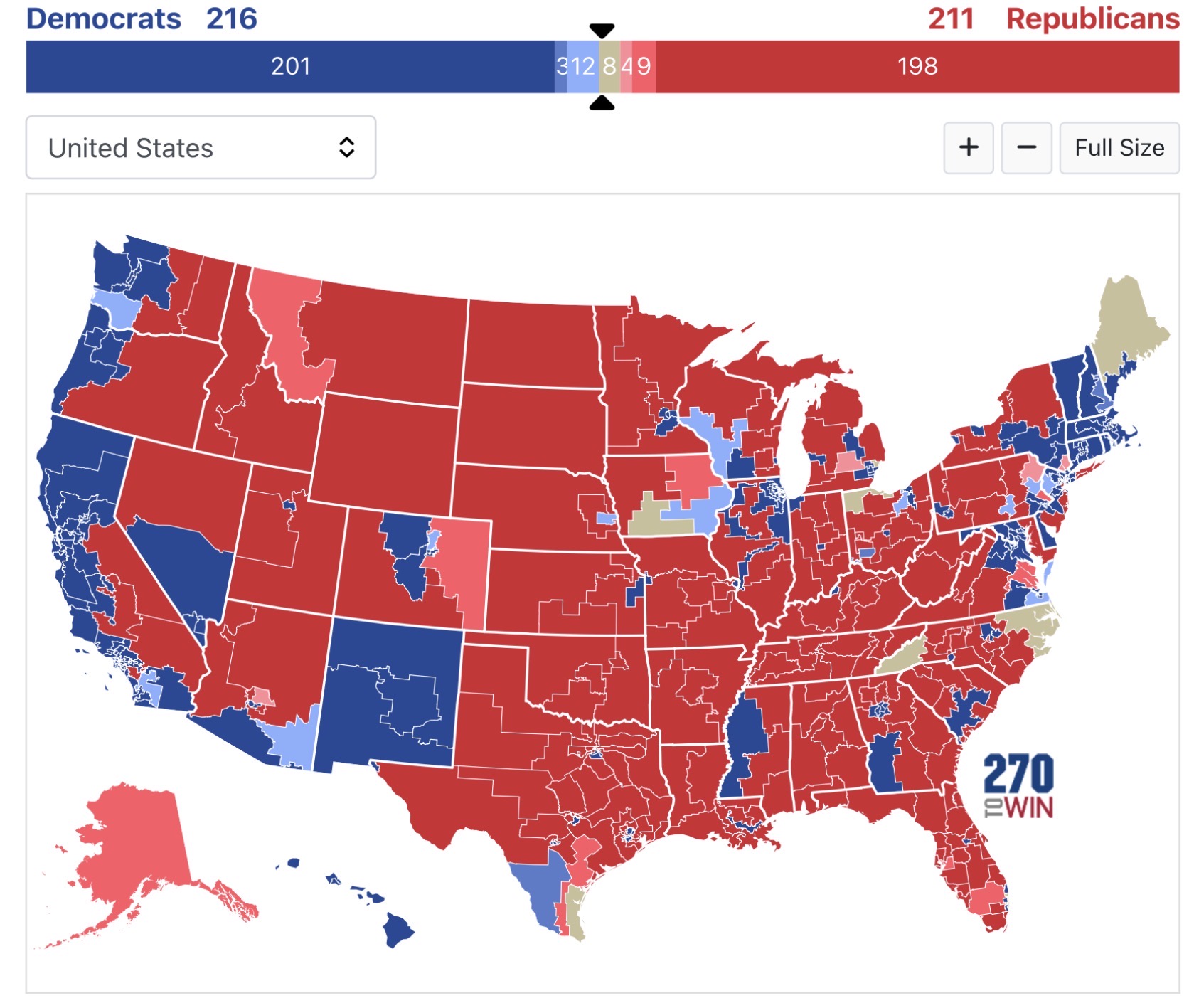
NEUTRAL CATEGORY

Map of U.S. House seats after the neutral category, 216 Democrat and 211 Republican

216 Democrat, 211 Republican

I have Republicans favored in four of the six neutral seats:

• AZ-1: 55/45 Republican (Hold)
• MI-7: 55/45 Republican (Hold)
• NY-17: 55/45 Republican (Hold)
• OH-7: 55/45 Democrat (Flip)
• PA-8: 55/45 Republican (Hold)
• VA-2: 65/35 Democrat (Flip)

Republicans have strong candidate quality in the four seats I favor them in. Jay Feely in AZ-1 fits the electorate, and Mike Lawler is considered one of the most talented politicians in the House (and running in a tough district). Rob Bresnahan in PA-8 has the key labor endorsements and is looking to hold a seat he unseated a tough blue-collar Democrat in as Trump carried it by more than 8 points (the most likely GOP win of Pennsylvania decisive seats). In MI-7, Tom Barrett is running in a seat that should be an automatic Democrat pick-up if not for their nomination of a DSA-aligned radical.

The most difficult pill to swallow here is the potential loss of OH-7. Max Miller has major character issues and a nasty custody battle playing out publicly he refused to get in front of. This would be an easy GOP hold if not for Miller’s serious liabilities.

It is also possible, just like last year’s Virginia Attorney General race, that partisan strength will get him over the line and save another seat on the road to a slim majority – but it won’t be by much if it happens.

BULLISH CATEGORY

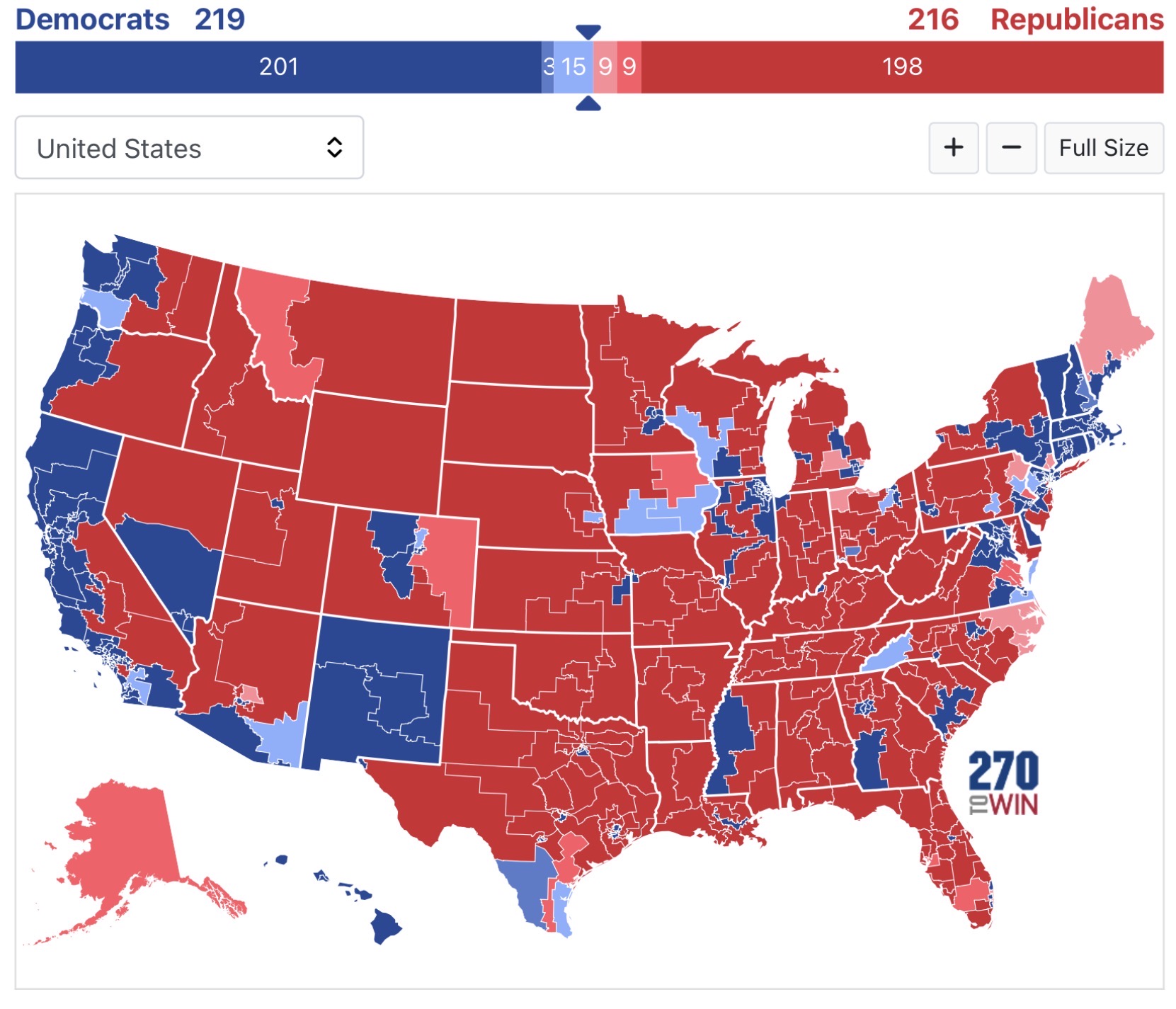
Map of the final U.S. House estimate after the bullish category, 219 Democrat and 216 Republican

Democrats 219, Republicans 216

My final pass through the map gives the Democrats the edge in 219 House seats – enough to claim a three-seat advantage over Republicans in the chamber. While this estimate may disappoint you, it is historically a very strong performance for the president’s party if these predictions stand up. Since midterms are volatile, they are rated in such as way as to identify the party positioned strongest in each seat rather than focusing on a ridiculous generic ballot number applied with a broad brush.

This is how I’ve rated the eight bullish seats:

• FL-25: 55/45 Republican (Flip)
• IA-3: 60/40 Democrat (Flip)
• ME-2: 70/30 Republican (Flip)
• NC-1: 60/40 Republican (Flip)
• MI-10: 55/45 Republican (Flip)
• NC-11: 55/45 Democrat (Flip)
• OH-9: 60/40 Republican (Flip)
• TX-34: 55/45 Democrat (Hold)

If Republican gains with Latinos hold up, FL-25 and TX-34 will be going red this year. Trump’s presidential baselines should float the GOP candidates in ME-2, NC-1, and OH-9.

I have reversed only one assessment from my original forecasts which were individually published, and that is for NC-11, the seat Chuck Edwards’s personal problems in Washington, D.C., stands to cost Republicans. I had it tilting 55/45 (odds) Republican when I released the forecast on October 10, but North Carolina’s early voting heavily favors Democrats, and Jennifer Balkcom will need a strong Election Day to overcome a very tough “Blue Dog” Democrat with maximum name recognition.

If I am wrong on Zach Nunn’s likelihood to hold IA-3 and if NC-11 sticks with its strong Republican identity, then Republicans will have a 218 to 217 edge.

SUMMARY

The simplest reality surrounding the fundamentals of the House is that neither party has a high ceiling, nor a low floor. Even an absolute wipeout of the Republicans in the House would still position them far better than they stood after the 2008 Obama wave, and almost dead even with how things were after 2018. The red districts are safer, but so are the blue.

If my predictions hold up, these decisions will have cost the GOP its majority:

• Utah judge sleeping with opposing counsel and giving Democrats a free House seat
• Courts scuttling the “Missouri First” map, costing Republicans the new MO-5 despite it having already been voted on in a primary
• Indiana legislature failing to redistrict two seats
• Nebraska legislature refusing to make a state Trump carried by more than 20 points a 3-0 GOP sweep
• Southern states like South Carolina, Mississippi, Alabama, Louisiana, and Georgia not jumping on opportunities afforded by the Callais decision to further redistrict.

I count up to 11 seats just in that sample that could have been safe Republican seats, which would have put Republicans at 218 just after leaners were considered. Democrats would have absolutely done this, and it’s a damn shame the Republican Party lacks the same tenacity.

RANGES

Democrat best case: 229 to 206 majority

Hold all seats I’ve favored them in, win VA-1, MT-1, and FL-14, plus all seven decisive seats I’ve favored Republicans in

Republican best case: 224 to 211 majority

Hold all the GOP leaners, upset OH-1 due to poor turnout in Cincinnati, win the three bearish seats I’ve tipped toward Democrats, narrowly hold VA-2, and keep OH-7, IA-3, and NC-11 on partisan strength and turnout.

History tells us all we need to know when it comes to the House. The out-party brings serious intensity, but the seats are cut in such a way that no party has a pathway to a seriously strong majority, and Democrat candidate issues related to the emergence of the DSA give Republicans a real shot to have another one of those outlier elections.

This is my final 2026 midterms release. I hope you understand I’ve put my best efforts toward bringing you actionable information choked out by a sea of narratives, noise, and lies. Thank you all for your support of Captain K’s Corner. I will be in the formation tomorrow morning, because there is no quit in me.

I advise you all to adopt the same attitude for long-term success.

Seth Keshel, MBA is a Senior Fellow at the Gold Institute for International Strategy and a retired Army Captain. He publishes Captain K’s Corner on Substack.

Seth Keshel on The Sean Spicer Show: Breaking Down the 2026 Senate Map

Seth Keshel on The Sean Spicer Show

This segment was hosted by Sean Spicer and aired on The Sean Spicer Show. Haley Stevens ENDORSES Mike Rogers?! Seth Keshel Breaks Down 2026 Senate Map I EP 836.

Featuring Seth Keshel, MBA, Senior Fellow, Gold Institute for International Strategy

In brief

Seth Keshel joins Sean Spicer on The Sean Spicer Show to break down the 2026 Senate map and midterm polling.

From the show’s description: “Seth Keshel reveals who REALLY wins the 2026 midterms if historical trends hold — Texas, Michigan, Alaska, Ohio, Pennsylvania, Virginia and Maine all on the table. Even Kansas. Author of The American War on Election Corruption and Captain K’s Corner on Substack, Seth Keshel joins Sean for a blunt, data-driven assessment of 2026 midterm polling.”

Watch the full segment at The Sean Spicer Show

Seth Keshel, MBA is a Senior Fellow at the Gold Institute for International Strategy and a retired Army Captain. He publishes Captain K’s Corner on Substack.