WASHINGTON TIMES: Top retired U.S., Korean generals detail tensions in Indo-Pacific

(This article, written by Mike Glenn, appeared in the Washington Times. https://www.washingtontimes.com/news/2025/dec/12/top-retired-us-korean-generals-detail-tensions-indo-pacific/)

If America’s relationship with Europe defined the 20th century, then the 21st century will be marked by Washington’s connections to the Indo-Pacific.

However, the former commander of U.S. Army troops in the region said some people can’t grasp its complexities or immense distances without a map.

In an address to the Gold Institute think tank, retired Gen. Charles Flynn on Thursday noted that the flying time from Hawaii to Guam, America’s farthest western territory, is roughly the same as a flight from Hawaii to the District of Columbia.

“When you’re in Guam, you’re in the second island chain. That’s how big this area of operations is. It’s massive,” Mr. Flynn said. 

The Indo-Pacific encompasses two continents — Asia and Australia — and the Southeast Asia archipelago, which serves as a land bridge connecting both. By some estimates, 7 out of 10 people on the planet will be in the region by 2040, he said.

China, which the Biden administration referred to as America’s “pacing challenge,” is amid a construction frenzy. The buildup is part of its Belt and Road Initiative, a Beijing-led global infrastructure and investment program launched in 2013 by President Xi Jinping that aims to connect Asia, Europe, Africa and beyond through land and sea routes.

China is moving ahead with explicitly military building projects as well, including along its mountainous border with India, known as the Line of Actual Control. About 20,000 to 30,000 Chinese troops regularly rotate in and out of the area, Mr. Flynn said.

“In the last five to seven years, they’ve built rail and road infrastructure to move laterally. They’ve also put surface-to-air missile systems there,” he said.

China is continuing to flex its economic muscles by applying pressure to several countries in Southeast Asia, from Cambodia and Laos to Bhutan and Myanmar. Beijing’s coercive campaign is becoming a dangerous security situation, Mr. Flynn said.

“That is why it’s really important for the United States to maintain relations with Vietnam, Thailand and India, the sort of bookends of countries in South Asia,” he said. “And by the way, Thailand is a treaty ally of the United States.”

China’s strategy is to float high-interest construction loans to countries it wants to exploit. When the country can’t repay the loan, Beijing moves in and assumes control over the project, whether it’s a port facility or an airfield. That also means access to its information technology system or electrical grid.

“We have one hell of a time getting them out of these small countries,” Mr. Flynn said.

The U.S. is an Indo-Pacific country not just because of its far-reaching military power, but also because “it has skin in the game.” The people living in Guam and the Northern Marianas are U.S. citizens. 

“We can’t forget about this part of the homeland,” Mr. Flynn said.

Retired South Korean Gen. Leem Ho-young, a former deputy commander of the U.S.-Korea Combined Forces Command, said most discussions about possible military action in the Indo-Pacific seem to focus on whether China will invade neighboring Taiwan.

“It seems like they don’t really discuss much about the threat that exists on the Korean peninsula because the two Koreas — the North and the South — are charging up,” Mr. Leem said.

He said President Trump — whom he called “The Global Peacemaker” — will likely prevent any cross-strait invasion of Taiwan.

The Korean Peninsula is another story. Mr. Leem said he spent most of his military career along the tense Demilitarized Zone between the North and South.

“For 50 kilometers to the north and 50 kilometers to the south [of the DMZ], there are about 1 million soldiers there pointing their guns at each other,” he said.

While North Korean officials mouth communist slogans, Mr. Leem said it would be more accurate to call the country a feudal dynasty. The Kim family has run the country since its founding in 1948 by Kim Il-sung. 

The current supreme leader, Kim Jong-un, has signaled that his chosen heir is his daughter, Kim Ju-ae, who is believed to be 12 or 13. That could be a problem for stability in North Korea, Mr. Leem said, where women are looked down upon.

Mr. Kim is overweight, smokes four packs of cigarettes a day and drinks up to 10 bottles of wine daily. Mr. Leem noted that his father and grandfather died as a result of bad hearts.

“It’s in his bloodline. It wouldn’t be surprising at all if he dropped dead today,” he said. “If that happens, there’s going to be a power struggle in North Korea. The power will be given to the person with a gun. China will pick a faction and support that faction.”

Mr. Leem said he wouldn’t be surprised if the other side in a North Korean internal dispute reaches out to South Korea or even the U.S. for backing. 

“If that happens and there are two different military factions in conflict in North Korea, this could lead to a conflict between China, which represents communism, and the U.S. and South Korea, which represent the powers of freedom,” he said. “The issues surrounding Taiwan will seem small by comparison.”

• Mike Glenn can be reached at mglenn@washingtontimes.com.

Rob Roos: Restoring National Sovereignty Across Europe

In his January 2025 European Parliament speech, Rob Roos presented that President Trump’s reelection represents a mandate for restoring national sovereignty and reversing progressive policies that have eroded European identities and freedoms. Due to the current tensions between EU bureaucrats and the Trump administration we are republishing the January speech.

Change will not come if we wait for someone else, or if we delay for another time. The words of Barack Obama, spoken during his historic campaign in 2008, still resonate—but today, they carry a very different meaning. It is a rallying cry for patriots, conservatives, and all who believe in freedom, sovereignty, and the dignity of our nations to stand together. We are the ones we’ve been waiting for. We are the change that we seek.

In 2008, Obama’s words signaled the dawn of a new era: one marked by social justice campaigns and the rise of “wokeism.” For years, these ideas were cloaked in promises of progress and inclusivity.

But what have they truly delivered? Today, we see the devastating consequences—fractured societies, eroded national identities, and an alarming loss of freedoms.

But, the tide is turning. The reelection of President Trump has sent a clear and powerful message from the people of the United States. The message is simple: We want our country back.

We want to be proud of our flag, our culture, and our heritage. We demand affordable, reliable energy to power our homes and businesses. We seek real food from our farmers, not synthetic substitutes dictated by unelected technocrats. We want secured borders, prosperity, peace, and the ability to pursue happiness without interference.

The overwhelming MAGA victory—President Trump reclaiming the presidency, the Senate, the House, and the popular vote—reflects a mandate that can not be ignored

For too long, the radical left has sought to dismantle the pillars of our civilization. Obama’s policies, often presented as ‘progress’, initiated a chain of events with devastating effects. I’ll give you four examples:

  1. The Arab Spring, spurred by social media campaigns, unleashed waves of instability that flooded Europe with millions of migrants. Our historic continent—once a beacon of cultural and intellectual achievements—is now grappling with security threats and the erosion of its identity and culture.
  2. The war in Ukraine, provoked by Obama’s NeoCon allies, has brought untold suffering. It began with the removal of Ukraine’s democratically elected leader in 2014, setting the stage for

conflict. These NeoCons, in collusion with the Military-Industrial Complex, are as culpable as any aggressor.

  • Critical Race Theory, a twisted ideology. It is nothing short of racism repackaged, weaponized to pit communities against each other.
  • Censorship and suppression of free speech. Through NGOs and the so-called “Censorship Industrial Complex,” they controlled narratives and silenced dissenting voices.

Their strategy has always been sophisticated—using fear, globalist policies, the illusion of moral superiority, and ‘democracy’ of institutions instead of democracy of the people.

The United Nations’ Sustainable Development Goals, the Green Deal, and the WHO’s pandemic overreach are all symptoms of a broader agenda: a transfer of power from the people to unaccountable elites.

Even NATO, once a coalition of nations united against foreign aggression, has now also become a tool wielded to suppress populist movements among its own people.

But we are not powerless. We the People represent true democracy. If we unite, we can reverse this destructive course. The momentum of the MAGA movement can inspire change across Europe and beyond. Now is the time to build a unified front that transcends party lines and minor disagreements.

We must Make Europe Great Again by:

  1. Restoring Free Speech: Reverse the Digital Services Act and protect public discourse.
  2. Ensuring Freedom: No Central Bank Digital Currencies. No digital IDs. We are born free and do not need technocratic controls.
  3. Dismantling the Green Deal: End this social engineering project that sacrifices our economies and energy and food security for an illusion of environmental progress.
  4. Defending Our Borders: Protect our nations from uncontrolled migration that threatens both safety and cultural heritage. National civil rights must take precedence over globalist human rights.
  5. Exposing Corruption: Demand full transparency in dealings with corporations and NGOs.
  • Deregulating Economies: Empower small and medium-sized businesses—the backbone of our prosperity. Deregulation fuels innovation and competitiveness.
  • Restoring National Sovereignty: Renegotiate or cancel harmful international agreements and treaties.

Change will not come if we wait for someone else or another time. We are the ones we’ve been waiting for. We are the change that we seek. Obama’s words, once a banner for radical policies, now serve as a call to reverse the damage inflicted on our nations and it’s people.

Let us unite, work together, and make this a reality. Let us Make Europe Great Again.

Rob Roos is a distinguished fellow at the Gold Institute for International Strategy, a Washington, DC based foreign policy and defense think-and-do tank.

Contact Gold Institute today!

Facing Facts & Rolling Back Mythologies: The New National Security Strategy

U.S. Air Force imagery accompanying national security strategy analysis

(This article was written by Peter Huessy and appeared in RealClearDefense. Facing Facts & Rolling Back Mythologies: The New National Security Strategy)

The new National Security Strategy is addressing some established foreign policy mythologies, a long overdue analysis. Though a relatively new way of laying out the U.S. strategy, it was very important that it do so.

The biggest drawback of the strategy is the lack of assessment of what security danger Russia poses to the U.S. and its allies even should the war in Ukraine be ended.

But the importance of the document is that it does address ten mythologies that have been largely conventional wisdom over the past many decades for the U.S. foreign policy establishment. These are rejected by the Trump administration with many additional details part of Secretary War Hegseth’s remarks at the Reagan Defense Forum on December 6th at the Simi Valley Reagan Library.

The most provocative section is the analysis of the direction which Europe has been moving—very low birthrates, massive and often illegal migration of people that reject western civilization, an absence of a commitment to defense spending, rejecting a robust nuclear deterrent and missile defense, (currently being adjusted), vastly too much regulation and government coercion (being partially undone with Brexit), and a deliberate policy of making energy expensive and scarce (also currently being partially rolled back).

Important is the high priority given to both nuclear deterrence and missile defense. After the breakup of the USSR, it was assumed nuclear weapons were largely irrelevant. And that Russia and China would become largely cooperative nuclear powers, such as with the Nunn-Lugar program cutting down “loose nukes” in the former USSR.

By 2010, the Nuclear Posture Review emphasized both the benefits of U.S. restraint in nuclear deployment and seeking a general policy of seeking the eventual abolition of nuclear weapons.

The new strategy underscores how nuclear deterrence is and remains central to U.S. security and for the need for major investments in nuclear modernization. In 1991, even with the collapse of the USSR, Senator Sam Nunn urged that the National Defense University Foundation (NDUF) continue a long standing program of Hill nuclear seminars as he warned that nuclear dangers were not going away and would certainly re-emerge. Instead, the elites went on a 40-year holiday from history and put nuclear investments at the bottom of the priority requirements for the past Cold War era.

The new strategy also jettisons the false assumption that missile defense is dangerous or destabilizing, firmly foot-stomping that defenses are a critical adjunct and insurance policy for the U.S. as General Michael Guetlein Director of Golden Dome emphasized on December 6th at the Reagan Defense Forum.

The strategy also captures an entire series of economic initiatives that are critical to U.S. security, for which it has been strangely criticized. In 1981, the National Governors Association assumed the U.S. did not need a steel industry as we could always buy cheap steel from China. The new Japanese investment in the U.S. steel industry and reshoring of U.S. industry is a welcome rebuff to the multiple decades hollowing out of U.S. manufacturing and heavy industry. And the key understanding that U.S. mineral mapping, mining, and milling is also critical to U.S. security is also welcome, as the recent mineral/trade deals have made clear.

On the Middle East, the strategy rejects the false notion that as former President Clinton noted in 2014, terrorism was largely related to Israel failing to offer the Palestinians a state. And implicitly reject the idea that Islamic jihad is some kind of peaceful religious individual empowerment as opposed to an ideology of conquest and murder. Keeping Iran from dominating the Middle East hydrocarbon reserves and engaging in terrorism while also being allied with Israel are priorities which is a welcome change from the embrace of Oslo, “the peace process” and Palestinian demands.

The strategy’s western hemisphere embrace is a welcome switch. For decades, the U.S. assumed open borders was a welcome adjunct to U.S. economic requirements. It was assumed migrants were largely agricultural workers, unrelated to a massive illegal drug and human trafficking business closely associated with a campaign of “unrestricted warfare” by China against the United States and also including North Korea, Iran, Russia, and Venezuela. And conventional wisdom assumed 100,000 drugs deaths a year was just the price one pays for a free and open society.

Critical to reforming our Western Hemisphere strategy is to understand the problem with an open border for agricultural workers is that it opens the borders to all potential “workers” including drug dealers and traffickers. And an open border with Mexico is also open to the rest of the world. That is why the section on Europe addresses that Europe is killing itself with mass migration of people that do not accept western civilization, but embrace Hamas and Jihad, condemn Israel, all of which itself will undermine the extent to which Europe can be an effective NATO ally and strengthen its western civilization heritage. As one top scholar recently surmised, Christendom may lose upwards of one billion or 50% of its adherents given current trends, especially in Europe, where hundreds of mosques are being built on top of what were Christian churches.

The requirement to keep Iran from its terrorism ways and its search for a nuclear weapons lever is also a welcome security plank. Gone is the strange notion the U.S. engineered a coup in Iran in 1954 or that because Khomeini was a “man of the cloth” his regime was benign.

Gone too is the notion that scarce, expensive, and hard to secure energy is a great idea as the former Secretary of Energy and green energy mandates assumed. Coupled with establishing secure sources of minerals, both mining and milling, as recent deals with Australia, Malaysia, the Kingdom of Saudi Arabia, and others have done will further improve U.S. security and end our reliance upon China for rare earth and other key minerals.

For decades, NATO did not even meet its own 2% of GDP for defense spending as an unstated assumption was that NATO was special and although 80 years removed from WWII, NATO was special and couldn’t spend a lot on defense because Europe had to have a huge welfare state to prevent another Hitler from coming to power.

The strategy also drowns the idea that military strength is provocative and unnecessarily aggressive, a widespread assumption embraced by foreign policy elites through the Cold War, the era of détente and peaceful coexistence and most loudly during the Reagan “peace through strength” military buildup, which of course successfully led to the end of the USSR which fundamentally was in fact an explicit economic war against the USSR, as outlined by Warren Norquist in his 2000 essay in the National Intelligentser. The extent to which the Reagan administration used economic measures to dissolve the USSR is seriously underappreciated and leads to a continued in ability to understand how effective such measures could be especially as the U.S. confronts two nuclear armed peer adversaries.

Warren Norquist details what Reagan confronted in 1981, nut unlike what President Trump also faced when in 2025 taking office for a second time. “The incoming Reagan Administration faced many challenges: Western Europe was making loans to the USSR at half the normal interest rate. Sweden was buying restricted high technology needed by the Soviets and reselling the items with all the necessary instructions. Many western firms were selling restricted technology to companies fronting for the USSR. The technologies the Soviets could not buy they were trying to steal.

The USSR was earning hard currency by selling oil at three times its production cost. The USSR was earning hard currency by selling weapons to oil rich countries like Iran, Iraq, and Libya. Europe was financing two gas pipelines from Siberia. If completed, West Germany, for instance, would become dependent on Moscow for 60 percent of its energy and Soviet hard currency earnings would double to $60 billion per year. The Soviets had effectively taken over Angola and Mozambique, and the Soviet military was providing aid and advice to many countries in Africa.

U.S. military spending had declined from 9.2 percent of Gross Domestic Product (GDP) under President John Kennedy in 1962 to less than 4.6 percent under President Jimmy Carter in 1979 according to the Federal Government Historical Budget, Tables 3.1 and 10.1.

In Nicaragua, the USSR financed equipment and thousands of trainers to ‘… build … an army of 60,000 regulars backed by an equal number … militia” … armed with heavy weapons.” The plan was to expand to 500,000 under arms according to General Jack Singlaub. The Soviets were positioning themselves to threaten Western Europe into less cooperation with the United States. And the USSR had invaded and was assumed to be winning in Afghanistan.”

The economic agenda for the new security strategy is very innovative but also most needed. The security strategy gets many things right especially including China, the Middle East, the Western Hemisphere as well as the twin defense needs of nuclear modernization and missile defense. Particularly welcome is the emphasis on preserving elements of Western civilization and the implied negative impact of rejecting religious faith, rejecting the need to acculturate legal immigrants and to halt illegal immigration and its companion twin evils of trafficking and drug running.

Peter Huessy is a Senior Fellow at the Gold Institute for International Strategy, a Washington D.C.-based foreign policy and defense think tank.

President Trump’s Reframing of the U.S.–South Korea Alliance: Alliance or Reliance?

(This article originally appeared in Korea On Point: https://koreaonpoint.org/articles/article_detail.php?idx=509&start=# )

Key takeaways:

– This distinction matters because burden-shifting implies withdrawal, while responsibility-sharing implies empowerment and inclusion.

– In effect, he challenged Seoul to embrace a self-conception aligned with its actual capabilities, that of a global actor critical to shaping Indo-Pacific stability, not merely a frontline state facing North Korea.

– By demanding more of Seoul and, in turn, granting it greater agency, he helped catalyze the transformation of the U.S.–ROK alliance from a mentorship into a mutual enterprise, from reliance to alliance.


Since the early months of his presidency, President Donald J. Trump’s approach to America’s alliances has been both disruptive and revelatory. For South Korea, one of Washington’s most steadfast defense partners in Asia, his method was particularly transformative. At first glance, President Trump’s insistence that U.S. allies increase their defense contributions seemed to signal a transactional mindset that risked unsettling long-established bonds. Yet beneath that rhetoric lay something more consequential, a reframing of the U.S.–Republic of Korea (ROK) relationship not as patron to client, but as a partnership between equals tasked with jointly defending and advancing shared strategic interests in the Indo-Pacific. His message to Seoul was clear, the time had come for South Korea to step fully into its role as a capable, self-confident regional power, not simply as a beneficiary of U.S. protection. Far from abandoning the alliance, this approach sought to mature it and transform an asymmetrical relationship rooted in the Cold War into a modern strategic compact befitting a South Korea that had emerged among the world’s foremost economies, democracies, and security contributors.​

President Trump’s entrance forced these issues into the open because his direct questioning of alliance costs and responsibilities unsettled policymakers on both sides. Critics often described his push for higher South Korean defense spending and cost-sharing as crude burden-shifting that reduced the alliance to a transactional ledger. But this reading overlooks the continuity between his rhetoric and a deeper tradition of strategic recalibration that expects capable allies to share not just fiscal, but also strategic responsibility for collective defense. At times inelegantly, President Trump articulated an expectation that America’s wealthiest and most capable partners should carry a larger share of the load in defending the free world, rather than relying indefinitely on U.S. subsidies.​

This distinction matters because burden-shifting implies withdrawal, while responsibility-sharing implies empowerment and inclusion. President Trump sought to make clear that the United States, while remaining the bedrock of regional security, would not forever subsidize an order in which others underinvest in their own defense. South Korea, endowed with advanced capabilities and national resilience, was precisely the kind of ally Washington wanted to see take on greater leadership. Under his administration, negotiations over the Special Measures Agreement on host-nation support for U.S. forces were contentious but clarifying, as Washington pressed for steep increases and Seoul maneuvered to frame any rise in its contribution as part of a more strategic, long-term alliance modernization. Seoul’s willingness to increase its contributions, while simultaneously expanding coordination on missile defense, intelligence-sharing, and joint exercises, demonstrated that shared responsibility could strengthen rather than strain the alliance.​

Behind President Trump’s demands lay an implicit invitation to equality. He signaled that Seoul’s growing strength and global stature were not inconvenient realities to be managed, but welcome assets to be fully integrated into a shared strategy. By insisting on more equitable participation, President Trump upended the traditional U.S.–ROK dynamic in which reassurance flowed one way, from Washington to Seoul, and dependency shaped expectations on both sides. His language often suggested impatience, but his strategic instinct reflected a belief in South Korea’s potential to act as an equal partner rather than as a perpetual security dependent. In effect, he challenged Seoul to embrace a self-conception aligned with its actual capabilities, that of a global actor critical to shaping Indo-Pacific stability, not merely a frontline state facing North Korea.​

Rather than undermining deterrence, this recalibration strengthened it. A South Korea increasingly confident in its own defense capabilities enhances, rather than diminishes, the credibility of U.S. commitments by signaling that any aggression would face not only U.S. power, but a capable and determined local ally. Deterrence in the Indo-Pacific now depends not solely on American military might, but on a constellation of capable partners willing to act in concert to resist coercion and revisionism. President Trump’s approach anticipated this architecture, even as many observers focused primarily on his rhetoric and style. In this context, “equal partnership” in security terms is not a euphemism for U.S. withdrawal, but a pathway to more durable stability rooted in shared will and distributed capabilities.​

In the broader Indo-Pacific competition, the U.S.–South Korea alliance has implications far beyond the Korean Peninsula. President Trump’s emphasis on equality resonated with his administration’s goal of building a network of self-reliant partners capable of collectively deterring coercion by major powers. By viewing South Korea as a co-equal stakeholder, Washington effectively widened the scope of Seoul’s expected engagement, from a narrow focus on North Korea to a broader role in regional security, maritime domain awareness, and supply-chain resilience. The administration encouraged South Korea to find greater synergies with like-minded democracies such as Japan, Australia, and India, reflecting an understanding that Indo-Pacific resilience would depend as much on allied initiative as on American leadership.​

President Trump’s re-envisioning of equality extended beyond defense into economic and technological domains that shape long-term strategic outcomes. In trade, he pressed for recalibration of KORUS that recognized South Korea’s advanced, globally competitive economy as a peer, not a dependent market, while continuing to support robust bilateral commerce. In technology, the administration promoted cooperation with allies on critical sectors such as 5G, semiconductors, and digital infrastructure to reduce reliance on Chinese supply chains and standards. This approach implicitly cast South Korea, home to world-leading chip and electronics firms, as a technological partner of first order, whose choices would significantly influence the balance of economic security in the region.​

No dimension of President Trump’s engagement tested the alliance more visibly than his first-term diplomacy with North Korea. The high-profile summits in Singapore and Hanoi triggered anxiety in Seoul, where policymakers feared marginalization or abrupt shifts in U.S. posture. Yet his direct engagement with Pyongyang, however unconventional, also highlighted that peace and stability on the peninsula were joint challenges requiring close U.S.–ROK coordination. His administration expected Seoul not to remain a passive observer, but to participate actively in post-summit diplomacy and contingency planning, reinforcing the idea of co-ownership of the peninsula’s future. The experience of navigating the uncertainties of U.S.–North Korea diplomacy pushed South Korea to strengthen its own diplomatic capacity, inter-Korean initiatives, and regional outreach.​

Alliance management is as much psychological as it is strategic, and the U.S.–ROK partnership has long been shaped by narratives of protection, vulnerability, and dependency. President Trump disrupted those narratives with a message that to many Koreans sounded provocative but also validating, South Korea is strong enough to do more and should act accordingly. To some, this seemed dismissive of past sacrifices; to others, it was a long-overdue acknowledgment of the country’s transformation into a confident middle power. Over time, this shift carries potential long-term benefits because equal partners tend to make clearer decisions, share risks more fairly, and build deeper trust. As the emotional premise of the alliance evolves from gratitude to solidarity, the relationship becomes better positioned to weather tactical disagreements while preserving strategic alignment.​

Policy analysts often measure alliance health in budgets, bases, and formal agreements, but beneath those metrics lies a deeper element, tone. President Trump’s unapologetically assertive tone changed how both nations spoke about their partnership, moving the discourse from deference to dialogue. High-level interactions increasingly encompassed not only defense coordination, but also cooperation on broader issues such as regional economic security, pandemic response, and supply-chain restructuring, even if those agendas were more fully articulated after his term. The relationship thus became more multidimensional, capable of friction, yet resilient because it rested on shared interests and values rather than one-sided dependence.​

History will continue to debate the style and substance of President Trump’s diplomacy, but the structural impact of his approach toward South Korea is likely to endure. By demanding more of Seoul and, in turn, granting it greater agency, he helped catalyze the transformation of the U.S.–ROK alliance from a mentorship into a mutual enterprise, from reliance to alliance. The result is a partnership better suited to confront the strategic realities of the 21st century, North Korea’s evolving threat, China’s regional assertiveness, and global challenges that no single nation can manage alone. Far from diminishing American leadership, this model amplifies it through empowered allies whose strength contributes directly to a more stable order. A South Korea that stands shoulder to shoulder with the United States strengthens not only deterrence on the Korean Peninsula, but also the resilience of the entire Indo-Pacific architecture. President Trump’s conviction that strong allies make strong alliances helped recast a foundational relationship for a new era, opening the door to a U.S.–ROK partnership defined by mutual commitment and co-equal strategic stakes rather than by the asymmetries of the past.

Eli M. Gold is the president of the Gold Institute for International Strategy, a Washington, DC based think-and-do tank.

Washington Declares Europe Civilisationally Bankrupt, and Brussels Works Hard to Prove It Right

A view of the US Capitol dome with the flag against a blue sky in Washington DC

(This article was written by Hermann Tertsch and appeared in El Debate. Washington declara a Europa en quiebra civilizacional y en Bruselas se esfuerzan por darle la razón)

The political leadership and the colossal institutional bureaucracy of the European Union hate and fear Donald Trump as much as they do the European national, conservative and sovereigntist forces. They know in Brussels that there is a direct relationship between this president’s second arrival at the White House and the conservative revolution spreading across the United States, Europe and now also Ibero-America, which makes the forces that are at least partly in political tune with the North American president grow without pause.

Now in Brussels, Berlin and Paris they have more reason to hate Trump. On the one hand, they have the 33-page United States Strategic Policy document, which warns that the economic decline and the political and social degradation in Europe are no longer problems of circumstance but a crisis of civilisation that makes the countries of the European Union, dragged along by a destructive ideology, weak societies incapable of being reliable and valid allies for the United States.

That is how serious they see the situation in Washington, and that is how serious many of us in Europe see it. And the media and the political caste of Brussels may eclipse and silence those of us Europeans who think this way, but not the administration of the United States. That does an enormous favour to the truth, which enters through new cracks in the perfectly mendacious and failed discourse of the European Commission and of governments as failed and weak as the German and the French.

One of the causes identified in the report as the origin both of the political degradation and of the economic decline is the fear of freedom and the ever greater censorship and persecution of dissent. Well, the European Union rushed to prove the White House report right before it had even been published by announcing a fine against Elon Musk’s platform, X. They cite misleading advertising, but everyone knows that the European Commission and its attack dogs against the national and anti-socialist forces cannot bear the degrees of freedom of expression that Elon Musk reintroduced at X when he bought the platform. And Musk himself has confirmed that the EU offered him a way to avoid fines if he went back to applying censorship to certain opinions, which are always the same ones, the conservative and national ones.

We members of the European Parliament are witnesses to a European Commission policy marked by the same panic felt by the social-democratic majorities of the People’s Party and the socialists in Germany, in Austria or in France, who block national governments that are already the leading force. The president of the European Commission feels no ridicule at all when she states that they are going to make a great deal of money available to independent media. Nor do they feel any shame when they are confronted with facts that are hard to call legal, such as the subsidising with thousands of millions in past years of NGOs, all of them leftist and with woke ideology, always devoted to the war against the conservative forces. Now with the Digital Services Act (DSA), which they have used to fine X, and with the “Democracy Shield”, which is the programme against supposed disinformation and attacks by external enemies but which is in reality first and foremost the joint command of extraordinary measures to combat the national, conservative and sovereigntist forces that grow ever stronger in the member states.

The direct relationship between Trump’s election and the spectacular growth of these forces of the real right does exist. But it is not that this spectacular conservative expansion across countries in the Americas and Europe was caused by a president who personally is not a conservative. The change of era has been maturing for years because the failure of social-democratic policies and their ideological hobbyhorses of climate, gender, immigration, multiculturalism, degrowth and impoverishment is a catastrophe that endangers the whole of Western civilisation in Europe.

The direct relationship that most unites these forces with Washington is the certainty that the arrival of the new Trump administration has prevented the social-democratic majority of the People’s Party, socialists and greens in Europe, which has imposed its policy for decades, from having a free hand to crush, by methods that are in no way orthodox, in no way democratic and very often in no way legal, the national forces that keep on growing.

They do not have a free hand because the European national forces are ever larger, but most especially because Washington denounces them and holds up a mirror to the European democracies that makes all their contradictions explode. One of the first, and much talked about, came in Munich at the beginning of the year from the mouth of Vice President JD Vance. This strategic paper is no less significant.

The whole political caste and the European elites bet on an electoral tandem as grotesque, mediocre and leftist as Kamala Harris and Tim Walz on the Democratic ticket in 2024, because with them globalist social engineering would already have been launched in unrestrained and perhaps irreversible fashion. It is no exaggeration to state that a victory by Harris and Walz would have brought with it in Europe a wave of bans on national parties. And that with a leftist administration in Washington they would not have exerted themselves much in looking for pretexts to impose that ancient and well-worn practice of prohibiting forces that in freedom could wrest power from them from speaking, acting and standing for election.

The North American administration says in its paper on Strategic Policy that Europe faces serious problems caused by the policy of the European Union and other transnational organisations which undermine the political freedoms and the sovereignty of nations and encourage an immigration that is transforming the continent and creating conflicts, the imposition of censorship, repression of freedom of expression in general and suppression of political opposition, in addition to the collapse of the birth rate, with a loss of national identity and self-esteem.

It is a pity that in the European Union there is not enough honesty to publish similar documents, and that when strategic papers are commissioned it is always done in the knowledge that they will be written by some member of the Europeanist caste who endorses the failed EU policy of past decades or at least does not openly fight it. Without allowing within the institutions any opinions other than the inbred ones of the two-party social-democratic caste, failure is assured. And Trump’s enemies once again prove him right.

Hermann Tertsch is a Distinguished Fellow (Honorary) at the Gold Institute for International Strategy, a Washington D.C.-based foreign policy and defense think tank.

Rob Roos: From bureaucracy to freedom | The Hague 2025

From bureaucracy to freedom

In his December 2, 2025 speech in The Hague, Rob Roos launched the “Living Together in Freedom” foundation, presenting the case that the current political system has devolved into a “corporatocracy” controlled by unelected technocrats and requiring an urgent shift toward decentralization. Due to the ongoing expansion of EU bureaucracy and the increasing threat of digital control mechanisms like CBDCs, we are publishing the full text of his address.

Ladies and gentlemen,

A very warm welcome to all of you. It’s wonderful to see so many of you here today. On behalf of the board of the foundation Samen Leven in Vrijheid (Living Together in Freedom), thank you sincerely for your presence. Today promises to be a meaningful event, especially with our very special guest from Argentina—more on that shortly.

But first, allow me to introduce our new foundation: Living Together in Freedom. A name that’s deliberately non-political—because we are not, and will never become, a political party. Frankly, there are already more than enough political parties in this country.

So what are we?

We are a civic movement. A growing initiative aimed at mobilizing citizens, entrepreneurs, politicians and everyone who cherishes one of the most essential pillars of human dignity: freedom.

We defend freedom in all its forms:

  • Freedom of thought, belief, and expression
  • Freedom of assembly and political participation
  • Bodily and personal autonomy
  • Privacy and communication rights
  • Legal and constitutional freedoms
  • Economic and social liberties
  • Educational, family and societal freedoms
  • And yes—freedom in the digital age

If we’re serious about protecting freedom, we cannot ignore politics. Political conflict is often not about freedom versus oppression, but about which freedoms take priority, and whether the state protects or dictates.

Our foundation believes in minimal government.

Self-reliance and personal responsibility must return to the forefront of our society.

Our mission is clear: to connect freedom loving people, thinkers and doers in order to safeguard liberty, sovereignty and prosperity. We aim to influence public discourse and policy—not through slogans, but through reason, dialogue and solutions. We believe the debate must return to where it belongs: – with the people.

We envision a future in which the Netherlands is free, sovereign, and prosperous. Like we used to be for a long time. Freedom, democracy, and entrepreneurship are not just values—they are the very foundation of a functioning society. But they do not maintain themselves. They require care, protection, and courage—from all of us.

We stand firmly for:

  • Freedom & Open Debate – to think, speak, and live without excessive government interference. Freedom also means responsibility—for oneself and for others.
  • We stand for Democracy & Sovereignty – politics should serve citizens, not global technocracies. Our constitution, not foreign treaties, should form the bedrock of our democracy.
  • We stand for Prosperity & Entrepreneurship – true wealth is the ability to build something meaningful. That requires low taxes, innovation, and a state that facilitates—not suffocates.

Three weeks ago, I traveled from Hanoi to Saigon in Vietnam—a one-party communist country. What struck me was remarkable: capitalism thrives on every street corner. People trade, sell, and build—despite the system.

Why? Because in 1986, the Vietnamese government allowed citizens to own small plots of land and trade surplus produce. Within two years, the country went from starvation to becoming a food exporter.

The lesson? Decentralization works. Give people ownership and responsibility, and they will build a better life. Centrally planned economies fail not because of bad intentions—but because no government can ever gather enough information to make the right decisions for millions of individuals. It leads to bureaucracy, stagnation, and despair.

You see the same in every failed system—North Korea vs South Korea, Cuba, Venezuela. Socialism has never brought wealth or freedom. Not once.

The only sustainable path forward is decentralization—of both economic and political power. And yet, Europe – with the European Union – is moving in the opposite direction. We have a government over our government. And with that I mean that the unelected European Commission rules over our elected parliament and our government. The European Commission becomes more powerful by the day. More money, more competences, and we already said ‘NO’ in 2005. We voted against the European Constitution. But it was adopted in the form of the Lisbon Treaty. So, voting for our national parliament is nowadays more for the show. The last two decades it has become clear that “We The People” are not able to change things via our democratic vote. So, besides politics we need a grass root movement.

We’ve developed ten core principles. I won’t cover them all today, but allow me to highlight number three:

3. Economy, Work and Entrepreneurship – We support lower taxes, less bureaucracy, and a strong focus on small businesses and innovation. Prosperity must be accessible to all citizens.

Ideological policies have created a flood of unnecessary rules, wasted public funds, and restricted our freedoms. Look at climate policy: it leads to higher taxes, more bureaucracy, and less freedom. And it is not helping our nature and environment either. Of course we have to take care of the planet. But not via this Ponzi scheme called Net Zero. This must stop—not slowly, not half-heartedly, but immediately.

We will not accept a digital prison. No digital ID. No CBDC. No ChatControl. No Media Freedom Act, no Digital Services Act. These are tools of Brussels bureaucracy, not of democracy. It’s not about “safe” speech—it’s about controlled speech. Not a free press, but state-approved journalism. Not free citizens, but monitored subjects. Ladies and gentlemen, I hate to say it but this is no democracy anymore. These same laws are used by tyrannic states.

Centralized power is the enemy of liberty. Ronald Reagan said it best and I quote: “Man is not free unless government is limited. There’s a clear cause and effect here – that is as neat and predictable as a law of physics: As government expands, liberty contracts”. End of quote.

Even the EU’s own treaties—Article 5—call for subsidiarity and proportionality. Yet power is hoarded in Brussels, when it should return to The Hague—and from The Hague to your local community.

Decentralization is not ideology—it’s necessity. Because the current system is not free capitalism—it’s a corpora-tó-cracy. Where elites, backed by mega-funds like BlackRock and Vanguard, dictate the rules in Davos. Where “public-private partnerships” mean backroom deals instead of democratic debate. This immense economic power leads to political power without any mandate. It circumvents our parliaments. It circumvents “We The People”.

We don’t need more multinational control—we need a thriving middle class and strong small businesses to carry the economy.

With this foundation, we hope to contribute to the future of our country. A beautiful country that is worth fighting for. Complaining won’t help. Running away, won’t solve it. Only action can turn the tide. And yes it will not be easy. But suffering pain is temporary – giving up is forever.

The political right is too divided—even when we agree on so much. Our goal is to unite people, build bridges, and create a real counterforce.

This is not about ego. We bear a duty—to preserve a free and prosperous Netherlands for the next generation, just as our ancestors did for us.

But we cannot do it alone. We need thinkers. We need doers. We need your support—moral, practical, and yes, also financial.

You are invited to respond to all three.

Thank you for your attention. I wish you an enjoyable lecture by Minister Sturzenegger. I look forward to building our future together.

Rob Roos is a distinguished fellow at the Gold Institute for International Strategy, a Washington, DC-based think-and-do tank.

Lebanon in 2025: State Erosion, Strategic Downgrades, and the Reassessment of U.S. Policy

Executive Summary

Lebanon in 2025 has reached a stage of structural collapse that now shapes how Washington, Riyadh, and other international actors evaluate the country’s strategic relevance. The decision by the Trump administration to cancel all scheduled meetings for Lebanese Armed Forces (LAF) Commander Rodolphe Haykal in Washington constitutes a pivotal indicator of this reassessment. This study examines the strategic implications of this diplomatic shift, contextualizes it within Lebanon’s internal security developments—including the arrest of Nouh Zeiter and the assassination of Hayssam “Abu Ali” Tbatabai—and analyzes how these events reinforce the perception of Lebanon as a state fully compromised by Hezbollah’s influence.

I. Strategic Context of the U.S. Recalibration

The cancellation of Haykal’s Washington engagements reflects a U.S. determination that Lebanon no longer functions as a neutral or independent actor within the regional system. The American position is informed by the persistent inability of Lebanese institutions to assert sovereignty or implement security obligations, particularly those related to dismantling illegal armed networks. The withdrawal of political recognition from the LAF is therefore not a tactical decision but part of a broader shift in how Washington interprets Lebanon’s alignment and credibility.

Concurrently, the “Beirut One” economic forum underscored the international consensus regarding Lebanon’s deteriorating governance. Foreign investors stated directly that economic recovery is impossible without the consolidation of state authority, the restriction of weapons to legitimate institutions, and the implementation of structural reforms. This external feedback reinforces the U.S. conclusion that Lebanon’s governing system remains unwilling or unable to initiate sovereignty-reinforcing measures.

II. Internal Security Indicators and the Erosion of Hezbollah’s Control

Lebanon’s internal security landscape revealed significant indicators of shifting power dynamics in 2025. The arrest of Nouh Zeiter, a major narcotics figure long considered protected by political and militia networks, demonstrated an unusual operational success by the Lebanese Army Intelligence Directorate. The arrest, executed without resistance, raised questions regarding the withdrawal of protective cover and whether certain factions within Hezbollah’s environment are weakening. Regional security actors have noted that the LAF’s recent ability to disrupt cross-border narcotics operations aligns with a pattern of reduced militia oversight in some localities.

A more consequential indicator was the targeted killing of Hayssam “Abu Ali” Tbatabai, a high-value Hezbollah commander with a standing American bounty. The rapid exploitation of a security lapse leading to his assassination signaled a deeper Israeli penetration of Hezbollah’s operational ecosystem. This event highlighted structural vulnerabilities within Hezbollah’s command-and-control networks, as well as growing discontent within its base, particularly among communities fatigued by continuous mobilization in service of Iran’s regional agenda. The assassination suggests that Hezbollah now faces second-generation attrition, marking an evolution in Israel’s long-term strategy to degrade the organization.

Together, these internal developments—Zeiter’s arrest and Tbatabai’s elimination—support the assessment that Lebanon’s coercive landscape is no longer monopolized by Hezbollah and that the party’s ability to maintain absolute control over its internal environment is visibly eroding.

III. Lebanon’s Institutional Unraveling and the Loss of Credibility

Lebanon’s institutional collapse remains the central factor driving international policy recalibration. Economically, the country continues to suffer from currency destruction, banking paralysis, capital flight, and minimal investor confidence. Demographically, Lebanon endures sustained emigration, the depletion of professional sectors, and the political marginalization of core communities, including a shrinking Christian presence. Politically, the paralysis of parliament, cabinet dysfunction, compromised judiciary, and constrained security institutions have rendered the state incapable of executing fundamental governance responsibilities.

Within this framework, Washington no longer distinguishes between the Lebanese state and Hezbollah’s decision-making apparatus. Foreign policy positions, including those related to Gaza, the Gulf, and U.N. engagement, are broadly understood to reflect Hezbollah’s strategic preferences rather than state interests. Consequently, the LAF is no longer perceived as an independent partner capable of enforcing United Nations Security Council Resolution 1701 or counterbalancing militia authority.

IV. Regional Dynamics and the Repositioning of U.S. and Saudi Policy

Lebanon’s marginalization is further entrenched by the emergence of a new regional architecture anchored by the United States, Saudi Arabia, Israel, Jordan, Egypt, and the UAE. This axis prioritizes stability, investment flows, counterterrorism, and technological cooperation. Lebanon remains structurally outside this framework due to its alignment with Iran’s regional networks. Tehran’s continued use of Hezbollah, Iraqi militias, Syrian auxiliaries, and Yemeni Houthis to project influence has reinforced the U.S. conclusion that Lebanon cannot be stabilized under its current political configuration.

Border tensions between Hezbollah and Israel intensify Washington’s perception of Lebanon as a security threat rather than a stabilizing partner. The downgrading of the LAF’s political engagement in Washington must be interpreted within this regional security lens.

V. Strategic Scenarios for Lebanon’s Trajectory

Given these converging factors, three strategic pathways are emerging in policy discussions:

1. Escalation of targeted sanctions against political, economic, and militia-aligned actors, with a focus on financial disruption and political isolation.

2. A coordinated U.S.–Saudi pressure framework that conditions aid, supports sovereignty-oriented political actors, and seeks partial restructuring of Lebanon’s security sector.

3. A controlled collapse leading to reconfiguration, potentially involving decentralized governance, federal models, or international trusteeship if national institutions become fully nonfunctional.

The combination of diplomatic downgrades, internal security shifts, and regional realignments strongly suggests that external actors are preparing for a post-Hezbollah or post-status-quo political order, regardless of Lebanese internal resistance.

Conclusion:

Lebanon’s 2025 trajectory reflects a profound crisis of sovereignty, institutional capacity, and strategic alignment. The U.S. cancellation of the LAF Commander’s Washington meetings is emblematic of a deeper determination that Lebanon, under current conditions, cannot operate as an independent state or credible partner. Simultaneously, the arrest of Nouh Zeiter and the assassination of Hayssam Tbatabai underscore structural vulnerabilities within the militia-state ecosystem and reveal shifts within Lebanon’s coercive environment.

HISTORY Reclaimed: Honouring Our War Dead

(This article, written by Geoffrey Van Orden, appeared in the HISTORY Reclaimed. Commonwealth War Graves Discrimination Claims Reviewed)

The Commonwealth War Graves Commission is one of our great institutions. It looks after a million war graves in more than 23,000 locations worldwide. In 2021, during the BLM onslaught, it limply allowed its reputation to be besmirched by unfair allegations of racial discrimination.

In 2019, at the height of the imported “Black Lives Matter” furore, David Lammy MP fronted “The Unremembered”, a Channel 4 documentary that sought to highlight discrimination in commemoration of African war dead by the Commonwealth War Graves Commission (CWGC). The programme was researched by a social theorist and feminist, Professor Michèle Barrett, who became a leading member of a special committee subsequently established by the CWGC to “Review Historical Inequalities in Commemoration”. Its remit was not just Africa but “to search for any similar problems that might exist elsewhere”. Its findings were published in 2021. Tendentiously, it found that “overarching imperial ideology connected to racial and religious differences were used to divide the dead and treat them unequally in ways that were impossible in Europe”. It seems to have been determined to ascribe base motives to administrators working in difficult circumstances a century ago. The CWGC was criticised for not looking for problems and not making them public. Helpfully, the Guardian felt able to report “pervasive racism” in the commemoration of black and Asian servicemen. The well had been successfully poisoned. Even six years later, as he observed Commonwealth High Commissioners laying their wreaths at the Cenotaph on 9 November 2025, the BBC narrator of the Remembrance Day commemorations could not resist commenting that their troops often “never received a proper grave”.

Visiting our war graves all over the world, I have always been struck by the equal and respectful commemoration of the deaths of not only British soldiers but those from the Empire, of all ranks and religions, who had served in every theatre of war. In addition to those from Africa and the Caribbean, some 4 million Indian soldiers served during the two World Wars in the British Indian armies in Burma, North Africa, the Middle East, and Europe. They were all volunteers, recruited primarily but not exclusively, from the Sikhs and Muslims of the Punjab. The spectacular India Gate landmark memorial in Delhi, erected during the Raj, has the names of the 70,000 Indian soldiers who died between 1914 and 1921. The CWGC’s Haidar Pasha cemetery in Istanbul, located next to the barrack site of Florence Nightingale’s hospital, has the well-laid out and individually named graves of Muslim soldiers of the British Indian Army.

I was particularly fortunate, over 40 years ago, to spend a year with the Indian Armed Forces, attending their Defence Services Staff College at Wellington in the Nilgiri Hills of South India and visiting Indian military units all over India. We had a great bond of shared traditions and experience. Nowhere did I meet hostility, quite the opposite. Indian officers and their families from those days continue to be among our closest friends. One of those officers, a retired Major General, joined me a few years ago for a tour of battlefields in Flanders. He was greatly moved by the individual names of the many Indian soldiers inscribed on the magnificent Menin Gate among the 54,000 British and Commonwealth soldiers who died in the Ypres salient with no known grave.

The idea that Britain would deliberately discriminate in its commemoration of the Fallen had a very hollow ring to it. I wondered what truly motivated those that thought it useful to deliberately seek out some example for complaint and what their motive was in impugning the work of yet another great national institution.

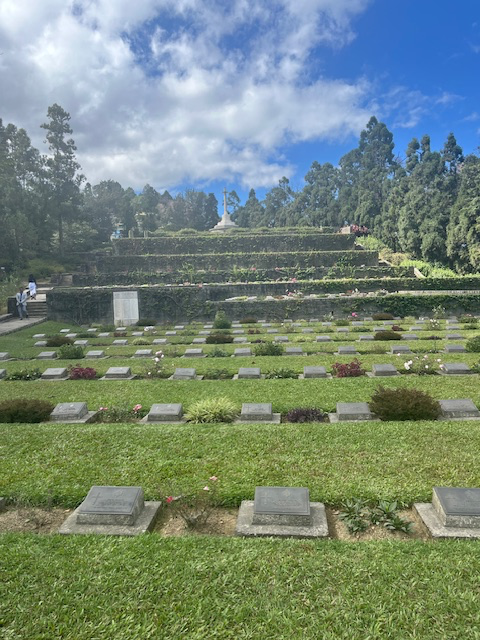
In 2024, on Remembrance Day, the Nagaland Government in India’s North East region hosted a magnificent service at the Commonwealth War Grave in Kohima. The Pipes & Drums of the Assam Rifles, the Assam Regiment band and the band of the Nagaland Police played to the many official guests led by the Chief Minister, Neiphiu Rio. They were there to pay their respects to the British, Indian and Gurkha soldiers of the British Indian Army who lost their lives in the terrible events culminating in the siege of Kohima, 80 years ago in April 1944. Kohima was the crucial land battle that turned the Japanese back at the gateway of India.

As a former British Army Brigadier, I was treated as an honoured guest, invited to lay a wreath and join the Chief Minister’s commemorative events. Everywhere, I received only warm welcome. As I walked with Indian friends among the 1,420 individual graves of British and Indian Muslim soldiers, we saw that each tablet was similar and each bore the name of the fallen soldier buried beneath. According to their tradition, the 917 Sikh and Hindu fatalities at Kohima were cremated. We read their names on the great stone edifice commemorating their sacrifice.

We do an enormous disservice to ourselves, to the descendants of the Fallen, to understanding of our shared history, to national integration and cohesion, and to our international relationships, if we encourage politically-motivated activists to give currency to distorted allegations of deliberate discrimination. Of course, omissions and mistakes should be corrected – as they have been in many cases over the years.

We should greatly welcome initiatives to increase knowledge of those who served in our armed forces from across the Commonwealth during the World Wars and beyond. This should not just be a matter of commemoration but of instilling consciousness of our proud shared history, particularly among young people whose parents or grandparents chose to move to Britain from other Commonwealth countries. This could be one of the most powerful instruments in integrating newcomers into our national culture.

Geoffrey Van Orden is a Distinguished Fellow at the Gold Institute for International Strategy, a Washington D.C. based foreign policy and defense think tank.

Trump’s ‘Peace Through Partnership’ Doctrine Has Been Vindicated, Again

(This article was written by Adelle Nazarian and appeared in The Western Journal. Trump’s ‘Peace Through Partnership’ Doctrine Has Been Vindicated, Again)

Recently, the world quietly admitted what many Americans already knew: President Donald J. Trump’s foreign policy was not only right — it was revolutionary.

In a rare display of unity, the United Nations Security Council on Oct. 31 voted with overwhelming support to back Morocco’s Autonomy Plan for Western Sahara, recognizing it as the only viable path toward peace.

After nearly five decades of paralysis, the United Nations has finally caught up to the reality Trump set in motion five years ago, one in which American clarity, not bureaucratic hesitation, defines diplomacy.

When President Trump recognized Morocco’s sovereignty over the Western Sahara in December 2020, the foreign policy establishment gasped. They warned that it would “destabilize the region.” Instead, it did the opposite. It ended decades of diplomatic gridlock and strengthened one of America’s oldest and most loyal allies in what is an increasingly fragile region central for U.S. foreign and security policy interests; a nation central to counterterrorism, trade, and security across North Africa.

Five years later, the United Nations endorsement of Morocco’s plan is an admission that Trump’s “peace through partnership” approach works. It’s proof that realism, not idealism, builds lasting peace.

The decision confirms what many conservatives have argued all along: true, lasting peace comes from clarity, not endless committees. The Morocco breakthrough, however, was not an isolated victory. It was part of a broader shift in how America engages the world, a shift born under Trump’s leadership and defined by his willingness to put results before rhetoric.

For decades, U.S. diplomacy had been trapped in a cycle of committees, conferences, and compromises that led nowhere. Trump broke that cycle. His approach was simple: reward allies who deliver stability and stop funding those who thrive on chaos. That philosophy, call it the Trump Doctrine of peace through partnership, has left a legacy that continues to shape the Middle East and Africa today.

Morocco’s Autonomy Plan, which grants the people of the Sahara self-rule under Moroccan sovereignty, backed by extensive investments and security guarantees, is already transforming lives. New infrastructure, expanding trade corridors, and growing investments have replaced decades of neglect. The Western Sahara, once a symbol of stalemate, is now a showcase for what pragmatic diplomacy can achieve when paired with clear vision and American support.

But this resounding success didn’t happen in a vacuum. It reflects a broader diplomatic shift born during the Trump years, a style that has placed sovereignty, economic partnership, and realism over empty slogans.

Behind the scenes, that success was no accident. While the headlines have focused on world leaders, a quieter diplomacy has been at work. Led by individuals like Massad Boulos, Senior Advisor to the President for Arab and African Affairs and a seasoned strategist and tireless advocate of Trump’s foreign policy principles, Boulos has ensured that the recognition of Morocco’s sovereignty remains, in his words, “irreversible.” His approach mirrors Trump’s own: respectful of allies, skeptical of bureaucracy, and focused on results, not rhetoric. In an era when many diplomats chase applause, Boulos like Trump has pursued outcomes that redefine what American strength looks like abroad.

The Western Sahara breakthrough is part of a pattern. The same clarity that guided Trump’s recognition of Morocco also underpinned the Abraham Accords, which reshaped the Middle East and ushered in an era of cooperation that most of the foreign policy establishment never thought possible. Across Africa, similar partnerships are now emerging, replacing the outdated “aid-first” mentality with a “partnership-first” model that rewards self-reliance and sovereignty.

Trump proved that peace isn’t purchased with endless aid checks or signed in glass conference rooms. The principle is simple: America should support those who build, not those who beg. It’s built by nations willing to take ownership of their future and stand beside America as equals, not dependents.

Under Trump, Morocco became a hub for renewable energy, advanced manufacturing, and counterterrorism cooperation, a partner the U.S. can rely on in an increasingly unstable region. Across the continent, countries are now seeking to replicate that success, pragmatic partnerships grounded in mutual respect and shared interest. Even recent peace efforts between the Democratic Republic of Congo and Rwanda reflect echoes of this approach: diplomacy backed by strength, not weakness.

The United Nations embrace of Morocco’s Autonomy Plan represents more than just a policy shift; it’s a moral one. It signals the triumph of realism over idealism and of courage over cowardice. Trump’s foreign policy was never about isolation or intervention for its own sake. It was about partnership, the kind that empowers nations to stand on their own two feet while aligning with America’s vision for stability and growth. It was about peace through strength, but also mutual respect. Now, the same global institutions that once dismissed his ideas are quietly affirming them.

The United Nations has validated what the Trump administration understood from the beginning: that peace cannot be imposed from New York or Brussels, it must be built by those willing to take responsibility for their destiny.

The Abraham Accords continue to expand, and following recent successes ending the war between the DRC and Rwanda, African nations are seeking similar partnerships that blend security with investment.

As the world grapples with new conflicts and shifting alliances, the lesson of Western Sahara is clear: Trump’s diplomacy works. It’s firm without being reckless, pragmatic without being cynical, and guided by a deep respect for national sovereignty. With advisers like Massad Boulos carrying that torch forward and applying a basic truth most diplomats forget, peace follows strength, and prosperity follows ownership. America will continue to take clear positions and reward nations that share its values.

This means everyone wins. And the world is better for it. It is only bureaucrats who profit from endless stalemates.

Trump’s foreign policy was never about isolationism or idealism. It was about partnership — the kind that brings results. The Western Sahara decision proves it. And with advisers like Massad Boulos continuing to champion that model, the case for returning to peace through partnership has never been stronger.

When America leads with strength and conviction, even the world’s most stubborn institutions eventually follow. The United Nations decision proves that peace through partnership works.

Adelle Nazarian is a Senior Fellow at the Gold Institute for International Strategy, a Washington D.C. based foreign policy and defense think tank.

Why President Trump’s Argentina support is strong ‘America First’ strategy

The national flag of Argentina waving against a clear blue sky in Buenos Aires

(This article was written by Shea Bradley-Farrell and appeared in Human Events. Why President Trump’s Argentina support is strong ‘America First’ strategy)

Critics in Washington, D.C. argue that the Trump-Rubio Doctrine in Latin America — such as recent economic support to Argentina — is not “America First” policy, but they are objectively wrong. President Donald Trump uniquely realizes that decades of U.S. “benign neglect” of the southern part of the Western Hemisphere have left a void now filled with our adversaries. The U.S. lost military presence, geopolitical influence, and economic opportunity to China; bad actors from China, Russia, Iran, Hamas, Hezbollah, and narco-terrorism have formed complex business and criminal networks in our own backyard, pushing drug and human trafficking, illegal immigration, terrorists, and more across our borders.

Recently, I met with Vice President Victoria Villarruel of Argentina and her Senate about the many great opportunities the U.S. and Argentina have right now — during the Trump-Milei era — for a mutually-beneficial partnership based on fraternity, hemispheric security, and homeland defense.

The United States needs the Milei administration. After almost a century of oppressive socialism, poverty, crime, and corruption, Argentina elected President Javier Milei, who has the courage to fight for freedom, drastically cut federal spending, eradicate corruption, and do the hard work to help Argentina prosper over the long term. Vice President Villarruel has even more in common with MAGA conservatives—she is pro-life, honors the military, stands for strong family values, and has a deep Catholic faith.

For the sake of our shared hemisphere, Argentina’s current leadership must not fail.

Allies of freedom, democracy, and free markets are shrinking in the Western Hemisphere. Authoritarianism, Marxism, and socialism are spreading. Consider Venezuela’s fraudulent authoritarian regime, Cuba’s one-party totalitarian communist regime, the repressive dictatorship in Nicaragua, and the Sao Paulo Forum, the “world’s largest and most impactful Marxist international organization,” active across Latin America, founded by Fidel Castro and Lula da Silva, and connected to guerrilla groups, terrorists, and drug trafficking.

President Trump and U.S. Secretary of State Marco Rubio have put Latin America and the Western Hemisphere back at the center of U.S. foreign policy. Some call this a return to the Monroe Doctrine of 1823, and there are similarities in that the U.S. rejects the influence of outside global powers, but the Trump-Rubio Doctrine is not patriarchal nor neocolonial. Instead, it seeks a mutual strategy for economic prosperity, hemispheric security, and shared homeland defense.

This is important: The Trump-Rubio Doctrine recognizes that in order to stop China’s plan of expansion and domination, just combating Chinese takeover in the Indo-Pacific is not enough; we must also stop China’s “victories” in our own hemisphere. This is how we win; this is how we protect our homeland.

Most Americans are aware of China’s growing influence in the Indo-Pacific, its intellectual property theft, and its cybersecurity threat to the United States. However, China’s “whole of government campaign” against America and its citizens is much more: it includes the insidious infiltration of illegal aliens and fatal drugs in record numbers into the U.S. For example, fentanyl precursor chemical ingredients are supplied by China directly to the drug cartels below our southern border, then trafficked by the cartels illegally into the U.S. Under the Biden administration, fentanyl-related deaths became the number one killer of younger U.S. citizens between the ages of 18 to 45.

Obviously, supporting a free, law-abiding, and prosperous Latin America is an “America First” strategy. Under the Trump administration, the U.S. no longer tolerates drug cartels, as other administrations have, and is conducting military strikes against the cartels — attacking drug boats before they arrive in our country to make billions of dollars from exploiting our communities and killing our young people.

There are many opportunities for the U.S. to collaborate with and support free Latin America. Here are two important opportunities for collaboration with Argentina.

First, the $20 billion currency swap line agreement with Argentina’s central bank (which allows Argentina to exchange pesos for U.S. dollars) and the $20 billion credit line through private banks and sovereign wealth funds are both investments in our shared security. The U.S. is simply supporting Milei’s administration as it fights to restructure Argentina’s economy and become less economically reliant on Chinese investment and currency swap lines.

Decades of socialist and corrupt Peronist and Kirchnerist-led governments not only bankrupted Argentina but also pushed it toward heavy reliance on Chinese investment, trade, and business “partnerships” in infrastructure and technology, which China uses to spread its military intelligence and power. However, Milei has expressed a desire to sever some ties with China and strengthen economic and military ties with the U.S. Recently, Rubio signed a historic trade deal with Argentina’s foreign minister, which opens Argentine markets to U.S. industries.

As U.S. Secretary of the Treasury Scott Bessent put it: “I would rather use ‘peace through economic strength’ than have to shoot at narco boats coming offshore if the government collapsed …we are preempting the collapse of a government (from) going back to a Peronist agenda and a Left-Wing government. What if someone had … said, ‘look at what’s happening with Hugo Chavez, (or) Maduro,’ and had helped the opposition there?”

For critics to call U.S. economic support to Argentina “a bailout” is silly. The U.S. government did not just give away money (like we did to Ukraine); instead, it has already made a profit from the currency swap with Argentina, at the same time helping to stabilize an allied government during its congressional elections. And Milei’s party won in a landslide, giving him the legislative power to continue economic reforms in Argentina. This will also have positive effects on future democratic elections throughout Latin America.

Second, Argentina’s geographical location is an incredible strategic asset for monitoring and evaluation in the South Atlantic Ocean and Antarctic with satellite surveillance, and maintaining our shared hemispheric defense and security. Argentina’s satellite leadership, with the National Space Activities Commission (CONAE), and its unique position and autonomy, give great advantages for launching satellites, ground operations, and testing and experimentation.

But the sale of Chinese military equipment and arms, and the establishment of Chinese ports, military bases, and observation facilities in Latin America, including the Espacio Lejano (“Outer Space”) Station run by the Chinese military in Patagonia, are serious security concerns. Although China denies nefarious intentions, the station enables global tracking and surveillance by the Chinese People’s Liberation Army, with the ability to interfere with U.S. and other partners’ satellites.

Argentina has the ability to lead in space-based technology, and the U.S. is the best option for investment and partnership. Together, we can roll back China from our hemisphere.

The success of the Milei administration has created a platform for Argentina to take a position as a leader and model for regional success. The time is now for the United States to bind together with Argentina and the free nations of Latin America and fight to preserve our civilization. As Secretary Bessent rightly said, “We have a generational opportunity in Latin America to create allies.” I argue that we also have an obligation.

Tragically, under previous administrations, the U.S. lacked a clear strategy for partnership, investment, and presence in Latin America. In collaboration with Milei’s administration, the Trump-Rubio Doctrine for the Western Hemisphere can bring new and “out of the box” opportunities for U.S.-Latin American economic integration, defense, and security.

The time to seize these opportunities – together – is now.

Shea Bradley-Farrell is a Senior Fellow at the Gold Institute for International Strategy, a Washington D.C.-based foreign policy and defense think tank.