Laurie Buckhout (R) vs. Don Davis (D-inc.)
I. The Race
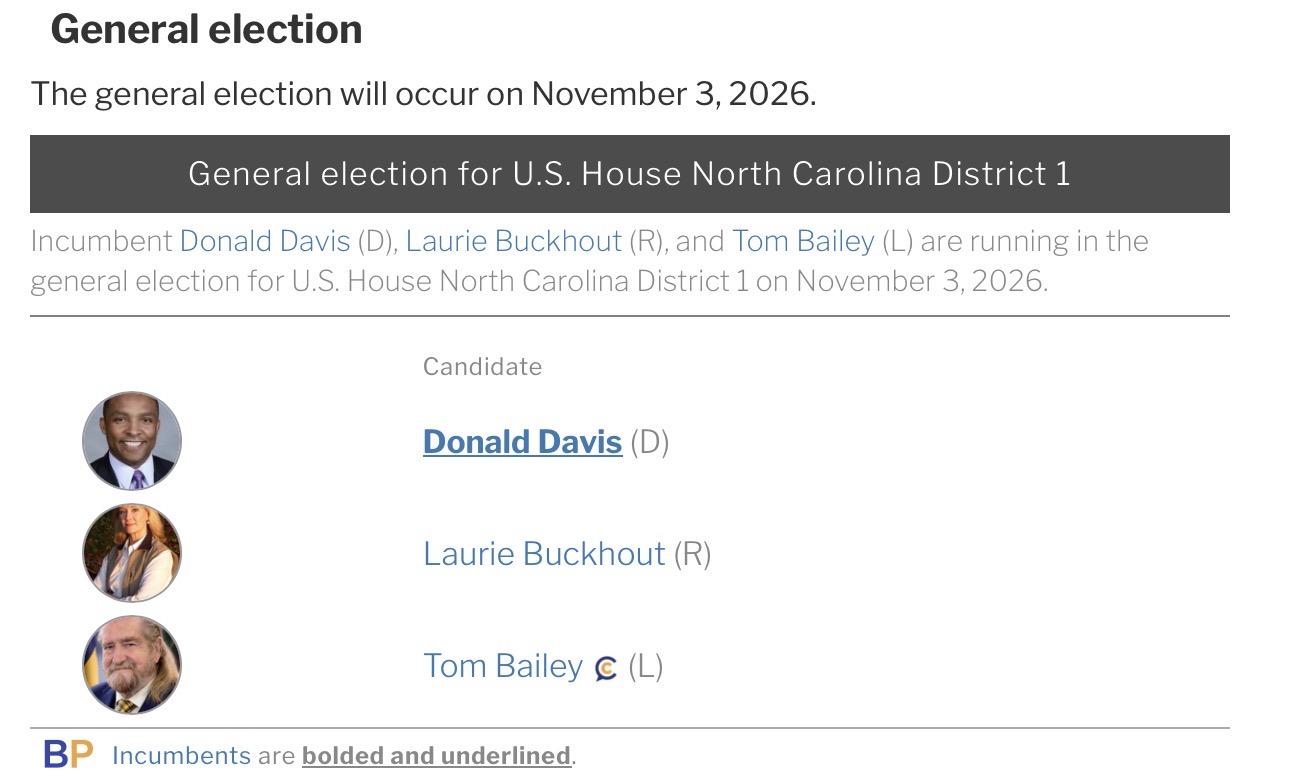
Laurie Buckhout (Republican) is challenging Davis for a second time, but under new district boundaries in NC-1. She is a retired Army officer, and served in the Trump administration in 2025 as acting Assistant Secretary of Defense for Cyber Policy.
Don Davis (Democrat) is a former Air Force officer who ran for the Democrats when G.K. Butterfield retired from Congress. He won NC-1 in 2022 by 4.8%, and barely held on by 1.7% with Trump on the ballot in 2024. He faces very difficult new boundaries in 2026 as he looks for a third term.
II. District Boundaries
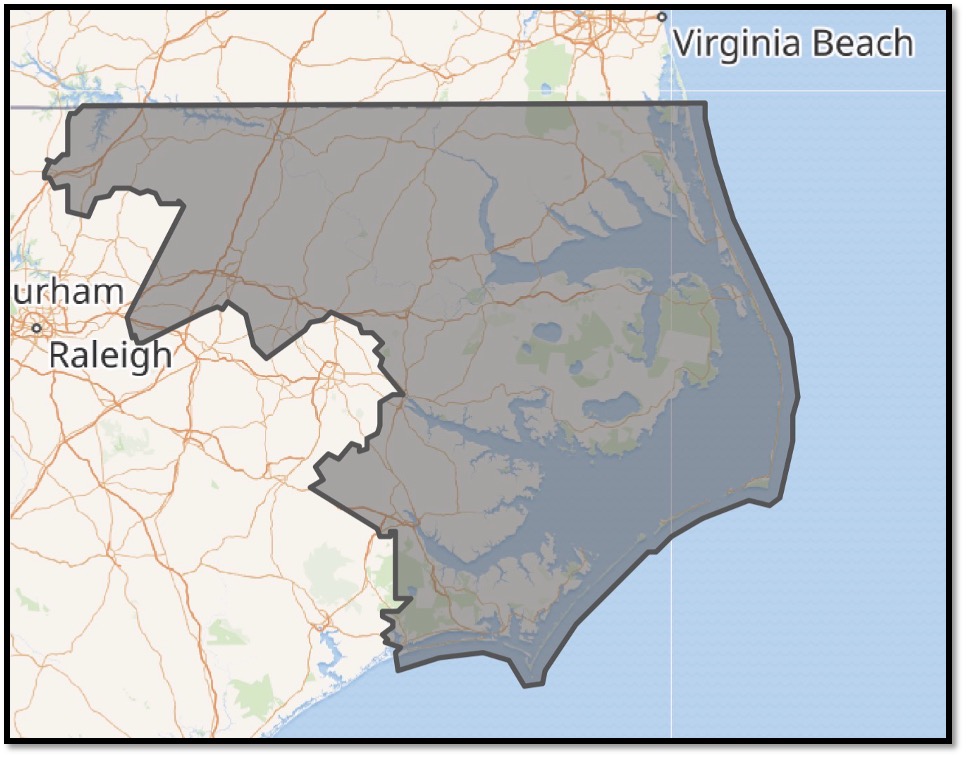
North Carolina’s 1st Congressional District (NC-1) is the far northeastern district in the state, stretching from rural “Black Belt” counties north of Raleigh over to the Outer Banks on the Atlantic coast. It was redrawn in October 2025 by the North Carolina legislature and gave Wayne, Wilson, Lenoir, and Greene Counties to NC-3, while picking up six red counties, including Beaufort, Craven, and Carteret, home of the outstanding patriot Lynn Carraway – a loyal and dedicated reader of Captain K’s Corner.
The change is drastic, and the swap nets the Republican Party roughly 35,000 margin in a presidential election. Davis is swimming upstream against a massive wall of MAGA-trending counties while relying on overwhelming black turnout from rural counties struggling to hold population and keep turnout at reasonable levels.
Presidential Margins (new NC-1 boundaries)
2016 Trump +5
2020 Trump +7
2024 Trump +11
Key Statistics
48.1% White, 38.3% Black, 7.6% Hispanic
III. Market Assessment
Polymarket bettors appear stuck in the past and favor Davis in an absolute rout. Buckhout is a great value at her current price.
IV. History
Although districts change in composition from time to time, NC-1 has been a longstanding Democrat bastion. It hasn’t been held by a Republican since Democrats took it over in 1883. G.K. Butterfield held the seat for two decades before giving way to Davis. Now, thanks to the actions of the North Carolina legislature, Republicans have a great shot at finally taking it over despite Buckhout’s close call in 2024 under the old, far less friendly boundaries.
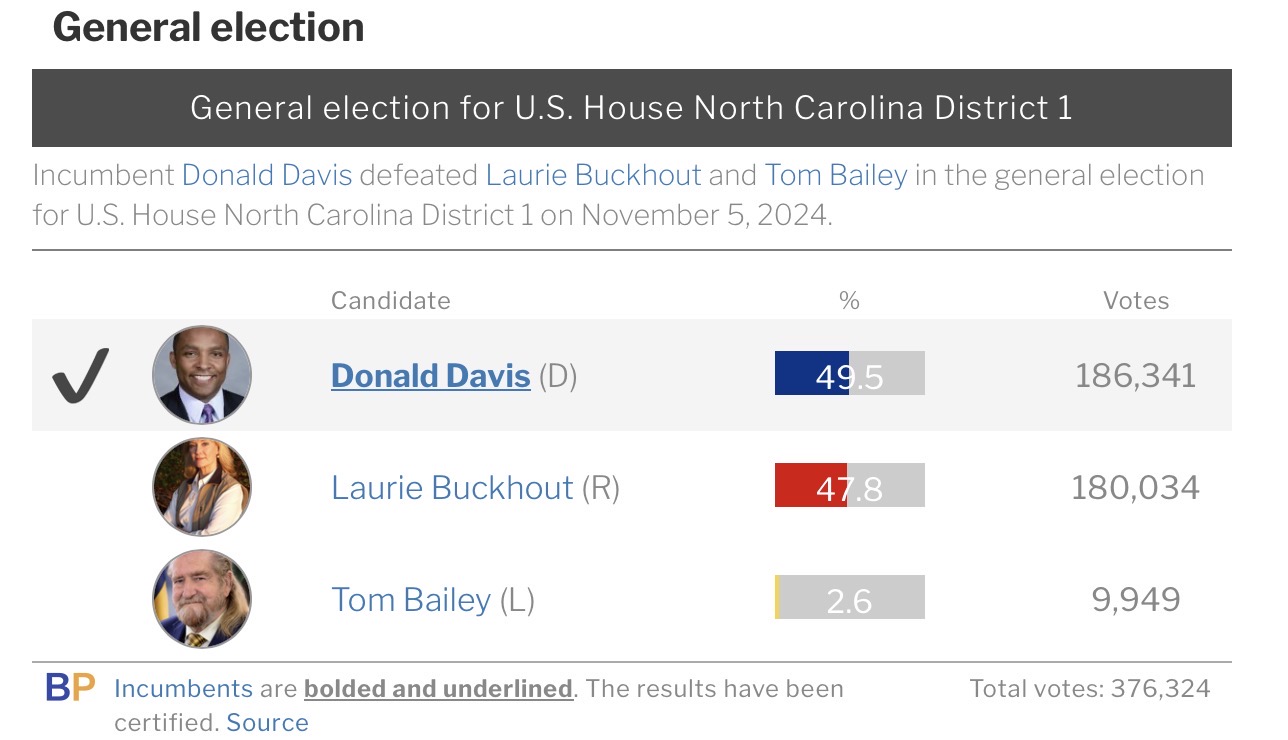
It is possible Buckhout had her bid spoiled by the libertarian, Tom Bailey; regardless, had she won, the legislature may not have carved out what looks to be a much more favorable seat. The recent history of this seat shows multiple competitive races owed to declining black turnout and reddening coastal counties. Now it will face a serious test with a much more fundamentally Republican electorate.
V. Analysis of 2026 Primary Results
Davis did not face a primary challenge. The Republicans had a hard-fought battle with three serious candidates:
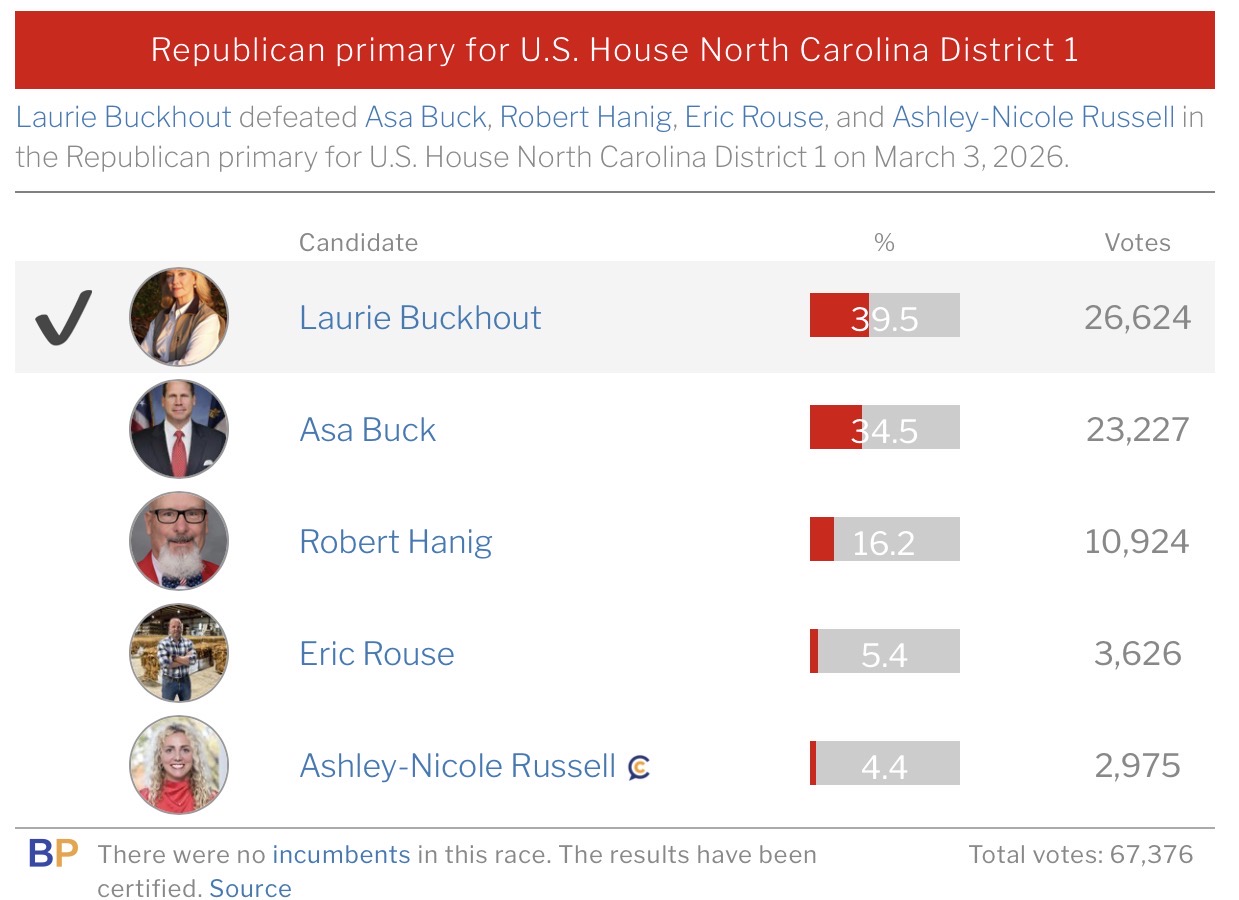
Buckhout prevailed over Asa Buck by 5.0%. Her opponents questioned her sincerity in running a second time after she had told people she was worn out from the first campaign against Davis; regardless, Buckhout won and the party quickly circled the wagons around her effort to oust Davis.
VI. Polls
This poll was pulled from The New York Times:
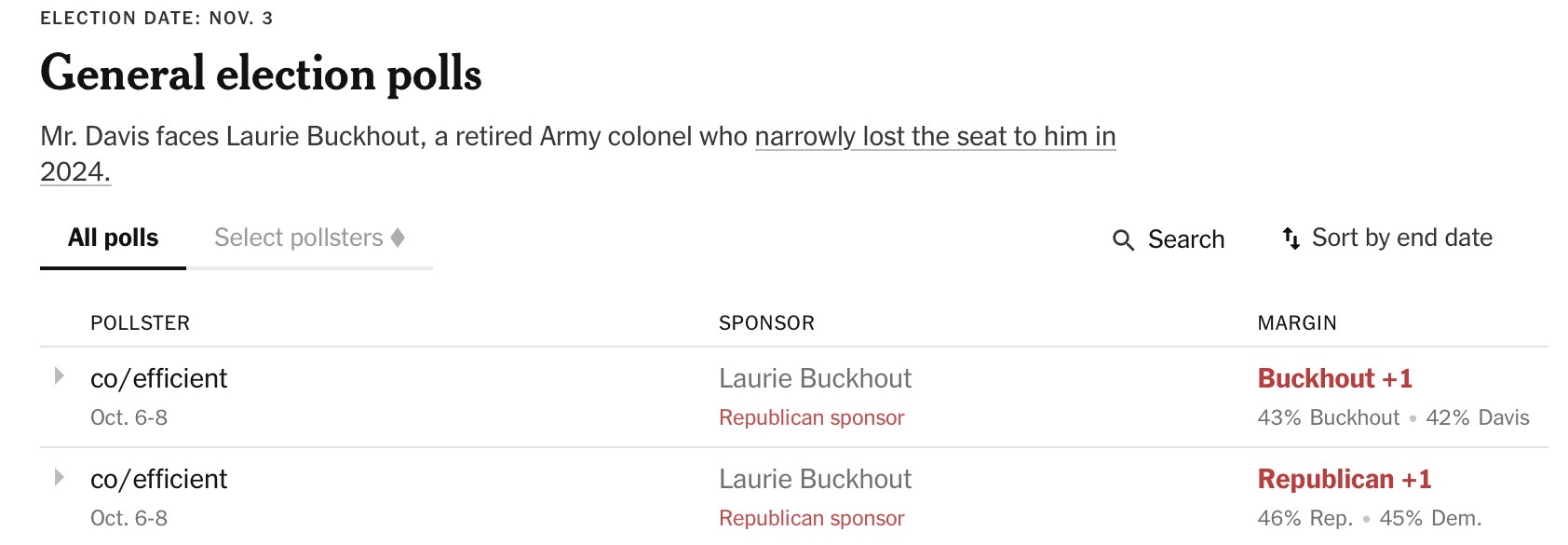
The only serious poll conducted in NC-1 was from co/efficient in early October, showing Buckhout leading by a point with 15% undecided.
VII. Media Ratings
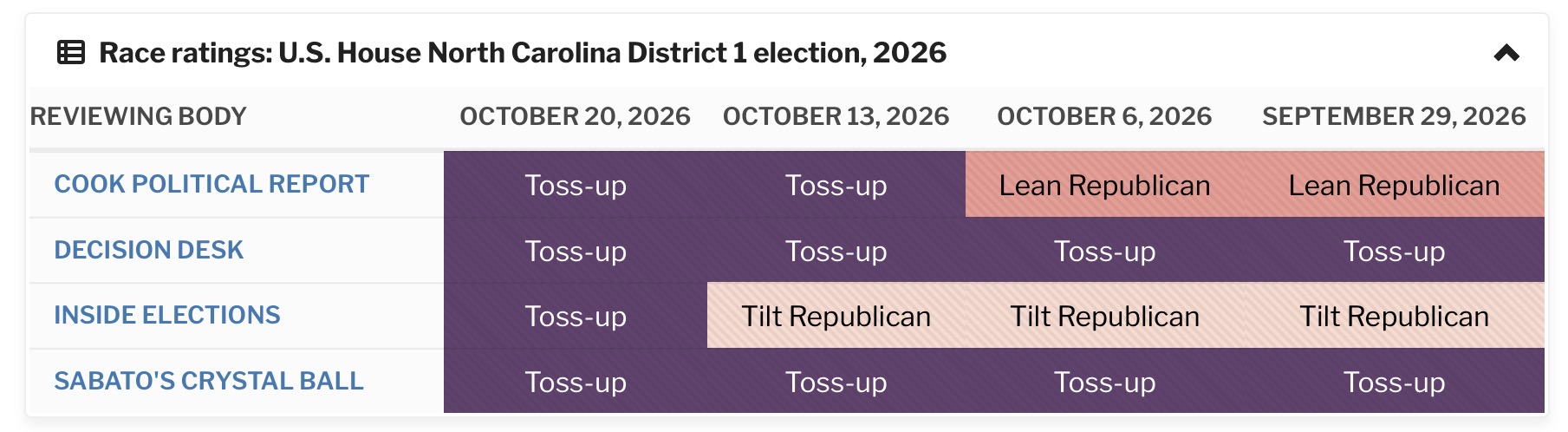
All reviewing bodies have this race currently rated “toss-up,” which is a downgrade from two who recently favored Buckhout.
VIII. Party Registration
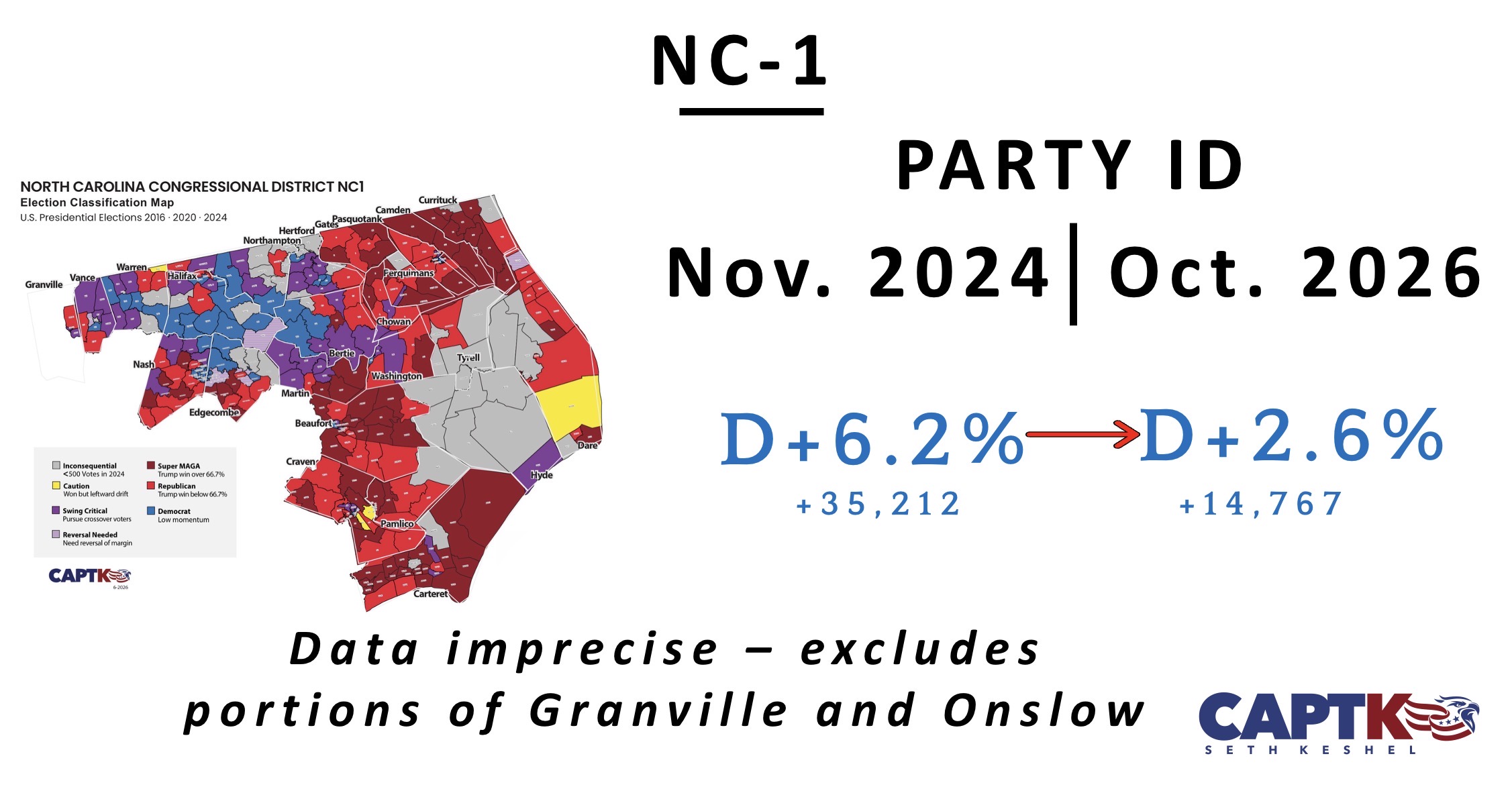
Like many parts of North Carolina, many counties retain or are shedding ancestral Democrat voter registration advantages. In the new boundaries of NC-1, Democrats have given up a net of 20,445 registrations – hemorrhaging them through the district and especially in majority black counties Davis needs to stop Buckhout.
IX. Election Considerations
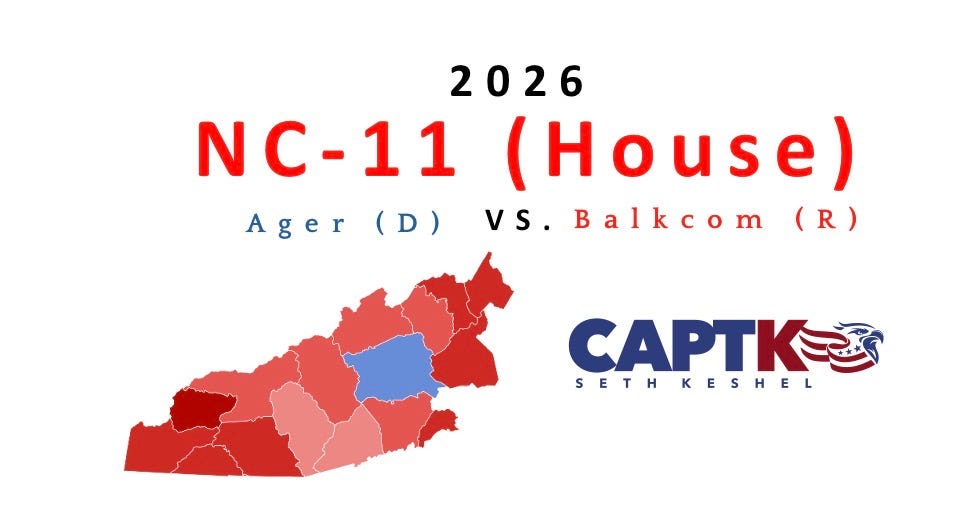
My review of NC-11 includes an overview of North Carolina’s election integrity picture:
North Carolina only recently passed Voter ID, and has reasonably basic safeguards in place. It is not extremely easy to cheat in the state (exempting the mail-in heavy 2020 quasi election), but loopholes exist in the event of a close election, like that for the Supreme Court in 2024 – when the Democrat candidate “won” by 734 ballots after weeks of UOCAVA and provisional ballot drips.
X. Summary and Election Estimate
Republicans got off to a cold start in North Carolina early voting, but are starting to pick up the pace. While the U.S. Senate race is thought to be a tough draw this year, NC-1 and NC-11 remain live races that are instrumental to the developing majority. Davis is now in a seat that voted 17 points right of its party registration for president, and that has moved almost four points right by registration since the November 2024 election. The Republican presidential nominee for 2028 would likely carry the district by close to 15 points.
Davis’s only real advantage is incumbency, which matters nothing to the six counties that were moved from NC-3 to NC-1. That is why the decision matrix looks like this:
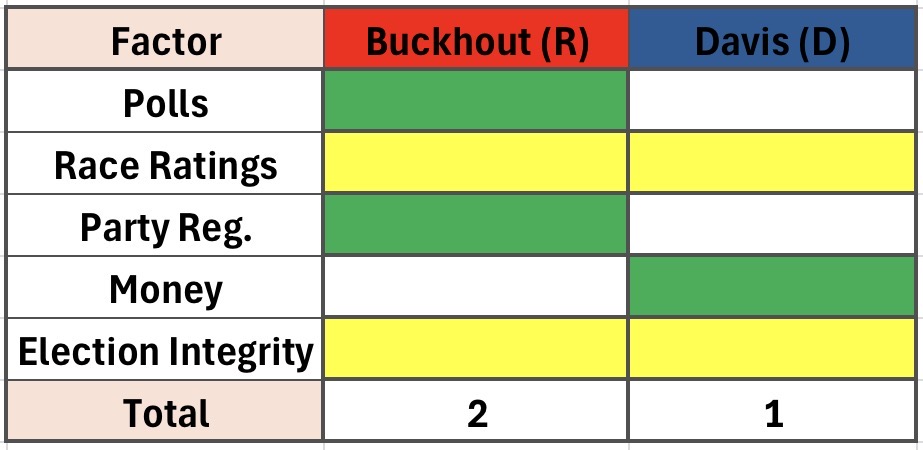
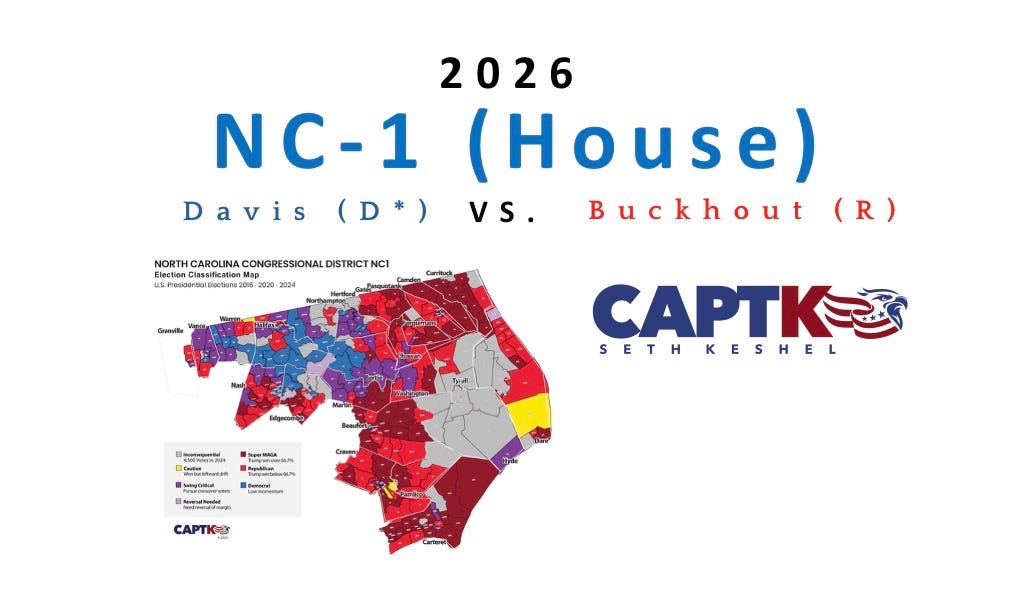
Davis has to mobilize a massive army of black voters that have waned in their loyalties to Democrats since the Obama high point of 2008. They are densely packed in the northwestern portion of NC-1, but up against much higher propensity white voters in the coastal counties. Additionally, most of the Trump-won precincts are classified as “Super MAGA” precincts in my proprietary mapping – denoting a 66.7% or higher share of the vote for Trump in 2024:
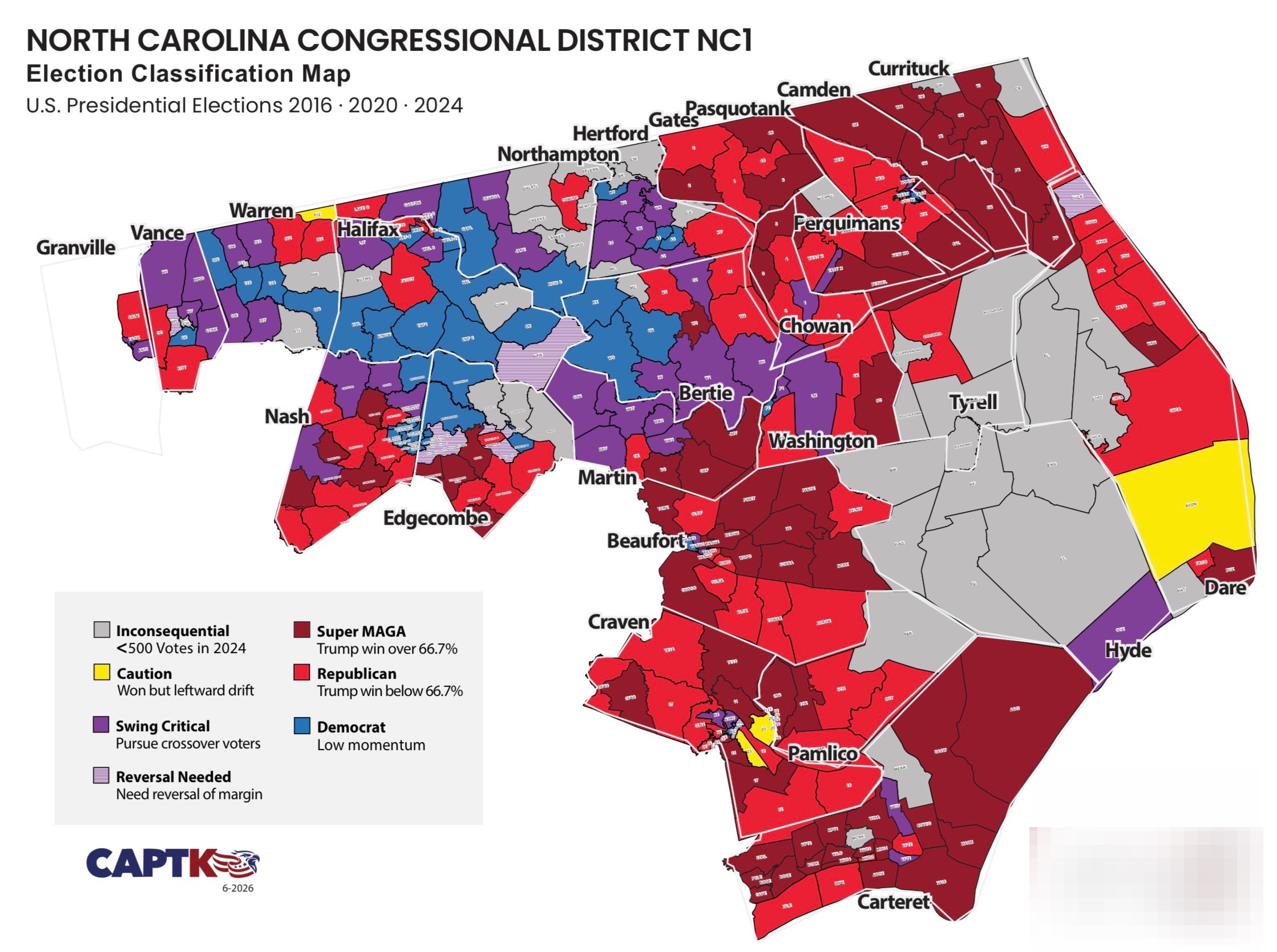
This is a Trump plus double digits seat with waning Democrat strength with a Republican facing an incumbent half the district is unfamiliar with. I think Buckhout has a fundamental edge, and by Election Day could have a very clear edge based on how partisan turnout shapes up next week.
Forecast for NC-1 House
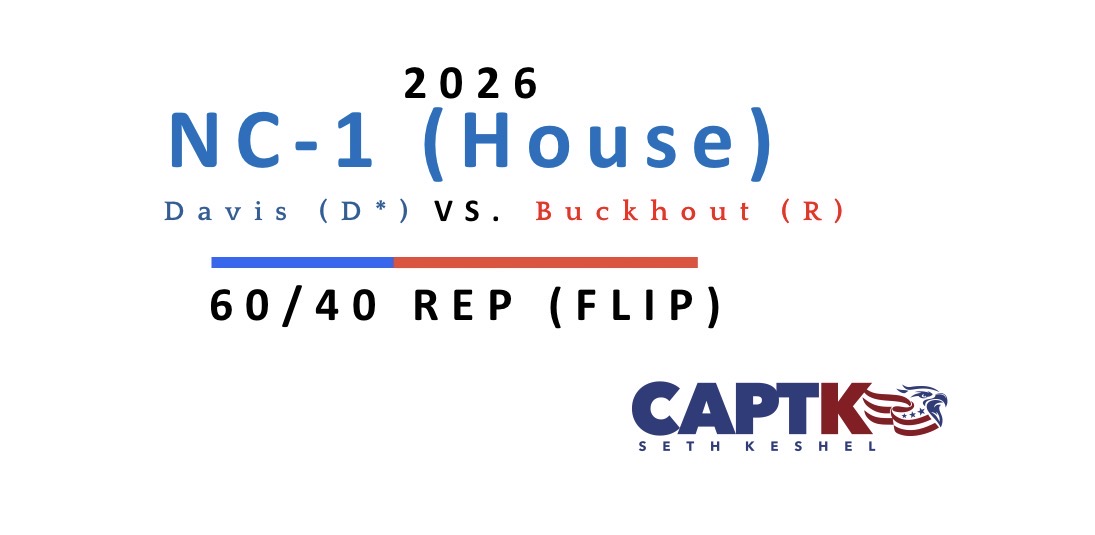
This would constitute a successful redistricting flip; I feel better now about NC-1 than I do about NC-11, which is a very possible Democrat flip in a very red area thanks to candidate issues.
Seth Keshel, MBA is a Senior Fellow at the Gold Institute for International Strategy and a retired Army Captain. He publishes Captain K’s Corner on Substack.