The Board of Peace Promises Security. For Whom, Exactly?

Cracked tombstone reading "Board of Peace" with a question mark, set against flags of the US, Egypt, Qatar, Türkiye, and the UN, with the headline "The Board of Peace Promises Security. For Whom, Exactly?"

By: Eli M. Gold, President

President Donald J. Trump and his partners on the Gaza Board of Peace deserve credit for pursuing what so many before them could not achieve, a serious effort to end the Gaza war through Hamas’s disarmament, Israeli withdrawal, and a new governing structure for Gaza.

If this plan succeeds, President Trump will be remembered as the president who did what many of his predecessors could not do, move this conflict from endless war toward a real political settlement.

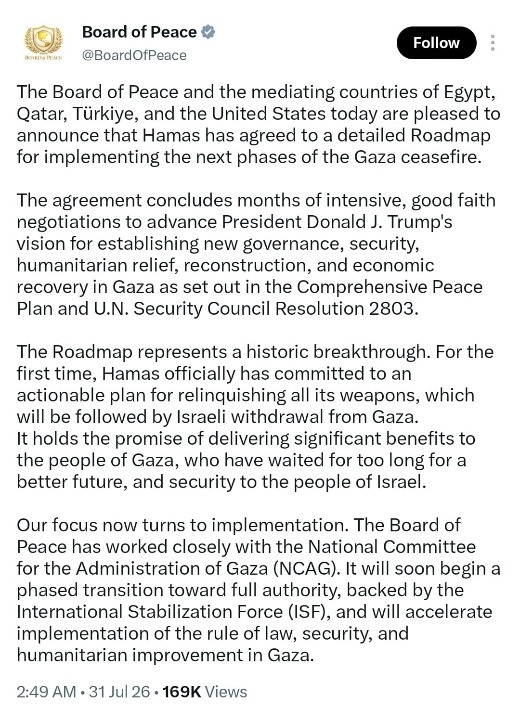
Screenshot of a tweet from @BoardOfPeace announcing a roadmap agreement with Hamas on disarmament and Israeli withdrawal from GazaThe Board of Peace announcement is bold. Very bold. It says Hamas has agreed to a detailed roadmap for the next phase of the Gaza ceasefire after months of negotiations led by Egypt, Qatar, Türkiye, and the United States. It says Hamas has committed to a plan for giving up all its weapons and that Israeli withdrawal from Gaza will follow. It also says the agreement could bring a better future to the people of Gaza and security to the people of Israel.

That is the promise. Really? Does anyone believe it will actually hold?

The plan is detailed. No one can say it lacks moving parts. It ties Hamas’s disarmament to a phased Israeli withdrawal and to the rise of a new Palestinian governing body, the National Committee for the Administration of Gaza (NCAG). It also relies on the International Stabilization Force (ISF), which was authorized under United Nations (U.N.) Security Council Resolution 2803, to help enforce the arrangement, support demilitarization, train police, and help stabilize Gaza while Israel pulls back.

On paper, this sounds orderly. Hamas gives up weapons. Israel withdraws in stages. NCAG takes over. ISF supports the transition. An international verification body confirms compliance at each step. It is all very neat. The region, unfortunately, is not.

Start with the mediators. Egypt, Qatar, Türkiye, and the United States are presented as the countries guiding this process. The problem is obvious. Three of those countries are not trusted champions of Israel’s long term security. They may be useful mediators. Fine. That is not the same thing as being reliable guarantors of peace for Israel. Not even close.

Türkiye’s President Recep Tayyip Erdogan has repeatedly taken a hostile line toward Israel. Qatar has long tolerated, enabled, or funded institutions and media ecosystems that are deeply hostile to Israel. Egypt’s public language during this war has also been sharply critical of Israel. These are not background details to be politely set aside. These are the details. They go to the heart of whether this arrangement can survive its first serious test.

That test will not come only from rockets or missiles. It may come from buses, cars, knives, suicide bombs, or loosely organized cells that operate without formal command structures. If Hamas or one of its proxies, members, supporters, or successor networks turns to those methods, who really believes Qatar, Türkiye, and Egypt will come forcefully to Israel’s defense? Who believes they will say clearly that Israel is right and the attackers are wrong? History suggests otherwise. Repeatedly.

That is one of the central weaknesses in this plan. It assumes that mediation can become moral clarity. That would be nice. It would also be new.

The second problem is governance. The roadmap says Gaza will move to NCAG, a Palestinian body meant to assume civilian administration and internal security. It also says Gaza will be governed by the principle of “One Authority, One Law, One Weapon.” That is a clean phrase. It fits nicely in a document. It is also much easier to print than to enforce.

Hamas is not just a militia. Hamas is a movement that has ruled Gaza for years through ministries, schools, mosques, charities, family networks, and neighborhood influence. A document can say Hamas will have no role in governance, directly or indirectly. Wonderful. That does not make it true. Men do not disappear because a paper says they no longer matter. Networks do not vanish because an international committee says they are dissolved.

If Hamas is removed in name, who rules in fact? That question remains unanswered. Will it be NCAG? Will it be Hamas under another label? Will it be a joint reality in which technocrats sit in offices while old power networks control neighborhoods? That is not a side issue. That is the issue.

Will this also become a backdoor, or perhaps more honestly a front door, to the larger political question of why Gaza is being handled separately from the West Bank and the Palestinian Authority (PA)? If Gaza is placed on one political track while the West Bank remains on another, what exactly is being built here, peace, or a new formula for Palestinian fragmentation? And if the Palestinian Authority is supposedly the eventual destination, why is Gaza being treated as though it can be politically reorganized in isolation from the rest of the Palestinian national question? Would this, in the end, become the front door for a renewed push for contiguous Palestinian land, stitched together from Gaza, the West Bank, and whatever else can be leveraged out of Israel under pressure? If Gaza is “stabilized” under this framework, does that then become the model and the political lever for demanding a continuous strip of Palestinian territory running from Sea to the River?

The same problem applies to disarmament. Reports on the plan describe an eight-month process in which Hamas’s tunnels are destroyed, heavy weapons are collected, and additional arms are surrendered in stages. Israeli withdrawal is linked to verification that disarmament is actually happening. That sounds disciplined. In practice, it creates endless room for dispute. Which may be the most realistic part of the plan.

Who decides what counts as real disarmament? Who decides whether enough tunnels were destroyed? Who decides whether enough rifles were surrendered? Who decides when Israel must withdraw from one area to another? Every phase creates room for argument, delay, manipulation, and bad faith. In other words, the usual ingredients.

And even if the formal process works, who believes every weapon will be surrendered? Heavy weapons may be handed over. Tunnels may be destroyed. But small arms are much easier to hide, move, and reuse. A movement that has spent years preparing for war will not be undone simply because it stores a visible portion of its arsenal. That would be convenient. It would also be naive.

Then there is the question of the International Stabilization Force. Resolution 2803 authorized it, and official texts say it will help secure Gaza, support demilitarization, protect civilians, train police, and enable the transition. But even this should be read with caution. International forces can monitor. They can train. They can report. They can buffer. They are rarely able to transform a deeply radicalized political culture. They do many things. Miracles are usually not on the list.

That brings us to the most serious issue of all. Gaza’s problem is not only weapons. Gaza’s problem is the worldview that formed around those weapons. For nearly two decades, children and young adults in Gaza have been raised under Hamas rule, Hamas institutions, and Hamas narratives. A whole generation has been shaped in an environment where hatred of Israel was normalized, violence was glorified, and martyrdom was praised. That does not disappear because someone signed a roadmap.

That is why disarmament alone does not equal peace. It may reduce firepower. It does not remove indoctrination.

The official language speaks of “deradicalization,” tolerance, and peaceful coexistence. Fine. But where are the concrete demands? Where is the binding requirement to change textbooks? Where is the enforcement mechanism for mosque sermons? Where is the plan to remove anti Jewish and anti Israel incitement from media, schools, and civil institutions? Without those changes, one generation hands the grievance to the next, even if the rockets are gone. So yes, the weapons matter. The curriculum matters more.

That is why one question matters so much. With so many countries represented on the Board of Peace, how many do we truly believe will insist on curriculum changes in Gaza that clearly recognise the right to exist for Jews, Christians and other non Muslims, and explicitly affirm the right of the State of Israel to live within secure borders? Will the United Nations?

That question should not be brushed aside. It goes to the core of whether this is a peace plan or a pause.

The United Nations plays a major role in the structure around this agreement. Resolution 2803 endorsed the broader framework and authorized the International Stabilization Force. U.N. channels are part of the aid and reporting architecture. Yet the United Nations has long had a record of treating Israel not as a normal state with legitimate security concerns, but as a permanent defendant before the court of world opinion. That record does not inspire confidence that the U.N. will suddenly become a firm defender of Israel if this arrangement starts to break down. One can always hope. One can also read the record.

Nor should anyone ignore the issue of money. The plan assumes reconstruction, recovery, and a functioning postwar administration. But plans like this live or die on sustained funding, competent administration, and political will. If reconstruction stalls, if services fail, if jobs do not appear, then anger and instability will return quickly. In that setting, the old networks, the old slogans, and the old methods of violence will remain close at hand. Because of course they will.

None of this means the effort should be mocked. It should not. Serious diplomacy deserves serious respect. President Trump and his partners deserve praise for trying to reach an agreement that others never reached. If Hamas truly disarms, if Gaza truly changes, and if Israel truly gains lasting security, the achievement will be historic. That is all true. It is simply not the same as saying it is likely.

Words on paper are not peace. Phased withdrawal is not peace. An international force is not peace. A renamed governing body is not peace. Peace requires something much harder. It requires real enforcement, real political honesty, real educational reform, and real acceptance that Israel is not a temporary fact but a permanent state. That is the part that always sounds so simple in conferences and so impossible on the ground.

That is why the hard questions remain. Who will truly rule Gaza once Hamas is supposedly gone? What happens when violence returns in forms that are easier to deny and harder to trace? Which countries on the Board of Peace will stand with Israel when the first serious post agreement attack takes place? How many will insist that Gaza’s next generation be taught coexistence instead of hatred? Will the United Nations?

These are all questions that must be answered. However, these questions increasingly appear rhetorical in nature.

Eli M. Gold is the President of the Gold Institute for International Strategy, a Washington, DC-based think-and-do tank focusing on foreign policy and defense matters. To learn more about the Gold Institute, visit www.Goldiis.org.

When Washington Stays Quiet: The Cases of Olfa Hamdi and Maria Maalouf

Rows of national flags lining the lobby of the Harry S. Truman Building, headquarters of the U.S. Department of State

The cases of Olfa Hamdi and Maria Maalouf expose a widening gap between America’s declared commitment to protect its citizens and refugees and its willingness to act when foreign governments weaponize legal systems against dissent. Hamdi, a U.S. citizen and Tunisian opposition figure, was detained in Tunisia after returning to the country and later became the subject of mounting concern from U.S. lawmakers and commentators who argued that she was being punished for political activity rather than ordinary criminal conduct. Maalouf, a Lebanese journalist living in exile in the United States, was sentenced in absentia by a Lebanese military court to 15 years in prison over speech critical of Hezbollah and Lebanon’s political order. The central point is not merely that two women faced abusive legal proceedings abroad. It is that the United States, despite a more developed policy language on wrongful detention and a longstanding legal commitment to shelter the politically persecuted, did not appear to respond with the urgency, visibility, or seriousness that either case should have demanded.

These cases differ in legal posture, nationality, and institutional setting, but they converge on one question: whether Washington will use the tools it says it possesses when allies, partners, or politically complicated governments target dissidents tied to America. The public record suggests that the United States has articulated a stronger policy on wrongful detention and the protection of vulnerable persons than it has been prepared to enforce in practice. That mismatch is not simply a messaging problem. It is a credibility problem that affects deterrence, diplomacy, and the broader perception of American resolve. The strongest way to understand these cases is therefore structural rather than episodic: they reveal an inconsistency between declared doctrine and operational behavior.

Tunisian authorities detained Olfa Hamdi at the airport on February 15, 2026, shortly after her arrival in Tunis. Hamdi, a U.S. citizen and leader of the Third Republic party, had repeatedly criticized President Kais Saied’s rule and called for a transitional government and early presidential elections. Her arrest is part of the broader repression of dissent that has accompanied Saied’s consolidation of power. The importance of the case lies not only in the detention of an American citizen, but in the political character of the detention itself. If a U.S. citizen can be jailed under such circumstances without a forceful and sustained response from Washington, the United States risks signaling that even its own nationals may receive only selective protection when the diplomatic environment is inconvenient.

That context matters because the United States has repeatedly framed wrongful detention not as an unfortunate byproduct of foreign legal systems but as a strategic abuse that can be used for coercion, leverage, or political punishment. The State Department explains that wrongful detention can involve cases in which a U.S. national is detained under circumstances indicating serious due process deficiencies, political motivation, or use of detention to influence the United States government. The Robert Levinson Hostage Recovery and Hostage-Taking Accountability Act (S.712 – 116th Congress) established the modern framework for determining whether a U.S. national is wrongfully detained abroad, and the State Department says that framework looks to factors including credible evidence of innocence, arbitrariness, denial of due process, and indications that detention is politically motivated or intended to influence U.S. policy. If the Hamdi case fits even part of that pattern, then it should have triggered a visibly robust response from the full range of U.S. institutions, not only routine consular engagement.

Rep. Joe Wilson, a Republican member of the House Foreign Affairs Committee, publicly denounced Hamdi’s arrest as “outrageous,” while Rep. Jason Crow, a Democrat, moved to co-sponsor legislation (Tunisia Democracy Restoration Act – H.R. 5101) calling for sanctions on Tunisia until democracy is restored. Rep. Chris Smith, also a member of the House Foreign Affairs Committee, raised Hamdi’s case alongside the detention of other Tunisian dissidents and warned that the arrests deepened concerns about civil liberties and judicial independence under Kais Saied. These interventions showed that Hamdi’s imprisonment was not being ignored on Capitol Hill. Yet congressional pressure, however important, is not the same as a coordinated executive response. The central problem is not that no one in Washington noticed; it is that the United States did not appear to convert congressional concern into a sustained public strategy proportionate to the detention of one of its own citizens. The absence of a clear and repeated executive message matters in diplomacy because public silence often becomes part of the political environment in which foreign governments calculate risk.

Maria Maalouf’s case is different in form but equally troubling in substance. The Jerusalem Post reported that a Lebanese military court sentenced Maalouf in absentia to 15 years in prison after remarks she made in a 2021 Israeli media interview criticizing Hassan Nasrallah and Hezbollah’s domination of the Lebanese state. Other reporting likewise described Maalouf as a journalist living in exile in the United States and one of several anti-Hezbollah media figures punished in absentia over their political speech. The use of a military court to impose a severe sentence for political expression is itself alarming. Equally troubling is Maalouf’s claim that she was not meaningfully notified and was denied a real opportunity to defend herself before sentencing, a circumstance that raises due process concerns even under the court’s own asserted legal framework.

Maalouf’s case should also be part of any serious American conversation with President Aoun about negotiations, normalization, and the future of Lebanon. While Beirut seeks U.S. support for diplomacy with Israel and a post-conflict political realignment, a Lebanese military court has sentenced a U.S.-based exile to 15 years in prison for speech that advocated the same broad direction: peace with Israel, resistance to Hezbollah, and a more sovereign Lebanese state. That is not a side issue. It is a measure of whether Lebanon’s governing order is genuinely prepared to move beyond Hezbollah’s coercive influence or is merely asking Washington to support diplomacy while preserving the domestic instruments of political intimidation.

Her case therefore implicates both freedom of expression and the right to fair proceedings. Although Maalouf is not a U.S. citizen, her presence in the United States as an exile or refugee gives the case direct relevance to U.S. law and policy. A foreign government’s decision to criminalize the speech of a U.S.-based political exile should not be treated as a distant matter, particularly when the speech concerns a U.S.-designated terrorist organization’s influence in the Middle East. The practical issue is whether refuge in the United States carries meaningful diplomatic protection when an authoritarian or captured judicial system attempts to project coercive power across borders. If the answer is uncertain, the deterrent value of American refuge is weakened for precisely the people U.S. law is meant to protect.

The current U.S. policy architecture is stronger on paper than many earlier frameworks. In September 2025, the White House announced an executive order to strengthen efforts to protect U.S. nationals from wrongful detention abroad. The White House said the order authorizes the Secretary of State to designate foreign states as State Sponsors of Wrongful Detention and to employ penalties that may include sanctions, visa restrictions, export controls, foreign assistance consequences, and related restrictions under existing law. Public reporting on the order likewise emphasized that it was designed to create punishments for countries that unjustly detain U.S. citizens and to raise the costs of this practice. The administration has also framed wrongful detention as a national-level policy concern rather than a narrow consular issue, with the State Department describing hostage-taking and wrongful detention as acts that undermine the rule of law and target Americans for political, financial, or strategic gain.

This policy detail is essential because it sharpens, rather than softens, the criticism in the Hamdi case. Washington cannot plausibly argue that it lacked a conceptual or legal basis for a stronger response when it has publicly described wrongful detention in precisely these terms and has advertised an expanded coercive toolkit. On paper, the United States possesses both the vocabulary and the instruments necessary to confront foreign abuses against Americans abroad. The unresolved question is whether those instruments will be used with consistency or only in cases that are already impossible to ignore.

The Maalouf case must be analyzed through a different but related legal lens: the protections the United States extends to refugees, asylees, and others who seek safety from persecution. U.S. Citizenship and Immigration Services states that refugee or asylum status may be granted to a person who has suffered past persecution or has a well-founded fear of future persecution on account of race, religion, nationality, membership in a particular social group, or political opinion. The asylum statute, codified at 8 U.S.C. § 1158, provides the legal basis for granting asylum to eligible applicants who are physically present in the United States or arriving at its borders. These protections are not merely formal. Asylum can permit a person to remain in the United States, obtain work authorization, pursue derivative protection for qualifying family members, and seek lawful permanent residence after one year. Even where asylum is unavailable, withholding of removal and protection under the Convention Against Torture may bar removal to a country where persecution or torture is more likely than not, though those forms of relief are narrower and do not offer the same benefits as asylum.

That legal structure does not automatically prevent all forms of transnational repression, but it does express a basic principle: the United States offers shelter because persecution on political grounds is unacceptable. When a foreign military court sentences a U.S.-based exile in absentia for political speech, that act collides directly with the underlying rationale of America’s refugee and asylum system. It tests whether the United States will treat refuge as a meaningful commitment rather than a purely domestic immigration status. This is why the Maalouf matter should be understood not as an eccentric foreign court ruling but as a challenge to the practical value of American protection for politically vulnerable people.

The inconsistency revealed by the Hamdi and Maalouf cases is therefore straightforward. In one instance, the United States has publicly committed to deter and punish the wrongful detention of its nationals abroad. In the other, U.S. law and policy recognize the need to protect individuals present in the United States from persecution tied to political opinion. Yet the public record in both matters suggests a restrained, low-visibility response rather than a forceful defense of either principle. This is the core thesis of the essay and the strongest basis for criticism: America’s declared protective doctrines are outpacing its willingness to operationalize them.

That gap matters because deterrence depends less on rhetoric than on observable consequences. If foreign governments conclude that Washington will reserve its strongest measures only for especially famous cases or for detentions by adversaries of the highest strategic salience, then the formal policy will not alter their behavior. Selective enforcement reduces the preventive value of the policy itself. Smaller states, fragile democracies, and hybrid regimes are often precisely the governments most likely to test the limits of U.S. resolve when they believe geopolitical considerations will mute the American response. The result is not only weaker deterrence but a broader invitation to use courts, detention, and in absentia proceedings as instruments of political intimidation.

There is also a normative cost. The United States regularly asks other governments to respect due process, free expression, and judicial independence. Those appeals carry greater force when Washington is willing to defend them in messy, politically inconvenient cases involving partners or countries that still maintain diplomatic relationships with the United States. When the response is quiet, delayed, or purely procedural, foreign elites may reasonably infer that U.S. principles are negotiable. Over time, that inference damages American credibility not only in human rights advocacy but in broader diplomacy, because commitments that appear selectively enforced are harder to take seriously.

A more serious U.S. response in Hamdi’s case would have begun with an unmistakable public determination that the detention raised wrongful-detention concerns under the Levinson Act framework. That should have been followed by sustained high-level diplomatic pressure, repeated public messaging, close coordination with Congress, and a transparent explanation of what costs Tunisia might face if the detention was not remedied. If the evidence supported it, the United States could also have considered the newer coercive tools publicized by the White House in 2025, including sanctions-related measures and restrictions linked to a formal wrongful-detention designation. Even if the administration stopped short of a formal designation, a visible escalation ladder would have demonstrated seriousness and helped restore deterrent value.

In Maalouf’s case, a substantive response would not depend on the wrongful-detention framework because she was not reported as a U.S. national. It would instead rest on a combination of diplomatic protest, public defense of freedom of expression, and a clear rejection of efforts by foreign military courts to criminalize the speech of U.S.-based exiles and refugees. Washington could also have used the case to articulate a broader policy against transnational repression, making clear that foreign governments may not exploit legal proceedings to intimidate dissidents who reside under U.S. protection. Such a response would have served not only Maalouf’s personal interests but the integrity of the American asylum and refuge system itself.

Such steps would not guarantee release in one case or reversal in the other. But foreign policy credibility is shaped as much by visible effort as by final outcomes. A government that says it will protect Americans and the persecuted must be seen trying with urgency and consistency, especially when the abuse is tied to political dissent. This is why the issue should matter even to observers who disagree on the personalities involved or on the wider politics of Tunisia and Lebanon. The principle at stake is whether legal coercion directed at an American citizen or a U.S.-based political exile will carry meaningful diplomatic consequences.

These cases should be understood not as isolated humanitarian episodes but as part of a larger contest over whether legal systems can be weaponized to suppress dissidents across borders. Wrongful detention, politicized prosecutions, in absentia convictions, and military-court proceedings are different legal instruments, but they often serve the same political end: punishing critics while preserving a thin appearance of legality. That is precisely why U.S. policy must connect citizen protection, anti-hostage diplomacy, and anti-transnational-repression measures into a coherent doctrine. Without that coherence, individual cases will continue to be handled in ad hoc fashion, and foreign governments will continue to infer that the United States distinguishes between principles it proclaims and principles it is prepared to defend.

For Tunisia, the lesson is that democratic backsliding should not be insulated from consequences merely because the country occupies a complicated place in regional diplomacy. For Lebanon, the lesson is that the use of military courts and politicized legal proceedings against critics of Hezbollah should carry diplomatic repercussions, especially when those critics reside in the United States. For Washington, the larger lesson is that credibility erodes when policy instruments are advertised broadly but deployed sparingly. These are not marginal concerns. They go to the heart of whether the United States still intends to match legal principle with strategic action.

The cases of Olfa Hamdi and Maria Maalouf are linked by more than timing or geography. They reveal a structural contradiction in American statecraft: the United States increasingly speaks the language of protection, accountability, and opposition to politically motivated repression, yet too often responds cautiously when called upon to defend those principles in practice. Hamdi’s detention tests whether Washington will vigorously protect its own citizens abroad, while Maalouf’s sentence tests whether refuge in the United States comes with meaningful resistance to foreign political persecution. If the United States wants its warnings about wrongful detention and political persecution to be taken seriously, it must act as though credibility is itself a strategic asset. That requires more than quiet diplomacy and general concern. It requires a visible willingness to impose costs, defend dissidents, and demonstrate that America’s legal and moral commitments are not merely aspirational slogans but operational principles.

Eli M. Gold is the President of the Gold Institute for International Strategy, a Washington, DC based think-and-do tank

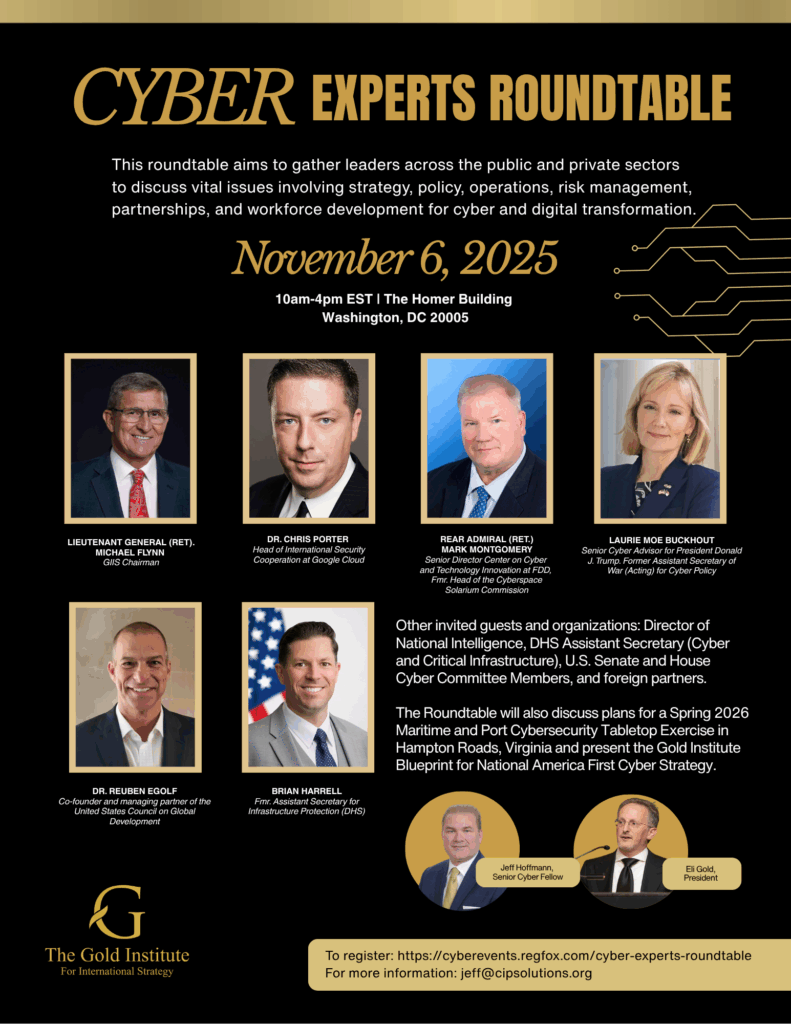
Cyber Experts Roundtable, Nov 6, 2025

CYBER EXPERTS ROUNDTABLE

This roundtable aims to gather leaders across the public and private sectors to discuss vital issues involving strategy, policy, operations, risk management, partnerships, and workforce development for cyber and digital transformation.

 Date: November 6, 2025
 Time: 10am–2pm EST
 Location: The Homer Building, Washington, DC 20005


Featured Speakers:

  • Lieutenant General (Ret.) Michael Flynn
    GIS Chairman

  • Dr. Chris Porter
    Head of International Security Cooperation at Google Cloud

  • Rear Admiral (Ret.) Mark Montgomery
    Senior Director, Center on Cyber and Technology Innovation at FDD
    Former Head of the Cyberspace Solarium Commission

  • Dr. Reuben Egolf
    Co-founder and Managing Partner, United States Council on Global Development

  • Brian Harrell
    Former Assistant Secretary for Infrastructure Protection (DHS)


Special Guests and Organizations Invited:

  • White House National Cyber Director

  • Office of the Secretary of War (Cyber and Space)

  • ODNI

  • FBI

  • DHS (CISA and Assistant Secretary for CIRRI)

  • U.S. House Subcommittee Chair for Government Oversight on Cyber, IT, and Innovation

  • Foreign partners


The roundtable will also discuss plans for a Spring 2026 Maritime and Port Cybersecurity Tabletop Exercise in Hampton Roads, Virginia.


Hosted by:

The Gold Institute for International Strategy

 Speakers include:

  • Jeff Hoffman, Senior Cyber Fellow

  • Eli Gold, President

📧 For more information, contact:
jeff@cipsolutions.org

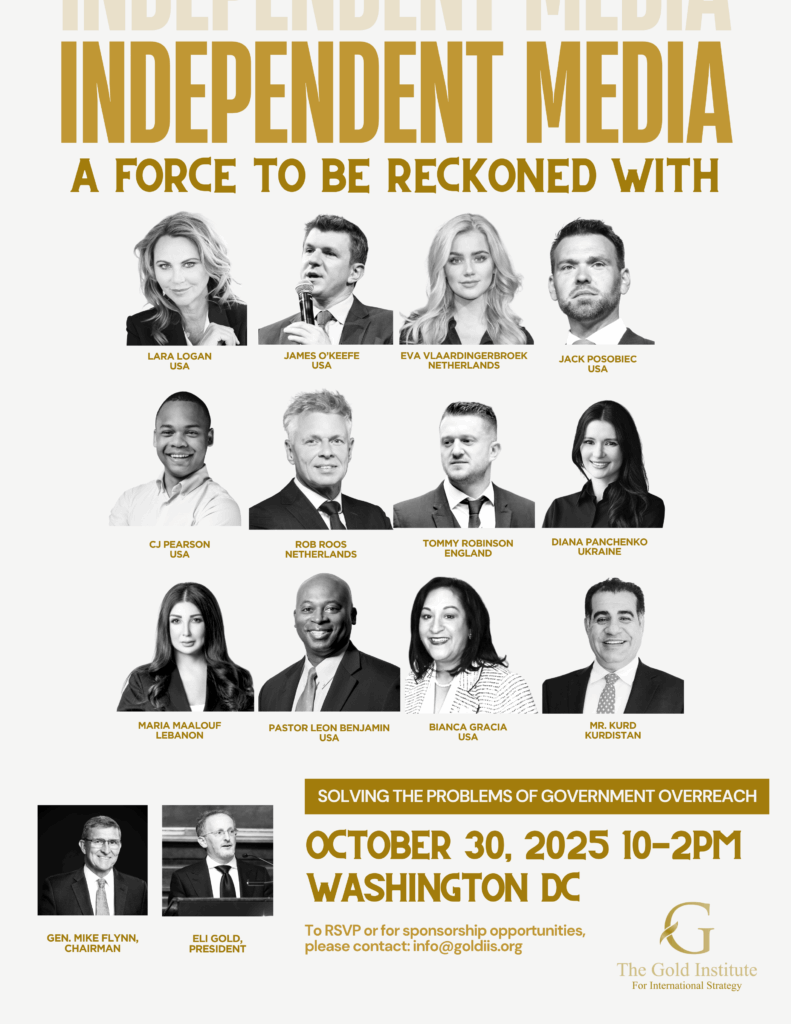
The Role Of Independent Media in International Affairs, Washington D.C. Oct 30th

The Gold Institute for International Strategy presents:

The Role Of Independent Media in International Affairs, Washington D.C.

October 30th: 10am-2pm
Roundtable discussions followed by team break-out sessions

Last day to buy tickets Wednesday, October 29, 2025 11:59 PM, EDT

The Gold Institute for International Strategy will offer a premier platform for fostering, analyzing and disseminating actionable insights on the role of alternative media relevant to national and international affairs.

National Security Strategy

The purpose of this National Security Strategy (NSS) is to identify three strategically significant but neglected threats and opportunities that directly impact U.S. national security long-term. The first is an “uncomfortable truth” for much of official Washington. America’s authoritarian adversaries have infiltrated and subverted from within every key American government agency and institution. This is not a new phenomenon, but the current depth, breadth, and ferocity of such is unprecedented. The underappreciated reason for this is that, unlike during the Cold War, America’s authoritarian adversaries see their transformation of America into an authoritarian regime, like them, as a matter of life-or-death for their continued survival.

The second neglected threat addressed by this NSS is another uncomfortable truth. It is a byproduct, or natural consequence, of the aforementioned ideological infiltration of our government and institutions. Today, a significant percentage of America’s most senior leaders, including government and military officials, have adopted Beijing’s and Moscow’s strategic objectives for America as their own. This has resulted in a level of U.S. policy convergence with Beijing and Moscow that is weakening the U.S. and its allies while strengthening our strategic adversaries.

The third threat addressed by this NSS is a natural outgrowth of the second. Like America, most of our democratic allies face a plague of foreign adversary internal subversion. Given this common threat, instead of each ally addressing it alone, we should confront it together and see this shared, persistent, threat as an opportunity to professionalize the crafting and execution of alliance strategy against these and other challenges to our alliances.

Read More