I’ve had high-level security clearances for much of my career, but it wasn’t until late in my career when I was admitted to a specific handful of sensitive, compartmented programs that I sat back in my chair one day and whispered to myself, “Wow. This is really like a James Bond movie.” Colonel Chris Costa, US Army (Ret) lived in that black world, and now he is the Ex. Dir of our International SPY Museum in DC. He joined me on the show this week: https://frontlinesoffreedom.com/show-981/
A little context…with the exception of Israel, no other nation comes close to our technical means of collection capabilities. In fact, our collection capabilities are so good that the sheer quantity of information acquired through SIGINT, MASINT, COMINT, ELINT, GEOINT, IMINT, FININT, OSINT, etc.., can rapidly overwhelm us. As human beings, we can only consume so much. Key info gets overlooked in the noise.
The bigger challenge, however, is that we can become so enamored of technical collection methods, that we hamper the deeper understanding of human will. Understanding the WHY behind an enemy’s decision-making is no less important than the where/when/what the enemy has done or is capable of doing. We need to know HOW an enemy thinks, so to speak. What motivates him? What does he consider important? How does he see the world? How does he see himself?
This is why the best spies operate inside the enemy’s mind. They build rapport with potential intel sources and find ways to penetrate the enemy circle of trust. Their heads are inside the enemy’s culture. We will need more of this in the future.
Why? Because the enemy’s increasing employment of hybrid capabilities that intentionally target the gray zone between war & peace, and crime & combat, confuses us as to how to respond AND almost infinitely expands the range of potential threats requiring a response. So, a strategy based overwhelmingly on responding can never be enough.
That means placing more priority on engaging MUCH earlier in the enemy decision cycle. That means not waiting until we detect the enemy assembling the parts and pieces for a strike but rather disrupting his plan at its earliest point…ie when he first conceives of it in his mind. THAT requires a much more robust human intelligence effort and a much deeper understanding of human will. It will also require us to get comfortable with a military that is no longer purposed to just “Deter, Fight and Win,” but also to “Deter, Fight, Win, and Disrupt.”
Written byErnie AudinoSenior Military Fellow, Gold Institute for International Strategy
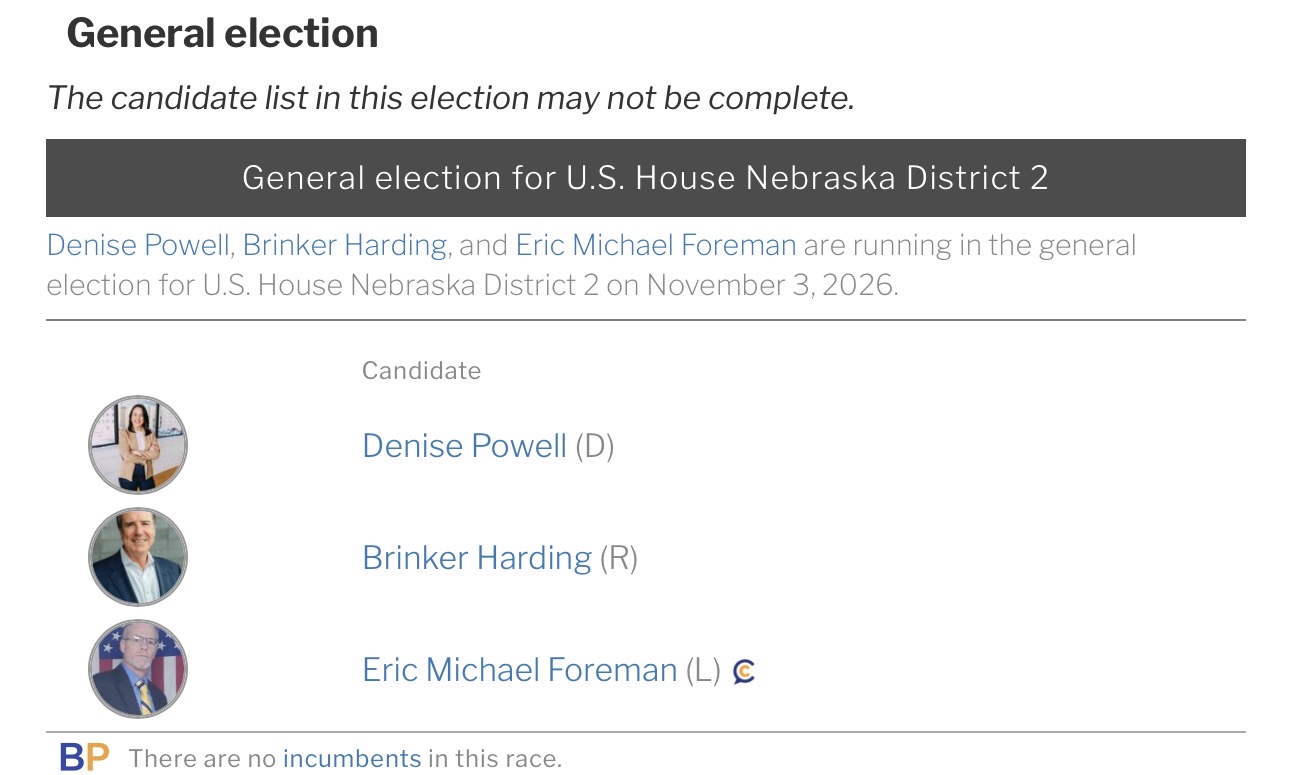
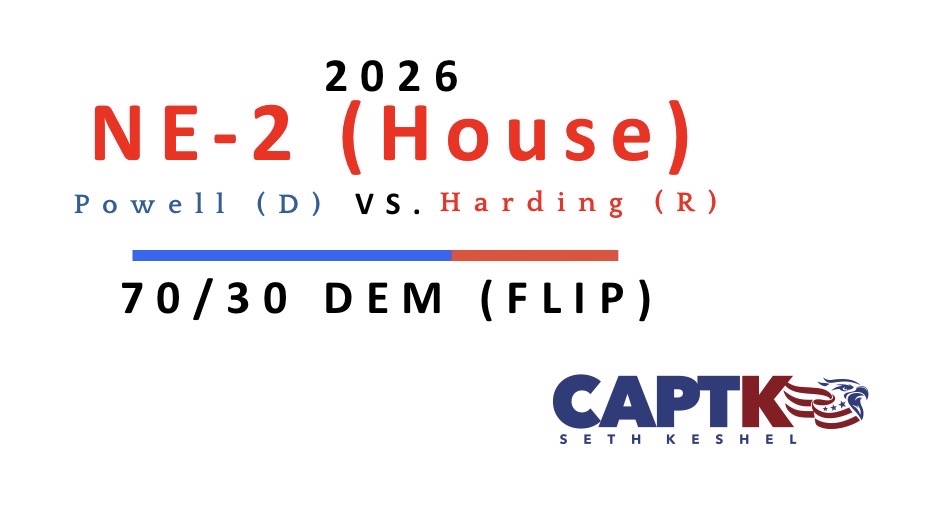
Brinker Harding (Republican) emerged from the GOP primary as the nominee looking to replace Don Bacon, who is retiring from Congress after five terms. Harding has spent most of the last decade as a member of the Omaha City Council.
Denise Powell (Democrat) has never run for office before. Her campaign revolves around her radical feminism (she co-founded a PAC called “Women Who Run Nebraska”), supposed outsider appeal, and her promises to stick it to Trump.
II. District Geography
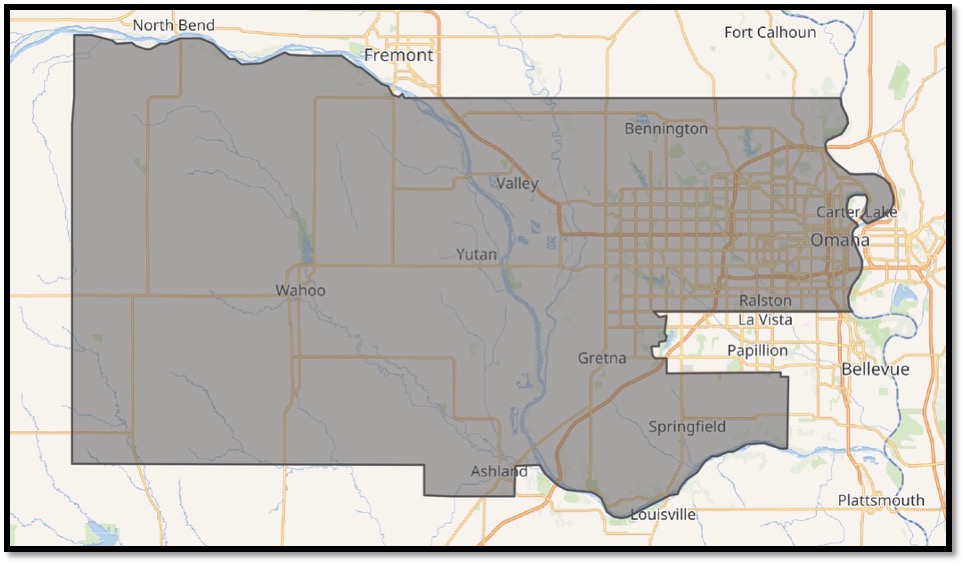
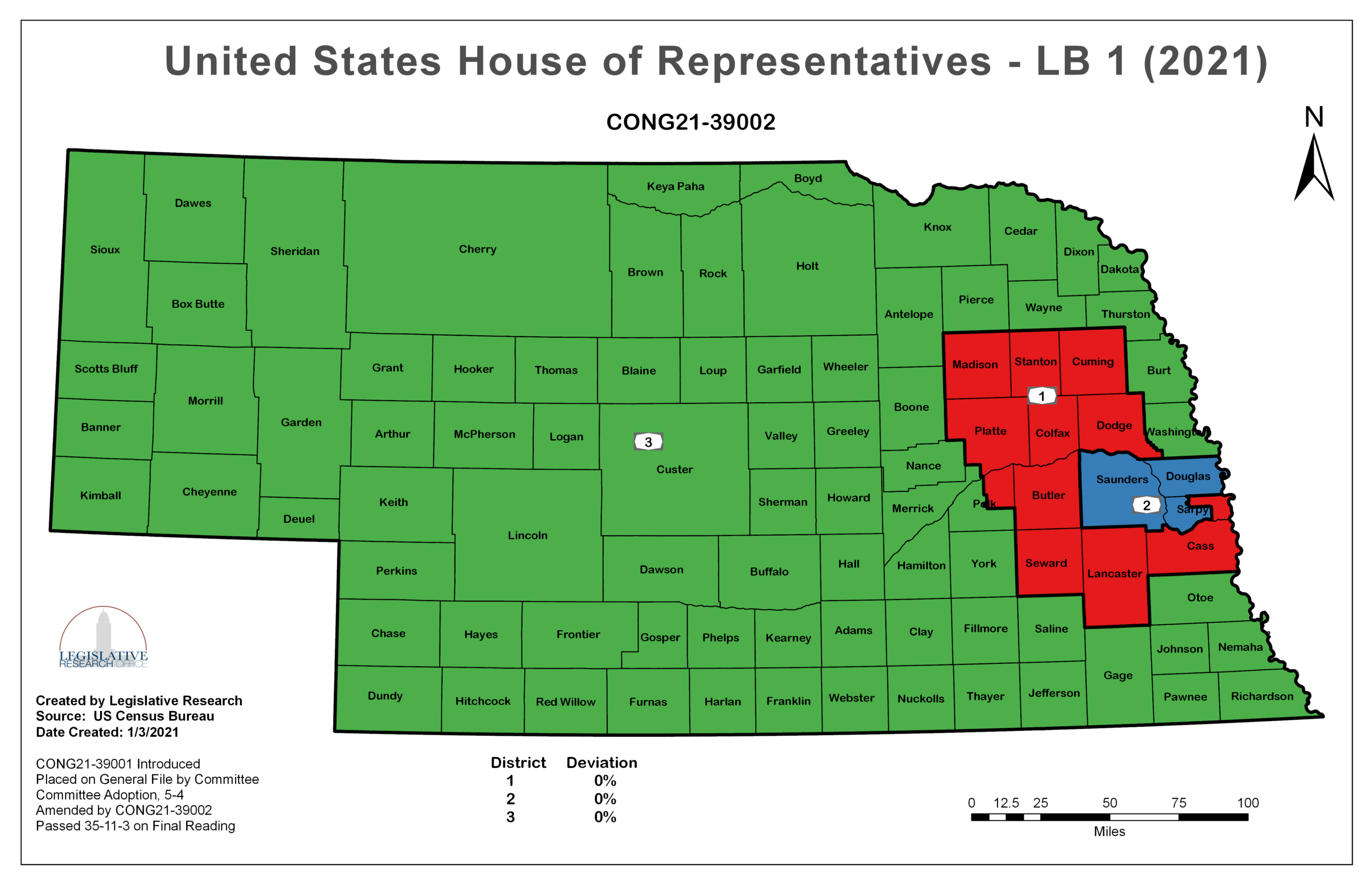
Nebraska’s 2nd Congressional District (NE-2) is a Republican Party catastrophe of its own making. President Trump carried the state, which has just three U.S. House districts, by 20.5%, yet lost the split electoral vote of NE-2 by 4.6%. The district consists of all of Douglas County (metro Omaha), a portion of Sarpy County, and all of Saunders County, which to the west of both. The idiotic Republican leadership in Nebraska’s unicameral legislature took the opportunity to redraw this seat ahead of the 2022 midterms, and instead of playing to win, added only a county (Saunders) that had less than 13,000 votes tallied in 2020 instead of shifting precincts around in Omaha.
Could they have figured out a creative way to ensure Republicans can cruise to victory in all three seats in a Trump +20 state? You tell me:
Sarpy is conservative, but becoming more suburbanized and losing margin. Saunders is super-MAGA, but small. Omaha, while not a monstrosity of a liberal city, is drifting leftward along with most major metros in America (including in the suburbs) and is reminding me a lot of KS-3, which Republicans lost in the 2018 wave.
Presidential Margins
2016 Trump +2.2%
2020 Biden +6.5%
2024 Harris +4.6%
Key Statistics
67.8% White, 12.8% Hispanic, 9.8% Black
97.9% Urban, 2.1% Rural
III. Market Assessment
Polymarket bettors, sniffing polls and presidential baselines, don’t think Brinker Harding has a chance.
IV. History
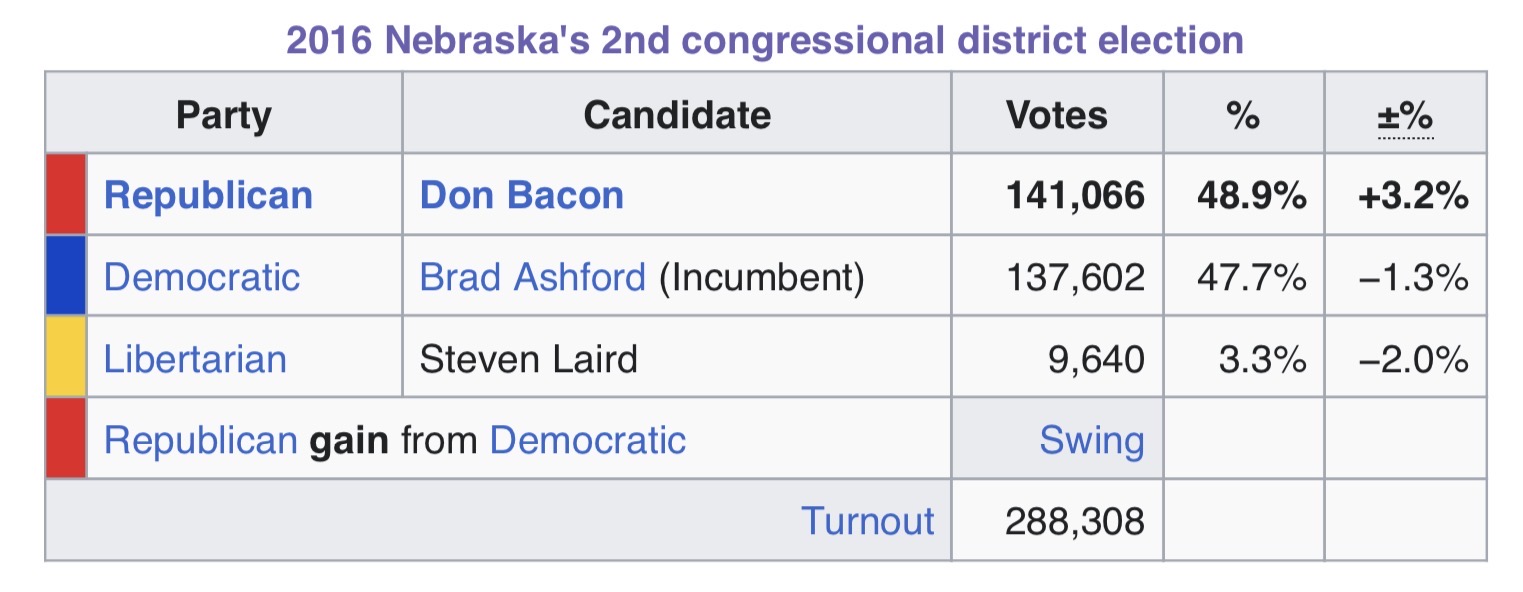
The district has represented Omaha since 1883; Republicans took the seat in 1994 and held it for 20 years, strangely losing it in 2014 (despite a red wave in which the GOP only lost one other seat) because Lee Terry blundered his way into a primary he barely won and lost the seat to Democrat Brad Ashford. Ashford won the seat with a 49% plurality thanks to a spoiler libertarian candidate exploiting the GOP feuding.
In 2016, retired Air Force Brigadier General Don Bacon won the Republican nomination and challenged Ashford for the seat. Bacon, an avowed Trump hater who now spends most of his days trashing Republicans on X, managed to knock off Ashford by an eyelash.
Bacon has managed to thread the needle four more times in an increasingly difficult district:
2018 +2.0%
2020 +4.6%
2022 +2.7%
2024 +1.9%
Five consecutive wins of the district for Bacon, and not a single one exceeding 4.6%. Trump outran Bacon’s 2016 margin by one point, so the above figures, with Bacon running 11.1% ahead of Trump in 2020 and 6.5% in 2024, truly demonstrate how much metro Omaha has drifted left in the past decade. Bacon did manage to win in 2018 by a higher margin than he posted in 2016, and almost directly in line with the 2016 presidential margin.
Bacon is now out, and leaves a difficult district for a GOP candidate with very little name recognition and a shattered coalition of voters.
V. Analysis of 2026 Primary Results
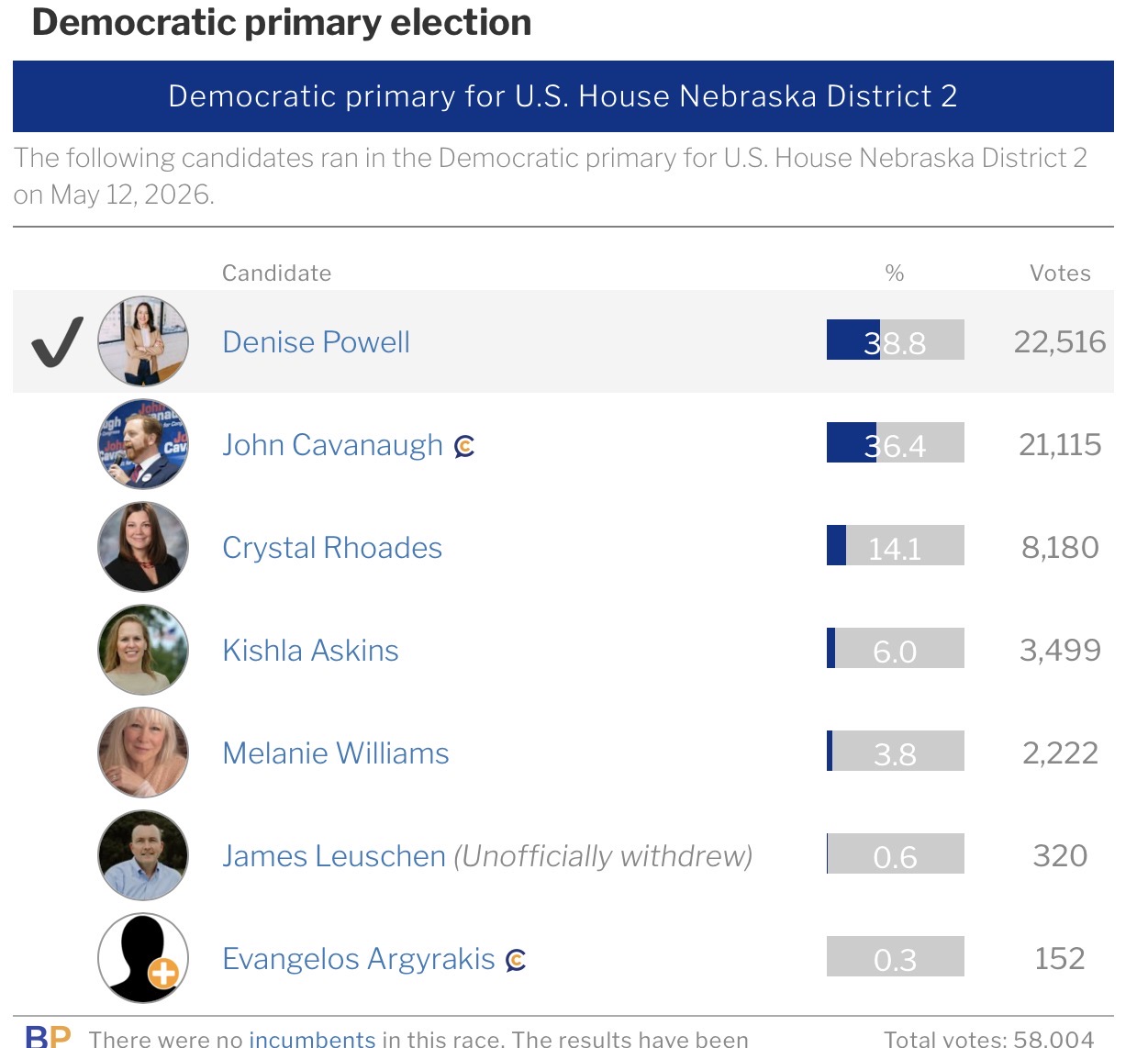
Harding ran unopposed in the Republican primary. Powell had to navigate a crowded field, and eventually prevailed over state legislator John Cavanaugh in a toxic battle:
Powell is the candidate who has to mend fences, but the rift isn’t as severe as can be observed in states that saw DSA-linked candidates battling establishment Democrats.
VI. Polls
I found one poll archived by The New York Times, and it shows Powell +4.
VII. Media Ratings
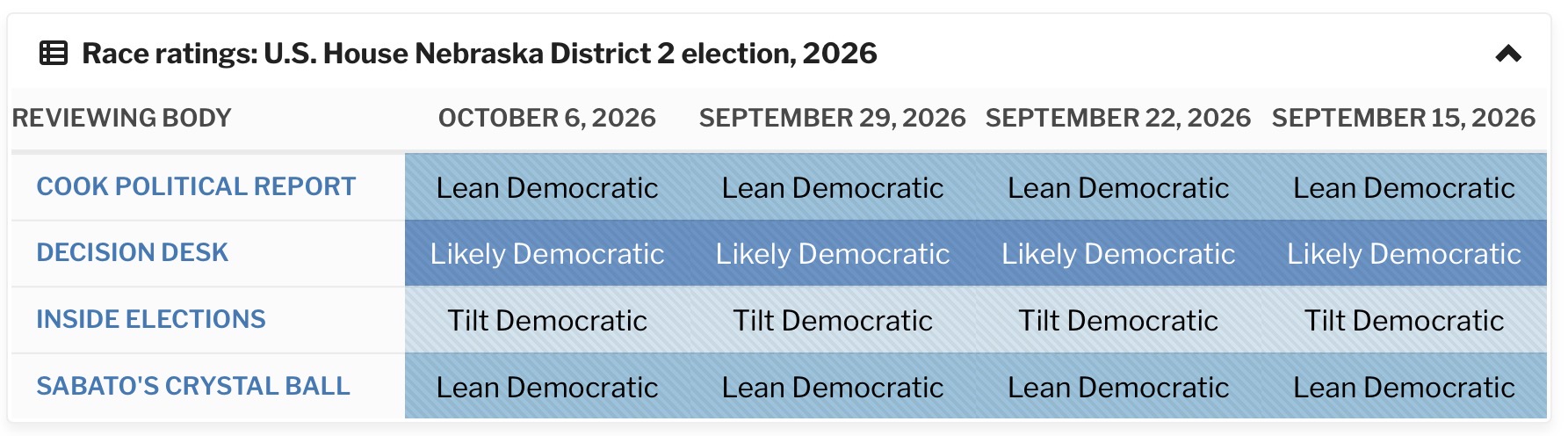
All four major reviewing bodies have the race favorable to Powell, ranging from “tilt” to “likely.” “Likely” probably overstates her advantage.
VIII. Party Registration
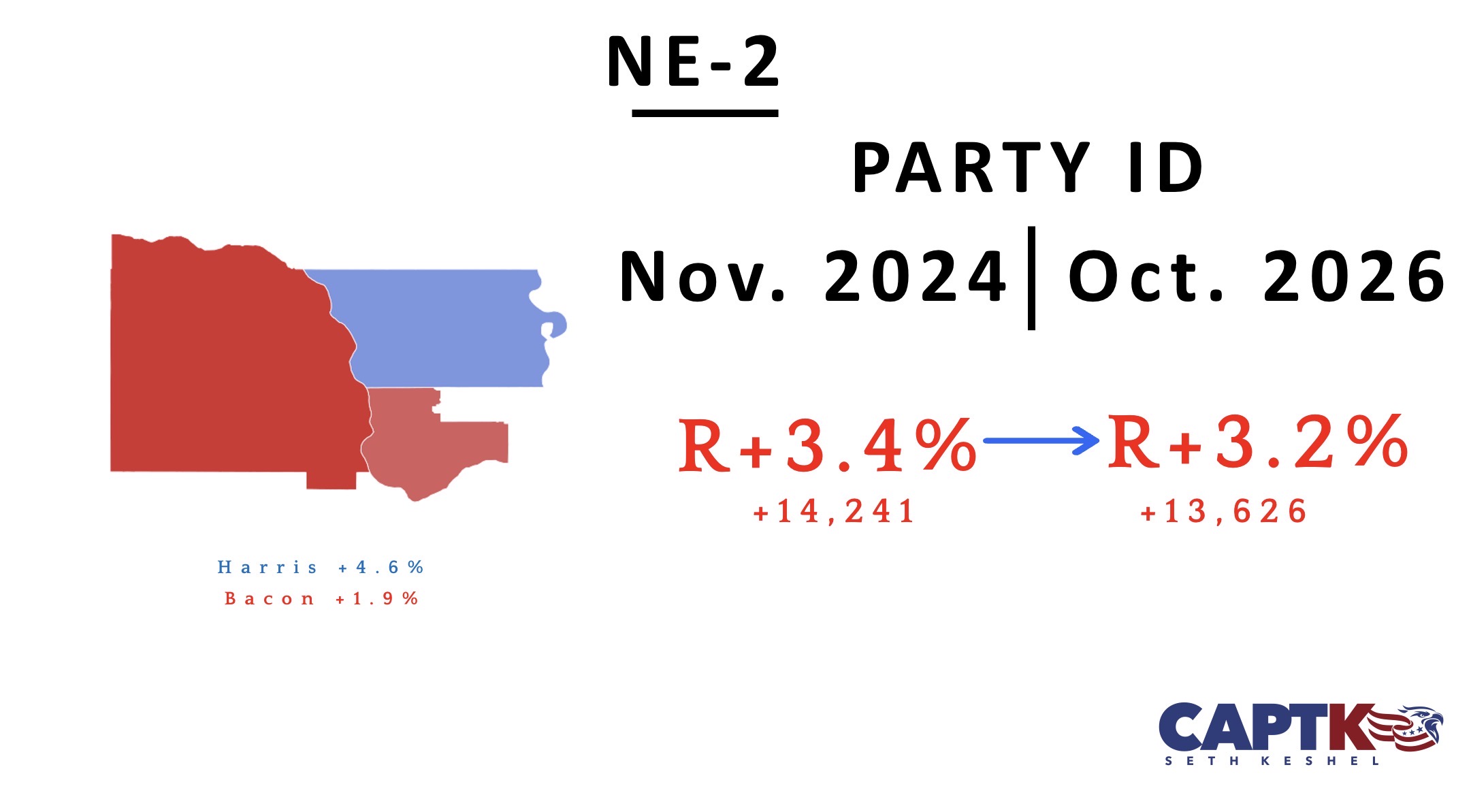
Since the 2024 election, NE-2 has inched slightly leftward – down 615 net registrations for Republicans and one-fifth of a point. This number generally tacks with the shifting of independent voters in presidential races, and the shift certainly doesn’t aid Harding’s cause.
IX. Election Considerations
Nebraska finally got with the program on Voter ID, and doesn’t operate Automatic Voter Registration or run mass mail-in elections. Manipulation is always possible with elections and has been identified in Nebraska, but this elections ranks low relative to others with regard to election integrity.
X. Summary and Election Estimate
Powell has three key factors in her favor:
• Money. Her figures compared to Harding’s at the end of June didn’t give her much of an advantage, but she isn’t being swamped by GOP funding like Democrat candidates have been in other seats. • The open seat and the suburban drift give her a big boost. Douglas County and, by extension, NE-2 remind me of KS-3, which Kevin Yoder lost to Sharice Davids in 2018. That seat hasn’t returned to the Republicans and gives no indication it will anytime soon. • Party registration figures reflect the continuing slide, and Harding lacks the big profile, status as a retired general, and party unity to make up the difference in a difficult year – especially given that Bacon never carried the seat by more than 4.6%.
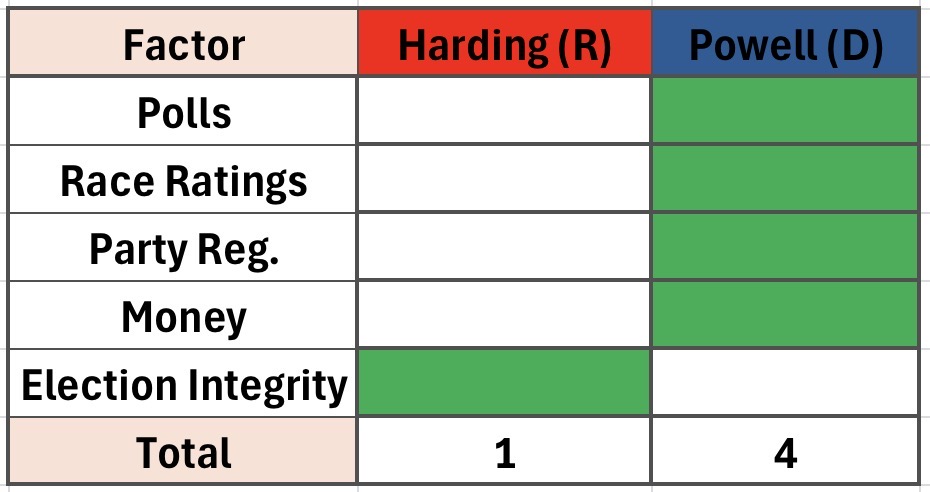
Still, we run the actual elections for a reason. Turnout matters, and if the district’s black vote (roughly one-tenth of the electorate) doesn’t turn out, the Hispanic vote runs right, and suburbanites don’t run left out of concern for the future of the Democrats (unlikely in NE-2), then Harding has a chance. I see the key factors like this:
Democrats are right to be bullish on a flip. While I don’t think NE-2 has a high ceiling for Democrats, Powell appears on the verge of taking the seat the Nebraska GOP refused to shore up.
Forecast for NE-2 House
Seth Keshel, MBA is a Senior Fellow at the Gold Institute for International Strategy and a retired Army Captain. He publishes Captain K’s Corner on Substack.
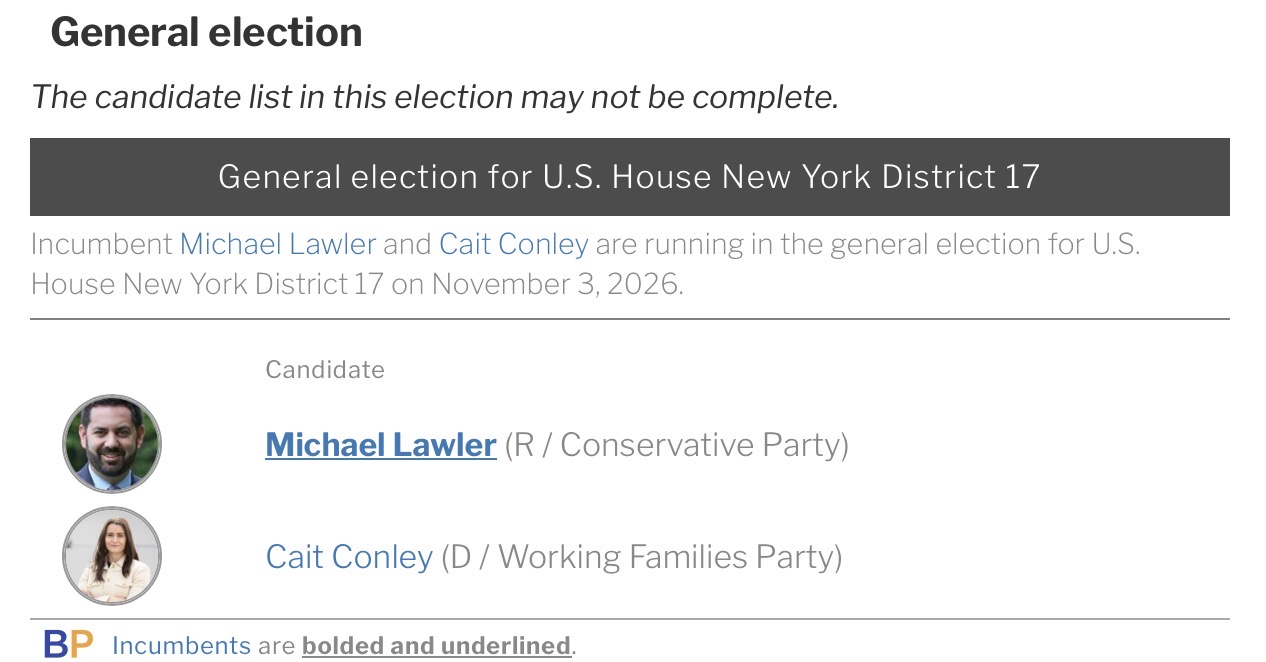
Mike Lawler (Republican) is seeking his third term and is one of just three Republicans in the House from a district President Trump lost in 2024. He has a proven record of running and winning in a tough district and is thought of as one of the more skilled politicians in Congress.
Cait Conley (Democrat) is new to campaigning, although she played a big role in CISA’s 2024 election monitoring operations. Prior to working at CISA, she had a long career as an Army officer.
II. District Geography
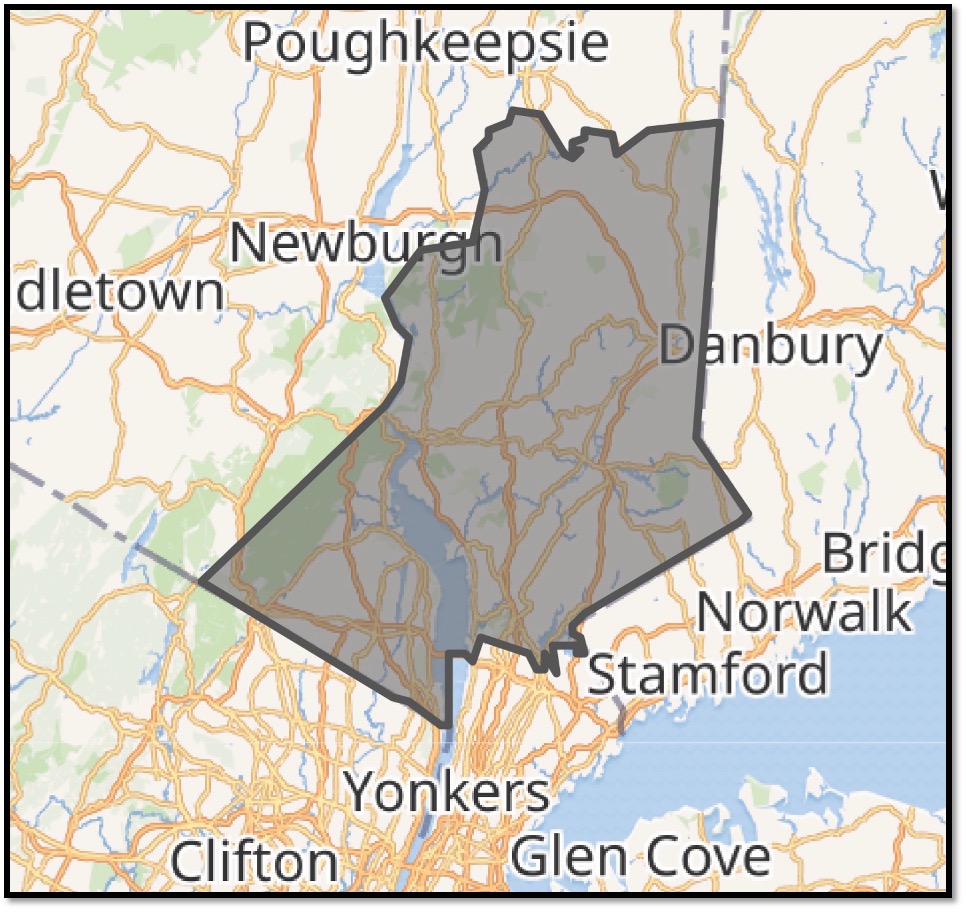
New York’s 17th Congressional District (NY-17) is located in the Hudson Valley not far north of New York City. It contains all of Rockland and Putnam Counties, as well as the extremely dense northern portion of Westchester County and a small portion of southern Dutchess County. Rockland is a competitive county, Putnam is very red, and Westchester County is a Democrat stronghold. The variance in these counties requires candidates to be flexible on ideology and fast to react to changes in public mood.
This district contains some of the most interesting electoral factoids I’ve encountered in my analysis of the 2026 races, which I will analyze in detail in the summary of this forecast. Until recently, it has been noticeably out of reach for President Trump. That changed in 2024 with his improvements with minorities, religious groups, and in the urban and suburban areas of the northeast.
Presidential Margins
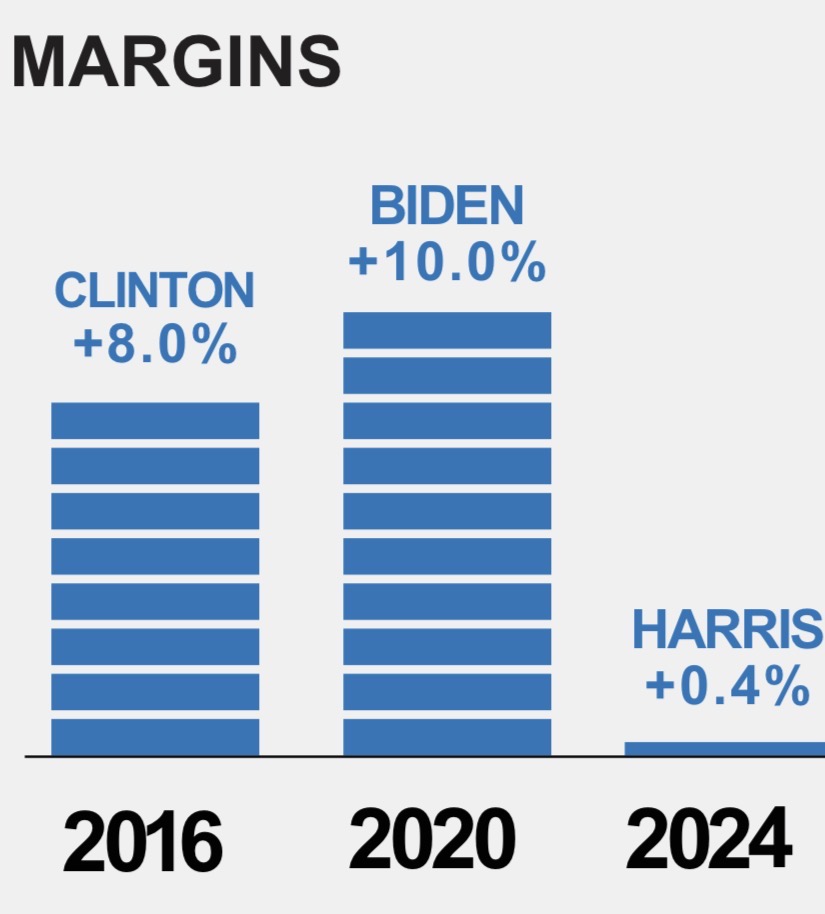
Harris wound up winning NY-17, but just barely at a +0.4% margin of victory. This marked a substantial improvement for Trump, who dropped it by 8.0% in 2016 and 10.0% in 2020, mail-in election and all. Similar shifts in margin in the 2024 presidential elections can be seen in adjacent spaces such as eastern Pennsylvania, throughout New Jersey, and in New York City itself. Lee Zeldin carried the district by four points in his 2022 gubernatorial bid.
Key Statistics
64.4% White, 19.9% Hispanic, 7.1% Black, 5.0% Asian
98.4% Urban, 1.6% Rural
III. Market Assessment
Conley, like most Democrats in decisive races, is favored on Polymarket – but not by a lot. That is an indicator of the competitive nature of this seat and Lawler’s quality as a candidate.
IV. History
Here in the beginning of the 21st century, NY-17 has remained consistently defined, with only slight variations. In elections held from 2002 through 2010, the seat includes parts of the Bronx, Rockland County, and Westchester County. From 2012 through 2020, races covered Rockland and a larger portion of Westchester. Democrats Eliot Engel, Nita Lowey, and Mondaire Jones held the seat.
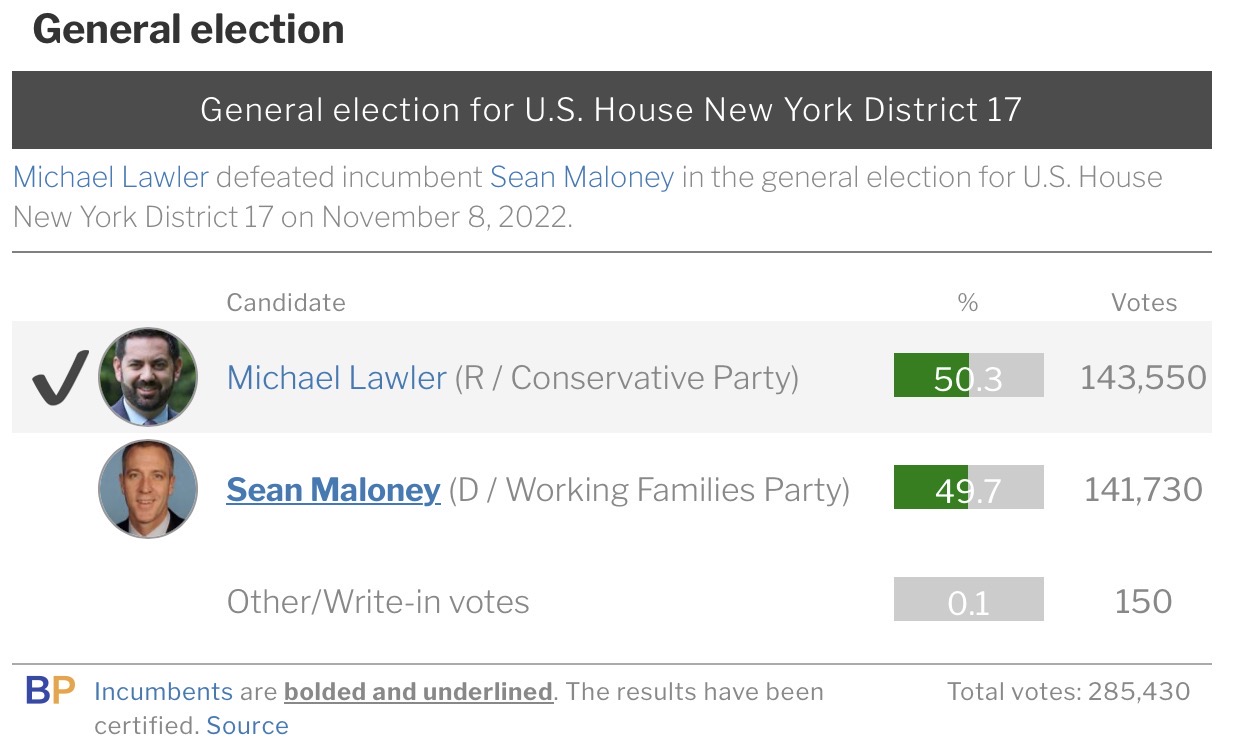
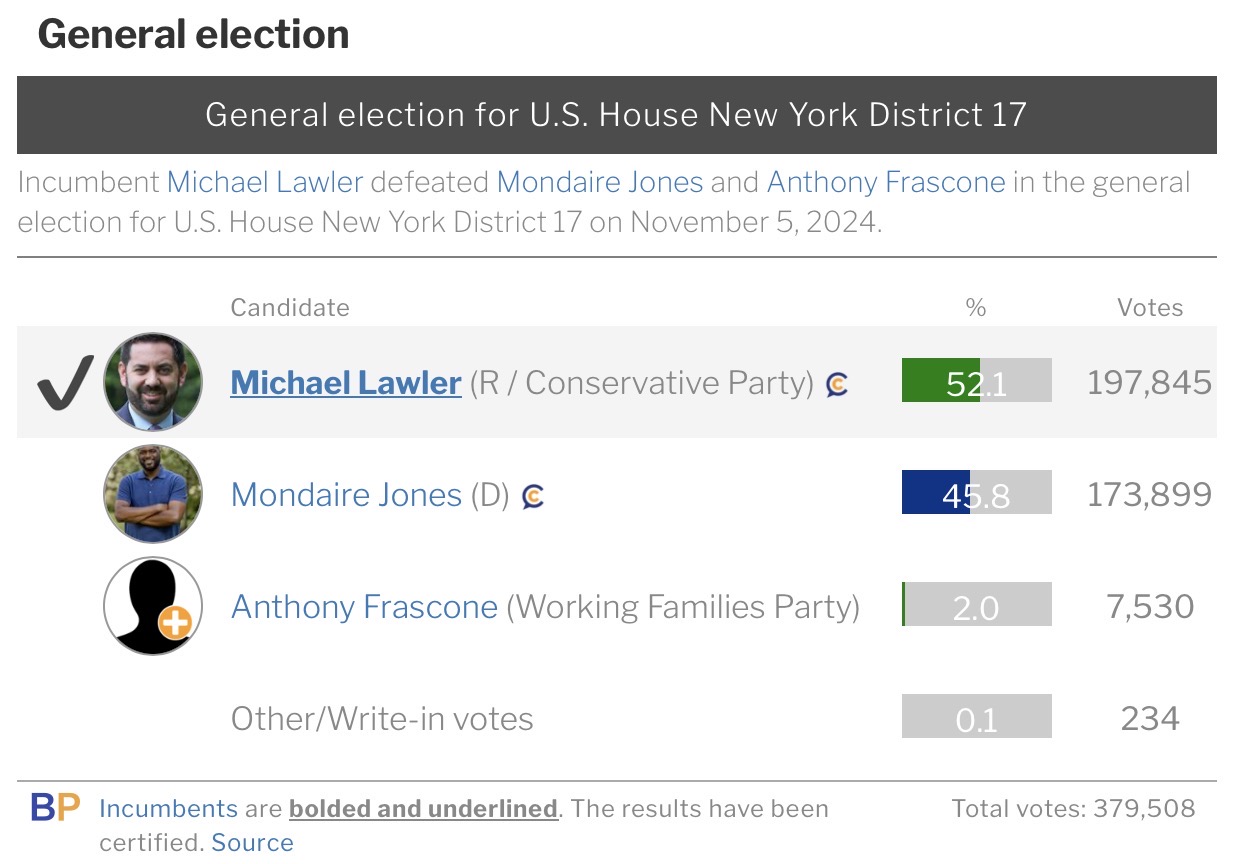
As soon as the seat was redrawn to add Putnam County and the small piece of Dutchess, Mike Lawler won the seat. Here is his razor close result from 2022:
Impressively, running for reelection in a district Biden had carried by 10 points just four years earlier, Lawler put some serious distance between himself and Mondaire Jones, who had held the seat in a previous form but lost the nomination to face Lawler in 2022.
V. Analysis of 2026 Primary Results
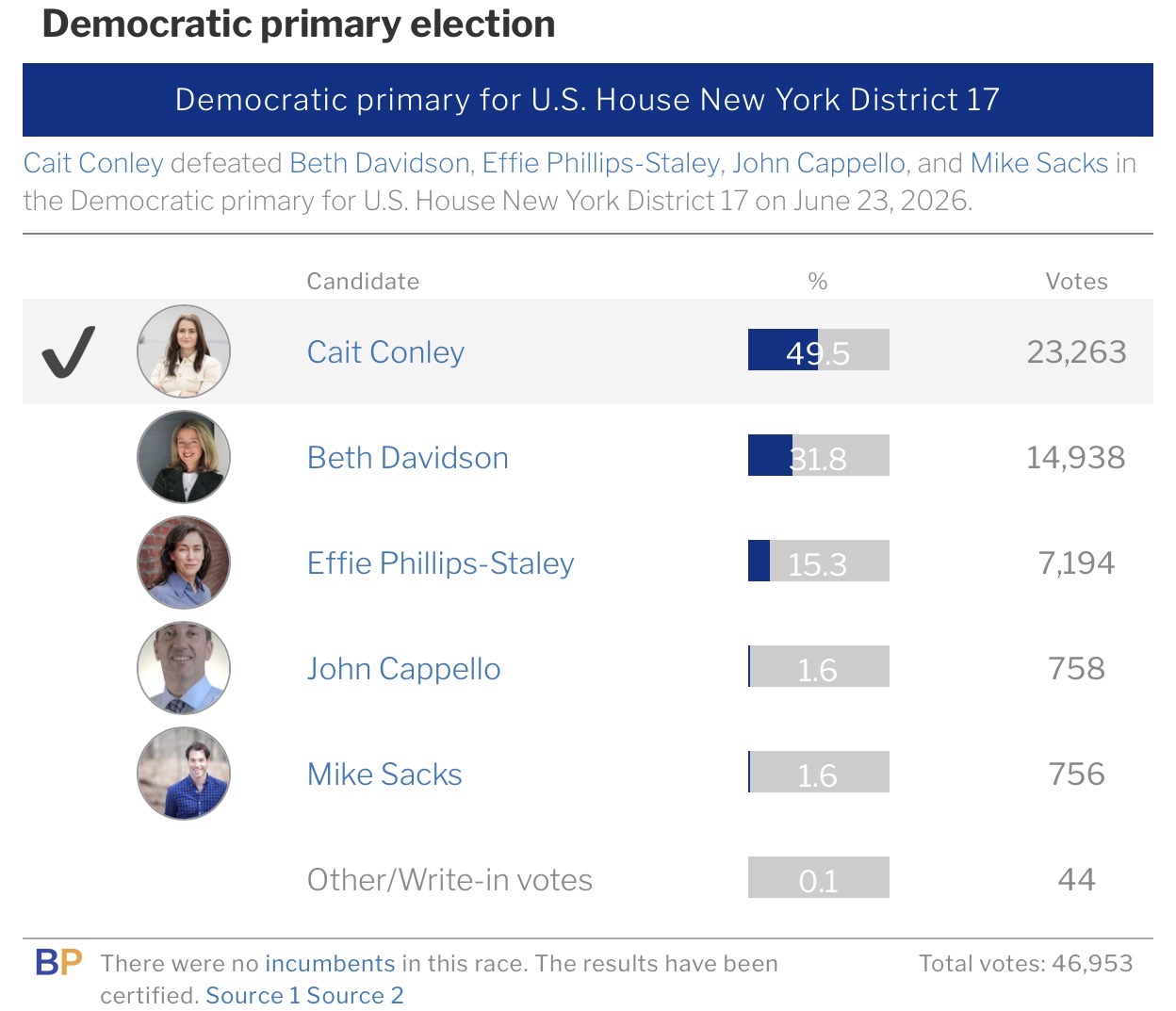
Lawler faced no primary challenge; Conley did, and won the election with just short of a majority:
There is no evidence the rest of the field that participated in the Democrat primary poses a risk to the General Election, as all have gotten behind the Conley campaign.
VI. Polls
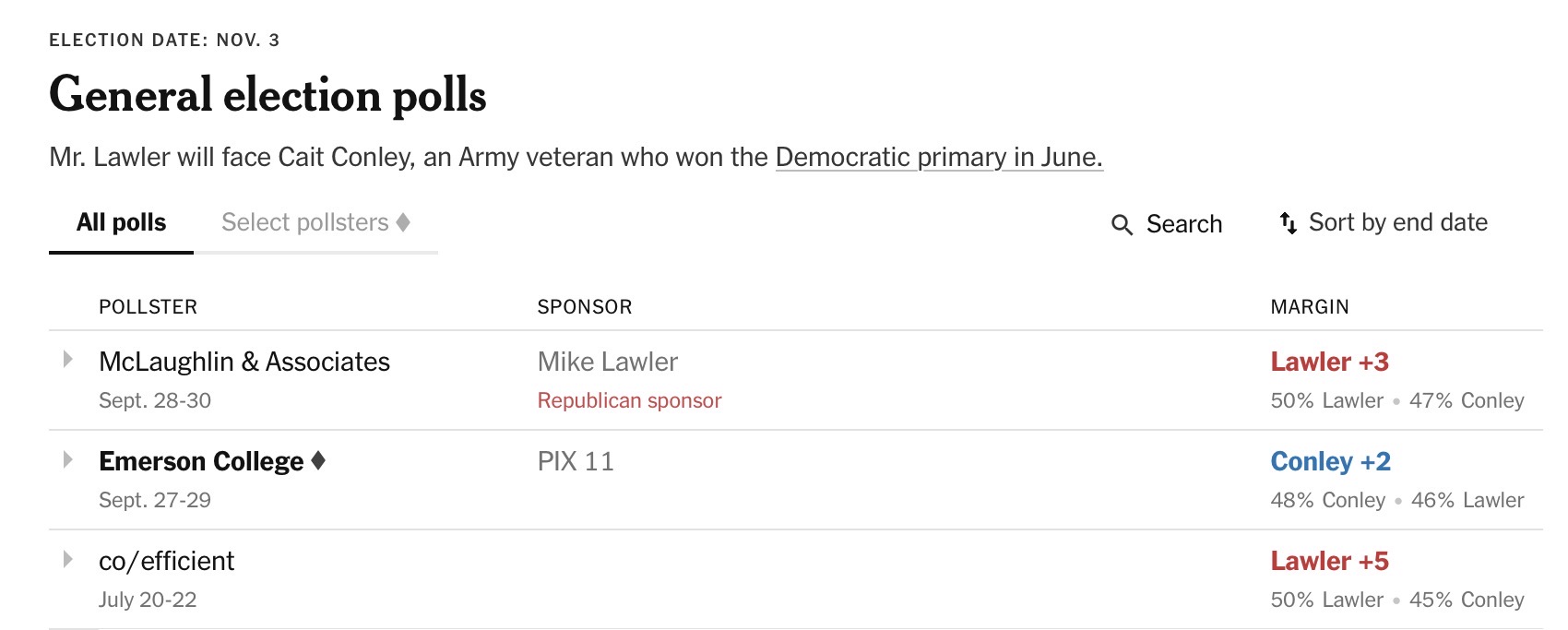
Polling data from The New York Times:
Tossing the 5-point outlier (pro-Lawler), we have polling suggesting a dead heat/statistical tie. Enough for me to buy that this is a close race without a clear favorite.
VII. Media Ratings
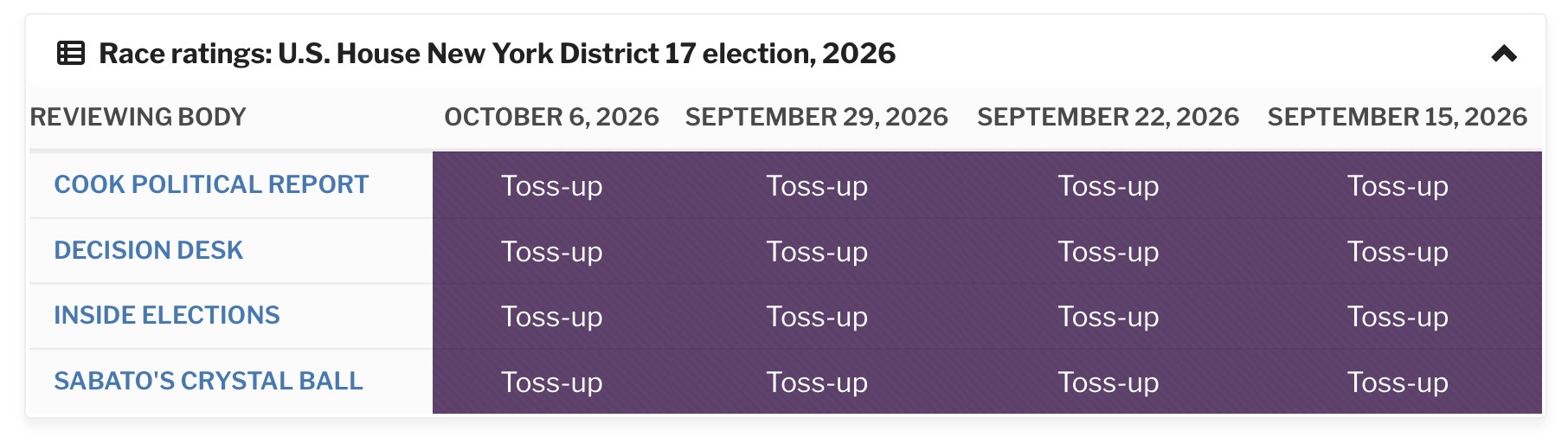
All major reviewing bodies lack the fortitude to make a call on this race as it stands. A positive sign for Lawler in a fundamentally tough district.
VIII. Party Registration
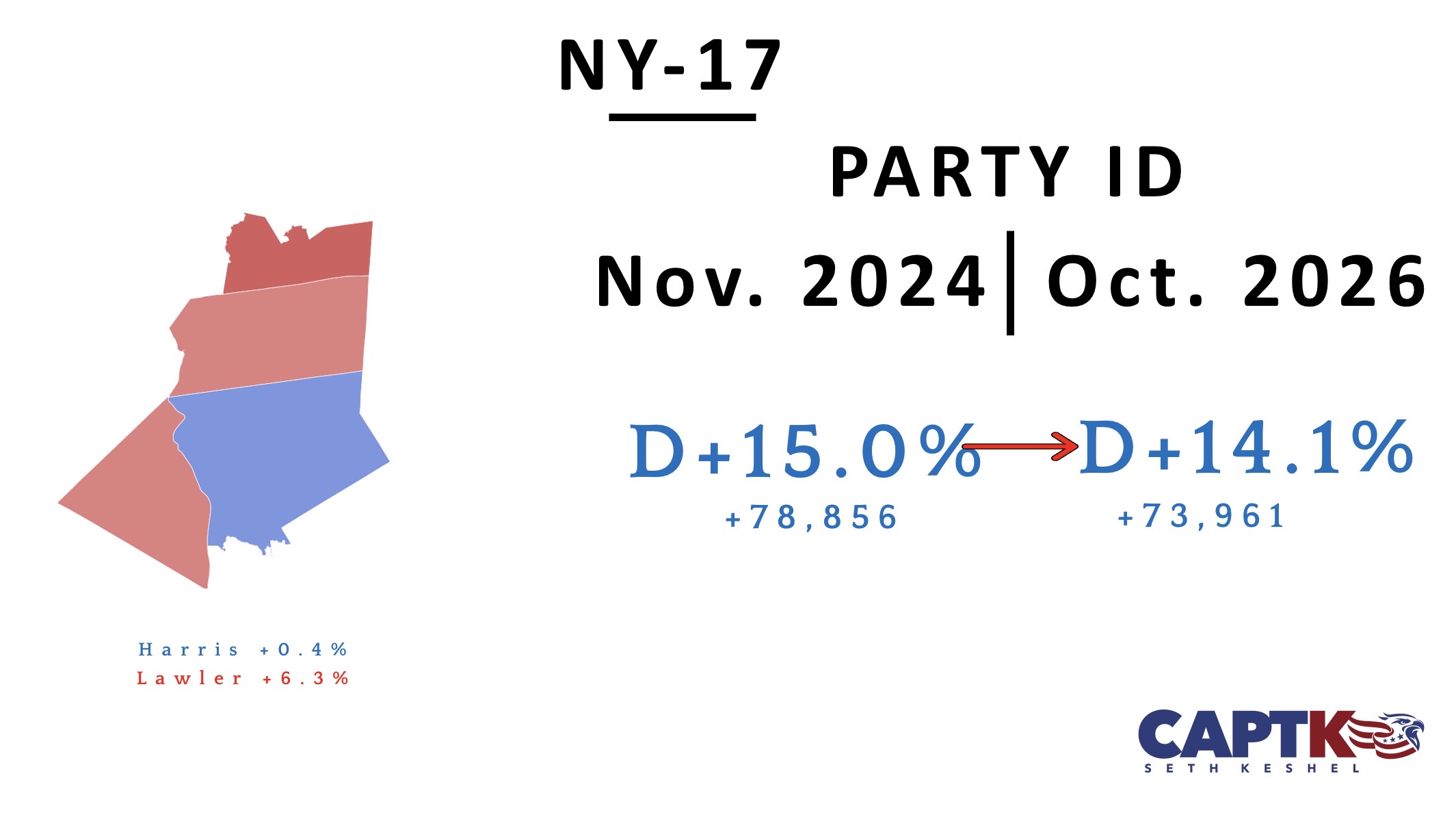
New York hasn’t updated its voter registration data in a while, but things are moving the right direction for Lawler – unlike how the registration data are moving against Tom Kean in NJ-7.
While this isn’t enough (like in a presidential election) to form a concrete prediction, it is yet another data point suggesting NY-17 isn’t the automatic flip that blue wave advocates surmise it to be.
IX. Election Considerations
I reviewed New York’s 2024 election, which featured a sharp shift in favor of Trump everywhere, in December 2024, in New York – 2024 Election Compendium.
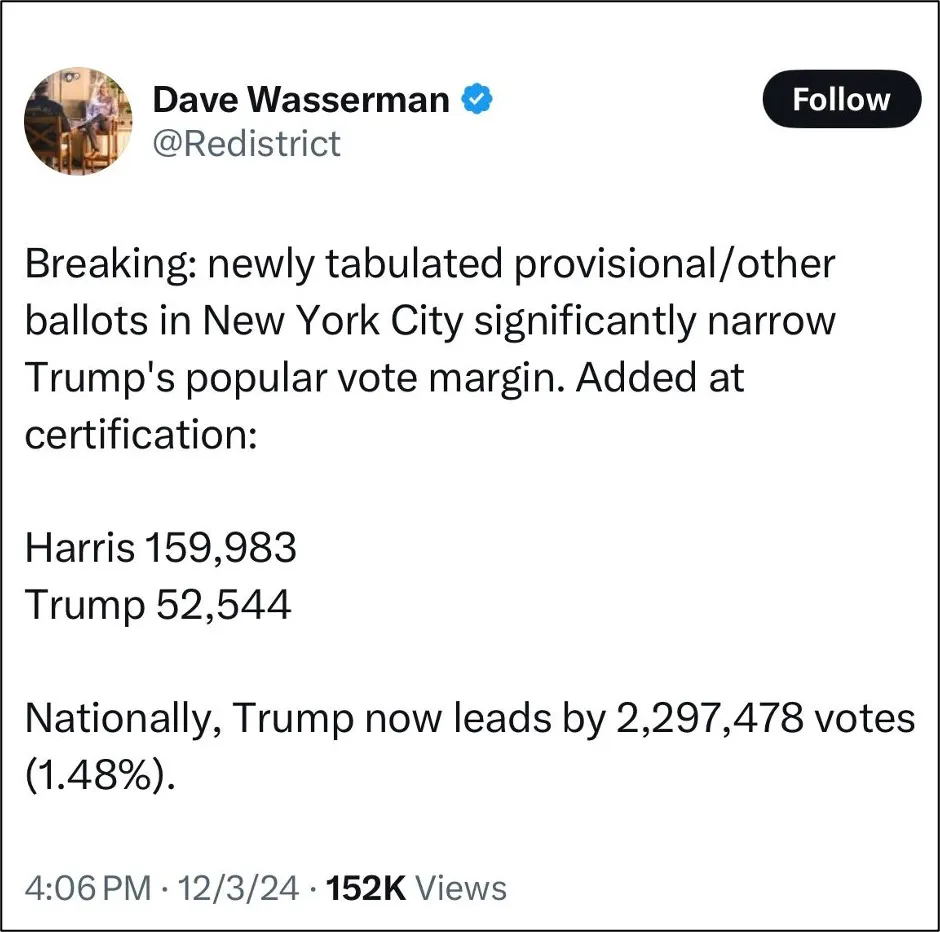
New York has a mixed bag of election laws. They do have Automatic Voter Registration, and also don’t require Voter ID, but the biggest threat to statewide election integrity has to do with transparency. On December 3, 2024, nearly a full month after Election Day, New York tabulated a massive ballot drop that went like this:
That drop had Harris with over three-quarters of the vote, a margin higher than she obtained overall within New York City’s five boroughs. Needless to say, with this sort of leeway, population dense areas have extra power to inflict maximum damage in the event of a close race. Think Westchester County in the battle for NY-17.
X. Summary and Election Estimate
Lawler’s methodology for carrying the district is simple. Knock it out of the park in the red turf present in Rockland, Putnam, and Dutchess Counties, and hold the line in Westchester. Lawler lost the 273 precincts of Westchester County that are part of NY-17 by 12 points (approximately 55% to 43%). Trump lost them by 20.3% (59.9% to 39.6%). Despite the lopsided margin, Trump improved in the Westchester portion by 7.4% over 2020.
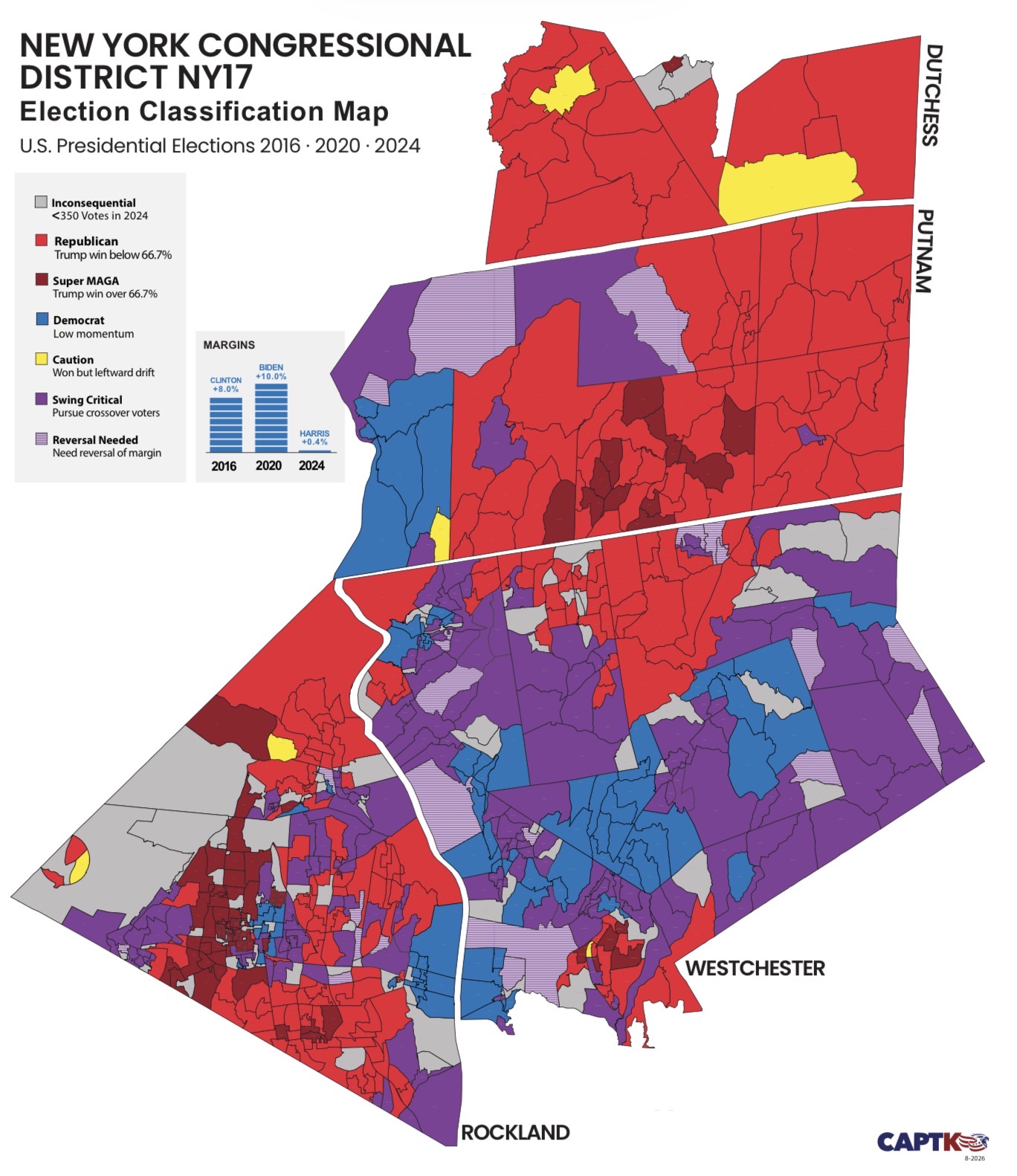
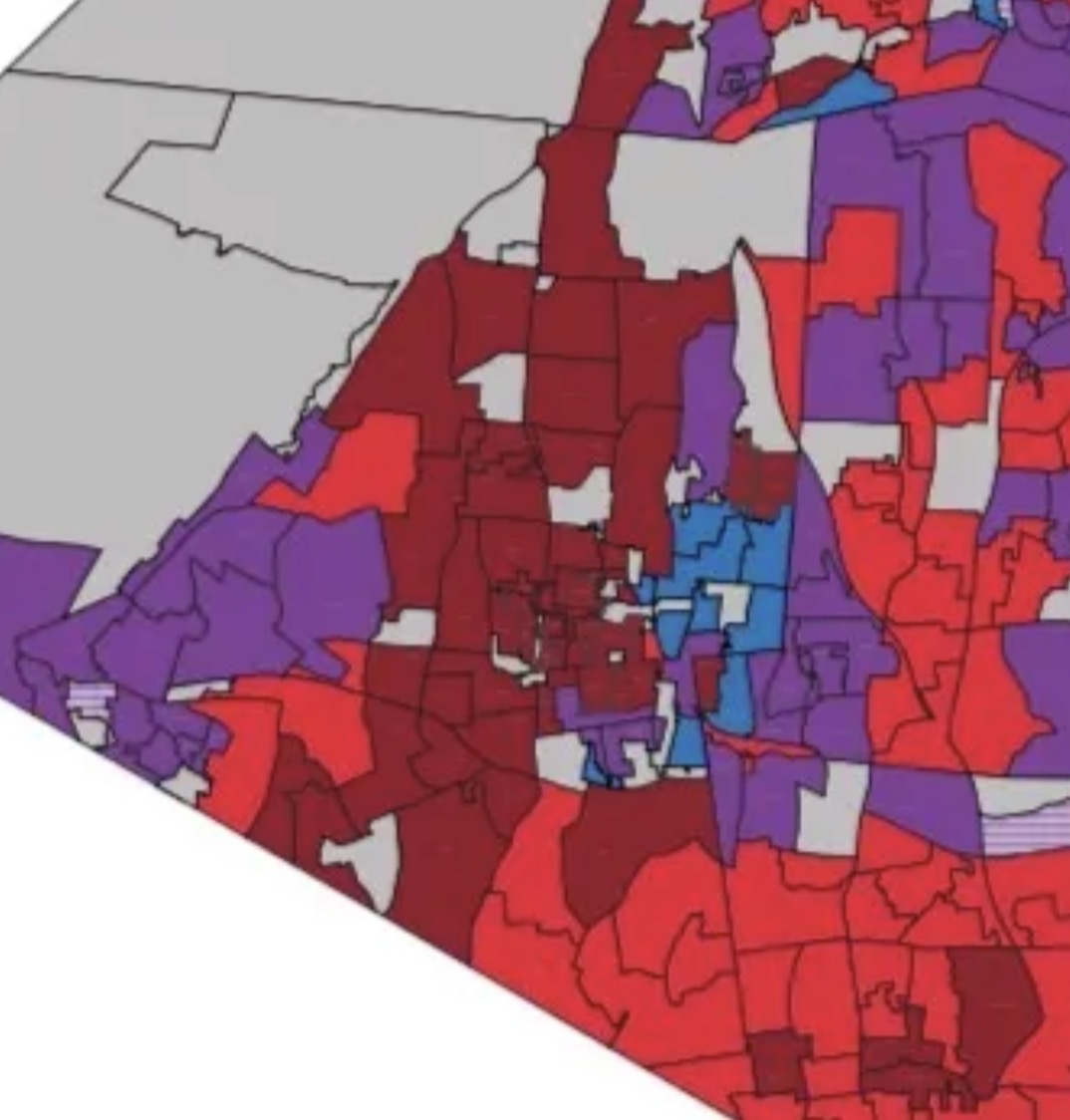
Captain K Proprietary Mapping of NY-17
What most don’t understand about this district is that it possesses the most overwhelmingly MAGA vote in the United States – even more crimson-shaded than the reddest areas of the Texas Panhandle or the most rural areas of Wyoming or Idaho. Let’s take a closer look at the crimson precincts in the heart of Rockland County:
By my count, there are 11 precincts in the Ramapo area in which Trump won over 95% of 500 or more votes (28 total precincts with Trump at over 95% of the vote). Here’s one example:
Trump had a similar margin there, and in the others, in 2020, but in 2016, the same precinct looked like this:
Trump 42 Clinton 657 Other 1 Margin – Clinton +87.9%
By now, I hope you understand why it is you subscribe to Captain K’s Corner – because you won’t find this level of detail anywhere else. Here’s why this is important to 2026:
Lawler is going to own this vote (and he won it by almost identical margins to Trump’s in 2024). He and Speaker Mike Johnson have been all over those precincts and courting the Orthodox/Hasidic Jewish bloc vote. Unlike the scattered voters of the remaining areas of NY-17, this group will absolutely vote, and they will vote for Lawler. The purpose of me pointing this out is not to advocate for any position in the ongoing debates over Zionism; it is to simply tell you that the people who provide the boost for Lawler are almost certainly to discern the emergence of the DSA faction of the Democrat Party as a clear and present threat to their political worldview, and side en masse with Lawler. Trump’s margin in those 28 precincts in which he got over 95 percent of the vote came out to this:
Trump 13,217 Harris 176 Other 30 Margin – Trump +97.2%
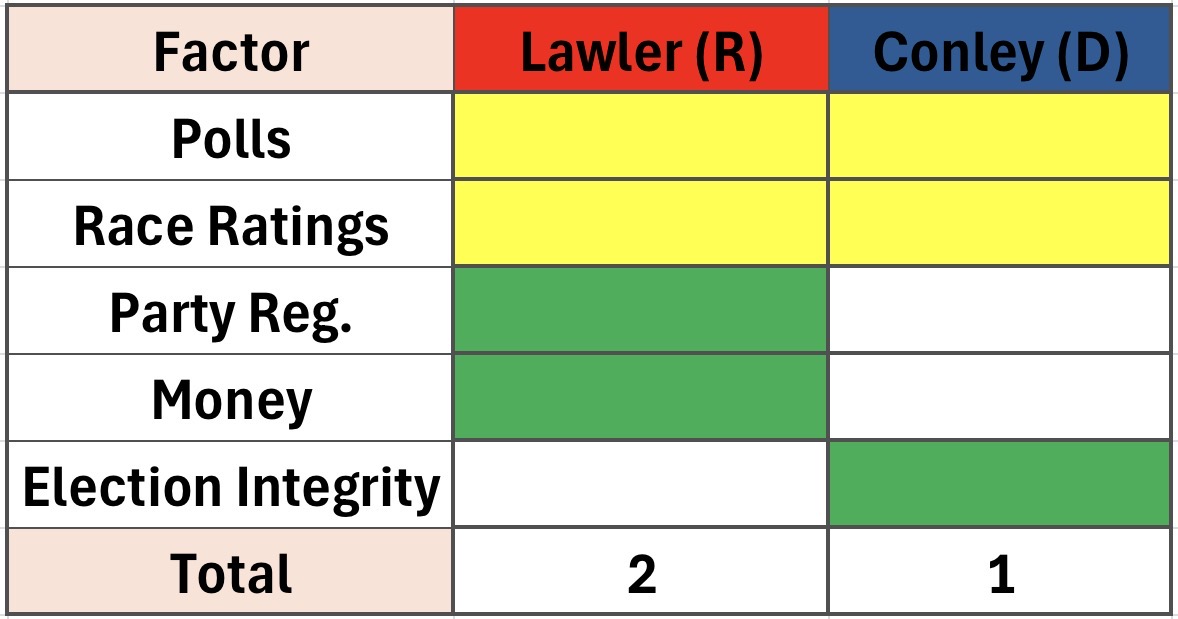
Lawler will then take those margins and do the Susan Collins routine to prevent getting blown out in Westchester, and put himself in position to hold his seat. I see the key factors of the race like this:
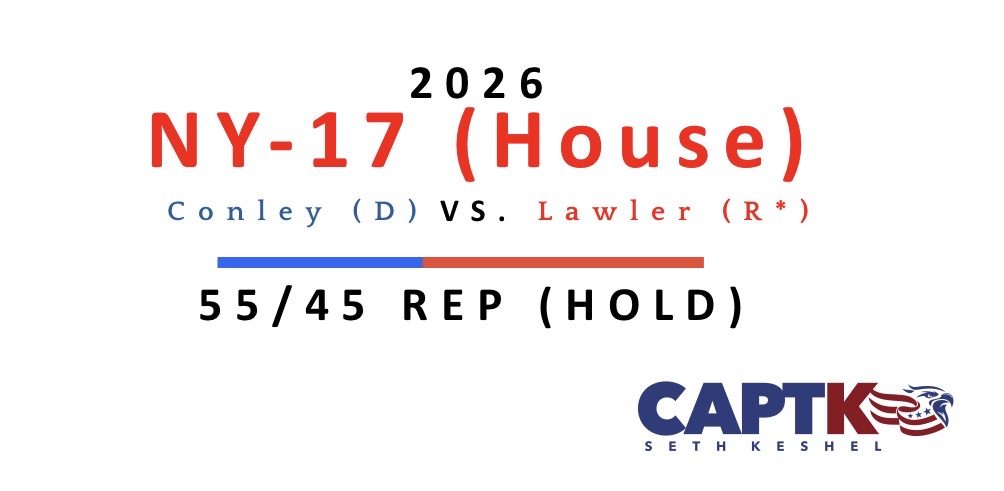
With Lawler’s resilience in Westchester County and strategic efforts to secure the Orthodox vote (which will vote in large numbers and as directed by their rabbis), I consider him the favorite in this race, even if only by a hair:
I think Westchester will swing, but I also think the turnout of enthusiastic Trump/Lawler supporters in Rockland County will balance this impact; He won’t win the race by 6 points, but he has some margin to give and Conley is the candidate lacking a major bloc vote. She can definitely win the race, but has serious structural challenges to account for.
Seth Keshel, MBA is a Senior Fellow at the Gold Institute for International Strategy and a retired Army Captain. He publishes Captain K’s Corner on Substack.
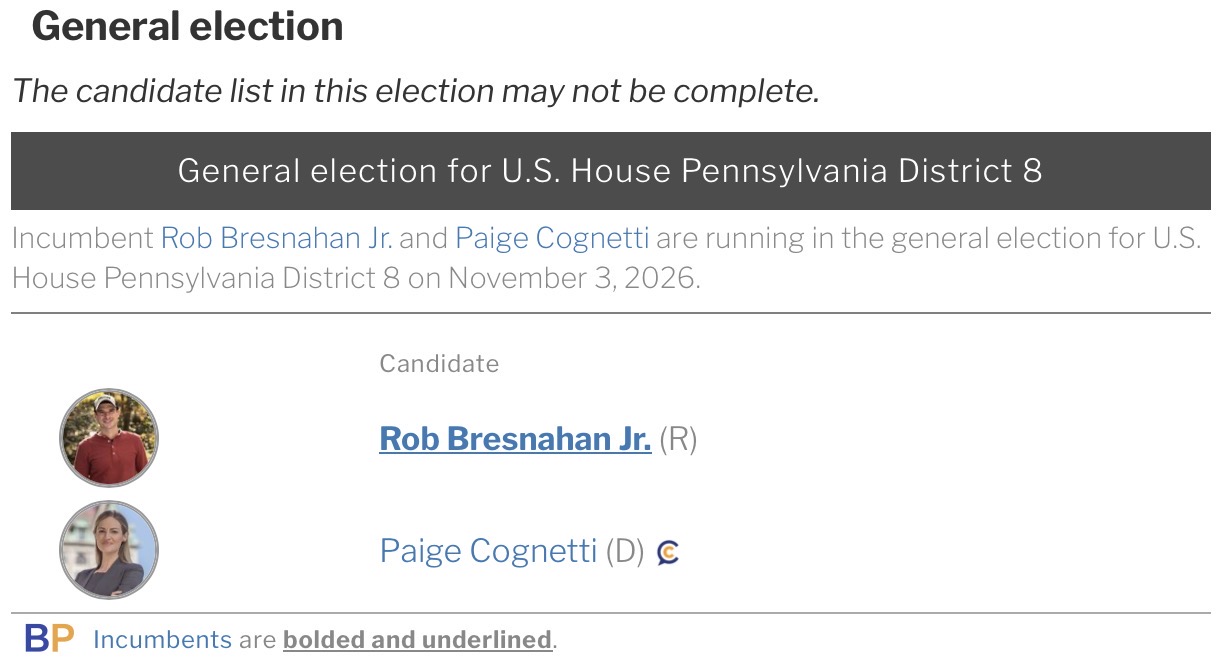
Rob Bresnahan (Republican), having taken the seat from Democrat incumbent Matt Cartwright by 1.6% in 2024, seeks a second term. He is defending what is by far the most favorable of three decisive seats this year for Republicans.
Paige Cognetti (Democrat) is the mayor of Scranton and is running on the standard Democrat “healthcare” platform and promising to bring transparency and anti-corruption measures to Washington. She is attempting this despite a major surge for President Trump in northeastern Pennsylvania in the last election.
II. District Geography
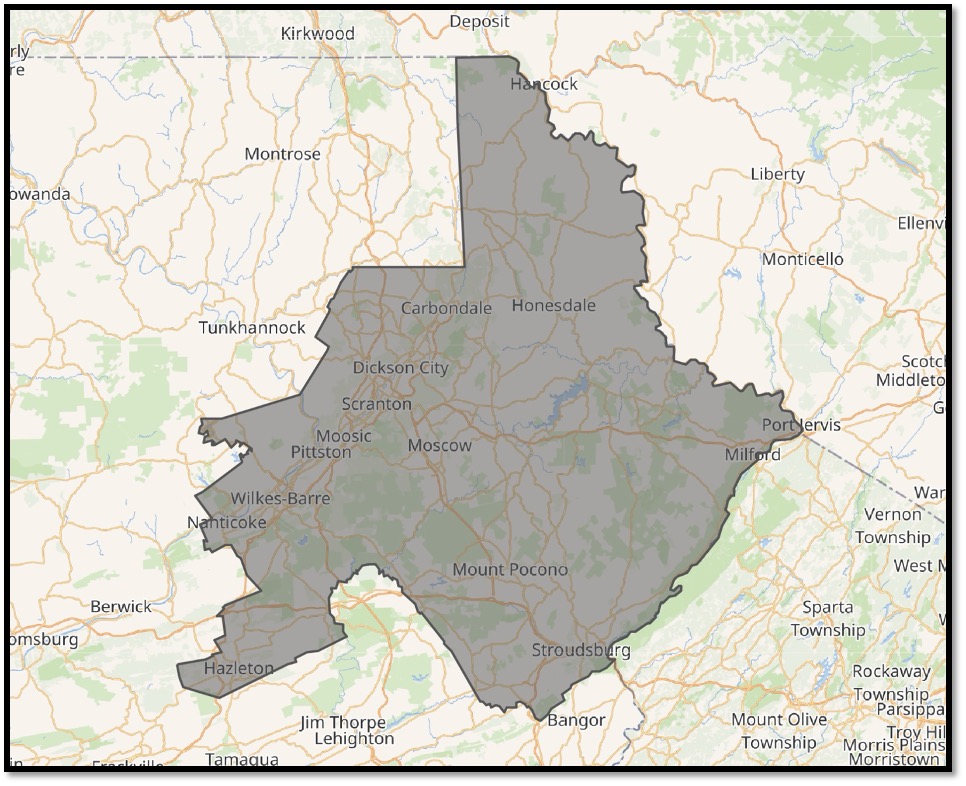
Pennsylvania’s 8th Congressional District (PA-8) is wedged into the far northeastern corner of the Keystone State, and is right across the Delaware River from another decisive seat, NJ-7. It contains all of Wayne, Pike, and Lackawanna Counties, as well as a portion of Luzerne County and most of Monroe County. Four of those five counties were won by Trump in the 2024 election, and the district’s sharp rightward movement played a huge role in the recapture of Pennsylvania’s 19 electoral votes.
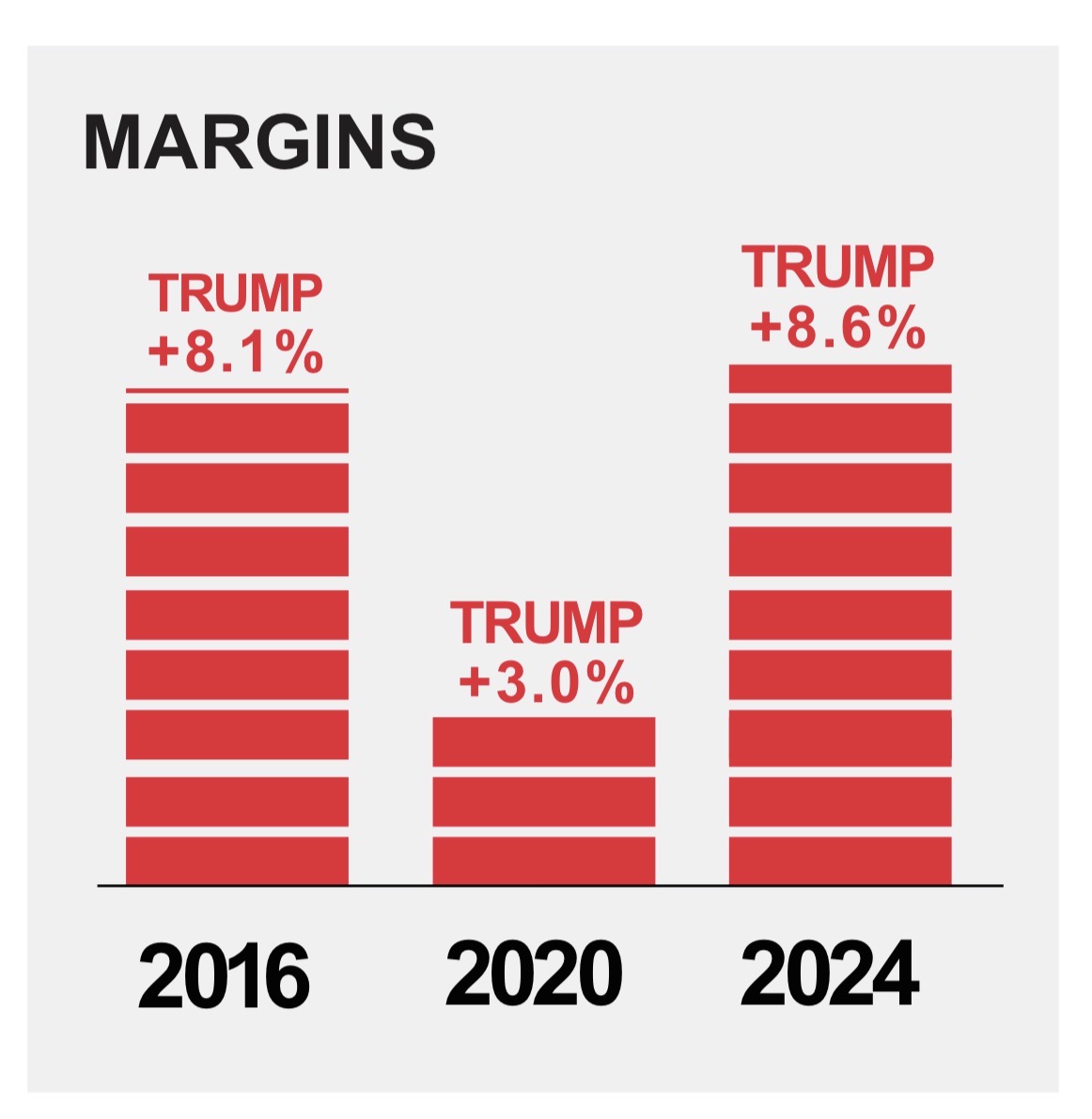
This is a huge working-class area that has shifted heavily toward the Republican Party in the age of Trump primarily over the issue of trade. Obama carried the dirt making up the present district by double digits in both of his runs, and even including a left lurch for “Scranton Joe” in 2020 due to the mail-in balloting fiasco, Trump carried it in all three of his runs – with his most impressive mark in 2024:
Presidential Margins
While the district is mostly made up of Trump’s bread-and-butter demographic, the white working class, over one-eighth of the population is Hispanic. Trump’s major gains with the Hispanic voter base helped propel Bresnahan to his 2024 victory over a tough Democrat incumbent.
Key Statistics
74.6% White, 13.2% Hispanic, 6.3% Black
III. Market Assessment
Polymarket bettors have over-valued Cognetti, giving her a 73% shot at victory.
IV. History
In 2016, much of the turf represented in today’s PA-8 was part of the old PA-10, including a lot of the bedrock northern Pennsylvania red wall. Tom Marino (Republican) won the seat by over 40 points against his Democrat opponent.
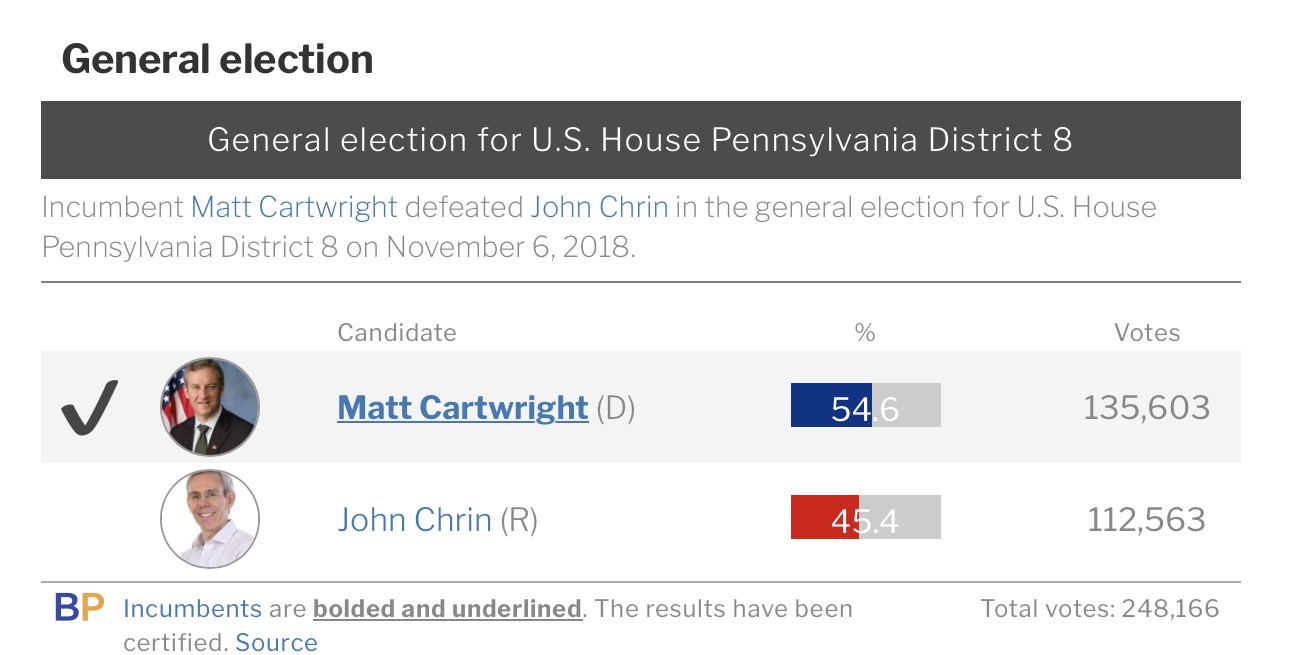
In 2018, courts ordered an entirely new map in the Keystone State ahead of midterms. The northeastern corner became PA-8, and the boundaries of the elections held in 2018 and 2020 closely match those in use today, with only minor changes in Luzerne and Monroe Counties. Matt Cartwright, who had been in Congress since 2013 representing the old PA-17 (which included Scranton), moved over to the new race in the fresh PA-8, and took care of business in the 2018 House wave:
He was reelected in 2020, alongside a Trump +3 margin in the district, by 3.6%, and held on as the GOP flipped the House majority in 2022 by 2.4%, though holding the seat in either race have been highly unlikely without the changes imposed by Act 77 (2019), which allowed for no-excuse mail-in voting throughout the state.
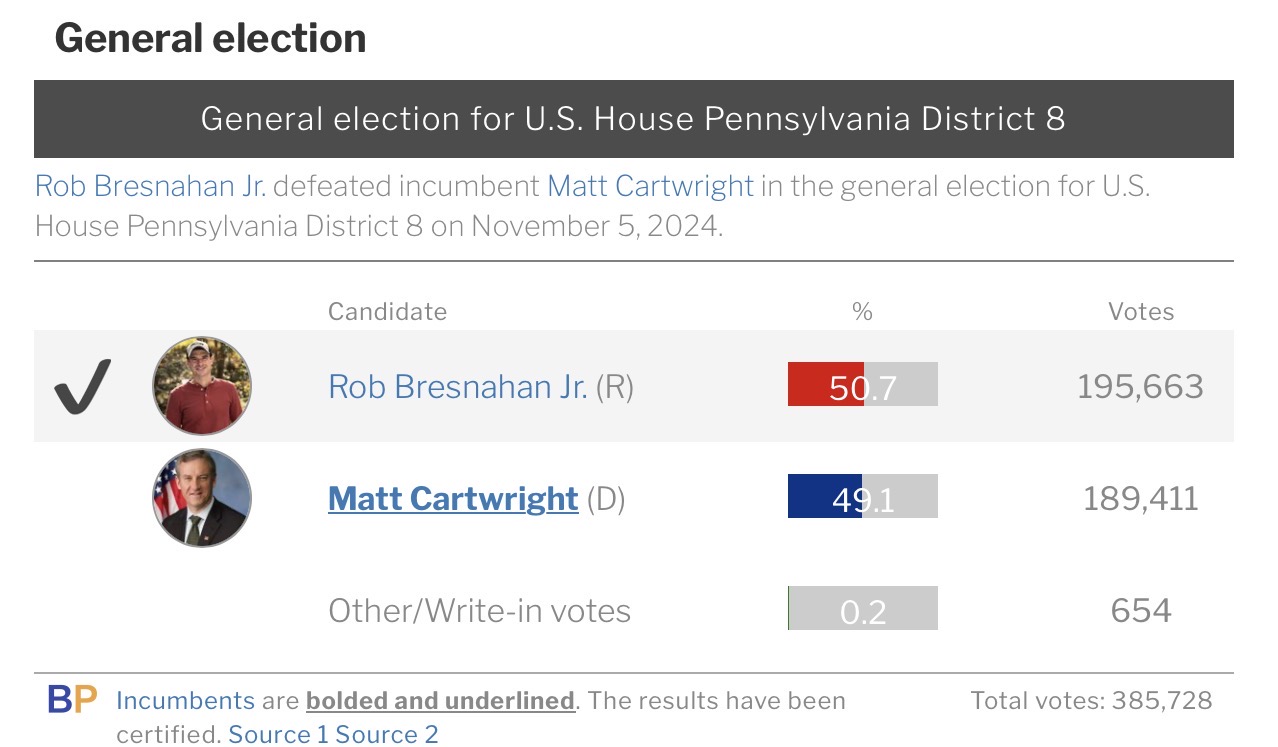
Stuck in increasingly reddening turf and facing a Trump surge in the region, Cartwright finally lost the seat in 2024 to the man defending it this year (Bresnahan):
It is widely believed that Bresnahan would have won a much more comfortable margin had he not been squaring off against Cartwright.
V. Analysis of 2026 Primary Results
Neither Bresnahan nor Cognetti faced a primary opponent, so there is no anticipation of party feuding or drama that will impact the November outcome.
VI. Polls
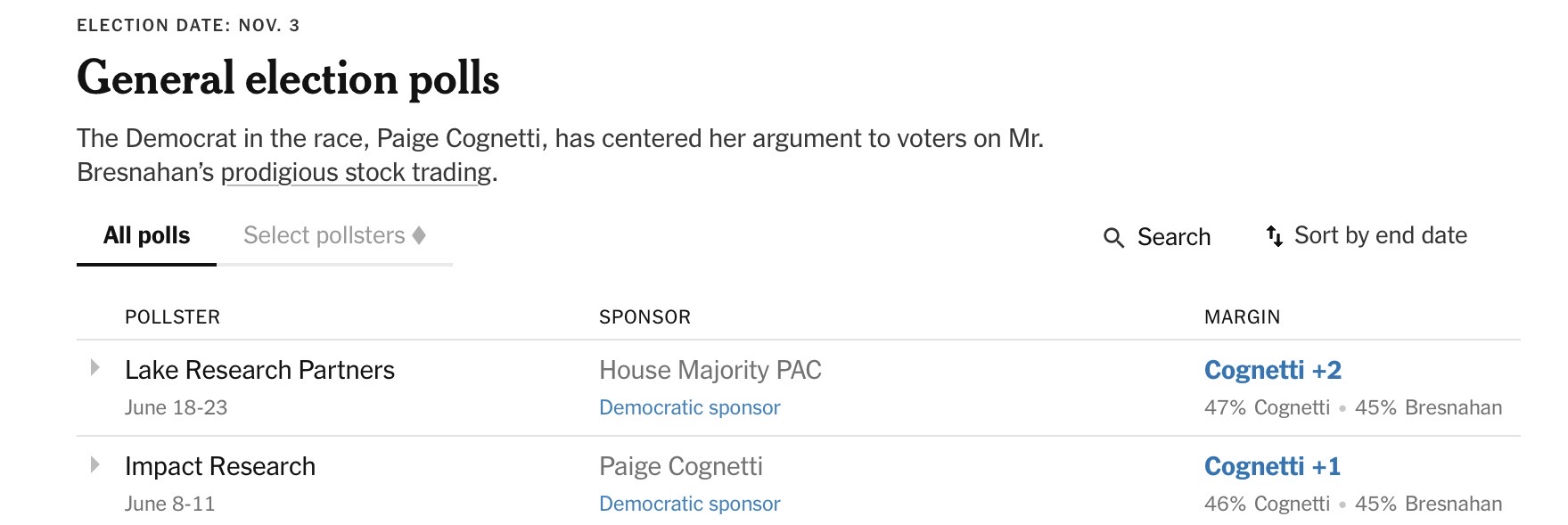
Poll listings pulled from The New York Times:
Two virtual ties in polls ordered by Democrat sponsors provide no visible edge for Cognetti.
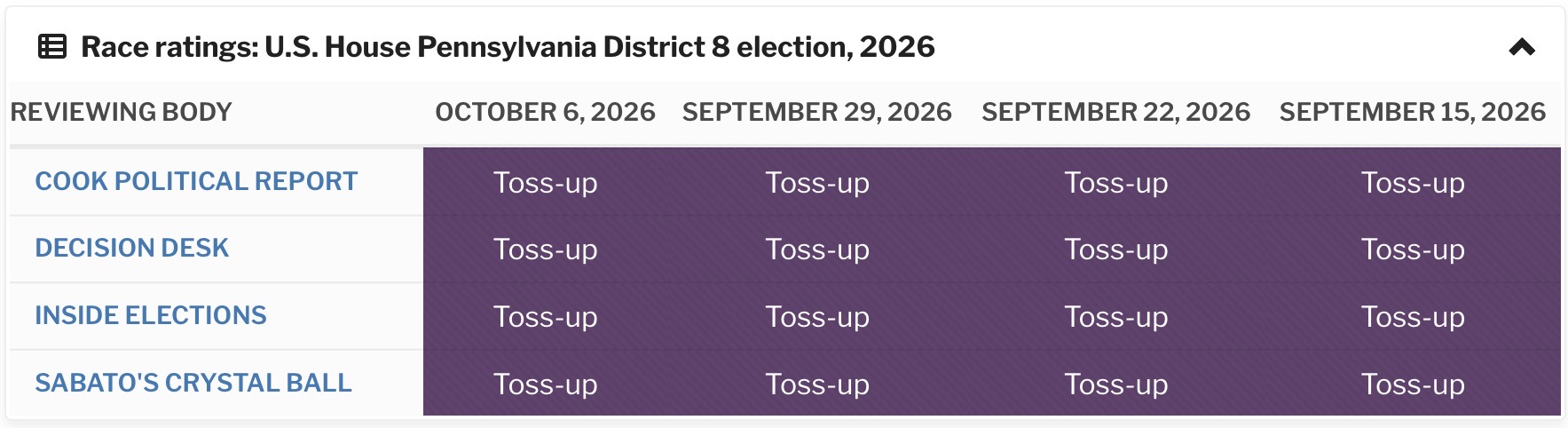
VII. Media Ratings
Since summer, two of these reviewing bodies have downgraded the race from “Lean Republican” to toss-up. No one at this stage in the game is willing to take a leap of faith one way or another.
VIII. Party Registration
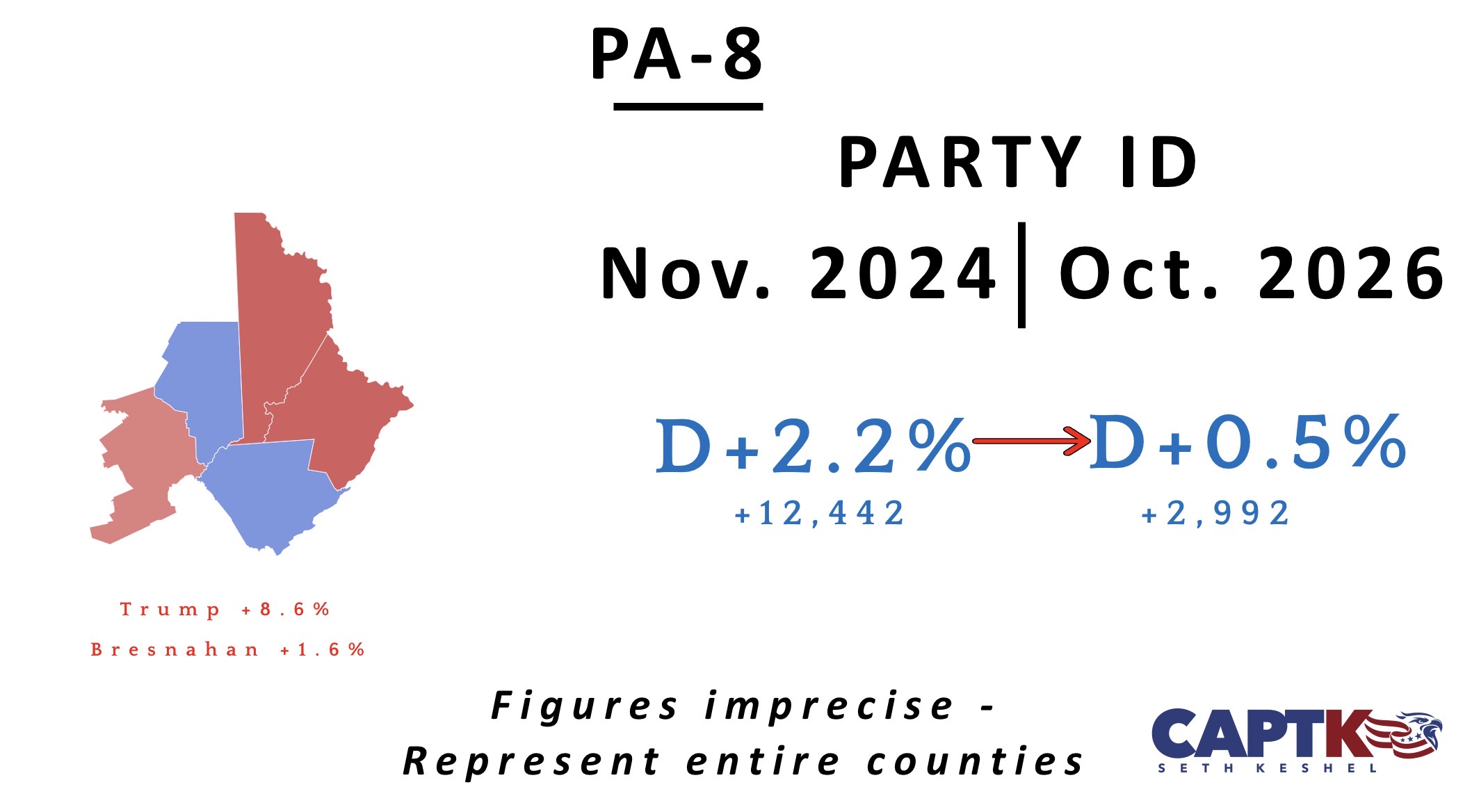
The figures above are imprecise and represent the voter registration figures of the five counties of PA-8 in full (not accounting for partial counties of Luzerne and Monroe); however, all five have become more Republican (Luzerne, Pike, and Wayne) or less Democrat (Lackawanna and Monroe) since Trump won the district big in 2024.
• Lackawanna from D+26,902 to D+24,722 • Luzerne from R+2,688 to R+4,746 • Monroe from D+7,606 to D+5,495 • Pike from R+8,710 to R+9,468 • Wayne from R+12,668 to R+13,011
Cognetti needs all she can squeeze out of Lackawanna and Monroe Counties, and neither are moving in her party’s direction. The continued Republican trend of this area is a huge boost for Bresnahan, even if these figures are more predictive of presidential trend than they are applicable to midterm analysis.
IX. Election Considerations
Read my book, The American War on Election Corruption, if you’d like to understand the major impacts to Pennsylvania’s elections caused by the introduction of mass mail-in voting. It’s not crackpot stuff; Pennsylvania’s elections are now more about ballot collection than they are about vote getting. The registration numbers shown above suggest Democrats, particularly with the area stagnant in population growth, should be incapable of gaining votes cycle after cycle, but they still manage to compete.
Pennsylvania has some of the worst elections in America. Read my 2024 election compendium, Pennsylvania – 2024 Election Compendium (December 21, 2024), to understand the stakes and why this is a potentially huge boost for Cognetti if the race is tight.
X. Summary and Election Estimate
I get people asking me all the time if I think Josh Shapiro can be beaten this year in the gubernatorial race. I don’t think there is a snowball’s chance in hell of that happening. The risk of a massive landslide is that the three key Republican defenses in the state (PA-7, PA-8, and PA-10) get buried for lack of GOP intensity. PA-8, Bresnahan’s seat, is by far the most likely of those seats to be successfully defended. If he can hold the seat, Republicans have a very good shot of a photo finish for the House majority.
Bresnahan has considerable strength in a working-class district not commonly associated with GOP candidates. He has the standard conservative endorsements, such as that of the NRA and many law enforcement organizations, but his most vital endorsements are these:
• Pennsylvania Conference of Teamsters • American Federation of Government Employees • Brotherhood of Railroad Signalmen • Many other labor unions too numerous to list
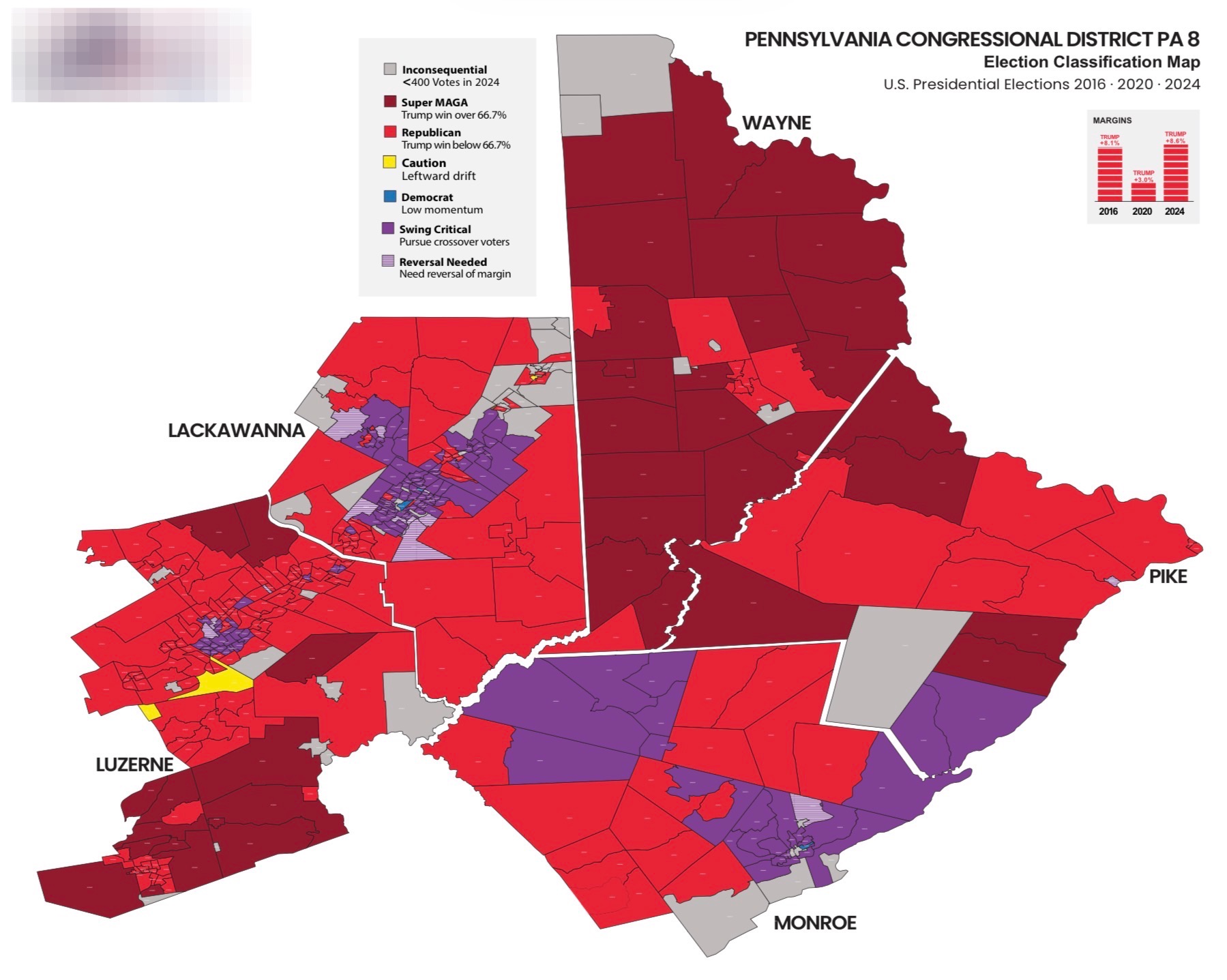
Understanding why those backers are important requires you to understand the electoral terrain:
Captain K Proprietary Mapping of PA-8
Wayne and Pike Counties are traditional Pennsylvania GOP strongholds. Wayne hasn’t backed a Democrat for president since 1892, while Pike has only backed three in the past century (and none since 1964). Those have been red, and only got redder under Trump. The key to the Trumpian revolution in Pennsylvania ran through counties like Luzerne and Monroe. Luzerne aligned with the winner of Pennsylvania’s electoral votes in every election from 1936 through 2016 (missed in 2020 because of the mail-induced quasi election), and Monroe is emerging as a new blue-collar bellwether along with Erie and Northampton Counties.
Lackawanna is where Cognetti is going to have to hit it big, and its Democrat strength has also waned. Obama beat Romney there by 27.2% in 2012, and Trump only missed the mark by 2.8% in 2024. If Bresnahan is going to ride the red counties to huge margins and have appeal to the Trumpy Monroe and Luzerne Counties, these blue collar endorsements will help him minimize the impact of Lackawanna for Cognetti (which she will win).
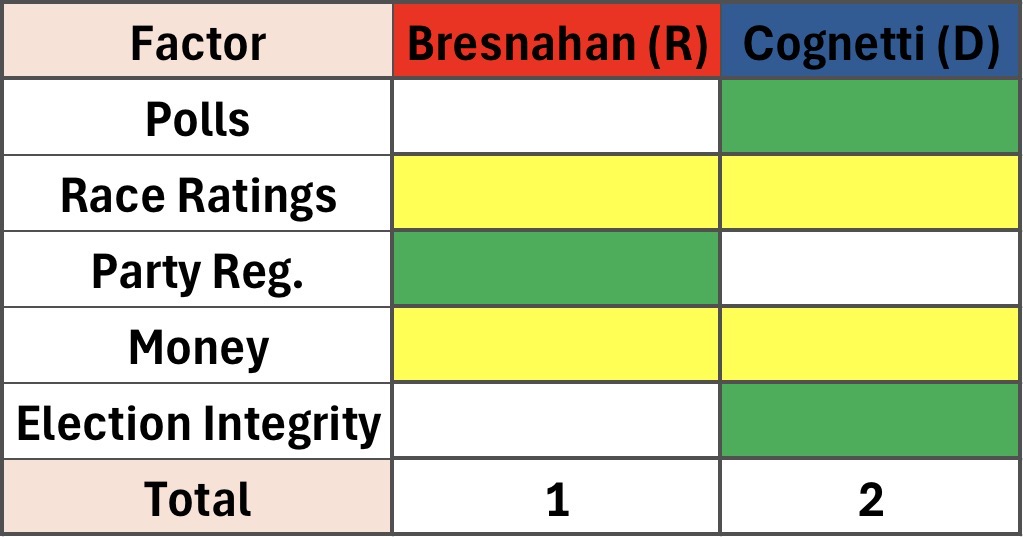
Here is where things stand today with regard to the key factors of the race:
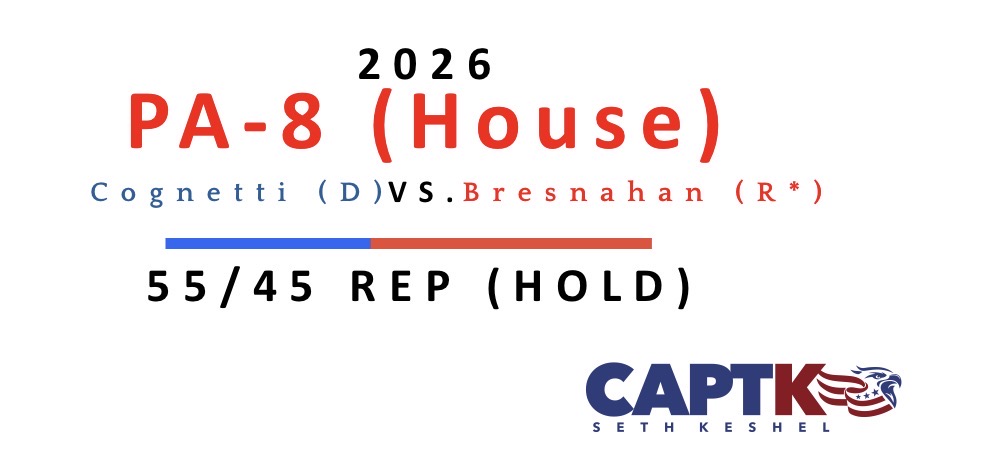
Forecast for PA-8 House
While campaigning for Congress, Bresnahan railed against members trading stocks; he has since become one of the most prolific traders in all of Congress, and Cognetti has made that a key issue of her anti-corruption crusade – essentially accusing him of insider trading. Still, Bresnahan knows the path to victory in PA-8 relies on him sticking to the trade-based platform that has earned him his blue-collar endorsements, and I think this seat tilts his way ever so slightly in what is a must-win for the Republicans.
Seth Keshel, MBA is a Senior Fellow at the Gold Institute for International Strategy and a retired Army Captain. He publishes Captain K’s Corner on Substack.
From the Spanish government, the only thing His Majesty’s regime has received is doglike submission and collaboration in an invasion of Spanish territory.
King Mohammed VI has lashed out at Spain’s immigration laws, which he considers riddled with “obsolete legal provisions and unrealistic court rulings.” Allowing that the court rulings stem precisely from the laws, one has to admit that the monarch is very much right on this. Then, when he says he will not accept “pressure, threats or blackmail,” he gets rather grand. Because the truth is that the only thing His Majesty’s regime has received from the government of Spain is doglike submission and collaboration in an invasion of Spanish territory.
It has not even received a mild official reproach for unleashing a hundred thousand subjects on us and leaving us twenty thousand invaders to subvert order and sow panic in the Spanish city, tormenting the people of Ceuta with relentless vandalism, aggression and crime. True, given the evident collaboration of Pedro Sánchez and his government with the Moroccan authorities in allowing this invasion to happen, a reproach from Madrid might have drawn a response from Rabat that would have exposed his government’s betrayal of Spain even more plainly. It is the latest and most tragic chapter in Sánchez’s record of servitude to the government of Morocco.
Mohammed VI is right that in Spain we have ridiculous immigration laws, with authorities who always apply them in favor of illegal immigration and the pull effect. It is very true, for example, that the policy toward minors has all the hallmarks of a kidnapping. German or Norwegian or Italian children who turn up alone in Spain are back with their families and in their countries within 24 hours. African children are, in effect, forcibly adopted by the Spanish administration.
That has a great deal to do with an industry that has grown up in Spain around immigration, of which the current government is promoter and beneficiary, and which serves to divert massive amounts of public money into private hands via NGOs, associations and related services, all of them in the socialist orbit. And also some bodies and orders of the Church, so that the Spanish bishops never hesitate to applaud immigration, the more the better. The spending per immigrant and on all the services arising from their mass presence adds up to colossal sums that end up in all these organizations, which pay for the staff and for the organizational, propaganda and activist machinery of the left.
There is only one other way just as effective to plunder the public coffers without limit or shame, and that is international cooperation. It hands out billions to the most outlandish, exotic and remote projects, with, of course, no real monitoring or tracing of the funds that reach those supposed beneficiaries. The truth is that in many of those projects Spanish funding is incomprehensible when it is not grotesque. And those budget lines must necessarily answer to other interests, far more logical but unspeakable.
Mohammed VI is right that Spain needs much clearer and more logical laws for its very grave immigration problem, which is already an invasion. And not only in Ceuta. Laws that allow the immediate deportation of anyone, of any age and condition, without legal permission to be on its territory. Laws that remove every incentive to violate the borders, which means preventing illegal immigrants from benefiting from social, medical and housing services. And laws that require all countries of origin to accept their citizens. Spain and the European Union have the means to demand this respect from the countries of origin effectively.
Relations with Morocco will surely improve as soon as the government in Spain is not a lackey of Mohammed VI but a legal and legitimate government with no crimes to hide. Rabat, which has a government that defends its national interests, will get along better with a Spanish government devoted to defending the interests of Spaniards than with a traitorous, cowed government, constrained by a thousand secrets, complexes, fears and cover-ups. The many ambiguities in Spanish-Moroccan relations, many of them created on the Spanish side, must end. With a secure, militarized border in Ceuta and Melilla, an urgent clarification of the real legal status of all Moroccans naturalized as Spaniards without having renounced Moroccan nationality, a swift routine for deporting all illegal immigrants, minors included of course, and an end to hostile gestures, relations should reach a point of normalization.
For that, a policy that systematically favors Morocco to Spain’s detriment must end. This must also be made clear in Brussels, which, alongside the Sánchez government, is the greatest source of grievances, outrages and abuses against Spain for the benefit of Morocco. Let everyone remember that Morocco’s trade with Europe passes through Spain.
We know the effects of the deplorable fact that, while the Moroccan government works for its country, the current government of Spain also works for Morocco and against Spanish interests. The Spanish socialist group in the European Parliament is the Moroccan lobby there. Everything can and must improve in relations between the two countries.
But it is clear today that the demand for mutual respect, I insist, mutual, can only be met when Spain has a legal and legitimate government that defends Spanish interests and not a puppet of foreign or criminal interests.
Written byHermann TertschDistinguished Fellow (Honorary), Gold Institute for International Strategy
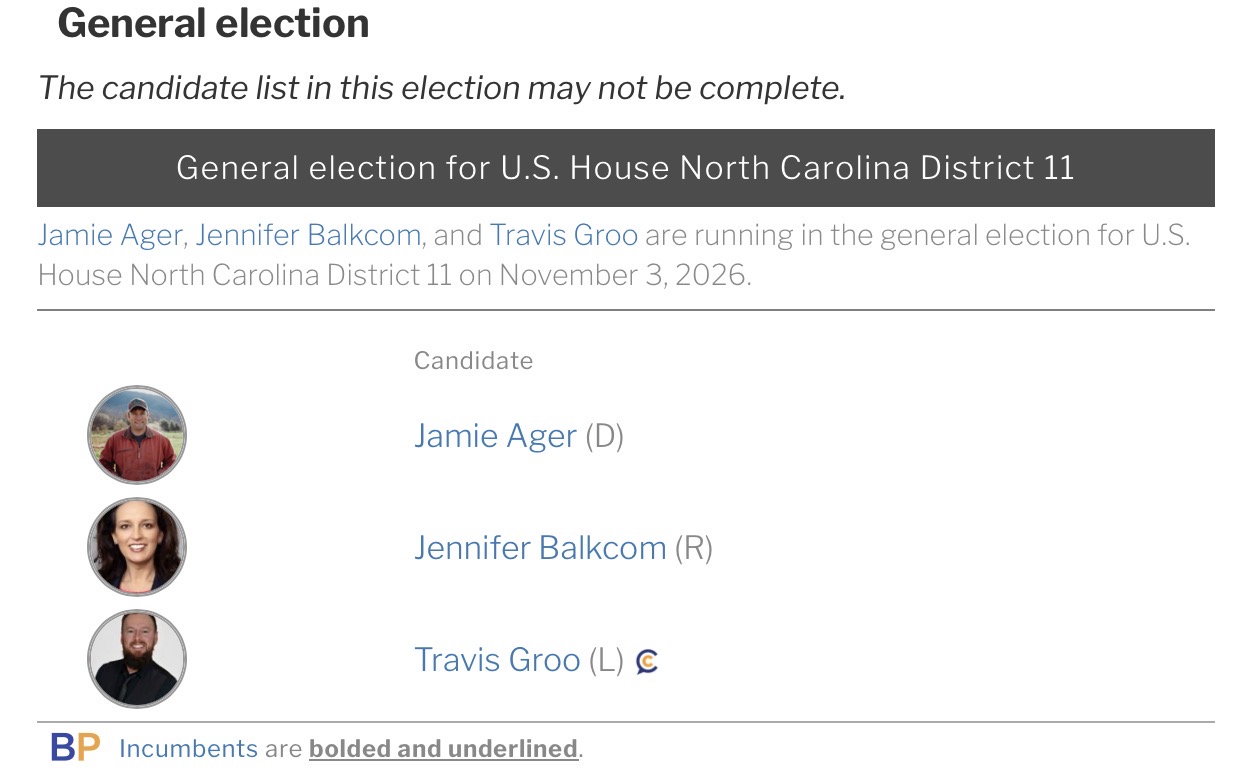
Jennifer Balkcom (Republican) was selected by the Executive Committee of the NC-11 Republican Party to run as GOP nominee. This pick happened after the primary, and was required after incumbent Chuck Edwards decided he didn’t want to run again when it became clear he was going to be roasted over an ethics investigation into inappropriate workplace conduct with female staffers. Balkcom has served two terms in the North Carolina House of Representatives and is faced with a major burden of starting from scratch with less than 90 days to run the campaign.
Jamie Ager (Democrat) is one of the best Democrat candidates in the United States and is attempting to revive a brand of “mountain Democrat” that is practically extinct. He’s 47, a farmer, and the CEO of Hickory Nut Gap Farms in Fairview, North Carolina. His reported net worth is nearly $19 million.
II. District Geography
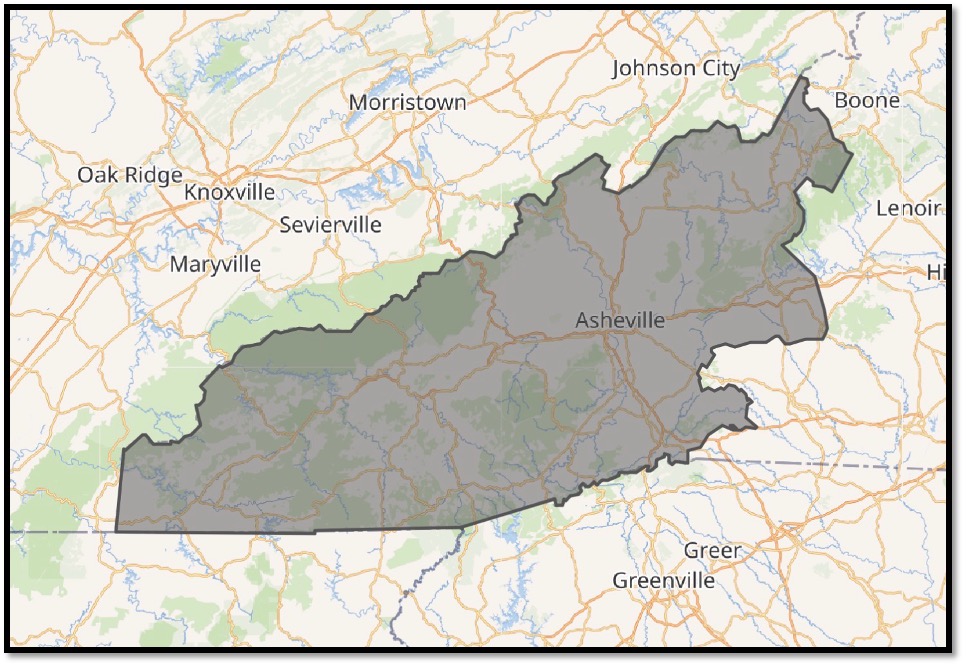
North Carolina’s 11th Congressional District (NC-11) is the westernmost district in the state. It hugs most of the state’s boundary with Tennessee and also borders South Carolina and Georgia. Asheville, a steadily growing leftist stronghold, is fully contained within the district, which is still dealing with the flood-related impacts of Hurricane Helene two years later.
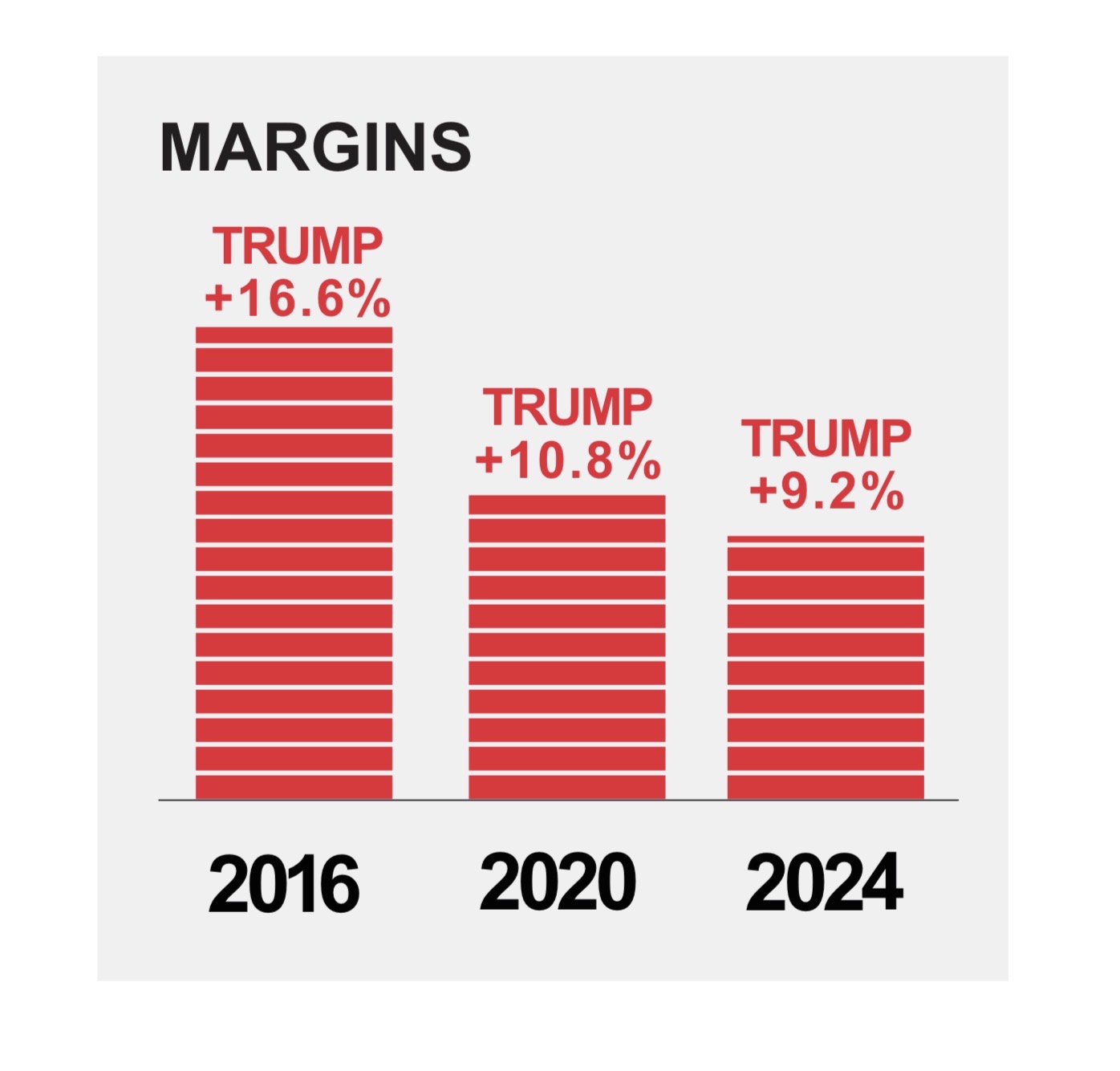
President Trump carried the district, as it is presently drawn, all three times he ran – but by declining margins each time.
Presidential Margins
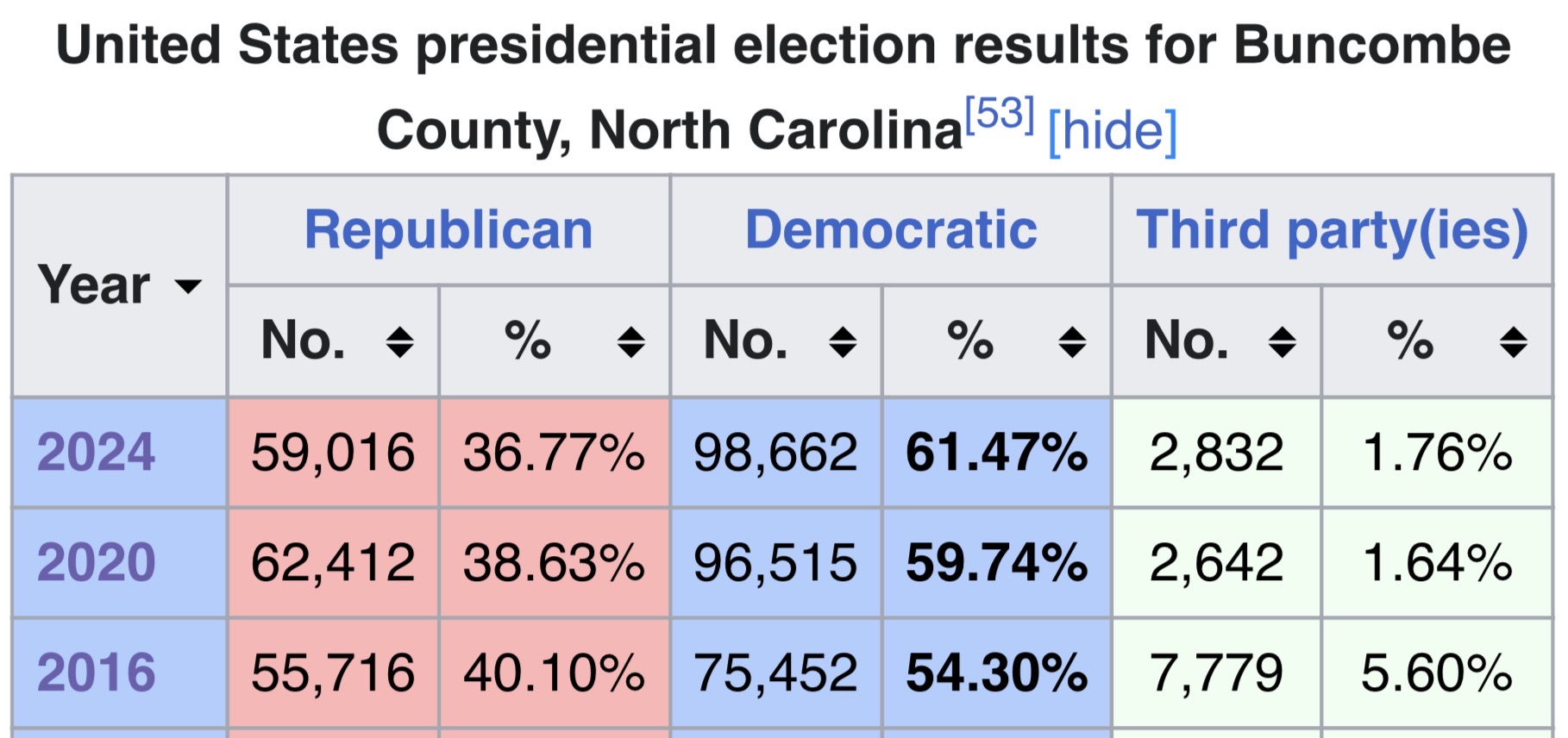
This decline in margin comes from much of the district being “maxed out,” meaning small counties with stagnant populations are no longer able to produce larger margins, and the expansion of Buncombe County (Asheville):
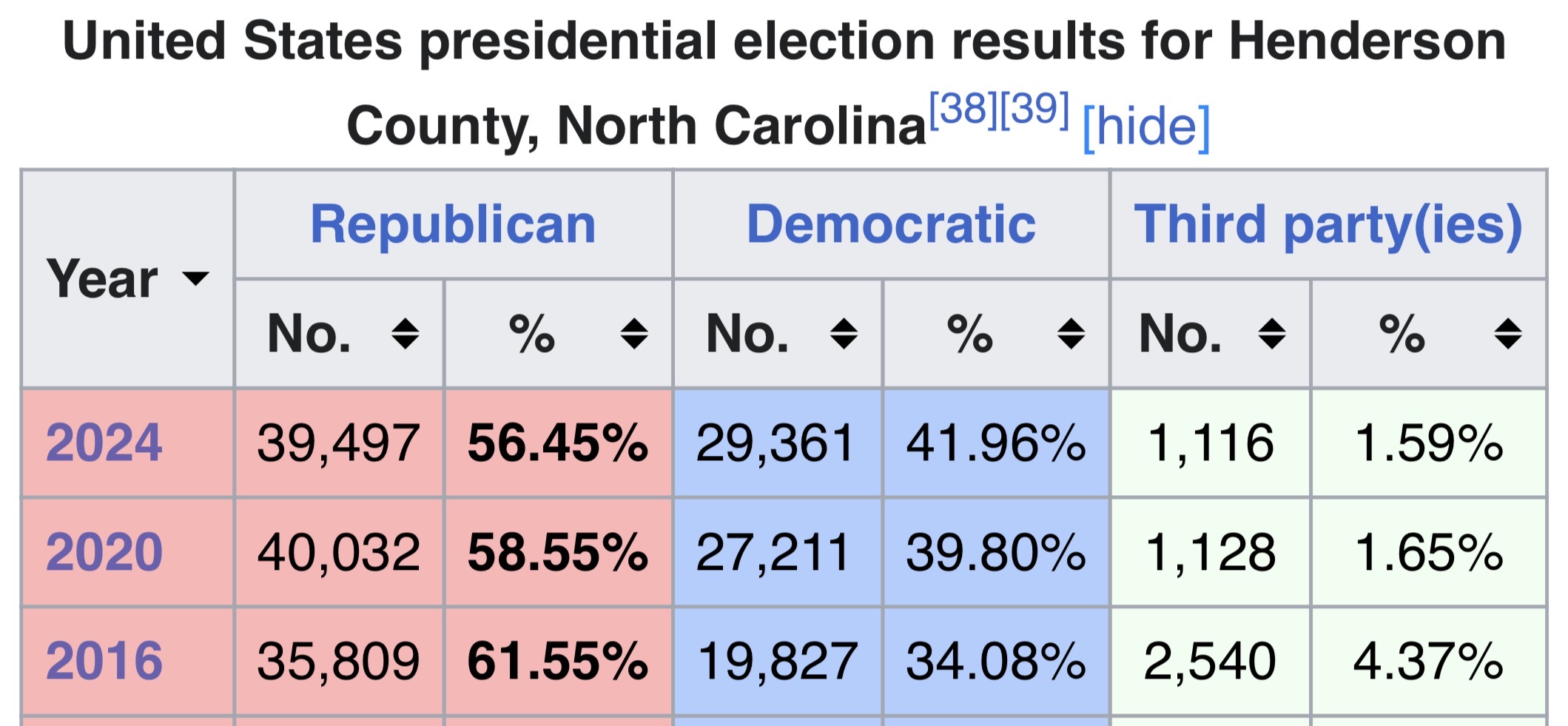
Whereas Trump lost Buncombe by 14.2%, a margin of 19,736 votes, in 2016, he lost it by 24.7% and 39,646 votes in 2024. There has also been a decline in GOP margin in mid-sized counties, such as Henderson, which Josh Stein carried against Mark Robinson in the 2024 gubernatorial race:
While it was worth +15,982 margin for Trump in 2016, it only gave him +10,136 in 2024. The North Carolina legislature would be wise to reassess these boundaries and split Asheville in two the next time they address the maps.
Key Statistics
82.3% White, 7.7% Hispanic
III. Market Assessment
Polymarket bettors understate Jennifer Balkcom’s position based on partisan strength alone, but accurately assess the risk of an Ager victory.
IV. History
NC-11 has a “blue dog” Democrat representing it in its recent history – former NFL quarterback Heath Shuler. Shuler fashioned himself as a conservative Democrat and was elected in the 2006 wave, then reelected twice. After his final reelection in 2010, the North Carolina House redrew the districts and cut away much of Asheville. Shuler read the room and retired from Congress.
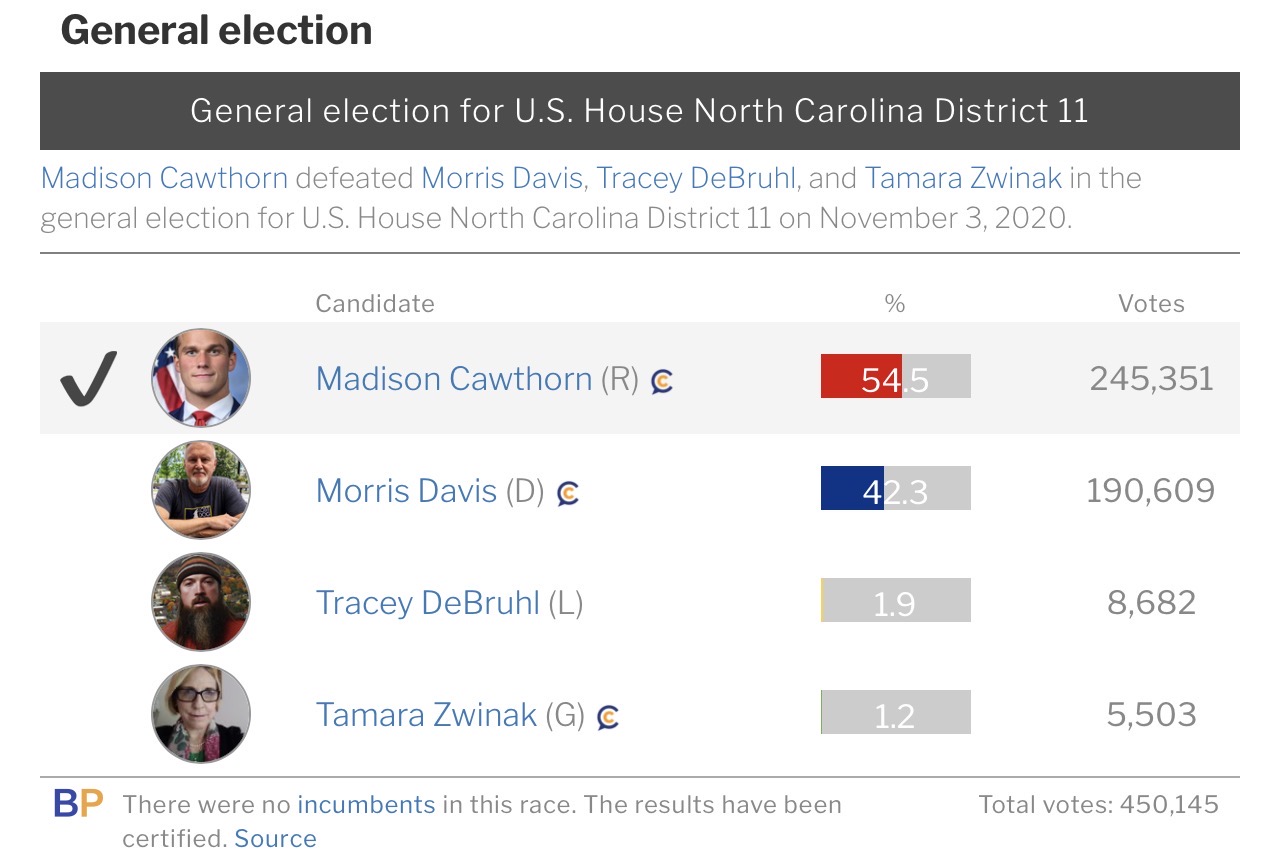
Then came Mark Meadows, who was elected in 2012 and re-elected three times before resigning the seat to become President Trump’s Chief of Staff in 2020, as the COVID-19 fracas was underway. With the seat open, Madison Cawthorn prevailed in the GOP primary and won the seat at the age of 25, with President Trump on the ticket:
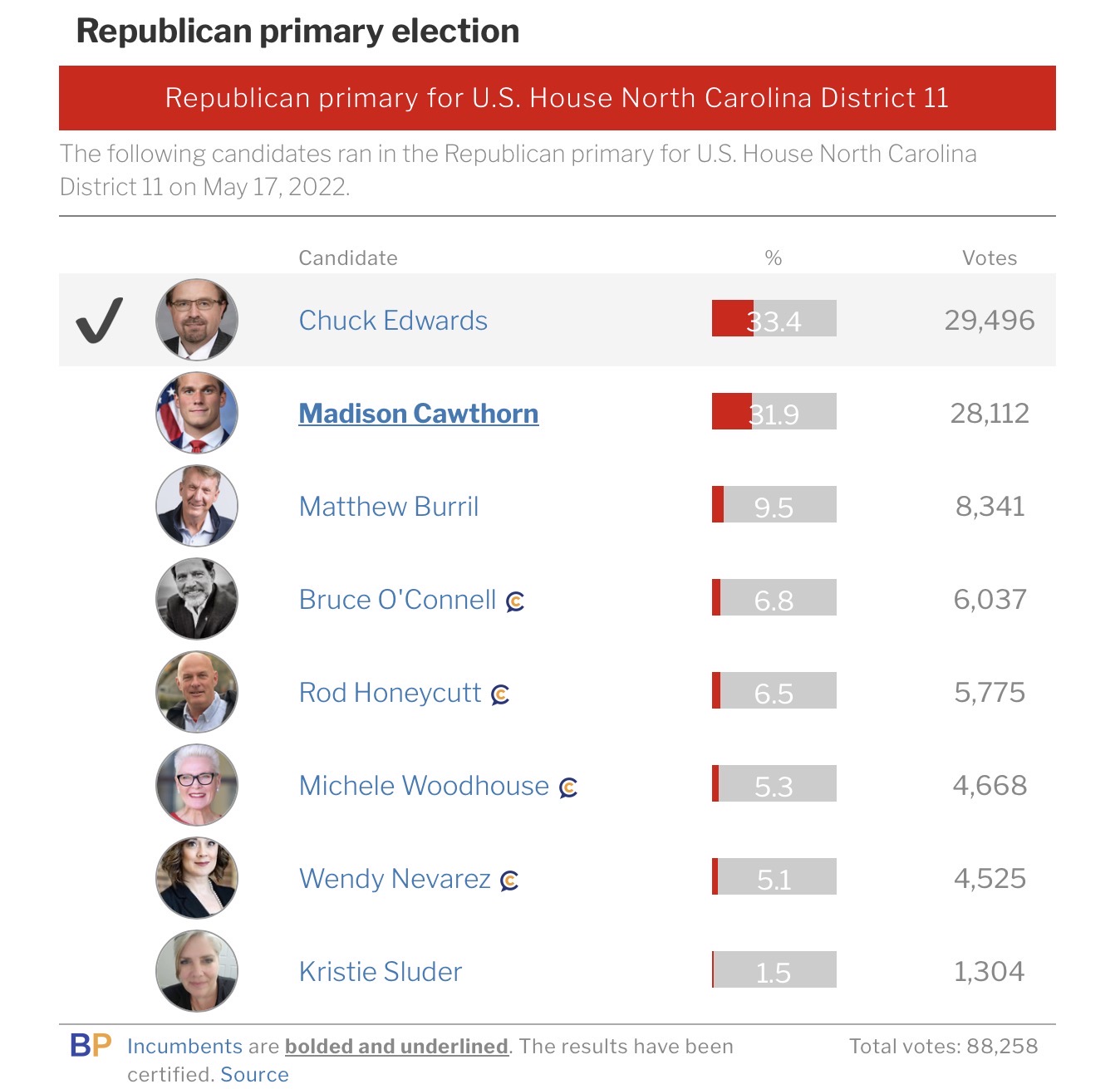
Cawthorn ran roughly even with Trump in the district (as it was drawn then), then proceeded to damage his reputation in Congress with careless behavior. Chuck Edwards exploited this and railed against Cawthorn’s morality, and ousted him in the 2022 GOP primary:
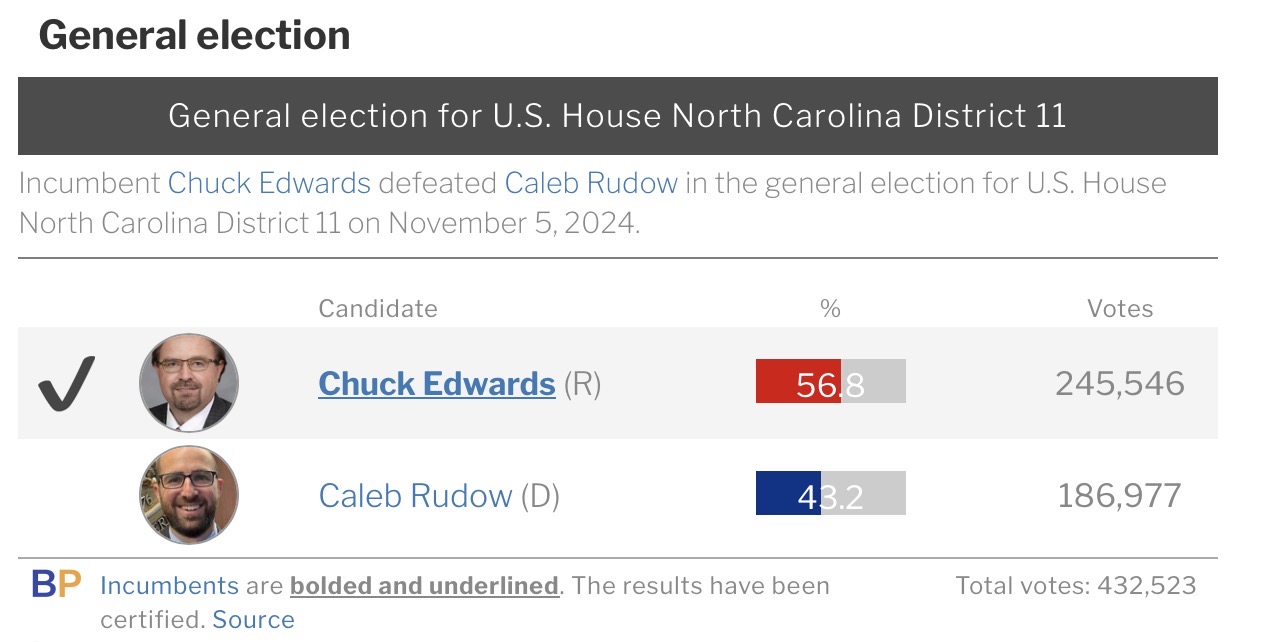
Edwards beat Democrat Jasmine Beach-Ferrara by 9.3% in the 2022 General Election, then cruised to reelection in 2024, outrunning Trump by 4.1% on the same ticket and in the same dirt:
All is well, right? A district with slight, but steady, leftward drift in a battleground state, but with a secure GOP incumbent that can win by more than 13 points?
Too bad Edwards couldn’t internalize all the admonishment he dished out to Cawthorn. Rather than buckling down on the work, he essentially wrote the “how to” guide for workplace harassment and generally making his staffers feel creeped out. The ethics investigation timeline didn’t drag out long enough to save Edwards’s campaign, so he dropped out of the race shortly after winning the primary.
And here we are, having to defend a relatively safe Republican seat in a midterm with little margin for error.
V. Analysis of 2026 Primary Results
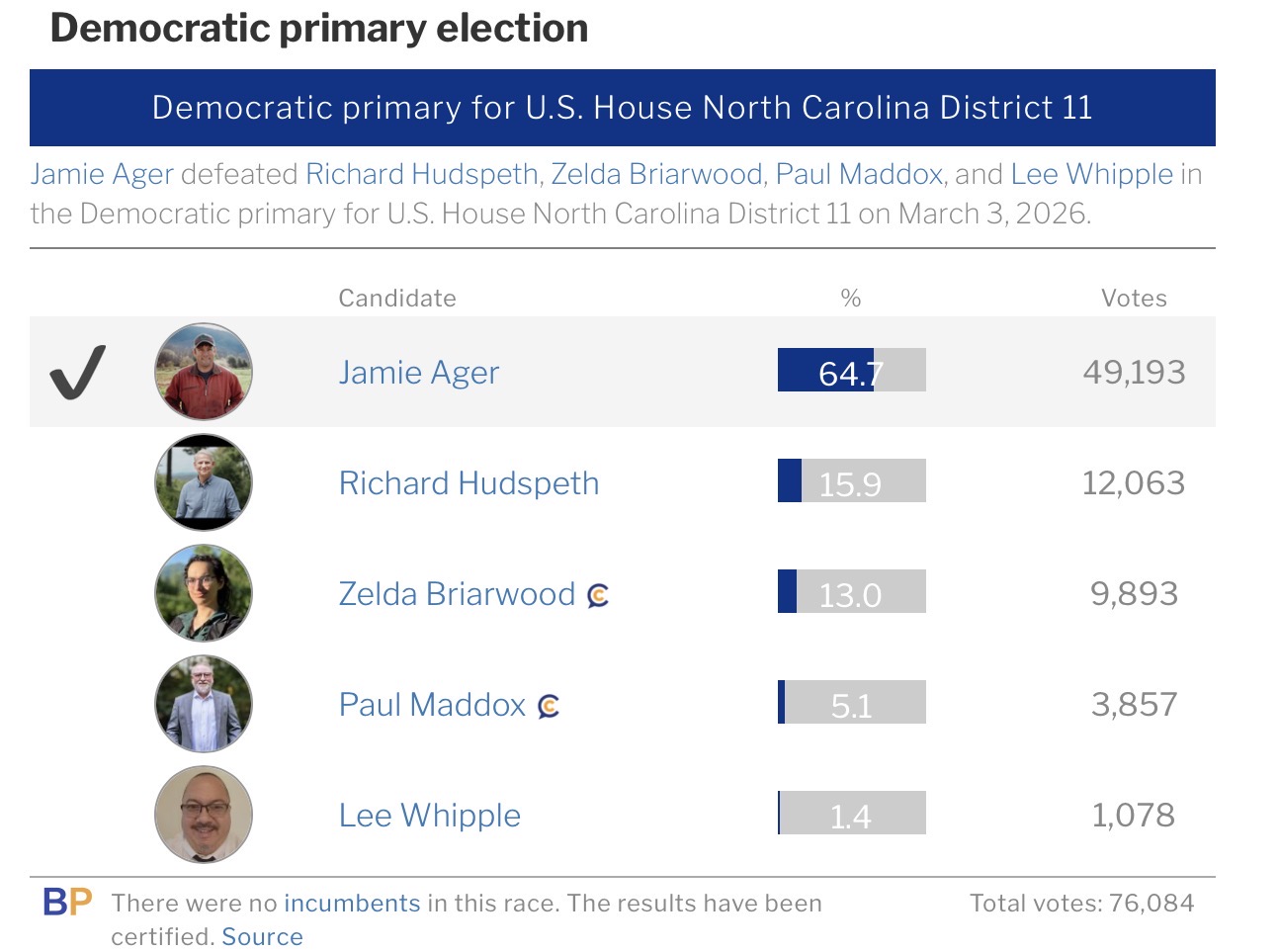
Edwards won his primary by more than 40 points, but that is now a moot point. Ager won his primary convincingly, also:
There are no signs of drama post-primary for Democrats, although Ager’s “blue dog” vibes will irritate radical leftists in Asheville; however, with an opportunity to win the seat, they’ll hold their noses and vote for him, especially with no Green candidate on the ballot.
Edwards’s departure and replacement by a candidate with a small online footprint and low name ID is the bigger story, and the late adjustment to this race is a major windfall for Democrats.
VI. Polls
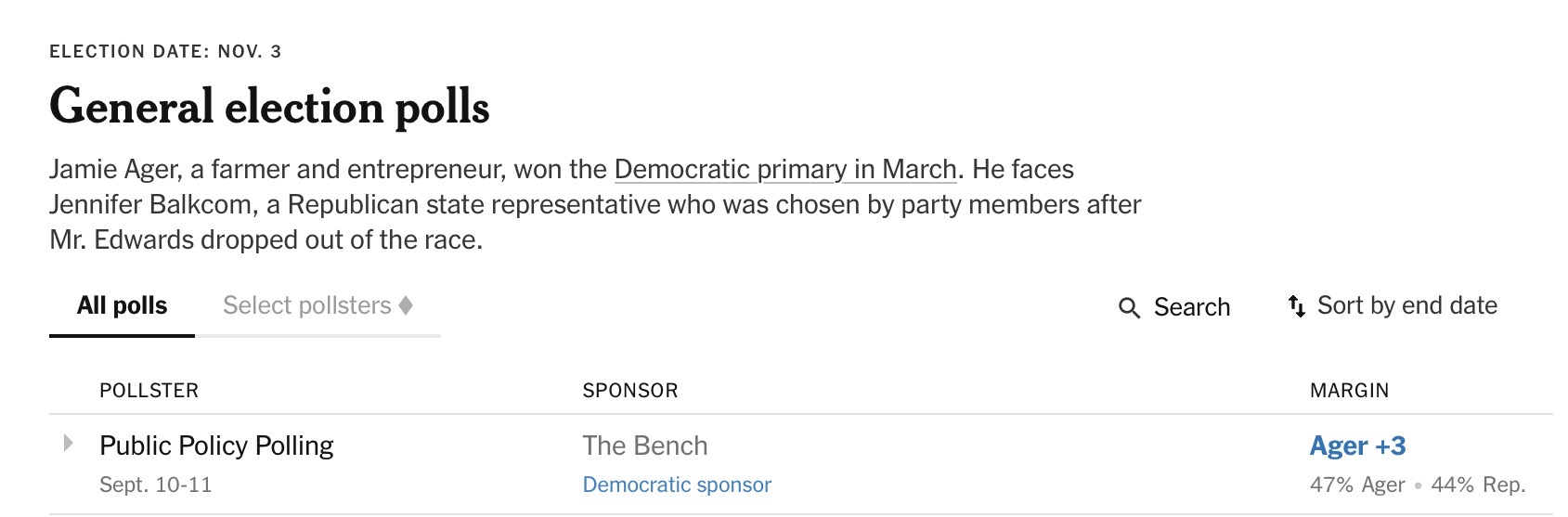
I pulled the only poll I could find from The New York Times:
A Democrat sponsor found the race at Ager +3, well short of a majority and generally inconclusive – as most polls are these days.
VII. Media Ratings
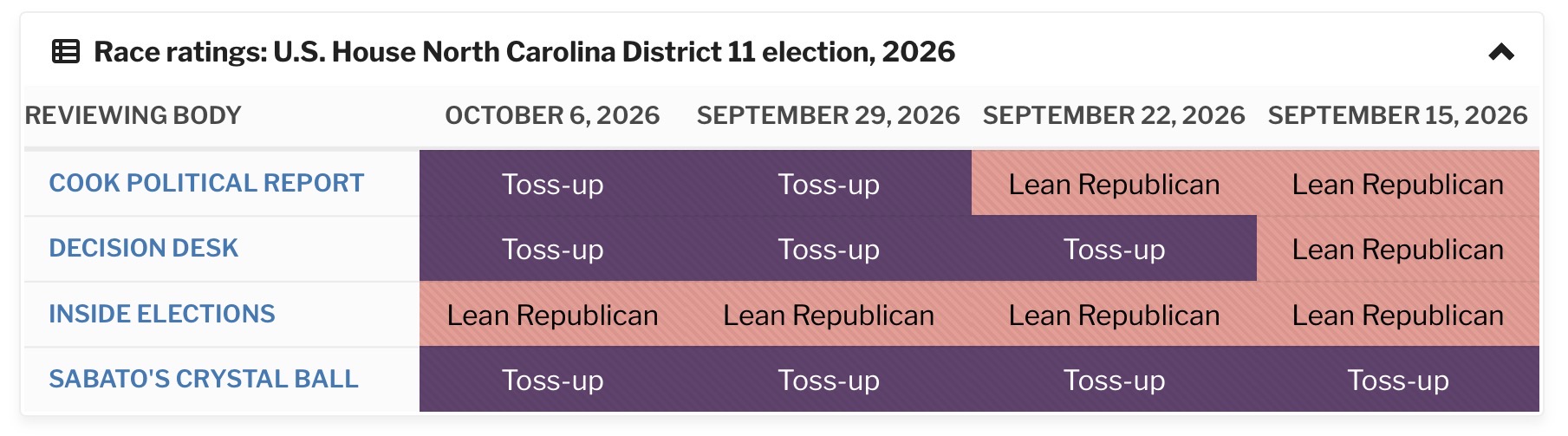
Only one of these analytical tanks still has the race favoring Balkcom, down from three a month ago. Still, no one is quite ready to lean it for Ager.
VIII. Party Registration
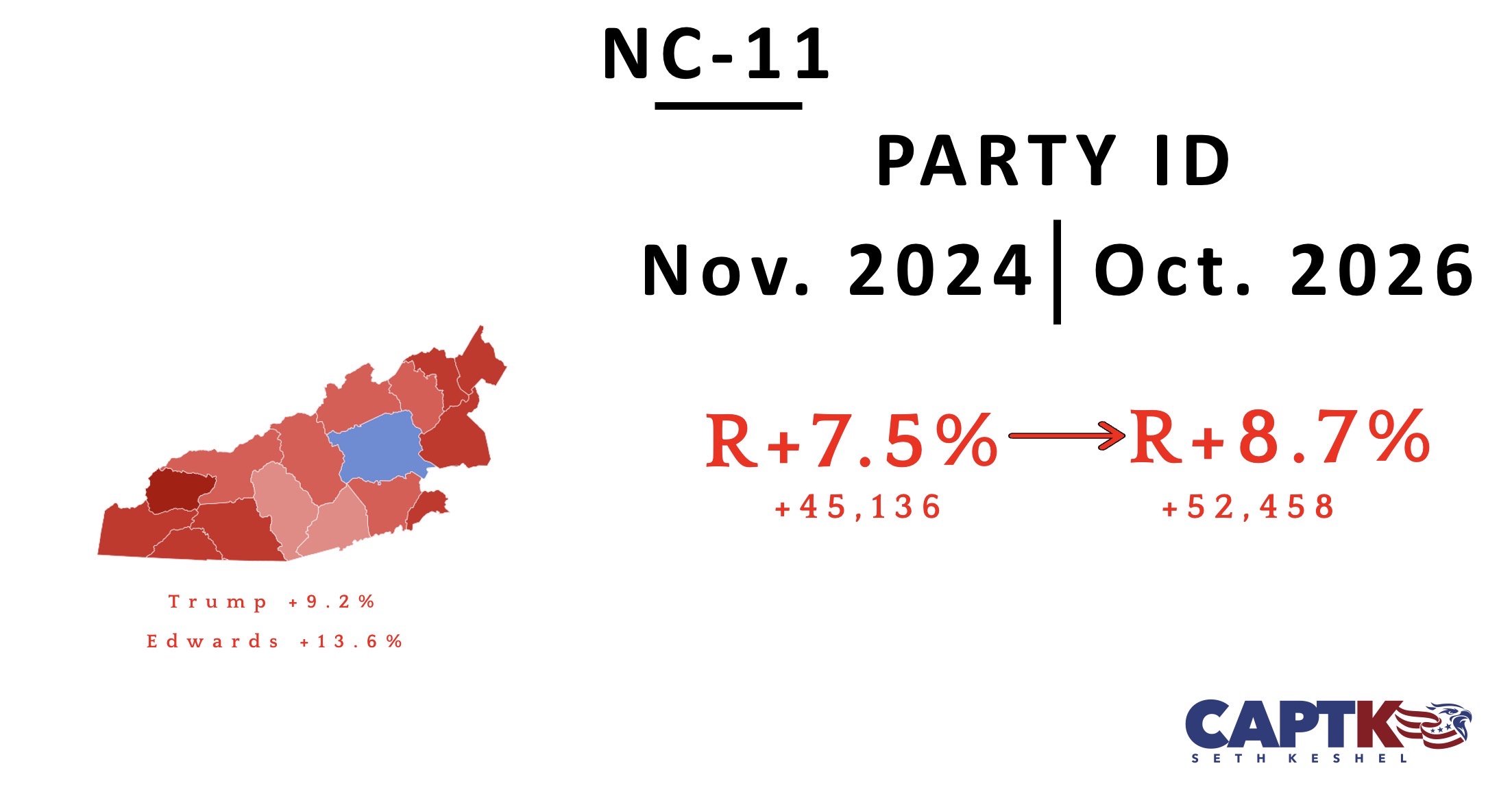
Despite a Democrat statewide surge in registrations since summer, NC-11 is notably more Republican than it was in November 2024. Democrats have lost over 2,500 registrants in Buncombe County since then, and the district itself sits over 7,000 registrations right from two years ago. This is not enough to seal the deal for Balkcom, but it makes the pathway to victory that much more difficult for Ager.
IX. Election Considerations
North Carolina only recently passed Voter ID, and has reasonably basic safeguards in place. It is not extremely easy to cheat in the state (exempting the mail-in heavy 2020 quasi election), but loopholes exist in the event of a close election, like that for the Supreme Court in 2024 – when the Democrat candidate “won” by 734 ballots after weeks of UOCAVA and provisional ballot drips.
In NC-11 specifically, based on disrupted registration to margin trends not seen in other portions of the state, I do believe absentee ballot cheating happened in small numbers in 2024 – but not enough to flip the state. Loopholes were available in Hurricane-impacted counties post-Helene, and my numbers suggest they were somewhat exploited. Those will not be open for exploitation in 2026, so the electoral environment isn’t of great concern to me this year.
You can read more about the above concerns in my review, North Carolina – 2024 Election Compendium (December 3, 2024).
X. Summary and Election Estimate
This seat becoming a decisive race for 2026 comes down to sheer Republican unforced error. It falls into the same category as OH-7, now a decisive race because Max Miller didn’t advise anyone of looming personal drama that was going to exacerbate the natural out-party margin advantage in a midterm year.
Edwards knew the ethics investigation was coming after him. He gambled and figured that anything that may drop on him would come after the November election, which he would have won against Ager somewhere in the mid to high single digits, riding incumbency. Had he prioritized the majority rather than his own status, he could have declined to run for reelection well in advance of the primary.
As things stand now, Balkcom has had to start from scratch. She won her own primary to run for reelection to the State House just two months ago, and now she’s taking on one of the most well-funded Democrats who actually fits his district in a year in which Democrats are blowing winnable races by nominating DSA-aligned radicals. She is being trounced in fundraising, and any leftward swinging that would have occurred against Edwards naturally (the swing in the former NC-11 was 7.8% left in 2018) will be amplified with the seat open.
Up until recently, I’ve had NC-11 in my “GOP leaner” category, even with Edwards out of the picture. Based on the data I track for these projections, I’m left with no choice but to now place this race on the decisive list. Mathematical pathways exist to a majority without this seat, but losing such a fundamentally strong seat makes it an extremely uphill climb to hold the House.
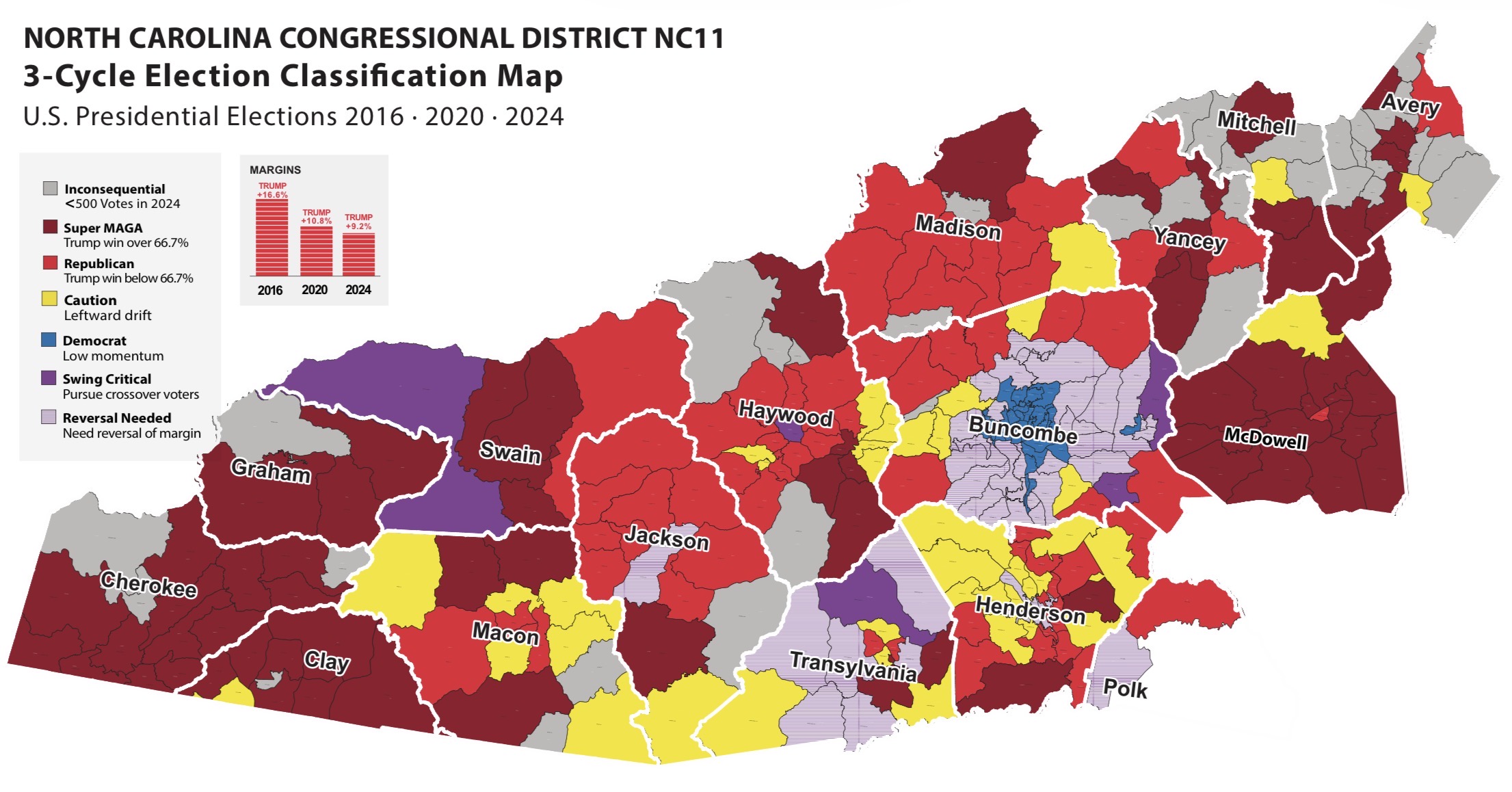
Captain K Proprietary Mapping of NC-11
The mapping above highlights the challenging electoral terrain in a race like this. Ager will get a big margin from Buncombe County (Asheville), which has a lot more high-propensity white liberals as a percentage voting in it than your standard urban area, such as Charlotte, which may see a drag with minority turnout once in-person early voting picks up. Those yellow precincts you see above (all over Henderson County), are precincts Trump won in 2024 that had notable leftward drift in margin from 2020, and in some cases, all the way back to 2016. These are the types of precincts Democrat Governor Josh Stein won in carrying this district by 7 points in his race against Mark Robinson (concurrent with the presidential race won by Trump by 9.2%).
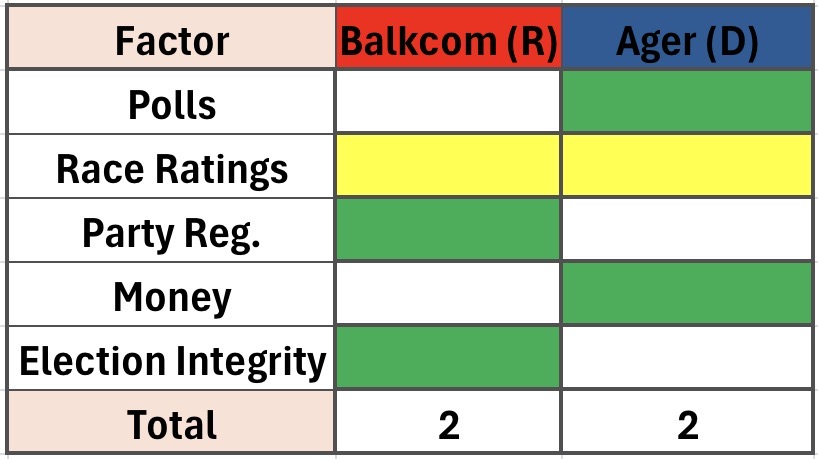
Here is where things stand today with regard to the key factors of the race:
Forecast for NC-11 House
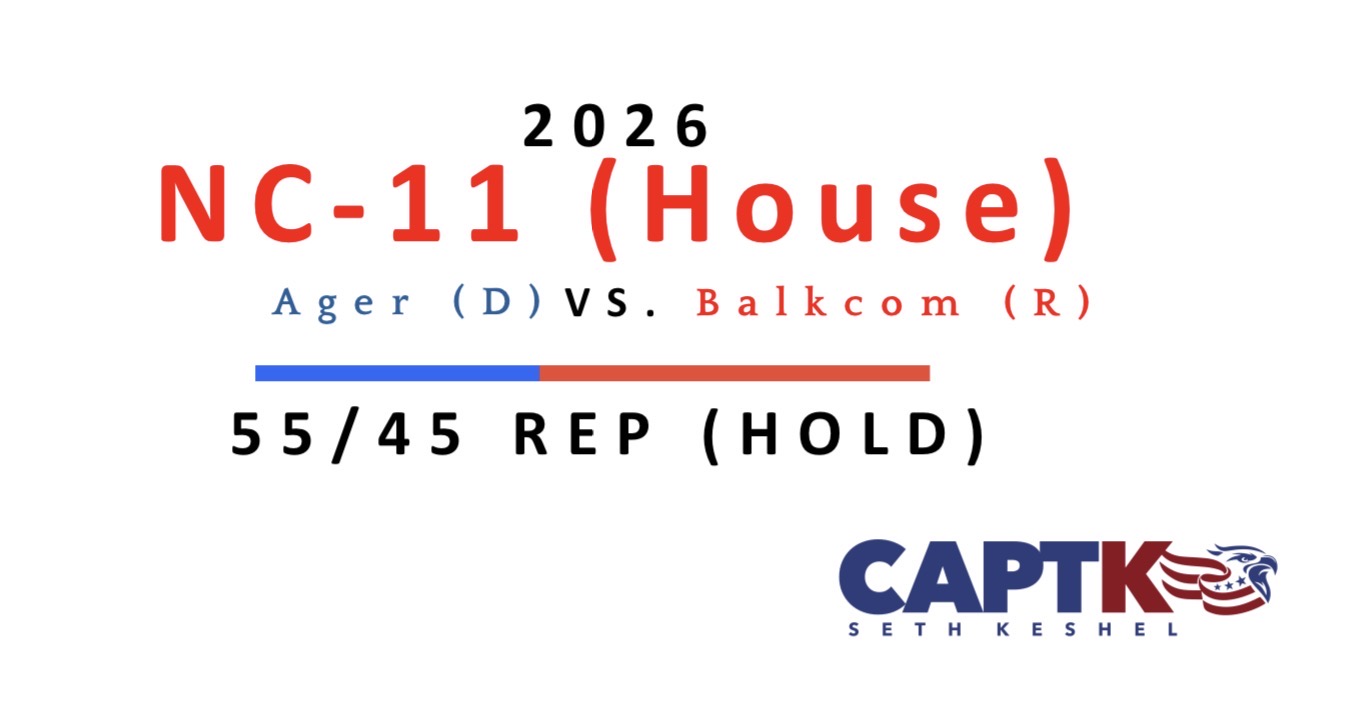
As noted earlier, Josh Stein won NC-11 by 7 points against Mark Robinson. North Carolina plays strange ball with Democrats in statewide elections, but has a very clear Republican preference for federal races. The big question for both Ager and Balkcom comes down to which preference will take root in this race. Edwards, free of scandal, would have carried this seat easily – albeit by a reduced margin from 2024. Balkcom, brand new to the race and facing a very tough midterm opponent with strong local ties and money, is a flip of the coin. A 55/45 rating in my system is a dead heat, and since I don’t believe in leaving things tied, she only holds an advantage based on the electoral terrain of the district and its modern precedent for electing Republicans. I don’t think either candidate has a ceiling of more than a few points in what may be one of the closest races this fall.
This seat has no business being in play, and you can thank Chuck Edwards if it is lost.
Seth Keshel, MBA is a Senior Fellow at the Gold Institute for International Strategy and a retired Army Captain. He publishes Captain K’s Corner on Substack.
Maria Maalouf interviews Barak Zilberberg, entrepreneur and former Republican candidate for Nevada governor, on The Capitol Show about his election loss and his vision for Nevada.
From the video’s own description: “He lost the election, but Barak Zilberberg insists his ideas are winning.”
Interview byMaria MaaloufSenior Media Fellow, Gold Institute for International Strategy
Col. (ret.) Christopher P. Costa, Executive Director of the International Spy Museum in Washington, D.C., joined Brig. Gen. Ernie Audino on Frontlines of Freedom to discuss his career in intelligence and the work of the museum.
On Frontlines of Freedom, Chris Costa joined the program. Gen. Audino’s comments: Life really is like a James Bond movie. Chris Costa is the Executive Director of the International Spy Museum in Washington, D.C., a role he has held since 2018, and a retired U.S. Army intelligence officer whose career spanned counterintelligence, human intelligence and special operations.
Brig. Gen. Ernie Audino, US Army (Ret.), is a Senior Military Fellow at the Gold Institute for International Strategy, a Washington D.C. based foreign policy and defense think tank. He hosts Frontlines of Freedom, a nationally syndicated military news and talk radio program.
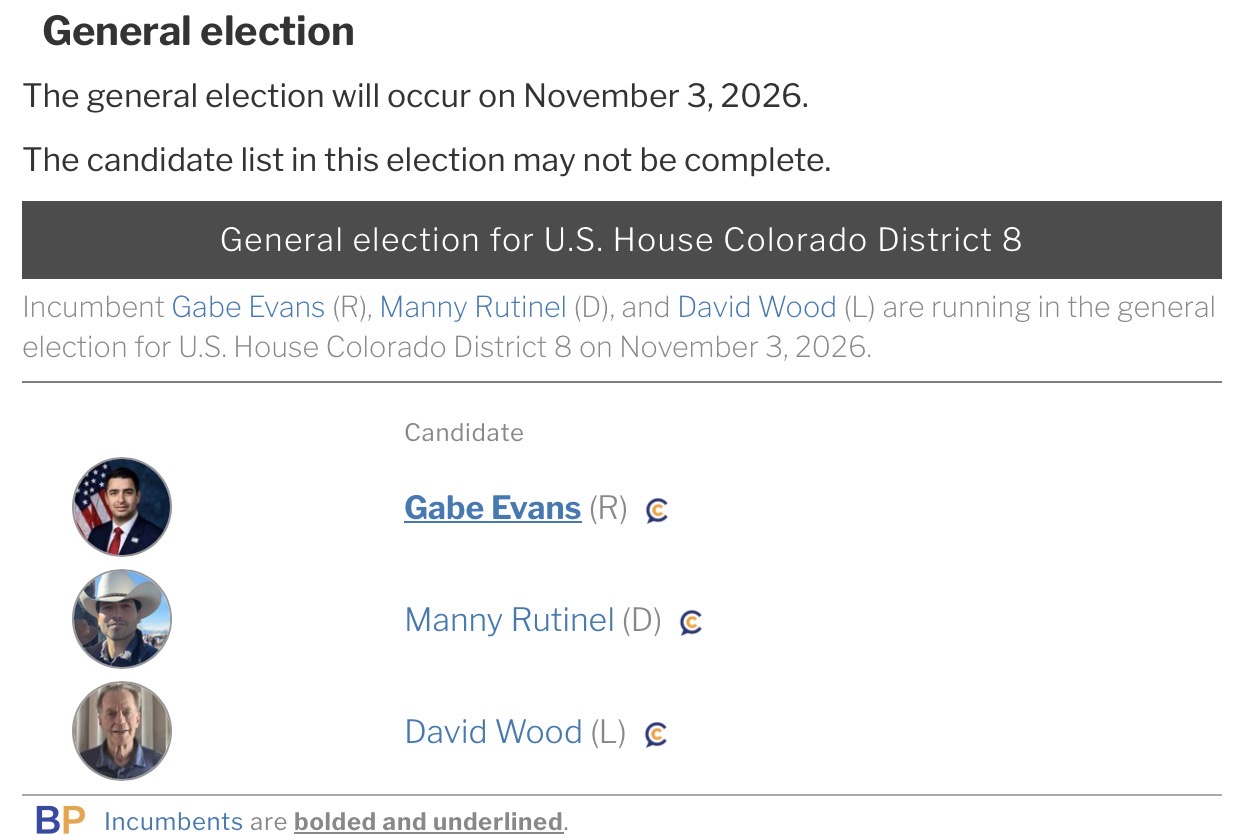
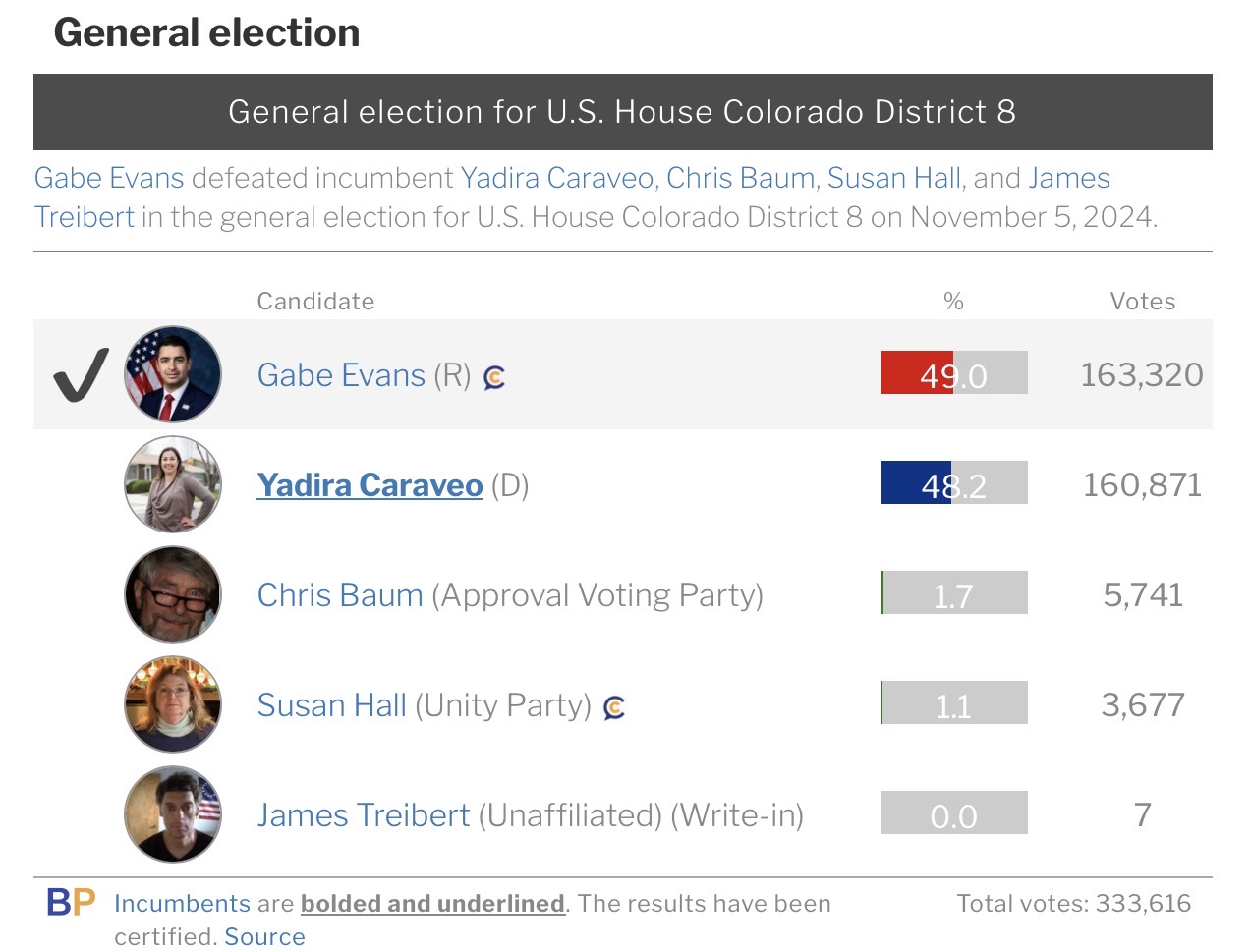
Gabe Evans (Republican) is seeking a second term in the U.S. House after upsetting Yadira Caraveo in 2024. That outcome was one of the biggest GOP surprises and instrumental in winning a very narrow majority. Evans had been a police officer and member of the Colorado House of Representatives prior to becoming a Congressman.
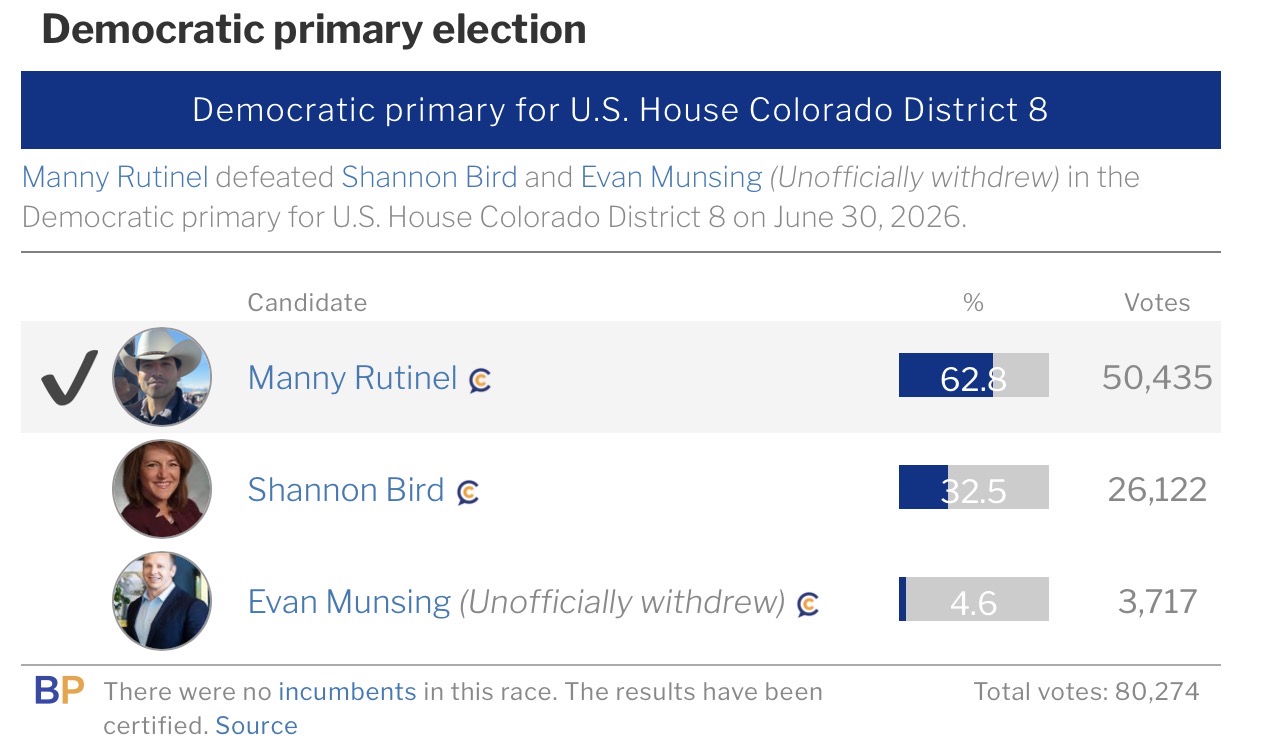
Manny Rutinel (Democrat) is also a former member of the Colorado House of Representatives; he was appointed in 2023 to fill the vacancy in District 32, and won his only full term in 2024 by running unopposed in an overwhelmingly Democrat district.
They are joined on the ticket by Libertarian candidate David Wood, who looks to play spoiler for Evans or Rutinel.
II. District Geography
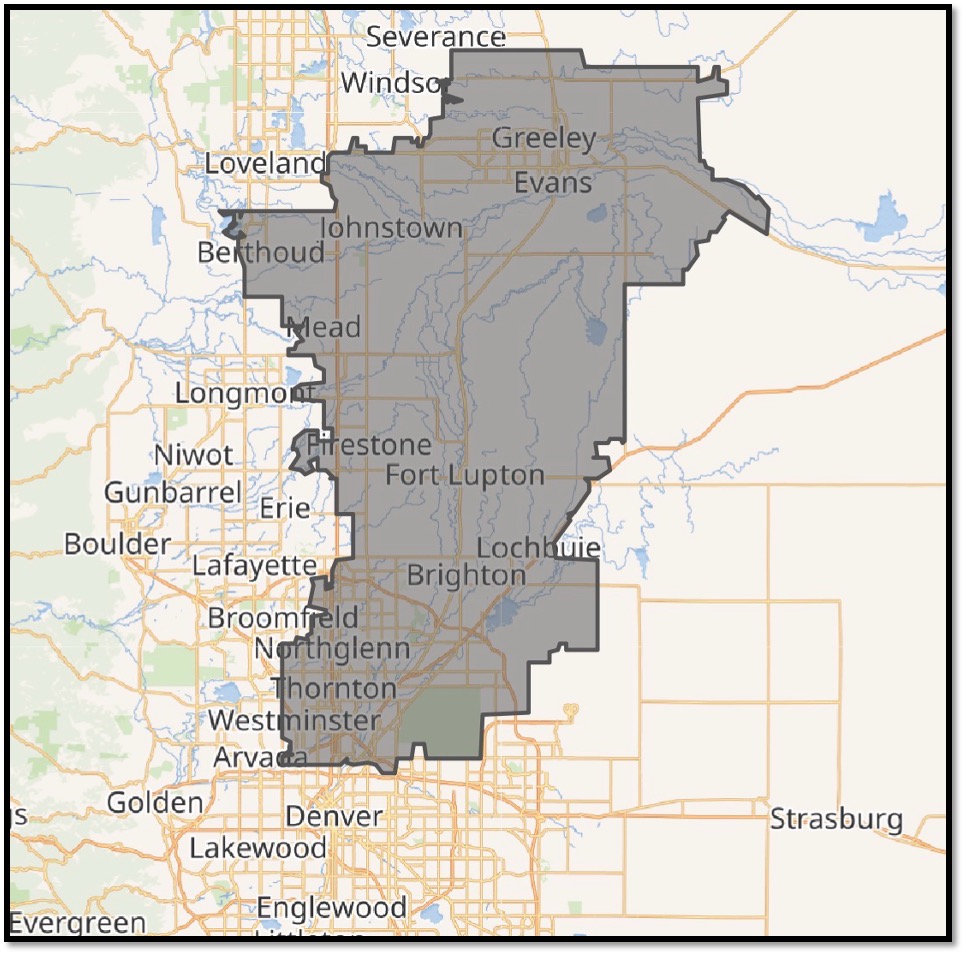
Colorado’s 8th Congressional District (CO-8) is north of Denver proper, and includes the most populated portion of Adams and Weld Counties, as well as a tiny sliver of Larimer County. The district is highly urbanized/suburbanized and has a median household income of over $100,000.
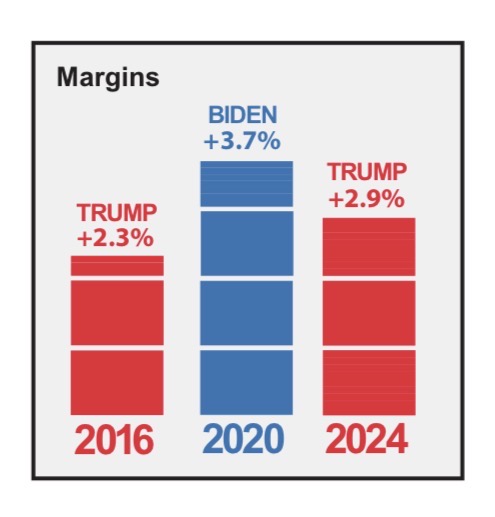
The district has a surprisingly high concentration of Hispanics (38.5% of the population), and GOP gains in 2024 were key to flipping the seat with Trump and Evans, whose grandfather was a Mexican immigrant, on the ticket. Trump had carried the district in 2016 thanks to a better suburban white share and a high third-party vote share sandbagging Clinton, then lost it in 2020 thanks to suburban drift (and mail-in balloting on steroids). He won it back thanks to the Hispanic gains throughout mostly Adams County.
Presidential Margins
Key Statistics
51.7% White, 38.5% Hispanic
III. Market Assessment
Polymarket bettors give Evans very little shot at holding onto the seat, and are overvaluing Rutinel based on polling, Colorado’s overall drift, and the view that CO-8 is one of the most vulnerable Republican-held seats.
IV. History
We lose the trail on the turf that has become CO-8 beginning with the 2022 election. Colorado gained a seat thanks to population growth, and with it, split up the old CO-6 to be even more favorable to Democrats, and divided Weld County (with the remainder in Lauren Boebert’s CO-4).
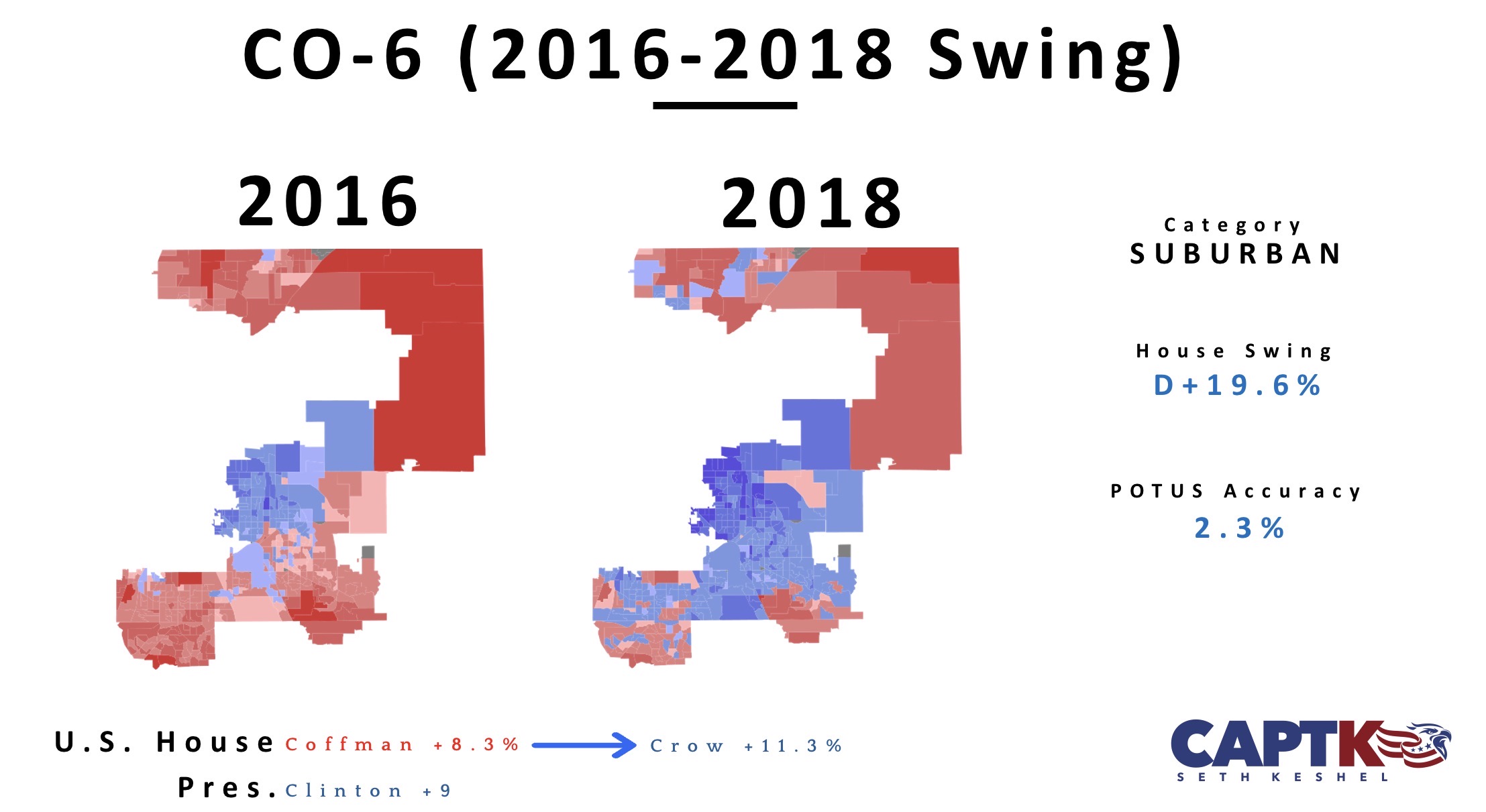
When Jason Crow knocked out Mike Coffman in 2018, the warning signs had been there. While Coffman held the seat in 2016, Trump lost it by 9 points. In 2018, the House margin caught up with the previous presidential margin, and the impact was felt all throughout suburban Denver – particularly in Arapahoe and Adams Counties.
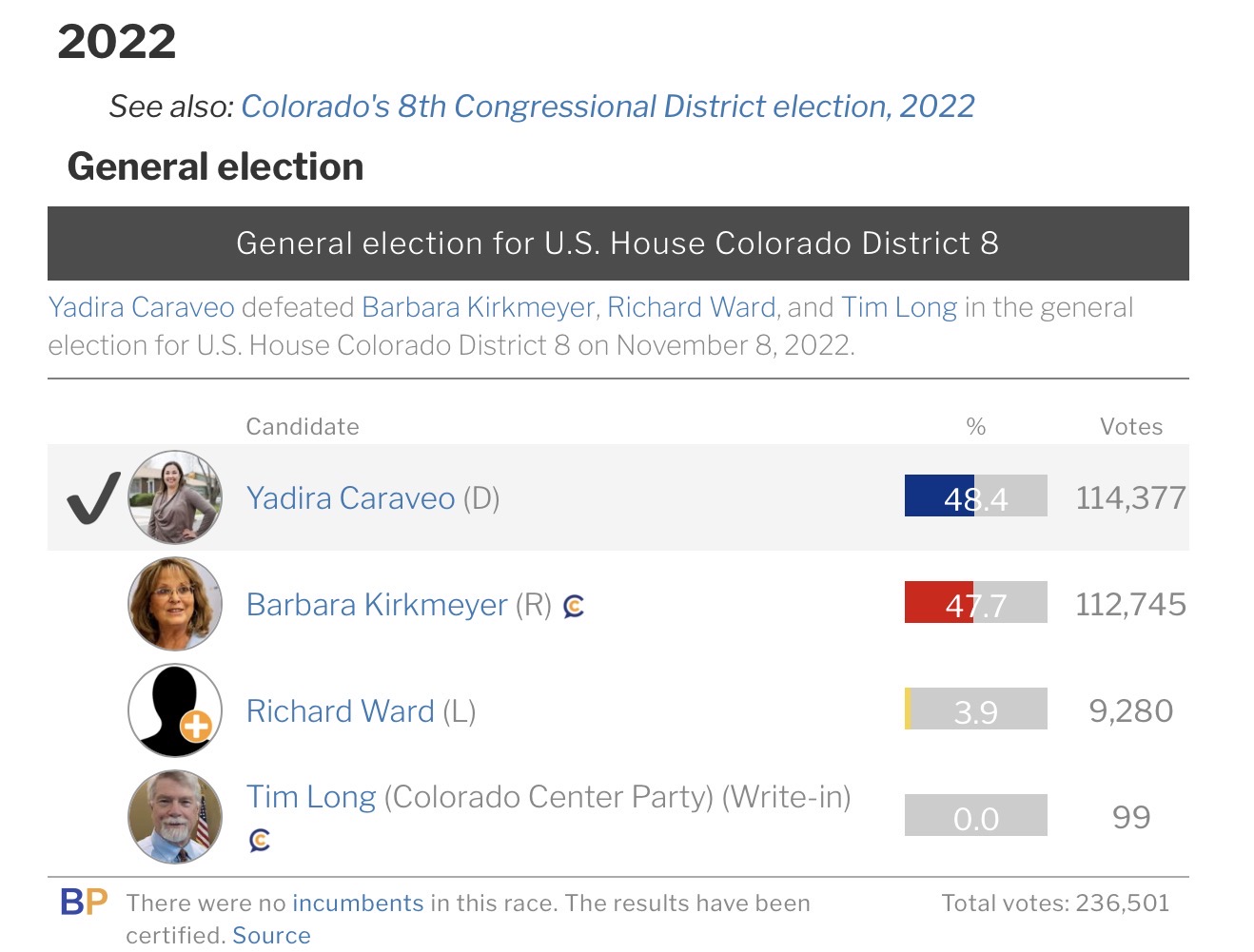
CO-6 has since been recut for Crow, and the new CO-8 eliminates Arapahoe County and readjusts for the slices of Adams, Larimer, and Weld Counties now making it up. In its first live test (2022), Democrats secured CO-8, but not by much:
Richard Ward, the Libertarian on the ballot, may have denied Barbara Kirkmeyer the win in 2022, thereby giving Evans the pathway to flip the seat with Trump on the ballot making major gains with Hispanics:
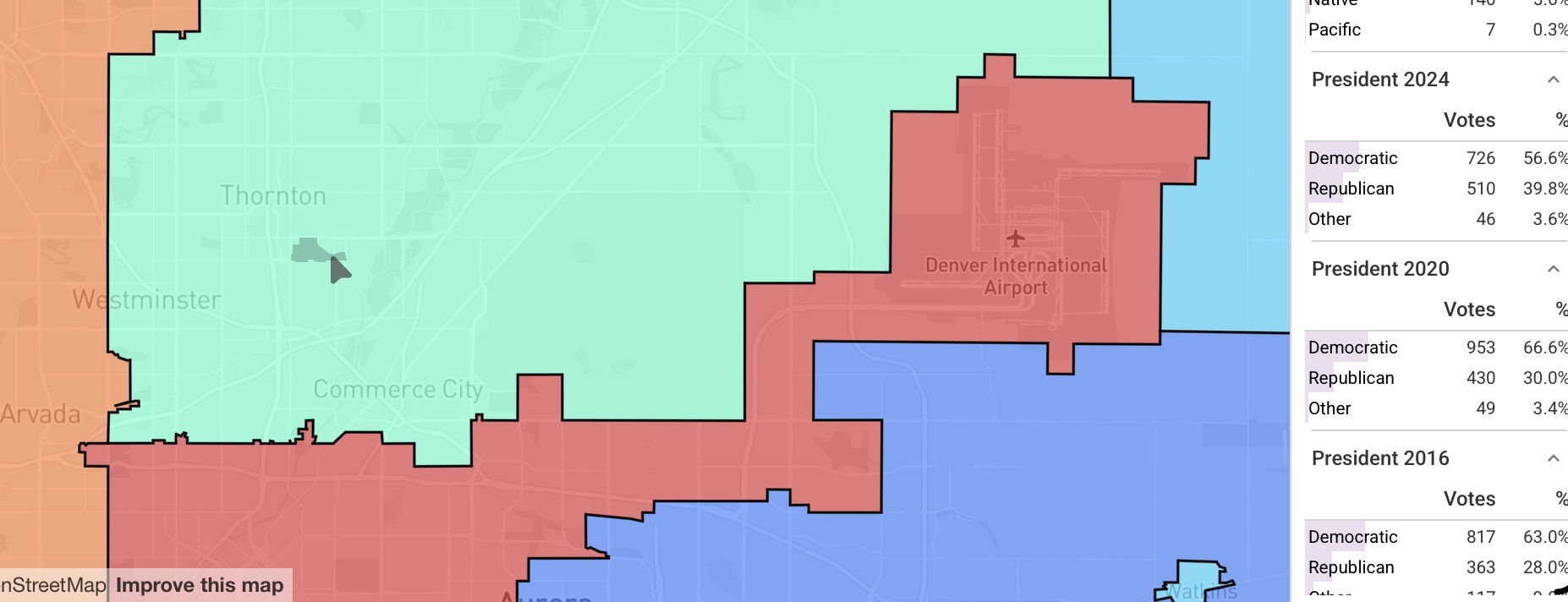
Here is a real-life example from a precinct in Adams County near Thornton with a 57% Hispanic population showing these minority gains:
Trump lost it by 16.8%, improved from the 35.0% margin of defeat in 2016. That is a 228-vote improvement at the top of the ticket for overall margin, and similar gains are seen all throughout the district (especially in Adams County).
The biggest area of concern with the seat is the year (GOP president midterm) and the type of electorate (suburban, with a big swing in 2018 documented).
V. Analysis of 2026 Primary Results
Evans ran unopposed in the GOP primary, and has no work to do for consolidating the party.
Rutinel, propped up by activist groups, shredded Shannon Bird. Bird presents as a typical suburban moderate who would have easily pulled away the middle of the electorate in a Democrat-favorable year. Bird, in the Colorado House, voted against restrictions on local cooperation with ICE and maintained a bipartisan reputation. Rutinel is a climate extremist who has scrubbed his campaign materials of most of his radical past, which includes a desire to reform agriculture and energy in ways that would relinquish local control. in a big way. Weld County produces 83% of Colorado’s crude oil and 56% of its natural gas, and has a bustling cattle industry, and Evans has made Rutinel’s extreme positions widely known.
The primaries, despite the hostile electoral terrain of the Denver suburbs, gave Evans a huge break and a window to steal victory from the jaws of defeat.
VI. Polls
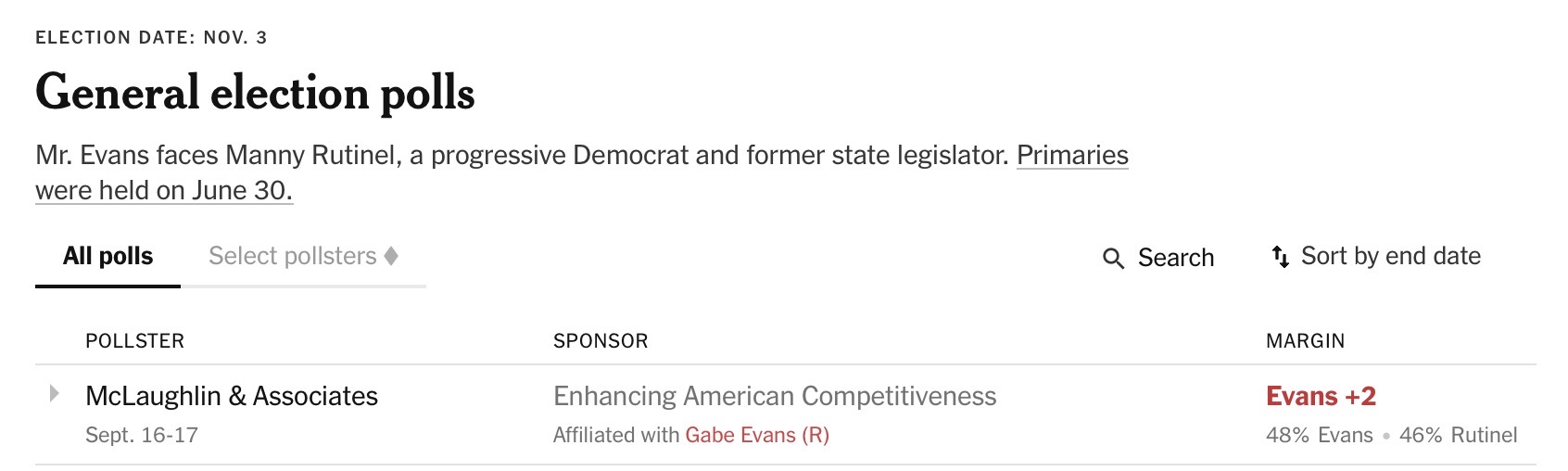
Poll pulled from The New York Times:
The only poll out there worth commenting on is from one of the few reputable pollsters left – McLaughlin & Associates. It has Evans up two, but short of a majority.
VII. Media Ratings
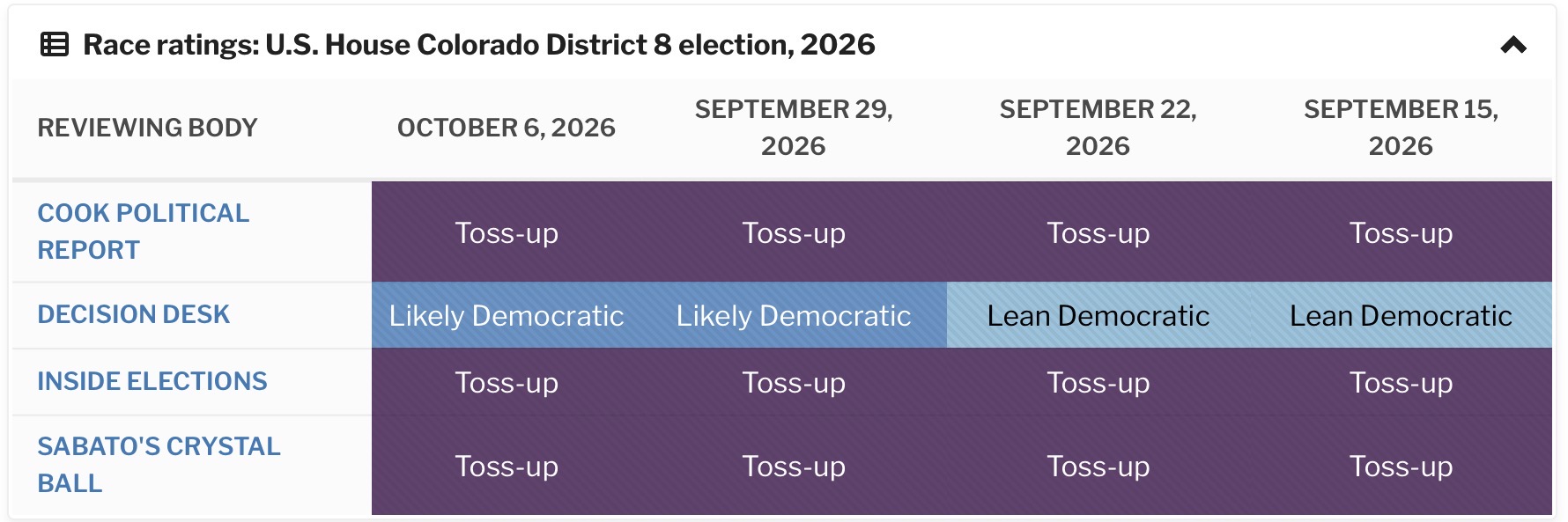
Everyone but Decision Desk has this race marked “toss-up.” Decision Desk is bullish most likely because of Colorado vibes, rather than considering candidate quality and the type of electorate these candidates are performing for.
VIII. Party Registration
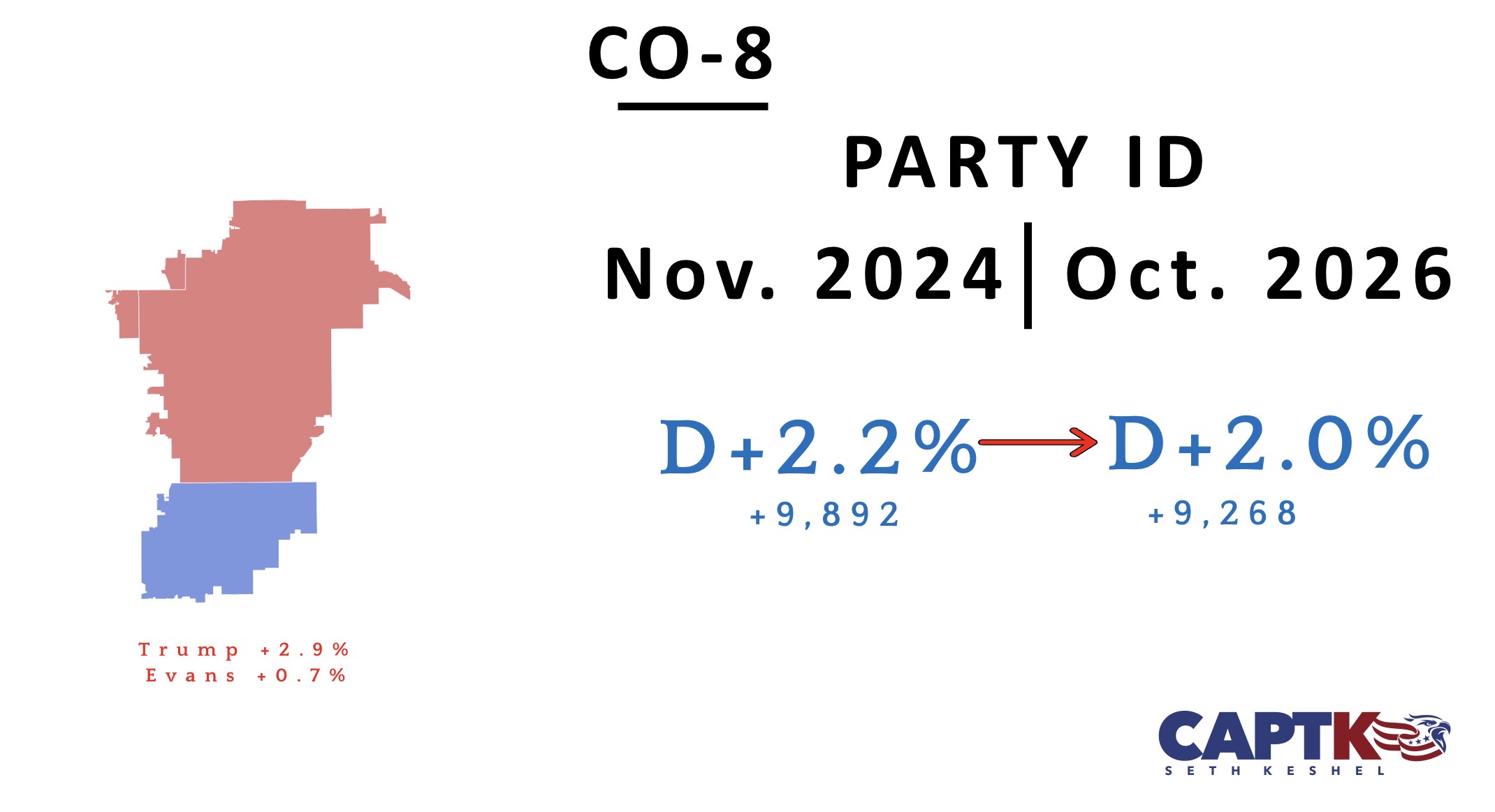
In yet another sign that Hispanics aren’t running back to rejoin Democrats, CO-8 has eased further toward even in party registration. Both Republicans and Democrats have lost membership since November 2024, but the Democrats have lost more. While party registration is highly predictive for presidential elections, it is not for midterms because of the serious turnout differentials and various reactions to the administration. Still, this is an encouraging indicator for Evans.
IX. Election Considerations
Despite the rantings of Secretary of State Jena Griswold and her insistence that Colorado’s elections represent the “gold standard” in America, nothing could be further from the truth. Colorado practices the three cardinal sins of elections:
• Automatic Voter Registration • Universal Mail-In Voting (everyone gets a ballot in the mail) • Ballot harvesting (with legal limits that cannot be enforced)
Just like they say no lead is safe in Coors Field (a baseball idiom), there is no tight race, such as the one CO-8 is shaping up to be, that is outside the margin of mail-in ballot stuffing. You can read all about Colorado’s election laws in my 2024 review, Lower Rockies – 2024 Election Compendium (January 4, 2025).
The nature of Colorado’s elections gives Rutinel a potentially decisive edge.
X. Summary and Election Estimate
This race reminds me a bit of MI-7. While the ethnic demographics of the voters are quite different, this is a seat that would have been a nearly-automatic pickup for Democrats (even easier than MI-7) had they nominated a vanilla moderate, such as Bird; unfortunately for them, their rabid grassroots voters who care little about the energy production of Weld County nominated someone who checked more diversity boxes, but is extremely unqualified.
Evans hit him hard last night over his radical positions, including weakness on drug culture and law and order:
.@GabeforColorado RIPS Manny Rutinel for putting Coloradans at risk: "He voted for a bill in the state legislature to legalize hard drug usage locations…he’s a defund the police, open borders radical."
RNC Research (@RNCResearch), Oct 7, 2026
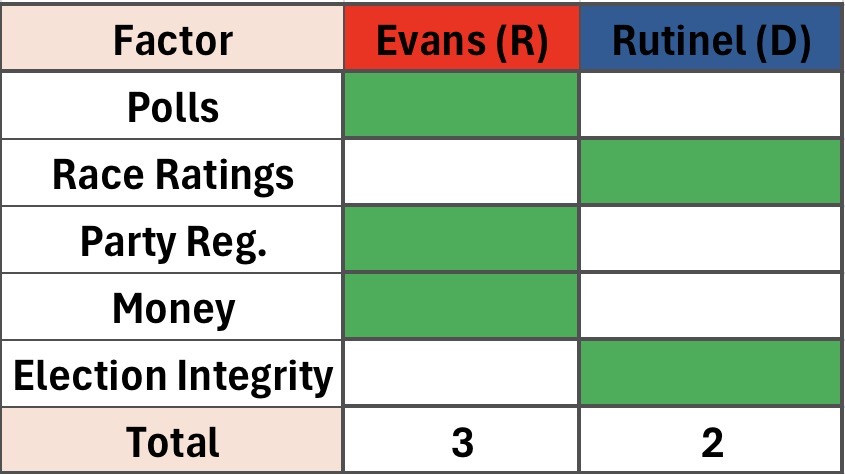
Here is how the key factors in this race stack up:
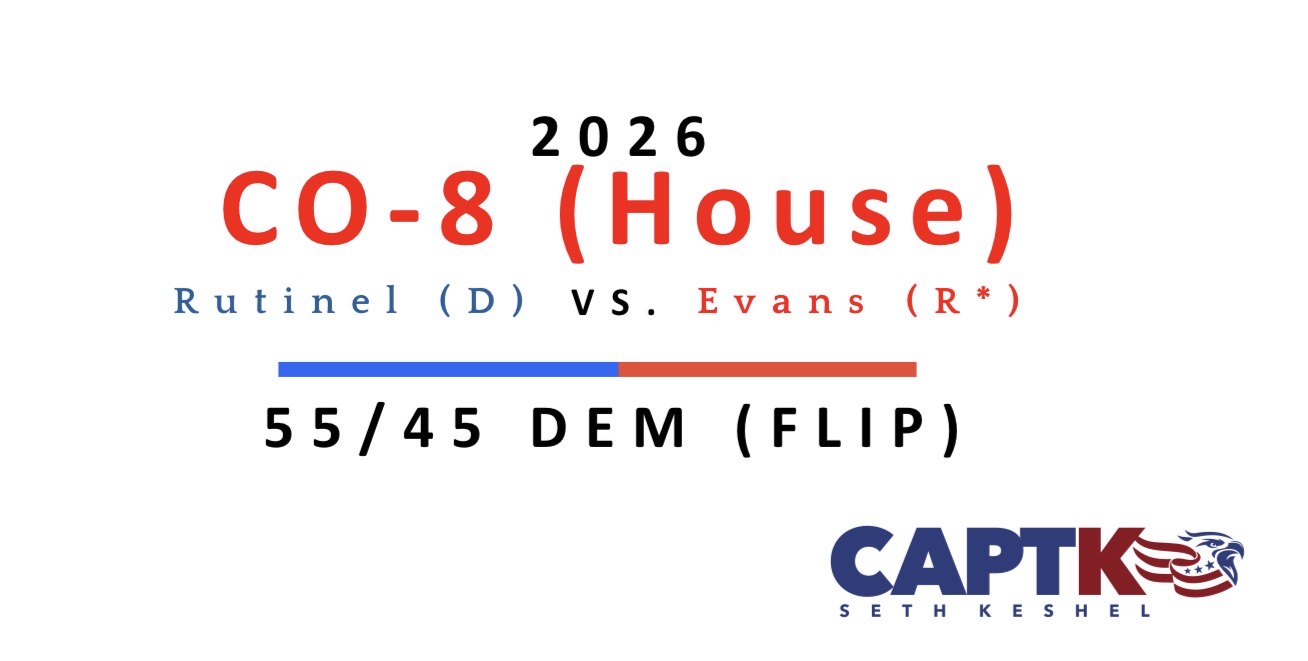
Forecast for CO-8 House
Remember, when I have any race at 55/45, I consider it a coin toss. Rutinel gets the hunch edge because of the trend of Colorado over the past decade, the nature of mail-in voting states, and the suburban/rural divide featured in CO-8. It will be hard for Republicans to hold all of Trump’s gains with Hispanics in a midterm cycle, and the suburban white electorate ran hard left in 2018; still, Rutinel’s radical nature and positions may completely prevent any leftward shift, and if that happens, Evans will be reelected.
This forecast is no knock on Evans, who is vastly underpriced in the markets and positioned perhaps better than any candidate looking to hold down a seat that appears to be in the first tier of Democrat flips in a normal year with sane candidates on the ballot.
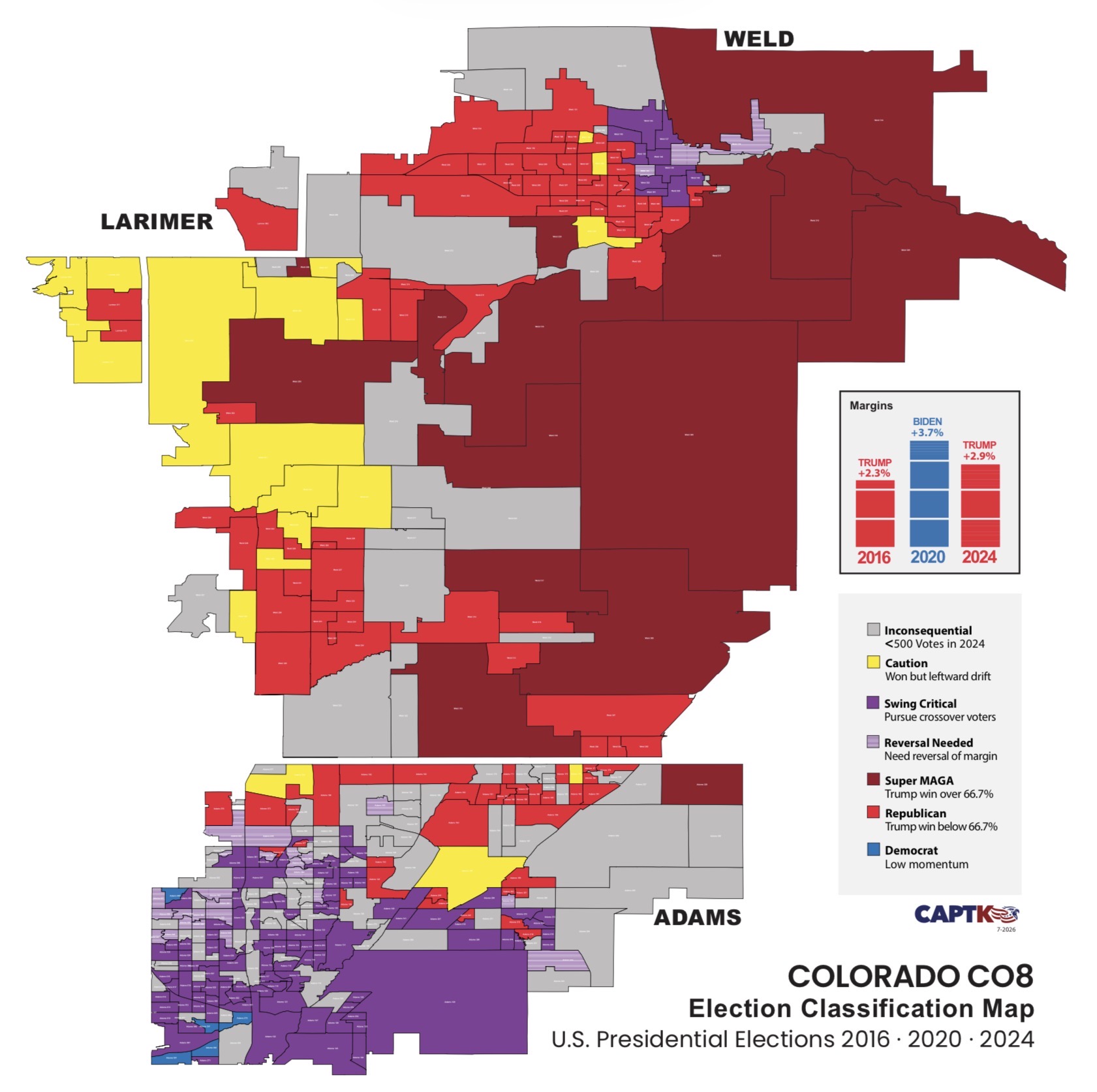
Captain K Proprietary Mapping of CO-8
Seth Keshel, MBA is a Senior Fellow at the Gold Institute for International Strategy and a retired Army Captain. He publishes Captain K’s Corner on Substack.
Senior Fellow Peter Huessy joined The John Batchelor Show with Rick Fisher to discuss the unprecedented expansion of Chinese and Russian nuclear forces.
On The John Batchelor Show, Peter Huessy and Rick Fisher warn of unprecedented nuclear threats from China and Russia. Fisher highlights China’s rapid expansion, including hundreds of missile silos and DF-61 mobile missiles, and warns China could deploy 6,000 to 8,000 warheads by 2035. Huessy describes Russia’s modernized arsenal, including the multiple-warhead Sarmat ICBM, and argues that both China and Russia treat nuclear forces as tools of coercion rather than deterrence alone, sharply raising global proliferation risks.
Peter Huessy is a Senior Fellow at the Gold Institute for International Strategy, a Washington D.C. based foreign policy and defense think tank.