2026 Ten-Point Forecast: Alaska U.S. Senate

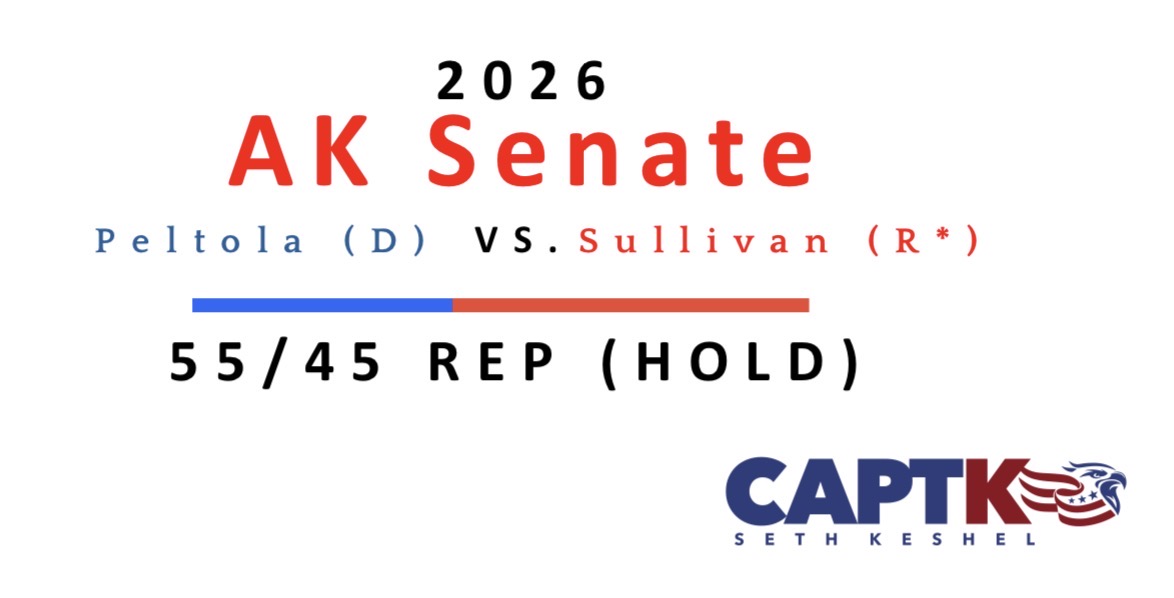
Graphic introducing the Alaska U.S. Senate race candidates

Dan Sullivan (R-inc.) vs. Mary Peltola (D)

I. The Race

Dan Sullivan (Republican) is running for his third term representing Alaska in the United States Senate. He last won reelection in 2020, running ahead of President Trump on the same ticket – albeit against an “independent” candidate rather than a card-carrying Democrat.

Mary Peltola (Democrat) replaced Republican U.S. House mainstay Don Young in Washington following a 2022 special election, and won a full term in November 2022. She is perhaps the Democrats’ only talented candidate in Alaska, and she opted to pursue the Senate instead of the AK-AL House seat she lost to Nick Begich in 2024 – essentially forfeiting that seat to the GOP this year.

Gerald Heikes, a no-name Republican, is also on the ticket and will factor in the First Choice calculation of the Ranked Choice system prior to redistribution of votes, and will probably be the first candidate voted off the island.

Daniel J. Sullivan, Jr., is the key factor in this race and was inserted by Alaska Democrats to spoil Senator Sullivan’s reelection chances. Significant judicial corruption allowed him to stay on the ballot against the wishes of the Division of Elections, which determined the imposter Sullivan’s motive for joining the Senate race was to deceive voters (obvious to most with a functioning brain).

II. State Profile
State profile graphic for Alaska

Alaska is a Republican stronghold despite not being tied to the standard set of evangelical preferences common throughout the Sun Belt and “Lower 48” conservative clubs and organizations. It prioritizes individual freedoms and property rights, and has a heavy reliance on the energy industry. These reasons, among others, are why the Last Frontier hasn’t backed a Democrat presidential nominee since 1964, during Lyndon B. Johnson’s national landslide.

Juneau aside, Alaska’s urban areas (primarily Anchorage and Fairbanks) are much more conservative than national counterparts, and under the MAGA realignment, the rural hinterlands have reddened substantially. Peltola is a Native Alaskan who spent time growing up in the rural areas of the state, which gives her a real advantage running in a statewide race. Senator Sullivan will need to maximize turnout in true Republican strongholds, such as the Matanuska-Susitna Borough (Sarah Palin’s home turf), and compete in Anchorage Municipality, to feel good about his chances of winning a third term.

Presidential Margins

2016 Trump +14.7%
2020 Trump +10.1%
2024 Trump +13.1%

Key Statistics

57.5% White, 14.8% Native Alaskan
65.7% Urban, 34.3% Rural

III. Market Assessment

Peltola, propped up by ludicrous polling, is vastly overpriced on Polymarket. The market, while not reflective of the true nature of the race, does correctly view this as a race that will come well inside of normal presidential margins.

IV. History

Sullivan was reelected without drama in 2020, with a presidential turnout and voter behavior, even though the election was a fiasco with far too much mail-in balloting authorized:
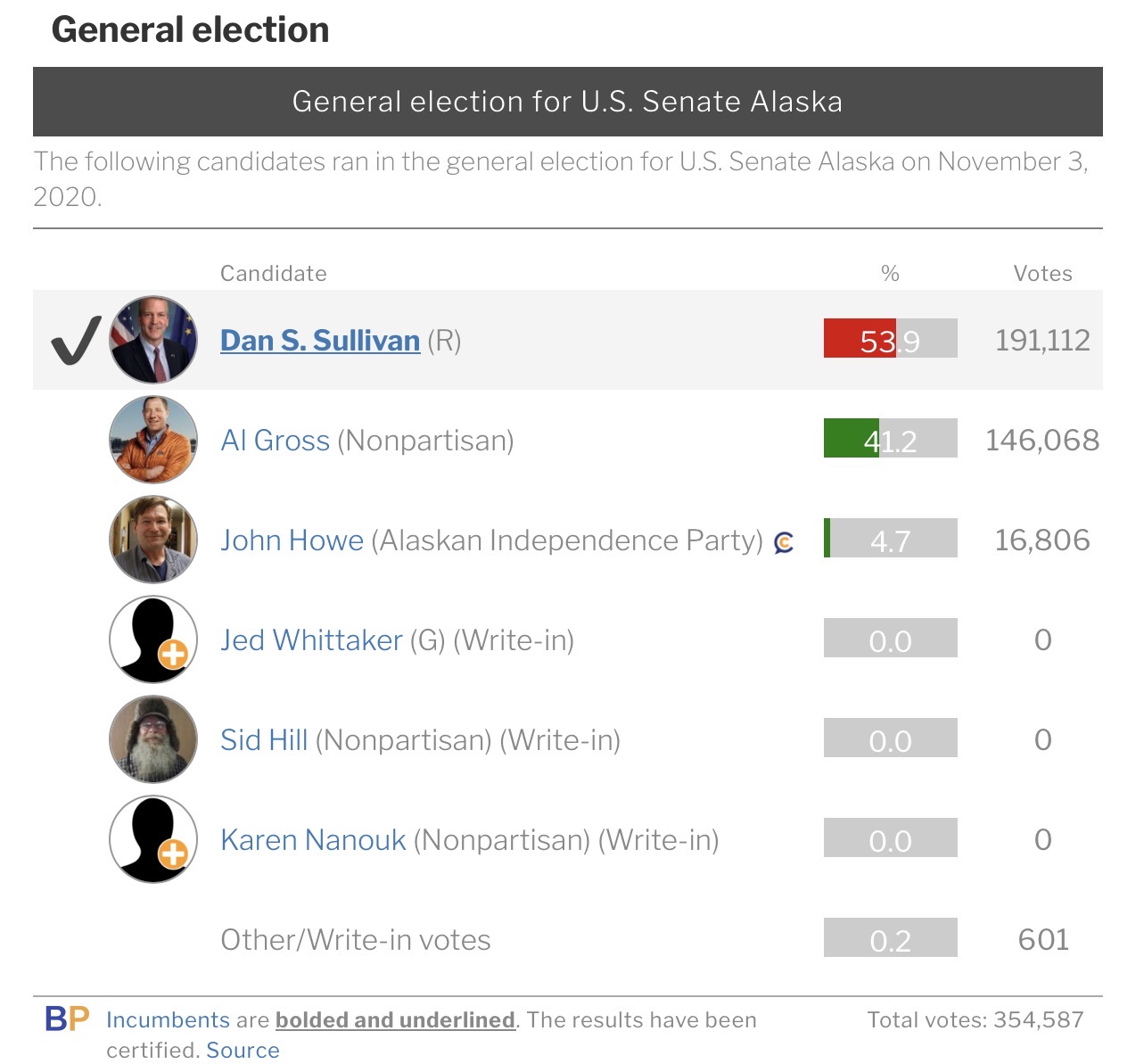
2020 Alaska U.S. Senate result

His first race for the seat, in 2014, came with a midterm red wave at his back and resulted in him unseating Mark Begich (Democrat):
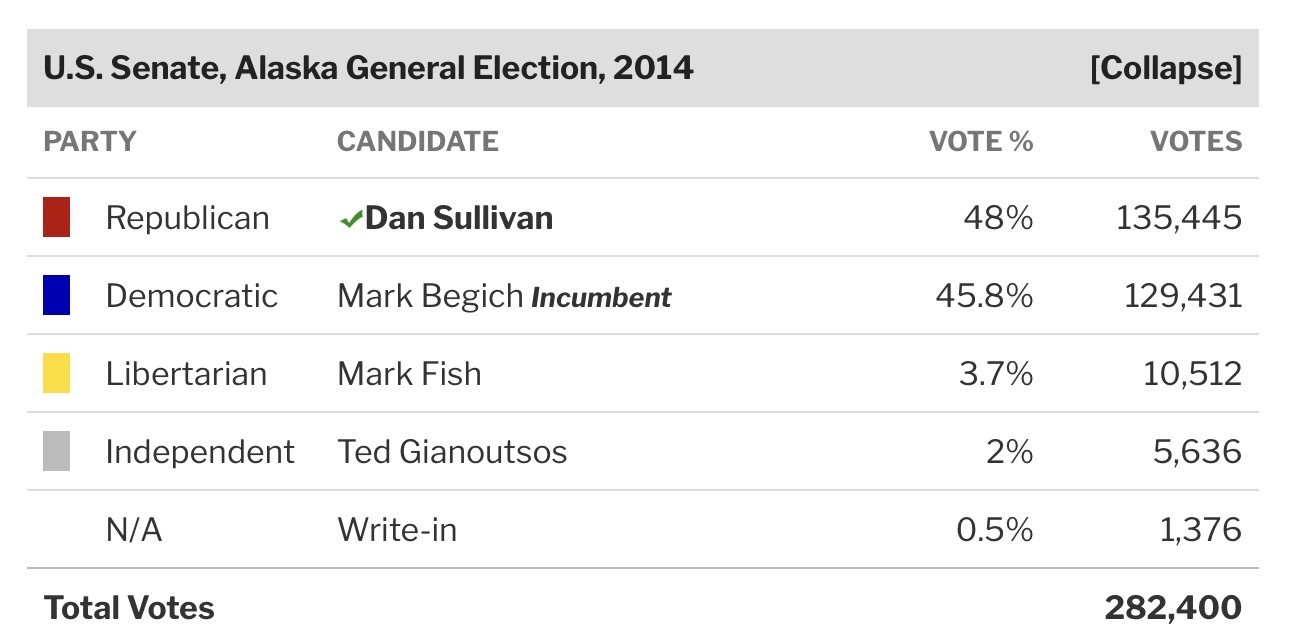
2014 Alaska U.S. Senate result, Sullivan over Begich

Sullivan was undoubtedly aided by the spoiler candidates taking more than six percent of the vote, allowing him to win with just 48%. Of note, Begich had shocked the political world in 2008 when he rode the Obama wave to knock off the legendary Ted Stevens, who at the time was the longest serving Senator in GOP history (since surpassed by Orrin Hatch and Chuck Grassley).

The other seat, held by swamp creature Lisa Murkowski (whose career Ranked Choice Voting was introduced to save), has been in Murkowski hands since 1981 – held by her father, Frank, starting then and transferring to Lisa by gubernatorial appointment after he (Frank) won his race for governor in 2002. Lisa immediately faced voters and won in a squeaker in 2004, despite a Bush landslide happening on the same ticket:
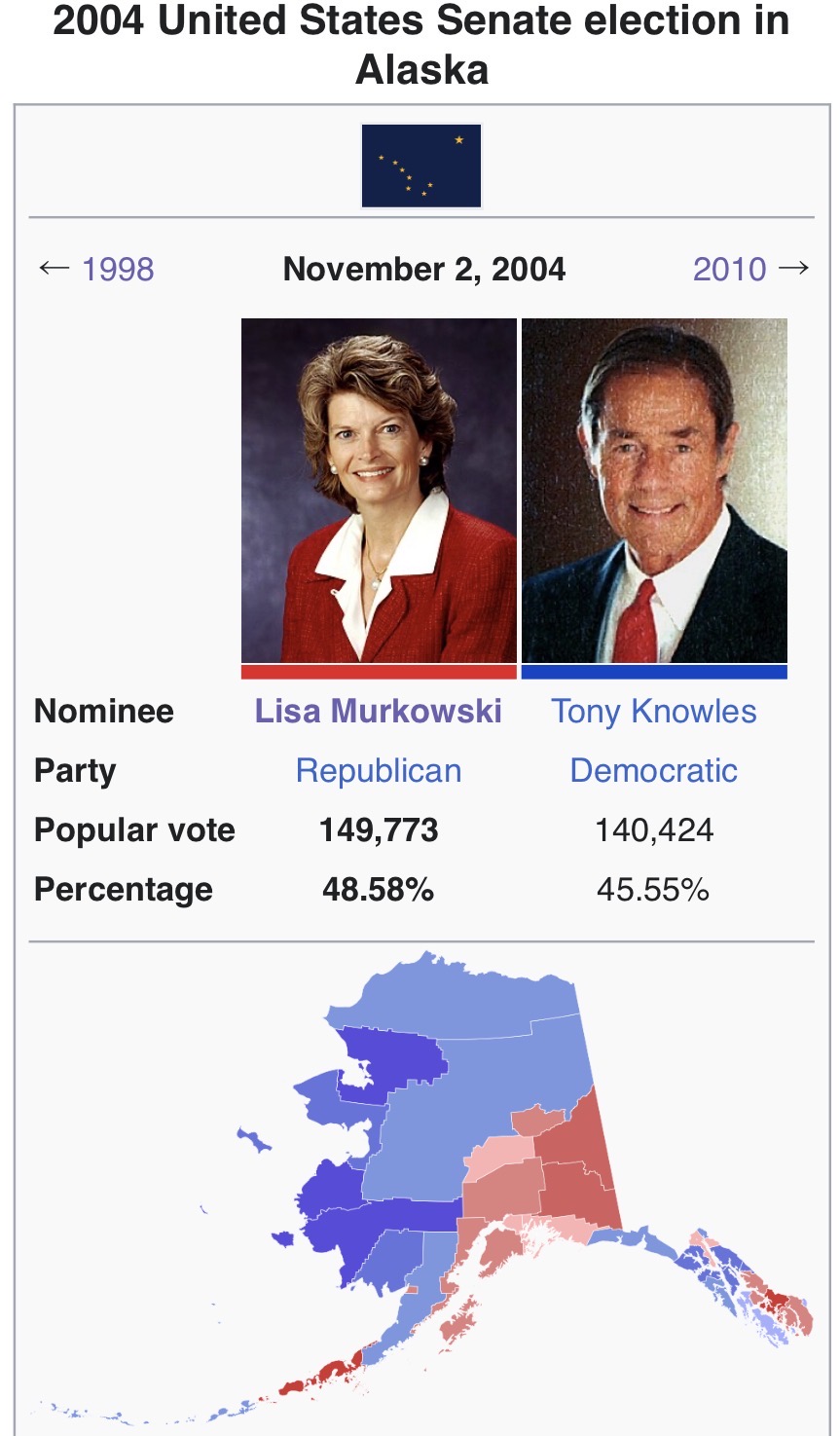
2004 Alaska U.S. Senate result, Murkowski's narrow win

The vastly unpopular Lisa lost the 2010 GOP primary, only to fluke her way into a win in the General Election via a write-in campaign with less than 40% of the total vote. Not to pile onto Murkowski – but both seats have very recent evidence of serious departure from presidential baselines that we don’t see in other states; they must not be ignored in 2026.

V. Analysis of 2026 Primary Results

Sullivan’s reelection campaign of 2020 was the first U.S. Senate campaign held under the ridiculous jungle primary system Alaska runs today (in lieu of GOP/Democrat segregated primaries). Peltola came into this year’s primary with guns blazing, clearing Senator Sullivan by 8.1% (13,518 votes):
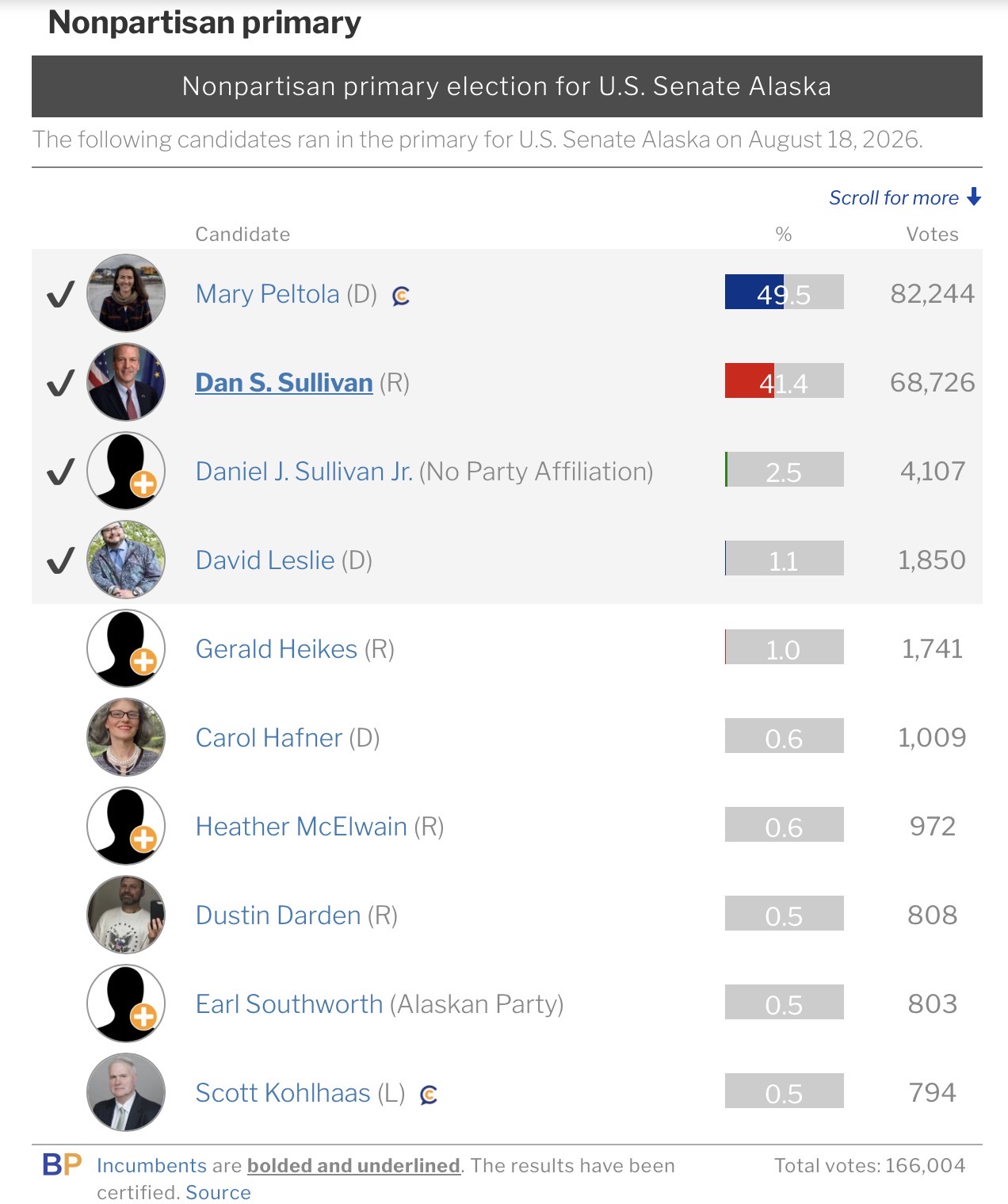
2026 Alaska U.S. Senate jungle primary results

The doomsday prophets online hailed that as a major sign the seat is flipping in November, but ignore the fact that she did better in 2024, just before dropping her seat to Nick Begich:
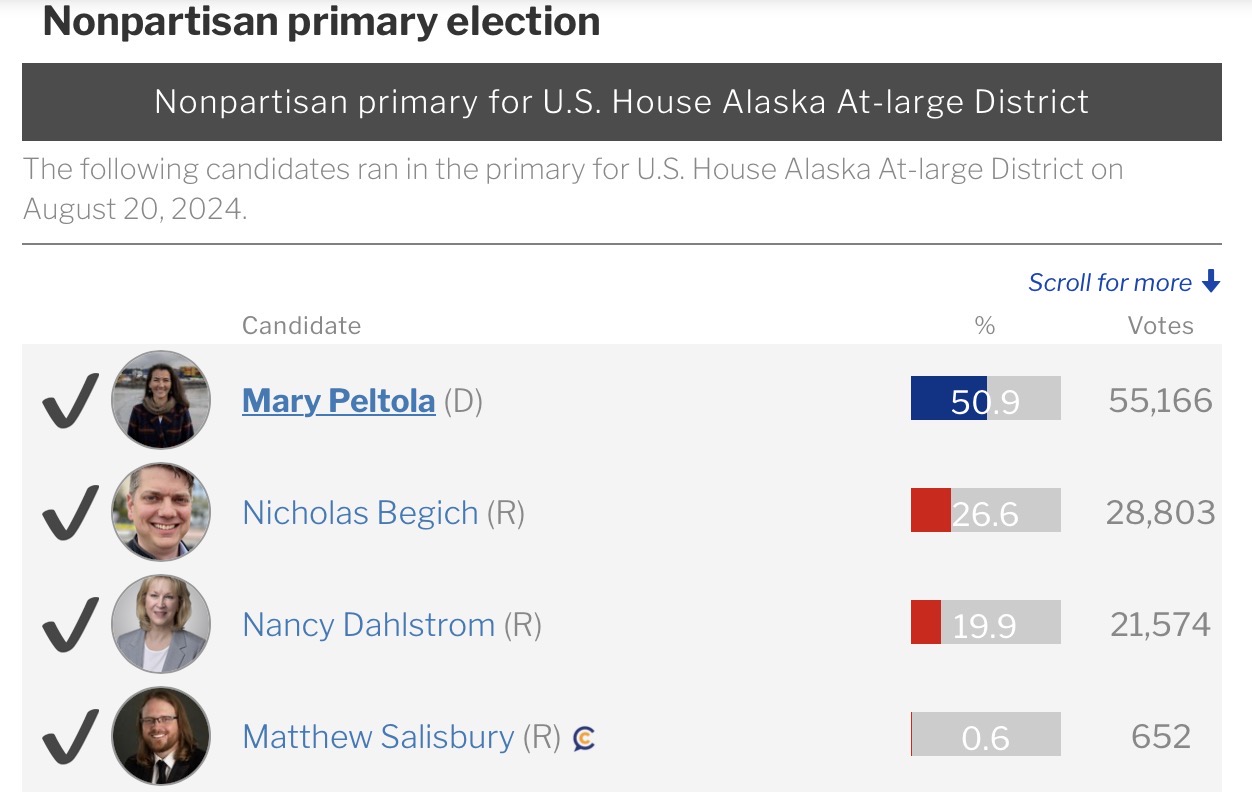
Peltola's 2024 Alaska primary result

The primary results are not predictive of what will happen in the General Election, although they accurately paint Peltola as a threat to take the seat. What is more important in the 2026 primary results is that the imposter Sullivan finished third and took 2.5% of the vote. It is not known how much of his support came from Peltola supporters who wanted to ensure he made the ballot to subtract votes from Senator Sullivan, or how many of imposter Sullivan’s votes were given out of sheer confusion over the multiple Sullivans on the ballot.

David Leslie, a loyal Democrat, did his duty to his party and dropped out shortly after the primary, which elevated Heikes to the November ballot. Now Senator Sullivan has to fend off a weak Republican (Heikes) and an imposter candidate (the other Sullivan) just to see how the reallocated votes from Ranked Choice Voting land against Peltola. Only Senator Sullivan or Mary Peltola has a chance to win this race; unfortunately, there is no way to predict how voters will rank their ballots in a system that is being constantly rejected when put before voters.

Peltola, for more than just her percentage, is the clear winner from the primary process this year.

VI. Polls

RCP Average: Peltola +1.2%
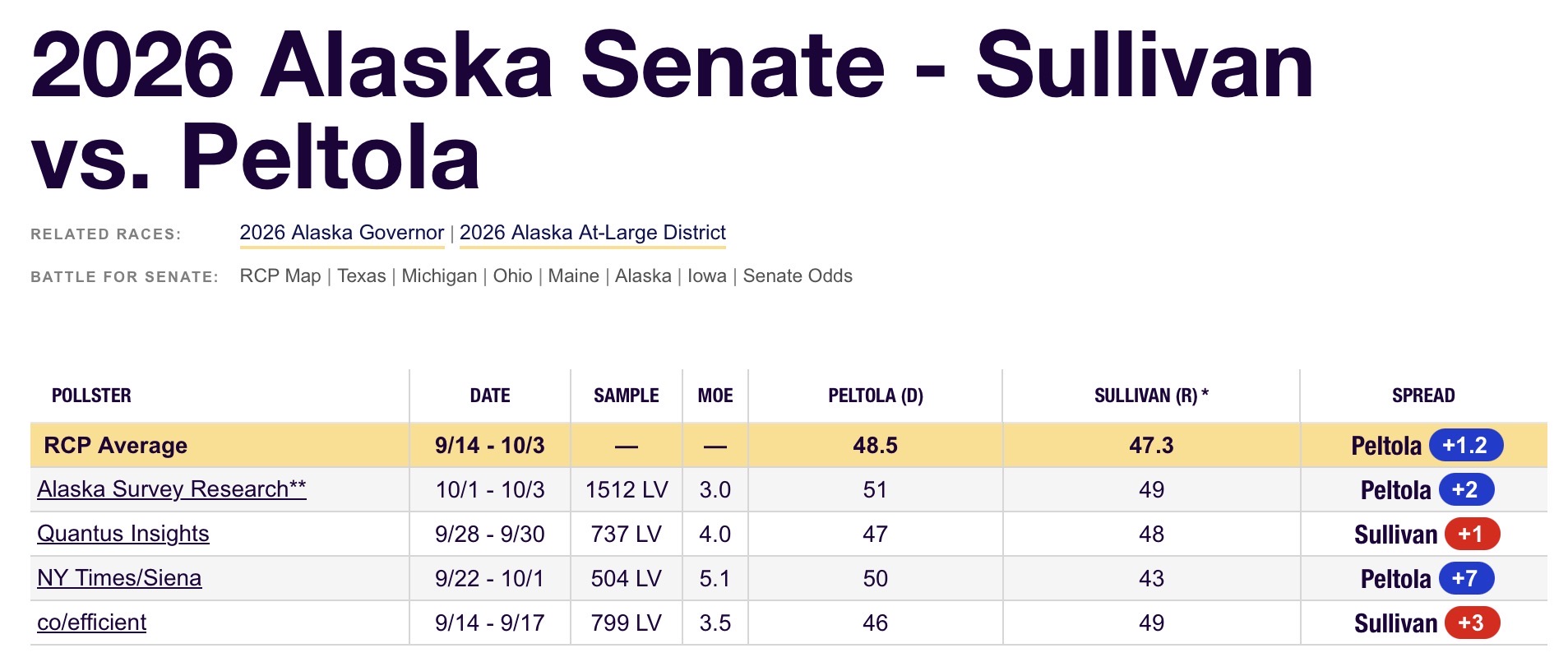
Recent polls of the Alaska U.S. Senate race

Because of the NYT/Siena outlier (Peltola +7), the average of polls gives Peltola a lead; tossing that outlier gives Sullivan a lead of less than one point. Besides it being obvious how media used rigged polling to influence outcomes, there is nothing conclusive about the Alaska Senate polling picture other than this is going to be a real race.

VII. Media Ratings
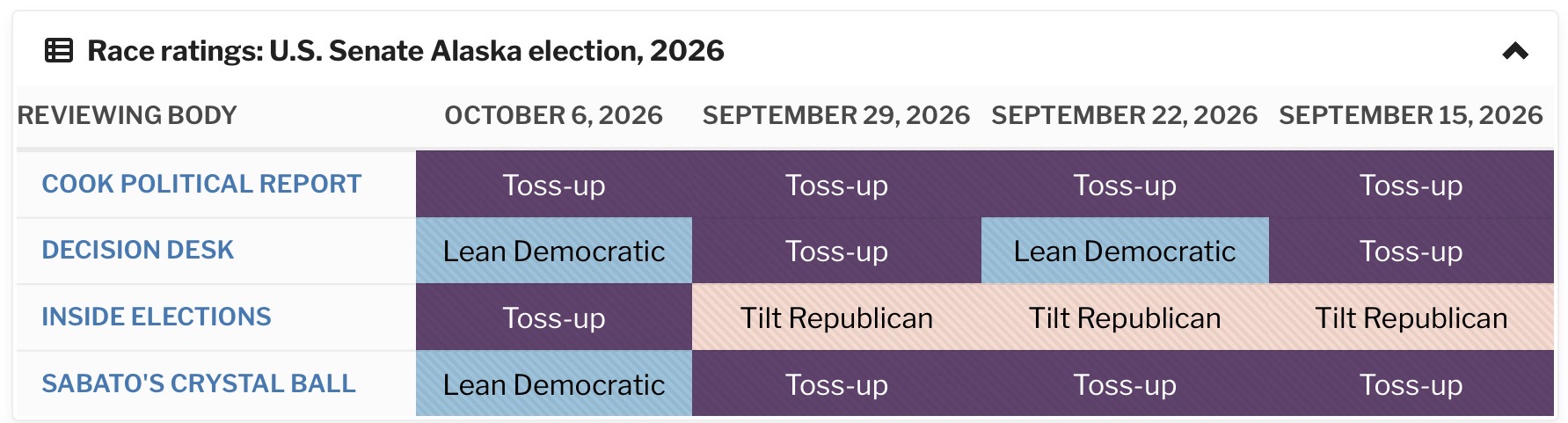
Media race ratings for the Alaska U.S. Senate race

Decision Desk and Sabato’s Crystal Ball have leaned the race toward Peltola just in the past week. Cook and Inside Elections have it firmly in toss-up territory.

VIII. Voter Registration by Party
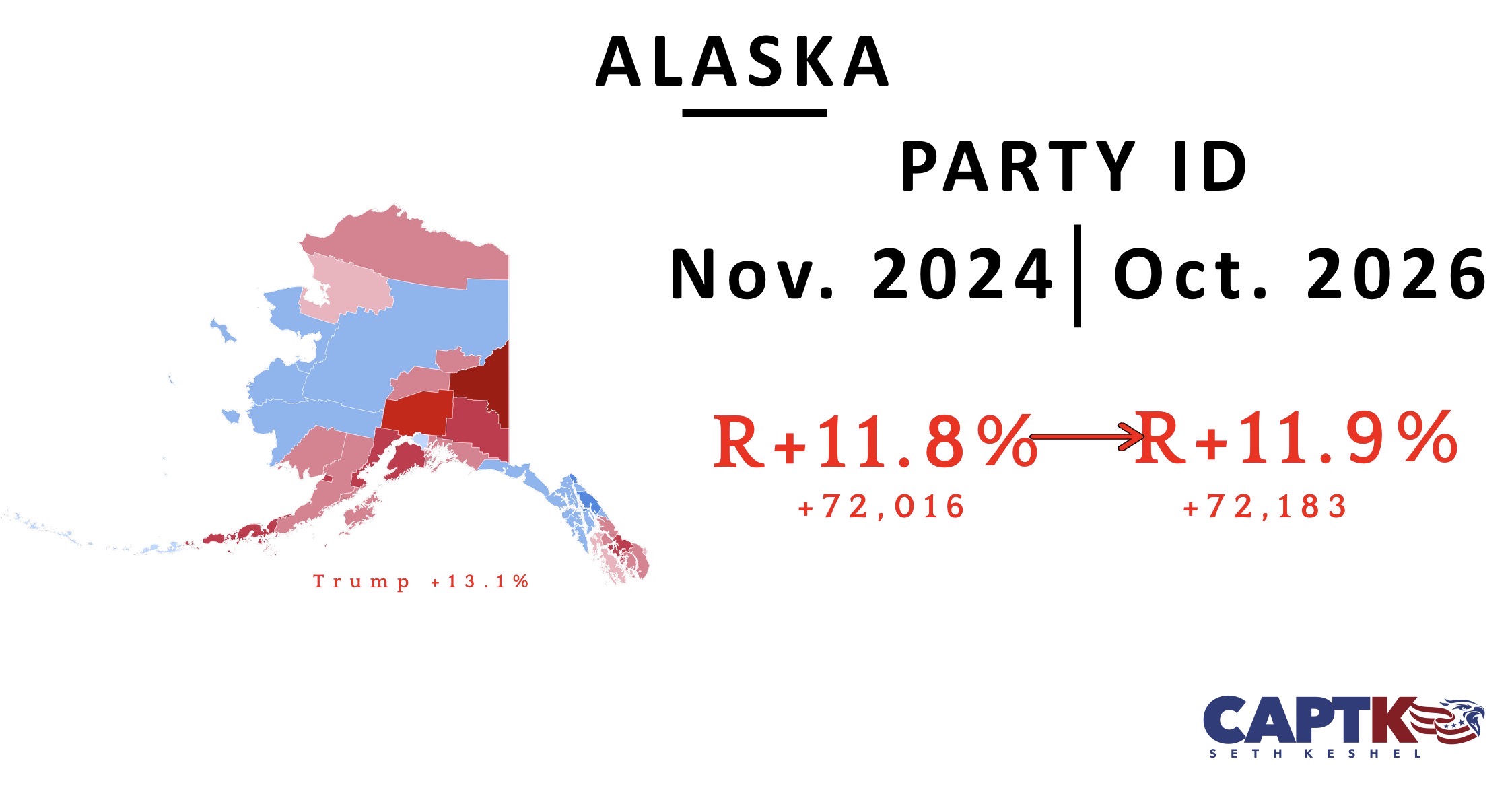
Alaska voter registration by party since 2024

Democrats have inched backward since the 2024 election, although not by much. There is no notable drift to the left in Alaska, which would have been a major boost in a state that already has voting patterns that can be documented as nothing other than strange.

IX. Election Considerations

I have made it no secret that Alaska’s elections are horrifying. Even with the recently concluded jungle primary, it took two weeks to count all of the ballots as spectators pondered how the Peltola-Sullivan clash would shape up with the Ranked Choice Voting considerations (and who else made the ballot). Keep in mind, Alaska has 1/32nd the population of Florida, which counts almost all of its votes within hours of poll closure, but expects us to find it normal they’ll take two weeks to figure it all out (blaming RCV tabulation).

X. Summary and Election Estimate

Primary results are inconclusive and polls are flawed. With those facts accepted, here is another:

The Sullivan-Peltola race is a true scramble.

Alaska’s recent statewide electoral history demonstrates serious deviation from presidential baselines:

• Peltola winning in 2022 General Election despite GOP House takeover and national popular vote win
• Peltola nearly holding the same seat against Trump presidential popular vote win and blowout in Alaska
• Sullivan barely knocking off Mark Begich in 2014 despite large Romney win in 2012 and a midterm red wave
• Begich beating Ted Stevens despite McCain beating Obama comfortably in 2008
• Lisa Murkowski’s close victory in 2004 despite Bush winning Alaska handily on the same ticket

Three of the incidents described above came before the state had to deal with the catastrophe known as Ranked Choice Voting.

Now you should understand how precarious the situation is. Alaskans have yet another shot to eradicate RCV this year with a ballot referendum (after the effort was torpedoed by mail-in ballots in 2024 arriving well after Election Day), but it gets one more swan song and could determine who runs the Senate next year.

Peltola and Sullivan will both almost certainly have at least 47% each in the First Choice Round.

Heikes will probably receive 1% or less, and have his votes mostly redistributed to Senator Sullivan, although Peltola will receive some. The imposter Sullivan will be eliminated after Round Two, and his vote redistribution will decide between Peltola and Senator Sullivan.

The issue here is that no one truly wants the imposter Sullivan. We don’t know how many of Senator Sullivan’s real supporters will be duped and vote for the wrong guy, and we don’t know how many of imposter Sullivan’s supporters are Peltola supporters who voted for him just to make sure he wound up as a stumbling block on the November ballot. Therefore, Senator Sullivan needs to go all in on two things:

• Using his significant monetary advantage (cash on hand), an information operation campaign with as much reach as can be bought to alert voters of the fraudulent Sullivan allowed to stay on the ballot (he wanted to lie about even his middle initial).
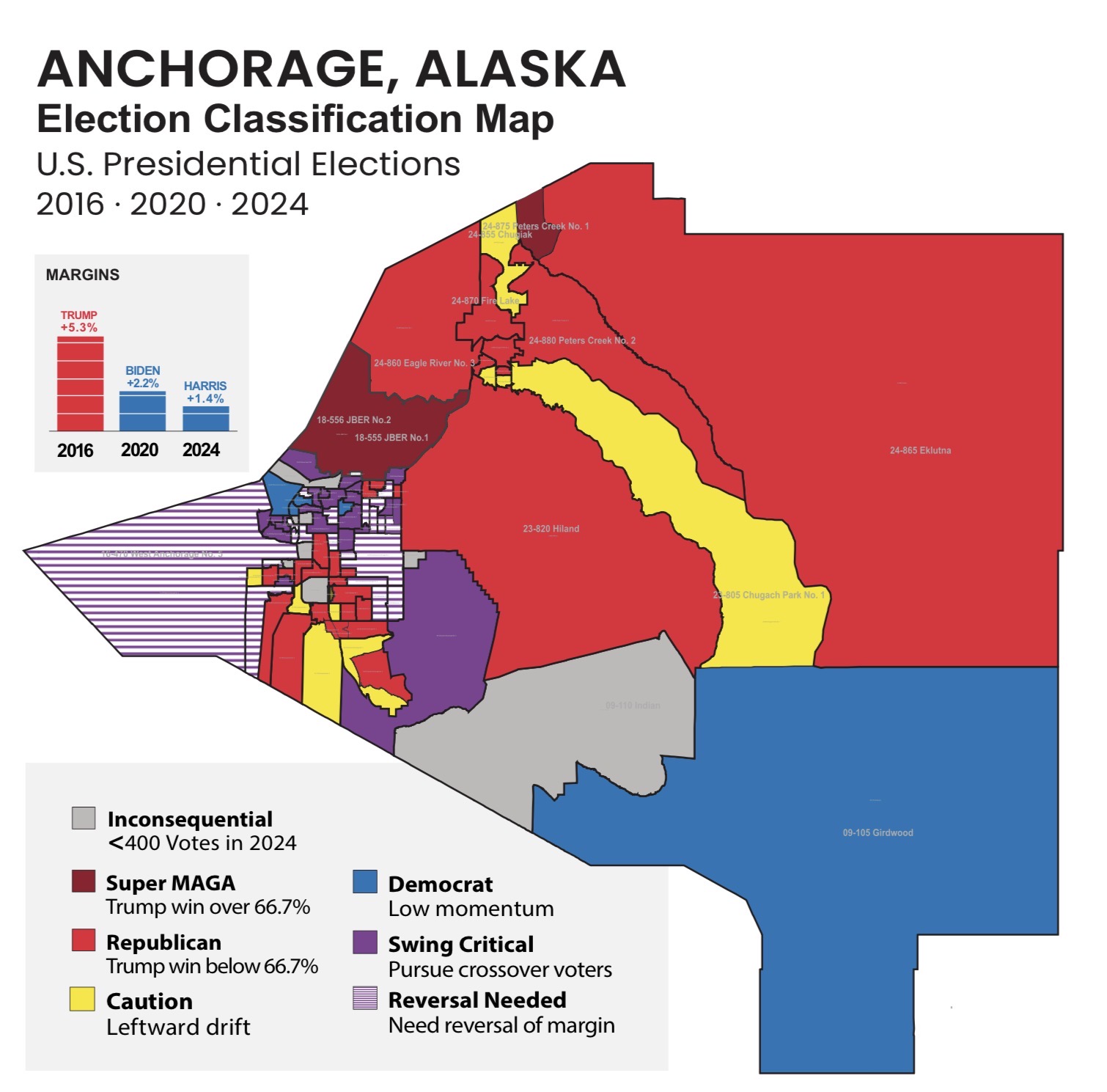
• Doing everything he can to get a majority on the First Choice Round to completely sidestep the redistribution fiasco. Two major jurisdictions are going to give him the shot for that: Anchorage Municipality and Matanuska-Susitna Borough.
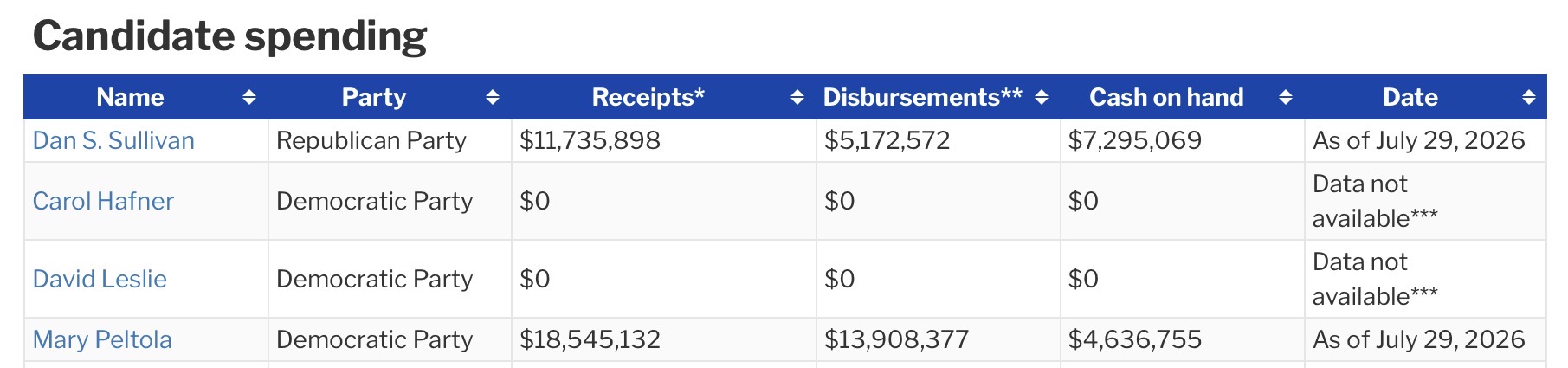
Campaign finance comparison in the Alaska U.S. Senate race
Captain K proprietary precinct map of Anchorage Municipality
Captain K Proprietary Mapping of Anchorage Municipality

Anchorage Municipality was won by Trump in 2016, but with suburban slide and the perfection of mail-in ballot collection, had slipped to the left. Sullivan won it in 2020, but Peltola has been a strong candidate here – where roughly 39% of the statewide vote came from in 2024.
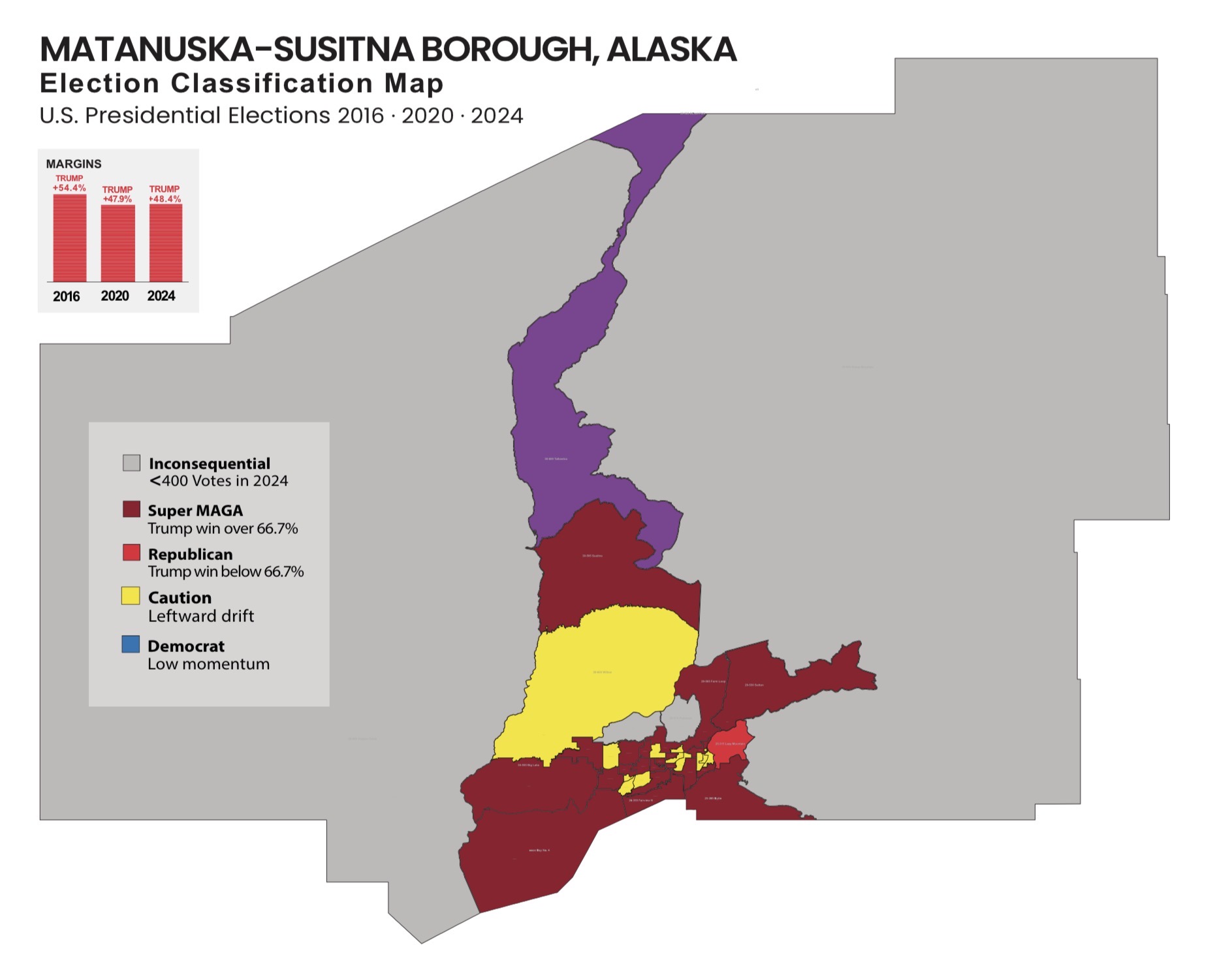
Captain K proprietary precinct map of Mat-Su Borough
Captain K Proprietary Mapping of Mat-Su Borough

The big GOP numbers that Senator Sullivan needs to maximize come from Matanuska-Susitna (Mat-Su) Borough just north of Anchorage. Trump never carried it by less than +47.9% margin, and about one-sixth of the state’s votes come from it. There are only a handful of precincts within Mat-Su Borough Peltola can hope to make any headway in.

Peltola’s big strength is that as a Native Alaskan, she will fare better in Alaska’s vast hinterlands than a standard white Democrat would, especially with Trump having shifted it so much in his direction – winning entire Native Alaskan villages when he had lost them hands down in 2016. Sullivan will need to take as much of the outlying portions as possible, but his best bets are to max out Mat-Su, take the Fairbanks metro, and hold his own in Anchorage. The expansion of mail-in balloting in Alaska reduces Peltola’s risk of having poor turnout in the villages, so it is unclear if the Democrat turnout drag being observed with minorities in other states will manifest in the great north.

Here is how the key factors in this race stack up:
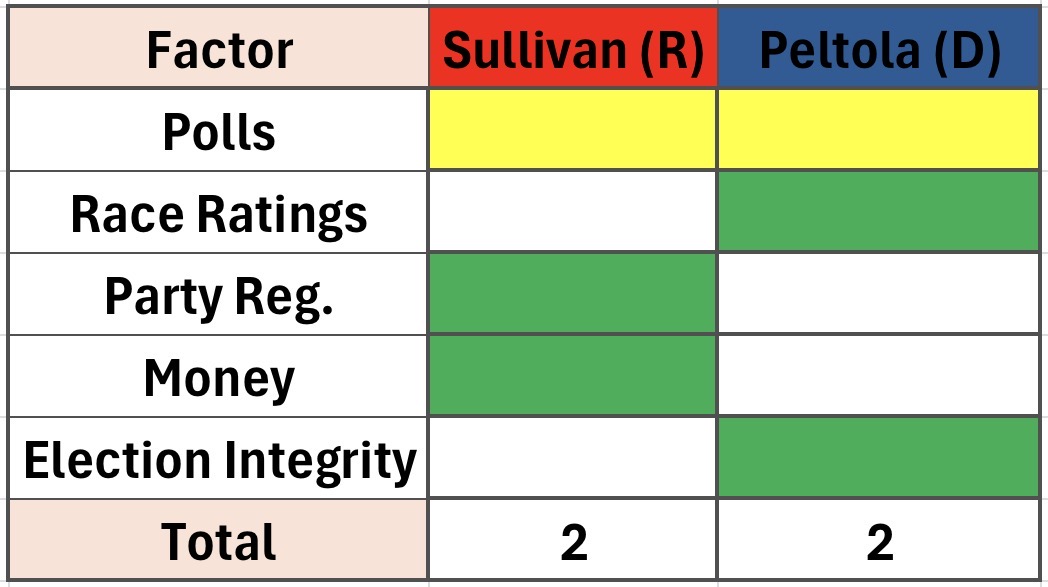
Key factors in the Alaska U.S. Senate race

Forecast for AK Senate

Forecast for the Alaska U.S. Senate race

55/45 in either direction is as close as my forecasts for midterms get. I will not leave a race at 50/50, and will nudge it based on intuition or gut feeling. Still, a 55/45 rating is indeed a flip of the coin. Alaska’s volatile nature for non-presidential statewide races is the key factor here; the state is red enough for Trump that Sullivan would coast to victory against a standard Democrat, but he drew Peltola, and she is tough despite her recent image issues that may hurt her with soft Republican crossovers.

The factors keeping the Sullivan camp up at night go far beyond Peltola’s name on the ballot. Ranked Choice Voting is a true monster to overcome, and the irony is that its proponents say it takes the gaming of elections out of the way. Within six years of introducing it, Democrats have figured out exactly how to game it – and the imposter Dan Sullivan will determine the fate of Senator Dan Sullivan one way or another. This is a dead heat.

Seth Keshel, MBA is a Senior Fellow at the Gold Institute for International Strategy and a retired Army Captain. He publishes Captain K’s Corner on Substack.

California Medical Breakthroughs Bring In Hundreds of Millions While the Very Same Industry Suffers Substantial Job Loss

Doctors and nurses walking through a hospital hallway

This article was written by Adelle Nazarian and appeared in The Western Journal. California Medical Breakthroughs Bring In Hundreds of Millions While the Very Same Industry Suffers Substantial Job Loss.

A medical breakthrough can begin in a California laboratory. Whether the manufacturing plant, skilled jobs, and next round of investment stay nearby is another question.

California’s leaders should have to answer it.

For Americans who want this country to build more of what it invents, life sciences should be a priority.

Developing treatments is an extraordinary achievement. Turning those discoveries into lasting productive capacity is how that achievement strengthens the country.

California has a considerable head start. According to Biocom’s 2026 economic impact report, the state’s life sciences industry generated $394 billion in economic output in 2025, directly employed more than 406,000 workers, and attracted $73.1 billion in private investment.

Those numbers describe a sector with impacts far beyond Silicon Valley or the state’s borders.

But investment alone does not guarantee expanding opportunity. A separate 2026 report from California Life Sciences found that employment in the sector had declined 1.8 percent.

That should temper the celebrations. A state can remain a magnet for capital while workers face a less promising picture. Policymakers should care about both.

California’s advantages are substantial: research universities, experienced entrepreneurs, scientific talent, and investors willing to finance difficult work. The challenge is to make building and expanding a business in the state as compelling as starting one there.

Palo Alto-based BridgeBio illustrates why that matters.

Its Attruby treats adults with transthyretin amyloid cardiomyopathy, also known as ATTR-CM, a serious disease in which abnormal protein deposits damage the heart.

Attruby’s approval in 2024 gave patients another treatment option for a condition that can lead to heart failure, and has quickly become a blockbuster drug, generating over $400 million in revenue for the company in the first half of 2026 alone.

BridgeBio’s progress is a case in point for the economic question California must answer: How can the state turn scientific and commercial success into more opportunities for its workers?

Companies developing new treatments need an environment that supports their next stage of growth, including access to skilled employees and a predictable path to expanding their operations.

For policymakers, the goal should be making California a place where companies have compelling reasons to deepen their investment. The state’s role in developing a treatment should be the beginning of a longer economic story.

Other companies demonstrate the breadth of that opportunity.

Pleasanton-based 10x Genomics supplies tools that help make future discoveries possible. Its Atera platform allows researchers to examine gene activity across tissue at large scale, helping them investigate the biology underlying disease.

On Sept. 3, Carlsbad-based Ionis Pharmaceuticals announced FDA approval of Zanvastro, the first disease-modifying treatment for Alexander disease. This rare, progressive, and often fatal neurological disorder can deprive children and adults of the ability to move independently or swallow.

In August, Redwood City-based Revolution Medicines announced FDA approval of Rasonque for certain adults with metastatic pancreatic cancer. The company reported that in a Phase 3 trial involving previously treated patients, the medicine reduced the risk of death by 60 percent compared with chemotherapy.

For families confronting these diseases, progress is measured in treatment options and time together. That human purpose should remain at the center of the debate.

Delivering those treatments requires skilled people, specialized facilities, and dependable production. California should be working to capture more of that opportunity, and Washington should recognize its importance to American industrial strength.

Local governments should establish clear permitting requirements and firm timelines for research and manufacturing facilities. Companies need to know what approval requires and when a decision will come. Predictability and rigorous safety standards can coexist.

Colleges and employers should develop training together, with courses tied to actual hiring needs. Paid apprenticeships and technical programs could help more Californians qualify for laboratory, production, and equipment maintenance work.

The economic promise of medical innovation should reach people pursuing practical credentials alongside those pursuing advanced degrees.

Taxpayers also deserve accountability. Any public incentive should include measurable investment and hiring commitments, public reporting, and consequences when recipients fail to deliver.

And federal policymakers have responsibilities, too.

Research funding should be predictable, awarded on scientific merit, and subject to meaningful oversight. Private investors take risks to develop commercial products. Public research can help establish the scientific foundations on which those products depend. Both deserve policies that reward useful work and responsible stewardship.

California cannot assume its reputation will secure its future. Entrepreneurs and investors have choices. State leaders should give them concrete reasons to build, manufacture, and hire in the Golden State.

BridgeBio’s success and the advances emerging across California demonstrate what American medical innovation can deliver. The next challenge is to create the conditions for that progress to support a stronger domestic workforce and manufacturing base.

America should remain capable of discovering new medicines and producing them. California has helped show what American science can accomplish. Its next test is whether more American workers can build a future around that success.

Written by Adelle Nazarian Senior Fellow, Gold Institute for International Strategy

2026 Ten-Point Forecast: NJ-7 (U.S. House – Decisive)

Graphic introducing the NJ-7 U.S. House race candidates

Thomas Kean, Jr. (R-inc.) vs. Rebecca Bennett (D)

I. The Race

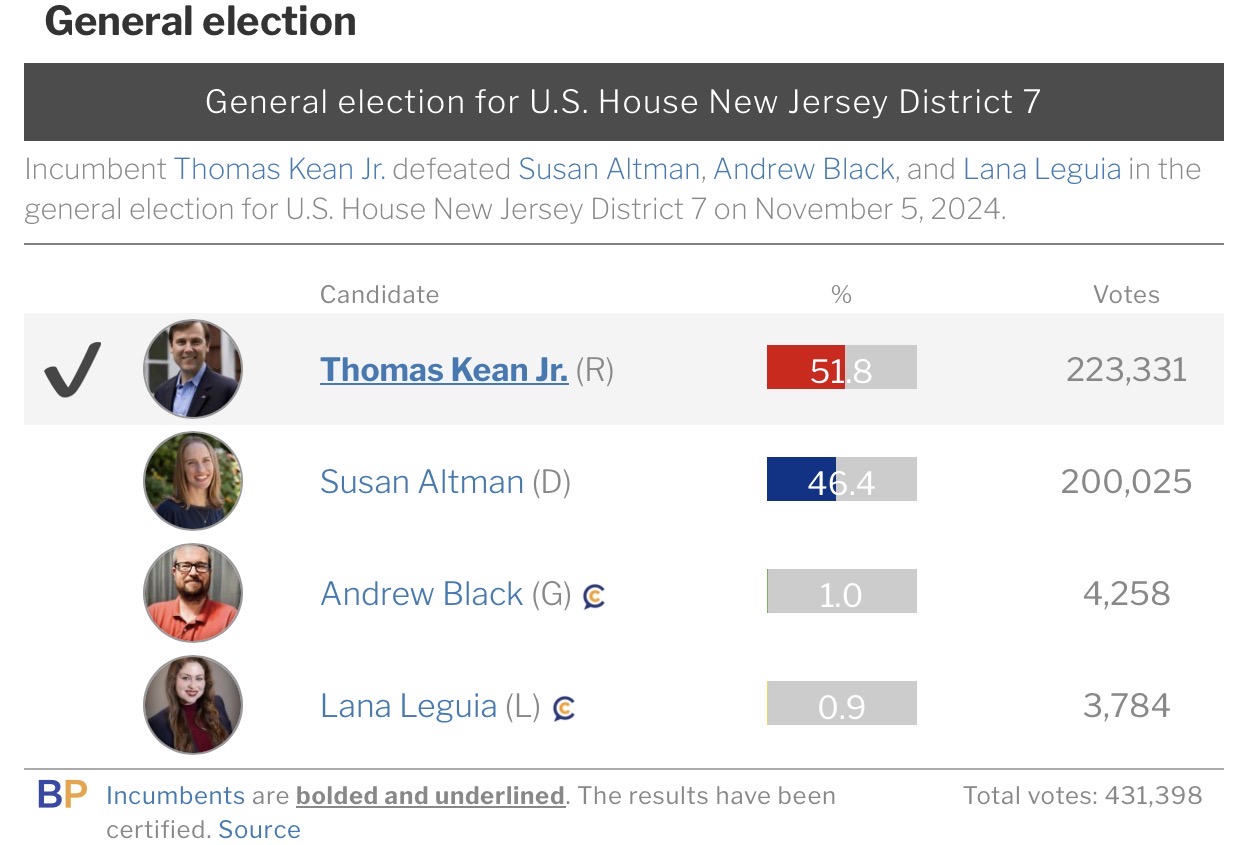
Thomas Kean, Jr. (Republican), son of the former New Jersey governor of the same name, is running for his third term in the U.S. House. He earned his first win in 2022, knocking out Tom Malinowski, before winning reelection in 2024 by +5.4% as President Trump ran strong in New Jersey. His campaign is clouded by concerns over transparency and fitness for office.

Rebecca Bennett (Democrat) is a veteran with a background in healthcare, and she has focused her campaign on exactly that – one of the few issues Democrats poll ahead of Republicans on.

II. District Geography

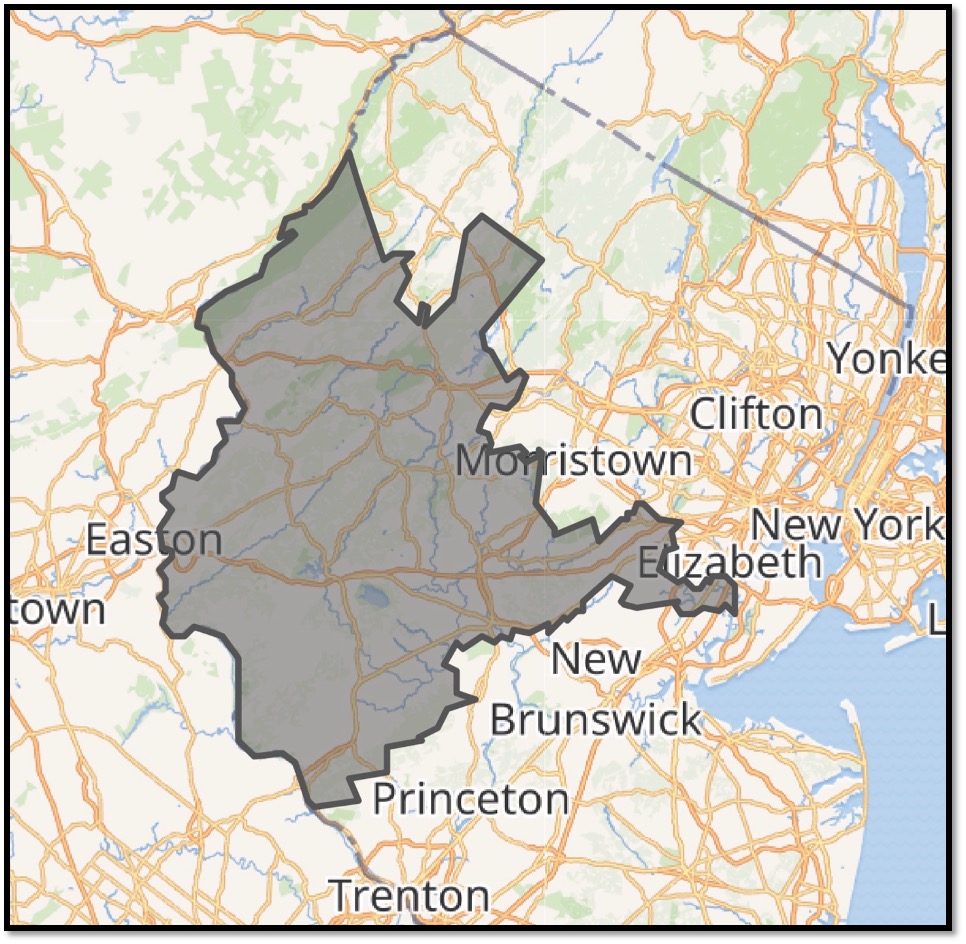
Map of New Jersey's 7th Congressional District

New Jersey’s 7th Congressional District (NJ-7) is a large district in the northwestern corner of the state. It holds all of Hunterdon and Warren Counties, and segments of Morris, Somerset, Sussex, and Union Counties. The boundaries of the district were altered after the 2022 election, making NJ-7 slightly more Republican than it had been previously. Bridgewater Township (population 46,000) is the largest place in the district; Kean is from Westfield, Union County (population 31,000).

This district covers almost the entirety of northern New Jersey from west to east, and has a suburban nature to it given its proximity to New York City. It has trended away from President Trump since he won a +6 margin in 2016, despite a nice recovery in 2024.

Presidential Margins

2016 Trump +6
2020 Biden +4
2024 Trump +2

Key Statistics

70.8% White, 12.2% Hispanic, 8.3% Asian
85.8% Urban, 14.2% Rural

III. Market Assessment

Polymarket bettors are acting like Kean isn’t even a two-term incumbent, and consider Bennett an overwhelming favorite to flip the seat.

IV. History

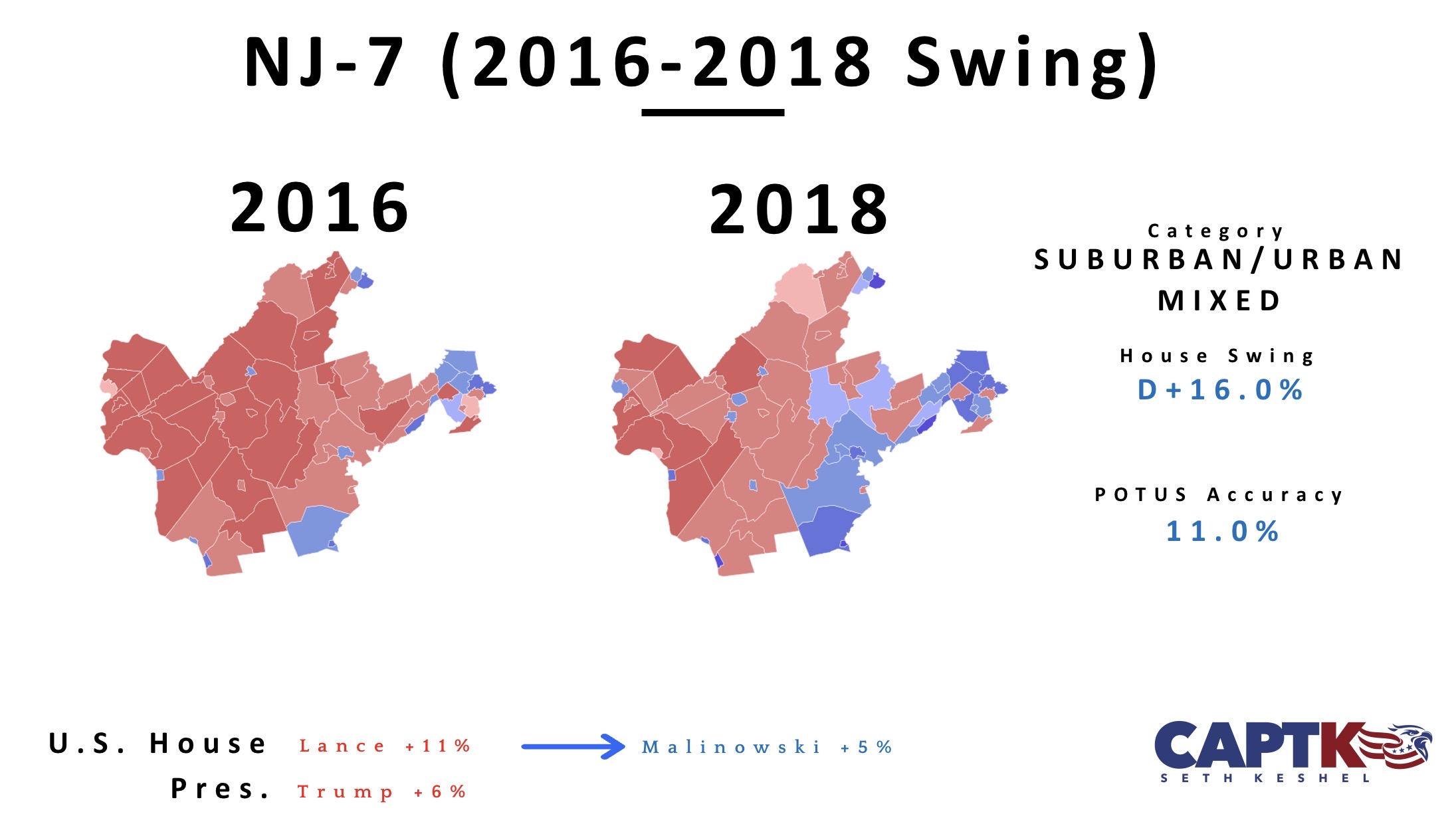
NJ-7 hasn’t changed much over the past two decades, which makes it easy to analyze. Leonard Lance (GOP) took office in 2009, and carried his seat by +11.0% in 2016, with Donald Trump winning the district by six points. With suburban seats in 2016, a notable presidential underperformance from the Congressman’s margin was a telltale sign trouble was on the horizon in 2018. Sure enough, Lance was ousted by Tom Malinowski, whom Kean eventually put out of work himself.

Here is the swing in the old NJ-7 from 2016-18:

Swing in the old NJ-7 from 2016 to 2018

Malinowski blew past the presidential margin by 11 points, and Lance’s incumbent House margin by 16. Kean, then a state Senator, challenged Malinowski in 2020 and came up just short (-1.2%). By 2022, the seat had been drawn more favorably for the GOP and Kean won a rematch, topping Malinowski by 2.8%. He then held NJ-7 in 2024, this time with a nice margin of +5.4%:

2024 NJ-7 result, Kean's reelection

In essence, the district is very competitive and is neither rural nor overly urbanized. It appears to swing dramatically based on who the president is, as what was then NJ-7 swung 16 points against Trump and then the newly drawn NJ-7, containing most of the original turf, blew back another 10.4% against Biden between 2018 and 2024. That isn’t a good sign for 2026 for the new incumbent.

V. Analysis of 2026 Primary Results

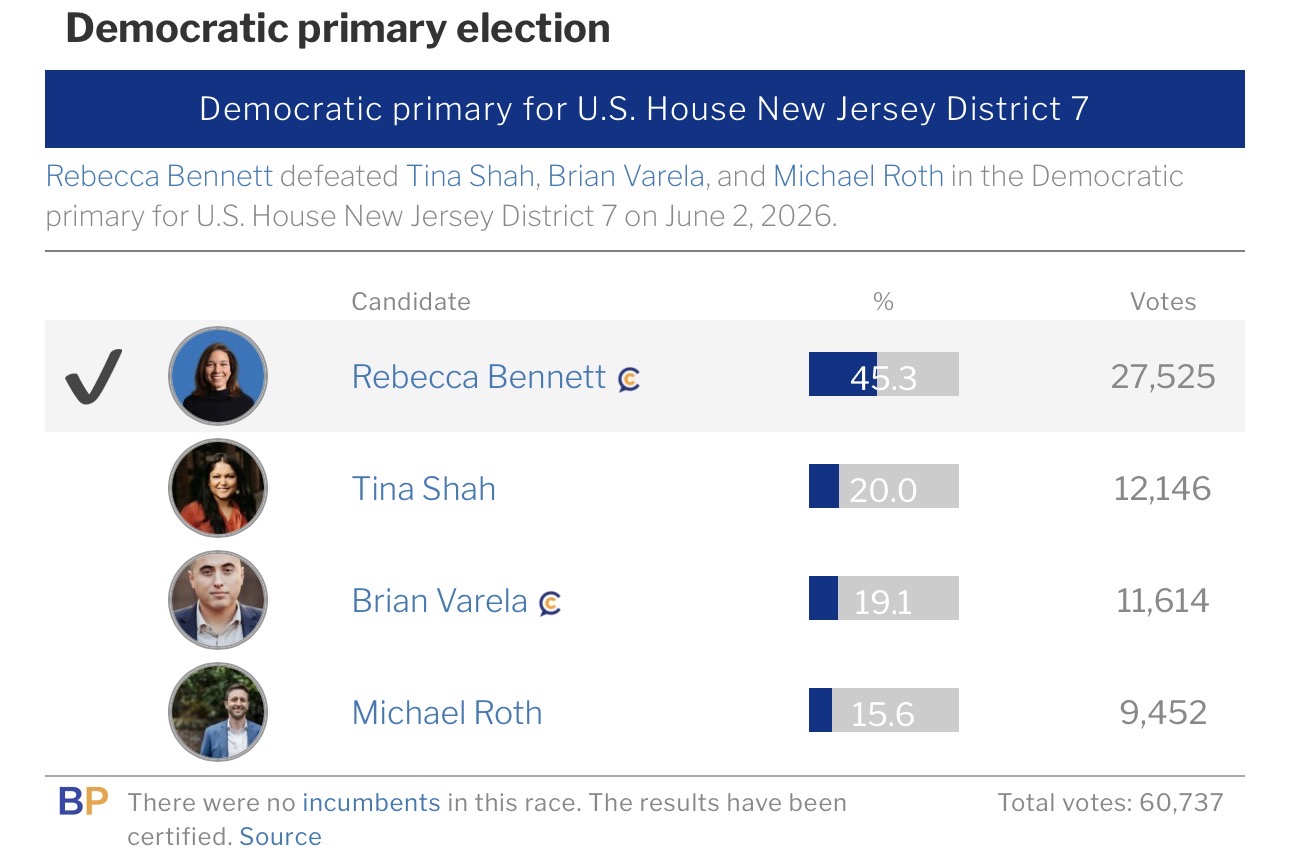
Kean, despite a lengthy absence from the House floor ahead of the primary, ran unopposed in the GOP primary. Bennett had to beat three other Democrats, and she did so with ease:

2026 NJ-7 Democrat primary results

Being held short of a majority hasn’t hurt her, and there are no reports of lingering drama in the Democrat camp. 2026 primaries appear to be a non-factor in the forthcoming Kean vs. Bennett matchup.

VI. Polls

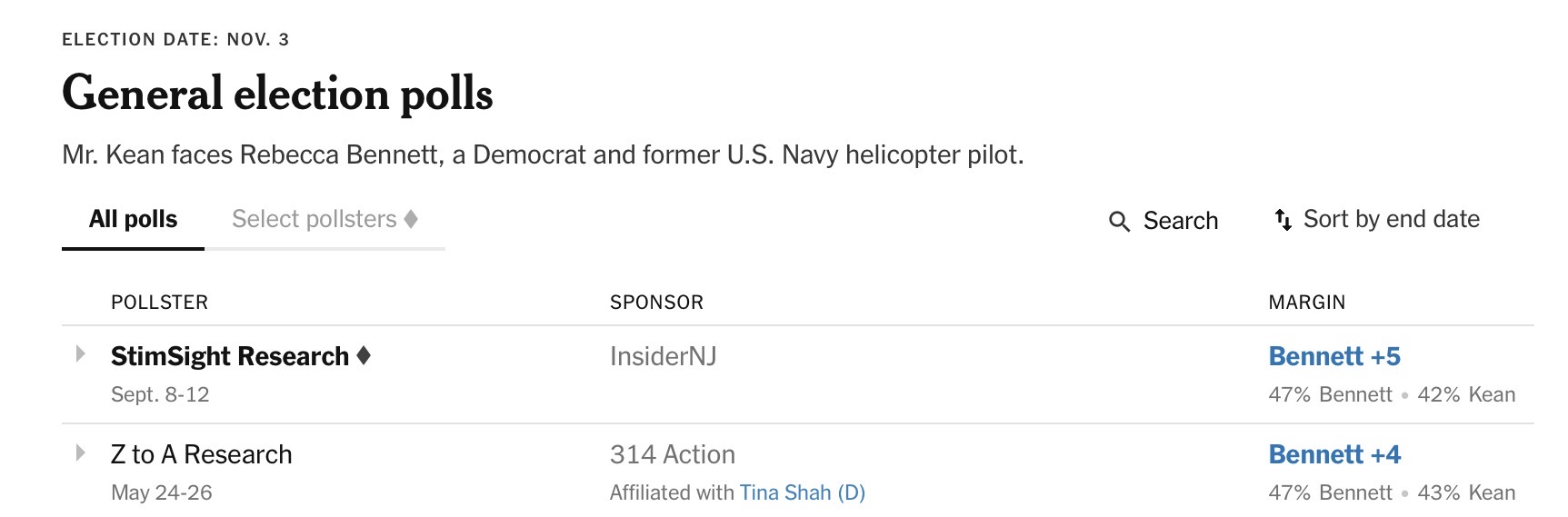
These polls came from The New York Times:

Recent polls of the NJ-7 race

Bennett’s primary opponents’ polling found her (Bennett) up 4 over Kean, while a more recent poll by StimSight Research has her up 5.

Average: Bennett +4.5%

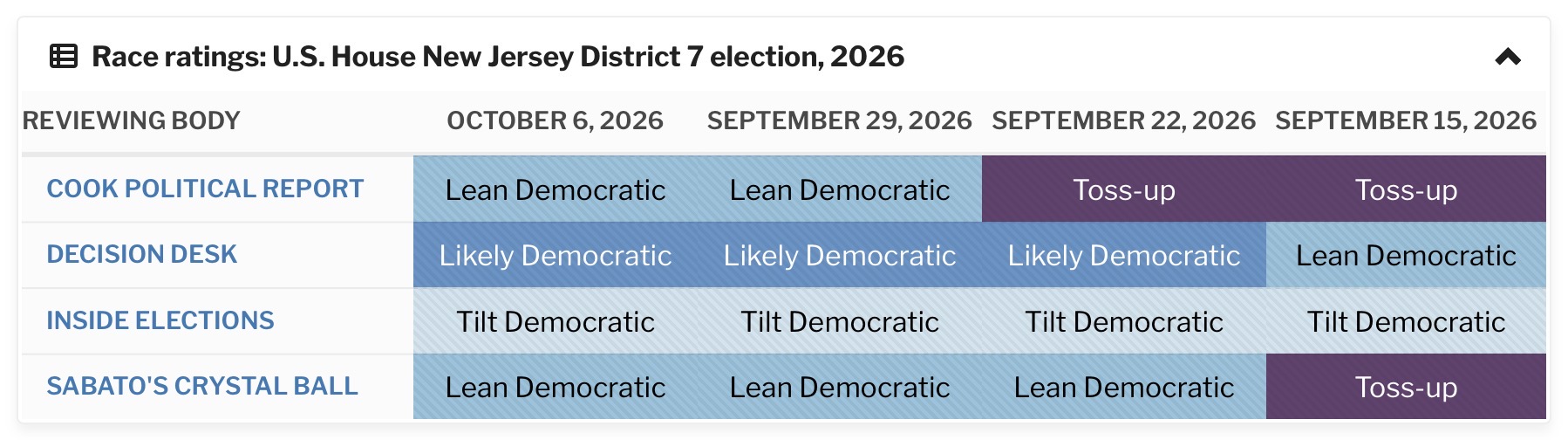
VII. Media Ratings

Media race ratings for NJ-7

Inside Elections is the most favorable toward Kean, having it only “tilt” Democrat (generally less than 2 points). The others are far more confident Bennett will flip the seat.

VIII. Party Registration

NJ-7 party registration changes

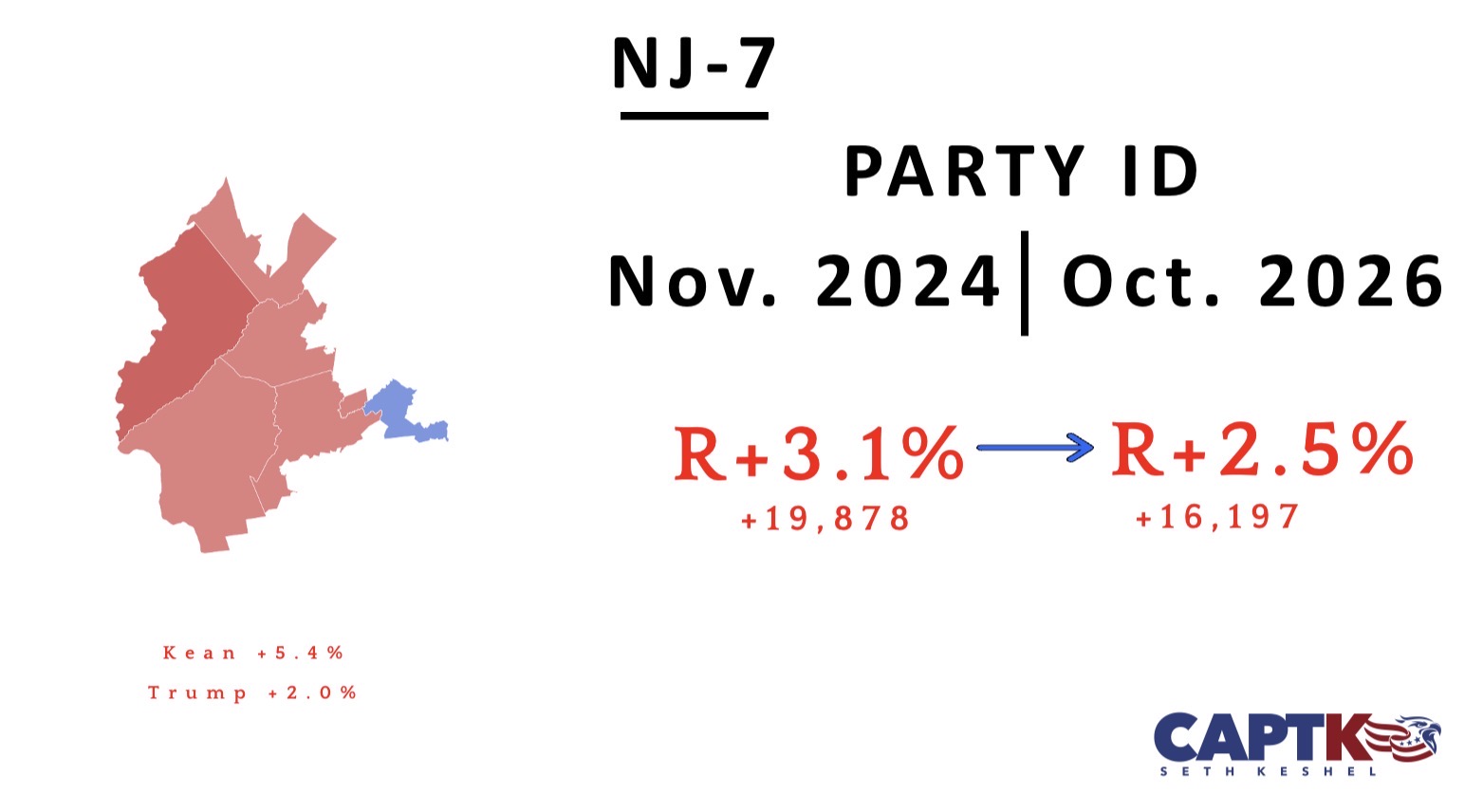
Republicans have lost almost 20% of their registration advantage since November 2024; both parties have been gaining registration, but Democrats are adding them at a superior rate (+7,036 D to +3,355 R) of over 2 to 1. The Republicans had a registration advantage of R+2.7% in 2022, when Kean won by 2.8%, and clearly he overran the registration index by 2.3% in 2024; Bennett has to like what she sees with the advantage diminishing and independents expected to stick to that grain next month.

IX. Election Considerations

New Jersey’s election laws make up a mixed bag. On some counts, they have an apocalyptic environment marred by Automatic Voter Registration. I wrote up the deeper meaning of the exposure of 6,600 non-citizens on the voter rolls this summer, and there is little doubt things are far worse than we are told.

Therefore, it can be reasonably baked into any race in New Jersey that the voter rolls are full of people who shouldn’t be on them. The state also lacks Voter ID, and has way too many mail-in ballots floating around in a given election than they did a decade ago. They do have tough laws against ballot harvesting, and I even wrote about them in my book.

Mikie Sherrill’s bloated margin from 2025’s off-year gubernatorial election strongly suggests people are still ballot harvesting extensively in New Jersey, as she blew past the vote total of her opponent, who himself blew past the 2021 vote total of the Democrat victor, Phil Murphy.

New Jersey runs lousy elections, when they need to.

X. Summary and Election Estimate

These are the primary factors that will decide this race:

NJ-7 is a volatile seat for midterm adjustments. Not only did it swing against the presidential margin by 11 points in 2018, it ran 16 points against its sitting representative who had held the seat for five terms. Rest assured it won’t have greater affinity for Kean than it did for Lance. The GOP lost four seats in the Garden State in 2018, and despite positive mail voting splits available in most places, they’re not so rosy in New Jersey (although it is too early to pass serious judgment).

Despite Republicans having made gains in New Jersey registration overall since 2024, NJ-7 has slipped nearly 4,000 registrations to the left.

Finally, Bennett and Democrats are hitting Kean where it counts:

Democrat ad attacking Thomas Kean, Jr.

In one of the strangest political stories of the year, Kean disappeared into thin air in early March, and reemerged at the end of June after having spent months dodging reporters and not campaigning for his uncontested primary. He missed 140 roll call votes, and when pressed, none of his GOP colleagues had any answers.

The official explanation was “depression.” Whether this is the truth or not, it couldn’t have come at a more inopportune time or been handled any worse in a critical year in which he still has a strong enough voter registration advantage to possibly hold the seat. Democrats have been advertising the missed work and painting Kean as a comfortable bureaucrat unaccountable to the people, and it seems to be working.

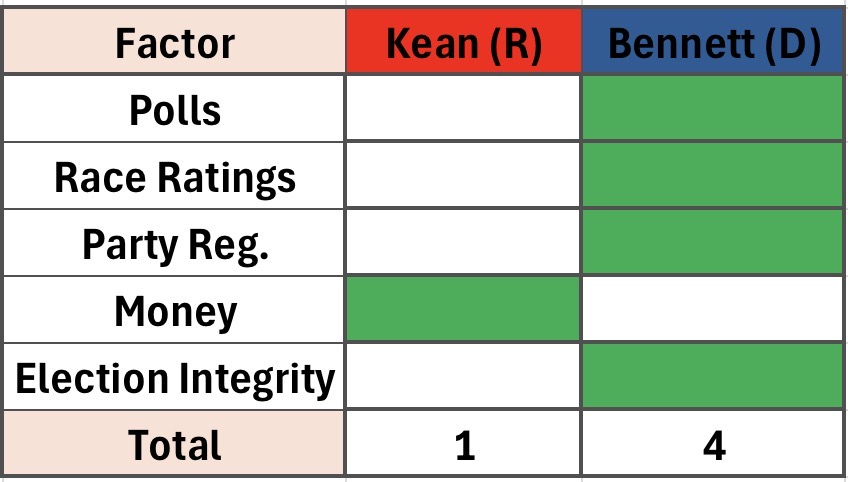
Here is how the key factors in this race stack up:

Key factors in the NJ-7 race

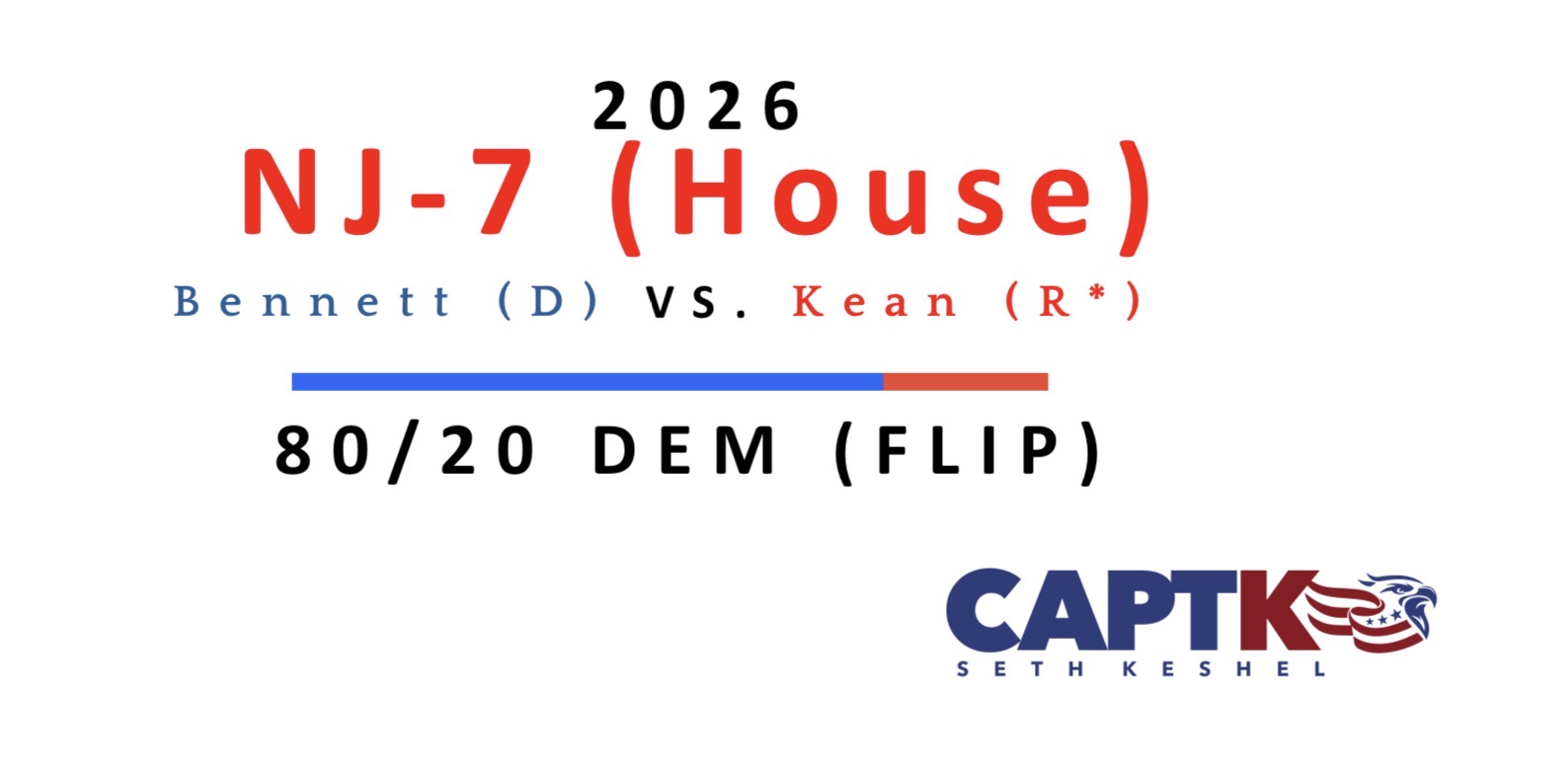
Forecast for NJ-7 House

Forecast for the NJ-7 U.S. House race

Despite having way more money than Bennett, Kean is a serious underdog in his seat thanks to factors both in and out of his control. He’s currently saddled with a 60% disapproval rating, and it appears voters aren’t buying his explanation for his absence this year. Bennett has no political experience and is winging that as a positive, giving her an “outsider” label she can ride to what is likely to be a fairly comfortable win next month. If that win happens, the GOP will hold just two of New Jersey’s 12 House seats.

Seth Keshel, MBA is a Senior Fellow at the Gold Institute for International Strategy and a retired Army Captain. He publishes Captain K’s Corner on Substack.
2026 Ten-Point Forecast: ME-2 (U.S. House – Decisive)

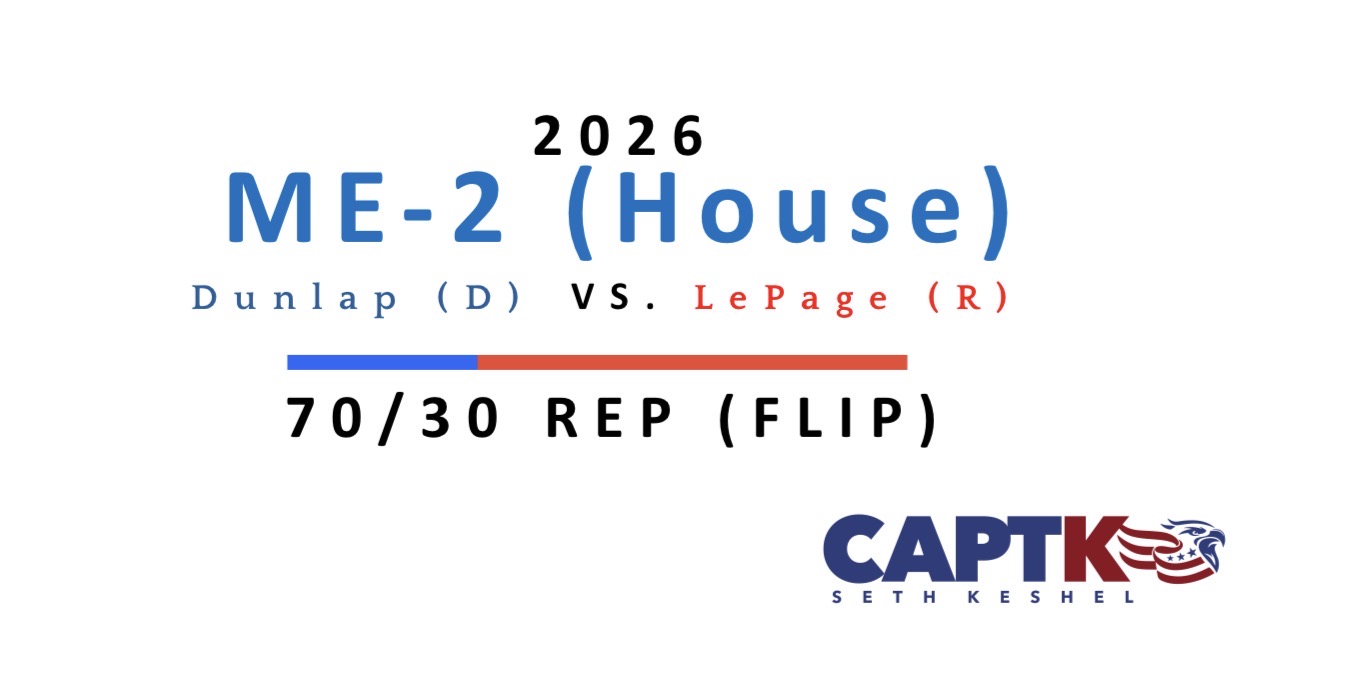
Graphic introducing the ME-2 U.S. House race candidates

Paul LePage (R) vs. Matthew Dunlap (D)

I. The Race

Paul LePage (Republican) is the former governor of Maine and is seeking to become just the second Republican member of Congress from any of the six New England states.

Matthew Dunlap (Democrat) is a career bureaucrat. He currently serves as State Auditor, and has twice been Secretary of State. Before that, he was a member of the Maine House of Representatives.

II. District Geography

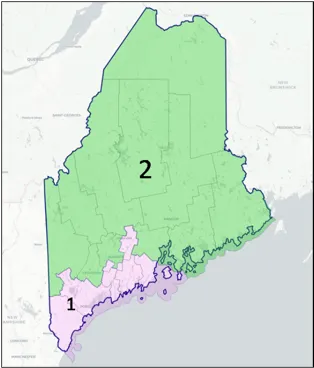
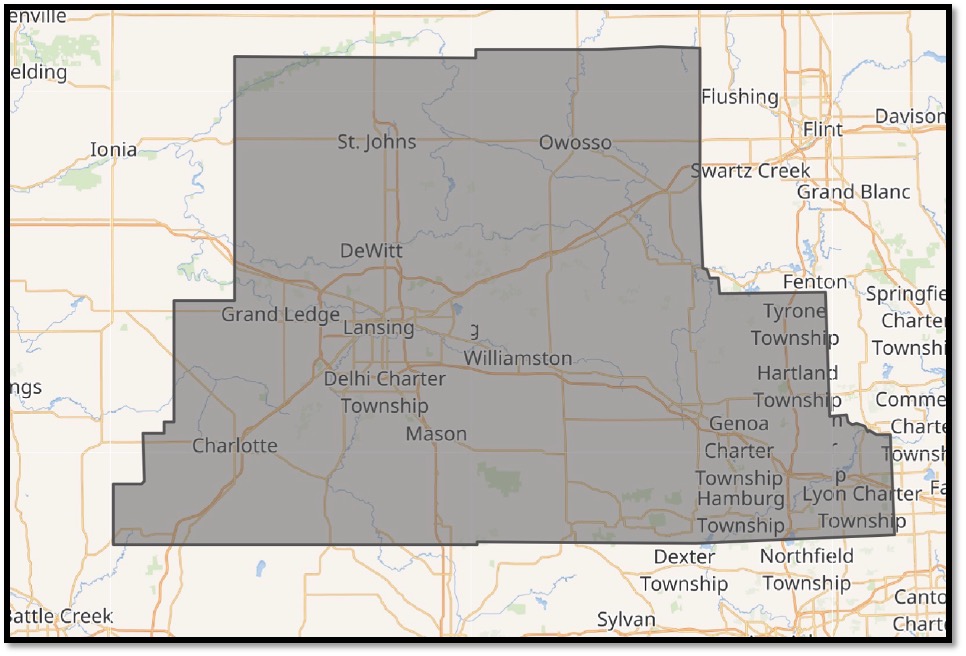
Map of Maine's 2nd Congressional District

ME-2 makes up the vast majority of Maine’s statewide geography and nestles up against the Canadian border.

The districts have changed very little in the state’s history, and Maine has split the electoral votes since 1972. In 2016, Donald Trump became the first Republican candidate to win ME-2 since 1988.

Presidential Margins under Trump

2016 Trump +10.3%
2020 Trump +7.4%
2024 Trump +9.1%

Key Statistics

90.9% White
72.1% Rural, 27.9% Urban

III. Market Assessment

Tapping into LePage’s name recognition and past track record and Trump’s three wins in ME-2, bettors on Polymarket are hunkering down for a LePage victory.

IV. History

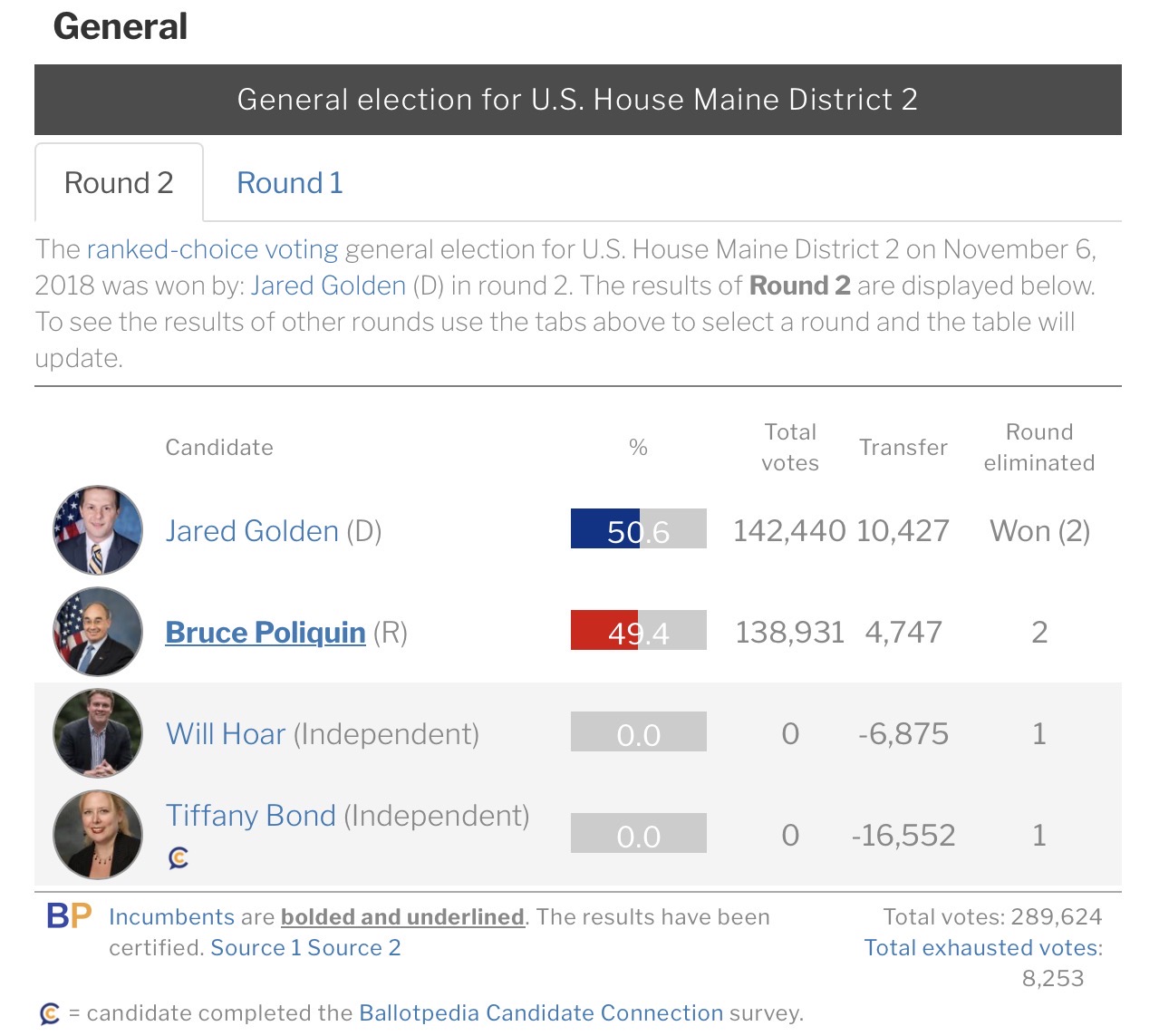
Republican Bruce Poliquin represented ME-2 for two terms, including the first two years of the Trump 45 administration. In the 2018 Democrat wave, he lost his seat (which swung 10.8% left) to Jared Golden, who is retiring from Congress after his current term expires. Interestingly enough, Poliquin beat Golden in the First Choice Round in the very first run of Ranked Choice Voting in Maine, but lost after votes were redistributed:

2018 ME-2 Ranked Choice Voting results

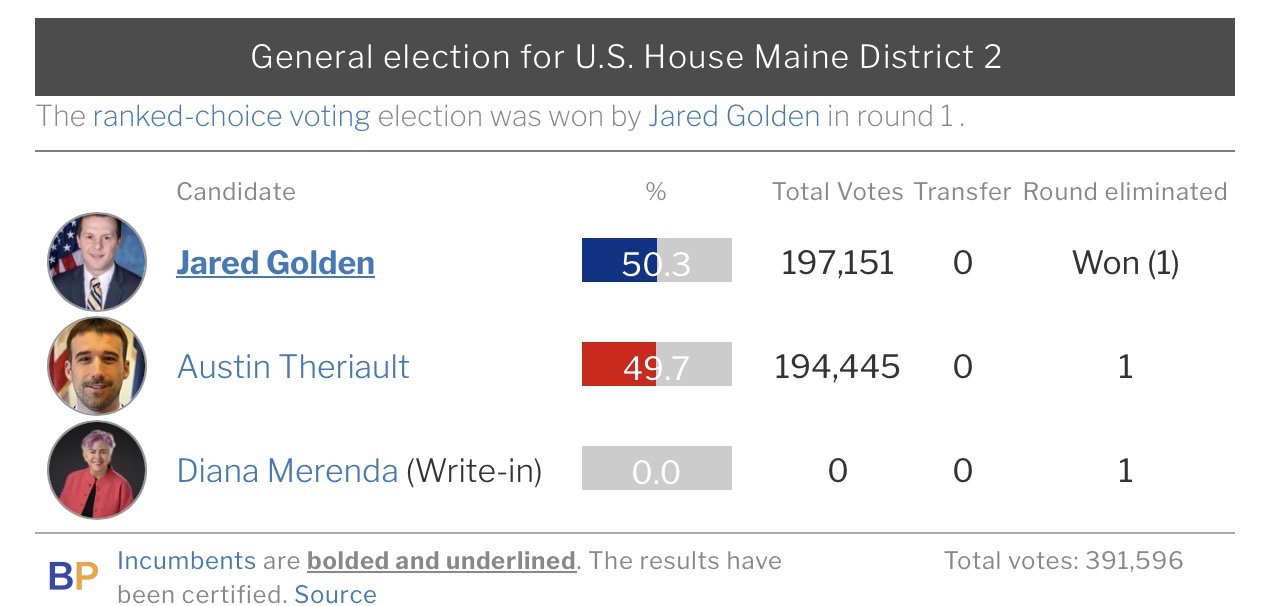
Golden has successfully defended the seat three times, by +6.2% in 2020, 6.1% in 2022 (over Poliquin again), and a razor-thin 0.6% in 2024 over a relatively unknown GOP challenger:

2024 ME-2 result, Golden's narrow win

That photo finish, which I will dissect later, seems to have been all Golden needed for smelling the coffee and calling it a career. No matter how moderate, the district appears to be running Republican red from here on out. With the pressure off, Golden (a member of the “Blue Dog” Caucus) has been almost Fetterman-esque in his support for Trumpian policy.

The recent history of ME-2 looks like that of Upstate New York or other parts of Appalachia. While they were once happy to stick with the party and fulfill union wishes, the Democrats appear to have worn out their welcome. Golden’s departure at the age of 44 seems to confirm it.

V. Analysis of 2026 Primary Results

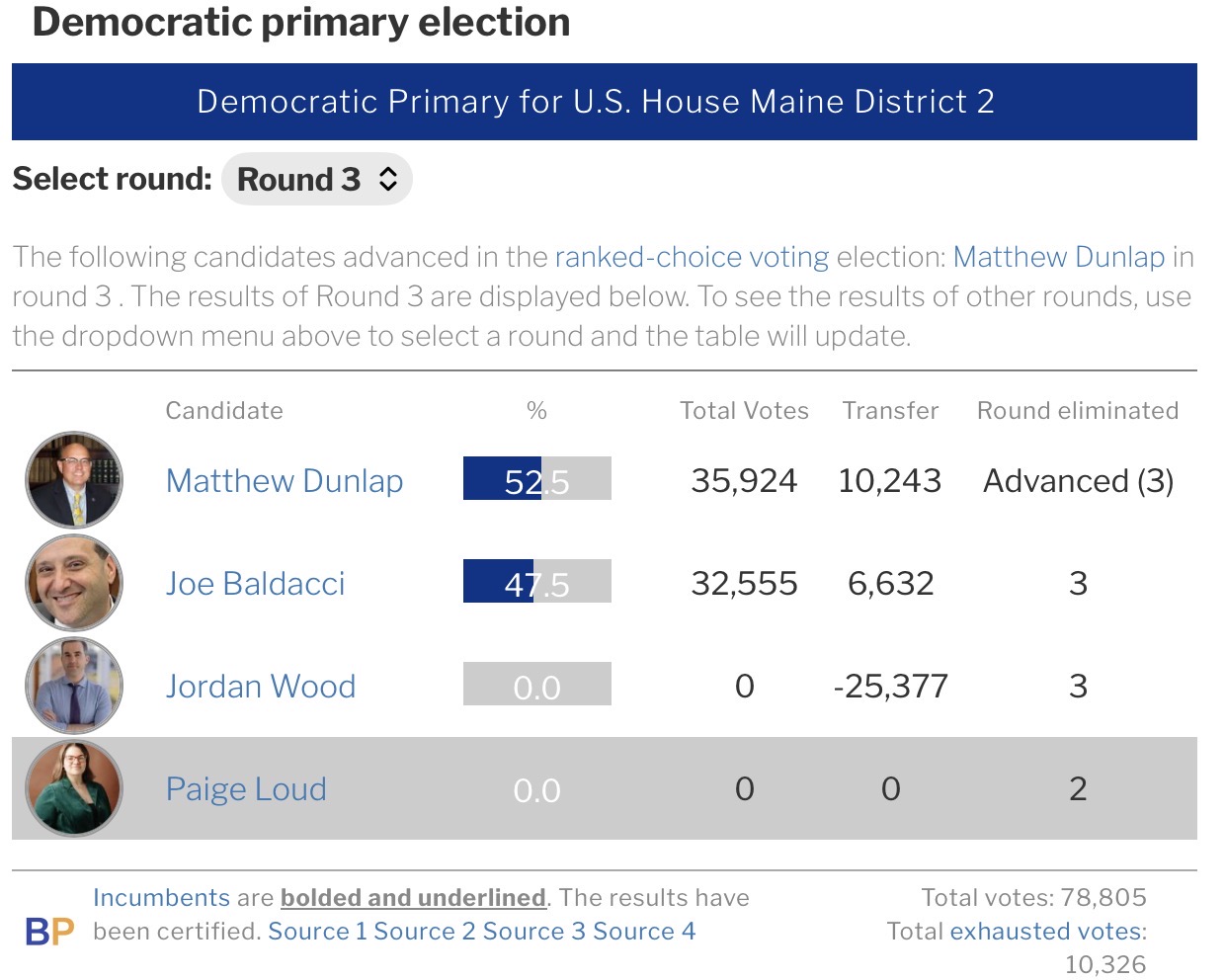
Republicans got behind the LePage campaign early, and as such, he ran unopposed in the GOP primary. Democrats had to scrap it out in the Ranked Choice Voting setup, and Dunlap prevailed in the third round after having trailed in the first two:

2026 ME-2 Democrat primary Ranked Choice results

Baldacci is the brother of John Baldacci, former governor of Maine, and was viewed as a moderate option in this rapidly reddening district. He broke ranks with the party on gun control, but the same progressive fringe that nominated Graham Platner for Senate backed Dunlap, who has been pushing Medicare for All and other progressive planks. While the ME-2 rift has none of the toxicity of the Senate situation post-Platner, Democrats probably went a bridge too far on ideology.

VI. Polls

Polls pulled from The New York Times:

Recent polls of the ME-2 race

The University of New Hampshire is about as reliable for polling (check their 2024 presidential polls for New Hampshire) as a slingshot is for stopping a tank. Tossing that one, Dunlap “leads” by one point in polls released over the past month.

VII. Media Ratings

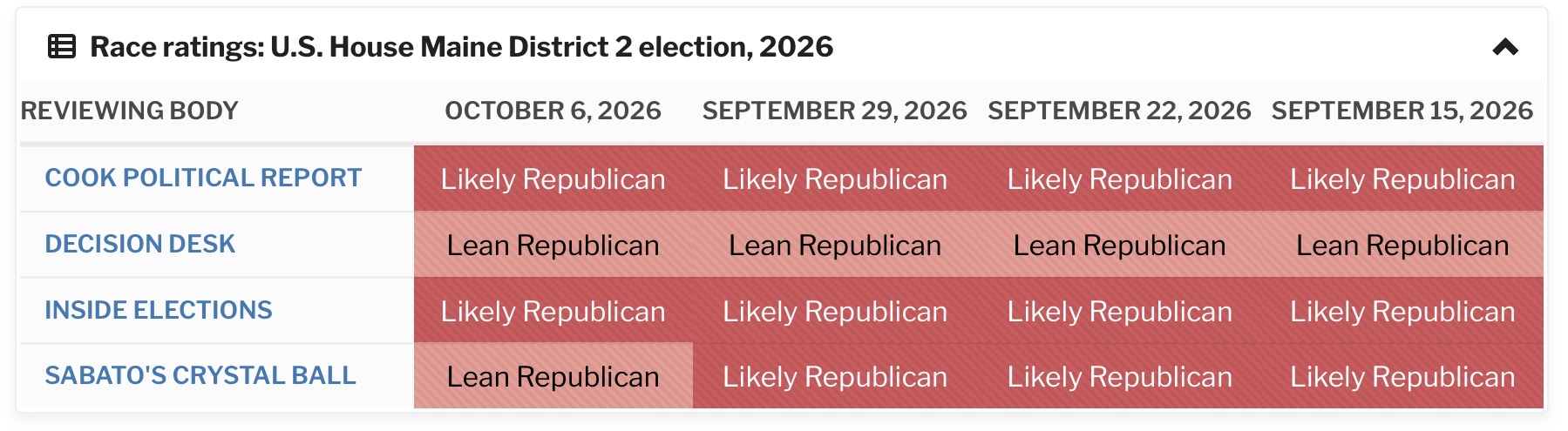
Media race ratings for ME-2

All four major reviewing bodies expect a LePage victory, with magnitude variable.

VIII. Party Registration

Maine party registration changes since 2024
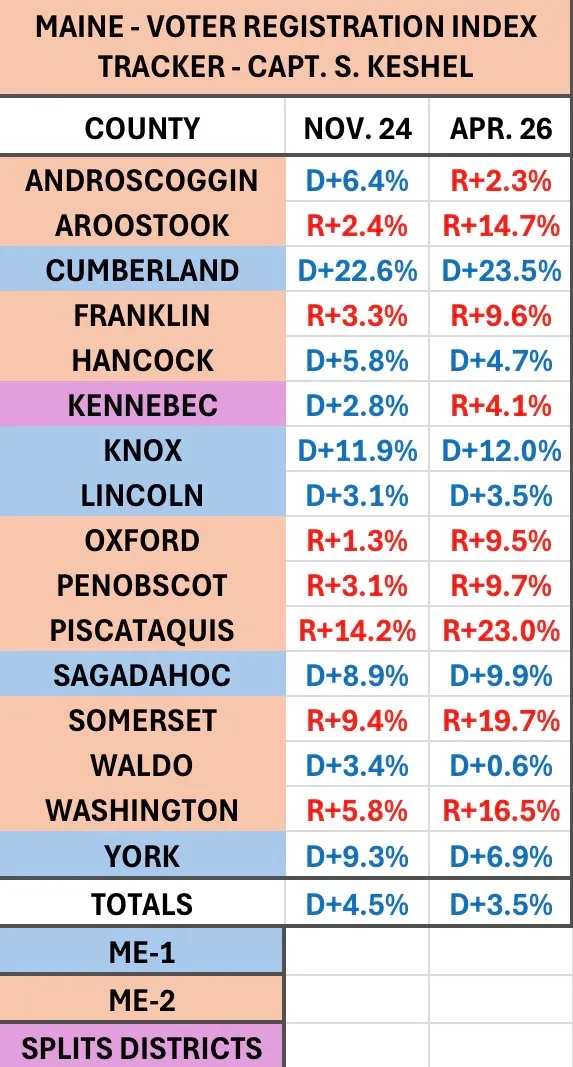
Party registration shifts by county in ME-2

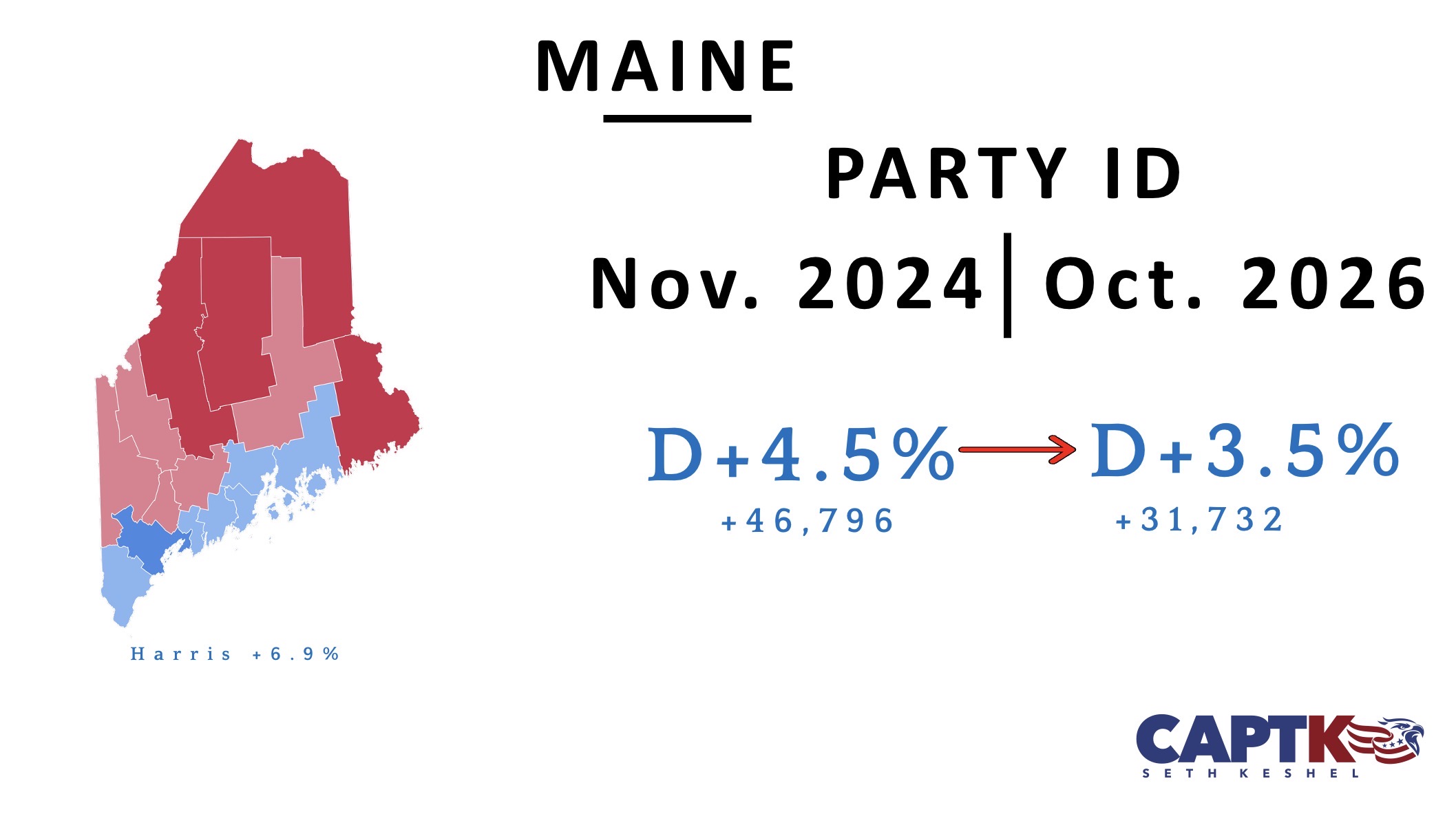
Maine sits a full point to the right of its registration index from November 2024, down from D+4.5% to D+3.5%. All 11 counties that are part of ME-2 have moved toward Republicans in registration, confirming what Jared Golden already felt in 2024 when he barely held on.

Advantage: LePage

IX. Election Considerations

Here is what I wrote in this section for my Maine Senate review, published just last week:

You name it, Maine has it. Too much mail-in voting, a blind eye to ballot harvesting, Automatic Voter Registration, and the dreadful Ranked Choice Voting, which is constantly gamed and exploited to produce the most troublesome outcomes. If this race winds up in a dead heat, a slow drip of mail-in ballots combined with Ranked Choice Voting tilts the scales heavily in favor of Jackson. Collins needs to get her majority in the First Choice round.

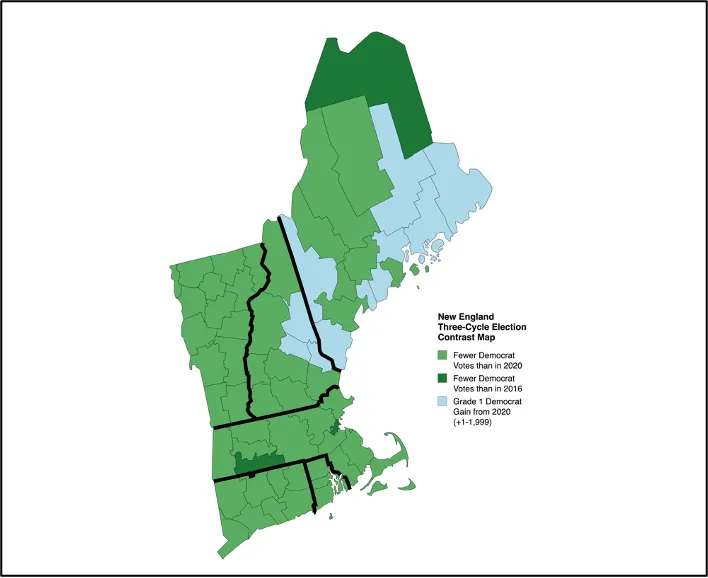
I am confident, based on where Democrats were adding votes in 2024 (from 2020), that Golden had his seat “fortified” by rampant ballot harvesting:

Where Democrats added votes in ME-2 from 2020 to 2024

X. Summary and Election Estimate

Trend is what matters here. Golden knows about it, and that’s why he saw his margin in 2024 and called it “good enough.” The Democrat “blue dog” coalition that remained viable in northern Maine is on its way out, and all 11 counties are reflecting that in their party registration data. To further complicate things, the Democrat base that nominated Platner punted on the more moderate candidate with big name recognition who could have better handled LePage, who has a massive cash advantage over Dunlap.

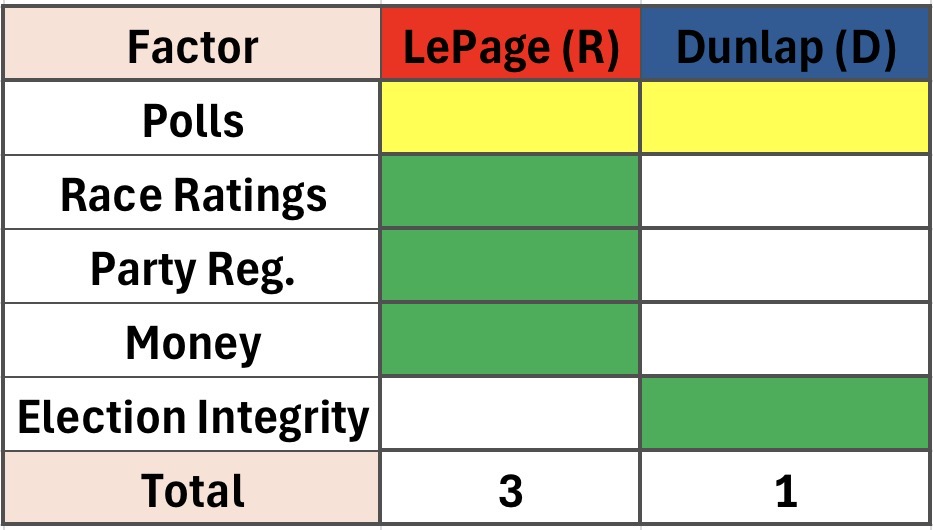
Here is how the key factors in this race stack up:

Key factors in the ME-2 race

Forecast for ME-2 House

Forecast for the ME-2 U.S. House race

A combination of partisan realignment, candidate quality, superior campaign finance, and extreme ideological positions all point to a changing of the partisan guard in ME-2, which would constitute a true flip, not one from redistricting. Unless something drastic happens between now and November 3, I suspect LePage will be joining his fellow Mainer, Susan Collins, in Congress come January 2027.

Seth Keshel, MBA is a Senior Fellow at the Gold Institute for International Strategy and a retired Army Captain. He publishes Captain K’s Corner on Substack.
Hermann Tertsch: “October 7 Was an Act of Genocidal Terrorism”

Memorial sculpture of shoes with an Israeli flag and flowers

This article was written by the editors and appeared in La Razón. Hermann Tertsch: “El 7 de octubre fue un acto de terrorismo genocida”.

Featuring Hermann Tertsch, Distinguished Fellow (Honorary), Gold Institute for International Strategy

Hermann Tertsch

The journalist and Member of the European Parliament for VOX, Hermann Tertsch, said that “October 7 was an act of genocidal terrorism,” but that, unfortunately, “Judeophobia, antisemitism and anti-Zionism, which is hatred of Israel, have soared in Europe.”

“Europe and the left have taken up the defense of Hamas’s terrorist executioners and a grotesque demonization of the victims,” he said.

The vice president of the Patriots for Europe group in the European Parliament said that “it is impossible to forget the diabolical cruelty of Hamas’s assault from Gaza, its unprecedented murderous frenzy in the massacre, the rapes, torture, mutilations and dismemberment of children, the elderly, women and men.”

In that sense, he said that October 7 and its effects are a wake-up call for the West. “Those who do not know how to defend themselves will be overrun by those who come to the West to colonize it and impose the cruelest and most totalitarian religious ideology,” he warned.

THREE YEARS

“Three years have passed since the greatest genocidal action against the Jewish people since the Holocaust. It is impossible to forget the diabolical cruelty of Hamas’s assault from Gaza, its unprecedented murderous frenzy in the massacre, the rapes, torture, mutilations and dismemberment of children, the elderly, women and men. Nor the kidnapping of 251 Israelis taken to Gaza, including the elderly, children and infants, most of whom would not return. Three years later it is clear that that massacre has radically changed the political map of the region and is changing that of the world, short of the fall of the regime in Iran, which bears ultimate responsibility for October 7, 2023,” he noted.

“It has also become very clear, to the displeasure of many, that Israel’s will, determination and capacity to defend itself are today the same as those that led it to victory in all the wars the Arabs launched to destroy the Jewish state. Despite the modernization of Israeli society and the effects of a left inevitably given over to wokeism, national consciousness and the sense of duty and service, those virtues that seem to be disappearing in some Western nations, are strong and firm. Unfortunately, these three years have also shown the extent to which Europe’s current rulers and broad sectors of public opinion, shaped by the published opinion that depends on those rulers, have taken positions defending Hamas’s terrorist executioners and grotesquely demonizing the victims,” he said.

WARNING

In that sense, he warned that “Judeophobia, antisemitism and anti-Zionism, which is hatred of the nation of Israel, have soared in Europe, conditioned by the massive Muslim penetration of its society, driven by the powerful influence of centers of power and buyers of goodwill such as Qatar and the Muslim Brotherhood, and stirred up by a left that has placed its last hope of survival in its alliance with Islamism and the Muslim invasion of the West.”

“Under the banner of glorifying the October 7 massacre, the forces of Islamism and socialism have taken to the streets of European cities, with immense violence when they wished. As now in France, in what the media disguise as student protests and is a forceful demonstration of the destructive power of the alliance of Islamism with the far-left Jean-Luc Mélenchon’s La France Insoumise (LFI) party. Or as during the 2025 Vuelta a España, when the Sánchez government used illegal African immigrants mixed with ETA sympathizers and other far-leftists to attack a team with Israeli shareholders with unusual violence,” he charged.

GENOCIDE

“October 7 was an act of genocidal terrorism. Of the only genocide that has been proposed and has never stopped being prepared in the Middle East since 1948, that of wiping the State of Israel and the Jews off the map. By contrast, the accusations of genocide constantly made by Islamism and leftism and the usual useful idiots in the service of the West’s enemies are absurd. First, because having the means to perpetrate a genocide if there were the will, it never did so and does not do so, as proven by the fact that the Palestinian population under Israel’s control has grown from 1.2 million in 1948 to 7.5 million now, and close to two million of them with Israeli nationality,” he pointed out.

Therefore, he said that “October 7 should have meant total international isolation for Hamas, for Hezbollah, for Iran and to a large extent for Qatar. And yet the response in Europe and the U.S., after a few weeks of official solidarity with the victims, has been the multiplication of demonstrations in favor of the terrorists, of Islamism, of sharia and of the call for genocide against Israel.”

“This criminal call, contained in the phrase ‘From the river to the sea’ for the Palestinian state, that is, with Israel already gone, has been uttered even by members of the Spanish government, the one that has gone furthest in Europe in its solidarity with the terrorists and harassment of Israel. The truth is that the social-democratic globalist majorities, whatever their parties call themselves, are alarmed at the spectacular growth of patriotic forces in Europe and America. These defend the nation, sovereignty and identity against invasions, multiculturalism, aggression and the open attempt to put an end to nations and their identity, which is the policy of the European Union with its current shrinking majority and a European Commission that has failed at everything except destroying, as is the current one of Ursula von der Leyen,” he lashed out.

“The last thing Von der Leyen, George Soros, Bill Gates, Macron or Friedrich Merz want to see is the European nations awaken to the imminent threat of total destruction of their social fabric, their culture, their identity and their rights. All of this is already happening because of the policies imposed from Brussels and the invasion it promotes. Brussels agrees with Qatar (what a coincidence, Qatargate) in wanting to prevent at all costs the European nations from understanding that Israel is fighting an enemy that is also theirs. That Spain, look at Ceuta, is a target of Muslim conquest, not after Israel but at the same time. And that immediately after come all the lands that have not been under Muslim rule,” he said.

USEFUL IDIOTS

At another point he said that “Israel has lost sympathizers and allies (bad allies, as has been shown) after being the victim of that monstrous assault, while the flags of the murderers fill the streets of European cities. The globalist rulers say that the Israeli armed response is judged ‘disproportionate’ in a comfortable Europe that no longer remembers what war is and treats terrorists like lost sheep. That is why they have adopted and spread all the lying propaganda generated by Hamas, and the Western media have presented it as revealed truth.”

He noted that “Hamas uses the civilian population as a human shield to maximize the number of victims of Israeli attacks. Because every Palestinian civilian death is a success for Hamas and a misfortune for Israel. The population takes on this role (some forced and others voluntarily), raised and indoctrinated in the culture of hatred, death and martyrdom in a fanaticized Gaza. But, mind you, financed with tens of billions in international aid. They could have made it a Mediterranean tourist spot. What they made was an immense underground terrorist base fed by the indoctrinated children on the surface.”

EFFECTS

Along those lines, he warned that “October 7 and its effects are a wake-up call for the West. Those who do not know how to defend themselves in a future that is already here (Ceuta is one proof, the French cities another) will be overrun by those who come to the West not to work or fleeing anything, but to colonize it and impose the cruelest and most totalitarian religious ideology. Europeans give examples of defenselessness every day. The European is harmless and defenseless in attitude and resources in the face of the invader’s aggression. Which is how the enemies of civilization want them.”

“Israel has never been able to afford that attitude because it would have ceased to exist as soon as it was born. That is why it is an example in self-defense and in forging national consciousness. The globalists, more conditioned every day by the Muslim Brotherhood, believe Israel is a bad example. For those of us who believe that the invaded European and Western nations can no longer afford defenselessness either, Israel is an ally, a friend and an example,” he concluded.

Read the full article at La Razón

Hermann Tertsch is a Distinguished Fellow (Honorary) at the Gold Institute for International Strategy, a Washington, D.C. foreign policy and defense think tank.

2026 Ten-Point Forecast: MI-7 (U.S. House – Decisive)

Graphic introducing the MI-7 U.S. House race candidates

Tom Barrett (R-inc.) vs. William Lawrence (D)

I. The Race

Tom Barrett (Republican) is seeking his second term in the U.S. House after having won the open seat vacated by Elissa Slotkin in 2024. Barrett is an Army veteran who had previously served in both the Michigan House and Senate chambers.

William Lawrence (Democrat) is among the most radical left-wing candidates the Democrats have running for the U.S. House in any district, let alone a moderate district in the Midwest. Until July 2026, he was a card-carrying member of the Democratic Socialists of America (DSA).

There is also a Green Party candidate, Shane Dedrick, who stands to take votes exclusively from Lawrence.

II. District Geography

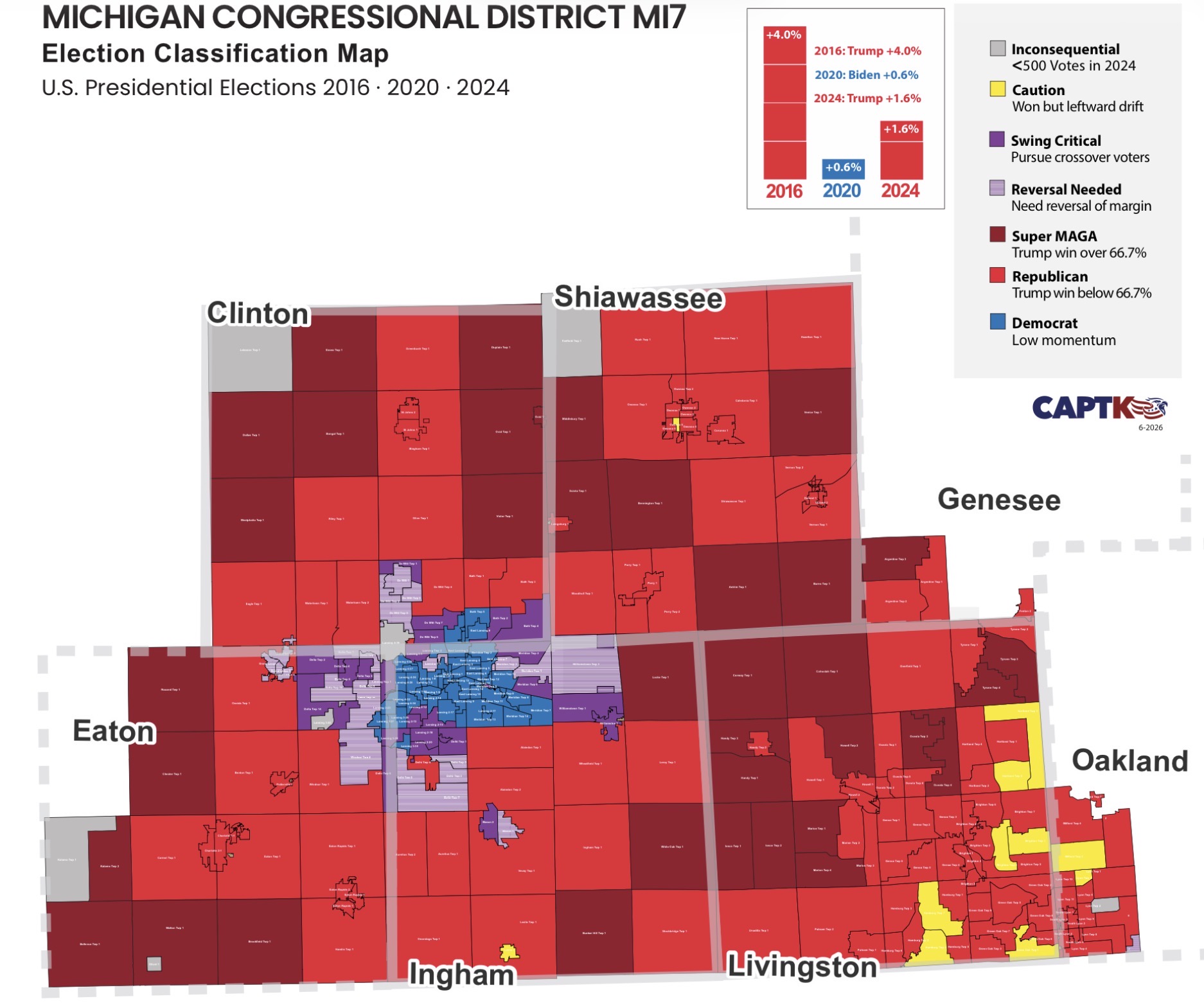
Map of Michigan's 7th Congressional District

Michigan’s 7th Congressional District (MI-7) sits right in the smack middle of the state. It contains Michigan’s capital city, Lansing, and Ingham County, as well as Clinton, Livingston, and Shiawassee Counties, almost all of Eaton County, and a tiny pinch of Oakland County.

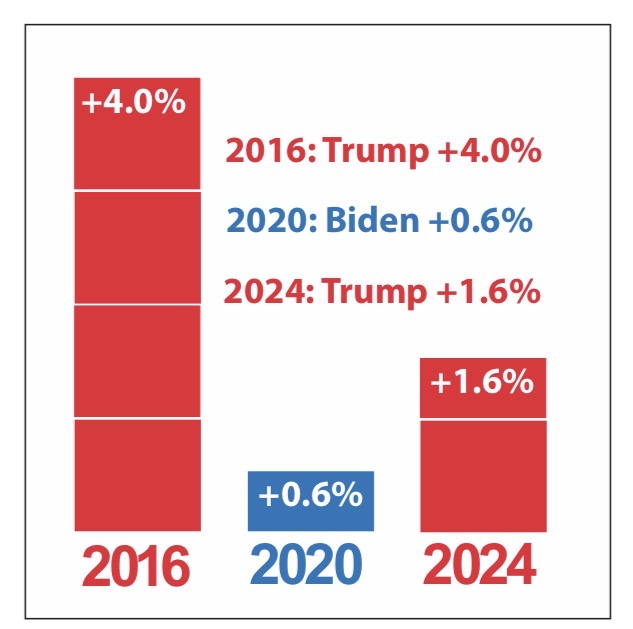
Thanks to the suburban realignment occurring in the past decade, this district has shifted away from Republicans a bit. It is down from a high point of Trump +4% in 2016, when he first flipped Michigan, to just a 1.6% presidential baseline in 2024. Some of this is owed to the expansion of mail-in balloting. Thanks to the expansion of that practice in 2020, Biden narrowly carried the popular vote in the district (as it is drawn today).

Presidential Margins

Presidential margins in MI-7

Key Statistics

79.9% White, 5.9% Black, 5.7% Hispanic

III. Market Assessment

Driven primarily by midterm vibes and the knowledge that MI-7 is a tough district with both candidates forced to play to the middle, Polymarket bettors think the Democrat, Lawrence, is a modest favorite.

IV. History

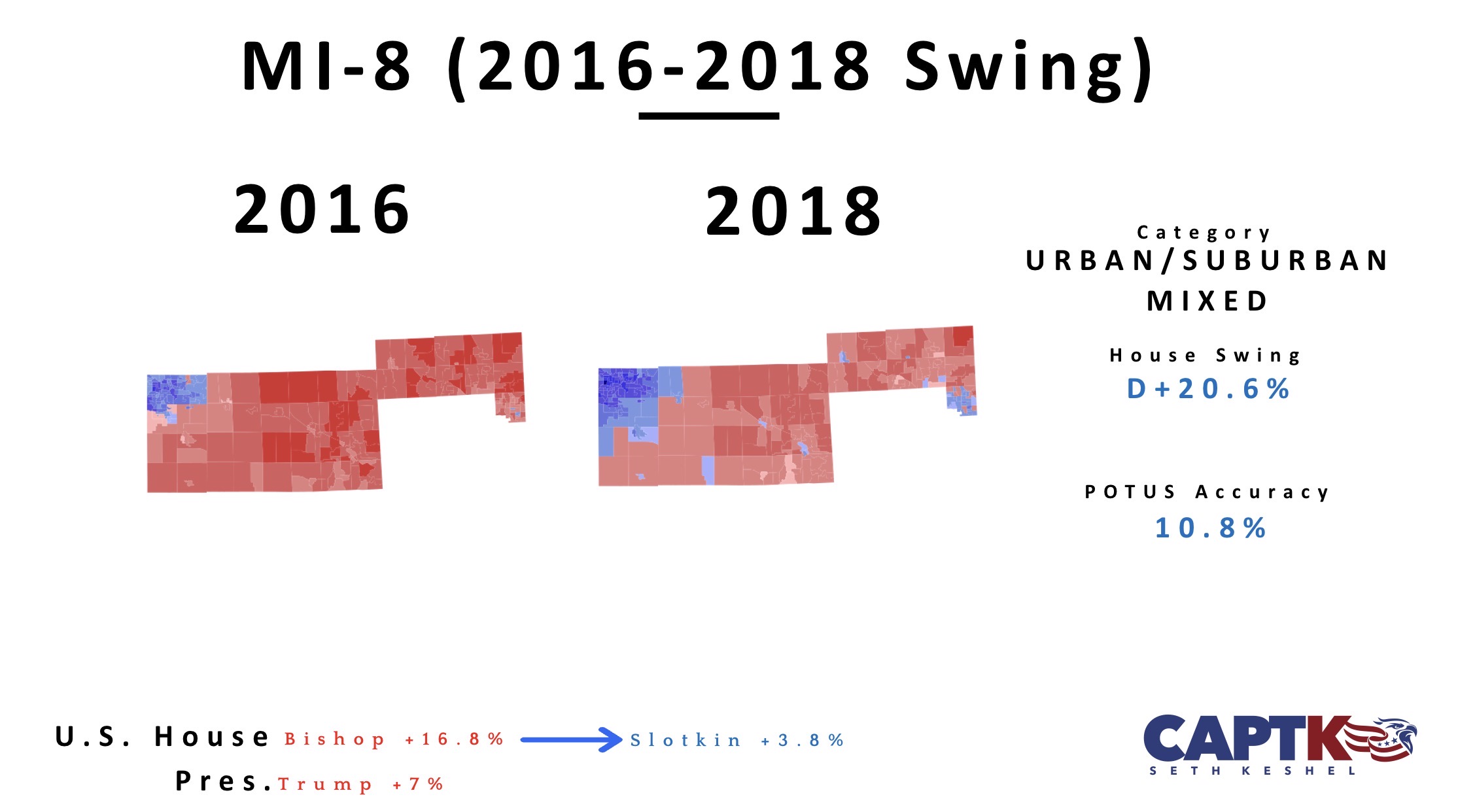
MI-7, according to Cook, rates as EVEN for its PVI rating. Its boundaries have undergone substantial redrawing and now extend further into the heart of the state than they once did, and have come to include Lansing in this decade. The Lansing portion of the district is what swung so heavily in the old MI-8, which eliminated Republican Mike Bishop in the 2018 wave and installed Elissa Slotkin, the now-Senator who spends her time comparing the president to Saddam Hussein and encouraging the military to disobey orders.

Election history of Michigan's old 8th District

MI-8, meeting the danger profile of a Republican House representative significantly outrunning Trump on the same ticket (by 9.8%), sustained one of the most serious left swings of the entire 2018 cycle, and Slotkin held the seat in the controversial 2020 election by almost the exact same margin (+3.6%). When maps were redrawn, Slotkin’s new seat became the current MI-7 (the subject of this forecast), adding on Clinton and Shiawassee Counties (and the vast chunk of Eaton), and altering the portion of Oakland County included in the district.

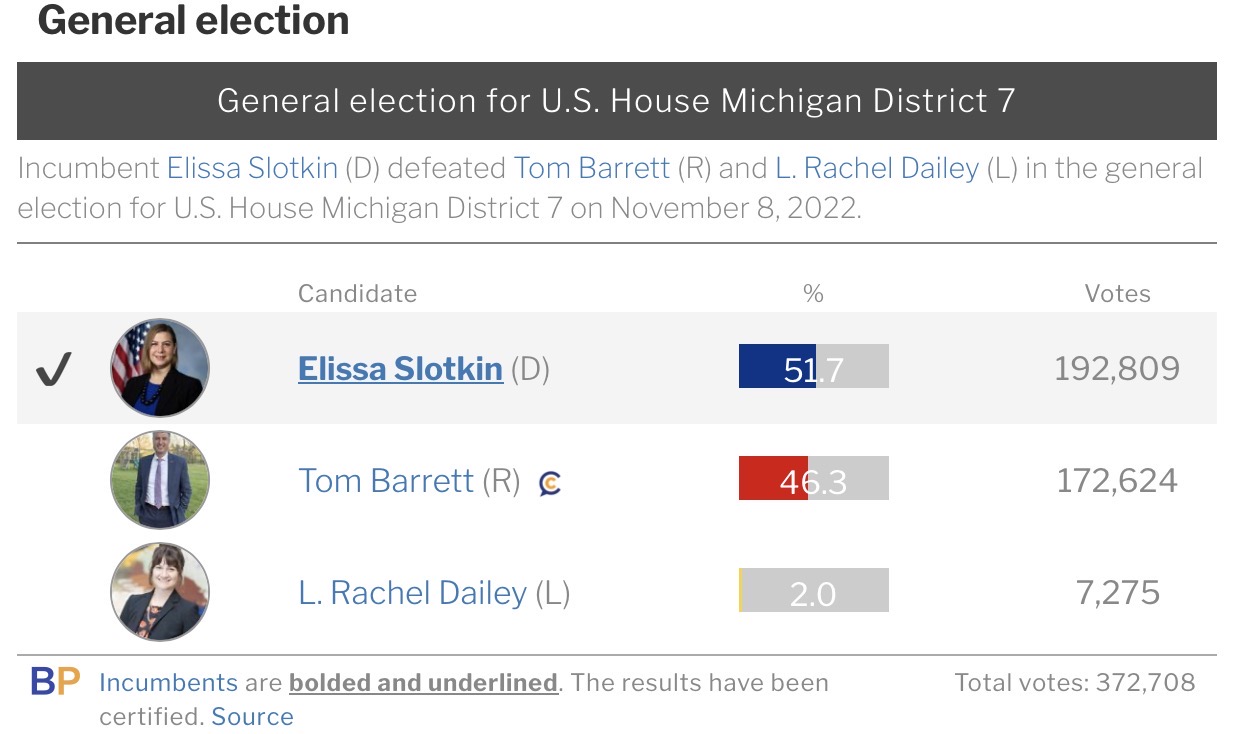
In the first race under the new boundaries, Slotkin repelled the GOP House advantage by holding the seat with a margin of +5.4% over Barrett:

2022 MI-7 result, Slotkin over Barrett

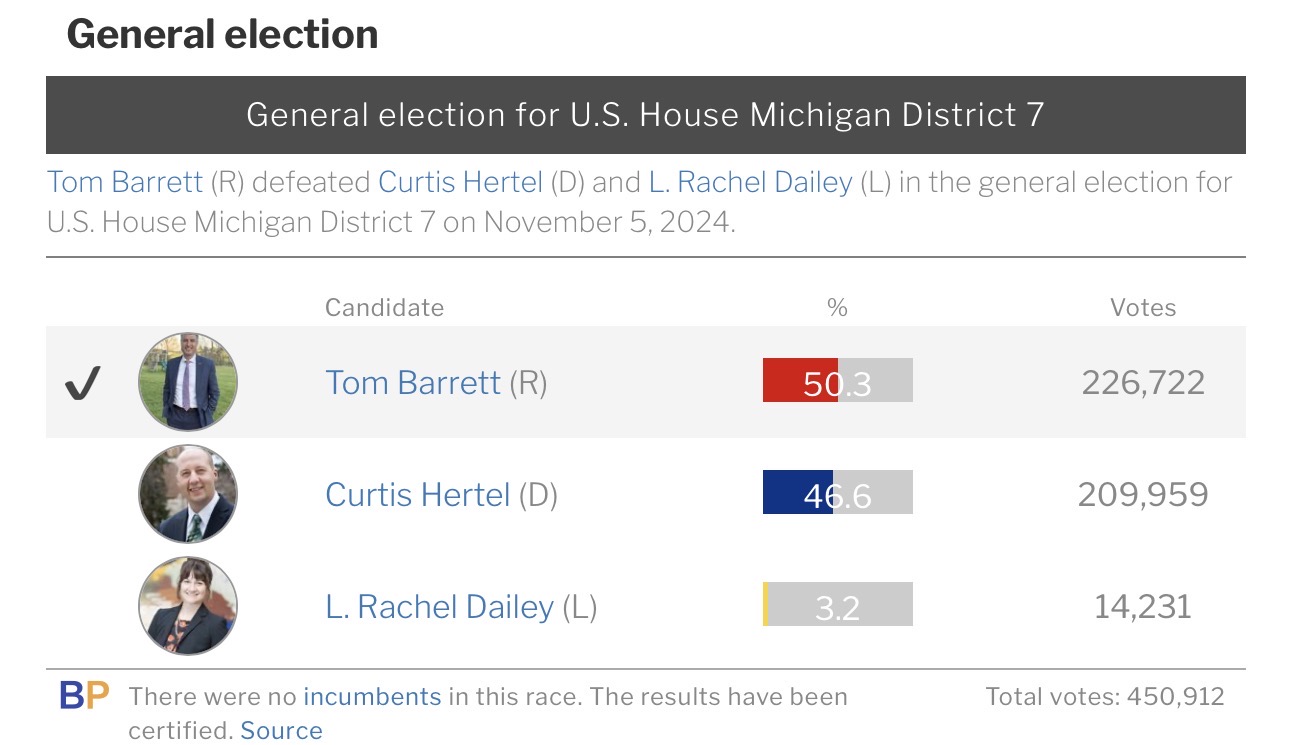
Barrett gave it another shot in 2024, with Slotkin vacating the seat to run for the U.S. Senate, and prevailed with a margin of +3.7%, with a libertarian sucking down 3.2% of the vote. It is unclear what the district baseline may be without the libertarian disruption. As it stands, Barrett ran 2.1% ahead of Trump by margin of victory, though his vote share is barely higher.

2024 MI-7 result, Barrett's win

Given its urban and suburban profile, plus the capital city and major university factor (Michigan State University) present in Lansing and Ingham County alone, MI-7 immediately falls into the 2018 threat category upon first glance.

V. Analysis of 2026 Primary Results

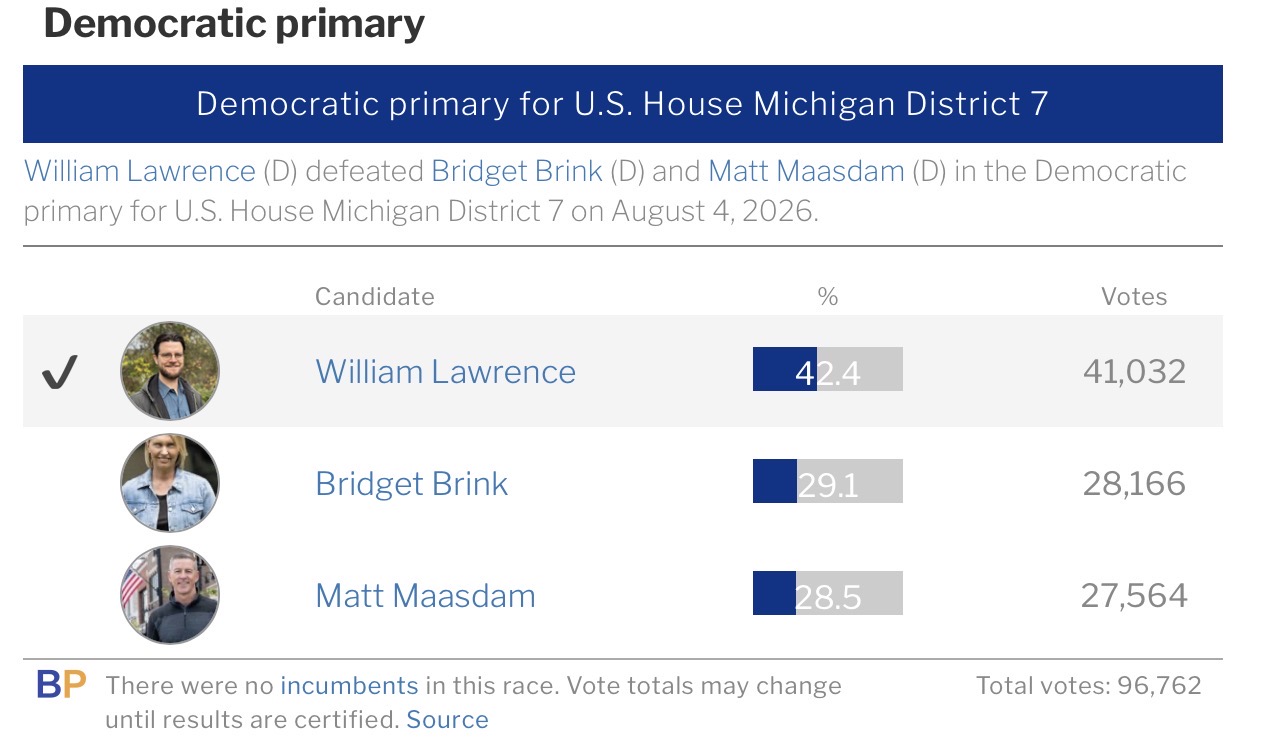
Barrett ran unopposed in the 2026 GOP primary. Lawrence, on the other hand, prevailed in a three-person field with all candidates receiving considerable vote shares:

2026 MI-7 Democrat primary results

This a wonderful example of the Democrat grassroots toppling an easily winnable race by tapping the wrong candidate in a primary – normally a Republican problem.

Maasdam is a Navy SEAL who served as a military aide to President Obama. He centered his campaign on cutting healthcare costs and catering to manufacturing interests. Brink spent a career in the State Department and has served as Ambassador to Slovakia and Ukraine in the past decade; her profile closely resembled Slotkin’s. Both candidates have formally endorsed Lawrence, although it seems to be more out of political necessity rather than genuine enthusiasm. Maasdam, despite finishing behind Brink, had urged her to drop out just before the primary to avoid splitting the moderate vote.

The two moderate candidates received 57.6% of the primary vote, which gives Lawrence a problem like his U.S. Senate counterpart, Abdul El-Sayed, in uniting the Democrat factions.

Advantage: Barrett

VI. Polls

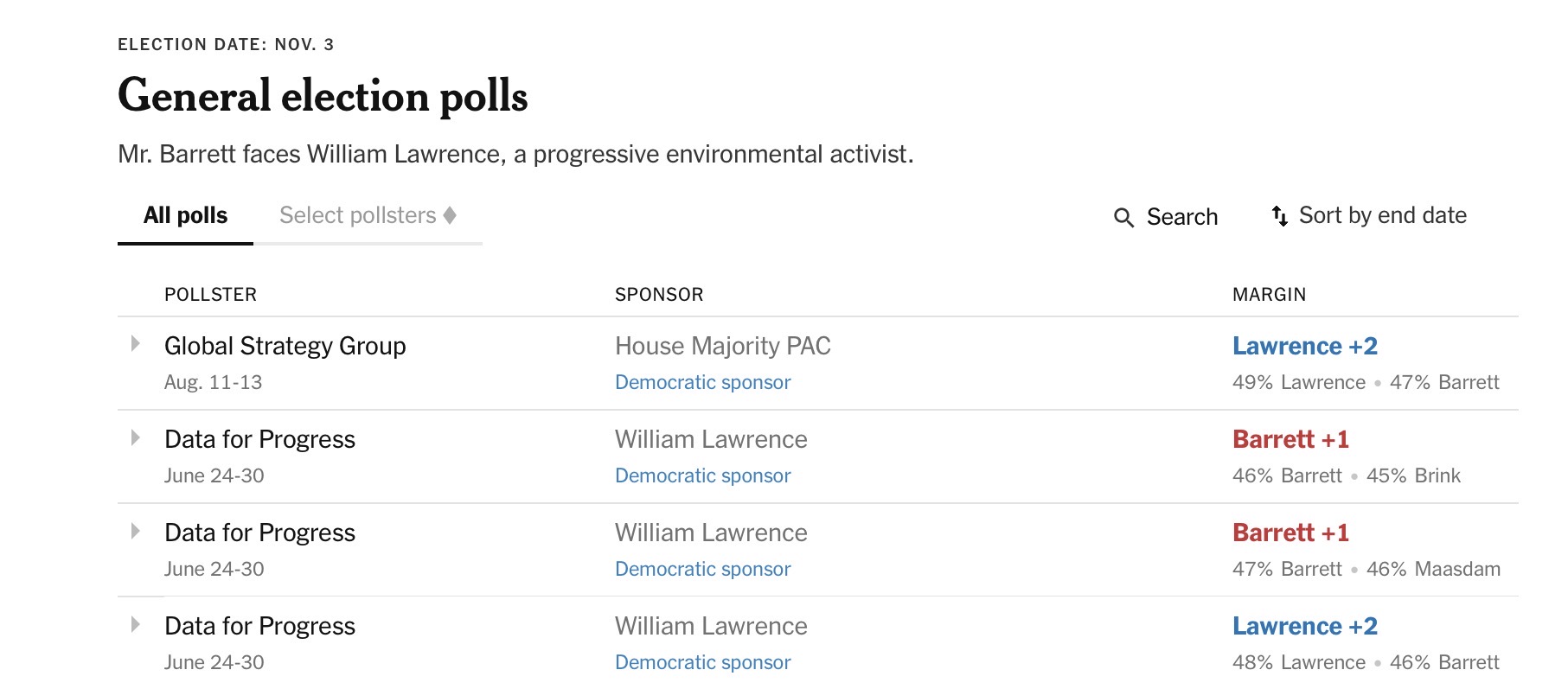
I pulled these polls from The New York Times:

Recent polls of the MI-7 race

None of them are good polls for Lawrence. He commissioned three himself during the Democrat primary, with the ones for his opponents’ hypothetical matchups with Barrett showing them losing, but his poll showing him winning. Another Democrat sponsor, House Majority PAC, got Lawrence +2 in August with Global Strategy Group doing the work.

The polls here are inconclusive, and amount to a push.

VII. Media Ratings

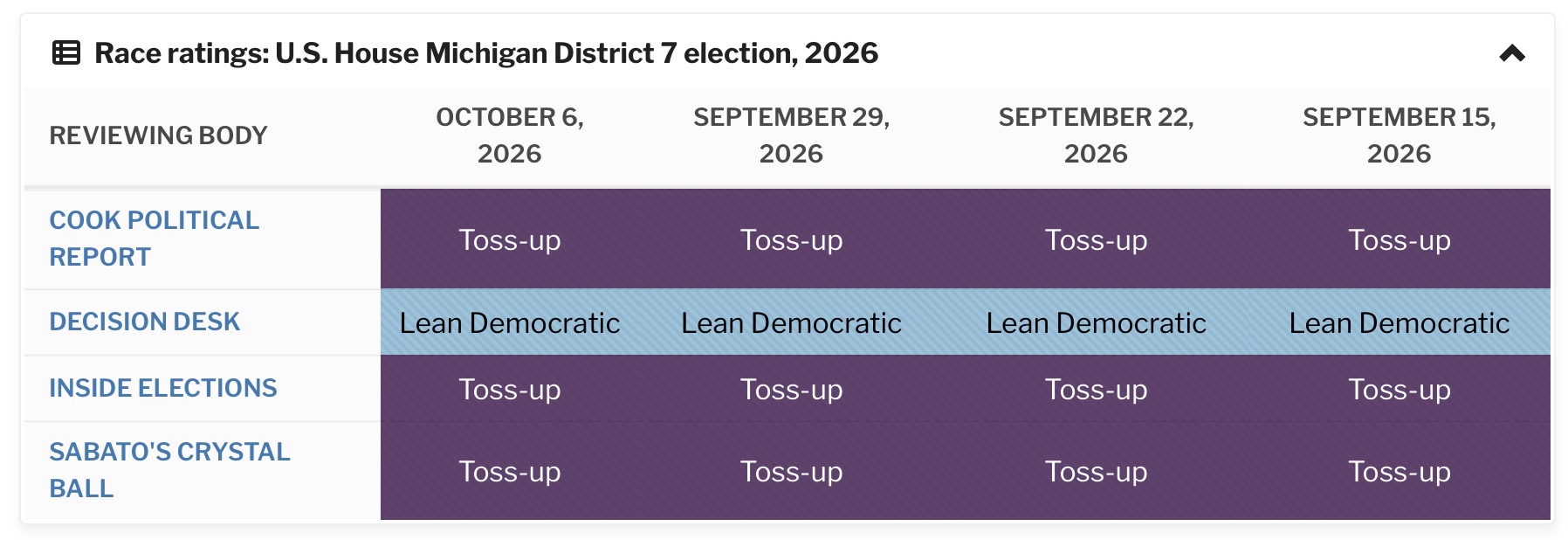
Media race ratings for MI-7

Three of the four major think tanks have this race as a toss-up, with only Decision Desk breaking from the ranks and leaning Lawrence.

VIII. Party Registration

Michigan does not register voters by party, but Pennsylvania does. The two have shifted together in the same direction in every presidential election since 1952, meaning that if Michigan did have party registration, it would move like Pennsylvania’s. Pennsylvania sits well to the right of its 2024 registration (D+3.1%), but has experienced Democrat gains in recent months. Those gains are primarily in the Philadelphia and Pittsburgh markets, but also in the capital region of Harrisburg.

Therefore, it is likely that Lansing and Ingham County are leaning slightly left since 2024, but the overwhelmingly red areas of MI-7 would not be.

IX. Election Considerations

No one who pays attention to American elections can forget the night of November 3, 2020, particularly how the TCF Center in Detroit was sealed off from the view of election observers as a massive Trump lead in Michigan slipped away. Michigan, of course, went on to be called in the wee hours of November 4 for Biden after a twofold increase in mail-in ballots from 2016 to 2020.

I have also documented the Michigan Senate primary from this summer, and am confident that Abdul El-Sayed survived a Democrat establishment effort to give the nomination to Haley Stevens through mail-in ballot fraud. You can make up your own mind when you review the stats.

Michigan, thanks to changes in election laws since 2016, has emerged as one of the national epicenters of election corruption. I documented all of these changes in my 2024 election review of the state, which Trump managed to win against the obstacles in place.

From that article:

• Voter ID – Michigan has a photo ID requirement for in-person voting, but there are workarounds available.
• Same Day Registration – Same day registration is allowed in Michigan.
• Ballot Harvesting – Like Pennsylvania, Michigan has reasonable ballot harvesting laws, but enforcement is lacking and does not deter the practice, which can be easily spotted by trend analysis and precinct mapping to spot for ballot bloat.
• Unique Corruption – Michigan has been exposed for covering up voter registration fraud rings, particularly in a major 2023 news story involving one in Muskegon County active during the 2020 election. Notably, similar registration fraud rings were exposed this cycle in Pennsylvania in multiple large counties. The state’s Attorney General, Dana Nessel, has threatened election integrity activists with imprisonment and police persecution for drawing attention to Michigan’s endless examples of election-related malfeasance.
• Automatic Voter Registration – Michigan operates Automatic Voter Registration, which has only entrenched Michigan’s voter registration corruption, as evidenced by the state having hundreds of thousands of more voters registered than there is an available pool of eligible voters statewide. The Secretary of State, Jocelyn Benson, has suggested the state is helpless to clean its voter rolls and responds harshly to citizens who expect the state to run fair elections. As a reminder, more than 83% of Michigan’s total population (including minors) is registered to vote, when only 77% of any population is over the age of 18 and therefore old enough to cast a ballot.

No state with the number of registered voters exceeding voting-age population can be trusted to run fair elections, and if control of the House hinges on MI-7, even the Democrat establishment will go to bat for Lawrence and trust they can bend him to their will in a hypothetical majority.

X. Summary and Election Estimate

Based on the volatility of suburban areas, which smoked the GOP in 2018, I would have this a 75/25 Democrat flip (likelihood, not margin) had Brink or Maasdam emerged from the Democrat primary with the nomination. This type of voter is exactly the type that bases a midterm vote on their opinion of the president and pleas for moderation, unless given a better reason to consider how to vote. And that reason is staring back at them on the ballot:

Graphic about Democrat candidate William Lawrence

Lawrence is indeed a leftist radical, and here are some of his credentials:

• Former DSA member and co-founder of the Sunrise Movement, a climate activist group pushing the Green New Deal
• Advisor to Dream Defenders, a radical socialist group seeking to dismantle the “capitalist police state”
• Has deleted many extreme online posts proclaiming his support for abolishing prisons and police and open migration for anyone to move anywhere, while ripping moderate Democrats in very harsh terms

Tom Barrett called this out in grand fashion at this week’s debate:

Socialist felon @WeWill2026 Lawrence to a Democrat who wasn’t extreme enough for him: "F*ck you… Hurry up and die." Liberal lunatic Lawrence is completely unfit to serve in Congress

NRCC (@NRCC), Oct 6, 2026

Barrett is flogging Lawrence financially, although those numbers will tighten some with the final report before the election. He has 6 times more receipts and 7.5 times more cash on hand than the guy who despises the capitalist system, and isn’t afraid to use it.

From the proprietary mapping file, you can get a lay of the land:

Captain K proprietary precinct map of MI-7
Captain K Proprietary Mapping

Barrett, thanks to Lawrence’s extremism, should dominate the vast expanse of the district, which is filled with favorable MAGA/GOP precincts. If Lawrence’s positions and campaign incompetence cause him to lose ground in the purple (solid and striped) precincts around Lansing, and the urban Democrat vote is down as we are seeing in early data, then Barrett has a clear advantage.

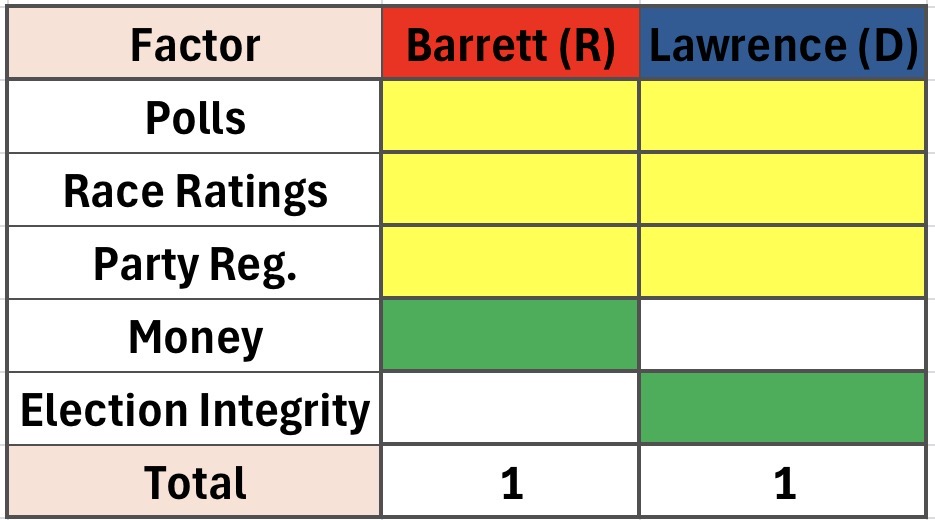
Here is how the key factors in this race stack up:

Key factors in the MI-7 race

Forecast for MI-7 House

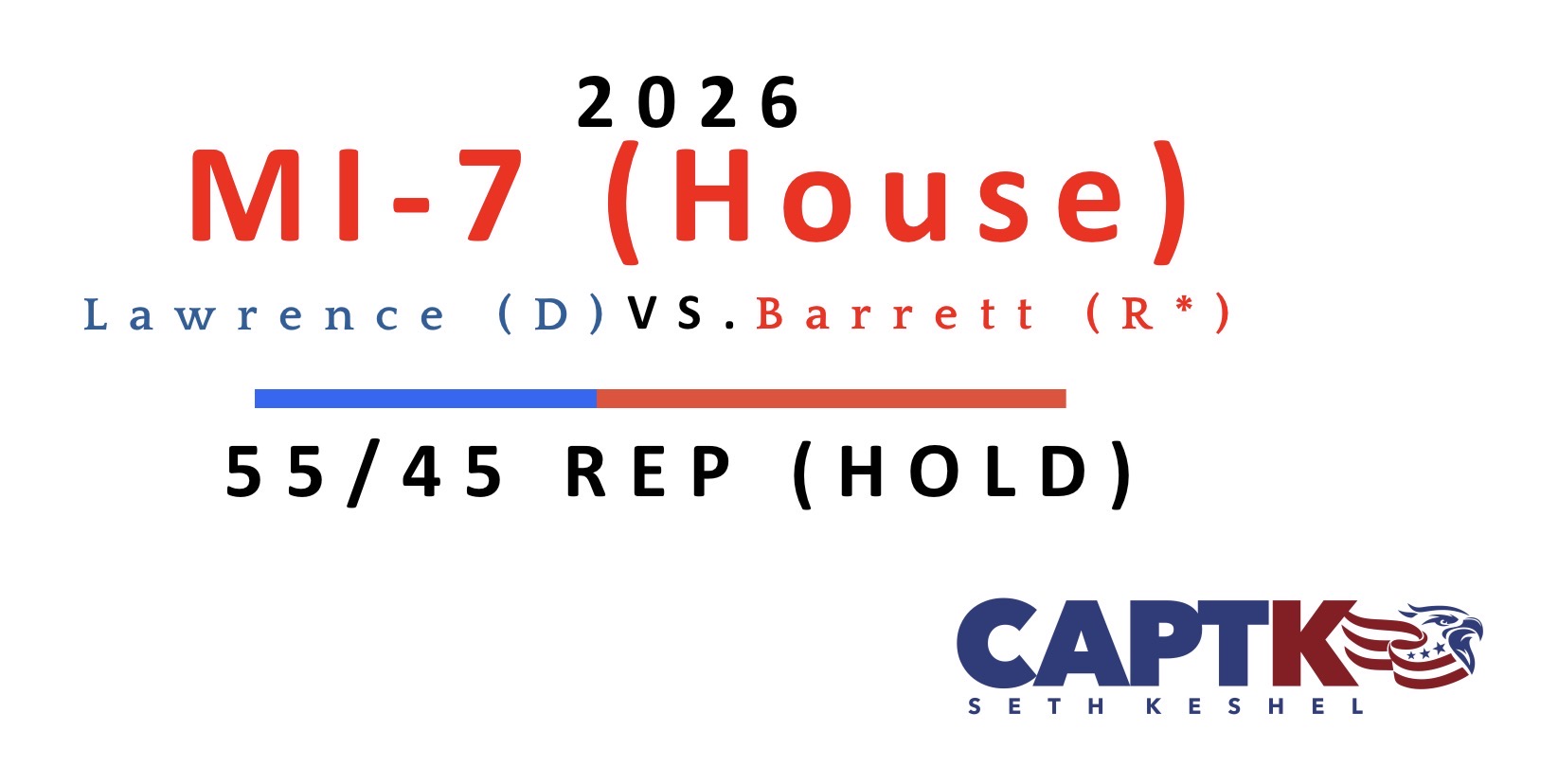
Forecast for the MI-7 U.S. House race

A potential Republican House majority always needed to catch a few breaks, especially with the courts stacked against them and so many difficult seats up for defense. MI-7 is a logical loss in this cycle given its very moderate nature found at the mercy of the state capital, but Lawrence makes it, I believe, more likely than not that the GOP will hold the seat. Lawrence still has a shot at flipping it thanks to midterm dynamics, but it will take all Democrat hands on deck in a state already struggling to back its Senate nominee at full throttle.

Seth Keshel, MBA is a Senior Fellow at the Gold Institute for International Strategy and a retired Army Captain. He publishes Captain K’s Corner on Substack.
Peter Huessy warns the theater nuclear deterrence gap is widening

A naval warship's open missile launcher bays. Photo by mingche lee on Pexels

Senior Fellow Peter Huessy joined The John Batchelor Show to discuss the widening gap in theater nuclear deterrence.

On The John Batchelor Show, Peter Huessy highlights America’s vulnerability in theater nuclear deterrence, where adversaries like Russia and China possess thousands of accurate regional nuclear weapons compared to minimal U.S. capabilities. He argues that Cold War disarmament sharply cut American theater capabilities and that modern deterrence calls for small nuclear cruise missiles on submarines, noting that a bipartisan congressional commission unanimously recommended rebuilding these capabilities, though procurement delays mean new systems will not be ready until 2030.

Peter Huessy is a Senior Fellow at the Gold Institute for International Strategy, a Washington D.C. based foreign policy and defense think tank.
Listen on The John Batchelor Show

Spain, Vox and the Future of Europe: Hermann Tertsch Warns of What Is to Come

Hermann Tertsch on the Quorvm Podcast

This segment was hosted by Javi Cabello and aired on Quorvm Podcast. España, Vox y el futuro de Europa: Hermann Tertsch advierte de lo que está por venir.

Featuring Hermann Tertsch, Distinguished Fellow (Honorary), Gold Institute for International Strategy

In brief

Hermann Tertsch joins Javi Cabello on the Quorvm Podcast to discuss Spain, Vox and the future of Europe.

From the show’s own description (translated): Hermann Tertsch talks about El País, the 11-M attacks, the Spanish Transition and the Constitution, as well as the PSOE, PP, Vox and Spain’s political future.

The interview is conducted in Spanish.

Watch the full segment at Quorvm Podcast

Hermann Tertsch is a Distinguished Fellow (Honorary) at the Gold Institute for International Strategy, a Washington, D.C. foreign policy and defense think tank.