Seoul pushes back against US signal for OPCON transfer delay

Gen. Xavier Brunson, commander of U.S. Forces Korea

This article was written by Bahk Eun-ji and appeared in The Korea Times. Seoul pushes back against US signal for OPCON transfer delay.

Featuring The Second Annual Indo-Pacific Summit, October 14, 2026, Gold Institute for International Strategy

The Korea Times reports that South Korea’s military will keep to the conditions for wartime operational control (OPCON) transfer agreed in 2015, after U.S. Forces Korea commander Gen. Xavier Brunson said changing threats call for new standards. Gen. Brunson made his remarks at the Gold Institute’s Second Annual Indo-Pacific Summit in Washington on October 14, where he said he supports the transfer but that time itself is a condition, pointing to North Korea’s recent missile tests.

The Defense Ministry’s spokesperson and Defense Minister Kang Shin-chul answered that the principle has not changed and that differences will be settled at the Security Consultative Meeting expected in December, while USFK reaffirmed a conditions-based approach. The article also carries analysis from Korean defense experts on the conditions and on North Korea’s missile capabilities.

The Second Annual Indo-Pacific Summit

Gen. Brunson spoke “during the Indo-Pacific Summit hosted by the Gold Institute for International Strategy.”

Read the full article at The Korea Times

The Gold Institute for International Strategy is a Washington, D.C. foreign policy and defense think tank.

Gen. Michael Flynn Awarded Korean Name ‘Shin Min-soo’ at the Second Indo-Pacific Summit

Chairman Woo Hyun-ui, Gen. Michael Flynn and Chairman Im Ho-young at the Korean naming ceremony in Washington

This article was written by Korea Daily Digital and appeared in The Korea Daily. Michael Flynn — Former US General Awarded Korean Name ‘Shin Min-soo’.

Featuring The Second Annual Indo-Pacific Summit, October 14, 2026, Gold Institute for International Strategy

The Korea Daily reports that the Korea-U.S. Alliance Friendship Association, together with the Korea-U.S. Alliance Foundation, presented Gold Institute Chairman Lt. Gen. (Ret.) Michael T. Flynn with the Korean name Shin Min-soo, along with a naming plaque, a traditional scroll and a personal seal, during the Second Annual Indo-Pacific Summit in Washington, co-hosted by the Foundation and the Gold Institute.

The association tied the name to Pyeongtaek, home of the U.S. Forces Korea headquarters, and explained that it carries the meaning of guarding the people, in honor of his father’s service as a Korean War veteran. Gen. Flynn described his family’s three generations of connection to Korea and noted that his own first name, Michael, likewise means a protector. Past recipients of Korean names from the association include Presidents Trump, Biden and Obama.

The Second Annual Indo-Pacific Summit

Gen. Flynn: “I will cherish the honor you have given me for the rest of my life.”

Read the full article at The Korea Daily

The Gold Institute for International Strategy is a Washington, D.C. foreign policy and defense think tank.

2026 Ten-Point Forecasts: FL U.S. Senate and Governor

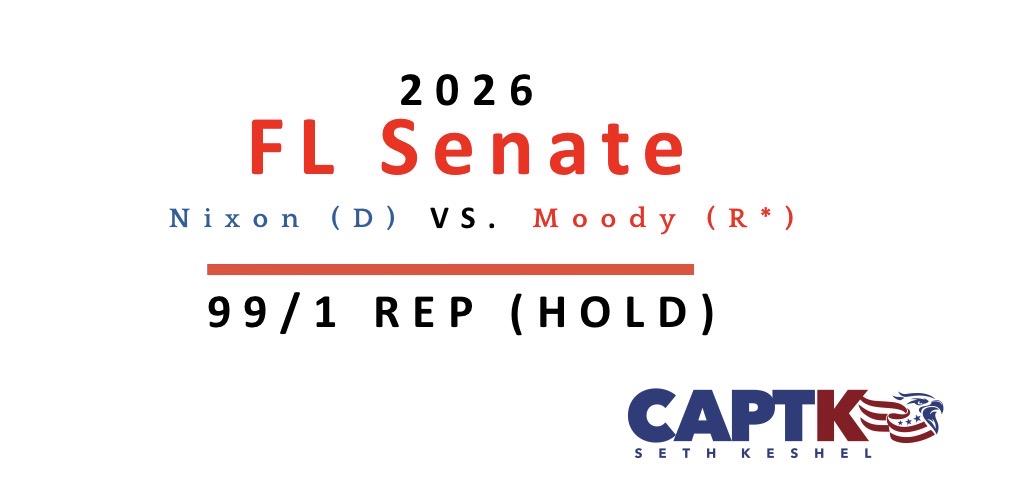
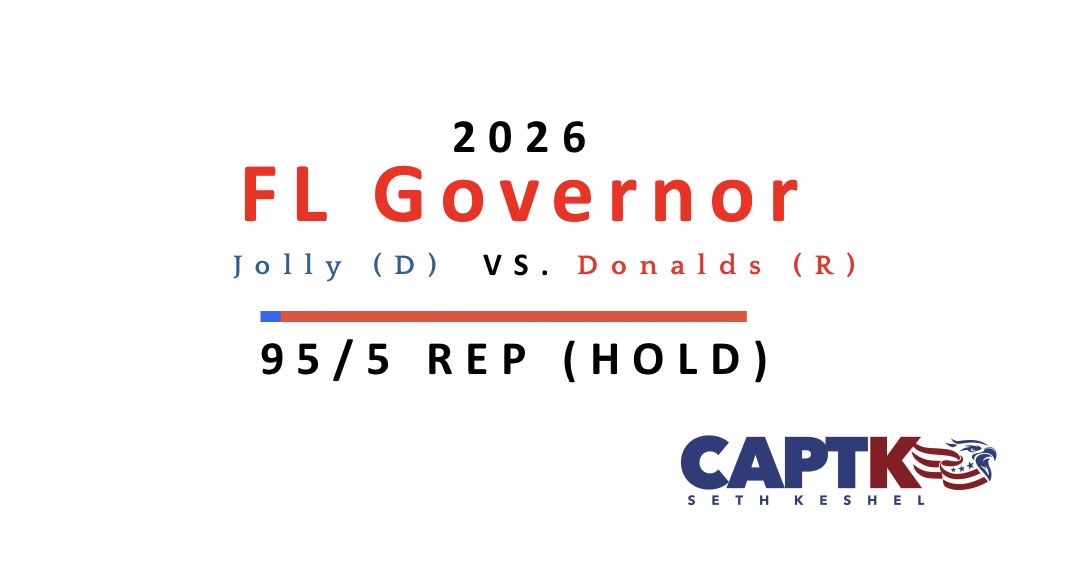
Florida U.S. Senate and governor forecast graphic

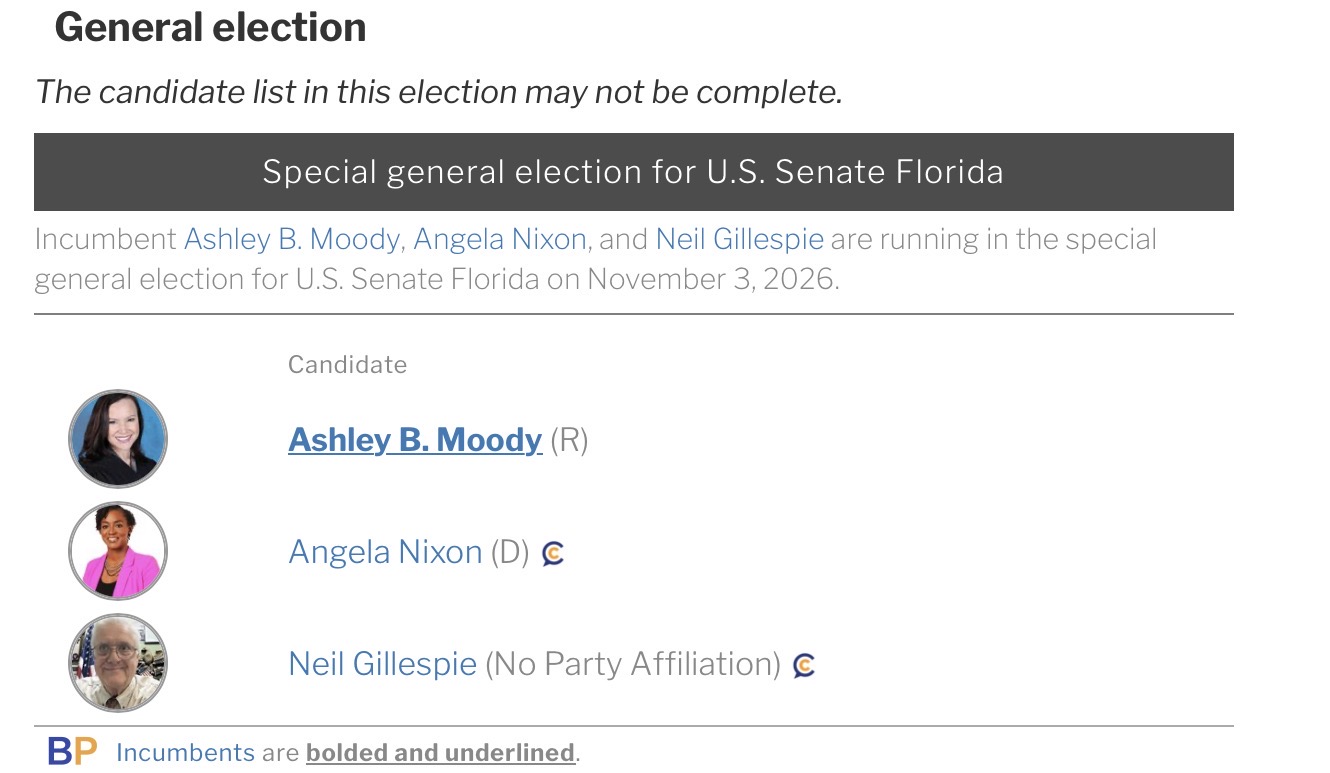
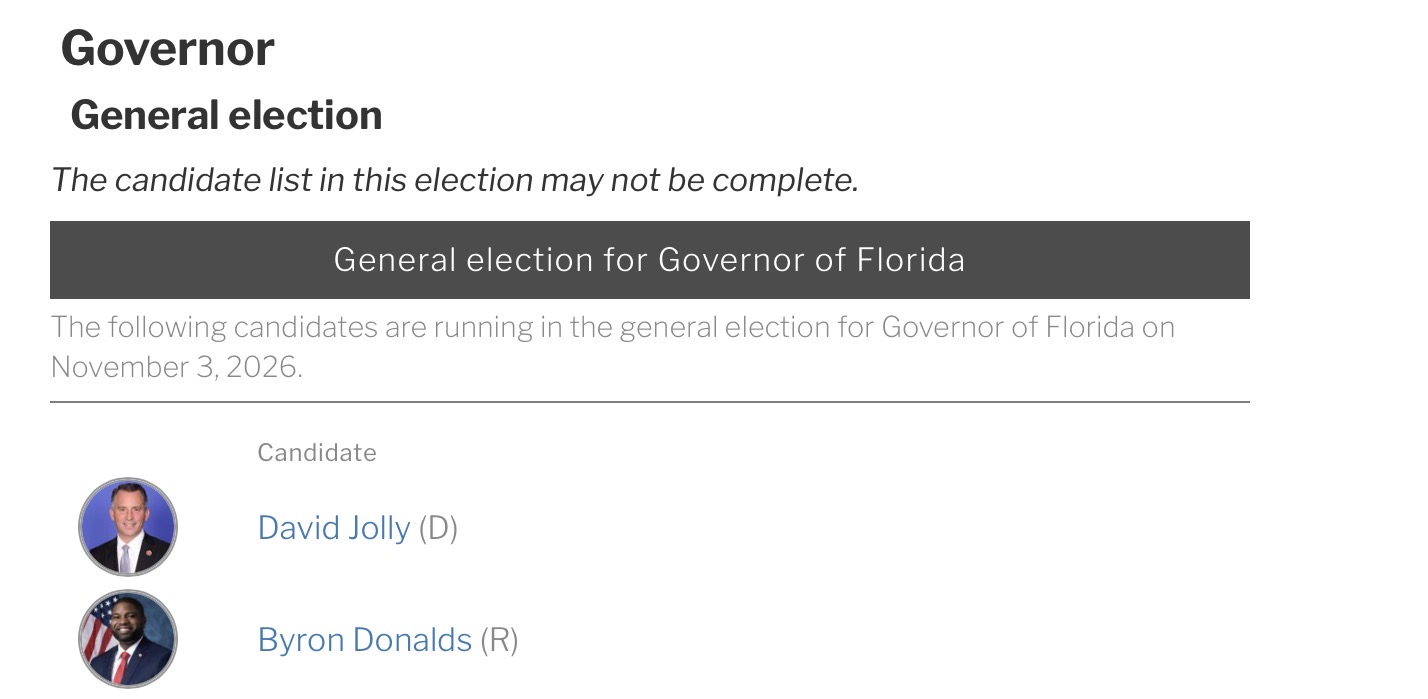
Ashley Moody (R*) vs. Angie Nixon; Byron Donalds (R) vs. David Jolly (D)

I. The Races

U.S. Senate

Florida U.S. Senate candidates Ashley Moody and Angie Nixon

Ashley Moody (Republican) was appointed to replace Marco Rubio in the United States Senate after he (Rubio) became Secretary of State under Trump 47. Moody had previously been Florida’s Attorney General, most recently winning her second term by +21.2% in 2022. She now faces a special election required by state law.

Angie Nixon (Democrat) is a DSA-aligned politician with three terms in the Florida House of Representatives. She shocked everyone by winning the Democrat nomination against Alexander Vindman in the August primary.

Governor

Florida governor candidates Byron Donalds and David Jolly

Byron Donalds (Republican) is the GOP nominee for governor after serving three terms in the U.S. House representing FL-19 (southwestern Florida). He is seeking to continue the reforms of Governor Ron DeSantis, under whom Florida has transformed into a powerful red state.

David Jolly (Democrat) is the latest former Republican to turn Democrat and seek the governorship, following Charlie Crist. Crist lost a close election to Rick Scott in 2014, and was absolutely annihilated by DeSantis in 2022. Strangely enough, Jolly served parts of two terms in the old FL-13, before being ousted by Crist in 2016.

II. State Profile

Florida state profile map

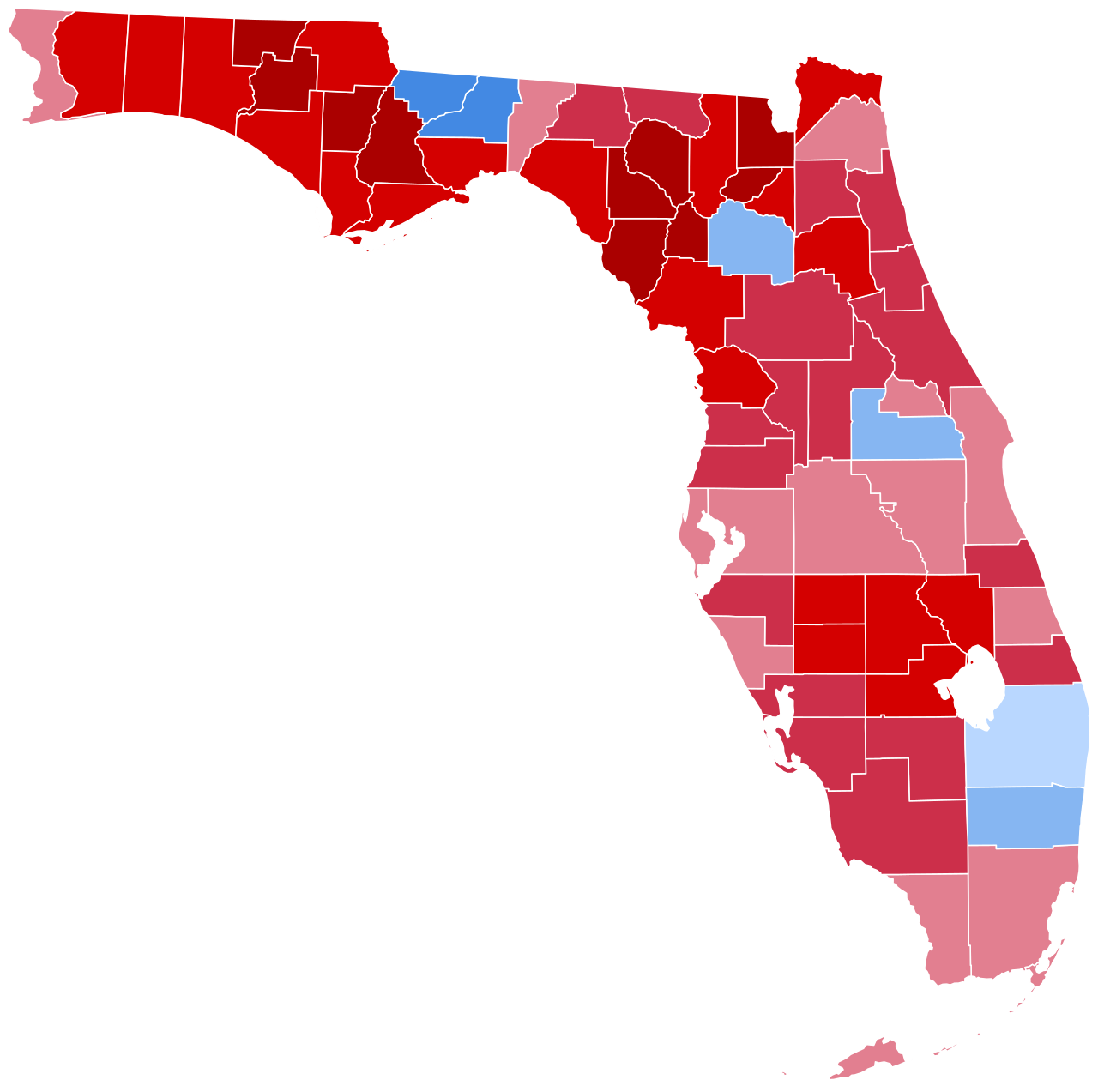
Most Captain K’s Corner readers remember Florida as an absolutely vital presidential swing state with a GOP-lean for statewide offices. Florida was so critical for Republican hopes that no GOP nominee for president made it to the White House without carrying Florida since 1924. Thanks to the rise of Donald Trump, and the governorship of Ron DeSantis, the days of Florida as a bellwether and swing state are long gone.

Florida presidential election margins

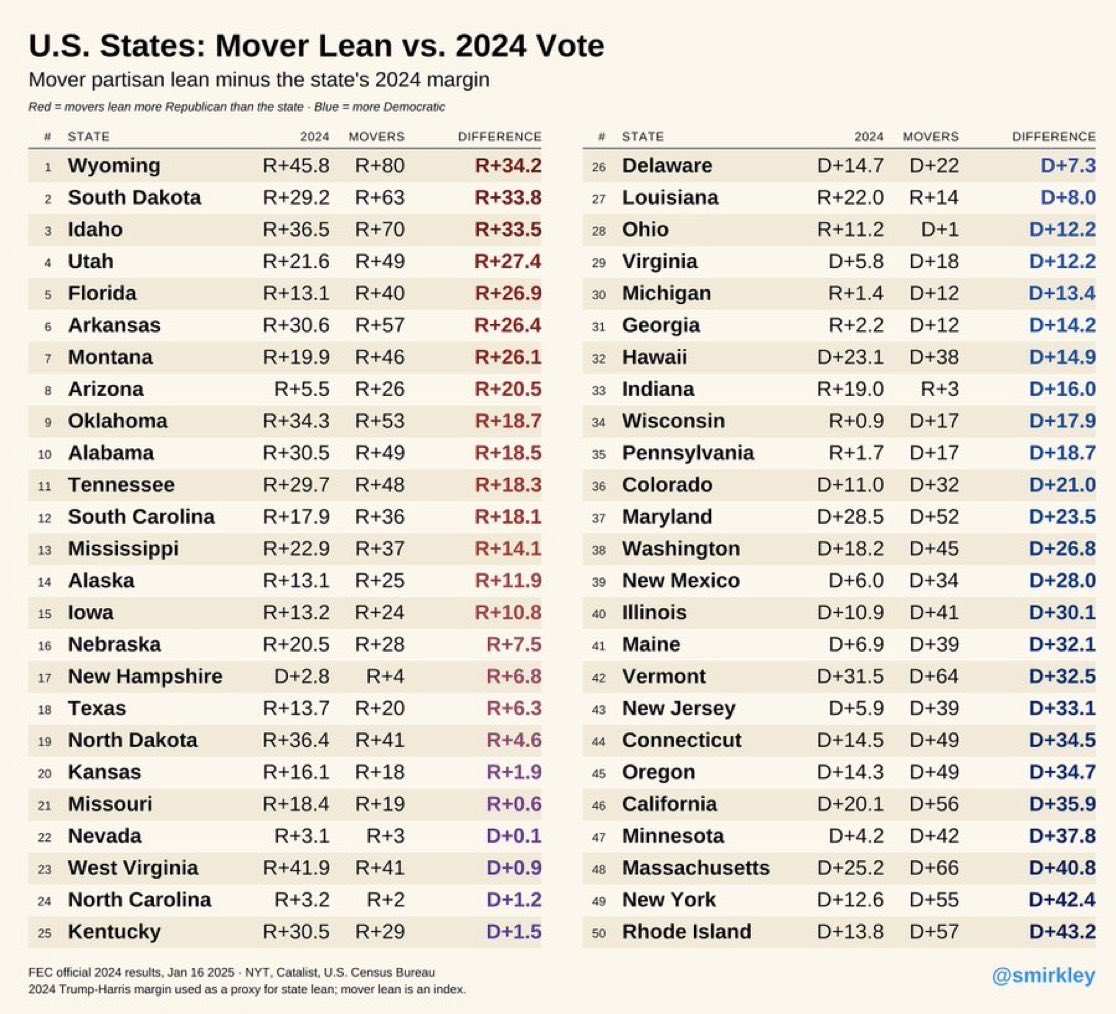
Florida is more than R+11% by registration, won by Trump at a margin of 13.1% in 2024, and receives new movers who are reported to be R+40% in their partisan disposition. Combined with the realignment of the Latino voting coalitions (primarily Venezuelan, Cuban, and Puerto Rican in Florida), the Sunshine State is a near-impenetrable red fortress. Republicans, unlike their timid counterparts in Texas, have been viciously attacking Democrat strongholds, and in several instances are turning them red.

Key Statistics

51.5% White, 26.5% Hispanic, 15.1% Black

III. Market Assessment

Polymarket bettors have better vibes about Moody’s campaign against Nixon, but Donalds is also heavily favored to win the governorship.

IV. History

U.S. Senate

Past statewide races and partisan trends are typically useful guides for races like these, but Florida has become so red, the distant past resembles another state entirely. The state hasn’t had two Democrat U.S. Senators serving simultaneously since Bob Graham and Bill Nelson served simultaneously from 2001 to 2005, when Graham retired. Mel Martinez (Republican) was elected in 2004 to replace Graham, but resigned before his term was over and was replaced by George LeMieux, who finished the term and gave way to Marco Rubio.

Rubio served until his appointment to Secretary of State, winning reelection on two more occasions. In that span, Nelson was ousted by Rick Scott in a 2018 upset. Since 2019, Florida has been represented by two Republicans in the U.S. Senate and has seen their reelection margins increase drastically.

Governor

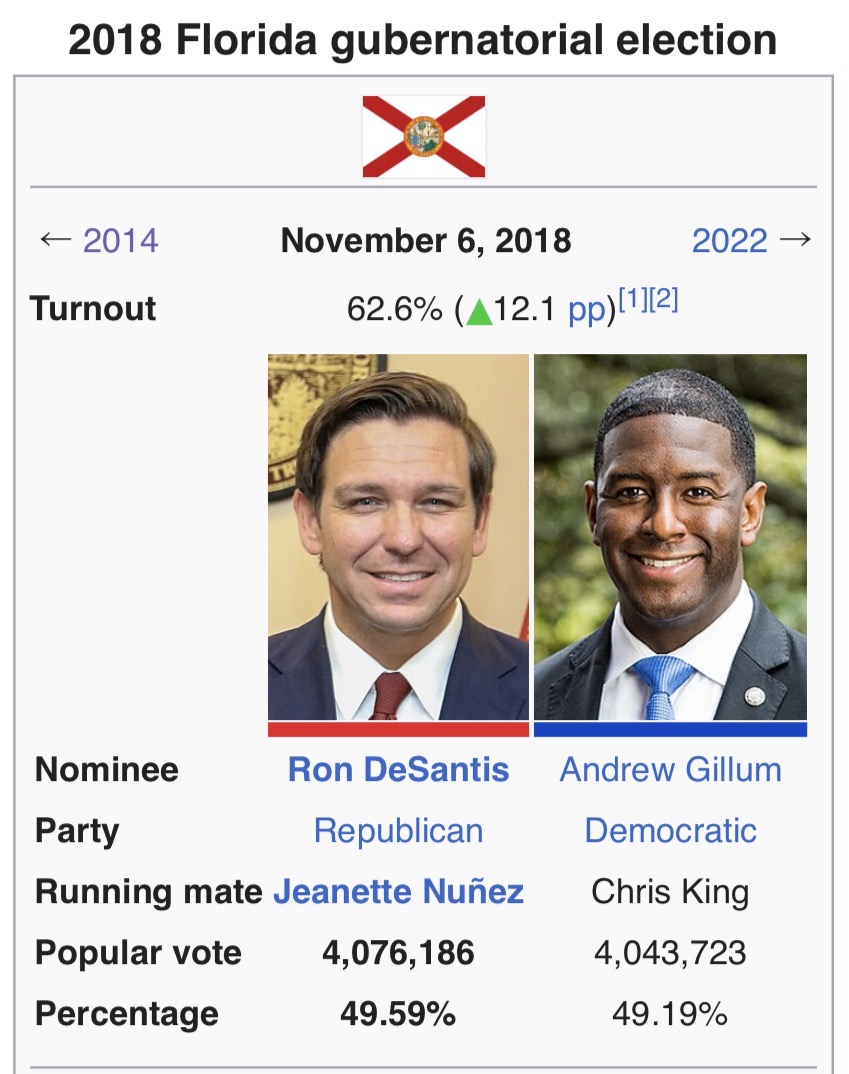
Despite its swing state status, Florida has preferred Republican governors exclusively dating back to the end of the 20th century, when Jeb Bush was elected (1998). Bush was reelected in 2002, then gave way to Crist in 2006. Crist vacated the office in 2010 and was replaced by Scott, who won harrowing margins of +1.2% in 2010 and +1.1% in 2014 to keep the streak alive. Perhaps the most important gubernatorial win of the century occurred in 2018, when DeSantis defied the polling odds and inched past Andrew Gillum:

Florida 2018 governor result, DeSantis over Gillum

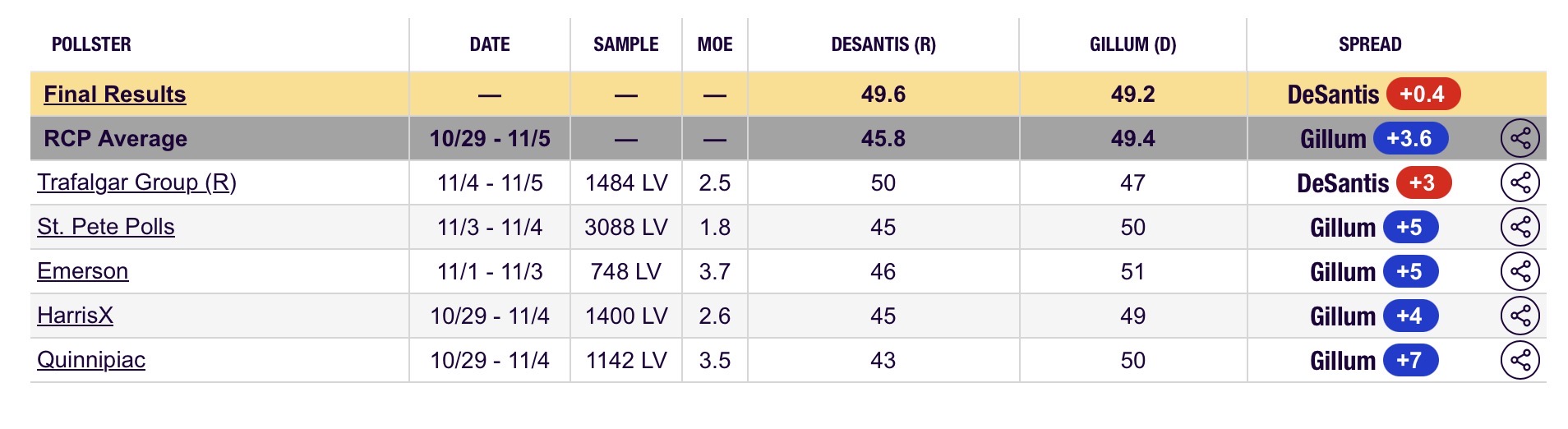
Florida was less than 33,000 Democrat votes away from electing a drug addict living a reckless lifestyle instead of the governor who turned them into the next Texas. DeSantis had been without hope until Trump endorsed his candidacy, and then overcame absolutely clueless polling to beat Gillum:

Polling in the 2018 Florida governor race

Since the modern Florida GOP made it out of the stormy waters, it has been smooth sailing.

V. Analysis of 2026 Primary Results

U.S. Senate

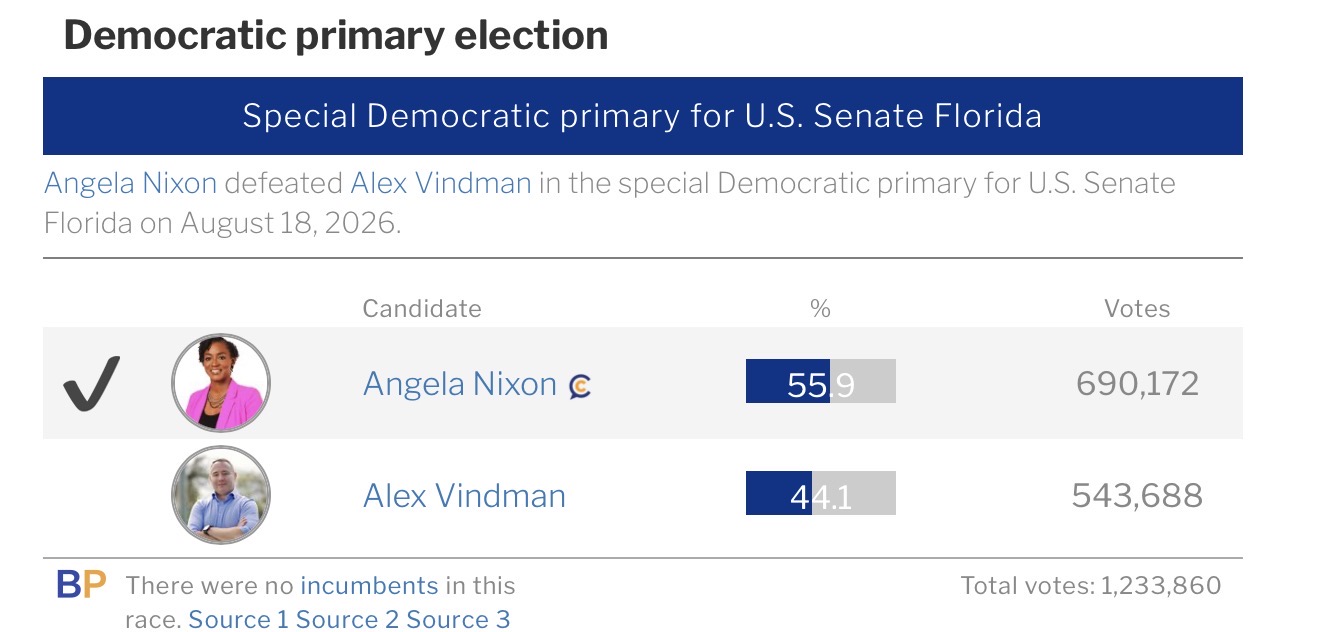
Moody took on a few primary challengers, but won her primary with 79.6% of the vote. The real primary drama took place over on the Democrat side, when Nixon stunned Vindman:

Florida 2026 Democratic U.S. Senate primary results, Nixon over Vindman

If you’re sitting around worried about what a bunch of polls say, the one poll I found on the Democrat primary had Vindman up by 10.0%. He lost by almost 12 points. Vindman, logically speaking, is a hated figure in Florida because of his role in targeting President Trump – the Republican leader at the time of Florida’s ascent to red stronghold.

Poll of the Florida 2026 Democratic U.S. Senate primary

While no one disputes the legitimacy of Nixon’s primary victory, her radicalism and ties to DSA-aligned groups will alienate the moderate baby boomers who supported Vindman and voted for Joe Biden in 2020.

Governor

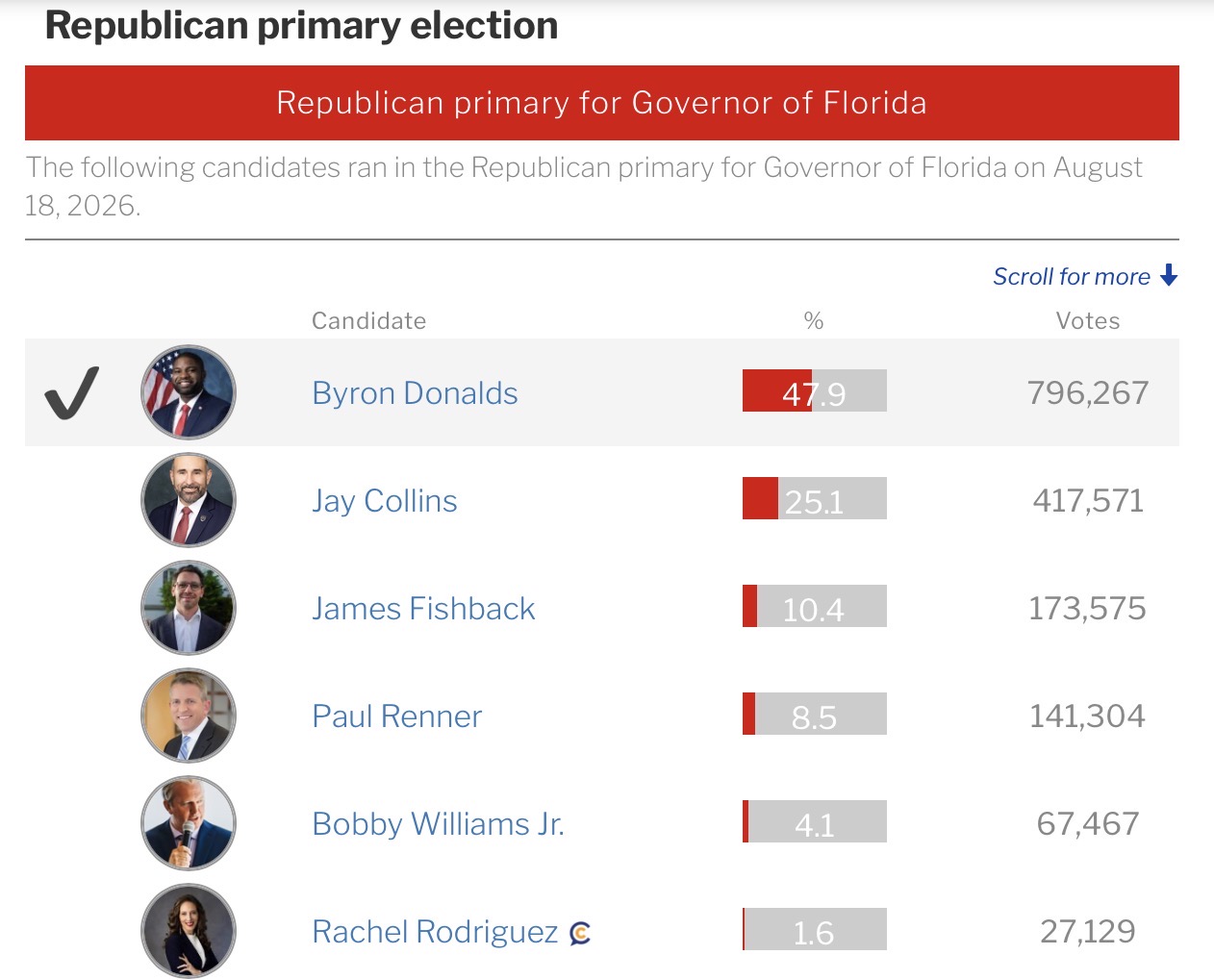
Florida 2026 Republican governor primary results

In a crowded field full of big names, including the sitting Lieutenant Governor (Collins) and former speaker of the Florida House of Representatives (Renner), as well as an insurgent fanning the flames of Gen Z resentment (Fishback), Donalds rode Trump’s endorsement to a comfortable win. While Donalds has his detractors, DeSantis is now behind his campaign and he shouldn’t be missing any key GOP coalition.

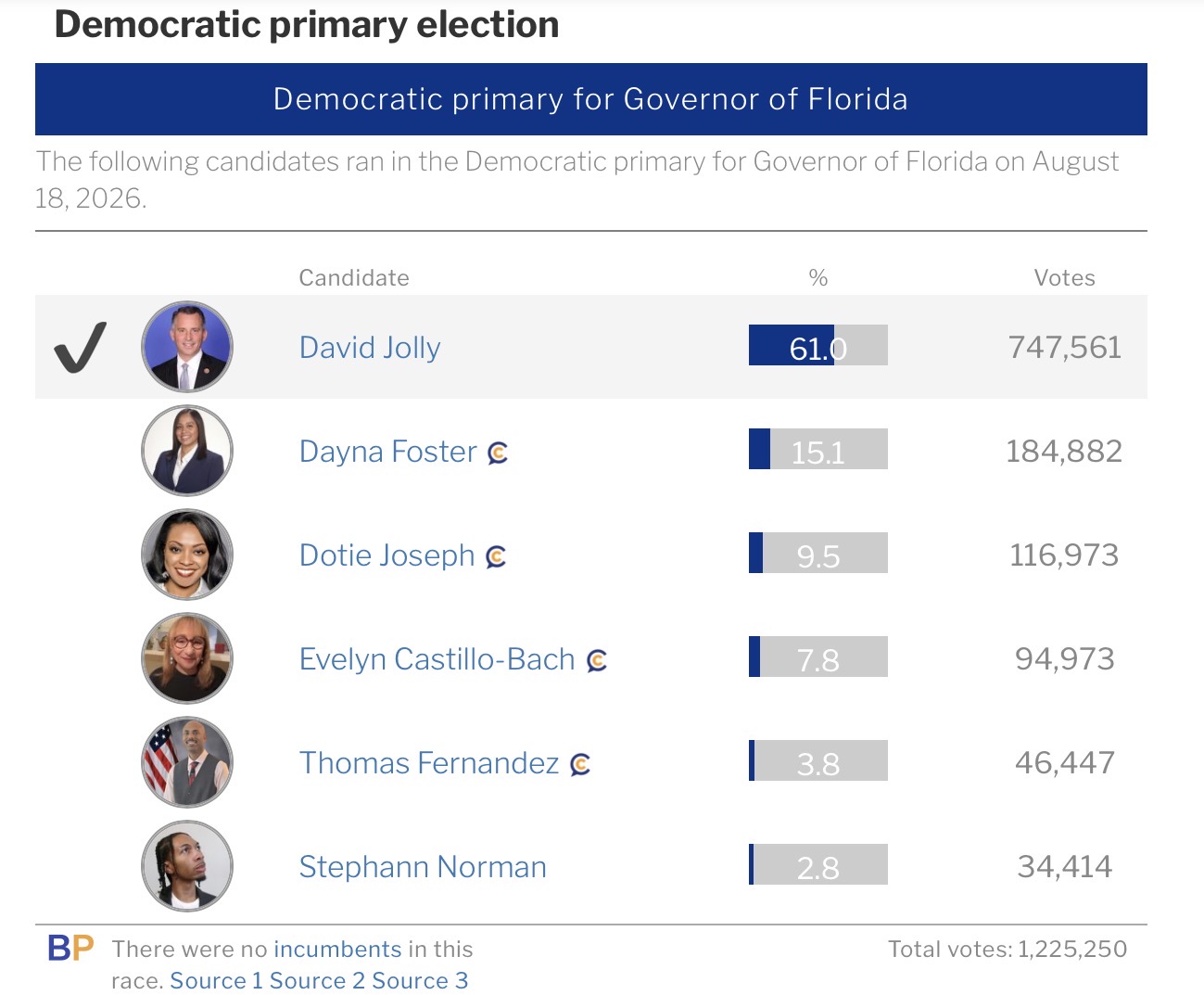
Florida 2026 Democratic governor primary results

Jolly won an easy majority in another crowded field, and there is no reported Democrat drama surrounding his win.

VI. Polls

U.S. Senate

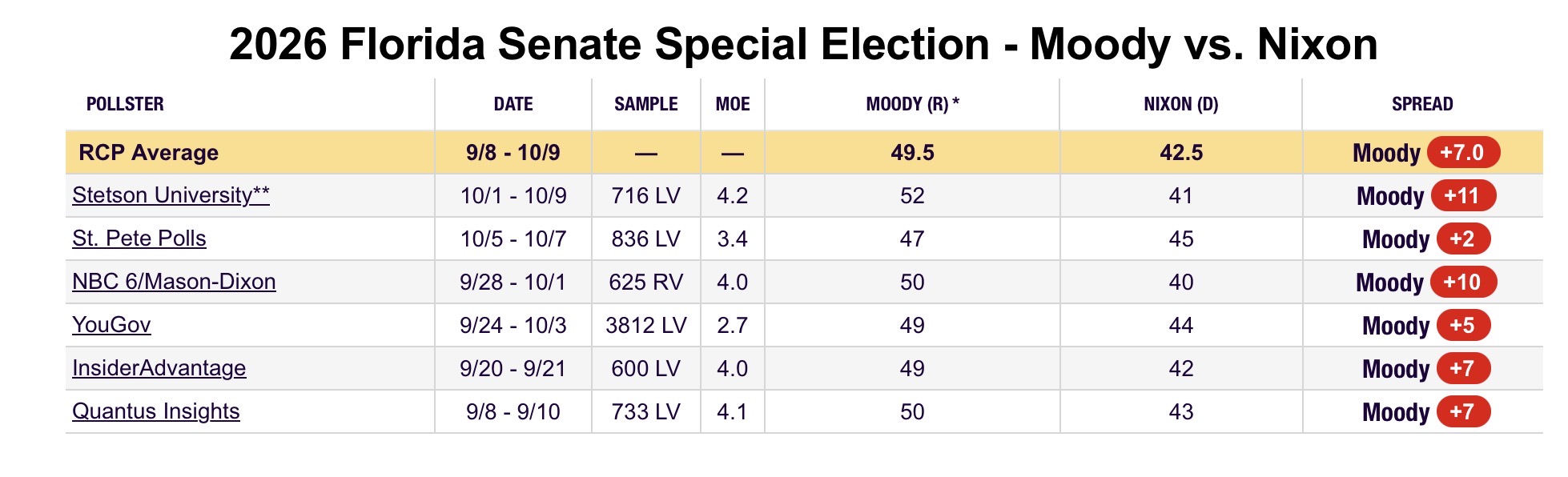
RealClearPolitics polls for the Florida U.S. Senate race

The RCP average of polls has Moody up 7, although St. Pete Polls is sandbagging her a bit with their recent +2.

Governor

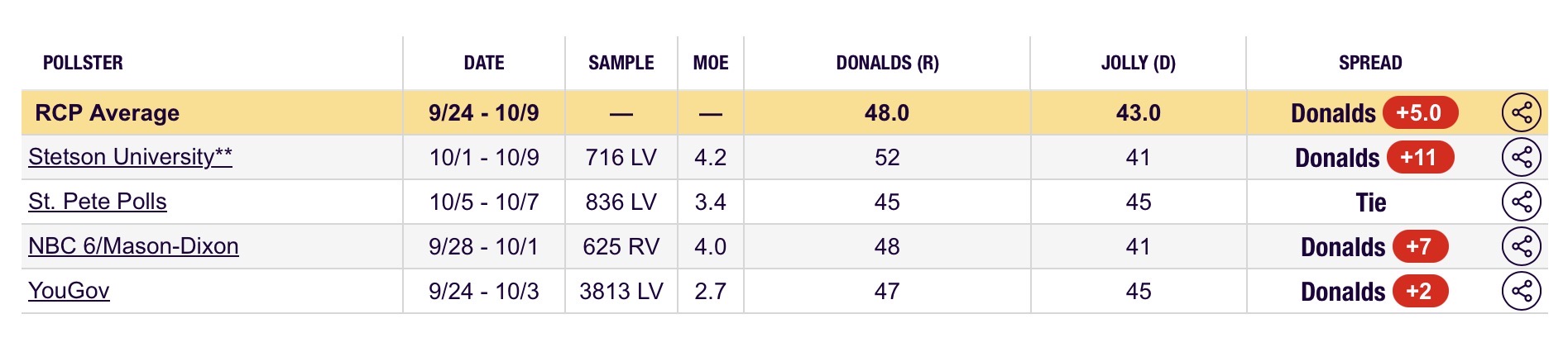
RealClearPolitics polls for the Florida governor race

With fewer polls making up the gubernatorial average, Donalds is up 5. Like Moody’s race, he’s held down a notch by St. Pete Polls. Notably, both Moody and Donalds are +11 in the most recent Stetson University poll.

VII. Media Ratings

U.S. Senate

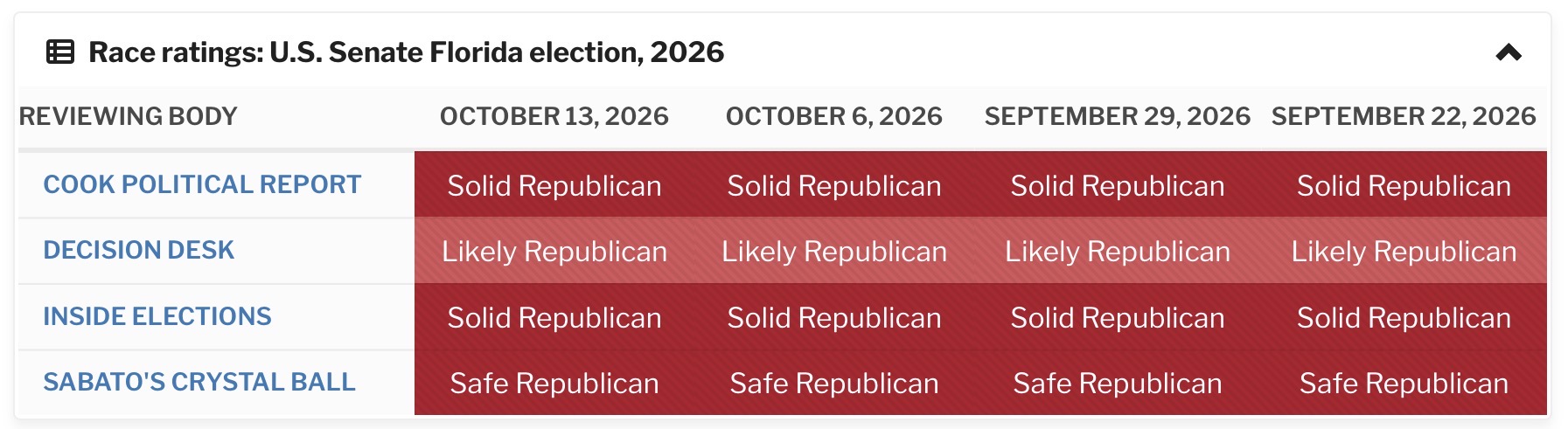
Media ratings for the Florida U.S. Senate race

None of the major reviewing bodies think Moody is in any trouble.

Governor

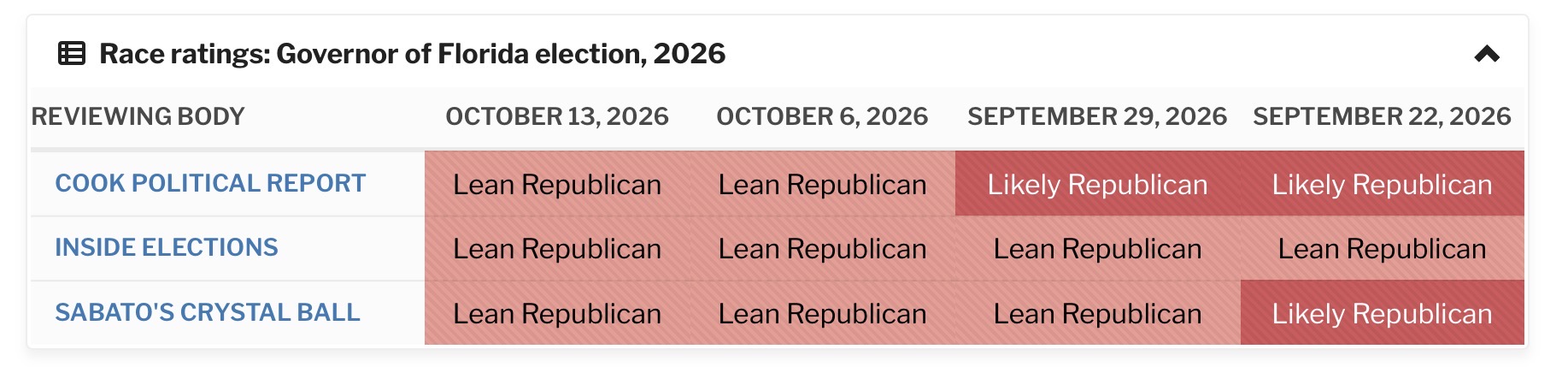
Media ratings for the Florida governor race

While none of them have Donalds on the hot seat, they’re leaving the window open for Jolly to close the gap.

VIII. Party Registration

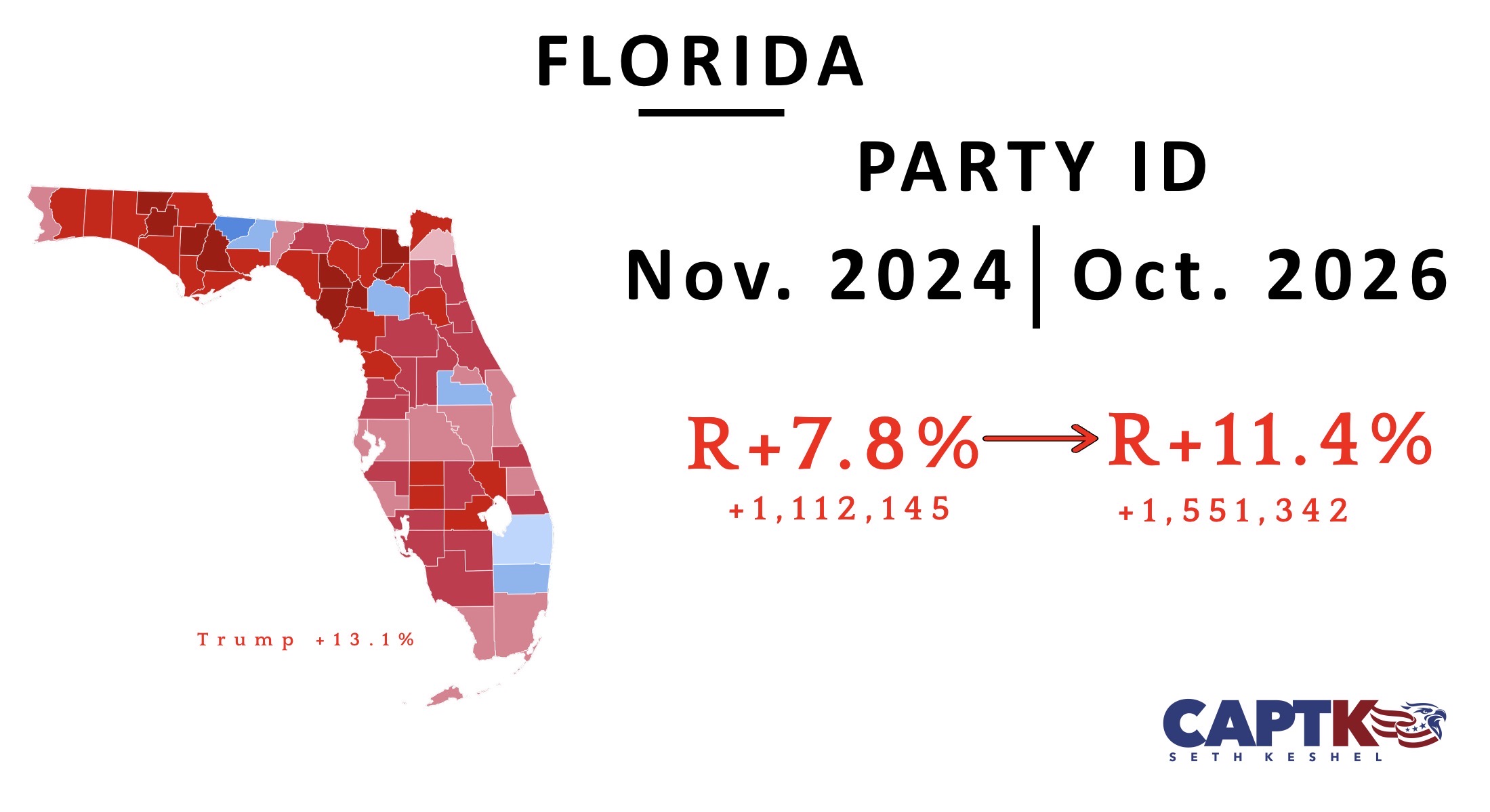
Florida party registration changes since November 2024

What’s the biggest mountain in the way of the Nixon/Jolly pairing? Look no further than party registration. Remember when I mentioned that new transplants to Florida are reportedly R+40% in their partisanship? The numbers above seemingly confirm this.

Republicans have netted a gain of 439,197 voters since Trump carried the state by 13.1% less than two years ago. Nearly 300,000 of that net is from Democrat losses, but still roughly 140,000 of that comes from new GOP registrations. These gains are widespread, reaching all the way down to former Democrat strongholds in Miami. Florida’s transformation is truly astounding.

IX. Election Considerations

People frequently ask me which states have made the most important reforms to elections since the 2020 quasi election. “Florida” is my hands-down answer. Governor DeSantis signed Senate Bill 524 in 2022, creating the election crimes task force and ensuring that the state would have proper control over mail-in balloting (requiring voters to request a ballot and confirm the address the ballot would be sent to). While it is a large state full of opportunities to attempt fraud, it has done an incredible job at preventing mass fraud.

Notably, Florida sets the “gold standard” for counting millions of ballots, nearly the entire statewide count, by the time people wake up the next day. They learned how important public trust in elections is after the 2000 “hanging chads” debacle and have set the standard for the rest of the country.

X. Summary and Election Estimate

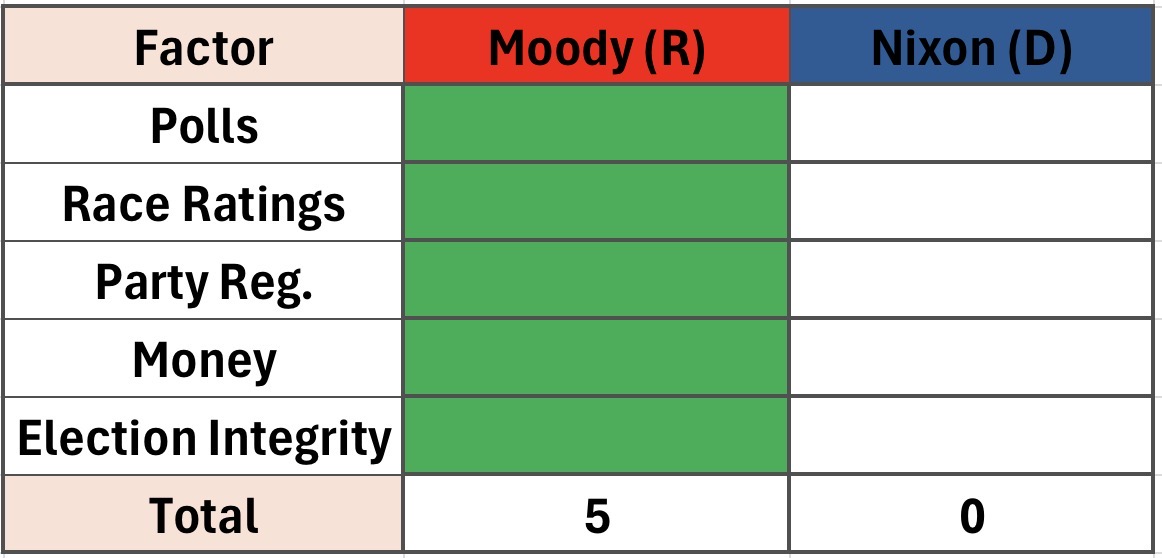
Florida is already running to the right of its final 2024 mail balloting return splits, and now the fake pollsters are quietly moving away from the Sunshine State. These two elections aren’t coming down to “who” will win, but by how much the Republican candidates will win by. The decision matrices tell the tale:

U.S. Senate

Ten-point ratings matrix for the Florida U.S. Senate race

Governor

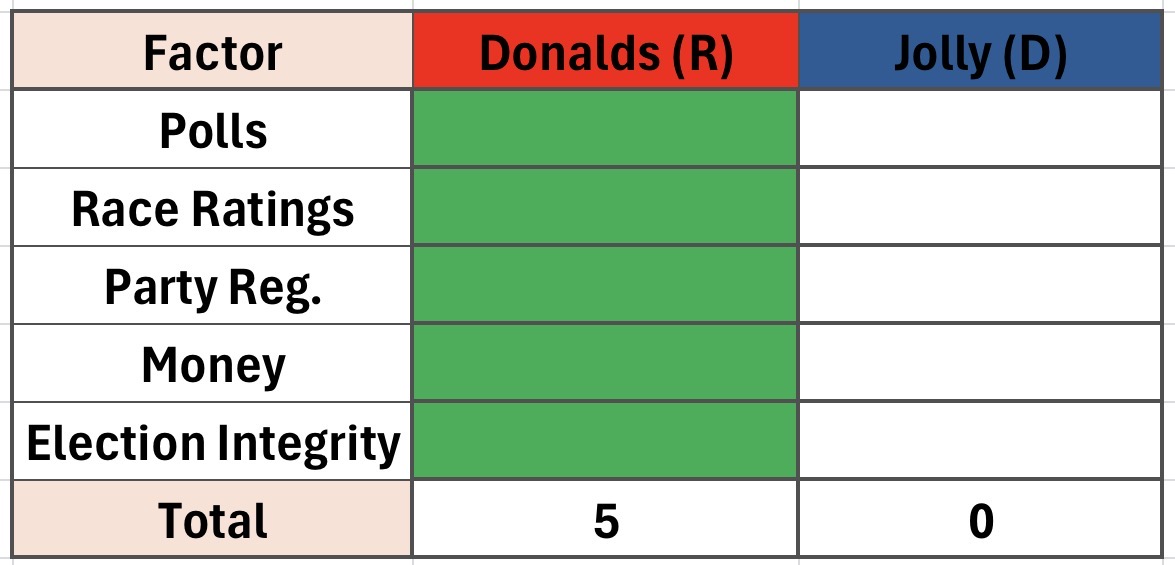
Ten-point ratings matrix for the Florida governor race

Thanks to Florida’s efforts to secure elections, the overwhelming growth of the Republican coalition, and a national atmosphere that has soured on the Democrat brand, these are two of the most obvious predictions out there.

Forecast for FL U.S. Senate

Forecast for the Florida U.S. Senate race

My 99/1 rating for Moody is to essentially state that I see zero path for Nixon. It wouldn’t surprise me if Moody, thanks to Nixon’s insane radicalism, wins by more than 20 points. The bigger question I have is whether or not Moody will win every county.

Forecast for FL Governor

Forecast for the Florida governor race

Donalds is also essentially a lock. To believe Floridians would watch the state clear R+11% by registration and even think about handing the keys over to the party they’ve completely abandoned defies logic. Donalds won’t have Moody’s numbers because Jolly is at least a real candidate, but I’d expect a margin in at least the low double digits.

Florida is a unique phenomenon, and we should all invite Democrats to waste funds there.

Seth Keshel, MBA is a Senior Fellow at the Gold Institute for International Strategy and a retired Army Captain. He publishes Captain K’s Corner on Substack.

NY Republican Nominee Caroline Shinkle Proposes Zero Federal Income Tax on W-2 Wages Up to $150,000

Caroline Shinkle and Maria Maalouf on The Capitol Show

In brief

Maria Maalouf hosts Caroline Shinkle, the Republican nominee for Congress in New York’s 12th District, on The Capitol Show to discuss her plan to end federal income tax on W-2 wages up to $150,000.

From the episode’s description: “Caroline Shinkle, the Republican nominee for Congress in New York’s 12th District, joins Maria Maalouf on The Capitol Show to discuss her proposal to eliminate federal income tax on W-2 wages up to $150,000, arguing that tackling fraudulent healthcare claims could fund the plan.”

Hosted by Maria Maalouf Senior Media Fellow, Gold Institute for International Strategy

2026 Ten-Point Forecast: CA-48 (U.S. House – Decisive)

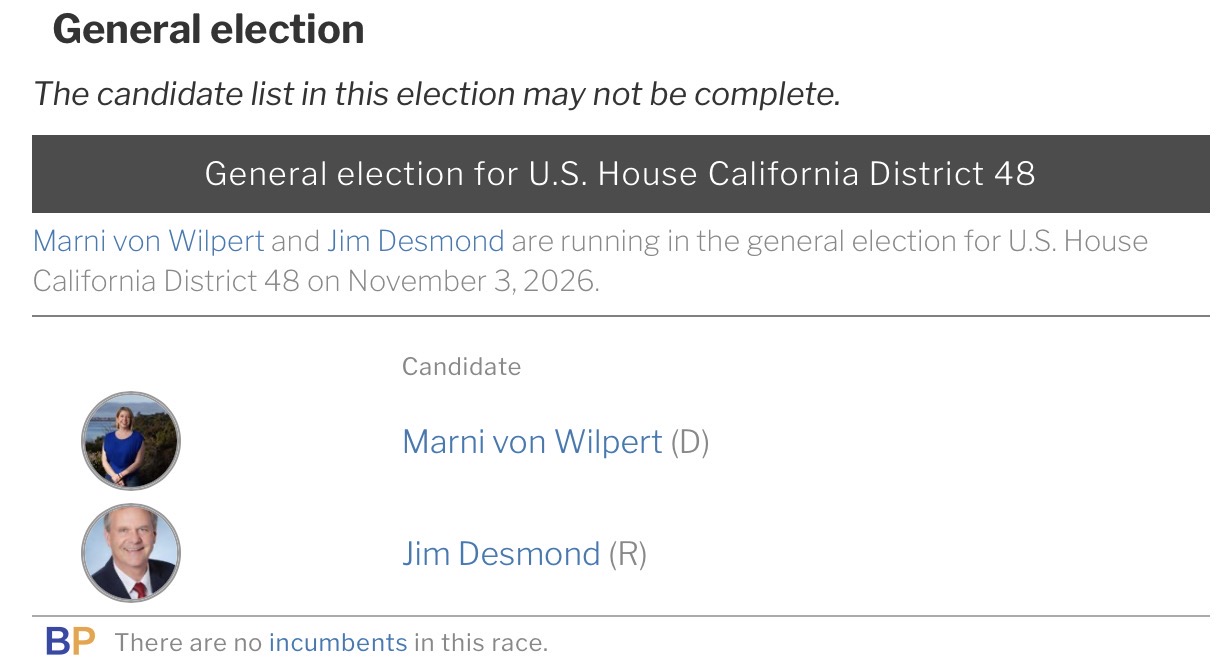
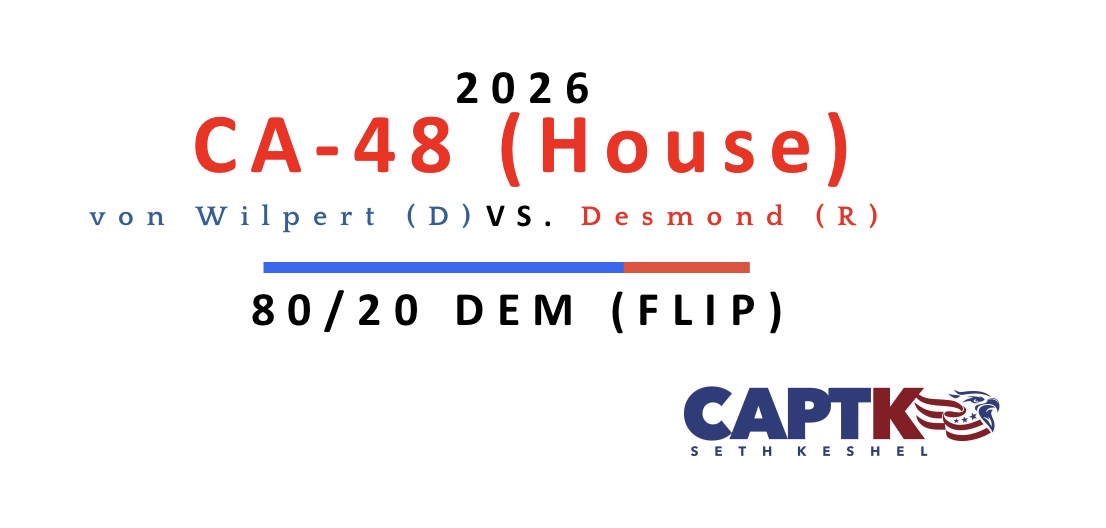
2026 Ten-Point Forecast: CA-48, Jim Desmond vs. Marni von Wilpert

Jim Desmond (R) vs. Marni von Wilpert (D)

Author’s Note: This forecast/prediction contains proprietary mapping data beyond the paywall information prepared by the author for analytical purposes.

I. The Race

CA-48 candidates Jim Desmond and Marni von Wilpert

Jim Desmond (Republican) has served two terms on the San Diego County Board of Supervisors. He’s a Navy veteran and is focusing his campaign on ensuring borders remain secure and policing crime and drug activity, which is rampant in urban California.

Marni von Wilpert (Democrat) is essentially the reverse image of Desmond. She’s a member of the San Diego City Council, and runs the standard female “get Trump” campaign focused on vague positions like healthcare and affordability, and more nefarious efforts to handcuff ICE and restrain them from fixing the city she’s helped ruin.

II. District Geography

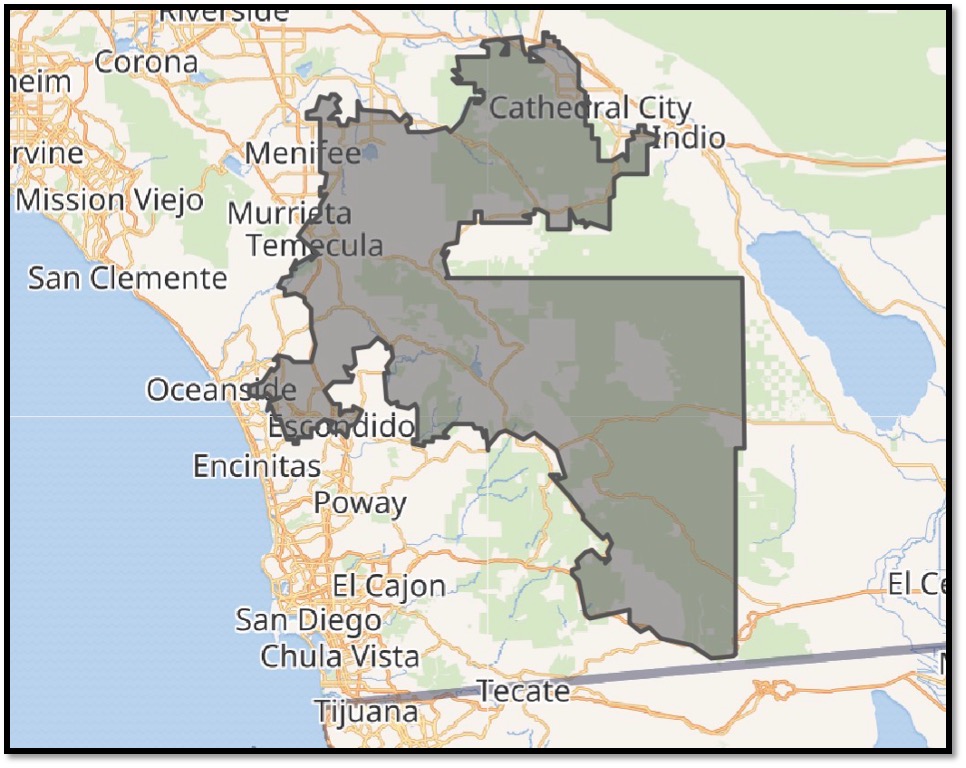
Map of California's new 48th Congressional District

California’s 48th Congressional District (CA-48) is newly drawn and facing the first election held under its new boundaries. The current CA-48 is held by Darrell Issa (Republican), who won by 18.6% in 2024 and is retiring instead of dealing with the new boundaries.

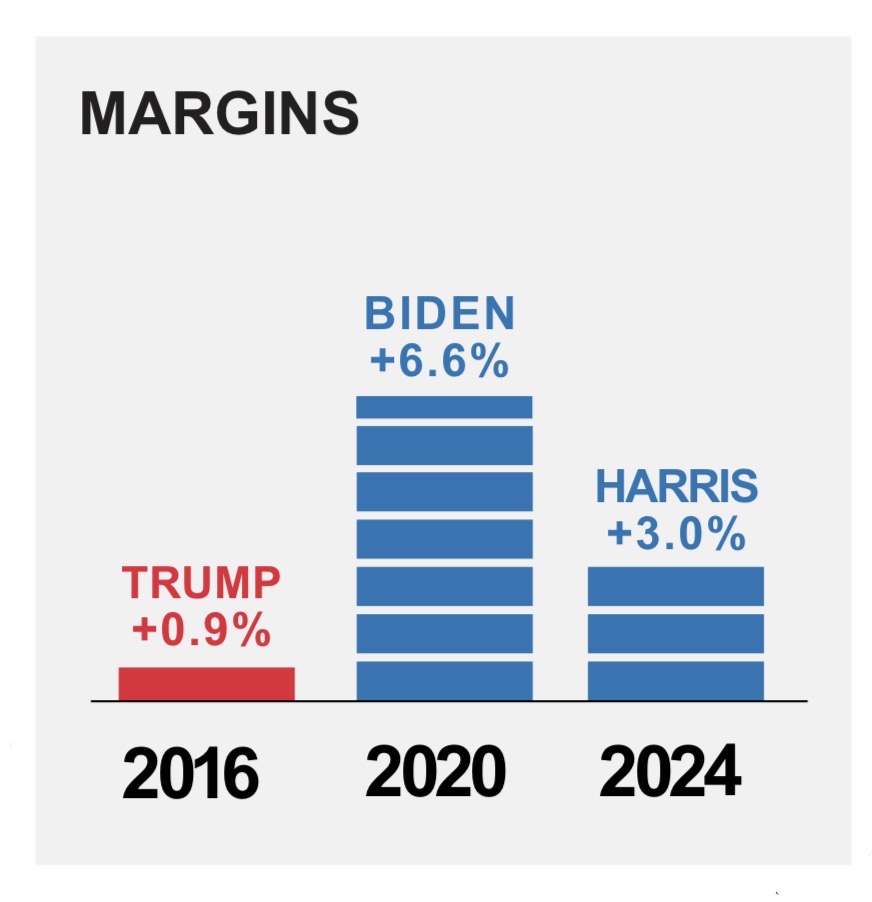
The new lines dodge conservative areas in northern San Diego County and run northeast in Riverside County to include Palm Springs, a hippie Democrat stronghold with huge margins. President Trump made a lot of progress within these boundaries in 2024, but still fell short against Kamala Harris.

Presidential Margins

Presidential margins within the CA-48 boundaries

Key Statistics

53.3% White, 29.4% Hispanic, 6.9% Asian

III. Market Assessment

Polymarket bettors are sticking with the California Democrat home team and expecting their all-mail elections to get von Wilpert over the top.

IV. History

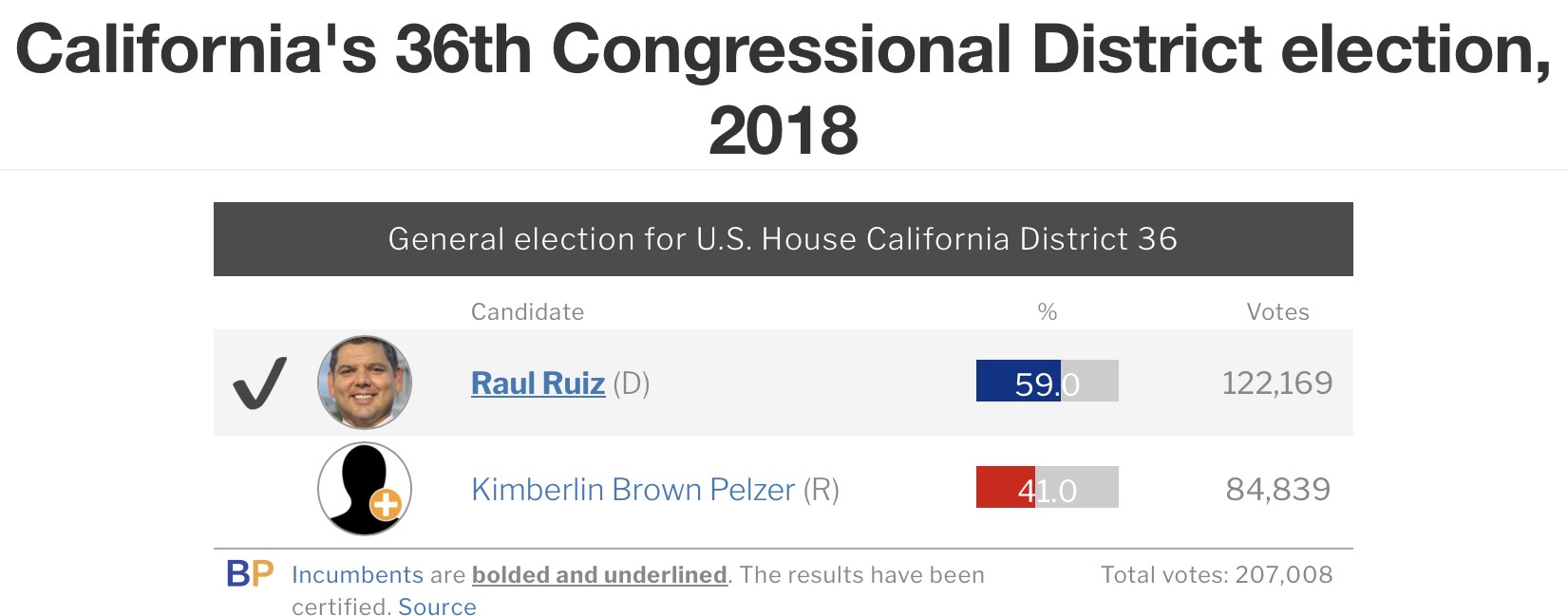
There is no precedent for swing and election outcomes in the district as it will be drawn for this election; however, in the first Trump midterm including Palm Springs (then in CA-36), the swing favored the GOP from 2016, swinging right by 6.2%. Raul Ruiz had won in 2016 by 24.2%.

Past election swing in the Palm Springs area district

Still, most of the swing in margin came from outlying areas of the district, which stretched east to west across California and deep into the desert.

V. Analysis of 2026 Primary Results

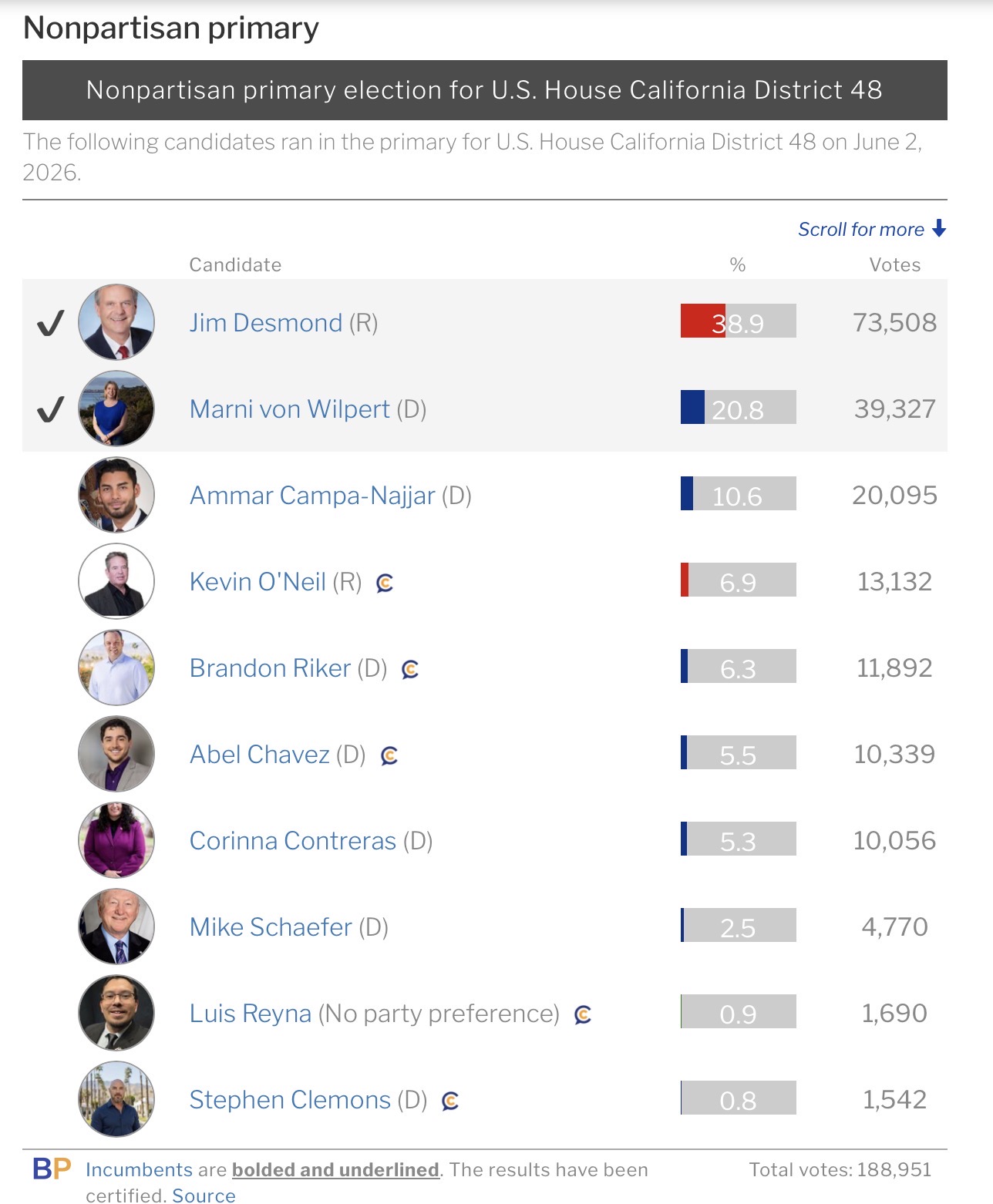
CA-48 2026 jungle primary results

Desmond came in first in CA-48’s jungle primary format with 38.9% of the vote. Von Wilpert doubled up the next closest Democrat and won her party’s nomination with just 20.8% of the vote. While Desmond beat von Wilpert handily, this is how the two-party voting looked:

Republican 45.8%
Democrat 53.3%

If there is reason to hope Desmond has a shot in this race, it’s because von Wilpert and Ammar Campa-Najjar (the third place finisher in the primary) had a meltdown drama-fest between special interest pets. Von Wilpert was accused of Islamophobia and racism, while Campa-Najjar was deemed a misogynist and homophobe. Sheesh – all is not well when that wretched coalition comes into conflict with itself. The primary outcome favors Desmond and gives him perhaps his lone advantage over von Wilpert.

VI. Polls

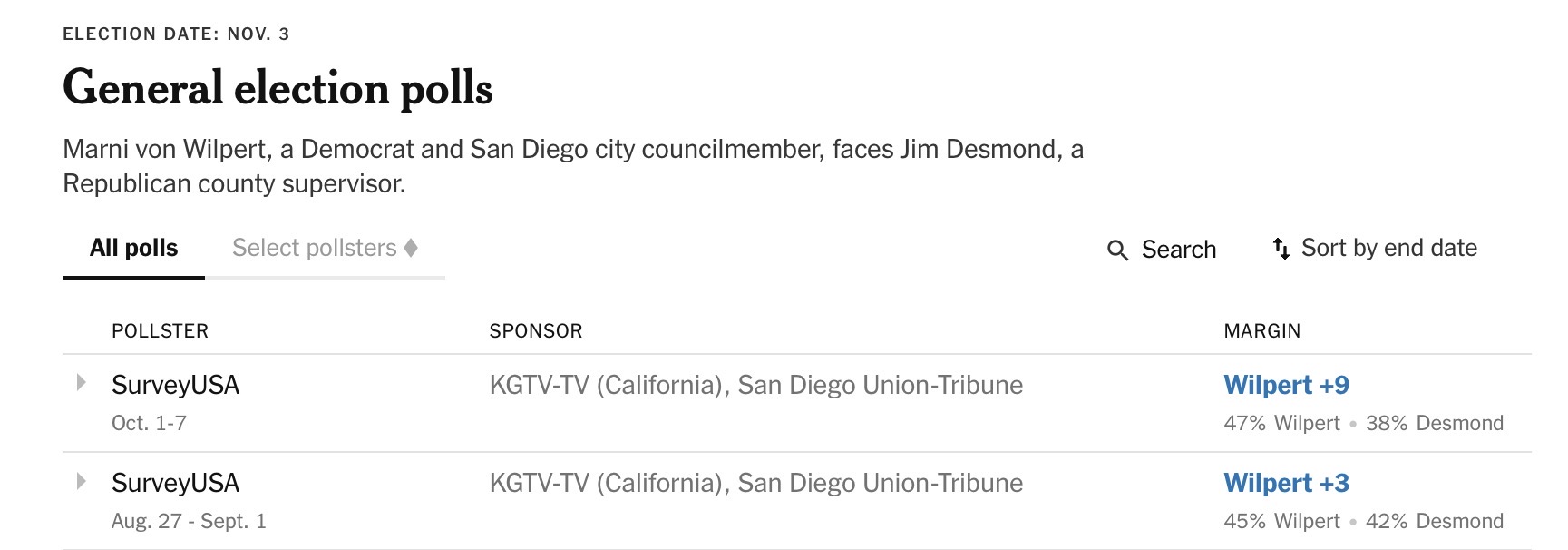
I pulled these polls from The New York Times:

CA-48 polls from The New York Times

On average, von Wilpert leads by 6 points.

VII. Media Ratings

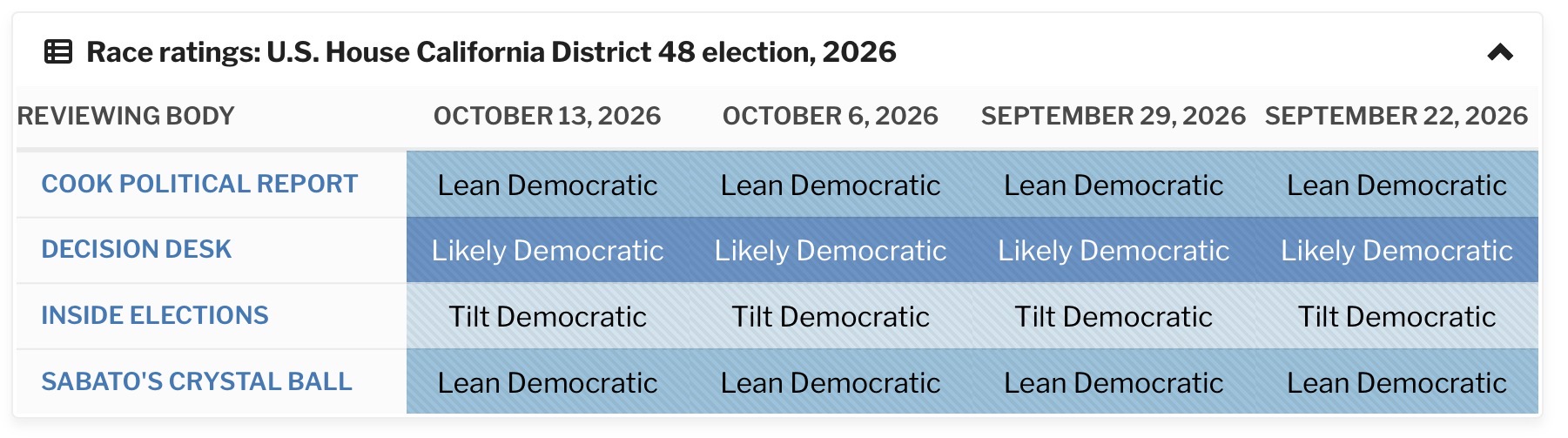
Media ratings for the CA-48 race

All major reviewing bodies favor von Wilpert, ranging from “tilt” to “likely.”

VIII. Party Registration

I cannot access or calculate party registration splits dating back to November 2024, when Kamala Harris carried the new boundaries by 3.0%, but I do have the current figures as of September 4, 2026:

Democrats 171,370 (37.01%)
Republicans 148,932 (32.16%)
Total 463,047

Lead D+4.9% (D+22,438)

This marks an increase for Democrats, up from D+4.4% (D+20,292) on April 3.

IX. Election Considerations

It will come as no surprise that California is the gold standard for Democrat election laws. I have written extensively about the topic this year with regard to their primaries, and wrote about all of the third-world ways they rig elections in the Gold State in my 2024 evaluation of their election:

California’s Universal Mail-In Voting and legalized ballot harvesting, in addition to the many weeks of ballot counting they are permitted to do, provide an emergency safety mechanism for any Democrat stuck in a close race. Von Wilpert benefits tremendously from this point.

X. Summary and Election Estimate

This seat stands to become much more competitive by the time the Democrats are forced to redraw maps at the end of the decade. Trump’s close finish required a lot of movement with Latinos, which are likely to regress in their share of Republican support in a Democrat favorable midterm.

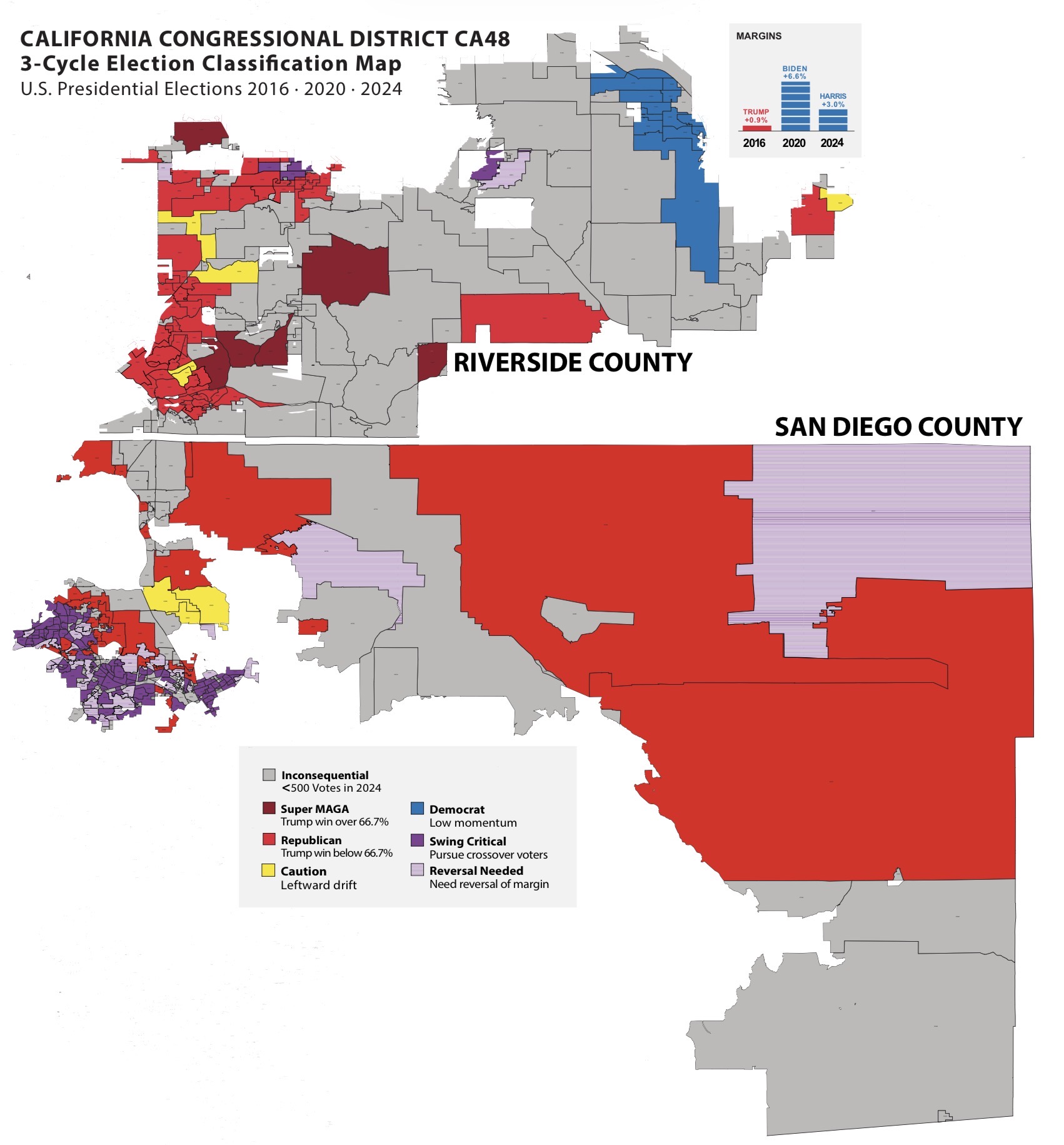
The proprietary mapping here, sponsored by patriot Shannon Lawrence, shows the challenge to Desmond:

Captain K proprietary precinct mapping of CA-48
Captain K Proprietary Mapping of CA-48

Rural San Diego County is red turf, but it is held in check by the purple jumble in the western portion of the county, particularly to the east of Carlsbad. Western Riverside County remains a GOP stronghold, but it is cancelled out and then surpassed by Palm Springs and the surrounding cities of the Coachella Valley with the only “Democrat” (Trump below 30%) precincts in the entire setup. California Democrats sharpened their pencils when drawing these maps. Desmond needs pitiful turnout in Palm Springs and to hold most of Trump’s Latino gains to have a shot.

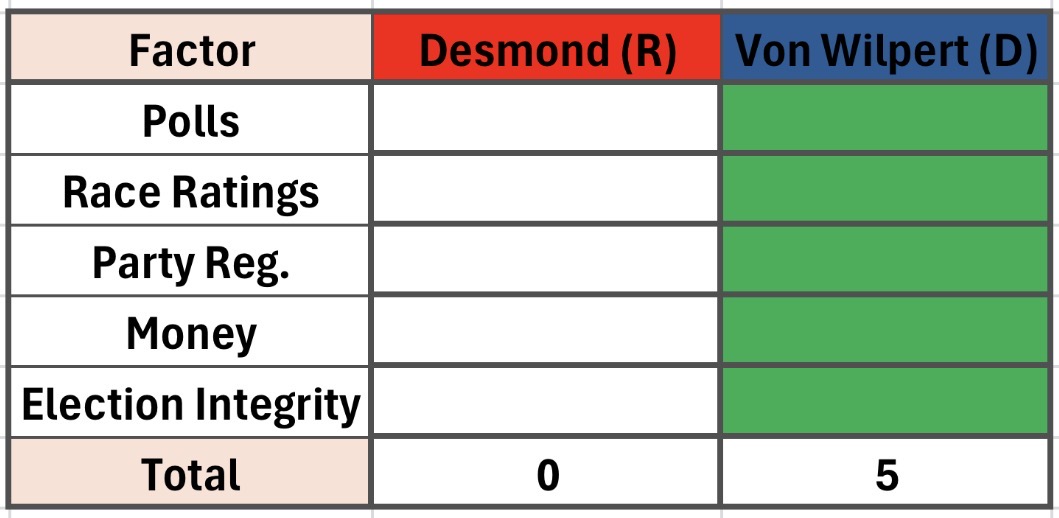
My ratings matrix shows a decisive advantage for von Wilpert:

Ten-point ratings matrix for CA-48

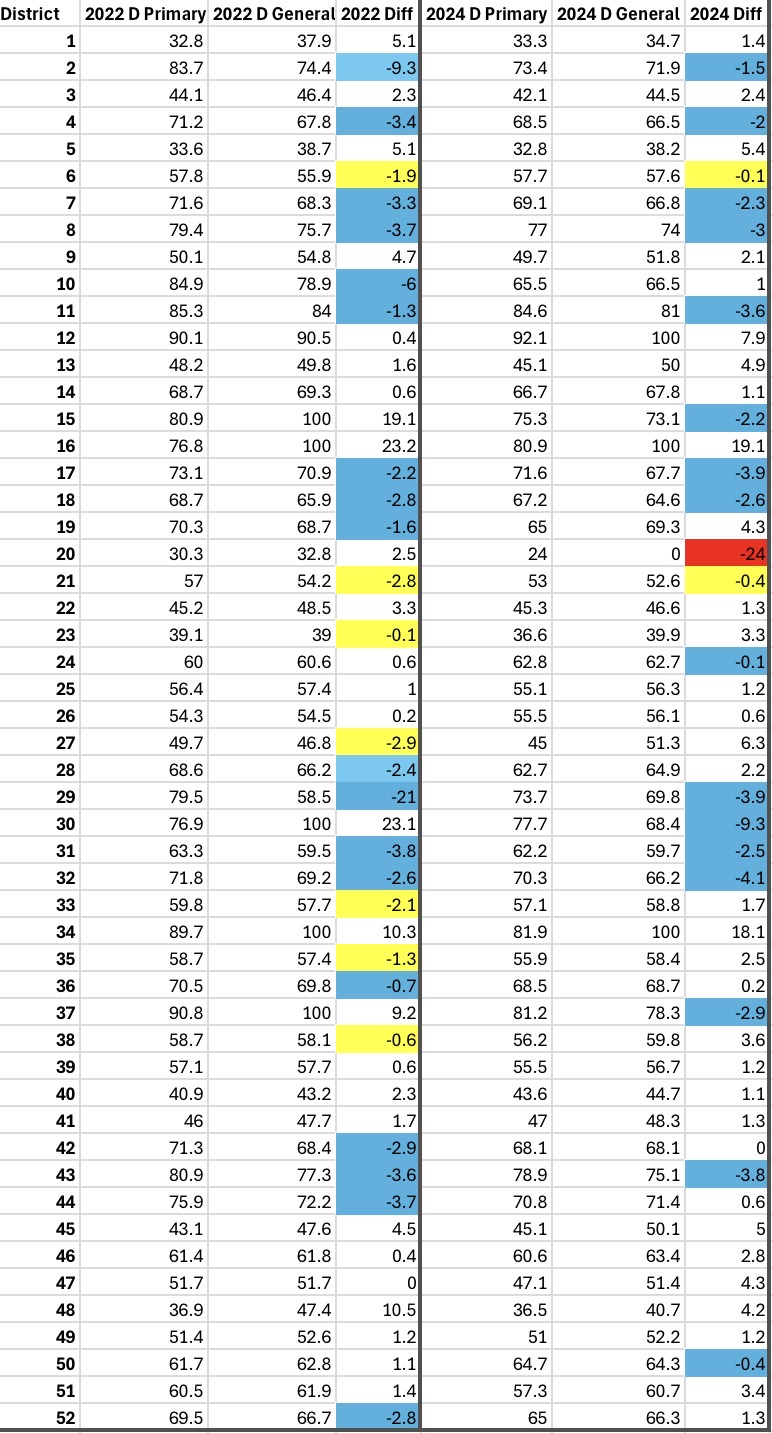
California primary statistics since they’ve moved to the jungle format give us a greater idea of how things are going to shake out. Consider:

California jungle primary statistics compared with general election results

Democrats almost always exceed their combined primary vote shares, especially in races that aren’t absolute blowouts. There were 7 races in 2022 in which Democrats combined for less than 60 percent of the primary vote in and in which they lost ground in the General Election. There were 2 such races in 2024. The largest regression was -2.9% in CA-27, and that occurred in a GOP-favorable year.

If von Wilpert were to shed 2.9% of the cumulative Democrat primary share of 53.3%, she would still win with 50.4%. Desmond’s only hope is that the primary fissures for Democrats persist, and she loses more than 3.3% of the cumulative primary share. Ideally, she would need to lose a lot; Democrat ballot harvesters operate legally and are well-compensated.

This district will improve in the long run, at least before it is redrawn. Until now, it’s a tough mountain to climb.

Forecast for CA-48 House

Forecast for the CA-48 House race

Seth Keshel, MBA is a Senior Fellow at the Gold Institute for International Strategy and a retired Army Captain. He publishes Captain K’s Corner on Substack.

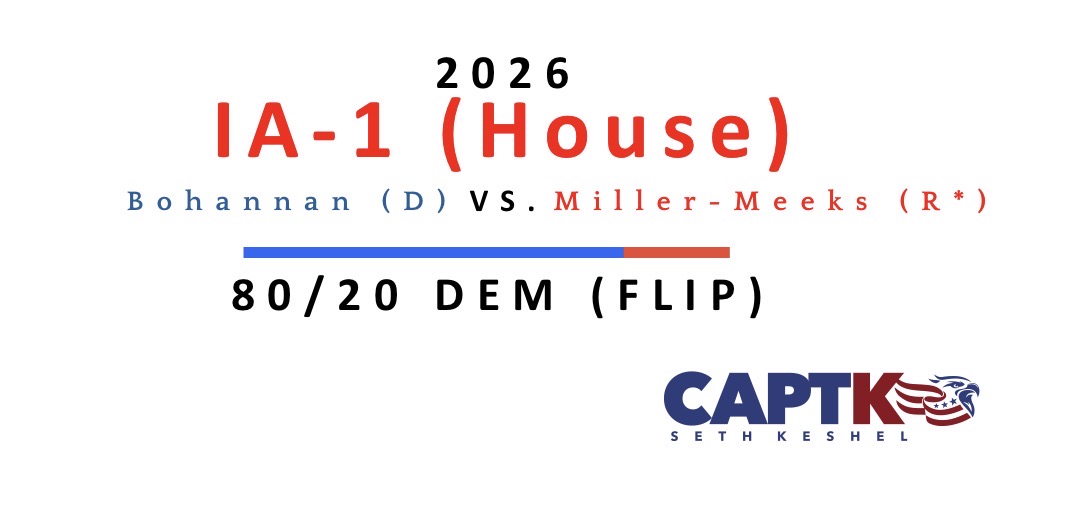
2026 Ten-Point Forecast: IA-1 (U.S. House – Decisive)

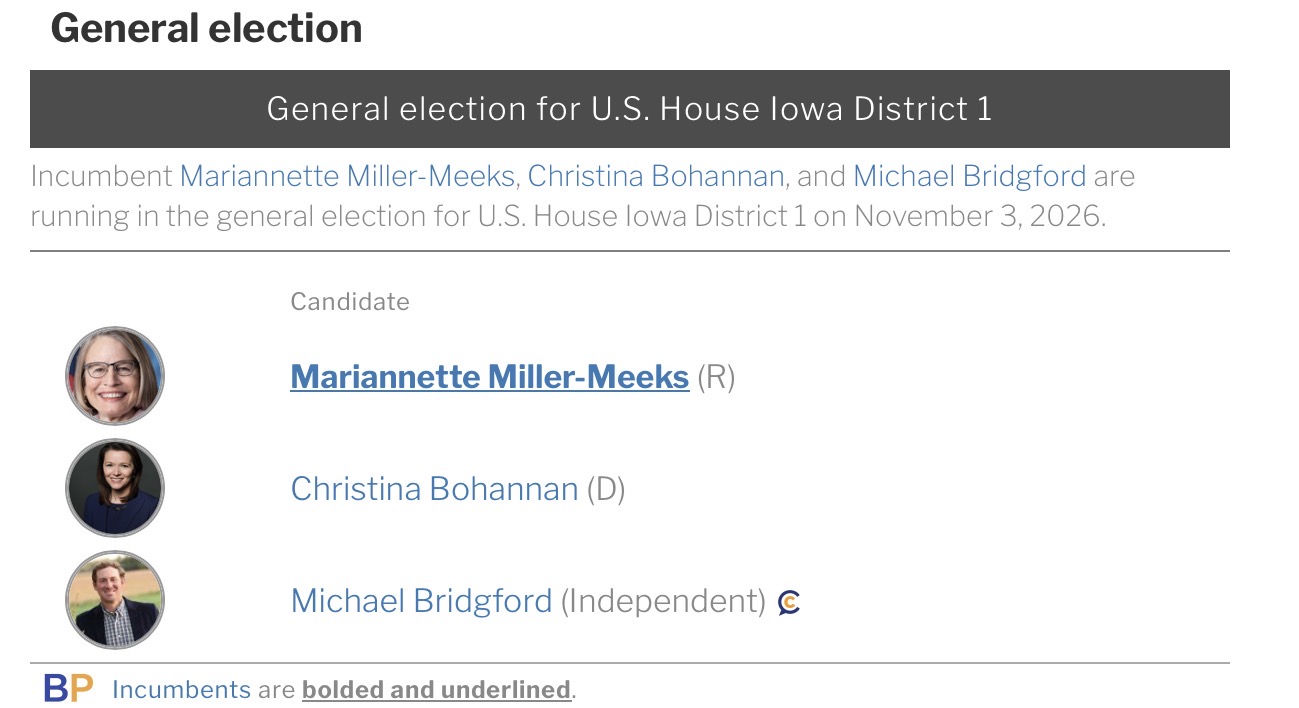
Mariannette Miller-Meeks and Christina Bohannan, the IA-1 House candidates

Mariannette Miller-Meeks (R-inc.) vs. Christina Bohannan (D)

I. The Race

The IA-1 candidates, Mariannette Miller-Meeks and Christina Bohannan

Mariannette Miller-Meeks (Republican) is running for a fourth term in the U.S. House, and has won two of her three terms by insanely close margins. She had previously run for the seat when it was designated IA-2, but lost to Dave Loebsack all three times she was the GOP nominee. She finally got in when Loebsack retired.

Christina Bohannan (Democrat) is a former Iowa State Representative who is nearly as persistent as Miller-Meeks; Bohannan has lost to her two times in a row, and is confident that the third time will be a charm this November.

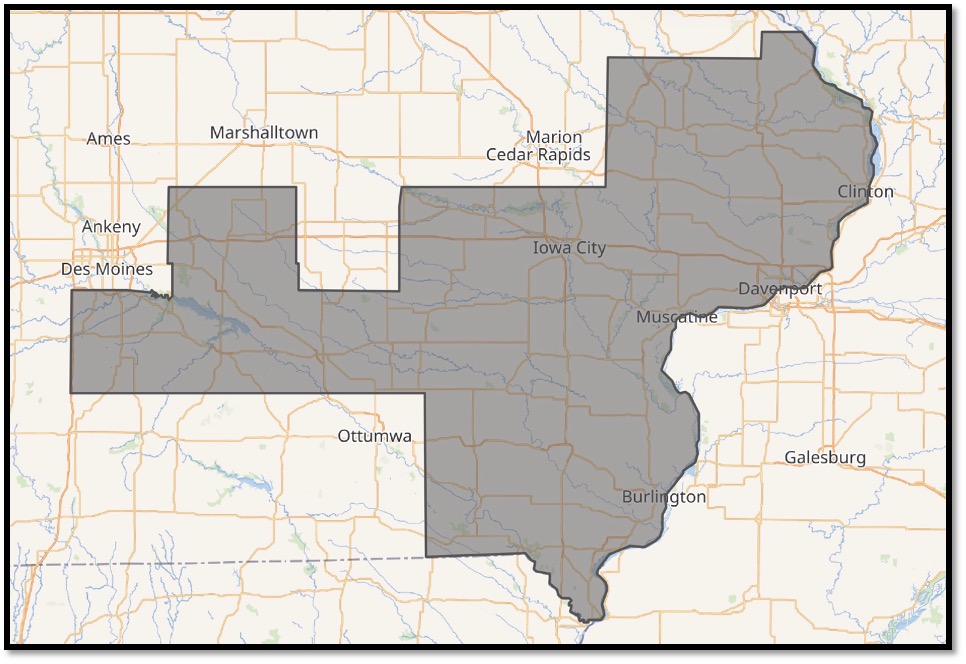
II. District Geography

Map of Iowa's 1st Congressional District

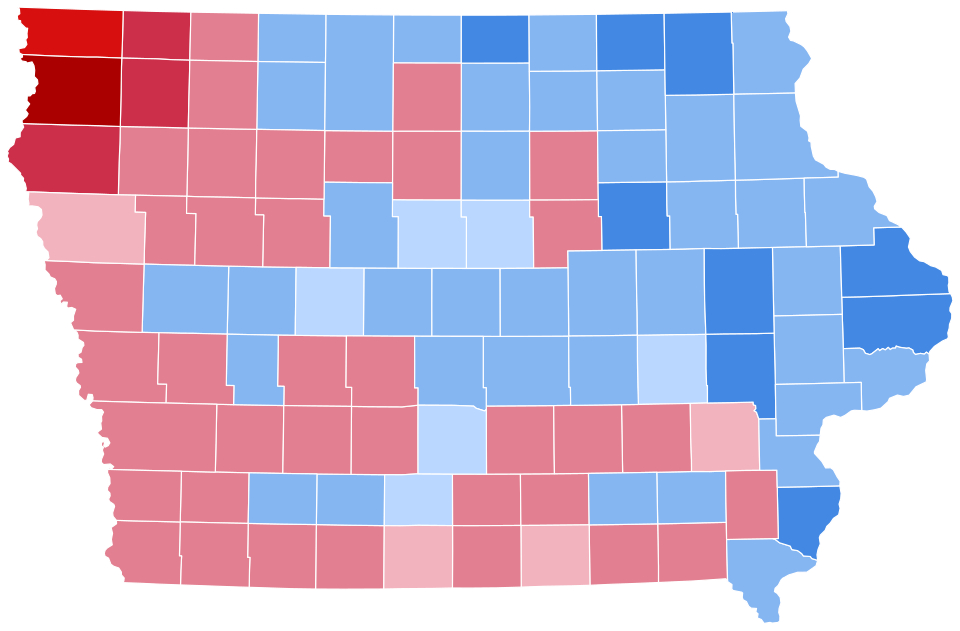
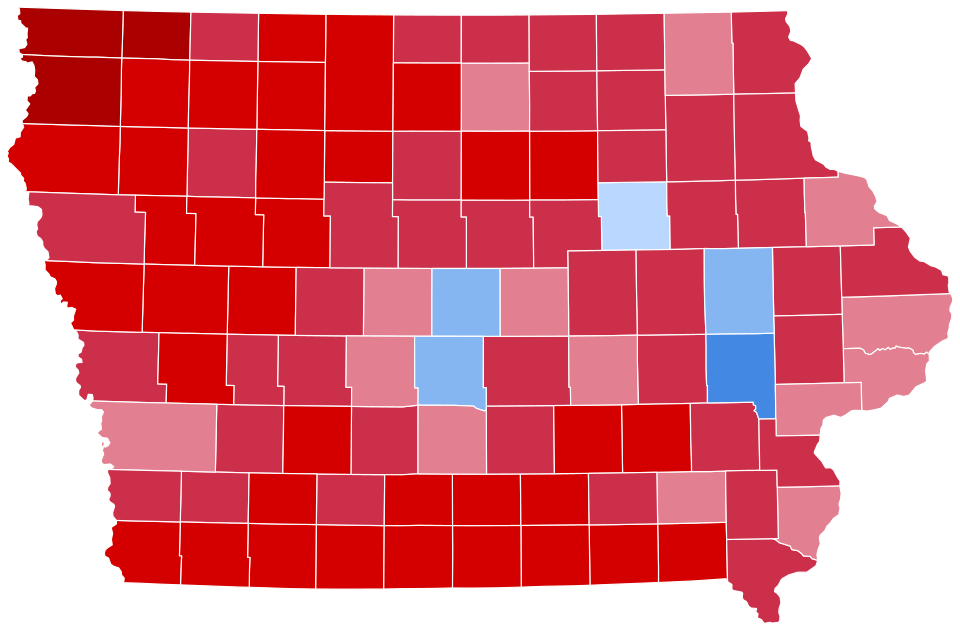
Iowa’s 1st Congressional District (IA-1) is made up of the southeastern quadrant of the state. As you can see, it has undergone a drastic political reformation since 2008:

Map of the 2008 presidential election in Iowa by county
2008 Presidential Election in Iowa
Map of the 2024 presidential election in Iowa by county
2024 Presidential Election in Iowa

The district resembles northern Illinois and Wisconsin politically far more than it resembles Missouri or Nebraska, which influence the western half of the state. Obama carried the current boundaries by 16 points in 2008, and then by 14 in 2012 as Iowa inched toward Romney in a statewide loss. Here were President Trump’s margins:

2016 Trump +3%

2020 Trump +2.9%

2024 Trump +8.5%

The political hurdles for Republicans in the district, especially normal Republicans like Miller-Meeks without Trump’s white working class superpowers, are Johnson County and the University of Iowa (Harris +37.8%), and Scott County, which contains Davenport. Racial demographics appear favorable but there is a long-standing blue-collar Democrat faction here.

Key Statistics

83.4% White, 5.6% Hispanic, 4.5% Black

66.4% Urban, 33.6% Rural

III. Market Assessment

Ouch. Looks a lot like NE-2, with bettors not expecting much out of Miller-Meeks.

IV. History

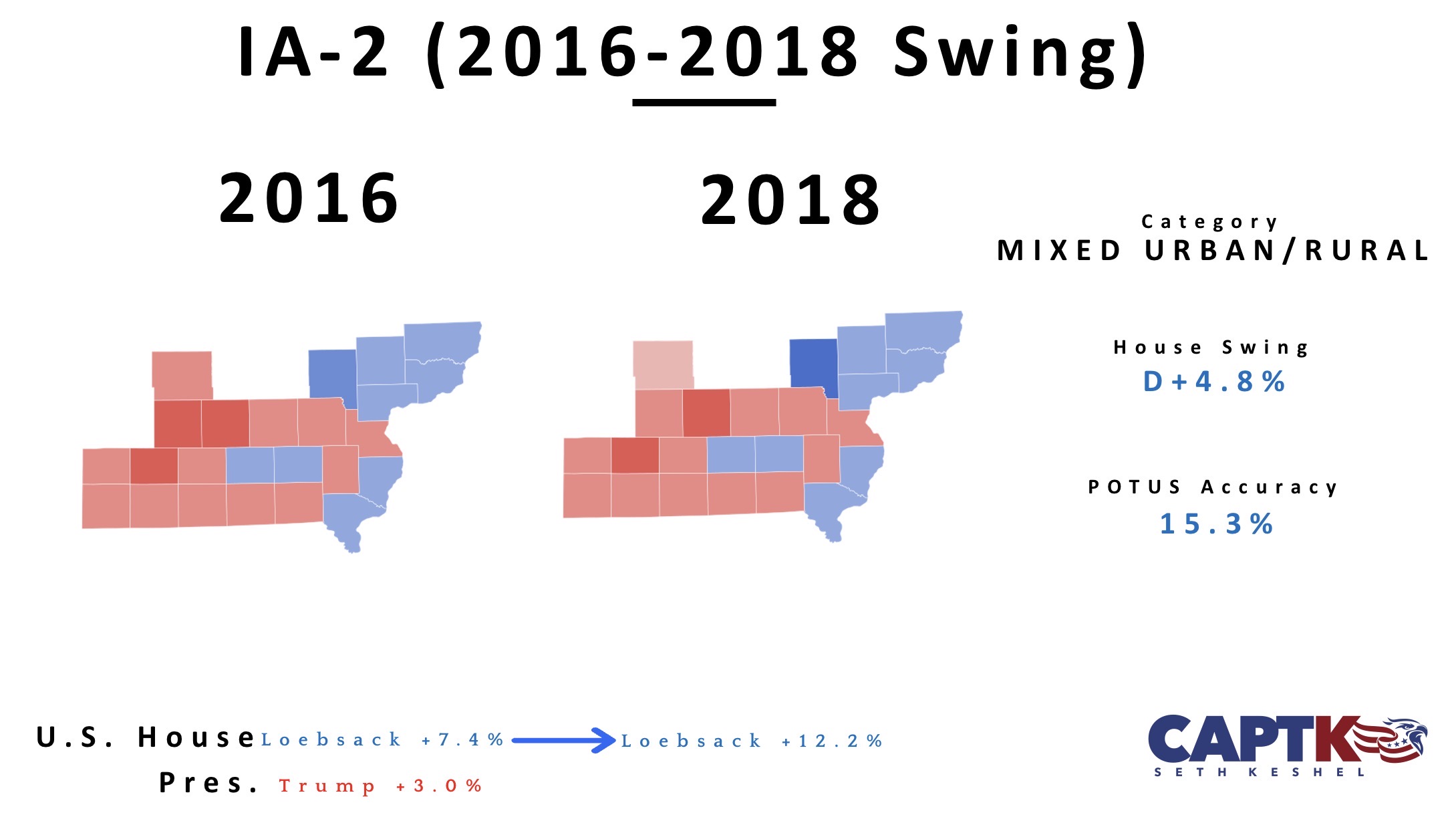
Democrat Dave Loebsack secured one of the party’s biggest upsets in 2006, knocking off incumbent Republican Jim Leach. He went on to defend the seat six more times, which included three wins over Miller-Meeks (including one in which he beat her like a drum in 2008). Without Trump on the ticket in 2018, Loebsack expanded his margin by 4.8% from the previous presidential election:

Result of the 2018 IA-1 House race won by Dave Loebsack

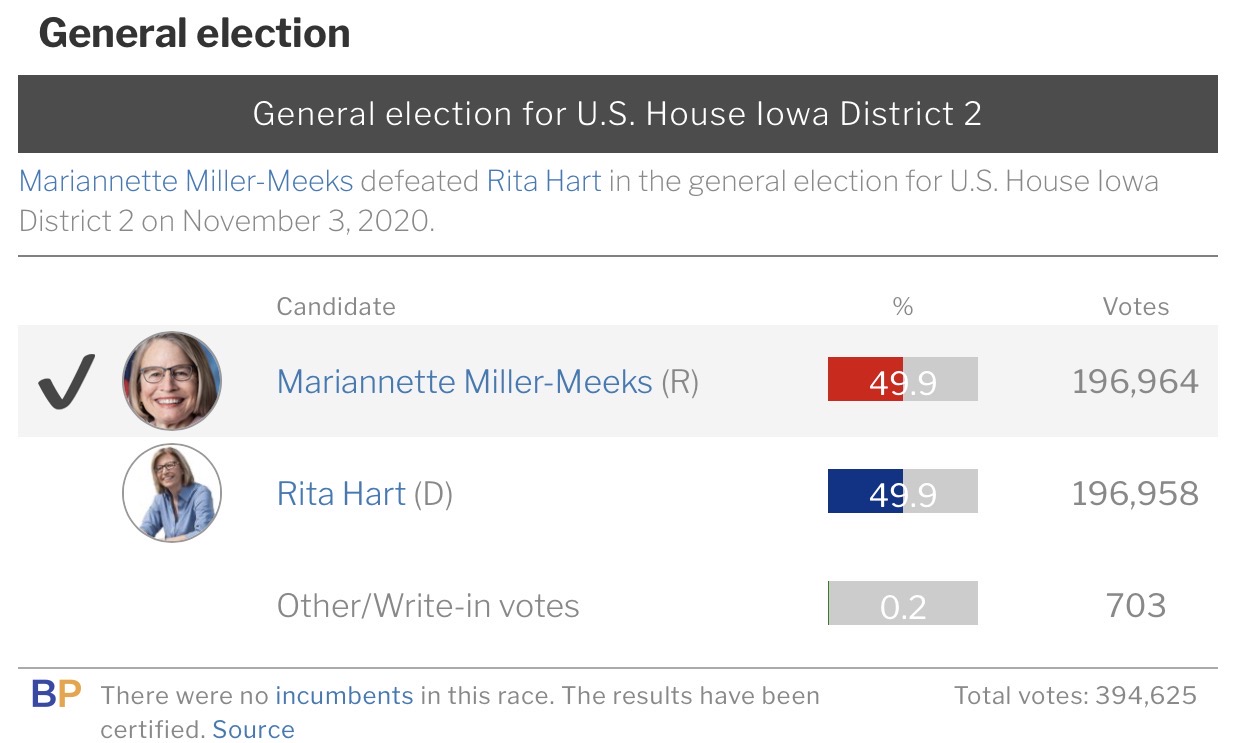
Once Loebsack finally retired, Miller-Meeks came back into the picture and rode a Trump statewide win to a razor close victory over Democrat Rita Hart – a margin of just six votes out of nearly 400,000 cast.

Result of the 2020 IA-1 House race, Miller-Meeks vs. Rita Hart

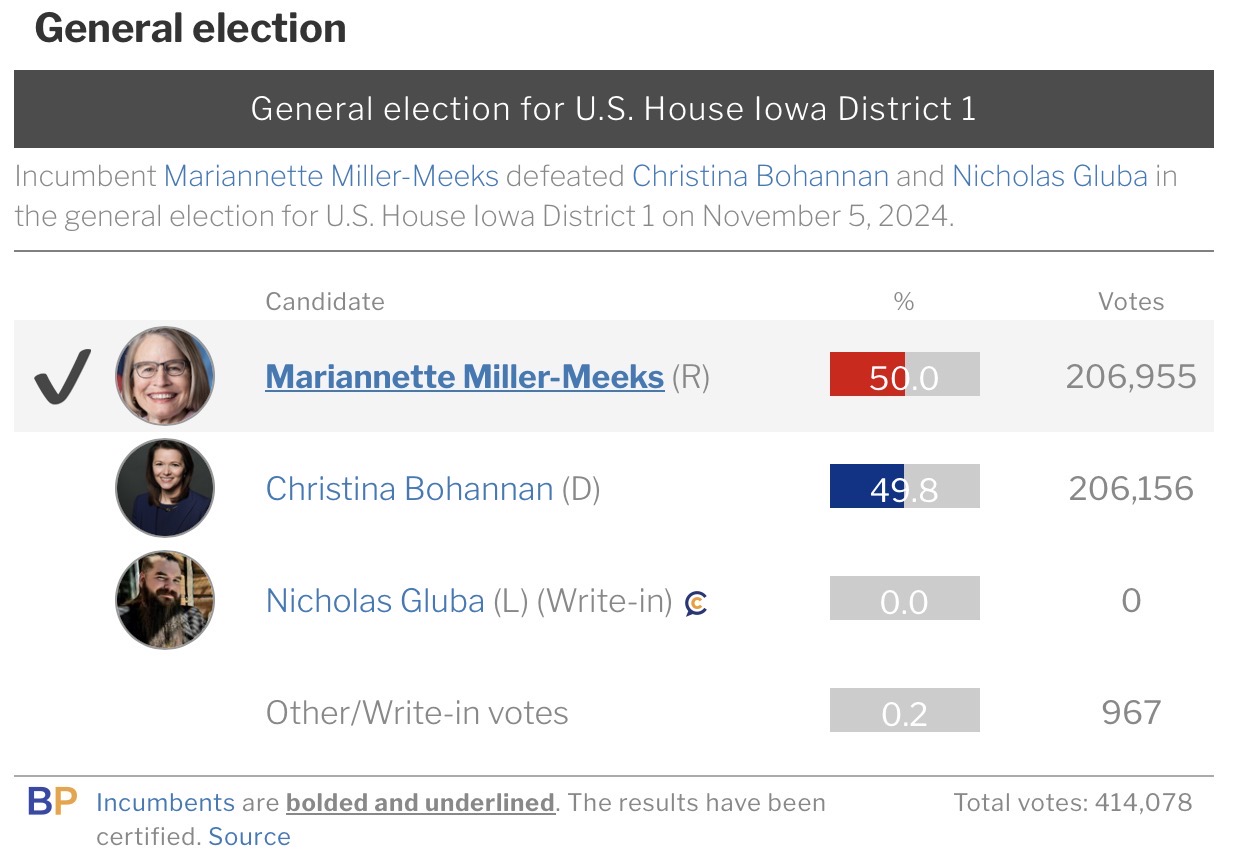
Her first meeting with Bohannan occurred in the 2022 GOP House takeover, and Miller-Meeks rode Kim Reynolds’ incumbent coattails to a 6.8% margin. One might think that with Trump destined to win Iowa by more than 13 points and IA-1 by 8.5%, Miller-Meeks would have another easy election against Bohannan:

Result of the 2024 IA-1 House race, Miller-Meeks vs. Bohannan

That assumption would constitute a wild miss; Miller-Meeks secured her seat in a very narrow GOP majority by 799 votes out of more than 400,000 cast. She has won two of the closest U.S. House races this century in a span of just three elections. This does not bode well for her in a year that is fundamentally more favorable to Democrats than a cycle in which Republicans are out of the White House.

V. Analysis of 2026 Primary Results

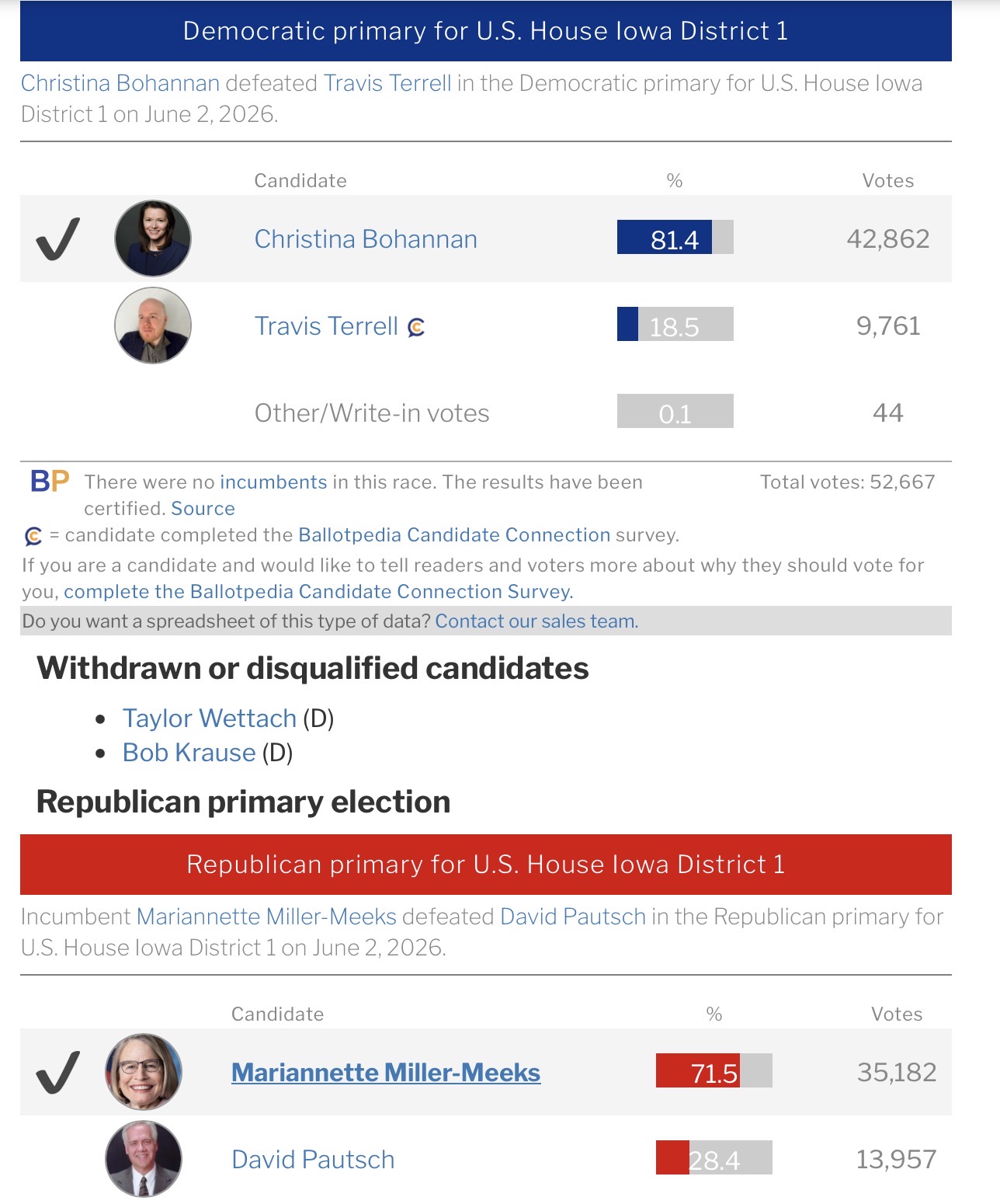
2026 IA-1 primary results

Miller-Meeks took on a primary challenger who posted a respectable share (28.4%), and Bohannan took out her opponent easily. No lingering drama from the primaries persists.

VI. Polls

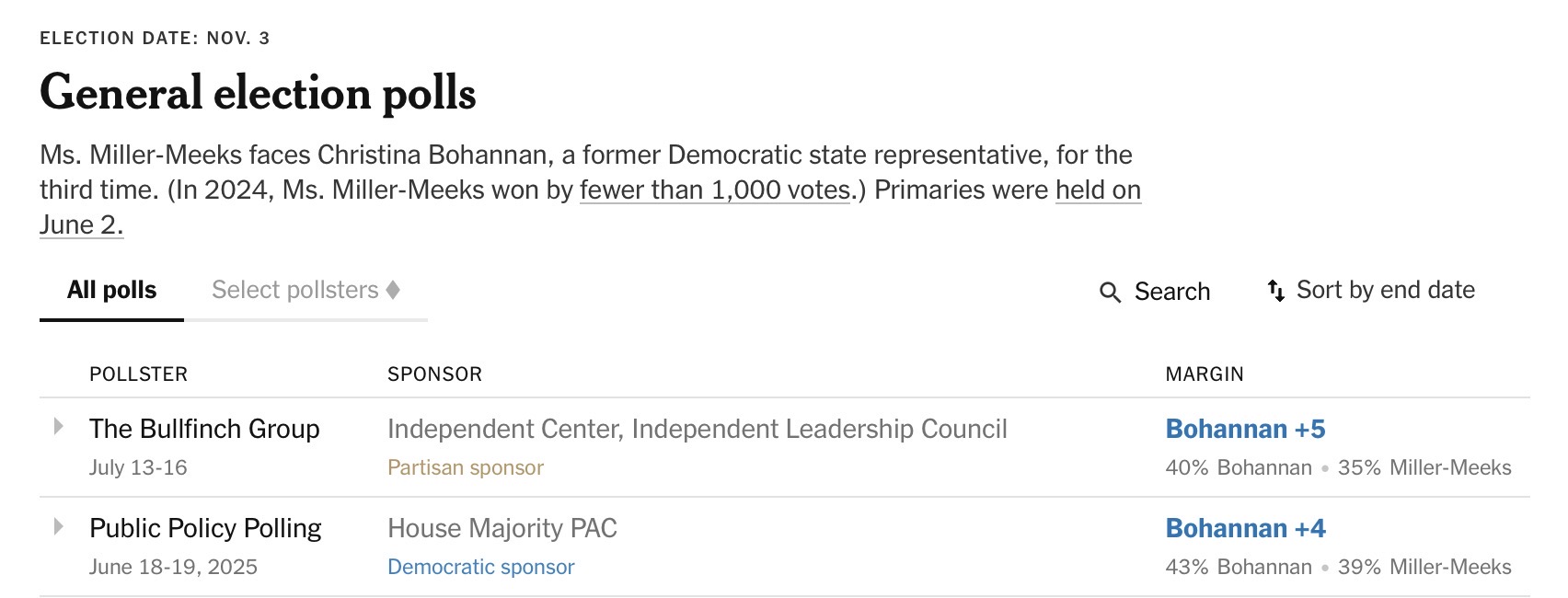
Polling data pulled from The New York Times:

IA-1 polls archived by The New York Times

The Bullfinch Group is to polling credibility what Nickelback is to fine music, but even a blind squirrel finds an acorn now and then. Bohannan leads by 4.5% in an average of the two polls I found.

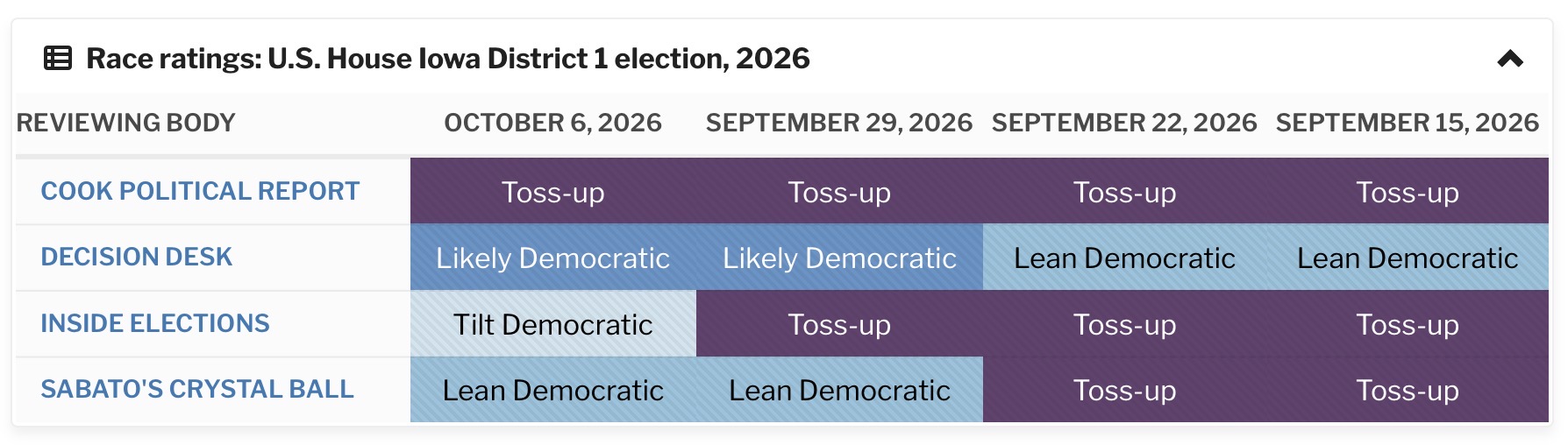
VII. Media Ratings

Media ratings for the IA-1 race

Cook remains hesitant to take a stance on the race, but the other three favor Bohannan by various degrees.

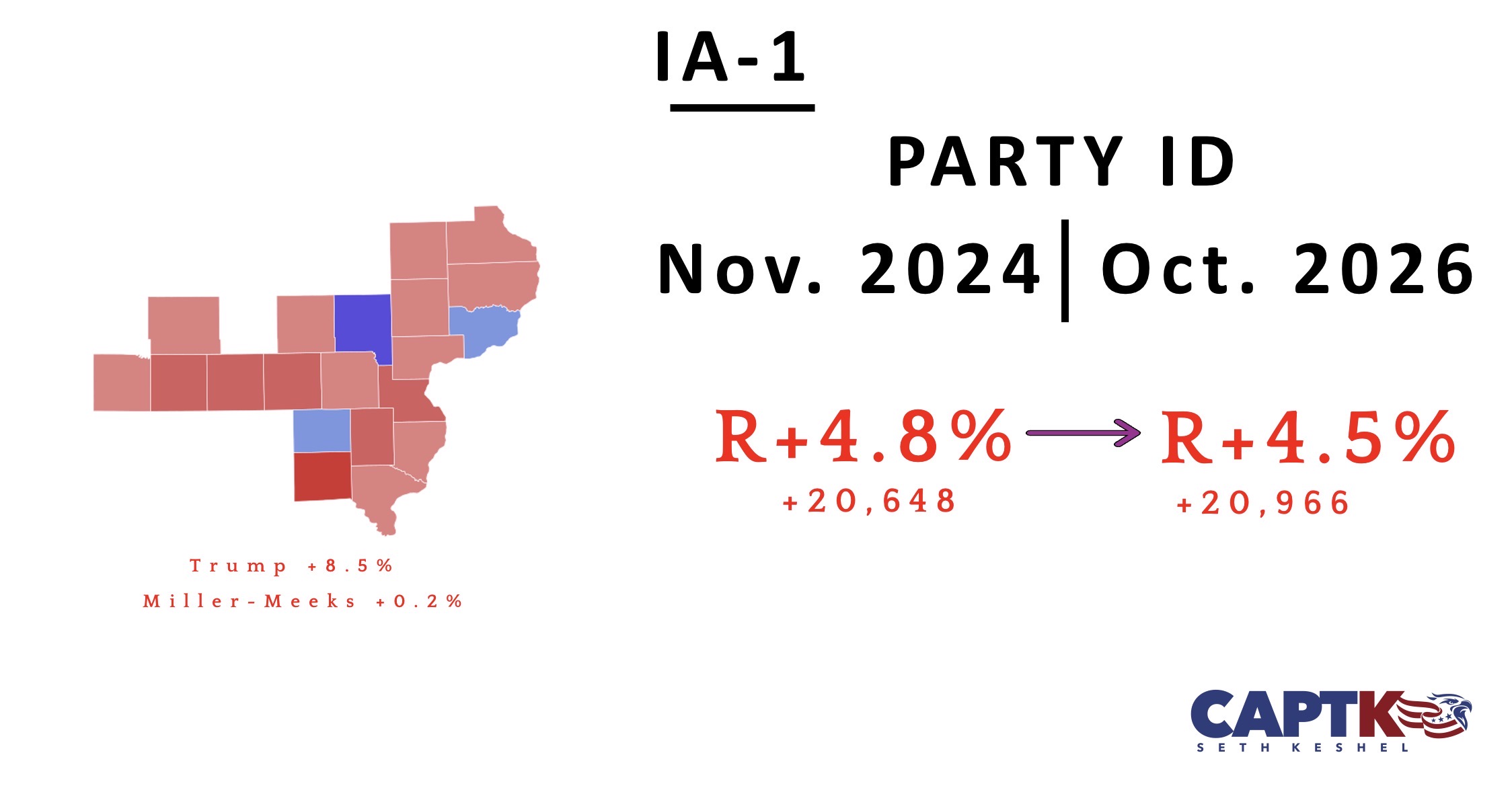
VIII. Party Registration

IA-1 party registration change

This is a mixed bag. Because there are more total active voters registered in the district, the Republican lead as a percentage has fallen by 0.3% despite a gain in the raw lead. This likely tracks with independent sentiment dragging results to the left this year and favors Bohannan.

IX. Election Considerations

One thing is for certain, and that is that Iowa runs excellent elections. A lot of this is owed to the current treasurer, Roby Smith, who started turning the screws on election reforms as a state legislator before the 2020 election. Iowa has manageable early voting windows, control over the mail-in balloting process, and a voter registration system that doesn’t automatically register voters. You can read more about Iowa’s 2024 election quality in his Iowa – 2024 Election Compendium (December 24, 2024).

X. Summary and Election Estimate

Miller-Meeks is in a tough spot, and it makes sense why the Republican Party is triaging her race.

TRIAGE NEWS: The Congressional Leadership Fund and Trump’s super PACs are cutting off their first GOP incumbents in NJ-7 and IA-1 as the party races to avoid more widespread losses in final three weeks. Also giving up OH-1 and MI-8.

Shane Goldmacher (@ShaneGoldmacher), October 13, 2026

In examining all of the decisive seats, IA-1 leaps off the page as one of (if not the most) likely losses of the entire field. Miller-Meeks is an uncharismatic candidate with two “scraper” election wins in the past three races. The first, the win of just six votes, took place with Trump on the ballot. Her second win was propped up by Kim Reynolds winning a GOP-favorable midterm reelection race by more than 20. Her win in 2024 was by less than a point, with Trump winning the district with a Reagan-like performance.

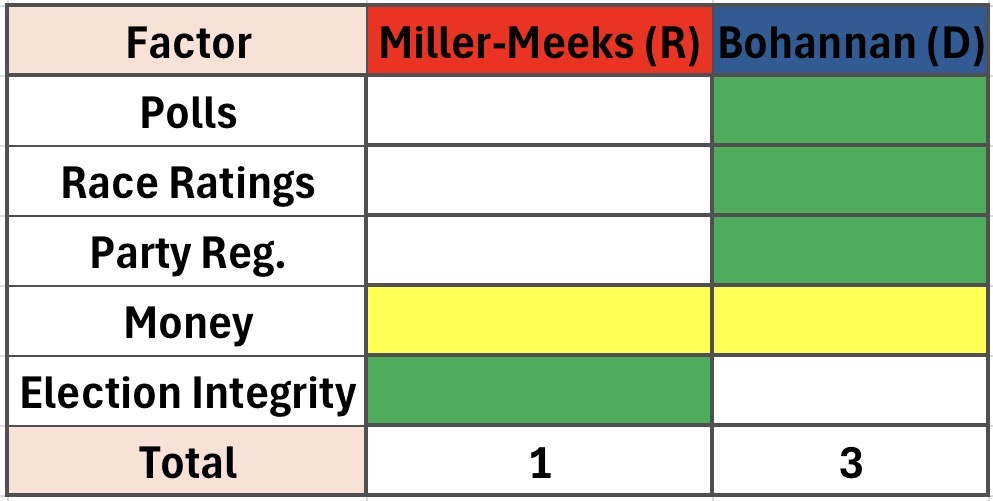
Unfortunately, I think she’s toast. Here is my matrix to support the decision:

Seth Keshel's key factors matrix for the IA-1 race

Bohannan has made enough public comments to prevent the DSA scare from setting in. She has been critical of Biden on the border and sticks mainly to center-left Democrat reforms, realizing she’s in a Trump +8.5% district. Additionally, the district has a very white population, which is much more likely to turn out and vote and be pushed into the standard political winds of a midterm. This means there isn’t much of a low-propensity minority coalition here likely to sit out and give a huge hand to Miller-Meeks. The incumbent’s only hope here is for the University of Iowa to be completely checked out and have very little elasticity present in the MAGA coalition.

Forecast for IA-1 House

Seth Keshel's forecast for the IA-1 House race

Seth Keshel, MBA is a Senior Fellow at the Gold Institute for International Strategy and a retired Army Captain. He publishes Captain K’s Corner on Substack.

Four Things to Expect out of the 2026 Midterms – A 30,000’ View

Cover image for Seth Keshel's midterm overview, Four Things to Expect out of the 2026 Midterms

Three more weeks.
This is my first post in nearly two weeks that isn’t a preview of a key race for the House or Senate. Today’s piece will be brief, but open for all of my subscribers in full. I may release a voter registration update spanning the 2024 election to the 2026 midterm election when I have closed books, but unless something absolutely wild breaks out, I’m going to be writing forecasts as I receive more and more data.

For today, I’m going to give you the clearest possible look at what I see developing in the midterms at a 30,000’ level. Like when you’re on the airplane and the captain tells you the cruising altitude and the weather at your destination, that’s what I’m going for today.

Here are four baseline items you can expect out of the 2026 midterms:

I. The GOP Can Retain the House Majority

Emphasis on can. They are not the favorites to do so, because 92 years of midterms inform us that the president’s party faces massive headwinds. Those have manifested as an average loss of 27 seats, and losses in 20 of 23 midterms since 1934; however, far fewer districts are competitive thanks to redistricting in blue and red states alike, and the GOP narrowly won the redistricting war thanks to the late impact of the Callais decision.

Even with Callais, the Democrats had a shot to sail to a relatively smooth flip of the House, even if their ceiling yielded only a small majority (less than 225). What they’ve done, however, is squander some of the most obvious flips by nominating radical, DSA-aligned candidates. In a normal year, even without an overwhelming generic ballot advantage, they would flip MI-7 and CO-8 with ease, winning both by roughly five points. I have the GOP favored to hold MI-7, and essentially dead even in CO-8.

We will soon find out just how much money impacts the balance of power when it is coming in hot from the Republican side. Normally, the Democrats are the ones with the huge financial advantage. Not so much this year. Republicans have a lot of seats to defend in which incumbents are doing the defending – this is an advantage worth a couple points, at minimum. While history suggests losses for the president’s party in 87% of midterms since 1934, I think the Republicans have perhaps a 1-in-3 shot of holding the House. Even if they don’t, the math doesn’t look promising for Democrats to command a large majority.

Like the Electoral College, the House math comes down to 435 individually drawn seats, not a generic ballot advantage.

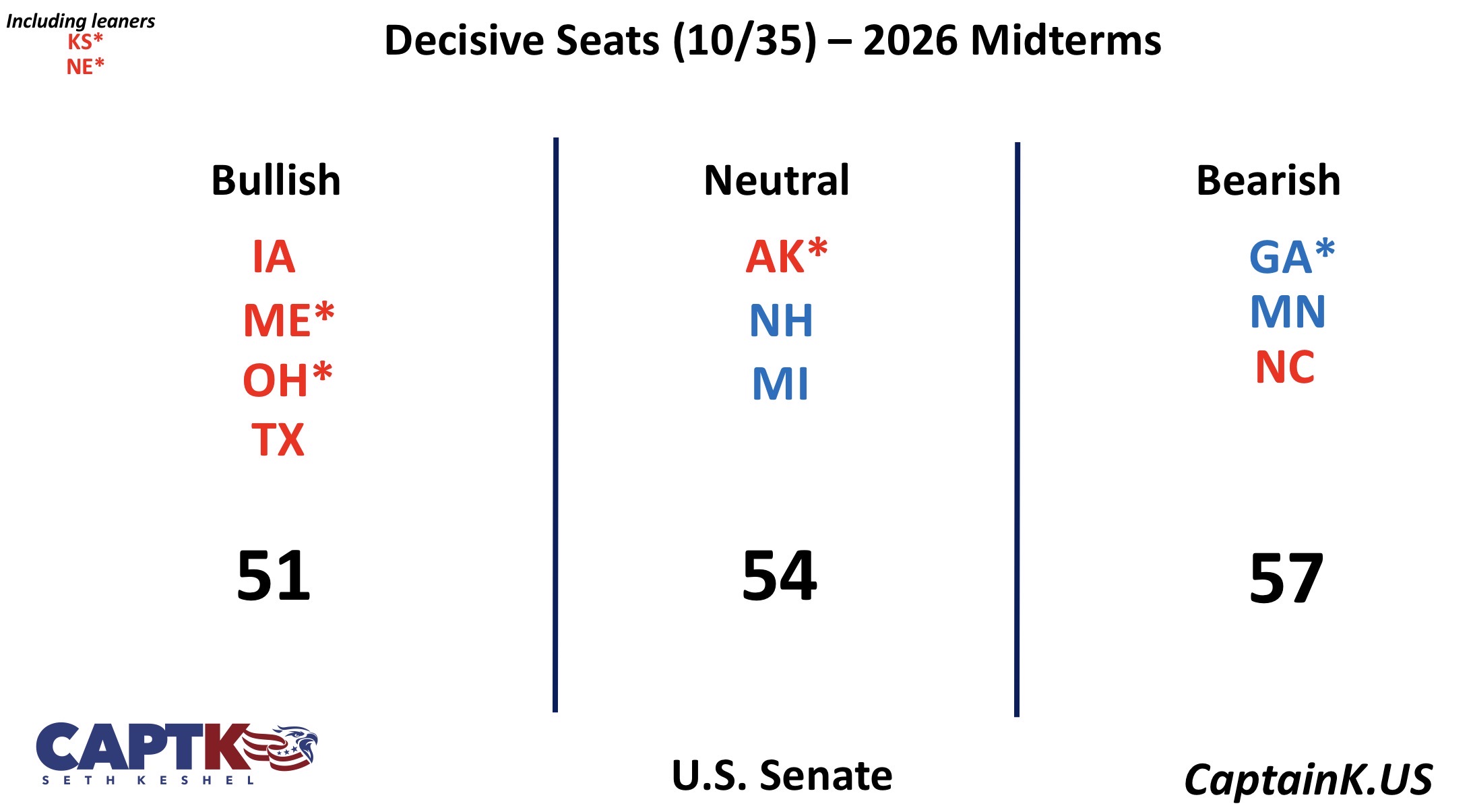
II. The Democrats Have the Uphill Senate Climb

Chart from Seth Keshel's 2026 Senate outlook

Just like the GOP can retain the House on paper, the Democrats can flip the Senate. It’s just not that easy, and the media are already hedging on the polls and their insane predictions that Democrats should be favored in four states Trump carried by over 11 points each.

Here’s how things go:

• Republicans have a 53-47 edge as things are today
• If Democrats flip North Carolina, that moves to 52-48
• Maine is a presidential blue state, but Collins is strong and likely to win, as I’ve profiled already – the Senate remains at 52-48 if this happens
• Democrats can hold Georgia, Minnesota, and New Hampshire (all likely), and even hold Michigan (toss-up), and still be down 52-48
• To get things to 50/50, they’d need to win two of Kansas, Nebraska, Iowa, Ohio, Alaska, or Texas
• Alaska may be a very dicey race for reasons I’ve profiled already, but the other states are formidable mountains and should help you understand why there is such a polling PSYOP underway

Senate races also behave more in line with presidential outcomes and feature far less volatility than House races. While the Democrats have a path, it’s most certainly not an easy one to navigate.

III. Tea Leaves

Many states have excellent reporting available in which analysts can observe mail-in balloting stats (like requests and returns) and in-person voting numbers. Georgia opens up in-person early voting today, and we will get a glimpse of enthusiasm that could tell us if Mike Collins has a shot in the Senate, or how the urban turnout in Atlanta that Keisha Lance Bottoms needs in order to become governor is shaping up. Data Republican has a great site with really cool trackers for Florida, Pennsylvania, and North Carolina.

Right now, early voting looks rough for Republicans in Virginia, but I am only monitoring VA-2, and possibly VA-1, as meaningful races. The media will cast this as a bad omen for the GOP, but what did we expect when the Trump 47 administration slashed the bureaucracy as promised? I warned of this in 2025 (and not a warning pleading not to do it).

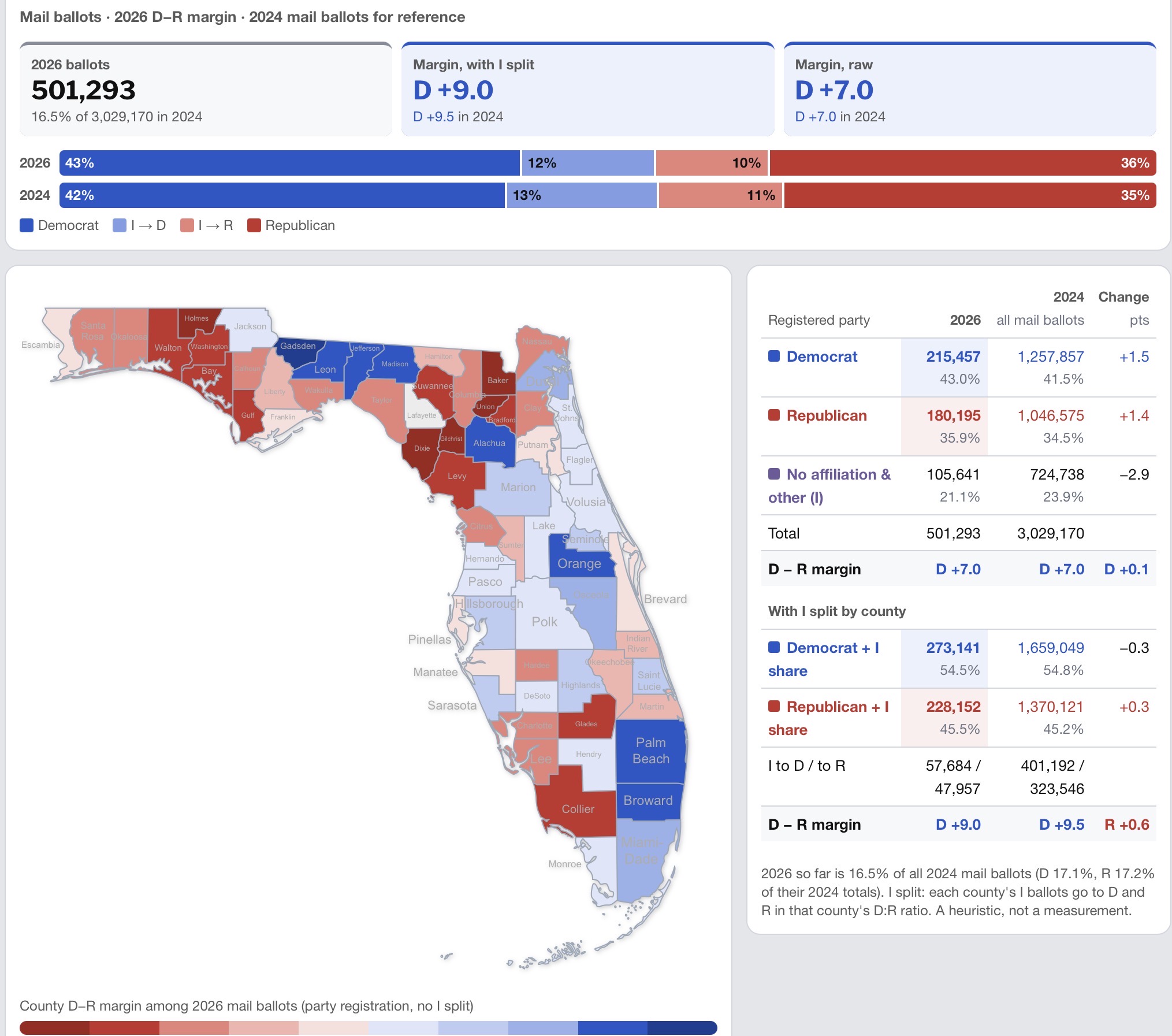
Right now, Florida is not giving us a warning of a blue wave. There may be an indication of a blue undertow, which would be consistent with a standard midterm environment, but I’m less inclined to believe Republicans are heading for a reverse 1994 wipeout. Here’s data from Florida, from Data Republican’s page:

Florida mail-in ballot return data from Data Republican's tracker

Yesterday, mail-in ballot returns favored Democrats by 7.1% (43.0% to 35.9%). You can see that in 2024, all mail-in ballots favored Democrats by 7.0%. This is also what things looked like in 2022; now, this may relatively favor Democrats because Florida is now R+11.4%, nearly four points to the right of the 2024 election – perhaps the GOP should run closer to even if all things were set equal.

That may be your Republican headwind, or perhaps during in-person early voting, Republicans will slaughter Democrats even worse than normal. Miami-Dade County and Broward County are much redder on returns compared with previous cycles, which is a bad omen for Democrats in the new decisive seat, FL-25.

In other states in which early voting data can be analyzed, Democrats appear to have mobilization issues in Ohio, Wisconsin, and more states in the Midwest. If this manifests in Georgia, North Carolina, and Texas, Democrats will struggle more than their forecasts and polls let on.

IV. Media and Polls Will Still Lie

If the pattern holds up, media fluff and polling nonsense will persist all the way until Election Day. Right now, there is a major operation to cover for James Talarico, who disappeared for almost two weeks before magically reemerging in Austin on October 9. If you’ve been following that drama on X, it has been suggested he was in a mental facility in Ohio, which the clinic denied and the New York Times denounced. Here’s an actual sequence of events:

Talarico disappeared in the middle of a campaign he’s supposedly winning, when actually winning it would require a full sprint through the finish line to win by the smallest of margins imaginable. When this came under scrutiny, we were told he had “the flu.” None of us would be off of work for that long with the flu, and no campaign would have been ground to a halt over it.

Whispers emerged about the Lindner Center of Hope in Mason, Ohio, which Lina Hidalgo (Harris County Judge) had been admitted to in 2023. Perhaps this was a source in Ohio, or one in Texas, or maybe just drawn from the internet as a rumor. Nick Sortor released audio of a receptionist at the clinic searching for “Talarico” in the database and confirming a discharge date. The date in the system didn’t line up with Talarico’s appearance in Austin, but that doesn’t erase the fact that she gave the information.

The facility, that evening, broke its own confirm/deny policies to state that they hadn’t ever treated Talarico. The statement looked to be written by a lawyer with plenty of room for interpretation.

The New York Times, yesterday, revealed that they had been shown proof of security footage confirming Talarico was indeed at home in Austin. They agreed not to show the evidence to the public. So, essentially, we were told “trust us” by the facility and by the media, as Talarico was lying about where he received medical care in Texas (Dallas or Austin?) and in which type of treatment center he was seen (primary or urgent care?).

There is a recorded call, and then there are two “trust us” statements – one from the facility and the other from the media. Talarico’s supporters say the call was made with AI; how are we to know any security footage, if it exists, isn’t made or timestamped by AI? If President Trump were being accused of a major scandal and ran to the NYT with evidence against it, would the public accept “trust us?” What would the media have done had Paxton disappeared for two weeks?

I fear we have reached the point in society at which anything can be written off as “AI” and without 100% evidence of something – it never happened. I don’t know if Talarico was in the mental facility or not, but I can damn near assure you they have something other than “the flu” going on. Many key Democrats are lamenting his absence from the trail publicly and don’t buy the story either.

You will continue to see the media rush to defend Democrat candidates and prop up suppression polling until the end of the cycle. The best thing that can happen for everyone is for the mainstream polling industry to go belly up, and be drastically wrong about the outcomes of this election. There are a few good pollsters left and some read this newsletter, and they will be the first to admit that many unethical pollsters should be forever exiled from the industry.

Conclusion

There you have the 30,000’ view in a nutshell. It will be an interesting three weeks, but these elections will face familiar headwinds and constant factors, as they do in every race. Key events can swing them, but early voting is underway in most states and the data we receive each day informs what is, and is not, possible for either side.

Thank you all for your readership, and make sure to get out and vote, and bring as many friends and family members of like mind with you to the polls.

Seth Keshel, MBA is a Senior Fellow at the Gold Institute for International Strategy and a retired Army Captain. He publishes Captain K’s Corner on Substack.