This article was written by Derk Jan Eppink and appeared in Wynia’s Week. De asielkwestie zal de bloedgroepenstrijd in de Europese PRO-fractie verhevigen.
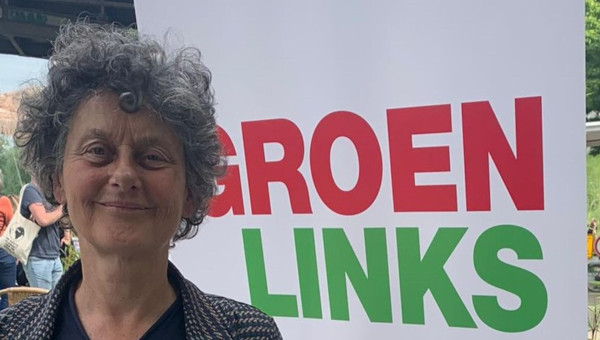
Social democracy is a conviction; Green is a religion. The merger ran into rejection symptoms because the first is willing to compromise, while for the second Green dogma prevails. It was not surprising that the merger of the PvdA and GroenLinks delegations in the European Parliament became the last piece of the puzzle.
Should PRO join the group of the European socialists or the European Greens? Party members chose the socialist group in a referendum, which does not mean the Greens will give up their faith. The struggle continues in the joint ‘PRO delegation meeting’. The factional debate has been parked for now, but it will return when the lists are drawn up for the 2029 European elections. Who will be lead candidate?
Heresy
A party committee led by party grandee Mariëtte Hamer came out in favor of joining the Party of European Socialists (PES), the second-largest group in the European Parliament. In her view the ‘power element’ must prevail, but according to convinced Greens there is only one faith. And share a pillow with that, and the devil sleeps between you.
For a sectarian club, compromise is heresy. The PES is used to compromises, for example with the (German) Christian Democrats. Greens think fundamentally differently about asylum, and that will remain a major theme in the next European elections. This puts enormous pressure on the PRO delegation within the socialist group, half of which consists of Greens. Will, for example, the ultra-Green Tineke Strik, who came up through the Dutch Council for Refugees, support a stricter asylum policy? Highly unlikely. For Greens, compromise is synonymous with betrayal.
The ‘power-building’ argument is also relative. Political developments in the EU are heading to the right. Look at developments in Germany, France, Spain: as soon as there are elections, the voters strike. Italy under Giorgia Meloni is currently more stable than Germany under Chancellor Merz. And France is charging into the jungle.
European Commission President Ursula von der Leyen wants to bring forward the decision on the EU’s multiannual budget because voters in many member states are turning right. As a result, new, more right-wing governments in Northern Europe are resisting the European mega-budget of 2,000 billion euros. Combined with excessive immigration and economic stagnation (due to climate and energy policy), Brussels will become even more of a whipping boy than it is now.
#MeToo
The harsh internal, almost sectarian, party culture of the Greens proved not conducive to smooth relations in the European Parliament, as Green delegation leader Bas Eickhout (49) found out. He was ‘co-chair’ of the Green group in the European Parliament and had a relationship with the 25-year-old Austrian member Lena Schilling. She was also a member of parliament, not a subordinate, and there was mutual consent. The relationship fell within ‘Green norms’.
A former chairman of the Green group, Daniel Cohn-Bendit, was once a prominent Franco-German charmer who saw his Green group, including staff, as an amorous field of work. Cohn-Bendit was adored. He was lucky, because there was no #MeToo yet. There is now, and it was used above all as a weapon against ‘the right’, preferably ‘white men’. But such men turned out to exist in left-wing circles too; in the arts, academia and politics.
Eickhout had rotten luck with his ‘co-chair’, the German Green Terry Reintke. Her main mission was the fight against ‘sexual harassment’ and her hashtag: ‘#MeToo’. Reintke waged a crusade and would certainly show ‘keine Gnade’ to Eickhout, popular with women, who cut his losses and resigned. He will undoubtedly find a new job at an NGO in Brussels, ‘to continue the struggle’. And Reintke has the Green realm to herself. Internally, the Greens are even worse than the Vatican.
Eastern Bloc methods
Much of this kind of thing, however, goes unseen in Brussels. The Dutch House of Representatives, with 150 members, has 260 accredited journalists. They knock everyone over in the corridors. At the European Union, of which the European Parliament is only a part, 21 Dutch correspondents are accredited. An MEP is glad when a correspondent calls at all.
It was to be expected that the merger of PRO’s two wings, PvdA and GroenLinks, would be problematic. The European wings come from two different worlds of thought. In the House of Representatives, the PvdA wing is being devoured by GroenLinks. There were already several PvdA MPs, such as Kati Piri, who belong more with GroenLinks than with the PvdA, whose culture and history are being filtered away. The ‘Red Rose’ has disappeared, and anyone entitled to the Drees medal must now have been a member for 65 years (!) instead of 60. Why not 100 years? The goal is to abolish the Drees medal. These are really Eastern Bloc methods, which ordinary social democrats do not notice.
A flea circus
Other European groups are crackling too, such as the European liberals. Renew, a French-dominated group at the wish of French President Macron, houses both the VVD and D66. Both have always sat in the same liberal group, and their members were ‘pro-European’ to varying degrees. Bolkestein’s Euroscepticism never got through. In The Hague the VVD regularly displays criticism of the euro for its grassroots in the country, but in Brussels there is no sign of it.
Malik Azmani (VVD), for instance, was rapporteur on the important EU Return Regulation as part of a stricter asylum policy: the option of forced return is necessary, because otherwise asylum is a one-way street, as it is now. Rapporteur Azmani looked like a ski jumper who started to wobble after take-off and crashed hard, nose in the snow. He was caught in a split. The VVD was in favor, but his own liberal group, with the French liberals in the lead, was against. The shadow rapporteur, the Christian Democrat François-Xavier Bellamy, took over the file and built a center-right majority.
In the confusion Azmani abstained, while the other VVD MEPs voted for the tough approach. D66 members, led by Gerben-Jan Gerbrandy, voted against. Renew looked like a flea circus. The liberal group once had two pillars: the British and the Germans. The British left; the German liberals are camping below the 5% threshold, and the French liberals are hopelessly fickle.
Bible-firm
The European Christian wing, made up of the SGP and ChristenUnie (CU), has a longer history. For decades they worked together, but in 2019 their paths parted. The SGP stayed in the European Conservatives and Reformists group (ECR), but the ChristenUnie moved to the large group of Christian Democrats (EPP). The bone of contention was The Hague: the CU was in the Rutte III cabinet (with VVD, CDA, D66) and the SGP in opposition. Relations soured, in Brussels too. The CU vetoed FvD joining the ECR, but lost the vote and left for the EPP. The SGP had an immense problem: in European elections the party won half a seat; the CU one and a half. That way they each had one. Brotherly sharing.
The consequence of the split was that the SGP had to win a whole seat on its own from then on. MEP Bert-Jan Ruissen ran a clear, conservative campaign in the 2024 European elections. The CU drifted onto a more left-wing track in Europe, as had already happened in the House of Representatives. Bible-firm voters preferred the SGP, while the CU lost its seat and disappeared from the European Parliament.
Storms
Anyone who projects current political developments in the EU member states onto the European Parliament should not be surprised when the traditional center axis breaks. The trend in the large countries, and the small ones too, can be found in the European Parliament. The ‘political center’ is getting ever smaller; the extremes larger. Germany and France foreshadow this. It will be interesting to see whether the PRO delegation weathers these storms.