Tom Barrett (R-inc.) vs. William Lawrence (D)
I. The Race
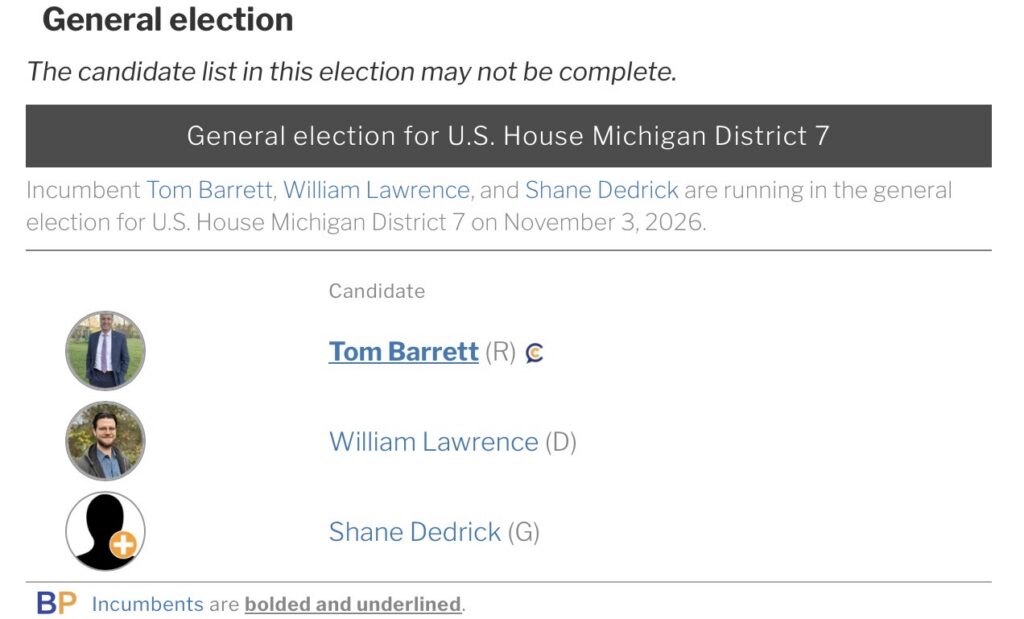
Tom Barrett (Republican) is seeking his second term in the U.S. House after having won the open seat vacated by Elissa Slotkin in 2024. Barrett is an Army veteran who had previously served in both the Michigan House and Senate chambers.
William Lawrence (Democrat) is among the most radical left-wing candidates the Democrats have running for the U.S. House in any district, let alone a moderate district in the Midwest. Until July 2026, he was a card-carrying member of the Democratic Socialists of America (DSA).
There is also a Green Party candidate, Shane Dedrick, who stands to take votes exclusively from Lawrence.
II. District Geography
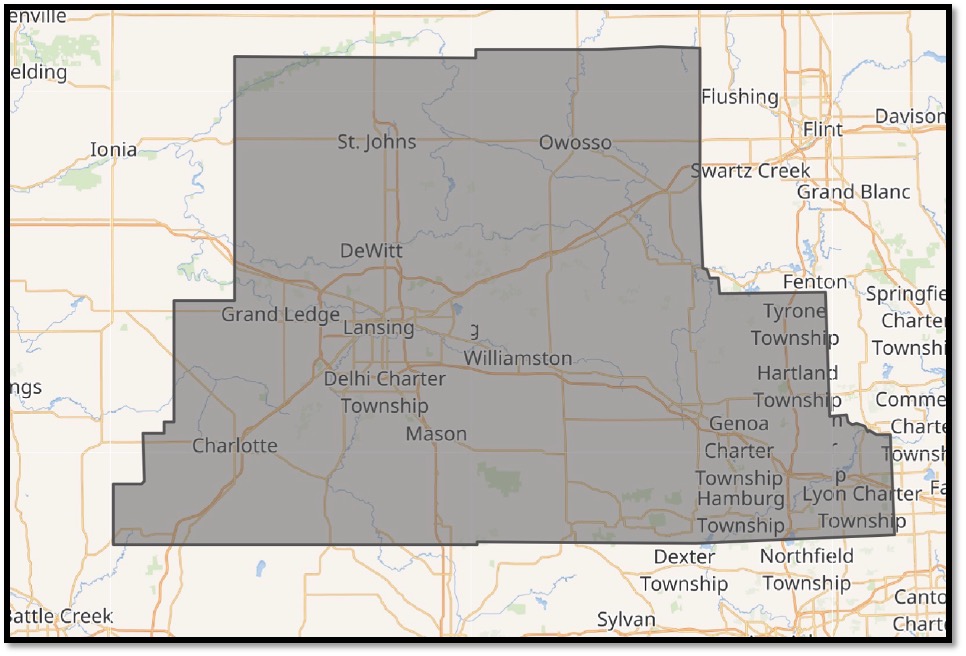
Michigan’s 7th Congressional District (MI-7) sits right in the smack middle of the state. It contains Michigan’s capital city, Lansing, and Ingham County, as well as Clinton, Livingston, and Shiawassee Counties, almost all of Eaton County, and a tiny pinch of Oakland County.
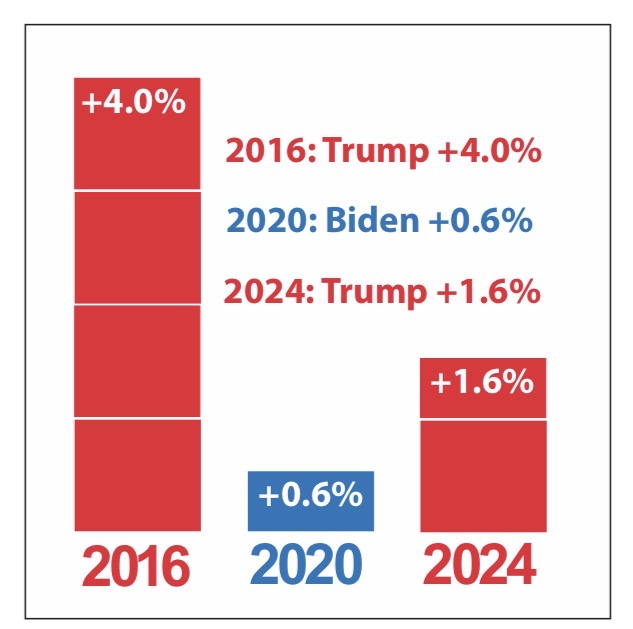
Thanks to the suburban realignment occurring in the past decade, this district has shifted away from Republicans a bit. It is down from a high point of Trump +4% in 2016, when he first flipped Michigan, to just a 1.6% presidential baseline in 2024. Some of this is owed to the expansion of mail-in balloting. Thanks to the expansion of that practice in 2020, Biden narrowly carried the popular vote in the district (as it is drawn today).
Presidential Margins
Key Statistics
79.9% White, 5.9% Black, 5.7% Hispanic
III. Market Assessment
Driven primarily by midterm vibes and the knowledge that MI-7 is a tough district with both candidates forced to play to the middle, Polymarket bettors think the Democrat, Lawrence, is a modest favorite.
IV. History
MI-7, according to Cook, rates as EVEN for its PVI rating. Its boundaries have undergone substantial redrawing and now extend further into the heart of the state than they once did, and have come to include Lansing in this decade. The Lansing portion of the district is what swung so heavily in the old MI-8, which eliminated Republican Mike Bishop in the 2018 wave and installed Elissa Slotkin, the now-Senator who spends her time comparing the president to Saddam Hussein and encouraging the military to disobey orders.
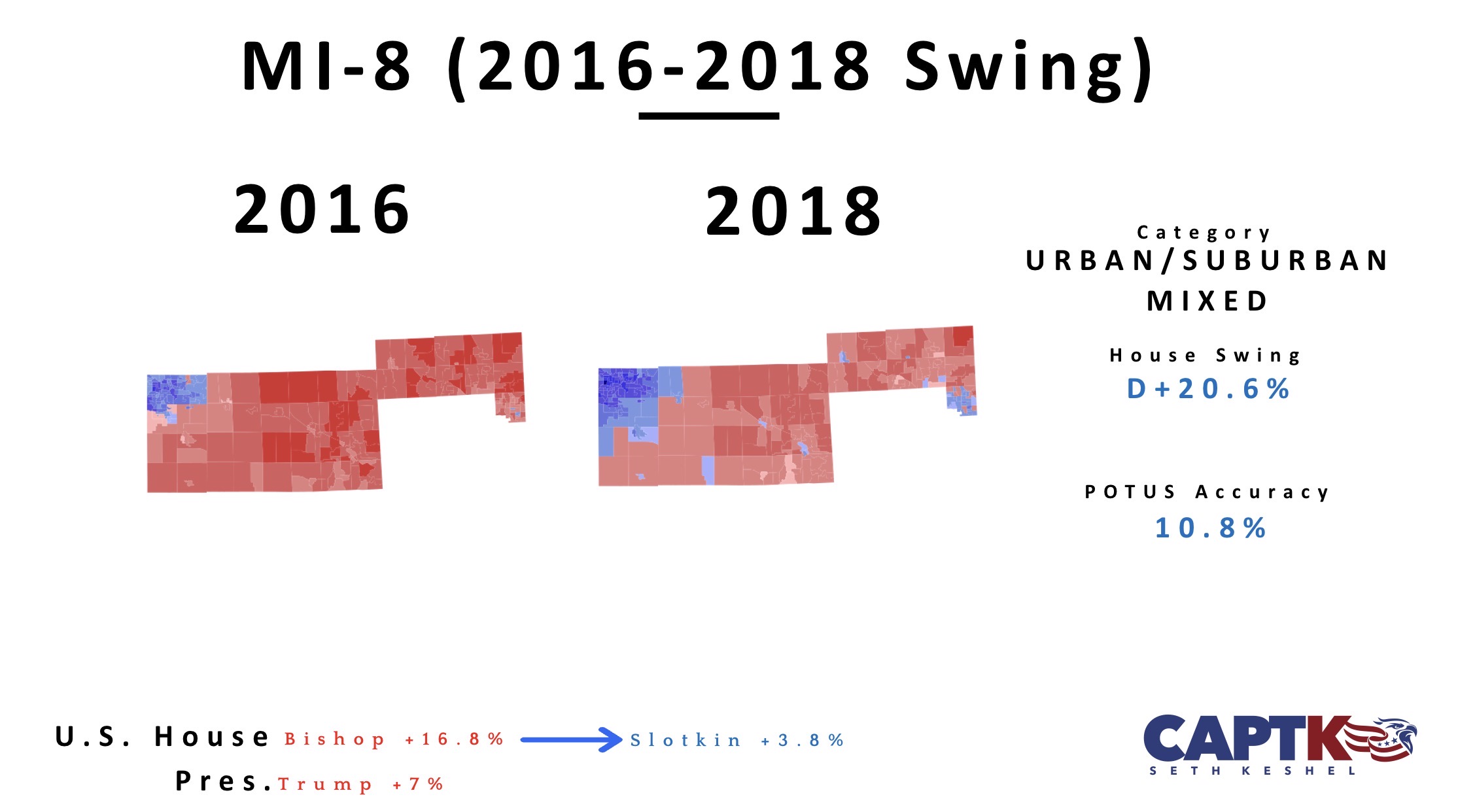
MI-8, meeting the danger profile of a Republican House representative significantly outrunning Trump on the same ticket (by 9.8%), sustained one of the most serious left swings of the entire 2018 cycle, and Slotkin held the seat in the controversial 2020 election by almost the exact same margin (+3.6%). When maps were redrawn, Slotkin’s new seat became the current MI-7 (the subject of this forecast), adding on Clinton and Shiawassee Counties (and the vast chunk of Eaton), and altering the portion of Oakland County included in the district.
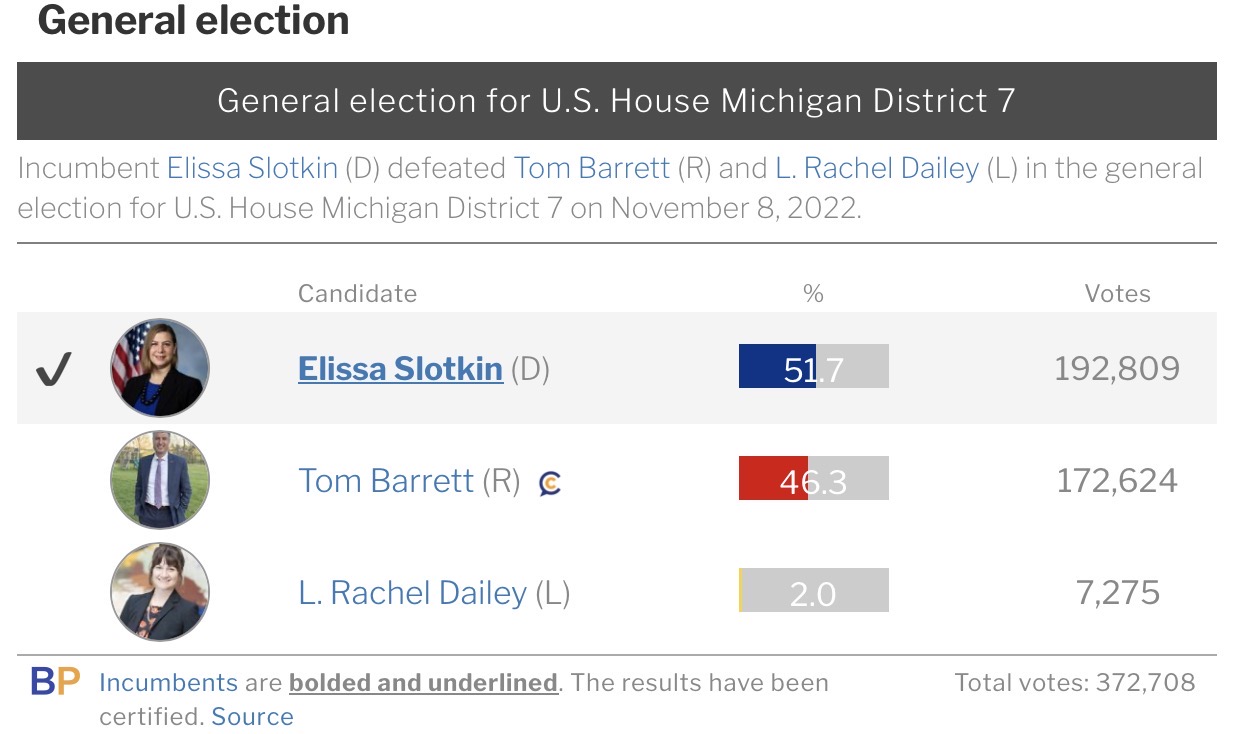
In the first race under the new boundaries, Slotkin repelled the GOP House advantage by holding the seat with a margin of +5.4% over Barrett:
Barrett gave it another shot in 2024, with Slotkin vacating the seat to run for the U.S. Senate, and prevailed with a margin of +3.7%, with a libertarian sucking down 3.2% of the vote. It is unclear what the district baseline may be without the libertarian disruption. As it stands, Barrett ran 2.1% ahead of Trump by margin of victory, though his vote share is barely higher.
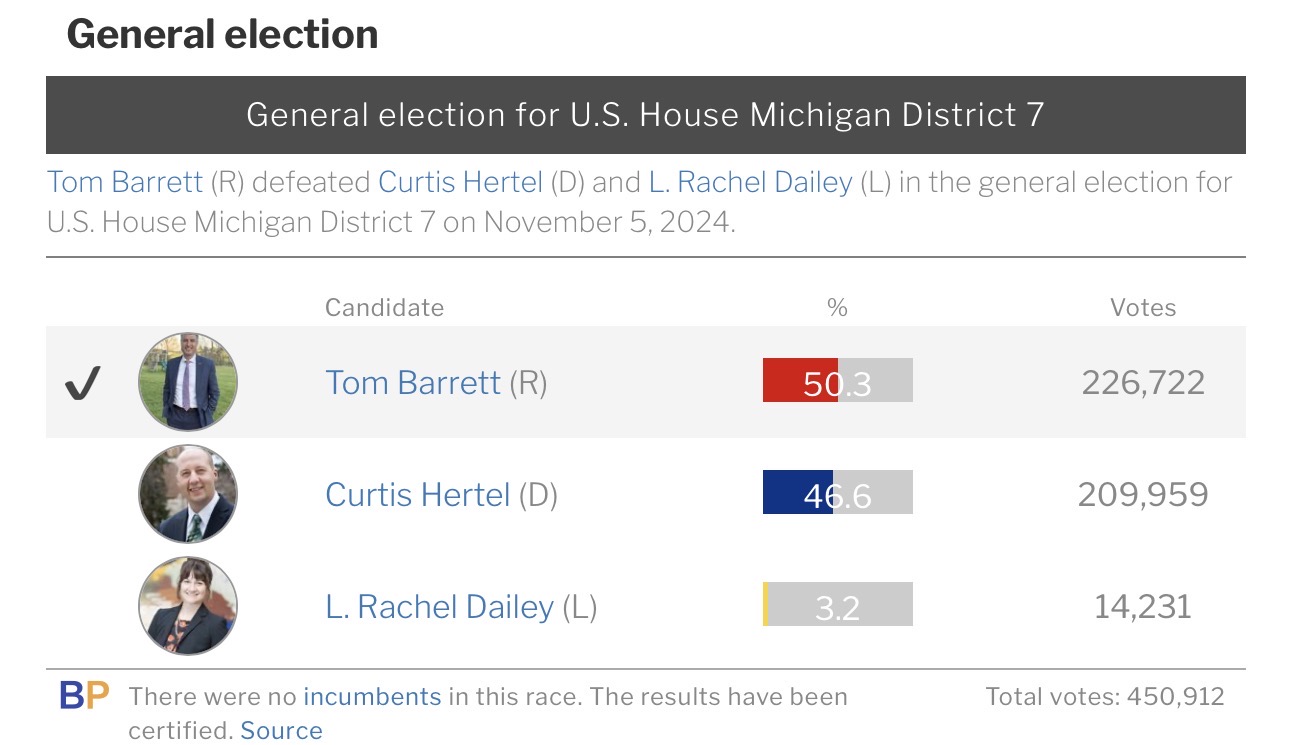
Given its urban and suburban profile, plus the capital city and major university factor (Michigan State University) present in Lansing and Ingham County alone, MI-7 immediately falls into the 2018 threat category upon first glance.
V. Analysis of 2026 Primary Results
Barrett ran unopposed in the 2026 GOP primary. Lawrence, on the other hand, prevailed in a three-person field with all candidates receiving considerable vote shares:
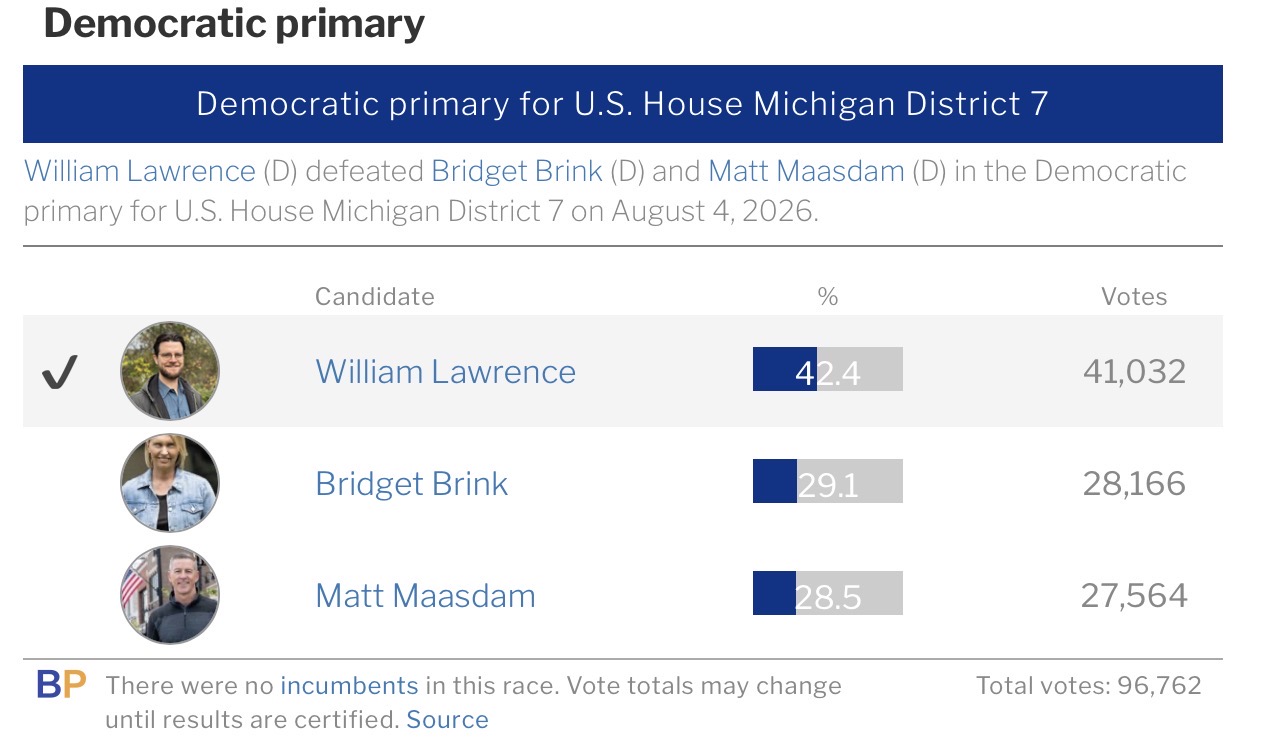
This a wonderful example of the Democrat grassroots toppling an easily winnable race by tapping the wrong candidate in a primary – normally a Republican problem.
Maasdam is a Navy SEAL who served as a military aide to President Obama. He centered his campaign on cutting healthcare costs and catering to manufacturing interests. Brink spent a career in the State Department and has served as Ambassador to Slovakia and Ukraine in the past decade; her profile closely resembled Slotkin’s. Both candidates have formally endorsed Lawrence, although it seems to be more out of political necessity rather than genuine enthusiasm. Maasdam, despite finishing behind Brink, had urged her to drop out just before the primary to avoid splitting the moderate vote.
The two moderate candidates received 57.6% of the primary vote, which gives Lawrence a problem like his U.S. Senate counterpart, Abdul El-Sayed, in uniting the Democrat factions.
Advantage: Barrett
VI. Polls
I pulled these polls from The New York Times:
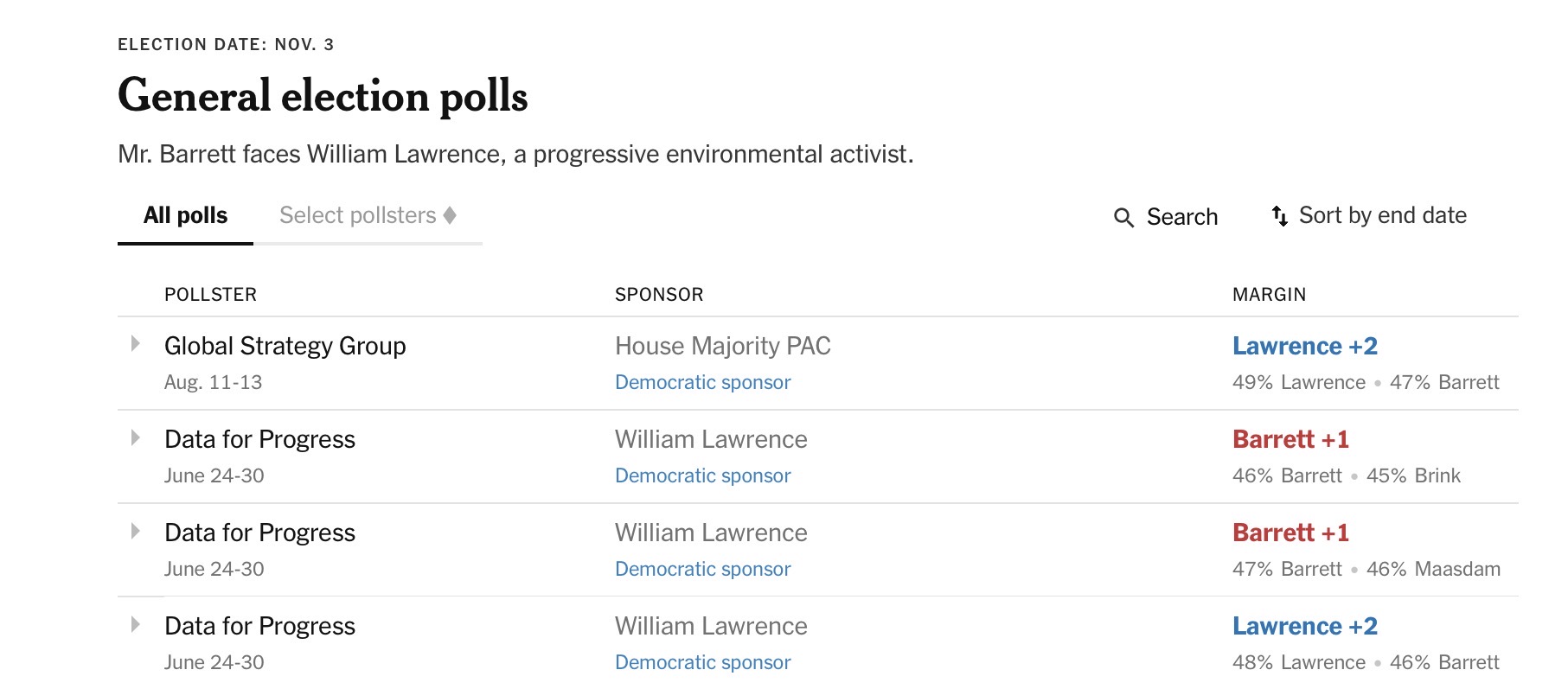
None of them are good polls for Lawrence. He commissioned three himself during the Democrat primary, with the ones for his opponents’ hypothetical matchups with Barrett showing them losing, but his poll showing him winning. Another Democrat sponsor, House Majority PAC, got Lawrence +2 in August with Global Strategy Group doing the work.
The polls here are inconclusive, and amount to a push.
VII. Media Ratings
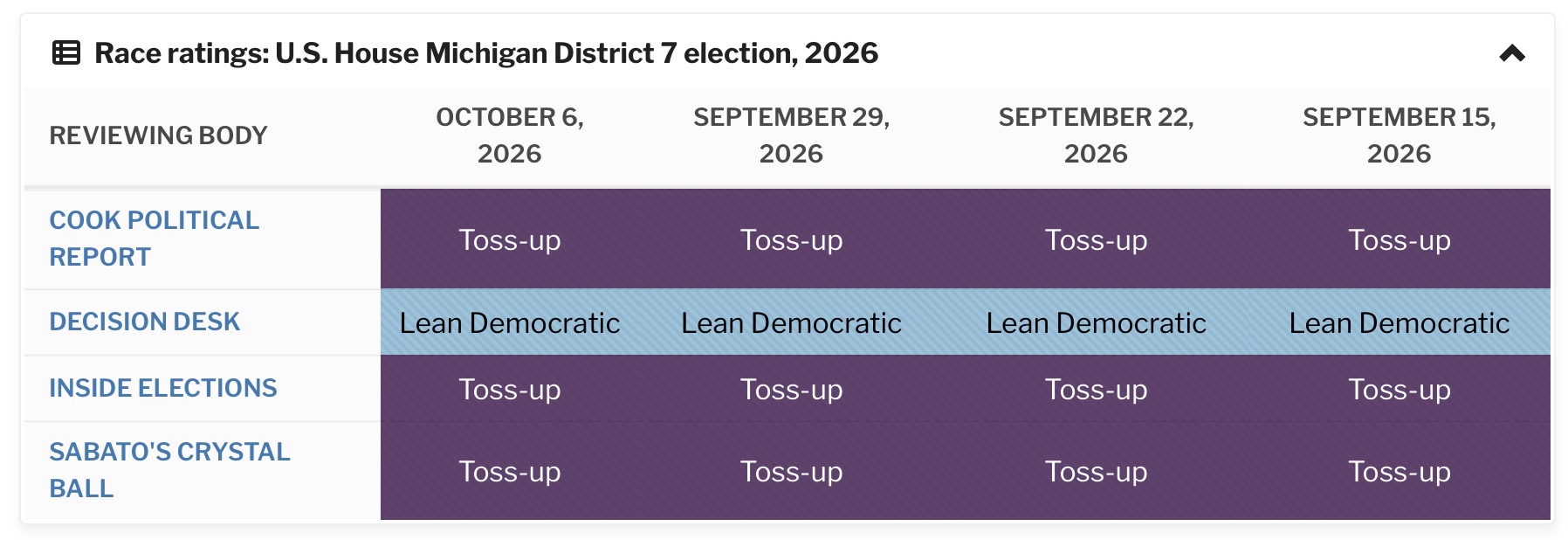
Three of the four major think tanks have this race as a toss-up, with only Decision Desk breaking from the ranks and leaning Lawrence.
VIII. Party Registration
Michigan does not register voters by party, but Pennsylvania does. The two have shifted together in the same direction in every presidential election since 1952, meaning that if Michigan did have party registration, it would move like Pennsylvania’s. Pennsylvania sits well to the right of its 2024 registration (D+3.1%), but has experienced Democrat gains in recent months. Those gains are primarily in the Philadelphia and Pittsburgh markets, but also in the capital region of Harrisburg.
Therefore, it is likely that Lansing and Ingham County are leaning slightly left since 2024, but the overwhelmingly red areas of MI-7 would not be.
IX. Election Considerations
No one who pays attention to American elections can forget the night of November 3, 2020, particularly how the TCF Center in Detroit was sealed off from the view of election observers as a massive Trump lead in Michigan slipped away. Michigan, of course, went on to be called in the wee hours of November 4 for Biden after a twofold increase in mail-in ballots from 2016 to 2020.
I have also documented the Michigan Senate primary from this summer, and am confident that Abdul El-Sayed survived a Democrat establishment effort to give the nomination to Haley Stevens through mail-in ballot fraud. You can make up your own mind when you review the stats.
Michigan, thanks to changes in election laws since 2016, has emerged as one of the national epicenters of election corruption. I documented all of these changes in my 2024 election review of the state, which Trump managed to win against the obstacles in place.
From that article:
• Voter ID – Michigan has a photo ID requirement for in-person voting, but there are workarounds available.
• Same Day Registration – Same day registration is allowed in Michigan.
• Ballot Harvesting – Like Pennsylvania, Michigan has reasonable ballot harvesting laws, but enforcement is lacking and does not deter the practice, which can be easily spotted by trend analysis and precinct mapping to spot for ballot bloat.
• Unique Corruption – Michigan has been exposed for covering up voter registration fraud rings, particularly in a major 2023 news story involving one in Muskegon County active during the 2020 election. Notably, similar registration fraud rings were exposed this cycle in Pennsylvania in multiple large counties. The state’s Attorney General, Dana Nessel, has threatened election integrity activists with imprisonment and police persecution for drawing attention to Michigan’s endless examples of election-related malfeasance.
• Automatic Voter Registration – Michigan operates Automatic Voter Registration, which has only entrenched Michigan’s voter registration corruption, as evidenced by the state having hundreds of thousands of more voters registered than there is an available pool of eligible voters statewide. The Secretary of State, Jocelyn Benson, has suggested the state is helpless to clean its voter rolls and responds harshly to citizens who expect the state to run fair elections. As a reminder, more than 83% of Michigan’s total population (including minors) is registered to vote, when only 77% of any population is over the age of 18 and therefore old enough to cast a ballot.
No state with the number of registered voters exceeding voting-age population can be trusted to run fair elections, and if control of the House hinges on MI-7, even the Democrat establishment will go to bat for Lawrence and trust they can bend him to their will in a hypothetical majority.
X. Summary and Election Estimate
Based on the volatility of suburban areas, which smoked the GOP in 2018, I would have this a 75/25 Democrat flip (likelihood, not margin) had Brink or Maasdam emerged from the Democrat primary with the nomination. This type of voter is exactly the type that bases a midterm vote on their opinion of the president and pleas for moderation, unless given a better reason to consider how to vote. And that reason is staring back at them on the ballot:

Lawrence is indeed a leftist radical, and here are some of his credentials:
• Former DSA member and co-founder of the Sunrise Movement, a climate activist group pushing the Green New Deal
• Advisor to Dream Defenders, a radical socialist group seeking to dismantle the “capitalist police state”
• Has deleted many extreme online posts proclaiming his support for abolishing prisons and police and open migration for anyone to move anywhere, while ripping moderate Democrats in very harsh terms
Tom Barrett called this out in grand fashion at this week’s debate:
Socialist felon @WeWill2026 Lawrence to a Democrat who wasn’t extreme enough for him: "F*ck you… Hurry up and die." Liberal lunatic Lawrence is completely unfit to serve in Congress
NRCC (@NRCC), Oct 6, 2026
Barrett is flogging Lawrence financially, although those numbers will tighten some with the final report before the election. He has 6 times more receipts and 7.5 times more cash on hand than the guy who despises the capitalist system, and isn’t afraid to use it.
From the proprietary mapping file, you can get a lay of the land:
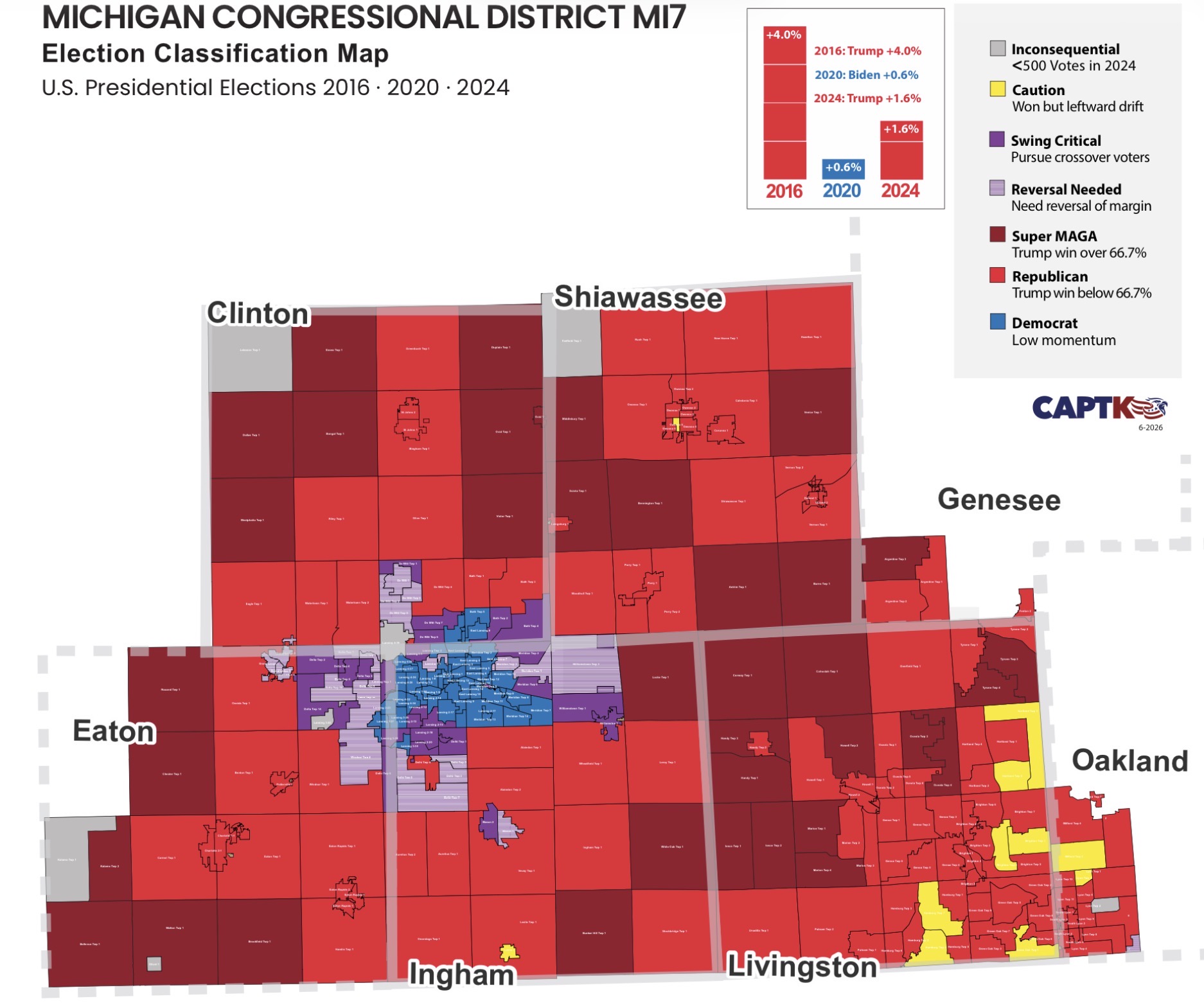
Barrett, thanks to Lawrence’s extremism, should dominate the vast expanse of the district, which is filled with favorable MAGA/GOP precincts. If Lawrence’s positions and campaign incompetence cause him to lose ground in the purple (solid and striped) precincts around Lansing, and the urban Democrat vote is down as we are seeing in early data, then Barrett has a clear advantage.
Here is how the key factors in this race stack up:
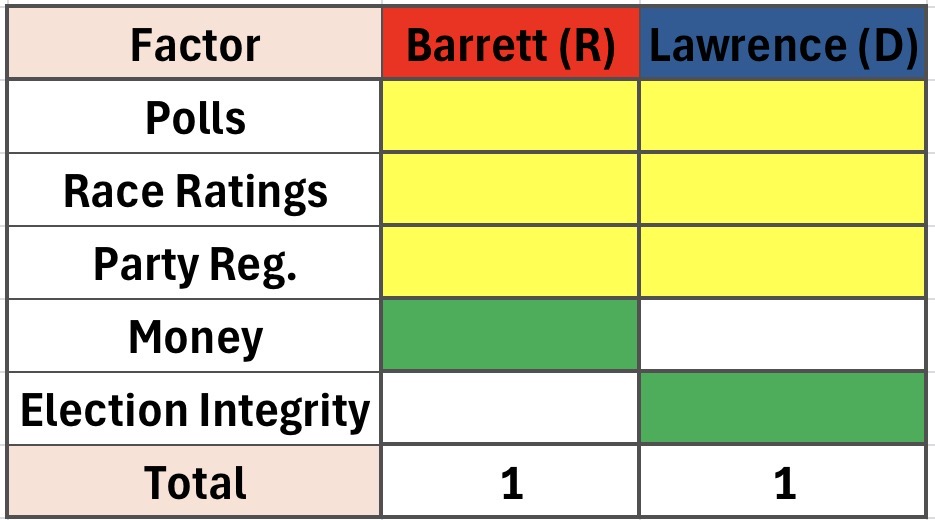
Forecast for MI-7 House
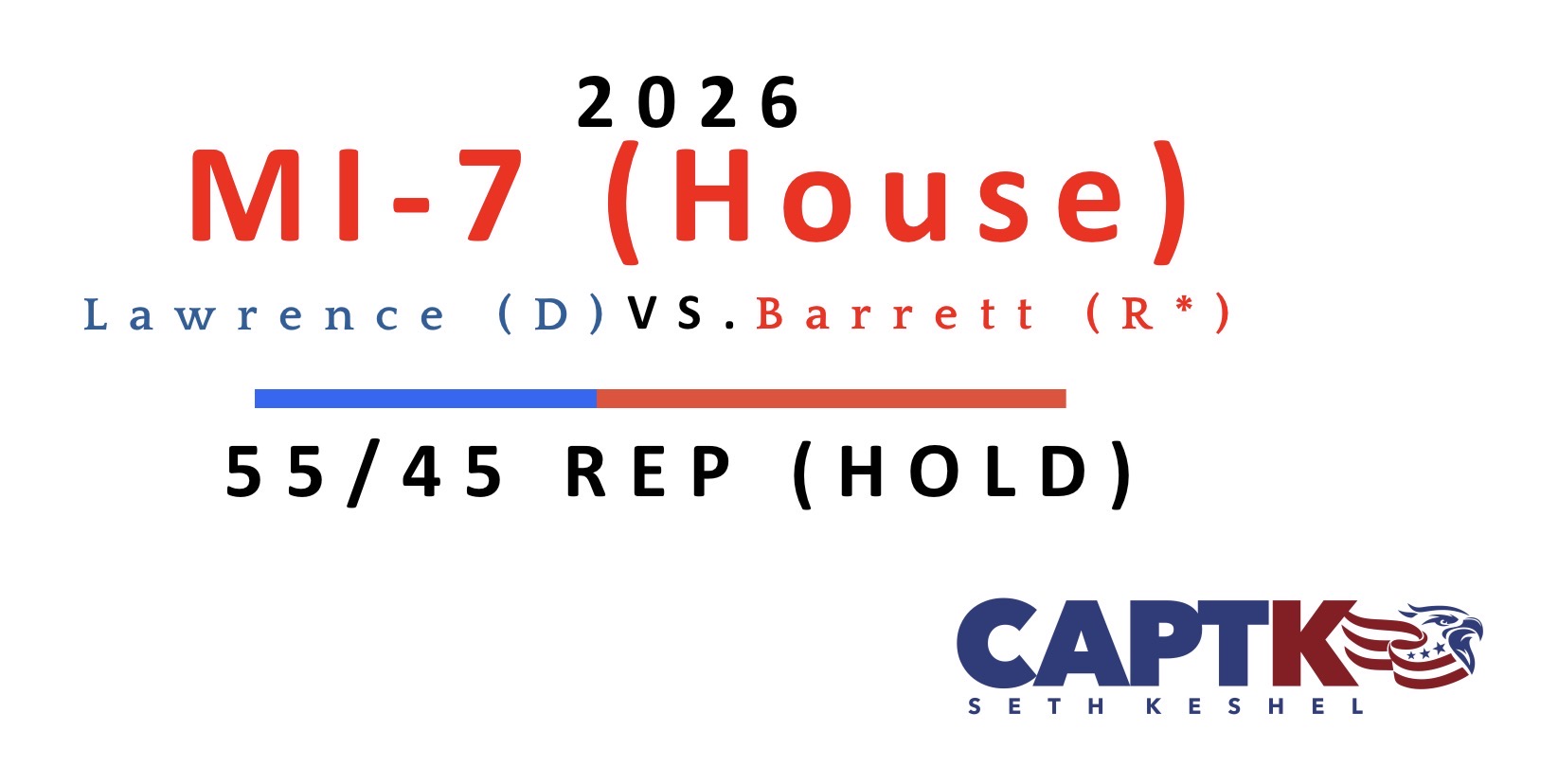
A potential Republican House majority always needed to catch a few breaks, especially with the courts stacked against them and so many difficult seats up for defense. MI-7 is a logical loss in this cycle given its very moderate nature found at the mercy of the state capital, but Lawrence makes it, I believe, more likely than not that the GOP will hold the seat. Lawrence still has a shot at flipping it thanks to midterm dynamics, but it will take all Democrat hands on deck in a state already struggling to back its Senate nominee at full throttle.
Seth Keshel, MBA is a Senior Fellow at the Gold Institute for International Strategy and a retired Army Captain. He publishes Captain K’s Corner on Substack.