Mike Ettore explains how to succeed through trust-based leadership

Frontlines of Freedom podcast cover art: a U.S. soldier silhouetted against an American flag at sunset

Mike Ettore, a retired Marine Corps infantry officer and founder of Fidelis Leadership Group, joined Brig. Gen. Ernie Audino on Frontlines of Freedom to discuss succeeding through trust-based leadership.

On Frontlines of Freedom, Mike Ettore joined the program to discuss succeeding through trust-based leadership. Gen. Audino’s Comments from Israel: Seizing ground takes BOG, major threats Israel NEEDS to be ready for. Special Guest: Mike Ettore is a retired Marine Corps Infantry officer and decorated combat leader, founder of Fidelis Leadership Group and author of a series of books on leadership.

Brig. Gen. Ernie Audino, US Army (Ret.), is a Senior Military Fellow at the Gold Institute for International Strategy, a Washington D.C. based foreign policy and defense think tank. He hosts Frontlines of Freedom, a nationally syndicated military news and talk radio program.

Listen on Spreaker Listen on Apple Podcasts

2026 Ten-Point Forecast: New Hampshire U.S. Senate

2026 Ten-Point Forecast: New Hampshire U.S. Senate

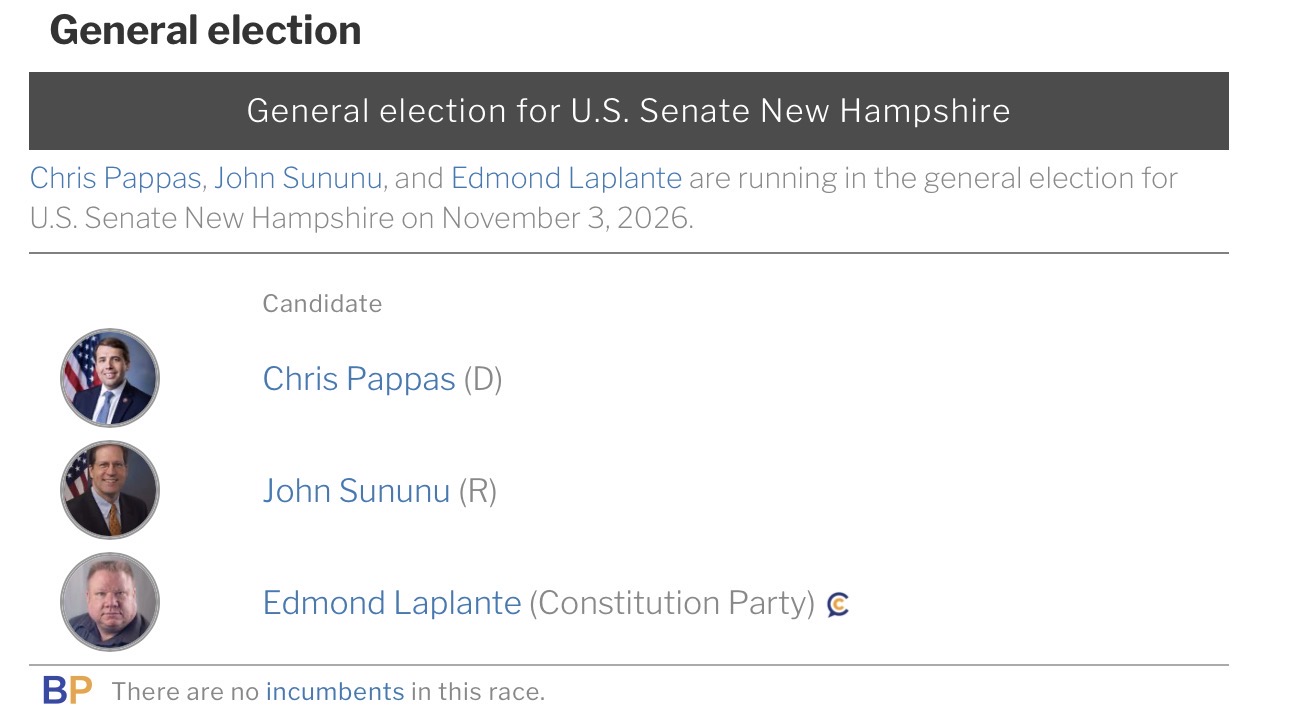
John Sununu (R) vs. Chris Pappas (D)

I. The Race

New Hampshire U.S. Senate candidates John Sununu and Chris Pappas

John Sununu (Republican) is from the well-known Sununu political family of New Hampshire, and once held the exact Senate seat he’s seeking in 2026. He won it in 2002, but lost it to Jeanne Shaheen in the 2008 Obama wave. Shaheen is now retiring, prompting Sununu’s latest run.

Chris Pappas (Democrat) is the sitting U.S. House Representative for NH-1, a seat he won in 2018 and has defended three times since. Despite New Hampshire’s competitive disposition, Pappas is largely focusing his campaign on “get Trump” themes, which may backfire on him given his opponent’s clout.

II. State Profile

New Hampshire state profile map

The Granite State is, by far, the most conservative of the six New England States. Like Maine, it was once a GOP stronghold; it voted for all but six Republican presidential nominees from 1856 through 1988, but has only backed one (George W. Bush, 2000) since then. Still, it generally elects Republican governors and surrounds them with GOP legislatures and plays an oversized role in early primaries.

New Hampshire is overwhelmingly white, and like its neighbors, has rural progressivism. These folks love their land and tolerate the guns, but aren’t down with the southern brand of evangelical influence that drives the modern Republican Party. This was obvious in the lopsided 2008 and 2012 presidential setbacks; however, Trump’s push in 2016 focused on the opioids epidemic and piqued the interest of New Hampshire’s white working class voter base. Strangely, the state’s two most populous counties (Hillsborough and Rockingham), situated along Massachusetts’ northern border, are the keys to Republican wins and are substantially more conservative than many counties in the state’s interior. New Hampshire, presidentially speaking, votes well to the left of its voter registration advantage, signifying frustrating levels of GOP crossover to Democrat federal candidates and the left-leaning nature of unaffiliated voters.

Key Statistics

88.3% White, 4.3% Hispanic, 2.6% Asian

III. Market Assessment

Polymarket transactions have Pappas as the 89% favorite; he is definitely overpriced on this market, despite the dynamics of a Trump midterm.

IV. History

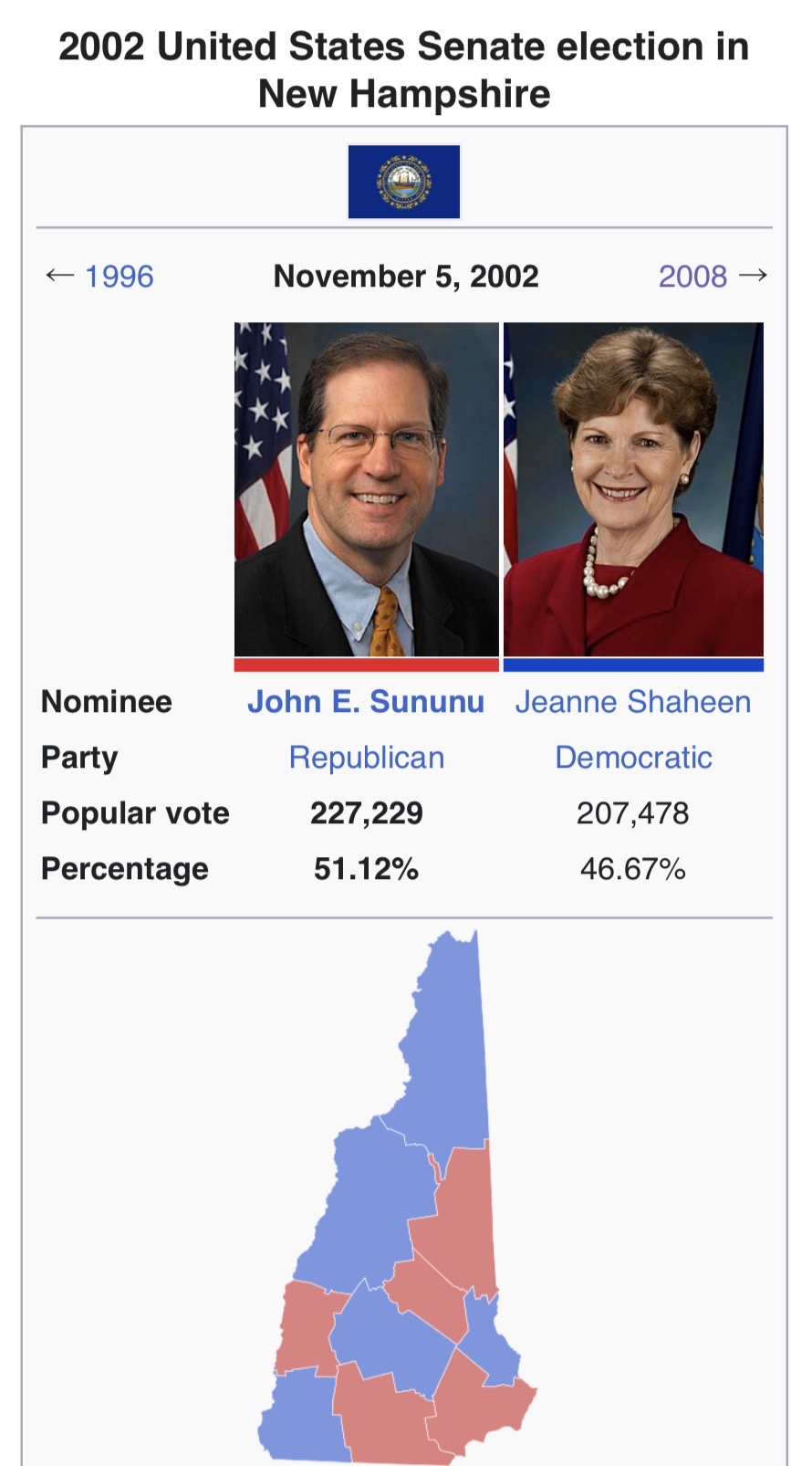
In the 2002 midterms, one of the few since 1934 to have favored the president’s party, Sununu defeated Shaheen by 4.5% for this exact seat:

2002 New Hampshire U.S. Senate result, Sununu over Shaheen

In 2008, Barack Obama won the Granite State by double digits; Sununu performed better than John McCain, but this time dropped the seat to Shaheen by 6.3%. She has successfully defended it twice, in 2014 and 2020. It drifted right from the 2012 presidential election with standard midterm dynamics in 2014, and she won her race over Scott Brown, former U.S. Senator from Massachusetts by 3.2%. She won her last race in a blowout, more than 8 points left of Biden’s win over Trump.

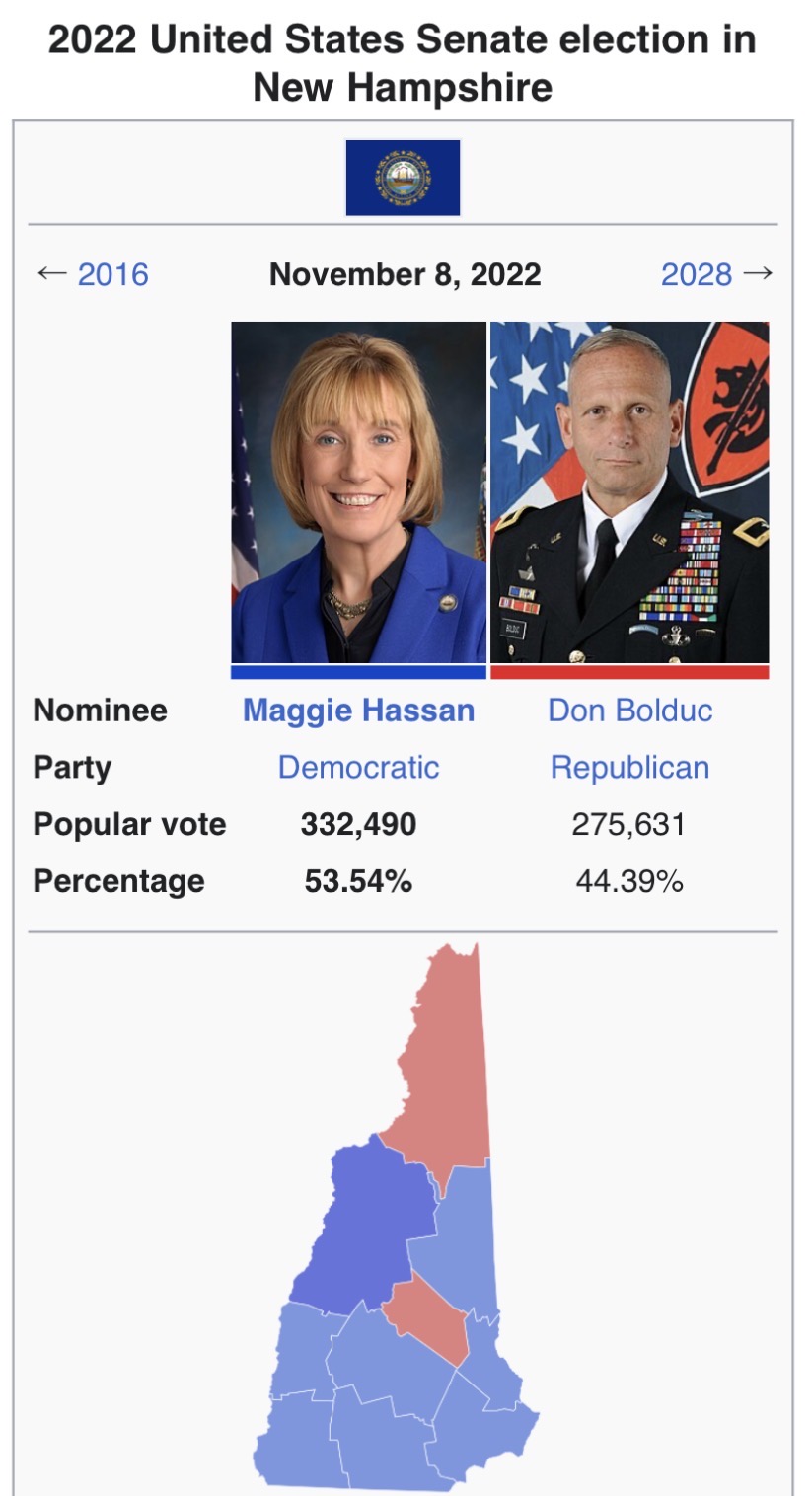
In the other seat, the one occupied by Maggie Hassan, the 2022 midterm featured a blowout despite Biden occupying the White House. The GOP nominated Brigadier General (USA, Ret.) Don Bolduc, and he went on to lose by 9.2%.

2022 New Hampshire U.S. Senate result, Hassan over Bolduc

Hassan first won the seat by an eyelash in the 2016 election from Kelly Ayotte, who extended a streak of GOP dominance stretching back to 1981 when she first won the seat in the 2010 wave. With Ayotte’s ouster, New Hampshire normalized its U.S. Senate seats to its standard presidential disposition – blue, but not overwhelmingly so.

In 2002 and 2022, New Hampshire Senate seats favored the president’s party by margin shift. In 2010 and 2014, they blew against it. This means that Trump’s presidency gives Pappas no guarantee of a margin to the left of Harris’s +2.8% mark from the 2024 presidential election.

V. Analysis of 2026 Primary Results

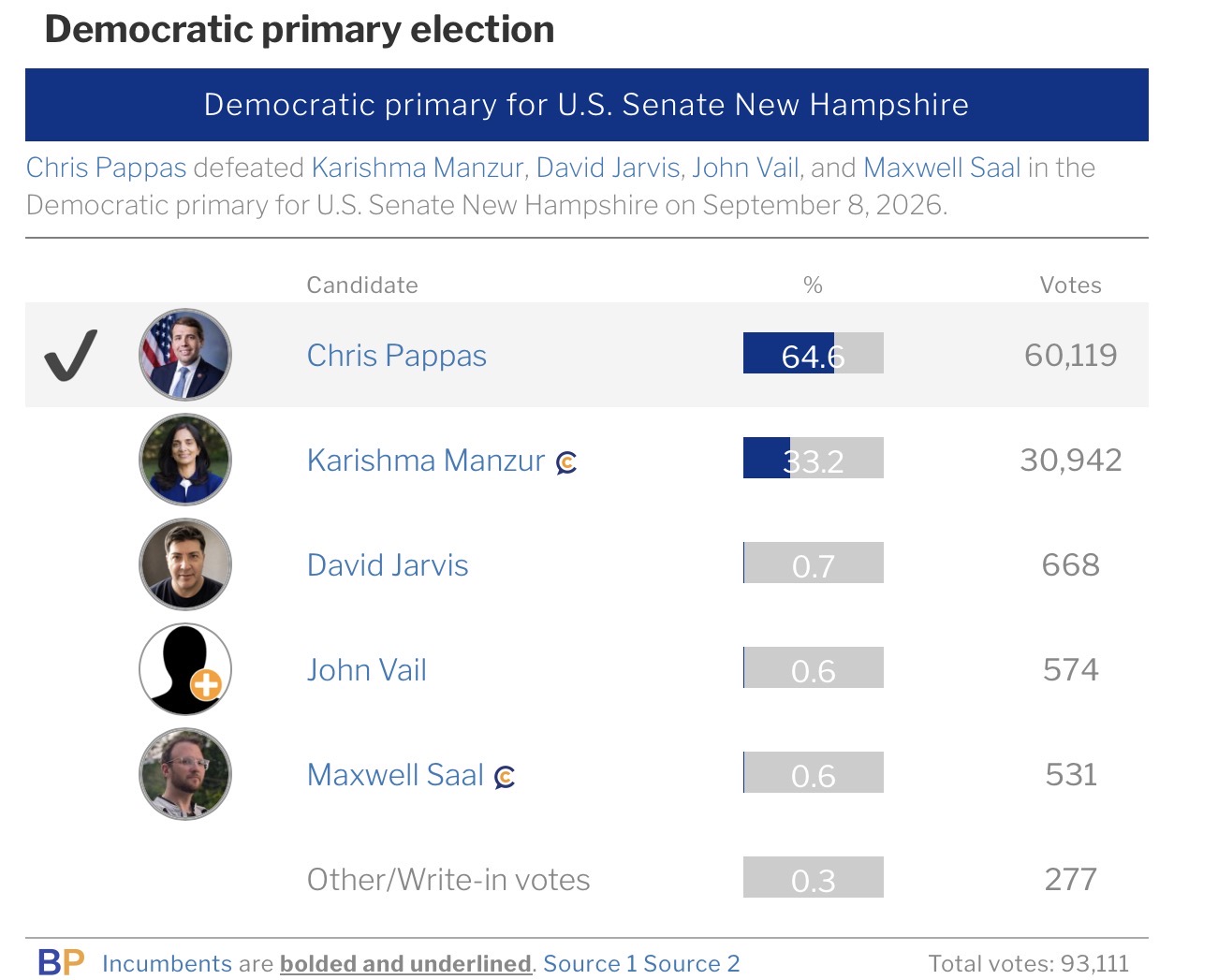
Both Sununu and Pappas prevailed over primary challengers.

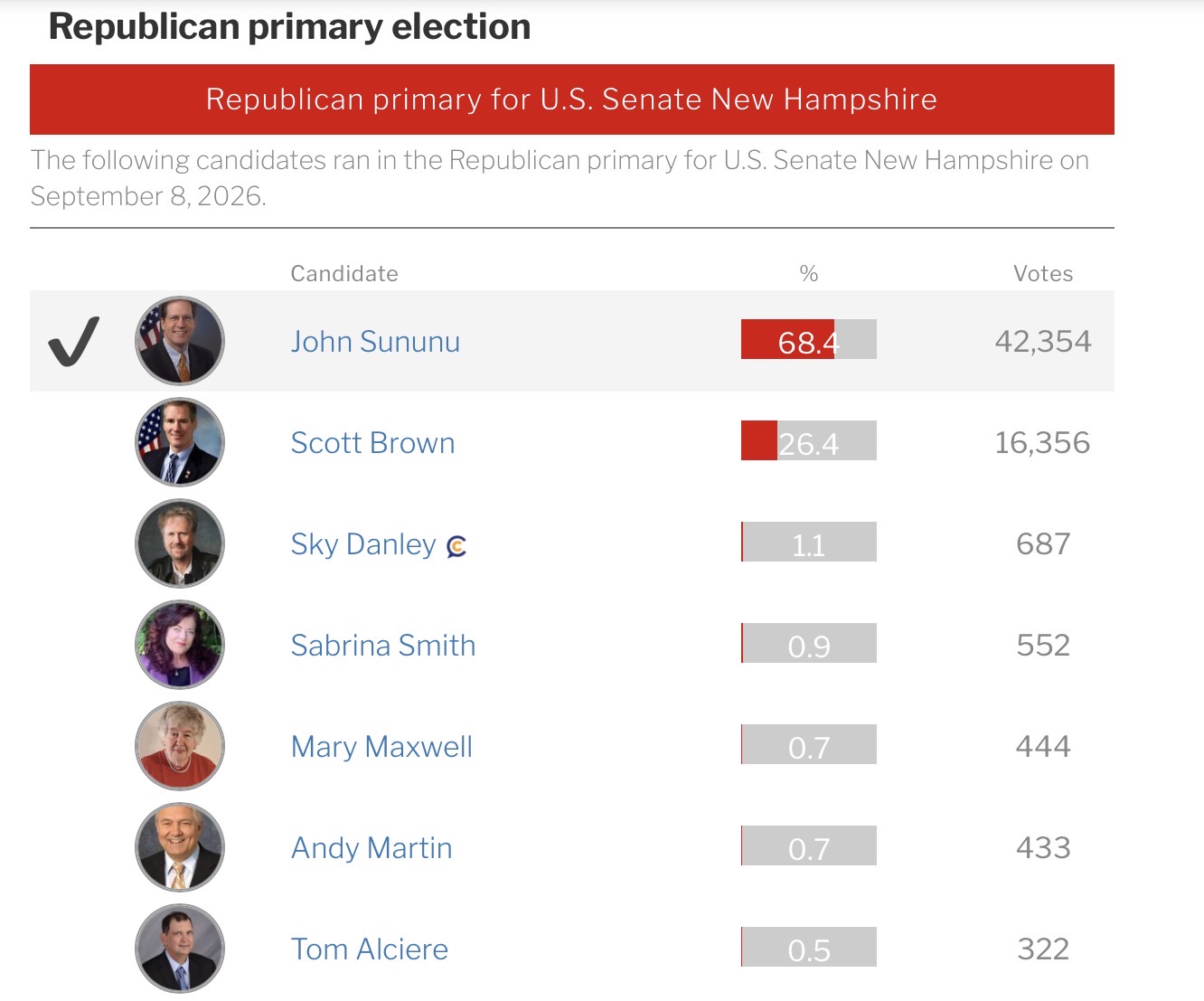
New Hampshire 2026 Republican U.S. Senate primary results

Sununu faced off against Brown, and won by +42.0%. Brown immediately congratulated Sununu, putting an end to any possibility of party drama impacting the General Election race negatively.

New Hampshire 2026 Democratic U.S. Senate primary results

Pappas, on the other hand, has had drama with DSA-aligned challenger Karishma Manzur, who still has not fully endorsed Pappas, though she says she opposes Sununu and Trump. Pappas, looking to earn her support (worth a third of the Democrat primary vote), has been overly accommodating to her. This rift matters, because statewide races in New Hampshire often come down to mere thousands of votes.

VI. Polls

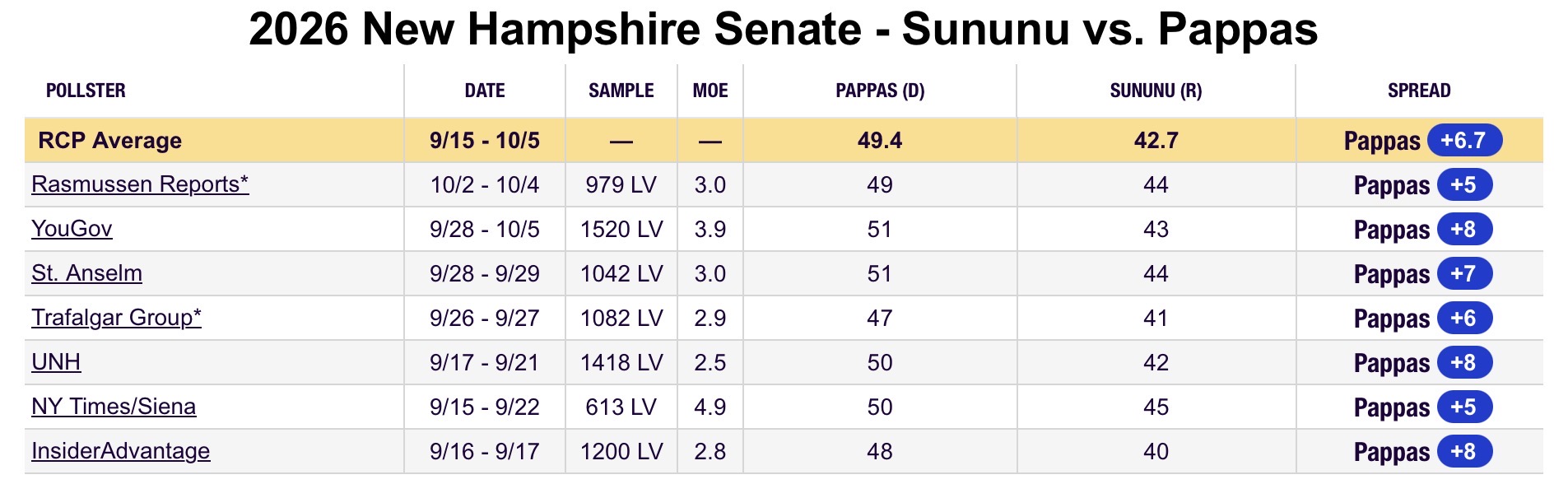
RealClearPolitics polls for the New Hampshire U.S. Senate race

The RCP average has Pappas up by almost 7 points, with all polls making up that average affording him a minimum lead of 5 points. Sununu had some tied or narrowly leading polls after the primary, but those are in the distant past at this point. I will note that some of the pollsters listed above have had a number of wild misses (especially St. Anselm).

VII. Media Ratings

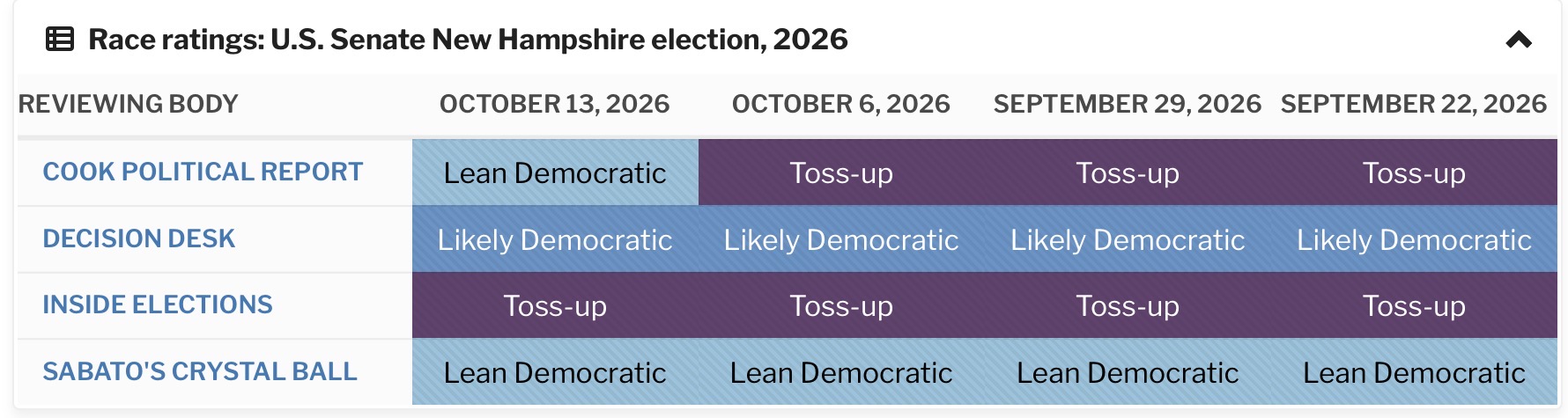
Media ratings for the New Hampshire U.S. Senate race

Inside Elections appears to have done some homework on New Hampshire Senate races and isn’t buying into polling showing a runaway race. The other three outlets give Pappas the edge.

VIII. Party Registration

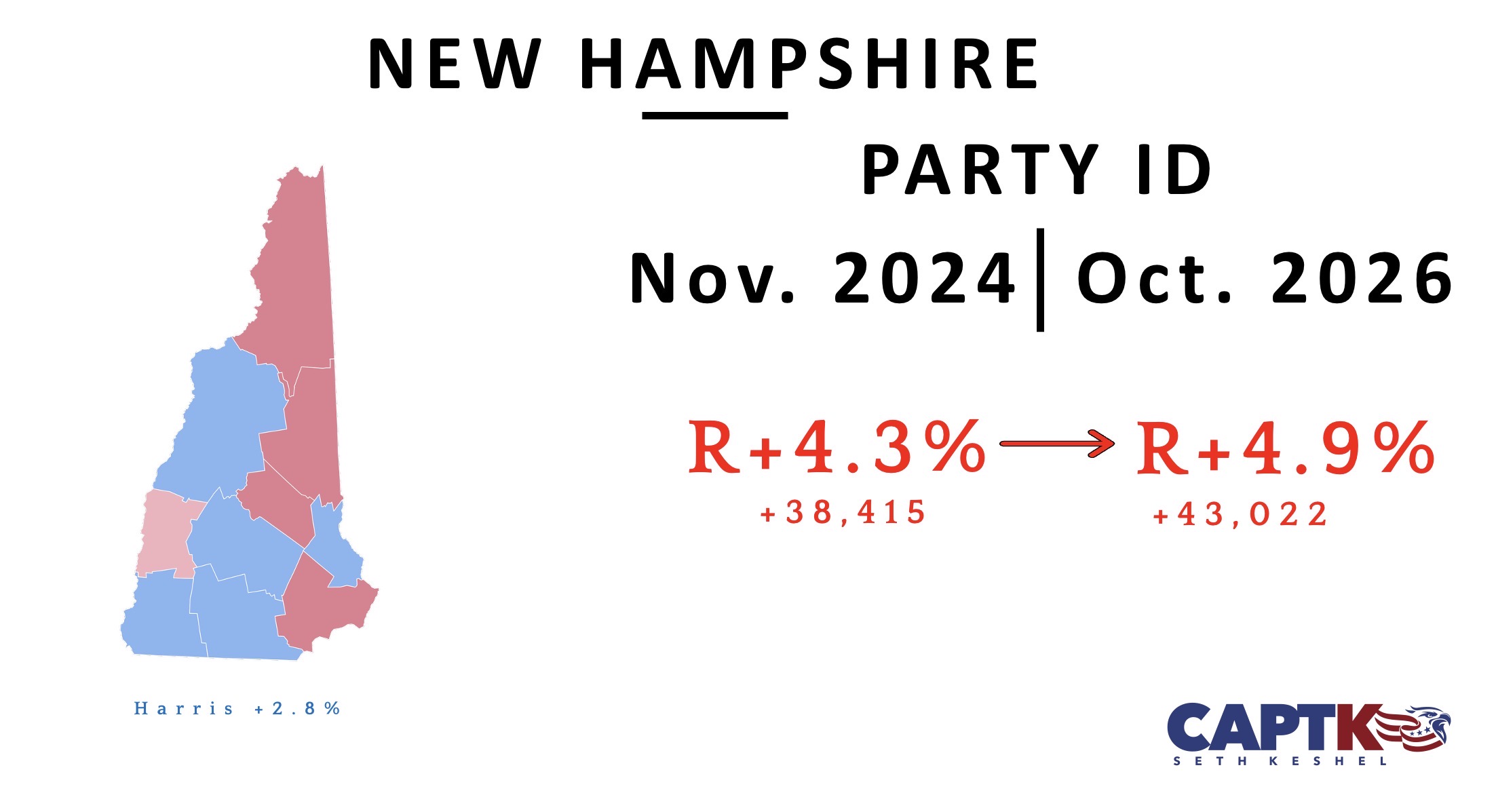
New Hampshire party registration changes since 2024

In the long run, things are positive for the GOP. They have moved the state more than a half-point to the right since Trump’s close finish in 2024; however, they’ve also dropped nearly 10,000 net registrations since the state’s summer update, which can be directly attributed to the state’s primary prompting voters to pick a party. Democrats jumped from 247,069 registrants in June to 255,943 in September. Factoring in the fact that independent voter behavior is a known commodity in the state, this may be like shifting change from one pocket to another – but it does suggest momentum for Pappas.

IX. Election Considerations

Here is what I had to say about vulnerabilities:

Opportunities for Election Manipulation

Two good things positioned New Hampshire for a competitive race in 2024. The first was the aforementioned voter roll purge that cut lots of fat out of the credit line for absentee cheating, and the second is the state’s lack of Automatic Voter Registration, which is a key hallmark of a blue state (New Hampshire is the only state without AVR that Harris won in the 2024 election, meaning Trump carried non-AVR states 248 to 5 in the Electoral College). There are two key issues that remain for election integrity measures:

• Voter ID – Republican Governor Chris Sununu signed a Voter ID bill this year, but not in time to have it take effect before this year’s election. This is a commonsense reform with major national support that must be seen through to ensure basic voter fraud cannot occur, especially with New Hampshire’s well-known same-day registration loophole present.

• Same Day Registration – This issue destroys election integrity in many other states, and has been known to taint New Hampshire’s close elections, such as has long been suspected in the case of Hillary Clinton’s 2,736-vote victory in 2016. The two densely populated counties along the Massachusetts state line, Rockingham and Hillsborough, are particularly vulnerable to out of state bad actors providing false identifying or qualifying documents and casting ballots in high numbers. This must be eliminated to ensure election security.

Relative to other states, New Hampshire doesn’t have a lot of issues. But Kelly Ayotte and Donald Trump both lost the state in 2016 by margins requiring very little manipulation.

X. Summary and Election Estimate

New Hampshire, despite Republican statewide dominance, has been stuck in a Democrat rut for federal elections since expelling Ayotte in 2016. Trump has had two close calls in the state, but most of the electorate comes from two urban counties near the Massachusetts line.

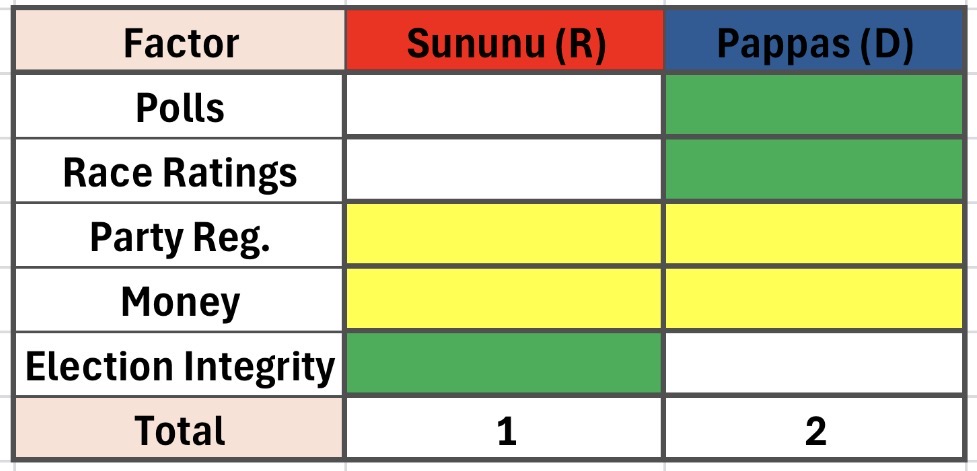
Sununu, thanks to his family name and experience, probably enjoys a boost of a few points on those factors alone. New Hampshire sometimes moves toward the president’s party in midterms, but it hasn’t done that for Republicans this century. The race looks like this in terms of key factors:

Ten-point decision matrix for the New Hampshire U.S. Senate race

Sununu has a significant edge in outside spending over Pappas, but Pappas has done better with individual contributions – which matches the momentum in registration changes from independents from the primaries. Scott Brown, who won a special election for U.S. Senate in Massachusetts in 2009, was a strong candidate, but Sununu’s name ID gives the GOP a shot in this race a generic Democrat wouldn’t have.

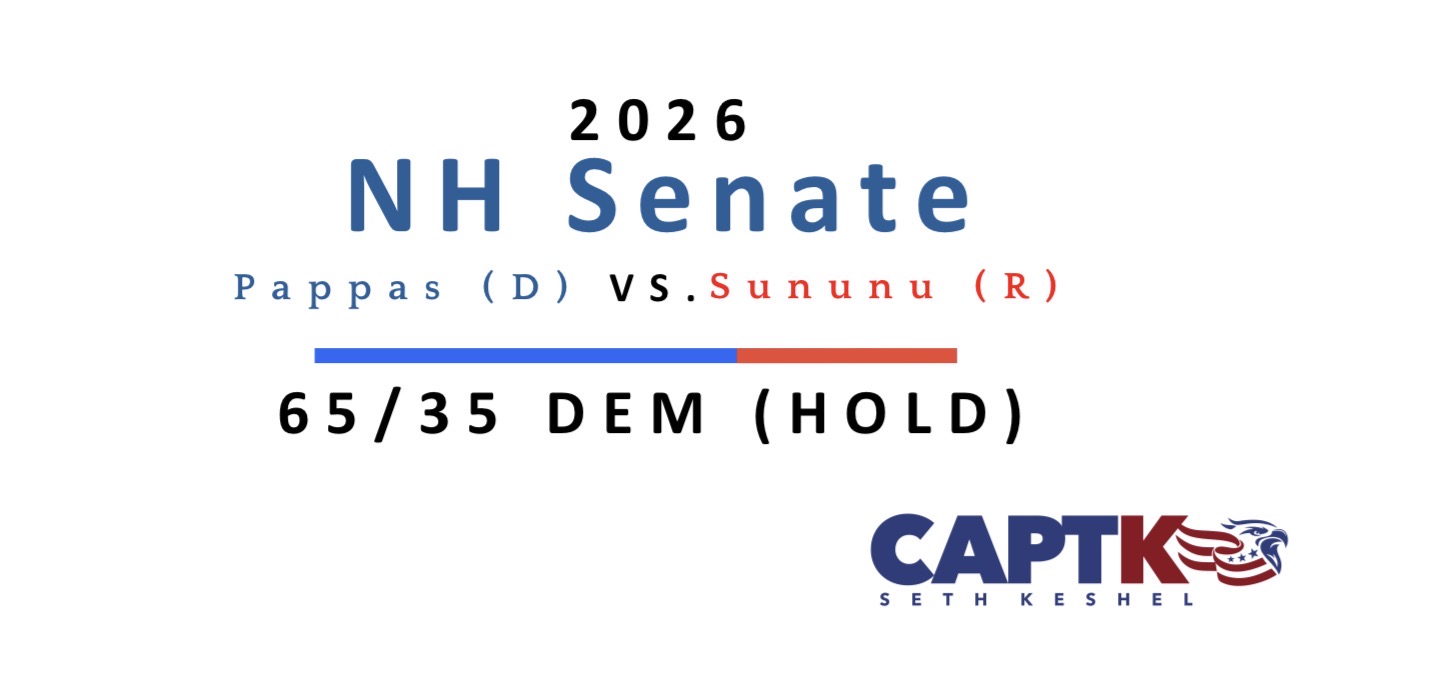
Forecast for NH Senate

For the reasons listed above, and with the expectation that some of Trump’s affluent New England voters from 2024 will defect, my forecast looks like this:

Forecast for the New Hampshire U.S. Senate race

Seth Keshel, MBA is a Senior Fellow at the Gold Institute for International Strategy and a retired Army Captain. He publishes Captain K’s Corner on Substack.

Former U.S. National Security Adviser Flynn Receives Korean Name ‘Shin Min-soo,’ Honoring Alliance Ties Spanning Three Generations

Gen. Michael Flynn with the leaders of the Korea-U.S. Alliance Friendship Association and Foundation

This article was written by Lee Ju-yeon and appeared in Sand Times. 플린 전 美국가안보보좌관, 한국 이름 ‘신민수’ 받았다…3代 걸친 한미동맹 인연.

Featuring The Second Annual Indo-Pacific Summit, October 14, 2026, Gold Institute for International Strategy

Sand Times (in Korean) reports that Gold Institute Chairman Lt. Gen. (Ret.) Michael T. Flynn received the Korean name Shin Min-soo from the Korea-U.S. Alliance Friendship Association at the Second Indo-Pacific Summit in Washington, co-hosted by the Korea-U.S. Alliance Foundation and the Gold Institute and attended by Korean and American officials and security experts.

The association’s chairman said the name asks Gen. Flynn to carry on his father’s legacy of protecting both nations, and Gen. Flynn said he would cherish the honor, describing how his grandfather, father and son all served in connection with Korea. The article lists earlier recipients of Korean names, including Presidents Trump, Biden and Obama. Summary translated from Korean.

The Second Annual Indo-Pacific Summit

The ceremony was held at the “2nd Indo-Pacific Summit co-hosted with the Gold Institute.”

Read the full article at Sand Times

The Gold Institute for International Strategy is a Washington, D.C. foreign policy and defense think tank.

Former National Security Adviser Michael T. Flynn Receives a Korean Name From the Korea-U.S. Alliance Friendship Association

Gen. Michael Flynn receiving his Korean name in Washington

This article was written by Ryu Won-geun and appeared in Global Economic Newspaper. [인물] 트럼프 1기 美 국가안보보좌관 지낸 마이클 T. 플린, 한국 이름 받았다…한미동맹친선協 증정.

Featuring The Second Annual Indo-Pacific Summit, October 14, 2026, Gold Institute for International Strategy

Global Economic Newspaper (in Korean) reports that Gold Institute Chairman Lt. Gen. (Ret.) Michael T. Flynn received the Korean name Shin Min-soo, with a nameplate, scroll and personal seal, from the Korea-U.S. Alliance Friendship Association at the Second Annual Indo-Pacific Summit in Washington, co-hosted by the Korea-U.S. Alliance Foundation and the Gold Institute.

The association’s chairman explained the meaning of the name and tied it to Gen. Flynn’s father’s Korean War service; Gen. Flynn thanked the association and spoke of his family’s three generations of ties to Korea. The article adds that summit participants discussed Indo-Pacific security with U.S. and Korean officials and experts. Summary translated from Korean.

The Second Annual Indo-Pacific Summit

The ceremony took place at the “Second Annual Indo-Pacific Summit.”

Read the full article at Global Economic Newspaper

The Gold Institute for International Strategy is a Washington, D.C. foreign policy and defense think tank.

Peter Huessy on nuclear deterrence strategy and the modernization of the U.S. triad

Missile launchers on display at Belgrade Fortress

Senior Fellow Peter Huessy joined The John Batchelor Show to discuss nuclear deterrence strategy and force modernization.

Peter Huessy reviews the evolution of America’s nuclear deterrent umbrella, which originally protected European and Asian allies against Soviet conventional military superiority. Huessy outlines escalating security threats across nuclear, cyber, counter-space, and electromagnetic spectrums driven by Russia, China, North Korea, and Iran. Reaffirming Reagan’s peace-through-strength principle, he rejects nuclear abolition as dangerous bluffing that invites enemy aggression. Huessy emphasizes the urgent necessity of fully modernizing the entire American nuclear triad to maintain credible global deterrence.

Peter Huessy is a Senior Fellow at the Gold Institute for International Strategy, a Washington D.C. based foreign policy and defense think tank.

Listen on The John Batchelor Show

Admiral Mark Montgomery: U.S. Ignored Ukraine’s Lessons on Iran’s Drone Threat to Gulf Bases

Maria Maalouf interviews retired Rear Admiral Mark Montgomery on The Capitol Show

In brief

Maria Maalouf hosts retired Rear Admiral Mark Montgomery of the Foundation for Defense of Democracies on The Capitol Show to discuss drone warfare and the lessons of Ukraine, U.S. critical infrastructure, affordable drone interceptors, AI and cybersecurity, the defense of the UAE and Saudi Arabia, the Houthi threat, and economic pressure on Iran.

Hosted by Maria Maalouf Senior Media Fellow, Gold Institute for International Strategy

In Pursuit of Nuclear Abolition

Iranian missiles on display in Tehran beneath banners with portraits of Iran's leaders

This article was written by Peter Huessy and appeared in RealClearDefense. In Pursuit of Nuclear Abolition.

We have had the last seven Presidents advocate for either major reductions in nuclear weapons or their near abolition, but almost no analysis has been forthcoming as to what reductions have secured for U.S. security, and whether one should try practically to get to or toward abolition. When such an analysis is completed, the maze of contradictions in the arguments for complete abolition became apparent as does the troubling impact such abolition narratives have on the current nuclear strategic balance including arms reductions.

It is true that even before the use of atomic weapons against Japan ended World War II, there were those who wished nukes could be banned altogether. After August 1945, and absent abolition, there were calls for such weapons and all uranium mining and research to be controlled by a UN organization under what was known as the 1946 Baruch Plan. All nations would allow inspections by a UN authority to ensure nuclear activity was peaceful. The U.S. would unilaterally give up its nuclear capability while Russia promised they would do so some time in the future.

Baruch failed. After the 1961 Berlin and 1962 Cuban crises, although the U.S. and USSR decided not to lob nuclear warheads at each other, luckily, off ramps were available and taken. But still the scent of Armageddon remained in the strategic environment. So, some 6 years later the Johnson administration proposed the Nuclear Non-Proliferation Treaty or NPT to at least prevent further proliferation of nuclear weapons. Those having exploded a nuclear device were designated the permanent five members–China, the United States, Russia, France, and Great Britain. Israel, Pakistan, and India did not sign the deal. Six years later (1974) Israel was assumed to have nukes, and that same year India exploded its first nuclear weapon. Thirty years later in 1998 Pakistan followed suit.

NPT treaty language required the permanent five to reduce their reliance on nuclear weapons, promote non-proliferation and, in the view of some, seek abolition. And thus, here was the first contradiction. The U.S. and NATO members would never have signed an agreement where they pledged to eliminate nuclear weapons in Europe, in the face of the huge Soviet conventional force advantage which was only balanced by the U.S. extended nuclear deterrent. The U.S. national security council wrote a Presidential memo to that effect. The fact: nuclear abolition is only pursued under conditions of general and complete conventional disarmament. Although the 1986 Conventional Forces-Europe (CFE) agreement and the collapse of the USSR markedly reduced former Warsaw Pact forces, military forces remained requiring U.S. extended nuclear deterrence to remain in place.

Russia and China have built arsenals of highly accurate and very low yield, battlefield nuclear weapon. While it may indeed be fanciful to believe such use of nuclear weapons —e.g., “escalate to win”—makes sense, unfortunately Moscow and Peking believe such warfare is workable and have deployed just such forces. If on the other hand one believes the threat to use such battlefield nuclear weapons is all bluff, then why does the West keep any nuclear extended deterrent in Europe? And if the bad guys won’t escalate using theater nuclear weapons, why would they escalate and use central strategic systems? It’s either all bluff or all real. Either the U.S. needs a nuclear deterrent or we don’t. Again, another contradiction.

Many abolitionists reject the option of nuclear deterrence at any level for fear that the retaliatory use of nuclear weapons will lead quickly to all out nuclear use and Armageddon. Many new books and Hollywood movies now have this message. Thus, for fear that without abolition nuclear war is inevitable, the abolitionists would unilaterally get rid of the very American nuclear deterrent that has kept the nuclear peace for 80 years. And thus, in still another contradiction, abolitionists make it more likely that our adversaries and enemies will use against us and our allies the very nuclear weapons whose elimination is being sought because the use of nuclear weapons is inevitable!

Another abolition narrative is that it is unfair for the nuclear “have” nations to bully other “have not” nuclear nations. Hans Blix, a Swedish diplomat, and the former International Atomic Energy Administration (IAEA) Director-General told me at a Senate briefing there was no reason the U.S. should have nuclear weapons but not any other country, such as Sweden for example. He declared the only fair solution was for everyone to have such weapons or no one. This again is a popular framing of the nuclear environment but nonetheless highly distorted, even dangerous. In the absence of abolition, Blix was advocating wholesale proliferation, a total contradiction of his mission at IAEA.

Furthermore, the U.S. extended deterrent force is hardly for bullying, as it is totally defensive, and not coupled with a conventional force that can invade East in Europe or West in the Pacific. On the other hand, China and Russia have battlefield nuclear force precisely to commit aggression, such as against Ukraine and Taiwan. They do not have nuclear weapons with which to extend protection to their friends. Their proxy friends such as North Korea and Iran, routinely attack and murder their neighbors. Between 1965-73 for example, as ROK retired General Bun In-Chun recently explained, North Korea regularly attacked ROK military bases, resulting in over 1000 North Korean terrorists killed or captured on ROK territory. Iran is the state in the world that engages in the most terror attacks including on their own people. Islamic Jihad, Hamas (the armed wing of the Muslim Brotherhood and Palestinians), Hezbollah and the Houthis undertake serial murder, rape and bombing campaigns, all at the direction of Iran, in the name of ridding the world of Jews, Christians and others standing in the way of spreading violent Islam everywhere, including planning and executing the attacks of 9-11. In yet another contradiction, ending U.S. extended deterrent would let loose the adversary bullies now chanting “death to America.”

President Reagan pushed at Reykjavik for the elimination of nuclear weapons but as part of a strategy to first eliminate what Ambassador Ron Lehman told me were “fast flyers,” especially large, multiple warhead land based missiles. The very missiles banned under START II. And precisely why Gorbachev and then the Russian Duma later rejected START II. Again, Iceland was when Reagan sought to lessen the major coercive and blackmail power of nuclear armed missiles, the very core of Soviet military power. START II got rid of such missiles but that objective is now missing in abolition strategies today. Another contradiction.

Though abolition continues to be a project for the distant future in the rhetorical hopes of some, the serious business is eliminating the blackmail and coercive (albeit reckless) use of nuclear weapons. Our enemies seek not to deter war, but to secure the objectives of war itself whether invading Ukraine, taking over Taiwan, killing all Israelis, or swallowing the Republic of Korea.

To ensure success, the Brothers Mayhem, (Russia, China, North Korea, and Iran), are seeking their objectives through a cooperative “unrestricted warfare” against the U.S. and the West. Nuclear weapons are the shield behind which they fight. Our job? To make sure we win, they lose.

Written by Peter Huessy Senior Fellow, Gold Institute for International Strategy

Commander Brunson: “Conditions Cannot Be Replaced by Timelines”

Gen. Xavier Brunson at the Second Annual Indo-Pacific Summit

This article was written by Jang Sun-hee and appeared in JKN. Commander Brunson: “Conditions Cannot Be Replaced by Timelines”.

Featuring The Second Annual Indo-Pacific Summit, October 14, 2026, Gold Institute for International Strategy

JKN reports that U.S. Forces Korea commander Gen. Xavier Brunson told the Gold Institute’s Second Annual Indo-Pacific Summit in Washington that he supports the transfer of wartime operational control, but that the conditions agreed by the allies cannot be swapped for a deadline. He said the security environment and the plans themselves have changed, pointing to North Korea’s October 12 ballistic missile launch.

Asked about the shape of the Combined Forces Command after the transfer, Gen. Brunson declined to speculate and called the alliance unmatched. The article also reviews the 2018 Security Consultative Meeting plan, Pentagon comments, his remarks at CSIS the day before, and the ongoing Full Operational Capability verification.

The Second Annual Indo-Pacific Summit

He spoke at “the 2nd Indo-Pacific Summit hosted by the think tank Gold Institute.”

Read the full article at JKN

The Gold Institute for International Strategy is a Washington, D.C. foreign policy and defense think tank.

USFK Commander: “Conditions for OPCON Transfer Have Changed,” Cites North Korean Missiles and Sets a “New Standard”

Gen. Xavier Brunson speaking at the Indo-Pacific Summit co-hosted by the Gold Institute

This article was written by Ha Man-ju and appeared in Asia Today. 주한미군사령관 “전작권 전환 조건 변했다”…北 미사일 거론하며 ‘새 기준’ 제시.

Featuring The Second Annual Indo-Pacific Summit, October 14, 2026, Gold Institute for International Strategy

Asia Today (in Korean) reports that U.S. Forces Korea commander Gen. Xavier Brunson told the Indo-Pacific Summit in Washington on October 14, co-hosted by the Gold Institute and the Korea-U.S. Alliance Foundation, that he supports the transfer of wartime operational control but opposes one that skips the agreed conditions, citing a North Korean missile launch and changed plans.

Gen. Brunson stressed core capabilities over a fixed deadline and also discussed issues along the DMZ and changes to combined exercises. Summary translated from Korean.

The Second Annual Indo-Pacific Summit

The “Indo-Pacific Summit” was co-hosted by the Gold Institute and the Korea-U.S. Alliance Foundation.

Read the full article at Asia Today

The Gold Institute for International Strategy is a Washington, D.C. foreign policy and defense think tank.

Military Cooperation Alone Cannot Sustain the Korea-U.S. Alliance; Economic Ties Must Be Strengthened

Gen. Michael Flynn speaking at the Second Annual Indo-Pacific Summit

This article was written by Ha Man-ju and appeared in Asia Today. 軍협력만으론 한미동맹 지탱 어려워… 경제결속 강화해야.

Featuring The Second Annual Indo-Pacific Summit, October 14, 2026, Gold Institute for International Strategy

Asia Today (in Korean) reports on remarks by Gold Institute Chairman Michael T. Flynn at the Indo-Pacific Summit in Washington on October 14, co-hosted by the Gold Institute and the Korea-U.S. Alliance Foundation. Gen. Flynn argued that the alliance needs deeper economic bonds, urging Korean companies to expand production and investment in the United States and to give priority to hiring American veterans who served in Korea, and warned that a future U.S. president could press for a troop withdrawal.

The article also reports remarks by Bradley Thayer on the limits of U.S.-Korea intelligence sharing on North Korea, and notes that U.S. Forces Korea commander Gen. Xavier Brunson was introduced at the summit. Summary translated from Korean.

The Second Annual Indo-Pacific Summit

The “Indo-Pacific Summit” was “co-hosted by the Gold Institute and the Korea-U.S. Alliance Foundation.”

Read the full article at Asia Today

The Gold Institute for International Strategy is a Washington, D.C. foreign policy and defense think tank.