Hermann Tertsch Accuses Madrid of Favoring Morocco Over Ceuta in European Parliament Debate

Historic fortification wall in Ceuta overlooking the sea

This article was written by the editors and appeared in La Verdad de Ceuta. VOX acusa a Sánchez de favorecer a Marruecos y critica al PP europeo por frenar una investigación sobre la crisis de Ceuta.

Featuring Hermann Tertsch, Distinguished Fellow (Honorary), Gold Institute for International Strategy

VOX has once again denounced, in the European institutions, the Spanish Government’s handling of the migration crisis in Ceuta at the end of July. MEP Hermann Tertsch spoke in a European Parliament debate on the Pact for the Mediterranean to criticize the absence of any reference to the autonomous city and to accuse Pedro Sánchez’s government of favoring Morocco’s interests.

Hermann Tertsch

During his speech, Tertsch described the events of July as the “worst attack ever suffered by a border of the European Union” and lamented that the text under debate made no reference to Ceuta. The MEP maintained that what happened constitutes “the greatest act of aggression in the Mediterranean since the Turkish occupation of Cyprus in 1974.”

The VOX representative also reproached the EU institutions for their response to Morocco, which he accused of receiving European funding and concessions to the detriment of Spain.

Criticism of the Sánchez Government

The party holds the central government responsible for the situation that, it maintains, Ceuta has been going through since the summer’s migration crisis. In its statement, VOX denounces security problems and pressure on public services that, in its view, make citizens’ daily lives difficult.

Tertsch aimed his criticism at the Prime Minister with a direct accusation: “The worst part is that Morocco’s supreme lobbyist is the Spanish Government of the traitor Sánchez, which decisively helped in that invasion.”

The statements are part of VOX’s strategy of taking its criticism of the handling of the crisis to the European institutions and calling for more restrictive migration measures.

Criticism of the European People’s Party

The MEP also criticized the European People’s Party for blocking, according to VOX, a committee of inquiry into the events in Ceuta proposed by the Patriots for Europe group. The party says the initiative was rejected last week in the European Parliament’s Conference of Presidents, with the PP and the left-wing groups voting against.

VOX considers that the decision prevents clarifying what happened during the crisis and demands greater involvement of the EU institutions in protecting the European Union’s external borders.

In this regard, Tertsch defended a tightening of European migration policy and called for “secure borders and urgent remigration,” a term the party uses to advocate the return of immigrants.

Read the full article at La Verdad de Ceuta

Hermann Tertsch is a Distinguished Fellow at the Gold Institute for International Strategy, a Washington, D.C. foreign policy and defense think tank.

Peter Huessy on China’s Bid to Visit U.S. Nuclear Weapons Labs

Entrance gate at Los Alamos National Laboratory Technical Area 18 in New Mexico

This article was written by Gordon G. Chang and appeared in Gatestone Institute. No Way! China Wants to Visit U.S. Nuclear Weapons Labs.

Featuring Peter Huessy, Senior Fellow, Gold Institute for International Strategy

China’s officials this year proposed to the Trump administration reciprocal visits to nuclear sites.

Specifically, the Chinese discussed visits to U.S. Department of Energy national labs. The U.S., a source told CNN, “would be open to discussing visits to nuclear testing sites.”

Unfortunately, China’s initiative looks suspect, and talks should not proceed until Beijing is ready to engage the United States meaningfully.

Washington has already begun “informal and preliminary” discussions with Beijing. President Donald Trump and Xi Jinping reportedly did not discuss the visits during their talks in Washington last month, but “further lower-level discussions” are expected before the two leaders meet again next month on the sidelines of the Asia-Pacific Economic Cooperation summit in China’s Shenzhen.

China’s proposal raised hopes in American policy circles for a broader agreement with Beijing about these weapons. As CNN reported, “The concept of allowing nuclear site visits could move the needle on the U.S. efforts to engage China on issues related to strategic stability and potentially serve as a building block for a trilateral agreement.”

A “trilateral agreement” — a deal among the U.S., China, and Russia — was a goal of the first Trump administration and remains a goal to this day. Trump on October 19 publicly said a meeting among the three countries would be “a very positive thing for the world.” He also hinted that such a meeting would occur next month in China.

China, at least up to this year, has also refused to discuss transparency measures and has never publicly confirmed the number of its weapons.

Beijing’s secrecy has forced others to guess the size of its arsenal. The Pentagon in a November 2022 report forecast that China would quadruple nukes from about 400 then to 1,500 by 2035.

The 2035 estimate looks far too low. Whatever the number, everyone agrees that the Chinese regime is rapidly building its arsenal. As Adm. Charles Richard, then commander of U.S. Strategic Command, said in 2021, “We are witnessing a strategic breakout by China.”

“I don’t think I’ve seen anything more disturbing in my career than the Chinese ongoing expansion of their nuclear force,” said then Secretary of the Air Force Frank Kendall in House testimony in March 2023.

“China is expanding its nuclear arsenal faster than any other country,” the Stockholm International Peace Research Institute reported this June.

The Chinese regime appears no longer content with a “minimal deterrent” — an arsenal only big enough to prevent an attack. With its rapid build-up, it is developing a “war-fighting” capability. With such a capability, threats to launch first strikes would be credible and Beijing would be able to intimidate adversaries. The ability to annihilate the United States could convince Washington not to defend, for instance, Taiwan. China has made these threats both in the last century and this one.

Peter Huessy

Is an agreement with China a good idea? “There is a near total lack of transparency in China’s nuclear forces,” noted Peter Huessy of the National Institute for Deterrence Studies and the Gold Institute for International Strategy in comments to Gatestone this month. “If the Trump administration can make progress here, that will help America’s security.”

Almost everybody would also like to see progress with China limiting nukes. “This is a very dangerous time, and there are very few guardrails in place on the U.S.-China nuclear relationship,” Paul Dean, a former acting assistant secretary of state overseeing arms control, told CNN. “We don’t need to wait for a crisis to start reducing nuclear risks.”

As Dean, now at the Nuclear Threat Initiative, said, “the risks are very real right now.”

They are especially real because China has almost certainly detonated fissile material secretly— and then sought to deceive the international community.

Beijing says it stopped testing nuclear weapons in 1996, but it has almost certainly been conducting secret detonations.

“Commercial surveillance satellites between 2020 and 2024 observed China dramatically expanding its nuclear weapons testing site at Lop Nur, to include the apparent drilling of new tunnels for the testing of nuclear devices underground,” Richard Fisher of the International Assessment and Strategy Center told this author in late 2025. “In addition to preparing to resume underground nuclear testing, it is also very likely that China has proceeded with ‘sub critical’ nuclear testing and the testing of components of nuclear weapons that included fissile material that produced very low-yield explosions.”

Fisher is not the only analyst who thinks the Chinese have been surreptitiously setting off nuclear devices. Huessy also assesses that both Russia and China have been conducting tests with fissile material for decades.

The U.S. intelligence community concurs. “After consultations with Director Ratcliffe and his team, they have confirmed to me that the CIA assesses that both Russia and China have conducted super-critical nuclear weapons tests in excess of the U.S. zero-yield standard,” Tom Cotton, chair of the Senate Intelligence Committee, stated in comments posted on X in November 2025.

Christopher Yeaw, U.S. assistant secretary of state for Arms Control and Nonproliferation, in a speech in June stated that there was “undeniable evidence” of Chinese yield-producing tests and that China has been “obfuscating nuclear explosions.” He said that perhaps in the future China will be testing fissile material in the 100-kiloton range. The Trump administration reports that China detonated fissile material on June 22, 2020 at Lop Nor.

The U.S. charges that China used the “decoupling” technique — detonating a device in an underground chamber instead of solid rock — to disguise and muffle an explosion of fissile material. The U.S. National Nuclear Security Administration conducted a decoupling test to mimic the Chinese effort.

There is concern that, in light of the Chinese deception, Beijing’s proposed reciprocal visits are little more than a public relations ploy.

As CNN reported, “skeptics noted that the Chinese may have floated the idea in an effort to create a positive atmosphere or to appear serious on the topic of nuclear arsenals.” The skeptics include U.S. officials.

Until China comes clean on its detonations of fissile material, there is no point in talking. Beijing is brazenly lying and therefore refusing to engage with America in good faith.

Read the full article at Gatestone Institute

Peter Huessy is a Senior Fellow at the Gold Institute for International Strategy, a Washington, D.C. foreign policy and defense think tank.

Our Discussion in Tel Aviv Last Week – Why Americans Should Care About Defensible Borders for Israel

Soldiers marching through a rugged landscape in Israel

This article was written by Ernie Audino and appeared in Frontlines of Freedom. OUR DISCUSSION in TEL AVIV LAST WEEK – WHY AMERICANS SHOULD CARE ABOUT DEFENSIBLE BORDERS for ISRAEL.

5-Star General George Marshall (also Sec Def, also Sec State, also architect of the Marshall Plan for Europe) said this, “You don’t fight unless you must, you don’t fight for long…and [that’s why] you don’t fight alone.” In the Real World, defensive alliances and partnerships are not charity cases. Just because you might want to be part of our “club,” doesn’t mean we necessarily want you. If your membership in our “club” only imposes cost, then you’re only a liability, not an asset. We want ASSETS. In fact, we want as many assets as we can get. We want partners who can stand beside us and throw knockout punches. That’s Israel. In this War on Humanity that was birthed in Tehran in 1979, no other ally has shown the will and the capability that Israel has.

And that’s a key reason why we should care about Israel. When democracies are at war, their Center of Gravity is almost always their domestic support. If we Americans want a strong and capable ally in Israel, now and into the foreseeable future, then we must acknowledge that the day-to-day security of Israel’s domestic population is in American interest, and THAT depends principally on defensible borders. This is of even greater interest to Americans of late, as many of our European allies have recently demonstrated neither the will nor the capability to throw a punch.

Written by Ernie Audino Senior Military Fellow, Kurdistan Program (U.S. Chair), Gold Institute for International Strategy

Gen. Xavier Brunson Delivers Remarks at the Gold Institute

Gen. Xavier T. Brunson is presented a gift by Eli M. Gold at the Homer Building in Washington, D.C.

This article was written by Sgt. Brendon Donahue and appeared in DVIDS. General Brunson Gold Institute Remarks [Image 2 of 3].

Featuring Eli M. Gold, President, Gold Institute for International Strategy

Eli M. Gold

U.S. Army Gen. Xavier T. Brunson, right, commander of United Nations Command, Combined Forces Command, and U.S. Forces Korea, is presented a gift for his remarks by Eli M. Gold, president of the Gold Institute for International Strategy, at the Homer Building in Washington D.C., October 14th, 2026. (U.S. Army photo by Sgt. Donahue, Brendon.)

Read the full article at DVIDS

Eli M. Gold is the President of the Gold Institute for International Strategy, a Washington, D.C. foreign policy and defense think tank.

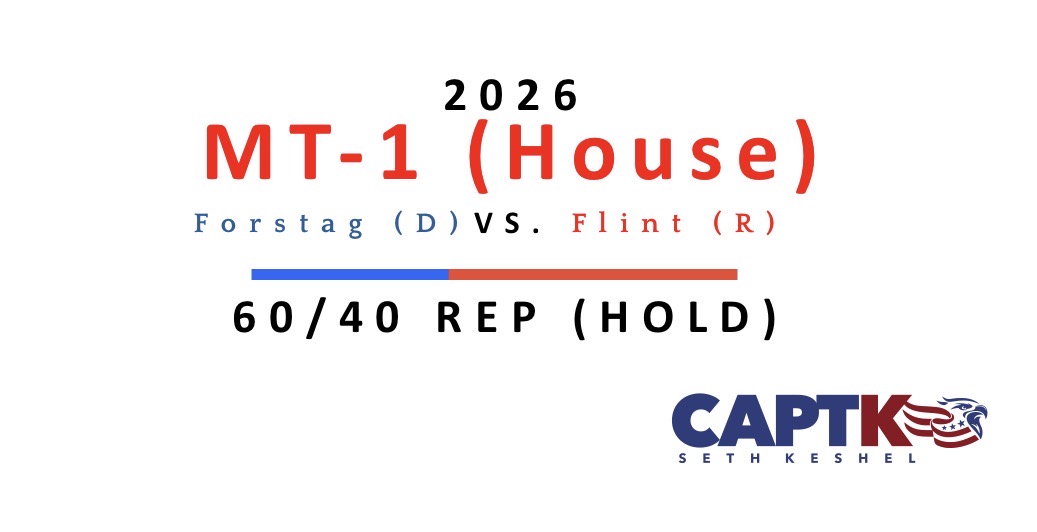
2026 Ten-Point Forecast: MT-1 (U.S. House – Leaner)

Montana landscape, cover image for the MT-1 House forecast

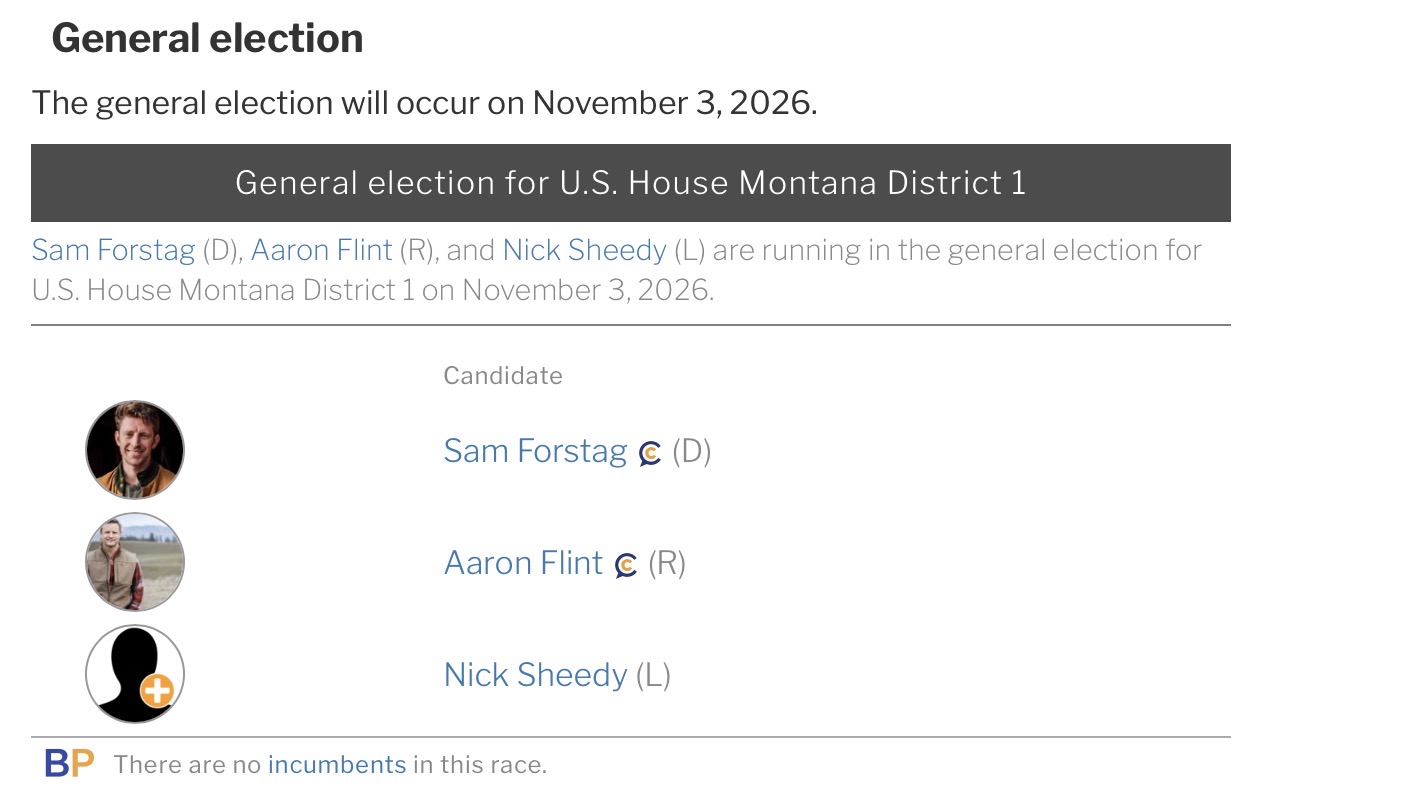
Aaron Flint (R) vs. Sam Forstag (D)

I. The Race

General election candidates for U.S. House Montana District 1: Sam Forstag (D), Aaron Flint (R) and Nick Sheedy (I)

Aaron Flint (Republican) is a well-known radio talk-show host and Army veteran. He’s new to elected politics and looking to replace Ryan Zinke, who served MT-1 for two terms.

Sam Forstag (Democrat) is a union man and smokejumper running a populist Democrat campaign with limited animosity toward the Trump administration. Most of it is boilerplate red state Democrat campaign fluff, but he’s adamant about bleeding the wealthy dry with taxes. I’m not sure how that’s going to fly with all of the people who watched Yellowstone and took their money north for a dream estate.

II. District Geography

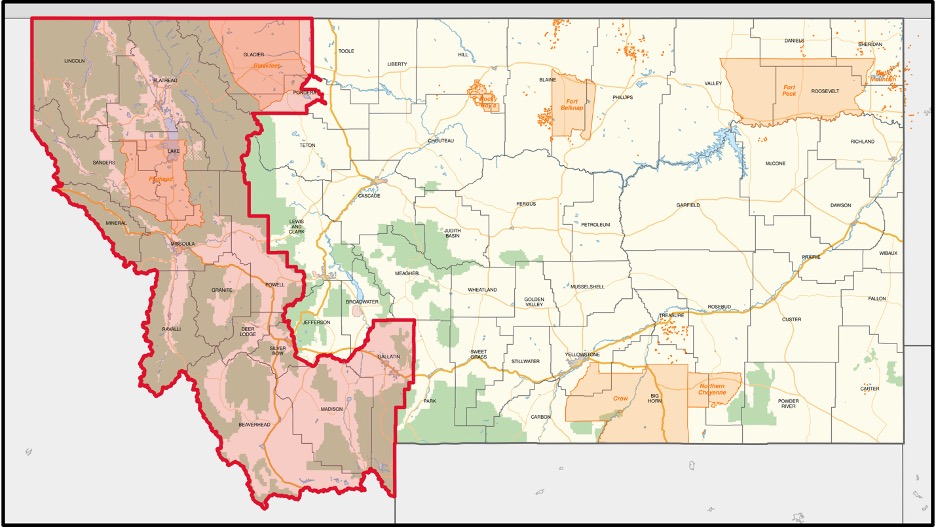
Map of Montana's 1st Congressional District

Montana’s 1st Congressional District (MT-1) is new. Montana’s population growth gave it a second seat in the U.S. House, and the at-large district it once had split in two. The people who drew the seat really failed Gerrymandering 101, because it is a tough district that could easily be lost in a Democrat wave year. It features all but a handful of Montana’s major cities – like Bozeman, Butte, Missoula, and Kalispell. All four of those except for Kalispell are trouble cities for the GOP that require high rural margins to override.

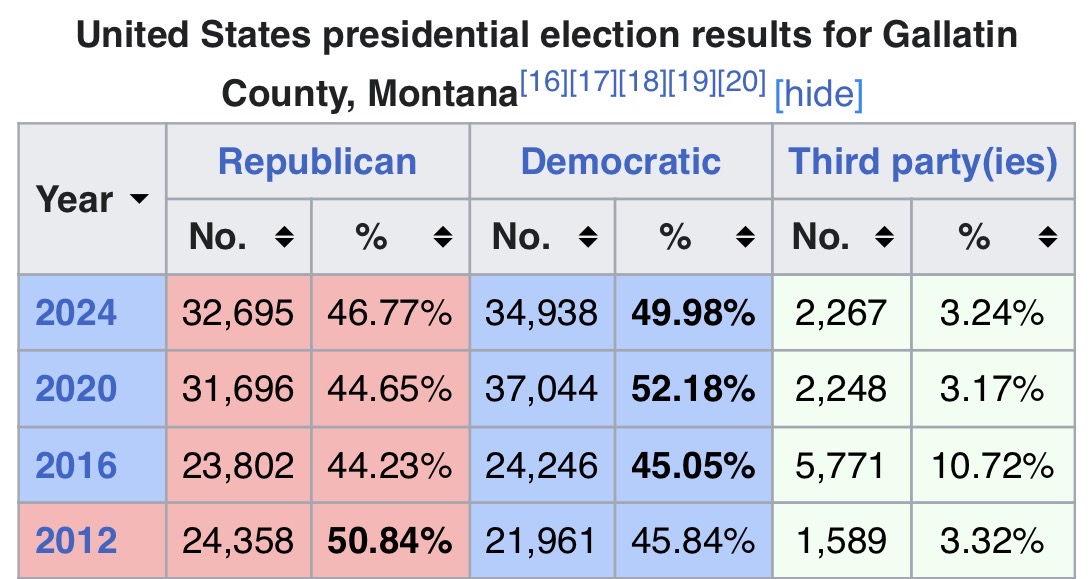
Bozeman is in Gallatin County. To provide an idea of how much the high tech development of this portion of Montana has hurt GOP margins, here’s a chart:

Chart of Gallatin County presidential margins since 2012

It has swung roughly 8 points left since 2012, and while not many raw votes have moved, the trajectory of Gallatin County (complete with an expanding tech industry and saddled with Montana State University) tracks like a standard Colorado urban area. Missoula County, home to the University of Montana, has provided Democrat presidential nominees with comfortable margins, although the GOP candidates normally park in the high 30s as a share of the vote. Outside of those areas, it’s cowboy country like the rest of Montana, with nice margins in places like Flathead County (Trump +33.8% in 2024) – home of some of the most amazing scenery anywhere in the world.

Presidential Margins

2016 Trump +12
2020 Trump +7
2024 Trump +11

Key Statistics

84.8% White, 4.4% Native American

III. Market Assessment

Despite the open seat and competitive nature of western Montana, Republican Flint remains a roughly two-to-one favorite on Polymarket.

IV. History

MT-1’s history, at least as an individual U.S. House seat, is new. Ryan Zinke, who is retiring from Congress, is the first person to represent the district. He served as Secretary of the Interior in Trump’s first administration and defeated Democrat Monica Tranel in 2022 by just 3.2% (less than 8,000 votes in margin). The two rematched in 2024, and Zinke expanded his margin to +7.7%; it is important to note that he rode the Trump train (which had a margin of +11%) to victory and ran 3.3% behind it.

For brevity’s sake, it is easy to understand why the president is rallying in Montana; it’s not for the U.S. Senate race.

V. Analysis of 2026 Primary Results

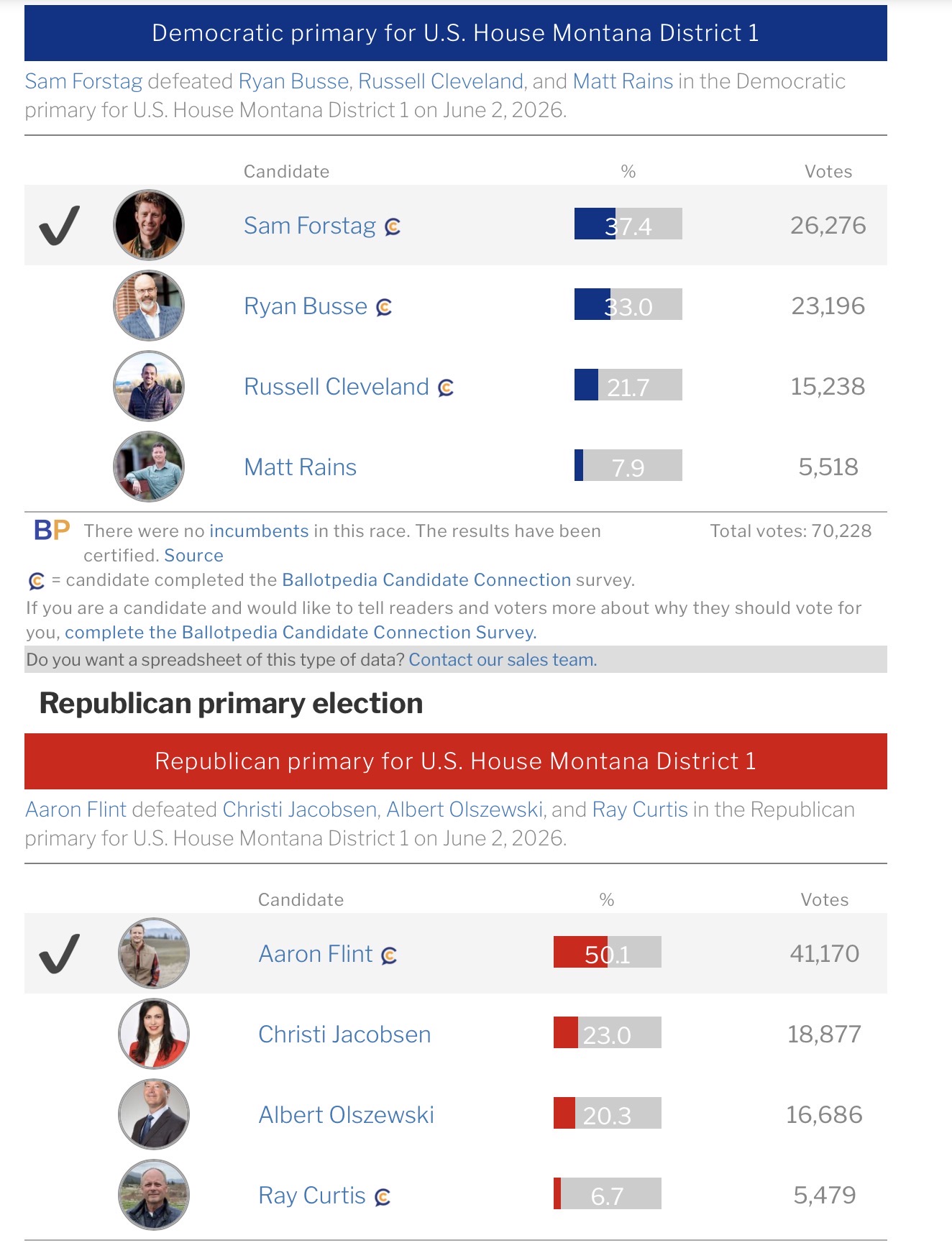
2026 primary results for Montana's 1st District

Both parties had crowded fields to nominate someone for the open seat. Flint won a bare majority for the GOP nomination, but Forstag squeaked past Ryan Busse by 3,080 votes to secure the Democrat nomination.

Despite the competition, everyone emerged unscathed and there is no bitter flap in this race on either side that should be expected to weigh on the General Election.

VI. Polls

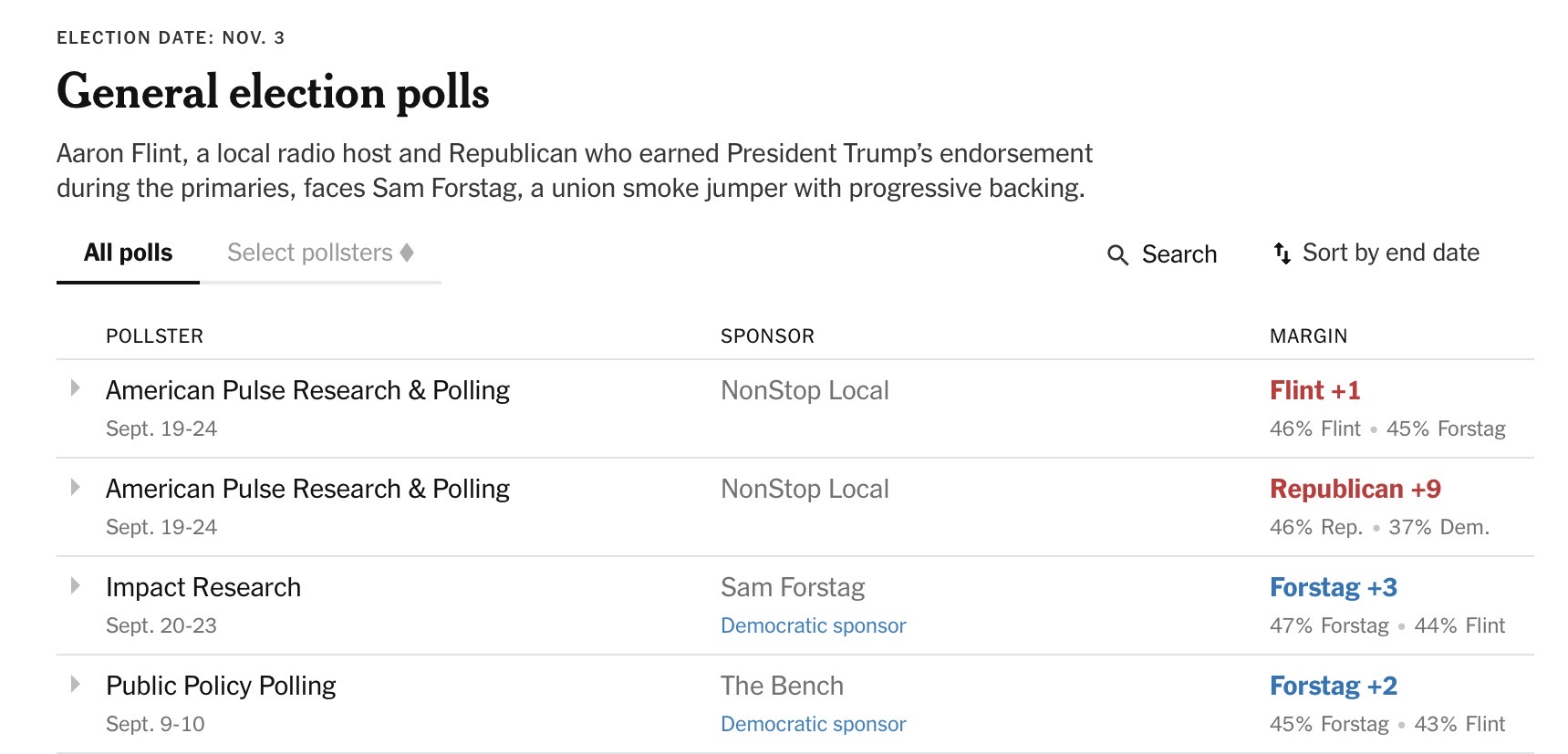
These polls were hosted by The New York Times:

Table of public polls in the MT-1 race

I don’t know what in the hell the Republican +9 poll is supposed to be, but that’s outside the realms of reality and logic. There are two narrow Forstag leads within the margin of error from September, and a Flint +1 that came out last month.

Polling reveals no clear advantage.

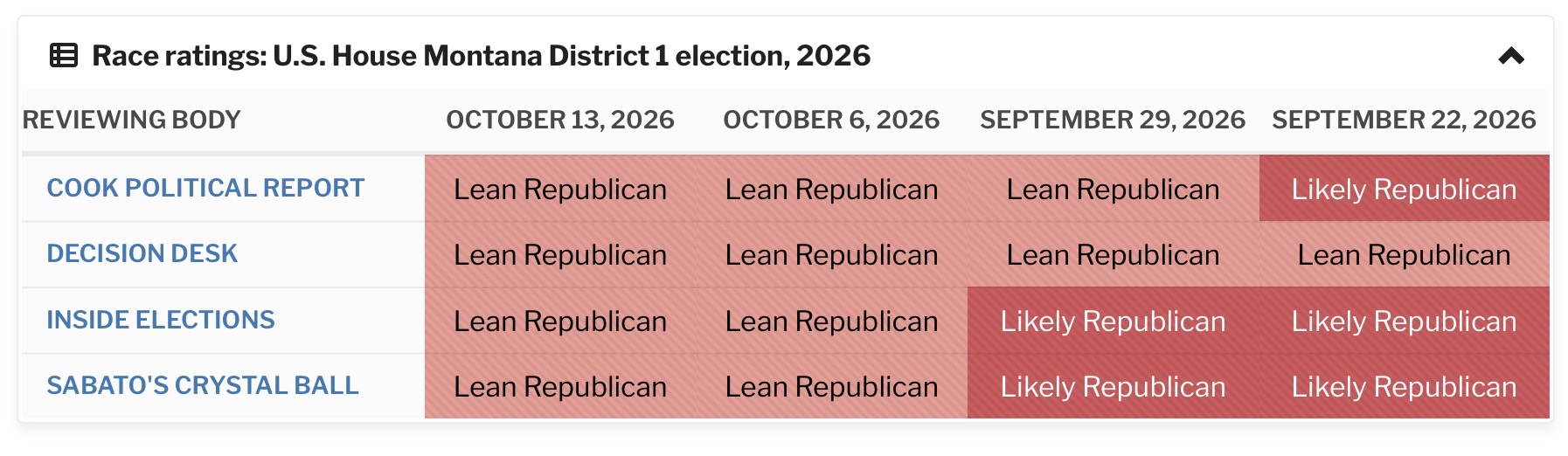
VII. Media Ratings

Media race ratings for MT-1

Every reviewing outlet considers the race “Lean Republican,” although three have recently downgraded from “Likely Republican” – a smart move.

VIII. Party Registration

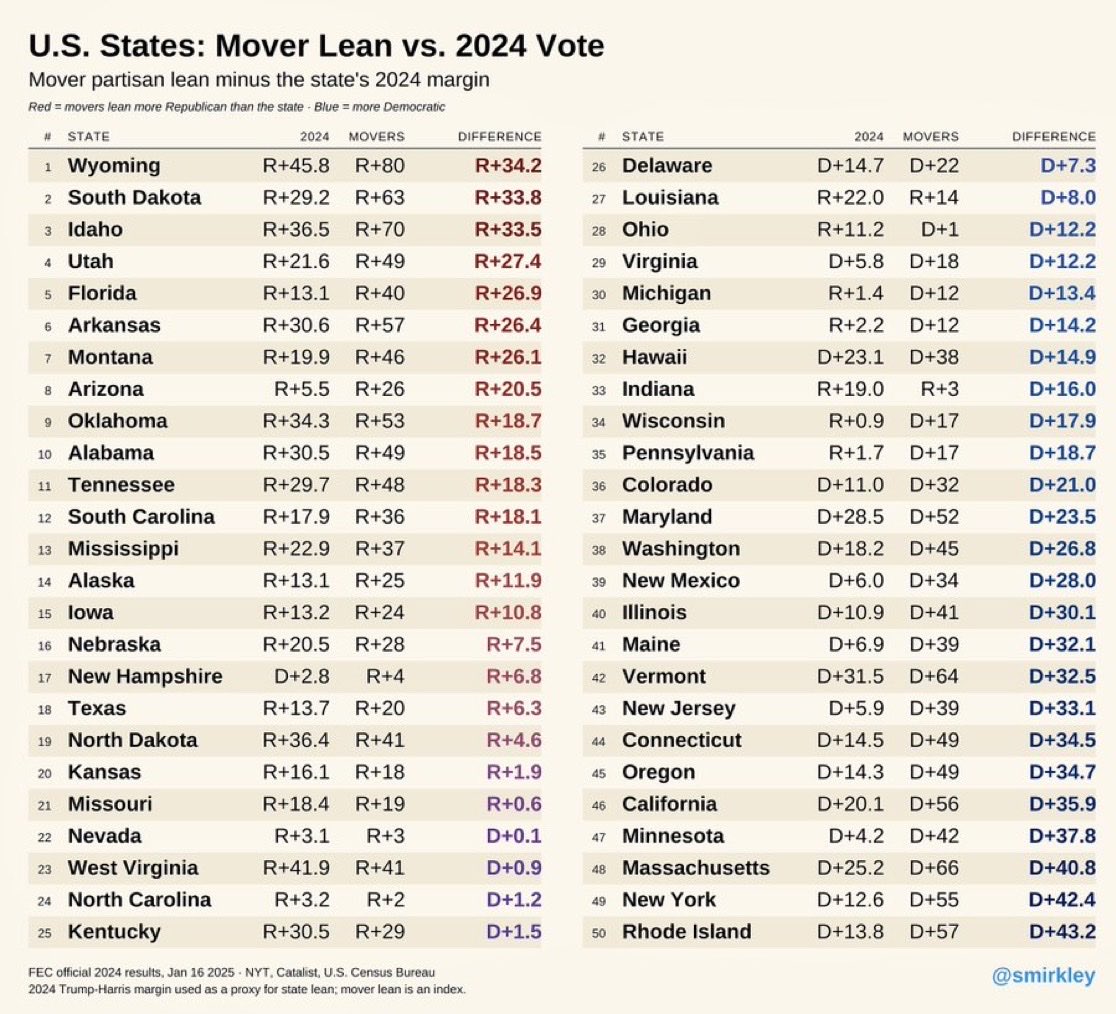
Montana does not register voters by party; however, data tracked for movers suggests new transplants to Montana are overwhelmingly Republican – perhaps as much as R+46.

Party lean of new movers to Montana

In a race that frequently comes down to tight margins, statistics like these really move the needle. I would consider this a likely stand-in advantage for party registration (if Montana tracked such data).

IX. Election Considerations

I profiled Montana’s 2024 election with regard to election integrity and found a low risk for that race.

In that article, however, I do note that the state has loose ballot harvesting laws, and independent researchers in Montana have found evidence of significant harvesting happening in Missoula and on reservations (like Blackfeet and Flathead, both inside MT-1’s boundaries). In a close race, this can be decisive.

X. Summary and Election Estimate

I don’t agree with all of President Trump’s rally locations because I think consultants and campaign strategists are buying into polling noise; however, the fundamentals of MT-1 absolutely justify increased attention, especially in a year that is ostensibly favorable to Democrats. MT-1 reminds me a little bit of AZ-2, a district with a GOP representative (Eli Crane) who didn’t get a huge margin in 2024. Crane’s base is white conservatives, especially from Yavapai and Gila Counties; they are inelastic (their margins are heavily Republican), as are the Democrat base voters (college kids, white liberals, and Native Americans).

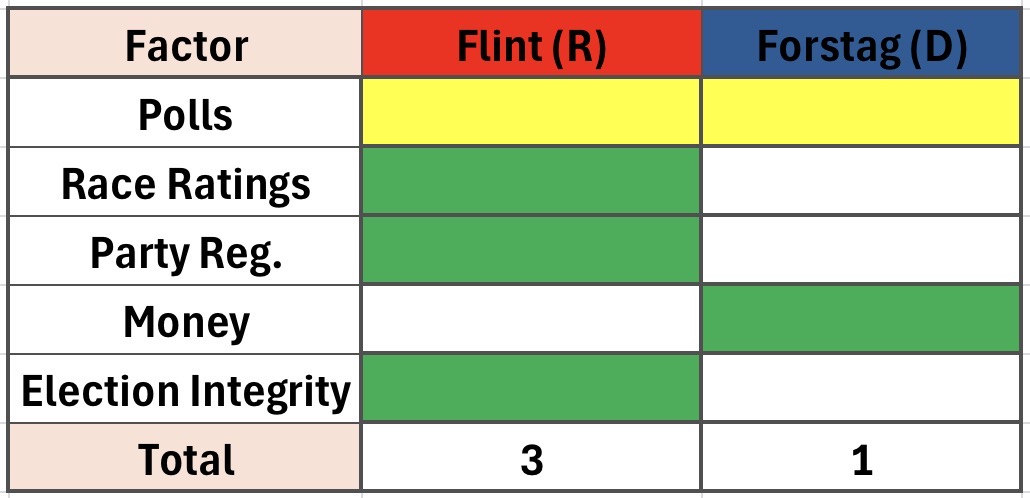
The same is true of this race, except for that it takes place with tighter baseline margins than the race in AZ-2 does. We will know if this seat is at risk of flipping based on how engaged Missoula and Gallatin Counties appear to be (home counties of two universities). This is what my decision matrix looks like:

Keshel's decision matrix for the MT-1 race

Forstag blew away Flint for receipts last quarter, although Flint has more on hand. Now is the time for him to use it, because MT-1 stands to be one of the top five upset opportunities available for Democrats in the 2026 cycle.

Forecast for MT-1 House

Keshel's forecast graphic for the MT-1 House race

The fundamentals of this race favor Flint, and not by much. The only thing keeping me from considering this race a tossup and leaning it to Flint 55/45 is the fact that transplants to Montana are overwhelmingly Republican. In a race decided by very few votes, those movers make a huge difference, and I don’t think they’re interested in being represented by someone tied to AOC and Bernie Sanders, or who wants to tax the hell out of them. The first order of business at the first possible opportunity for Montana Republicans should be to rearrange the district lines and pull MT-1 out of the line of fire. MT-2 has a Republican margin of more than 30 points, and Bozeman would fit quite nicely inside of it while sharing a district with Billings.

Seth Keshel, MBA is a Senior Fellow at the Gold Institute for International Strategy and a retired Army Captain. He publishes Captain K’s Corner on Substack.

Seth Keshel in The Washington Times on Why the Midterm Polls May Be Wrong

Voting booths set up beside an American flag on Election Day

This article was written by Seth McLaughlin and appeared in The Washington Times. Doubts abound about midterm polls. Could a ‘silver wave’ upend predictions of a Democratic takeover?.

Featuring Seth Keshel, MBA, Senior Fellow, Gold Institute for International Strategy

The polls say Democrats are headed for a wave in the midterm elections, but pollsters have been wrong before, and it would not take much of a miss to flip that script.

That is the worry hanging over races nationwide, including marquee Senate contests in red states such as Ohio and Texas. Democrats hold narrow leads in public surveys in those Republican strongholds and are counting on wins to take back the upper chamber.

It all comes down to a bigger question: Can the polls be trusted?

Pollsters have taken plenty of heat after several high-profile misses in recent cycles, and many analysts say the job is only getting harder. Fewer people pick up calls from unknown numbers, and response rates keep dropping. Meanwhile, campaigns are sifting through scattered streams of data to figure out who will actually show up on Election Day.

Harry Enten, CNN’s chief data analyst, said even a modest miss in Republicans’ favor could scramble expectations. It could flip Democratic-held Senate seats, such as in Michigan, and even help Republicans hold the House, which has historically been tough for a president’s party to keep in the midterms.

“If the polls underestimate Republicans by 2 to 4 points, well, remember all that blue that was on the map before? All that blue went bye bye, see you later, adios, amigos, sayonara,” Mr. Enten said.

Matt Towery, the Republican pollster who runs InsiderAdvantage, a polling and market research firm, said some polls are missing a key dynamic. He calls it the “silver wave” — a possible surge of older voters that could expose flaws in the polling and reshape the outcome on Nov. 3.

Early voting offers some hints. In Georgia, fewer than 70,000 early votes have come from 18- to 29-year-olds, compared with more than 549,000 from voters 65 and older. Ohio tells a similar story: 406,000 early votes from the white-haired crowd, against fewer than 50,000 from the 34-and-younger crowd.

“All of this nonsense you’ve heard about young people storming the polls and they’re going to change everything — it’s not taking place,” Mr. Towery said on Fox News.

Robert Cahaly, who runs polling and market research firm Trafalgar Group, said voters 50 and older are far more willing to vote than younger Americans, who often tell pollsters they will cast a ballot and then do not follow through.

He also said seniors who were less enthusiastic about President Trump in 2024 than about past Republican nominees are drifting back toward the Republican Party.

“A lot of the seniors are coming back, and they might not all love Trump,” Mr. Cahaly said.

He attributed the shift to older voters being more supportive of Mr. Trump’s approach to Iran — a stance he linked to their memories of the hostage crisis — and to their being less affected by high gas prices because they drive less, if at all, and are better positioned financially.

Older voters are also worried about the rise of socialism in the United States, he said.

The bigger problem, Mr. Cahaly said, is that the polling industry’s traditional tools just do not work like they used to.

Automated phone surveys have been hobbled by the disappearance of landlines, and voters are increasingly unwilling to answer calls from unknown numbers or sit through long online surveys.

He also knocked polls that ask 20 or 30 questions, saying they tend to attract highly engaged voters and people with time on their hands.

“How many people do you know that are under 50 that are going to answer the phone verbally from a number they don’t know?” he said.

Mr. Cahaly said many media and university polls overrepresent college-educated and higher-income voters, who have trended Democratic and have more time to kill, while missing the working-class and older voters who have moved toward Republicans.

He is not alone in questioning whether the polls capture the electorate.

Frank Luntz, a longtime pollster, said the industry’s biggest challenge is not measuring public opinion. It is figuring out who will actually cast a ballot.

Mr. Luntz said Republicans, especially Trump supporters, are less likely to take surveys and that many polls do not ask the questions needed to gauge engagement and turnout. Polls, he said, may be missing less-engaged voters who will not answer a survey but still show up on Election Day.

“I’m not convinced that they’re polling the people actually going to participate,” he said. “Turnout determines everything.”

Similar doubts have popped up elsewhere in the polling world.

In a recent interview with Politico, Republican pollster and strategist Patrick Ruffini said he thinks many surveys are right that the environment favors Democrats but may be overstating the size of the battleground.

Mr. Ruffini pointed to states such as Ohio, Iowa and Kansas, where he said history suggests Democrats face steeper odds than recent polling implies.

He also said pollsters are wrestling with response-rate problems that appear to favor Democrats.

“When you’re seeing high-propensity Democrats at twice the rate of high-propensity Republicans, when we know that the turnout on both sides would be roughly evenly paired, that’s a warning sign for polling in this cycle,” he told Politico.

Others have questioned specific surveys.

Take a recent University of Texas poll showing Democratic state Rep. James Talarico leading Republican Attorney General Ken Paxton by 3 percentage points in Texas’ U.S. Senate race, even though the Republican got just 55% of the White vote in the survey.

Seth Keshel, MBA

“Even Ted Cruz had 66% of the White vote in 2018,” said former Army Capt. Seth Keshel, an election analyst, citing exit polls and historical datasets. “So those kinds of things, you look at it, it’s like … either all these White rural voters that have voted Republican for everybody are going to run 20 points left, or this poll is going to be dead wrong.”

Look back at 2024: Mr. Trump carried Kansas by 16 percentage points, Texas by nearly 14 and Ohio by 11. He also won Iowa by 13 points after the final Des Moines Register poll showed Ms. Harris up by 3 points.

Others cite Sen. Susan M. Collins, Maine Republican, who was left for dead in 2020 after polls showed her losing by 6 percentage points. She won by 9 percentage points. She is trying to repeat that this year against Democrat Troy Jackson, who is up by almost 2 points in the latest RealClearPolitics polling average.

Mr. Keshel also questioned prediction markets and polls that suggest Democrats are competitive in deeply Republican states.

He said Mr. Talarico may become the first Democrat to win statewide in Texas since 1994, but it would take a near-perfect alignment of depressed Republican turnout, crossover voting and overwhelming Democratic margins in urban areas.

He applied the same skepticism to Kansas, where Democrats have struggled statewide for decades.

“My beef with the whole system is I don’t think that pollsters are considering any reality,” he said.

Read the full article at The Washington Times

Seth Keshel, MBA is a Senior Fellow at the Gold Institute for International Strategy and a retired Army Captain. He publishes Captain K’s Corner on Substack.

2026 Ten-Point Forecast: PA-7 (U.S. House – Decisive)

PA-7 forecast cover image from Captain K's Corner

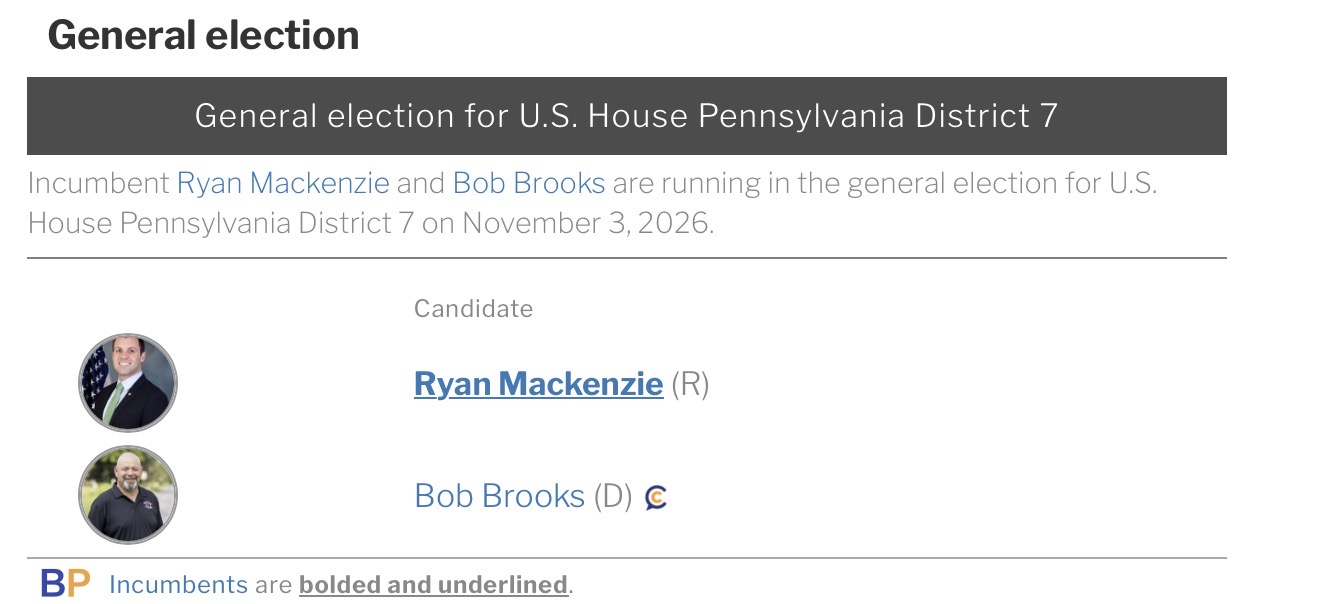
Ryan Mackenzie (R-inc.) vs. Bob Brooks (D)

I. The Race

PA-7 candidates Ryan Mackenzie and Bob Brooks

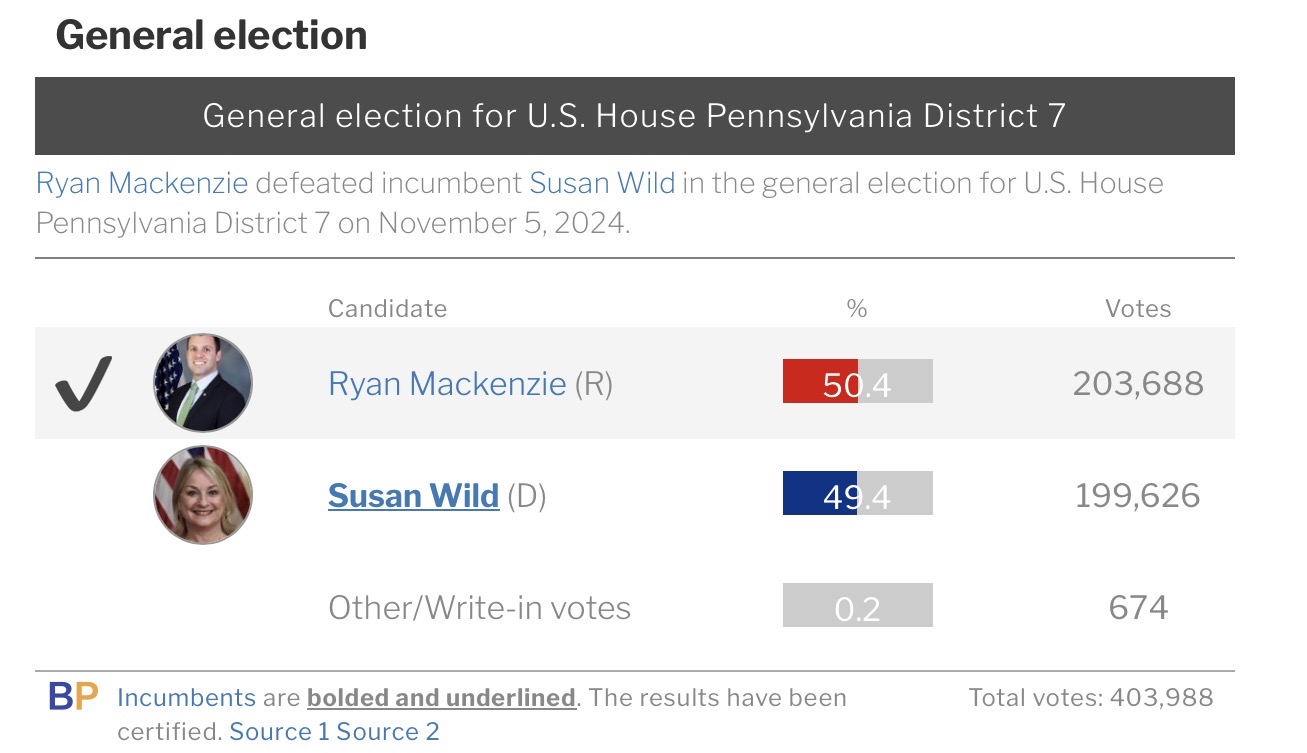
Ryan Mackenzie (Republican) is running for reelection after having unseated three-term Democrat incumbent Susan Wild in November 2024 with a margin of +1.0%. Mackenzie had been a member of the Pennsylvania House of Representatives prior to his run.

Bob Brooks (Democrat) is a local recruit who has never pursued office before. He is a retired firefighter and local businessman from Bethlehem and is running a pro-union campaign and trying to tie Trump’s popular trade policies to current inconveniences voters face.

II. District Geography

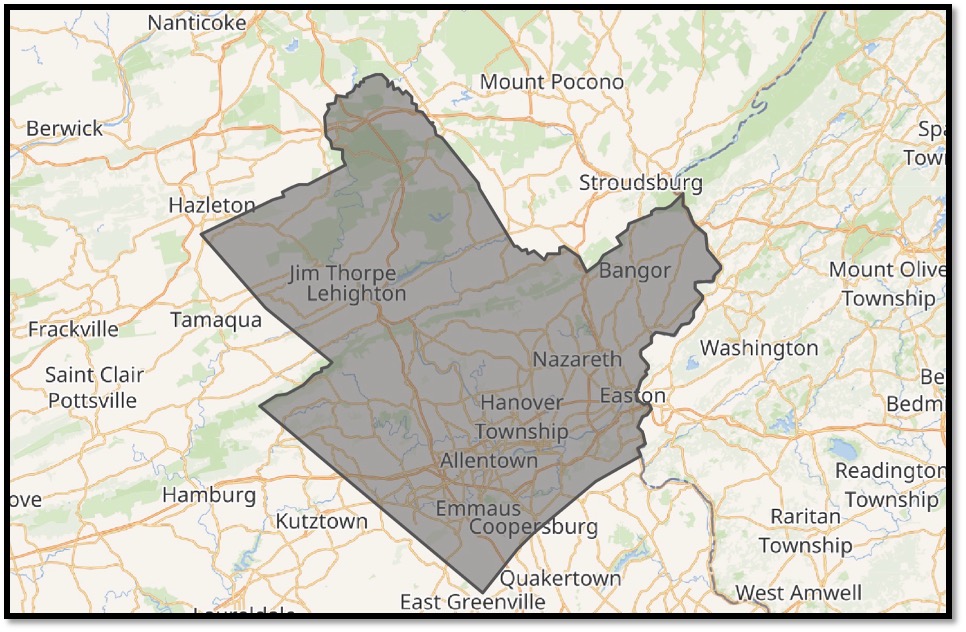
Map of Pennsylvania's 7th Congressional District

Pennsylvania’s 7th Congressional District covers the Lehigh Valley and is made up of all of Carbon, Lehigh, and Northampton Counties, plus a tiny edge of Monroe County. The rest of Monroe County belongs to the neighboring district, PA-8, which is another decisive seat I profiled last week. Northampton County is a working-class county that, along with Erie County, has emerged as a key bellwether in statewide politics (especially in presidential elections). Previously, Luzerne County had aligned with the winner of every presidential election from 1936 through 2016, but that streak came to a halt when Trump won it in 2020 and (supposedly) didn’t carry Pennsylvania’s electoral votes.

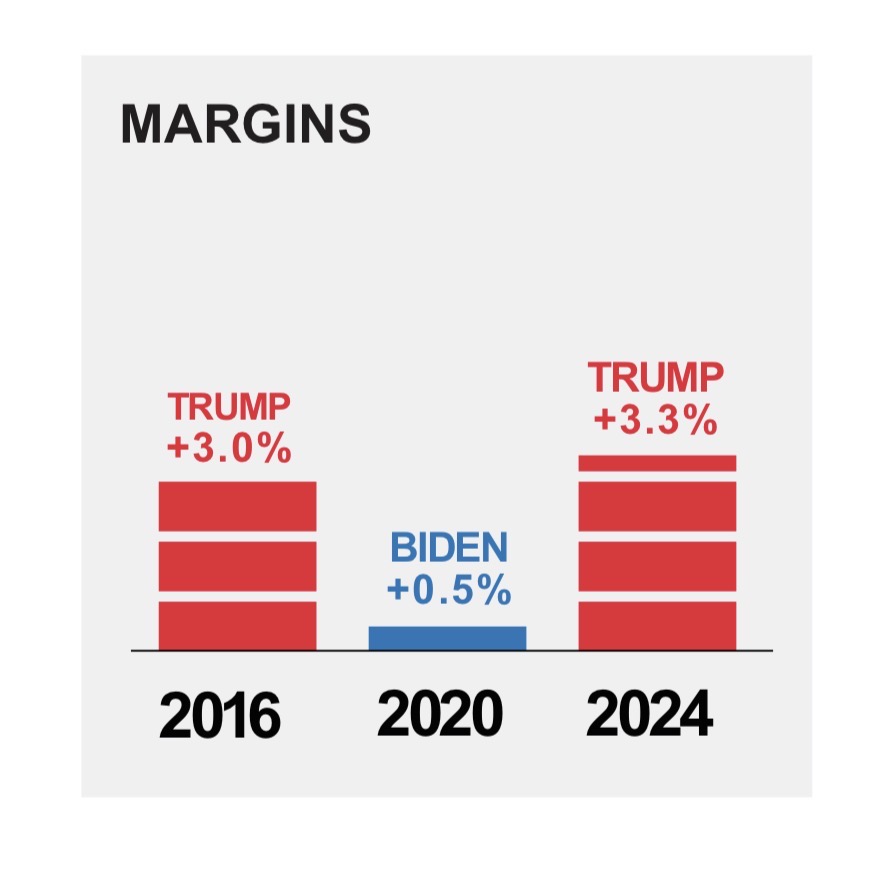
Presidential Margins

PA-7 presidential margins

This district, along with the entirety of eastern Pennsylvania, southern New York, and northern New Jersey, is in the midst of a strong Republican realignment. With Wild now unseated, Mackenzie may run stronger, especially if Trump’s coalition shows up this year. Notably, PA-7 includes a much higher representation of Hispanic voters than outsiders may expect when thinking of the Lehigh Valley.

Key Statistics

68.6% White, 19.1% Hispanic, 5.5% Black

III. Market Assessment

Brooks is overwhelmingly favored on Polymarket, but I think he is vastly overpriced and locked into a much more competitive race than this market suggests.

IV. History

The Pennsylvania Supreme Court mandated an entirely new map ahead of the midterms, and it sent what we knew of the existing seats flying. The boundaries currently marking off PA-7 contained multiple House seats on the old map, so there is no steady comparison with which to measure the swing of our only midterm example with Trump in office.

Wild, whom Mackenzie ousted last time around, won PA-7 by a solid 10 points in 2018, just two years after Trump carried the current boundaries by 3 points. With Biden riding Pennsylvania’s loose mail-in balloting standards to a narrow win of PA-7, Wild held it with the power of incumbency by 3.8%. In what should have been a GOP pickup in 2022, Wild ran a strong campaign and held the seat by 2 points – with just 1.8% slippage to the right. It took Trump on the ticket and carrying bellwether Northampton to finally dislodge Wild:

PA-7 2024 House election result

Mackenzie margin was a mere point, with just 4,062 votes separating the two candidates. In summary, the 2018 presidential to midterm swing was severe, but incumbents in PA-7 are tough. Mackenzie’s effective strength, given that he had to get through an incumbent himself, may play stronger than the single point the 2024 results show.

V. Analysis of 2026 Primary Results

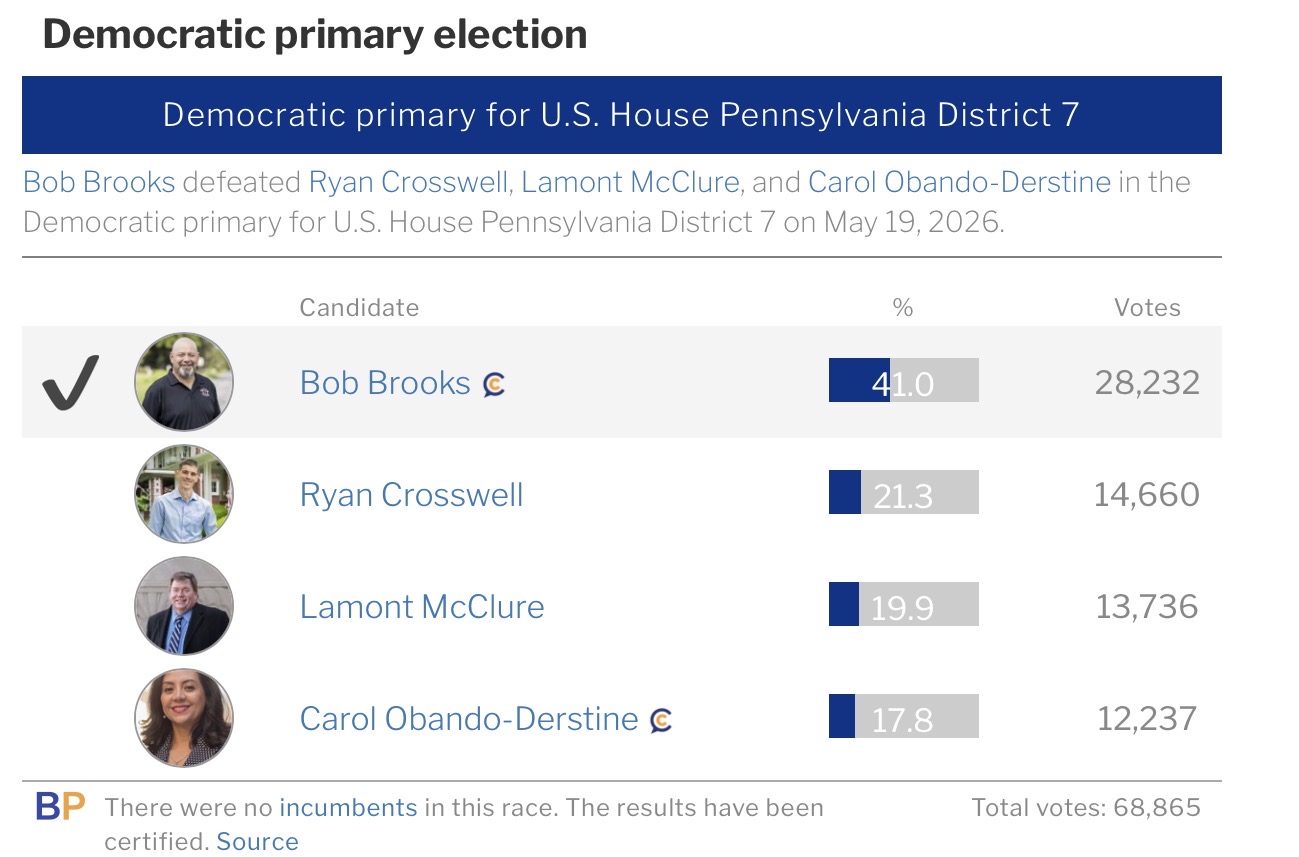
Mackenzie ran unopposed for renomination, and has no GOP drama to deal with. Brooks has had a bit of trouble with the Democrat field trying to paint him as a conservative because of previous pro-gun statements and swipes against cultural rot liberals enjoy, but I think this helps him in a Trumpy district and causes him no real harm. Brooks won with a plurality over a crowded field:

PA-7 2026 Democratic primary results

Brooks has some family drama related to lawsuits, and Mackenzie has worked to throw it in his face. I’m not sure they’re going to register in this day and age, where everything is deemed an outrage. My view here is that Brooks will have no real issue consolidating his party base.

VI. Polls

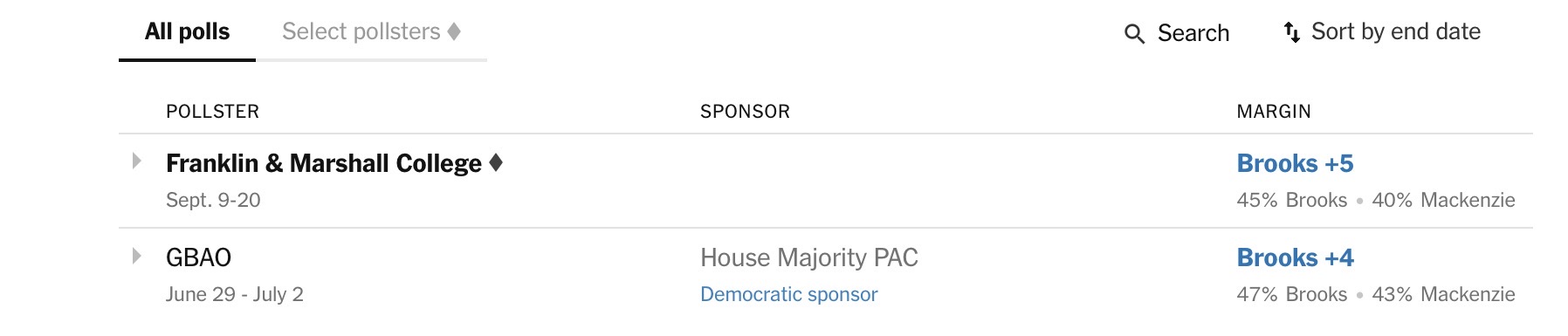
The two polls below were hosted by The New York Times:

PA-7 polls listed by The New York Times

The polls show lots of undecided voters, with Brooks averaging +4.5%.

VII. Media Ratings

Media ratings for the PA-7 race

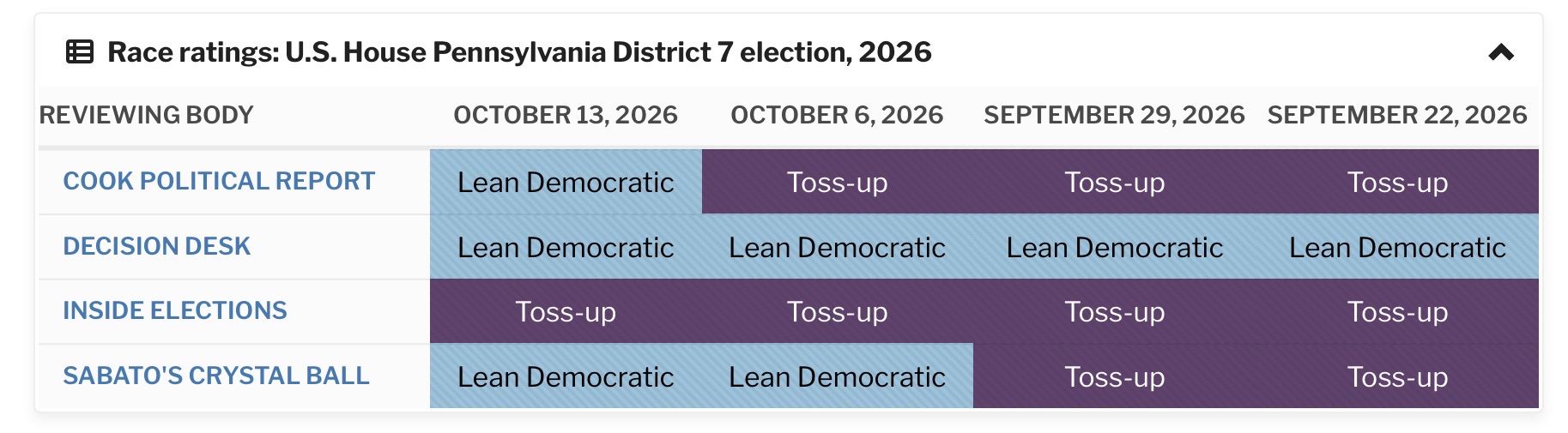
Inside Elections is sitting this one out (so far), and the other three reviewers consider PA-7 to be leaning for Brooks.

VIII. Party Registration

Party registration changes in PA-7

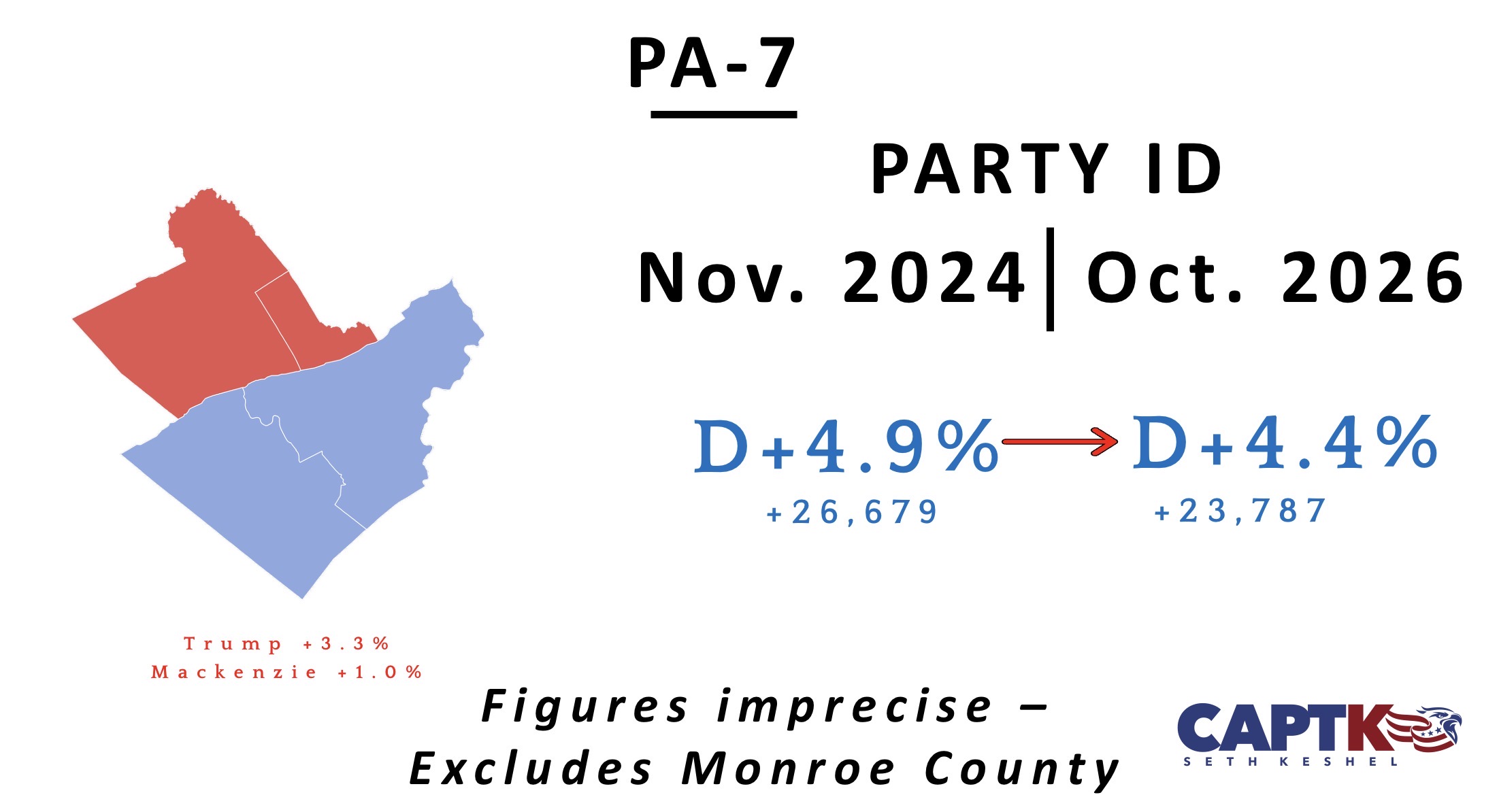
The registration data for PA-7 is positive for the GOP, and only confirms what I’ve long thought – that recent registration gains for the Democrats in Pennsylvania are artificial and confined to urban areas.

This district sits roughly a half point to the right of its 2024 registration index, suggesting the Trump working-class realignment of the Midwest is staying largely intact despite a Democrat midterm headwind blowing across the region. These gains do not mean that Mackenzie will hold the seat, but they do have long-term implications as a positive sign for the Republican Party in the region.

IX. Election Considerations

I am carrying forward the assessment I wrote for PA-8 and PA-10 with regard to election integrity:

Read my book, The American War on Election Corruption, if you’d like to understand the major impacts to Pennsylvania’s elections caused by the introduction of mass mail-in voting. It’s not crackpot stuff; Pennsylvania’s elections are now more about ballot collection than they are about vote getting. The registration numbers shown above suggest Democrats, particularly with the area stagnant in population growth, should be incapable of gaining votes cycle after cycle, but they still manage to compete.

Pennsylvania has some of the worst elections in America.

X. Summary and Election Estimate

I’ve heard from some of my sources that they don’t like PA-7 for a Mackenzie hold this year and call it “DOA.” They even think Scott Perry has a better chance to hold PA-10 as a wily veteran than Mackenzie, the rookie, does to hold PA-7. I disagree with them, think PA-10 is ripe for Democrats, and think Mackenzie has better odds of winning than Perry does.

Hispanics represent a large portion of the electorate and many are starting to think they’re going to stay strong for the Republicans and surprise everyone. The voter registration gains don’t hurt, and incumbents have proven tough to move in this district. Wild only dropped 1.8% of margin in the 2022 GOP House popular vote win, and then 3 points from there when Trump forced Mackenzie over the finish line. Therefore, if Mackenzie loses the seat, I don’t think he’s going to do so by a lot.

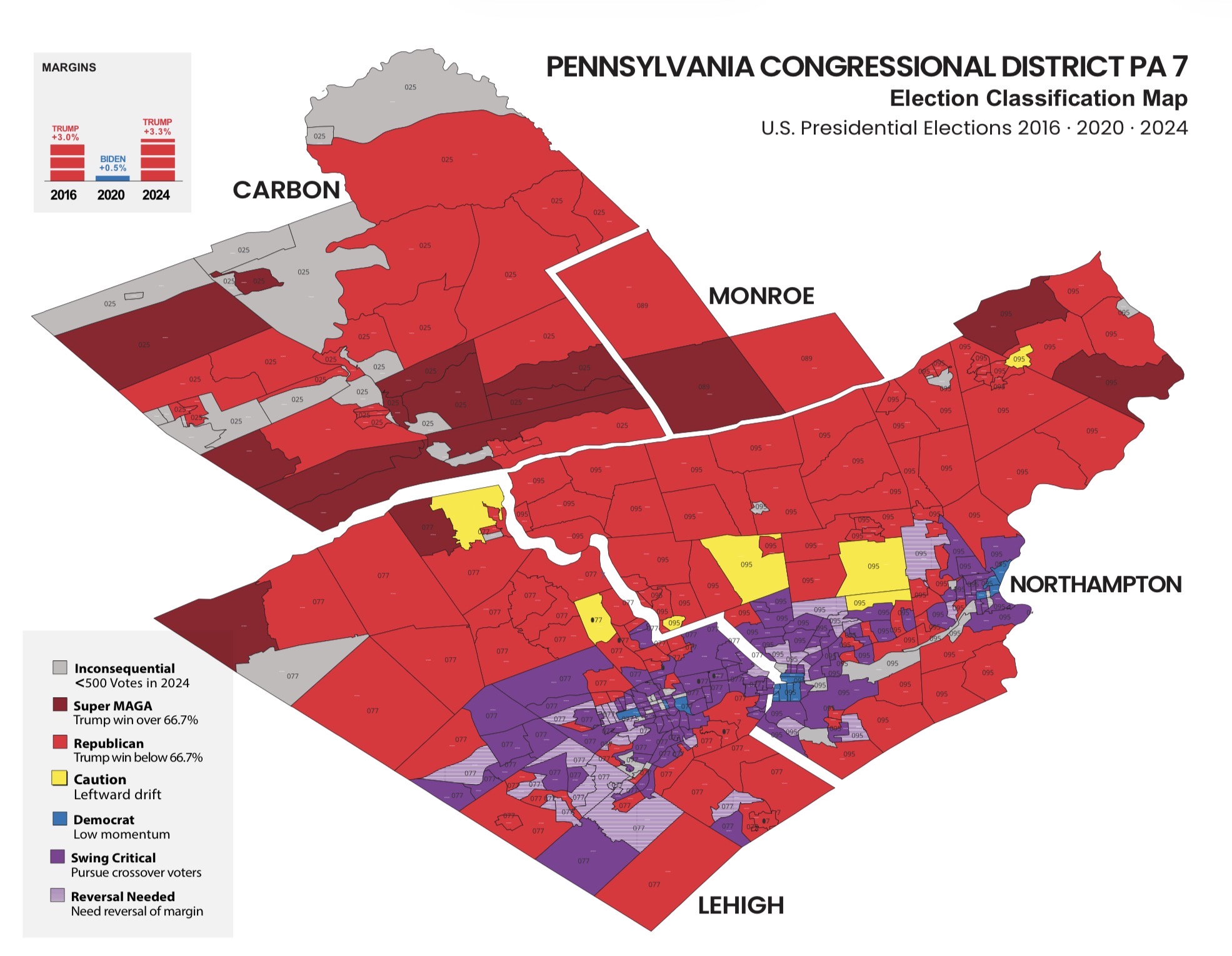
The race is going to be won or lost in the purple precincts cutting right across Lehigh and Northampton Counties:

Captain K precinct mapping of PA-7
Captain K Proprietary Mapping of PA-7

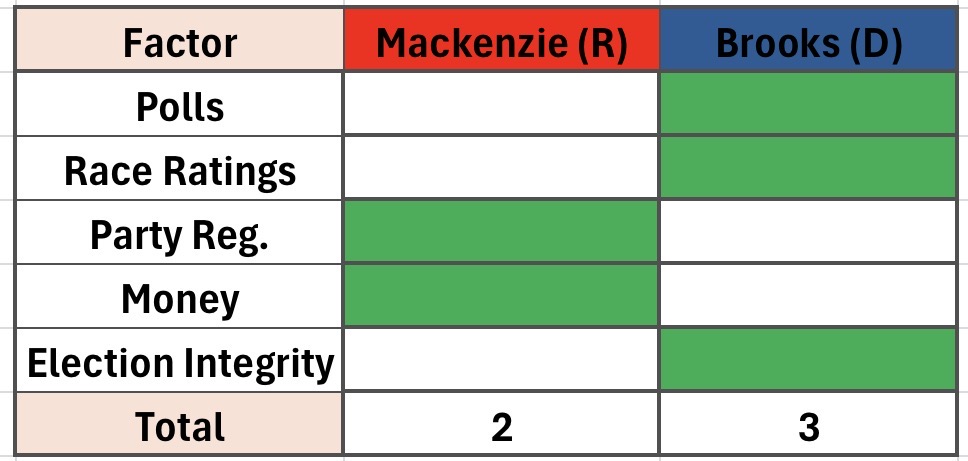
Here is how my decision matrix for PA-7 shakes out:

Ten-point decision matrix for the PA-7 race

Brooks has outpaced Mackenzie for fundraising lately, but trails overall and has less cash on hand. He takes 3 of 5 key factors and has a notable edge in that it is difficult to keep a president’s full coalition together in a midterm year – which is a must in a district Trump carried by just 3.3%.

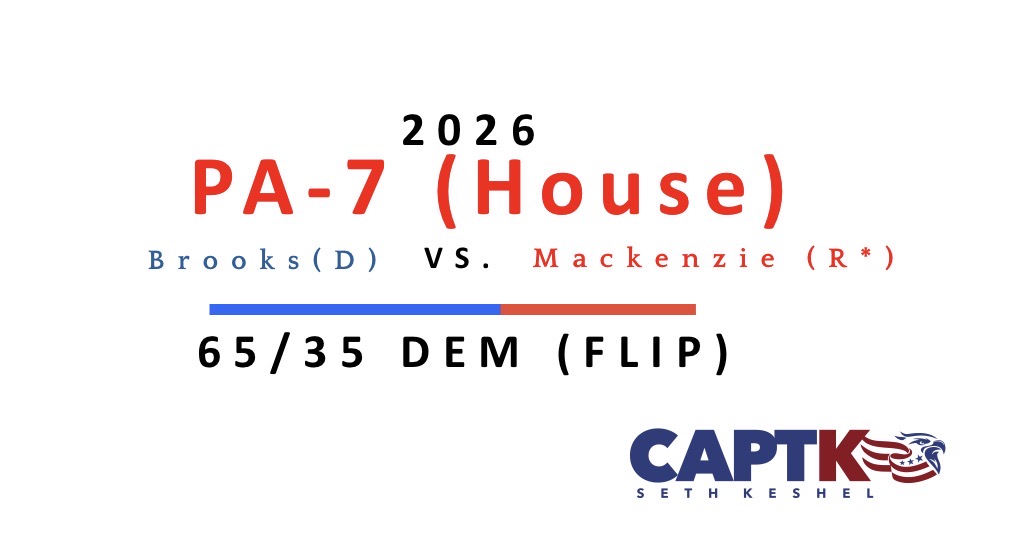
Forecast for PA-7 U.S. House

Forecast for the PA-7 House race

This is going to be a tough hold, but I think it is a more defensible seat than PA-10 this year given the trends of the voter bases and the fact that Perry could barely hold on in a Trump statewide win. If Republicans can hold PA-8, they give themselves a shot at a House majority. If they can pull it off in PA-7, then they’re right there on the putting green.

Seth Keshel, MBA is a Senior Fellow at the Gold Institute for International Strategy and a retired Army Captain. He publishes Captain K’s Corner on Substack.

2026 Ten-Point Forecast: Iowa U.S. Senate

2026 Ten-Point Forecast: Iowa U.S. Senate

Ashley Hinson (R) vs. Josh Turek (D)

I. The Race

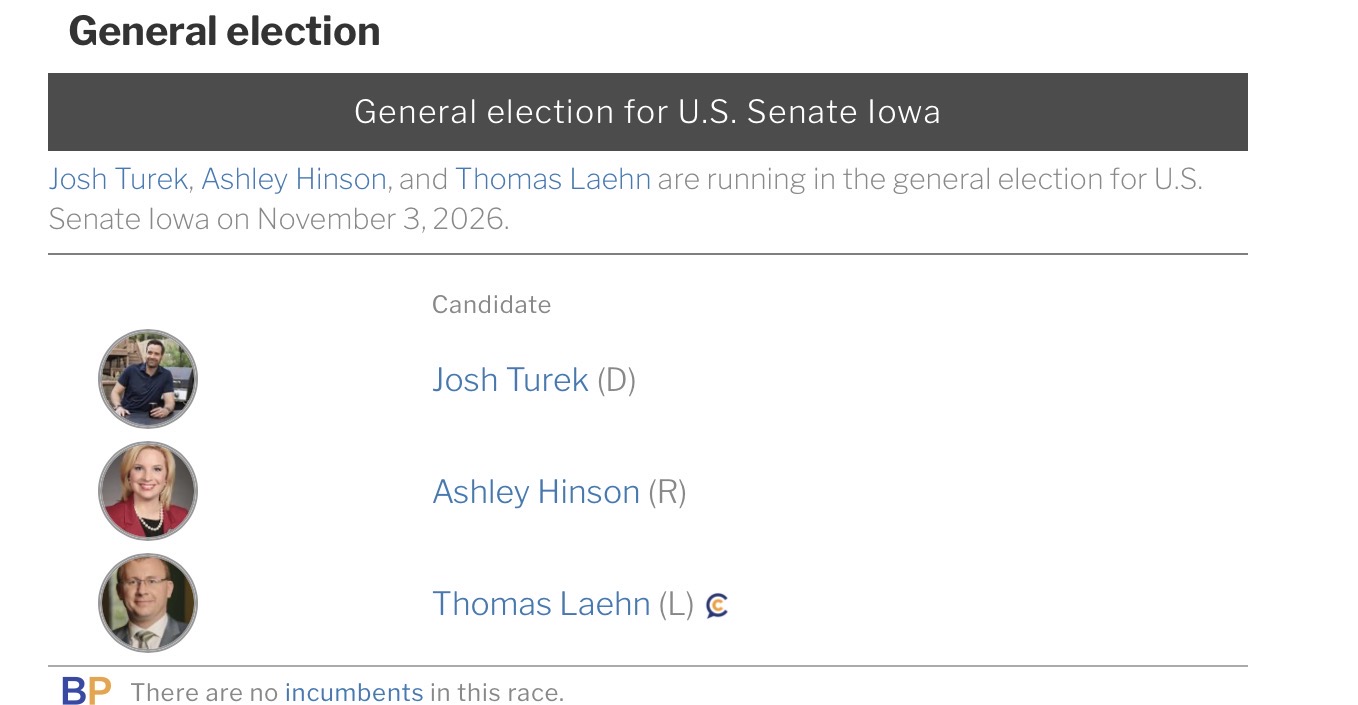
Iowa U.S. Senate candidates Ashley Hinson and Josh Turek

Ashley Hinson (Republican) was a well-known news anchor in Cedar Rapids before serving in the Iowa House of Representatives. In 2020, she knocked off Democrat Abby Finkenauer for her seat (now called IA-2, but then labeled IA-1). She has since won reelection twice by increasing margins each time.

Josh Turek (Democrat) is a member of the Iowa House of Representatives. He is a well-known former wheelchair basketball player and is running a campaign heavy on “moderate” overtones, which suggests Iowa Democrats are well aware of the President’s popularity in the Hawkeye State.

II. State Profile

Iowa state profile map

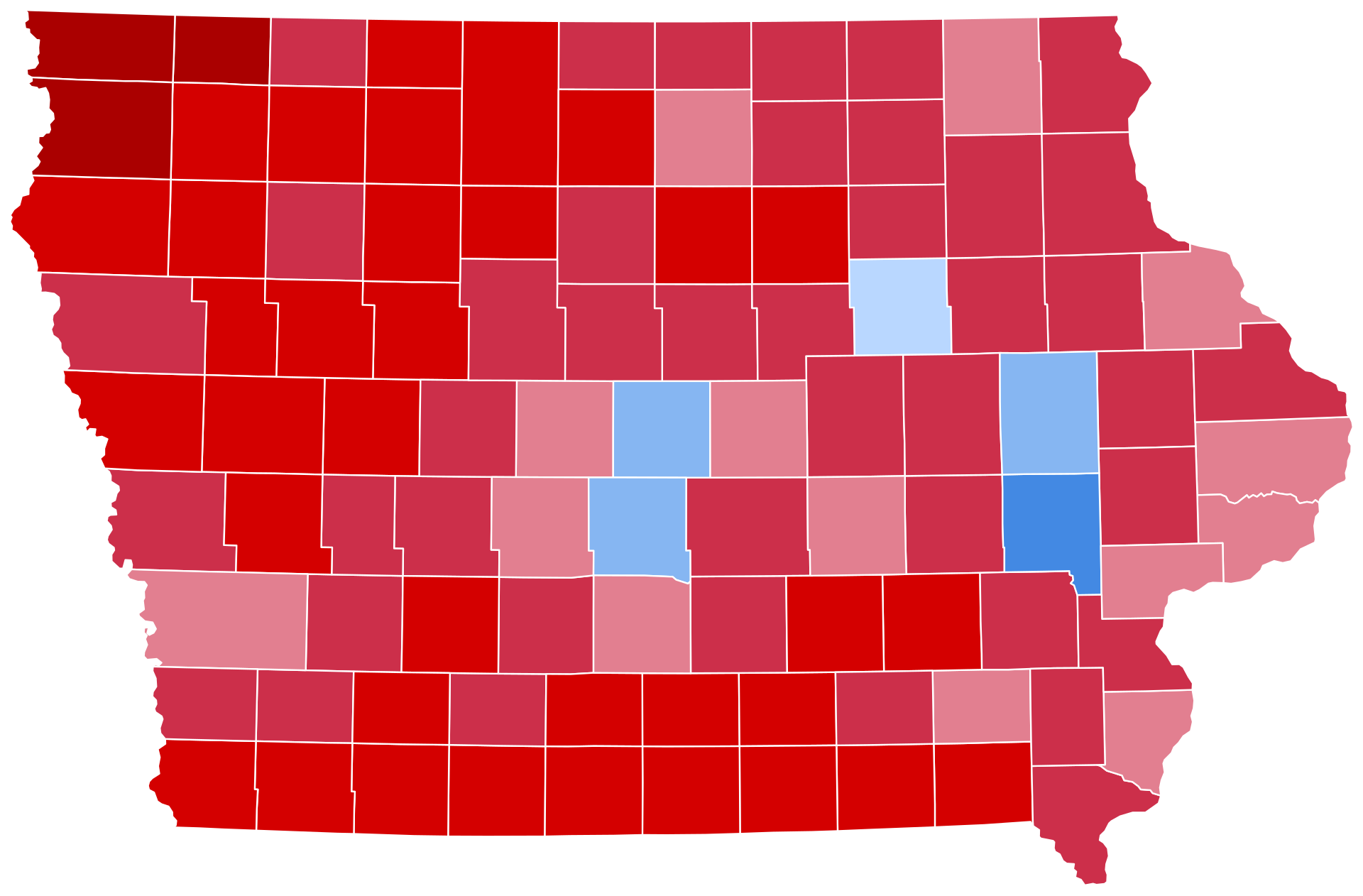
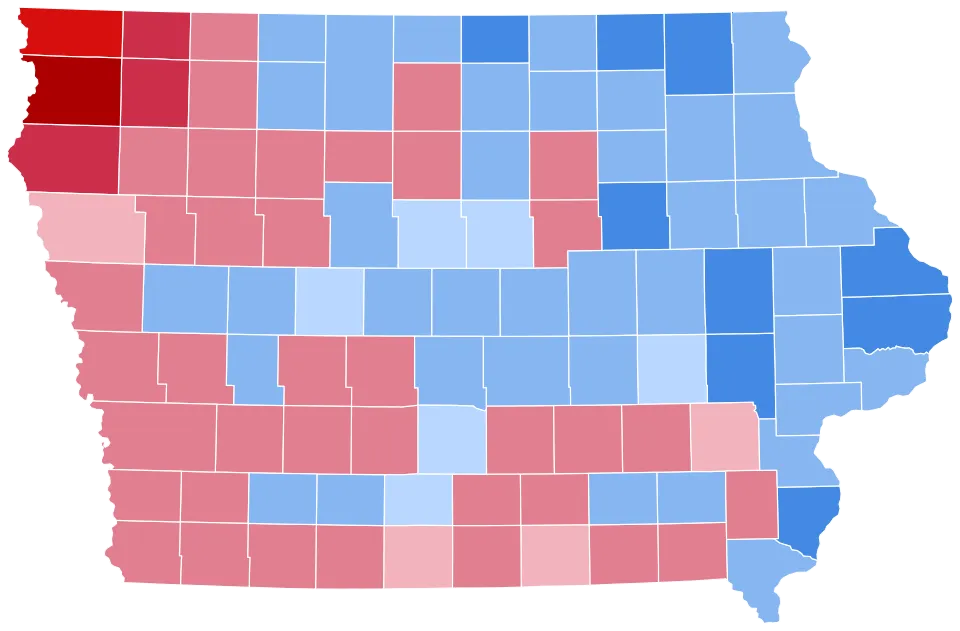
Iowa’s trend during the Trump era more closely resembles Missouri’s rather than Wisconsin’s. There are traditionally conservative areas in the northwest portion of the state that resisted Obamamania in 2008, when Iowa went blue by a margin of 9.5%, but the heaviest work of the Trump coalition has been in shifting the eastern half of the state to a dark shade of red:

County map of the 2008 presidential election in Iowa
2008 Presidential Election in Iowa
County map of the 2024 presidential election in Iowa
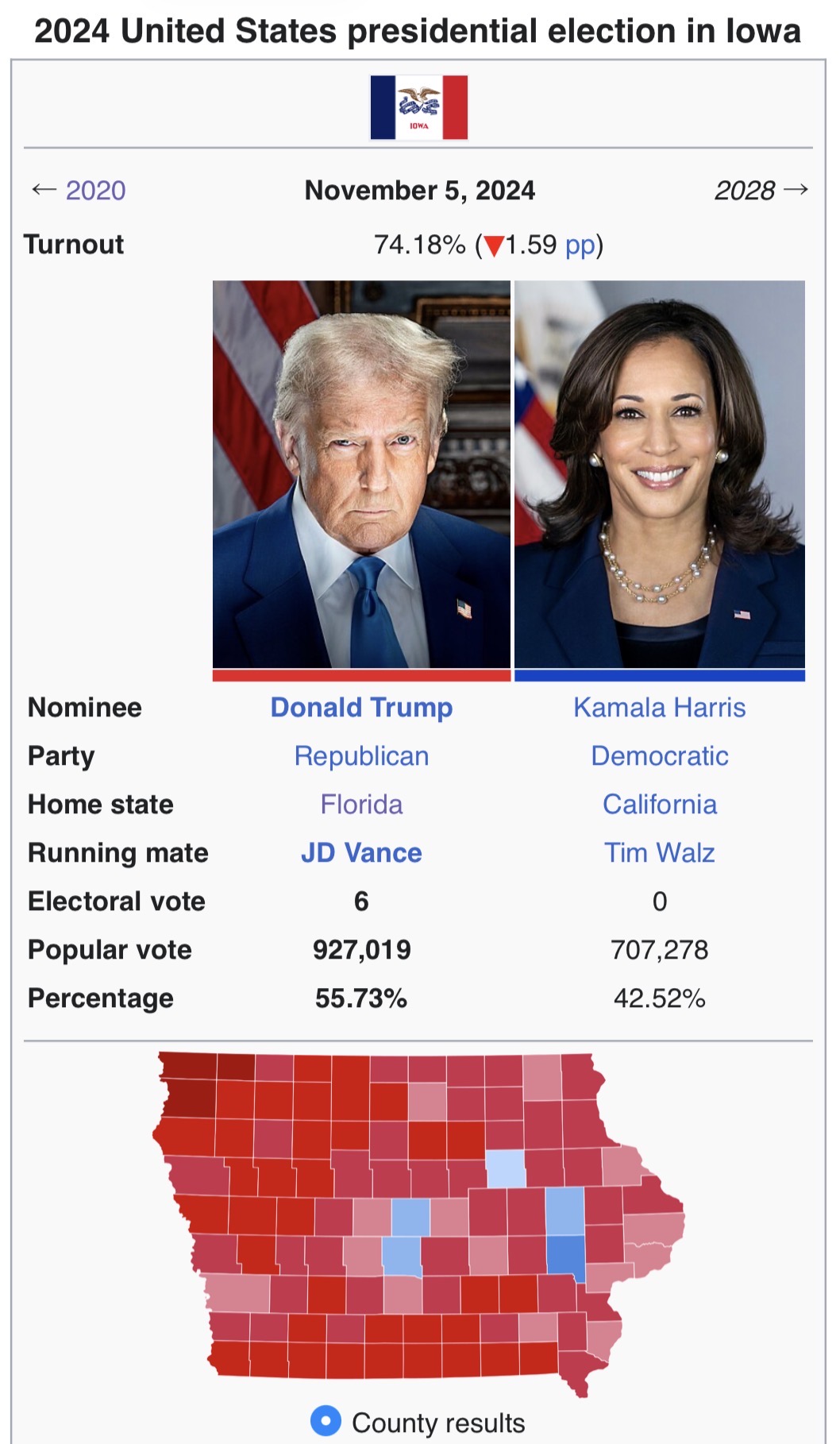
2024 Presidential Election in Iowa

Donald Trump smoked Kamala Harris so badly in Iowa in 2024 that it ended Ann Selzer’s polling career.

Harris won just five counties as Trump pulled off the biggest Republican margin of presidential victory in Iowa since 1972, when Richard Nixon won it by a mile. She only won Polk County, which accounts for 15% of the statewide vote and contains metro Des Moines, by 10.8%, and lost Scott County (Davenport) on the eastern edge of the state.

Simply put, Turek is facing a presidential margin of +13.2%:

Iowa presidential election margins

Key Statistics

84.5% White, 5.6% Hispanic, 4.1% Black

III. Market Assessment

In what is a relatively rare occurrence in 2026, Polymarket bettors are mostly backing the Republican (Hinson) in this race.

IV. History

I mostly have to look outside of Iowa to get a feeling for what history suggests will happen with the Hinson-Turek race. Iowa has not had a Senate election in either of the rough GOP midterm years of the 21st century (2006 and 2018), so I am going to rely heavily on regional comps to inform my decision-making.

Iowa has had two of most tenured Senators in the history of the United States both serving at the same time in recent years. Democrats had Tom Harkin, elected in 1984 and reelected four times, in office until 2015. He was replaced by Republican Joni Ernst, whose retirement opened this seat for Hinson’s run. Harkin won by +10.4% in the 2002 midterm, which bucked historic trends and favored Republicans under George W. Bush. He then ran on the same ticket as Obama in 2008 and carried his race by +25.4%, a blowout defying the political alignment of Iowa.

Chuck Grassley, the Republican in the other seat, won election to the Senate in 1980 and remains there to this day. He has won by three ridiculous margins in the 21st century (+42.3%, +31.1%, and +24.4% in 2004, 2010, and 2016, respectively), and by a more modest one in 2022 (+12.2%). He is now 93 years old, but openly speculating about running in 2028.

With two legendary Senators skewing numbers, and Ernst having two favorable campaign years, a 2014 red wave and a run with Trump on the ticket, I have no real comparison to what a left-leaning midterm environment may look like for an Iowa Senate race within the state’s borders. So, let me travel to a few states regionally that had Senate races up in 2018.

Wisconsin – Trump won by 0.8% in 2016, but Democrat incumbent Baldwin won reelection by 10.8%. Democrat swing of 11.6% – not enough to tip Iowa.

Minnesota – Trump lost by 1.5% in 2016, but Democrat Tina Smith won an open seat by 10.6%. Democrat swing of 9.1% – not enough to tip Iowa.

Michigan – Trump won by 0.2% in 2016, but Democrat incumbent Debbie Stabenow won reelection by 6.5%. Democrat swing of 6.7% – not enough to tip Iowa.

Nebraska – Trump won by 25.1% in 2016, and Republican incumbent Deb Fischer was reelected by 19.1% in 2018. Democrat swing of 6.0% – not enough to tip Iowa.

Missouri – Trump won by 18.6% in 2016, and Republican Josh Hawley unseated Democrat Claire McCaskill in 2018 by a margin of 5.8%. This is 12.8% left of Trump’s margin, and close – but still not enough to flip Iowa. McCaskill’s strength as an incumbent resisting a regional realignment made this closer than it otherwise would have been.

I have no pure example of any state near or resembling Iowa that would give me a Trump-era midterm example of the state flipping based on swing. Hinson’s biggest vulnerability lies in the fact that she isn’t an incumbent (at least in the Senate).

V. Analysis of 2026 Primary Results

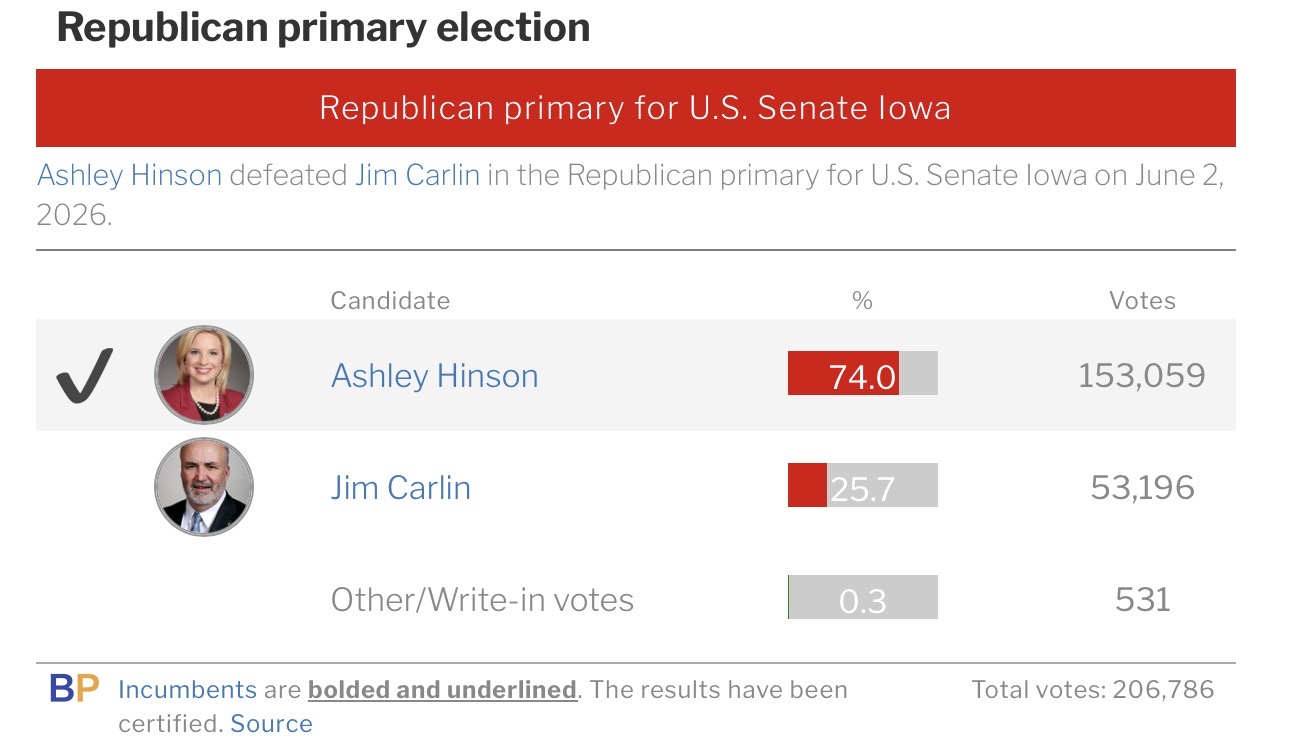
Hinson received Trump’s endorsement early in her campaign and moved on to pick up a strong primary victory:

Iowa 2026 Republican U.S. Senate primary results

Her opponent, Jim Carlin, tried to stir up nonsense over ideological purity after the campaign, but has since gotten with the program and thrown his support behind Hinson.

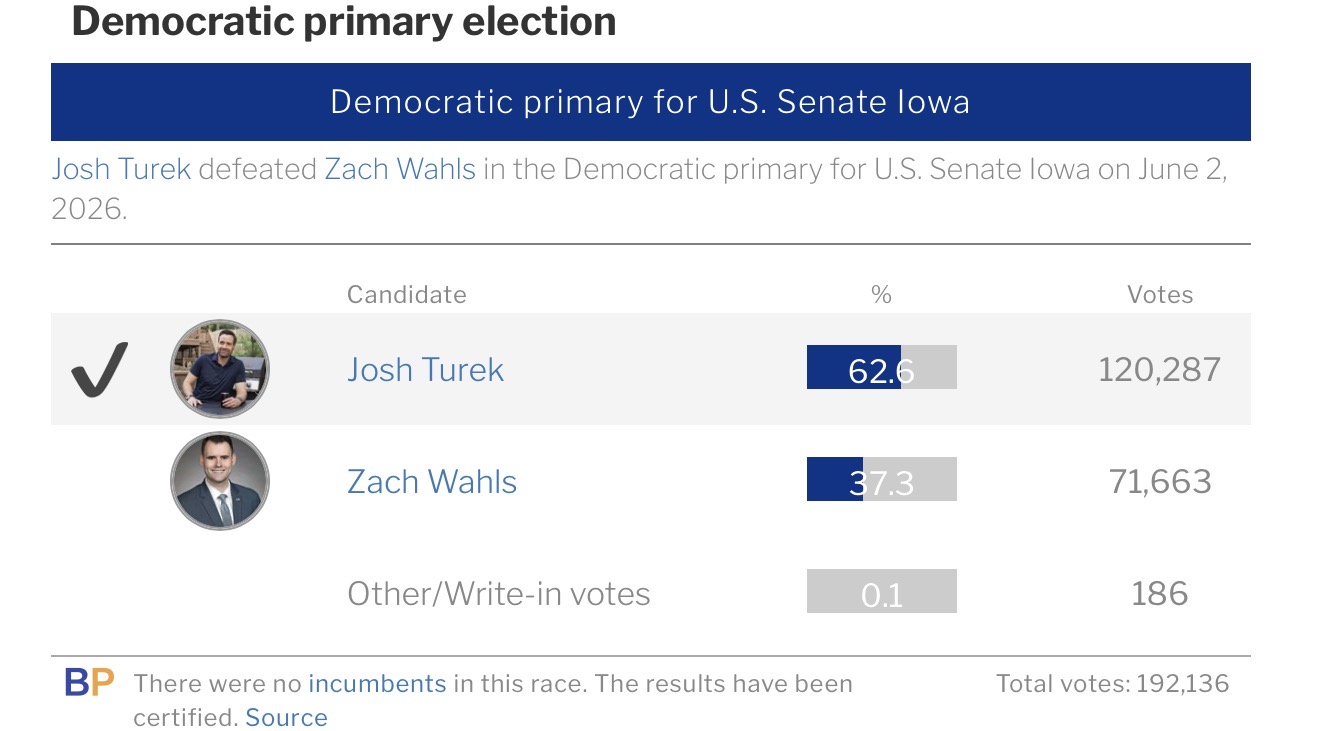
The Democrats have arrived at the cusp of the election with little drama. Turek defeated Zach Wahls by a 25.3% margin and the party is fully unified for the campaign.

Iowa 2026 Democratic U.S. Senate primary results

VI. Polls

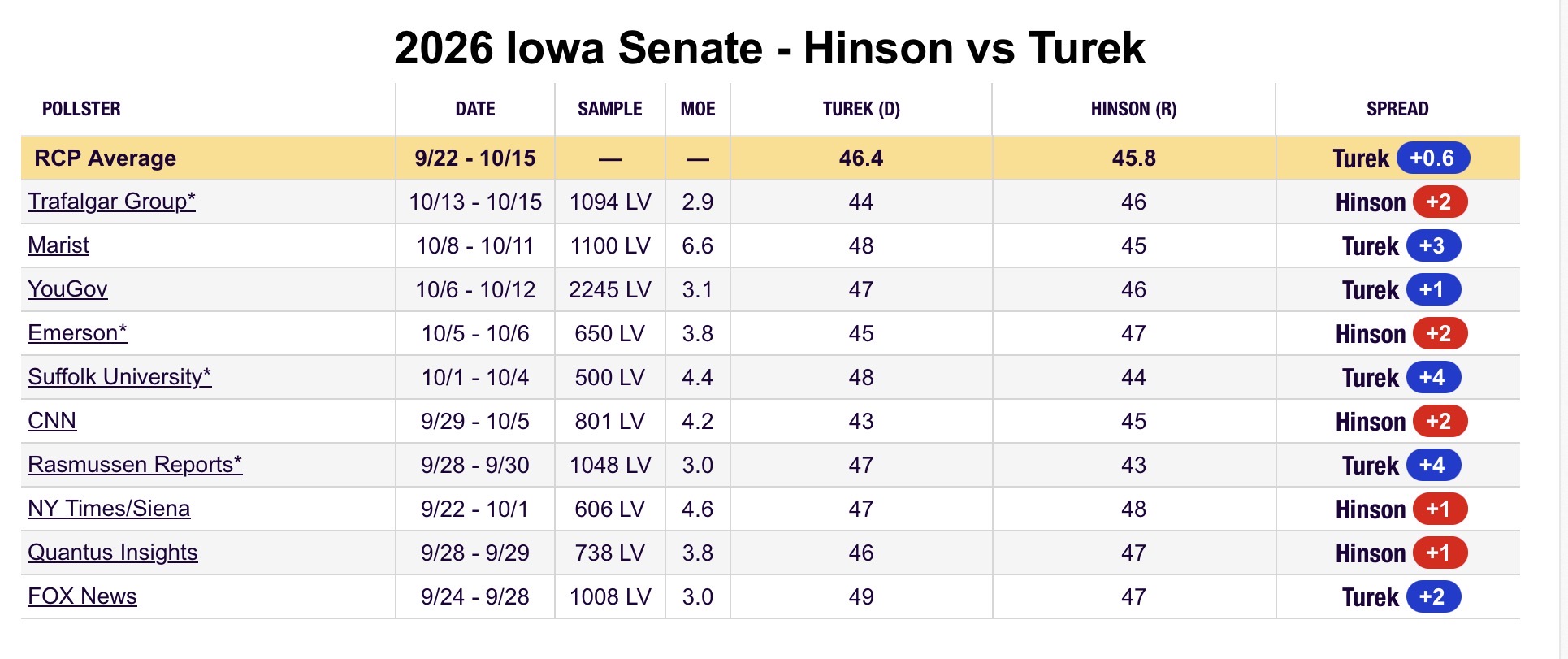
Polling has been all over the place, and here we see in this forecast an example of market traders not buying the results. Here is the RCP average:

RealClearPolitics polls for the Iowa U.S. Senate race

In the current sample making up the average, Hinson leads in 5 polls, and so does Turek. Turek’s narrow edge in the average is propped up by a pair of +4 outliers. Polling shows a push and reminds me of polls from Kansas – not picking up the support of white rural voters.

VII. Media Ratings

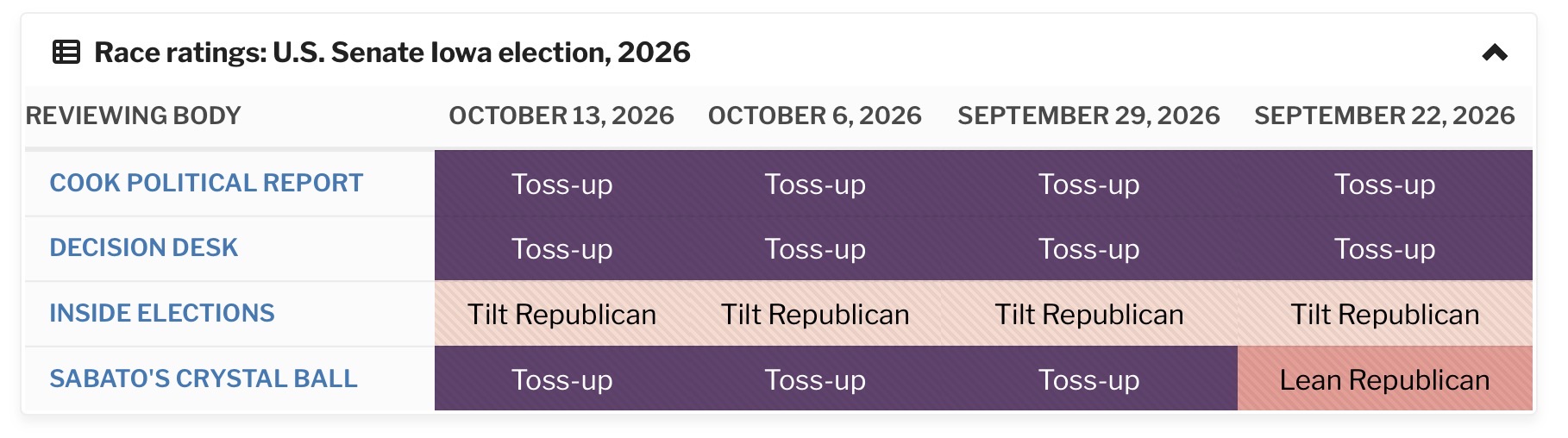
Media ratings for the Iowa U.S. Senate race

Inside Elections favors Hinson narrowly, while the other three reviewing bodies call the race a “toss-up.”

VIII. Party Registration

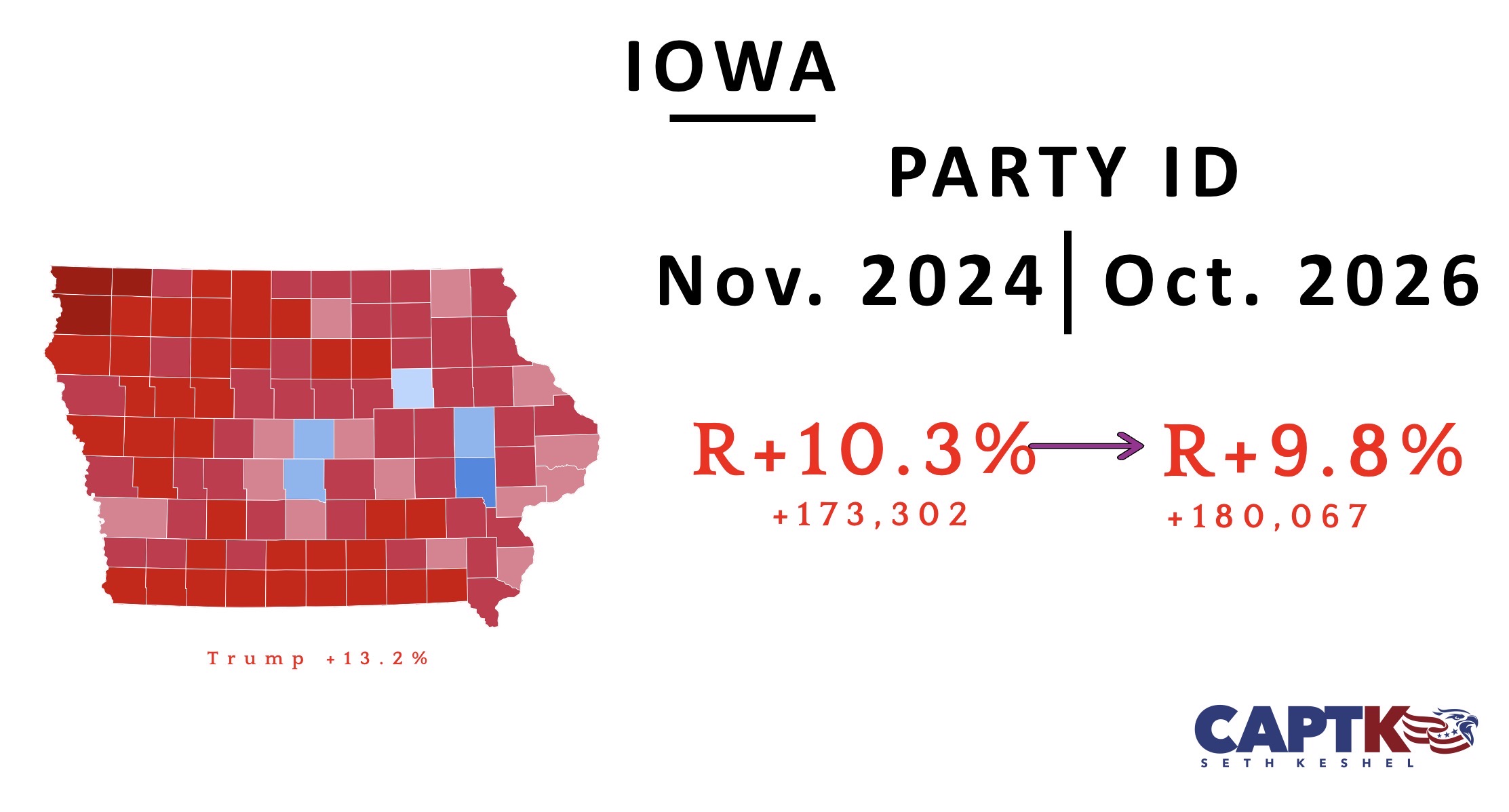
Iowa party registration by congressional district since November 2024

Senate races more closely resemble presidential outcomes because everyone votes. IA-1 looks rough for the GOP incumbent, and IA-3 is going to come down to the wire, but Republicans have a wider lead in IA-2 and IA-4 is deep red territory. Cumulatively, Republicans have a raw registration lead 6,765 higher than they had in November 2024, when Trump won the state by 13.2%. The index has decreased by a half-point from R+10.3% to R+9.8% thanks to the number of total registrants increasing, but it is clear the Democrat brand is in the garbage in the heartland.

Voters understand that no matter how moderate a Democrat touts himself to be, he will be pushing Chuck Schumer’s agenda in Washington. If Republicans vote, Democrats like Turek are at a major disadvantage.

IX. Election Considerations

From my IA-1 forecast:

One thing is for certain, and that is that Iowa runs excellent elections. A lot of this is owed to the current treasurer, Roby Smith, who started turning the screws on election reforms as a state legislator before the 2020 election. Iowa has manageable early voting windows, control over the mail-in balloting process, and a voter registration system that doesn’t automatically register voters.

X. Summary and Election Estimate

These are the major factors for the U.S. Senate race in Iowa:

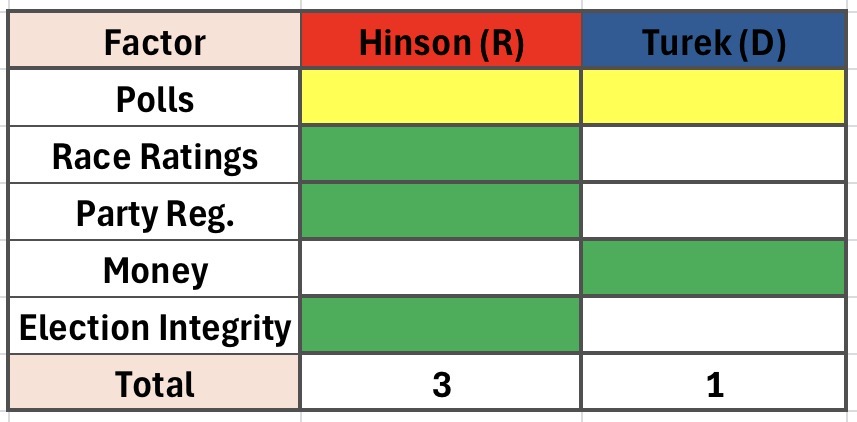
The mountain of presidential margin. Senate races are not like House races, which voters know they can reverse two years later if they don’t like how things worked out. No fair comparison from 2018 exists to suggest Turek is likely to reverse a Trump +13.2% state against an appealing candidate like Hinson.

Turek had a massive third-quarter fundraising haul, putting him ahead of Hinson for receipts (although he trails for cash on hand down the stretch run). Harris won just five counties; rural voters realize he will rubber-stamp Schumer’s agenda no matter how moderate he claims to be. Hinson has been given leeway to moderate her positions compared to Trump’s, which will help her in urban areas most susceptible to the wild swings Turek would need in his favor to edge her out of the seat.

Iowa runs solid elections and has excellent control over counting and mail-in balloting. Unlike the Alaska Senate race, which gives me bad vibes because of Ranked Choice Voting and other elections issues, there is no advantage afforded through poor election administration to Democrats anywhere in the state.

This is what my decision matrix looks like for this race:

Ten-point decision matrix for the Iowa U.S. Senate race

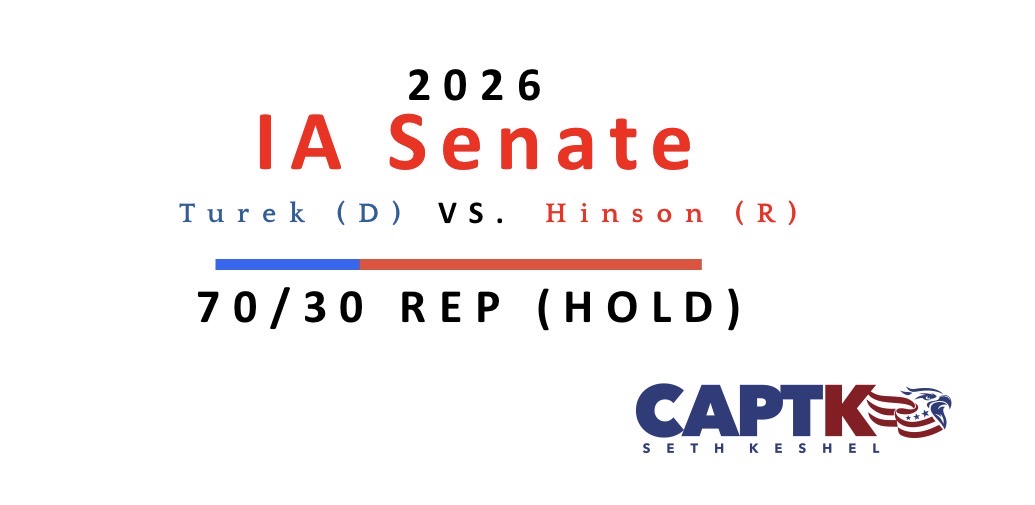
With all of these factors considered, I suspect Hinson will replace Ernst in the Senate, with a modest margin in single digits.

Forecast for IA Senate

Forecast for the Iowa U.S. Senate race

Seth Keshel, MBA is a Senior Fellow at the Gold Institute for International Strategy and a retired Army Captain. He publishes Captain K’s Corner on Substack.

2026 Ten-Point Forecast: MI-10 (U.S. House – Decisive)

2026 Ten-Point Forecast: MI-10

Michael Bouchard (R) vs. Christina Hines (D)

I. The Race

MI-10 candidates Michael Bouchard and Christina Hines

Michael Bouchard (Republican) is a young Army officer veteran running to replace John James in MI-10. His father, Michael Bouchard, Sr., has been the sheriff of Oakland County since 1999, which gives Michael Jr. strong name recognition and significant local infrastructure.

Christina Hines (Democrat) is another person relatively new to politics. She is a career prosecutor who ran for Macomb County Prosecutor in 2024 unsuccessfully, and she has built her campaign around generic Democrat priorities like healthcare and affordability. She’s been fairly careful about containing any Trump Derangement Syndrome in a district that has moved heavily to the right in the Trump era.

II. District Geography

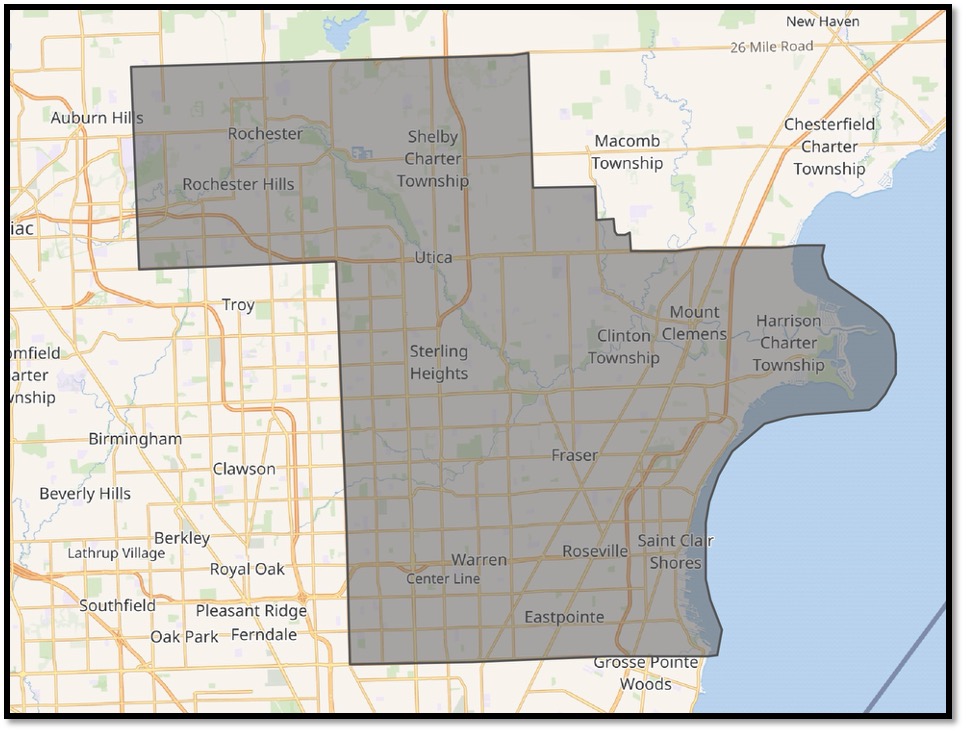
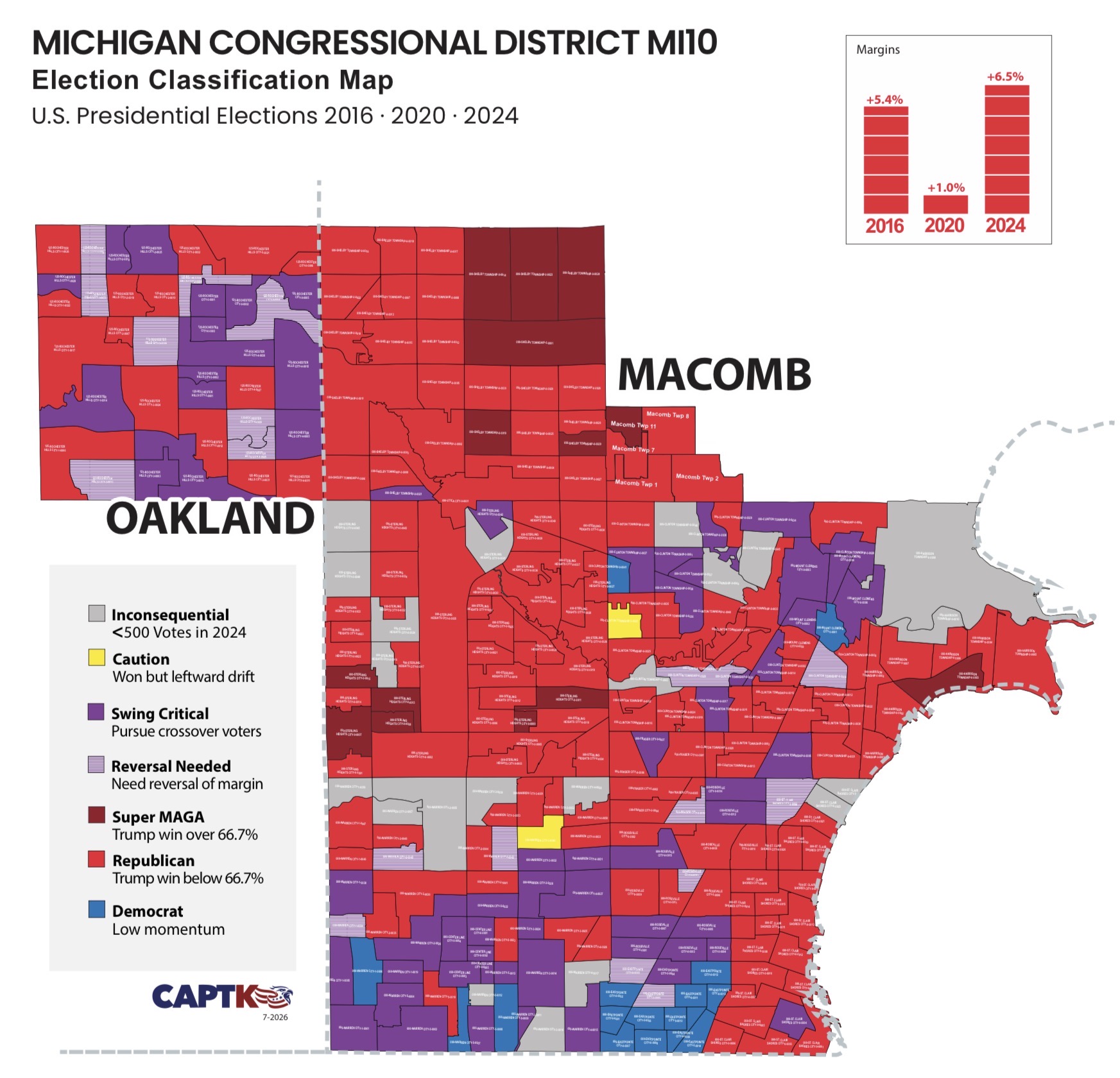
Map of Michigan's 10th Congressional District

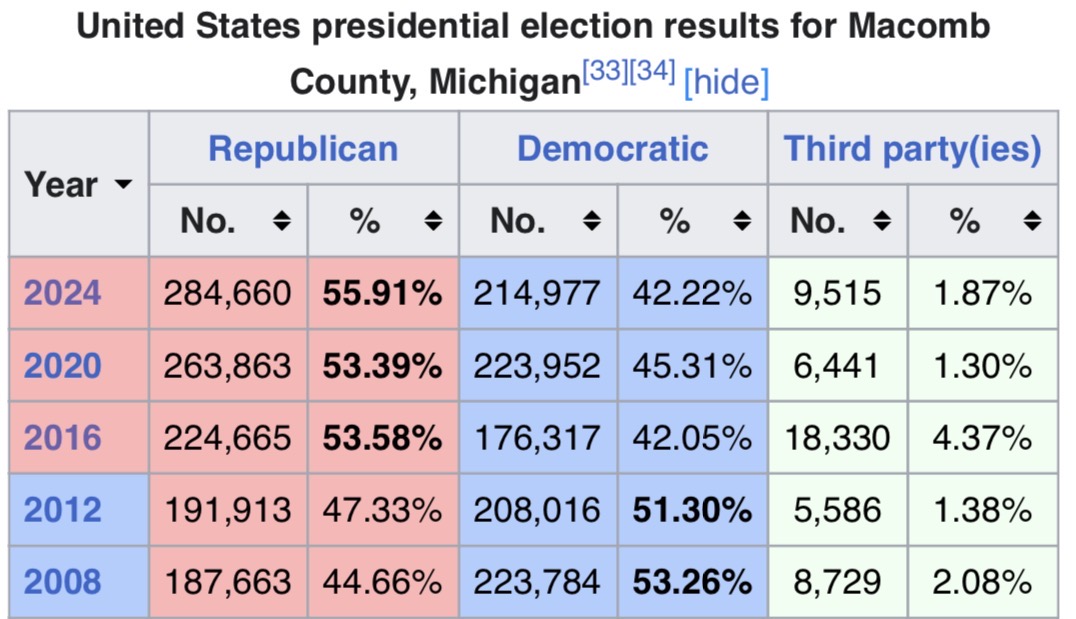
Michigan’s 10th Congressional District (MI-10) is heavily urbanized and consists of most of Macomb County, and a tiny sliver of northeastern Oakland County. It features a clashing of coalitions, with traditional Republicans in parts of the district (like Oakland County), and Trumplicans spread throughout Macomb County, which has a recent presidential track record like this:

Macomb County presidential election track record

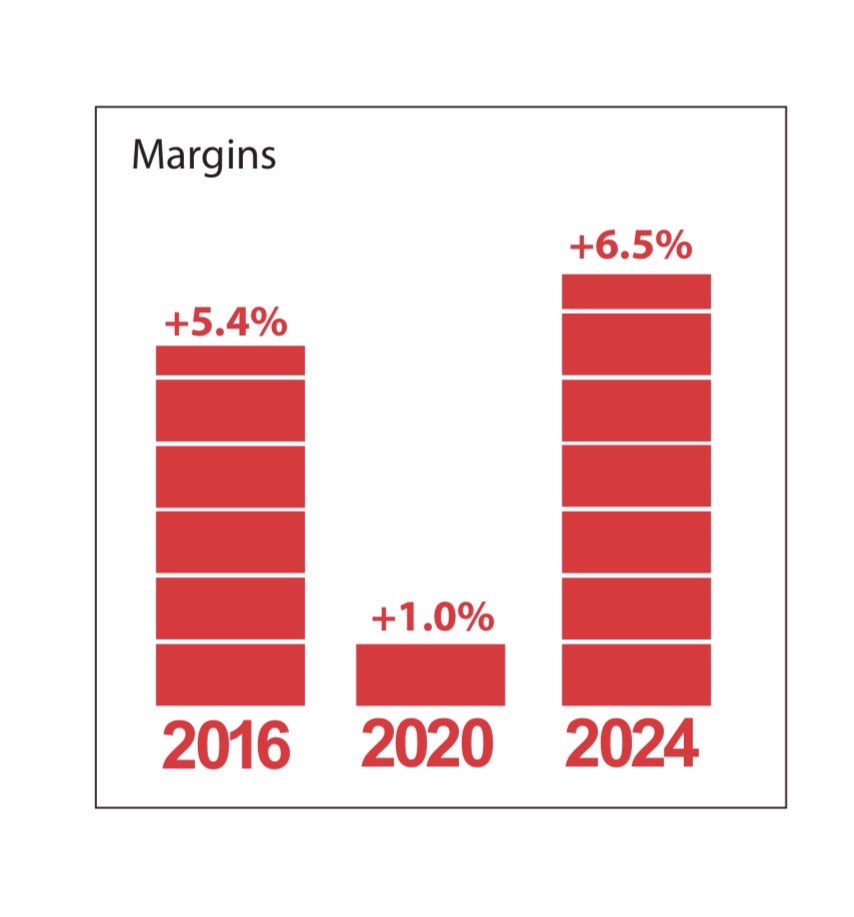
Macomb sits over 21 points and 100,000 net margin right of where it landed when Obama carried it in 2008. Barring this working-class transformation, the present district wouldn’t be competitive. Here is how it has performed in terms of presidential margin in the past three cycles (as drawn today):

MI-10 presidential margins in the past three cycles as drawn today

The low Trump margin from 2020 is definitely owed to the corruption of that election cycle and the doubling of mail-in balloting from 2016 to 2020 in Michigan; still, the part of the district that sandbags the margin is the portion of Oakland County made up of precincts that have gradually drifted away from the GOP (around Rochester), matching the county’s trajectory.

Key Statistics

72.8% White, 13.3% Black, 6.1% Asian

III. Market Assessment

In a low volume market, Polymarket bettors favor Hines, although not by ludicrous splits such as those we see in other races.

IV. History

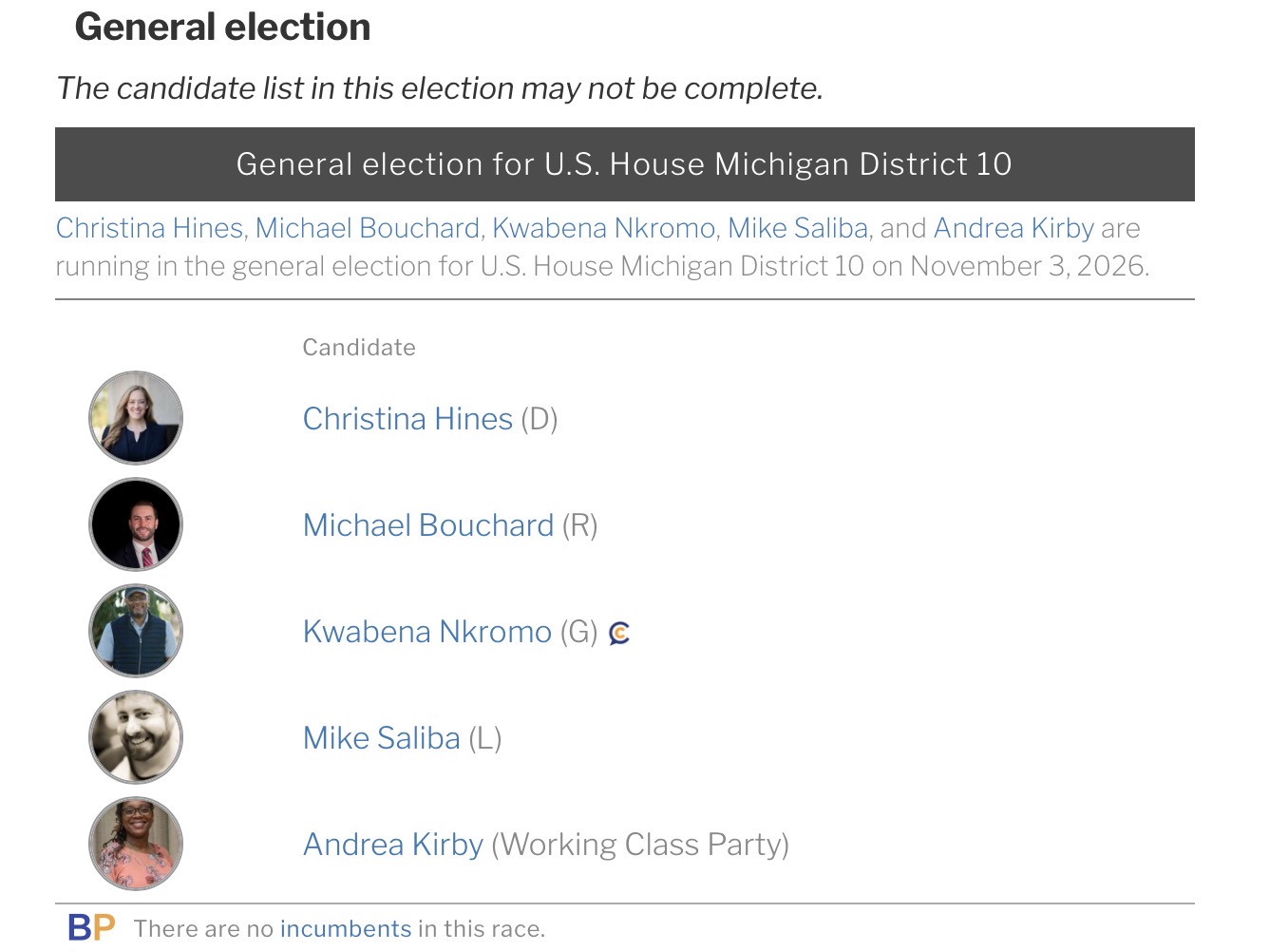
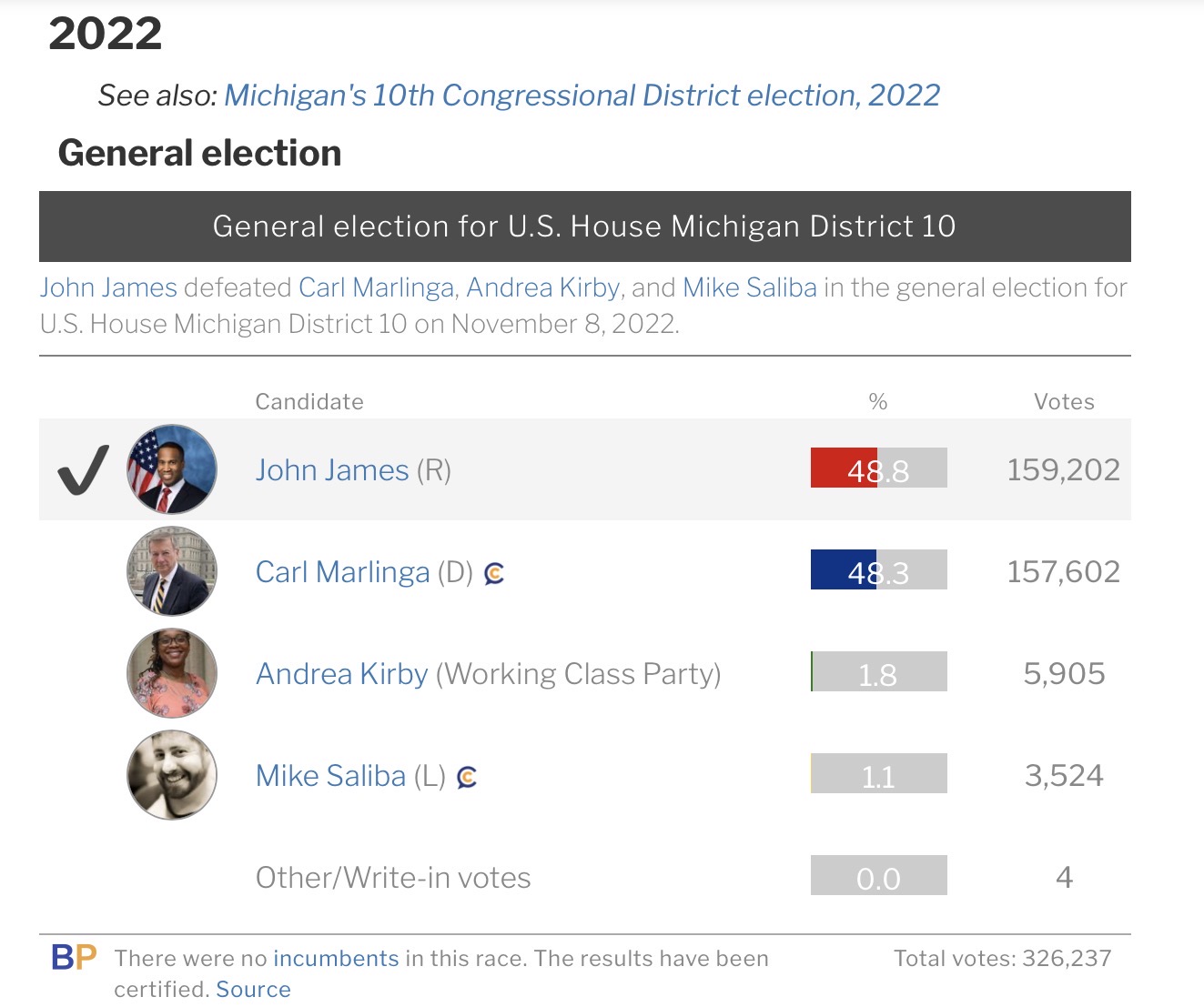
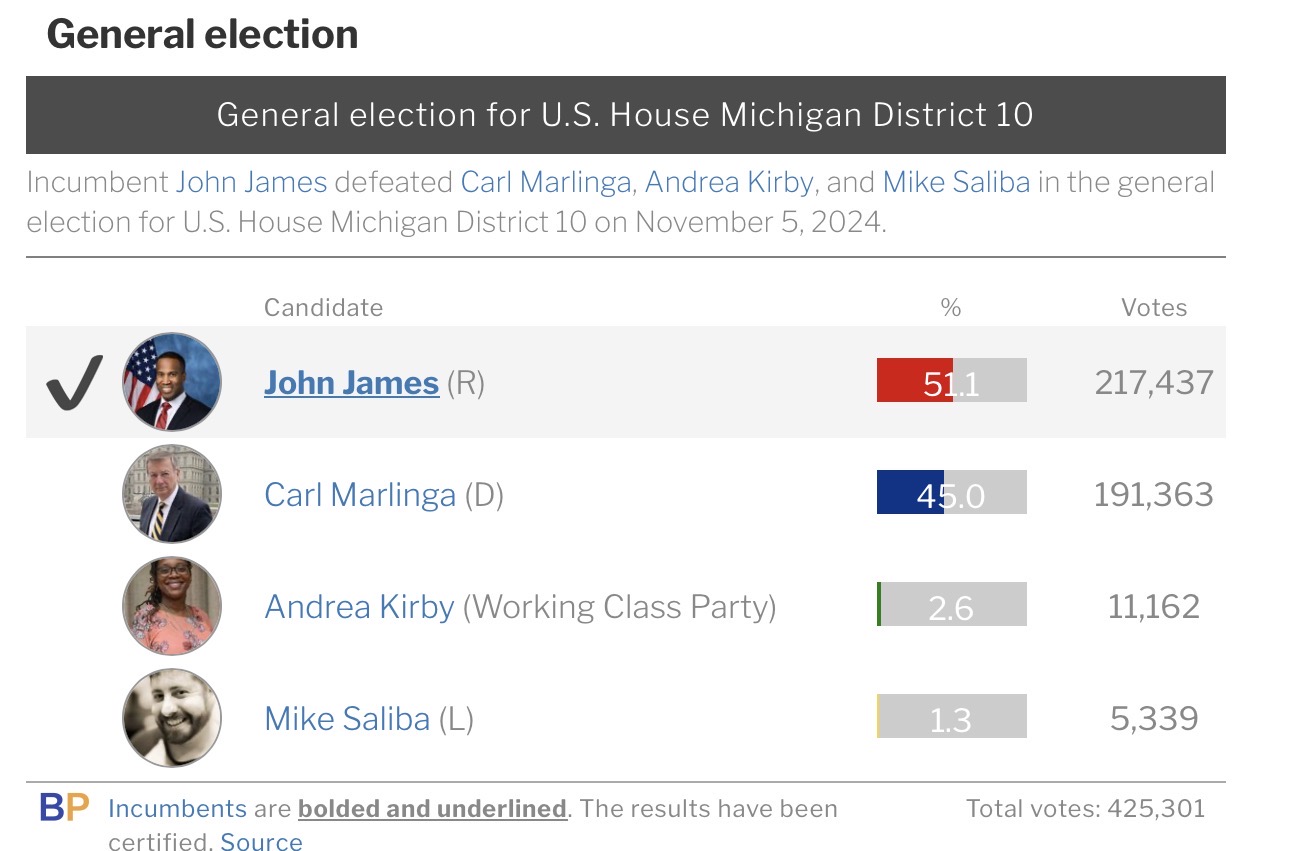
There is little use in analyzing the exact seat going back more than a few cycles. In the 2010s, what is now MI-10 was divided into multiple districts with safe partisan margins. In the very first race using the present boundaries, John James prevailed by an eyelash over his Democrat opponent, with a margin of a half-point. Looking at the minor party splits, it seems Andrea Kirby saved James:

MI-10 2022 House election result

James then ran for reelection in 2024 (once again facing off with Marlinga) and ran almost dead even with Trump, signifying the shift in the partisan infrastructure in the district:

MI-10 2024 House election result

James then did what James does, and ran off to the next biggest thing in a year that once again favors Democrats to win the governorship. He’s challenging Jocelyn Benson instead of defending a seat the Democrats would have been all over anyway, and now risks a third statewide defeat in eight years. In case I’m not making myself clear, he’d have been a lot better off holding down this seat in a tough cycle than forcing the party to defend it so heavily. If James wins and proves me wrong, then I’ll recant my sentiments.

The recent history of MI-10 highlights the growing strength of the Trump-aligned GOP, primarily in Macomb County, but leaves no doubt that another race for an open seat is going to come down to a photo finish.

V. Analysis of 2026 Primary Results

Democrats avoided the error their primary voters inflicted upon them in MI-7, where they nominated radical DSA-aligned candidate Will Lawrence to take on Tom Barrett.

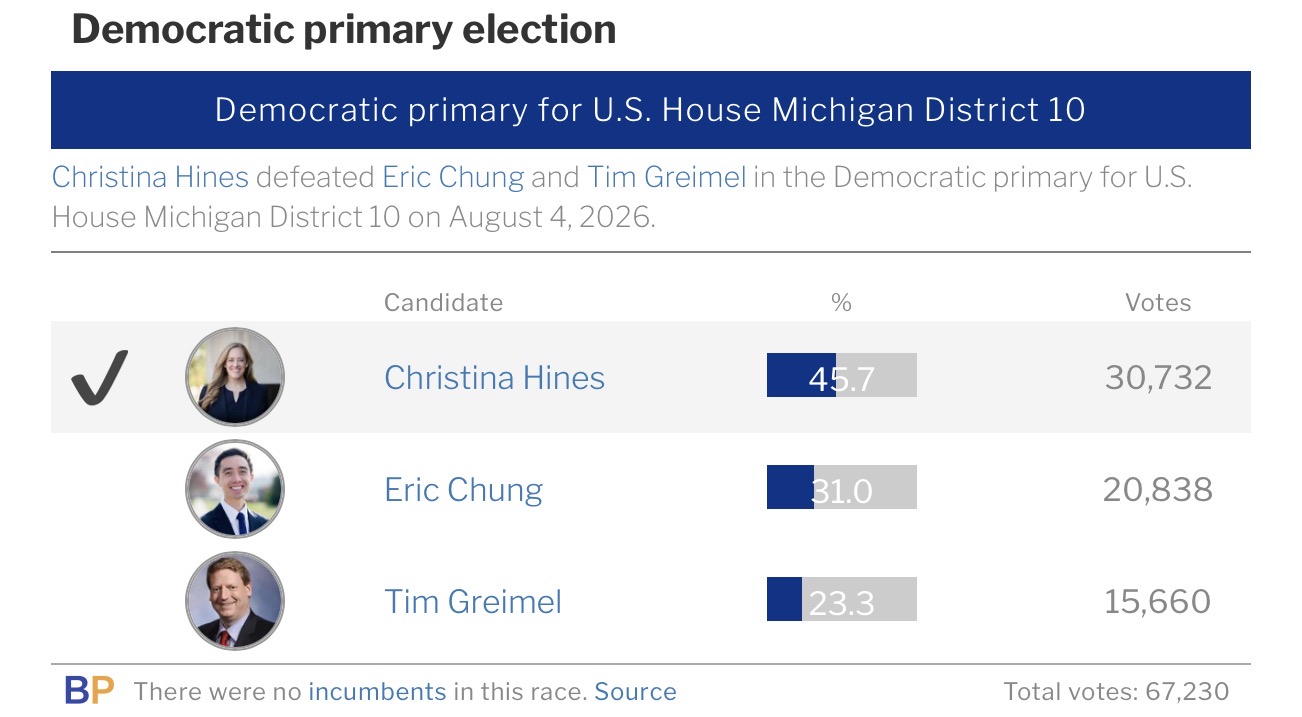
MI-10 2026 Democratic primary results

Hines prevailed with a plurality against a competitive field of moderates, which all backed her after the primary and put an end to any possibility of drama in the party.

Bouchard prevailed on the GOP side with 72.6% of the vote, beating the next closest candidate by almost 55 points.

VI. Polls

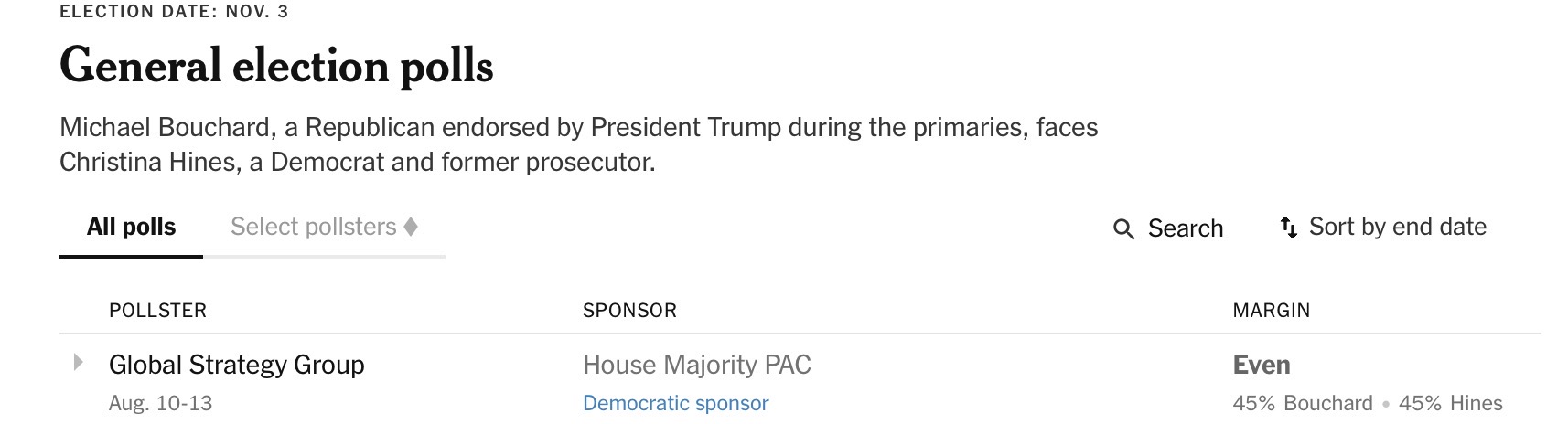
The only poll posted by The New York Times shows a dead heat:

MI-10 poll listed by The New York Times

VII. Media Ratings

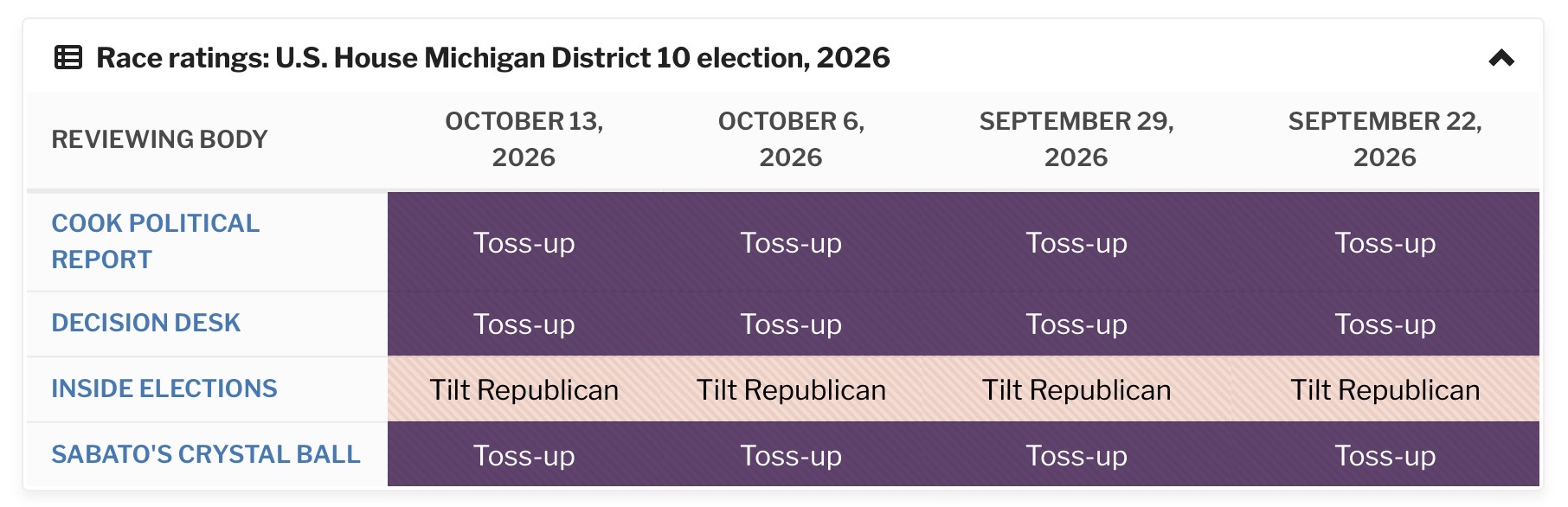
Inside Elections thinks Bouchard has a slight edge, but the other three main reviewers call it a toss-up:

Media ratings for the MI-10 race

VIII. Party Registration

Michigan does not have party registration, but it tracks tightly with Pennsylvania, which does. The overwhelming trend throughout Pennsylvania’s working-class counties is hard to the right, with continuing drop-offs for Democrats that now extend to non-whites. The suburban areas of Oakland County in the district may resemble those in Pennsylvania, which presently display a slight leftward drift.

IX. Election Considerations

In my preview of the MI-7 race, I directed readers to my review of Michigan’s 2024 election, which contains my takes on election integrity matters. From that piece:

• Unique Corruption – Michigan has been exposed for covering up voter registration fraud rings, particularly in a major 2023 news story involving one in Muskegon County active during the 2020 election. Notably, similar registration fraud rings were exposed this cycle in Pennsylvania in multiple large counties. The state’s Attorney General, Dana Nessel, has threatened election integrity activists with imprisonment and police persecution for drawing attention to Michigan’s endless examples of election-related malfeasance.

• Automatic Voter Registration – Michigan operates Automatic Voter Registration, which has only entrenched Michigan’s voter registration corruption, as evidenced by the state having hundreds of thousands of more voters registered than there is an available pool of eligible voters statewide. The Secretary of State, Jocelyn Benson, has suggested the state is helpless to clean its voter rolls and responds harshly to citizens who expect the state to run fair elections. As a reminder, more than 83% of Michigan’s total population (including minors) is registered to vote, when only 77% of any population is over the age of 18 and therefore old enough to cast a ballot.

As I wrote in the MI-7 article:

No state with the number of registered voters exceeding voting-age population can be trusted to run fair elections, and if control of the House hinges on MI-7, even the Democrat establishment will go to bat for Lawrence and trust they can bend him to their will in a hypothetical majority.

Michigan, thanks to the work of Jocelyn Benson as Secretary of State, does not run an elections system any real analyst should consider secure of trustworthy. Ask Mike Rogers, who lost to Elissa Slotkin in the wee hours of the morning once all the mail-in ballots came in after Trump was declared the winner of the state.

X. Summary and Election Estimate

While MI-10 has changed considerably from the Obama days, the GOP margins there do not exceed the margin of midterm variables. James barely won the seat in a 2022 House popular vote victory for the GOP, but did hold it by a margin nearly identical to Trump’s on the same ticket. I would feel better about the GOP’s odds of holding MI-10 if James had stayed put as an incumbent instead of charging off to run for governor, but I think Bouchard’s name recognition, owed to his popular sheriff father in Oakland County, will help him shore up soft GOP and swing voter support in that county specifically.

Captain K precinct mapping of MI-10
Captain K Proprietary Mapping of MI-10

Rochester and Rochester Hills, the portion of Oakland County inside MI-10, is crucial terrain. The precincts in purple are Trump losses, but with at least 30% of the vote for Trump. The solid purples moved toward Trump in 2024, while the striped ones moved away from Trump. If I’m correct and Sheriff Bouchard’s network helps carry Bouchard Jr. to stable or improved performances in those precincts, then the math favors him, not Hines. Southern Macomb County will be her prime hunting grounds, but the vast remainder of Macomb has precincts favorable to a law and order candidate like Bouchard.

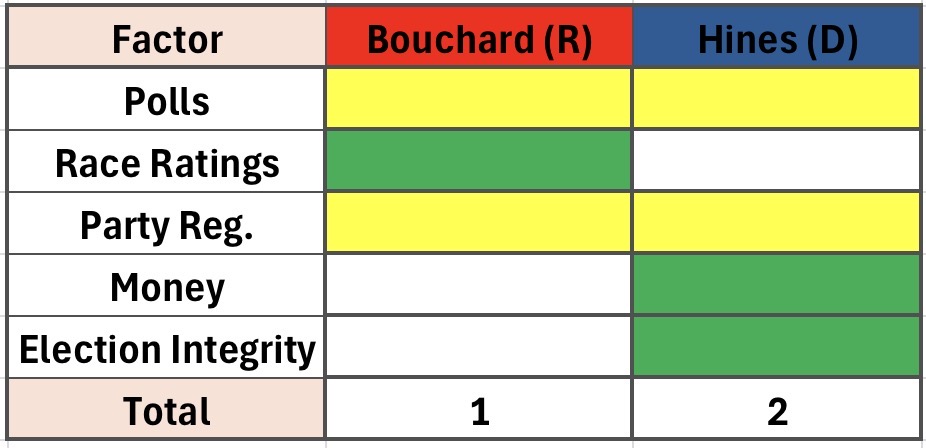
Here is my decision matrix depicting key factors of the race:

Ten-point decision matrix for the MI-10 race

The matrix above essentially shows a push. I gave Hines the nod on money because of her last report, but the campaigns are roughly equal in cash on hand. This race appears to fall into the same category of PA-8 – a working-class district with a slice of suburbia and some fundamentals that favor the GOP candidate just enough to provide a window of opportunity.

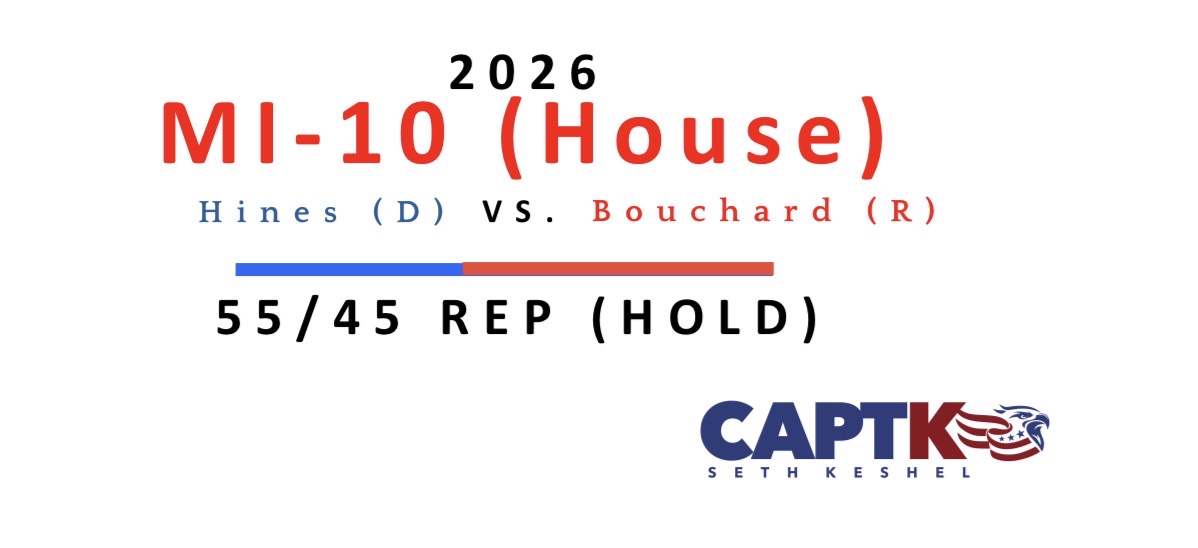
Forecast for MI-10 House

Forecast for the MI-10 House race

I’m looking at a race that looks a lot like the one in this district in 2022, and would not be surprised if either candidate wins by less than a point. The GOP would be wise to focus here rather than on PA-10, IA-1, or NJ-7, to name a few.

Seth Keshel, MBA is a Senior Fellow at the Gold Institute for International Strategy and a retired Army Captain. He publishes Captain K’s Corner on Substack.

2026 Ten-Point Forecast: PA-10 (U.S. House – Decisive)
2026 Ten-Point Forecast: PA-10

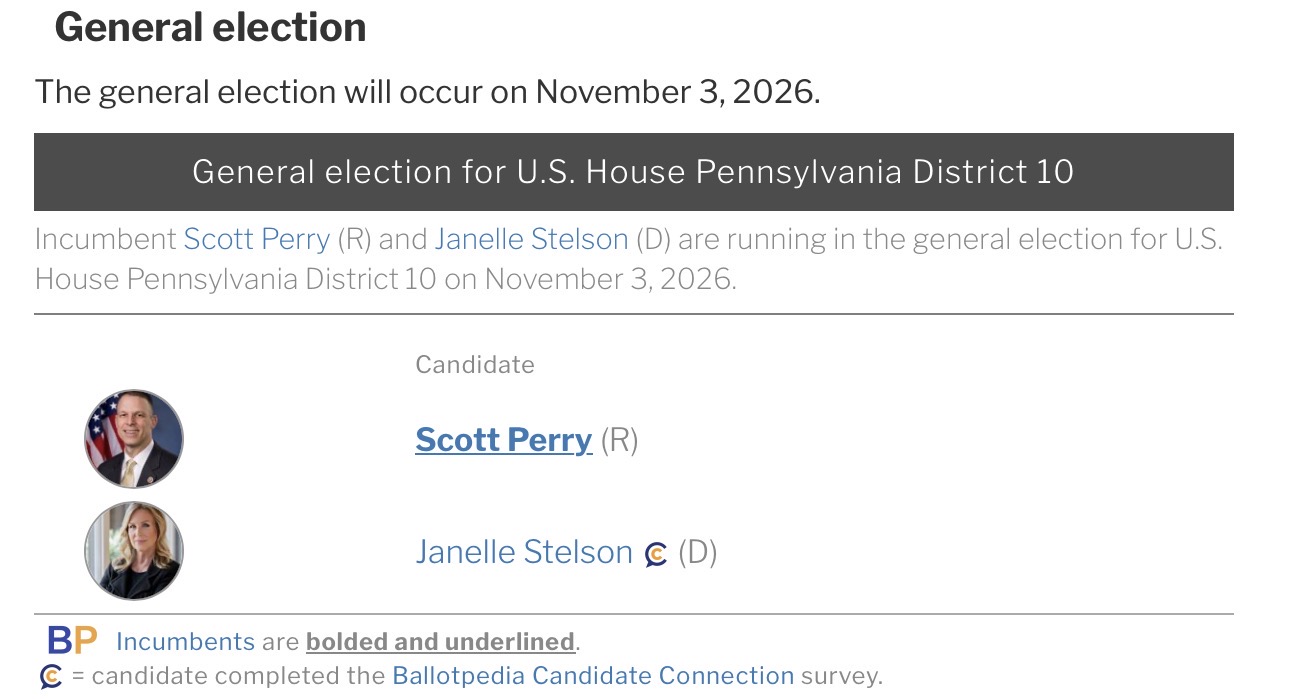
Scott Perry (R-inc.) vs. Janelle Stelson (D)

I. The Race

PA-10 candidates Scott Perry and Janelle Stelson

Scott Perry (Republican) is a retired Army brigadier general seeking his eighth term in the U.S. House. He was first elected in 2012 when the old boundaries of his district made up PA-4. In 2018, when the Pennsylvania Supreme Court issued a new map, his district was renamed PA-10 and was substantially more favorable for Democrats. Perry held on by a thread in 2024 despite Trump’s statewide victory.

Janelle Stelson (Democrat) is a former news anchor who narrowly lost to Perry in 2024. She touts her “former Republican” credentials to drum up moderate support and is running on a generic “affordability” platform. She has been extremely careful not to alienate Trump supporters, as opposed to the talking points of many of her Democrat counterparts running in 2026.

II. District Geography

Map of Pennsylvania's 10th Congressional District

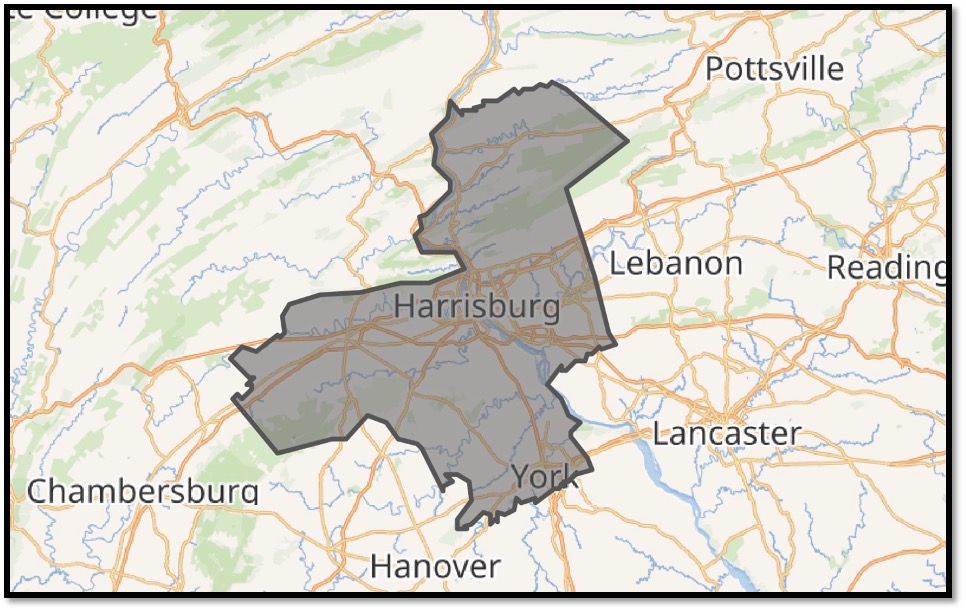
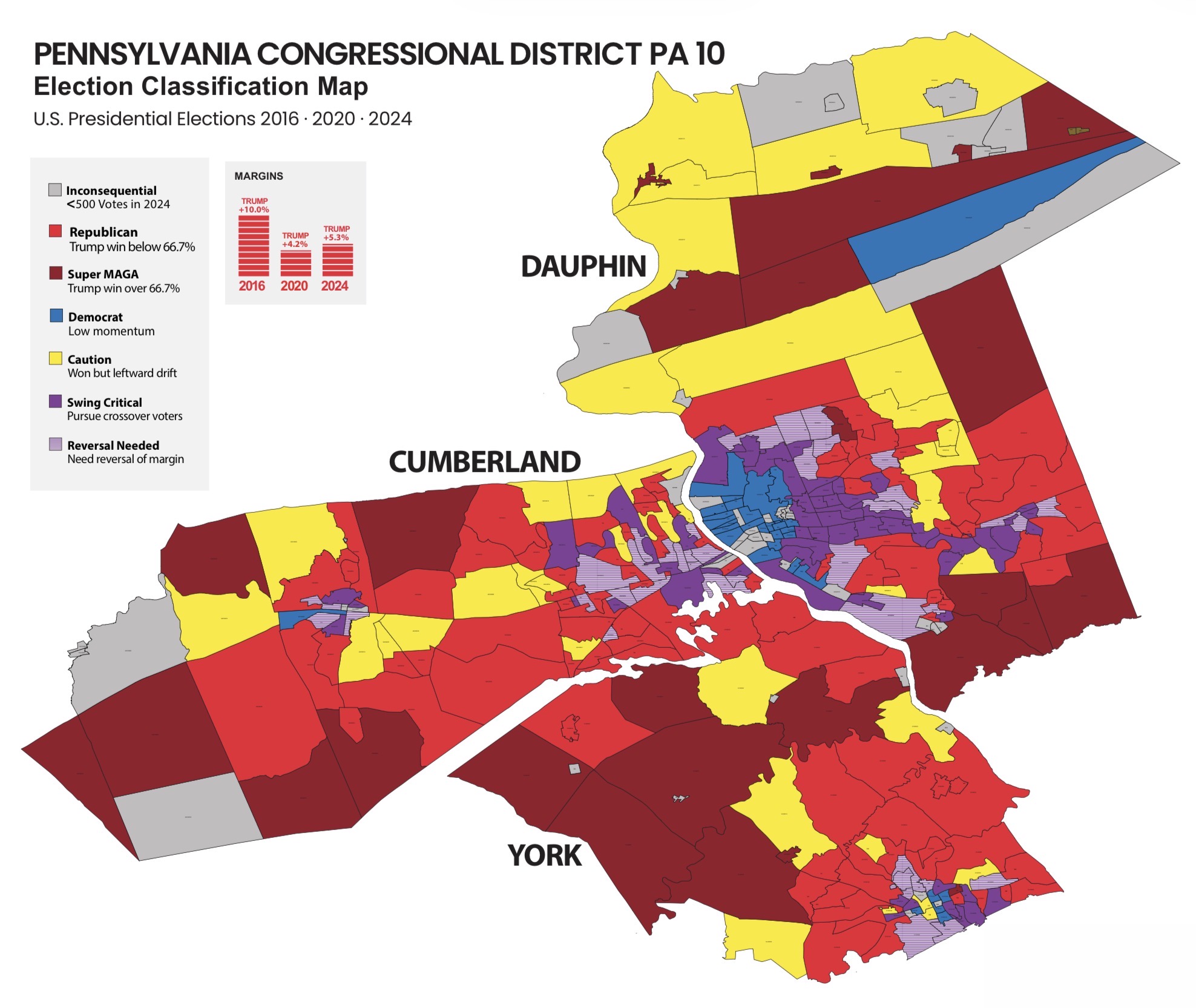
Pennsylvania’s 10th Congressional District (PA-10) includes all of Dauphin County, which contains the state capital of Harrisburg, most of Cumberland County, and a portion of York County, which includes the York itself (the only favorable terrain Democrats have in York County).

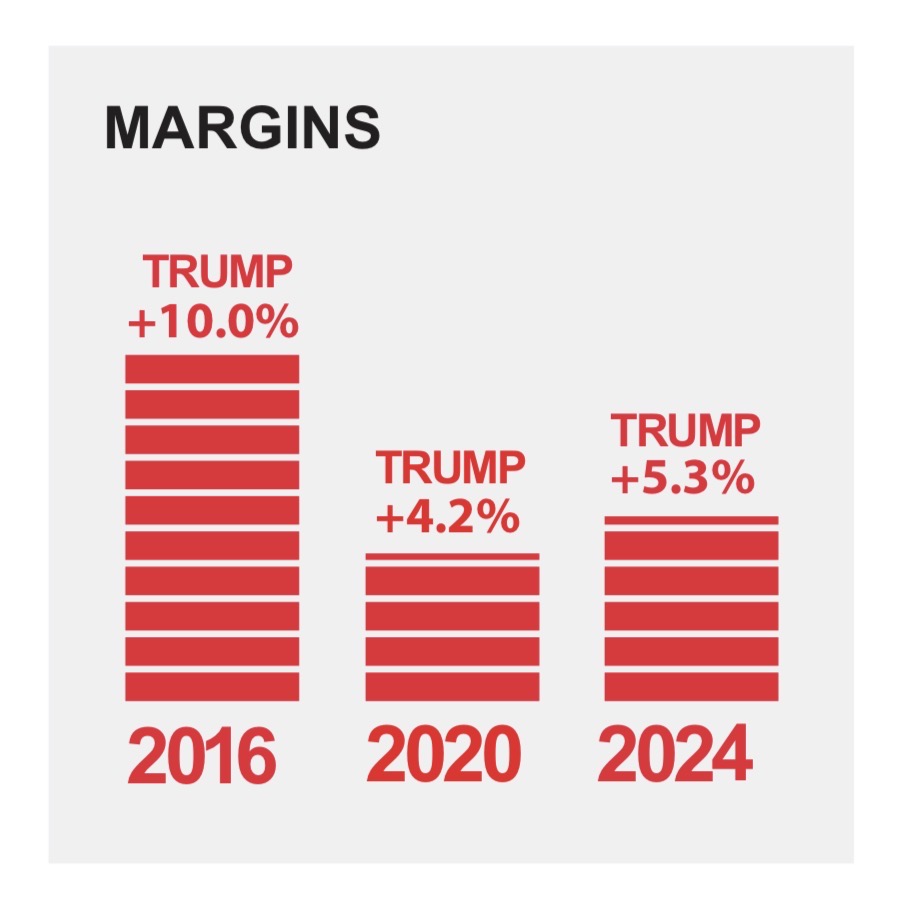
Dauphin is relatively competitive for a capital county. Trump lost it by 2.9% in 2016, 8.5% in 2020, and 5.9% in 2024. Cumberland County is a GOP stronghold, but is starting to slip. Trump’s margin has gone from +17.8% in 2016 to just +9.4% in 2020. Trump has carried the present boundaries of PA-10 in all three of his runs, but the slippage is clear.

Presidential Margins

PA-10 presidential margins

Key Statistics

71.2% White, 10.1% Black, 9.5% Hispanic

III. Market Assessment

Polymarket bettors, despite low volume, widely believe Stelson will pick up PA-10.

IV. History

The trail on PA-10 is hard to pick up thanks to the Pennsylvania Supreme Court overturning the map Perry ran on in 2016 when Trump first emerged at the top of the GOP ticket. Perry won the old PA-4 in a walk that year, topping his Democrat opponent by a margin of +32.2%. With the new map in place, things became much more difficult; Perry defeated Democrat George Scott by just 2.6%.

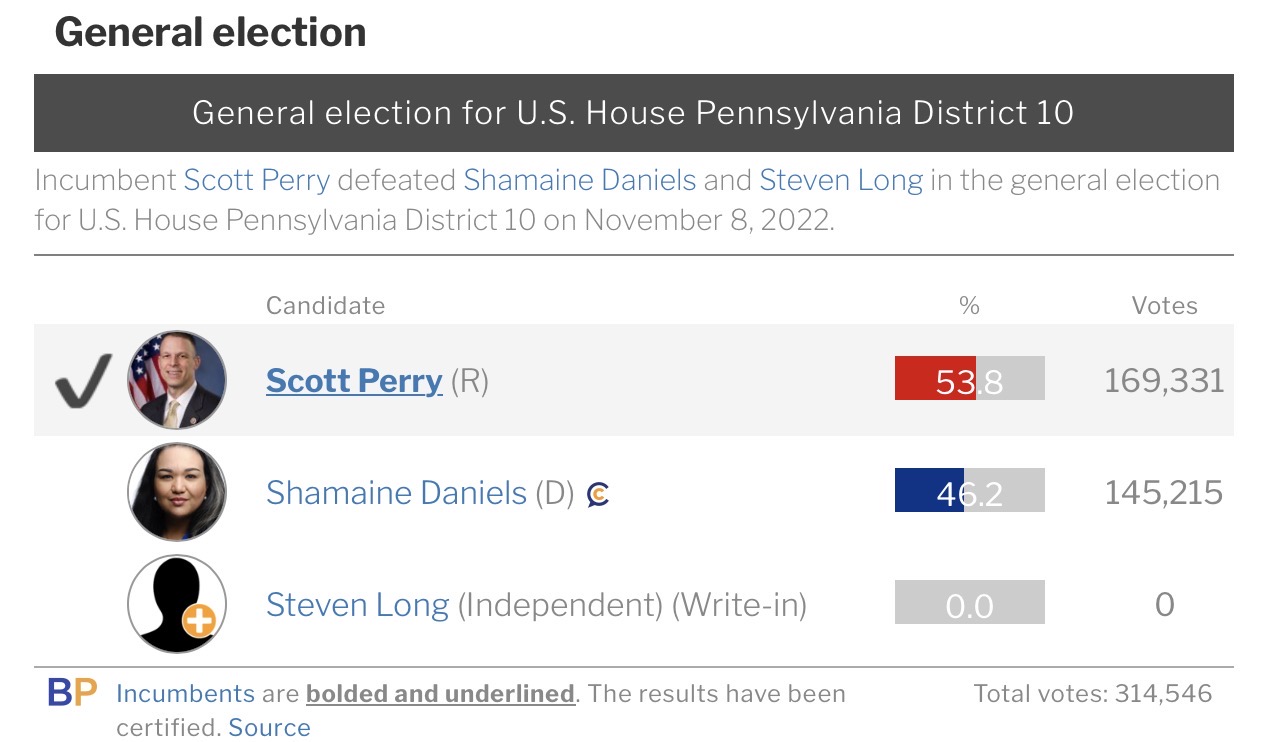
Surprisingly, Perry had little trouble holding the district in the fiasco that was Pennsylvania’s 2020 election, and slightly outran Trump. In 2022, he held the seat comfortably, beating Shamaine Daniels by 7.6% in a year the GOP retook the House majority:

PA-10 2022 House election result

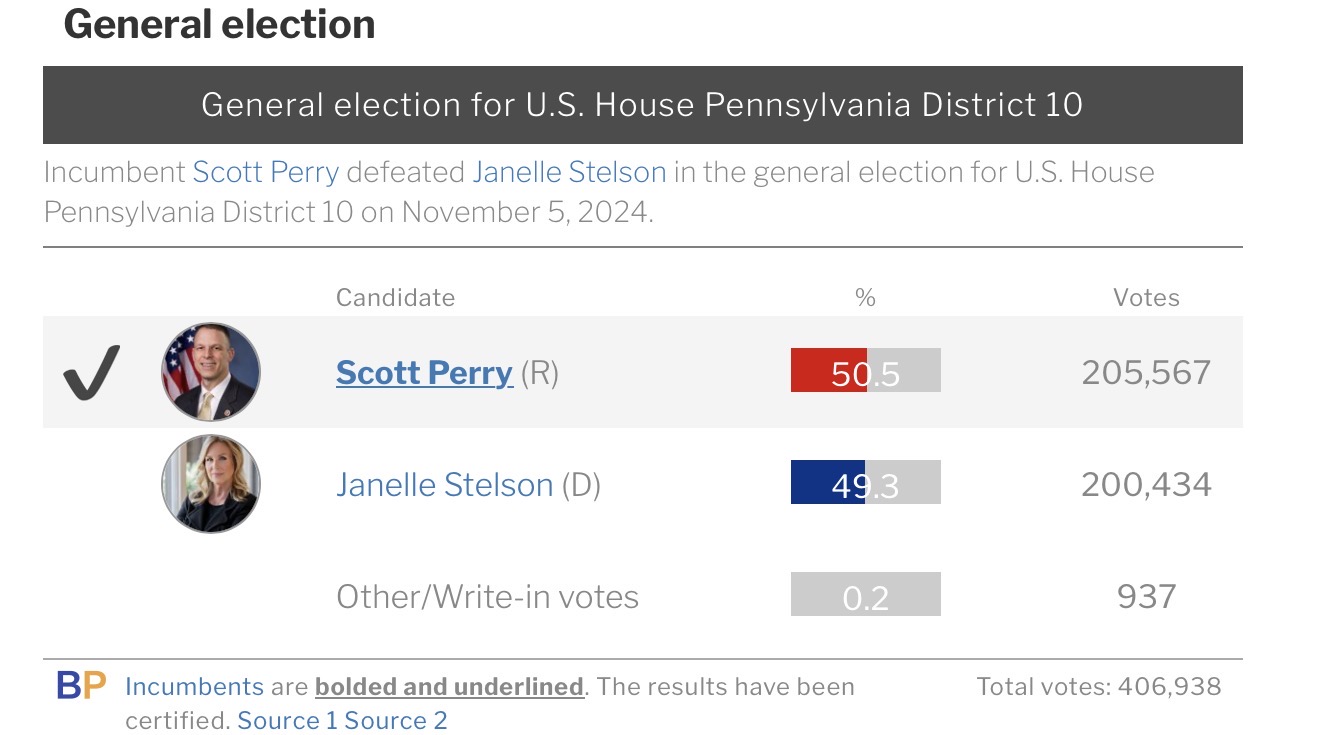
Perry’s seat became hot (as it remains) in 2024, when he barely squeaked past Stelson in her political debut:

PA-10 2024 House election result

Perry’s margin was +1.2% (+5,133), underperforming Trump’s margin in PA-10 by a full four points. The recent history of PA-10 paints one of the few rosy pictures in Pennsylvania for Democrats.

V. Analysis of 2026 Primary Results

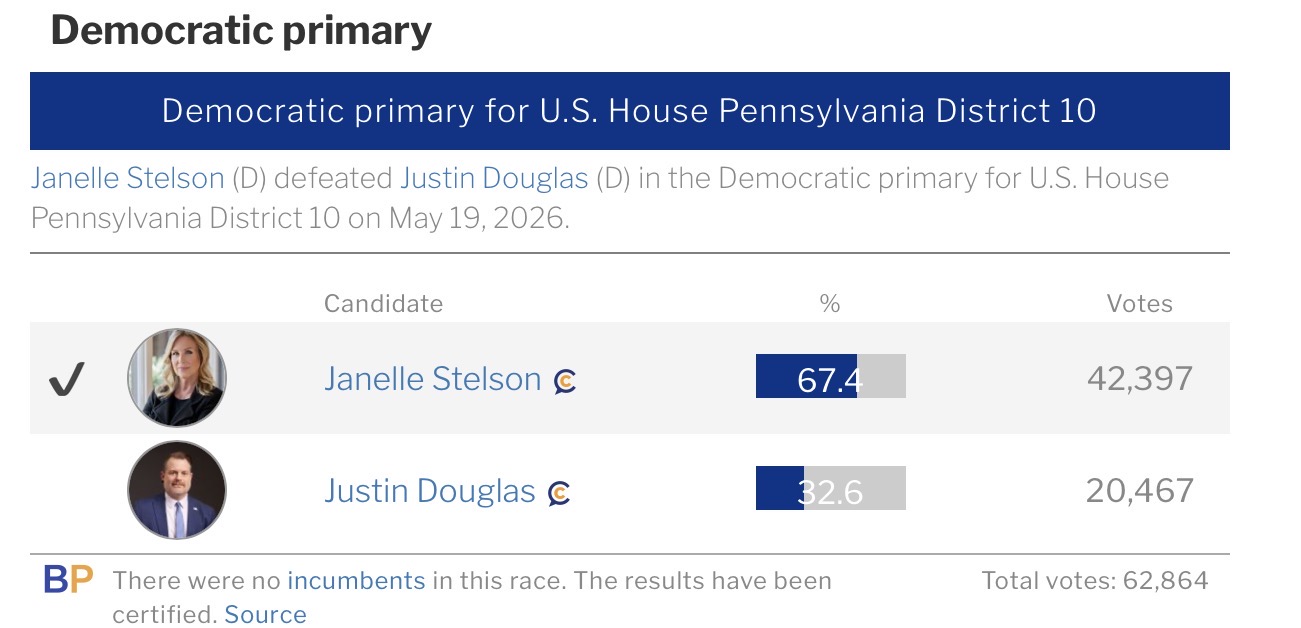
Perry ran unopposed in the GOP primary. Stelson took on a challenge from the left by Justin Douglas, a woke Dauphin County Commissioner who somehow thought it was a good idea to run on abolishing ICE in a state that is 12 points right of its 2008 presidential margin. Stelson prevailed roughly two-to-one:

PA-10 2026 Democratic primary results

Their campaign was ugly early on. Stelson wouldn’t debate Douglas because she didn’t appreciate him refusing to back her if she won. Unfortunately, she did win; Douglas would have fit a MI-7 or CO-8 model if he would have pulled it out. The two have made amends, but the primary aftermath is one of the few advantages Perry has at the moment.

VI. Polls

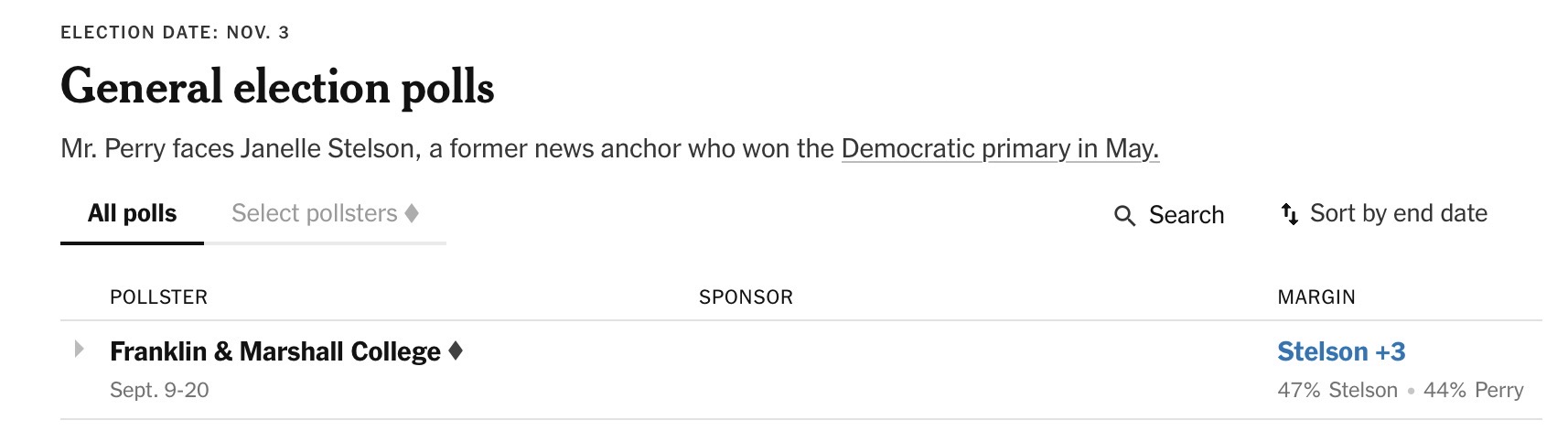
Poll pulled from The New York Times:

PA-10 poll listed by The New York Times

In the only recent available poll, Stelson leads by 3% (Franklin and Marshall College).

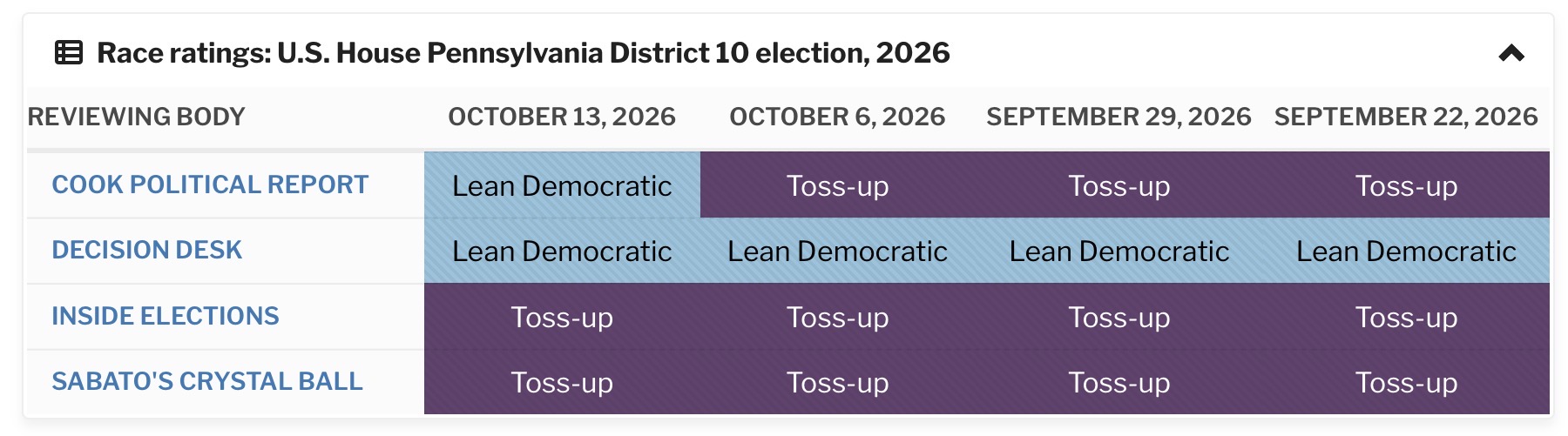
VII. Media Ratings

Media ratings for the PA-10 race

Two reviewers are still on “toss-up,” while Cook and Decision Desk have it leaning for Stelson.

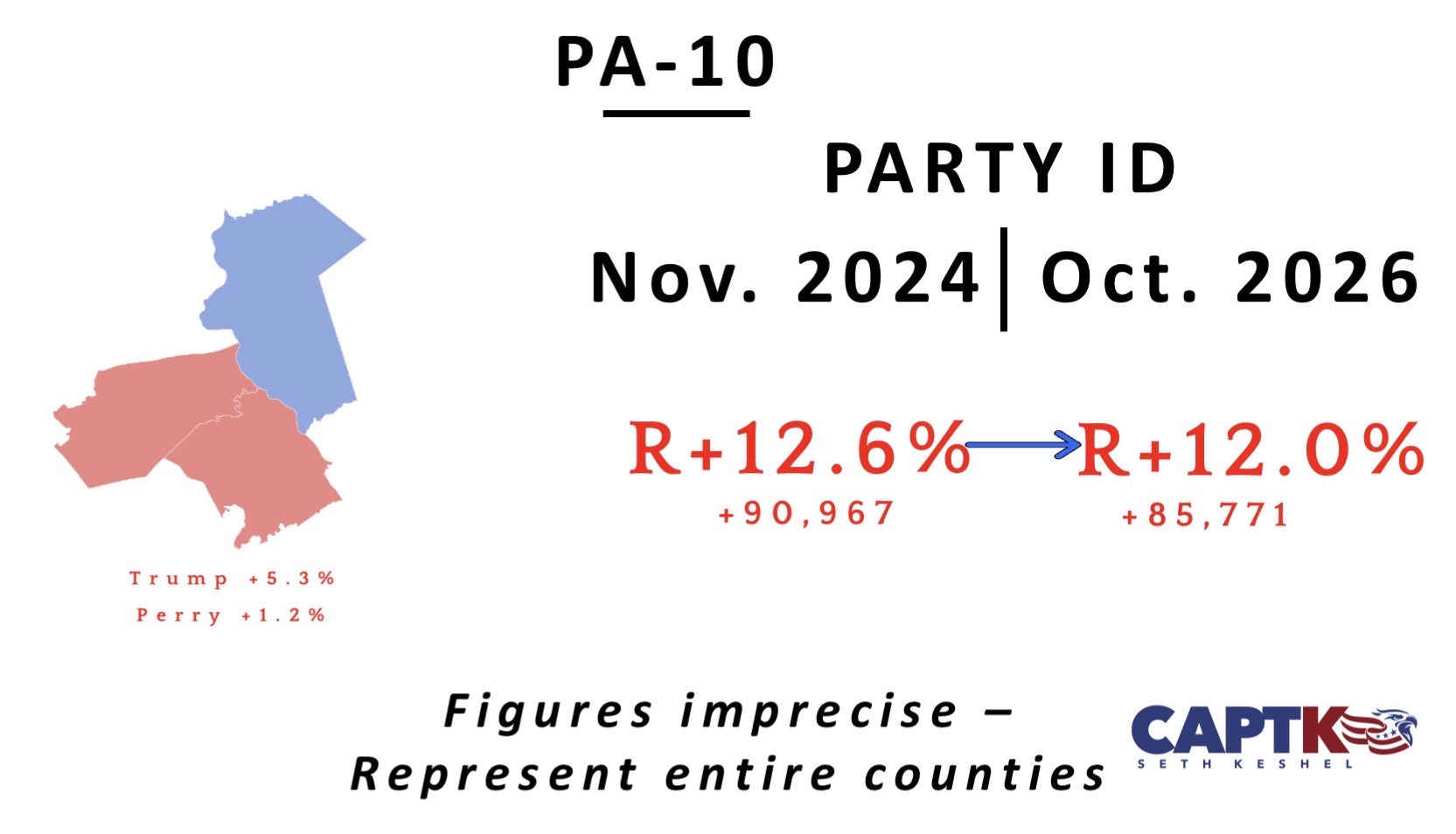
VIII. Party Registration

Party registration changes in Cumberland, Dauphin and York counties

The graphic above, although not representative of a drastic change and not fully representative of the district (carved out of the three full counties), spells real trouble for Perry. Pennsylvania is rapidly turning red, but all three of these counties sit left of their 2024 registration indexes:

Cumberland from R+28,279 to R+25,932

Dauphin from D+9,742 to D+11,305

York from R+72,430 to R+71,144

IX. Election Considerations

Rather than recreate the wheel, I am copying what I wrote in my assessment of PA-8:

Read my book, The American War on Election Corruption, if you’d like to understand the major impacts to Pennsylvania’s elections caused by the introduction of mass mail-in voting. It’s not crackpot stuff; Pennsylvania’s elections are now more about ballot collection than they are about vote getting. The registration numbers shown above suggest Democrats, particularly with the area stagnant in population growth, should be incapable of gaining votes cycle after cycle, but they still manage to compete.

Pennsylvania has some of the worst elections in America.

X. Summary and Election Estimate

Perry’s GOP colleague, Rob Bresnahan, is in a much better position to hold PA-8 than Perry is in to hold PA-10. Bresnahan has cobbled up key labor endorsements, has a financial advantage, and has seen his counties make GOP gains even with Democrats making up substantial ground statewide for the past six months. Additionally, with several reasonably comfortable reelections prior to his 2024 close call, I am concerned that Stelson has a natural popularity owed to her time as a news anchor. PA-10 is full of moderate/Trump hesitant precincts (marked in yellow below) that are tailor-made for Stelson, who has been running on a bland platform – especially compared to the increasingly radical positions espoused by the new class of Democrat candidates.

Captain K precinct mapping of PA-10
Captain K Proprietary Mapping of PA-10

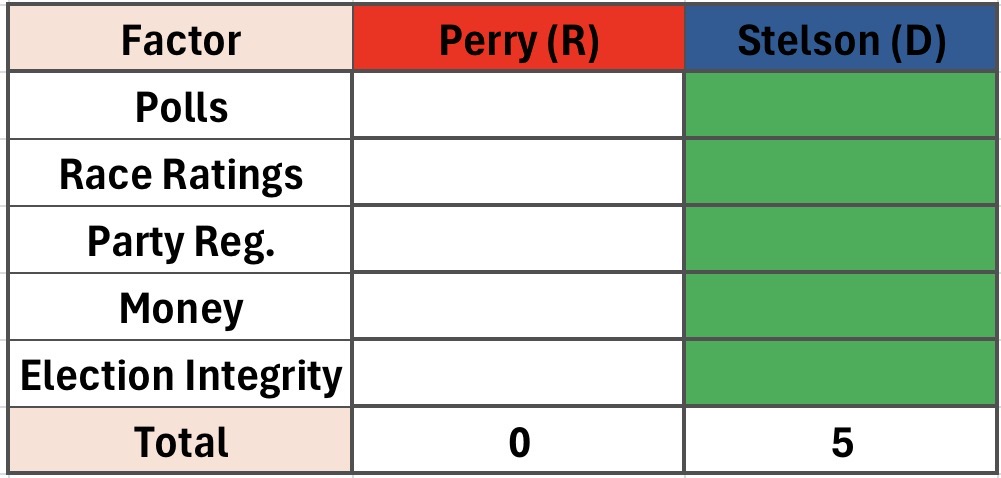
Perry’s only shot here is for minority turnout in Harrisburg and York (City) to be in the gutter, and for squishy Republicans in Cumberland and Dauphin to identify the Democrat brand with the emerging DSA faction and stick to their party registration labels (R). Otherwise, Stelson controls the key factors of the race:

Ten-point decision matrix for the PA-10 race

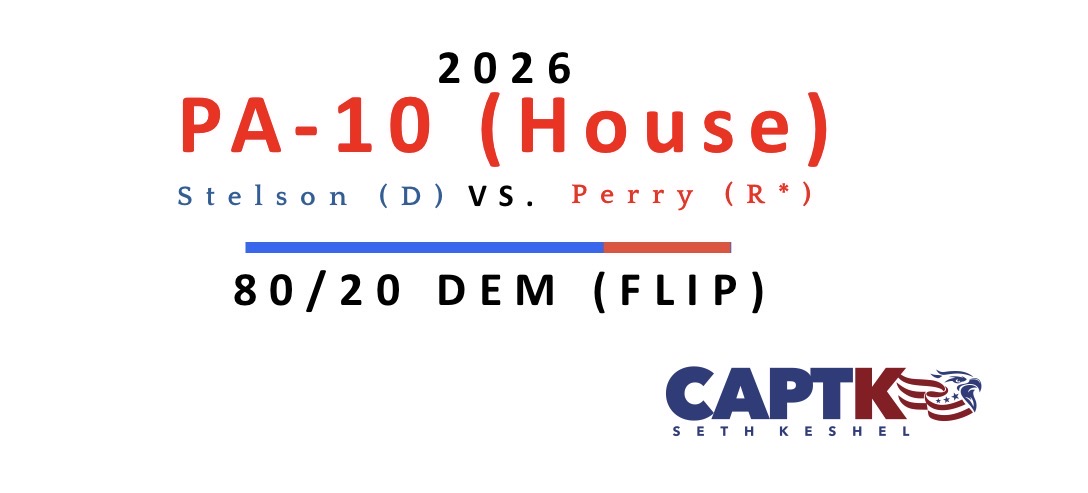
Josh Shapiro is going to win by enough to naturally jeopardize the three key Republican defenses. Perry’s is the most vulnerable, with the worst registration trend, and with him barely holding on even with Trump on the ticket. The writing is on the wall.

Forecast for PA-10 House

Forecast for the PA-10 House race

Seth Keshel, MBA is a Senior Fellow at the Gold Institute for International Strategy and a retired Army Captain. He publishes Captain K’s Corner on Substack.