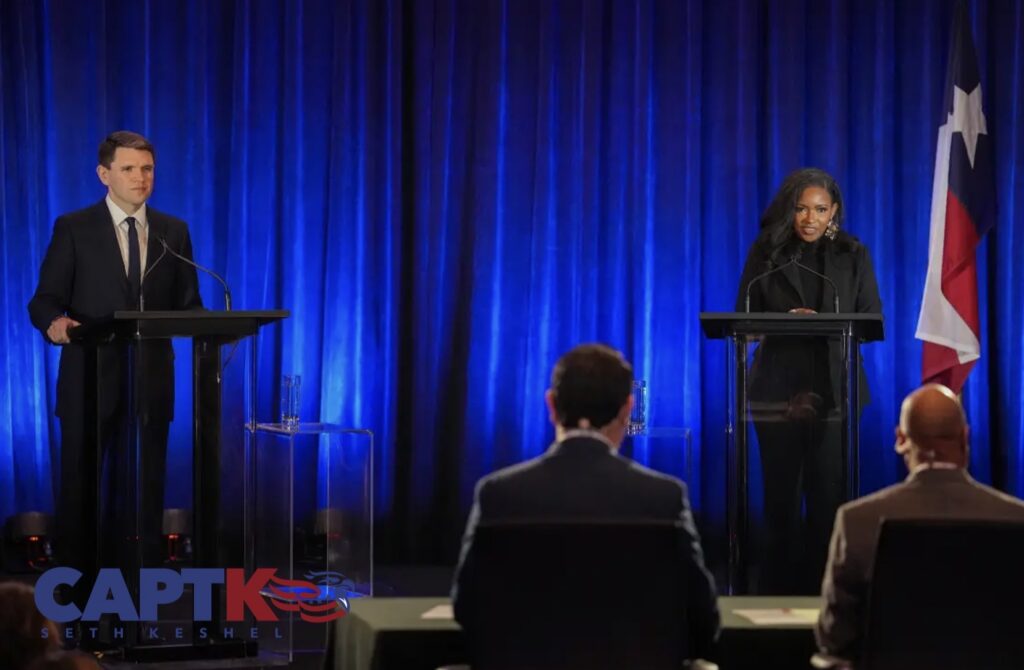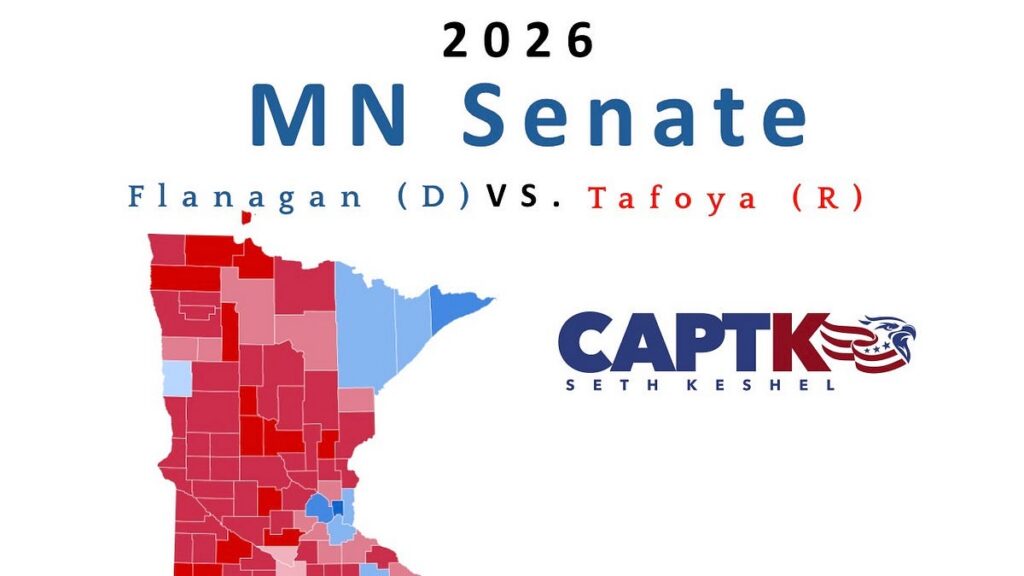
Michele Tafoya (R) vs. Peggy Flanagan (D)
I. The Race
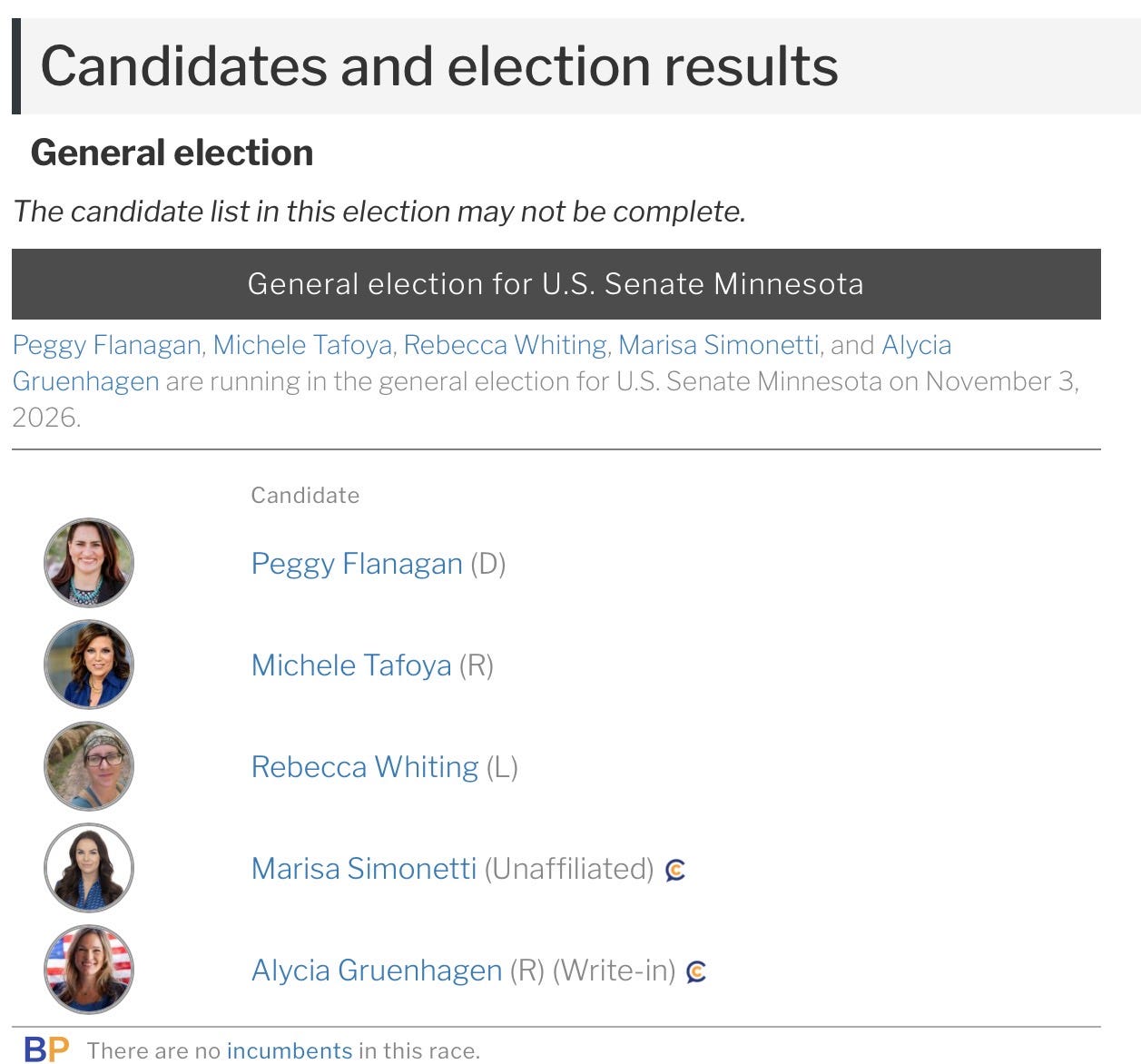
Michele Tafoya (Republican) is new to politics after a career as a sports broadcaster and is running on an anti-corruption platform in a state that has that problem in every direction.
Peggy Flanagan (Democrat) is the sitting lieutenant governor of Minnesota, having won alongside Tim Walz in 2018 and 2022, with her second win by a reduced margin of +7.7%. She has worked to conceal Minnesota’s substantial fraud and corruption, participated in anti-ICE chaos, and is not uniformly supported by Democrat factions within the state.
II. State Profile
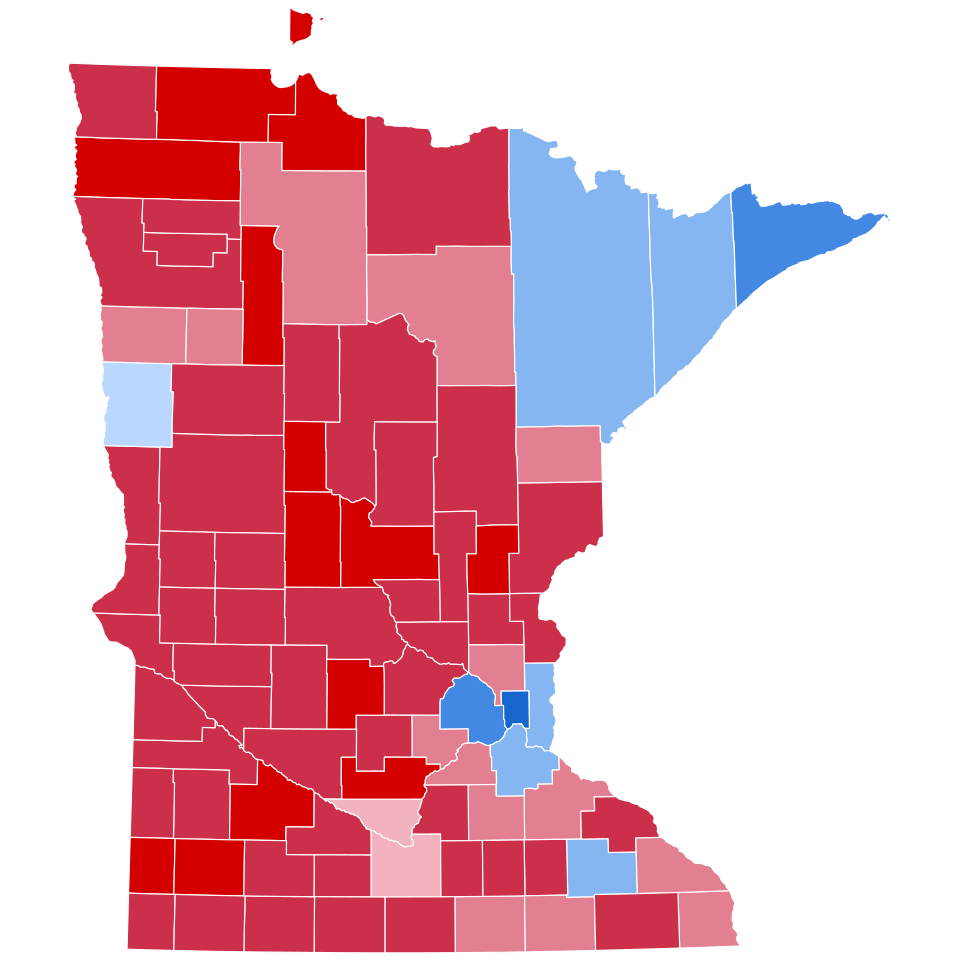
Minnesota is the GOP’s white whale. It is the state with the longest standing Democrat-voting streak in presidential elections, with 13 consecutive wins stretching back to 1976. Donald Trump almost joined Richard Nixon and his predecessors in the hall of GOP nominees to carry the state in 2016, primarily because of third-party defectors from Hillary Clinton, but missed it by 1.5%. Since then, the state legislature has enacted the standard litany of blue state laws loosening up election rules, laws, and procedures to ensure the Twin Cities can get over the top of what has been an increasingly reddening state for most of two decades.
In 2024, Trump won the 85 counties outside of Hennepin and Ramsey Counties (the two dominant blue counties of the Twin Cities metro) by 12.7%. Unfortunately, he got clobbered in the two that prop Democrats up statewide:
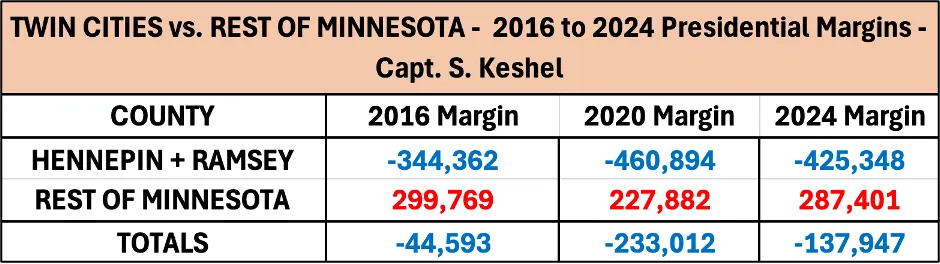
Hennepin and Ramsey produce roughly 30% of all ballots cast in Minnesota’s elections. Without serious gains there, GOP statewide candidates are on the outside looking in. How strongly those two counties tie Flanagan to fraud and corruption, and the degree to which they respond to midterm dynamics, will make or break Tafoya’s campaign.
Demographic Statistics
76.3% White, 6.9% Black, 6.1% Hispanic
III. Market Assessment
Polymarket bettors have Flanagan shares positioned at 89%. This is surprising, since polling (the main driver of trades on the platform) is suggesting a closer-than-normal race. Tafoya shares offer huge returns if she pulls the upset.
IV. History
This is the first Senate race I’ve profiled this year with no incumbent. Tina Smith’s retirement left the seat open, so neither Tafoya nor Flanagan will get the incumbency boost. In Minnesota, it is powerful; here are Amy Klobuchar’s margins for the other seat:
2006 +20.1%
2012 +34.7%
2018 +24.1%
2024 +15.7%
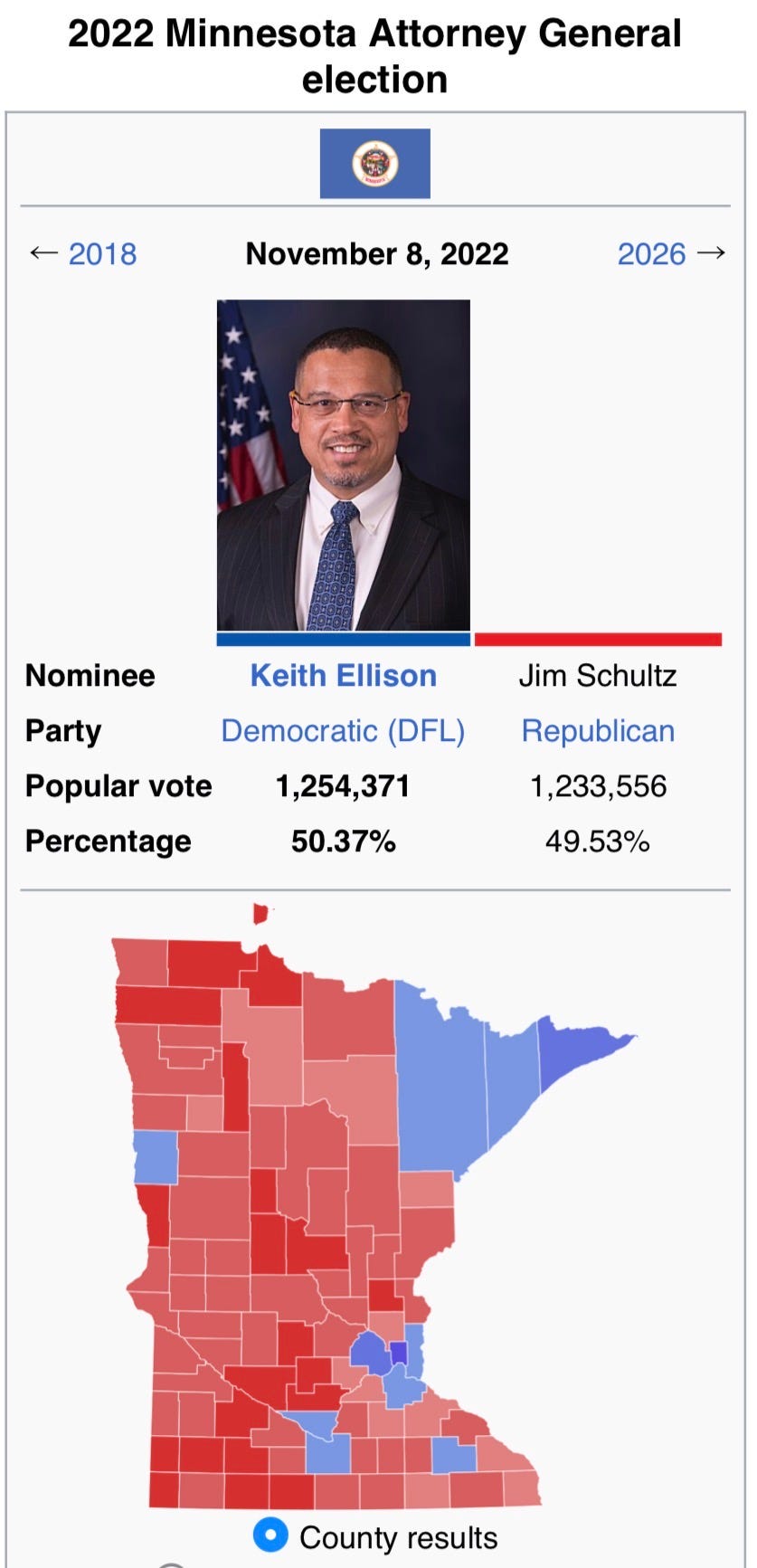
Notably, Klobuchar’s 2018 margin ran 22.6% right of the 2016 presidential result. Walz, running for governor, won by 11.4%; however, the polarizing Keith Ellison only won the Attorney General’s office by 3.9%. Flanagan resembles Ellison far more than she resembles Klobuchar, who is a shoe-in to replace Walz as governor. Minnesota’s U.S. House races were a mixed bag in 2018, with Democrats flipping two suburban seats but losing two rural seats in a full realignment of the suburbs and the state’s Iron Range and southern rural areas. In short, 2018’s elections, from the first Trump midterm, do not suggest automatic Democrat success – although Tina Smith won her special election for the seat Flanagan and Tafoya are after by +10.6%.
The 2022 midterm results, despite comfortable Walz and Flanagan reelections, saw Ellison barely scrape by (+0.8%). If Minnesota voters (Democrat insistence aside) continue to prioritize going after corruption, the U.S. Senate race could be this year’s big sleeper.
V. Analysis of 2026 Primary Results
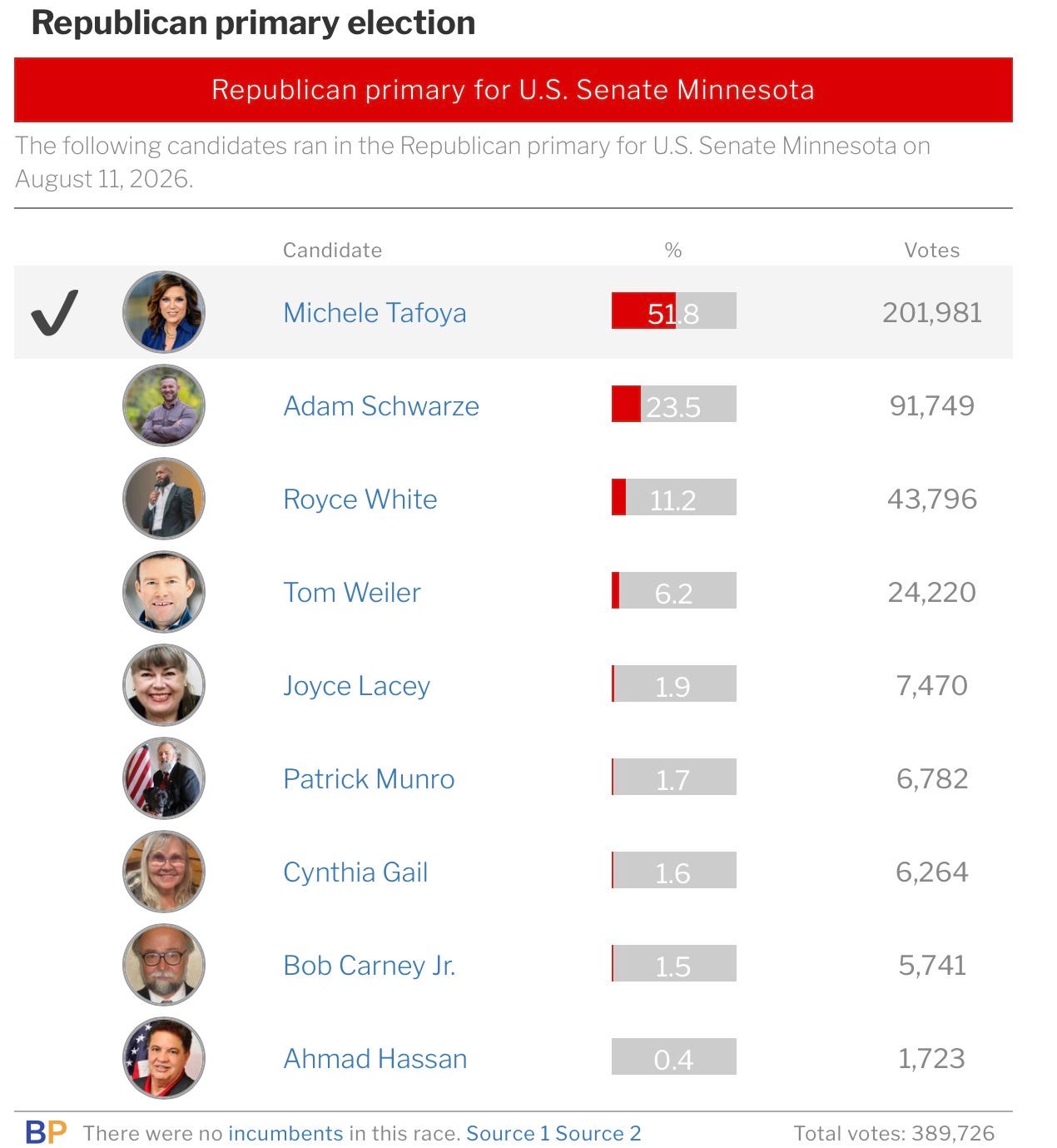
Tafoya won with a bare majority in a crowded field that included 2024 Senate nominee, Royce White. Unlike the GOP gubernatorial primary, I am not aware of any drama here that will prevent Tafoya from having Republicans behind her campaign.
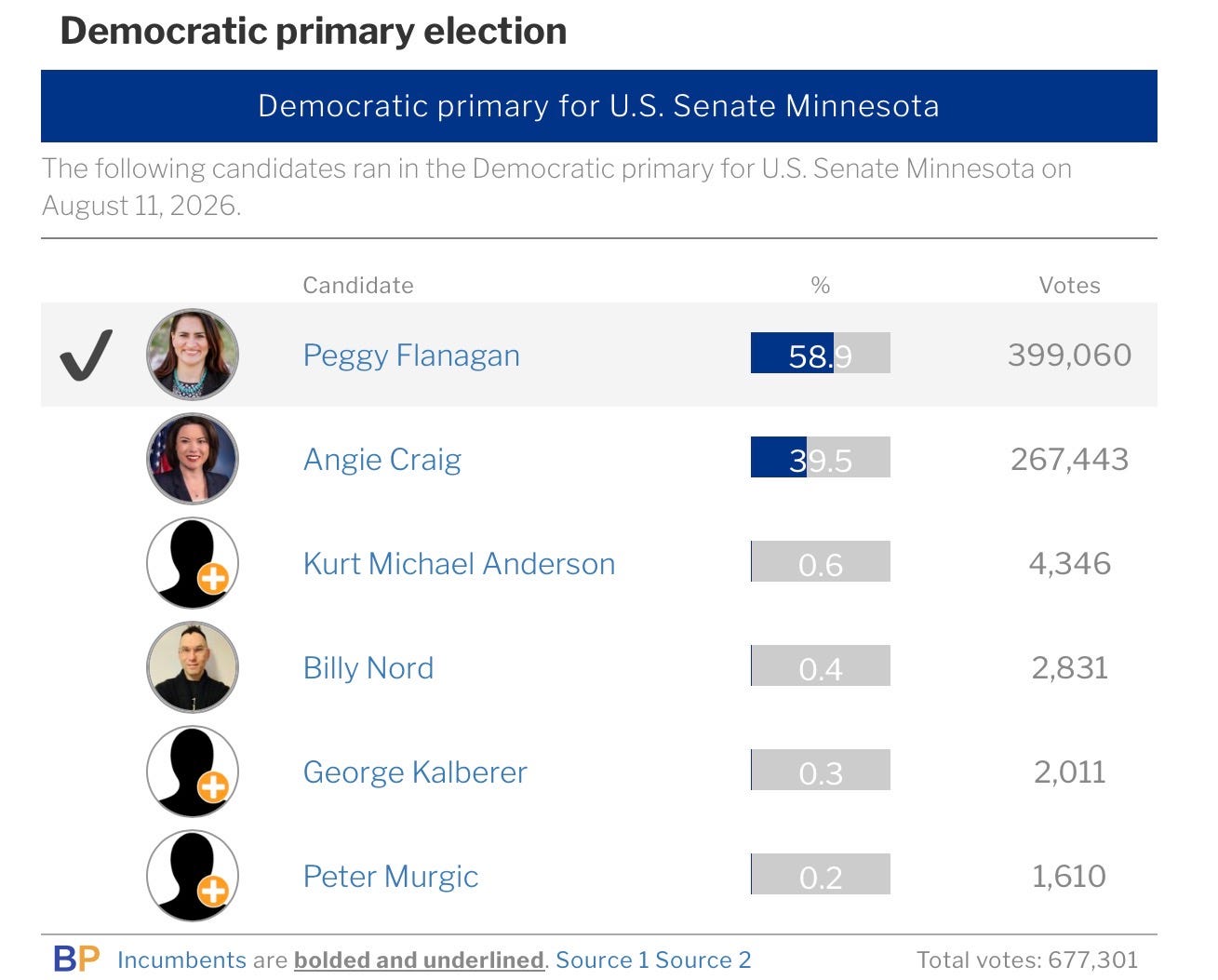
Democrats, on the other hand, are the ones with the primary problem.
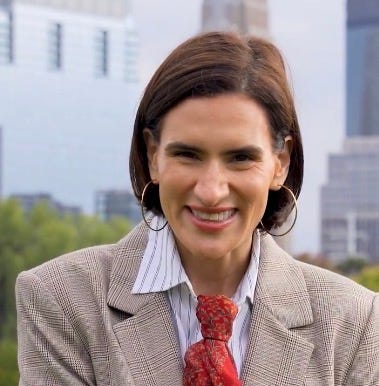
While Flanagan won by plenty (+19.4% margin) over Rep. Angie Craig (MN-2), Craig would have waltzed to a 2026 midterm victory as a low-controversy suburban female Democrat running in a “get Trump” environment. Flanagan, a renowned activist selected to be Walz’s running mate thanks to diversity check boxes, gives the “mushy middle” room to reconsider their past Democrat loyalties. Check out this creepy outfit in a recent campaign video:
VI. Polls
RCP Average: Flanagan +1.6%
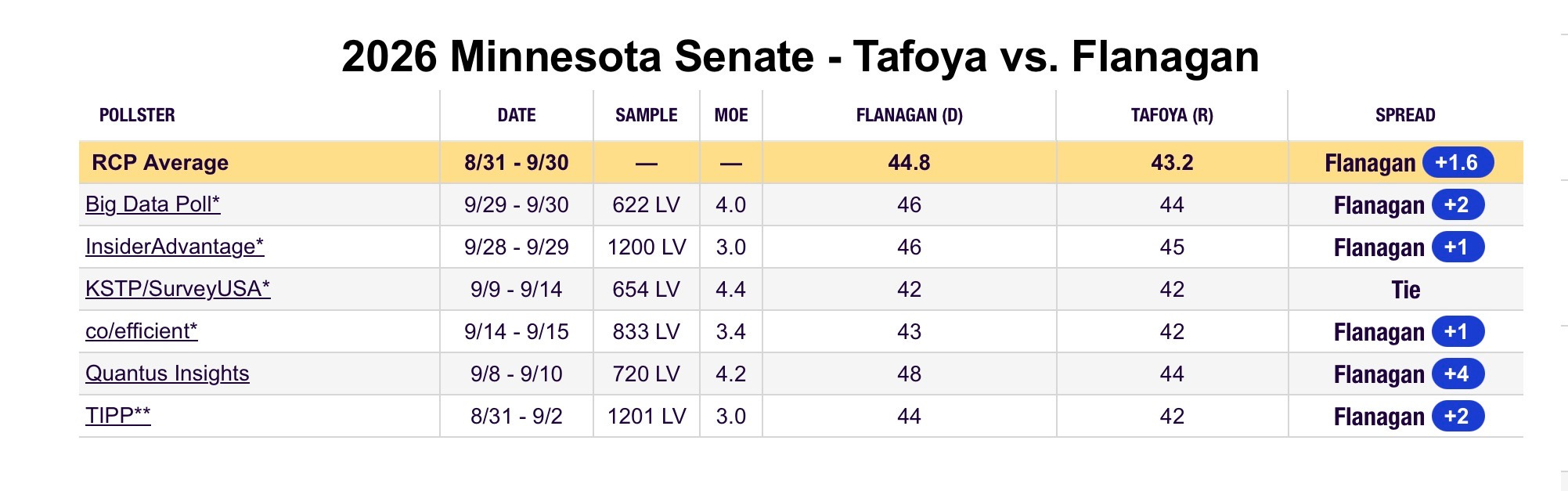
In a year marred by terrible polling and in a Democrat state without a Republican U.S. Senator for almost two decades, I would expect to see Flanagan up like Roy Cooper in North Carolina polls. Instead, she’s polling like Ashley Hinson in Iowa, who I will believe will be stronger than her polling indicates. The two-party shares reflect a lot of undecided voters, but given the divisive Democrat primary, some of the missing voters could be Democrats waiting to come home. Either way, Tafoya is within the margin of error in every single poll since the beginning of September.
VII. Media Ratings
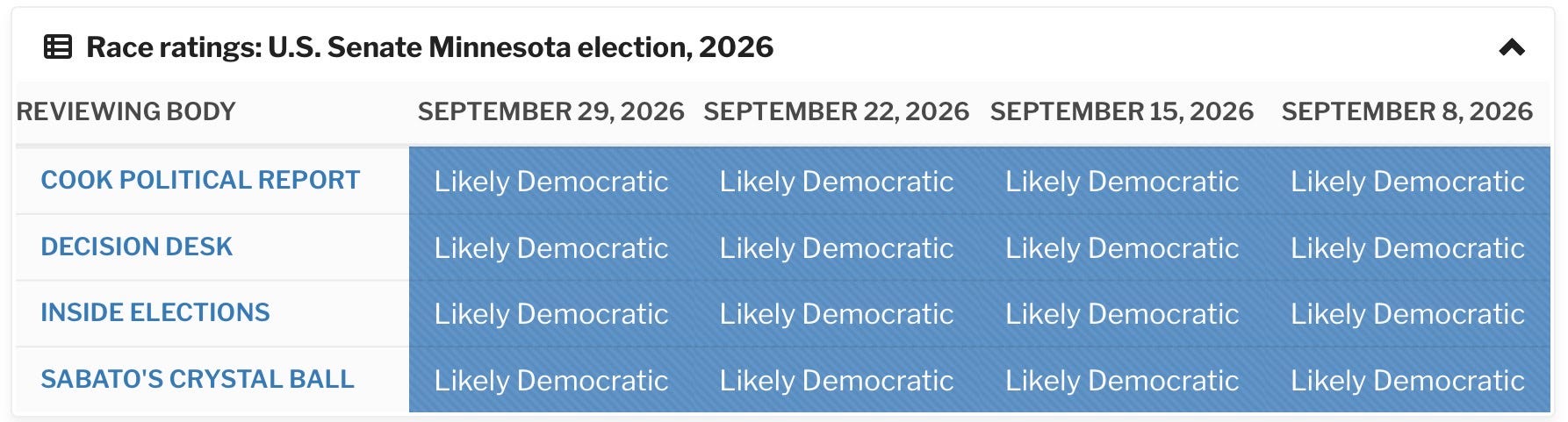
Minnesota is emerging on radars as a Senate battleground, but I think these reviewing bodies are overstating Flanagan’s strength.
VIII. Party Registration
Minnesota does not register voters by party. Until very recently, in something only offset by the Democrat primary surge, Iowa had been shifting Republican since the 2024 election. Not much has changed there (a proxy for Minnesota), so the ideological and political environment in Minnesota is likely not much different than it was in 2024.
IX. Election Considerations
This is Flanagan’s great equalizer. Minnesota runs absolutely filthy elections, and I’ve documented that here within these virtual pages for years.
That article reviews recent changes to Minnesota’s election laws, including:
• Allowing 16- and 17-year-olds to pre-register to vote
• Automatic Voter Registration
• Driver’s Licenses for All
• Expanded Early Voting
Opportunities for Election Manipulation
Familiarize yourself with the grading criteria for my election ratings. Here is how Minnesota rates with regard to the most common election demerits and its own unique traits:
• Voter ID – Minnesota requires no proof of identification to cast a ballot.
• Same Day Registration – Minnesota permits same day voter registration.
• Ballot Harvesting – Ballot harvesting is allowed, but according to law, a “designated agent” (ballot harvester) can only return ballots on behalf of three people. I have no idea how this can be monitored, let alone enforced, so it goes without saying that ballot harvesting is clearly taking place in population dense areas as evidenced by the mountainous spike in Democrat ballots in the Twin Cities in the past two elections. Undercover video of ballots being sold in the Somalian parts of Minneapolis serves as hard proof of criminal activity tainting elections in the state.
• Unique Corruption – The fleabag Minnesota legislature, which comprised a Democrat trifecta (House, Senate, Governor) in the past session, passed a ton of new election reforms, none of them good – more early voting, licenses for illegals, Automatic Voter Registration, and allowing 16- and 17-year-olds to pre-register to vote. These were all passed because every Demofrat in the state knows Minnesota would go the way of Iowa and Wisconsin if permitted to trend organically.
With the race no longer hidden from national attention, you can expect Democrats to have the Somali ballot trafficking machine on full blast, and all hands on deck in the Twin Cities to try and steer the race to Flanagan.
X. Summary and Election Estimate
These are the major factors for the U.S. Senate race in Minnesota:
Minnesota is still Minnesota. To overcome the Twin Cities, Tafoya will need to have her messaging down pat and exploit the divide between Democrat factions. Ellison’s 2022 challenger for Attorney General, Jim Schultz, got almost 32 percent in Hennepin County and nearly 30 percent in Ramsey County. In Hennepin, we are talking almost 10 points better than Trump’s losing margin from 2024. Tafoya will need to be aiming for a third of the vote in those two counties to be within striking distance.
If the people are truly upset about Flanagan’s role in the rampant fraud and corruption in Minnesota, all bets are off:
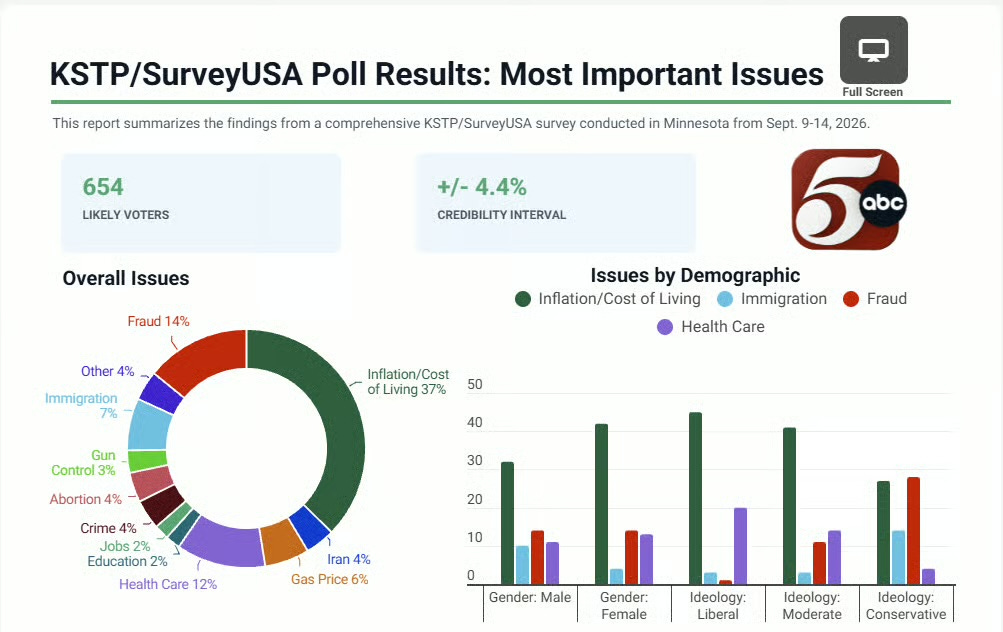
The survey above lists “inflation/cost of living” as the chief concern of Minnesota voters, but the second-most prominent issue pertains to the fraud. ZeroHedge, which posted the survey, had this to say about the issue in their recent article outlining the possible Senate upset:
Federal prosecutors estimate that at least $9 billion billed to 14 state-run Medicaid programs since 2018 may be fraudulent, a figure Walz disputes, on top of separate schemes in which sham nonprofits billed the state for child care, school lunches and other services. According to a House Oversight report, the state’s Democratic leaders knew about the fraud and failed to act.
Most of those charged are of Somali descent, and the House report found state officials ignored the fraud to avoid accusations of racism. Gov. Tim Walz’s net approval has since collapsed from +19 in June 2025 to -14 in August 2026. The damage has spread to Attorney General Keith Ellison, Sen. Amy Klobuchar and the Democratic legislature. Pollsters have yet to publish separate numbers for Flanagan, though a politician who has stood one step behind Walz since 2019 has little room to distance herself from the scandal. Tafoya has built her campaign on that exact point.
Minnesota, having previously elected Jesse Ventura as governor, is fond of political outsiders, which may give Tafoya an anti-establishment edge (now that former grassroots darling Flanagan had has her time in the sun and used it to create problems). Tafoya hasn’t been shy about the fraud issues:
NEW 📺 AD: We teach our kids that bad behavior has consequences, but somehow politicians think the same rules don’t apply to them. Peggy Flanagan ignored warning signs while fraudsters stole our tax dollars. She has spent eight years as lieutenant governor in the Walz …
Michele Tafoya (@Michele_Tafoya), Sep 18, 2026
Here is how the key factors in this race stack up:
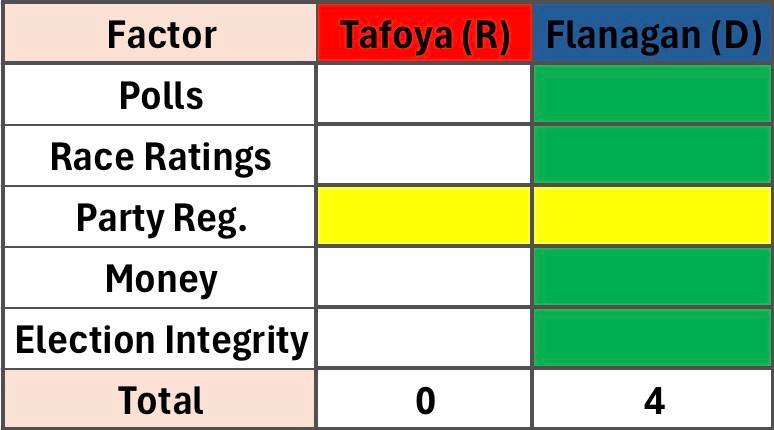
Forecast for Minnesota U.S. Senate
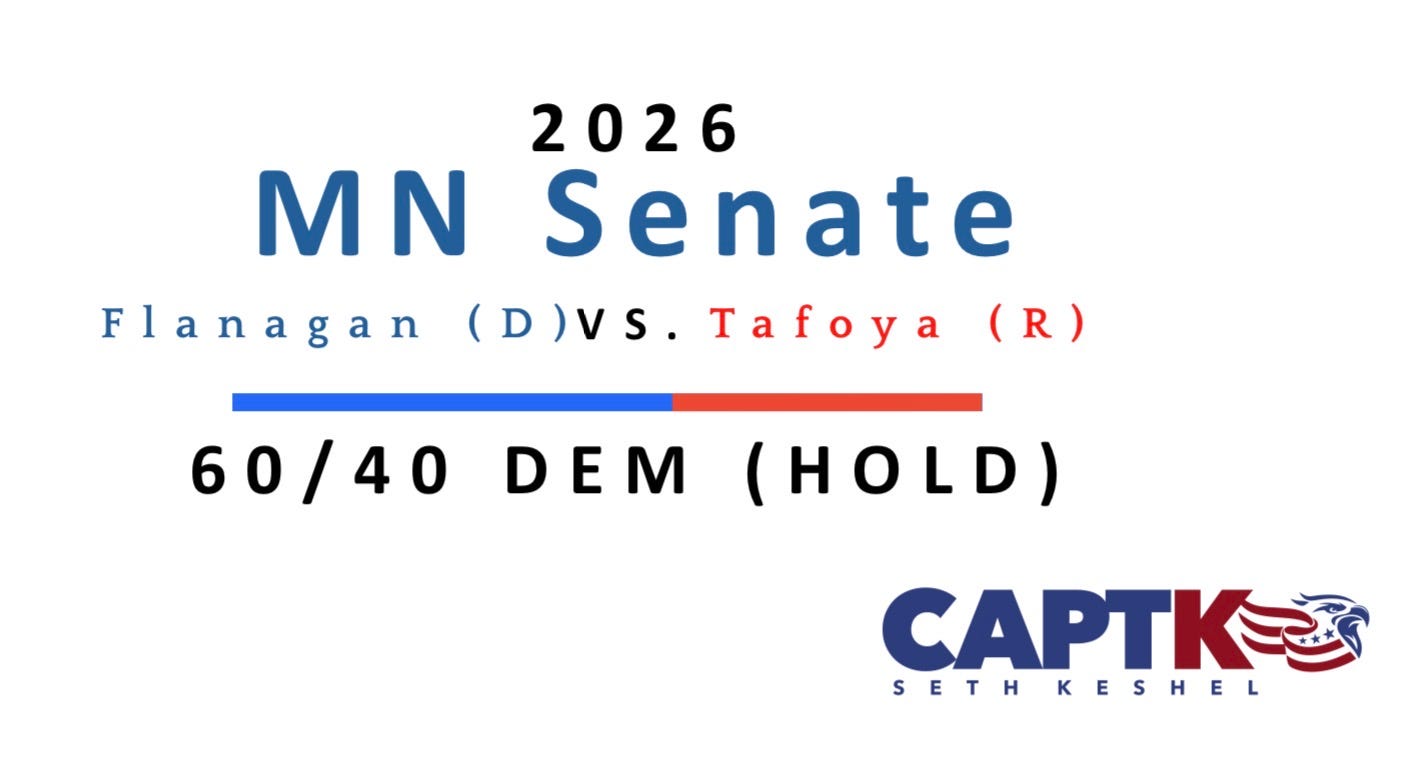
Just like Republicans aren’t going to get caught from behind in Texas, Ohio, Alaska, or Iowa without throwing every dollar they can at them, the Democrats are in the same boat in Minnesota. If they have any shot at taking over the Senate, even with a loss of Maine, they can’t drop Minnesota’s Senate race. Had Craig been nominated and the rampant corruption not been such a pressing issue during this cycle, I would probably have this seat rated at 85-15% odds for Democrats instead of 60-40%.
Tafoya is definitely in the game. She will probably produce a results map with as many red counties as Trump does, but how many votes make up how much margin intensity is the key – and it will only matter if she can make a sizable dent in the Twin Cities Democrat machine. Flanagan, thanks to the key factors of the race and codified electoral corruption, maintains a fundamental edge that gives her the advantage for an underwhelming (for Democrat standards) victory.
Do not sleep on this race. Somali gangs have been busy doing all they can to flip public sentiment toward Tafoya.
Seth Keshel, MBA is a Senior Fellow at the Gold Institute for International Strategy and a retired Army Captain. He publishes Captain K’s Corner on Substack.