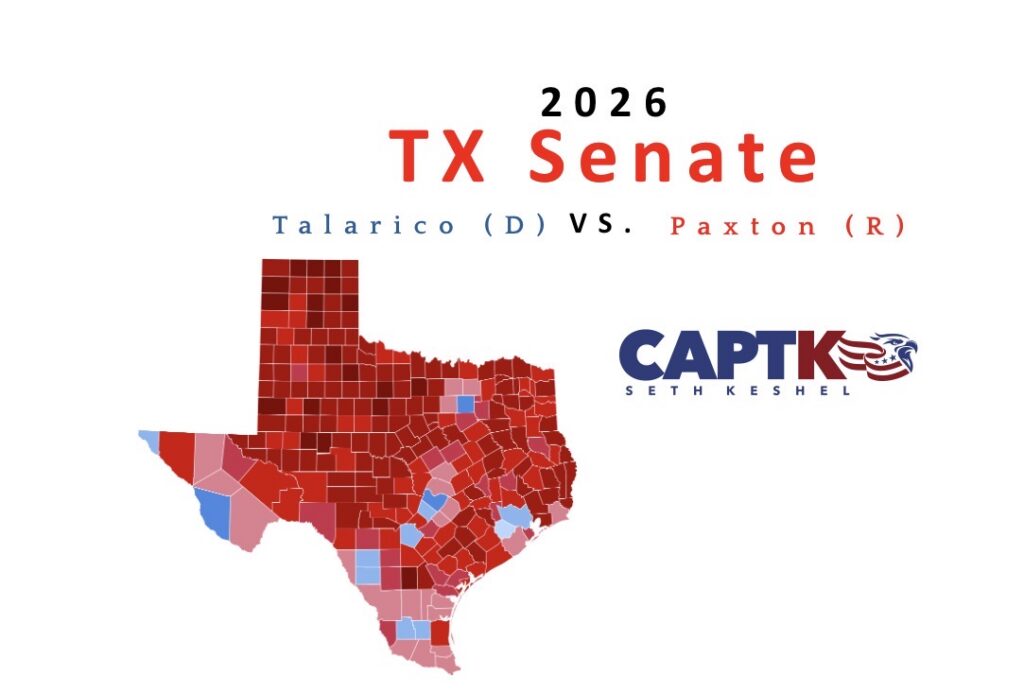
Ken Paxton (R) vs. James Talarico (D)
I. The Race
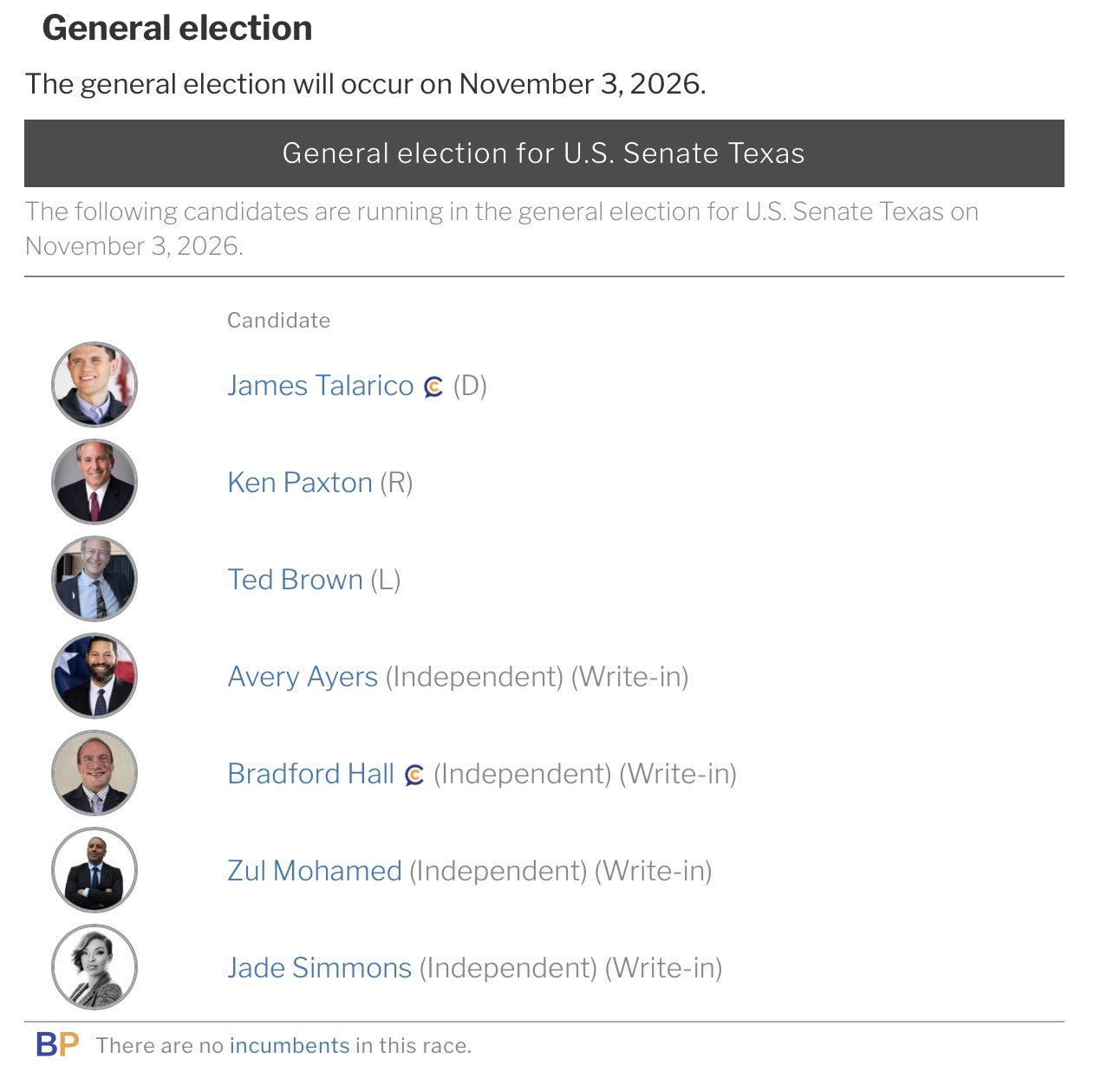
Ken Paxton (Republican) is the Attorney General of Texas, and has won three statewide races for that office. He knocked out four-term incumbent John Cornyn in a run-off earlier this year to win the party nomination for the General Election.
James Talarico (Democrat) is the Texas state representative who defeated Jasmine Crockett in the Democrat primary earlier this year to earn the party’s Senate nomination. If elected, he will be the first Democrat since 1994 to win a statewide race.
II. State Profile
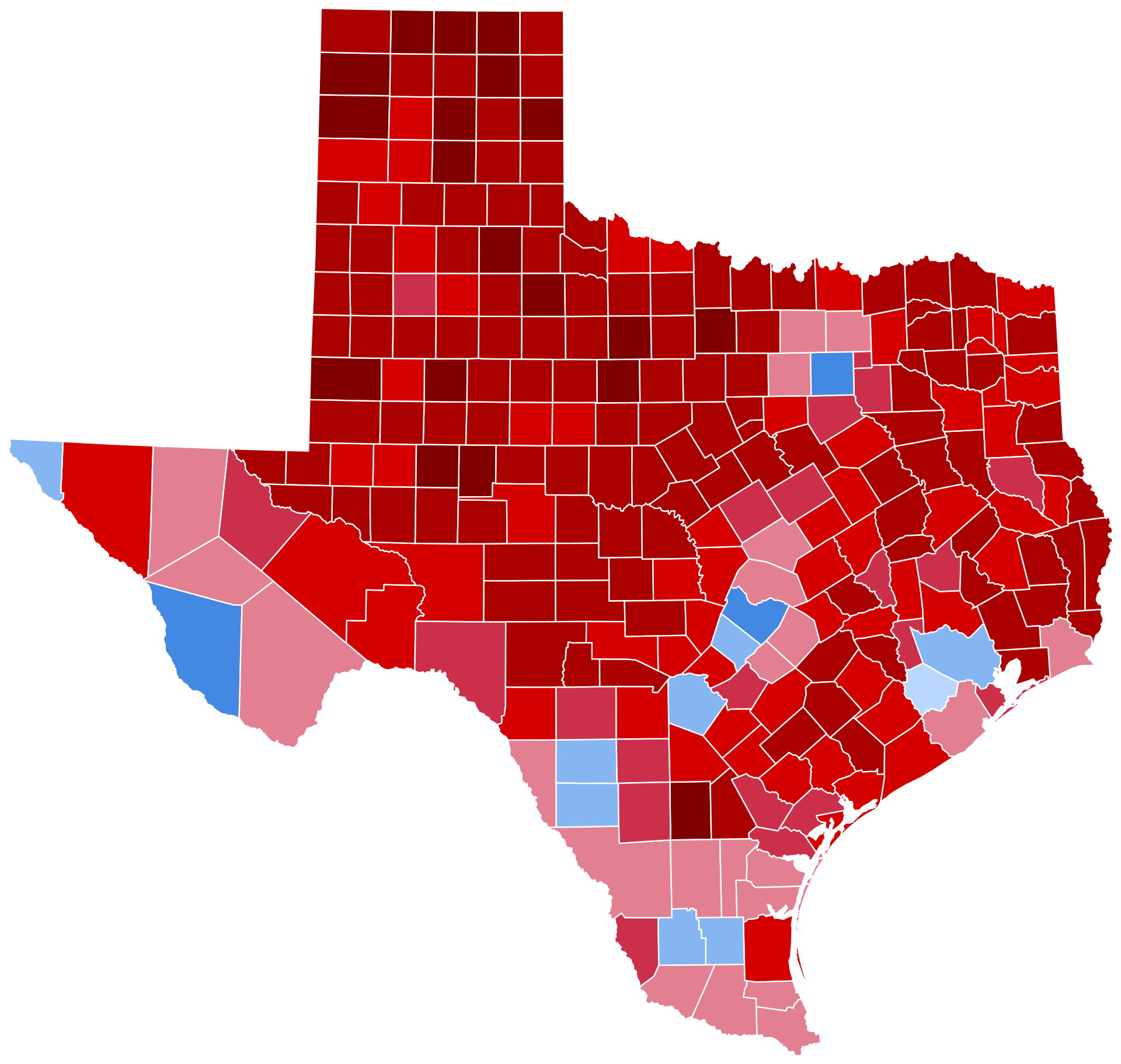
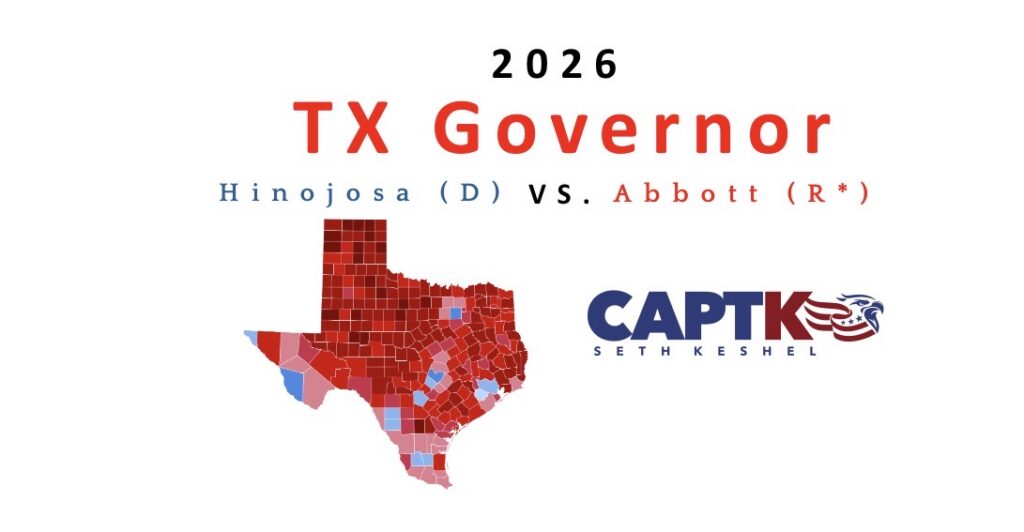
From my forecast of the gubernatorial race:
The overwhelming theme of all 2026 analysis of Texas should be the same – if all of that red votes, then Texas will be red. The struggle with all of the work put into that endeavor so far ties directly to the fact that Texas has open primaries and does not register voters by party, whereas Florida closes primaries and does have party registration. We can watch it live as every vote comes in and know definitively in which direction the electorate is headed.
Texas’s presidential baseline is perhaps more imposing to Democrats’ long-term hopes than any before it, even those elections George W. Bush won by more than Trump’s +13.7% margin in 2024. The bedrock of that victory was a historic performance with Latino voters – 55% of them backed Trump:
While some of its urban counties, especially Dallas and Travis, have gone the way of their counterparts in the past 20 years (mega-blue), Harris (which contains Houston) and Bexar (San Antonio) have large working-class populations which have kept the county margins from getting out of control against Republicans. The rural areas of Texas are overwhelmingly Republican, and even more so now that rural South Texas has lurched in the same direction.
Democrats must have low Republican turnout, large swings in a small handful of counties, and overwhelming turnout in four blue bubbles (Harris, Bexar, Travis, Dallas Counties) to win a statewide election in Texas – something they haven’t done since 1994.
2026, thanks to its place on the calendar and in the electoral cycles, gives them their best shot in years to do just that, and they mostly have their eyes set on the Senate race between James Talarico and Ken Paxton, which I will profile after the end of in-person early voting.
Presidential Margins
2016 Trump +9.0%
2020 Trump +5.6%
2024 Trump +13.7%
Key Statistics
• 40.2% Hispanic, 39.3% White, 11.6% Black, 5.1% Asian
III. Market Assessment
Despite most of the bets being on Paxton, whales are betting on Talarico and creating an illusion that has little basis in a historical concept, given no Democrat wins statewide in 32 years.
IV. History
Democrats last had a United States Senator representing Texas in 1993, when Bob Krueger lost a special election to Republican Kay Bailey Hutchison. Krueger had replaced Lloyd Bentsen, Michael Dukakis’s choice for vice president in 1988, who had become Secretary of the Treasury under President Clinton earlier that year.
Hutchison then proceeded to be elected for a full term in 1994, then reelected by massive margins in 2000 and 2006. She had expected to turn the seat over to David Dewhurst, but Ted Cruz got in the way, won the nomination, and has sat in that seat ever since first elected in 2012 and seated in 2013. As a side note, Cruz is perhaps the most annoying senator in the Republican universe, and I hope to see him appointed to the Supreme Court so we can avoid having to listen to him doom on and on about Texas:
Honestly, the vote I regret more than any is Cruz in the 2016 primary.
I had a dozen people tell me they saw him in 2024 doing this routine about losing to Allred right before he won by 9 points. Frisking people for every dollar possible.Seth Keshel (@RealSKeshel), Nov 1, 2026
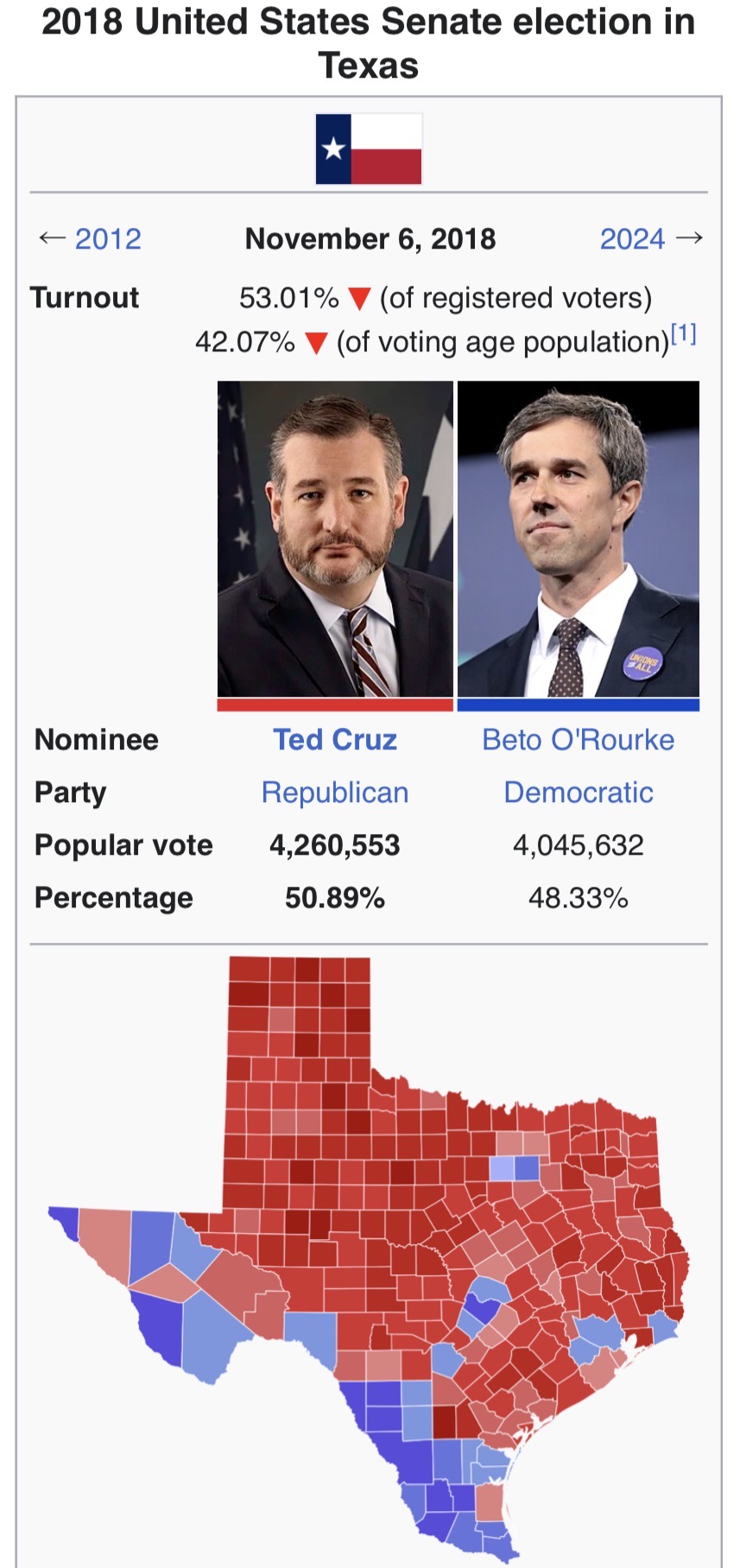
Cruz and practically every other shaky Republican appearing on cable news is spooked about this year’s race because of this result from 2018:
The seat Paxton and Talarico are vying for has been in Republican hands since John Tower was elected in 1961 to finish the term begun by none other than Lyndon B. Johnson, who vacated it to become John F. Kennedy’s vice president. Tower made the handoff to Phil Gramm in 1984, and in 2002, John Cornyn was elected to take over. While I’m on the topic of Cornyn, if for some reason Talarico defies the odds and wins this seat, you can blame Cornyn and his endless millions spent on attack ads against Paxton when he should have just retired after giving us this garbage:
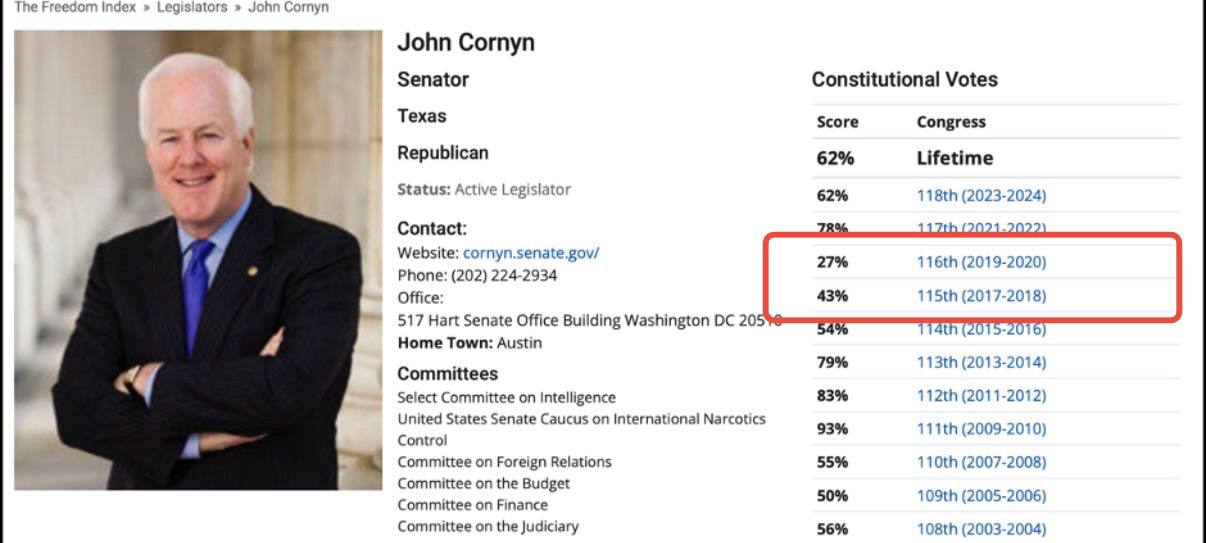
Yes, Cornyn had his worst years of voting in the four years of the Trump 45 administration, yet he sits online like a scorned teen wondering why the GOP primary voters rejected him – all while praying Paxton loses.
V. Analysis of 2026 Primary Results
Both sides had damaging primaries, the Republicans more so.
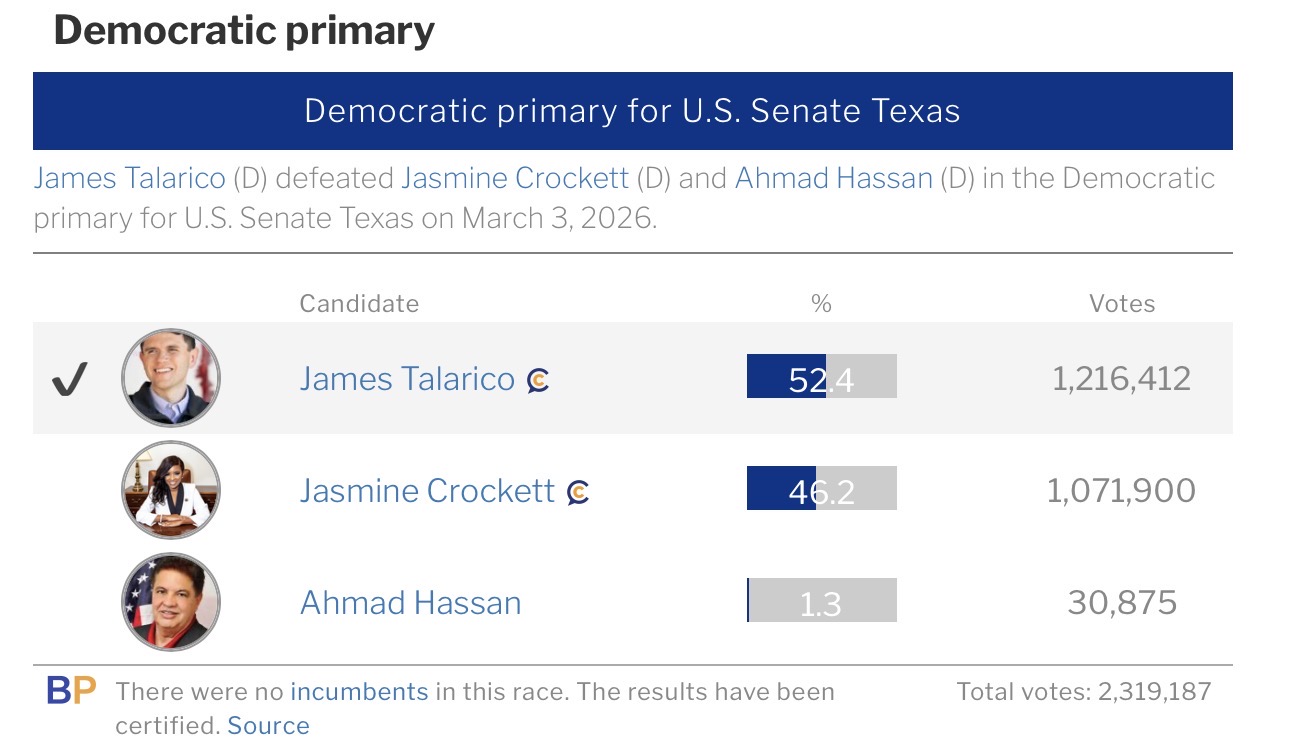
Talarico got past Jasmine Crockett, the big-mouthed U.S. House Representative from Dallas who serves no other purpose than to talk trash about whites, Republicans, and people who believe America has redeeming value. Crockett still refuses to endorse Talarico, and there is reason to believe in analyzing early voting data that the black vote could be soft for the Democrat nominee.
I have used tons of virtual ink describing the ins and outs of the warlike Republican primary, which Paxton won in the run-off with overwhelming force:
Three Texas-Sized Takeways from Paxton’s Dominant Runoff Victory
The risk for this year’s General Election is that we have a huge repeat of butt-hurt Cornyn voters defecting to support Talarico just to send Republicans a message, particularly in places like DFW and Central Texas. I have built these pitfalls into my modeling.
VI. Polls
The RCP average reflects the insane polls that have come out of Texas this cycle:
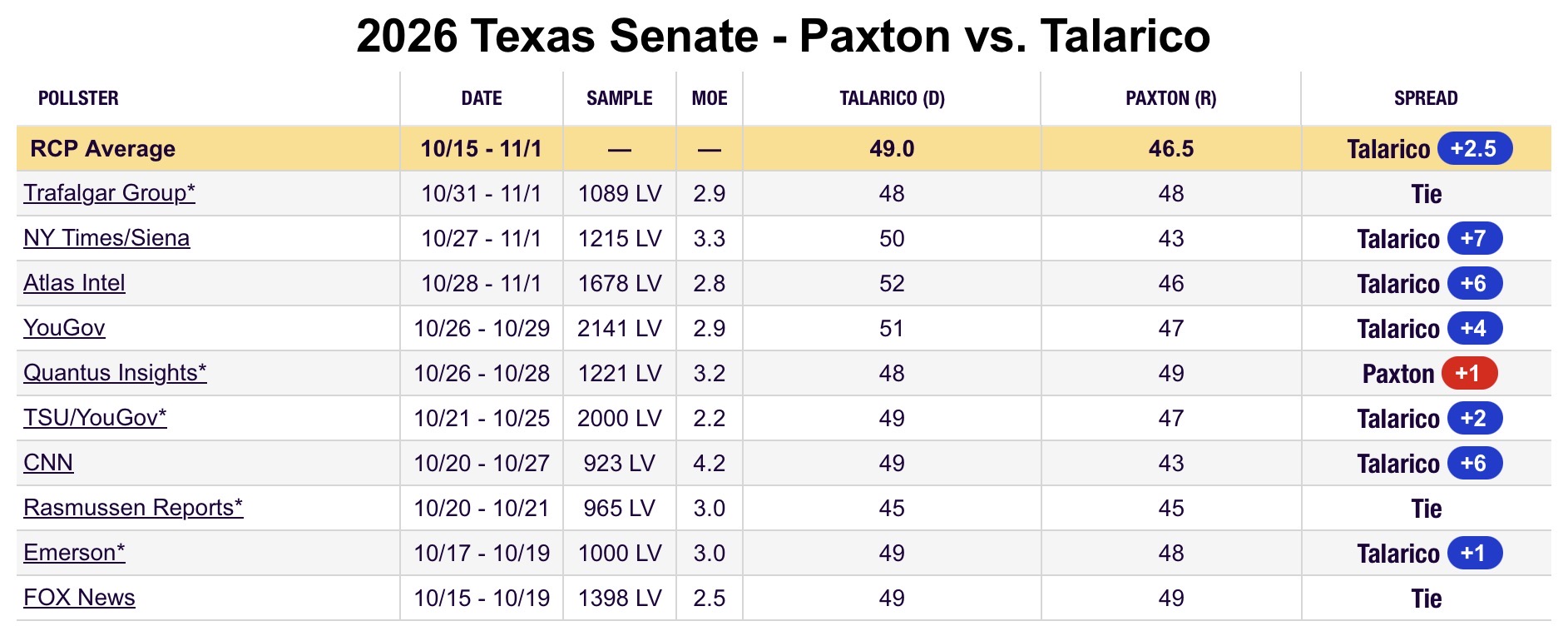
Strange to me how we have a series of polls giving Talarico leads of 6 or 7 points (600,000 to 700,000 in margin, which is impossible), at the same time Paxton has two showing narrow leads (Quantus and Trafalgar). Someone is right, and someone is wrong.
VII. Media Ratings
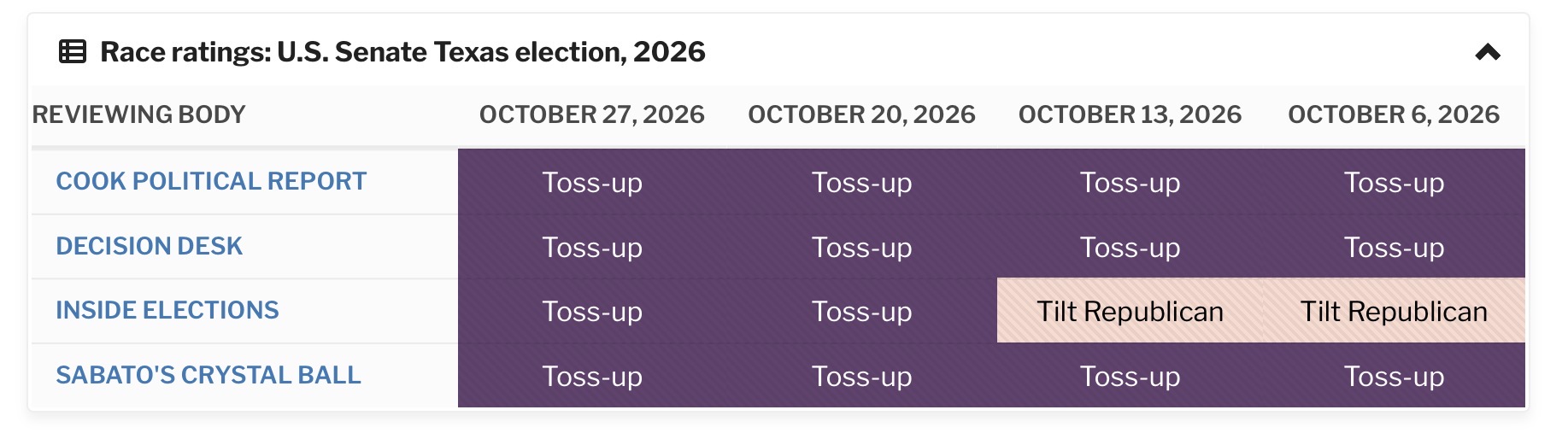
It is interesting to me, despite all the polling noise, that none of these reviewing bodies are going with the trend and calling a state that hasn’t elected a Democrat in a statewide race for 32 years for a vegan who has policies completely antithetical to everything Texan. They all choose the safety of “toss-up” until the storm passes over tomorrow night.
VIII. Party Registration
Texas doesn’t have party registration, and it’s a damn shame. If it did, we would have an actual idea of who has voted instead of having to rely on silly models that presume vote selection based on primary participation. If you didn’t know, in the Rio Grande Valley and other Hispanic-dominant areas of South and West Texas (which Trump won in 2024) voters almost exclusively vote in Democrat primaries because it is a certainty Democrats will win the local races.
I keep trying to help people see how futile it is to create a primary model for Texas since there is no party registration. Here’s an example from Hidalgo County in the Rio Grande Valley.
There were over 58,000 Dem primary voters and only 18,500 Rep. That is a D+52 split.…Seth Keshel (@RealSKeshel), Oct 27, 2026
IX. Election Considerations
Rather than reinvent the wheel, I’m relaying what I wrote in my assessment of the decisive House race, TX-34:
Texas, being such a huge state with an overwhelmingly urban and suburban population, has people rung up on election corruption charges all the time – including in South Texas.
Still, Texas has strong control over what few mail-in ballots are sent out, and the risk for widespread corruption in this race (relative to others I’ve profiled) is low. You can read about Texas’s election integrity picture from my 2024 evaluation:
Texas – 2024 Election Compendium
X. Summary and Election Estimate
A word of caution. I have been warning everyone about midterms for a long time, all the way back to the first days of the Trump 47 administration when everyone was prattling on about red waves. Midterms are the elections in which the miracles can happen. Think of it like a comet passing by every 32 years that we step outside to see as it passes by. Yes, this (or perhaps 2018, depending how this race works out) is the best chance Democrats have had since 1994 to win a statewide race. If it happens, you can blame Cornyn for a lot of the damage.
Ultimately, Texas is a large state in which 90% of the population is urban and suburban. Democrats have 4.8 million presidential votes in the last election; just because they don’t win statewide races doesn’t mean there are no Democrats. Beto O’Rourke exceeded Hillary Clinton’s vote total in 2018, so there is precedent for Democrats in Democrat-favorable years to put down a lot of votes. Fortunately for Cruz, he came up with 91% of Trump’s 2016 vote total and got past by 2.6%.
If Paxton gets 91% of the 6.4 million Trump votes in Texas, he’ll cruise to an easy victory. If he gets 81%, he will almost certainly still win. That is the impact of Texas going to Trump by nearly 14 points. A lot has changed since the Betomania close call of 2018; Trump won the Hispanic vote in 2024, and there is evidence to suggest Abbott, and by extension Paxton will hold a lot of those gains.
NEW: Dem officials are raising alarm bells that Latino men are refusing to turn on President Trump in Texas and have a growing "aversion" to James Talarico.
Democrats on the ground are surprised to find that Latino men they interview are "loyal" to President Trump.
"Mr. …Collin Rugg (@CollinRugg), Nov 1, 2026
For all the noise about early voting data, Republicans are voting. Early voting became steadily more Republican after Democrat high-propensity voters were spent, and Election Day stands to put practically all GOP-won counties from 2022 over that year’s totals. The simple fact remains that in order for Talarico to win by the slimmest of margins, three things must occur:
• A collapse of the rural and exurban GOP vote, which clearly isn’t happening based on the early voting data.
• Presidential turnouts in the big four urban counties (Harris, Dallas, Travis, and Bexar) with margins trouncing O’Rourke’s; I have factored this into my modeling in favor of Talarico.
• A reversion of the Hispanic vote to 2016-18 levels (check out the Cruz-O’Rourke map).
El Paso County, home of O’Rourke, produced a near-presidential vote count in 2018. O’Rourke won it by 50 points, at roughly 100,000 raw vote margin. That is higher than Clinton’s raw margin in a presidential election just two years earlier. This year, turnout may equal the O’Rourke number, but with it not being Talarico’s home county and Paxton likely to clear 35% (instead of Cruz’s 25%), up to 40,000 of O’Rourke’s margin goes in the trash right away.
My decision matrix shows the potential for a close race:
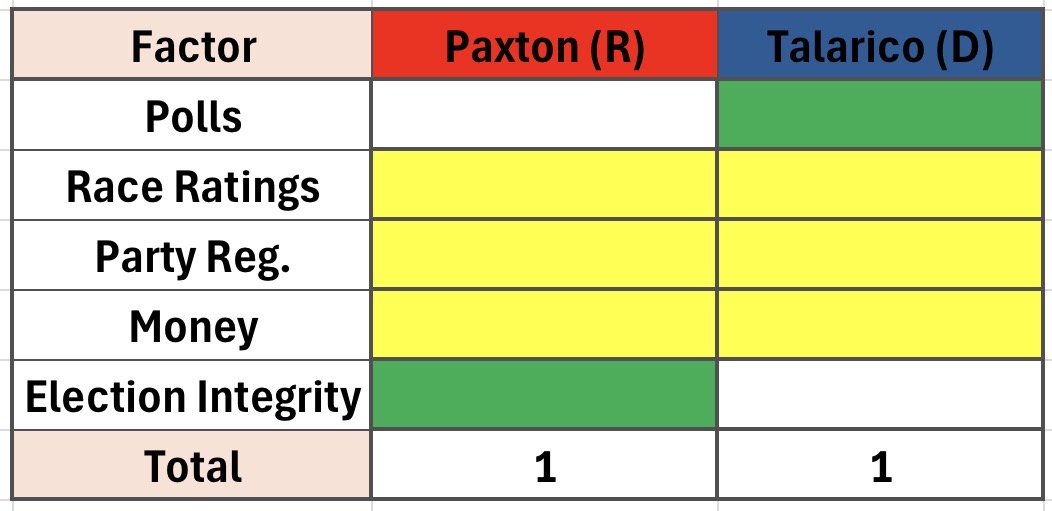
Now, you’re going to want to know my expectation, right? I don’t like hiding under the safety of a “toss-up.” While this is the best chance for Democrats in a while to win something in Texas, I struggle to see how they can be considered the “favorite” – especially based on polls and modeled primary data. These models are counting on a repeat of 2018 – back when Republicans didn’t have the Hispanic support they do today, and before hundreds of thousands of new Republicans moved to Texas, which they don’t want to see turn blue.
I waited for early voting to conclude and ran a county-by-county model in all 254 Texas counties. Here were some of the guidelines:
• Extrapolate early voting turnout and mesh with 2022 Election Day turnout to create a full turnout model
• Analyzed Paxton 2022, Cruz 2024, and Cruz 2018 victory/defeat margins and generally picked the lowest one in counties I expect Paxton to win (with exceptions for Denton, Collin, and a few others)
• Maximized turnout to near-presidential levels for Talarico in the big four blue counties and gave generous margins of victory in Tarrant and Williamson Counties, and put him within a point of flipping Collin County
And here is what I got…
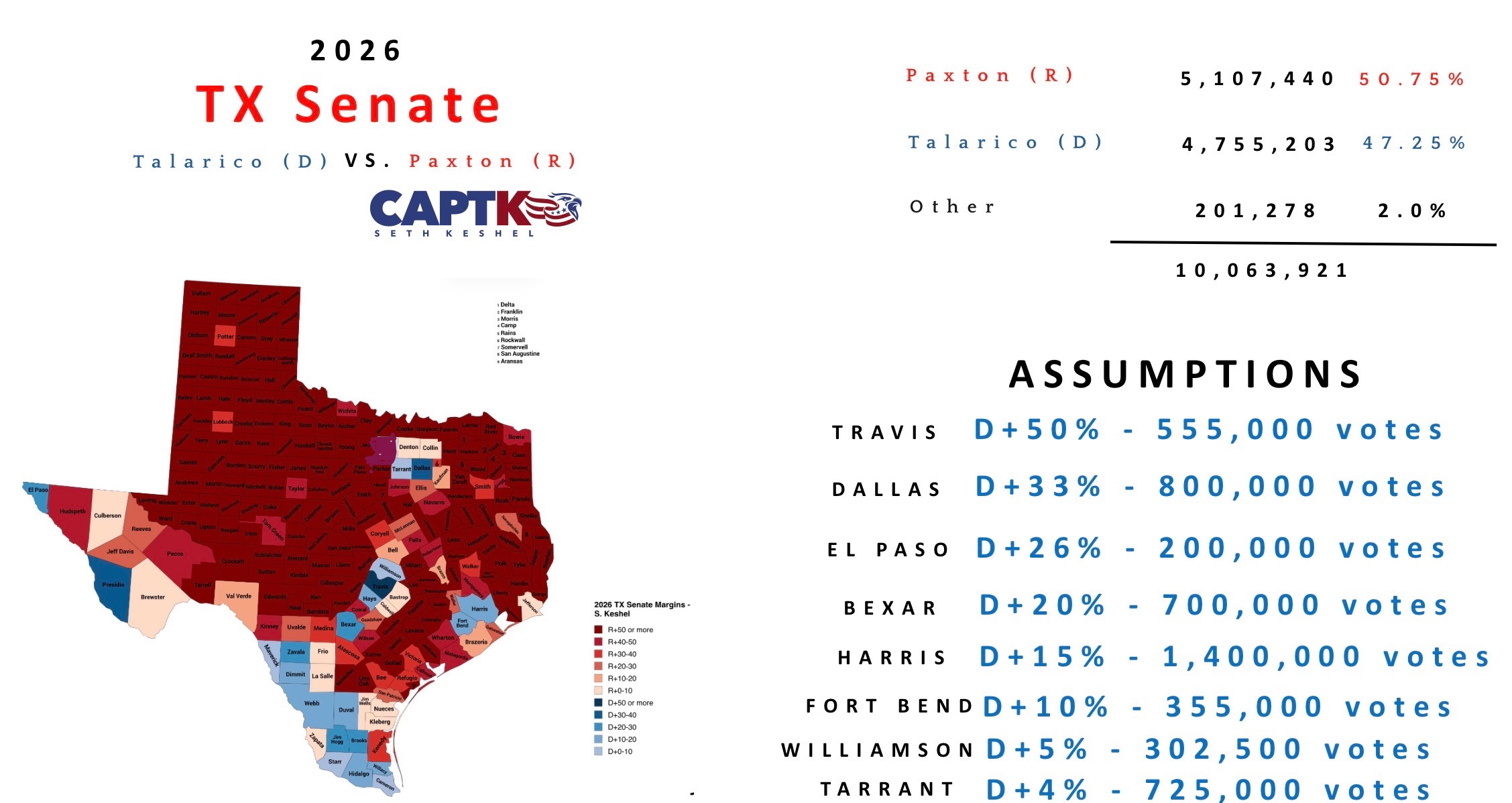
This gives Talarico these margins:
Travis +277,500 (O’Rourke +240,494)
Dallas +264,000 (O’Rourke +240,269)
El Paso +52,000 (O’Rourke +100,539)
Bexar +140,000 (O’Rourke +109,346)
Harris +210,000 (O’Rourke +201,298)
Fort Bend +35,500 (O’Rourke +30,976)
Williamson +15,125 (O’Rourke +5,993)
Tarrant +29,000 (O’Rourke +4,308)
I have returned most of the counties of the Rio Grande Valley to Democrats, although by margins more closely matching the 2022 Texas statewide map. I have shorted Paxton’s raw margin gains in Republican strongholds like Montgomery, Parker, and Grayson Counties, and even sent him backward in raw margin in overwhelmingly Republican rural counties for sake of favoring Talarico as much as possible.
And I still came up with…
PAXTON +3.5% (+352,237) – right at 80% of President Trump’s 2024 vote total.
Forecast for TX Senate
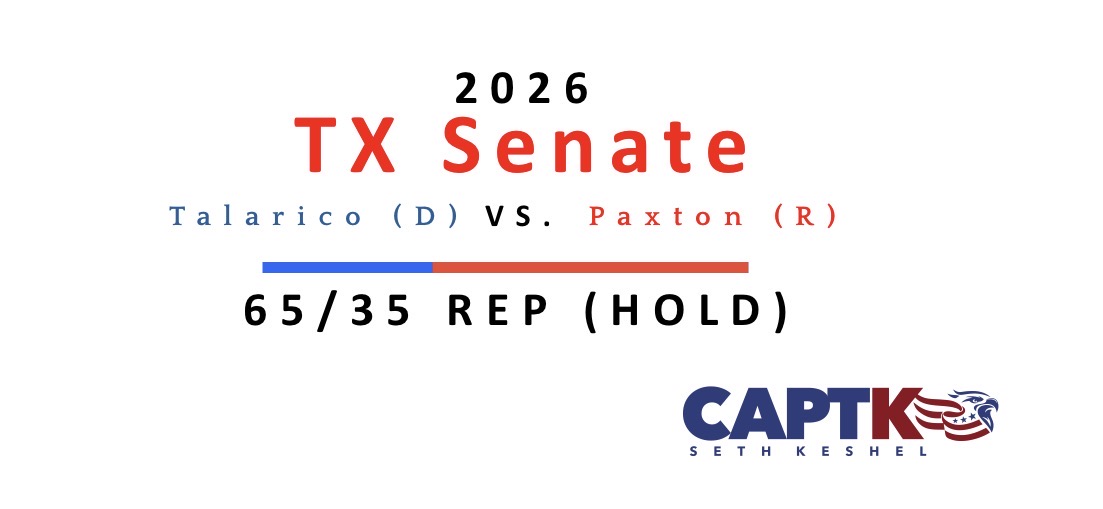
If Republicans vote and treat Election Day as a referendum on the future of Texas, then Paxton will win. The question is, “How far will he run behind Abbott?” With the way rural turnout is shaping up, Abbott should feel fine. High turnout favors Republicans. Democrats don’t have the numbers to beat Republicans if they turn out. With Trump’s 6.4 million votes, and likely a couple hundred thousand new Texas Republicans settling in the Lone Star State, a loss here would land squarely on the shoulders of those who decided to listen to liars like John Cornyn and cross over or sit out to send a message.
I would be surprised if the polls were right, while at the same time recognizing that there are structural vulnerabilities here giving a small window of opportunity for the party that never wins to break the spell. If you’re a Texan and have a Paxton issue, get over it. Letting Democrats have this seat because you sat out will ensure they flood Texas with resources for the foreseeable future, when in fact it should be running right just like Florida.
Seth Keshel, MBA is a Senior Fellow at the Gold Institute for International Strategy and a retired Army Captain. He publishes Captain K’s Corner on Substack.