August 2026 Voter Registration by Party Updates for Key 2026 and 2028 Battlegrounds

Voter registration by party chart for key 2026 and 2028 battleground states

My monthly update capturing true approval ratings from 7 critical states in the most fireproof analytical model there is.

Author’s Note: For a summary of why voter registration by party is so important, and to understand the importance of these states and why each were selected for this recurring study, please see the March 2025 summary.

Last month’s report can be found here.

FLORIDA

Net Shift Since July: R+14,082

  • Florida Democrats can’t catch a break. They added 24,463 new party members in the run-up to primaries this month and still got smoked by a net 14,082 (more than June) by the GOP. Republicans have now widened their lead by a net of 429,717 since the November 2024 election, a truly astounding performance. If you don’t ever want to live under Democrats, move to Florida.
  • Florida’s drift is predictive for Pennsylvania and Michigan since 1952, portending good things for future GOP campaigns in both of those battlegrounds in the next presidential election. Florida appears to be emerging as the premier GOP superstate, passing Texas (although not in order of importance by electoral votes and House seats).
  • Races to watch: FL-14 (leaner), FL-22 (leaner), FL-25 (decisive)

IOWA

Net Shift Since July: D+583

  • After a big gain in June directly tied to primaries, it’s back to a grind, although a small gain for Democrats on paper. Iowa has a bigger GOP registration advantage by raw count than it did in November 2024, but slightly left as a percentage thanks to a larger count of registered voters.
  • Iowa is worth tracking because it has a valid correlation to the shifts in Wisconsin and Minnesota, which cannot be precisely tracked by party registration. Furthermore, Iowa has two extremely competitive House seats that must be watched closely, and now a gubernatorial contest looking tight.
  • Races to watch: IA-1 (decisive), IA-3 (decisive), U.S. Senate, Governor

PENNSYLVANIA

Net Shift Since July: D+7,079 Total, R+34,722 Active

  • Democrats put up an overall gain similar to their June pickup, suggesting they have active voter registration efforts underway in the urban areas; however, a voter roll purge annihilated more than half of what active voter registration lead remained for Democrats. Was this prompted by the big exposé in New Jersey, and a purge of non-citizens perhaps?
  • I’m certainly happy to see the overall lead get close to a tie, but Democrat gains in the overall roll suggest a mixed bag ahead of midterms. I think the Democrat lurch to DSA-driven is going to prevent Pennsylvania from making a serious move back to blue.
  • Races to watch: PA-1 (leaner), PA-7 (decisive), PA-8 (decisive), PA-10 (decisive)

NORTH CAROLINA

Net Shift Since July: D+136 Total, D+3,611 Active

  • The overall voter roll has a lot less volatility (D+136) than in Pennsylvania, which makes me think Democrats have two vastly different operations going on in those states; however, the Democrats had a nice gain in active registrations, which could just be efforts to reactivate existing registrations rather than finding entirely new voters.
  • With former Democrat Governor Roy Cooper running for U.S. Senate, Republicans need all the help they can get. I consider the GOP-held seat in North Carolina the most likely to flip to Democrats in 2026, with Michael Whatley the Republican nominee.
  • Races to watch: NC-1 (leaner), U.S. Senate

NEW HAMPSHIRE

Net Shift Since July: R+4,085

  • New Hampshire’s first update in three months is out, and it’s a big gain for the GOP. This is a product of voter roll maintenance (we’ll still take it), which is down 57,486 since last update.
  • The Granite State remains the most likely Republican flip for the 2028 presidential election.
  • Races to watch: NH-1 (leaner), U.S. Senate

ARIZONA

Net Shift Since July: D+8,005

  • It’s been a while since I’ve updated Arizona, but the Secretary of State’s numbers dropped last month, so I’ve captured them here. Democrats have made up +8,005 registrations in the last few months, mostly out of Maricopa County.
  • Arizona’s statewide offices are up for grabs this year, and the Democrats have a real shot at flipping the legislature for the first time since the 1960s, so the battle for voter registration looms large. I have a strong suspicion that the GOP is having membership issues with the Mormon church, also evident in Utah – and not good for the 2026 midterm outlook. I remain optimistic long-term for Arizona, but the GOP needs to get serious on its urban strategy.
  • Races to watch: AZ-1 (decisive), AZ-6 (decisive), all statewide offices

NEVADA

Net Shift Since July: D+1,335

  • Democrats expanded their lead by another 1,335 last month, but that was three times lower than June, which points to recent gains being tied to primaries. As expected, last month was powered by Clark County – but also by voter roll maintenance in red counties. Washoe County was mostly a push, and is a better representation of the balance of power than any other county.
  • Races to watch: NV-3 (leaner), all statewide offices

Seth Keshel, MBA is a Senior Fellow at the Gold Institute for International Strategy and a retired Army Captain. He publishes Captain K’s Corner on Substack.

The Future of Nuclear Deterrence

A row of four missiles angled skyward on a launcher against an overcast sky.

(This article was written by Peter Huessy and appeared in RealClearDefense. The Future of Nuclear Deterrence)

In the 30 years between 1914 and 1945, 90 million people were killed in conventional war. Given the potential for conventional armed conflict remained high and nuclear weapons were present among U.S. adversaries, it was widely agreed among the allies that nuclear deterrence was required.

There were sharp disagreements and sometimes acrimonious debates over nuclear deterrent strategy directions. For example, some of the founding scientists who built the first bombs wished the U.S. had eliminated such weapons. Major arguments raged about whether the U.S. should test an H-Bomb—was this going to just add another round in the arms race.

Despite such fights, the nuclear community met some very big challenges. With the Soviet launch of the Sputnik satellite in 1957, the U.S. worried the Soviets could range orbiting nuclear warheads over American cities and be able to strike with no notice, especially when compared to the then deterrent largely made up of strategic bombers which took hours to reach their targets. NASA was formed, and with the Defense Education Act the U.S. got into the space and missile business.

When senior USAF officers told Congress that all of U.S. bomber weapons were stored at 14 bases and if eliminated would put the U.S. out of the nuclear business, the nuclear community met the challenge and created the survivable nuclear Triad. President Eisenhower secured Congressional support to build submarines running far out in the oceans and solid-fueled land-based missiles in mid-western silos, both capable of launching at the USSR from thousands of miles away, and ready on a day-to-day basis. Polaris was deployed in 1960 and Minuteman in October 1962.

President Kennedy also wisely adopted a strategy of “flexible response” moving away from simple notions of “mutual assured destruction.” The President was determined to give nuclear armed adversaries an off-ramp option that avoided the stark choice between surrender and suicide.

With the 1961 Berlin and 1962 Cuban nuclear crises, the possibility of nuclear war was placed in stark relief. It was clear that some kind of arms control and mutual restraint was needed. And thus, with the limited test ban treaty, the nuclear non-proliferation treaty, and then the SALT and START agreements, between 1961-2010 the U.S. led a successful campaign that eventually reduced strategic (long range) nuclear weapons to roughly 2000 deployed warheads from levels that had at one time exceeded 12,000.

With the collapse of the USSR, it was projected that nuclear weapons would be less relevant as the prospects of a nuclear conflict would be very low. It was after all “the end of history” and liberal internationalism would be the norm.

Nuclear weapons budgets dropped significantly as the U.S. officials instead concentrated on taking down terrorism.

But within a decade, the initial superpower cooperative hopes and reset buttons were dashed. Nuclear deterrent imperatives returned.

In 2010 the Administration and Congress nailed down a path for nuclear modernization, finally ending nuclear negligence that had lasted decades.

However, despite relatively stable funding for the last 16 years, and continued support for the current program of record to modernize our nuclear forces, serious divisions within the nuclear community have arisen. Just as the international environment worsened, various proposals—all of which would weaken U.S. deterrence–have been advocated, with the ten most significant being:

Stop nuclear warhead pit production and delay further production to 2050; unilaterally cut U.S. nuclear forces by over 70%, to 217 missiles/500 warheads from 800 missiles/1550 warheads allowed under New START; unilaterally eliminate all U.S. theater or short range nuclear forces from Europe; delete R&D funding for the SLCM-N cruise missile; delete all funding for the space based elements of U.S. missile defense; complicate the strategy of extended nuclear deterrence by adding new commanders in theater; adopt a firm fixed timetable for global abolition of nuclear weapons; lock-in a unilateral U.S. nuclear freeze; reduce the salience of nuclear strategy in U.S. security policy; and finally, remove sole Presidential authority to launch nuclear weapons. Some of these elements have been previously proposed in one fashion or the other, but they still had a common element: as long as nuclear weapons remained, nuclear deterrence itself continued to be a primary U.S. requirement.

However, now a new element has come forward—the dangerous idea of jettisoning nuclear deterrence as a strategy all-together.

What happened?

Well, the loose campaign to abolish nuclear weapons—an idea ongoing since the dawn of the nuclear era—has switched gears. Unable to secure abolition, a new plan has emerged. A campaign to abolish nuclear deterrence itself, even as nuclear weapons remain in the hands of America’s enemies.

What’s the origin of such an idea?

It’s a logical outgrowth of some experts believing that nuclear weapons no longer deter. Or that deterrence is more and more a “bluff” and not real. For example, Ukraine is not deterred by Russia’s nuclear weapons and Iran, and its terror proxies are not deterred by Israel’s nuclear weapons.

Another underlying assumption is that despite 80 years of successful nuclear deterrence, a future breakdown in deterrence is “inevitable.” And that a policy of actually retaliating with nuclear force under conditions of a breakdown in deterrence is foolish “warfighting” (an actually long held assumption by many in the abolition community). And that any initial use of nuclear force, no matter how limited, will inevitably lead to such subsequent widespread nuclear use that nuclear winter and civilization collapse occurs.

This theme has been promoted by Hollywood in at least three new films–Oppenheimer (2023), House of Dynamite (2025) and At the Brink (2026). The recent book (2024) “Nuclear War: A Scenario” has the same message and the re-released 1984 movie “Threads”, originally released in England as part of a campaign to stop the INF nuclear deployments, does as well. None of the movies support sustaining nuclear deterrence, extended or otherwise or accurately acknowledge that for 80 years such deterrence has worked—perfectly. Instead, what is offered are clever slogans, [“global zero”], hardly an effective deterrent alternative especially as nuclear weapons remain in the arsenals of our enemies.

To deter is serious business. Slogans and fancy worded UN declarations deter nothing. Real deterrence is in the just passed House military bill. As HASC Chairman Mike Rogers (R-AL) explained, the full nuclear TRIAD “improves readiness, expands our capabilities and invests in the technologies required to secure our country and protect us from our adversaries.”

Peter Huessy is a Senior Fellow at the Gold Institute for International Strategy, a Washington D.C. based foreign policy and defense think tank.

The Board of Peace Promises Security. For Whom, Exactly?

Cracked tombstone reading "Board of Peace" with a question mark, set against flags of the US, Egypt, Qatar, Türkiye, and the UN, with the headline "The Board of Peace Promises Security. For Whom, Exactly?"

By: Eli M. Gold, President

President Donald J. Trump and his partners on the Gaza Board of Peace deserve credit for pursuing what so many before them could not achieve, a serious effort to end the Gaza war through Hamas’s disarmament, Israeli withdrawal, and a new governing structure for Gaza.

If this plan succeeds, President Trump will be remembered as the president who did what many of his predecessors could not do, move this conflict from endless war toward a real political settlement.
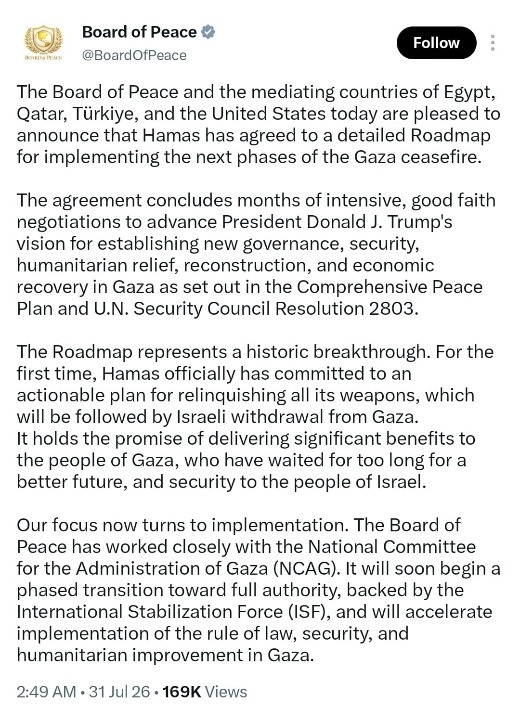
Screenshot of a tweet from @BoardOfPeace announcing a roadmap agreement with Hamas on disarmament and Israeli withdrawal from GazaThe Board of Peace announcement is bold. Very bold. It says Hamas has agreed to a detailed roadmap for the next phase of the Gaza ceasefire after months of negotiations led by Egypt, Qatar, Türkiye, and the United States. It says Hamas has committed to a plan for giving up all its weapons and that Israeli withdrawal from Gaza will follow. It also says the agreement could bring a better future to the people of Gaza and security to the people of Israel.

That is the promise. Really? Does anyone believe it will actually hold?

The plan is detailed. No one can say it lacks moving parts. It ties Hamas’s disarmament to a phased Israeli withdrawal and to the rise of a new Palestinian governing body, the National Committee for the Administration of Gaza (NCAG). It also relies on the International Stabilization Force (ISF), which was authorized under United Nations (U.N.) Security Council Resolution 2803, to help enforce the arrangement, support demilitarization, train police, and help stabilize Gaza while Israel pulls back.

On paper, this sounds orderly. Hamas gives up weapons. Israel withdraws in stages. NCAG takes over. ISF supports the transition. An international verification body confirms compliance at each step. It is all very neat. The region, unfortunately, is not.

Start with the mediators. Egypt, Qatar, Türkiye, and the United States are presented as the countries guiding this process. The problem is obvious. Three of those countries are not trusted champions of Israel’s long term security. They may be useful mediators. Fine. That is not the same thing as being reliable guarantors of peace for Israel. Not even close.

Türkiye’s President Recep Tayyip Erdogan has repeatedly taken a hostile line toward Israel. Qatar has long tolerated, enabled, or funded institutions and media ecosystems that are deeply hostile to Israel. Egypt’s public language during this war has also been sharply critical of Israel. These are not background details to be politely set aside. These are the details. They go to the heart of whether this arrangement can survive its first serious test.

That test will not come only from rockets or missiles. It may come from buses, cars, knives, suicide bombs, or loosely organized cells that operate without formal command structures. If Hamas or one of its proxies, members, supporters, or successor networks turns to those methods, who really believes Qatar, Türkiye, and Egypt will come forcefully to Israel’s defense? Who believes they will say clearly that Israel is right and the attackers are wrong? History suggests otherwise. Repeatedly.

That is one of the central weaknesses in this plan. It assumes that mediation can become moral clarity. That would be nice. It would also be new.

The second problem is governance. The roadmap says Gaza will move to NCAG, a Palestinian body meant to assume civilian administration and internal security. It also says Gaza will be governed by the principle of “One Authority, One Law, One Weapon.” That is a clean phrase. It fits nicely in a document. It is also much easier to print than to enforce.

Hamas is not just a militia. Hamas is a movement that has ruled Gaza for years through ministries, schools, mosques, charities, family networks, and neighborhood influence. A document can say Hamas will have no role in governance, directly or indirectly. Wonderful. That does not make it true. Men do not disappear because a paper says they no longer matter. Networks do not vanish because an international committee says they are dissolved.

If Hamas is removed in name, who rules in fact? That question remains unanswered. Will it be NCAG? Will it be Hamas under another label? Will it be a joint reality in which technocrats sit in offices while old power networks control neighborhoods? That is not a side issue. That is the issue.

Will this also become a backdoor, or perhaps more honestly a front door, to the larger political question of why Gaza is being handled separately from the West Bank and the Palestinian Authority (PA)? If Gaza is placed on one political track while the West Bank remains on another, what exactly is being built here, peace, or a new formula for Palestinian fragmentation? And if the Palestinian Authority is supposedly the eventual destination, why is Gaza being treated as though it can be politically reorganized in isolation from the rest of the Palestinian national question? Would this, in the end, become the front door for a renewed push for contiguous Palestinian land, stitched together from Gaza, the West Bank, and whatever else can be leveraged out of Israel under pressure? If Gaza is “stabilized” under this framework, does that then become the model and the political lever for demanding a continuous strip of Palestinian territory running from Sea to the River?

The same problem applies to disarmament. Reports on the plan describe an eight-month process in which Hamas’s tunnels are destroyed, heavy weapons are collected, and additional arms are surrendered in stages. Israeli withdrawal is linked to verification that disarmament is actually happening. That sounds disciplined. In practice, it creates endless room for dispute. Which may be the most realistic part of the plan.

Who decides what counts as real disarmament? Who decides whether enough tunnels were destroyed? Who decides whether enough rifles were surrendered? Who decides when Israel must withdraw from one area to another? Every phase creates room for argument, delay, manipulation, and bad faith. In other words, the usual ingredients.

And even if the formal process works, who believes every weapon will be surrendered? Heavy weapons may be handed over. Tunnels may be destroyed. But small arms are much easier to hide, move, and reuse. A movement that has spent years preparing for war will not be undone simply because it stores a visible portion of its arsenal. That would be convenient. It would also be naive.

Then there is the question of the International Stabilization Force. Resolution 2803 authorized it, and official texts say it will help secure Gaza, support demilitarization, protect civilians, train police, and enable the transition. But even this should be read with caution. International forces can monitor. They can train. They can report. They can buffer. They are rarely able to transform a deeply radicalized political culture. They do many things. Miracles are usually not on the list.

That brings us to the most serious issue of all. Gaza’s problem is not only weapons. Gaza’s problem is the worldview that formed around those weapons. For nearly two decades, children and young adults in Gaza have been raised under Hamas rule, Hamas institutions, and Hamas narratives. A whole generation has been shaped in an environment where hatred of Israel was normalized, violence was glorified, and martyrdom was praised. That does not disappear because someone signed a roadmap.

That is why disarmament alone does not equal peace. It may reduce firepower. It does not remove indoctrination.

The official language speaks of “deradicalization,” tolerance, and peaceful coexistence. Fine. But where are the concrete demands? Where is the binding requirement to change textbooks? Where is the enforcement mechanism for mosque sermons? Where is the plan to remove anti Jewish and anti Israel incitement from media, schools, and civil institutions? Without those changes, one generation hands the grievance to the next, even if the rockets are gone. So yes, the weapons matter. The curriculum matters more.

That is why one question matters so much. With so many countries represented on the Board of Peace, how many do we truly believe will insist on curriculum changes in Gaza that clearly recognise the right to exist for Jews, Christians and other non Muslims, and explicitly affirm the right of the State of Israel to live within secure borders? Will the United Nations?

That question should not be brushed aside. It goes to the core of whether this is a peace plan or a pause.

The United Nations plays a major role in the structure around this agreement. Resolution 2803 endorsed the broader framework and authorized the International Stabilization Force. U.N. channels are part of the aid and reporting architecture. Yet the United Nations has long had a record of treating Israel not as a normal state with legitimate security concerns, but as a permanent defendant before the court of world opinion. That record does not inspire confidence that the U.N. will suddenly become a firm defender of Israel if this arrangement starts to break down. One can always hope. One can also read the record.

Nor should anyone ignore the issue of money. The plan assumes reconstruction, recovery, and a functioning postwar administration. But plans like this live or die on sustained funding, competent administration, and political will. If reconstruction stalls, if services fail, if jobs do not appear, then anger and instability will return quickly. In that setting, the old networks, the old slogans, and the old methods of violence will remain close at hand. Because of course they will.

None of this means the effort should be mocked. It should not. Serious diplomacy deserves serious respect. President Trump and his partners deserve praise for trying to reach an agreement that others never reached. If Hamas truly disarms, if Gaza truly changes, and if Israel truly gains lasting security, the achievement will be historic. That is all true. It is simply not the same as saying it is likely.

Words on paper are not peace. Phased withdrawal is not peace. An international force is not peace. A renamed governing body is not peace. Peace requires something much harder. It requires real enforcement, real political honesty, real educational reform, and real acceptance that Israel is not a temporary fact but a permanent state. That is the part that always sounds so simple in conferences and so impossible on the ground.

That is why the hard questions remain. Who will truly rule Gaza once Hamas is supposedly gone? What happens when violence returns in forms that are easier to deny and harder to trace? Which countries on the Board of Peace will stand with Israel when the first serious post agreement attack takes place? How many will insist that Gaza’s next generation be taught coexistence instead of hatred? Will the United Nations?

These are all questions that must be answered. However, these questions increasingly appear rhetorical in nature.

Eli M. Gold is the President of the Gold Institute for International Strategy, a Washington, DC-based think-and-do tank focusing on foreign policy and defense matters. To learn more about the Gold Institute, visit www.Goldiis.org.

How One Congressional Resolution Could Save the Midterms: The GOP’s Hindu Vote Gamble

The United States Capitol Building in Washington, D.C., where H. Res. 69 awaits co-sponsors

(This article was written by Adelle Nazarian and appeared in The Western Journal. How One Congressional Resolution Could Save the Midterms: The GOP’s Hindu Vote Gamble)

The political landscape in America’s crucial suburban swing districts is undergoing a quiet but massive realignment.

For years, the Republican Party has made deliberate, strategic inroads with Indian American voters, a highly educated, affluent, and rapidly growing demographic whose core values of family, fiscal conservatism, and entrepreneurship naturally align with the GOP platform.

Yet, as the mid-term elections approach, this hard-earned momentum is hitting a dangerous roadblock.

There is an alarming wave of nativist, “Groyper” Christian extremist attacks targeting American Hindus. And if GOP leadership fails to denounce this specific brand of bigotry forcefully, they risk throwing away a historic opportunity to secure a vital voting bloc and to finally dismiss the narrative that suggests the Republican Party is racist.

The key to turning this around lies on the floor of Congress: co-sponsoring H. Res. 69, “Celebrating Hindu Americans, condemning attacks on Hindu places of worship, Hinduphobia, and anti-Hindu bigotry, and for other purposes,” a bipartisan resolution introduced to celebrate American Hindu contributions and explicitly condemn Hinduphobia officially.

When far-right agitators target American Hindus, they create an unstable vacuum, and the greatest beneficiaries are, ironically, radical Islamists and their extreme-left allies.

Historically and globally, Hindus and Indians remain the primary victims of Islamist aggression. Yet, when anti-Hindu incidents flare up across Texas and other parts of the country, Islamists expertly weaponize these moments. They use far-right bigotry as a shield to deflect public attention away from their own expansionist agendas.

Simultaneously, pro-Maoist, extreme-left factions exploit these attacks to pull Indian Americans into a superficial, highly manipulative “people of color” solidarity narrative.

In this carefully constructed leftist framework, the specific trauma and distinct identity of the American Hindu community are completely erased, rendering them subservient to the broader Islamist political agenda.

Look no further than the recent elections in Frisco, Texas, to see how this toxic dynamic plays out on the ground.

Frisco, a fast-growing Dallas suburb where nearly 20 percent of the population is of Indian origin, became a dark flashpoint for the party’s internal identity crisis. Far-right activists and outside agitators routinely descended on the town and even tore an Indian flag in a demonstration.

In the mayoral race, a candidate aligned with this extreme rhetoric openly vilified the immigrant population. The result was a decisive, self-inflicted defeat for the nativist camp. Suburban voters, including conservative-leaning Indian Americans who moved to Texas for safer neighborhoods and better schools, rejected the vitriol.

Frisco proved that anti-Hindu and anti-Indian bigotry is a losing political strategy in modern American suburbs.

The shifting allegiance of Indian American voters is backed by hard numbers. Polling data shows that Indian affiliation with the Democratic Party dropped by close to 10 percentage points between 2020 and 2024, with one in three Indians actively planning to vote Republican.

This shift is critical because Indian Americans are strategically concentrated in highly competitive, “purple” congressional districts where a few thousand votes decide the majority. In Texas districts like TX-22 and TX-24, the suburbs around Houston and Dallas-Fort Worth boast some of the highest concentrations of South Asian voters in the country, capable of tilting close suburban seats.

In Georgia’s GA-06 and GA-07, the Atlanta suburbs feature rapidly growing Hindu American populations that have already proven to be the deciding margins in statewide and federal races. Meanwhile, in Virginia’s VA-07 and VA-10, the tech-heavy corridors of Northern Virginia are filled with high-skilled Indian American professionals who vote at incredibly high rates.

If the GOP allows anti-Hindu and anti-Indian rhetoric to go unchecked, these voters will stay home or swing back left out of basic self-preservation.

By targeting American Hindus, who overwhelmingly enter the United States as highly skilled, law-abiding legal immigrants, the far-right unwittingly validates the extreme left’s entire worldview.

The hard left relies on a rigid “oppressor versus oppressed” dynamic. When highly successful, integrated American Hindus are subjected to xenophobic abuse, the left is handed an easy opening to legitimize and weaponize their narrative. They can smugly point to these attacks and argue that America is fundamentally and systematically unsafe for anyone who isn’t white.

By failing to aggressively police its own fringes, the GOP forces a highly conservative, naturally independent demographic right into the waiting arms of the progressive coalition.

Ultimately, passing H. Res. 69 isn’t just a matter of moral clarity. It is a political necessity.

By aggressively co-sponsoring the resolution, the GOP can signal to millions of American Hindus that their faith, their safety, and their contributions are valued. It cuts the legs out from under the left’s racial narratives, exposes the opportunism of Islamist organizations, and protects the precise suburban margins the GOP needs to secure the midterms.

Adelle Nazarian is a Senior Fellow at the Gold Institute for International Strategy, a Washington D.C.-based foreign policy and defense think tank.