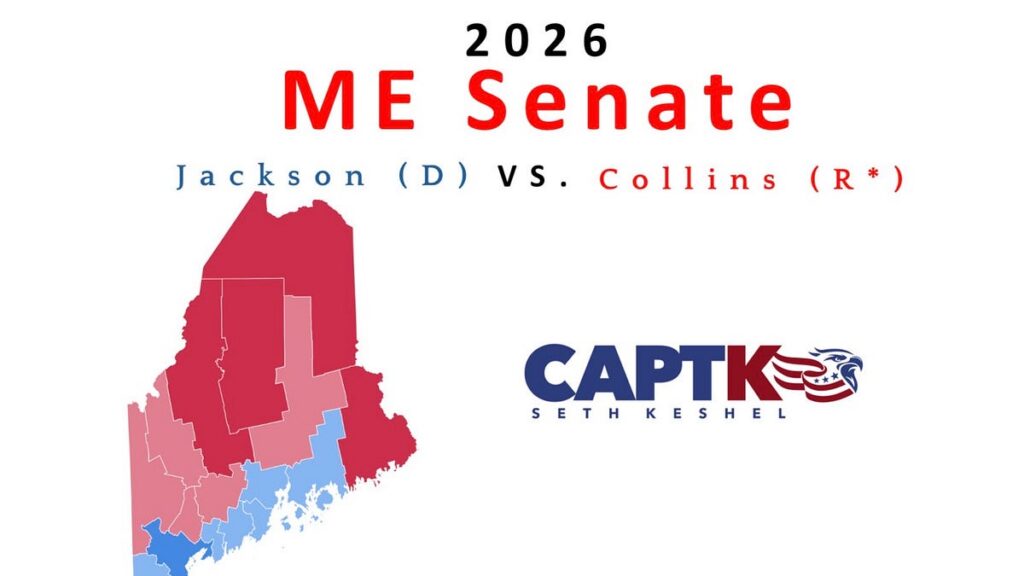
Susan Collins (R-inc.) vs. Troy Jackson (D)
I. The Race
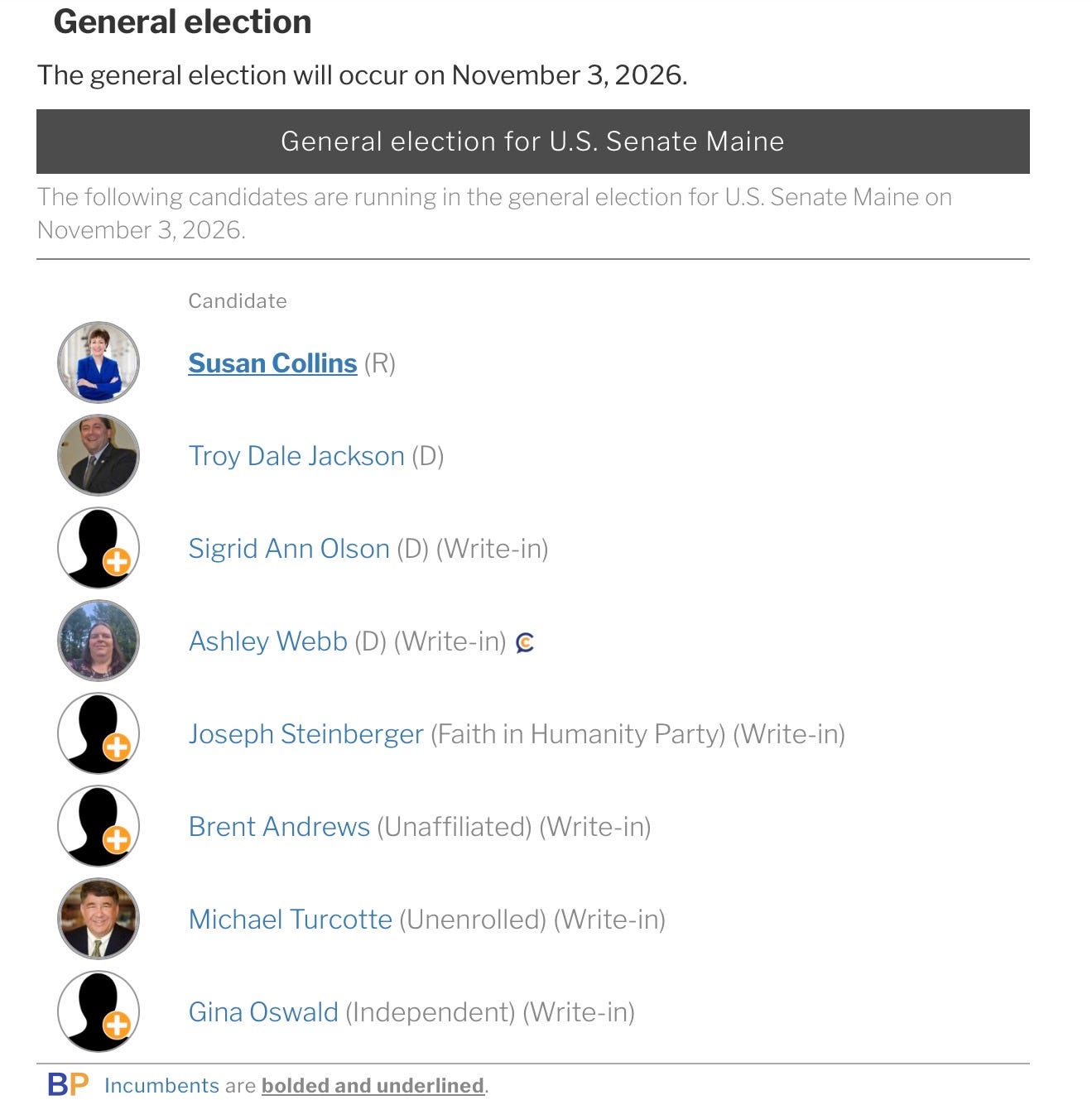
Susan Collins (Republican) is seeking her sixth term in the U.S. Senate, and is the only Republican in all of Congress from any of the six New England states. She last won reelection in 2020 by 8.6% in a COVID-marred election.
Troy Jackson (Democrat), a former state Senator, began 2026 running for the Democrat gubernatorial nomination. He lost the race, but received the Senate nomination after the Democrats torpedoed the scandal-ridden Graham Platner, whom I have written about often this year.
II. State Profile
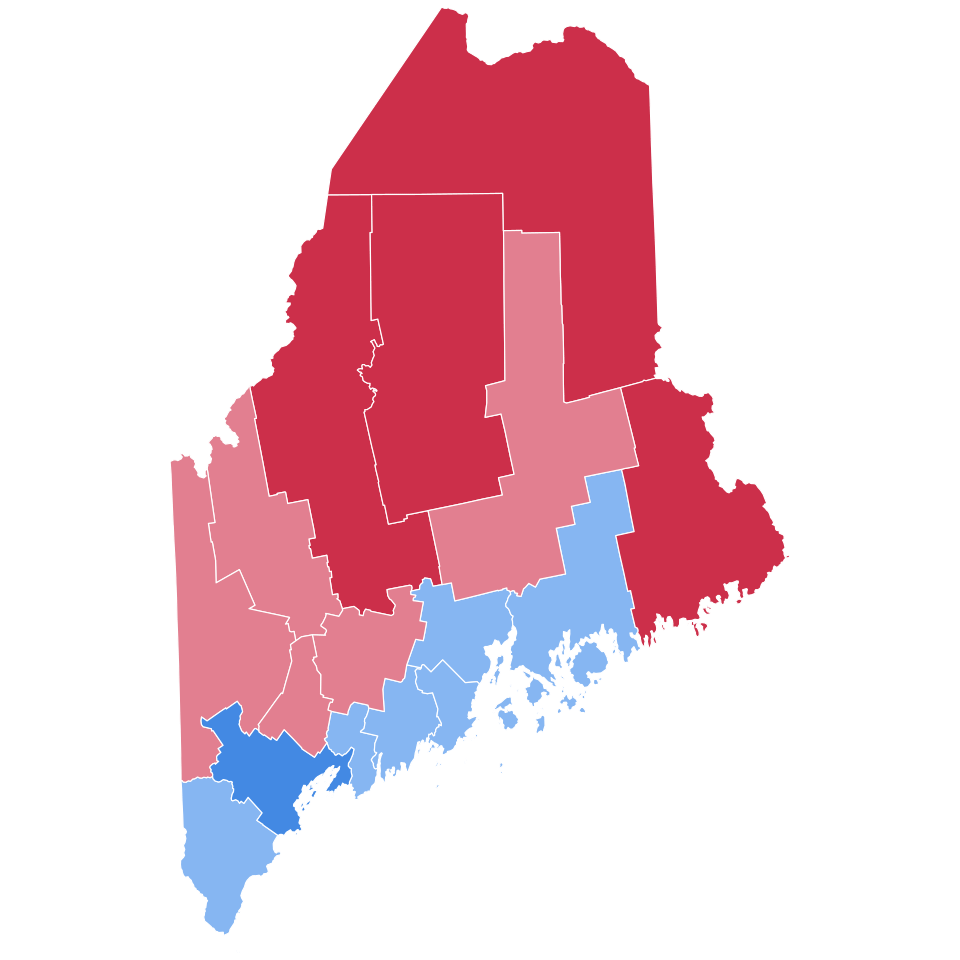
Maine was once an impenetrable Republican fortress when it came to presidential preference. The state backed all but three GOP presidential nominees between 1860 and 1988 before flipping into perma-blue status in 1992. It is one of two states (the other being Nebraska) that splits its electoral votes; Donald Trump carried ME-2 (northern Maine) all three times he ran for president, but struggled to compete in ME-1 (southern Maine). Troy Jackson’s brand is “working man from northern Maine,” and it is clear he is looking to peel away as much GOP identity as possible there to ride the partisanship in the southern and coastal portions of the state that Collins has managed to flout.
The state is lily-white, but remains loyal to Democrats because the southern portion of the state votes harder for Democrats than the northern portion votes for Republicans like Trump:
2016 ME-1 Clinton +14.8%; ME-2 Trump +10.3%
2020 ME-1 Biden +23.1%; ME-2 Trump +7.4%
2024 ME-1 Harris +21.6%; ME-2 Trump +9.1%
From my 2024 Leaner Deep Dive of Maine:
Democrat strength is clustered in the far southern end of the state, with Cumberland (23.7%) and York Counties (15.8%) combining for nearly 40% of the statewide ballot count in the 2020 presidential race. The northern part of the state, which falls into ME-2, is much more favorable for Republicans with a working-class agenda but splits its votes (Democrat congressman) and cannot regularly overtake the massive Democrat margin of Cumberland County (metro Portland), which dwarfs the next largest margin for either party by nearly 10%.
Demographic Statistics
94.4% White, 1.5% Hispanic, 1.2% Black
III. Market Assessment
Poll-believing apes are throwing money around for Democrats, but Collins is trading a lot higher than she was earlier this summer as people start to research her past races.
IV. History
The forecast for this race hinges on Collins’ specific history in winning this seat on five different occasions. There is no national comparison, no bellwether, and no proxy state to measure – she is the only member of Congress from the Republican Party representing any New England state, and that is for good reason.
For those of you who hate polling as much as I do, 2020 Maine Senate is a textbook museum display piece:
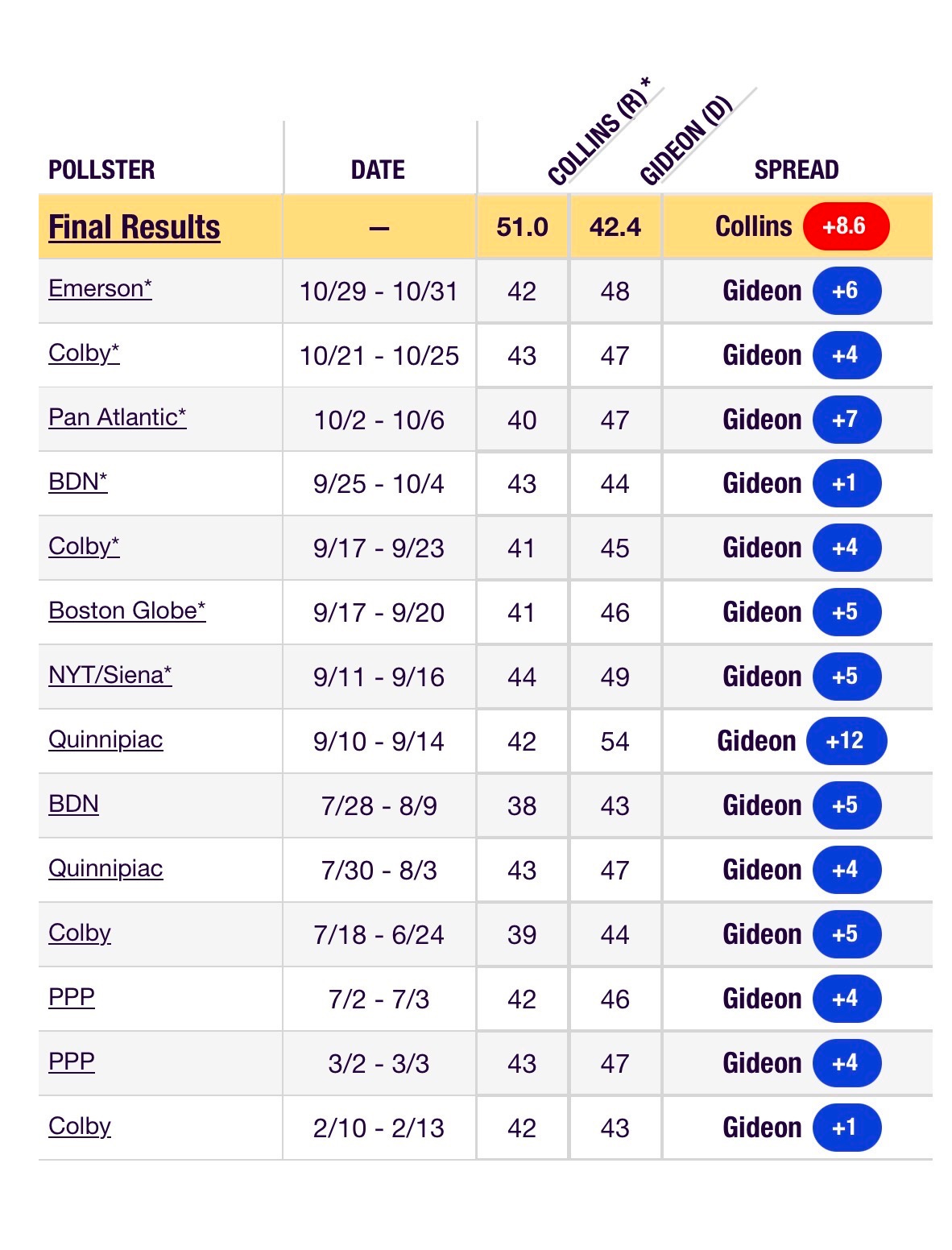
Not one damn poll had Collins leading. She wound up winning by nearly 9 points, roughly 18 points ahead of Donald Trump on the same ticket. She torpedoed a highly-regarded Democrat up-and-comer; in 2014, she laid the lumber to Shenna Bellows, the crooked Democrat Secretary of State who tried, but failed, to keep Trump off the state’s ballot in 2024. The beating was merciless, with a +37% margin and win of every county for Collins, who was defending in an apocalyptic year for Democrats.
In 2020, with a presidential electorate and modern polarization serving as a test, Collins lost ME-1 by 5 points, but won ME-2 by 24 points, 18 and 17 points ahead of Trump, respectively. Her model has proven simple – limit the damage in ME-1, and blow out ME-2. Jackson is trying to count on polarization in ME-1 and shaving margin in ME-2, but he has a major problem from the not-so-distant past looming over his shoulder.
V. Analysis of 2026 Primary Results
This is where the water gets really choppy. Collins ran unopposed, with enough Republican Mainers having the sense to accept her squishy nature, which I recommended last August.
The Democrats essentially experienced Götterdämmerung after having allowed Graham Platner to make it all the way through the official primary as the nominee. Once it became clear the image-conscious moderate weaklings in southern Maine wouldn’t vote for a literal Nazi who recounts his deployment bowel movements and fantasizes about political violence, they moved onto sexual assault stories and ran him off faster than you can say Joshua Lawrence Chamberlain.
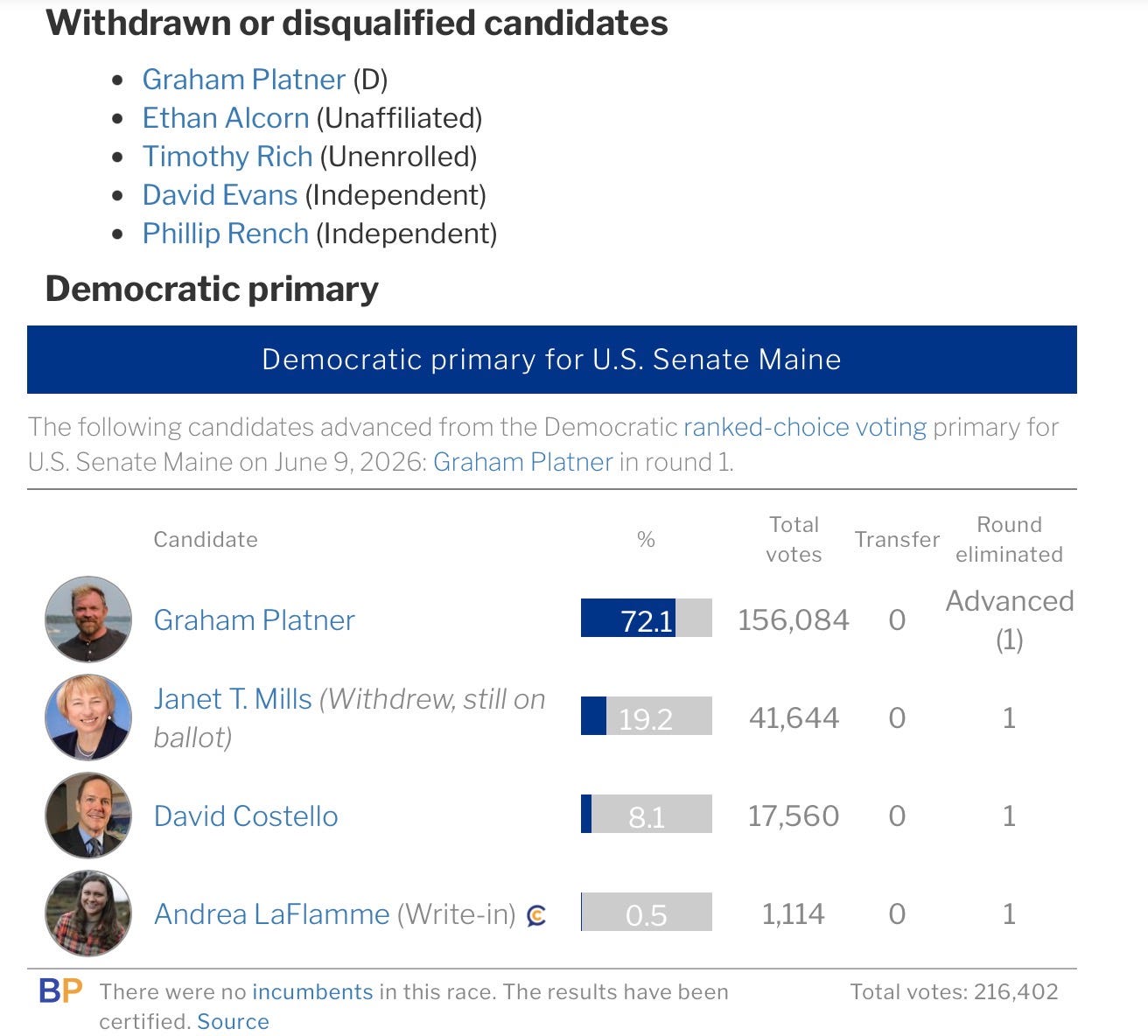
Platner, despite his controversial nature, topped sitting Governor Janet Mills and took 156,084 primary votes. He tried to hang on once the media drumbeat started and the Democrats began to shoo him away, but the threats for more and more dirt to be released persisted. Platner left the race in July. It is a near certainly that a large percentage of his base supporters won’t vote for Jackson, who has eased into his role as nominee and cozied up to the elites he has spent his entire career raging against.
The Platner exile is one of the most impactful events of the 2026 midterm cycle, and one very few are talking about anymore. The Democrats’ presumptive path to a Senate majority arguably runs through Maine. If Collins holds it, the math gets extremely fuzzy for the left.
VI. Polls
RCP Average: Jackson +0.1%
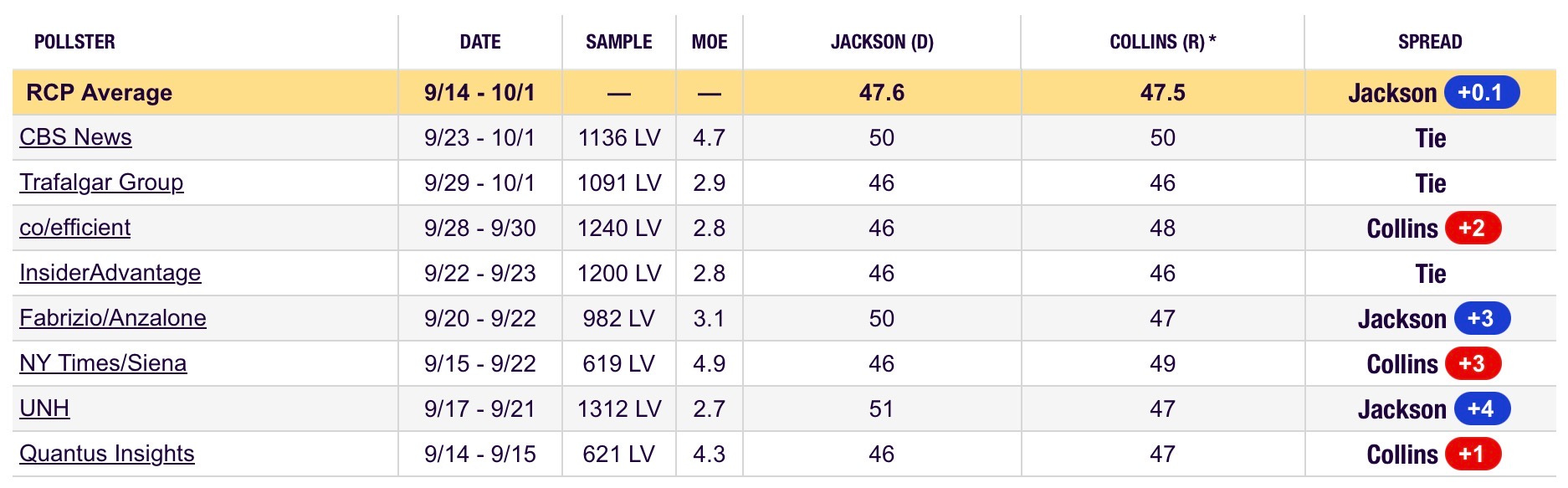
Collins has led/tied in 6 of the last 8 polls released, including a +3 from NYT/Siena last week and a +2 from co/efficient this week. Tossing the two Jackson outliers, Collins has a small but clear polling lead. This is important given how significantly she outperformed her 2020 numbers. Bottom line, this is not where Democrats want to see Jackson heading down the home stretch, when Republican candidates usually tighten the polling up.
VII. Media Ratings
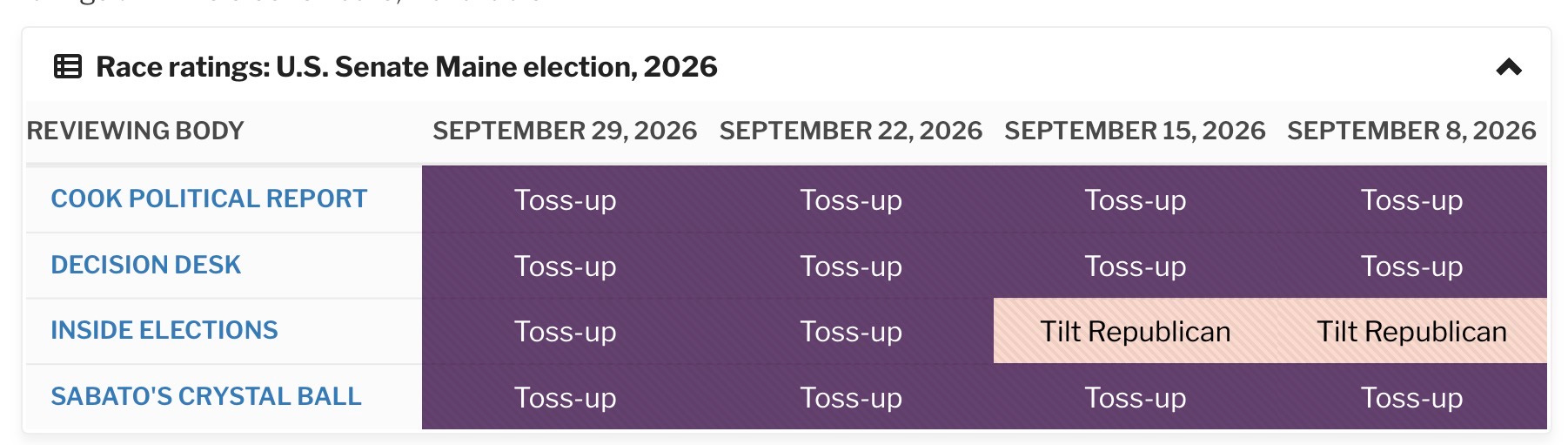
Toss-ups all around. Not enough guts to pick against Collins, but not enough conviction to research her consistent electoral over-performances.
VIII. Party Registration
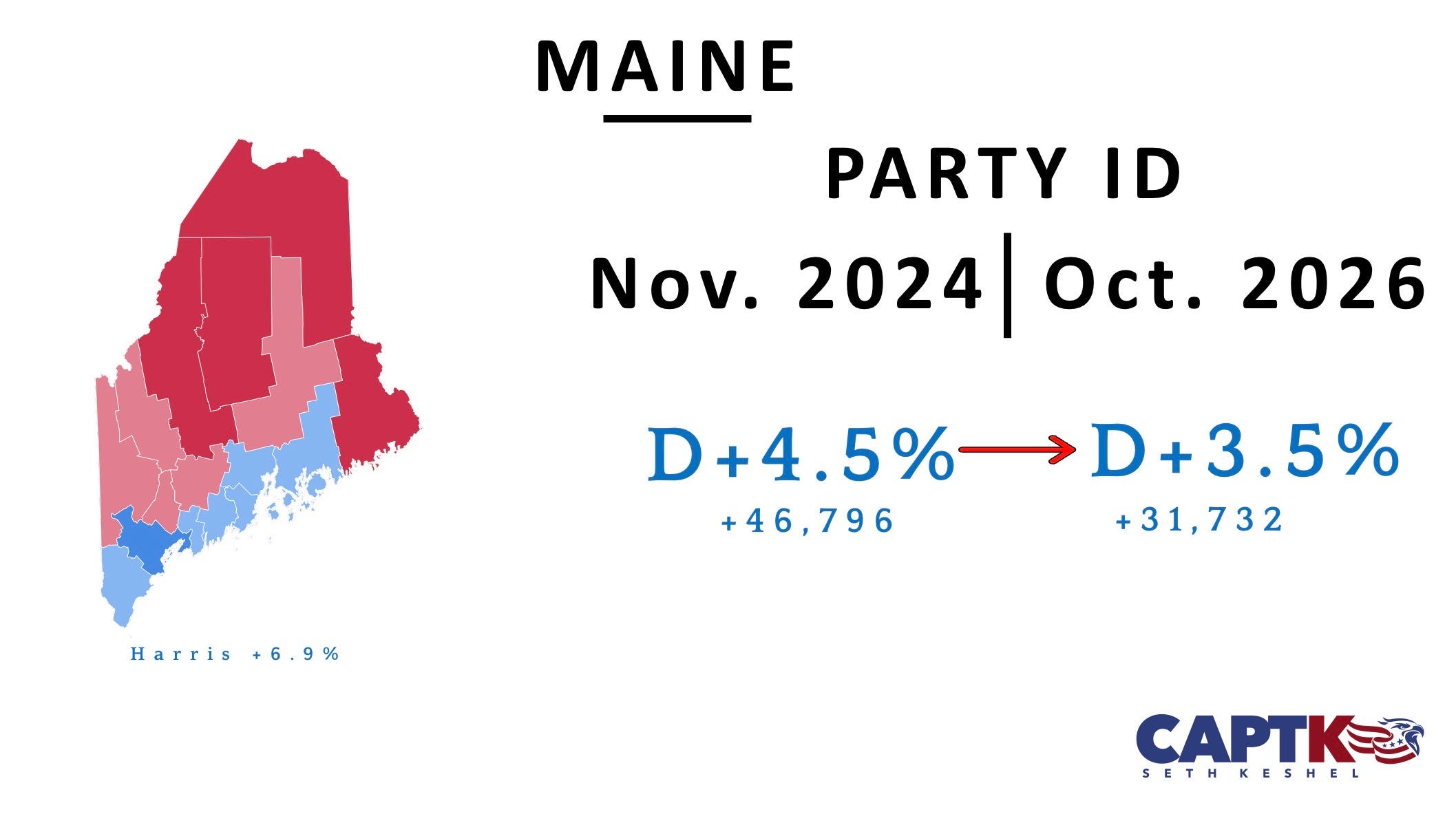
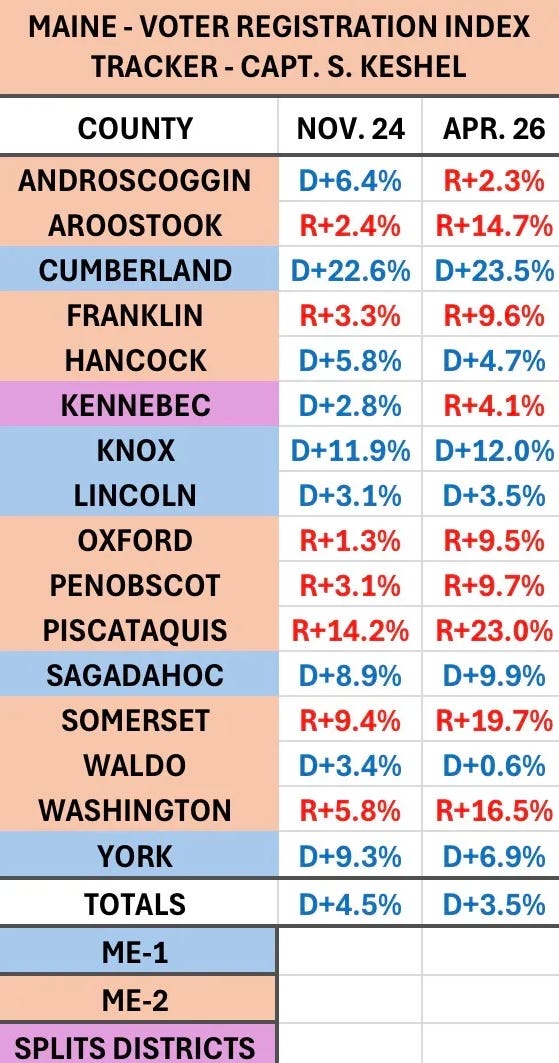
These figures haven’t been updated by the Secretary of State since spring, but they certainly don’t help Jackson’s case. ME-2 continues to align with Republicans, while southern Maine remains mostly put with Democrats (York County shifting right is a huge deal for Collins, however). Her performance against party registration data is a key component of this assessment.
IX. Election Considerations
Advantage: Jackson.
Maine runs, by far, the worst elections in all of New England.
You name it, Maine has it. Too much mail-in voting, a blind eye to ballot harvesting, Automatic Voter Registration, and the dreadful Ranked Choice Voting, which is constantly gamed and exploited to produce the most troublesome outcomes. If this race winds up in a dead heat, a slow drip of mail-in ballots combined with Ranked Choice Voting tilts the scales heavily in favor of Jackson. Collins need to get her majority in the First Choice round.
X. Summary and Election Estimate
These are the major factors for the U.S. Senate race in Maine:
Collins has a history of vastly outperforming polling and presidential baselines that simply cannot be ignored. Perhaps full polarization will finally set in and her luck will run out this year, but betting against her requires tuning out her past performances. I wrote this in my “But the Polls” piece from June:
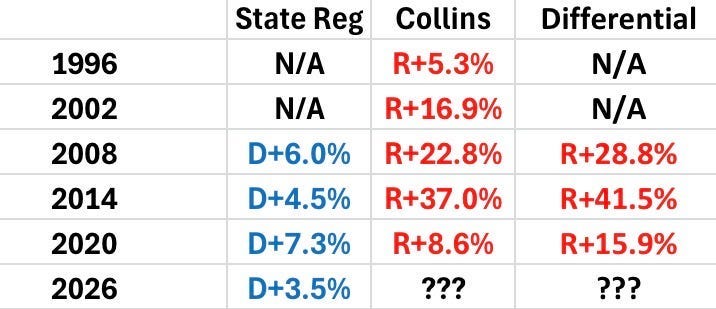
Maine ran 2.8% left by registration from 2014 to 2020, but Collins still ran 15.9% right of the voter registration index. Now, voter registration is 3.8% right of the 2020 election. If we throw out the ridiculous 2014 Collins +37.0% margin (Democrat president’s midterm), then Collins has run an average of 22.4% right of voter registration in two separate runs.
She only needs to run 3.6% right of the present voter registration index to beat Graham Platner, or whoever the hell the Democrat machine attempts to parachute in at the last minute in an attempt to mitigate Platner’s liabilities as a candidate. The polls, and by extension the gamblers, do not account for what history tells us, and history tells me that it is extremely unlikely for the incumbent senator from Maine to underperform by 19 points against voter registration from her historical benchmarks and lose to an increasingly radical candidate who will offend the intellectual elites in the exurbs of Boston.
Jackson is far behind Collins in terms of campaign finance. He wasn’t allowed to transfer any gubernatorial funds to his Senate campaign, so Collins had a head start he’s been unable to match. Republican outside spending trumps that of the Democrats by nearly double.
The only doubt for me, as an analyst, manifests when I consider this is the first midterm race in 24 years Collins has faced with a GOP president in office. The 2002 midterm cycle, thanks to the 9/11 dynamic, is one of just three cycles favoring the president’s party in the U.S. House since 1934, and it propped up Collins by a margin of +16.9%.
Jackson may dent Collins’ margins from 2024 in ME-2, and polarization may hurt her in ME-1; however, the Platner effect will undoubtedly favor Collins and deprive Jackson of a major chunk of raw votes he needs in order to topple an incumbent who does one thing very well – survive. If Collins finishes within 20 points in Cumberland County (ME-1), and wins Penobscot County (ME-2), she’s got the race locked up.
Here is how the key factors in this race stack up:
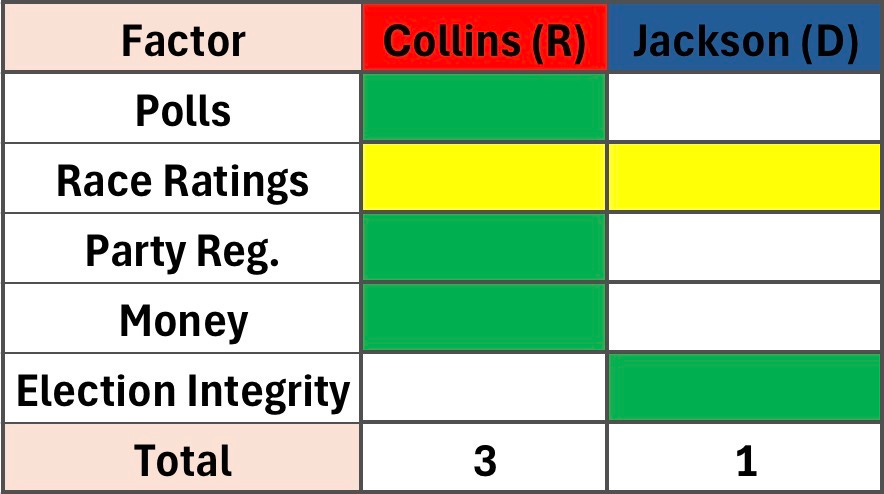
Forecast for Maine U.S. Senate
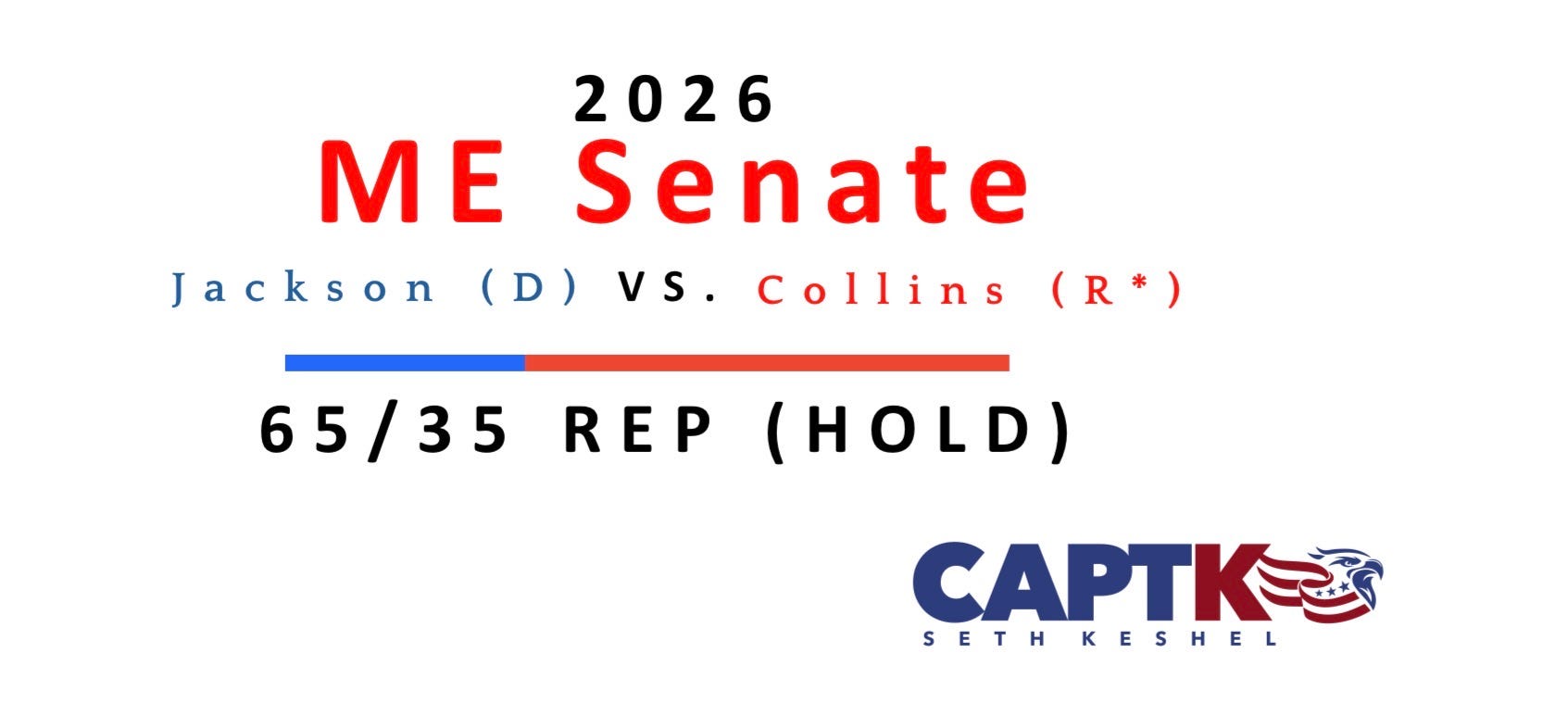
I expect Collins to win this race, probably inside of her 2020 margin and perhaps by as little as 3-4 points. Like a great artillery officer, she seems to have the range on exactly what she needs to achieve in an otherwise hostile district (ME-1) while leveraging existing support networks in areas of strength within the Trumpy ME-2 district. A Collins win in Maine this year devastates Democrat chances for a Senate majority, even if they hold Georgia and flip North Carolina. They would then be required to prevent any upsets (such as in Michigan, New Hampshire, and Minnesota) and flip two of Ohio, Alaska, Iowa, or Texas to get the math to 50/50.
Seth Keshel, MBA is a Senior Fellow at the Gold Institute for International Strategy and a retired Army Captain. He publishes Captain K’s Corner on Substack.