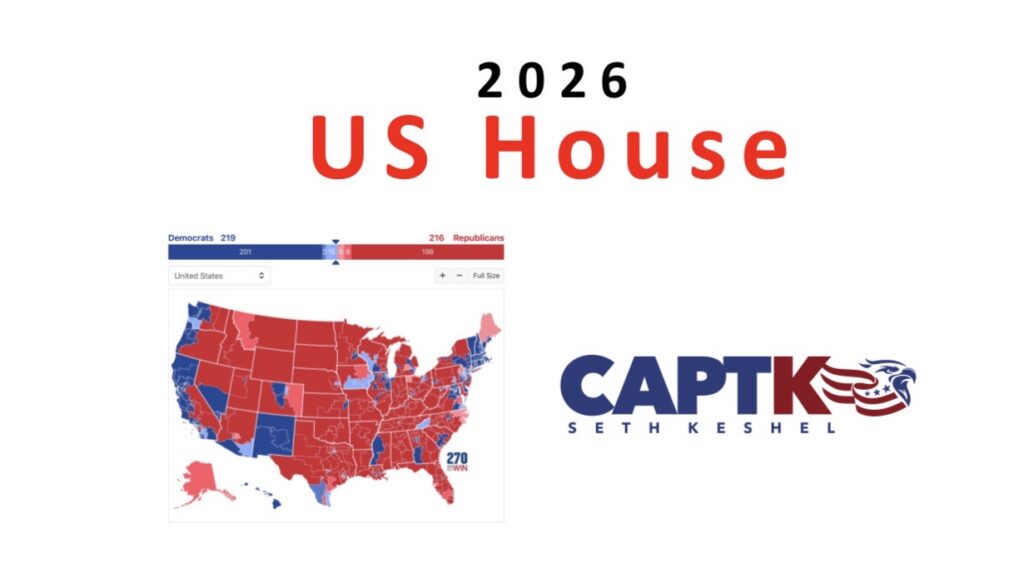
Ratings and victory scenarios explained
Midterm elections in the United States House of Representatives have been very predictable for almost a century. I have been sounding the alarm long before the right-wing doom squads on social media soured on the Trump administration. Since 1934, the president’s party has lost seats in the House in 20 of 23 midterm elections, with an average loss of 27 seats.
Roughly one in eight midterms sees the president’s party gain seats. This hasn’t happened since 2002, but this year’s midterm affords Republicans a far greater chance to hold the majority than a standard cycle because of the massive redistricting efforts undertaken by many states that have pulled about 90% of seats completely out of competitiveness. Even Ronald Reagan’s GOP lost the 1986 midterms when the President enjoyed a 63% approval rating. History tends to do what history does.
As I wrote in my estimate for the Senate:
I’m here to give you what I believe is a balanced view free of polling noise and narrative propaganda.
ENTRY POINT
The House is the more volatile chamber of Congress. Mariannette Miller-Meeks, who is fighting for her political life in IA-1, won her seat by 6 votes in 2020 – out of roughly 400,000 cast. There will be races this year that are decided by potentially hundreds (if not fewer) of votes. For this reason, my running scale of House estimates is more turbulent than my Senate estimates (which more closely resemble the presidential disposition of an entire state rather than a district voting on local issues).
The map below, where marked for a party, does not mean a seat is 100% safe and out of range for an upset. This is just a starting point for which seats I consider highly likely to align with Democrats or Republicans:
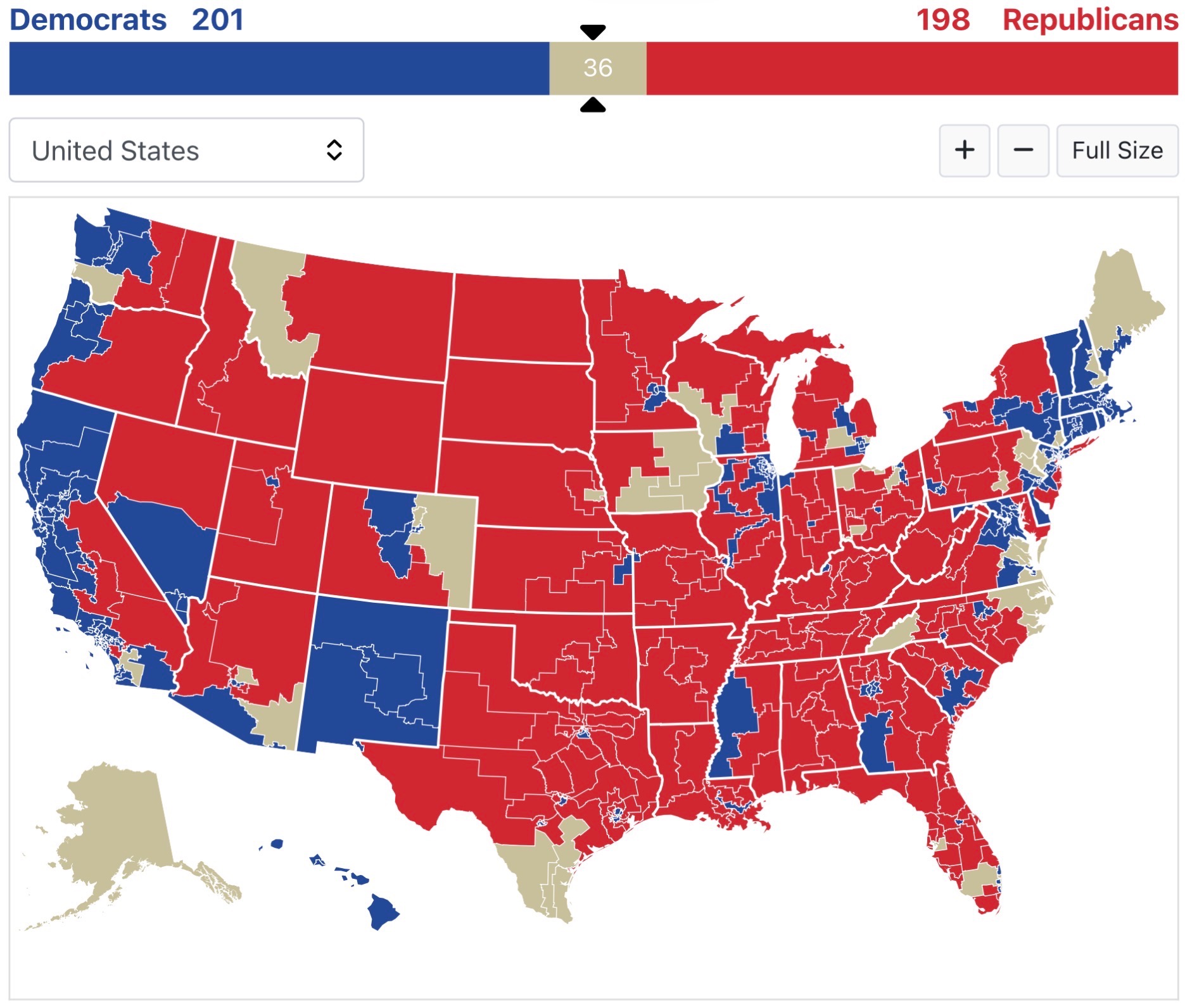
201 Democrat, 198 Republican
Remember, these solid reds and blues do not all align with a predicted margin. They simply create the initial boundaries for the overall assessment. They include some seats on the periphery of being flippable in a wave environment, such as AZ-2 (Eli Crane, Republican), MI-4 (Bill Huizenga, Republican), and KY-6 (open).
While I would not consider 201 seats the floor for Democrats, who as the out-party have the tailwind in competitive seats, I would say 198 seats is the absolute bottom of the barrel for the Republican Party. This is not my prediction, but it should help you understand that I view the insane betting market projections showing Democrats over 240 seats as implausible, if not fundamentally impossible. This is because of the strength of redistricting done by both parties. Obama took office in 2009 with 257 Democrats in the House; Trump took office in 2017 with 241 Republicans in the House. Those days are long gone, because parties are fighting for small majorities until at least the next reapportionment.
LEANERS
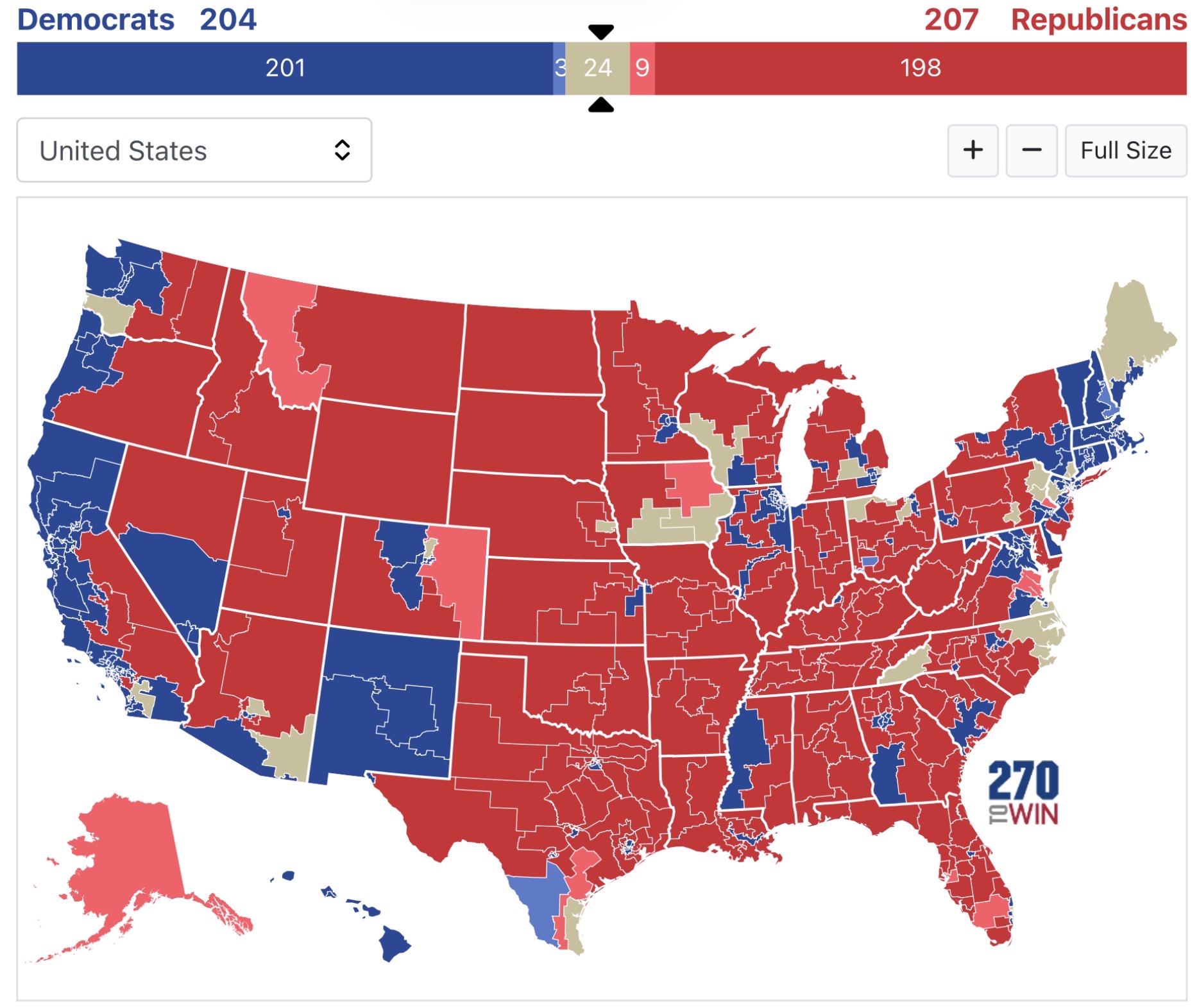
207 Republican, 204 Democrat
The second group of seats, which I limited to 12, includes those that usually fall into the category of “what about?” They could all qualify for upsets (some more likely than others, but other races took precedence for full analysis.
I also profiled Alaska-At Large (which would have been a real fight this year if Democrats didn’t use their best candidate on the Senate Race) and MT-1 separately.
These seats do carry risk, but if turnout for the GOP is strong, I like their chances to hold them.
Highest Risks for Republicans
• FL-14: against incumbent Kathy Castor, need strong Election Day turnout
• VA-1: Wittman looking to hold on in what appears to be one of the Democrats’ strongest states; a 2025 environment would take him out
• MT-1: poorly cut seat that included every progressive city in Montana; requires strong turnout to hold
In a nutshell, if Republicans are to position themselves to win a narrow majority, they need to hold all nine seats I’m favoring them in with “leaners.” If turnout in Cincinnati remains terrible, Democrats have an increased risk of losing OH-1 (Landsman, incumbent).
DECISIVE SEATS
I have arrived at Election Day with 24 seats considered decisive. This is an arbitrary designation on my part, but these seats are the seats I expect to mostly align with the ultimate winner of the race to 218 or more seats:
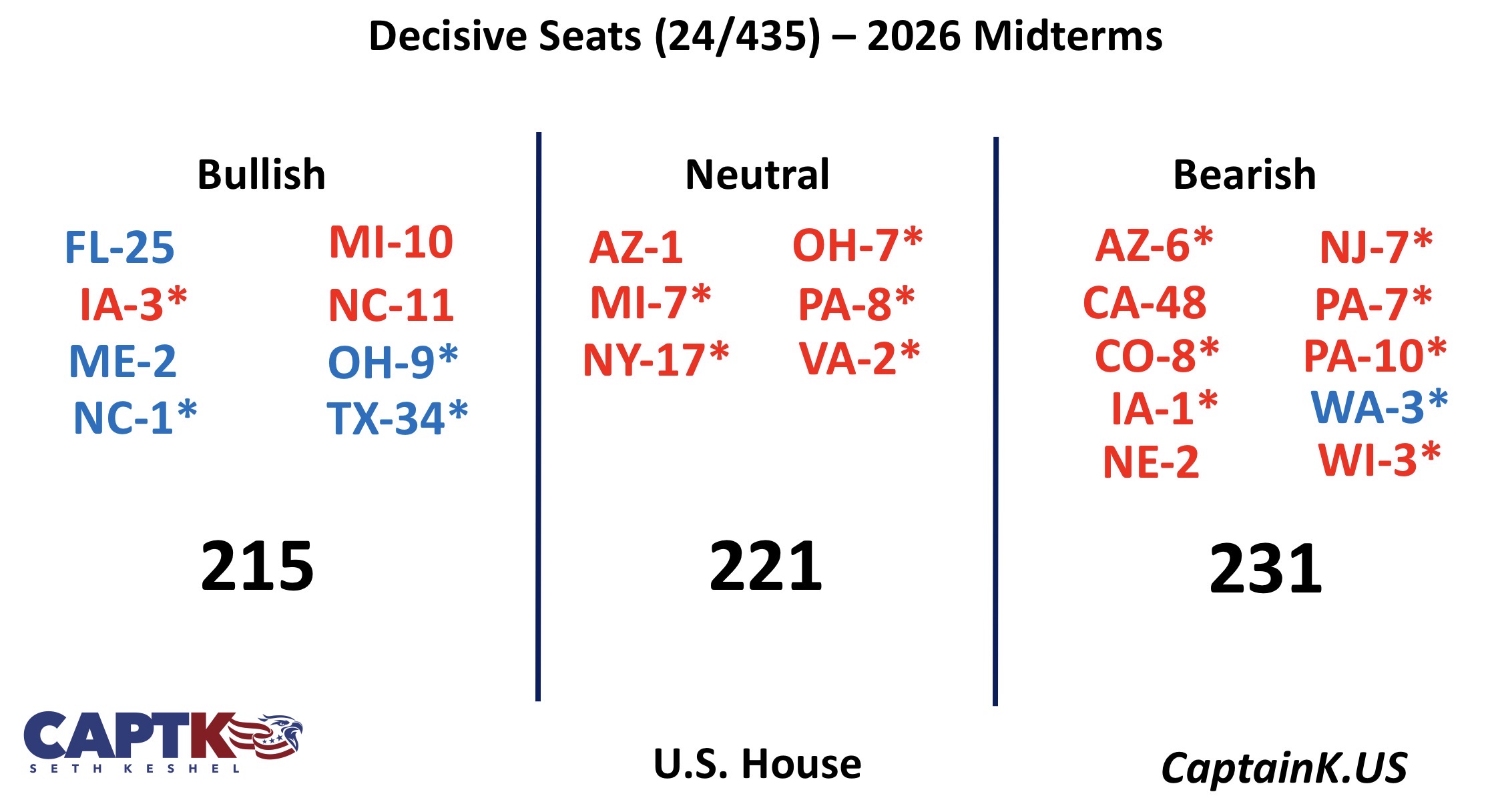
The color of the seats represents which party holds them now, not who I predict to win. The asterisks denote an incumbent running. The numbers beneath each column represent how many seats Republicans would hold if they hold all 207 seats through the leaners category I favor them in, and then win each seat in each respective column.
I have broken them down into three categories, rated from the GOP perspective:
• Bearish: Seats that fundamentally favor the Democrat, whether through historical trend, candidate quality, open seats, or because the election integrity picture isn’t conducive to GOP success
• Neutral: Seats that offer Republicans a heightened chance to win compared to those in the bearish category; candidate quality, presidential baselines, or election integrity improvements put seats in this middle category
• Bullish: These seats are fundamentally favorable to Republican candidates
BEARISH CATEGORY
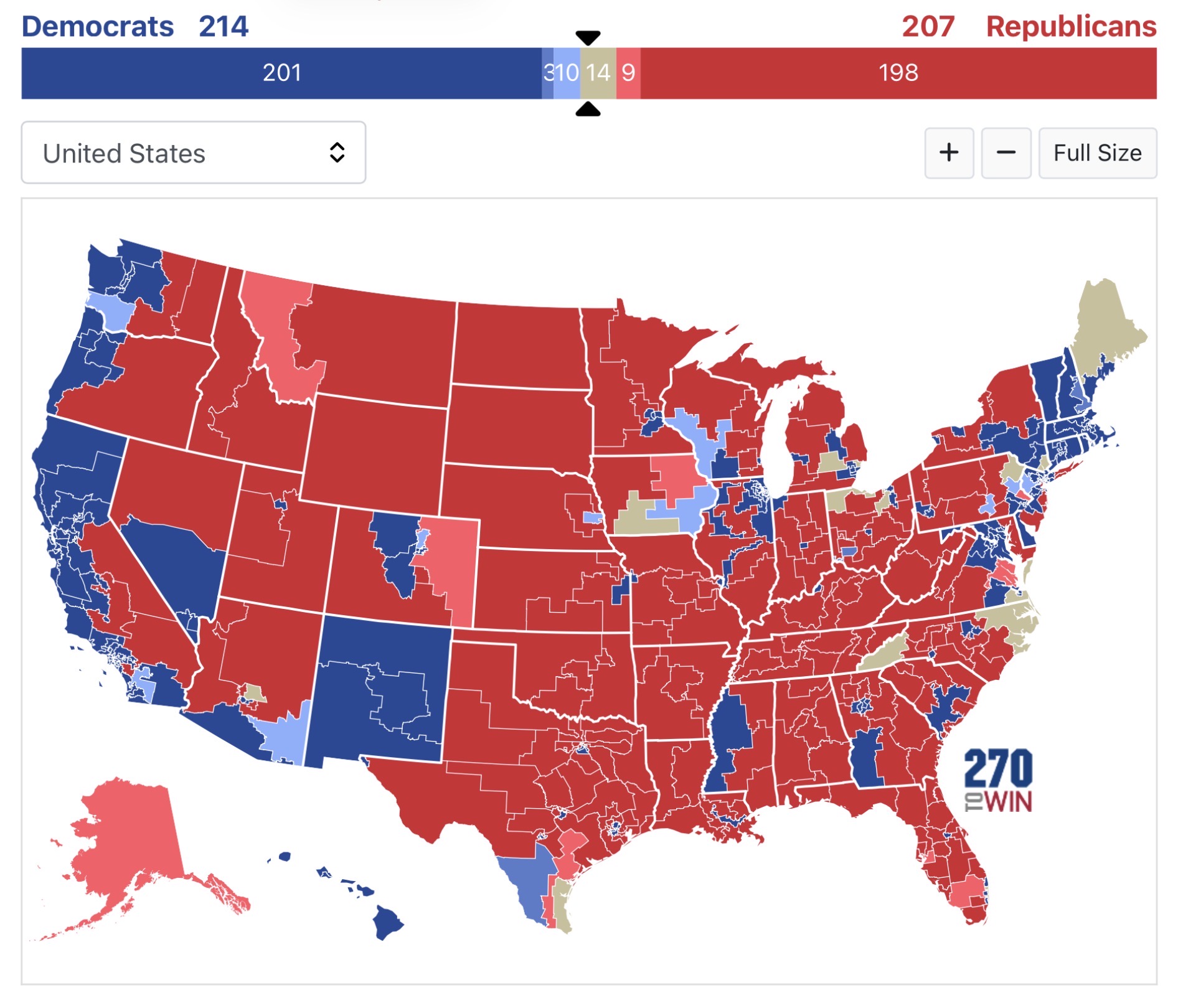
214 Democrat, 207 Republican
These seats are labeled bearish for good reason. I have leaned all 10 of these seats to favor Democrats, and by the following odds (not margins):
• AZ-6: 55/45 Democrat (Flip)
• CA-48: 70/30 Democrat (Flip)
• CO-8: 55/45 Democrat (Flip)
• IA-1: 80/20 Democrat (Flip)
• NE-2: 70/30 Democrat (Flip)
• NJ-7: 80/20 Democrat (Flip)
• PA-7: 65/35 Democrat (Flip)
• PA-10: 80/20 Democrat (Flip)
• WA-3: 70/30 Democrat (Hold)
• WI-3: 60/40 Democrat (Flip)
Please understand, in my ratings system a 55/45 race is a flip of the coin. I refuse to leave races at 50/50 to hedge like these pathetic pundits do, so I find the criteria I think will tip it, and move it in that direction.
The best candidates to hold their seats are Juan Ciscomani (AZ-6), Gabe Evans (CO-8), and Derrick Van Orden (WI-3). If Republicans can win even two of these races, they’ll be in the mix to win a narrow majority and prevent the Democrats from moving up to 214 after the bearish seats are accounted for.
NEUTRAL CATEGORY
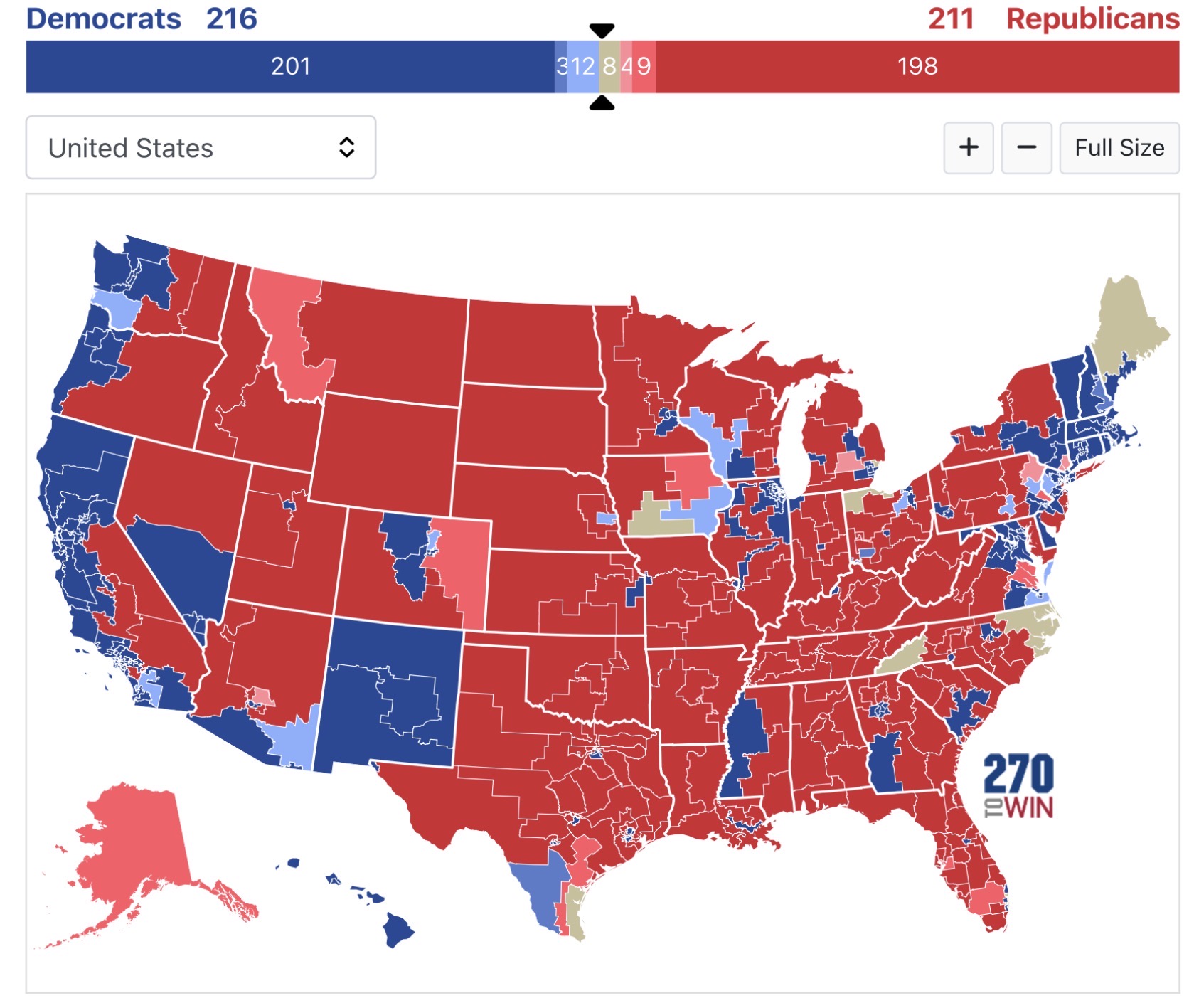
216 Democrat, 211 Republican
I have Republicans favored in four of the six neutral seats:
• AZ-1: 55/45 Republican (Hold)
• MI-7: 55/45 Republican (Hold)
• NY-17: 55/45 Republican (Hold)
• OH-7: 55/45 Democrat (Flip)
• PA-8: 55/45 Republican (Hold)
• VA-2: 65/35 Democrat (Flip)
Republicans have strong candidate quality in the four seats I favor them in. Jay Feely in AZ-1 fits the electorate, and Mike Lawler is considered one of the most talented politicians in the House (and running in a tough district). Rob Bresnahan in PA-8 has the key labor endorsements and is looking to hold a seat he unseated a tough blue-collar Democrat in as Trump carried it by more than 8 points (the most likely GOP win of Pennsylvania decisive seats). In MI-7, Tom Barrett is running in a seat that should be an automatic Democrat pick-up if not for their nomination of a DSA-aligned radical.
The most difficult pill to swallow here is the potential loss of OH-7. Max Miller has major character issues and a nasty custody battle playing out publicly he refused to get in front of. This would be an easy GOP hold if not for Miller’s serious liabilities.
It is also possible, just like last year’s Virginia Attorney General race, that partisan strength will get him over the line and save another seat on the road to a slim majority – but it won’t be by much if it happens.
BULLISH CATEGORY
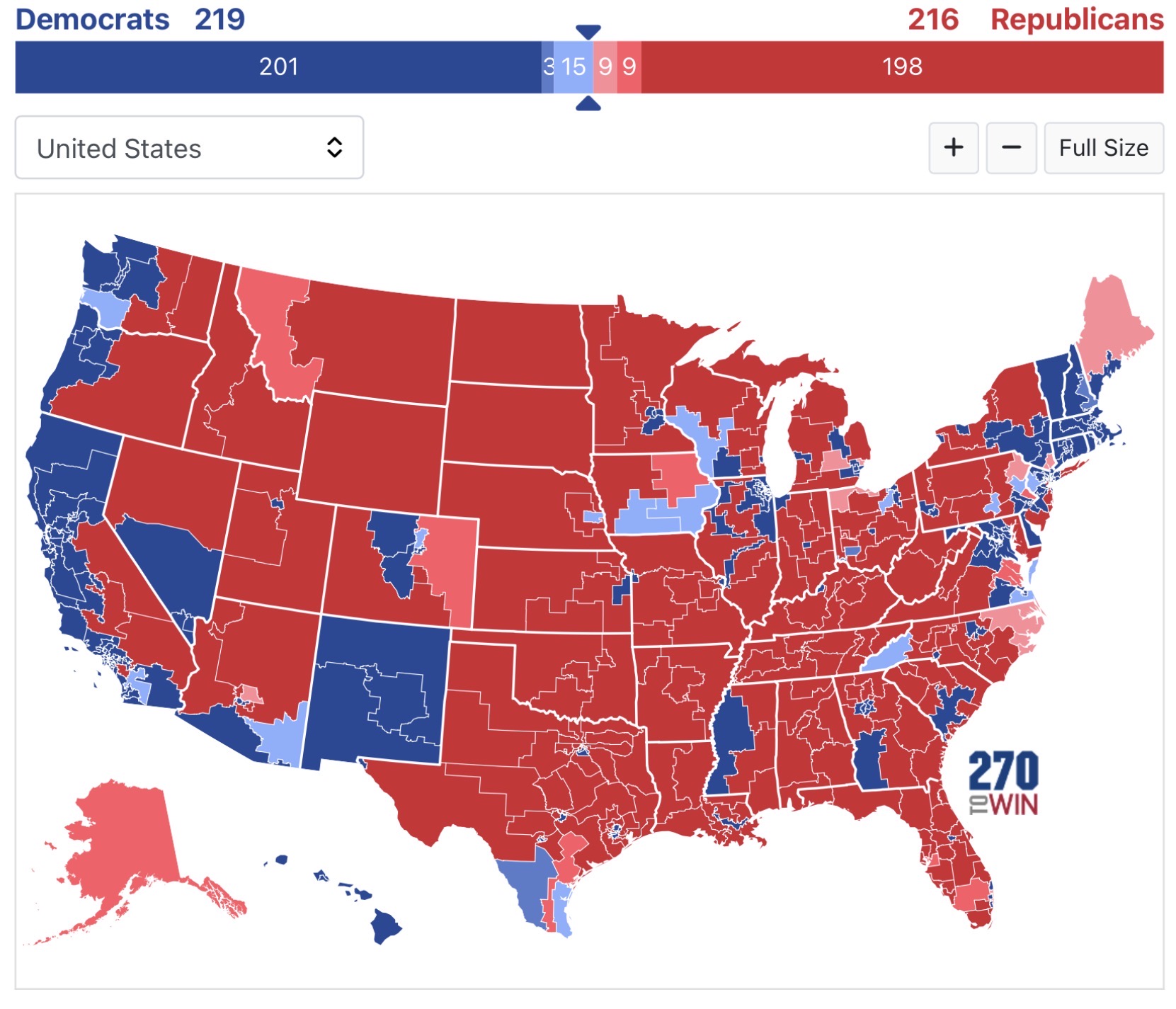
Democrats 219, Republicans 216
My final pass through the map gives the Democrats the edge in 219 House seats – enough to claim a three-seat advantage over Republicans in the chamber. While this estimate may disappoint you, it is historically a very strong performance for the president’s party if these predictions stand up. Since midterms are volatile, they are rated in such as way as to identify the party positioned strongest in each seat rather than focusing on a ridiculous generic ballot number applied with a broad brush.
This is how I’ve rated the eight bullish seats:
• FL-25: 55/45 Republican (Flip)
• IA-3: 60/40 Democrat (Flip)
• ME-2: 70/30 Republican (Flip)
• NC-1: 60/40 Republican (Flip)
• MI-10: 55/45 Republican (Flip)
• NC-11: 55/45 Democrat (Flip)
• OH-9: 60/40 Republican (Flip)
• TX-34: 55/45 Democrat (Hold)
If Republican gains with Latinos hold up, FL-25 and TX-34 will be going red this year. Trump’s presidential baselines should float the GOP candidates in ME-2, NC-1, and OH-9.
I have reversed only one assessment from my original forecasts which were individually published, and that is for NC-11, the seat Chuck Edwards’s personal problems in Washington, D.C., stands to cost Republicans. I had it tilting 55/45 (odds) Republican when I released the forecast on October 10, but North Carolina’s early voting heavily favors Democrats, and Jennifer Balkcom will need a strong Election Day to overcome a very tough “Blue Dog” Democrat with maximum name recognition.
If I am wrong on Zach Nunn’s likelihood to hold IA-3 and if NC-11 sticks with its strong Republican identity, then Republicans will have a 218 to 217 edge.
SUMMARY
The simplest reality surrounding the fundamentals of the House is that neither party has a high ceiling, nor a low floor. Even an absolute wipeout of the Republicans in the House would still position them far better than they stood after the 2008 Obama wave, and almost dead even with how things were after 2018. The red districts are safer, but so are the blue.
If my predictions hold up, these decisions will have cost the GOP its majority:
• Utah judge sleeping with opposing counsel and giving Democrats a free House seat
• Courts scuttling the “Missouri First” map, costing Republicans the new MO-5 despite it having already been voted on in a primary
• Indiana legislature failing to redistrict two seats
• Nebraska legislature refusing to make a state Trump carried by more than 20 points a 3-0 GOP sweep
• Southern states like South Carolina, Mississippi, Alabama, Louisiana, and Georgia not jumping on opportunities afforded by the Callais decision to further redistrict.
I count up to 11 seats just in that sample that could have been safe Republican seats, which would have put Republicans at 218 just after leaners were considered. Democrats would have absolutely done this, and it’s a damn shame the Republican Party lacks the same tenacity.
RANGES
Democrat best case: 229 to 206 majority
Hold all seats I’ve favored them in, win VA-1, MT-1, and FL-14, plus all seven decisive seats I’ve favored Republicans in
Republican best case: 224 to 211 majority
Hold all the GOP leaners, upset OH-1 due to poor turnout in Cincinnati, win the three bearish seats I’ve tipped toward Democrats, narrowly hold VA-2, and keep OH-7, IA-3, and NC-11 on partisan strength and turnout.
History tells us all we need to know when it comes to the House. The out-party brings serious intensity, but the seats are cut in such a way that no party has a pathway to a seriously strong majority, and Democrat candidate issues related to the emergence of the DSA give Republicans a real shot to have another one of those outlier elections.
This is my final 2026 midterms release. I hope you understand I’ve put my best efforts toward bringing you actionable information choked out by a sea of narratives, noise, and lies. Thank you all for your support of Captain K’s Corner. I will be in the formation tomorrow morning, because there is no quit in me.
I advise you all to adopt the same attitude for long-term success.
Seth Keshel, MBA is a Senior Fellow at the Gold Institute for International Strategy and a retired Army Captain. He publishes Captain K’s Corner on Substack.